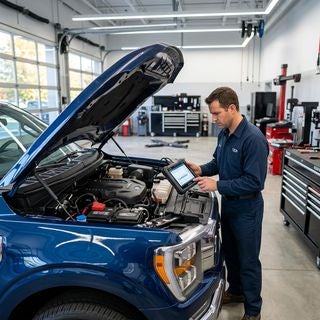
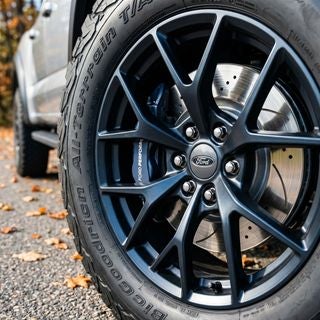
You should schedule a Ford brake inspection every 10,000 miles or at every scheduled oil change, whichever occurs first. Routine checks allow technicians to evaluate friction material thickness and hydraulic system integrity before severe wear occurs. However, you should arrange an immediate inspection if you hear continuous squealing or grinding, feel pedal softness or steering wheel shudder during deceleration, or see an active brake warning light on your dashboard. Following a consistent inspection schedule ensures that minor wear is identified before it damages surrounding components. While the 10,000-mile interval serves as a reliable baseline for general driving, real-world conditions often dictate more frequent checkups. For instance, commuting through stop-and-go traffic along State Route 170 in Calcutta places higher demand on friction materials than steady highway cruising. Heavier vehicles like the 2026 Ford F-150 equipped with a 3.5L engine also transfer substantial kinetic energy into heat during braking, which accelerates pad wear when carrying heavy cargo or towing. Specific warning signs indicate that your braking system requires attention prior to your next scheduled service interval: Continuous high-pitched squealing or harsh metal-on-metal grinding noises when applying pressure to the pedal A spongy, soft, or unusually low brake pedal that sinks closer to the floorboard than normal Steering wheel pulsation, chassis shudder, or vehicle pulling to one side while slowing down A sharp burning odor near the wheel wells following hard stops Illumination of the red brake system light or yellow anti-lock braking system light on the instrument cluster Prompt attention to these symptoms prevents minor pad wear from turning into costly rotor scoring or caliper failure. To speak directly with our factory-trained service team, give us a quick call or stop by our East Liverpool facility for an in-person diagnostic review. Table of Contents What Is Included in a Ford Multi-Point Brake Inspection? How Many Miles Do Original Ford Motorcraft Brake Pads Last? Why Does Brake Fluid Need to Be Flushed Periodically in Ford Vehicles? What Are the Costs of Ford Brake Replacement and Rotor Resurfacing? Common Questions About Ford Brake Maintenance Proactive Ford Service Keeps Every Journey Safe What Is Included in a Ford Multi-Point Brake Inspection? A Ford multi-point brake inspection includes a complete technical evaluation of brake pad lining thickness, rotor surface integrity, caliper pin sliding action, hydraulic fluid moisture levels, brake line flexible hoses, and parking brake mechanism operation. Technicians remove all four wheels to measure friction components against factory minimum tolerances and inspect internal mechanical linkages. During the evaluation, technicians perform detailed measurements and physical checks across several core assemblies: Brake Pad Lining Thickness: Technicians use precision calipers to measure remaining friction material on inner and outer pads. Any lining measuring at or below 2 mm requires immediate replacement to ensure safe stopping power and prevent metal backing plates from contacting the disc. Rotor Condition and Thickness: Rotors are checked for minimum disc thickness, lateral runout, and surface defects such as deep grooves, heat cracks, or heavy corrosion ridges along the outer lip. Caliper and Hardware Operation: Inspection covers caliper slide pins, rubber dust boots, piston seals, and anti-rattle clips to ensure even pressure application and prevent sticking. Hydraulic Lines and Fluid Quality: Flexible rubber hoses and hard steel lines are checked for cracking, chafing, fluid seepage, or rust. Brake fluid is tested for chemical moisture absorption and clarity. Parking Brake Linkage: Technicians verify cable tension, electronic actuator functionality, and parking brake shoe lining condition on rear drum-in-hat or caliper-integrated setups. Our technicians routinely show vehicle owners physical wear measurements on precision gauges during routine service walk-throughs to provide full clarity on remaining pad life. For owners balancing busy work schedules, scheduling Ford mobile service options brings certified maintenance care directly to your driveway or workplace. How Many Miles Do Original Ford Motorcraft Brake Pads Last? Original Ford Motorcraft brake pads typically last between 40,000 and 60,000 miles under standard driving conditions, though actual lifespan ranges from 30,000 to 70,000 miles based on compound selection, vehicle weight, and driving habits. Heavy cargo loads, frequent mountain braking, or urban traffic shorten pad longevity. The material formulation of Motorcraft friction linings plays a major role in operating characteristics and durability: Motorcraft Ceramic Brake Pads: Formulated primarily from dense ceramic compounds and non-ferrous filler materials, ceramic pads deliver exceptionally quiet operation, minimal brake dust accumulation on wheels, and consistent pedal feel during daily commuting. They are standard equipment on everyday family vehicles like the 2026 Ford Explorer equipped with a 2.3L engine and SelectShift® transmission. Motorcraft Semi-Metallic Brake Pads: Engineered with steel, iron, and copper fibers embedded in synthetic resin, semi-metallic pads offer superior heat transfer, higher friction coefficients under extreme thermal loads, and maximum fade resistance. These are ideal for heavy-duty hauling or towing up to 10,400 lbs in a 2026 Ford F-150 or track-focused performance in a 2026 Ford Mustang. Navigating steep riverfront bluffs and hill climbs across East Liverpool increases friction temperatures, making semi-metallic compounds particularly effective for local trucks and heavy SUVs. To keep your vehicle operating at factory standards without disturbing your calendar, utilize Ford pick-up and delivery service to have your vehicle serviced and returned directly to your home. Why Does Brake Fluid Need to Be Flushed Periodically in Ford Vehicles? Brake fluid must be flushed every three years in Ford vehicles because hydraulic fluid is hygroscopic and naturally absorbs moisture from atmospheric humidity over time. Excess water lowers the boiling point of the fluid, causing a soft brake pedal during hard stops and accelerating internal oxidation throughout calipers and ABS valves. The hydraulic braking system relies on incompressible liquid to transfer force from the brake pedal to the wheel calipers. As brake fluid ages and absorbs ambient moisture through microscopic pores in flexible rubber hoses and reservoir caps, its thermal stability degrades significantly: Vapor Lock and Thermal Fade: Heavy or prolonged braking creates extreme friction temperatures at the caliper. Water-contaminated brake fluid boils at a much lower temperature than fresh fluid, producing vapor bubbles within the sealed hydraulic lines. Because vapor compresses under pressure while liquid does not, the brake pedal sinks toward the floor, resulting in sudden pedal fade or increased stopping distances. Internal Component Corrosion: Moisture trapped inside the hydraulic system reacts with iron and aluminum components. Over time, this leads to internal pitting on caliper pistons, valve bore degradation inside the anti-lock braking system hydraulic control unit, and premature degradation of master cylinder seals. Periodic flushes completely remove contaminated fluid, flush out microscopic metallic debris, and replenish anti-corrosion additives that keep internal hydraulic seals flexible and pressure-tight. What Are the Costs of Ford Brake Replacement and Rotor Resurfacing? Replacing both front and rear Ford brake pads and rotors generally varies by vehicle class, rotor dimensions, and axle requirements. Resurfacing rotors also varies by vehicle and labor requirements, whereas replacing rotors with new factory parts depends on parts and installation needs. Contact the dealership for current pricing. Deciding whether to resurface or replace worn rotors depends on precise measurements taken during the inspection process: Maintenance Consideration Rotor Resurfacing (Lathing) Full Rotor Replacement Primary Requirement Rotor thickness must exceed discard limit Required when rotor is cracked, warped, or thin Typical Part / Labor Cost $30 to $60 per rotor (labor only) $80 to $200 per rotor (plus installation labor) Surface Finish Outcome Restores smooth parallel friction surface Returns assembly to factory original disc specs Ideal Application Minor surface scoring or light rust buildup Heavy grooving, heat checking, or severe runout Rotor resurfacing involves mounting the brake disc to a precision machine lathe that shaves away a thin layer of metal, removing surface irregularities and light heat checking. Resurfacing is only viable if the final disc thickness remains safely above the minimum thickness specification cast directly into the rotor housing. If a rotor is machined below this limit, it loses the structural mass required to dissipate heat effectively, leading to rapid warpage and thermal failure. When installing new friction components, using genuine OEM parts ensures exact mechanical fitment, factory-matched noise dampening shims, and optimal thermal performance. Vehicle owners looking to perform maintenance or replace worn components can order genuine Motorcraft brake parts directly through our service center. Common Questions About Ford Brake Maintenance Q: How long does a Ford brake inspection take at the dealership? A standard Ford multi-point brake inspection typically takes 30 to 45 minutes when performed by a factory-trained technician. If the inspection is completed alongside routine maintenance, such as an oil change or tire rotation, the total service appointment usually lasts between one and two hours. Q: Is a brake inspection included in the Ford Works service package? Yes, the Ford Works maintenance package includes a visual and dimensional brake inspection alongside a synthetic blend oil change, filter replacement, tire rotation, pressure check, battery test, and comprehensive fluid check. It provides a complete diagnostic assessment of vital safety components in a single visit. Q: What causes a steering wheel to shake when applying Ford brakes? Steering wheel vibration during braking is usually caused by uneven rotor surface wear or lateral runout, often referred to as warped rotors. High thermal stress or uneven caliper clamping pressure creates variation in rotor thickness, causing the pads to skip across the disc surface and transfer pulsations through the steering system. Q: Can I drive safely if my Ford brake wear indicator light comes on? You should schedule a service appointment as soon as possible when the brake warning light illuminates. While the light indicates that brake pad lining thickness has reached a critical threshold or fluid level is low, continuing to drive risks rotor damage, elevated stopping distances, and potential hydraulic power loss. Q: How does towing a heavy trailer impact Ford brake maintenance schedules? Towing heavy loads significantly increases thermal friction and kinetic energy transfer, causing brake pads to wear down much faster than during unladen driving. Ford recommends inspecting friction materials at every 5,000 to 7,500 miles if you routinely tow trailers or haul heavy cargo. Proactive Ford Service Keeps Every Journey Safe Keeping your braking system in peak operational condition is essential for highway safety, predictable vehicle handling, and long-term component durability. Routine inspections eliminate guesswork by tracking pad wear rates, monitoring rotor thickness, and identifying hydraulic fluid degradation before performance suffers. Our service center provides the factory tools, specialized diagnostic equipment, and genuine Motorcraft parts required to keep your Ford performing exactly as the engineers intended. Whether you need a routine multi-point check, fluid flush, or full pad and rotor replacement, our certified service team is ready to assist. To preserve your vehicle's stopping performance and enjoy complete peace of mind on the road, schedule a service appointment online today. You can also visit our East Liverpool service center or speak directly with an advisor by giving us a quick call to discuss your maintenance needs. © 2026 Tri State Ford. All rights reserved. Vehicle specification data © JATO Dynamics Limited. Ford Brake Inspection in East Liverpool OH | Tri State Ford

How Does Leasing a Car Work?
A vehicle lease functions as a long-term agreement where you pay for the projected depreciation of a new vehicle over a set timeframe—typically 24 to 36 months—rather than financing its total purchase price. You pay an initial amount at signing, follow a structured monthly payment schedule, adhere to agreed-upon annual mileage caps, and return or buy the vehicle when the contract ends. Leasing provides a straightforward way to drive a new vehicle with different monthly payments than traditional buying. Because payments are based on expected vehicle depreciation rather than the full purchase value, drivers enjoy reduced monthly costs along with coverage under the 3-year/36,000-mile bumper-to-bumper warranty and 5-year/60,000-mile powertrain warranty. When you enter a lease contract, you agree on key parameters upfront: The contract length (most commonly 24, 36, or 39 months) The annual mileage allowance (typically 10,000, 12,000, or 15,000 miles per year) The scheduled monthly payment information and due date End-of-term options, including returning the vehicle, starting a new lease, or purchasing the car outright Driving along the riverfront bluffs and hilly terrain of East Liverpool means having a durable, modern vehicle matters for daily commuting. Leasing allows drivers to transition into an updated vehicle every few years without worrying about long-term mechanical wear or resale depreciation. To explore current lease terms or tour our showroom at 1503 Pennsylvania Ave, East Liverpool, OH 43920, drop by our dealership location or call our finance team at (330) 462-7578. Table of Contents What Is the Main Difference Between Leasing and Buying a Vehicle? Who Benefits Most From Leasing a Ford Model? How Are Lease Payments Calculated: Capitalized Cost, Residual Value, and Money Factor Should You Make a Down Payment and What Credit Score Is Needed to Lease? How Do Mileage Limits, Lease Swaps, and End-of-Lease Buyouts Work? Common Questions About Leasing a Ford Vehicle Exploring Your Ford Leasing Options at Tri State Ford What Is the Main Difference Between Leasing and Buying a Vehicle? The main distinction between leasing and buying comes down to financial equity and vehicle ownership structure. Buying finances the full purchase price of a vehicle until you pay off the loan and own the title, whereas leasing finances only the vehicle's estimated value loss during the time you drive it. When choosing between these purchase paths, several core operational factors stand out: Monthly Payment Structure: Leasing generally yields monthly payments compared to financing the total price of a new vehicle because you pay only for depreciation plus a rent charge. Ownership Equity: Buying builds long-term vehicle equity as payments accrue toward total ownership. Leasing operates like a long-term vehicle setup where you return the keys at contract end without trade-in equity, unless market conditions create positive equity above the preset buyout price. Vehicle Customization: Purchased vehicles can be modified, repainted, or fitted with custom aftermarket accessories without restriction. Leased vehicles must be maintained in factory condition and returned without permanent alterations. Warranty and Maintenance: Leased models stay continuously protected under original manufacturer warranties throughout the typical 36-month lease cycle, protecting drivers from out-of-pocket costs on major mechanical repairs. Whether you prefer long-term ownership or regular updates to vehicle tech, reviewing vehicle choices helps clarify your decision. You can explore our inventory of brand-new Ford models, view current manufacturer lease offers, or check out our selection of single-owner pre-owned vehicles to compare purchase choices side by side. Pricing Pricing by trim Feature Active AWD Active FWD Platinum AWD ST-Line AWD Base MSRP $31,750 $30,350 $37,940 $32,595 Destination charge $1,495 $1,495 $1,495 $1,495 Pricing (continued) Feature ST-Line Elite AWD 2.0L ST-Line FWD ST-Line Select AWD 2.0L Base MSRP $38,935 $31,195 $35,015 Destination charge $1,495 $1,495 $1,495 Who Benefits Most From Leasing a Ford Model? Leasing offers the greatest value to drivers who prefer upgrading to updated tech every two to three years, maintain predictable driving habits, and prefer keeping monthly expenses low under full factory warranty protection. A vehicle lease is well-suited for several types of drivers: Tech-Oriented Drivers: Commuters who want the latest cabin features, including SYNC 4A and Ford Co-Pilot360 driver-assist technologies, can refresh their vehicle technology every few years. Predictable-Distance Commuters: Drivers taking daily trips along State Route 170 in Calcutta usually find that standard 12,000-mile or 15,000-mile annual caps fit their daily driving patterns cleanly without triggering excess mileage fees. Budget-Conscious Families: Families needing generous passenger room and safety tech benefit from lower monthly payments on full-size or midsize SUVs without committing to a 72-month purchase loan. For example, a driver leasing a 2026 Ford Escape with its 1.5L engine paired with an automatic 8-speed transmission gets an EPA-estimated 26 city / 32 hwy MPG alongside about 37.5 cu ft of rear cargo space. This delivers modern capability and space for weekend activities without long-term commitment. To keep your current vehicle running at peak performance, you can select factory-approved replacement tires, or if you prefer long-term ownership with low mileage, browse our certified pre-owned Ford inventory. How Are Lease Payments Calculated: Capitalized Cost, Residual Value, and Money Factor Lease payments are calculated by determining net capitalized cost, subtracting the vehicle's estimated residual value at term end, and adding a finance fee known as the money factor across the contract months. Understanding the underlying math behind your lease agreement helps clarify how monthly payments are structured: Gross Capitalized Cost: The agreed-upon sale price of the vehicle, including any selected option packages or mandatory dealer processing fees. Net Capitalized Cost: The gross capitalized cost minus any capitalized cost reductions, such as cash down payments, manufacturer incentives, or trade-in equity. Residual Value: The leasing company’s predetermined projection of what the vehicle will be worth when the lease contract ends. Higher residual values lead to lower monthly payments because the vehicle depreciates less over the lease term. Money Factor: The lease charge expressed as a small decimal fraction (for example, 0.0025). Multiplying the money factor by 2,400 yields the equivalent Annual Percentage Rate (APR). To see how MSRP affects lease pricing, consider the trim breakdown of the 2026 Ford Escape lineup. The baseline Active FWD carries a Base MSRP of $30,350, while adding all-wheel drive moves the Active AWD to $31,750. Sportier styling on the ST-Line FWD starts at $31,195, and the ST-Line AWD sits at $32,595. Upgrading to the punchier 2.0L engine with SelectShift® in the ST-Line Select AWD 2.0L brings the Base MSRP to $35,015. The luxury-oriented Platinum AWD starts at $37,940, while the top-tier ST-Line Elite AWD 2.0L reaches $38,935. Each model carries a mandatory $1,495 destination charge. Higher trims carry higher initial capitalized costs, but strong residual values keep monthly lease payments competitive. Drivers looking to lower their net capitalized cost can start by estimating your trade-in value online to see how current vehicle equity can reduce overall monthly lease costs. Should You Make a Down Payment and What Credit Score Is Needed to Lease? Placing a large down payment on a leased vehicle is generally discouraged because upfront capital reduction payments are non-refundable if the vehicle is totaled or stolen early in the lease, while securing top-tier lease rates typically requires a credit score of 720 or higher. When structuring a lease, understanding upfront money and credit requirements protects your wallet: The Down Payment Risk: On a financed purchase, a down payment builds equity immediately. On a lease, a down payment—referred to as a capitalized cost reduction—simply prepays a portion of the depreciation. If the vehicle is involved in a severe collision or stolen during the first few months, gap protection covers the difference between market value and lease balance, but any cash paid upfront at signing is lost. Credit Tier Qualifications: Leasing companies structure interest rates (money factors) into distinct credit tiers. A credit score above 720 typically qualifies applicants for Tier 1 rates, securing the lowest possible money factor. Scores between 660 and 719 usually qualify for competitive lease terms, though slightly higher money factors may apply. Optimal Upfront Strategy: Paying minimum drive-off fees—covering the first month's payment, registration, and mandatory acquisition fees—is often the safest approach. This keeps your cash liquid while maintaining a predictable monthly payment. Shoppers comparing lease options on our showroom floor often ask whether placing thousands down upfront saves money long-term, and our finance team explains that preserving cash while rolling incentives into net capitalized cost offers better financial protection. You can verify your current leasing tier by submitting an online credit application with our finance desk. How Do Mileage Limits, Lease Swaps, and End-of-Lease Buyouts Work? Lease agreements establish strict annual mileage limits with per-mile charges for overages, allow contract assumption through formal lease swaps, and provide a fixed-price buyout option at term completion. Managing operational parameters during and after your lease contract ensures a smooth experience: Mileage Allowance Structures: Standard lease contracts offer annual mileage tiers of 10,000, 12,000, or 15,000 miles. Exceeding your cumulative contract limit results in excess mileage charges at vehicle turn-in, typically ranging between $0.15 and $0.25 per excess mile. Purchasing extra miles upfront during initial lease structuring is significantly less expensive than paying per-mile penalties at return. Lease Transfers and Swaps: If your driving needs change mid-contract, a formal lease swap allows another qualified individual to take over your remaining lease term and monthly payments through lender approval. End-of-Lease Buyout Option: Every lease contract specifies a fixed purchase option price equal to the vehicle's residual value. If market prices make the car worth more than the preset residual figure, executing a lease buyout lets you purchase the vehicle outright without paying wear-and-tear or excess mileage charges. For business owners needing high-mileage utility, structured vehicle options extend beyond consumer SUVs. You can evaluate our commercial F-Series work truck inventory to evaluate specialized commercial purchasing and financing arrangements tailored for heavy-duty operational demands. Fuel Economy Fuel economy and range by trim Feature Active AWD Active FWD Platinum AWD ST-Line AWD MPG 26 city / 32 hwy / 28 combined 27 city / 34 hwy / 30 combined 23 city / 31 hwy / 26 combined 26 city / 32 hwy / 28 combined Fuel Economy (continued) Feature ST-Line Elite AWD 2.0L ST-Line FWD ST-Line Select AWD 2.0L MPG 23 city / 31 hwy / 26 combined 27 city / 34 hwy / 30 combined 23 city / 31 hwy / 26 combined Common Questions About Leasing a Ford Vehicle Q: What happens if I exceed my lease mileage allowance before the contract ends? Exceeding your total cumulative mileage limit results in excess mileage fees when you return the vehicle, calculated at the per-mile rate stated in your contract (typically between $0.15 and $0.25 per mile). However, if you choose to execute an end-of-lease buyout or trade the vehicle in toward a new purchase where market value covers the balance, excess mileage charges do not apply. Q: Can I end my car lease early or turn in the vehicle before contract expiration? Early lease termination is permitted by most lenders, but it usually involves paying the difference between the remaining contract balance and the vehicle’s current wholesale value, along with an early termination fee. Alternative options include transferring the lease to a qualified buyer through a formal lease swap or trading the vehicle in early if market equity supports a buyout. Q: Is routine vehicle maintenance included in a standard Ford lease? Standard lease agreements cover major mechanical defects under the factory 3-year/36,000-mile bumper-to-bumper warranty, but routine scheduled maintenance such as fluid changes, tire rotations, and cabin air filter replacements remain the driver's responsibility unless an optional maintenance package is included at signing. Q: What wear and tear charges should I expect when returning a leased vehicle? Leasing companies allow normal wear and tear, including minor paint scratches under two inches, light tire tread wear, and small interior scuffs. Excess wear-and-tear charges apply to un-repaired body denting, cracked windshield glass, worn tires below minimum safety tread depths, or deep interior upholstery stains. Q: Can I purchase my leased Ford model before the lease term expires? Yes, drivers can execute an early lease buyout at any point during the agreement term. The purchase price equals the remaining capitalized cost balance plus the predetermined residual value and any applicable purchase option fees outlined in the original contract. Engine & Performance Powertrain specs by trim Feature Active AWD Active FWD Platinum AWD ST-Line AWD Engine 1.5L 1.5L 2L 1.5L Horsepower 180 hp 180 hp 250 hp 180 hp Torque 199 lb-ft 199 lb-ft 280 lb-ft 199 lb-ft Transmission automatic 8-speed automatic 8-speed SelectShift® automatic 8-speed Drivetrain All-wheel drive Front-wheel drive All-wheel drive All-wheel drive Engine & Performance (continued) Feature ST-Line Elite AWD 2.0L ST-Line FWD ST-Line Select AWD 2.0L Engine 2L 1.5L 2L Horsepower 250 hp 180 hp 250 hp Torque 280 lb-ft 199 lb-ft 280 lb-ft Transmission SelectShift® automatic 8-speed SelectShift® Drivetrain All-wheel drive Front-wheel drive All-wheel drive Exploring Your Ford Leasing Options at Tri State Ford Navigating lease choices requires evaluating your daily driving patterns, monthly budget goals, and preference for new automotive technology to select the ideal Ford model and contract terms. At Tri State Ford, our team helps drivers evaluate lease options, review current manufacturer incentives, and structure agreements tailored to their driving needs. Whether you want a compact Ford Escape for daily commuting or a midsize SUV like the Ford Edge, leasing offers an accessible path to driving a new vehicle backed by factory warranty protection. To start your lease search, view our current online inventory, review trade-in estimates, or visit our showroom floor. Take the next step today by visiting our sales floor or calling our friendly team at (330) 462-7578 to schedule a test drive and explore personalized lease options. Keep Your Vehicle Running Strong Keep your vehicle performing at its best with our service team: Order Parts Schedule Service Appt © 2026 Tri State Ford. All rights reserved. Vehicle specification data © JATO Dynamics Limited. Car Leasing Options in East Liverpool, OH | Tri State Ford