Blog / Maintenance & Service, Expert Repairs & Diagnostics, Genuine Parts & Accessories, Engine Care &

How Often Should You Schedule a Ford Brake Inspection?

x

You should schedule a Ford brake inspection every 10,000 miles or at every scheduled oil change, whichever occurs first. Routine checks allow technicians to evaluate friction material thickness and hydraulic system integrity before severe wear occurs. However, you should arrange an immediate inspection if you hear continuous squealing or grinding, feel pedal softness or steering wheel shudder during deceleration, or see an active brake warning light on your dashboard.

Following a consistent inspection schedule ensures that minor wear is identified before it damages surrounding components. While the 10,000-mile interval serves as a reliable baseline for general driving, real-world conditions often dictate more frequent checkups. For instance, commuting through stop-and-go traffic along State Route 170 in Calcutta places higher demand on friction materials than steady highway cruising. Heavier vehicles like the 2026 Ford F-150 equipped with a 3.5L engine also transfer substantial kinetic energy into heat during braking, which accelerates pad wear when carrying heavy cargo or towing.

Specific warning signs indicate that your braking system requires attention prior to your next scheduled service interval:

  • Continuous high-pitched squealing or harsh metal-on-metal grinding noises when applying pressure to the pedal
  • A spongy, soft, or unusually low brake pedal that sinks closer to the floorboard than normal
  • Steering wheel pulsation, chassis shudder, or vehicle pulling to one side while slowing down
  • A sharp burning odor near the wheel wells following hard stops
  • Illumination of the red brake system light or yellow anti-lock braking system light on the instrument cluster

Prompt attention to these symptoms prevents minor pad wear from turning into costly rotor scoring or caliper failure. To speak directly with our factory-trained service team, give us a quick call or stop by our East Liverpool facility for an in-person diagnostic review.

Table of Contents

What Is Included in a Ford Multi-Point Brake Inspection?

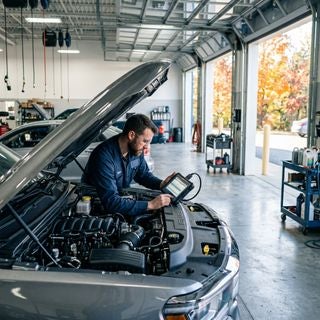
A Ford multi-point brake inspection includes a complete technical evaluation of brake pad lining thickness, rotor surface integrity, caliper pin sliding action, hydraulic fluid moisture levels, brake line flexible hoses, and parking brake mechanism operation. Technicians remove all four wheels to measure friction components against factory minimum tolerances and inspect internal mechanical linkages.

During the evaluation, technicians perform detailed measurements and physical checks across several core assemblies:

  • Brake Pad Lining Thickness: Technicians use precision calipers to measure remaining friction material on inner and outer pads. Any lining measuring at or below 2 mm requires immediate replacement to ensure safe stopping power and prevent metal backing plates from contacting the disc.
  • Rotor Condition and Thickness: Rotors are checked for minimum disc thickness, lateral runout, and surface defects such as deep grooves, heat cracks, or heavy corrosion ridges along the outer lip.
  • Caliper and Hardware Operation: Inspection covers caliper slide pins, rubber dust boots, piston seals, and anti-rattle clips to ensure even pressure application and prevent sticking.
  • Hydraulic Lines and Fluid Quality: Flexible rubber hoses and hard steel lines are checked for cracking, chafing, fluid seepage, or rust. Brake fluid is tested for chemical moisture absorption and clarity.
  • Parking Brake Linkage: Technicians verify cable tension, electronic actuator functionality, and parking brake shoe lining condition on rear drum-in-hat or caliper-integrated setups.

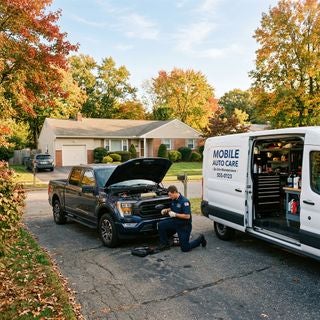
Our technicians routinely show vehicle owners physical wear measurements on precision gauges during routine service walk-throughs to provide full clarity on remaining pad life. For owners balancing busy work schedules, scheduling Ford mobile service options brings certified maintenance care directly to your driveway or workplace.
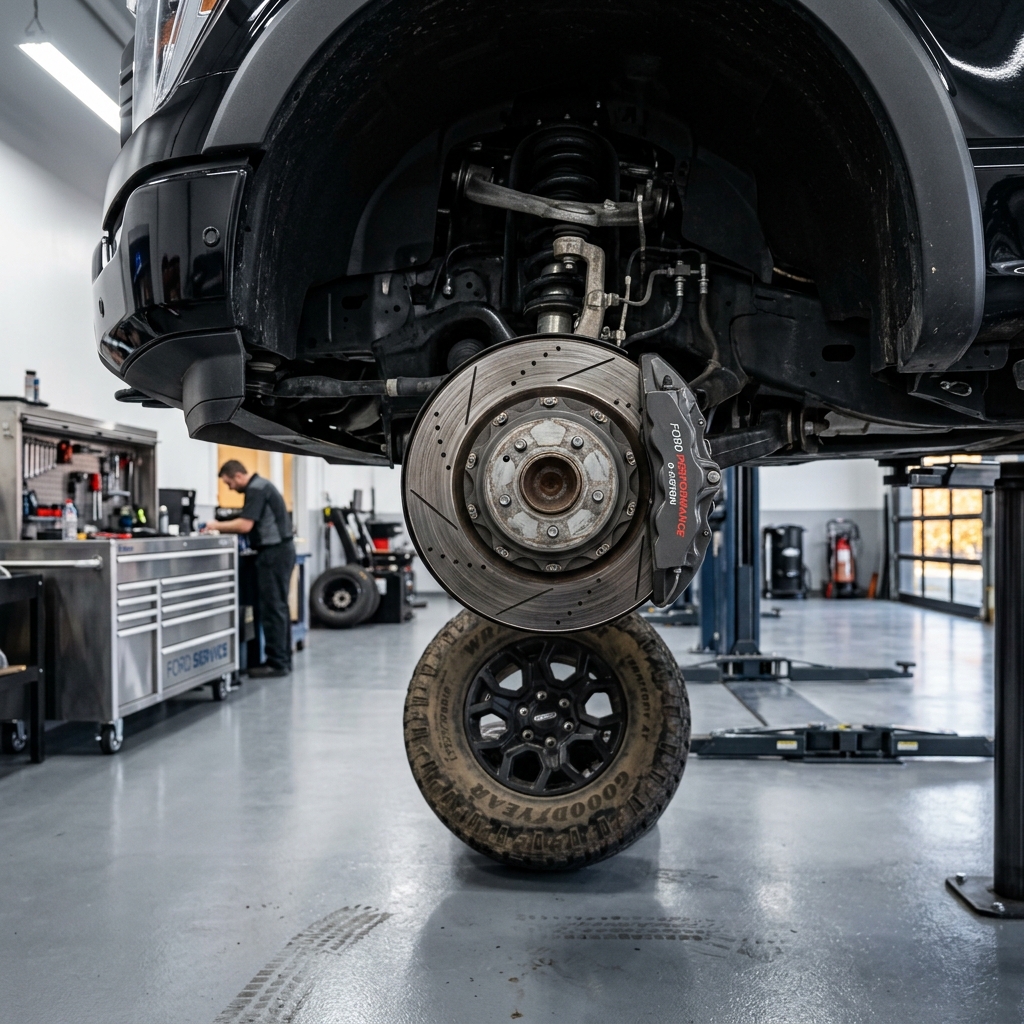
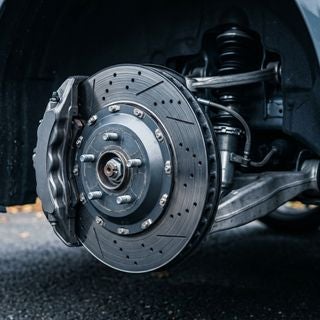
A black truck elevated on a hydraulic lift with an exposed slotted brake rotor positioned above a tire resting on the floor. (Representative image for illustration purposes only. Actual vehicle may vary based on trim and configuration.)

How Many Miles Do Original Ford Motorcraft Brake Pads Last?

Original Ford Motorcraft brake pads typically last between 40,000 and 60,000 miles under standard driving conditions, though actual lifespan ranges from 30,000 to 70,000 miles based on compound selection, vehicle weight, and driving habits. Heavy cargo loads, frequent mountain braking, or urban traffic shorten pad longevity.

The material formulation of Motorcraft friction linings plays a major role in operating characteristics and durability:

  • Motorcraft Ceramic Brake Pads: Formulated primarily from dense ceramic compounds and non-ferrous filler materials, ceramic pads deliver exceptionally quiet operation, minimal brake dust accumulation on wheels, and consistent pedal feel during daily commuting. They are standard equipment on everyday family vehicles like the 2026 Ford Explorer equipped with a 2.3L engine and SelectShift® transmission.
  • Motorcraft Semi-Metallic Brake Pads: Engineered with steel, iron, and copper fibers embedded in synthetic resin, semi-metallic pads offer superior heat transfer, higher friction coefficients under extreme thermal loads, and maximum fade resistance. These are ideal for heavy-duty hauling or towing up to 10,400 lbs in a 2026 Ford F-150 or track-focused performance in a 2026 Ford Mustang.

Navigating steep riverfront bluffs and hill climbs across East Liverpool increases friction temperatures, making semi-metallic compounds particularly effective for local trucks and heavy SUVs. To keep your vehicle operating at factory standards without disturbing your calendar, utilize Ford pick-up and delivery service to have your vehicle serviced and returned directly to your home.

Why Does Brake Fluid Need to Be Flushed Periodically in Ford Vehicles?

Brake fluid must be flushed every three years in Ford vehicles because hydraulic fluid is hygroscopic and naturally absorbs moisture from atmospheric humidity over time. Excess water lowers the boiling point of the fluid, causing a soft brake pedal during hard stops and accelerating internal oxidation throughout calipers and ABS valves.

The hydraulic braking system relies on incompressible liquid to transfer force from the brake pedal to the wheel calipers. As brake fluid ages and absorbs ambient moisture through microscopic pores in flexible rubber hoses and reservoir caps, its thermal stability degrades significantly:

  • Vapor Lock and Thermal Fade: Heavy or prolonged braking creates extreme friction temperatures at the caliper. Water-contaminated brake fluid boils at a much lower temperature than fresh fluid, producing vapor bubbles within the sealed hydraulic lines. Because vapor compresses under pressure while liquid does not, the brake pedal sinks toward the floor, resulting in sudden pedal fade or increased stopping distances.
  • Internal Component Corrosion: Moisture trapped inside the hydraulic system reacts with iron and aluminum components. Over time, this leads to internal pitting on caliper pistons, valve bore degradation inside the anti-lock braking system hydraulic control unit, and premature degradation of master cylinder seals.

Periodic flushes completely remove contaminated fluid, flush out microscopic metallic debris, and replenish anti-corrosion additives that keep internal hydraulic seals flexible and pressure-tight.

What Are the Costs of Ford Brake Replacement and Rotor Resurfacing?

Replacing both front and rear Ford brake pads and rotors generally varies by vehicle class, rotor dimensions, and axle requirements. Resurfacing rotors also varies by vehicle and labor requirements, whereas replacing rotors with new factory parts depends on parts and installation needs. Contact the dealership for current pricing.

Deciding whether to resurface or replace worn rotors depends on precise measurements taken during the inspection process:

Maintenance Consideration Rotor Resurfacing (Lathing) Full Rotor Replacement
Primary Requirement Rotor thickness must exceed discard limit Required when rotor is cracked, warped, or thin
Typical Part / Labor Cost $30 to $60 per rotor (labor only) $80 to $200 per rotor (plus installation labor)
Surface Finish Outcome Restores smooth parallel friction surface Returns assembly to factory original disc specs
Ideal Application Minor surface scoring or light rust buildup Heavy grooving, heat checking, or severe runout

Rotor resurfacing involves mounting the brake disc to a precision machine lathe that shaves away a thin layer of metal, removing surface irregularities and light heat checking. Resurfacing is only viable if the final disc thickness remains safely above the minimum thickness specification cast directly into the rotor housing. If a rotor is machined below this limit, it loses the structural mass required to dissipate heat effectively, leading to rapid warpage and thermal failure.

When installing new friction components, using genuine OEM parts ensures exact mechanical fitment, factory-matched noise dampening shims, and optimal thermal performance. Vehicle owners looking to perform maintenance or replace worn components can order genuine Motorcraft brake parts directly through our service center.

Common Questions About Ford Brake Maintenance

Q: How long does a Ford brake inspection take at the dealership?

A standard Ford multi-point brake inspection typically takes 30 to 45 minutes when performed by a factory-trained technician. If the inspection is completed alongside routine maintenance, such as an oil change or tire rotation, the total service appointment usually lasts between one and two hours.

Q: Is a brake inspection included in the Ford Works service package?

Yes, the Ford Works maintenance package includes a visual and dimensional brake inspection alongside a synthetic blend oil change, filter replacement, tire rotation, pressure check, battery test, and comprehensive fluid check. It provides a complete diagnostic assessment of vital safety components in a single visit.

Q: What causes a steering wheel to shake when applying Ford brakes?

Steering wheel vibration during braking is usually caused by uneven rotor surface wear or lateral runout, often referred to as warped rotors. High thermal stress or uneven caliper clamping pressure creates variation in rotor thickness, causing the pads to skip across the disc surface and transfer pulsations through the steering system.

Q: Can I drive safely if my Ford brake wear indicator light comes on?

You should schedule a service appointment as soon as possible when the brake warning light illuminates. While the light indicates that brake pad lining thickness has reached a critical threshold or fluid level is low, continuing to drive risks rotor damage, elevated stopping distances, and potential hydraulic power loss.

Q: How does towing a heavy trailer impact Ford brake maintenance schedules?

Towing heavy loads significantly increases thermal friction and kinetic energy transfer, causing brake pads to wear down much faster than during unladen driving. Ford recommends inspecting friction materials at every 5,000 to 7,500 miles if you routinely tow trailers or haul heavy cargo.

Proactive Ford Service Keeps Every Journey Safe

Keeping your braking system in peak operational condition is essential for highway safety, predictable vehicle handling, and long-term component durability. Routine inspections eliminate guesswork by tracking pad wear rates, monitoring rotor thickness, and identifying hydraulic fluid degradation before performance suffers.

Our service center provides the factory tools, specialized diagnostic equipment, and genuine Motorcraft parts required to keep your Ford performing exactly as the engineers intended. Whether you need a routine multi-point check, fluid flush, or full pad and rotor replacement, our certified service team is ready to assist.

To preserve your vehicle's stopping performance and enjoy complete peace of mind on the road, schedule a service appointment online today. You can also visit our East Liverpool service center or speak directly with an advisor by giving us a quick call to discuss your maintenance needs.
© 2026 Tri State Ford. All rights reserved.

Vehicle specification data © JATO Dynamics Limited.

Ford Brake Inspection in East Liverpool OH | Tri State Ford
Posted in:

Related Posts

d

How Does Ford Mobile Service Work?

Ford Mobile Service brings certified vehicle maintenance directly to your driveway or workplace by dispatching factory-trained technicians in custom-outfitted service vans. The technician arrives during your scheduled time window, brings specialized diagnostic tools and genuine parts, completes the maintenance on site, and leaves your parking space clean without requiring you to visit a dealership service bay. Owners can book an appointment through the Ford App, online, or by giving our team a quick call at (330) 462-7578. When the service van arrives at your home, the technician performs the requested maintenance right in your driveway, whether you own a 2026 Ford Escape with the 1.5L EcoBoost engine or a heavy-duty 2026 Ford F-150 featuring the 3.5L EcoBoost V6. Our mobile units operate as fully functional extensions of our main garage, carrying fluid extraction systems, pneumatic tools, and original equipment manufacturer components. For drivers navigating the steep riverfront bluffs around East Liverpool, having routine maintenance performed on site saves valuable commuting time while preserving complete vehicle reliability. If an inspection reveals a larger repair that requires heavy hydraulic lifts, our staff can seamlessly transfer your vehicle to our dealership facility on Pennsylvania Avenue. Table of Contents Does Ford Mobile Service Cost More Than Bringing Your Vehicle to the Dealership? What Services and Maintenance Can Ford Mobile Service Perform in Your Driveway? Is Driveway Mobile Service as Fast as Bringing Your Vehicle to a Dealer Bay? Which Service Program Is Recommended for Major Engine or Transmission Repairs? How Do Ford Rewards Points Work for Driveway Oil Changes and Maintenance? Common Questions About Ford Mobile Service Convenient Driveway Maintenance Tailored to Your Schedule Does Ford Mobile Service Cost More Than Bringing Your Vehicle to the Dealership? Ford Mobile Service costs the exact same price as bringing your vehicle into a physical service bay, with no extra convenience fees or travel surcharges added for driveway appointments. Routine maintenance items like oil changes, tire rotations, and battery installations carry identical retail pricing whether completed in a dealer workshop or in your driveway. Participating dealerships structure mobile maintenance to match standard retail pricing sheets, ensuring transparent pricing across all maintenance channels. By choosing our Ford Mobile Service program, owners eliminate personal transit costs, fuel consumption, and lost work time without paying a premium for at-home care. Identical Retail Rates: Oil changes, cabin air filter replacements, and fluid top-offs cost the same rate on site as they do in the shop. Zero Travel Surcharges: Standard maintenance visits inside our designated service radius do not incur mileage fees or house-call dispatch costs. Full Coupon Eligibility: Current offers and eligible benefits may vary; contact the dealership for current service pricing and eligibility. Our service advisors frequently hear owners ask whether mobile vans carry factory diagnostic tools and genuine Motorcraft parts. Every mobile appointment utilizes the same diagnostic hardware, software updates, and factory-certified filters that our master technicians use inside the main facility. What Services and Maintenance Can Ford Mobile Service Perform in Your Driveway? Ford Mobile Service can complete routine fluid changes, filter replacements, battery installations, brake pad renewals, tire rotations, multi-point vehicle inspections, lamp replacements, software updates, and minor recall repairs directly in your driveway. The mobile van is equipped to handle roughly eighty percent of standard recommended vehicle maintenance schedules on site. The equipment installed inside each service van allows certified technicians to perform clean, spill-free maintenance on popular family vehicles like the 2026 Ford Explorer equipped with the 2.3L EcoBoost engine. Waste oil is vacuum-extracted through sealed equipment into onboard holding tanks, preventing any fluid drips on your pavement. Engine Oil and Filter Service: Complete drain or vacuum extraction of engine oil with new Motorcraft® filter installation. Brake System Care: Inspection and replacement of front or rear brake pads and rotors, along with brake fluid checks. Battery Testing and Replacement: Diagnostic testing of cold-cranking amps and full installation of a new Motorcraft® battery. Tire Maintenance: Four-wheel tire rotations, air pressure adjustments, and tread depth evaluations. Filters and Wipers: Replacement of engine air filters, cabin air filters, and windshield wiper blades. System Software and Recalls: Wireless modules allow technicians to flash powertrain control software and address eligible safety recalls. For busy families balancing school routines and work schedules around Calcutta, scheduling a mobile appointment online keeps your daily driver in peak mechanical condition without disturbing your family calendar. Is Driveway Mobile Service as Fast as Bringing Your Vehicle to a Dealer Bay? Driveway mobile service saves total vehicle owner time compared to a dealer bay visit because it completely eliminates driving time, check-in lines, and waiting room stays. While the physical labor time required for a technician to replace brake pads or change engine oil is virtually identical, the overall time commitment for the vehicle owner drops from several hours to a few minutes. When a vehicle enters a traditional service lane, it undergoes intake queuing, staging, and parking moves before and after the actual repair. Mobile technicians work continuously on a single vehicle from the moment they park in your driveway until the job is finished. Zero Transit Time: You do not spend time driving to a facility or arranging shuttle rides back home. No Line Delays: Work starts immediately upon the technician's scheduled arrival window. Uninterrupted Productivity: Owners can continue working from home or managing household tasks while service takes place outside. During routine battery evaluations, mobile technicians perform a digital load test and charging system check. If your vehicle shows slow cranking symptoms, reviewing our battery service guide provides helpful technical details on battery lifespans before your driveway appointment. Which Service Program Is Recommended for Major Engine or Transmission Repairs? Ford Pickup & Delivery or a direct in-bay appointment is recommended for major engine, transmission, or heavy suspension overhaul work because these complex jobs require heavy-duty hydraulic vehicle lifts, engine cranes, and specialized shop machinery. Mobile service vans handle light mechanical repairs, while full-facility bays accommodate deep mechanical teardowns. When a vehicle experiences severe mechanical issues involving powertrain removals or frame-level repairs, mobile service technicians recommend bringing the truck or SUV into a dedicated service bay. Through Ford Pickup & Delivery, a dealership team member picks up your vehicle from your home, leaves a loaner if arranged, takes your vehicle to the main repair facility, and returns it once master technicians complete the heavy overhaul. Complex shop repairs rely on direct access to heavy workshop tools, including: Two-Post and Four-Wheel Hydraulic Lifts: Required for complete transmission drops, transfer case removals, and subframe access. Heavy Machinery: Hydraulic presses, tire mounting and high-speed balancing machines, and engine hoists. Fluid Flushing Stations: Commercial-grade equipment for complete transmission fluid flushes and heavy cooling system flushes. If your vehicle requires deep mechanical overhaul parts, our team handles ordering OEM Ford parts directly from factory distribution hubs to ensure exact fitment and full warranty compliance. How Do Ford Rewards Points Work for Driveway Oil Changes and Maintenance? Ford Rewards points can be redeemed directly toward driveway oil changes, tire rotations, and mobile maintenance at the exact same conversion values used inside dealership service departments. Points earned from a new vehicle purchase or previous maintenance visits apply toward your invoice, lowering or completely covering your out-of-pocket costs. Point redemption values vary by service and vehicle; contact the dealership for current Ford Rewards redemption details. Technicians or service advisors process your reward points digitally at the time of booking or upon completion of the driveway visit. Flexible Redemption: Apply points to full maintenance invoices or use them toward eligible charges alongside standard payment methods. Automatic Point Earning: Every driveway service visit earns new reward points on all eligible parts and labor costs. Fleet and Work Truck Support: Local business owners managing a commercial commercial Ford F-Series work trucks fleet can combine rewards points across multiple vehicles to reduce fleet operating expenses. Common Questions About Ford Mobile Service Q: Do I need a paved driveway for Ford Mobile Service? A: A clean, level surface such as a concrete driveway, asphalt parking pad, or firm parking space is required so the technician can safely place jack stands, wheel chocks, and service equipment. Technicians cannot perform raised-vehicle work on steep inclines, soft soil, or loose gravel. Q: What happens if it rains or snows on my scheduled mobile service day? A: Mobile service vans are outfitted to operate in light rain or cold conditions, but severe weather, heavy snow, or dangerous lightning may require rescheduling. If weather prevents safe driveway work, our team contacts you to pick up the vehicle or adjust your appointment window. Q: Can Ford Mobile Service complete open safety recalls on my vehicle? A: Many software flashes, module updates, light wiring harness inspections, and minor hardware replacements under open factory recalls can be completed right in your driveway. Complex recalls requiring major component teardowns must still be scheduled inside our main service center. Q: Do I need to stay outside with the technician while work is performed? A: You do not need to stand outside during the appointment. Once you unlock the vehicle and hand over the key fob, you can return indoors while the technician completes the scheduled work, runs diagnostics, and cleans the work area. Q: How do I verify if my address qualifies for mobile driveway maintenance? A: Coverage is based on distance from our main facility and technician scheduling availability across local zip codes. You can confirm eligibility by entering your address in the Ford App or calling our service desk directly at (330) 462-7578 to check your street address. Convenient Driveway Maintenance Tailored to Your Schedule Over 90% of routine maintenance tasks can be completed right in your driveway with Ford Mobile Service, offering unmatched convenience without compromising quality. By combining driveway convenience with transparent retail pricing, original equipment parts, and full Ford Rewards integration, maintaining your vehicle has never been easier. Whether your household requires a routine oil change on a 2026 Ford Escape, a brake service on a 2026 Ford Explorer, or routine maintenance on a 2026 Ford F-150, our certified technicians deliver expert service without interrupting your busy day. Book your next mobile maintenance appointment online or visit our service center address to speak with our service team today. © 2026 Tri State Ford. All rights reserved. Vehicle specification data © JATO Dynamics Limited. Ford Mobile Service in East Liverpool OH | Tri State Ford

l

Why Should You Use a Factory-Trained Ford Technician?

Using a factory-trained Ford technician ensures your vehicle is repaired by a specialist educated directly by Ford Motor Company on proprietary diagnostic software, model-specific wiring, and factory engineering standards. These technicians complete specialized coursework covering Ford engines, transmissions, electrical architectures, and safety systems, using genuine OEM parts to maintain factory warranty coverage, vehicle longevity, and optimal safety. Modern automobiles feature interconnected electronic control modules, complex multiplex wiring networks, and advanced driver-assist computer systems. When a warning light illuminates or a mechanical component underperforms, standard generic code scanners often retrieve broad error codes that fail to pin down the root cause. Factory-trained technicians utilize the Professional Technician System (PTS) network to access precise vehicle technical service bulletins, exact electrical schematics, and factory repair procedures designed specifically for your model year. Engineers at Ford design vehicles with specialized tolerances and unique mechanical assemblies. For example, servicing the SelectShift transmission or diagnosing the twin-turbo system on a 3.5L EcoBoost engine in a 2026 Ford F-150 rated for 10,400 lbs of towing capacity requires direct familiarity with Ford engineering. Drivers navigating the rolling hills and local commutes along State Route 170 in Calcutta rely on precise engine calibration and braking response, which factory-trained technicians verify using model-specific software calibrations. When you bring your vehicle to our service bay, you receive care from professionals who work on Ford powertrains and chassis every single day. If you want to discuss your vehicle's performance or set up a routine checkup, you can give our team a quick call or drop by our service center location to speak directly with an expert advisor. Table of Contents What Are the Certification Levels and Training Hours for Ford Technicians? Is ASE Certification Required at a Ford Dealership Service Department? Do Independent Mechanics Have Access to Ford FDRS Diagnostic Software? What Specialized Training Do Ford Technicians Receive for Electric and Hybrid Vehicles? How Much Does Service Cost at a Ford Dealership and What Records Protect Your Warranty? Common Questions About Ford Service and Technician Training Trust Your Vehicle to Factory-Trained Experts at Tri State Ford What Are the Certification Levels and Training Hours for Ford Technicians? Ford structures technician advancement through distinct certification tiers within the STARS framework, beginning at Registered Technician and progressing to Senior Master Technician. Achieving higher certification levels requires completing hundreds of hours of Web-Based Training and hands-on classroom instruction over several years. The Ford technician certification pathway includes five primary recognition levels: Registered Technician: Foundations in vehicle inspection, safety protocols, routine fluid maintenance, and fundamental shop practices. Certified Technician: Completion of core technical modules covering braking systems, steering, suspension, and basic electrical diagnosis. Specialty Trained Technician: Mastery in specific mechanical areas such as diesel engine repair, automatic transmissions, or electrical system diagnostics. Master Technician: Comprehensive expertise across multiple specialty areas, validated by passing rigorous written and practical examinations alongside active industry credentials. Senior Master Technician: The highest level of factory recognition, requiring a minimum of five consecutive years as a Master Technician plus complete mastery across engine performance, transmission overhauls, chassis systems, and high-voltage drive units. Many professional technicians begin their career through the Automotive Student Service Educational Training (ASSET) program. This two-year college cooperative education program combines classroom instruction at participating colleges with paid, hands-on apprenticeship inside a Ford dealership service center. Students in the Automotive Student Service Educational Training (ASSET) curriculum rotate between academic lectures on engine theory and real-world shop operations, logging hundreds of hours on current-model vehicles. Beyond initial education, Ford technicians undergo continuous training whenever new vehicle platforms or updated components launch. Whether adjusting safety parameters on a 2026 Ford Explorer equipped with a 2.3L engine or servicing heavy-duty driveline assemblies, certified technicians use authentic replacement components. You can conveniently order OEM parts online directly through our dealership to ensure your vehicle retains original factory specifications. Is ASE Certification Required at a Ford Dealership Service Department? ASE certification is not strictly mandatory for entry-level dealership service roles, but Ford requires technicians to earn specific National Institute for Automotive Service Excellence credentials to achieve advanced Master and Senior Master Technician status. The Automotive Service Excellence certification represents an independent, industry-wide benchmark testing general automotive knowledge across various vehicle systems. While general mechanics at independent repair shops often hold individual ASE certifications to demonstrate general competency, Ford factory credentials focus specifically on Ford engineering, proprietary software, and factory repair procedures. A technician working on a Ford vehicle benefits from combining both universal automotive testing and manufacturer-specific instruction. In our dealership service center, entry-level technicians start with web-based foundational modules and routine maintenance services while working under the guidance of senior mentors. As technicians progress toward Master status, they must maintain valid ASE certifications in areas such as engine repair, automatic transmission/transaxle, manual drive train and axles, suspension and steering, brakes, electrical systems, heating and air conditioning, and engine performance. Combining universal ASE testing with specialized Ford factory training gives technicians a complete understanding of both general mechanical principles and brand-specific technology. Whether your vehicle requires routine inspection or specialized care, you can schedule a service appointment online to reserve time with our team. If you are experiencing starting issues or electrical glitches, review our specialized battery maintenance guidance before visiting. For major mechanical repairs or extended component replacements, drivers can consult our finance department to explore available payment management options. Do Independent Mechanics Have Access to Ford FDRS Diagnostic Software? Independent mechanics can purchase subscription access to Ford Diagnosis and Repair System (FDRS) software and Integrated Diagnostic System (IDS) tools, but many third-party shops opt for generic aftermarket scanners due to software licensing fees and hardware requirements. The Ford Diagnosis and Repair System (FDRS) is the current-generation diagnostic software designed for Ford vehicles utilizing modern vehicle communication networks. Earlier vehicle platforms utilize the Integrated Diagnostic System (IDS) program. These software suites allow technicians to perform complete vehicle module re-flashing, clear deep-level diagnostic trouble codes, run automated actuator tests, reprogram key fobs, and recalibrate advanced driver-assist camera and radar sensors following alignment or body service. While independent repair facilities can legally purchase software licenses directly from Ford Motor Company, doing so requires investing in specialized hardware interface tools, such as the official VCM III vehicle communication module. Furthermore, independent shops must pay recurring subscription fees to maintain active software access. Because independent garages service dozens of different vehicle makes each week, maintaining active OEM diagnostic subscriptions for every manufacturer is often cost-prohibitive. Consequently, many general repair shops rely on multi-brand aftermarket scan tools. While aftermarket tools can read generic OBD-II engine codes, they frequently lack the capability to communicate with proprietary Ford computer modules, execute deep module resets, or install factory software updates. A factory-trained technician operating Ford Diagnosis and Repair System (FDRS) inside a dealership service department connects directly to Ford factory servers, downloading exact software calibrations designed for your specific vehicle identification number. What Specialized Training Do Ford Technicians Receive for Electric and Hybrid Vehicles? Ford technicians undergo specialized high-voltage training covering battery pack diagnostics, high-voltage safety isolation, electric drive module maintenance, and Ford Pro Charging infrastructure. Working on high-voltage electrified vehicles requires rigorous safety protocols that go beyond traditional internal combustion engine maintenance. Technicians complete coursework on personal protective equipment (PPE) usage, high-voltage rubber insulating glove testing, and precise battery de-energizing procedures before performing any work inside high-voltage enclosures. This training ensures technician safety while preventing electrical damage to sensitive vehicle control units. The technical curriculum for electrified powertrains includes: Diagnostic isolation of high-voltage battery cell imbalances and module testing. Thermal management system maintenance, including dedicated cooling loops and electric water pump diagnostics. Servicing integrated electric drive units, single-speed transmissions, and rotor position sensors. Inspection and troubleshooting of onboard charging modules, AC/DC converters, and charging port assemblies. Calibration of regenerative braking systems that balance friction braking with electric motor deceleration. When servicing complex hybrid systems or high-voltage battery arrays, factory-trained technicians use insulated hand tools rated for high-voltage isolation alongside factory software monitoring routines. This specialized training ensures that hybrid and all-electric Ford models operate safely, efficiently, and reliably throughout their service lives. How Much Does Service Cost at a Ford Dealership and What Records Protect Your Warranty? Ford dealership labor rates and routine maintenance costs vary by vehicle and service needs; contact our service department for current pricing. While independent garages may advertise lower hourly shop rates, dealership service departments deliver higher initial repair accuracy and long-term value. Factory-trained technicians complete repairs faster because they utilize model-specific technical manuals, exact diagnostic routines, and specialized hand tools. Installing genuine Motorcraft fluids, filters, and mechanical components helps eliminate fitment issues and premature wear, ensuring your vehicle remains dependable over thousands of miles. To maintain your vehicle's factory warranty coverage—such as the standard 3-year/36,000-mile bumper-to-bumper warranty or the 5-year/60,000-mile powertrain warranty —you must maintain detailed service documentation. If a warrantable component fails, the vehicle manufacturer may request proof that required maintenance was performed according to the owner's manual schedule. To ensure your factory warranty remains valid, maintain an organized service folder containing: Itemized repair orders showing the date of service and exact vehicle mileage at the time of work. The full Vehicle Identification Number (VIN) clearly printed on every service receipt. Part numbers and descriptions verifying that factory-approved fluids, such as Motorcraft engine oil, were used. Complete receipts for all purchased parts and fluids if minor self-service tasks are performed. When managing the steep riverfront bluffs and hill climbs in East Liverpool, keeping up with routine transmission fluid changes and brake pad replacements ensures maximum engine braking efficiency and long-term drivetrain protection. Servicing your vehicle at an authorized dealership helps keep your maintenance records organized, but you should still save copies of all service receipts. If you are looking for trusted maintenance care, you can find our service center easily, contact our service team by calling (330) 462-7578, or obtain driving directions to our service bays for your next maintenance visit. Common Questions About Ford Service and Technician Training Q: What is the main difference between a factory-trained technician and a general mechanic? A factory-trained technician receives direct education from Ford Motor Company focusing on proprietary vehicle software, specific engine architectures, and factory service bulletins. General mechanics service many different automotive brands using aftermarket tools, whereas factory-trained technicians specialize exclusively in Ford engineering and utilize OEM diagnostic hardware connected directly to factory database servers. Q: How long does it take for a mechanic to become a Ford Master Technician? Becoming a Ford Master Technician typically takes several years of dedicated work. Mechanics must complete hundreds of hours of Web-Based Training and classroom instruction, gain years of hands-on dealership service experience, and pass multiple ASE certification tests across core mechanical areas before earning Master Technician recognition. Q: Will servicing my vehicle at an independent shop void my Ford factory warranty? Servicing your vehicle at an independent shop does not automatically void your factory warranty. Under federal law, you have the right to have routine maintenance performed at any repair facility. However, you must keep complete, itemized receipts showing that correct fluids and parts were installed at recommended mileage intervals, and any damage caused by improper aftermarket repairs or substandard parts will not be covered under warranty. Q: What diagnostic equipment is used during a Ford dealership multi-point inspection? During a multi-point inspection, technicians utilize the Ford Diagnosis and Repair System (FDRS) software to check electronic control modules for stored fault codes. They also perform physical evaluations using specialized precision tools to measure brake pad thickness, tire tread depth, battery cold-cranking amps, and cooling system pressure levels. Q: How often do Ford technicians need to renew or update their certifications? Ford technicians undergo continuous training throughout the year. Whenever Ford introduces new vehicle platforms, updated powertrain options, or new electrical architectures, technicians must complete mandatory Web-Based Training modules and classroom instruction to maintain active certification status for those specific systems. Trust Your Vehicle to Factory-Trained Experts at Tri State Ford Keeping your Ford operating smoothly requires proper diagnostic technology, genuine OEM replacement parts, and technicians trained directly by the manufacturer. Whether your vehicle needs routine fluid service, brake inspection, or advanced powertrain diagnostic work, relying on certified professionals ensures the job gets done right the first time. Our service team is dedicated to delivering clear communication, efficient turnarounds, and expert care for every driver who walks through our doors. To experience reliable vehicle maintenance tailored to your schedule, schedule your next service appointment online or call our service department today. © 2026 Tri State Ford. All rights reserved. Vehicle specification data © JATO Dynamics Limited. Factory-Trained Ford Technicians in East Liverpool OH | Tri State Ford

6

Which Auto Parts Are Most Critical for Vehicle Safety?

The auto parts most critical for vehicle safety are tires, brake pads and rotors, steering and suspension linkages, replacement airbags, and timing belts. These components directly dictate stopping distance, emergency evasion handling, structural crash protection, and reliable engine timing. Compromising on their quality drastically elevates the risk of mechanical failure, extended stopping times, loss of directional control, and cabin intrusion during a collision. Vehicle mechanical systems operate as an interconnected safety envelope. When a driver presses the brake pedal or turns the steering wheel, every link in that mechanical chain must withstand immediate kinetic pressure. High-grade components undergo rigorous stress testing, thermal validation, and material analysis to handle emergency maneuvers. Substituting lower-grade components weakens this system, transforming standard road hazards into immediate safety threats. For drivers navigating the steep riverfront bluffs and sudden stops around East Liverpool, mechanical precision is essential. Steering tie rods, ball joints, control arms, and coil springs maintain tire contact with the pavement. If budget steering or suspension parts yield under heavy cornering or load shifts, electronic safety systems like stability control and anti-lock braking systems cannot properly function. Maintaining these safety-critical systems with validated components preserves overall operational safety. If you ever suspect wear in your vehicle's core safety mechanics, feel free to stop by our East Liverpool service facility or reach out to our technicians directly by giving us a quick call to discuss an inspection. Table of Contents Why Are Budget Tires Considered a Major Safety Risk? What Are the Risks of Using aftermarket brake pads and rotors? Why Should You Never choose low-quality replacement airbags? Are OES Parts as Good as OEM Parts? Do Detailed Maintenance Records Showing Quality Parts Boost Trade-In Value? Key Service Questions Regarding Vehicle Parts and Safety Trust Tri State Ford for Professional Safety Component Service Why Are Budget Tires Considered a Major Safety Risk? Budget tires are considered a major safety risk because they utilize low-grade synthetic rubber compounds, rigid sidewalls, and shallow tread designs that significantly lengthen stopping distances and reduce wet-weather traction. These structural deficiencies compromise vehicle stability, increase hydroplaning risks, and heighten the probability of sudden tread separation or catastrophic blowouts under load. Tires serve as the sole physical point of contact between a vehicle and the road surface, covering a total contact patch roughly the size of four human palms. Premium and Original Equipment tires are engineered with specific silica-enhanced rubber formulations that remain flexible across broad temperature ranges. In contrast, low-cost tire manufacturers save on production costs by using stiffer, lower-cost petroleum-based compounds. This lack of compound flexibility prevents the tread from conforming to road micro-textures, leading to a substantial drop in cornering grip and stopping performance during unexpected hard braking. The National Highway Traffic Safety Administration identifies 2/32 inch as the absolute minimum tread depth before immediate tire replacement is required. However, budget tires often lose traction well before reaching that wear bar due to poor water-evacuation channels. During heavy rainstorms, inferior tread architecture fails to channel water away from the contact patch, lifting the tire off the pavement and causing severe hydroplaning. Furthermore, the National Highway Traffic Safety Administration advises drivers to check tire inflation pressure at least monthly when the tires are cold, setting levels to the manufacturer's specification found on the driver's door placard rather than the maximum pressure stamped on the tire sidewall. Maintaining optimal tire pressure and monitoring tread depth preserves original handling dynamics and ensures that factory driver-assist features operate as designed. Drivers looking to verify their current tire condition can easily schedule a service appointment online with our certified maintenance team. What Are the Risks of Using aftermarket brake pads and rotors? Using aftermarket brake pads and rotors introduces severe safety risks, including rapid thermal brake fade, uneven rotor warping, excessive stopping distances, and potential complete friction material shear under emergency braking. Low-quality friction compounds lack proper thermal resistance, turning excessive kinetic heat into a slippery glazed layer that leaves the brake pedal feeling spongy and unresponsive. Brake systems rely on converting kinetic energy into thermal energy through friction. High-tier brake pads, such as genuine Motorcraft components, utilize vehicle-specific friction formulations engineered to match the exact weight, braking bias, and thermal demands of the vehicle. These premium pad assemblies include integrated noise-damping insulators, engineered steel shims, and application-specific attaching hardware that ensure precise caliper alignment and even wear distribution. Cheap aftermarket pads frequently skip these critical insulating shims and hardware, resulting in high-pitched brake squeal, severe dusting, and premature rotor scarring. When drivers come into our service facility after noticing longer braking distances on wet roads, our technicians frequently discover low-grade friction pads or budget tires that lack proper thermal resistance. Low-cost brake rotors compound these issues by using inferior cast iron with uneven density, thinner internal cooling vanes, and coarse surface machining. Under repeated stopping cycles, low-grade iron cannot dissipate heat efficiently. This thermal build-up causes the rotor face to warp, creating violent pedal pulsation and steering wheel shudder. In severe cases, extreme heat causes brake fluid contamination and boiling, leading to pedal drop and sudden loss of braking power. To prevent friction failure and maintain proper caliper movement, routine system flushes and hardware replacements are required: Flush brake fluid every two to three years or 30,000 miles to eliminate moisture contamination and maintain hydraulic pressure. Replace caliper slide pins, anti-rattle clips, and stainless steel hardware during every pad replacement to prevent binding. Inspect rotor thickness and lateral runout at every oil change interval to catch uneven wear before damage occurs. Why Should You Never choose low-quality replacement airbags? You should never choose low-quality replacement airbags because non-OEM, unvetted, or counterfeit airbag assemblies can fail to deploy or violently explode during a crash, sending metal fragments into the cabin. Improperly manufactured inflators transform a life-saving restraint into a fatal hazard during otherwise survivable collisions. Airbags rely on precise pyrotechnic charges and chemical propellants calibrated to deploy within milliseconds of an impact signal. According to safety alerts from the National Highway Traffic Safety Administration, unvetted and counterfeit replacement airbag inflators—including banned imported units labeled with suspect identifiers like DTN60DB—pose severe risks of rupture. Rather than safely expanding the fabric cushion to protect vehicle occupants, defective inflator canisters can violently rupture under pressure, propelling sharp metal shrapnel directly toward the driver and passengers. Vehicles involved in previous collisions where airbags deployed require rigorous verification before returning to the road. The National Highway Traffic Safety Administration strongly urges owners of used vehicles repaired after a crash deployment to have their supplemental restraint systems thoroughly inspected by a factory-authorized service center. Non-genuine replacement parts purchased through unregulated online channels or cut-rate body shops often lack safety sensor calibration and chemical propellant stability. Ensuring that every replacement airbag is a genuine OEM unit maintains original crash test ratings and protects human life. Are OES Parts as Good as OEM Parts? Original Equipment Supplier (OES) parts are functionally identical to Original Equipment Manufacturer (OEM) parts because they are produced by the same tier-one manufacturing suppliers using identical engineering drawings, tooling, and quality standards. Choosing OES components provides exact factory-level fitment, material integrity, and operational reliability while frequently offering a lower cost point. Vehicle manufacturers design complex systems but outsource the physical production of specific components—such as alternators, brake calipers, sensors, and spark plugs—to specialized automotive suppliers. When a component is branded with the vehicle manufacturer's logo and packaged in factory boxes, it is categorized as an OEM part. When that exact same supplier packages the identical component under their own brand name, it is sold as an OES part. Both variants share identical metallurgy, dimensions, tolerances, and performance ratings. In contrast, low-tier generic aftermarket parts are reverse-engineered by third-party factories without access to original factory CAD files or proprietary alloy recipes. This often results in improper bolt alignment, electrical resistance variations, and accelerated wear rates. Sticking with OEM or verified OES components preserves factory warranty protections and prevents premature mechanical breakdown. Ford stands behind its official Motorcraft replacement components with a comprehensive two-year unlimited-mileage service-parts warranty, providing long-term confidence for every repair. Owners needing factory-approved parts for upcoming vehicle maintenance can easily order genuine Ford parts directly through our dedicated parts center. Do Detailed Maintenance Records Showing Quality Parts Boost Trade-In Value? Detailed maintenance records showing the exclusive use of high-quality OEM or top-tier OES parts significantly boost trade-in value by eliminating mechanical uncertainty and verifying diligent vehicle stewardship. Dealership appraisers and prospective buyers pay a premium for vehicles with documented maintenance histories because they represent lower reconditioning costs and reduced risk of hidden mechanical defects. When a vehicle enters the dealership appraisal process, evaluators examine overall condition, tire tread wear, brake pad thickness, fluid clarity, and service documentation. A comprehensive logbook filled with receipts for factory-specified fluid changes, genuine filter replacements, and premium safety components signals that the engine, transmission, and chassis have been well preserved. This documented history allows the dealership to classify the vehicle as a high-tier pre-owned candidate, justifying a higher trade-in valuation. For vehicle owners navigating the gently rolling suburban terrain around Calcutta, consistent adherence to the factory maintenance schedule protects core drivetrain longevity. Routine engine oil and filter changes performed according to the vehicle's intelligent oil-life monitor prevent sludge build-up and internal friction. Documenting these services along with timing belt replacements, cooling system flushes, and brake overhauls proves that the vehicle has been operated under optimal maintenance standards, delivering tangible financial returns when it comes time to trade up. Key Service Questions Regarding Vehicle Parts and Safety Q: How often should I check my tire pressure and tread depth? You should inspect tire pressure at least once a month when the tires are cold, using the recommended PSI found on your vehicle's driver-side door placard. Tread depth should be checked during every monthly pressure check or oil change interval using a dedicated gauge. Tires measuring at or below 2/32 inch tread depth require immediate replacement, as severe traction loss and hydroplaning hazards increase drastically below this safety threshold. Q: What are the primary signs that my vehicle's brake pads need replacement? The most common indicators of worn brake pads include high-pitched squealing noises caused by built-in wear indicators, severe pedal pulsation, grinding metallic sounds during braking, and increased stopping distances. If your brake pedal feels unusually soft or spongy when pressed, friction material degradation or brake fluid overheating may be present, requiring an immediate brake inspection to restore system safety. Q: Why is professional installation recommended for steering and suspension parts? Professional installation is critical for steering and suspension components because tierods, ball joints, control arms, and struts require precise torque specifications, specialized press tools, and immediate four-wheel alignment adjustments. Incorrectly installed suspension linkage can cause severe handling instability, uneven tire wear, and failure of electronic driver-assist sensors that rely on accurate steering angle data. Q: How do I know if my timing belt needs to be replaced? Timing belt replacement intervals are vehicle-specific and detailed within your official factory maintenance schedule rather than determined by visual inspection alone. Because timing belts operate inside engine covers and control critical valve-to-piston synchronization, a snapping belt on an interference engine can cause catastrophic internal engine destruction. Following your vehicle's designated mileage interval for timing belt service prevents sudden snapping and costly engine replacement. Q: Can using non-OEM oil filters cause engine damage? Yes, low-quality aftermarket oil filters often utilize poor synthetic or paper filtering media and lack internal anti-drainback valves. This can lead to oil starvation during cold engine starts and allow unfiltered debris to circulate through tight engine tolerances. Using genuine OEM or Motorcraft oil filters ensures proper oil flow rates, pressure regulation, and particle filtration designed specifically for your engine's internal architecture. Trust Tri State Ford for Professional Safety Component Service Tri State Ford provides certified service and genuine OEM parts to ensure every vehicle safety system operates at peak factory standards. Protecting your vehicle with top-tier components prevents unexpected breakdowns, maintains handling precision, and ensures long-term driving safety. Our factory-trained technicians utilize specialized diagnostic equipment, official service protocols, and genuine Motorcraft parts for every repair. Whether your vehicle requires fresh tires, premium brake pads, or routine battery service guidance, our team delivers transparent vehicle care tailored to your driving requirements. When you are ready to experience certified automotive care, visit our local service center at 1503 Pennsylvania Ave, East Liverpool, OH 43920 or give our service advisors a call at (330) 462-7578 to schedule your maintenance appointment today. © 2026 Tri State Ford. All rights reserved. Critical Vehicle Safety Parts in East Liverpool OH | Tri State Ford