Blog

All Maintenance & Service, Expert Repairs & Diagnostics, Genuine Parts & Accessories, Engine Care & New Vehicle Reviews, Buying Guides, Financing & Insurance, Model Comparisons, Automotive News Used Vehicle Guides, Financing & Insurance, Buying Guides, Trade-In Advice, Certified Pre-Owned Automotive News, New Vehicle Reviews, Buying Guides, Financing & Insurance, Seasonal Driving Tips Maintenance & Service, Warranty & Service Contracts, Repair & Diagnostics, Parts & Components Compare Cars Used Vehicle Guides, Financing & Insurance, Buying Guides, Vehicle Warranty Information, Pre-Owned Maintenance & Service, Battery Care & Diagnostics, Electric Vehicle (EV) Maintenance, Seasonal Vehicle Trade-In Advice, Financing & Insurance, Buying Guides, Used Vehicle Guides, New Vehicle Maintenance & Service, Essential Vehicle Care, Preventive Maintenance Tips, Vehicle Longevity Maintenance & Service, Parts & Accessories, Vehicle HVAC Care, Seasonal Vehicle Maintenance, DIY Buying Guides, Financing & Insurance, New Vehicle Reviews, Model Comparisons, Sales & Promotions Tips Used Vehicle Guides, Financing & Insurance, Buying Guides, Pre-Owned Vehicle Sales, Vehicle Maintenance & Service, Brake Systems & Repair, Vehicle Parts & Accessories, Towing & Load New Vehicle Reviews, Buying Guides, Model Comparisons, Financing & Insurance, Inventory & Sales Buying Guides, Financing & Insurance, New Vehicle Reviews, Model Comparisons, Technology & Leasing & Lease Deals, Financing & Insurance, New Vehicle Sales, Commercial Vehicle Leasing, Maintenance & Service, Warranty & Recalls, Repair & Diagnostics, Parts & Accessories, Vehicle Vehicle Sales Events, New Vehicle Pricing & Incentives, Financing & Lease Options, Trade-In & Vehicle Trade-In Tips, Financing & Insurance, Buying Guides, Dealership Sales Strategies, Inventory Community Events & Customer Appreciation, New Vehicle Reviews, Financing & Trade-In Guides, Maintenance & Service, Recall Information, Safety & Reliability, Vehicle Ownership Care, Parts & New Vehicle Reviews, Buying Guides, Financing & Insurance, Model Comparisons, Automotive Technology Maintenance & Service, Vehicle Lighting & Electrical Systems, Automotive Safety & Inspection, OEM Maintenance & Service, Vehicle Pickup & Delivery, Mobile Service & On-Site Repairs, Oil Change & Model Comparisons, New Vehicle Reviews, Technology & Innovation, Safety Features, Buying Guides Commercial Truck Sales, Fleet Vehicle Financing, Custom Work Truck Upfits, Commercial Vehicle Commercial Vehicle Sales, Financing & Leasing, Small Business Vehicle Incentives, Fleet Purchasing Commercial Vehicle Sales, Fleet Purchasing & Management, Financing & Leasing for Businesses, New & Community Events, New Vehicle Buying Guides, Financing & Insurance, Maintenance & Service, Local Dealership Events & Promotions, Financing & Trade-In Options, Maintenance & Service Specials, Maintenance & Service, Vehicle Ownership Care, Mobile Repair Services, Genuine Parts & Certified New Vehicle Reviews, Buying Guides, Financing & Insurance, Model Comparisons, Used Vehicle Guides Used Vehicle Guides, Financing & Insurance, Buying Guides, New Vehicle Reviews, Commercial Vehicle Vehicle Sales Process, Financing & Credit Applications, New and Used Vehicle Inventory, Pickup and Buying Guides, Financing & Insurance, New Vehicle Reviews, Commercial Fleet Sales, Custom Orders & Buying Guides, New Vehicle Reviews, Financing & Insurance, Commercial Vehicle Sales, Model Commercial Vehicle Sales, Fleet Leasing & Management, Commercial Financing & Tax Incentives, Financing & Insurance, Leasing Benefits, Model Comparisons, Technology & Innovation, Buying Guides Leasing & Financing Options, Buying Guides, Model Comparisons, Negotiation Tips, Inventory & Leasing & Financing Options, Buying Guides, New Vehicle Reviews, Model Comparisons, Technology & Maintenance & Service, Automotive Detailing, Paint Protection & Care, Seasonal Vehicle Care, Maintenance & Service, Automotive Electrical Systems, Battery Care & Replacement, Vehicle Lighting Maintenance & Service, Automotive Fluids & Lubricants, Vehicle Care & Ownership, Dealership Service Maintenance & Service, Brake System Care, Vehicle Safety & Inspection, Parts Quality & Replacement, Maintenance & Service, Brake System Care, Vehicle Safety & Inspections, Parts & Repairs, Expert Maintenance & Service, Mobile Vehicle Services, Vehicle Care & Ownership, Genuine Parts & Repairs, Maintenance & Service, Safety Features, Technology & Innovation, Seasonal Driving Tips, Parts & Maintenance & Service, Technology & Innovation, Vehicle Diagnostics & Telematics, Fleet Management Maintenance & Service, Tire Care & Repair, Roadside Assistance, Vehicle Safety & Inspections, Maintenance & Service, Tire Care & Repair, Wheel Alignment & Balancing, Suspension Maintenance, Maintenance & Service, Vehicle Care & Longevity, Scheduled Service Packages, Oil Changes & Fluid Maintenance & Service, Vehicle Inspection & Diagnostics, Parts & Repairs, Warranty & Resale Value, Maintenance & Service, Vehicle Inspections, Oil Change & Fluid Services, Tire Care & Battery Maintenance & Service, Vehicle Interior Care, Technology & Innovation in Service, Professional Maintenance & Service, Vehicle Software Updates, Safety Features, Technology & Innovation, Recall & New Vehicle Reviews, Buying Guides, Financing & Insurance, Model Comparisons, Inventory Highlights New Vehicle Reviews, Buying Guides, Financing & Insurance, Model Comparisons, Inventory Updates New Vehicle Reviews, Buying Guides, Model Comparisons, Maintenance & Service, Technology & New Vehicle Reviews, Buying Guides, Technology & Innovation, Safety Features, Seasonal Driving Tips Vehicle Sales Events, New Vehicle Purchasing, Incentives & Discounts, Financing & Pre-Approval, Buying Guides, Financing & Insurance, Used Vehicle Guides, New Vehicle Reviews, Cross-Border Buying Guides, Financing & Insurance, Vehicle Inventory & Offers, Dealership Visit Preparation, Commercial Leasing Options, Business Fleet Solutions, Financing & Leasing Programs, Commercial Commercial Truck Sales, Fleet Purchasing Guides, Financing & Lease Options, Work Truck Community Engagement & Events, New Vehicle Promotions, Financing & Trade-In Options, Maintenance & Community Events & Dealership News, New Vehicle Promotions & Incentives, Maintenance & Service Community Events & Dealership News, New Vehicle Reviews, Financing & Insurance, Maintenance & Custom Ordering & Build Process, New Vehicle Inventory & Offers, Financing & Trade-In Guidance, East Liverpool, OH Ford Dealer East Liverpool, OH Used Cars Financing & Insurance, Buying Guides, Commercial Vehicle Solutions, Fleet Management, Inventory and Financing & Insurance, Buying Guides, New Vehicle Reviews, Used Vehicle Guides, Automotive Sales Financing & Insurance, Buying Guides, New Vehicle Reviews, Used Vehicle Guides, Automotive Sales & Financing & Insurance, Buying Guides, New Vehicle Reviews, Used Vehicle Guides, Model Comparisons Financing & Insurance, Buying Guides, Used Vehicle Guides, New Vehicle Reviews, Automotive Sales Financing & Insurance, Buying Guides, Used Vehicle Guides, Trade-In Tips, New Vehicle Sales Financing & Insurance, Buying Guides, Vehicle Inventory & Offers, Trade-In & Appraisal, Dealership Financing & Insurance, Buying Guides, Vehicle Trade-In Tips, Dealership Sales Process, New Vehicle Leasing & Financing Options, New Vehicle Leasing Guides, Buying Guides, Inventory Spotlight, Trade Leasing Options, Financing & Insurance, New Vehicle Reviews, Buying Guides, Technology & Innovation Leasing Options, Financing & Insurance, New Vehicle Sales, Buying Guides, Vehicle Inventory Maintenance & Service, Air Conditioning Repair, Genuine Parts & Accessories, Dealer-Authorized Maintenance & Service, Automotive Air Conditioning Repair, Vehicle Cooling System Care, Diagnostic Maintenance & Service, Automotive Detailing & Cleaning, Seasonal Vehicle Care, Vehicle Protection & Maintenance & Service, Automotive Detailing & Paint Care, Vehicle Exterior Protection, Paint Repair Maintenance & Service, Automotive Detailing & Protection, Corrosion & Rust Prevention, Paint & Maintenance & Service, Automotive Detailing, Vehicle Care & Protection, Off-Road Vehicle Maintenance & Service, Automotive Electrical Systems, Battery Care & Replacement, Diagnostics & Maintenance & Service, Automotive Glass Repair, Safety Features, Technology & Innovation, Mobile & Maintenance & Service, Automotive Lighting & Electrical, Vehicle Safety & Visibility, DIY Vehicle Maintenance & Service, Automotive Parts & Accessories, Seasonal Vehicle Care, Vehicle Safety & Maintenance & Service, Automotive Parts & Accessories, Vehicle Air Quality & HVAC Care, Preventive Maintenance & Service, Automotive Parts & Accessories, Vehicle Ownership Care, Engine Care & Maintenance & Service, Automotive Parts & Accessories, Vehicle Safety & Repair, Warranty & Maintenance & Service, Automotive Parts & Components, Vehicle Safety & Repair, Warranty & Service Maintenance & Service, Automotive Parts & Repairs, Vehicle Warranty & Protection, Service Center Maintenance & Service, Automotive Repair Tips, Service Team Selection, Warranty & Service Policies, Maintenance & Service, Automotive Repair, Mobile & Remote Vehicle Service, Warranty & Roadside Maintenance & Service, Automotive Repair, Parts & Accessories, Vehicle Ownership Care, Technology & Maintenance & Service, Automotive Repair, Parts & OEM Components, Vehicle Longevity & Care, Service Maintenance & Service, Automotive Technology & Diagnostics, Vehicle Electronics & Sensors, Seasonal Maintenance & Service, Automotive Technology & Software Updates, Warranty & Recall Service, Mobile Maintenance & Service, Battery Care & Replacement, Vehicle Electrical Systems, Seasonal Vehicle Maintenance & Service, Brake System Care, OEM Parts & Replacement, Vehicle Safety & Inspections, Maintenance & Service, Brake System Care, Vehicle Repair Tips, Automotive Parts & Components, Maintenance & Service, Brake System Care, Vehicle Safety & Inspection, Automotive Repair Tips, Maintenance & Service, Brake System Care, Vehicle Safety & Inspections, Parts & Components, Maintenance & Service, Brake System Care, Vehicle Safety Inspections, Automotive Repair Tips, OEM Maintenance & Service, Certified Technician Insights, Warranty & Service Coverage, Genuine OEM Maintenance & Service, Cooling System Repairs, Vehicle Ownership Care, Diagnostic & Maintenance & Service, Diagnostic Services, Vehicle Health & Diagnostics, Service Tips & Advice, Maintenance & Service, Engine Care & Performance, Parts & Accessories, Genuine vs. After Maintenance & Service, Paint Protection & Detailing, Vehicle Exterior Care, Seasonal Vehicle Maintenance & Service, Parts & Accessories, Engine Care & Repair, Vehicle Longevity Tips, OEM Parts Maintenance & Service, Parts & Replacements, Vehicle Care Tips, Seasonal Maintenance, DIY Vehicle Maintenance & Service, Recall Updates & Safety Notices, Genuine Parts & Accessories, Truck Care & Maintenance & Service, Repair & Diagnostics, OEM Parts & Accessories, Warranty & Recall Maintenance & Service, Repair & Diagnostics, Parts & Accessories, Vehicle Ownership Care, Service Maintenance & Service, Repair & Diagnostics, Parts & Components, Preventive Care & Tips, Warranty & Maintenance & Service, Repair & Diagnostics, Tire & Wheel Care, Vehicle Safety & Inspection, Parts Maintenance & Service, Repair & Diagnostics, Warranty & Service Coverage, Genuine OEM Parts & Maintenance & Service, Repair & Parts, Vehicle Ownership Care, Safety Features, Technology & Maintenance & Service, Repair & Parts, Vehicle Ownership Care, Transmission Maintenance & Service, Repair Solutions, Vehicle Ownership Care, Parts & Accessories, Diagnostic Maintenance & Service, Repair Tips & Techniques, Vehicle Care & Ownership Maintenance & Service, Safety Features, Automotive Recalls & Repairs, Parts & Warranty Services, Maintenance & Service, Safety Features, Automotive Recalls & Repairs, Technology & Innovation, Maintenance & Service, Safety Features, Automotive Recalls, Vehicle Ownership Care, Parts & Repairs Maintenance & Service, Safety Features, Parts & Repairs, Vehicle Ownership Care, Automotive Service Maintenance & Service, Safety Features, Recall & Repair Updates, Parts & Repairs, Vehicle Ownership Maintenance & Service, Safety Features, Recall & Safety Campaigns, Vehicle Inspection & Repairs, Maintenance & Service, Safety Features, Recall & Warranty Information, Vehicle Diagnostics & Maintenance & Service, Safety Features, Recall Repairs & Safety Campaigns, Parts & Genuine Maintenance & Service, Safety Features, Recalls & Repairs, Parts & Accessories, Vehicle Ownership Maintenance & Service, Safety Features, Repair & Recall Updates, Parts & Components, Vehicle Maintenance & Service, Safety Features, Repair & Replacement, Vehicle Care & Inspection, Parts & Maintenance & Service, Safety Features, Seasonal Driving Tips, Technology & Innovation, Parts & Maintenance & Service, Safety Features, Technology & Innovation, Automotive Electrical Systems, Maintenance & Service, Safety Features, Technology & Innovation, Automotive News, Parts & Repairs Maintenance & Service, Safety Features, Technology & Innovation, Automotive Parts & Accessories, Maintenance & Service, Safety Features, Technology & Innovation, Automotive Recalls, Parts & Repairs Maintenance & Service, Safety Features, Technology & Innovation, Automotive Recalls, Vehicle Maintenance & Service, Safety Features, Technology & Innovation, Automotive Service Tips, Recall & Maintenance & Service, Safety Features, Technology & Innovation, Parts & Repairs, Seasonal Driving Maintenance & Service, Safety Features, Technology & Innovation, Parts & Repairs, Vehicle Ownership Maintenance & Service, Safety Features, Technology & Innovation, Recall & Warranty Information, Maintenance & Service, Safety Features, Technology & Innovation, Repair & Recall Information, Parts Maintenance & Service, Safety Features, Technology & Innovation, Tire Care & Replacement, Maintenance & Service, Safety Features, Vehicle Inspections, DIY Vehicle Care, Repair & Diagnostics Maintenance & Service, Safety Recalls & Repairs, Vehicle Safety & Compliance, Powertrain & Maintenance & Service, Seasonal Driving Tips, Model Comparisons, Technology & Innovation, Safety Maintenance & Service, Seasonal Driving Tips, Safety Features, Technology & Innovation, Automotive Maintenance & Service, Seasonal Driving Tips, Safety Features, Technology & Innovation, Parts & Maintenance & Service, Seasonal Driving Tips, Vehicle Care & Ownership, Brake System Maintenance, Maintenance & Service, Seasonal Driving Tips, Vehicle Care & Ownership, Parts & Accessories, Safety Maintenance & Service, Seasonal Driving Tips, Vehicle Care & Ownership, Safety Features, Maintenance & Service, Seasonal Driving Tips, Vehicle Care & Protection, Brake Maintenance, Tire Maintenance & Service, Seasonal Driving Tips, Vehicle Care & Warranty, Service Specials & Packages, Maintenance & Service, Seasonal Driving Tips, Vehicle Cooling Systems, Automotive Safety Features, Maintenance & Service, Service Scheduling & Convenience, Vehicle Repair & Diagnostics, Parts & Maintenance & Service, Technology & Innovation, Automotive Service Transparency, Digital Vehicle Maintenance & Service, Technology & Innovation, Safety Features, Parts & Warranty, Vehicle Maintenance & Service, Tire Care & Replacement, Seasonal Vehicle Care, Safety Features, Automotive Maintenance & Service, Tire Care & Replacement, Vehicle Safety & Handling, Seasonal Vehicle Maintenance & Service, Tire Care & Replacement, Vehicle Safety & Inspection, Emergency Roadside Maintenance & Service, Tire Care & Replacement, Vehicle Safety & Inspections, Seasonal Vehicle Maintenance & Service, Transmission Care & Repair, Vehicle Fluid Services, Automotive Diagnostics, Maintenance & Service, Transmission Care, Repair & Parts, Vehicle Ownership Care, Common Vehicle Maintenance & Service, Vehicle Care Tips, Parts & Accessories, Seasonal Vehicle Maintenance, Maintenance & Service, Vehicle Detailing & Care, Parts & Accessories, Seasonal Vehicle Preparation, Maintenance & Service, Vehicle Detailing & Cosmetic Care, Automotive Cleaning & Protection, Service Maintenance & Service, Vehicle Detailing & Cosmetic Care, Service Scheduling & Convenience, Maintenance & Service, Vehicle Detailing & Protection, Repair & Inspection, Parts & Accessories, Maintenance & Service, Vehicle Detailing & Protection, Vehicle Care Tips, Seasonal Vehicle Maintenance & Service, Vehicle Diagnostics & Repair, Engine Performance & Troubleshooting, Fuel Maintenance & Service, Vehicle Fluids & Lubrication, Engine Care & Repair, Parts & Accessories, Maintenance & Service, Vehicle Ownership Care, Parts & Accessories, Repair & Diagnostics, Certified Maintenance & Service, Vehicle Repair & Diagnostics, Parts & Accessories, DIY Vehicle Care, Safety Maintenance & Service, Vehicle Repair & Diagnostics, Parts & Accessories, Hybrid & Electric Vehicle Maintenance & Service, Vehicle Repair & Diagnostics, Parts & Accessories, Seasonal Driving Tips, Maintenance & Service, Vehicle Repair & Diagnostics, Parts & Accessories, Service Lane Tips & Maintenance & Service, Vehicle Repair & Diagnostics, Parts & Accessories, Towing & Performance Maintenance & Service, Vehicle Repair & Parts, Service Convenience & Customer Care, Roadside Maintenance & Service, Vehicle Repair Tips, Parts & Accessories, Safety Features, Technology & Maintenance & Service, Vehicle Service Warranties, Repair & Coverage Plans, Ownership & Vehicle Model Comparisons, Buying Guides, New Vehicle Reviews, Financing & Insurance, Inventory Updates Model Comparisons, Buying Guides, New Vehicle Reviews, Technology & Innovation, Safety Features Model Comparisons, Buying Guides, Technology & Innovation, Safety Features, Maintenance & Service Model Comparisons, New Vehicle Reviews, Buying Guides, Technology & Innovation, Financing & Model Comparisons, New Vehicle Reviews, Buying Guides, Technology & Innovation, Safety Features Model Comparisons, New Vehicle Reviews, Safety Features, Technology & Innovation, Seasonal Driving Model Comparisons, New Vehicle Reviews, Technology & Innovation, Buying Guides, Maintenance & Model Comparisons, New Vehicle Reviews, Technology & Innovation, Maintenance & Service, Buying Model Comparisons, Towing & Hauling Guides, Maintenance & Service, Technology & Innovation, New New Vehicle Promotions, Buying Guides, Financing & Insurance, New Vehicle Reviews, Inventory New Vehicle Reviews, Buying Guides, Financing & Insurance, Model Comparisons, Automotive Sales New Vehicle Reviews, Buying Guides, Financing & Insurance, Model Comparisons, Commercial & Work New Vehicle Reviews, Buying Guides, Financing & Insurance, Model Comparisons, Vehicle Customization New Vehicle Reviews, Buying Guides, Financing & Insurance, Model Comparisons, Vehicle Inventory New Vehicle Reviews, Buying Guides, Financing & Insurance, New Vehicle Specials, Trade-In & Value New Vehicle Reviews, Buying Guides, Financing & Insurance, Used Vehicle Guides, Inventory Updates New Vehicle Reviews, Buying Guides, Financing & Insurance, Used Vehicle Guides, Model Comparisons New Vehicle Reviews, Buying Guides, Financing & Insurance, Vehicle Inventory & Specials, Model New Vehicle Reviews, Buying Guides, Financing & Insurance, Vehicle Inventory, Model Comparisons New Vehicle Reviews, Buying Guides, Model New Vehicle Reviews, Buying Guides, Model Comparisons, Financing & New Vehicle Reviews, Buying Guides, Safety Features, Technology & Innovation, Model Comparisons New Vehicle Reviews, Buying Guides, Technology & Innovation, Safety Features, Maintenance & Service New Vehicle Reviews, Financing & Insurance, Buying Guides, New Vehicle Specials, Model Comparisons New Vehicle Reviews, Financing & Insurance, Buying Guides, Technology & Innovation, Automotive New Vehicle Reviews, Financing & Insurance, Buying Guides, Used Vehicle Guides, Model Comparisons New Vehicle Reviews, Model Comparisons, Buying Guides, Technology & Innovation, Safety Features New Vehicle Reviews, Model Comparisons, Commercial Truck Guides, Technology & Innovation, New Vehicle Reviews, Model Comparisons, Financing & Insurance, Technology & Innovation, Safety New Vehicle Reviews, Model Comparisons, Off-Road Adventures, Technology & Innovation, Maintenance & New Vehicle Reviews, Model Comparisons, Safety Features, Technology & Innovation, Buying Guides New Vehicle Reviews, Model Comparisons, Technology & Innovation, Financing & Insurance, Maintenance New Vehicle Reviews, Model Comparisons, Technology & Innovation, Safety Features, Buying Guides New Vehicle Reviews, Model Comparisons, Technology & Innovation, Safety Features, Maintenance & New Vehicle Reviews, Off-Road Capabilities, Outdoor Adventure Vehicles, Technology & Innovation, New Vehicle Reviews, Technology & Innovation, Buying Guides, Maintenance & Service, Model New Vehicle Reviews, Technology & Innovation, Buying Guides, Safety Features, Model Comparisons New Vehicle Reviews, Technology & Innovation, Safety Features, Maintenance & Service, Buying Guides New Vehicle Sales, Financing & Incentives, Trade-In & Appraisal, Special Sales Events, Electric New Vehicle Sales, Financing & Incentives, Trade-In & Value Guides, Manufacturer Promotions, New Vehicle Sales, Financing & Insurance, Buying Guides, Manufacturer Incentives & Discounts, New Vehicle Sales, Vehicle Delivery & Logistics, Financing & Credit Applications, Trade-In & Trucks Used Vehicle Guides, Buying Guides, Financing & Insurance, Model Comparisons, Selling Your Car Used Vehicle Guides, Financing & Insurance, Buying Guides, Model Comparisons, Local Dealership Vehicle Sales Events, Financing & Leasing, Trade-In & Trade-Up Guides, New Vehicle Inventory Vehicle Sales Events, New Vehicle Buying Guides, Financing & Incentives, Dealership Inventory Vehicle Sales Events, New Vehicle Pricing, Financing & Credit Applications, Trade-In & Loyalty Vehicle Sales Process, Online Vehicle Purchasing, Financing & Loan Approval, Trade-In & Vehicle Vehicle Sales Promotions, New Vehicle Buying Guides, Financing & Credit Applications, Dealership Vehicle Sales Promotions, New Vehicle Buying Guides, Financing & Incentives, Trade-In & Valuation, Vehicle Sales, Online Car Buying, Financing & Incentives, Trade-In Guides, New Vehicle Delivery
5

Is It Smarter to Buy or Lease a New Car?

Buying a vehicle is the smarter choice if you drive higher annual mileage, plan to hold your vehicle past loan payoff to build cash equity, and want complete ownership freedom. Leasing is the smarter choice if you prefer lower monthly payments, want to upgrade to a new model with updated active safety technology every three years, and want full factory warranty protection throughout your driving term without taking on long-term resale risk. Deciding between buying and leasing comes down to how you plan to use your vehicle and what fits your monthly budget. When you finance a purchase, your payments work toward paying off the full vehicle price, leaving you with a valuable asset once the loan term concludes. This approach suits drivers who log heavy highway miles on daily commutes across state lines along State Route 170 from communities like Calcutta, where mileage flexibility and long-term ownership value are major priorities. Leasing operates on a different structure. Instead of paying for the entire purchase price of a new vehicle, your lease payments cover only the estimated depreciation during the contract term, plus interest and administrative fees. That structure usually yields a noticeably lower monthly payment compared to traditional auto financing on the exact same model. For example, drivers looking at a 2026 Ford Explorer XLT starting at $42,585 MSRP can enjoy its standard SelectShift® automatic transmission, All-wheel drive, and 5,000 lbs towing capacity for a lower initial monthly commitment through a lease than through a standard auto loan. At Tri State Ford, our team helps you compare both payment paths side-by-side so you can make an informed choice. You can start exploring your options by completing an online credit application before visiting our showroom. If you prefer to speak directly with an F&I specialist, feel free to give us a call at (330) 462-7578 or stop by our East Liverpool showroom location to discuss current incentives. Table of Contents What Are the Main Financial Differences Between Buying and Leasing? What Are the Pros and Cons of Leasing vs Financing a Vehicle? How Do Residual Value and Depreciation Impact Monthly Payments and Equity? How Do Mileage Limits and Contract Terms Work on a Car Lease? Who Benefits Most From Leasing versus Buying a New Ford? Common Questions About Buying vs Leasing a Vehicle What Are the Main Financial Differences Between Buying and Leasing? Buying requires financing the total sales price of the vehicle, which builds clear ownership equity as monthly loan principal is paid down over time. Leasing charges only for the anticipated vehicle depreciation over a fixed contract period, resulting in lower monthly payments but zero accumulated equity at the end of the term. The financial framework of each payment method differs across three core areas: upfront capital requirements, ongoing monthly obligation, and end-of-term financial position. Upfront Costs: Purchasing a vehicle through traditional financing typically involves a down payment, sales tax calculated on the total purchase price, title fees, and initial registration fees. In contrast, a lease usually requires a smaller initial out-of-pocket payment due at signing, which often consists of the first month's payment, an acquisition fee, taxes, and government fees. Monthly Payment Calculations: Financing payments are calculated using the vehicle's total sale price minus your down payment or trade-in value, spread across loan terms typically ranging from 48 to 72 months at an agreed annual percentage rate. Lease payments calculate the difference between the initial capitalized cost and the vehicle's future projected value at contract end, adding a finance charge known as the money factor. Tax and Equity Realization: Ohio state tax rules treat buying and leasing differently. When purchasing, sales tax applies to the full negotiated purchase price of the vehicle upfront or rolled into the loan. When leasing, sales tax is assessed on the monthly lease payment stream, lowering your initial tax obligation. Drivers who prefer owning pre-owned vehicles to avoid initial depreciation often look into options like our pre-owned Carfax 1-Owner vehicles, which offer strong long-term equity potential for buyers focused on keeping total cost of ownership low. What Are the Pros and Cons of Leasing vs Financing a Vehicle? Financing provides unlimited driving mileage, freedom from physical wear charges, and eventual ownership free of monthly payments, but carries higher monthly installments and future repair responsibilities once factory coverage expires. Leasing offers lower monthly payments, continuous coverage under manufacturer warranties, and simple vehicle turn-in options, balanced against annual mileage caps, wear guidelines, and persistent monthly payments. Understanding these trade-offs helps narrow down which structure aligns best with your driving lifestyle and financial strategy. Financing Advantages Equity Accumulation: Every payment reduces your loan balance, building trade-in or cash value for future purchases. Unlimited Mileage: You can drive as many miles as you want without worrying about excess mileage penalties. Customization Rights: You are free to add genuine Ford accessories, bedliners, tow hitches, or custom equipment. Long-Term Savings: Once the loan is paid off, you enjoy years of payment-free ownership. Financing Disadvantages Higher Monthly Cost: Monthly loan payments are higher because you pay for the entire vehicle price. Post-Warranty Repairs: Once the standard 3-year/36,000-mile bumper-to-bumper warranty and 5-year/60,000-mile powertrain warranty expire, you are responsible for maintenance and mechanical repairs. Leasing Advantages Lower Monthly Payments: Monthly lease payments are generally lower than financing payments for the same model. Continuous Factory Protection: A standard 36-month lease keeps your vehicle under factory warranty coverage for the entire term. Latest Technology: You get regular access to new infotainment systems, driver-assist features, and cabin comforts every few years. Leasing Disadvantages No Ownership Equity: You do not build equity in the vehicle during the lease term. Contract Restrictions: Exceeding annual mileage limits or incurring excess wear-and-tear leads to charges at lease end. To lower monthly costs on either path, check out our latest manufacturer vehicle specials or evaluate our certified pre-owned Ford inventory for additional value options. How Do Residual Value and Depreciation Impact Monthly Payments and Equity? Residual value is the estimated future market value of a vehicle at the conclusion of a lease, set by the lender at contract signing. A higher residual value percentage means the vehicle is projected to retain more of its worth, which directly lowers your monthly lease payment because you pay for less total depreciation. Depreciation measures how much value a vehicle loses over time due to age, mileage, and normal usage. New vehicles experience their steepest rate of depreciation during the first three years. Leasing shields you from unpredictable market drops because the residual value is fixed upfront in your contract. If the market value of the vehicle drops sharply during your lease term, the leasing company absorbs that loss—you simply turn the keys in at lease end. When you finance a purchase, depreciation directly impacts your cash equity. Vehicles that hold high resale value, such as the Ford F-150, help buyers build positive equity faster during an auto loan. Families test-driving the 2026 Ford Explorer XLT usually ask whether a high residual value makes a lease more affordable than financing before we run the formal payment numbers. Because the Explorer retains strong market value, its high residual percentage keeps monthly lease payments surprisingly competitive against longer-term financing options. Knowing what your current car is worth can significantly impact both finance and lease calculations. You can value your trade-in online to see how much equity you can apply as a down payment toward your next vehicle. Proper upkeep also preserves trade-in value, which is why monitoring our factory service specials helps keep your vehicle in prime operational condition. How Do Mileage Limits and Contract Terms Work on a Car Lease? A Ford Credit Red Carpet Lease specifies a structured annual mileage allowance—typically 10,000 miles, 12,000 miles, or 15,000 miles per year—spread across standard term lengths like 36-month contracts. Exceeding your total contractual mileage limit triggers an excess mileage charge at turn-in, typically billed at $0.25 per mile. Choosing the correct mileage allowance at the start of your lease is essential for managing overall costs. Ford Credit allows lessees to purchase additional miles upfront at a lower rate if higher driving needs are anticipated. Annual Mileage Tier Total 36-Month Mileage Limit Ideal Driving Profile 10,000 miles / year 30,000 total miles Short local commutes, remote workers, retirees 12,000 miles / year 36,000 total miles Average suburban commuting, weekly errands, light weekend driving 15,000 miles / year 45,000 total miles Long daily state-line commutes, frequent road trips, multi-county driving For drivers in East Liverpool who commute along riverfront routes or navigate hilly Appalachian Plateau terrain every day, tracking annual mileage ensures you stay within your agreed contract boundaries. Commercial buyers and heavy-duty truck users who haul gear and log heavy commercial mileage usually benefit more from direct purchasing or commercial line-of-credit financing. If you require a truck built for demanding job sites without mileage restrictions, check out our specialized Ford F-Series work truck inventory. Who Benefits Most From Leasing versus Buying a New Ford? Leasing benefits drivers who value driving a new vehicle with current technology every two to three years, prefer lower predictable monthly payments, and keep annual driving under 15,000 miles. Buying benefits drivers who want complete asset ownership, drive high annual mileage, plan to keep their vehicle for five or more years, or require full freedom to customize their truck or SUV. Matching your personal priorities to the right acquisition method ensures you get the maximum value out of your vehicle choice. Best Candidates for Leasing Tech-Focused Commuters: Drivers who want the latest intuitive smartphone integration, advanced driver-assist features, and modern cabin conveniences. Budget-Conscious Monthly Buyers: Shoppers looking to minimize monthly cash outlay while driving a well-equipped trim level like the 2026 Ford Escape ST-Line, featuring All-wheel drive, a 1.5L engine, and EPA estimates of 26 city / 32 hwy mpg. Low-to-Moderate Mileage Drivers: Suburban commuters whose predictable daily routes fall neatly within standard annual mileage allowances. Best Candidates for Buying High-Mileage Drivers: Commuters who regularly exceed 15,000 miles per year traveling across state lines. Long-Term Owners: Families who want to pay off their auto loan and enjoy years of zero monthly vehicle payments. Utility & Towing Users: Truck owners who use their vehicles for heavy towing, off-road recreation, or work site hauling where minor scratches and heavy wear can occur. Take the next step in finding your ideal model by browsing our full new Ford vehicle inventory to compare current trim levels and features. Common Questions About Buying vs Leasing a Vehicle Q: Can I buy my Ford vehicle at the end of a Red Carpet Lease term? Yes, Ford Credit lease contracts include a contractual purchase option. You can purchase your leased vehicle at the end of the term for the pre-determined residual value stated in your original lease agreement, plus any applicable state taxes and administrative fees. Buying your leased vehicle lets you keep a car whose history and maintenance you already know, completely avoiding any excess mileage or wear-and-tear charges. Q: What happens if I want to end my vehicle lease earlier than scheduled? Ending a lease early typically incurs early termination fees, which can equal the difference between your remaining lease balance and the current wholesale value of the vehicle. However, options exist to manage early exit, such as trading the vehicle in early if market equity permits, or rolling remaining lease balances into a new purchase. Our finance team can review your current payoff balance to determine the cleanest transition path. Q: Do promotional Ford Credit interest rates apply to both buying and leasing? Ford Credit offers specialized promotional incentives for both paths, but they operate through different financial mechanisms. Purchases often feature low APR financing, such as 0% APR promotional rates for 36-month terms on select core models for well-qualified buyers. Lease promotions utilize reduced money factors and direct factory lease cash incentives to lower your monthly payment. Q: Are routine maintenance and tire replacements included in a vehicle lease? Standard lease contracts cover mechanical breakdown protection under the factory warranty but leave routine wear items—such as tires, brake pads, oil changes, and windshield wipers—as the driver's responsibility. Because lease terms are short, you will rarely need major maintenance beyond standard oil changes and tire rotations, keeping ongoing operational costs very predictable. Q: How does trading in my current vehicle work when starting a new lease? You can apply trade-in equity toward a new lease contract just as you would with a vehicle purchase. Equity from your trade-in acts as a capital reduction (down payment), which directly lowers the total capitalized cost of the lease and reduces your monthly payments. Alternatively, you can elect to take a portion of your trade equity as a cash payout rather than putting it all toward the lease down payment. If you are ready to evaluate your payment options or take a test drive, give our team a call at (330) 462-7578 or get directions to our dealership to visit our team today. We look forward to helping you drive home in the right vehicle for your budget. Keep Your Vehicle Running Strong Keep your vehicle performing at its best with our service team: Order Parts Schedule Service Appt © 2026 Tri State Ford. All rights reserved. Vehicle specification data © JATO Dynamics Limited. Buy vs Lease New Cars in East Liverpool OH | Tri State Ford

5

Why Does a Car Make a Clicking Noise When Turning?

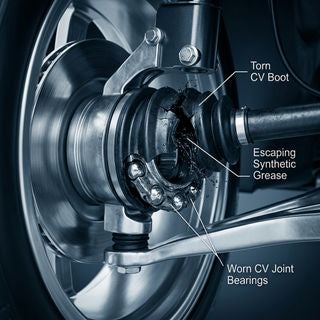
A car makes a rhythmic clicking noise when turning primarily because of a worn outer constant velocity joint on a front-wheel-drive or all-wheel-drive drive axle. When the joint's protective rubber boot tears or cracks, synthetic grease escapes and dirt enters, causing the internal steel bearings and cage to wear and snap repeatedly against their channels on every rotation during tight turns under load. A repeating click that speeds up as road speed increases is one of the most recognizable drivability symptoms in modern vehicles. On front-wheel-drive models and all-wheel-drive crossovers like the 2026 Ford Escape AWD, the outer constant velocity joint undergoes significant pivoting to transfer engine torque while accommodating steering angles. As bearing clearances expand from mechanical wear, every full turn shifts torque across pitted metal surfaces, creating a distinct popping or clicking sound. Identifying whether the sound occurs during slow maneuvers or higher-speed cornering helps narrow down the mechanical source before scheduling a professional vehicle evaluation. If you suspect an issue with your vehicle's front axle or steering, our team at Tri State Ford can inspect your suspension and driveline at 1503 Pennsylvania Ave, or you can give us a quick call to discuss what you are hearing on the road. Table of Contents How Do Constant Velocity Joints Work and Why Do They Click? What Is the Mechanical Cause of Turning Clicks and Typical CV Axle Repair Costs? Can Bad Wheel Bearings, Ball Joints, or Brake Calipers Cause Turning Clicks? How Far Can You Drive on a Clicking CV Axle and How Do You Identify Which Side Is Failing? Common Questions About Vehicle Turning Clicks and Drivetrain Repairs Schedule Drivetrain Inspection and Service How Do Constant Velocity Joints Work and Why Do They Click? Constant velocity joints transfer smooth rotational power from the transmission and differential to the drive wheels at a continuous speed while allowing the front wheels to steer and absorb vertical suspension movement. They click when damaged bearing balls or worn housing tracks snap against each other under angular stress during turns. Every drive axle features two distinct joint designs that work together: Outer CV joint: Positioned adjacent to the wheel hub, this component accommodates steering angles up to 45 degrees while continuing to turn the wheel smoothly. Inner CV joint: Positioned near the transaxle or differential, this component flexes up and down to follow vertical suspension travel over bumps and uneven pavement. Flexible rubber boot: An accordioned neoprene or silicone cover clamped tightly over each joint to seal in high-temperature grease and seal out moisture, sand, and road grit. Because outer joints endure both rotational force and sharp steering angles, they experience greater lateral stress than inner joints. When a rubber boot degrades or suffers road debris damage, grease flings outward onto nearby suspension parts. Starved of lubrication, internal steel ball bearings grind against their hardened cage. During turns, the severe angle forces these misaligned bearings into worn pockets, producing a rhythmic clicking or snapping sound that gets louder as throttle is applied. Driveline components on capable 4x4 models, such as the 2026 Ford Bronco Sport 4x4 equipped with its SelectShift® transmission and 2L engine, rely on pristine CV axle boots to maintain smooth torque delivery across rugged terrain and daily commutes alike. Commuters navigating gently rolling terrain and State Route 170 around Calcutta often notice this symptom first during tight low-speed turns, such as turning into a driveway or making a U-turn. Heavier vehicles and commercial setups, including our F-Series work truck options, rely on robust front driveline assemblies that demand routine inspection during scheduled maintenance intervals to ensure long-term durability. What Is the Mechanical Cause of Turning Clicks and Typical CV Axle Repair Costs? The primary mechanical cause of a turning click is an outer CV joint with worn internal ball bearings, with professional CV axle replacement contact us for current pricing depending on vehicle drivetrain design and labor complexity. When diagnosing turning noises, the precise failure mechanism dictates the necessary repair path: Split boot without joint noise: If a split flexible boot is discovered early before contamination or noise occurs, replacing just the boot assembly typically costs between $180 and $450. Worn joint with active clicking: Once rhythmic snapping or clicking is present, internal metal scoring has already occurred. Installing a complete original equipment or remanufactured CV axle assembly usually costs $250 to $650 per side for standard front-wheel-drive passenger cars, while specialized all-wheel-drive or heavy-duty trucks can reach $700 or more due to additional labor. Secondary hub or suspension labor: If corrosion or seized hardware requires extra shop time, overall repair expenses increase accordingly. Drivers who bring a vehicle in with a turning noise often ask if replacing just the boot will fix it, but technicians recommend replacing the entire axle assembly once clicking starts because internal metal scoring cannot be undone by fresh grease alone. Installing a factory-spec complete axle assembly ensures proper shaft balance, correct splines, and factory-torqued axle nuts. Vehicle owners performing maintenance or working with trusted technicians can order genuine Ford parts online directly through our facility to ensure factory fitment and durability. Can Bad Wheel Bearings, Ball Joints, or Brake Calipers Cause Turning Clicks? Bad wheel bearings, worn ball joints, and sticking brake calipers can all cause noise while turning, but each produces a distinct sound and vibration profile rather than the sharp, rhythmic clicking of a failing outer CV joint. Differentiating among front-end component noises requires paying close attention to pitch, rhythm, and driving conditions: Wheel bearing: A failing wheel bearing produces a low-frequency hum, growl, or drone that grows louder with vehicle speed. The sound changes tone when vehicle weight shifts from side to side during high-speed cornering, rather than producing a sharp metallic click during low-speed turns. In extreme failure stages, a disintegrating bearing can clunk as load shifts across the hub. Ball joint and tie-rod end: A worn ball joint or loose tie-rod end creates a deep creaking, popping, or heavy clunk when turning the steering wheel or driving over bumps. This noise stems from mechanical play in the suspension pivot points rather than rotational speed. Brake dust shield and hardware: A bent metal dust shield or loose brake pad retainer clip can scrape or tick against the brake rotor. This noise often changes when applying the brakes and occurs even when rolling straight. Sway-bar link and strut mount: Worn sway-bar link bushings or binding upper strut mount bearings snap or knock once as the body rolls during a turn, rather than producing a continuous, speed-dependent click. Drivers experiencing frequent stop-and-go driving along commercial corridors like Market Street in Boardman subject their front steering and suspension joints to thousands of movement cycles daily. Inspecting these components together during routine service isolates the exact source of any front-end noise. How Far Can You Drive on a Clicking CV Axle and How Do You Identify Which Side Is Failing? A vehicle can sometimes be driven a few hundred miles after initial CV axle clicking begins, but continued driving risks complete axle fracture, loss of motive power, and secondary damage to the wheel hub or transmission. Identifying which side has failed requires a simple road test in an empty parking lot: Right-turn load test: Turn the steering wheel sharply to the right while accelerating gently in a slow circle. If clicking intensifies, the driver-side (left) outer joint is under heavy load and is likely failing. Left-turn load test: Turn the steering wheel sharply to the left under light throttle. Increased clicking points toward a failing passenger-side (right) outer joint. Visual boot check: Inspect behind both front wheels with a flashlight. Fresh grease splattered across the inner wheel barrel, brake caliper, or lower control arm clearly identifies a torn boot. Ignoring a clicking axle eventually leads to bearing cage disintegration. If the joint snaps completely while driving, the drive shaft spins freely without delivering power to the wheels, leaving the vehicle stranded. In severe cases, a loose spinning shaft can damage the transmission housing or front suspension arms. Schedule an evaluation promptly, or schedule a test drive or inspection visit with our service team to evaluate your vehicle's road performance safely. Common Questions About Vehicle Turning Clicks and Drivetrain Repairs Q: Does a turning click always mean the outer CV joint is failing? A rhythmic clicking that speeds up with road wheel rotation during sharp turns is caused by a worn outer CV joint in the vast majority of cases. However, loose brake hardware, a bent brake rotor dust shield, or a severely damaged wheel bearing can occasionally mimic rotational noises. A physical underbody inspection confirms whether axle boot tear or joint play is present. Q: Why does the clicking sound get louder when accelerating through a turn? Applying throttle transfers engine torque directly through the drive axle while the joint operates at an angle. This added rotational force pushes the internal steel bearing balls harder against worn grooves in the joint cage, accentuating mechanical clearance and making the rhythmic click much sharper and louder. Q: Can a torn CV boot be replaced without installing a whole new axle? A boot replacement is feasible only if the damage is caught immediately before grease loss occurs and before grit enters the joint. Once a joint begins making audible clicking or popping sounds, internal wear has scored the metal surfaces, requiring a complete CV axle replacement to restore safety and proper operation. Q: Will a bad CV joint cause steering wheel vibration? While an outer joint primarily clicks during turns, a severely worn joint or unbalanced axle shaft can cause noticeable vibration through the steering wheel or floorboards during acceleration. Inner joint failure more frequently causes heavy front-end wobble or shudder during straight-line acceleration. Q: What happens if a CV axle snaps completely while driving? If an axle joint fractures completely, engine power can no longer reach that drive wheel. On front-wheel-drive vehicles, the car loses all forward movement. The broken axle shaft can also swing freely, causing secondary damage to nearby brake lines, steering linkages, and transmission seals. Schedule Drivetrain Inspection and Service Addressing turning noises early prevents unexpected breakdown situations and protects critical front suspension and steering components from severe secondary damage. Rhythmic clicking or popping during turns indicates that driveline components require expert evaluation by certified technicians who understand factory tolerances and OEM replacement standards. Our factory-trained service team provides thorough multi-point underbody inspections, precise diagnostic play checks, and high-quality replacement parts tailored to your specific vehicle model. Whether you drive a front-wheel-drive sedan, an all-wheel-drive crossover, or a four-wheel-drive truck, maintaining proper drive axle integrity preserves smooth handling, tire wear, and long-term driving confidence. If your vehicle is making unusual noises when turning, visit our service center at 1503 Pennsylvania Ave, give our advisors a quick call, or easily schedule a service appointment online today to keep your vehicle operating smoothly and reliably. © 2026 Tri State Ford. All rights reserved. Vehicle specification data © JATO Dynamics Limited. Clicking Noise When Turning in East Liverpool OH | Tri State Ford

5

What Should You Check Before Buying a Used Car?

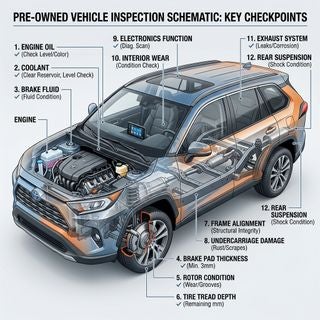
Before buying a used car, perform a systematic pre-purchase evaluation covering five core areas: a stone-cold engine start, an under-hood fluid and belt inspection, an exterior check for paint overspray and panel misalignments, a comprehensive road test across all speeds, and a complete title and vehicle history verification. Checking these key items protects your investment, identifies hidden structural or mechanical issues, and gives you clear leverage during purchase evaluation. A thorough used car assessment requires systematically working from the engine bay to the test drive route. Running the 17-character VIN through the official NHTSA recall lookup ensures there are no unresolved safety recalls before you commit to a vehicle purchase. You should also verify that the seller's identification matches the name printed on the physical title, examine state title records, and review a full vehicle history report to rule out previous flood exposure or title fraud. When walking buyers through a pre-owned truck or SUV on the lot, the first thing shoppers usually ask to see is a true cold start before taking it out on the road. Gathering your financial documentation ahead of time streamlines the entire transaction once you find the right vehicle. Completing an online credit application helps establish your purchasing budget before setting foot on the lot. If you want to view pre-owned cars in person or schedule a professional vehicle appraisal, you can obtain directions to our showroom at 1503 Pennsylvania Ave, East Liverpool, OH 43920 or give our sales team a quick call to check current vehicle availability. Table of Contents What Cold-Start Checks on a Used Car Reveal Hidden Engine Issues? What Key Mechanical Components and Fluids Should You Inspect Under the Hood? What Exterior and Body Condition Signs Indicate Prior Accident Damage or Rust? How Do You Determine Fair Market Value and Negotiate a Purchase Value in Calcutta? What Is the Difference Between Manufacturer CPO and Dealer Certified Programs? What Questions Do Used Car Buyers Ask Most Before Finalizing a Deal? What Cold-Start Checks on a Used Car Reveal Hidden Engine Issues? Insisting on a true cold start reveals critical engine flaws—such as worn valve stem seals, timing chain slack, and failing fuel pumps—that a pre-warmed engine easily conceals. Starting the vehicle when the engine block is completely cold forces hidden rattles, smoke emissions, and rough idle issues to present themselves immediately. Arranging your visit in advance allows you to request that the seller leave the vehicle untouched for several hours before you arrive. Touching the hood upon arrival lets you confirm the engine block is stone-cold. When turning the key, observe the tailpipe for exhaust smoke; persistent blue smoke indicates burning oil from worn piston rings or valve guides, while heavy white smoke that smells sweet points to internal coolant leaks. Listen closely during the first two seconds after startup. A sharp metallic rattle that disappears once oil pressure builds often indicates a loose timing chain or worn hydraulic lifters. Browsing carefully maintained pre-owned single-owner models reduces the likelihood of encountering these deferred maintenance issues, as complete service records typically accompany well cared-for vehicles. What Key Mechanical Components and Fluids Should You Inspect Under the Hood? Inspecting the vital engine fluids, rubber hoses, serpentine belt, and battery connections under the hood reveals how consistently the previous owner maintained the vehicle. Healthy fluids display clear coloration without burnt smells or contamination, directly indicating the internal health of the engine, transmission, and cooling system. Pulling the engine oil dipstick allows you to verify both fluid level and consistency. Oil should range from amber to dark brown; a gritty texture signals neglected oil changes, while a milky, frothy appearance under the oil cap or on the dipstick indicates coolant mixing with the oil due to a blown head gasket or cracked block. Inspecting the transmission fluid dipstick—where equipped—is equally critical. Healthy automatic transmission fluid is bright red, whereas dark brown or black fluid with a burnt odor signifies severe clutch wear and internal thermal breakdown. Examine the coolant expansion tank for oily films or rust deposits, check drive belts for frays or cracking, and look for white corrosion around battery terminals to ensure the electrical system remains sound. What Exterior and Body Condition Signs Indicate Prior Accident Damage or Rust? Uneven body panel gaps, inconsistent paint texture, scratched fender bolt heads, and bubbling paint near wheel arches are clear physical indicators of prior collision repair or advancing corrosion. Spotting these exterior defects helps you identify structural damage that unibody repairs may have tried to mask. Evaluating exterior body condition requires inspecting panel alignment along the hood, doors, and trunk seam lines. Consistent gaps along every edge indicate factory assembly, whereas a gap that narrows or widens sharply suggests a panel was removed or realigned following an impact. Sighting down the side of the body panels under natural light helps uncover subtle ripples or heavy orange peel texture from non-factory resprays. Checking fender bolts inside the engine compartment reveals whether body panels have been unbolted for repairs; scratched paint on bolt heads proves a wrench was used. Running a light plastic-coated magnet over lower door panels and rear quarters confirms whether steel sheet metal or plastic body filler lies beneath the paint. Examining the riverfront bluffs terrain along East Liverpool highlights why inspecting the undercarriage for frame rust and pinch-weld damage is essential on local vehicles exposed to moisture and road salt. How Do You Determine Fair Market Value and Negotiate a Purchase Value in Calcutta? Determining fair market value requires comparing local market vehicle listings against trusted valuation guides while adjusting for exact mileage, trim level, vehicle condition, and history. Presenting documented repair estimates from an independent inspection gives you firm, factual leverage to negotiate a reasonable price adjustment. Establishing a realistic offer begins with researching recent sales data for identical vehicle configurations in your region. Adjusting your target price based on documented condition issues—such as uneven tire wear indicating alignment or suspension faults—provides an objective foundation for negotiation rather than aggressive haggling. Evaluating your current vehicle's worth online using a trusted trade-in valuation tool gives you an exact baseline for offset financing when buying a pre-owned truck or SUV. Navigating the gently rolling hills around Calcutta requires a capable, dependable vehicle, whether you are choosing between a quality used truck or exploring brand-new Ford inventory options to match your daily driving needs. What Is the Difference Between Manufacturer CPO and Dealer Certified Programs? Manufacturer Certified Pre-Owned (CPO) programs provide factory-backed warranty protection honored at authorized brand dealerships nationwide, whereas dealer-certified programs rely on third-party service contracts restricted to specific dealer networks. Choosing a factory CPO model guarantees original equipment replacement parts and standardized multi-point factory inspections. A factory CPO vehicle undergoes an exhaustive inspection process administered by factory-trained technicians to meet strict age and mileage thresholds. A Gold Certified Ford vehicle includes a 12-month/12,000-mile comprehensive limited warranty alongside a 7-year/100,000-mile powertrain limited warranty, providing peace of mind backed directly by the manufacturer. Exploring our selection of certified pre-owned Ford vehicles allows you to combine factory-backed protection with advanced features like Ford Co-Pilot360 and SYNC 4 infotainment technology. Buyers can also take advantage of current national vehicle incentives on select models, or review available factory service offers to keep their vehicle running smoothly over the long haul. What Questions Do Used Car Buyers Ask Most Before Finalizing a Deal? Q: What documentation should I bring to the dealership when buying a used car? You should bring a valid driver's license, current proof of auto insurance, your most recent pay stubs or proof of income, and proof of residency such as a utility bill. If you plan to trade in your current vehicle, bring the physical title, current registration, and all original set of keys. Having these documents ready prevents paperwork delays and speeds up loan approval. Q: How long does a thorough test drive need to be when evaluating a used vehicle? A complete test drive should take about 15 to 20 minutes to evaluate the car across different driving conditions. You need enough time to test low-speed maneuvering on local streets, complete several firm stops to check brake feel, and accelerate up to highway speeds to listen for wheel bearing noise, transmission slipping, or steering vibration. Q: Does a clean vehicle history report guarantee that a used car has never been in an accident? No, a clean history report only reflects incidents reported to insurance companies, law enforcement, or repair databases. Private accident repairs paid out-of-pocket leave no official paper trail on history reports. Always combine a vehicle history report with a thorough physical inspection of panel gaps, seam sealers, and bolt heads to verify body integrity. Q: Should I test drive a used car on both surface streets and the highway? Yes, driving across both environments reveals distinct mechanical behaviors. Low-speed surface driving highlights power steering noise, suspension clunks over bumps, and low-gear transmission engagement. Highway speeds reveal wheel imbalance, alignment pulling, high-rpm engine performance, and wind noise around door seals that low-speed parking lot drives completely miss. Q: Can missing original accessories or spare keys affect the final purchase price? Yes, missing factory items like key fobs, floor mats, cargo covers, or owner's manuals add real out-of-pocket replacement costs after purchase. Modern electronic key fobs with remote start or push-button ignition can cost several hundred dollars to cut and program. Pointing out missing original equipment provides legitimate justification for asking the seller for a value discussion. When you are ready to shop for your next pre-owned vehicle with total confidence, visit our dealership or call our friendly sales team at (330) 462-7578 to schedule your test drive today. Keep Your Vehicle Running Strong Keep your vehicle performing at its best with our service team: Order Parts Schedule Service Appt © 2026 Tri State Ford. All rights reserved. Used Car Inspection Tips in East Liverpool OH | Tri State Ford
f

When Is a Tire Considered Legally Unsafe to Drive On?

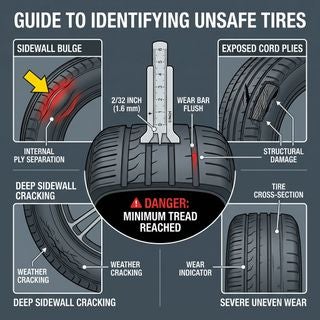
A passenger vehicle tire is legally unsafe to drive on when its tread depth wears down to 2/32 inch (approximately 1.6 mm), when built-in wear indicator bars become flush with the tread surface, or when structural damage such as sidewall cracks exceeding 1.5 mm deep, exposed internal cords, bulges, or tread separation appear. In Ohio, driving on tires below the legal minimum tread limit compromises wet-weather stopping distance and elevates the risk of hydroplaning, necessitating immediate replacement to maintain vehicle control and road safety. Maintaining proper tire health is essential for protecting your vehicle and everyone inside it. Tire tread serves a mechanical purpose: it evacuates water from beneath the rubber contact patch so your vehicle can steer and stop effectively. When tread rubber wears down past safe thresholds, traction drops sharply on wet asphalt and slush, causing stopping distances to increase dramatically even at moderate road speeds. Beyond tread depth, a tire becomes unsafe whenever its structural casing is compromised. Internal belting and rubber compounds break down over time due to age, heat cycles, UV exposure, and impact stress from road hazards. Physical deformities like bubbles on the sidewall indicate that internal structural plies have ruptured, allowing high-pressure air to push against the outer rubber layer. Continuing to drive on a tire with internal plies damaged like this risks a sudden highway blowout. Regular multi-point safety inspections help spot these compromised conditions before they cause a breakdown on the road. Drivers can visit our dealership location at 1503 Pennsylvania Ave for a thorough tire safety check, give our team a quick call to discuss any unusual tire symptoms, or schedule a test drive in a new vehicle equipped with the latest safety technologies. Table of Contents At What Tread Depth Must You Replace Passenger Vehicle Tires? How Do Formal Inspection Standards Define Unsafe Wear Patterns and Commercial Thresholds? How Deep Must Sidewall Cracks from Dry Rot Be Before Mandatory Replacement? What Are the 7 Critical Warning Signs That You Need New Tires Right Away? Common Questions About Tire Safety, Wear Patterns, and Replacement Limits Schedule Certified Tire Care and Safety Inspections At What Tread Depth Must You Replace Passenger Vehicle Tires? Passenger vehicle tires reach their mandatory replacement limit at 2/32 inch of remaining tread depth, though automotive safety standards strongly recommend replacing all-season tires once tread wears down to 4/32 inch for adequate wet-weather braking and hydroplane resistance. Once tread depth drops below 4/32 inch, a tire loses up to three-quarters of its capacity to channel water away from the contact patch, significantly increasing stopping distances during heavy rainfall. | Tread Depth | Safety Condition | Driver Action Required | | --- | --- | --- | | 6/32 inch or more | Good Condition | Routine maintenance and regular rotations | | 4/32 inch | Recommended Limit | Plan for replacement; wet grip decreases | | 2/32 inch | Mandatory Replacement | Immediate replacement required by law | Checking your tread depth at home takes less than a minute and requires only simple tools. The traditional coin check offers a fast visual reference: insert a standard U.S. penny upside down into the main tread groove with Abraham Lincoln's head facing you. If the top of Lincoln's head remains completely visible above the rubber block, your tread depth has reached or fallen below the legal minimum threshold of 2/32 inch, and the tire must be replaced immediately. For a clearer picture of seasonal performance, perform a quarter check. Placing a quarter upside down into the groove measures depth against George Washington's head, which sits at roughly 4/32 inch from the coin edge. If the top of Washington's head is visible, the tire has reached the point where wet traction and snow gripping power decline noticeably. Measuring multiple spots across the tire surface is critical because alignment issues or improper inflation often cause uneven rubber loss. Check the inner groove, center groove, and outer edge groove on every tire. If any single groove reads 2/32 inch or lower, that tire is legally worn out regardless of how much rubber remains on the rest of the surface. Driver assist features like pre-collision assist with automatic emergency braking rely on solid tire traction to slow your vehicle effectively in emergencies. Our tire center makes finding the correct factory-fit replacement straightforward. You can easily order tires matched by vehicle year, make, and model through our online portal, or view our current manufacturer vehicle specials for service offers on complete tire sets. How Do Formal Inspection Standards Define Unsafe Wear Patterns and Commercial Thresholds? Formal motor vehicle inspection standards define a tire as unsafe when molded wear indicator bars sit level with adjacent tread blocks, when wear is uneven across the tread face, or when tread on heavy vehicles weighing over 10,000 pounds falls below 4/32 inch on steering axles. State inspection codes and federal safety guidelines require tires to maintain uniform tread coverage across all major grooves to ensure vehicle stability and predictable tracking. Uneven tread wear patterns signal specific underlying mechanical or maintenance issues that compromise safety: Shoulder Wear on Both Edges: Heavy rubber loss on both outer shoulders indicates chronic under-inflation, which causes the tire center to collapse inward and forces the outer edges to bear excessive vehicle weight. Center Tread Wear: Concentrated wear along the center rib indicates over-inflation, reducing the contact patch size and causing harsh ride quality along with accelerated center tire wear. Single-Edge Wear: Pronounced wear along only the inner or outer edge points to wheel misalignment, camber errors, or worn steering linkages that pull the tire sideways as it rolls. Cupping or Scalloping: High-and-low diagonal dips across the tread surface indicate worn shock absorbers, out-of-balance wheel assemblies, or damaged suspension bushings allowing the wheel to bounce down the road. Safety standards enforce stricter tread thresholds for heavier vehicles due to the immense kinetic energy and stopping distance required for large trucks and towing rigs. While passenger cars share a mandatory minimum floor of 2/32 inch, vehicles with a gross vehicle weight rating exceeding 10,000 pounds must maintain at least 4/32 inch of tread depth on front steering axle tires. Commercial standards also mandate that any tire with two adjacent tread grooves measuring below 2/32 inch, or any tire showing internal fabric, steel belts, or ply separation, must be removed from service immediately. Commuters navigating the rolling hills and highway stretches around Calcutta encounter varying pavement textures and seasonal weather that accelerate uneven wear if tire maintenance is neglected. Regular rotations every 5,000 to 8,000 miles distribute steering and driving forces evenly across all four positions, extending total tread life and keeping wear patterns uniform. How Deep Must Sidewall Cracks from Dry Rot Be Before Mandatory Replacement? Sidewall cracks caused by dry rot require immediate tire replacement when they reach 1.5 mm (approximately 1/16 inch) in depth, when internal structural cords become visible, or when deep fissures open anywhere along the sidewall face. Even if a tire retains substantial tread height, rubber compound oxidation causes structural brittleness that can result in sudden tread separation or sidewall blowouts at highway speeds. Rubber degradation is a chemical process triggered by atmospheric ozone, ultraviolet light, heat cycles, and extended vehicle inactivity. Tire manufacturers blend protective waxes and anti-ozonant compounds into the rubber to maintain elasticity. When a vehicle is driven regularly, the mechanical flexing of the rotating wheel pushes these protective waxes to the surface. When a vehicle sits parked for long periods, this continuous replenishment stops, allowing UV rays and environmental oxygen to break down polymer chains inside the rubber matrix. A simple thumb flex check helps evaluate whether sidewall cracking is cosmetic checking or deep structural failure: Clean and Inspect: Wipe dirt and grime off the tire sidewall near the rim flange and raised lettering where micro-cracking usually begins. Apply Pressure: Press your thumb firmly against the rubber directly beside the crack to flex the sidewall surface. Observe Fissure Behavior: If the crack remains shallow and closed under pressure, it is superficial surface checking. If the crack opens up to reveal lighter inner rubber, nylon cords, or steel wire, the tire structure is compromised. The presence of full tread depth can create a dangerous false sense of security on older tires. Low-mileage vehicles, seasonal trailers, and secondary commuter cars often show deep tread blocks while the underlying carcass has dry rotted into a brittle state. Chemical tire dressings containing heavy petroleum distillates or harsh silicone solvents accelerate this dry rot process by stripping away the factory anti-ozonant barrier. Cleaning tires with mild soap and water is the safest way to preserve sidewall elasticity. When replacement components or specialized tire equipment are needed, drivers can order genuine OEM parts directly through our service portal to ensure exact fitment and factory safety standards. What Are the 7 Critical Warning Signs That You Need New Tires Right Away? Drivers should inspect their tires monthly for seven clear indicators that signal a tire has reached the end of its safe operational life and requires replacement: 1. Tread Depth Below 2/32 Inch: Rubber worn down to or past the legal 2/32 inch limit cannot evacuate water or slush, creating severe hydroplaning hazards. 2. Flush Tread Wear Indicators: Molded rubber bars running across the bottom of the tread grooves sit level with surrounding tread blocks when the tire is fully worn out. 3. Deep Sidewall Cracking or Dry Rot: Cracks reaching 1.5 mm deep or showing internal structural cords reveal severe chemical degradation of the rubber matrix. 4. Sidewall Bulges, Bubbles, or Blisters: A localized bulge on the outer sidewall indicates that the internal structural plies have ruptured, allowing air pressure to push out the surface rubber. 5. Persistent Air Pressure Loss: A tire that consistently loses pressure or triggers the tire pressure monitoring system (TPMS) warning light without an obvious nail puncture often suffers from bead leaks or internal liner porosity. 6. Excessive Steering Wheel Vibration or Vehicle Pulling: Unexplained shaking through the steering wheel or seat that persists after wheel balancing suggests internal belt separation or structural casing distortion. 7. Severe Irregular Wear Patterns: Deep cupping, diagonal scuffing, or severe inner-edge wear exposes internal plies and drastically reduces tire traction. Drivers taking daily trips through Boardman often experience persistent steering wheel vibration when internal tire belts begin shifting under load. Physical damage like sidewall bulges from impact with deep potholes requires immediate attention, as a bulged tire can burst without warning under normal road stresses. If a blowout occurs while driving, avoid slamming on the brakes. Keep both hands firmly on the steering wheel, maintain momentum for a brief second to stabilize vehicle trajectory, ease off the accelerator gradually, and guide the vehicle safely onto the road shoulder. For roadside emergencies, drivers can access manufacturer-backed assistance directly through Ford Roadside Assistance: 1-800-241-3673 for flat tire changes and towing support. Common Questions About Tire Safety, Wear Patterns, and Replacement Limits Q: At what specific tread depth are passenger tires legally considered unsafe and due for mandatory replacement, even if they still look usable? Studies show that nearly 30% of tire-related accidents involve tires worn below the legal tread depth limit of 2/32 inch (about 1.6 mm). At this depth, the built-in wear indicator bars molded into the tread grooves become flush with the outer tread face. While a tire with 2/32 inch of tread may appear visually intact from a distance, its ability to channel water on wet pavement is compromised, leading to increased stopping distances and severe hydroplaning risks. Q: How do formal inspection and safety standards define unsafe tread wear patterns, including thresholds for heavier vehicles, beyond simple visual checks? Formal inspection standards classify a tire as unsafe if any tread wear indicator bar touches the road surface, if tread wear is uneven across the tread face, or if internal steel belts or fabric cords are exposed. For vehicles weighing over 10,000 pounds, safety standards mandate a minimum tread depth of 4/32 inch on front steering axles to maintain control under high load conditions. Uneven wear patterns like cupping, shoulder wear, or single-edge wear indicate alignment, inflation, or suspension failures that require immediate correction. Q: How deep do sidewall cracks from dry rot need to be before a tire must be replaced immediately, even if the tread depth is still above the legal minimum? Sidewall cracks from dry rot dictate immediate tire replacement when they reach 1.5 mm (roughly 1/16 inch) in depth, open up under manual pressure to reveal inner lighter rubber, or expose underlying structural cords. Deep dry rot cracks mean volatile oils inside the rubber compound have evaporated, leaving the tire brittle and susceptible to catastrophic sidewall blowouts regardless of how much remaining tread depth is present. Q: How does the DOT date code on a tire sidewall indicate when a tire is expired? The DOT date code is a four-digit number stamped on the tire sidewall that represents the week and year of manufacture. For example, a code reading 3121 indicates the tire was produced during the 31st week of 2021. Major safety guidelines recommend having tires inspected annually after 5 years in service and replacing any tire once it reaches 6 to 10 years of age from its manufacture date, as internal rubber compounds degrade over time even when stored or driven infrequently. Q: What action should a driver take if a tire experiences a sudden blowout at highway speeds? If a tire suffers a sudden blowout, hold the steering wheel firmly with both hands to maintain control and resist the urge to slam on the brakes. Maintain light pressure on the accelerator for a brief moment to stabilize the vehicle's momentum, then ease off the gas pedal gradually while steering straight. Once the vehicle slows down and stabilizes, signal gently and guide the car onto a safe, flat surface off the roadway before applying the brakes. Schedule Certified Tire Care and Safety Inspections Regular tire care and timely replacements are essential for maintaining your vehicle's safety, fuel economy, and handling stability. Driving on worn tread, dry-rotted sidewalls, or damaged internal belts puts your safety at risk, especially during severe weather conditions. Professional tire inspections identify subtle wear patterns, improper inflation, and structural defects long before they lead to roadside breakdowns. Our factory-trained technicians provide comprehensive tire health checks, wheel alignments, precision balancing, and tread depth assessments using specialized diagnostic equipment. Whether you need a simple rotation or a complete set of new factory-recommended tires, our team ensures your vehicle leaves our service bay operating at peak safety standards. Taking care of your tires is easy and convenient with our online booking tools. You can get directions to our service center, give our service desk a quick call to ask about current tire availability, or schedule a service appointment online to keep your vehicle running safely on every trip. © 2026 Tri State Ford. All rights reserved. Tire Safety & Legal Limits in East Liverpool OH | Tri State Ford
d

How Do You Know If a Used Car Is Worth Buying?

A used car is worth buying when it has a clear title, documented maintenance records, no structural frame damage, healthy fluid levels, and a pre-purchase inspection showing sound mechanical performance that justifies the asking price. Verifying these core factors ensures you get reliable transportation that protects your budget and your family on every drive. Evaluating a pre-owned vehicle requires a methodical approach that combines physical inspection, history verification, and a comprehensive test drive. Whether you need a dependable truck for work, a midsize SUV for daily commutes along State Route 170 in Calcutta, or a spacious full-size model for family road trips, checking 12 critical areas helps you separate well-maintained vehicles from high-risk options: Vehicle Identification Number (VIN) consistency across all body tags and legal title documents Vehicle history report verification for accident, lien, and title status Exterior body panel alignment and frame integrity check Tire tread depth, inflation pressure, and wear pattern evaluation Essential fluid levels and fluid cleanliness (engine oil, coolant, transmission, brake fluid) Brake system responsiveness, pad thickness, and rotor surface condition Undercarriage rust inspection, focusing on rocker panels and structural rails Engine start-up sound, exhaust clarity, and idle smoothness Transmission engagement, shift timing, and power delivery Steering precision, suspension dampening, and wheel alignment Interior electrical systems, air conditioning, and smartphone integration infotainment controls Operational testing of active safety technology and driver-assist features Taking the time to evaluate these 12 factors before signing any paperwork provides complete confidence in your purchase. Our sales team at Tri State Ford believes in absolute transparency, providing transparent vehicle details and multi-point inspection summaries for every pre-owned model on our lot. When you are ready to explore our current selection in person, you can easily find our East Liverpool showroom location or give our staff a quick call to ask about specific vehicle arrivals. Table of Contents What Are the Most Important Physical and Mechanical Checks on a Used Car? How Do You Verify Vehicle History and Check for Unreported Accidents? Is High Mileage Highway Driving Better Than Low Mileage City Driving? Is a Certified Pre-Owned Vehicle Worth the Price Difference Over Regular Used? Should You Hire a Mechanic for a Pre-Purchase Inspection? What Buyers Ask Most About Used Car Inspections and CPO Vehicles What Are the Most Important Physical and Mechanical Checks on a Used Car? The most critical physical and mechanical checks on a used car prioritize engine oil quality, brake pad and rotor wear, transmission shift smoothness, underbody corrosion, and tire wear patterns. Focusing on these vital mechanical areas prevents unexpected repair expenses immediately after purchase. Starting under the hood gives you an immediate picture of how the previous owner cared for the vehicle. Pull the engine oil dipstick to confirm the oil is smooth and amber or dark brown; milky oil indicates coolant contamination from a blown head gasket, while gritty or thick black oil signals extended missed oil changes. Examine the engine coolant reservoir to verify clean, brightly colored fluid rather than rusty sludge. Checking transmission fluid reveals whether the internal clutches have overheated; clean fluid presents a clear reddish color without a burnt odor. Fluid guidelines published in the AAA Time-Stamped Car Maintenance Checklist emphasize replacing low, dark, or dirty fluids immediately rather than simply topping them off to maintain internal component hydraulic pressure. Tires tell an honest story about steering alignment and suspension health. Inspect all four tires across the entire tread surface. Uneven wear on the inner or outer edges often points to misaligned wheels, worn tie rods, or failing struts. Verify that tread depth exceeds minimum safety thresholds so your family stays secure during sudden rainstorms or icy winter roads. When examining the exterior, look closely along side door panels and wheel arches for bubbling paint or flaking metal. In regions exposed to road salt, undercarriage corrosion on frame rails and rocker panels can compromise structural integrity. On a road test, pay close attention to how the vehicle accelerates, stops, and handles. Grinding noises or pulsing in the pedal when slowing down signal worn brake pads or warped rotors. Test modern convenience and driver assistance features, including blind spot monitoring, lane-keeping assist, touchscreens, and easy smartphone connection menus, to ensure all onboard electronics function properly. If you plan to upgrade your current ride, start by estimating your trade-in value online to see how your current vehicle can reduce the overall purchase cost of a high-quality pre-owned car, truck, or SUV. How Do You Verify Vehicle History and Check for Unreported Accidents? You verify a vehicle history by matching the VIN across the dashboard, door jamb, and title documentation, then running that number through an official history database like CARFAX or AutoCheck. Matching these identifiers prevents title fraud and reveals documented owner history, service records, and reported collisions. While official vehicle history reports capture accidents reported by police departments, insurance companies, and body shops, minor fender benders paid out-of-pocket may not appear on a digital record. Combining a history report with a physical visual inspection protects you against hidden previous repairs. Look for these physical indicators of past body work or frame repairs: Uneven gaps between exterior body panels, fenders, hood lines, and trunk lids Paint color variations between adjacent panels or rough overspray on rubber door seals Fresh undercoating applied selectively over isolated sections of the underbody or frame rails Clamp marks, welding ripples, or distorted metal on inner frame structures under the hood or trunk floor Headlight or taillight lenses that look brand new on one side while cloudy on the other Systematically checking these physical details prevents unpleasant surprises later. Once you feel confident about what type of vehicle and history profile suits your daily routine, you can explore current purchase specials or check out national manufacturer offers to compare buying pre-owned versus purchasing new. If you prefer a specific color or feature package, our sales specialists can also assist with a custom vehicle order tailored directly to your family's preferences. Is High Mileage Highway Driving Better Than Low Mileage City Driving? High-mileage highway driving is generally better for a vehicle's mechanical longevity than low-mileage city driving because steady cruising maintains consistent operating temperatures and drastically reduces mechanical stress. Sustained highway miles produce far less wear per mile on major vehicle systems compared to short, frequent trips around town. During highway cruising, the engine operates at a steady rotation speed with continuous oil pressure and optimal coolant circulation. The transmission remains locked in top gear, which eliminates the heat generated by constant gear hunting. Brakes, suspension bushings, starter motors, and clutch packs experience minimal engagement over long distances. High highway miles also allow the engine to burn off condensation and carbon deposits in the exhaust system. By contrast, stop-and-go driving—such as daily errands around high-density commercial corridors like Market Street in Boardman— subjects a vehicle to repetitive heat cycles, continuous gear changes, aggressive braking, and prolonged engine idling. Cold engine starts in city traffic cause higher internal engine wear because oil takes time to reach full operating temperature and circulation. A vehicle with 80,000 miles driven primarily on open highways often exhibits cleaner internal engine components and tighter suspension dynamics than a city-driven car with 40,000 miles. When evaluating a used vehicle, focus on overall mechanical condition, documented oil change frequency, and drive quality rather than looking solely at the odometer reading. A high-mileage vehicle backed by detailed maintenance logs often represents outstanding long-term value. Is a Certified Pre-Owned Vehicle Worth the Price Difference Over Regular Used? A certified pre-owned vehicle is worth the higher price tag if you want manufacturer-backed extended warranty protection, a rigorous multi-point mechanical inspection, and included roadside emergency coverage. CPO models usually carry a price premium between $1,000 and $3,000 over non-certified used cars of similar age and mileage, but that extra cost covers thorough mechanical reconditioning and factory warranty backing. Standard used cars are sold with remaining factory warranty coverage or as-is, meaning future repair bills become your full responsibility as soon as you drive off the lot. A Certified Pre-Owned vehicle must satisfy strict age and mileage limits before it undergoes a factory-mandated inspection process covering powertrain performance, safety systems, interior amenities, and cosmetic condition. Any worn wear-and-tear components that fail inspection standards are replaced with genuine original equipment manufacturer parts. Key advantages of choosing a CPO vehicle include: Comprehensive extended powertrain and bumper-to-bumper warranty protection Dedicated 24/7 roadside assistance for flat tires, battery jump-starts, and emergency towing Detailed vehicle history verification meeting strict manufacturer certification criteria Low-mileage, late-model vehicles featuring modern safety tech and smartphone integration Flexible pre-owned financing rates offered directly through manufacturer lenders For buyers balancing budget limits with the desire for long-term peace of mind, certified vehicles deliver an ideal middle ground. You can explore a wide range of reliable options by browsing our pre-owned 1-owner inventory or viewing our selection of certified pre-owned Ford inventory to find the right combination of value, warranty coverage, and feature content for your family. Should You Hire a Mechanic for a Pre-Purchase Inspection? Hiring an independent certified mechanic for a pre-purchase inspection is highly recommended whenever you purchase a non-certified used car. Professional mechanics possess the specialized tools, vehicle lifts, and diagnostic equipment required to detect mechanical issues hidden beneath shiny body paint. During a professional inspection, a technician raises the vehicle on a hydraulic lift to examine underside components that are difficult to evaluate from the ground. They inspect CV axle boots, steering rack seals, transmission casings, and differential covers for fluid leaks. They measure brake pad thickness, check brake rotor surfaces, evaluate suspension bushings for dry rot or cracking, and look for structural frame damage or rust. Connecting an OBD-II diagnostic scanner allows the technician to check for pending trouble codes, cleared diagnostic lights, or emission system faults stored in the computer modules. Spending a modest amount on an independent inspection provides immense bargaining leverage or gives you the clear answer needed to walk away from a problematic car. Professional pre-purchase inspections are especially beneficial when purchasing out-of-warranty trucks or high-mileage vehicles. Once you find a solid vehicle that passes mechanical checks, taking the next step toward ownership is simple. You can jumpstart the buying process by completing our secure online financing application to secure competitive loan terms tailored to your household budget. What Buyers Ask Most About Used Car Inspections and CPO Vehicles Q: How do you check for body damage or previous frame repair yourself? Inspect body panel gaps for uniform width along the hood, doors, and trunk lid. Check for subtle color variations between adjacent metal panels and feel along lower door edges for rough paint overspray. Under the hood and inside the trunk floor, look for irregular welding seams, ripples in the sheet metal, or fresh undercoating sprayed over structural frame rails. Q: What tools should you bring to inspect a used car yourself? Bring a high-lumen flashlight to look into dark engine corners and undercarriage areas, a digital tire tread depth gauge, and paper towels to check fluid colors on dipsticks. A small magnet helps detect plastic body filler hidden under exterior paint, while an OBD-II code scanner lets you check onboard vehicle computer modules for hidden diagnostic fault codes. Q: Can a vehicle history report miss previous accidents? Yes, a vehicle history report can miss prior collision damage if the accident was paid out-of-pocket and never reported to insurance companies, law enforcement agencies, or repair facilities that supply data to reporting services. That is why combining a digital history report with a thorough visual inspection and a test drive is always necessary. Q: What driver-assist and tech features should you test on a used vehicle? Test all cabin electronics, including touchscreen response, Bluetooth connectivity, backup camera clarity, and smartphone integration functions like Apple CarPlay or Android Auto. On your test drive, activate active driver-assist systems like adaptive cruise control, blind spot monitoring, and lane-keeping alerts to verify that front sensors and radar units work properly. Q: How do financing options differ between standard used and certified pre-owned vehicles? Certified pre-owned vehicles often qualify for current financing options offered directly by factory-backed lending institutions. Standard used vehicles are financed through traditional bank or credit union loan rates, which vary based on your overall credit profile, down payment amount, and the age of the vehicle. Finding a high-quality used car, truck, or SUV requires balancing mechanical inspection, vehicle history verification, and smart financing. Our sales team at Tri State Ford is dedicated to making your buying experience clear, straightforward, and stress-free. Whether you want to test drive a pre-owned model or check out our complete new vehicle inventory, we are here to help you drive home in a vehicle you trust. Stop by our showroom on Pennsylvania Avenue or reach out to our team at (330) 462-7578 to schedule your test drive today. Keep Your Vehicle Running Strong Keep your vehicle performing at its best with our service team: Order Parts Schedule Service Appt © 2026 Tri State Ford. All rights reserved. Used Car Buying Guide in East Liverpool OH | Tri State Ford

f

What Does a Flashing Check Engine Light Mean? Insights from Our Service Manager

What Does a Flashing Check Engine Light Mean? Insights from Our Service Manager What Does a Flashing Check Engine Light Indicate? A flashing check engine light indicates an active, severe engine misfire occurring right now, allowing unburned fuel to dump directly into your exhaust system. Under SAE J2012 and OBD-II standards, the engine computer blinks the warning lamp when misfire rates reach a threshold high enough to overheat and permanently destroy the catalytic converter within minutes. As the Service Manager at Tri State Ford with a decade of hands-on experience in automotive diagnostics, I see drivers face this issue every month. When your dashboard malfunction indicator lamp flashes rather than staying solid, your vehicle is signaling an immediate mechanical emergency. The computer has detected that one or more cylinders are not firing correctly, which sends raw gasoline down the exhaust stream. When that fuel reaches the extremely hot catalytic converter, it ignites inside the exhaust housing rather than inside the combustion chamber. This secondary combustion rapidly elevates catalytic converter temperatures well past normal operating limits. In severe cases, the internal ceramic honeycombs melt or disintegrate, turning what could have been a straightforward ignition fix into a costly catalytic converter replacement. Drivers navigating the riverfront bluffs and rising terrain around East Liverpool should take this warning seriously, as pulling heavy loads up hills with an active misfire accelerates exhaust system damage. If your light starts blinking while you are on the road, give our team a call at (330) 462-7578 to discuss immediate vehicle care, or find directions to our service center location to bring your vehicle in safely via flatbed tow. Table of Contents Is a Steady Check Engine Light Different From a Flashing Warning? What Causes the Engine Misfire Behind a Flashing Engine Light? Is It Safe to Drive a Short Distance With a Flashing Check Engine Light? How Does an OBD-II Scanner Diagnose Misfire Diagnostic Trouble Codes? How Much Do Professional OBD-II Diagnostic Scans and Repairs Cost? Is a Steady Check Engine Light Different From a Flashing Warning? A steady check engine light signals a non-critical emissions or engine performance fault that requires attention but generally allows you to complete your trip safely. Conversely, a flashing check engine light signifies an ongoing misfire that actively damages vital engine and exhaust hardware every second the vehicle runs. When the warning light remains solid, the onboard computer has logged a diagnostic code for a system operating outside normal tolerances. Common triggers for a steady light include a loose gas cap, a failing oxygen sensor, or a minor leak in the evaporative emissions system. While a steady light should be diagnosed promptly to preserve fuel efficiency and overall engine health, it rarely leaves you stranded on the shoulder or causes sudden catalyst failure. In many instances, the computer initiates a limited operation mode to protect mechanical parts while permitting short-distance driving. A flashing warning light leaves zero room for delay. The constant pulsing pattern—typically blinking once per second—is specifically reserved for conditions that threaten catastrophic hardware breakdown. When drivers ask our service bay about warning lights, I explain that a steady light gives you time to plan a routine diagnostic visit, whereas a flashing light requires shutting off the ignition as soon as you pull into a safe location. Addressing steady lights early by ordering genuine OEM parts like replacement gas caps or sensors helps prevent minor sensor wear from turning into bigger drivability trouble later. What Causes the Engine Misfire Behind a Flashing Engine Light? An engine misfire triggering a flashing check engine light is caused by an interruption in the air, fuel, or spark required for proper cylinder combustion. The primary culprits are worn spark plugs, failed ignition coils, faulty fuel injectors, or a loss of mechanical cylinder compression. In modern engines like the Ford 2.3L EcoBoost inline-four or the 5.0L V8, combustion relies on precise timing. If an ignition coil pack fails or a spark plug gap expands due to wear, the electrical arc fails to ignite the air-fuel mixture inside the cylinder. The unfired fuel mixture is pushed past the exhaust valve during the exhaust stroke. The same outcome occurs when a fuel injector sticks open, flooding the cylinder with excessive fuel, or when a vacuum leak starves a cylinder of proper atmospheric pressure. Worn or fouled spark plugs that fail to produce a strong electrical spark Failed coil-on-plug ignition units that stop delivering high voltage Clogged, leaking, or stuck-open fuel injectors disrupting the fuel charge Mechanical compression loss from burnt valves, damaged piston rings, or head gasket leaks Intake vacuum leaks causing an extreme lean misfire on specific cylinders When raw fuel reaches the exhaust manifold, temperatures can exceed 1,600 degrees Fahrenheit inside the exhaust piping. That thermal spike breaks down the precious metals within the catalyst core. Identifying whether the misfire stems from electrical, fuel delivery, or mechanical causes requires methodical shop testing. Is It Safe to Drive a Short Distance With a Flashing Check Engine Light? Driving even a short distance with a flashing check engine light is unsafe because unburned fuel entering the exhaust manifold can melt the internal structure of your catalytic converter within two to three miles. To prevent compounding repair bills, you should pull over safely, turn off the engine, and arrange emergency vehicle transport. Continuing to drive under heavy engine load or at highway speeds while the light blinks magnifies the mechanical strain. Drivers commuting along Route 170 near Calcutta often experience noticeable engine shaking, sluggish acceleration, or severe power loss when a misfire occurs. Operating a misfiring engine under load causes raw fuel to continuously wash down cylinder walls, diluting protective engine oil and increasing internal friction on crankshaft bearings and cylinder liners. If your dashboard light flashes while driving, reduce your speed immediately, avoid hard acceleration, and find a safe spot off the roadway. For Ford owners, safety coverage includes access to official Ford Roadside Assistance at (800) 241-3673, which provides specialized towing to authorized facilities where factory-trained technicians handle complex powertrain repairs. While our service technicians inspect and repair your vehicle in the bay, customers interested in exploring our current vehicle lineup can consider scheduling a test drive in a new model to experience the latest Ford safety features firsthand. How Does an OBD-II Scanner Diagnose Misfire Diagnostic Trouble Codes? An OBD-II scanner diagnoses a flashing check engine light by plugging directly into the vehicle diagnostic port to retrieve stored numerical trouble codes from the engine control module. These diagnostic codes pinpoint whether misfires are isolated to a single cylinder or spread across multiple combustion chambers. When an engine misfire occurs, the vehicle computer logs specific diagnostic trouble codes categorized as active, pending, or stored. Active codes reflect severe, recurring faults that trigger immediate warning lights, whereas pending codes represent initial detection events awaiting confirmation across secondary drive cycles. Stored codes preserve historical diagnostic information for technician reference. P0300: Indicates a random or multiple cylinder misfire where the computer cannot isolate the issue to a single cylinder P0301 through P0308: Identifies a specific cylinder experiencing a misfire, with the final digit matching the affected cylinder number P0316: Signals that an engine misfire was detected during the first 1,000 engine revolutions after startup While an entry-level handheld scanner identifies the numerical code, professional diagnostic equipment goes much deeper. Advanced tools run live power balance tests, monitor real-time oxygen sensor waveforms, and track fuel trim percentages. This comprehensive data allows a technician to distinguish between an electrical coil breakdown, a clogged fuel injector, or a mechanical valve fault before replacing any components. How Much Do Professional OBD-II Diagnostic Scans and Repairs Cost? A professional OBD-II diagnostic scan typically ranges from $80 to $150, which covers hands-on technician evaluation, electrical pin-point testing, and computerized system analysis. Total repair expenses depend on the underlying cause, ranging from minor ignition parts to extensive catalytic converter replacement. Reading the initial trouble code is only the first step in proper auto service. The diagnostic fee pays for an experienced technician to verify sensor values, check system wiring, conduct smoke tests for vacuum leaks, and perform compression checks. Replacing a single spark plug or ignition coil pack is relatively inexpensive, whereas replacing a damaged catalytic converter ruined by prolonged driving with a flashing light can push repair bills significantly higher. Repair Service Typical Cost Factors Primary Benefit Diagnostic Evaluation Professional technician labor, scanner hookup, pinpoint testing Identifies accurate root cause without guessing Spark Plug & Coil Replacement Number of cylinders, engine access, genuine OEM parts Restores clean ignition spark and engine power Fuel Injector Service Injector cleaning, solenoid testing, unit replacement Ensures correct air-fuel mixture in combustion chamber Catalytic Converter Replacement Direct-fit exhaust assembly, manifold labor, oxygen sensors Restores exhaust flow and vehicle emissions compliance Taking prompt action when your warning light flashes preserves your engine, protects your exhaust hardware, and keeps long-term maintenance costs manageable. If you suspect an engine misfire or need an accurate vehicle diagnostic check, feel free to give our team a quick call, stop by our East Liverpool service center, or secure your spot by scheduling your service appointment online today. © 2026 Tri State Ford. All rights reserved. Flashing Check Engine Light Repair in East Liverpool OH | Tri State Ford
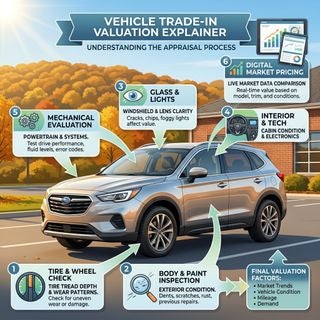
d

Valuing Your Trade-In: Expert Advice with Tri State Ford

Valuing Your Trade-In: Expert Advice with Tri State Ford Finding the true value of your trade-in involves pairing estimates from online valuation tools with an in-person appraisal at a dealership to account for mechanical condition, wear and tear, and regional market demand. Today, we are speaking with Nick Pirl, Sales Manager at Tri State Ford with 9 years of automotive experience, who shares expert advice on how to evaluate your vehicle, navigate trade-in estimates, and maximize your vehicle's overall trade-in credit. Q: How do I find the value of my trade-in? A: You can find the value of your trade-in by gathering preliminary market ranges from online valuation tools and pairing them with a professional physical appraisal at a local dealership. Online estimators establish a helpful baseline, but an on-site inspection evaluates your vehicle's specific mechanical condition, overall cosmetic appearance, local buyer demand, and current wholesale market trends. Combining digital research with an expert physical evaluation ensures you receive an accurate and competitive offer for your vehicle. When local drivers visit our showroom at 1503 Pennsylvania Ave, Nick Pirl walks them through the appraisal process step by step. Dealerships calculate trade-in allowances by reviewing recent transaction data from wholesale auctions and regional market sales, then subtracting estimated reconditioning expenses such as tire replacements, detailing, or mechanical touch-ups. If you want to discuss your vehicle before traveling to the lot, giving our sales specialists a quick call helps you gather initial insights into your car's market standing. Commuters traveling daily along the Ohio River around East Liverpool frequently ask whether an online valuation guarantees a final offer price. Digital software provides a solid starting point, but it cannot assess transmission smoothness, brake condition, or paint finish. A brief hands-on examination by an experienced appraiser is required to confirm a final offer or trade-in credit toward a new Ford model. Q: How do I calculate the trade-in value of my car using online tools? A: Calculating your car's trade-in value online requires entering your exact vehicle identification number or license plate, precise mileage, trim details, and an honest assessment of its current condition into a market valuation tool. Online calculators reference extensive databases of recent sales, auction results, and regional supply figures to generate an estimated price range. Providing complete details regarding minor scratches, interior wear, or accident history delivers the most accurate baseline estimate. Nick notes that accuracy depends heavily on selecting the correct condition category when inputting your vehicle's information. Most vehicle owners naturally tend to rate their vehicle in excellent condition, but only a small fraction of pre-owned vehicles truly meet that strict standard without needing reconditioning. When you utilize our online tool to value your trade-in, selecting the good or fair tier if your car shows standard daily wear keeps your expectations closely aligned with the final written offer. Drivers residing in suburban neighborhoods throughout Calcutta who travel along State Route 170 know that maintaining consistent service records and keeping interior surfaces clean supports vehicle value over time. If you want to see how clean, well-maintained vehicles are priced on the market, you can explore our pre-owned single-owner vehicle inventory to see how single-owner history and documented maintenance protect overall vehicle equity. Q: What factors affect my vehicle's trade-in value the most? A: Total mileage, mechanical health, body condition, vehicle history reports, and current regional demand affect your trade-in value more than any other factors. Crossing notable mileage thresholds, such as every 10,000 miles or major markers like 60,000 and 100,000 miles, creates noticeable adjustments in wholesale valuation due to upcoming maintenance schedules. Furthermore, documented damage on a vehicle history report or unaddressed mechanical issues directly lowers what an appraiser can offer. "An appraiser looks past a morning car wash to evaluate structural integrity, tire tread, service records, and true market demand." According to Nick, popular factory options like four-wheel drive systems, advanced driver-assist features, and spacious seating configurations consistently boost trade-in values for trucks and family SUVs. Presenting complete service documentation reassures appraisers that key mechanical systems, brakes, and engine components have been maintained according to manufacturer specifications. Conversely, non-factory modifications like aftermarket exhaust systems or custom suspension lifts tend to reduce trade-in value because they restrict resale appeal. If you are planning to trade in your current vehicle to lower your payments on a new Ford, reviewing current factory incentive offers can increase your overall savings. Shoppers looking for a specific trim level, paint color, or equipment group can also use our custom factory order portal to configure their ideal vehicle while applying trade-in credit directly to the build. Additionally, those seeking certified quality with warranty protection can browse our certified pre-owned Ford lineup to evaluate how certified models preserve long-term value. Q: How does the trade-in sales tax credit work on a new purchase? A: A trade-in sales tax credit reduces your state sales tax obligation by subtracting your trade-in vehicle's agreed value from the purchase price of the new vehicle before sales tax is calculated. In states where this tax benefit applies, you only pay sales tax on the net price difference rather than the full purchase price of the new automobile. This financial mechanism creates significant savings that help close the gap between trade-in offers and private sale prices. Nick explains that this tax structure offers immediate financial relief that many buyers forget to include in their budget comparisons. For instance, if you receive a trade-in allowance toward a new vehicle, that amount is deducted from the taxable total, saving you money on state sales tax out of pocket. As you view our current new Ford inventory, factoring in this tax reduction helps lower your total financed amount and overall interest charges. To see how your trade-in credit and tax savings shape your overall monthly financing structure, you can submit a secure online credit application prior to visiting the dealership. Business owners and commercial drivers seeking to upgrade their work fleet can also leverage these tax benefits by reviewing our F-Series commercial work truck selection to optimize business expenses and vehicle performance. Q: What is the difference between Kelley Blue Book and Edmunds trade-in values? A: The primary difference between Kelley Blue Book and Edmunds comes down to their data inputs and proprietary pricing models. Kelley Blue Book places heavy emphasis on wholesale dealer auction results, regional dealer transaction data, and consumer sales trends across localized geographic markets. Edmunds uses a distinct algorithm that factors in active retail dealer inventory, regional supply and demand ratios, and historic consumer buying patterns to establish estimated values. Nick points out that because these two platforms weight market variables differently, their trade-in estimates for the exact same vehicle can vary by several hundred dollars. KBB values tend to shift quickly based on auction trends, whereas Edmunds values often reflect broader retail market availability and dealer supply. Understanding these operational differences allows consumers to view online pricing guides as helpful references rather than non-negotiable prices. When buyers bring in figures from multiple valuation websites, Nick recommends using the overlapping price range as a realistic target. An appraiser will ultimately evaluate your car against live market condition reports and current local inventory demand. Utilizing both online resources provides realistic expectations, but the finalized offer rests on a physical walk-around and real-time wholesale demand. Q: How do negative equity and existing car loans affect a trade-in? A: Trading in a car with an existing balance requires paying off the loan, and if the vehicle's trade-in value is less than the loan payoff, the remaining balance is called negative equity. Dealerships assist buyers by paying off the original lender directly and rolling the negative equity balance into the new vehicle loan, subject to lender approval. While this allows you to complete your trade-in without paying cash upfront, it increases the total principal and monthly payment on your new loan. Nick advises drivers with negative equity to review their financing options carefully before finalizing a transaction. If you owe more than your vehicle's current market worth, applying a cash down payment or selecting a new model with substantial factory rebates can help absorb the balance and keep your loan-to-value ratio healthy. Paying down your current loan balance prior to trading in is often a smart financial step if you are not facing an immediate need to swap vehicles. When you are ready to review your vehicle's trade-in potential and discuss your financing options in person, you can access interactive directions to our dealership location. Our sales and finance specialists are here to provide clear, transparent advice on trade-in appraisals, payoff balances, and payment terms. If you want to review your trade-in scenarios before visiting, feel free to give our team a direct phone call today. Keep Your Vehicle Running Strong Keep your vehicle performing at its best with our service team: Order Parts Schedule Service Appt © 2026 Tri State Ford. All rights reserved. Trade-In Vehicle Valuation in East Liverpool OH | Tri State Ford
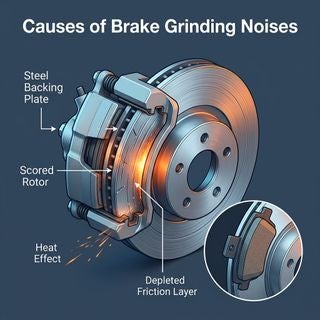
d

Expert Braking Insights: Why Is My Car Making a Grinding Noise When I Brake?

Expert Braking Insights: Why Is My Car Making a Grinding Noise When I Brake? A harsh, metallic grinding noise during braking almost always indicates that your brake pad friction material is completely depleted, causing the steel backing plate to scrape directly against the rotor. To explain the mechanical causes, safety risks, and repair expectations behind these sounds, we sat down with Matt Shaw, Service Manager at Tri State Ford, who brings 10 years of specialized automotive service experience to drivers seeking trusted vehicle care. Q: What primary mechanical issues cause a car to make a grinding noise when braking? A: A grinding noise during braking is primarily caused by brake pads wearing down to their steel backing plates, which then scrape directly against the cast-iron rotor surfaces. While friction material depletion accounts for the vast majority of cases, severe grinding can also stem from road debris such as small stones lodged between the dust shield and the rotor, or broken caliper mounting hardware rubbing against rotating components. When you press the brake pedal, the hydraulic caliper clamps the brake pads against the spinning rotor to slow your vehicle. Under normal conditions, friction material made of semi-metallic or organic compounds absorbs that intense contact safely. Once that layer wears past its minimum thickness, the remaining steel backing plate contacts the rotor directly. This steel-on-steel friction creates immediate scoring, severe heat buildup, and a dramatic drop in stopping power. Drivers navigating the rolling elevation changes near State Route 170 in Calcutta frequently notice this sound on downhill descents, where thermal stress accelerates pad wear. In other instances, the noise presents suddenly without prior wear symptoms. A piece of loose gravel caught between the brake rotor and the metal dust shield can produce a piercing rasp or scraping sound that changes with wheel speed rather than pedal pressure. Foreign objects in the caliper assembly or missing anti-rattle clips can also allow components to shift and rub. If you suspect severe pad wear or backing plate contact, you can reach our East Liverpool service center on Pennsylvania Avenue or give our service team a call for a quick diagnostic walk-through and expert advice. Q: Do ceramic brake pads eliminate grinding noises completely? A: Ceramic brake pads virtually eliminate high-frequency squeals and dust-related noise during normal operation, but they cannot eliminate metal-on-metal grinding if the pad wears down to its backing plate. Because ceramic pads still rely on a hard steel backing plate for structural mounting in the caliper, driving on fully depleted friction material will produce the exact same damaging metallic friction against the rotor as semi-metallic pads. The primary benefit of ceramic friction formulations lies in their composition, which uses dense ceramic compounds and embedded copper or synthetic fibers instead of coarse steel strands. This design dampens noise frequencies above human hearing thresholds and generates light-colored dust that does not stick readily to wheels. Under everyday driving conditions, high-grade ceramic pads operate significantly quieter than high-metallic alternatives. However, no friction formulation exempts a braking system from mechanical wear. Once the ceramic layer wears below 2 millimeters, the mechanical wear indicator or the steel plate itself will contact the rotor. Expecting ceramic pads to prevent metal grinding after complete wear is a common misconception. Maintaining quiet, responsive stopping performance requires replacing pads before the friction material disappears, which you can support by ordering genuine OEM brake components tailored specifically to your vehicle specifications. Q: How far can you safely drive on grinding brakes before catastrophic failure occurs? A: You should not drive a vehicle with grinding brakes beyond the few miles required to reach a certified repair facility. Extended driving on worn backing plates can cause caliper pistons to overextend beyond their fluid seals, leading to complete hydraulic fluid loss and sudden brake failure. "When you hear metal grinding against metal, your stopping distance is already compromised and every extra mile risks turning a basic pad service into a complete hydraulic overhaul." Continuing to press steel against cast iron creates extreme localized friction heat. This thermal spike can warp the rotor, crack the friction surfaces, and boil the brake fluid inside the caliper lines. Vaporized fluid creates air pockets in the sealed hydraulic circuit, causing the brake pedal to sink to the floor without generating stopping pressure. Additionally, the intense heat can scorch caliper piston boots, causing rubber seals to melt and leak fluid directly onto the hot disc. If severe grinding occurs unexpectedly while you are far from home or stranded on the road, utilizing Ford Roadside Assistance: 1-800-241-3673 provides towing support directly to a qualified service bay. During emergency vehicle evaluations, technicians perform comprehensive safety checks, including routine electrical and battery checks, to verify that all electronic safety systems function properly before putting the vehicle back on the road. Q: Can severe grinding brakes cause a vehicle to pull to one side while stopping? A: Severe grinding can cause a vehicle to pull toward one side during braking whenever friction levels or hydraulic caliper pressures become unequal across an axle. When one brake pad wears down to its metal backing plate before the opposing side, or if a caliper slide pin seizes due to extreme friction heat, the uneven stopping force pulls the steering wheel toward the side with stronger friction or binding. Unequal wear patterns frequently develop when caliper slide pins lack proper lubrication or when a caliper piston sticks inside its bore. The stuck pad remains pinned against the rotor while driving, grinding away its friction layer at double the normal rate. When you apply the brakes, the side with intact friction material grips effectively, while the metal-on-metal side slides with reduced efficiency. This differential torque creates a noticeable yaw moment that pulls the front end off course. Drivers negotiating steep riverfront bluffs in East Liverpool near the Ohio River often notice this pull immediately on downhill stops, as weight shifts forward and exaggerates axle imbalances. Inspecting caliper slide pins, hardware boots, and hydraulic lines prevents one-sided binding from destroying rotors prematurely. For added convenience when dealing with braking issues at home or work, exploring Ford Mobile Service options allows certified technicians to perform remote maintenance inspections directly in your driveway. Q: Why do new brake pads sometimes squeak after installation, and how does that differ from grinding? A: New brake pads sometimes produce a high-pitched squeak during their initial break-in period due to microscopic surface vibrations, light glazing, or a lack of dampening lubricant behind the backing plate. That high-frequency squeal is fundamentally different from a harsh, low-frequency metal grinding sound, which indicates physical gouging and heavy mechanical contact between steel and rotor iron. During the initial bedding-in phase, new pad material transfers a thin, uniform layer of friction compound onto the smooth rotor surface. Until that transfer layer fully stabilizes across several dozen moderate stops, light vibration frequencies can resonate through the caliper frame as a squeak. Technicians mitigate this sound by applying specialized anti-squeal dampening shims and high-temperature silicone grease to the rear backing contact points during assembly. Grinding, by contrast, is never a normal break-in sound. A grinding noise signifies deep structural gouging, uneven rotor scoring, or severe mechanical interference. If a newly serviced brake system produces a harsh metal-on-metal sound, it typically means an anti-rattle clip was installed improperly or a mounting bolt has loosened. Drivers who prefer seamless maintenance scheduling can take advantage of Ford Pick Up & Delivery service to have their vehicle transported to the shop and returned after a complete inspection. Q: What should drivers expect regarding brake replacement service costs and professional inspections? A: Professional brake service costs vary based on whether you require a simple pad replacement or a full pad-and-rotor overhaul per axle, with routine maintenance costing significantly less than repairing damaged calipers and gouged rotors. A comprehensive brake inspection includes measuring pad thickness in millimeters, evaluating rotor surface variation, checking caliper slide operation, and testing hydraulic fluid condition. When caught early, replacing brake pads on a single axle remains a straightforward, cost-effective maintenance item. However, allowing pads to grind down to their steel backing plates quickly cuts deep grooves into the rotors, making resurfacing impossible and requiring full rotor replacement. In severe cases, extreme heat damages the caliper assembly itself, requiring fluid flushes and new hydraulic hardware that increases total repair expenses. During a professional inspection at our convenient East Liverpool facility, factory-trained technicians measure remaining friction depth against original manufacturer tolerances. Catching wear before metal-on-metal contact protects your rotors and ensures reliable stopping distance. If you hear unexpected braking sounds or want peace of mind before a long trip, (330) 462-7578 is available for quick questions, or you can get started by scheduling your service appointment online today. © 2026 Tri State Ford. All rights reserved. Brake Grinding Noise Repair in East Liverpool OH | Tri State Ford
b

2026 Ford Explorer vs Chevrolet Traverse vs GMC Acadia

The 2026 Ford Explorer offers a strong combination of value, fuel economy, and driving dynamics. Starting at $40,465 for the Active 4WD 100A trim, the Explorer delivers 300 hp and up to 24 combined MPG in rear-wheel drive, outclassing both the Chevrolet Traverse and GMC Acadia in upfront cost and long-term efficiency while offering proven 5-star safety. Table of Contents Which 2026 SUV Offers the Best Value for Families? How Do the 2026 Ford Explorer, Chevrolet Traverse, and GMC Acadia Compare in Space for Boardman Family Weekends? Performance and Handling: Which 2026 SUV Excels on Riverfront Roads? Fuel Efficiency and Range for Daily Commuting Tech Features That Simplify School Runs and Errands Safety Systems That Protect Your Loved Ones Warranty, Maintenance, and Service Options for 2026 SUVs Frequently Asked Questions from Buyers Comparing the 2026 Ford Explorer, Chevrolet Traverse, and GMC Acadia Take the Next Step Toward Your Family's Next SUV Which 2026 SUV Offers the Best Value for Families? The 2026 Ford Explorer offers competitive value compared with its rivals, starting at an accessible MSRP of $40,465 for the Active 4WD 100A configuration compared to $42,800 for the base Chevrolet Traverse AWD LT and $52,500 for the GMC Acadia AT4 AWD. Family budgets stay balanced when selecting the Explorer, which equips essential standard features without forcing buyers into expensive upper tier trim packages. When evaluating midsize three-row SUVs, entry pricing tells only part of the story. The 2026 Ford Explorer Active RWD carries a starting MSRP of $40,585, while the well-equipped Active 4WD starts at $42,585. Every Ford Explorer trim shares a standard destination charge of $1,795. In comparison, moving up the competitor ladder quickly pushes pricing past typical family allocations. The Chevrolet Traverse ranges from $42,800 for the AWD LT up to $57,100 for the AWD High Country and $57,400 for the AWD RS. The GMC Acadia starts even higher, demanding $52,500 for the off-road focused AT4 AWD, $55,900 for the Denali FWD, and $57,900 for the top-tier Denali AWD. For buyers considering options before upgrading their household driveway, you can easily value your trade-in online to see how much equity you can apply toward a new model. Furthermore, shoppers comparing ownership choices can also explore our pre-owned Carfax 1-Owner inventory for additional budget flexibility. The Ford Explorer maximizes feature density per dollar spent. Standard equipment on every Explorer trim includes an array of premium features like a 13.2-inch infotainment display screen, adaptive cruise control with stop and go capability, integrated navigation with a 12-month trial, and heated front seats—equipment that often requires expensive optional add-on packages on competing vehicles. Pricing Manufacturer-listed pricing per trim, across compared vehicles. 2026 Ford Explorer Trim MSRP 2026 Chevrolet Traverse Trim MSRP 2026 GMC Acadia Trim MSRP:--:--:--:--:--:-- Active 4WD 100A $40,465 AWD LT $42,800 AT4 AWD $52,500 Active RWD $40,585 AWD High Country $57,100 Denali FWD $55,900 Active 4WD $42,585 AWD RS $57,400 Denali AWD $57,900 How Do the 2026 Ford Explorer, Chevrolet Traverse, and GMC Acadia Compare in Space for Boardman Family Weekends? The 2026 Ford Explorer offers a balanced interior design with standard 6-passenger seating and about 16 cu ft of rear cargo volume behind the third row, extending to about 86 cu ft with rear seats folded flat. While the Chevrolet Traverse and GMC Acadia feature slightly larger total cargo shells, the Explorer's overall dimensions provide exceptional interior room while remaining significantly easier to park and maneuver in busy suburban environments. Navigating daily parking lots and garage spaces in Boardman is effortless in the Ford Explorer thanks to its total vehicle length of 198.7 inches and a curb-to-curb turning circle of 464.5 inches. The Chevrolet Traverse measures 204.5 inches long with a 468.1-inch turning circle, making tight maneuvers noticeably more cumbersome during peak weekend shopping hours. Inside the cabin, passenger comfort remains top-tier across all three rows of the Ford Explorer. Up front, occupants enjoy 40.7 inches of headroom and 43.0 inches of legroom. Second-row passengers benefit from standard captain's chairs providing 40.5 inches of headroom and 39.0 inches of legroom, while third-row passengers receive 38.9 inches of headroom and 32.2 inches of legroom. For families needing maximum seating capacity, Ford offers an optional second-row bench seat with E-Z Entry that expands total capacity to 7 passengers. When towing weekend equipment, the Ford Explorer Active 4WD matches the capability of larger alternatives. Built on a sturdy chassis with a published curb weight of 4,303 lbs, the Explorer carries a maximum towing capacity of 5,000 lbs (braked) and a payload capacity of 1,467 lbs. The GMC Acadia weighs in at a heavier 4,715 lbs curb weight while offering an identical 5,000-lb towing rating. To ensure your family vehicle remains in top condition for every outing, our dealership provides convenient Ford Mobile Service right in your driveway. We also offer pickup and delivery options for routine maintenance, and our finance team can assist you with an online credit application before your visit. Engine & Performance Powertrain specs by trim Specification 2026 Ford Explorer 2026 Chevrolet Traverse 2026 GMC Acadia:--:--:--:-- Engine 2.3L 2.5L 2.5L Horsepower 300 hp 328 hp 327 hp Torque 310 lb-ft 326 lb-ft 326 lb-ft Transmission SelectShift® automatic 8-speed automatic 8-speed Drivetrain All-wheel drive All-wheel drive All-wheel drive Performance and Handling: Which 2026 SUV Excels on Riverfront Roads? The 2026 Ford Explorer offers responsive dynamic handling and driver engagement thanks to its standard rear-wheel-drive architecture and a turbocharged 2.3L EcoBoost® I-4 engine generating 300 hp and 310 lb-ft of torque. Coupled with an advanced SelectShift® 10-speed automatic transmission, the Explorer offers quick throttle response and smooth gear shifts across all driving conditions. Engineered on Ford's CD6 platform, the Explorer places its engine longitudinally, distributing vehicle weight more evenly between the front and rear axles. This setup provides precise steering feedback through an electric speed-proportional power steering system. Front independent strut suspension with a stabilizer bar works alongside a rear multi-link independent suspension to absorb road imperfections while minimizing body roll. By contrast, the 2026 Chevrolet Traverse and 2026 GMC Acadia utilize front-wheel-drive platform foundations. Both GM models power their wheels using a 2.5L turbocharged 4-cylinder engine paired with an 8-speed automatic transmission. The Traverse produces 328 hp and 326 lb-ft of torque, while the Acadia generates 327 hp and 326 lb-ft of torque. Despite their slight power advantage, both competitors carry extra curb weight and rely on an 8-speed transmission that shifts less fluidly than Ford's 10-speed unit. Ford's Intelligent 4WD system on Active 4WD trims constantly monitors traction, seamlessly transferring torque to the wheels with the most grip. Integrated Terrain Management System driver modes allow operators to tailor powertrain response to specific road conditions. Owners looking to customize their vehicle's look or performance can easily order genuine parts directly through our dealership catalog. Fuel Efficiency and Range for Daily Commuting The 2026 Ford Explorer Active RWD leads this comparison in fuel economy, achieving an EPA-estimated 20 city / 29 hwy / 24 combined MPG and providing a maximum highway driving range of 430 miles on its 17.9-gallon fuel tank. For daily drivers navigating State Route 170 around Calcutta, the Explorer reduces trip stops at the pump compared to heavier alternatives. Selecting all-wheel drive maintains impressive efficiency. The Ford Explorer Active 4WD and Active 4WD 100A trims earn an EPA-estimated rating of 20 city / 27 hwy / 23 combined MPG, delivering a calculated vehicle range of 412 miles. Both competitors require more fuel for daily trips. The 2026 Chevrolet Traverse AWD High Country achieves 20 city / 24 hwy / 21 combined MPG, burning 7.0 annual tons of CO2 according to EPA calculations compared to the Explorer RWD's 6.2 annual tons. The 2026 GMC Acadia AWD matches the Traverse at 19 city / 24 hwy / 21 combined MPG. Over years of daily commutes, the Ford Explorer saves owners substantial fuel costs. Fuel Economy Fuel economy and range by trim Specification 2026 Ford Explorer 2026 Chevrolet Traverse 2026 GMC Acadia:--:--:--:-- MPG 20 city / 27 hwy / 23 combined 20 city / 24 hwy / 21 combined 19 city / 24 hwy / 21 combined Tech Features That Simplify School Runs and Errands Inside the cabin, the 2026 Ford Explorer features an intuitive digital command center headlined by a massive standard 13.2-inch touchscreen center display paired with a 12.3-inch reconfigurable digital instrument cluster. Designed for minimal driver distraction, the Ford Digital Experience interface delivers crisp graphics and effortless menu navigation for everyday connectivity. Smartphone integration is standard across the Explorer lineup, featuring wireless Apple CarPlay and Android Auto capabilities. Drivers can control navigation, media, and climate settings using natural voice commands powered by built-in Google Assistant technology. Passengers stay powered up throughout long drives with standard USB charging ports located across all three seating rows: 4 ports in the front row, 2 ports in the second row, and 2 ports in the third row. Audio performance comes from a standard 6-speaker system featuring AM/FM radio, SiriusXM with 360L capability, and internet radio streaming. Convenient 12V power outlets are strategically located in the front console, rear seating area, and cargo compartment to power coolers or camping gear. While the Chevrolet Traverse High Country equips a 17.7-inch screen, its software interface relies heavily on subscription-based features. Ford provides standard embedded SIM card Wi-Fi hotspot capability with included data options and 911 Assist emergency telematics without requiring high-tier trim upgrades. Safety Systems That Protect Your Loved Ones Safety is fundamental to the 2026 Ford Explorer, which earns a full 5-Star Overall Safety Rating from the NHTSA and an IIHS Top Safety Pick+ designation. Every Explorer comes standard with Ford Co-Pilot360 Assist+, a comprehensive suite of active safety technologies engineered to protect families on busy roads. Standard active safety features on the 2026 Ford Explorer include: Pre-Collision Assist with Automatic Emergency Braking and Forward Collision Warning BLIS® (Blind Spot Information System) with Rear Cross Traffic Braking Lane-Keeping System with Active Lane Control and Lane Departure Warning Adaptive Cruise Control with Stop-and-Go functionality Rear Parking Sensors and a High-Definition Rear Backup Camera Passive safety equipment inside the Explorer is equally thorough. The cabin includes 7 standard airbags, featuring dual front airbags, front seat-mounted side airbags, driver knee airbags, and Safety Canopy® side-curtain airbags extending coverage across all three rows. ISOFIX / LATCH child seat anchors are standard in both the second and third rows for quick, secure car seat installation. The Chevrolet Traverse and GMC Acadia also offer driver-assist packages such as Forward Collision Alert and Side Blind Zone Alert. However, the Explorer’s driver-assist interventions, including active steering support and millimetre-wave radar object detection, provide subtle, highly responsive protection that instills complete confidence. Warranty, Maintenance, and Service Options for 2026 SUVs Ford protects every 2026 Explorer with a comprehensive manufacturer warranty package, featuring a 3-year / 36,000-mile bumper-to-bumper warranty and a 5-year / 60,000-mile powertrain warranty. Corrosion perforation coverage lasts for 5 years with unlimited mileage, while exterior paint finishes are covered for 3 years or 36,000 miles. Owners also receive 5 years or 60,000 miles of 24/7 Roadside Assistance. If you ever require emergency flat tire changes, fuel delivery, or towing assistance, you can quickly contact Ford Roadside Assistance at (800) 241-3673 for brand-certified technician support. When maintenance is required, our certified dealership technicians utilize genuine OEM Ford parts engineered specifically for your vehicle. Owners can conveniently schedule a service appointment online for routine oil changes or tire rotations, or review our routine battery service guide to keep electrical systems operating at peak performance. For shoppers seeking additional vehicle options, you can also browse our certified pre-owned Ford inventory to explore thoroughly inspected vehicles backed by factory-extended coverage. Frequently Asked Questions from Buyers Comparing the 2026 Ford Explorer, Chevrolet Traverse, and GMC Acadia Q: Is the 2026 Ford Explorer less expensive than the Chevrolet Traverse and GMC Acadia? Yes, the 2026 Ford Explorer has a lower starting price than both competitors. The Explorer Active 4WD 100A starts at $40,465, while the base Chevrolet Traverse AWD LT starts at $42,800 and the GMC Acadia AT4 AWD starts at $52,500. Even fully equipped Ford Explorer trims remain significantly lower in price than top-tier Traverse High Country ($57,100) or Acadia Denali ($57,900) models. Q: Which SUV gets better gas mileage for daily driving? The 2026 Ford Explorer Active RWD gets the best fuel economy in this comparison, achieving an EPA-estimated 20 city / 29 hwy / 24 combined MPG. All-wheel drive Explorer models earn 20 city / 27 hwy / 23 combined MPG. Both the Chevrolet Traverse AWD (20 city / 24 hwy / 21 combined MPG) and GMC Acadia AWD (19 city / 24 hwy / 21 combined MPG) use more fuel during daily city and highway driving. Q: How much can the 2026 Ford Explorer tow compared to the Traverse and Acadia? The 2026 Ford Explorer carries a maximum towing capacity of 5,000 lbs when properly equipped, matching the maximum 5,000-lb towing capacity of the GMC Acadia. This power allows families to haul boats, camper trailers, or utility equipment with complete confidence. Q: Does the 2026 Ford Explorer come standard with all-wheel drive? The 2026 Ford Explorer is available in both Rear-Wheel Drive (Active RWD) and Intelligent All-Wheel Drive (Active 4WD and Active 4WD 100A) configurations. This allows buyers to select the exact drivetrain needed for their local driving conditions and winter weather preferences. Q: What key technology features come standard on the 2026 Ford Explorer? Every 2026 Ford Explorer comes standard with a 13.2-inch central touchscreen, a 12.3-inch digital instrument display, wireless Apple CarPlay and Android Auto, built-in Google Assistant voice controls, tri-zone automatic climate control, heated front seats, and 8 total USB charging ports across all three rows. Dimensions & Capacity Capacity and dimensions by trim Specification 2026 Ford Explorer 2026 Chevrolet Traverse 2026 GMC Acadia:--:--:--:-- Seating 6 7 7 Cargo 16.3 cu ft 22.9 cu ft 23.0 cu ft Curb weight 4,303 lbs — 4,715 lbs Towing 5,000 lbs — 5,000 lbs Payload 1,467 lbs — 1,678 lbs Take the Next Step Toward Your Family's Next SUV The 2026 Ford Explorer stands out as the clear winner in the three-row midsize SUV segment, delivering robust EcoBoost® power, standard Ford Co-Pilot360 Assist+ safety, superior combined fuel economy, and exceptional pricing value. At Tri State Ford, our friendly sales team is dedicated to providing an informative, customer-focused shopping experience. Whether you want to explore available color choices like Vapor Blue Metallic or Star White Metallic Tri-Coat, compare seating configurations, or take a test drive, we are here to help. To plan your visit, get directions to Tri State Ford at 1503 Pennsylvania Ave, East Liverpool, OH 43920. Give our team a quick call at (330) 462-7578 to speak with an advisor, or explore our new vehicle inventory online to find your family's next 2026 Ford Explorer today. © 2026 Tri State Ford. All rights reserved. Vehicle specification data © JATO Dynamics Limited. 2026 Ford Explorer SUV in East Liverpool OH | Tri State Ford
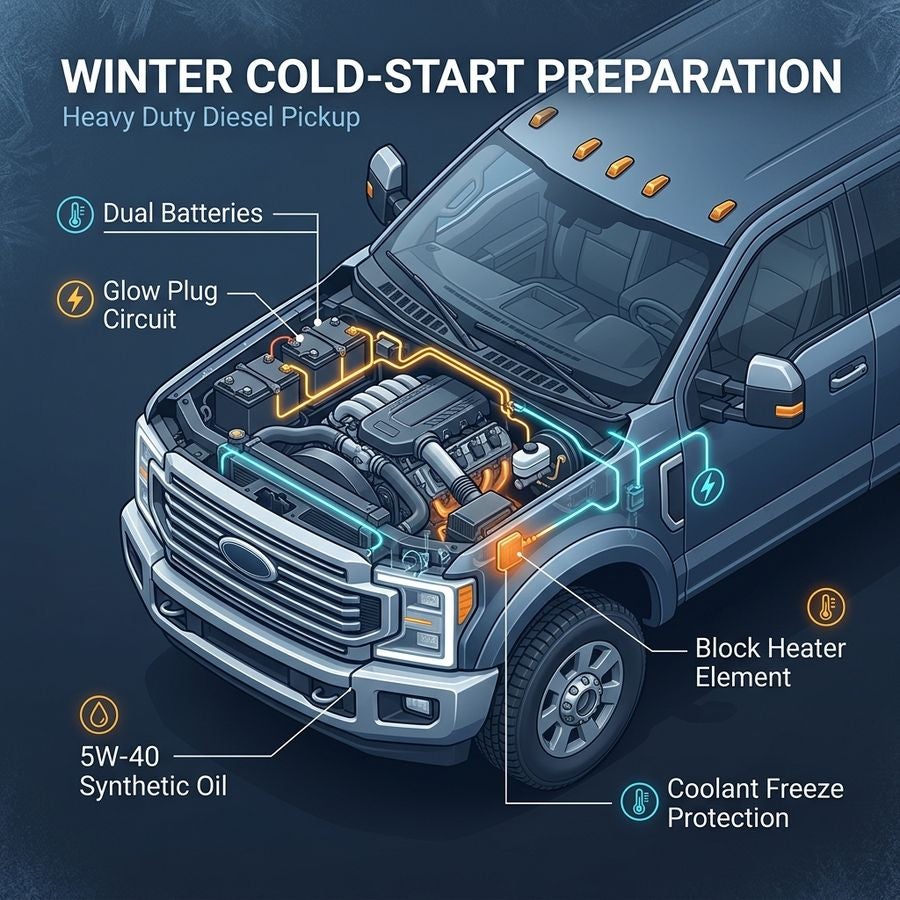
g

How Do You Prepare a Super Duty Diesel for Winter Starting?

Preparing a Super Duty diesel for cold weather requires testing both dual Group 65 batteries with a digital conductance load tester, verifying glow plug circuit resistance, checking coolant freeze protection, and testing the engine block heater element. Maintaining strong resting battery voltage above 12 volts and ensuring high glow plug current draw prevents severe cold-weather cranking failures when ambient temperatures drop below freezing. To keep a 2026 Ford Super Duty F-250, 2026 Ford Super Duty F-350, or 2026 Ford Super Duty F-450 starting smoothly through freezing conditions, systematic service is essential before the first severe drop in temperature. Ford’s 6.7L Power Stroke V8 turbo diesel relies on rapid cylinder pre-heating and fast starter motor rotation to compress cold air enough to ignite diesel fuel. A comprehensive winter preparation routine addresses every component in the cold-starting system: Dual Battery Conductance Load Testing: Test both 12-volt batteries individually after disconnecting the parallel cable to identify isolated cell degradation before sub-zero mornings arrive. Glow Plug and Control Module Diagnostics: Check for active or pending diagnostic codes and measure electrical resistance across all glow plug heating elements. Engine Oil Viscosity Adjustment: Switch to an approved API CK-4 5W-40 full synthetic diesel engine oil to reduce internal drag during freezing cranking procedures. Coolant Freeze Protection Verification: Test engine coolant concentration using a refractometer to ensure protection down to at least -35°F. Block Heater System Inspection: Inspect the heating element resistance and inspect the power cord for cracking, corrosion, or physical damage. Truck owners managing heavy loads around Calcutta know how taxing morning starts on State Route 170 can be when frost coats the windshield. A weak electrical system struggles significantly as oil thickens in cold weather. Cleaning corrosion from terminal posts, applying protective dielectric grease, and verifying alternator output under full glow plug load ensures reliable starts all winter long. If you want our certified technicians to evaluate your truck before snow arrives, find our East Liverpool service facility or give our service desk a quick call to set up an inspection. Table of Contents What Are the Primary Symptoms of Failing Glow Plugs Versus a Weak Battery? What Battery Specs, CCA Ratings, and AGM Options Does a Powerstroke Need? How Do You Test Glow Plugs with a Multimeter and How Long Should They Pre-Heat? At What Temperature Should You Plug In a Super Duty Block Heater? Common Questions About Pre-Winter Super Duty Diesel Inspections Schedule Your Pre-Winter Super Duty Service W hat Are the Primary Symptoms of Failing Glow Plugs Versus a Weak Battery? Failing glow plugs cause extended engine cranking accompanied by unburned white exhaust smoke and specific diagnostic trouble codes while starter motor speed remains normal, whereas a weak battery results in noticeably slow engine turnover, rapid solenoid clicking, or instrument cluster gauge resets. Distinguishing between a glow plug issue and a battery fault saves diagnostic time and prevents unnecessary component replacement. On modern 6.7L Power Stroke engines, the glow plug system pre-heats the combustion chambers, while the dual batteries deliver electrical energy to spin the starter and energize high-pressure fuel injectors. When one system degrades, the engine exhibits distinctly different symptoms: Failing Glow Plug Indicators: The starter motor cranks the engine at a normal, vigorous speed, but the engine hesitates to catch. Raw, unburned diesel fuel passes into the exhaust system, creating dense white smoke upon startup. The engine may idle roughly for 10 to 30 seconds after firing up. Fault codes such as P0670 (glow plug control module circuit) or P0671–P0678 (individual cylinder glow plug circuits) typically illuminate the check engine light. Warm starts later in the day usually remain completely normal. Weak Battery Indicators: The engine turns over sluggishly, sounding strained or slow. You may hear rapid clicking noises from the starter relay under the hood. During cranking, the heavy electrical draw causes interior lights to dim significantly and instrument cluster needles to sweep completely across the dials upon reset. If battery voltage drops below 10.5 volts while cranking, the powertrain control module cannot properly energize the fuel injectors, resulting in a continuous crank-no-start condition. Truck owners bringing their diesel trucks into our service bay before winter usually ask whether to replace both batteries at once when only one fails. Because the dual batteries operate in parallel, an old battery will constantly pull down a new one, making dual replacement the safest practice. If your truck shows signs of slow cranking or check engine lights, review our routine battery service advice or order OEM replacement parts directly from our dealership. What Battery Specs, CCA Ratings, and AGM Options Does a Powerstroke Need? A 6.7L Power Stroke diesel requires two matched Group 65 12-volt batteries connected in parallel, delivering a minimum rating of 750 CCA each, though ratings between 800 CCA and 850 CCA per battery are ideal for heavy winter use. Cold Cranking Amps ( CCA) measure a battery's capacity to deliver peak electrical current at 0°F for 30 seconds while maintaining terminal voltage above 7.2 volts. This rating differs from standard Cranking Amps (CA), which is measured at a milder 32°F and overstates low-temperature performance. Diesel engines require exceptionally high CCA ratings because cold engine oil creates massive mechanical drag against the pistons, while the glow plug system simultaneously draws high amperage from the circuit before the starter even engages. Selecting between standard flooded lead-acid and Absorbed Glass Mat ( AGM) batteries comes down to durability and recharge efficiency: Flooded Lead-Acid Batteries: Standard factory-spec option providing reliable starting power at an economical price point. They require clean terminals and periodic case cleaning to prevent self-discharge across surface debris. AGM Batteries: Superior choice for cold winter conditions. AGM technology immobilizes electrolyte fluid inside fiberglass mat separators. This design delivers higher cold cranking power, recharges faster under high alternator output, resists severe diesel engine vibration, and handles deep discharge cycles without permanent plate damage. Replacing dual batteries as a matched pair ensures balanced internal resistance. Mixing an aged battery with a fresh one causes the newer unit to discharge into the weaker unit while parked, leading to premature failure of both batteries during extreme cold spells. How Do You Test Glow Plugs with a Multimeter and How Long Should They Pre-Heat? Test a diesel glow plug by disconnecting its electrical harness, setting a digital multimeter to measure resistance in Ohms, and touching one lead to the top terminal tip while grounding the other lead to the engine block—a functional plug measures between 0.5 Ohms and 2.0 Ohms. Testing glow plugs without removing them from the cylinder head is a straightforward process that pinpoints dead heating elements quickly: Turn off the ignition and allow the engine bay to cool down completely. Locate the glow plug wiring harness along the valve cover area and carefully disconnect the individual connector from the target glow plug. Set your digital multimeter to the lowest Ohms scale (resistance setting). Place the red positive probe on the threaded top terminal of the glow plug. Place the black negative probe on a clean, unpainted metal surface on the cylinder head or engine block to ensure a solid ground. Evaluate the reading: a healthy glow plug displays between 0.5 Ohms and 2.0 Ohms. A reading of infinite resistance indicates an internal open circuit, while a reading near 0 Ohms indicates a shorted plug. Both defective conditions require replacement. Pre-heating time depends directly on ambient temperatures. When you switch the ignition key to the ON position, the glow plug control module energizes the plugs and illuminates the wait-to-start coil light on the dash. In freezing weather, allow this light to remain illuminated for the full 3 to 15 seconds until it turns off automatically. On modern 2026 Ford Super Duty models, glow plugs can continue operating in a post-heating phase for up to two minutes after the engine starts to stabilize combustion and reduce cold idling emissions. Allow the engine to idle for roughly 15 seconds immediately after firing up to build proper engine oil pressure before putting the truck in gear. Heavy hauling along riverfront bluffs in East Liverpool places high demand on cold engine components, making proper pre-heating vital to longevity. Drivers looking to upgrade to a newer diesel tow rig can schedule a test drive in a heavy-duty truck to experience modern quick-heating glow plug systems firsthand. At What Temperature Should You Plug In a Super Duty Block Heater? Ford recommends connecting the engine block heater on 6.7L Power Stroke Super Duty diesels when ambient outdoor temperatures fall to 15°F or lower, and usage becomes mandatory at -9°F to ensure engine protection and starting capability. An engine block heater uses an electric heating element submerged in the engine coolant jacket to warm the block and motor oil. Heating the engine core reduces fluid viscosity, eases internal starter resistance, and helps the cylinders reach compression ignition temperature almost immediately. Timer Efficiency: You do not need to leave the block heater plugged in all night. Connecting the cord to an outdoor grounded timer set to turn on 2 to 3 hours before your scheduled morning commute warms the engine block completely while saving electricity. Cord Routing Safety: Ford owner manual guidelines explicitly state you must never fully close or drop the hood under its own weight when the block heater power cord is routed out of the engine bay. Pinching the cord can damage internal wiring insulation or interfere with the hood latch mechanism. Pre-Winter Inspection: Check the heater cord for frayed insulation, bent plug prongs, or road salt corrosion. Measure electrical continuity across the plug terminals using a multimeter to confirm the internal heating element has not burnt out. Common Questions About Pre-Winter Super Duty Diesel Inspections Q: Why does a diesel Super Duty require two batteries instead of one? Ford Super Duty diesel trucks require two heavy-duty 12-volt batteries wired in parallel to provide the high surge amperage needed during cold starts. Spinning a high-compression diesel engine demands substantial starter torque, while the glow plug system draws heavy current simultaneously. Dual batteries double the available cold cranking amps while maintaining the vehicle's 12-volt electrical system architecture. Q: What causes white smoke coming from the exhaust on a cold winter morning? White exhaust smoke immediately after a cold diesel start usually indicates unburned diesel fuel vapor exiting the tailpipe. When one or more glow plugs fail, the affected cylinder lacks the heat necessary to ignite injected fuel during initial cranking. Once the engine warms up from compression heat, the white smoke typically clears, but replacing the failed glow plug resolves the root cause. Q: Can a single bad glow plug cause a Power Stroke engine not to start? A single defective glow plug rarely prevents a 6.7L Power Stroke engine from starting entirely, but it causes rough idling, cylinder misfires, and noticeable white smoke upon startup. However, if multiple glow plugs or the central glow plug control module fail, the engine may experience extended cranking times or a total no-start condition in freezing ambient temperatures. Q: Is it necessary to switch engine oil viscosity before winter in a diesel truck? Switching to an approved API CK-4 5W-40 full synthetic diesel engine oil before winter improves cold-weather cranking performance substantially. Full synthetic 5W-40 flows much faster at low temperatures than conventional 15W-40 oil, reducing starter load during cold activation and ensuring rapid oil pressure delivery to critical turbocharger bearings and valve gear. Q: How long can you leave an engine block heater plugged in continuously? Leaving an engine block heater plugged in continuously will not melt internal engine components because coolant transfers heat away, but running it non-stop wastes electricity. The engine reaches its maximum temperature rise after 2 to 3 hours of operation. Using a heavy-duty outdoor timer to energize the block heater several hours before morning startup provides maximum warm-up benefits efficiently. To ensure your diesel truck receives a complete cold-weather system checkup, you can easily schedule a service appointment online with our certified technicians. Schedule Your Pre-Winter Super Duty Service A thorough pre-winter diesel inspection protects your truck against unexpected winter starting failures, battery strain, and glow plug faults. Checking dual battery conductance, glow plug circuit resistance, coolant freeze thresholds, and block heater operation before freezing weather sets in ensures your vehicle starts reliably every morning. Our service center provides expert diagnostic care tailored specifically to 6.7L Power Stroke diesel engines. Our factory-trained technicians utilize advanced diagnostic equipment, genuine OEM components, and thorough multi-point inspection procedures to keep your heavy-duty truck operating at peak performance. Visit our service center at 1503 Pennsylvania Ave, East Liverpool, OH 43920 for comprehensive winter maintenance. Speak directly with our service advisors by giving us a quick call to discuss battery testing or glow plug replacement. Take advantage of our convenient mobile service options to have routine maintenance performed directly at your home or work site. Reach out to our team today to prepare your Super Duty diesel for reliable winter performance. © 2026 Tri State Ford. All rights reserved. Super Duty Diesel Winter Prep in East Liverpool OH | Tri State Ford

d

How Do Cash Back Rebates Compare to Low APR Financing?

Cash back rebates immediately subtract money from the purchase price of a vehicle, whereas low APR financing lowers the interest percentage charged on your loan balance over time. A cash rebate provides instant equity upfront, while promotional low-interest financing delivers continuous savings throughout the loan term. Determining which incentive yields greater value depends entirely on the total amount financed, the length of the loan repayment term, and the alternative market interest rate you qualify for through standard lending channels. When manufacturers release promotional incentives, buyers are typically faced with an either-or scenario rather than the ability to stack both offers. A customer cash offer acts as direct down payment assistance or a price reduction, which shrinks the principal loan balance from day one. In contrast, financing offers through Ford Credit—such as current promotional APR for 36 months or promotional APR for 72 months —keep the principal balance higher while eliminating or heavily discounting interest charges. On larger purchases like a full-size truck or a three-row SUV, avoiding interest over five or six years often generates thousands of dollars in cumulative savings, easily outpacing a modest upfront rebate. Evaluating these offers requires looking beyond the monthly payment figure to compare the total lifecycle cost of the loan. Families comparing options on our sales lot usually want to see how a cash incentive balances against a reduced interest rate over a five-year term before making a final commitment. If you are planning a trip to discuss current incentive structures with our finance team, you can drop by our showroom on Pennsylvania Avenue or give our staff a quick call to walk through real-time rate comparisons on specific models. Table of Contents How Do Loan Amount, Down Payment Size, and Math Determine Your Savings? Is current promotional APR Available on 72-Month Auto Loans and What Credit Score Is Required? How Soon Can You Refinance After Taking a Cash Rebate? What Free Online Tools and Sales Tax Rules Impact Your Financing Choice? Common Questions About Low APR Rates Versus Cash Rebates Explore New Vehicle Financing Options at Tri State Ford How Do Loan Amount, Down Payment Size, and Math Determine Your Savings? Mathematical total-cost calculations favor low APR financing when borrowing large sums over long terms, whereas large cash down payments make upfront customer rebates more financially advantageous. The total principal financed dictates how much interest accrues over time. Because interest accrues as a percentage of the remaining principal each month, higher starting balances paired with standard market interest rates rapidly generate significant interest charges, allowing a low promotional interest rate to outperform an upfront cash discount. Consider how these calculations apply to a high-capability vehicle like the 2026 Ford F-150. On an F-150 King Ranch 4x4 SuperCrew 5-1/2’ Box featuring a 3.5L V6 engine, a SelectShift® transmission, and an EPA rating of 17 city / 23 hwy, the base MSRP is $69,625 with a $2,795 destination charge. Financing a balance of that size over 60 or 72 months at standard commercial auto loan rates can accumulate major interest overhead. Accepting a low promotional interest rate wipes out the bulk of those interest fees, producing overall lifetime savings that easily dwarf a standardized cash back offer. Conversely, down payment size dramatically alters this balance. If a buyer puts down a substantial cash down payment or carries significant vehicle trade-in equity, the net loan amount drops. When borrowing a smaller sum—such as on an entry-level F-150 STX SuperCab 6-1/2’ Box with a base MSRP of $44,855 —a standard $1,500 or $2,500 cash rebate eliminates a higher percentage of the total vehicle price. For suburban commuters around Calcutta taking shorter 36-month or 48-month loan terms, reducing the initial principal balance with a rebate yields lower net payments than taking a minor rate reduction on an already small loan balance. To run these numbers accurately, you must multiply the monthly payment under both scenarios by the total number of loan months, then add any upfront fees to see the total out-of-pocket cost. Buyers exploring our pre-owned single-owner vehicle inventory often utilize similar total-cost math when weighing standard bank auto loans against lower cash sale prices. Pricing Pricing by trim Feature King Ranch 4x4 SuperCrew 5-1/2’ Box King Ranch 4x4 SuperCrew 6-1/2’ Box King Ranch SuperCrew 5-1/2’ Box Lariat 4x4 SuperCrew 5-1/2’ Box Lariat 4x4 SuperCrew 6-1/2’ Box Lariat SuperCrew 5-1/2’ Box Platinum 4x4 SuperCrew 5-1/2’ Box Platinum 4x4 SuperCrew 6-1/2’ Box Platinum SuperCrew 5-1/2’ Box Police Responder 4x4 SuperCrew 5-1/2’ Box Raptor 4x4 SuperCrew 5-1/2’ Box STX 4x4 SuperCab 6-1/2’ Box STX 4x4 SuperCrew 5-1/2’ Box STX SuperCab 6-1/2’ Box STX SuperCrew 5-1/2’ Box Tremor 4x4 SuperCrew 5-1/2’ Box XL 4x4 Regular Cab 6-1/2’ Box XL 4x4 Regular Cab 8’ Box XL 4x4 SuperCab 6-1/2’ Box XL 4x4 SuperCrew 5-1/2’ Box XL 4x4 SuperCrew 6-1/2’ Box XL Regular Cab 6-1/2’ Box XL Regular Cab 8’ Box XL SuperCab 6-1/2’ Box XL SuperCrew 5-1/2’ Box XLT 4x4 SuperCab 6-1/2’ Box XLT 4x4 SuperCrew 5-1/2’ Box XLT 4x4 SuperCrew 6-1/2’ Box XLT SuperCab 6-1/2’ Box XLT SuperCrew 5-1/2’ Box:--:--:--:--:--:--:--:--:--:--:--:--:--:--:--:--:--:--:--:--:--:--:--:--:--:--:--:--:--:--:-- Base MSRP $69,625 $69,930 $65,825 $63,360 $63,965 $59,560 $72,600 $72,905 $68,800 $52,350 $79,005 $48,655 $51,070 $44,855 $47,190 $64,915 $44,600 $42,305 $45,400 $47,820 $50,475 $39,585 $37,290 $41,600 $43,935 $49,495 $51,915 $54,555 $45,695 $48,055 Destination charge $2,795 $2,795 $2,795 $2,795 $2,795 $2,795 $2,795 $2,795 $2,795 $2,595 $2,795 $2,795 $2,795 $2,795 $2,795 $2,795 $2,795 $2,795 $2,795 $2,795 $2,795 $2,795 $2,795 $2,795 $2,795 $2,795 $2,795 $2,795 $2,795 $2,795 Dimensions & Capacity Capacity and dimensions by trim Feature King Ranch 4x4 SuperCrew 5-1/2’ Box King Ranch 4x4 SuperCrew 6-1/2’ Box King Ranch SuperCrew 5-1/2’ Box Lariat 4x4 SuperCrew 5-1/2’ Box Lariat 4x4 SuperCrew 6-1/2’ Box Lariat SuperCrew 5-1/2’ Box Platinum 4x4 SuperCrew 5-1/2’ Box Platinum 4x4 SuperCrew 6-1/2’ Box Platinum SuperCrew 5-1/2’ Box Police Responder 4x4 SuperCrw 5-1/2’ Box Raptor 4x4 SuperCrew 5-1/2’ Box STX 4x4 SuperCab 6-1/2’ Box STX 4x4 SuperCrew 5-1/2’ Box STX SuperCab 6-1/2’ Box STX SuperCrew 5-1/2’ Box Tremor 4x4 SuperCrew 5-1/2’ Box XL 4x4 Regular Cab 6-1/2’ Box XL 4x4 Regular Cab 8’ Box XL 4x4 SuperCab 6-1/2’ Box XL 4x4 SuperCrew 5-1/2’ Box XL 4x4 SuperCrew 6-1/2’ Box XL Regular Cab 6-1/2’ Box XL Regular Cab 8’ Box XL SuperCab 6-1/2’ Box XL SuperCrew 5-1/2’ Box XLT 4x4 SuperCab 6-1/2’ Box XLT 4x4 SuperCrew 5-1/2’ Box XLT 4x4 SuperCrew 6-1/2’ Box XLT SuperCab 6-1/2’ Box XLT SuperCrew 5-1/2’ Box:--:--:--:--:--:--:--:--:--:--:--:--:--:--:--:--:--:--:--:--:--:--:--:--:--:--:--:--:--:--:-- Seating 5 5 5 5 5 5 5 5 5 5 5 5 5 5 5 5 3 3 6 6 6 3 3 6 6 6 6 6 6 6 Cargo 52.8 cu ft 62.3 cu ft 52.8 cu ft 52.8 cu ft 62.3 cu ft 52.8 cu ft 52.8 cu ft 62.3 cu ft 52.8 cu ft 52.8 cu ft 52.8 cu ft 62.3 cu ft 52.8 cu ft 62.3 cu ft 52.8 cu ft — 62.3 cu ft 77.4 cu ft 62.3 cu ft 52.8 cu ft 62.3 cu ft 62.3 cu ft 77.4 cu ft 62.3 cu ft 52.8 cu ft 62.3 cu ft 52.8 cu ft 62.3 cu ft 62.3 cu ft 52.8 cu ft Curb weight 5,096 lbs 5,143 lbs 5,096 lbs 5,020 lbs 5,122 lbs 5,020 lbs 5,096 lbs 5,143 lbs 5,096 lbs 5,020 lbs 5,710 lbs 4,895 lbs 4,941 lbs 4,641 lbs 4,687 lbs 5,267 lbs 4,655 lbs 4,679 lbs 4,895 lbs 4,941 lbs 5,122 lbs 4,391 lbs 4,396 lbs 4,641 lbs 4,687 lbs 4,895 lbs 4,941 lbs 5,122 lbs 4,641 lbs 4,687 lbs Towing 10,400 lbs 10,800 lbs 10,400 lbs 9,300 lbs 9,200 lbs 9,300 lbs 10,400 lbs 10,800 lbs 10,400 lbs — 8,200 lbs 7,400 lbs 7,500 lbs 7,500 lbs 7,600 lbs 9,300 lbs 9,400 lbs 7,500 lbs 7,400 lbs 7,500 lbs 9,200 lbs 9,000 lbs 7,400 lbs 7,500 lbs 7,600 lbs 7,400 lbs 7,500 lbs 9,200 lbs 7,500 lbs 7,600 lbs Payload 1,945 lbs 2,000 lbs 1,945 lbs 2,020 lbs 2,020 lbs 2,020 lbs 1,945 lbs 2,000 lbs 1,945 lbs 2,030 lbs 1,410 lbs 1,600 lbs 1,650 lbs 1,670 lbs 1,685 lbs 1,725 lbs 1,740 lbs 1,715 lbs 1,600 lbs 1,650 lbs 2,020 lbs 1,810 lbs 1,775 lbs 1,670 lbs 1,685 lbs 1,600 lbs 1,650 lbs 2,020 lbs 1,670 lbs 1,685 lbs Is current promotional APR Available on 72-Month Auto Loans and What Credit Score Is Required? Promotional current promotional APR financing for 72-month terms is occasionally offered during major manufacturer sales events, but eligibility is restricted strictly to high-tier credit applicants and specific vehicle trims. Lenders extend these zero-interest long-term loans selectively because carrying a loan balance for six years without earning interest exposes the financial institution to inflation and default risks. Consequently, manufacturers restrict these top-tier rates to buyers demonstrating exceptional credit history and financial stability. Qualifying for zero percent interest or the lowest tier of promotional APR usually requires a credit score of 740 or higher, often categorized as Tier 1 or Tier 1+ credit by captive lenders like Ford Credit. Beyond the credit score threshold, underwriters evaluate your debt-to-income ratio, length of employment, and past vehicle payment history. Borrowers with credit scores in the mid-600s may still qualify for reduced promotional rates—such as promotional APR or 3.9% APR —even if the zero-percent banner offer is reserved for higher tiers. If your credit score falls just below the tier-one cutoff, submitting a credit application with a qualified co-signer or placing a larger cash down payment can sometimes elevate your approval tier. Buyers searching for high value outside of new vehicle incentives frequently browse our certified pre-owned Ford lineup, where factory-backed warranty protection pairs with competitive credit union or institutional lending options. Completing a secure online credit application allows our finance specialists to determine your exact rate tier before you shop. How Soon Can You Refinance After Taking a Cash Rebate? You can refinance an auto loan almost immediately after taking advantage of a manufacturer cash back rebate, provided your loan agreement does not include a specific prepayment penalty clause. Most standard vehicle contracts executed today are simple-interest loans without early payoff fees. This structure allows savvy buyers to accept an upfront customer cash rebate paired with standard dealer financing, then quickly refinance the remaining loan balance with a third-party lender or credit union to secure a lower market interest rate. While no legal restriction prevents refinancing right away, practical administrative timelines usually mandate a brief waiting period of 60 to 90 days. This window is necessary for several administrative steps to clear: The state bureau of motor vehicles must process the original title registration and record the initial lienholder. The original lending institution must establish your active account and generate a formal loan account number. The refinancing credit union or bank requires an official payoff quote and clear title documentation from the primary lender before issuing funds. Refinancing too quickly—before the initial account is fully registered—can cause administrative delays or duplicate title filing fees. Additionally, buyers who trade in a vehicle must wait for the old balance to settle. If you plan to leverage trade equity toward your purchase before considering a future refinance, you can obtain a Kelley Blue Book instant cash offer online or utilize our trade-in valuation tool to establish your accurate vehicle equity upfront. What Free Online Tools and Sales Tax Rules Impact Your Financing Choice? Free online auto payment calculators let you model side-by-side total costs by entering purchase prices, trade-in values, loan terms, and interest rates. Captive manufacturer websites, financial comparison portals, and dealership credit tools allow buyers to adjust down payment inputs dynamically. These digital tools highlight the exact point where a cash rebate yields greater savings than a discounted interest rate, helping shoppers remove guesswork before visiting a showroom. State sales tax regulations represent another vital variable in the mathematical equation. In many states, manufacturer cash rebates are deducted from the selling price before state and local sales tax is calculated. For instance, if a buyer accepts a $3,000 cash rebate on a $40,000 SUV, the taxable sale price drops to $37,000, immediately saving the buyer additional money in reduced sales tax obligations. However, in states where tax is assessed on the full vehicle price prior to rebate application, that secondary tax benefit disappears. Local commuting habits and vehicle usage also influence how quickly you pay off a vehicle. For drivers working near Boardman who travel daily along major suburban retail corridors, high annual mileage can cause faster vehicle depreciation. In high-mileage scenarios, taking a cash rebate upfront builds immediate vehicle equity, helping protect against negative equity if you decide to trade the vehicle in after three or four years rather than holding the loan for its full six-year term. Common Questions About Low APR Rates Versus Cash Rebates Q: Do credit unions offer special loan discounts for new vehicle purchases? Many local credit unions offer interest rate discounts ranging from 0.25% to 0.50% for setting up automatic electronic loan payments or purchasing energy-efficient vehicles. When paired with a manufacturer cash rebate, securing an aggressive low rate from a credit union can sometimes deliver lower total loan costs than taking the manufacturer's promotional financing offer alone. Q: How does a down payment change the math on low APR versus cash back? A larger down payment reduces the principal loan balance, which directly reduces the total interest that can accrue over the life of the loan. As the total amount financed gets smaller, the monetary value of a low interest rate decreases, making an upfront cash rebate significantly more valuable to the buyer. Q: Can I combine a promotional low APR rate with a manufacturer cash rebate on the same vehicle? In most cases, retail incentives are structured as standalone choices where buyers must choose either the low interest rate or the customer cash rebate. However, manufacturers occasionally offer specialized bonus cash or regional down payment assistance that can be stacked with promotional low-APR financing on select trims and model years. Q: Does taking a cash rebate lower the vehicle sales tax I owe? In jurisdictions where state regulations allow rebates to be subtracted prior to tax calculation, taking a cash rebate lowers the net purchase price subject to sales tax. You should verify local state tax guidelines with your finance manager during the purchasing process to calculate exact out-of-pocket tax obligations. Q: What credit documentation do I need to bring to get pre-approved for promotional rates? To qualify for promotional financing rates smoothly, buyers should bring recent pay stubs or proof of income, a valid driver's license, current proof of auto insurance, and documentation for any trade-in vehicle title or existing payoff statement. Bringing these items accelerates loan underwriting approval. Explore New Vehicle Financing Options at Tri State Ford Selecting the ideal combination of manufacturer incentives, trade-in equity, and loan structures requires clear side-by-side comparisons tailored to your household budget. Our financing staff specializes in laying out transparent comparisons between low-APR promotional rates and customer cash rebates, ensuring you make an informed financial choice on your next vehicle purchase. Whether you are looking for a heavy-duty work truck, a fuel-efficient commuter, or a spacious family SUV, our sales team is ready to walk you through current incentives and trim options. We invite you to explore our new Ford vehicle inventory online to see current model availability and incentive structures. When you are ready for a test drive or a personalized payment calculation, call our sales department at (330) 462-7578 or drop by our dealership showroom to get started. Keep Your Vehicle Running Strong Keep your vehicle performing at its best with our service team: Order Parts Schedule Service Appt © 2026 Tri State Ford. All rights reserved. Vehicle specification data © JATO Dynamics Limited. Cash Back Rebates vs Low APR Financing in East Liverpool OH | Tri State Ford

;

What Does It Mean When Your Check Engine Light Comes On?

A check engine light turns on when your vehicle's onboard computer detects an operational error in the engine, transmission, or emissions control system. The engine control module continuously reads data from sensors throughout the powertrain, and when sensor values fall outside preset factory thresholds, the system stores a diagnostic code and illuminates the amber dashboard light to warn you before component damage occurs. Modern Ford vehicles rely on a sophisticated network of digital sensors to monitor everything from air-fuel ratios to exhaust temperature. When the powertrain control module registers an anomaly—such as an unexpected air leak or an erratic voltage signal—it triggers the service indicator light on your instrument cluster. This warning serves as an early notification system designed to prevent minor sensor malfunctions from turning into severe mechanical breakdowns. Ignoring an active engine light can lead to reduced fuel efficiency, rough idling, higher tailpipe emissions, and potential harm to major exhaust components like the catalytic converter. Driving along the bluffs and river valley roads in East Liverpool places steady demands on your engine, making prompt attention to powertrain warnings essential for vehicle longevity. If your dashboard warning light activates, contacting (330) 462-7578 allows our certified service team to perform a comprehensive system scan, pin down the exact diagnostic trouble code, and explain the necessary corrective steps clearly. Drivers needing immediate in-person assistance can easily stop by our convenient East Liverpool service center for professional inspection. Table of Contents What Are the 10 Most Common Reasons Your Check Engine Light Turns On? What Is the Difference Between a Solid and a Flashing Check Engine Light? Why Does an Engine Misfire Cause the Check Engine Light to Flash? How Do Pending Codes, Stored Codes, and OBD2 Scanners Work? Common Questions About Check Engine Lights and Vehicle Repairs Schedule Certified Ford Diagnostic Care at Tri State Ford What Are the 10 Most Common Reasons Your Check Engine Light Turns On? The ten most common causes for a check engine light illumination are a loose or missing gas cap, a failing oxygen sensor, a damaged catalytic converter, a dirty or faulty mass airflow sensor, worn spark plugs, failing ignition coils, an evaporative emission system leak, a failed EVAP purge valve, a malfunctioning thermostat, or a failing engine coolant temperature sensor. Vehicle owners frequently encounter these mechanical and electrical triggers during routine driving. Understanding how each component functions helps clarify why the onboard computer activates the warning light: Loose, Cracked, or Missing Gas Cap: The evaporative emission system maintains a pressurized seal to prevent fuel vapors from escaping into the atmosphere. A loose cap breaks this seal, triggering an EVAP system leak code such as DTC P0457 or P0440. Failing Oxygen Sensor: Measuring unburned oxygen in the exhaust stream, a degraded O2 sensor sends incorrect data to the engine computer, reducing fuel economy by up to 40 percent and accelerating exhaust wear. Malfunctioning Catalytic Converter: Responsible for converting harmful exhaust gases into harmless emissions, a failing converter restricts exhaust flow, causes severe power loss, and often generates a sulfur odor. Faulty Mass Airflow Sensor: The mass airflow sensor measures incoming air volume to determine proper fuel delivery. Contamination on the sensor element causes hesitation, stalling, and poor acceleration. Worn Spark Plugs: Spark plugs ignite the compressed fuel-air mixture inside each cylinder. As electrode gaps widen over thousands of miles, incomplete combustion leads to rough idling and engine misfires. Failing Ignition Coils: Modern engines utilize individual ignition coils for each cylinder. A failing coil stops supplying high-voltage electricity to its spark plug, triggering immediate misfire codes. Evaporative Emission System Leaks: Damaged EVAP hoses or charcoal canisters prevent the vehicle from purging fuel vapors properly into the engine intake, causing persistent warning lights. Stuck EVAP Purge Valve: Common on turbocharged EcoBoost powertrains, a stuck purge valve allows uncontrolled fuel vapors into the intake manifold, creating rich air-fuel mixtures and rough starts after refueling. Faulty Engine Thermostat: A thermostat stuck open prevents the engine coolant from reaching optimal operating temperature, causing the engine control unit to keep the fuel system in a rich warming-up mode. Failing Coolant Temperature Sensor: An inaccurate coolant sensor sends false temperature readings to the dashboard and engine computer, causing improper fan operation and fuel delivery errors. Navigating daily driving along State Route 170 in Calcutta with a active sensor fault forces your engine to run inefficiently. Models like the Ford Escape powered by the 1.5L engine or the Ford Explorer equipped with the 2.3L powertrain rely on precise sensor synchronization. Addressing these common issues promptly keeps your powertrain running smoothly and protects vital emissions equipment. What Is the Difference Between a Solid and a Flashing Check Engine Light? A solid check engine light indicates a non-emergency powertrain or emissions fault that requires professional diagnosis soon, while a flashing check engine light signals an active, severe engine misfire that allows raw fuel to enter the exhaust stream and destroy the catalytic converter within minutes. When the service indicator glows steady, your vehicle's onboard computer has identified a persistent anomaly—such as a failing sensor or a minor emissions leak—that does not present an immediate threat of catastrophic mechanical destruction. You can generally continue driving gently to complete your immediate trip, but you should schedule a diagnostic evaluation at your earliest convenience to prevent worsening performance. A flashing warning light represents an urgent emergency. When the light blinks repeatedly, one or more engine cylinders are failing to ignite fuel properly. As unburned gasoline passes through the engine exhaust valve into the red-hot exhaust manifold, it ignites inside the catalytic converter internal structure, raising temperatures beyond 1,600 degrees Fahrenheit. Continuing to drive under load with a blinking warning light can melt internal converter components, create severe exhaust restrictions, and lead to engine fire hazards. If your dashboard light begins blinking, pull off the road safely, turn off the engine, and arrange for immediate towing service. Why Does an Engine Misfire Cause the Check Engine Light to Flash? An engine misfire causes the check engine light to flash because unburned fuel leaves the combustion chamber and ignites inside the catalytic converter, generating extreme thermal stress that can permanently melt the converter's internal ceramic core in a matter of minutes. During normal operation, the spark plug ignites the air-fuel mixture inside the cylinder at a precise millisecond during the compression stroke. If a failed ignition coil, fouled spark plug, or clogged fuel injector prevents combustion, that full charge of gasoline gets pushed out of the exhaust valve into the manifold. Because exhaust gas temperatures already exceed one thousand degrees, raw fuel ignites immediately upon contact with the internal catalyst material. The catalytic converter relies on rare precious metals coating a fine ceramic honeycomb to neutralize harmful emissions. Internal fuel fires elevate temperatures far beyond structural tolerances, causing the ceramic substrate to liquefy, collapse, and block the exhaust passage completely. The engine control module continuously tracks crankshaft speed variations using position sensors. When it detects rapid deceleration beats corresponding to a non-firing cylinder, it instantly flashes the check engine light to command the driver to stop the vehicle immediately and prevent thousands of dollars in catalytic converter and engine damage. How Do Pending Codes, Stored Codes, and OBD2 Scanners Work? A pending code is a temporary error recorded when the engine computer detects a fault during a single drive cycle, whereas a stored code is a permanent fault confirmed over multiple drive cycles that actively triggers the dashboard check engine light. The vehicle's onboard diagnostic system uses a multi-tier testing process before illuminating warning lights: Pending Codes: When a sensor reading strays outside normal ranges once, the powertrain control module logs a pending diagnostic trouble code without turning on the dashboard light. If the error does not recur on subsequent drives, the computer clears the pending code automatically. Stored Codes: If the same operational fault recurs across consecutive drive cycles under similar operating conditions, the computer elevates the entry to a stored code and illuminates the check engine light. Stored codes remain in memory until cleared manually or resolved through systematic drive cycle testing. Handheld OBD2 Code Readers: Basic handheld code readers and Bluetooth smartphone adapters cost between $20 and $60. These tools connect to the OBD2 port beneath the steering column to read four-digit diagnostic trouble codes. Diagnostic Limitations: A free store code scan or handheld reader only provides the raw code number; it does not identify the exact failing part. For instance, a lean mixture code could point to a vacuum leak, a weak fuel pump, a clogged filter, or a faulty sensor. Professional diagnostic equipment and physical testing are required to pinpoint the root cause. Automatic Light Reset: If an underlying fault is fully repaired, the computer will turn off the check engine light on its own after 50 to 100 miles of varied city and highway driving across several complete drive cycles. Commercial operators utilizing our new Ford F-Series work trucks rely on precise computer diagnostics to maintain fleet uptime and avoid costly roadside breakdowns. Common Questions About Check Engine Lights and Vehicle Repairs Q: Will a free store code scan tell you the exact part to replace? A free store code scan retrieves only the diagnostic trouble code logged by your car's computer, indicating which system or sensor detected abnormal behavior. It does not pinpoint the precise failing component. For example, a code for an oxygen sensor circuit error might stem from a damaged wiring harness, a blown fuse, or an engine vacuum leak rather than a bad sensor itself. Comprehensive hands-on diagnostic testing by factory-trained technicians is necessary to verify the exact faulty component before installing replacement parts. Q: How many miles does it take for a check engine light to turn off on its own after a repair? After an underlying mechanical or electrical fault is completely repaired, the engine control unit typically requires 50 to 100 miles of varied driving to turn off the check engine light automatically. The computer must complete multiple drive cycles—which include specific periods of engine warm-up, steady highway cruising, and street driving—to run self-diagnostic monitors and verify that all operating parameters have returned to factory specifications. Q: How much does a basic handheld OBD2 code reader cost for home diagnostics? A basic standalone handheld OBD2 code reader or a wireless Bluetooth adapter that syncs with a smartphone application generally costs between $20 and $60. These entry-level diagnostic tools plug directly into the standard 16-pin OBD2 port beneath your vehicle's dashboard. They allow vehicle owners to read stored diagnostic trouble codes, view basic engine parameter data, and clear temporary error codes from the computer memory. Q: Can a loose fuel cap cause a check engine light on a Ford vehicle? A loose, missing, or worn fuel cap is one of the most frequent causes of a check engine light on Ford cars, trucks, and crossovers. The evaporative emission control system pressurizes the fuel tank to trap harmful gasoline vapors. When the gas cap fails to form an airtight seal, the pressure sensor detects a vacuum leak and triggers codes such as DTC P0457 or P0440, turning on the dashboard warning light. Q: Is it safe to drive my vehicle to the dealership with a solid check engine light? Driving short distances with a solid, steady check engine light is generally safe provided the engine displays normal coolant temperatures, steady oil pressure, and smooth performance without unusual noises. A steady light indicates a non-critical issue that requires evaluation soon. However, if the engine hesitates, stalls, or displays a flashing check engine light, you should pull over safely and request roadside assistance immediately to avoid catastrophic internal damage. Schedule Certified Ford Diagnostic Care at Tri State Ford Resolving a check engine light quickly protects your powertrain, preserves your vehicle's resale value, and ensures safe driving for every daily journey. Our factory-certified technicians utilize advanced OEM diagnostic equipment to pinpoint underlying electrical and mechanical issues accurately, using genuine replacement components designed specifically for your vehicle. When a dashboard indicator activates, you can schedule a service appointment online at your convenience or order genuine Ford parts online directly through our service department. If your vehicle requires routine electrical checkups alongside engine code scans, feel free to read our battery maintenance guide to learn how stable voltage keeps onboard computer systems operating reliably. When you need trusted, transparent vehicle care from experienced professionals, visit our facility at 1503 Pennsylvania Ave or give our service desk a call at (330) 462-7578 to keep your Ford running reliably for years to come. © 2026 Tri State Ford. All rights reserved. Vehicle specification data © JATO Dynamics Limited. Check Engine Light Diagnostics in East Liverpool OH | Tri State Ford

Contact Us

Fill out this form below and we'll contact you shortly
*Required Fields