
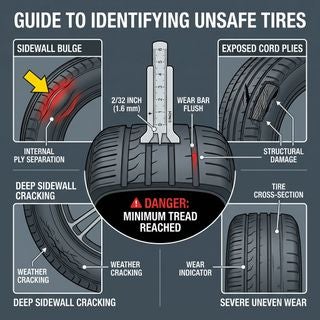
A passenger vehicle tire is legally unsafe to drive on when its tread depth wears down to 2/32 inch (approximately 1.6 mm), when built-in wear indicator bars become flush with the tread surface, or when structural damage such as sidewall cracks exceeding 1.5 mm deep, exposed internal cords, bulges, or tread separation appear. In Ohio, driving on tires below the legal minimum tread limit compromises wet-weather stopping distance and elevates the risk of hydroplaning, necessitating immediate replacement to maintain vehicle control and road safety.
Maintaining proper tire health is essential for protecting your vehicle and everyone inside it. Tire tread serves a mechanical purpose: it evacuates water from beneath the rubber contact patch so your vehicle can steer and stop effectively. When tread rubber wears down past safe thresholds, traction drops sharply on wet asphalt and slush, causing stopping distances to increase dramatically even at moderate road speeds.
Beyond tread depth, a tire becomes unsafe whenever its structural casing is compromised. Internal belting and rubber compounds break down over time due to age, heat cycles, UV exposure, and impact stress from road hazards. Physical deformities like bubbles on the sidewall indicate that internal structural plies have ruptured, allowing high-pressure air to push against the outer rubber layer. Continuing to drive on a tire with internal plies damaged like this risks a sudden highway blowout.
Regular multi-point safety inspections help spot these compromised conditions before they cause a breakdown on the road. Drivers can visit our dealership location at 1503 Pennsylvania Ave for a thorough tire safety check, give our team a quick call to discuss any unusual tire symptoms, or schedule a test drive in a new vehicle equipped with the latest safety technologies.
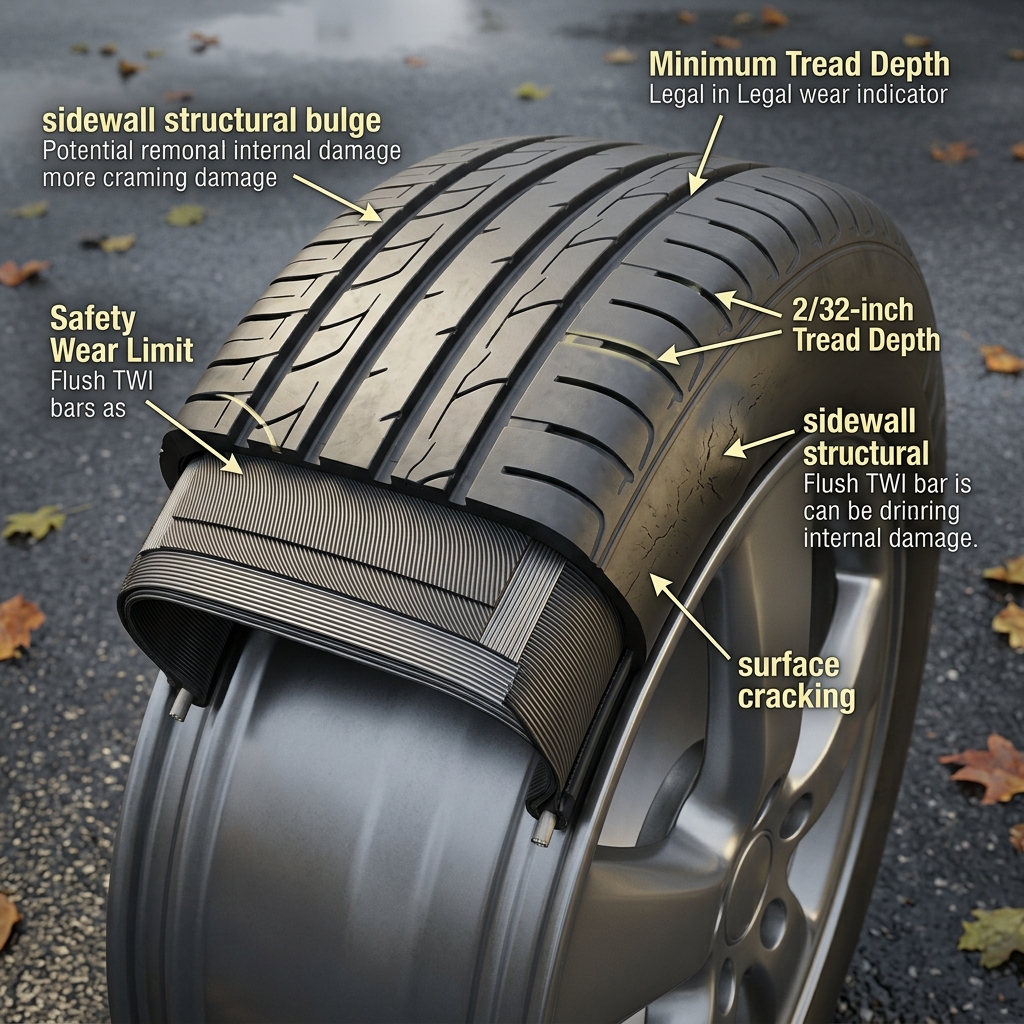
Table of Contents
- At What Tread Depth Must You Replace Passenger Vehicle Tires?
- How Do Formal Inspection Standards Define Unsafe Wear Patterns and Commercial Thresholds?
- How Deep Must Sidewall Cracks from Dry Rot Be Before Mandatory Replacement?
- What Are the 7 Critical Warning Signs That You Need New Tires Right Away?
- Common Questions About Tire Safety, Wear Patterns, and Replacement Limits
- Schedule Certified Tire Care and Safety Inspections
At What Tread Depth Must You Replace Passenger Vehicle Tires?
Passenger vehicle tires reach their mandatory replacement limit at 2/32 inch of remaining tread depth, though automotive safety standards strongly recommend replacing all-season tires once tread wears down to 4/32 inch for adequate wet-weather braking and hydroplane resistance. Once tread depth drops below 4/32 inch, a tire loses up to three-quarters of its capacity to channel water away from the contact patch, significantly increasing stopping distances during heavy rainfall.
| Tread Depth | Safety Condition | Driver Action Required |
| --- | --- | --- |
| 6/32 inch or more | Good Condition | Routine maintenance and regular rotations |
| 4/32 inch | Recommended Limit | Plan for replacement; wet grip decreases |
| 2/32 inch | Mandatory Replacement | Immediate replacement required by law |
Checking your tread depth at home takes less than a minute and requires only simple tools. The traditional coin check offers a fast visual reference: insert a standard U.S. penny upside down into the main tread groove with Abraham Lincoln's head facing you. If the top of Lincoln's head remains completely visible above the rubber block, your tread depth has reached or fallen below the legal minimum threshold of 2/32 inch, and the tire must be replaced immediately.
For a clearer picture of seasonal performance, perform a quarter check. Placing a quarter upside down into the groove measures depth against George Washington's head, which sits at roughly 4/32 inch from the coin edge. If the top of Washington's head is visible, the tire has reached the point where wet traction and snow gripping power decline noticeably.
Measuring multiple spots across the tire surface is critical because alignment issues or improper inflation often cause uneven rubber loss. Check the inner groove, center groove, and outer edge groove on every tire. If any single groove reads 2/32 inch or lower, that tire is legally worn out regardless of how much rubber remains on the rest of the surface. Driver assist features like pre-collision assist with automatic emergency braking rely on solid tire traction to slow your vehicle effectively in emergencies.
Our tire center makes finding the correct factory-fit replacement straightforward. You can easily order tires matched by vehicle year, make, and model through our online portal, or view our current manufacturer vehicle specials for service offers on complete tire sets.
How Do Formal Inspection Standards Define Unsafe Wear Patterns and Commercial Thresholds?
Formal motor vehicle inspection standards define a tire as unsafe when molded wear indicator bars sit level with adjacent tread blocks, when wear is uneven across the tread face, or when tread on heavy vehicles weighing over 10,000 pounds falls below 4/32 inch on steering axles. State inspection codes and federal safety guidelines require tires to maintain uniform tread coverage across all major grooves to ensure vehicle stability and predictable tracking.
Uneven tread wear patterns signal specific underlying mechanical or maintenance issues that compromise safety:
- Shoulder Wear on Both Edges: Heavy rubber loss on both outer shoulders indicates chronic under-inflation, which causes the tire center to collapse inward and forces the outer edges to bear excessive vehicle weight.
- Center Tread Wear: Concentrated wear along the center rib indicates over-inflation, reducing the contact patch size and causing harsh ride quality along with accelerated center tire wear.
- Single-Edge Wear: Pronounced wear along only the inner or outer edge points to wheel misalignment, camber errors, or worn steering linkages that pull the tire sideways as it rolls.
- Cupping or Scalloping: High-and-low diagonal dips across the tread surface indicate worn shock absorbers, out-of-balance wheel assemblies, or damaged suspension bushings allowing the wheel to bounce down the road.
Safety standards enforce stricter tread thresholds for heavier vehicles due to the immense kinetic energy and stopping distance required for large trucks and towing rigs. While passenger cars share a mandatory minimum floor of 2/32 inch, vehicles with a gross vehicle weight rating exceeding 10,000 pounds must maintain at least 4/32 inch of tread depth on front steering axle tires. Commercial standards also mandate that any tire with two adjacent tread grooves measuring below 2/32 inch, or any tire showing internal fabric, steel belts, or ply separation, must be removed from service immediately.
Commuters navigating the rolling hills and highway stretches around Calcutta encounter varying pavement textures and seasonal weather that accelerate uneven wear if tire maintenance is neglected. Regular rotations every 5,000 to 8,000 miles distribute steering and driving forces evenly across all four positions, extending total tread life and keeping wear patterns uniform.
How Deep Must Sidewall Cracks from Dry Rot Be Before Mandatory Replacement?
Sidewall cracks caused by dry rot require immediate tire replacement when they reach 1.5 mm (approximately 1/16 inch) in depth, when internal structural cords become visible, or when deep fissures open anywhere along the sidewall face. Even if a tire retains substantial tread height, rubber compound oxidation causes structural brittleness that can result in sudden tread separation or sidewall blowouts at highway speeds.
Rubber degradation is a chemical process triggered by atmospheric ozone, ultraviolet light, heat cycles, and extended vehicle inactivity. Tire manufacturers blend protective waxes and anti-ozonant compounds into the rubber to maintain elasticity. When a vehicle is driven regularly, the mechanical flexing of the rotating wheel pushes these protective waxes to the surface. When a vehicle sits parked for long periods, this continuous replenishment stops, allowing UV rays and environmental oxygen to break down polymer chains inside the rubber matrix.
A simple thumb flex check helps evaluate whether sidewall cracking is cosmetic checking or deep structural failure:
- Clean and Inspect: Wipe dirt and grime off the tire sidewall near the rim flange and raised lettering where micro-cracking usually begins.
- Apply Pressure: Press your thumb firmly against the rubber directly beside the crack to flex the sidewall surface.
- Observe Fissure Behavior: If the crack remains shallow and closed under pressure, it is superficial surface checking. If the crack opens up to reveal lighter inner rubber, nylon cords, or steel wire, the tire structure is compromised.
The presence of full tread depth can create a dangerous false sense of security on older tires. Low-mileage vehicles, seasonal trailers, and secondary commuter cars often show deep tread blocks while the underlying carcass has dry rotted into a brittle state. Chemical tire dressings containing heavy petroleum distillates or harsh silicone solvents accelerate this dry rot process by stripping away the factory anti-ozonant barrier. Cleaning tires with mild soap and water is the safest way to preserve sidewall elasticity.
When replacement components or specialized tire equipment are needed, drivers can order genuine OEM parts directly through our service portal to ensure exact fitment and factory safety standards.
What Are the 7 Critical Warning Signs That You Need New Tires Right Away?
Drivers should inspect their tires monthly for seven clear indicators that signal a tire has reached the end of its safe operational life and requires replacement:
- 1. Tread Depth Below 2/32 Inch: Rubber worn down to or past the legal 2/32 inch limit cannot evacuate water or slush, creating severe hydroplaning hazards.
- 2. Flush Tread Wear Indicators: Molded rubber bars running across the bottom of the tread grooves sit level with surrounding tread blocks when the tire is fully worn out.
- 3. Deep Sidewall Cracking or Dry Rot: Cracks reaching 1.5 mm deep or showing internal structural cords reveal severe chemical degradation of the rubber matrix.
- 4. Sidewall Bulges, Bubbles, or Blisters: A localized bulge on the outer sidewall indicates that the internal structural plies have ruptured, allowing air pressure to push out the surface rubber.
- 5. Persistent Air Pressure Loss: A tire that consistently loses pressure or triggers the tire pressure monitoring system (TPMS) warning light without an obvious nail puncture often suffers from bead leaks or internal liner porosity.
- 6. Excessive Steering Wheel Vibration or Vehicle Pulling: Unexplained shaking through the steering wheel or seat that persists after wheel balancing suggests internal belt separation or structural casing distortion.
- 7. Severe Irregular Wear Patterns: Deep cupping, diagonal scuffing, or severe inner-edge wear exposes internal plies and drastically reduces tire traction.
Drivers taking daily trips through Boardman often experience persistent steering wheel vibration when internal tire belts begin shifting under load. Physical damage like sidewall bulges from impact with deep potholes requires immediate attention, as a bulged tire can burst without warning under normal road stresses.
If a blowout occurs while driving, avoid slamming on the brakes. Keep both hands firmly on the steering wheel, maintain momentum for a brief second to stabilize vehicle trajectory, ease off the accelerator gradually, and guide the vehicle safely onto the road shoulder. For roadside emergencies, drivers can access manufacturer-backed assistance directly through Ford Roadside Assistance: 1-800-241-3673 for flat tire changes and towing support.
Common Questions About Tire Safety, Wear Patterns, and Replacement Limits
Q: At what specific tread depth are passenger tires legally considered unsafe and due for mandatory replacement, even if they still look usable?
Studies show that nearly 30% of tire-related accidents involve tires worn below the legal tread depth limit of 2/32 inch (about 1.6 mm). At this depth, the built-in wear indicator bars molded into the tread grooves become flush with the outer tread face. While a tire with 2/32 inch of tread may appear visually intact from a distance, its ability to channel water on wet pavement is compromised, leading to increased stopping distances and severe hydroplaning risks.
Q: How do formal inspection and safety standards define unsafe tread wear patterns, including thresholds for heavier vehicles, beyond simple visual checks?
Formal inspection standards classify a tire as unsafe if any tread wear indicator bar touches the road surface, if tread wear is uneven across the tread face, or if internal steel belts or fabric cords are exposed. For vehicles weighing over 10,000 pounds, safety standards mandate a minimum tread depth of 4/32 inch on front steering axles to maintain control under high load conditions. Uneven wear patterns like cupping, shoulder wear, or single-edge wear indicate alignment, inflation, or suspension failures that require immediate correction.
Q: How deep do sidewall cracks from dry rot need to be before a tire must be replaced immediately, even if the tread depth is still above the legal minimum?
Sidewall cracks from dry rot dictate immediate tire replacement when they reach 1.5 mm (roughly 1/16 inch) in depth, open up under manual pressure to reveal inner lighter rubber, or expose underlying structural cords. Deep dry rot cracks mean volatile oils inside the rubber compound have evaporated, leaving the tire brittle and susceptible to catastrophic sidewall blowouts regardless of how much remaining tread depth is present.
Q: How does the DOT date code on a tire sidewall indicate when a tire is expired?
The DOT date code is a four-digit number stamped on the tire sidewall that represents the week and year of manufacture. For example, a code reading 3121 indicates the tire was produced during the 31st week of 2021. Major safety guidelines recommend having tires inspected annually after 5 years in service and replacing any tire once it reaches 6 to 10 years of age from its manufacture date, as internal rubber compounds degrade over time even when stored or driven infrequently.
Q: What action should a driver take if a tire experiences a sudden blowout at highway speeds?
If a tire suffers a sudden blowout, hold the steering wheel firmly with both hands to maintain control and resist the urge to slam on the brakes. Maintain light pressure on the accelerator for a brief moment to stabilize the vehicle's momentum, then ease off the gas pedal gradually while steering straight. Once the vehicle slows down and stabilizes, signal gently and guide the car onto a safe, flat surface off the roadway before applying the brakes.
Schedule Certified Tire Care and Safety Inspections
Regular tire care and timely replacements are essential for maintaining your vehicle's safety, fuel economy, and handling stability. Driving on worn tread, dry-rotted sidewalls, or damaged internal belts puts your safety at risk, especially during severe weather conditions. Professional tire inspections identify subtle wear patterns, improper inflation, and structural defects long before they lead to roadside breakdowns.
Our factory-trained technicians provide comprehensive tire health checks, wheel alignments, precision balancing, and tread depth assessments using specialized diagnostic equipment. Whether you need a simple rotation or a complete set of new factory-recommended tires, our team ensures your vehicle leaves our service bay operating at peak safety standards.
Taking care of your tires is easy and convenient with our online booking tools. You can get directions to our service center, give our service desk a quick call to ask about current tire availability, or schedule a service appointment online to keep your vehicle running safely on every trip.