
Blog / Maintenance & Service, Expert Repairs & Diagnostics, Genuine Parts & Accessories, Engine Care &

What Does a Flashing Check Engine Light Mean? Insights from Our Service Manager

f

What Does a Flashing Check Engine Light Mean? Insights from Our Service Manager

What Does a Flashing Check Engine Light Indicate?

A flashing check engine light indicates an active, severe engine misfire occurring right now, allowing unburned fuel to dump directly into your exhaust system. Under SAE J2012 and OBD-II standards, the engine computer blinks the warning lamp when misfire rates reach a threshold high enough to overheat and permanently destroy the catalytic converter within minutes.

As the Service Manager at Tri State Ford with a decade of hands-on experience in automotive diagnostics, I see drivers face this issue every month. When your dashboard malfunction indicator lamp flashes rather than staying solid, your vehicle is signaling an immediate mechanical emergency. The computer has detected that one or more cylinders are not firing correctly, which sends raw gasoline down the exhaust stream. When that fuel reaches the extremely hot catalytic converter, it ignites inside the exhaust housing rather than inside the combustion chamber.

This secondary combustion rapidly elevates catalytic converter temperatures well past normal operating limits. In severe cases, the internal ceramic honeycombs melt or disintegrate, turning what could have been a straightforward ignition fix into a costly catalytic converter replacement. Drivers navigating the riverfront bluffs and rising terrain around East Liverpool should take this warning seriously, as pulling heavy loads up hills with an active misfire accelerates exhaust system damage. If your light starts blinking while you are on the road, give our team a call at (330) 462-7578 to discuss immediate vehicle care, or find directions to our service center location to bring your vehicle in safely via flatbed tow.

Table of Contents

Is a Steady Check Engine Light Different From a Flashing Warning?

A steady check engine light signals a non-critical emissions or engine performance fault that requires attention but generally allows you to complete your trip safely. Conversely, a flashing check engine light signifies an ongoing misfire that actively damages vital engine and exhaust hardware every second the vehicle runs.

When the warning light remains solid, the onboard computer has logged a diagnostic code for a system operating outside normal tolerances. Common triggers for a steady light include a loose gas cap, a failing oxygen sensor, or a minor leak in the evaporative emissions system. While a steady light should be diagnosed promptly to preserve fuel efficiency and overall engine health, it rarely leaves you stranded on the shoulder or causes sudden catalyst failure. In many instances, the computer initiates a limited operation mode to protect mechanical parts while permitting short-distance driving.

A flashing warning light leaves zero room for delay. The constant pulsing pattern—typically blinking once per second—is specifically reserved for conditions that threaten catastrophic hardware breakdown. When drivers ask our service bay about warning lights, I explain that a steady light gives you time to plan a routine diagnostic visit, whereas a flashing light requires shutting off the ignition as soon as you pull into a safe location. Addressing steady lights early by ordering genuine OEM parts like replacement gas caps or sensors helps prevent minor sensor wear from turning into bigger drivability trouble later.

What Causes the Engine Misfire Behind a Flashing Engine Light?

An engine misfire triggering a flashing check engine light is caused by an interruption in the air, fuel, or spark required for proper cylinder combustion. The primary culprits are worn spark plugs, failed ignition coils, faulty fuel injectors, or a loss of mechanical cylinder compression.

In modern engines like the Ford 2.3L EcoBoost inline-four or the 5.0L V8, combustion relies on precise timing. If an ignition coil pack fails or a spark plug gap expands due to wear, the electrical arc fails to ignite the air-fuel mixture inside the cylinder. The unfired fuel mixture is pushed past the exhaust valve during the exhaust stroke. The same outcome occurs when a fuel injector sticks open, flooding the cylinder with excessive fuel, or when a vacuum leak starves a cylinder of proper atmospheric pressure.

  • Worn or fouled spark plugs that fail to produce a strong electrical spark
  • Failed coil-on-plug ignition units that stop delivering high voltage
  • Clogged, leaking, or stuck-open fuel injectors disrupting the fuel charge
  • Mechanical compression loss from burnt valves, damaged piston rings, or head gasket leaks
  • Intake vacuum leaks causing an extreme lean misfire on specific cylinders

When raw fuel reaches the exhaust manifold, temperatures can exceed 1,600 degrees Fahrenheit inside the exhaust piping. That thermal spike breaks down the precious metals within the catalyst core. Identifying whether the misfire stems from electrical, fuel delivery, or mechanical causes requires methodical shop testing.

Is It Safe to Drive a Short Distance With a Flashing Check Engine Light?

Driving even a short distance with a flashing check engine light is unsafe because unburned fuel entering the exhaust manifold can melt the internal structure of your catalytic converter within two to three miles. To prevent compounding repair bills, you should pull over safely, turn off the engine, and arrange emergency vehicle transport.

Continuing to drive under heavy engine load or at highway speeds while the light blinks magnifies the mechanical strain. Drivers commuting along Route 170 near Calcutta often experience noticeable engine shaking, sluggish acceleration, or severe power loss when a misfire occurs. Operating a misfiring engine under load causes raw fuel to continuously wash down cylinder walls, diluting protective engine oil and increasing internal friction on crankshaft bearings and cylinder liners.

If your dashboard light flashes while driving, reduce your speed immediately, avoid hard acceleration, and find a safe spot off the roadway. For Ford owners, safety coverage includes access to official Ford Roadside Assistance at (800) 241-3673, which provides specialized towing to authorized facilities where factory-trained technicians handle complex powertrain repairs. While our service technicians inspect and repair your vehicle in the bay, customers interested in exploring our current vehicle lineup can consider scheduling a test drive in a new model to experience the latest Ford safety features firsthand.
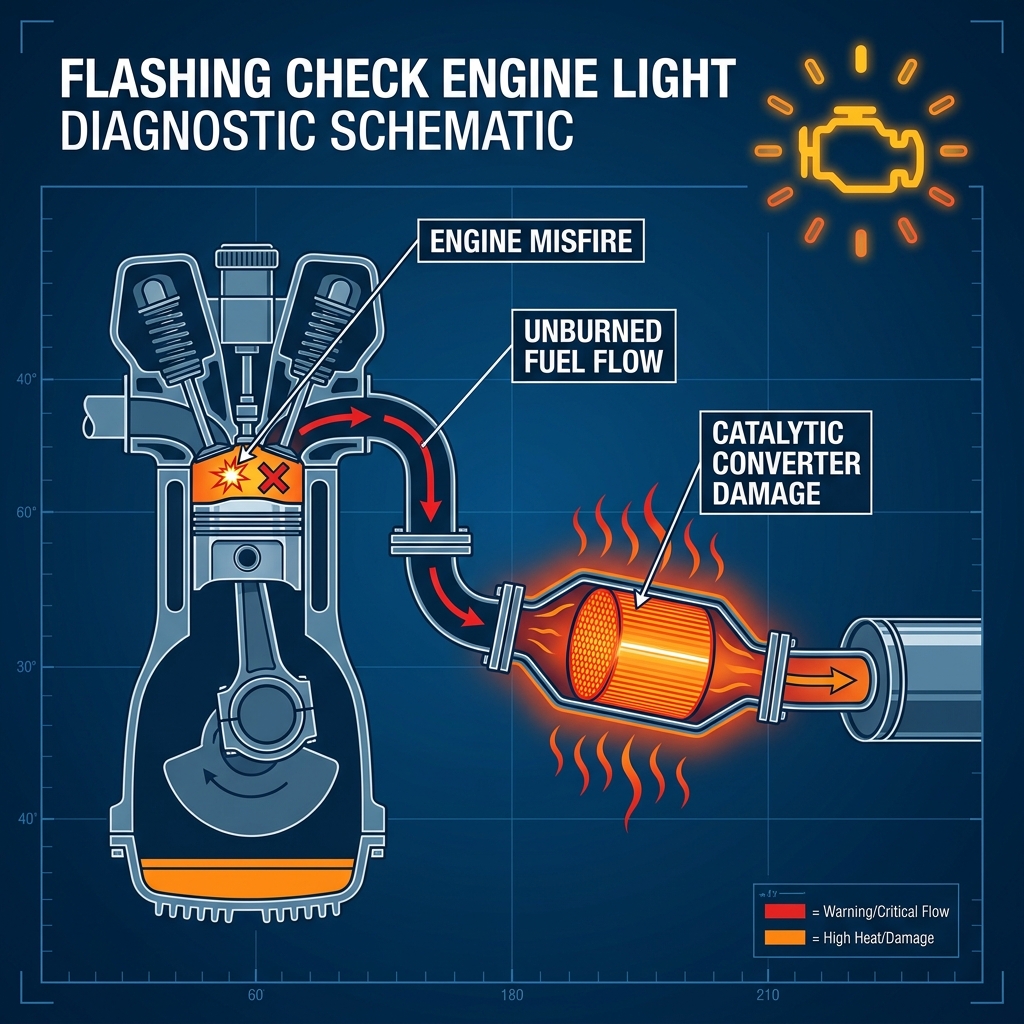
Diagnostic schematic showing an engine misfire causing unburned fuel to damage a glowing catalytic converter. (Representative image for illustration purposes only. Actual vehicle may vary based on trim and configuration.)

How Does an OBD-II Scanner Diagnose Misfire Diagnostic Trouble Codes?

An OBD-II scanner diagnoses a flashing check engine light by plugging directly into the vehicle diagnostic port to retrieve stored numerical trouble codes from the engine control module. These diagnostic codes pinpoint whether misfires are isolated to a single cylinder or spread across multiple combustion chambers.

When an engine misfire occurs, the vehicle computer logs specific diagnostic trouble codes categorized as active, pending, or stored. Active codes reflect severe, recurring faults that trigger immediate warning lights, whereas pending codes represent initial detection events awaiting confirmation across secondary drive cycles. Stored codes preserve historical diagnostic information for technician reference.

  • P0300: Indicates a random or multiple cylinder misfire where the computer cannot isolate the issue to a single cylinder
  • P0301 through P0308: Identifies a specific cylinder experiencing a misfire, with the final digit matching the affected cylinder number
  • P0316: Signals that an engine misfire was detected during the first 1,000 engine revolutions after startup

While an entry-level handheld scanner identifies the numerical code, professional diagnostic equipment goes much deeper. Advanced tools run live power balance tests, monitor real-time oxygen sensor waveforms, and track fuel trim percentages. This comprehensive data allows a technician to distinguish between an electrical coil breakdown, a clogged fuel injector, or a mechanical valve fault before replacing any components.

How Much Do Professional OBD-II Diagnostic Scans and Repairs Cost?

A professional OBD-II diagnostic scan typically ranges from $80 to $150, which covers hands-on technician evaluation, electrical pin-point testing, and computerized system analysis. Total repair expenses depend on the underlying cause, ranging from minor ignition parts to extensive catalytic converter replacement.

Reading the initial trouble code is only the first step in proper auto service. The diagnostic fee pays for an experienced technician to verify sensor values, check system wiring, conduct smoke tests for vacuum leaks, and perform compression checks. Replacing a single spark plug or ignition coil pack is relatively inexpensive, whereas replacing a damaged catalytic converter ruined by prolonged driving with a flashing light can push repair bills significantly higher.

Repair Service Typical Cost Factors Primary Benefit
Diagnostic Evaluation Professional technician labor, scanner hookup, pinpoint testing Identifies accurate root cause without guessing
Spark Plug & Coil Replacement Number of cylinders, engine access, genuine OEM parts Restores clean ignition spark and engine power
Fuel Injector Service Injector cleaning, solenoid testing, unit replacement Ensures correct air-fuel mixture in combustion chamber
Catalytic Converter Replacement Direct-fit exhaust assembly, manifold labor, oxygen sensors Restores exhaust flow and vehicle emissions compliance

Taking prompt action when your warning light flashes preserves your engine, protects your exhaust hardware, and keeps long-term maintenance costs manageable. If you suspect an engine misfire or need an accurate vehicle diagnostic check, feel free to give our team a quick call, stop by our East Liverpool service center, or secure your spot by scheduling your service appointment online today.

© 2026 Tri State Ford. All rights reserved.

Flashing Check Engine Light Repair in East Liverpool OH | Tri State Ford
Posted in:

Related Posts

Article image

Why Tri State Ford is the Trusted Choice for Timing Chain Service

Why Tri State Ford is the Trusted Choice for Timing Chain Service When it comes to maintaining your 2026 Ford, ensuring the proper care of critical engine components like the timing chain is essential for long-term reliability and performance. The timing chain plays a pivotal role in synchronizing the engine’s camshaft and crankshaft, directly impacting engine timing and overall operation. Choosing the right service provider for timing chain maintenance or replacement can prevent costly engine damage and keep your Ford running smoothly for years. That’s why drivers from East Liverpool, Calcutta, and surrounding communities trust Tri State Ford for expert timing chain service tailored to their vehicle’s specific needs. At Tri State Ford, we understand that the timing chain is a durable yet complex component that requires specialized knowledge and precision during service. Our technicians are Ford-certified and receive ongoing training to stay current with the latest engine technologies, especially those found in the 2026 Ford lineup, including EcoBoost engines known for their advanced timing systems. This expertise ensures that every timing chain inspection, adjustment, or replacement meets Ford’s rigorous standards, safeguarding your engine’s health and preserving its warranty coverage. One of the reasons Tri State Ford stands out in timing chain service is our use of genuine Ford parts. While aftermarket or generic chains may seem like a cost-saving option, they often lack the exact specifications and durability required for Ford engines. Genuine parts from Tri State Ford are engineered to fit perfectly, resist stretching, and withstand the stresses of daily driving across varied conditions—whether you’re commuting through Boardman or taking your truck to rugged work sites in Midland. This focus on authentic parts directly translates to improved reliability and peace of mind. Our service center is equipped with advanced diagnostic tools designed to detect early signs of timing chain wear or tensioner issues before they escalate into engine problems. This proactive approach is vital because a failing timing chain can cause erratic engine performance, increased fuel consumption, or even catastrophic engine failure. Technicians at Tri State Ford carefully assess the chain’s condition, associated components such as guides and tensioners, and overall engine timing to recommend the most effective service plan tailored for your vehicle’s mileage and usage patterns. Moreover, our commitment to transparent communication means you’ll receive honest explanations about your timing chain’s condition and clear guidance on needed repairs. We know that maintaining your Ford is an investment, so we focus on delivering dependable service with no hidden fees or unnecessary upsells. Whether you’re in Calcutta, OH, or nearby Poland, OH, drivers rely on our knowledgeable team for timely, efficient service that fits their schedules and keeps their vehicles performing at peak levels. For those in East Liverpool and surrounding areas, Tri State Ford offers convenient service scheduling, along with shuttle options and loaner vehicles to minimize disruption to your day. We invite you to experience why so many in the region trust us with their timing chain maintenance by visiting our service center. You can get directions to Tri State Ford or call us at (330) 462-7578 to discuss your timing chain service needs and schedule an appointment. In summary, Tri State Ford’s combination of certified technicians, genuine Ford parts, advanced diagnostics, and customer-first approach makes us the dependable choice for timing chain services. We focus on preserving your engine’s longevity and performance, ensuring your Ford stays ready for every mile ahead. Table of Contents Expert Timing Chain Replacement for Your 2026 Ford at Tri State Ford Common Causes of Timing Chain Noise: When Does Rattling Mean Trouble? How Tri State Ford’s Timing Chain Service Stands Apart from General Mechanics Preparing for Your 2026 Ford Timing Chain Service: Essential Documents and Maintenance Tips Expert Timing Chain Replacement for Your 2026 Ford at Tri State Ford When it comes to timing chain replacement on your 2026 Ford, Tri State Ford provides expert service tailored specifically to your vehicle’s needs. Our technicians are extensively trained on the latest Ford engine designs, including the advanced EcoBoost engines that rely on precise timing chain operation for optimal performance and durability. Unlike general repair shops, we understand the exact specifications, torque settings, and replacement procedures mandated by Ford engineers, ensuring that every timing chain replacement restores your engine’s reliability and efficiency. Timing chains are critical components that synchronize the crankshaft and camshaft rotation, keeping your engine’s valves opening and closing at the right moments. Over time, these chains can stretch or develop wear, potentially causing engine performance issues or even severe damage if left unaddressed. Our technicians use genuine Ford timing chains and OEM parts, which meet stringent quality standards and provide a perfect fit, minimizing the risk of premature failure compared to aftermarket alternatives. At Tri State Ford, we follow detailed Ford factory protocols during the replacement process. This includes thorough inspections of related components such as tensioners, guides, sprockets, and seals to ensure the entire timing system functions flawlessly. Our service bays are equipped with advanced diagnostic tools that verify correct timing and engine calibration after replacement, guaranteeing your Ford runs smoothly and safely. For drivers in Calcutta, OH, and nearby areas like Poland and Boardman Township, this attention to detail means peace of mind. Whether your 2026 Ford is primarily used for daily commuting or heavy-duty tasks, a properly serviced timing chain from Tri State Ford helps preserve engine health and prevents costly repairs down the road. Maintaining your vehicle’s timing chain system with Tri State Ford’s expertise protects your investment and supports the dependable performance you expect from Ford. If you own a Ford truck or SUV, such as those found in our Truck Inventory, trust our certified technicians for precise, thorough timing chain replacement to keep your engine running at its best. Common Causes of Timing Chain Noise: When Does Rattling Mean Trouble? A rattling noise from your engine often signals an issue with the timing chain, but it doesn’t always mean the chain itself is stretched or damaged. Several factors can contribute to timing chain noise, and understanding these helps ensure timely and accurate diagnosis. One common cause is a failing timing chain tensioner. This component maintains proper chain tension, and if it weakens or malfunctions, the chain can become loose and produce a rattling sound, especially during cold starts or engine idling. Another frequent source is wear on the chain guides or sprockets, which can cause the chain to vibrate or slip slightly, leading to noise. Low or dirty engine oil can also exacerbate timing chain noise since proper lubrication is essential for smooth operation and reducing friction. Over time, insufficient maintenance in areas like oil changes can accelerate wear on these components. It’s important to note that not every rattling noise means the timing chain is stretched or at immediate risk of failure. Some noises can stem from related parts or temporary conditions that require inspection rather than full replacement. However, ignoring persistent rattling can lead to more severe damage, including engine misalignment or even catastrophic failure. Professional diagnostics using specialized equipment can pinpoint the exact cause of the noise, ensuring the right repair is performed. For drivers near Calcutta, OH, or East Liverpool, OH, expert service from trained technicians offers peace of mind by accurately identifying and addressing timing chain issues before they escalate. How Tri State Ford’s Timing Chain Service Stands Apart from General Mechanics When it comes to timing chain service, Tri State Ford offers a level of expertise and precision that general mechanics often cannot match. Our technicians receive continuous, Ford-specific training that keeps them current with the latest engine technologies and factory-recommended procedures. This specialized knowledge ensures that every timing chain replacement or repair is performed exactly to Ford’s stringent standards, protecting your 2026 Ford’s engine performance and durability. Unlike many general repair shops, Tri State Ford uses only genuine Ford parts designed specifically for your vehicle’s engine. These OEM components maintain the integrity of your timing system, reducing the risk of premature wear or failure. Additionally, our service center is equipped with advanced diagnostic tools calibrated for Ford engines, allowing us to detect subtle issues that might be overlooked elsewhere. This precision helps prevent unnecessary repairs and ensures any timing chain concerns are addressed thoroughly. Another key advantage is our comprehensive service approach. Timing chain replacement involves intricate engine disassembly and precise reassembly, which demands meticulous attention to detail. Our technicians follow detailed factory repair manuals and utilize the latest service bulletins to avoid common pitfalls seen in less specialized shops. This level of care helps preserve engine balance and timing accuracy, directly contributing to smoother operation and longer engine life. For drivers in communities like Calcutta, OH, and East Liverpool, OH, trusting Tri State Ford means receiving dependable timing chain service backed by Ford’s heritage of quality and reliability. Our commitment to expert care and genuine parts supports your vehicle’s performance for many miles ahead. Preparing for Your 2026 Ford Timing Chain Service: Essential Documents and Maintenance Tips When scheduling a timing chain service for your 2026 Ford at Tri State Ford, having the right documents ready can streamline the process and ensure accurate service records. Bring your vehicle’s registration and proof of ownership to confirm service eligibility. Additionally, having your Ford’s Maintenance Schedule or service booklet on hand helps our technicians verify recommended intervals and any previous repairs related to the timing chain system. Preparing your vehicle with routine maintenance prior to the timing chain service can also improve outcomes. Ensure oil changes and fluid levels are up to date since clean engine oil is critical for timing chain longevity, especially for EcoBoost engines. Checking for any unusual engine noises or performance issues before your appointment allows our technicians to diagnose concerns efficiently. For those traveling from nearby areas like Calcutta, OH, or East Liverpool, OH, Tri State Ford’s service center at 1503 Pennsylvania Ave offers a welcoming environment with expert staff ready to assist. If you have questions or need assistance preparing for your appointment, feel free to call us at (330) 462-7578 or get directions to Tri State Ford. © 2026 Tri State Ford. All rights reserved.

;

What Does It Mean When Your Check Engine Light Comes On?

.hrizn-rte-content .e-rte-image { border: 0;max-width: 100%;height: auto } .hrizn-rte-content .e-rte-image.e-imginline { display: inline-block;float: none;margin-left: 5px;margin-right: 5px;max-width: calc(100% - 10px);vertical-align: bottom } .hrizn-rte-content .e-rte-image.e-imgbreak, .hrizn-rte-content .e-rte-image.e-imgcenter { display: block;float: none;margin: 5px auto;max-width: 100% } .hrizn-rte-content .e-rte-image.e-imgleft { float: left;margin: 0 12px 8px 0;max-width: 100% } .hrizn-rte-content .e-rte-image.e-imgright { float: right;margin: 0 0 8px 12px;max-width: 100% } .hrizn-rte-content figure.e-rte-image { margin: 8px auto;max-width: 100% } .hrizn-rte-content figure.e-imgleft { float: left;margin: 0 12px 8px 0 } .hrizn-rte-content figure.e-imgright { float: right;margin: 0 0 8px 12px } .hrizn-rte-content figure.e-imgcenter { display: block;margin: 8px auto;text-align: center } A check engine light turns on when your vehicle's onboard computer detects an operational error in the engine, transmission, or emissions control system. The engine control module continuously reads data from sensors throughout the powertrain, and when sensor values fall outside preset factory thresholds, the system stores a diagnostic code and illuminates the amber dashboard light to warn you before component damage occurs. Modern Ford vehicles rely on a sophisticated network of digital sensors to monitor everything from air-fuel ratios to exhaust temperature. When the powertrain control module registers an anomaly—such as an unexpected air leak or an erratic voltage signal—it triggers the service indicator light on your instrument cluster. This warning serves as an early notification system designed to prevent minor sensor malfunctions from turning into severe mechanical breakdowns. Ignoring an active engine light can lead to reduced fuel efficiency, rough idling, higher tailpipe emissions, and potential harm to major exhaust components like the catalytic converter. Driving along the bluffs and river valley roads in East Liverpool places steady demands on your engine, making prompt attention to powertrain warnings essential for vehicle longevity. If your dashboard warning light activates, contacting (330) 462-7578 allows our certified service team to perform a comprehensive system scan, pin down the exact diagnostic trouble code, and explain the necessary corrective steps clearly. Drivers needing immediate in-person assistance can easily stop by our convenient East Liverpool service center for professional inspection. Table of Contents What Are the 10 Most Common Reasons Your Check Engine Light Turns On? What Is the Difference Between a Solid and a Flashing Check Engine Light? Why Does an Engine Misfire Cause the Check Engine Light to Flash? How Do Pending Codes, Stored Codes, and OBD2 Scanners Work? Common Questions About Check Engine Lights and Vehicle Repairs Schedule Certified Ford Diagnostic Care at Tri State Ford What Are the 10 Most Common Reasons Your Check Engine Light Turns On? The ten most common causes for a check engine light illumination are a loose or missing gas cap, a failing oxygen sensor, a damaged catalytic converter, a dirty or faulty mass airflow sensor, worn spark plugs, failing ignition coils, an evaporative emission system leak, a failed EVAP purge valve, a malfunctioning thermostat, or a failing engine coolant temperature sensor. Vehicle owners frequently encounter these mechanical and electrical triggers during routine driving. Understanding how each component functions helps clarify why the onboard computer activates the warning light: Loose, Cracked, or Missing Gas Cap: The evaporative emission system maintains a pressurized seal to prevent fuel vapors from escaping into the atmosphere. A loose cap breaks this seal, triggering an EVAP system leak code such as DTC P0457 or P0440. Failing Oxygen Sensor: Measuring unburned oxygen in the exhaust stream, a degraded O2 sensor sends incorrect data to the engine computer, reducing fuel economy by up to 40 percent and accelerating exhaust wear. Malfunctioning Catalytic Converter: Responsible for converting harmful exhaust gases into harmless emissions, a failing converter restricts exhaust flow, causes severe power loss, and often generates a sulfur odor. Faulty Mass Airflow Sensor: The mass airflow sensor measures incoming air volume to determine proper fuel delivery. Contamination on the sensor element causes hesitation, stalling, and poor acceleration. Worn Spark Plugs: Spark plugs ignite the compressed fuel-air mixture inside each cylinder. As electrode gaps widen over thousands of miles, incomplete combustion leads to rough idling and engine misfires. Failing Ignition Coils: Modern engines utilize individual ignition coils for each cylinder. A failing coil stops supplying high-voltage electricity to its spark plug, triggering immediate misfire codes. Evaporative Emission System Leaks: Damaged EVAP hoses or charcoal canisters prevent the vehicle from purging fuel vapors properly into the engine intake, causing persistent warning lights. Stuck EVAP Purge Valve: Common on turbocharged EcoBoost powertrains, a stuck purge valve allows uncontrolled fuel vapors into the intake manifold, creating rich air-fuel mixtures and rough starts after refueling. Faulty Engine Thermostat: A thermostat stuck open prevents the engine coolant from reaching optimal operating temperature, causing the engine control unit to keep the fuel system in a rich warming-up mode. Failing Coolant Temperature Sensor: An inaccurate coolant sensor sends false temperature readings to the dashboard and engine computer, causing improper fan operation and fuel delivery errors. Navigating daily driving along State Route 170 in Calcutta with a active sensor fault forces your engine to run inefficiently. Models like the Ford Escape powered by the 1.5L engine or the Ford Explorer equipped with the 2.3L powertrain rely on precise sensor synchronization. Addressing these common issues promptly keeps your powertrain running smoothly and protects vital emissions equipment. What Is the Difference Between a Solid and a Flashing Check Engine Light? A solid check engine light indicates a non-emergency powertrain or emissions fault that requires professional diagnosis soon, while a flashing check engine light signals an active, severe engine misfire that allows raw fuel to enter the exhaust stream and destroy the catalytic converter within minutes. When the service indicator glows steady, your vehicle's onboard computer has identified a persistent anomaly—such as a failing sensor or a minor emissions leak—that does not present an immediate threat of catastrophic mechanical destruction. You can generally continue driving gently to complete your immediate trip, but you should schedule a diagnostic evaluation at your earliest convenience to prevent worsening performance. A flashing warning light represents an urgent emergency. When the light blinks repeatedly, one or more engine cylinders are failing to ignite fuel properly. As unburned gasoline passes through the engine exhaust valve into the red-hot exhaust manifold, it ignites inside the catalytic converter internal structure, raising temperatures beyond 1,600 degrees Fahrenheit. Continuing to drive under load with a blinking warning light can melt internal converter components, create severe exhaust restrictions, and lead to engine fire hazards. If your dashboard light begins blinking, pull off the road safely, turn off the engine, and arrange for immediate towing service. Why Does an Engine Misfire Cause the Check Engine Light to Flash? An engine misfire causes the check engine light to flash because unburned fuel leaves the combustion chamber and ignites inside the catalytic converter, generating extreme thermal stress that can permanently melt the converter's internal ceramic core in a matter of minutes. During normal operation, the spark plug ignites the air-fuel mixture inside the cylinder at a precise millisecond during the compression stroke. If a failed ignition coil, fouled spark plug, or clogged fuel injector prevents combustion, that full charge of gasoline gets pushed out of the exhaust valve into the manifold. Because exhaust gas temperatures already exceed one thousand degrees, raw fuel ignites immediately upon contact with the internal catalyst material. The catalytic converter relies on rare precious metals coating a fine ceramic honeycomb to neutralize harmful emissions. Internal fuel fires elevate temperatures far beyond structural tolerances, causing the ceramic substrate to liquefy, collapse, and block the exhaust passage completely. The engine control module continuously tracks crankshaft speed variations using position sensors. When it detects rapid deceleration beats corresponding to a non-firing cylinder, it instantly flashes the check engine light to command the driver to stop the vehicle immediately and prevent thousands of dollars in catalytic converter and engine damage. How Do Pending Codes, Stored Codes, and OBD2 Scanners Work? A pending code is a temporary error recorded when the engine computer detects a fault during a single drive cycle, whereas a stored code is a permanent fault confirmed over multiple drive cycles that actively triggers the dashboard check engine light. The vehicle's onboard diagnostic system uses a multi-tier testing process before illuminating warning lights: Pending Codes: When a sensor reading strays outside normal ranges once, the powertrain control module logs a pending diagnostic trouble code without turning on the dashboard light. If the error does not recur on subsequent drives, the computer clears the pending code automatically. Stored Codes: If the same operational fault recurs across consecutive drive cycles under similar operating conditions, the computer elevates the entry to a stored code and illuminates the check engine light. Stored codes remain in memory until cleared manually or resolved through systematic drive cycle testing. Handheld OBD2 Code Readers: Basic handheld code readers and Bluetooth smartphone adapters cost between $20 and $60. These tools connect to the OBD2 port beneath the steering column to read four-digit diagnostic trouble codes. Diagnostic Limitations: A free store code scan or handheld reader only provides the raw code number; it does not identify the exact failing part. For instance, a lean mixture code could point to a vacuum leak, a weak fuel pump, a clogged filter, or a faulty sensor. Professional diagnostic equipment and physical testing are required to pinpoint the root cause. Automatic Light Reset: If an underlying fault is fully repaired, the computer will turn off the check engine light on its own after 50 to 100 miles of varied city and highway driving across several complete drive cycles. Commercial operators utilizing our new Ford F-Series work trucks rely on precise computer diagnostics to maintain fleet uptime and avoid costly roadside breakdowns. Common Questions About Check Engine Lights and Vehicle Repairs Q: Will a free store code scan tell you the exact part to replace? A free store code scan retrieves only the diagnostic trouble code logged by your car's computer, indicating which system or sensor detected abnormal behavior. It does not pinpoint the precise failing component. For example, a code for an oxygen sensor circuit error might stem from a damaged wiring harness, a blown fuse, or an engine vacuum leak rather than a bad sensor itself. Comprehensive hands-on diagnostic testing by factory-trained technicians is necessary to verify the exact faulty component before installing replacement parts. Q: How many miles does it take for a check engine light to turn off on its own after a repair? After an underlying mechanical or electrical fault is completely repaired, the engine control unit typically requires 50 to 100 miles of varied driving to turn off the check engine light automatically. The computer must complete multiple drive cycles—which include specific periods of engine warm-up, steady highway cruising, and street driving—to run self-diagnostic monitors and verify that all operating parameters have returned to factory specifications. Q: How much does a basic handheld OBD2 code reader cost for home diagnostics? A basic standalone handheld OBD2 code reader or a wireless Bluetooth adapter that syncs with a smartphone application generally costs between $20 and $60. These entry-level diagnostic tools plug directly into the standard 16-pin OBD2 port beneath your vehicle's dashboard. They allow vehicle owners to read stored diagnostic trouble codes, view basic engine parameter data, and clear temporary error codes from the computer memory. Q: Can a loose fuel cap cause a check engine light on a Ford vehicle? A loose, missing, or worn fuel cap is one of the most frequent causes of a check engine light on Ford cars, trucks, and crossovers. The evaporative emission control system pressurizes the fuel tank to trap harmful gasoline vapors. When the gas cap fails to form an airtight seal, the pressure sensor detects a vacuum leak and triggers codes such as DTC P0457 or P0440, turning on the dashboard warning light. Q: Is it safe to drive my vehicle to the dealership with a solid check engine light? Driving short distances with a solid, steady check engine light is generally safe provided the engine displays normal coolant temperatures, steady oil pressure, and smooth performance without unusual noises. A steady light indicates a non-critical issue that requires evaluation soon. However, if the engine hesitates, stalls, or displays a flashing check engine light, you should pull over safely and request roadside assistance immediately to avoid catastrophic internal damage. Schedule Certified Ford Diagnostic Care at Tri State Ford Resolving a check engine light quickly protects your powertrain, preserves your vehicle's resale value, and ensures safe driving for every daily journey. Our factory-certified technicians utilize advanced OEM diagnostic equipment to pinpoint underlying electrical and mechanical issues accurately, using genuine replacement components designed specifically for your vehicle. When a dashboard indicator activates, you can schedule a service appointment online at your convenience or order genuine Ford parts online directly through our service department. If your vehicle requires routine electrical checkups alongside engine code scans, feel free to read our battery maintenance guide to learn how stable voltage keeps onboard computer systems operating reliably. When you need trusted, transparent vehicle care from experienced professionals, visit our facility at 1503 Pennsylvania Ave or give our service desk a call at (330) 462-7578 to keep your Ford running reliably for years to come. © 2026 Tri State Ford. All rights reserved. Vehicle specification data © JATO Dynamics Limited. Title Tags Check Engine Light Diagnostics in East Liverpool OH | Tri State Ford Meta Description Keywords Open Graph Twitter Card Canonical Article Metadata Geographic Targeting { "@context": "https://schema.org", "@graph": [ { "@type": "NewsArticle", "@id": "#article", "headline": "What Does It Mean When Your Check Engine Light Comes On?", "datePublished": "2026-09-10T20:15:31.278Z", "dateModified": "2026-09-10T20:17:43.186Z", "author": { "@id": "#author" }, "publisher": { "@id": "#dealer" }, "wordCount": 2142, "description": "Learn why a vehicle's check engine light turns on, how onboard sensors detect errors, and why prompt attention prevents major mechanical damage." }, { "@type": "AutoDealer", "@id": "#dealer", "name": "Tri State Ford", "url": "https://www.tristateford.net", "telephone": "+13304627578", "sameAs": [ "https://maps.google.com/?cid=1136336406351438323" ], "address": { "@type": "PostalAddress", "streetAddress": "1503 Pennsylvania Ave", "addressLocality": "East Liverpool", "addressRegion": "OH", "postalCode": "43920", "addressCountry": "US" }, "areaServed": { "@type": "GeoCircle", "geoMidpoint": { "@type": "GeoCoordinates", "latitude": "40.6367833", "longitude": "-80.5443033" }, "geoRadius": "48280" }, "geo": { "@type": "GeoCoordinates", "latitude": "40.6367833", "longitude": "-80.5443033" }, "openingHours": [ "Mo 09:00-20:00", "Tu 09:00-18:00", "We 09:00-18:00", "Th 09:00-20:00", "Fr 09:00-18:00", "Sa 09:00-15:00" ] }, { "@type": "FAQPage", "@id": "#faq", "mainEntity": [ { "@type": "Question", "name": "Will a free store code scan tell you the exact part to replace?", "acceptedAnswer": { "@type": "Answer", "text": "A free store code scan retrieves only the diagnostic trouble code logged by your car's computer, indicating which system or sensor detected abnormal behavior. It does not pinpoint the precise failing component. For example, a code for an oxygen sensor circuit error might stem from a damaged wiring harness, a blown fuse, or an engine vacuum leak rather than a bad sensor itself. Comprehensive hands-on diagnostic testing by factory-trained technicians is necessary to verify the exact faulty component before installing replacement parts." } }, { "@type": "Question", "name": "How many miles does it take for a check engine light to turn off on its own after a repair?", "acceptedAnswer": { "@type": "Answer", "text": "After an underlying mechanical or electrical fault is completely repaired, the engine control unit typically requires 50 to 100 miles of varied driving to turn off the check engine light automatically. The computer must complete multiple drive cycles—which include specific periods of engine warm-up, steady highway cruising, and street driving—to run self-diagnostic monitors and verify that all operating parameters have returned to factory specifications." } }, { "@type": "Question", "name": "How much does a basic handheld OBD2 code reader cost for home diagnostics?", "acceptedAnswer": { "@type": "Answer", "text": "A basic standalone handheld OBD2 code reader or a wireless Bluetooth adapter that syncs with a smartphone application generally costs between $20 and $60. These entry-level diagnostic tools plug directly into the standard 16-pin OBD2 port beneath your vehicle's dashboard. They allow vehicle owners to read stored diagnostic trouble codes, view basic engine parameter data, and clear temporary error codes from the computer memory." } }, { "@type": "Question", "name": "Can a loose fuel cap cause a check engine light on a Ford vehicle?", "acceptedAnswer": { "@type": "Answer", "text": "A loose, missing, or worn fuel cap is one of the most frequent causes of a check engine light on Ford cars, trucks, and crossovers. The evaporative emission control system pressurizes the fuel tank to trap harmful gasoline vapors. When the gas cap fails to form an airtight seal, the pressure sensor detects a vacuum leak and triggers codes such as DTC P0457 or P0440 , turning on the dashboard warning light." } }, { "@type": "Question", "name": "Is it safe to drive my vehicle to the dealership with a solid check engine light?", "acceptedAnswer": { "@type": "Answer", "text": "Driving short distances with a solid, steady check engine light is generally safe provided the engine displays normal coolant temperatures, steady oil pressure, and smooth performance without unusual noises. A steady light indicates a non-critical issue that requires evaluation soon. However, if the engine hesitates, stalls, or displays a flashing check engine light, you should pull over safely and request roadside assistance immediately to avoid catastrophic internal damage." } } ] } ] }

f

How Do You Fix an Oil Leak on a 2026 Ford?

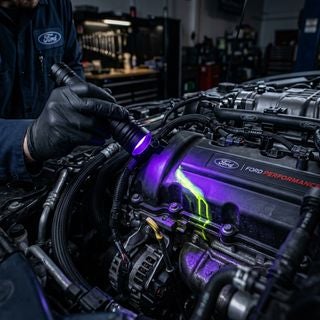
To fix an oil leak on a 2026 Ford, you must clean the engine bay, identify the exact origin using fluorescent ultraviolet dye or inspection powder, replace the compromised gasket or fitting, and refill the crankcase to the proper level. Minor seeps at the valve cover or oil pan require installing a new pre-formed seal or applying Motorcraft High Performance Engine RTV Silicone, whereas pressurized leaks along turbocharger oil feed lines require replacing degraded line fittings and copper seals before fluid loss harms internal components. Identifying an engine oil leak early prevents thermal damage and protects critical engine components from lubrication starvation. Fresh engine oil appears amber or light brown with a slick feel, whereas older oil turns dark brown or black. If oil drips onto hot exhaust manifolds, it generates a harsh burning odor and light white smoke under the hood. Continuing to drive with severe oil loss can lead to low oil pressure warnings, premature bearing wear, or severe engine overheating. When inspecting a leak at home, place a clean sheet of white cardboard directly beneath the engine crossmember overnight. Engine oil leaves a distinct dark brown or black stain, distinguishing it from red transmission fluid or pink coolant. If you notice persistent puddling, check the dipstick level before starting the vehicle to ensure sufficient oil remains in the crankcase. For persistent or high-pressure leaks, professional diagnostic equipment provides the most accurate answer. You can visit our service department at 1503 Pennsylvania Ave for a comprehensive multi-point inspection, or give our service team a quick call at (330) 462-7578 to discuss observed symptoms with a certified technician. Table of Contents What Are the Common Causes and Leak Points on Ford EcoBoost Engines? 2026 Ford F-150 vs Ram 1500: Which Truck Offers Better Oil Leak Resistance? How to Inspect Your Ford for Oil Leaks and Check for Safety Recalls Can You Use an Extended Warranty to Cover Ford Oil Leak Repairs? Frequently Asked Questions About Ford Engine Oil Leaks Schedule Professional Oil Leak Diagnostics What Are the Common Causes and Leak Points on Ford EcoBoost Engines? Common oil leak points on Ford EcoBoost engines center around high-heat and high-pressure zones, including the valve cover gaskets, lower oil pan mating surfaces, timing chain covers, and turbocharger oil supply lines. Modern forced-induction engines subject engine seals to rapid thermal expansion and contraction cycles, which causes rubber gaskets to harden and RTV sealant bonds to degrade over extended mileage. On the 2.0L EcoBoost engine, which powers versatile crossover models like the 2026 Ford Escape with standard all-wheel drive, primary leak points include the front timing cover seal and the valve cover perimeter gasket. Over time, crankcase pressure can force oil past hardened valve cover corner seals, allowing oil to pool around spark plug wells or seep down the front engine cover. The 2.0L EcoBoost in the 2026 Ford Explorer also requires careful inspection around the front crankshaft seal, where road debris and heat can accelerate rubber breakdown. The twin-turbocharged 3.5L EcoBoost V6 presents a distinct set of potential leak areas due to its tight engine bay packaging and elevated turbocharger operating temperatures: Vacuum Pump Seal: On older 3.5L engine architectures, the mechanical vacuum pump mounted to the rear of the passenger-side cylinder head can develop a slow oil seep that drips directly onto the transmission bell housing. Turbocharger Oil Lines: High exhaust gas temperatures near the turbochargers can degrade the small rubber O-rings and crush washers on the oil feed and return lines, causing oil to vaporize against the exhaust piping. Composite Oil Pan Sealant: Certain previous-generation engine designs utilized composite plastic oil pans sealed with liquid RTV sealant. Repeated heat cycles caused minor pan flexing, leading to slow seeps along the lower engine block rail. Recent Ford engine designs have addressed this by utilizing updated pan structures and press-in-place gaskets. When truck owners bring an EcoBoost into our service bay with an oil leak, our technicians usually check the rear vacuum pump and valve covers before looking at the lower oil pan. Driving across varied elevations, such as the rolling hills around State Route 170 in Calcutta, puts steady load on the turbocharger cooling and lubrication system. Maintaining clean engine oil and replacing PCV valves at recommended intervals relieves excess crankcase pressure, protecting internal seals across all EcoBoost engine configurations. 2026 Ford F-150 vs Ram 1500: Which Truck Offers Better Oil Leak Resistance? The 2026 Ford F-150 offers exceptional long-term oil leak resistance by pairing refined engine sealing techniques with durable metal oil pans and press-in-place synthetic rubber gaskets across its powertrain lineup. While Ram 1500 trucks historically relied on standard stamped steel or cast aluminum oil pans, earlier generations of full-size trucks faced persistent valve cover and oil cooler adapter leaks. Modern Ford engineering focuses on heavy-duty crankcase ventilation and robust gasket designs built for heavy towing and demanding commercial service. In full-size work trucks, engine oil integrity directly impacts productivity and long-term durability. The 2026 Ford F-150 equipped with the 3.5L EcoBoost V6 delivers an impressive 10,400 lbs towing capacity, supported by a heavy-duty engine oil cooler and a precise SelectShift® automatic transmission. To withstand high oil pressures during heavy hauling, Ford utilizes engineered press-in gaskets at major engine mating surfaces rather than relying solely on liquid sealant beads, preventing the gasket distortion that affected older truck engines. To keep work fleets running smoothly without unexpected downtime, proper maintenance of cooling and lubrication systems remains essential. You can explore our current new work truck lineup to see how modern Ford powertrains are configured for heavy-duty work, or check out our complete new truck inventory to compare cab styles and engine options built to handle rigorous regional workloads. How to Inspect Your Ford for Oil Leaks and Check for Safety Recalls Performing an accurate DIY oil leak inspection requires a systematic approach to trace fluid back to its highest point of origin on the engine assembly. Gravity causes leaking oil to travel downward and backward along the chassis frame rails while driving, which often makes a minor valve cover leak appear as a major oil pan failure underneath the vehicle. Follow this step-by-step diagnostic process to isolate an oil leak: Clean the Engine Bay: Spray a dedicated automotive degreaser over the dirty lower engine surfaces and rinse carefully with low-pressure water, taking care to avoid delicate electrical connectors. Apply Leak Detection Powder or UV Dye: Dust suspected leak areas with aerosol leak detection powder, or pour a bottle of fluorescent engine oil UV dye directly into the oil filler cap. Run the Engine: Idle the vehicle for 10 to 15 minutes, or drive a short distance to allow oil pressure to build up within the engine galleries. Inspect with an Ultraviolet Light: Shine a blacklight around timing covers, valve cover rails, and oil filter housings. The fluorescent dye will glow brightly at the exact crack or gasket breach where fluid emerges. If a previous repair attempt failed to fix the issue, your vehicle may have been misdiagnosed. Misdiagnoses frequently occur when residual oil from a upper engine leak accumulates around the rear main seal or transmission torque converter housing. Requesting a UV dye tracer test ensures technicians verify the top-most active leak source before replacing expensive structural components. In some cases, oil leaks stem from specific factory service actions or safety recalls rather than normal wear. For instance, manufacturer safety recalls have previously addressed missing cylinder head ball plugs on select 2.0L EcoBoost and 2.3L EcoBoost engines that could allow oil to escape near hot exhaust manifolds. You can check your vehicle's safety recall status at any time by entering your 17-character Vehicle Identification Number (VIN) into the official Ford owner portal or the NHTSA recall lookup tool. Drivers navigating daily trips near Market Street in Boardman can rely on authorized Ford service centers to complete all recall repairs free of charge. Can You Use an Extended Warranty to Cover Ford Oil Leak Repairs? Official Ford Protect Extended Service Plans cover major engine oil leak repairs, including the replacement of oil pan gaskets, valve cover seals, timing cover gaskets, and internal engine oil seals damaged through normal operational wear. Coverage eligibility depends on the specific plan tier selected at contract activation: PowertrainCARE: Covers fundamental mechanical components, including internal engine seals, oil pump assemblies, and cylinder head gaskets across 29 core powertrain parts. BaseCARE: Expands coverage to 84 mechanical components, adding steering gear housing seals and primary engine cooling hardware. ExtraCARE: Protects 113 key parts, covering complex electronic sensors, fuel systems, and engine accessory seals. PremiumCARE: Comprehensive bumper-to-bumper protection covering over 1,000 components, including high-tech engine sensors, turbocharger oil lines, and complete gasket sets. Warranty claims require proof that the vehicle was maintained according to the recommended service schedule published in the owner manual. Failing to perform regular oil changes can lead to sludge buildup, which restricts crankcase ventilation and damages internal seals. Keep all oil change receipts and maintenance logs organized to ensure seamless claim processing when service is required. Component damage resulting from aftermarket engine modifications, improper installation, or pre-existing conditions prior to contract coverage is not covered under extended warranty terms. When repairing an active leak, using genuine factory components preserves engine tolerances and ensures precise fitment. You can schedule a service appointment with our factory-trained technicians to inspect covered components, or order genuine OEM parts directly through our service department for approved maintenance tasks. Frequently Asked Questions About Ford Engine Oil Leaks Q: Can a failing vacuum pump cause an oil leak on a 3.5L EcoBoost engine? Yes, on earlier 3.5L EcoBoost V6 engine designs, the mechanical vacuum pump attached to the back of the passenger-side cylinder head can develop an oil leak at its mounting seal. As the seal degrades, engine oil seeps out and drips down onto the top of the transmission housing, often mimicking a leaking valve cover gasket or rear main seal failure. Q: Is it safe to drive my Ford if it has a minor oil leak? You can drive short distances with a slow oil seep provided you regularly check the dipstick and maintain proper oil levels in the crankcase. However, if oil leaks directly onto hot exhaust components, creates a strong burning smell, or causes the low oil pressure light to illuminate, you should pull over immediately and switch off the engine to prevent severe mechanical damage or thermal hazards. Q: What should I do if a technician misdiagnoses my vehicle's oil leak? If an initial repair fails to stop an oil leak, request a comprehensive ultraviolet dye test to trace the fluid's exact path from the highest point on the engine. Ask the service advisor to review official Technical Service Bulletins related to your specific engine code, which often outline updated diagnostic steps for complex leaks around timing covers, turbo oil lines, and oil pan seals. Q: How do I know if my Ford oil leak is covered by a factory recall? You can verify recall eligibility by locating your 17-character VIN on your registration card or driver-side dashboard and entering it into the official Ford support website or the NHTSA recall tool. If an active safety recall applies to your engine's oil system, an authorized Ford dealership will perform the necessary inspection and component replacement at no cost to you. Q: What is the difference between fresh engine oil and other leaking fluids? Fresh engine oil has an amber or light brown appearance with a slick feel, turning dark brown or black as it ages. Red or dark pink fluid indicates automatic transmission or power steering fluid, clear light brown or blue fluid with a sweet odor points to engine coolant, and clear thin fluid near the passenger side footwell is typically harmless air conditioning condensation. Schedule Professional Oil Leak Diagnostics Addressing an engine oil leak promptly protects your vehicle's mechanical reliability, maintains resale value, and ensures your engine remains fully lubricated under heavy driving loads. Whether your vehicle requires a simple valve cover gasket replacement, updated turbocharger oil line fittings, or a complete multi-point inspection, professional diagnostic care provides lasting peace of mind on local roads and work sites. Our factory-certified technicians utilize specialized diagnostic tools, genuine Motorcraft fluids, and precise OEM replacement seals engineered specifically for your vehicle's powertrain. You can get directions to Tri State Ford to drop off your vehicle for expert care, or give our team a call at (330) 462-7578 to speak directly with a knowledgeable service advisor. If you are also considering an upgraded truck or SUV while your vehicle is in for service, feel free to schedule a test drive online today. © 2026 Tri State Ford. All rights reserved. Vehicle specification data © JATO Dynamics Limited. Title Tags 2026 Ford Oil Leak Repair in East Liverpool OH | Tri State Ford Meta Description Keywords Open Graph Twitter Card Canonical Article Metadata Geographic Targeting { "@context": "https://schema.org", "@graph": [ { "@type": "NewsArticle", "@id": "#article", "headline": "How Do You Fix an Oil Leak on a 2026 Ford?", "datePublished": "2026-09-04T21:14:36.270Z", "dateModified": "2026-09-04T21:16:19.597Z", "author": { "@id": "#author" }, "publisher": { "@id": "#dealer" }, "wordCount": 2129, "description": "Learn how to diagnose and repair an oil leak on a 2026 Ford, from identifying damaged gaskets to replacing seals and preventing engine damage." }, { "@type": "AutoDealer", "@id": "#dealer", "name": "Tri State Ford", "url": "https://www.tristateford.net", "telephone": "+13304627578", "sameAs": [ "https://maps.google.com/?cid=1136336406351438323" ], "address": { "@type": "PostalAddress", "streetAddress": "1503 Pennsylvania Ave", "addressLocality": "East Liverpool", "addressRegion": "OH", "postalCode": "43920", "addressCountry": "US" }, "areaServed": { "@type": "GeoCircle", "geoMidpoint": { "@type": "GeoCoordinates", "latitude": "40.6367833", "longitude": "-80.5443033" }, "geoRadius": "48280" }, "geo": { "@type": "GeoCoordinates", "latitude": "40.6367833", "longitude": "-80.5443033" }, "openingHours": [ "Mo 09:00-20:00", "Tu 09:00-18:00", "We 09:00-18:00", "Th 09:00-20:00", "Fr 09:00-18:00", "Sa 09:00-15:00" ] }, { "@type": "FAQPage", "@id": "#faq", "mainEntity": [ { "@type": "Question", "name": "Can a failing vacuum pump cause an oil leak on a 3.5L EcoBoost engine?", "acceptedAnswer": { "@type": "Answer", "text": "Yes, on earlier 3.5L EcoBoost V6 engine designs, the mechanical vacuum pump attached to the back of the passenger-side cylinder head can develop an oil leak at its mounting seal. As the seal degrades, engine oil seeps out and drips down onto the top of the transmission housing, often mimicking a leaking valve cover gasket or rear main seal failure." } }, { "@type": "Question", "name": "Is it safe to drive my Ford if it has a minor oil leak?", "acceptedAnswer": { "@type": "Answer", "text": "You can drive short distances with a slow oil seep provided you regularly check the dipstick and maintain proper oil levels in the crankcase. However, if oil leaks directly onto hot exhaust components, creates a strong burning smell, or causes the low oil pressure light to illuminate, you should pull over immediately and switch off the engine to prevent severe mechanical damage or thermal hazards." } }, { "@type": "Question", "name": "What should I do if a technician misdiagnoses my vehicle's oil leak?", "acceptedAnswer": { "@type": "Answer", "text": "If an initial repair fails to stop an oil leak, request a comprehensive ultraviolet dye test to trace the fluid's exact path from the highest point on the engine. Ask the service advisor to review official Technical Service Bulletins related to your specific engine code, which often outline updated diagnostic steps for complex leaks around timing covers, turbo oil lines, and oil pan seals." } }, { "@type": "Question", "name": "How do I know if my Ford oil leak is covered by a factory recall?", "acceptedAnswer": { "@type": "Answer", "text": "You can verify recall eligibility by locating your 17-character VIN on your registration card or driver-side dashboard and entering it into the official Ford support website or the NHTSA recall tool. If an active safety recall applies to your engine's oil system, an authorized Ford dealership will perform the necessary inspection and component replacement at no cost to you." } }, { "@type": "Question", "name": "What is the difference between fresh engine oil and other leaking fluids?", "acceptedAnswer": { "@type": "Answer", "text": "Fresh engine oil has an amber or light brown appearance with a slick feel, turning dark brown or black as it ages. Red or dark pink fluid indicates automatic transmission or power steering fluid, clear light brown or blue fluid with a sweet odor points to engine coolant, and clear thin fluid near the passenger side footwell is typically harmless air conditioning condensation." } } ] } ] }