

Blog / Maintenance & Service, Expert Repairs & Diagnostics, Genuine Parts & Accessories, Engine Care &

What Causes a Car to Shake When Braking?

d

A car shakes when braking primarily due to disc thickness variation across the brake rotors, uneven friction material deposits on the rotor face, sticking caliper slide pins, or worn front suspension bushings. When brake pads clamp down on an uneven metal surface or compromised mechanical hardware, the resulting hydraulic force fluctuations send rapid pulses through the brake pedal and steering wheel.

Braking relies on smooth, consistent contact between the brake pad friction material and the spinning iron surface of the brake rotor. When a vehicle decelerates, friction transforms kinetic energy into heat. If that heat is distributed unevenly, or if mechanical components fail to release smoothly, the uniform surface of the rotor breaks down. Even a microscopic variation in rotor thickness—as thin as a fraction of a millimeter—causes the brake pad to catch and release rapidly as the wheel rotates.

Mechanical issues elsewhere in the wheel assembly can also generate or magnify this shaking. Corroded caliper pistons, seized guide pins, loose wheel bearings, or degraded rubber suspension bushings prevent the braking system from maintaining flat, even contact against the rotor hub. When navigating the steep descents along the riverfront bluffs of East Liverpool, this uneven contact generates intense thermal cycles that rapidly worsen vibration.

Identifying the underlying cause of brake vibration requires a comprehensive inspection of the entire friction assembly. Drivers noticing pedal pulsation or wheel shimmy can visit our service center location on Pennsylvania Ave or give our service team a quick call at (330) 462-7578 to have our factory-trained technicians inspect the full system.

Table of Contents

How Do Warped Rotors and Uneven Pad Deposits Cause Brake Pulsation?

Brake pulsation occurs when brake rotors develop uneven thickness or localized friction material buildup, forcing the brake pads to jump across high and low spots as the wheel turns. This physical oscillation transfers directly through the hydraulic brake fluid and suspension components, reaching the driver's foot and hands during deceleration.

Many drivers assume a warped rotor is physically bent like a wavy metal plate. In modern vehicles, true structural warping from mechanical bending is quite rare. Instead, brake pulsation is usually caused by disc thickness variation (DTV) or uneven friction material transfer.

  • Disc Thickness Variation: When a rotor spins through a misaligned caliper or against worn pads, specific areas of the disc wear down faster than others. As the brake pad squeezes a rotor that varies in thickness around its circumference, the hydraulic pressure inside the brake lines surges and drops with every wheel revolution.
  • Friction Material Deposit: During aggressive stopping or prolonged heavy braking, temperatures between the pad and rotor spike dramatically. If a driver brings the car to a complete stop and holds the brake pedal down firmly while the brakes are scorching hot, binding resin from the brake pad melts directly onto that single spot on the rotor face.
  • Lateral Runout: Minor wobble in the rotor's rotation, often caused by rust scale on the wheel hub or improper lug nut torque, causes the disc to contact the inner and outer pads unevenly during normal driving, eventually shaving high spots into the disc face.

Over time, those hot spots on the rotor undergo a metallurgical change, transforming into a dense carbon-iron compound that wears at a different rate than the surrounding cast iron. Once these friction patches form, standard braking friction becomes uneven. Replacing degraded components with factory-spec hardware restores a smooth stopping surface, and our parts department can assist you to order genuine OEM Ford rotors and pads engineered specifically for your vehicle's braking system.
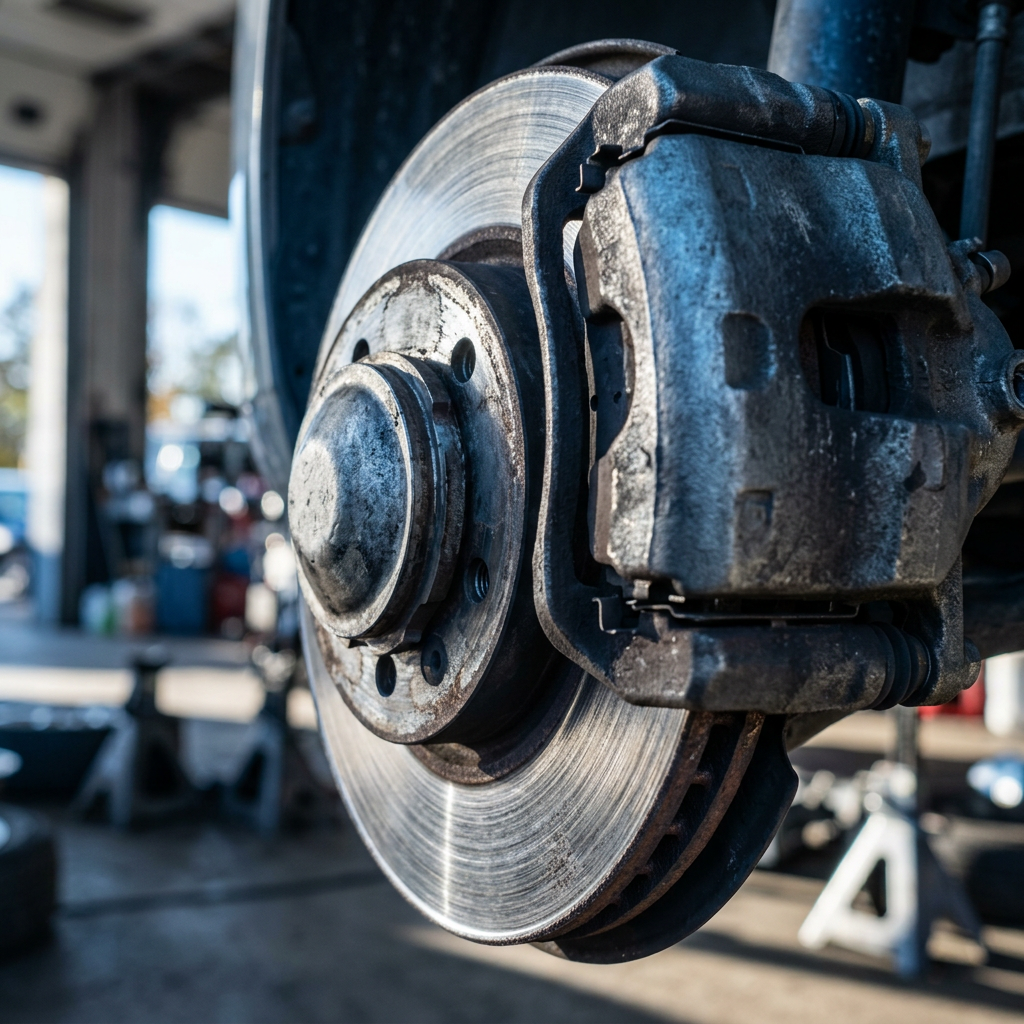
Close-up of a worn car brake rotor and caliper mounted on a vehicle inside a mechanic repair shop. (Representative image for illustration purposes only. Actual vehicle may vary based on trim and configuration.)

Does Your Steering Wheel or Brake Pedal Shake? Pinpointing the Issue

Shaking felt in the steering wheel during braking signals uneven front brake rotors or worn front steering and suspension components, whereas pulsation felt primarily through the brake pedal points to rear rotor thickness variation or anti-lock brake system engagement.

Because front brakes handle roughly 70 percent of a vehicle's stopping force, friction variations on the front axle transmit feedback directly through the steering knuckles, tie rods, and steering column. If the steering wheel oscillates side-to-side in your hands when slowing down from highway speeds, the front brake rotors or front control arm bushings are almost always the friction source.

When rear brake rotors suffer from thickness variation, the diagnostic feedback travels a different path:

  • Rear braking forces act directly on the chassis and hydraulic line pressure rather than the front steering geometry.
  • Vibration from rear rotors travels through the brake fluid column back up to the master cylinder, creating a rhythmically pulsing brake pedal under your foot.
  • Severe rear rotor unevenness can also create a low-frequency hum or a subtle body vibration felt in the driver's seat frame.

It is also critical to distinguish mechanical brake rotor pulsation from normal anti-lock braking system (ABS) operation. An active ABS system rapidly pulses the brake pedal only during heavy emergency braking or on slippery surfaces to prevent wheel lockup, accompanied by an instrument cluster warning light and a rapid mechanical chatter. If pedal pulsation occurs during light, routine deceleration on dry pavement without an ABS light, the cause is mechanical rotor or caliper wear.

How Sticking Calipers, Seized Pins, and Worn Suspension Cause Shaking

Sticking brake calipers and frozen slide pins force brake pads to drag continuously against the rotor face, generating extreme localized heat that warps metal discs and triggers severe vibration.

A disc brake caliper uses hydraulic pressure from a piston to push brake pads against the rotor. To maintain even pressure on both sides of the disc, floating calipers slide back and forth on steel guide pins protected by rubber dust boots. If moisture penetrates those rubber boots, rust forms on the guide pins, freezing the caliper in place.

  1. Continuous Dragging: A seized guide pin prevents the outer pad from retracting when you release the brake pedal, leaving the pad rubbing constantly against the spinning rotor.
  2. Extreme Heat Buildup: Continuous friction raises rotor temperatures well beyond normal operational ranges, glazing the brake pad friction layer and creating severe thermal hot spots on the rotor surface.
  3. Vehicle Pulling: A stuck caliper exerts uneven drag on one side of the vehicle, often causing the car to pull toward the stuck side during normal driving and vibrate violently when the brakes are applied.

Worn suspension hardware acts as an amplifier for these brake system defects. Components like tie rod ends, lower ball joints, and rubber control arm bushings are designed to absorb road shock and keep the front tires firmly aligned. When these steering linkages develop mechanical play, they can no longer damp the feedback from minor brake rotor variations. As a result, a tiny rotor imperfection that would normally go unnoticed turns into a harsh shake throughout the entire front assembly.

Warped Rotors vs. Unbalanced Wheels: Key Symptom Differences

Unbalanced wheels cause a continuous floorboard or steering wheel vibration that persists at constant highway speeds regardless of brake pedal pressure, whereas warped brake rotors produce vibration strictly when depressing the brake pedal.

Diagnostic Factor Warped Brake Rotors Unbalanced Wheels / Damaged Tires
Primary Trigger Pressing the brake pedal Vehicle speed (typically 50–70 mph)
Cruising Behavior Smooth and quiet Constant vibration or rhythmic hum
Pedal Feedback Rhythmic pulsing underfoot Stationary and steady pedal feel
Steering Feedback Shimmy occurs only while decelerating Continuous wheel vibration at speed
Primary Cause Disc thickness variation or heat spots Uneven tire weight, lost wheel weight, bent rim

Isolating these symptoms saves troubleshooting time. Suburban commutes along State Route 170 highlight this distinction clearly: if a car hums and vibrates continuously while cruising at 45 mph, wheel balance or tire damage is the primary suspect. However, if the ride remains completely smooth until you apply the brakes for a stoplight, the issue resides squarely within the braking friction system.

What Is the Cost of Replacing Brake Pads and Rotors?

Professional brake pad and rotor replacement averages $250 to $500 per axle depending on vehicle size and friction material specifications, while DIY replacement parts generally cost $80 to $200 per axle.

While replacing brake components at home saves initial labor expenses, professional service eliminates common installation mistakes that cause rapid recurrence of brake shaking. Home repairs without specialized precision tools carry hidden technical risks:

  • Hub Cleaning: Failing to remove microscopic rust scale from the wheel hub surface with a wire wheel before installing new rotors creates lateral runout right out of the box.
  • Fastener Torque: Uneven lug nut or caliper mounting bolt torque warps brand-new rotors within a few hundred miles of driving.
  • Slide Pin Service: Reusing dry or corroded caliper slide pins causes immediate pad binding and localized heat damage on new rotors.
  • Pad Bed-In Procedure: Skipping the critical thermal bed-in process prevents friction material from transferring evenly across the new disc surface.

Investing in factory-certified service ensures that hub surfaces are measured for runout, slide pins are cleaned and lubricated with high-temperature silicone grease, hardware clips are replaced, and wheel fasteners are torqued precisely to factory specifications.

Common Questions About Brake Shaking and Expert Service Care

Q: Can bad tires cause a car to shake when braking?

Worn, unevenly treaded, or separated tires can amplify vibration during braking because deceleration transfers vehicle weight onto the front tire contact patches. If a tire has flat spots, broken internal steel belts, or severe cupping, the increased downward load during stopping forces the tread imperfections against the pavement, creating a distinct shudder through the steering column and chassis.

Q: Is it safe to drive with a shaking brake pedal?

Driving with a shaking brake pedal is unsafe because vibration reduces the contact surface between the brake pad and rotor, increasing stopping distances and stressing front suspension linkages. Severe brake pulsation indicates irregular friction or overheating, which can lead to brake fluid boiling, reduced hydraulic pressure, or catastrophic friction material failure during an emergency stop.

Q: Can warped brake rotors be resurfaced instead of replaced?

Warped brake rotors can often be resurfaced on a brake lathe if the metal disc retains sufficient thickness above the manufacturer's discard limit. Machining removes high spots and restores a flat surface. However, if the rotor has deep thermal heat spots, heavy corrosion grooves, or thin metal specifications, complete replacement with new OEM rotors is necessary for long-term safety.

Q: How long do brake pads and rotors typically last?

Brake pads generally last between 30,000 and 70,000 miles, while brake rotors typically last between 50,000 and 70,000 miles depending on driving habits, vehicle weight, and road conditions. Driving in hilly terrain, hauling heavy loads, or aggressive stop-and-go commuting accelerates heat buildup and friction wear, requiring more frequent brake inspections.

Q: Why does my brake pedal vibrate only at high highway speeds?

Brake pedal vibration occurring exclusively at highway speeds is caused by minor disc thickness variation or subtle lateral runout that is too small to feel at lower city speeds. Because the wheel rotates significantly faster at 60 mph, the brake pad impacts rotor surface high spots much more frequently per second, turning minor friction variations into noticeable pedal pulses.

Smooth, dependable stopping power is essential for everyday driving confidence and family safety. Our technicians see vehicles every week with minor brake vibrations that are easily corrected before they lead to premature suspension wear or rotor damage. To restore smooth braking performance, stop by our East Liverpool service center, give our service department a call, or easily schedule a service appointment online today.
© 2026 Tri State Ford. All rights reserved.

Brake Vibration Causes in East Liverpool OH | Tri State Ford
Posted in:

Related Posts

d

Why Are Your Car Tires Wearing Down Unevenly?

Uneven tire wear on a car is primarily caused by incorrect tire inflation pressure, misaligned suspension angles, unbalanced wheel assemblies, and worn mechanical components such as shocks, struts, or ball joints. When a tire does not maintain flat, uniform contact with the road surface, friction concentrates along specific bands of the tread. Over time, this targeted friction produces distinct wear patterns—such as shoulder baldness, center tread thinning, cupping, or diagonal feathering—that compromise overall driving performance. Identifying the specific pattern on your tires provides clear insight into underlying mechanical needs. For instance, when tire inflation is not regularly adjusted, rubber degrades prematurely across either the center line or both outer edges. Similarly, hitting potholes or curb edges during daily drives can easily alter factory alignment settings, causing the tires to drag at unintended angles across the asphalt. Routine inspection allows driver's options to address these mechanical discrepancies before permanent tire damage occurs. When tires begin showing irregular tread depth, resolving the issue promptly preserves handling precision and braking reliability. Drivers can search available replacement options using our online tire lookup tool to explore factory-recommended sizes and load ratings. For in-person diagnostic support, our service team is available at our East Liverpool facility to inspect suspension components, verify alignment angles, and measure remaining tread depth across every groove. If you prefer to discuss your vehicle's symptoms before visiting, give our service counter a quick call at (330) 462-7578. In suburban areas like Calcutta, frequent stop-and-go driving along State Route 170 combined with moderate elevation changes can accelerate tread degradation whenever pressures or alignment angles drift outside factory specifications. Table of Contents Is Uneven Tire Wear Dangerous to Drive On? How Does Improper Pressure Cause Center or Shoulder Wear? What Is Camber Angle and How Do Worn Suspension Parts Cause Wear? Should Wheel Alignment, Balancing, and Tire Rotation Be Done Together? Common Questions About Tire Wear and Wheel Alignment Schedule Expert Tire and Wheel Maintenance at Tri State Ford Is Uneven Tire Wear Dangerous to Drive On? Driving on unevenly worn tires is dangerous because it significantly reduces wet-weather traction, lengthens stopping distances, increases hydroplaning risks, and dramatically elevates the possibility of a sudden tire blowout. Tread grooves are precisely engineered to channel water away from the tire footprint; when uneven wear erodes those channels unevenly, water becomes trapped beneath the rubber, causing the vehicle to slide across wet pavement. As tire tread wears down unevenly, the structural integrity of the tire carcass becomes compromised. Severe edge wear or inner-shoulder thinning exposes internal steel belts and fabric plies to moisture, road debris, and thermal stress. This degradation creates localized hot spots during highway travel, making the tire vulnerable to structural separation. Furthermore, modern driver-assist systems—including anti-lock braking and electronic stability control—rely on uniform tire diameter and predictable friction coefficients to function properly. Irregular tread depth alters individual wheel rotation speeds, which can cause safety systems to miscalculate available grip during emergency maneuvers. Elevated Hydroplaning Vulnerability: Shallow tread areas fail to clear standing water, causing tires to float off the road surface at lower speeds. Reduced Emergency Braking Efficiency: Uneven contact patches decrease rubber-to-asphalt friction, adding critical feet to total stopping distance. Unpredictable Vehicle Handling: Misaligned or cupped tires cause vehicle pulling, steering wheel drift, and delayed response during sudden steering inputs. Risk of Sudden Structural Failure: Extreme wear on tread edges weakens sidewall support and exposes internal cords to high-speed blowouts. Our factory-trained technicians evaluate tread depth profile and tire casing health during every multi-point inspection. To experience how proper alignment and balanced tires restore smooth, responsive handling, consider scheduling a road test evaluation with our service department. How Does Improper Pressure Cause Center or Shoulder Wear? Improper tire inflation directly alters the shape of the tread footprint, causing overinflated tires to bulge outward and wear rapidly along the tread center, while underinflated tires collapse inward and concentrate road friction on both outer shoulders. Maintaining correct air pressure allows the tire casing to support vehicle weight uniformly across the entire tread width. When a tire is overinflated above the manufacturer recommendation, internal air pressure forces the center portion of the tread to expand outward. As a result, the outer shoulders carry minimal weight, and the center line absorbs the majority of road friction, resulting in rapid central tread loss. Conversely, an underinflated tire lacks sufficient air pressure to keep the center tread firmly pressed against the road. The vehicle's weight forces the center to bow inward slightly, shifting heavy loads directly onto both outer edges. This causes double-shoulder wear, accelerates heat accumulation, and increases rolling resistance, which also lowers fuel economy. Finding the correct air pressure for your vehicle requires checking the official tire information placard located on the driver-side door jamb or reviewing the owner's manual. The pressure stamped directly onto the tire sidewall represents the maximum inflation limit of the tire casing, not the engineered setting for your specific vehicle. Checking inflation when tires are cold—before driving more than one mile—ensures accurate pressure readings. Outdoor temperature fluctuations also impact internal pressure; ambient cold causes air to contract, dropping tire pressure by roughly 1 PSI for every 10-degree Fahrenheit decrease in temperature. What Is Camber Angle and How Do Worn Suspension Parts Cause Wear? Camber angle refers to the inward or outward vertical tilt of the wheel when viewed from the front of the vehicle, where incorrect tilt angles force excessive vehicle weight onto either the inner or outer edge of the tire tread. Worn suspension components—such as degraded shock absorbers, loose ball joints, or deteriorated control arm bushings—allow the wheel assembly to move unpredictably, producing distinct scalloped or cupped wear patterns across the tread surface. When a wheel has negative camber, the top of the tire tilts inward toward the engine bay, concentrating load and road friction along the inside edge of the tread. When a wheel exhibits positive camber, the top tilts outward, causing rapid wear along the outside shoulder. Alignment technicians adjust camber using adjustable control arm bolts or strut mounts to ensure the tire stands perpendicular to the road surface during cornering and straight-line driving. In addition to camber, incorrect toe alignment —where tires point inward or outward relative to the vehicle centerline—causes feathering, a condition where tread blocks develop sharp edges on one side and rounded edges on the other as the tire scrubs across the pavement. Suspension wear creates a different type of damage known as cupping or scalloping. Shock absorbers and struts function to dampen spring oscillations and keep the tire firmly planted on the road surface. When shock dampening fails or internal valving degrades, the wheel bounces continuously at highway speeds. Every time the tire lands back on the asphalt, road friction scoops out small, repeating patches of rubber around the tire perimeter. Loose wheel bearings and worn steering tie rods also allow unwanted wheel play, leading to erratic diagonal wear patches. Maintaining precise suspension geometry requires replacing worn components with high-quality parts engineered for your vehicle's specific chassis specifications. Drivers seeking replacement components can explore ordering OEM Ford replacement suspension parts directly through our dedicated parts department. Should Wheel Alignment, Balancing, and Tire Rotation Be Done Together? Combining wheel alignment, wheel balancing, and tire rotation during a single maintenance appointment provides the most effective protection against premature tread wear, even though each service addresses a completely different mechanical function. Alignment adjusts suspension angles, balancing neutralizes weight imbalances in the wheel assembly, and rotation changes wheel positions to equalize tread wear across all four tires. Tire rotation moves wheels from high-stress positions to lower-stress positions according to engineered patterns, such as a forward cross for front-wheel-drive vehicles or a rearward cross for rear-wheel and four-wheel-drive trucks. While rotation distributes future tread wear evenly, rotating tires cannot fix existing alignment wear patterns; once rubber is scrubbed away unevenly by incorrect camber or toe settings, the physical shape of the tread block remains altered. Resolving the root cause requires performing a precision wheel alignment alongside rotation. Service Procedure Primary Mechanical Function Symptoms Addressed Recommended Service Frequency Tire Rotation Changes wheel position to distribute position-specific friction across all four tires Uneven front-to-rear tread depth variance Every 5,000 to 7,500 miles (or every oil change) Wheel Alignment Adjusts camber, toe, and caster suspension angles to factory specifications Vehicle pulling, off-center steering wheel, edge wear Annually or after hitting major road hazards Wheel Balancing Places small counterweights on the rim to equalize total mass distribution High-speed steering wheel wobble, cupped tread Whenever mounting new tires or every 10,000 miles When evaluating alignment needs, technicians differentiate between a 2-wheel alignment and a 4-wheel alignment. A 2-wheel alignment adjusts only the front steering axle angles, whereas a 4-wheel alignment measures and recalibrates camber, toe, and tracking angles on both front and rear independent suspensions relative to the vehicle's geometric thrust line. Vehicles equipped with solid rear axles often require 2-wheel adjustments, while most modern crossover SUVs, sedans, and trucks with independent rear suspension require 4-wheel alignment to ensure straight tracking. The price difference reflects the additional labor and sensor calibration involved in aligning both axles. Commuters travelling daily from Boardman toward regional highways often encounter uneven pavement transitions that can knock front or rear wheels out of factory alignment, making combined tire maintenance essential for maintaining high-speed driving stability. Common Questions About Tire Wear and Wheel Alignment Q: How do you find the correct tire pressure for your vehicle? The correct cold tire pressure for your vehicle is listed on the official tire information placard affixed to the driver-side door jamb, as well as in the owner's manual. Avoid using the maximum PSI figure stamped into the tire sidewall, as that number represents the maximum pressure the tire structural casing can hold, rather than the ideal inflation setting calculated by vehicle engineers for optimal tread wear, safety, and fuel economy. Q: Can rotating your tires fix an existing alignment wear pattern? Tire rotation cannot fix or reverse an existing alignment wear pattern because rubber that has already been scrubbed off the tread cannot be restored. Rotating tires merely shifts the damaged rubber to a different wheel position, which can temporarily slow down further localized damage. To permanently stop irregular tread wear, the underlying mechanical alignment fault or loose suspension component must be repaired before performing a rotation. Q: What is the typical price difference between a 2-wheel and 4-wheel alignment? A 2-wheel alignment generally costs less because service technicians only measure and adjust the front steering axle angles. A 4-wheel alignment involves calibrating suspension geometry on both front and rear axles to align all four wheels to the vehicle thrust line. Please contact the dealership for current service pricing, as costs may vary by vehicle and service needs. Q: Why do worn shocks or struts cause scalloped tire wear? Worn shocks or struts lack the dampening force needed to control suspension spring bounce over road bumps. As a result, the tire repeatedly lifts slightly off the pavement and slaps back down at speed. This continuous bouncing creates a series of shallow, scooped-out dips or scalloped patches around the tread perimeter, leading to high-speed cabin vibration and increased road noise. Q: How frequently should tire balancing and alignment be checked on a Ford F-150? Tire rotation and balance checks should occur every 5,000 to 7,500 miles, making it convenient to schedule alongside routine oil changes. Alignment angles on a Ford F-150 should be verified at least once per year or immediately after heavy off-road use, hauling maximum payload capacities, or impacting deep potholes and curbs that can shift factory suspension settings. Schedule Expert Tire and Wheel Maintenance at Tri State Ford Protecting your vehicle investment requires proactive tire care, precise computerized alignment, and timely replacement of worn suspension components. Regularly inspecting your tread depth, keeping air pressure set to factory specifications, and addressing handling vibrations early prevents premature tire failure and maintains dependable driving control in all road conditions. Our factory-certified technicians utilize specialized diagnostic alignment racks and precision balancing tools designed specifically for your vehicle model. Whether your vehicle requires a routine tire rotation, a comprehensive 4-wheel alignment, or suspension component replacements, our team provides transparent guidance and quality care to keep your vehicle running smoothly. Take control of your vehicle's safety and tread longevity today by scheduling your next service appointment online. You can also visit our service department directly at 1503 Pennsylvania Ave, East Liverpool, OH 43920, or give our service advisors a call at (330) 462-7578 to discuss your tire wear concerns and reserve a convenient inspection time. © 2026 Tri State Ford. All rights reserved. Tips to Prevent Uneven Tire Wear in East Liverpool OH | Tri State Ford

f

How Often Do Brake Pads Need to Be Replaced?

Brake pads typically last between 40,000 and 60,000 miles under normal driving conditions, though overall wear ranges from 20,000 to 70,000 miles depending on friction material, driving habits, and vehicle weight. Physical pad thickness determines safety far more accurately than odometer readings: replacement planning should begin when friction material wears down to 1/4 inch (approximately 6 mm), and new pads must be installed before the lining reaches 3 to 4 mm (or 3/32 of an inch). Friction lining on a brand-new brake pad measures about 12 mm thick. As you drive, the friction material gradually wears away against the spinning metal rotor to bring your vehicle to a controlled stop. Front brake pads handle roughly 60% to 70% of the stopping load due to forward weight transfer during deceleration, causing them to wear out faster than rear pads. Routine multi-point inspections provide the most dependable way to track pad wear over time. During standard maintenance services, our technicians measure remaining pad material across all four wheels using specialized thickness gauges. Catching thin pad lining early prevents severe metal-on-metal contact, preserving the smooth surface of your brake rotors and preventing costly damage to brake calipers. Vehicle size and regular cargo weight also play a significant role in wear schedules. For instance, a compact crossover like the Ford Escape with a 1.5L engine and all-wheel drive experiences different braking friction demands than a fully loaded three-row Ford Explorer equipped with a 2.3L engine and four-wheel drive. Drivers navigating steep riverfront bluffs in East Liverpool place extra thermal strain on their braking systems, making regular physical thickness measurements essential. If you suspect your vehicle requires a brake check, you can visit our East Liverpool service center on Pennsylvania Ave or give our team a quick call to consult with an advisor. Table of Contents What Factors Cause Brake Pads to Wear Out Faster? How Does Ceramic Brake Pad Lifespan Compare to Semi-Metallic? What Is the Average Cost to Replace Both Brake Pads and Rotors? Do OEM Brake Pads Last Longer Than Aftermarket Alternatives? Common Questions About Brake Maintenance and Lifespan Schedule Professional Brake Service at Tri State Ford What Factors Cause Brake Pads to Wear Out Faster? Driving environment, vehicle load, braking technique, and pad compound directly dictate how quickly brake pad lining degrades over time. Aggressive stop-and-go traffic, frequent high-speed braking, carrying heavy payloads, and navigating steep terrain all accelerate friction wear, causing pads to need replacement far earlier than the 60,000-mile mark. Urban commuting involves constant acceleration and deceleration cycles that create sustained heat buildup within the brake caliper assembly. This friction heat breaks down the pad's chemical bonding agents faster than steady open-highway driving. Commuters traveling along State Route 170 in Calcutta frequently encounter traffic light cycles and lower speed limits, which subjects brake components to repeated stop-and-go friction throughout daily driving. Braking habits significantly alter component longevity. Drivers who coast early when approaching red lights or downhill grades allow air to cool the rotors and pads, reducing thermal stress. Conversely, late, heavy foot pressure on the brake pedal generates intense surface friction that rapidly shaves away pad material. Riding the brake pedal continuously while descending long hills keeps the pad pressed against the rotor, generating extreme heat that can glaze pad surfaces and reduce stopping power. Vehicle mass and towed weight create additional stopping resistance. Heavy-duty haulers and full-size trucks like the Ford F-150 require substantially more hydraulic clamping pressure to bring heavy loads to a complete stop. When towing trailers or carrying full passenger loads, the extra kinetic energy converts directly into friction heat, accelerating pad degradation across both axles. Environmental elements like road salt, moisture, and debris also contribute to premature wear. Winter road treatments accelerate corrosion on caliper slide pins and backing plates. Sticky or binding caliper pins prevent the pad from fully retracting away from the rotor after you release the brake pedal, causing the pad to drag continuously and wear down unevenly. How Does Ceramic Brake Pad Lifespan Compare to Semi-Metallic? Ceramic brake pads generally last between 50,000 and 70,000 miles, whereas semi-metallic brake pads typically last between 30,000 and 50,000 miles. Ceramic compounds utilize dense ceramic fibers combined with copper or non-ferrous filler materials, creating a durable surface that withstands daily wear while producing minimal dust and noise. Semi-metallic brake pads contain between 30% and 65% metal content by weight, incorporating steel fibers, iron powder, and graphite alloys. This metallic construction offers superior heat dissipation and high initial bite, making semi-metallic pads well-suited for heavy-duty towing and high-stress applications. However, the harder metallic fibers act more aggressively against the rotor surface and wear down faster under normal passenger vehicle operation than refined ceramic formulations. Organic or non-asbestos organic (NAO) brake pads represent a third category, made from materials like glass, rubber, resin, and Kevlar. Organic pads deliver soft, quiet braking performance but wear out quickly, often lasting only 25,000 to 35,000 miles. They are primarily selected for lighter vehicles or budget applications where high heat resistance is not required. Brake Pad Material Type Typical Service Lifespan Primary Advantages Best Suited For Organic (NAO) 25,000 – 35,000 miles Quiet operation, low rotor wear Light passenger cars, gentle city driving Semi-Metallic 30,000 – 50,000 miles High heat tolerance, excellent stopping power Heavy towing, trucks, performance applications Ceramic 50,000 – 70,000 miles Extended longevity, low dust, ultra-quiet Daily commuting, family crossovers, sedans Choosing the correct friction material depends on your vehicle type and primary driving demands. While ceramic pads provide maximum mileage and cleaner wheels for everyday driving, semi-metallic pads remain the preferred choice for drivers who regularly push their vehicles through heavy work cycles. What Is the Average Cost to Replace Both Brake Pads and Rotors? Replacing both brake pads and rotors averages between $250 and $500 per axle, which translates to $500 to $1,000 for a comprehensive four-wheel service including parts and labor. Exact costs fluctuate based on vehicle classification, rotor design, caliper configuration, and whether specialized ceramic pads are selected. Labor charges typically account for half of the total invoice. Replacing rotors involves removing the wheel assembly, unbolting the brake caliper and mounting bracket, cleaning hub contact surfaces, compressing caliper pistons, and torquing all hardware to precise factory specifications. Larger vehicles with complex rear electronic parking brake mechanisms require electronic service mode activation prior to disassembly, slightly increasing total labor time. Brake rotors do not always require replacement during every pad service. Rotors generally last through two complete sets of brake pads—roughly 50,000 to 70,000 miles—provided the pads are changed before wear indicators scratch or groove the rotor face. During a pad replacement, technicians measure rotor thickness with a micrometer to verify that enough metal remains above the discard-limit spec cast into the rotor housing. If a rotor meets thickness safety standards and exhibits no deep scoring or thermal warping, it can sometimes be resurfaced on a precision brake lathe to restore a flat friction face. However, modern vehicle rotors are manufactured with thinner, lighter castings to optimize fuel efficiency. Consequently, replacing worn rotors with fresh units often provides superior thermal stability and longer service life compared to machining thin metal. Delaying pad replacement past the 3 mm safety mark rapidly escalates repair costs. When pad friction lining disappears completely, the steel backing plate grinds directly against the cast-iron rotor. This metal-on-metal friction destroys the rotor surface in short order and can overheat hydraulic caliper pistons, transforming a routine pad service into a complete system overhaul. Do OEM Brake Pads Last Longer Than Aftermarket Alternatives? Original equipment manufacturer (OEM) brake pads deliver reliable, standardized longevity because they are formulated to match the exact weight, rotor metallurgy, and hydraulic leverage of your specific vehicle. Premium aftermarket ceramic pads can match OEM pad life under ideal conditions, but entry-level aftermarket options often wear unevenly or degrade faster under thermal stress. Factory Ford Motorcraft pads undergo rigorous testing to ensure balanced friction performance across wide temperature ranges. OEM engineers select specific pad friction formulations that balance pad life, rotor preservation, noise suppression, and pedal feel. This precise engineering minimizes premature dusting, squealing, and pad glazing. Generic aftermarket pads frequently use a single friction compound across dozens of different vehicle models to reduce manufacturing costs. A compound designed broadly for multiple vehicle platforms may prove too soft for heavy SUVs or too hard for lighter passenger cars, leading to accelerated wear or increased rotor surface damage. When maintaining your braking system, ordering genuine Motorcraft replacement parts guarantees factory fitment and predictable wear life without guessing about compound compatibility. Matching OEM pads with factory-spec rotors ensures consistent stopping distance and protects your braking hardware over tens of thousands of miles. Common Questions About Brake Maintenance and Lifespan Our service team receives many questions about brake squeals, warning lights, pedal feel, and proper inspection habits. Here are clear answers to common questions regarding brake care. Q: What does a high-pitched squealing sound from brakes indicate? A high-pitched squeal while applying the brakes usually indicates that your brake pads have worn down to approximately 3 mm of remaining friction material. Most quality pads feature built-in metal wear indicators—small spring-steel tabs that contact the spinning rotor to produce a deliberate, high-frequency sound. This noise serves as an acoustic warning that it is time to schedule a pad replacement before metal backing plates contact and ruin the rotor surface. Q: What is the minimum safe thickness for brake pads? The absolute minimum safe brake pad thickness is 3/32 of an inch (roughly 3 mm). Operating a vehicle with pad material thinner than 3 mm significantly increases stopping distances and risks immediate metal-on-metal rotor damage. Service centers recommend planning a pad replacement as soon as measurements show 1/4 inch (about 6 mm) of material remaining, ensuring you schedule maintenance well before hitting critical wear limits. Q: How often should brake rotors be replaced? Brake rotors typically last between 50,000 and 70,000 miles, generally outlasting two sets of brake pads under standard driving conditions. Technicians measure rotor thickness with a precision micrometer during every brake inspection. If the rotor face is grooved, heat-cracked, warped, or worn below the manufacturer's minimum thickness threshold, new rotors must be installed alongside fresh pads to ensure safe braking performance. Q: Why do front brake pads wear out faster than rear brake pads? Front brake pads wear faster because physics shifts vehicle weight forward onto the front axle whenever you press the brake pedal. This dynamic weight transfer forces the front braking assembly to absorb 60% to 70% of the total stopping force. Because rear brakes manage less stopping load, rear pads often last significantly longer than front sets. Q: What causes a brake pedal to feel soft or squishy? A soft or squishy brake pedal points to air trapped within the hydraulic brake lines, degraded brake fluid, or a leaking brake component. As brake fluid ages, it absorbs atmospheric moisture, lowering its boiling point and creating compressible steam pockets under heavy braking. A sinking pedal requires immediate professional inspection to flush the hydraulic fluid or repair master cylinder seals. If your vehicle exhibits squealing, pedal vibration, or thin pad measurements, you can easily schedule a multi-point inspection online with our certified service team. Schedule Professional Brake Service at Tri State Ford Maintaining healthy brake pads and rotors keeps your vehicle stopping safely on every daily commute and family journey. Whether your vehicle requires a routine thickness measurement, fresh fluid, or a complete pad and rotor replacement, our certified technicians provide expert service using factory-approved parts. Our service department provides transparent digital vehicle inspections, thorough hardware cleaning, and precision installation tailored to your specific Ford model. We also handle comprehensive vehicle maintenance, including routine battery checks and multi-point inspections, to keep your vehicle performing reliably year-round. Visit our local Ford dealership at 1503 Pennsylvania Ave, East Liverpool, OH 43920, or call (330) 462-7578 to speak directly with an expert service advisor and book your appointment today. © 2026 Tri State Ford. All rights reserved. Vehicle specification data © JATO Dynamics Limited. Brake Pad Replacement in East Liverpool OH | Tri State Ford

b

When Should You Replace Your Car Tires?

Replace your tires when the tread depth drops to 2/32 inch, when the rubber reaches six years of age, or immediately if you spot sidewall bulges, severe cracking, or deep cuts. The built-in tread wear indicators become level with the tread surface at 2/32 inch, signaling the absolute safety minimum. However, wet-weather stopping distance increases significantly once tread wears below 4/32 inch. Routine monthly checks help identify shallow tread, uneven wear, or structural rubber damage before a tire fails on the road. Tires serve as the single physical link between your vehicle and the pavement, bearing the entire vehicle weight while transferring steering, braking, and acceleration forces. Over time, friction wears down the outer rubber compound, reducing the depth of the circumferential grooves designed to channel water away from the contact patch. The National Highway Traffic Safety Administration (NHTSA) reports that worn tread and tire failures contribute to thousands of highway incidents annually, emphasizing the critical importance of timely tire replacement. Driving conditions around northeastern Ohio place heavy demands on vehicle rubber throughout the year. For example, navigating the riverfront bluffs and elevated steep grades in East Liverpool demands strong traction during seasonal rain, sleet, and winter ice. When rubber hardens from age or wears thin from mileage, stopping distances expand, and cornering grip degrades rapidly. Monitoring tire health involves checking air pressure cold at least once a month, inspecting the sidewalls for physical injury, and verifying that the remaining tread meets safety standards. If you suspect an issue or experience unusual steering wheel vibration, our team at Tri State Ford is available at (330) 462-7578 to conduct a comprehensive tire safety inspection. You can also visit our East Liverpool service center for professional tire balancing, alignment, and tread measurements. Table of Contents How Low Can Tire Tread Get and How Do You Measure It? What Physical Damage and Aging Require Buying New Tires? How Do Worn Tires Impact Braking and Driving Performance? Where Should Two New Tires Be Installed on a Front-Wheel-Drive Car? Common Tire Replacement Questions Answered Schedule Professional Tire Care at Tri State Ford How Low Can Tire Tread Get and How Do You Measure It? Tires must be replaced when tread depth reaches 2/32 inch, which represents the legally enforced safety minimum across most of the United States. Safety experts and original equipment manufacturers strongly advise replacing tires at 4/32 inch to preserve essential wet-road traction and emergency braking performance. As tires wear down, the depth of their tread channels decreases, limiting the volume of water the tire can clear from under the contact patch. When driving at highway speeds through heavy rain, a tire with 2/32 inch of tread takes drastically longer to stop than a new tire with full depth. Measuring Tread Depth with the Penny Test The penny test provides a quick, accessible method to estimate remaining tread depth at home: Select a standard U.S. penny and locate a main tread groove where the rubber appears most worn. Turn the coin so Abraham Lincoln’s head points upside down and faces toward you. Insert the coin straight into the center tread groove. Observe whether the top of Lincoln’s head is covered by the tread rubber. If the entire top of Lincoln’s head remains visible, your tread depth is at or below 2/32 inch, meaning the tire is worn out and requires immediate replacement. Using the Quarter Test for Extended Wet Safety The quarter test measures whether your tires have reached the recommended replacement threshold of 4/32 inch: Insert a U.S. quarter upside down into a primary tread groove with George Washington’s head facing you. Check if the top of Washington’s head is obscured by the rubber. If the top of his head is fully visible, the tread depth has dropped below 4/32 inch. While legally permissible, rubber at this level loses significant traction on wet roads, indicating it is time to start shopping for replacement tires. Identifying Built-In Tread Wear Indicator Bars Modern passenger tires feature built-in tread wear indicator bars molded directly into the primary circumferential grooves. These indicator bars consist of narrow bridges of raised rubber set at exactly 2/32 inch above the bottom of the groove. When the surrounding tread rubber wears down flush with these indicator bars, the tire has reached its legal wear limit and must be taken out of service. Utilizing Digital and Mechanical Tread Depth Gauges For precise readings, technicians use a dedicated tread depth gauge calibrated in thirty-seconds of an inch. To use a manual or digital gauge: Push the gauge probe all the way out. Place the base of the gauge flat against the outer tread block surrounding a main groove. Press the central probe down into the lowest point of the groove until it rests flush against the base rubber. Read the measurement displayed on the barrel or digital screen. Measure across three distinct locations on the tire—the inner shoulder, center tread, and outer shoulder—to identify uneven wear patterns caused by improper alignment or inflation issues. What Physical Damage and Aging Require Buying New Tires? A tire requires immediate replacement if it displays sidewall bulges, severe rubber cracking, deep cuts that expose internal steel belts, or if it reaches six years of age regardless of remaining tread depth. Physical damage to the tire carcass weakens its structural integrity, making it unsafe for high-speed driving. Rubber degrades over time due to exposure to atmospheric oxygen, ultraviolet light, ozone, and thermal changes. Even if a vehicle is driven infrequently and retains deep tread, the internal chemical bonds within the rubber compound break down over time. Ford guidelines recommend replacing tires every six years, or sooner if physical wear dictates, and replacing unused spare tires after six years in storage. Identifying Structural Sidewall Damage Sidewall injuries represent a severe safety hazard because the sidewall absorbs flexing forces during cornering and load carrying. Common forms of structural damage include: Sidewall Bulges and Blisters: A outward bubble on the sidewall indicates that internal fabric cords have snapped after a pothole or curb impact, allowing pressurized air to push through the inner liner. This condition cannot be repaired and requires immediate replacement. Deep Cuts and Gouges: Scrapes or punctures that slice deep enough into the sidewall or shoulder rubber to reveal cord fabric or steel plies compromise the strength of the tire casing. Radial Weather Cracking: Dry rot manifests as fine networks of cracks along the sidewall or inside the tread grooves, signaling that the rubber compounds have dried out and lost elasticity. Tread Separation: Ripples, bulges, or localized elevated areas on the tread surface indicate that the outer tread layer is detaching from the underlying steel belt structure. Reading the DOT Date Code Every tire stamped with a Department of Transportation (DOT) code displays its manufacturing date within the final four digits of the Tire Identification Number (TIN) located on the lower sidewall: DOT PJ8X L5R1 2523 In the example above, the final four digits ( 2523) indicate that the tire was manufactured during the 20th week of 2023. Checking this code ensures you know the exact age of your tires. Puncture Repair Limits According to United States Tire Manufacturers Association (USTMA) industry standards, punctures are only repairable if they occur within the central tread area and measure 1/4 inch or less in diameter. Punctures located on the tire shoulder, sidewall, or bead area cannot be safely patched or plugged, as these flexible zones endure extreme structural loads. Additionally, driving on a flat or underinflated tire causes internal heat damage and rubber shaving, rendering the casing unsuitable for repair. When physical damage or advanced age requires getting new tires, you can use our online tire finder tool to filter exact original equipment tire sizes and speed ratings for your specific vehicle. How Do Worn Tires Impact Braking and Driving Performance? Worn tire tread increases stopping distances on wet roads, degrades cornering grip, and drastically raises the risk of hydroplaning by reducing the tire’s ability to evacuate water from under the contact patch. Shallow tread grooves cannot clear accumulated water, forcing the tire to ride on a thin film of liquid and losing contact with the road surface. Emergency braking tests demonstrate the severe performance penalty of driving on worn rubber. Vehicles stopping on wet pavement at 60 mph on tires worn down to 4/32 inch require an average of 87 additional feet to come to a complete stop compared to vehicles on new tires. That additional stopping distance equals roughly a full second of travel time at highway speeds, which can mean the difference between a safe stop and a severe rear-end collision. Reduced Handling and Cornering Traction Beyond straight-line braking, shallow tread negatively impacts overall handling stability: Steering Response: Worn tires exhibit sluggish turn-in response, causing the steering wheel to feel loose or uncommunicative during lane changes. Lateral Grip: Reduced tread block height lowers lateral grip, causing the vehicle to slide outward during tight cornering maneuvers. Accelerative Traction: Slippery or wet pavement causes worn tires to spin easily under power, triggering traction control intervention and reducing momentum. Elevated Heat Build-Up: Reduced tread depth means less rubber mass to dissipate heat generated during high-speed driving, increasing thermal strain on the internal casing. The rolling terrain and wooded roads near Calcutta demand reliable traction during seasonal rain and freezing weather. Vehicles such as the 2026 Ford Escape equipped with All-wheel drive and a 1.5L EcoBoost engine rely on deep, aggressive tread blocks to distribute power effectively across all four wheels. When tread wears thin, even advanced driver-assist safety technology like anti-lock braking and electronic stability control cannot overcome the fundamental loss of mechanical grip. Where Should Two New Tires Be Installed on a Front-Wheel-Drive Car? When replacing only two tires on a front-wheel-drive vehicle, the new tires must always be installed on the rear axle. Installing fresh tires with full tread depth on the rear wheels maintains directional stability and prevents dangerous rear-end fishtailing on wet or slick roads. Many drivers assume that because a front-wheel-drive car uses its front tires for steering, acceleration, and the majority of braking force, fresh rubber belongs on the front. However, automotive safety engineers, tire manufacturers, and the NHTSA unanimously advise placing new tires on the rear axle regardless of whether the vehicle is front-wheel-drive, rear-wheel-drive, or all-wheel-drive. The Physics of Rear Traction and Hydroplaning Placing worn tires on the rear axle creates a critical traction imbalance during rain or emergency maneuvers: Oversteer Risk: If the rear tires have shallower tread than the front tires, the rear wheels will lose grip first when driving through standing water or making a sudden lane change. Loss of Control: When the rear tires hydroplane, the back end of the car slides outward, causing sudden oversteer (fishtailing). Oversteer is extremely difficult for most drivers to correct. Understeer Management: Conversely, if fresh tires sit on the rear and worn tires remain on the front, the front tires may lose traction first during hard cornering (understeer). Understeer causes the car to push straight ahead, which is easily managed by simply easing off the accelerator pedal. Tire Replacement Rules for All-Wheel-Drive Systems Vehicles equipped with full-time or automatic all-wheel-drive systems, such as the 2026 Ford Explorer featuring a 2.3L EcoBoost engine and a SelectShift® automatic transmission, operate under stricter tire replacement requirements. AWD transfer cases and center differentials require all four tires to roll at virtually identical circumferences. Variations in tread depth greater than 2/32 inch between tires cause the front and rear axles to rotate at slightly different speeds, generating constant friction and heat within the mechanical transfer case. On AWD models, replacing all four tires simultaneously is standard practice to protect complex drivetrain components from expensive mechanical damage. If you ever experience a sudden blowout, flat tire, or severe vibration while driving, remember that complimentary roadside assistance coverage is available for covered Ford owners by contacting Ford Roadside Assistance: 1-800-241-3673. If you suspect uneven tire wear or wish to evaluate your vehicle's overall road performance, you can schedule a test drive or vehicle safety evaluation with our service team to review your tire condition and suspension geometry. Common Tire Replacement Questions Answered Understanding tire care helps you protect your investment, maintain vehicle safety, and prevent premature wear. Below are concise answers to common questions about tire lifespan, repair safety, and driving diagnostics. Q: How do you read the DOT date code on a tire sidewall to check its age? Look at the outer sidewall for the DOT Tire Identification Number, which ends in a four-digit numerical code. The first two digits represent the calendar week of production, while the final two digits indicate the year. For example, a code reading 4222 indicates the tire was produced during the 42nd week of 2022. Tires older than six years should be inspected annually by a professional, and those reaching ten years should be replaced regardless of tread depth. Q: Is it safe to drive on a tire with a plug after a puncture? A plug applied from the outside without removing the tire from the wheel is considered a temporary emergency repair only. Safe puncture repair requires a combination plug-patch installed from inside the tire casing after taking the tire off the rim. This process seals the inner liner and fills the puncture path through the tread plies, preventing moisture from rusting the internal steel belts. Q: Why does my vehicle pull to one side even when tire pressures are balanced? A persistent vehicle pull can be caused by uneven tread wear, internal tire conicity, improper wheel alignment, or dragging brake components. Conicity occurs when manufacturing variations or internal belt shifts cause a tire to roll slightly cone-shaped, creating a lateral pulling force. Swapping the front tires from left to right can help determine if the pull stems from a tire structural issue or suspension alignment misalignment. Q: What tire maintenance helps extend tread life between replacements? Rotating your tires every 5,000 to 8,000 miles promotes balanced rubber wear across all four positions, while maintaining correct cold inflation pressures prevents shoulder or center wear. Additionally, scheduling a four-wheel alignment after hitting harsh potholes or curbs prevents uneven edge scrubbing. For owners performing routine garage maintenance or replacing damaged wheel hardware, our service counter provides quick access for ordering genuine Ford parts and tires engineered specifically for your model. Schedule Professional Tire Care at Tri State Ford Maintaining healthy tires is essential for keeping your vehicle safe, responsive, and efficient through every season. Whether your vehicle needs a routine rotation, wheel alignment, or a fresh set of factory-recommended tires, our team is equipped to handle all your maintenance needs with certified care. We invite you to visit our state-of-the-art facility for quick, transparent tire inspections and expert advice on choosing the right replacement rubber for your driving habits. You can stop by our dealership location at 1503 Pennsylvania Ave, East Liverpool, OH 43920 or speak directly with a service advisor by calling (330) 462-7578. Ready to make sure your vehicle is prepared for the road ahead? Take a moment to schedule a service appointment online today and let our service team keep your vehicle running smoothly and safely. © 2026 Tri State Ford. All rights reserved. Vehicle specification data © JATO Dynamics Limited. Car Tire Replacement Guide in East Liverpool OH | Tri State Ford