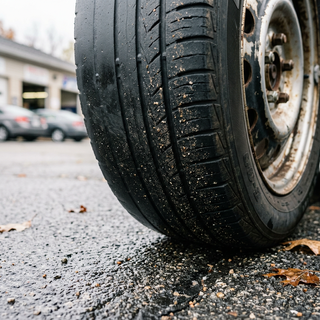

Replace your tires when the tread depth drops to 2/32 inch, when the rubber reaches six years of age, or immediately if you spot sidewall bulges, severe cracking, or deep cuts. The built-in tread wear indicators become level with the tread surface at 2/32 inch, signaling the absolute safety minimum. However, wet-weather stopping distance increases significantly once tread wears below 4/32 inch. Routine monthly checks help identify shallow tread, uneven wear, or structural rubber damage before a tire fails on the road.
Tires serve as the single physical link between your vehicle and the pavement, bearing the entire vehicle weight while transferring steering, braking, and acceleration forces. Over time, friction wears down the outer rubber compound, reducing the depth of the circumferential grooves designed to channel water away from the contact patch. The National Highway Traffic Safety Administration (NHTSA) reports that worn tread and tire failures contribute to thousands of highway incidents annually, emphasizing the critical importance of timely tire replacement.
Driving conditions around northeastern Ohio place heavy demands on vehicle rubber throughout the year. For example, navigating the riverfront bluffs and elevated steep grades in East Liverpool demands strong traction during seasonal rain, sleet, and winter ice. When rubber hardens from age or wears thin from mileage, stopping distances expand, and cornering grip degrades rapidly.
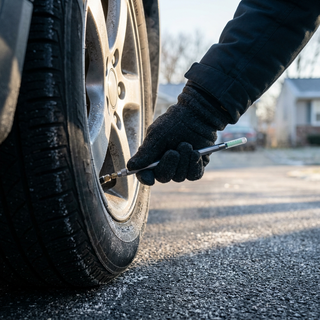
Monitoring tire health involves checking air pressure cold at least once a month, inspecting the sidewalls for physical injury, and verifying that the remaining tread meets safety standards. If you suspect an issue or experience unusual steering wheel vibration, our team at Tri State Ford is available at (330) 462-7578 to conduct a comprehensive tire safety inspection. You can also visit our East Liverpool service center for professional tire balancing, alignment, and tread measurements.
Table of Contents
- How Low Can Tire Tread Get and How Do You Measure It?
- What Physical Damage and Aging Require Buying New Tires?
- How Do Worn Tires Impact Braking and Driving Performance?
- Where Should Two New Tires Be Installed on a Front-Wheel-Drive Car?
- Common Tire Replacement Questions Answered
- Schedule Professional Tire Care at Tri State Ford
How Low Can Tire Tread Get and How Do You Measure It?
Tires must be replaced when tread depth reaches 2/32 inch, which represents the legally enforced safety minimum across most of the United States. Safety experts and original equipment manufacturers strongly advise replacing tires at 4/32 inch to preserve essential wet-road traction and emergency braking performance.
As tires wear down, the depth of their tread channels decreases, limiting the volume of water the tire can clear from under the contact patch. When driving at highway speeds through heavy rain, a tire with 2/32 inch of tread takes drastically longer to stop than a new tire with full depth.
Measuring Tread Depth with the Penny Test
The penny test provides a quick, accessible method to estimate remaining tread depth at home:
- Select a standard U.S. penny and locate a main tread groove where the rubber appears most worn.
- Turn the coin so Abraham Lincoln’s head points upside down and faces toward you.
- Insert the coin straight into the center tread groove.
- Observe whether the top of Lincoln’s head is covered by the tread rubber.
- If the entire top of Lincoln’s head remains visible, your tread depth is at or below 2/32 inch, meaning the tire is worn out and requires immediate replacement.
Using the Quarter Test for Extended Wet Safety
The quarter test measures whether your tires have reached the recommended replacement threshold of 4/32 inch:
- Insert a U.S. quarter upside down into a primary tread groove with George Washington’s head facing you.
- Check if the top of Washington’s head is obscured by the rubber.
- If the top of his head is fully visible, the tread depth has dropped below 4/32 inch. While legally permissible, rubber at this level loses significant traction on wet roads, indicating it is time to start shopping for replacement tires.
Identifying Built-In Tread Wear Indicator Bars
Modern passenger tires feature built-in tread wear indicator bars molded directly into the primary circumferential grooves. These indicator bars consist of narrow bridges of raised rubber set at exactly 2/32 inch above the bottom of the groove. When the surrounding tread rubber wears down flush with these indicator bars, the tire has reached its legal wear limit and must be taken out of service.
Utilizing Digital and Mechanical Tread Depth Gauges
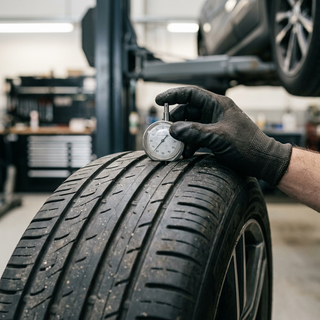
For precise readings, technicians use a dedicated tread depth gauge calibrated in thirty-seconds of an inch. To use a manual or digital gauge:
- Push the gauge probe all the way out.
- Place the base of the gauge flat against the outer tread block surrounding a main groove.
- Press the central probe down into the lowest point of the groove until it rests flush against the base rubber.
- Read the measurement displayed on the barrel or digital screen.
- Measure across three distinct locations on the tire—the inner shoulder, center tread, and outer shoulder—to identify uneven wear patterns caused by improper alignment or inflation issues.
What Physical Damage and Aging Require Buying New Tires?
A tire requires immediate replacement if it displays sidewall bulges, severe rubber cracking, deep cuts that expose internal steel belts, or if it reaches six years of age regardless of remaining tread depth. Physical damage to the tire carcass weakens its structural integrity, making it unsafe for high-speed driving.
Rubber degrades over time due to exposure to atmospheric oxygen, ultraviolet light, ozone, and thermal changes. Even if a vehicle is driven infrequently and retains deep tread, the internal chemical bonds within the rubber compound break down over time. Ford guidelines recommend replacing tires every six years, or sooner if physical wear dictates, and replacing unused spare tires after six years in storage.
Identifying Structural Sidewall Damage
Sidewall injuries represent a severe safety hazard because the sidewall absorbs flexing forces during cornering and load carrying. Common forms of structural damage include:
- Sidewall Bulges and Blisters: A outward bubble on the sidewall indicates that internal fabric cords have snapped after a pothole or curb impact, allowing pressurized air to push through the inner liner. This condition cannot be repaired and requires immediate replacement.
- Deep Cuts and Gouges: Scrapes or punctures that slice deep enough into the sidewall or shoulder rubber to reveal cord fabric or steel plies compromise the strength of the tire casing.
- Radial Weather Cracking: Dry rot manifests as fine networks of cracks along the sidewall or inside the tread grooves, signaling that the rubber compounds have dried out and lost elasticity.
- Tread Separation: Ripples, bulges, or localized elevated areas on the tread surface indicate that the outer tread layer is detaching from the underlying steel belt structure.
Reading the DOT Date Code
Every tire stamped with a Department of Transportation (DOT) code displays its manufacturing date within the final four digits of the Tire Identification Number (TIN) located on the lower sidewall:
DOT PJ8X L5R1 2523
In the example above, the final four digits ( 2523) indicate that the tire was manufactured during the 20th week of 2023. Checking this code ensures you know the exact age of your tires.
Puncture Repair Limits
According to United States Tire Manufacturers Association (USTMA) industry standards, punctures are only repairable if they occur within the central tread area and measure 1/4 inch or less in diameter. Punctures located on the tire shoulder, sidewall, or bead area cannot be safely patched or plugged, as these flexible zones endure extreme structural loads. Additionally, driving on a flat or underinflated tire causes internal heat damage and rubber shaving, rendering the casing unsuitable for repair.
When physical damage or advanced age requires getting new tires, you can use our online tire finder tool to filter exact original equipment tire sizes and speed ratings for your specific vehicle.
How Do Worn Tires Impact Braking and Driving Performance?
Worn tire tread increases stopping distances on wet roads, degrades cornering grip, and drastically raises the risk of hydroplaning by reducing the tire’s ability to evacuate water from under the contact patch. Shallow tread grooves cannot clear accumulated water, forcing the tire to ride on a thin film of liquid and losing contact with the road surface.
Emergency braking tests demonstrate the severe performance penalty of driving on worn rubber. Vehicles stopping on wet pavement at 60 mph on tires worn down to 4/32 inch require an average of 87 additional feet to come to a complete stop compared to vehicles on new tires. That additional stopping distance equals roughly a full second of travel time at highway speeds, which can mean the difference between a safe stop and a severe rear-end collision.
Reduced Handling and Cornering Traction
Beyond straight-line braking, shallow tread negatively impacts overall handling stability:
- Steering Response: Worn tires exhibit sluggish turn-in response, causing the steering wheel to feel loose or uncommunicative during lane changes.
- Lateral Grip: Reduced tread block height lowers lateral grip, causing the vehicle to slide outward during tight cornering maneuvers.
- Accelerative Traction: Slippery or wet pavement causes worn tires to spin easily under power, triggering traction control intervention and reducing momentum.
- Elevated Heat Build-Up: Reduced tread depth means less rubber mass to dissipate heat generated during high-speed driving, increasing thermal strain on the internal casing.
The rolling terrain and wooded roads near Calcutta demand reliable traction during seasonal rain and freezing weather. Vehicles such as the 2026 Ford Escape equipped with All-wheel drive and a 1.5L EcoBoost engine rely on deep, aggressive tread blocks to distribute power effectively across all four wheels. When tread wears thin, even advanced driver-assist safety technology like anti-lock braking and electronic stability control cannot overcome the fundamental loss of mechanical grip.
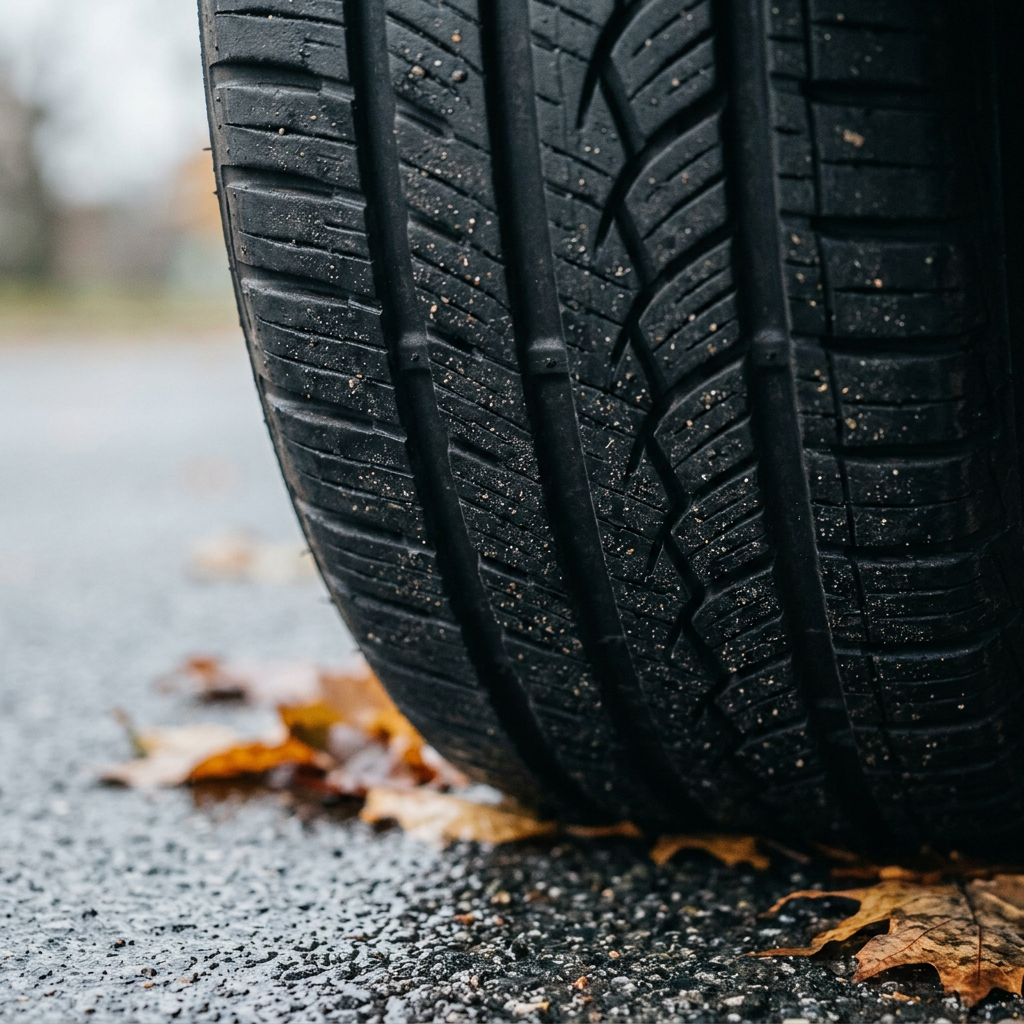
Where Should Two New Tires Be Installed on a Front-Wheel-Drive Car?
When replacing only two tires on a front-wheel-drive vehicle, the new tires must always be installed on the rear axle. Installing fresh tires with full tread depth on the rear wheels maintains directional stability and prevents dangerous rear-end fishtailing on wet or slick roads.
Many drivers assume that because a front-wheel-drive car uses its front tires for steering, acceleration, and the majority of braking force, fresh rubber belongs on the front. However, automotive safety engineers, tire manufacturers, and the NHTSA unanimously advise placing new tires on the rear axle regardless of whether the vehicle is front-wheel-drive, rear-wheel-drive, or all-wheel-drive.
The Physics of Rear Traction and Hydroplaning
Placing worn tires on the rear axle creates a critical traction imbalance during rain or emergency maneuvers:
- Oversteer Risk: If the rear tires have shallower tread than the front tires, the rear wheels will lose grip first when driving through standing water or making a sudden lane change.
- Loss of Control: When the rear tires hydroplane, the back end of the car slides outward, causing sudden oversteer (fishtailing). Oversteer is extremely difficult for most drivers to correct.
- Understeer Management: Conversely, if fresh tires sit on the rear and worn tires remain on the front, the front tires may lose traction first during hard cornering (understeer). Understeer causes the car to push straight ahead, which is easily managed by simply easing off the accelerator pedal.
Tire Replacement Rules for All-Wheel-Drive Systems
Vehicles equipped with full-time or automatic all-wheel-drive systems, such as the 2026 Ford Explorer featuring a 2.3L EcoBoost engine and a SelectShift® automatic transmission, operate under stricter tire replacement requirements. AWD transfer cases and center differentials require all four tires to roll at virtually identical circumferences.
Variations in tread depth greater than 2/32 inch between tires cause the front and rear axles to rotate at slightly different speeds, generating constant friction and heat within the mechanical transfer case. On AWD models, replacing all four tires simultaneously is standard practice to protect complex drivetrain components from expensive mechanical damage.
If you ever experience a sudden blowout, flat tire, or severe vibration while driving, remember that complimentary roadside assistance coverage is available for covered Ford owners by contacting Ford Roadside Assistance: 1-800-241-3673.
If you suspect uneven tire wear or wish to evaluate your vehicle's overall road performance, you can schedule a test drive or vehicle safety evaluation with our service team to review your tire condition and suspension geometry.
Common Tire Replacement Questions Answered
Understanding tire care helps you protect your investment, maintain vehicle safety, and prevent premature wear. Below are concise answers to common questions about tire lifespan, repair safety, and driving diagnostics.
Q: How do you read the DOT date code on a tire sidewall to check its age?
Look at the outer sidewall for the DOT Tire Identification Number, which ends in a four-digit numerical code. The first two digits represent the calendar week of production, while the final two digits indicate the year. For example, a code reading 4222 indicates the tire was produced during the 42nd week of 2022. Tires older than six years should be inspected annually by a professional, and those reaching ten years should be replaced regardless of tread depth.
Q: Is it safe to drive on a tire with a plug after a puncture?
A plug applied from the outside without removing the tire from the wheel is considered a temporary emergency repair only. Safe puncture repair requires a combination plug-patch installed from inside the tire casing after taking the tire off the rim. This process seals the inner liner and fills the puncture path through the tread plies, preventing moisture from rusting the internal steel belts.
Q: Why does my vehicle pull to one side even when tire pressures are balanced?
A persistent vehicle pull can be caused by uneven tread wear, internal tire conicity, improper wheel alignment, or dragging brake components. Conicity occurs when manufacturing variations or internal belt shifts cause a tire to roll slightly cone-shaped, creating a lateral pulling force. Swapping the front tires from left to right can help determine if the pull stems from a tire structural issue or suspension alignment misalignment.
Q: What tire maintenance helps extend tread life between replacements?
Rotating your tires every 5,000 to 8,000 miles promotes balanced rubber wear across all four positions, while maintaining correct cold inflation pressures prevents shoulder or center wear. Additionally, scheduling a four-wheel alignment after hitting harsh potholes or curbs prevents uneven edge scrubbing.
For owners performing routine garage maintenance or replacing damaged wheel hardware, our service counter provides quick access for ordering genuine Ford parts and tires engineered specifically for your model.
Schedule Professional Tire Care at Tri State Ford
Maintaining healthy tires is essential for keeping your vehicle safe, responsive, and efficient through every season. Whether your vehicle needs a routine rotation, wheel alignment, or a fresh set of factory-recommended tires, our team is equipped to handle all your maintenance needs with certified care.
We invite you to visit our state-of-the-art facility for quick, transparent tire inspections and expert advice on choosing the right replacement rubber for your driving habits. You can stop by our dealership location at 1503 Pennsylvania Ave, East Liverpool, OH 43920 or speak directly with a service advisor by calling (330) 462-7578.
Ready to make sure your vehicle is prepared for the road ahead? Take a moment to schedule a service appointment online today and let our service team keep your vehicle running smoothly and safely.