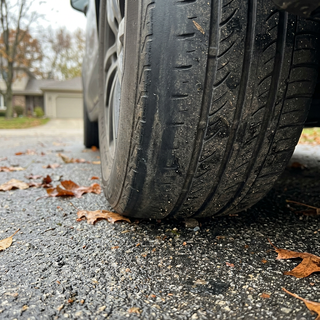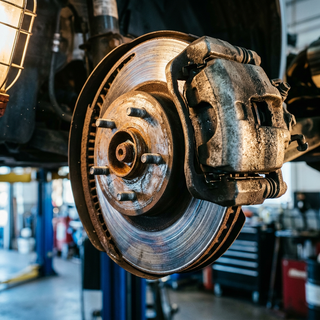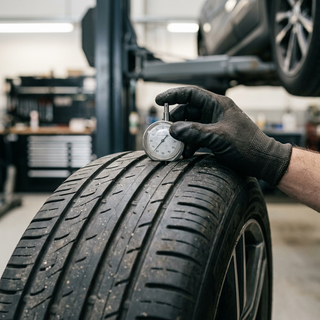

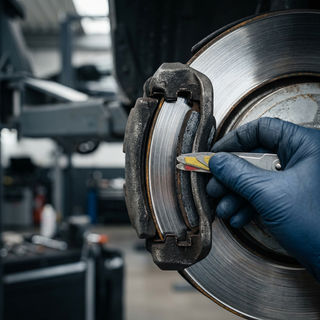
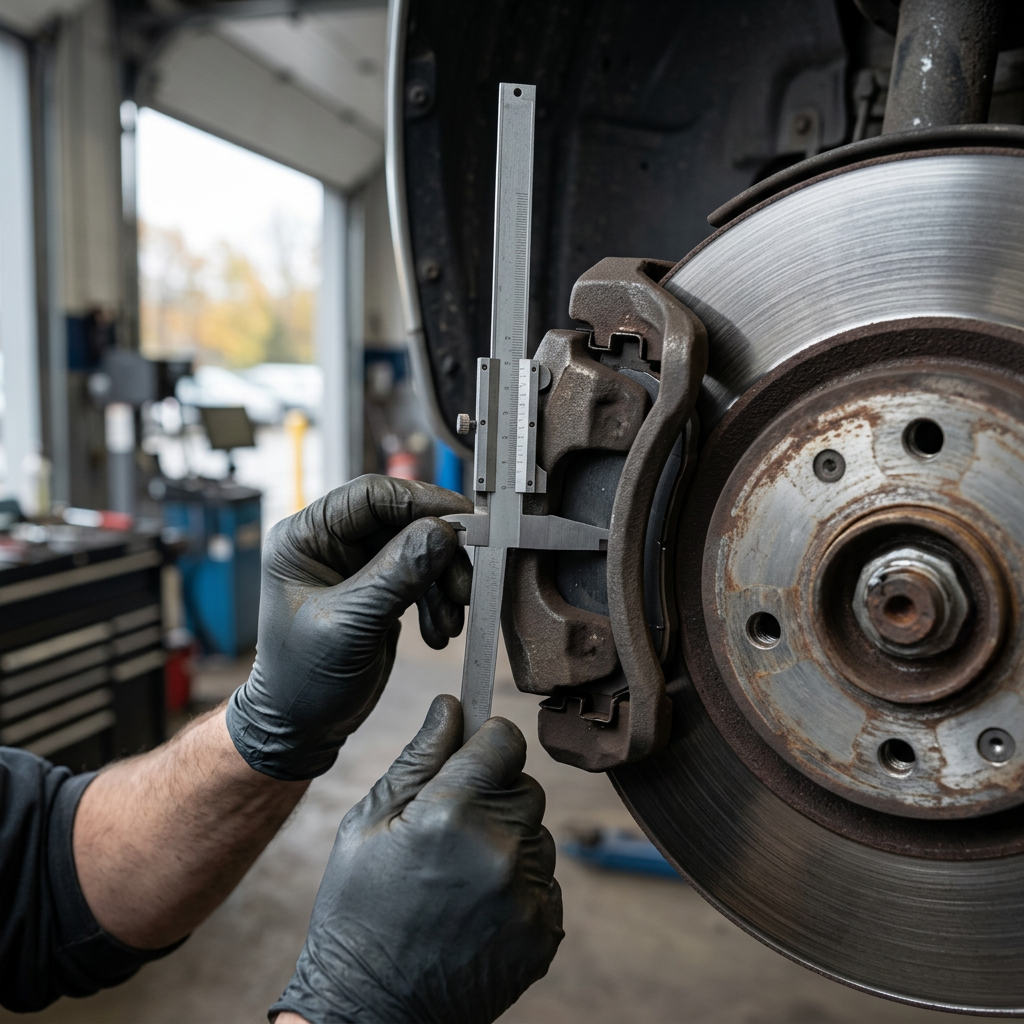
Brake pads typically last between 40,000 and 60,000 miles under normal driving conditions, though overall wear ranges from 20,000 to 70,000 miles depending on friction material, driving habits, and vehicle weight. Physical pad thickness determines safety far more accurately than odometer readings: replacement planning should begin when friction material wears down to 1/4 inch (approximately 6 mm), and new pads must be installed before the lining reaches 3 to 4 mm (or 3/32 of an inch).
Friction lining on a brand-new brake pad measures about 12 mm thick. As you drive, the friction material gradually wears away against the spinning metal rotor to bring your vehicle to a controlled stop. Front brake pads handle roughly 60% to 70% of the stopping load due to forward weight transfer during deceleration, causing them to wear out faster than rear pads.
Routine multi-point inspections provide the most dependable way to track pad wear over time. During standard maintenance services, our technicians measure remaining pad material across all four wheels using specialized thickness gauges. Catching thin pad lining early prevents severe metal-on-metal contact, preserving the smooth surface of your brake rotors and preventing costly damage to brake calipers.
Vehicle size and regular cargo weight also play a significant role in wear schedules. For instance, a compact crossover like the Ford Escape with a 1.5L engine and all-wheel drive experiences different braking friction demands than a fully loaded three-row Ford Explorer equipped with a 2.3L engine and four-wheel drive. Drivers navigating steep riverfront bluffs in East Liverpool place extra thermal strain on their braking systems, making regular physical thickness measurements essential.
If you suspect your vehicle requires a brake check, you can visit our East Liverpool service center on Pennsylvania Ave or give our team a quick call to consult with an advisor.
Table of Contents
- What Factors Cause Brake Pads to Wear Out Faster?
- How Does Ceramic Brake Pad Lifespan Compare to Semi-Metallic?
- What Is the Average Cost to Replace Both Brake Pads and Rotors?
- Do OEM Brake Pads Last Longer Than Aftermarket Alternatives?
- Common Questions About Brake Maintenance and Lifespan
- Schedule Professional Brake Service at Tri State Ford
What Factors Cause Brake Pads to Wear Out Faster?
Driving environment, vehicle load, braking technique, and pad compound directly dictate how quickly brake pad lining degrades over time. Aggressive stop-and-go traffic, frequent high-speed braking, carrying heavy payloads, and navigating steep terrain all accelerate friction wear, causing pads to need replacement far earlier than the 60,000-mile mark.
Urban commuting involves constant acceleration and deceleration cycles that create sustained heat buildup within the brake caliper assembly. This friction heat breaks down the pad's chemical bonding agents faster than steady open-highway driving. Commuters traveling along State Route 170 in Calcutta frequently encounter traffic light cycles and lower speed limits, which subjects brake components to repeated stop-and-go friction throughout daily driving.
Braking habits significantly alter component longevity. Drivers who coast early when approaching red lights or downhill grades allow air to cool the rotors and pads, reducing thermal stress. Conversely, late, heavy foot pressure on the brake pedal generates intense surface friction that rapidly shaves away pad material. Riding the brake pedal continuously while descending long hills keeps the pad pressed against the rotor, generating extreme heat that can glaze pad surfaces and reduce stopping power.
Vehicle mass and towed weight create additional stopping resistance. Heavy-duty haulers and full-size trucks like the Ford F-150 require substantially more hydraulic clamping pressure to bring heavy loads to a complete stop. When towing trailers or carrying full passenger loads, the extra kinetic energy converts directly into friction heat, accelerating pad degradation across both axles.
Environmental elements like road salt, moisture, and debris also contribute to premature wear. Winter road treatments accelerate corrosion on caliper slide pins and backing plates. Sticky or binding caliper pins prevent the pad from fully retracting away from the rotor after you release the brake pedal, causing the pad to drag continuously and wear down unevenly.
How Does Ceramic Brake Pad Lifespan Compare to Semi-Metallic?
Ceramic brake pads generally last between 50,000 and 70,000 miles, whereas semi-metallic brake pads typically last between 30,000 and 50,000 miles. Ceramic compounds utilize dense ceramic fibers combined with copper or non-ferrous filler materials, creating a durable surface that withstands daily wear while producing minimal dust and noise.
Semi-metallic brake pads contain between 30% and 65% metal content by weight, incorporating steel fibers, iron powder, and graphite alloys. This metallic construction offers superior heat dissipation and high initial bite, making semi-metallic pads well-suited for heavy-duty towing and high-stress applications. However, the harder metallic fibers act more aggressively against the rotor surface and wear down faster under normal passenger vehicle operation than refined ceramic formulations.
Organic or non-asbestos organic (NAO) brake pads represent a third category, made from materials like glass, rubber, resin, and Kevlar. Organic pads deliver soft, quiet braking performance but wear out quickly, often lasting only 25,000 to 35,000 miles. They are primarily selected for lighter vehicles or budget applications where high heat resistance is not required.
| Brake Pad Material Type | Typical Service Lifespan | Primary Advantages | Best Suited For |
|---|---|---|---|
| Organic (NAO) | 25,000 – 35,000 miles | Quiet operation, low rotor wear | Light passenger cars, gentle city driving |
| Semi-Metallic | 30,000 – 50,000 miles | High heat tolerance, excellent stopping power | Heavy towing, trucks, performance applications |
| Ceramic | 50,000 – 70,000 miles | Extended longevity, low dust, ultra-quiet | Daily commuting, family crossovers, sedans |
Choosing the correct friction material depends on your vehicle type and primary driving demands. While ceramic pads provide maximum mileage and cleaner wheels for everyday driving, semi-metallic pads remain the preferred choice for drivers who regularly push their vehicles through heavy work cycles.
What Is the Average Cost to Replace Both Brake Pads and Rotors?
Replacing both brake pads and rotors averages between $250 and $500 per axle, which translates to $500 to $1,000 for a comprehensive four-wheel service including parts and labor. Exact costs fluctuate based on vehicle classification, rotor design, caliper configuration, and whether specialized ceramic pads are selected.
Labor charges typically account for half of the total invoice. Replacing rotors involves removing the wheel assembly, unbolting the brake caliper and mounting bracket, cleaning hub contact surfaces, compressing caliper pistons, and torquing all hardware to precise factory specifications. Larger vehicles with complex rear electronic parking brake mechanisms require electronic service mode activation prior to disassembly, slightly increasing total labor time.
Brake rotors do not always require replacement during every pad service. Rotors generally last through two complete sets of brake pads—roughly 50,000 to 70,000 miles—provided the pads are changed before wear indicators scratch or groove the rotor face. During a pad replacement, technicians measure rotor thickness with a micrometer to verify that enough metal remains above the discard-limit spec cast into the rotor housing.
If a rotor meets thickness safety standards and exhibits no deep scoring or thermal warping, it can sometimes be resurfaced on a precision brake lathe to restore a flat friction face. However, modern vehicle rotors are manufactured with thinner, lighter castings to optimize fuel efficiency. Consequently, replacing worn rotors with fresh units often provides superior thermal stability and longer service life compared to machining thin metal.
Delaying pad replacement past the 3 mm safety mark rapidly escalates repair costs. When pad friction lining disappears completely, the steel backing plate grinds directly against the cast-iron rotor. This metal-on-metal friction destroys the rotor surface in short order and can overheat hydraulic caliper pistons, transforming a routine pad service into a complete system overhaul.
Do OEM Brake Pads Last Longer Than Aftermarket Alternatives?
Original equipment manufacturer (OEM) brake pads deliver reliable, standardized longevity because they are formulated to match the exact weight, rotor metallurgy, and hydraulic leverage of your specific vehicle. Premium aftermarket ceramic pads can match OEM pad life under ideal conditions, but entry-level aftermarket options often wear unevenly or degrade faster under thermal stress.
Factory Ford Motorcraft pads undergo rigorous testing to ensure balanced friction performance across wide temperature ranges. OEM engineers select specific pad friction formulations that balance pad life, rotor preservation, noise suppression, and pedal feel. This precise engineering minimizes premature dusting, squealing, and pad glazing.
Generic aftermarket pads frequently use a single friction compound across dozens of different vehicle models to reduce manufacturing costs. A compound designed broadly for multiple vehicle platforms may prove too soft for heavy SUVs or too hard for lighter passenger cars, leading to accelerated wear or increased rotor surface damage.
When maintaining your braking system, ordering genuine Motorcraft replacement parts guarantees factory fitment and predictable wear life without guessing about compound compatibility. Matching OEM pads with factory-spec rotors ensures consistent stopping distance and protects your braking hardware over tens of thousands of miles.
Common Questions About Brake Maintenance and Lifespan
Our service team receives many questions about brake squeals, warning lights, pedal feel, and proper inspection habits. Here are clear answers to common questions regarding brake care.
Q: What does a high-pitched squealing sound from brakes indicate?
A high-pitched squeal while applying the brakes usually indicates that your brake pads have worn down to approximately 3 mm of remaining friction material. Most quality pads feature built-in metal wear indicators—small spring-steel tabs that contact the spinning rotor to produce a deliberate, high-frequency sound. This noise serves as an acoustic warning that it is time to schedule a pad replacement before metal backing plates contact and ruin the rotor surface.
Q: What is the minimum safe thickness for brake pads?
The absolute minimum safe brake pad thickness is 3/32 of an inch (roughly 3 mm). Operating a vehicle with pad material thinner than 3 mm significantly increases stopping distances and risks immediate metal-on-metal rotor damage. Service centers recommend planning a pad replacement as soon as measurements show 1/4 inch (about 6 mm) of material remaining, ensuring you schedule maintenance well before hitting critical wear limits.
Q: How often should brake rotors be replaced?
Brake rotors typically last between 50,000 and 70,000 miles, generally outlasting two sets of brake pads under standard driving conditions. Technicians measure rotor thickness with a precision micrometer during every brake inspection. If the rotor face is grooved, heat-cracked, warped, or worn below the manufacturer's minimum thickness threshold, new rotors must be installed alongside fresh pads to ensure safe braking performance.
Q: Why do front brake pads wear out faster than rear brake pads?
Front brake pads wear faster because physics shifts vehicle weight forward onto the front axle whenever you press the brake pedal. This dynamic weight transfer forces the front braking assembly to absorb 60% to 70% of the total stopping force. Because rear brakes manage less stopping load, rear pads often last significantly longer than front sets.
Q: What causes a brake pedal to feel soft or squishy?
A soft or squishy brake pedal points to air trapped within the hydraulic brake lines, degraded brake fluid, or a leaking brake component. As brake fluid ages, it absorbs atmospheric moisture, lowering its boiling point and creating compressible steam pockets under heavy braking. A sinking pedal requires immediate professional inspection to flush the hydraulic fluid or repair master cylinder seals.
If your vehicle exhibits squealing, pedal vibration, or thin pad measurements, you can easily schedule a multi-point inspection online with our certified service team.
Schedule Professional Brake Service at Tri State Ford
Maintaining healthy brake pads and rotors keeps your vehicle stopping safely on every daily commute and family journey. Whether your vehicle requires a routine thickness measurement, fresh fluid, or a complete pad and rotor replacement, our certified technicians provide expert service using factory-approved parts.
Our service department provides transparent digital vehicle inspections, thorough hardware cleaning, and precision installation tailored to your specific Ford model. We also handle comprehensive vehicle maintenance, including routine battery checks and multi-point inspections, to keep your vehicle performing reliably year-round.
Visit our local Ford dealership at 1503 Pennsylvania Ave, East Liverpool, OH 43920, or call (330) 462-7578 to speak directly with an expert service advisor and book your appointment today.