

Blog / Used Vehicle Guides, Financing & Insurance, Buying Guides, Trade-In Advice, Certified Pre-Owned

What Should You Know Before Buying a Used Car From a Dealer?

2

Before buying a used car from a dealer, buyers should confirm the complete out-of-the-door price breakdown, request a comprehensive vehicle history report, verify open safety recalls using the vehicle identification number, and review available maintenance records. Purchasing also requires clarifying warranty coverage or Certified Pre-Owned status, confirming whether an independent pre-purchase inspection is permitted, and negotiating final pricing using objective market value benchmarks.

Navigating the pre-owned car market requires a methodical approach that protects your investment and ensures daily driving dependability. Asking the right questions before signing any paperwork transforms what can feel like an intimidating negotiation into a clear, transparent purchase process. At Tri State Ford, our team believes informed buyers make the best decisions for their families and budgets.

When evaluating a used vehicle on the lot, your initial conversation with the sales team should establish total financial expectations and mechanical transparency. Knowing what documentation to request upfront prevents surprises during the finance and insurance signing process.

Before taking a test drive on local roads, request the vehicle identification number (VIN) to pull an official vehicle history report. This documentation provides essential details regarding previous ownership, title status, and any reported accidents or structural repairs.

  • Confirm the total out-of-the-door price, including all taxes, title transfer costs, and dealer documentation fees.
  • Request a full vehicle history report to verify title status, past ownership, and reported accident records.
  • Ask if the vehicle has undergone a mechanical safety inspection and request a copy of the completed repair order.
  • Determine whether any remaining factory warranty applies or if the vehicle is sold under a dealer warranty or as-is.
  • Confirm whether the dealer permits an independent mechanic to perform a pre-purchase inspection off-site.

If you are planning to visit our dealership to inspect our inventory, you can easily find our showroom location in East Liverpool or give our sales team a call to verify current pre-owned vehicle availability before driving in.

Ta ble of Contents

What Is the Difference Between a Certified Pre-Owned Car and a Standard Used Car?

A Certified Pre-Owned (CPO) vehicle undergoes a rigorous factory-mandated multi-point mechanical inspection, meets strict age and mileage limits, and includes manufacturer-backed extended warranty coverage, whereas a standard used car is sold under any remaining original factory warranty, a short-term dealer warranty, or as-is without extended protection.

Understanding the distinction between certified inventory and standard pre-owned models helps buyers balance upfront purchase costs against long-term peace of mind. Manufacturer certification programs, such as Ford Blue Advantage, establish strict baseline criteria before a vehicle can earn certified status. Candidates must typically be recent model years with low mileage and a clean title history free of major collision or flood damage.

Factory-trained technicians perform comprehensive technical inspections covering powertrain performance, braking efficiency, suspension integrity, electronic systems, and safety equipment. Any worn or non-compliant components are reconditioned or replaced using original equipment manufacturer parts before certification is granted.

Feature Comparison Certified Pre-Owned (CPO) Standard Used Car
Inspection Standard Multi-point factory-mandated inspection Basic safety or state inspection
Warranty Protection Manufacturer-backed extended warranty Remaining factory warranty or as-is
Vehicle Age Limits Newer model years (typically under 6 years) No age restrictions
Mileage Thresholds Low mileage limits (typically under 80,000 miles) Any recorded odometer mileage
Roadside Coverage Included complimentary roadside assistance Optional or third-party add-on
Financing Eligibility Often qualifies for lower promotional APRs Standard used vehicle financing rates

Beyond additional mechanical safeguards, certified pre-owned vehicles often provide financial advantages over non-certified options. Lenders generally view certified vehicles as lower-risk assets due to their documented condition and extended warranty backing, which frequently unlocks lower interest rates comparable to new car financing offers.

For buyers seeking maximum transparency, browsing our single-owner used inventory or exploring the certified pre-owned Ford lineup ensures access to detailed vehicle background records. If you currently own a vehicle, choosing to value your trade-in online can significantly offset the final purchase amount of a certified model.
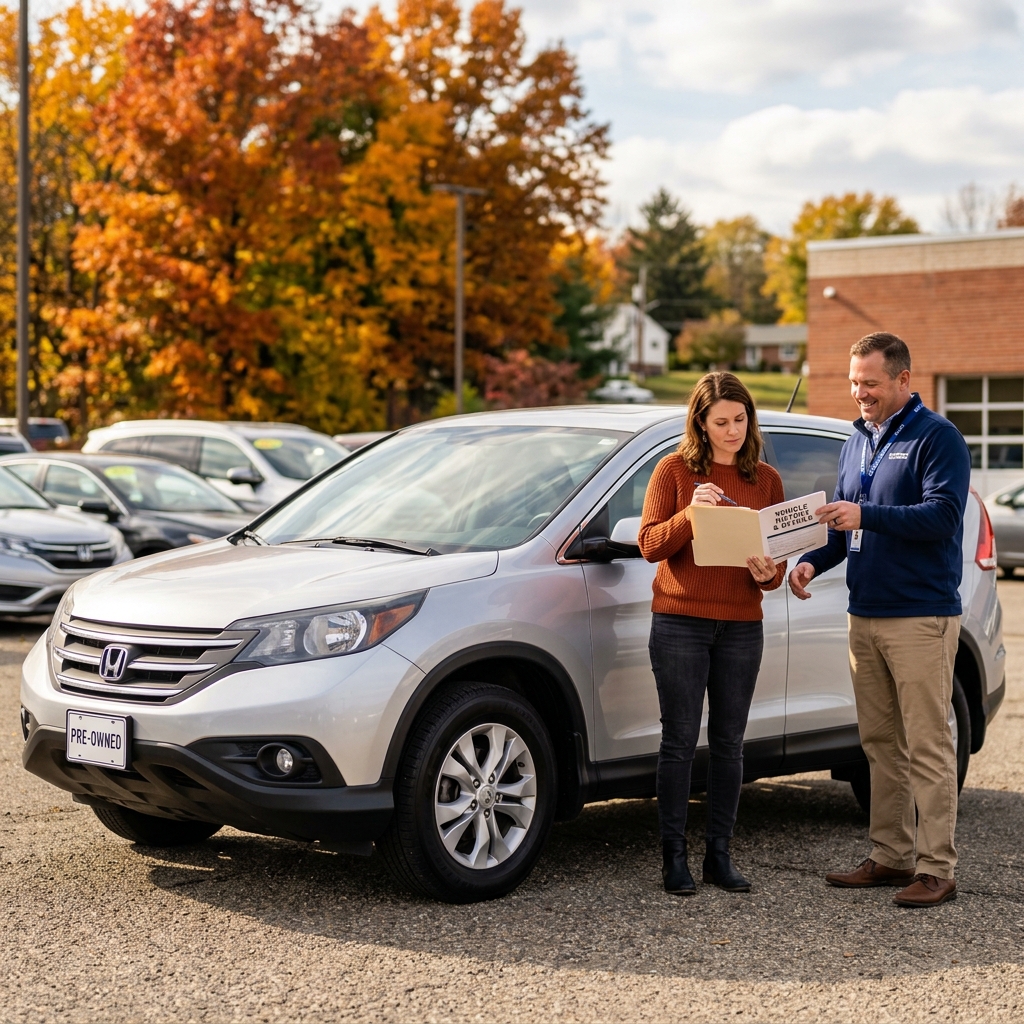
A woman and car salesman look over vehicle history documents next to a silver pre-owned Honda SUV in autumn. (Representative image for illustration purposes only. Actual vehicle may vary based on trim and configuration.)

What Questions Should You Ask About a Used Car's Service History and Open Recalls?

Shoppers should ask whether regular oil changes and major mileage-based maintenance services were completed on schedule, request physical or digital service invoices, and verify open safety recalls using the 17-digit vehicle identification number on the official National Highway Traffic Safety Administration (NHTSA) lookup tool.

A vehicle's historical maintenance record offers direct insight into how well prior owners cared for key mechanical components. While a vehicle history report captures reported service events from participating facilities, requesting detailed repair orders from the selling dealer reveals exact parts replaced, fluid change intervals, and recent reconditioning work completed on the lot.

Our advisors see that shoppers reviewing pre-owned vehicles with our sales staff routinely ask to verify oil change histories and battery health checks before discussing contract terms. Inquiring about routine service helps prevent unexpected maintenance expenses shortly after taking delivery.

Key questions to ask the dealer regarding vehicle history and safety include:

  • Has this vehicle completed all scheduled oil, filter, and transmission fluid changes according to manufacturer guidelines?
  • Are detailed service invoices or internal reconditioning repair orders available for review?
  • Has the 17-digit VIN been run through the NHTSA recall database to confirm zero unrepaired safety recalls exist?
  • Was this vehicle owned locally by a private party, or was it previously operated as a fleet, lease, or rental vehicle?
  • What mechanical repairs or wear-and-item replacements were performed by your service department to prepare this car for sale?

Safety recalls require prompt attention because unperformed recall campaigns can impact vehicle safety, fuel efficiency, or structural integrity. Federal law mandates that franchised dealers repair open recalls on new vehicles, and reputable dealerships proactively resolve open safety recalls on used inventory using factory parts before placing cars on the sales floor.

When reviewing service documentation, pay special attention to recent brake pad thickness, tire tread measurements, and electrical system diagnostics. Vehicles that received consistent care, including routine battery inspections, demonstrate lower risks of premature component failure. For added convenience after your purchase, our dealership also offers remote mobile service options for qualified routine maintenance needs.

How Much Does an Independent Pre-Purchase Inspection Cost and Is It Necessary?

An independent pre-purchase inspection typically costs between $100 and $250 depending on the vehicle class, location, and shop labor rates, providing an unbiased mechanical evaluation before finalizing a purchase agreement.

Investing in a pre-purchase inspection (PPI) performed by an ASE-certified technician outside the selling dealership is one of the most effective ways to avoid hidden mechanical issues. Even when a vehicle looks flawless on the outside and carries a clean history report, an independent mechanic examining the vehicle on a hydraulic lift can spot subtle signs of frame damage, fluid seepage, suspension wear, or substandard body repairs.

A professional pre-purchase inspection covers essential vehicle systems:

  • Engine mechanical health, diagnostic trouble codes, and cooling system pressure tests.
  • Transmission shift engagement, fluid cleanliness, and driveline smoothness.
  • Undercarriage condition, including frame alignment, rust levels, exhaust system seals, and floor pan integrity.
  • Braking components, rotor surfaces, suspension bushings, struts, and tire wear patterns.
  • Electronic modules, climate control functionality, power windows, and active safety sensor operation.

For commuters driving along State Route 170 in Calcutta, evaluating pre-owned all-wheel-drive crossovers requires checking tire tread depth and undercarriage condition before signing. An independent mechanic can verify that driveline systems operate smoothly without binding or noise.

When comparing pre-owned pricing against original vehicle values, shoppers often review factory baseline specs. For example, a new 2026 Ford Escape Active AWD starts at a Base MSRP of $31,750 with a $1,495 destination charge, featuring an automatic 8-speed transmission, a 1.5L engine, EPA estimates of 26 city / 32 hwy MPG, seating for 5, cargo room of about 37.5 cu ft, and a 2,000 lbs towing capacity. Understanding these baseline specs helps buyers weigh the value of a pre-owned compact SUV against brand-new Ford models available on the market.

Pricing

Pricing by trim

Feature Active AWD Active FWD Platinum AWD ST-Line AWD
Base MSRP $31,750 $30,350 $37,940 $32,595
Destination charge $1,495 $1,495 $1,495 $1,495

Pricing (continued)

Feature ST-Line Elite AWD 2.0L ST-Line FWD ST-Line Select AWD 2.0L
Base MSRP $38,935 $31,195 $35,015
Destination charge $1,495 $1,495 $1,495

Engine & Performance

Powertrain specs by trim

Feature Active AWD Active FWD Platinum AWD ST-Line AWD
Engine 1.5L 1.5L 2L 1.5L
Horsepower 180 hp 180 hp 250 hp 180 hp
Torque 199 lb-ft 199 lb-ft 280 lb-ft 199 lb-ft
Transmission automatic 8-speed automatic 8-speed SelectShift® automatic 8-speed
Drivetrain All-wheel drive Front-wheel drive All-wheel drive All-wheel drive

Engine & Performance (continued)

Feature ST-Line Elite AWD 2.0L ST-Line FWD ST-Line Select AWD 2.0L
Engine 2L 1.5L 2L
Horsepower 250 hp 180 hp 250 hp
Torque 280 lb-ft 199 lb-ft 280 lb-ft
Transmission SelectShift® automatic 8-speed SelectShift®
Drivetrain All-wheel drive Front-wheel drive All-wheel drive

What Is the Out-of-the-Door Price and Which Dealer Fees Can Be Negotiated?

The out-of-the-door (OTD) price is the entire total cost required to purchase and register a vehicle, combining the negotiated vehicle price, state and local sales taxes, county title transfer fees, registration costs, and dealer documentation charges.

Focusing exclusively on the advertised listing price or monthly payment projection can create an incomplete financial picture. When negotiating a pre-owned vehicle purchase, request an itemized OTD quote in writing before discussing financing terms or signing purchase options. This breakdown ensures complete transparency regarding every line item added to the base vehicle cost.

Understanding which line items are fixed government fees and which represent dealer charges empowers buyers during negotiations:

  • Negotiated Vehicle Price: The agreed purchase price for the car itself, subject to market data and condition negotiation.
  • State and County Sales Tax: Mandatory state and local taxes calculated based on the buyer's county of residence and applicable trade-in tax credits.
  • Title and Registration Fees: State-regulated charges required to legally transfer ownership, issue license plates, and record liens.
  • Dealer Documentation Fee: A charge covering title processing and administrative record-keeping; while allowed by state law, the amount varies by dealership.
  • Dealer Prep and Reconditioning Fees: Charges sometimes added for detailing or inspection; buyers can request these be removed or bundled into the vehicle price.
  • Optional Add-ons: Items like fabric protection, window etching, or paint sealants that can be declined or removed from the contract entirely.

Requesting an itemized worksheet upfront eliminates confusion regarding optional dealer add-ons. Government taxes and official state title fees cannot be waived or altered by the dealership, but optional service protection plans and dealer accessory packages remain completely negotiable.

What Is the Best Strategy If a Dealer Refuses to Drop the Price of a Used Car?

When a dealer holds firm on a pre-owned vehicle listing price, the most effective strategy is leveraging third-party market value data to negotiate complimentary dealer add-ons or walking away politely while leaving clear contact details with the sales management team.

In competitive automotive markets, dealerships price pre-owned inventory using real-time market software that tracks regional supply and demand. If a vehicle is already priced aggressively at fair market value, a dealer may have minimal margin left to discount the selling price directly. However, price is only one component of a successful vehicle purchase agreement.

If the selling price is firm, shift your negotiation strategy toward non-cash concessions and value-added items that carry low internal cost for the dealer but provide significant real-world value to you:

  • Request a brand-new set of tires or an upgraded battery installed prior to delivery.
  • Ask for complimentary routine oil changes or scheduled maintenance vouchers for your first year of ownership.
  • Request minor cosmetic reconditioning, such as paint touch-ups, wheel scuff repairs, or interior detailing.
  • Negotiate a higher valuation on your trade-in vehicle to reduce the net transaction price and lower your total tax liability.
  • Ask the dealer to include an extended protection plan or powertrain warranty at no additional charge.

Utilizing objective pricing tools like Kelley Blue Book gives buyers factual leverage. Presenting local market comparables showing lower prices for identical models in similar condition provides a rational basis for your offer. If an agreement cannot be reached, thank the sales advisor, leave your target price number, and walk away. Dealerships frequently follow up with buyers if market conditions shift or if inventory remains on the lot longer than anticipated.

Quick Answers to Common Used Car Buying Questions

Q: How does market value software affect used car pricing?

Market value software evaluates regional auction sales, active retail listings, vehicle mileage, and local demand to set competitive prices. Dealerships use these live data feeds to align pre-owned vehicle prices with current market trends. Buyers can utilize online market guides to confirm that a vehicle's listing price aligns with fair purchase ranges in their geographic area.

Q: Can you negotiate dealer documentation fees on a pre-owned vehicle?

Dealer documentation fees cover administrative processing, title submission, and secure record storage. While the doc fee amount is set by dealer policy or state caps and charged uniformly to all buyers, you can negotiate a reduction in the overall vehicle selling price to offset the cost of the fee.

Q: What paperwork should you bring when buying a used car from a dealer?

Buyers should bring a valid driver's license, current auto insurance card, payment method for down payment funds, and recent pay stubs if applying for financing. If trading in a vehicle, bring the current vehicle title, valid registration card, and all keys or key fobs. Completing an online credit application ahead of time speeds up processing.

Q: Is a vehicle history report completely foolproof?

Vehicle history reports provide valuable records of reported accidents, title transfers, and facility service visits, but they rely on reporting from insurance companies, law enforcement, and repair shops. An unreported incident or private repair may not appear on the report, which is why an independent mechanical inspection remains essential.

Q: What happens if a used car has an open safety recall?

If a pre-owned vehicle has an open safety recall, factory-authorized dealerships perform the required recall repairs free of charge using genuine manufacturer components. Buyers can verify recall status using the 17-digit VIN on the official NHTSA recall lookup website before taking delivery.

Take the Next Step Toward Your Used Vehicle

Asking targeted questions regarding vehicle condition, service history, recall status, and out-of-the-door pricing ensures a confident and transparent car-buying experience. At Tri State Ford, our team is committed to providing clear documentation, fair market pricing, and high-quality pre-owned cars, trucks, and SUVs that fit your lifestyle and budget.

Whether you are looking for a reliable pre-owned family crossover, a pre-owned truck, or exploring options for a custom factory order on a brand-new model, our knowledgeable sales staff is here to guide you through every step of the process.

Visit our showroom today at 1503 Pennsylvania Ave, East Liverpool, OH 43920 to test drive our pre-owned inventory. You can also explore our online resources, get driving directions by visiting our East Liverpool location, or (330) 462-7578 to speak directly with our team and schedule your test drive.

Keep your vehicle performing at its best with our service team:


© 2026 Tri State Ford. All rights reserved.

Vehicle specification data © JATO Dynamics Limited.

Used Car Buying Tips in East Liverpool OH | Tri State Ford
Posted in:

Related Posts

l

How Do You Protect Yourself When Buying a Used Car?

To protect yourself when buying a used car, demand complete written transparency by reviewing the vehicle history report, verifying the FTC Buyers Guide disclosure, obtaining a comprehensive out-the-door price quote, and scheduling an independent pre-purchase inspection before signing any contract. Securing all verbal agreements in writing guarantees that promised repairs or warranty coverages remain legally binding. Purchasing a pre-owned truck, SUV, or sedan offers exceptional value, but navigating the buying process requires a systematic approach to safeguard your investment. Protecting your interests begins long before you sign financial paperwork. It starts by gathering objective data about the car's background, mechanical condition, and total ownership costs. Evaluating a vehicle step by step eliminates uncertainty, giving you complete peace of mind when choosing a ride for your daily routine. A thorough evaluation combines documentary evidence with physical inspection. Requesting title history, verifying service records, and taking a comprehensive test drive help confirm that a vehicle matches its listed condition. For drivers commuting along State Route 170 around Calcutta, reliable daily transportation is essential for balancing work runs, family schedules, and weekend errands. Taking time to inspect steering alignment, brake responsiveness, and cabin comfort under real-world driving conditions ensures the vehicle meets your everyday performance needs. Before finalizing any vehicle purchase, always request a complete itemized pricing breakdown rather than relying on estimated monthly payments. Verifying taxes, title transfer fees, and dealer documentation fees up front prevents unexpected costs at contract signing. If you are ready to explore dependable pre-owned options, you can visit our showroom floor or give our team a quick call to discuss available inventory and schedule a walk-around appointment today. Table of Contents What Key Questions Should You Ask About Vehicle History and Usage? Will a Dealer Allow an Independent Mechanic Inspection and What Does It Cover? What Does the Buyers Guide Reveal About Warranty Coverage and Written Terms? Is Paying Extra for a Certified Pre-Owned Vehicle Worth the Investment? How Do You Negotiate the Best Out-the-Door Price on a Used Vehicle? Quick Answers to Common Questions About Buying Used Vehicles Take the Next Step Toward Your Next Used Vehicle What Key Questions Should You Ask About Vehicle History and Usage? You should ask whether the dealer provides a free vehicle history report detailing title status, prior ownership count, accident records, open safety recalls, and routine service history. Confirming whether a vehicle served as a personal commuter, commercial fleet vehicle, or daily rental reveals how consistently it was maintained and how heavily it was driven. A vehicle history report serves as an essential foundation for evaluating any pre-owned truck, car, or crossover. Reports sourced through platforms like AutoCheck or Carfax compile data from state motor vehicle departments, collision repair facilities, and law enforcement agencies. These documents reveal crucial background details, including title brands such as salvage, flood, or lemon law buyback status. They also record odometer readings over time, helping buyers identify potential mileage rollback discrepancies before committing to a vehicle. Beyond the title history report, asking detailed questions about previous ownership provides context regarding mechanical wear. Shoppers comparing pre-owned trucks on our lot often ask whether a vehicle was owned locally or used as a commercial fleet vehicle before looking at the odometer. While fleet vehicles frequently adhere to strict, manufacturer-recommended maintenance schedules, they may experience higher cumulative wear from multiple drivers. Conversely, single-owner personal vehicles often come with detailed maintenance receipts, showing regular oil changes, tire rotations, and scheduled fluid flushes. It is equally vital to check for unperformed safety recalls using the National Highway Traffic Safety Administration recall lookup tool. Enter the 17-digit Vehicle Identification Number to verify whether the manufacturer has issued safety notices for components like airbag inflators, fuel pumps, or electronic control modules. Our team verifies recall status on incoming inventory, ensuring necessary factory service updates are addressed. If you are considering transitioning to a tailored setup, you can explore our custom vehicle ordering options, check out current new vehicle information, or value your current trade-in online to establish your trade equity before shopping. Will a Dealer Allow an Independent Mechanic Inspection and What Does It Cover? Reputable dealerships allow independent pre-purchase inspections and will permit you to take the vehicle to a certified technician of your choice. A thorough pre-purchase inspection evaluates mechanical components, fluid integrity, electrical systems, brake wear, suspension parts, frame alignment, and diagnostic trouble codes to identify hidden issues before you buy. An independent inspection gives buyers an unbiased, professional assessment of a vehicle's mechanical health. Even when a vehicle has undergone a multi-point dealership reconditioning process, an independent mechanic offers a secondary review tailored directly to your concerns. Most technicians charge between $100 and $200 for a pre-purchase inspection, making it a modest investment that can prevent costly unexpected repairs down the road. During a pre-purchase inspection, a qualified technician places the vehicle on a hydraulic lift to examine undercarriage components that are impossible to inspect on a sales lot. They check for frame corrosion, subframe damage, fluid leaks around the oil pan and transmission housing, and uneven tire wear that indicates alignment or suspension issues. Negotiating the steep riverfront elevation changes along the bluffs in East Liverpool requires strong suspension dampening, healthy brake pads, and tight steering linkages, making an undercarriage check especially valuable for local drivers. The mechanic will also run a full diagnostic scan on the vehicle’s engine control unit to check for cleared or pending diagnostic trouble codes. This scan detects potential sensor failures, transmission slips, or emissions system faults that might not immediately trigger a dashboard warning light during a short test drive. Once the inspection is complete, the mechanic provides an itemized report detailing component conditions, upcoming maintenance requirements, and estimated repair costs, giving you clear leverage during price negotiations. What Does the Buyers Guide Reveal About Warranty Coverage and Written Terms? The window Buyers Guide explicitly states whether a used car is sold as is or with a specific dealer warranty, outlining the exact percentage of repair costs the seller agrees to cover. Federal law requires this disclosure to be displayed on every pre-owned vehicle offered by a dealership, and any verbal promise made on the sales floor must be written directly onto the document to be legally binding. Prominently posted on a vehicle's side window, the FTC Buyers Guide acts as a primary legal disclosure governing your purchase. If the as is - no dealer warranty box is checked, the dealership assumes no financial responsibility for mechanical or electrical failures once you drive off the lot. In an as-is transaction, all future maintenance and repair expenses belong entirely to the buyer. Conversely, if the vehicle includes a dealer warranty, the Buyers Guide will specify whether coverage is full or limited, list the covered systems—such as engine assembly, transmission components, or drive axles—and define the exact duration, such as a 30-day/1,000-mile limited warranty. +-----------------------------------------------------------------------------------+ | FTC BUYERS GUIDE DISCLOSURE | +------------------------------------+----------------------------------------------+ | Coverage Status | Legal Meaning & Financial Responsibility | +------------------------------------+----------------------------------------------+ | As Is - No Dealer Warranty | Buyer pays 100% of all repair costs | | | immediately after delivery. | +------------------------------------+----------------------------------------------+ | Implied Warranties Only | State law limits seller disclaimers; | | | coverage varies by jurisdiction. | +------------------------------------+----------------------------------------------+ | Dealer Warranty (Limited / Full) | Dealer pays specified percentage of parts | | | and labor for designated systems. | +------------------------------------+----------------------------------------------+ | Manufacturer Warranty Remaining | Original factory coverage transfers according| | | to original time and mileage limits. | +------------------------------------+----------------------------------------------+ Never rely on spoken assurances regarding future repairs or physical reconditioning. If a sales representative promises to fix a cracked windshield, replace worn brake pads, or supply a second key fob, insist that those items are explicitly itemized on a written "We Owe" form or directly referenced in the Buyers Guide contract. Written stipulations turn informal promises into enforceable contractual obligations. Understanding warranty terms also helps you structure your auto financing responsibly. Knowing whether key mechanical assemblies are protected allows you to budget accurately for ongoing ownership costs without unexpected repair expenses disrupting your monthly household finances. You can start the buying process from home by completing our secure online credit application to review financing options tailored to your purchasing budget. Is Paying Extra for a Certified Pre-Owned Vehicle Worth the Investment? Purchasing a Certified Pre-Owned (CPO) vehicle is worth the additional cost for buyers seeking factory-backed warranty coverage, rigorous multi-point mechanical inspections, and built-in benefits like emergency roadside assistance. Factory certification minimizes financial risk by ensuring the vehicle meets strict manufacturer standards for age, mileage, and mechanical condition. Unlike standard pre-owned vehicles, certified pre-owned cars, trucks, and crossovers undergo a rigorous factory-mandated evaluation process before earning certification. For instance, Ford Certified Pre-Owned models must pass a detailed inspection covering engine performance, transmission shifting, body panel alignment, frame integrity, interior electronics, and safety systems. Any component that fails to meet strict factory guidelines must be repaired or replaced using genuine OEM parts before the vehicle is offered for sale. +-----------------------------------------------------------------------------------+ | Ford CERTIFIED PRE-OWNED COVERAGE | +----------------------------------+------------------------------------------------+ | Program Tier | Key Benefits & Warranty Terms | +----------------------------------+------------------------------------------------+ | Ford Gold Certified | • 172-point mechanical inspection | | | • 12-month/12,000-mile comprehensive warranty | | | • 7-year/100,000-mile powertrain warranty | | | • 24/7 roadside assistance included | +----------------------------------+------------------------------------------------+ | Ford Blue Certified | • 139-point mechanical inspection | | | • 90-day/4,000-mile comprehensive warranty | | | • 24/7 roadside assistance included | +----------------------------------+------------------------------------------------+ Beyond comprehensive mechanical reconditioning, factory certification provides long-term peace of mind through extended warranty protections. Ford Gold Certified vehicles include a 12-month/12,000-mile comprehensive limited warranty alongside a 7-year/100,000-mile powertrain limited warranty measured from the original factory in-service date. These programs also feature 24/7 emergency support services, reachable anytime via Ford Roadside Assistance: 1-800-241-3673, which covers towing, flat-tire changes, fuel delivery, and lockout assistance across the country. For families prioritizing long-term dependability and modern safety technologies like Ford Co-Pilot360, certified pre-owned inventory strikes an optimal balance between initial affordability and long-term security. You can compare our selection of pre-owned single-owner vehicles or browse our current certified pre-owned Ford inventory to find models that fit your lifestyle requirements. How Do You Negotiate the Best Out-the-Door Price on a Used Vehicle? To negotiate the best out-the-door price, request an itemized quotation including the vehicle sale price, documentation fees, applicable state taxes, and registration charges before discussing monthly financing options. Comparing local market valuation data, leveraging documented inspection findings, and keeping financing negotiations separate from vehicle price discussions ensure you secure a fair deal. Successful price negotiation relies on objective research rather than high-pressure tactics. Before visiting the dealership, consult independent vehicle valuation resources to establish the fair market value range for the specific year, trim level, engine configuration, and mileage you are considering. Knowing the average selling price for comparable models gives you a clear baseline when evaluating a dealer's opening offer. Focusing exclusively on the out-the-door price prevents common negotiation pitfalls. Dealers can alter monthly loan payments by extending financing term lengths or adjusting down payment structures without actually reducing the purchase price of the car. Insist on reviewing an itemized breakdown that clearly separates the vehicle price from mandatory state taxes, license fees, and dealer documentation fees. If an independent mechanic inspection revealed upcoming maintenance items—such as tires needing replacement within 5,000 miles or worn brake rotors—use the written repair estimate to request a corresponding price adjustment. If you plan to trade in your current vehicle, keep the trade-in appraisal discussion separate from the pre-owned vehicle price negotiation. Separating these transactions ensures you receive fair market value for your trade-in based on its condition and current wholesale demand. Before finalizing your terms, be sure to ask our team about eligible national vehicle incentives and manufacturer offers that may apply to your purchase. Quick Answers to Common Questions About Buying Used Vehicles Q: Can you request a free vehicle history report directly from the dealership? Yes, reputable dealerships provide a complimentary Carfax or AutoCheck report on pre-owned vehicles in their inventory. You can request a digital copy via email or view the report directly on the dealership's online listing before visiting the showroom. The report details title status, prior ownership records, accident history, and reported maintenance services. Q: What paperwork should you gather before applying for pre-owned vehicle financing? To streamline your credit approval, bring valid government-issued photo identification, your most recent pay stubs or proof of income, a current utility bill verifying your residential address, and proof of active auto insurance. If you plan to trade in a vehicle, bring its title, current registration card, and payoff information if an outstanding loan exists. Q: What happens if an open safety recall is listed on a used car's VIN? If a pre-owned vehicle has an open safety recall, the manufacturer is responsible for completing the required recall repairs at no charge to the owner through an authorized dealership. You should ask the selling dealer to perform all open recall service procedures before you take delivery, or confirm in writing when the necessary recall parts will be available. Q: Are dealer documentation fees negotiable on a pre-owned vehicle purchase? Dealer documentation fees cover administrative costs associated with processing title transfers, contract preparation, and state registry filings. While the documentation fee rate is typically standardized across a dealership's operations, you can negotiate a reduction in the vehicle's sales price to offset administrative fees if the total out-the-door cost exceeds your target budget. Q: How does trading in a vehicle with an existing loan balance affect your purchase? When trading in a vehicle with an active loan, the dealer contacts your lender to obtain an official payoff quote. If your vehicle's trade-in value exceeds the loan balance, the remaining positive equity applies directly as a down payment toward your purchase. If the loan balance exceeds the vehicle's trade-in value, the remaining equity gap can often be rolled into your new auto loan upon lender approval. To explore current factory options, browse our brand-new vehicle inventory to compare model specs and tech packages. Take the Next Step Toward Your Next Used Vehicle Finding a pre-owned truck, SUV, or sedan begins with clear documentation, verified vehicle history, and a transparent purchasing process. Asking targeted questions about maintenance history, verifying Buyers Guide warranty terms, and scheduling an independent inspection ensure you make an informed decision aligned with your budget and lifestyle. Our team at Tri State Ford is dedicated to providing an honest, straightforward buying experience for every customer. Whether you are looking for a fuel-efficient daily commuter, a spacious family vehicle, or a capable pickup equipped for weekend towing, we offer a wide selection of thoroughly inspected pre-owned vehicles backed by complete vehicle history reports. Ready to take the next step toward your next vehicle? You can get directions to our East Liverpool dealership to explore our lot in person, or give us a quick call to schedule a test drive today. Keep Your Vehicle Running Strong Keep your vehicle performing at its best with our service team: Order Parts Schedule Service Appt © 2026 Tri State Ford. All rights reserved. Used Car Buying Tips in East Liverpool OH | Tri State Ford

d

How Much Down Payment Is Recommended for a Used Car?

Financial experts and auto lenders recommend putting down 10% to 20% of the purchase price on a pre-owned vehicle. A 10% down payment serves as the baseline to secure competitive financing approval, whereas a 20% down payment further lowers monthly obligations, offsets upfront vehicle depreciation, and minimizes overall loan interest costs. When purchasing a pre-owned truck or SUV, providing upfront cash or trade equity directly alters the structural risk of the loan. Lenders calculate loan-to-value (LTV) ratios by dividing the total financed amount by the official wholesale valuation of the vehicle. For example, financing $22,000 on a vehicle valued at $20,000 creates a 110% LTV ratio. Placing 10% to 20% down lowers that ratio, helping buyers lock in more favorable interest rates across traditional lenders and credit unions. For buyers evaluating an option durable with Ford vehicles, a healthy down payment reduces the risk of becoming underwater on an auto loan. Because pre-owned vehicles experience slower depreciation than brand-new vehicles, a modest upfront investment preserves positive equity much faster. To discuss specific vehicle availability or speak with a finance representative in person, visit our physical showroom location or call (330) 462-7578 to connect with our financing department directly. Table of Contents How Does the 20/4/10 Budgeting Rule Apply to Used Cars? How Does Credit Score Affect Required Down Payments and Interest Rates? What Additional Out-of-Pocket Costs Should You Budget for at Signing? Can You Use a Vehicle Trade-In as a Down Payment? Where Can You Finance a Used Car Near East Liverpool and What Are the Requirements? How Does a Larger Down Payment Lower Your Monthly Payment and Total Loan Costs? Frequently Asked Questions About Pre-Owned Vehicle Financing Take the Next Step Toward Your Pre-Owned Vehicle at Tri State Ford How Does the 20/4/10 Budgeting Rule Apply to Used Cars? The 20/4/10 budgeting rule recommends placing a 20% down payment, financing for a maximum term of 4 years (48 months), and keeping total monthly vehicle expenses—including loan principal, interest, and insurance—under 10% of gross monthly income. Applied to pre-owned vehicles, this formula protects household cash flow while preventing over-extension on long loan terms. Applying this rule to pre-owned trucks and family crossovers helps local buyers balance daily household expenses with dependable transportation. For commuters navigating the State Route 170 corridor around Calcutta, keeping auto expenses within a strict percentage of monthly income ensures long-term financial flexibility. Choosing a shorter 48-month term prevents interest charges from accumulating over extended periods, even though 60-month and 72-month terms remain popular choices for lower immediate payments. Adjusting the rule slightly for pre-owned models is common. While brand-new vehicles rapidly lose value in their first three years, pre-owned models have already absorbed that initial steep drop. As a result, placing a 10% down payment on pre-owned single-owner models or a certified pre-owned Ford lineup model often meets lender LTV requirements while satisfying practical household budgets. Budgeting Component 20/4/10 Rule Target Practical Application for Pre-Owned Vehicles Down Payment 20% of purchase price 10% to 20% cash or net trade equity Loan Term 48 months maximum 48 to 60 months depending on APR Total Monthly Cost Under 10% of gross income Includes principal, interest, taxes, and auto insurance How Does Credit Score Affect Required Down Payments and Interest Rates? Your credit score directly dictates the interest rate offered by auto lenders and determines whether a cash down payment is mandatory for loan approval. Borrowers in higher credit tiers secure significantly lower annual percentage rates (APRs), whereas lower credit scores require larger down payments to offset lender risk. According to Experian's Q2 2026 state of the automotive finance market report, average pre-owned vehicle interest rates vary widely across credit score tiers: Super Prime (781–850): Average APR of 6.29% Prime (661–780): Average APR of 8.81% Near Prime (601–660): Average APR of 13.93% Subprime (501–600): Average APR of 19.10% Deep Subprime (300–500): Average APR of 21.62% For buyers with prime credit, lenders may offer zero-down financing options because the default risk remains low. However, for buyers in near-prime or subprime credit tiers, lenders frequently impose strict loan-to-value caps, often requiring 10% to 20% down in cash or trade value before approving the loan structure. Placing additional cash down moves a borrower into a lower risk threshold, which can sometimes reduce the assigned interest rate by a full percentage point or more. Completing an online credit application allows our finance team to review available lending programs across multiple financial institutions to determine your exact down payment requirement. What Additional Out-of-Pocket Costs Should You Budget for at Signing? Buyers must budget for state sales tax, county tax rates, title charges, registration fees, and dealership documentation fees in addition to their planned vehicle down payment. In Ohio, the base state vehicle sales tax is 5.75%, with local county additions raising the total tax rate higher depending on where the vehicle is registered. Out-of-pocket costs at signing fall into distinct regulatory and administrative categories: State and Local Sales Tax: Calculated on the net purchase price after trade-in credits are applied. Title Transfer Fees: Official state charges processed through the Ohio Bureau of Motor Vehicles to transfer legal ownership. Vehicle Registration and License Plate Fees: Annual state fees required to register the vehicle for road use. Dealership Documentation Fees: Administrative costs for processing title paperwork, state filings, and financial compliance documents. Failing to plan for these closing expenses can create an unpleasant surprise at the closing desk. For example, purchasing a $20,000 pre-owned SUV subject to a combined 7% sales tax rate generates $1,400 in tax obligations alone, alongside standard title and registration fees. Buyers can choose either to pay these fees out-of-pocket at signing or to finance them directly into the total loan balance. Financing fees increases the loan-to-value ratio, which may require a larger cash down payment to stay within lender approval limits. Can You Use a Vehicle Trade-In as a Down Payment? Net trade-in equity—calculated as your current vehicle's market value minus any remaining loan balance—applies directly toward the down payment on a pre-owned vehicle purchase. Utilizing positive trade-in equity reduces or completely eliminates the need to out-of-pocket cash at signing. When your current car is worth more than the balance owed on its existing loan, that positive difference serves as real cash value. For instance, if your trade-in is valued at $8,000 and your remaining loan pay-off is $5,000, you have $3,000 in positive net equity. That $3,000 counts immediately as a 15% down payment on a $20,000 pre-owned vehicle. Our team frequently sees family shoppers use their existing vehicle's equity to transition into pre-owned three-row SUVs equipped with Ford Co-Pilot360 and space for the whole family. If you prefer exploring brand-new Ford models, checking current factory offers, or sticking to pre-owned options, evaluating your existing car via our online trade-in appraisal tool gives you a clear figure before visiting our showroom. Where Can You Finance a Used Car Near East Liverpool and What Are the Requirements? Shoppers near East Liverpool can secure pre-owned vehicle financing directly through dealership finance centers, local credit unions, or regional commercial banks. Local lenders generally require a 10% down payment or a minimum of $1,000 down, depending on credit tier, income verification, and vehicle age. Drivers commuting along the Ohio River bluffs and steep grades around East Liverpool need dependable transportation equipped with driver-assist features for changing seasonal road conditions. Securing auto financing locally involves presenting standard documentation to satisfy lender underwriter guidelines: Proof of Income: Recent pay stubs or tax documents showing steady earnings. Proof of Residence: A recent utility bill or mortgage/lease statement matching your application address. Government-Issued Identification: A valid driver's license. Valid Auto Insurance: Proof of comprehensive and collision coverage naming the lender as lienholder. Working with our finance center services simplifies the process by submitting a single application to multiple local and national lending institutions. This competitive framework helps buyers secure flexible down payment terms tailored to their specific financial profile. How Does a Larger Down Payment Lower Your Monthly Payment and Total Loan Costs? Increasing your down payment directly reduces the loan principal, which decreases your monthly payment and substantially lowers total interest expenses over the life of the loan. Every $1,000 applied as a down payment reduces monthly payments by roughly $15 to $20, depending on the interest rate and loan duration. A higher down payment affects loan economics across three distinct areas: Immediate Principal Reduction: Borrowing less money means calculating interest on a smaller base amount from day one. Lower Interest Charges: Reducing total principal drastically cuts cumulative interest costs over 48, 60, or 72 months. Improved Term Options: a lower financed amount can help buyers better manage monthly payments. Financing a vehicle with a larger down payment can reduce monthly payments and total interest costs. Down Payment Amount Financed Amount ($20k Price) Estimated Monthly Payment (60 mos @ 11%) Total Interest Paid Lower down payment Lower financed amount Lower estimated monthly payment Lower total interest Higher down payment Higher equity contribution Lower estimated monthly payment Lower total interest To explore our current pre-owned inventory, stop by our East Liverpool dealership address, give our team a quick call, or browse our latest current offers online. Frequently Asked Questions About Pre-Owned Vehicle Financing Q: Is a 10% down payment always required for a pre-owned vehicle loan? A: A 10% down payment is not legally mandatory, but most auto lenders prefer or require it for borrowers outside super-prime credit tiers. Placing at least 10% down keeps the loan-to-value ratio within reasonable guidelines, which significantly improves approval odds and helps secure lower interest rates from commercial banks and credit unions. Q: What happens if I put zero down on a pre-owned truck or SUV? A: Putting zero down increases your total loan principal, raises your monthly payment, and forces you to pay significantly more interest over the loan term. It also places you at risk of negative equity, where you owe more on the vehicle loan than the vehicle's fair market wholesale value. Q: Can I finance the state sales tax and registration fees into my loan? A: Yes, most lenders allow qualified buyers to roll sales tax, title charges, and registration fees directly into the total financed loan amount. However, doing so increases your loan-to-value ratio, which may require a higher cash down payment to satisfy the lender's maximum approval threshold. Q: How does loan-to-value (LTV) ratio affect my required down payment? A: LTV represents the total loan amount divided by the vehicle's official wholesale valuation. If a lender capped LTV at 100% on a $15,000 vehicle and total costs with taxes came to $16,500, you would need at least a $1,500 down payment to cover the difference and obtain loan approval. Q: What documents should I bring to the dealership to complete financing? A: Buyers should bring a valid driver's license, their most recent pay stubs or proof of income, a current utility bill for residence verification, proof of auto insurance, and title or payoff information if trading in an existing vehicle. Take the Next Step Toward Your Pre-Owned Vehicle at Tri State Ford Selecting the right down payment strategy provides financial confidence and ensures comfortable monthly payments throughout your vehicle ownership. Whether you choose to put down 10%, 20%, or leverage positive trade-in equity, our dedicated team at Tri State Ford is here to guide you through every step of the purchasing process. Visit our showroom today to test drive our rugged, dependable pre-owned Ford trucks and family SUVs, value your current vehicle, and secure financing tailored directly to your budget. Keep Your Vehicle Running Strong Keep your vehicle performing at its best with our service team: Order Parts Schedule Service Appt © 2026 Tri State Ford. All rights reserved. Used Car Down Payment Advice in East Liverpool OH | Tri State Ford

l

What Is the Best Used Vehicle for a Family of 5?

Midsize crossovers and 3-row SUVs represent the overall best used vehicle choice for a family of 5, balancing daily interior comfort, child seat room, and modern safety features. Models like a used Ford Explorer or Ford Edge deliver generous rear hip room, versatile cargo configurations, and reliable all-wheel drive traction for everyday driving. A pre-owned Ford Explorer provides flexible seating for six or seven passengers, 5,000 lbs of maximum towing capacity, and 46 cubic feet of cargo room behind the second row. Finding the ideal pre-owned model for five passengers requires looking beyond basic seating counts. Families must evaluate how three car seats or growing teenagers fit across the second row, how much dedicated trunk space remains during road trips, and how long-term mechanical dependability fits into the household budget. A spacious 2-row midsize crossover offers exceptional rear legroom and deep trunk space for groceries and sports gear, making it a sleek, easy-to-park option for suburban errands. Meanwhile, a 3-row SUV offers split-folding rear seats that transform from extra passenger seating to expansive gear storage in seconds. To test out cabin dimensions with your own child seats and family gear, visit our showroom directions or give our sales team a quick call to check current pre-owned availability. You can also browse our new Ford vehicle inventory to compare brand-new family crossover capabilities against late-model used options on the lot. Table of Contents What Minimum Hip Room and Legroom Do You Need for Three Car Seats Across? How Do Used Minivans Compare to Midsize SUVs for Family Seating and Comfort? Is the Honda CR-V or Toyota RAV4 More Reliable as a Used Family Crossover? What Mileage Range and Safety Features Matter Most on Used SUVs Under $20,000? Does a 3-Row SUV Offer Reasonable Cargo Space with the Back Row Up? Quick Answers About Buying a Used Vehicle for a Family of 5 Which Used Family Vehicles Deliver the Best Resale Value and Long-Term Value? What Minimum Hip Room and Legroom Do You Need for Three Car Seats Across? Fitting three child safety seats side-by-side across the second row requires a vehicle with a minimum second-row hip room measurement of 54 to 56 inches. For families carrying taller children or teenagers, maintaining a second-row legroom measurement of 38 inches or higher ensures adequate knee clearance and long-distance comfort. Installing three child seats across a single bench row involves more than measuring total seat width. Rear hip room measures the distance between the interior door panels at seat cushion height, providing the structural boundary for base-width seat shells. Convertible seats and high-back boosters typically feature base widths ranging from 17 to 19 inches. When three seats are installed side-by-side, physical contact between shell edges, harness tensioning clearances, and access to low-anchors and tethers ( LATCH) require at least 54 inches of clear horizontal width. Vehicles with contoured outer cushions or narrow center seats often pinch the center car seat upward, preventing a flat, secure latching foundation. Legroom demands expand as children transition from rear-facing safety seats to forward-facing boosters and adult-sized legs. Rear-facing infant seats extend far forward into the front seatbacks, requiring generous longitudinal cabin depth so driver and front passenger legroom remains uncompromised. Midsize 2-row crossovers like a used Ford Escape offer 41 inches of second-row legroom on EcoBoost models, backed by a 60/40-split sliding second-row bench that lets parents adjust the balance between legroom and cargo depth. Larger 3-row vehicles like a used Ford Explorer provide 38 inches of second-row legroom, a payload capacity of 1,467 lbs, and standard driver-assist features like Pre-Collision Assist with Automatic Emergency Braking that enhance peace of mind. To review certified models that pass multi-point safety inspections, check our certified pre-owned Ford lineup to find pre-owned family vehicles ready for immediate delivery. Dimensions & Capacity Capacity and dimensions by trim Feature Active 4WD Active 4WD 100A Active RWD Active RWD 100A:--:--:--:--:-- Seating 6 6 6 6 Cargo 16.3 cu ft 16.3 cu ft 16.3 cu ft 16.3 cu ft Curb weight 4,303 lbs 4,303 lbs 4,303 lbs 4,303 lbs Towing 5,000 lbs 5,000 lbs 5,000 lbs 5,000 lbs Payload 1,467 lbs 1,467 lbs 1,467 lbs 1,467 lbs Dimensions & Capacity (continued) Feature Platinum Platinum 4WD ST ST 4WD:--:--:--:--:-- Seating 6 6 6 6 Cargo 16.3 cu ft 16.3 cu ft 16.3 cu ft 16.3 cu ft Curb weight 4,303 lbs 4,303 lbs 4,631 lbs 4,631 lbs Towing 5,000 lbs 5,000 lbs 5,000 lbs 5,000 lbs Payload 1,467 lbs 1,467 lbs 1,139 lbs 1,139 lbs Dimensions & Capacity (continued) Feature ST-LINE 4WD ST-LINE RWD Tremor 4WD Utility Police Interceptor 4x4:--:--:--:--:-- Seating 7 7 6 7 Cargo 16.3 cu ft 16.3 cu ft 16.3 cu ft 52.0 cu ft Curb weight 4,303 lbs 4,303 lbs 4,424 lbs 4,732 lbs Towing 5,000 lbs 5,000 lbs 5,000 lbs 3,500 lbs Payload 1,467 lbs 1,467 lbs 1,346 lbs 2,108 lbs How Do Used Minivans Compare to Midsize SUVs for Family Seating and Comfort? Used minivans excel at low step-in height, sliding door access, and maximum interior volume, while midsize SUVs offer superior ground clearance, higher towing capacities, and available all-wheel drive systems built for poor road conditions. Minivans like the Toyota Sienna, Honda Odyssey, and Chrysler Pacifica feature low floor heights and power-sliding side doors that eliminate tight parking spot door-ding worries while making drop-offs seamless. Their flat interior floors and wide second-row bench options provide over 56 inches of rear hip room, accommodating three car seats or three adult passengers without crowding. However, traditional minivans rely primarily on front-wheel drive configurations and offer lower chassis clearance, which can limit driver confidence on unpaved gravel roads or unplowed winter streets. Midsize 2-row and 3-row SUVs provide elevated seating positions, rugged body structures, and robust drivetrain capabilities. A used 3-row crossover like a pre-owned Ford Explorer combines versatile 6- or 7-passenger seating with advanced SelectShift® automatic transmission controls and Intelligent 4WD. Suburban families taking weekend trips past Beaver Creek in Calcutta benefit from an SUV's capability to cross rough terrain, haul bike racks, or tow camping trailers weighing up to 5,000 lbs. SUV cabins offer elevated sightlines and refined driver-assist features, trading a small amount of floor-to-ceiling vertical volume for higher utility and foul-weather traction. Shoppers exploring well-maintained options can view our pre-owned Carfax 1-owner inventory to secure a clear vehicle history, or complete our online credit application to streamline competitive auto loan approvals. Is the Honda CR-V or Toyota RAV4 More Reliable as a Used Family Crossover? Both the Honda CR-V and Toyota RAV4 rank at the top of used compact crossover reliability benchmarks, with the Toyota RAV4 emphasizing traditional powertrain durability and the Honda CR-V delivering slightly more interior rear-seat room and cargo utility. Both vehicles earned 5-star overall safety ratings from the National Highway Traffic Safety Administration ( NHTSA). The Toyota RAV4 utilizes a naturally aspirated 2.5L 4-cylinder engine producing 203 hp paired with a direct-shift 8-speed automatic transmission. This conventional gear-shifting transmission delivers predictable throttle response and proven mechanical longevity under heavy family commuter use. In comparison, the Honda CR-V features a 1.5L turbocharged 4-cylinder engine paired with a Continuously Variable Transmission ( CVT), generating 190 hp and maximum torque early in the rev range at 1,700 rpm. Feature / Metric Honda CR-V Toyota RAV4:--:--:-- Engine Type 1.5L Turbo 4-cylinder 2.5L 4-cylinder Horsepower 190 hp @ 6,000 rpm 203 hp @ 6,600 rpm Transmission Continuously Variable (CVT) 8-speed Automatic Second-Row Legroom 41 inches 38 inches Cargo Space Behind 2nd Row 39 cubic feet 38 cubic feet NHTSA Overall Safety Rating 5 Stars 5 Stars For a family of 5, cabin dimensions favor the Honda CR-V, which offers 41 inches of second-row legroom and 39 cubic feet of rear cargo space compared to the RAV4's 38 inches of second-row legroom and 38 cubic feet of trunk volume. However, both compact crossovers remain tight across the rear bench when fitting three full-size child safety seats simultaneously. Buyers seeking larger cabin footprints often move up to midsize options like the Ford Edge or Ford Explorer. To review current current offers across our pre-owned and new vehicle departments, check out our current manufacturer vehicle specials before finalizing your purchase decision. What Mileage Range and Safety Features Matter Most on Used SUVs Under $20,000? When shopping for a reliable used family SUV priced under $20,000, target vehicles in the 60,000 to 100,000-mile range that include verified maintenance records and advanced crash-avoidance technologies. Purchasing a family vehicle in this price segment requires balancing initial acquisition cost against remaining mechanical service life. Vehicles maintained with regular oil changes, timely transmission fluid services, and documented brake care routinely exceed 150,000 to 200,000 total miles. Obtaining a detailed vehicle history report ensures the SUV has stayed clear of major structural flood or accident damage while confirming consistent ownership care. Family buyers should prioritize three key safety design baselines when filtering pre-owned inventory: 2012 Model Year Floor: Ensures factory-standard Electronic Stability Control ( ESC) and head-protecting side-curtain airbags are present. 2015 Small-Overlap Crash Reinforcements: Marks the era when structural designs were updated to pass Insurance Institute for Highway Safety ( IIHS) driver-side small-overlap frontal impact evaluations. 2019 Active Driver-Assist Integration: Highlights model years where forward collision warning and Automatic Emergency Braking ( AEB) shifted from high-cost optional packages to standard factory equipment on mainstream trims like Ford Co-Pilot360™. Checking active driver-assist system functionality during test drives guarantees features like Blind Spot Information System ( BLIS®) and Lane-Keeping System operate without warning lights or sensor faults. Fuel Economy Fuel economy and range by trim Feature Active 4WD Active 4WD 100A Active RWD Active RWD 100A:--:--:--:--:-- MPG 20 city / 27 hwy / 23 combined 20 city / 27 hwy / 23 combined 20 city / 29 hwy / 24 combined 20 city / 29 hwy / 24 combined Fuel Economy (continued) Feature Platinum Platinum 4WD ST ST 4WD:--:--:--:--:-- MPG 20 city / 29 hwy / 24 combined 20 city / 27 hwy / 23 combined 18 city / 25 hwy / 21 combined 18 city / 25 hwy / 20 combined Fuel Economy (continued) Feature ST-LINE 4WD ST-LINE RWD Tremor 4WD Utility Police Interceptor 4x4:--:--:--:--:-- MPG 20 city / 27 hwy / 23 combined 20 city / 29 hwy / 24 combined 19 city / 23 hwy / 21 combined — Does a 3-Row SUV Offer Reasonable Cargo Space with the Back Row Up? Most midsize 3-row SUVs provide between 16 and 21 cubic feet of cargo space behind the third row, which comfortably accommodates routine grocery runs or duffel bags but requires folding the rear bench for oversized strollers or vacation luggage. Families test-driving a 3-row SUV on our lot often check cargo depth behind the back row first, making sure it holds a full-size stroller before folding the split bench down. In a pre-owned Ford Explorer, the trunk area behind the upright third row offers 16 cubic feet of vertical storage volume. This space accommodates up to four upright rolling suitcases or several paper grocery bags. When traveling with a family of 5, the 50/50-split or 60/40-split third-row seat can be partially folded flat, expanding total rear cargo volume up to 46 cubic feet while maintaining comfortable seating for all five family members. For long family road trips across state lines along the Ohio River, utilizing a roof cargo box or attaching a hitch-mounted carrier to an SUV equipped with a 5,000 lbs tow package keeps the interior floor clear without squeezing second-row passengers. If you are planning to upgrade your current vehicle to a more spacious family crossover, use our instant cash offer appraisal tool to receive a clear trade-in valuation in minutes. Quick Answers About Buying a Used Vehicle for a Family of 5 Q: Can a 2-row crossover comfortably handle a family of 5 with luggage for weekend trips? Yes, a midsize 2-row crossover like a used Ford Edge or Ford Escape provides comfortable seating for five along with generous cargo capacity. With up to 37 cubic feet of trunk space behind the rear bench on an EcoBoost Ford Escape, there is plenty of room for sports bags and luggage. If you carry bulky strollers or camping gear regularly, adding a roof rack or a hitch-mounted cargo carrier provides extra storage without cramping passenger legroom. Q: How do I verify if a used family vehicle has open safety recalls before buying? You can check open safety recall status instantly by entering the vehicle's 17-character Vehicle Identification Number ( VIN) into the official NHTSA recall lookup website. Every reputable dealership checks and clears open manufacturer safety recalls on pre-owned inventory before offering vehicles for sale on the lot. Our sales team provides complete vehicle history reports for every used car, truck, and SUV in stock. Q: What is the benefit of choosing a certified pre-owned SUV over a standard used car? A certified pre-owned vehicle undergoes a rigorous multi-point mechanical inspection by factory-trained technicians to verify safety components, engine performance, brake wear, and interior equipment. Certified models also include manufacturer-backed powertrain warranty coverage and roadside assistance programs. This extra layer of factory inspection and warranty protection delivers peace of mind for parents seeking budget stability. Q: How does all-wheel drive impact fuel economy on a used midsize family SUV? An all-wheel drive ( AWD) system typically reduces EPA fuel economy estimates by roughly 1 to 2 MPG combined compared to a front-wheel drive or rear-wheel drive model. Modern Intelligent AWD systems engage four-wheel traction only when sensors detect wheel slippage, operating in efficient two-wheel drive during dry highway cruising to save fuel while maintaining winter weather capability. Q: What documents should I bring to prequalify for financing on a used family vehicle? To speed up your credit prequalification process, bring a valid driver's license, your most recent pay stubs or proof of income, a current utility bill for address verification, and your current vehicle registration and title if you plan to trade in your car. Having these documents organized helps our finance department secure current auto loan information quickly. Pricing Pricing by trim Feature Active 4WD Active 4WD 100A Active RWD Active RWD 100A:--:--:--:--:-- Base MSRP — — — — Destination charge — — — — Pricing (continued) Feature Platinum Platinum 4WD ST ST 4WD:--:--:--:--:-- Base MSRP $50,965 — $54,905 — Destination charge $1,795 — $1,795 — Pricing (continued) Feature ST-LINE 4WD ST-LINE RWD Tremor 4WD Utility Police Interceptor 4x4:--:--:--:--:-- Base MSRP — — — — Destination charge — — — — Which Used Family Vehicles Deliver the Best Resale Value and Long-Term Value? Midsize SUVs built with durable powertrains, proven safety structures, and strong towing capabilities—such as the Ford Explorer—deliver superior resale value retention over long ownership periods. Vehicle value retention depends heavily on market demand, mechanical dependability, and versatile utility. Midsize 3-row SUVs remain highly sought after in the pre-owned market due to their ability to adapt to changing family needs over time. A used Ford Explorer Platinum trim equipped with a 3.5L EcoBoost V6 or 2.3L EcoBoost engine, original base MSRP of $50,965, and factory destination charge of $1,795 maintains strong trade-in equity thanks to its 5,000 lbs tow rating and premium cabin amenities. Models featuring all-wheel drive systems command higher resale values in cold-winter regions where road salt and steep, icy riverfront bluffs in East Liverpool make foul-weather traction essential for daily driving. To maximize long-term financial value when purchasing a used family vehicle, consider these practical buying steps: Verify Complete Service Records: Prioritize vehicles showing regular oil changes, fluid flushes, and tire rotations on their vehicle history report. Choose Midsize Drivetrains: Select capably powered 4-cylinder turbo or V6 engines that handle full passenger loads without straining mechanical components. Lock In Trade-In Equity: Apply the value of your current car toward your down payment to lower principal loan balances and monthly finance costs. Ready to find the ideal pre-owned vehicle for your family of 5? Stop by our East Liverpool dealership location, call our team at (330) 462-7578, or use our trade-in value estimation tool to start your upgrade today. Keep Your Vehicle Running Strong Keep your vehicle performing at its best with our service team: Order Parts Schedule Service Appt © 2026 Tri State Ford. All rights reserved. Vehicle specification data © JATO Dynamics Limited. Used Family SUVs in East Liverpool OH | Tri State Ford