


You should use an original equipment manufacturer (OEM) Ford Motorcraft oil filter specified for your vehicle's exact engine displacement and model year. Engineered directly to Ford factory specifications, Motorcraft filters feature media rated at 80% to 90% efficiency at 20 microns, a silicone anti-drainback valve, and a precise 8 to 16 PSI pressure relief valve. This engineering combination protects high-pressure oiling systems and EcoBoost turbochargers far better than generic aftermarket options.
Maintaining a Ford engine requires components designed specifically for its lubrication architecture. Modern Ford powerplants, such as the 3.5L EcoBoost V6 in the Ford F-150 or the 2.3L EcoBoost in the Ford Ranger, operate under tight tolerances and elevated internal temperatures. Motorcraft oil filters undergo rigorous durability testing to ensure they maintain oil flow rates while filtering out microscopic debris. Using a factory-certified filter protects sensitive variable camshaft timing actuators and turbocharger feed lines from oil starvation.
Selecting the right oil filter involves matching the exact part number designated in your owner's manual. While generic filters may fit the physical thread size of a Ford oil filter housing, their internal construction often varies significantly from original equipment standards. Installing a genuine Motorcraft filter ensures that internal bypass valves, filter media surface area, and pressure relief ratings perfectly match your engine's requirements.
For routine maintenance or parts assistance, you can drop by our service center location at 1503 Pennsylvania Ave, East Liverpool, OH 43920 or speak directly with our service desk at (330) 462-7578. Our service department frequently provides updates on service and parts information to help keep your vehicle running smoothly.
Table of Contents
- Does It Matter What Oil Filter You Put on Your Ford?
- lower-cost
- What Happens If You Use the Wrong or Inferior Oil Filter on a Ford?
- How Do OEM Motorcraft Technical Specs Compare on Bypass Pressure, Valves, and Efficiency?
- How Often Should You Replace Your Ford Oil Filter and What Does an OEM Filter Cost?
- Frequently Asked Questions About Ford Oil Filters
Does It Matter What Oil Filter You Put on Your Ford?
Yes, the specific oil filter installed on a Ford vehicle directly impacts oil flow rates, cold-start lubrication, and long-term internal engine protection. Installing a filter with incorrect bypass pressure settings or inferior filter media can lead to oil pressure drops, valve chatter, and accelerated engine component wear.
Every engine family engineered by Ford relies on precise oil pressure calculations to operate internal valves, hydraulic tensioners, and camshaft phasers. A filter designed with excessive flow resistance forces the oiling system to work harder, while a filter with inadequate filtration allows harmful soot and metal particulates to recirculate. For drivers navigating the gently rolling suburban hills of Calcutta, frequent engine restarts and short trip cycles make rapid oil delivery essential during every morning ignition sequence.
The structural integrity of the filter housing also plays a massive role in engine safety. Standard oil systems build considerable hydraulic pressure during initial cold starts, especially during sub-freezing winter weather. Original equipment filters feature heavy-gauge steel canisters and seam welds designed to withstand high pressure spikes without expanding or leaking at the base gasket.
Proper maintenance keeps your Ford vehicle performing reliably through years of daily driving. To ensure your vehicle receives factory-matched parts during every oil change, drivers can easily schedule a service appointment online with our certified technician team. For owners who prefer managing maintenance on specialized models or custom factory orders, maintaining factory filter specifications preserves long-term engine health and durability.
Are lower-cost Aftermarket Oil Filters Bad for Ford Engines?
Aftermarket oil filters may not meet Ford specifications for Ford engines because they frequently utilize low-grade nitrile anti-drainback valves, thin metal canisters, and fragile paper filter media. Under high oil pressure and extreme thermal cycles, these lower-cost filters can rupture, restrict oil flow, or allow unfiltered engine oil to bypass the filter element entirely.
lower-cost oil filters cut manufacturing costs by replacing quality internal components with lower-tier materials. Instead of synthetic-blended media, lower-cost filters often rely on thin cellulose paper that degrades quickly when exposed to heat and fuel dilution. Over time, saturated cellulose media can collapse inward, blocking oil flow to critical bearings. Furthermore, low-cost filters routinely feature cardboard end caps glued to the filter element, which can loosen and send loose fibers into narrow oil galleries.
The structural weakness of lower-cost filters becomes especially dangerous under severe driving conditions. For drivers in East Liverpool hauling heavy payloads or towing trailers up steep riverfront bluffs along the Ohio River valley, oil temperatures rise quickly and put intense stress on the lubrication system. Under these demanding conditions, lower-cost nitrile anti-drainback valves harden and crack, allowing oil to drain back into the pan when the engine turns off. This creates dry cold starts, leaving valvetrain components unlubricated for critical seconds during startup.
Choosing higher-quality components prevents costly repairs down the road. Our dealership offers access to current maintenance and parts information to make original equipment service accessible and affordable for every truck and SUV owner.
What Happens If You Use the Wrong or Inferior Oil Filter on a Ford?
Installing the wrong or an inferior oil filter on a Ford engine can lead to dry cold starts, reduced oil pressure, valvetrain ticking, and catastrophic engine failure. When a filter fails to deliver adequate oil flow or allows debris to bypass the filter media, critical components like crankshaft bearings and turbocharger shafts suffer rapid mechanical wear.
One immediate issue caused by an incorrect oil filter is dry cold start noise. When an oil filter lacks a high-quality anti-drainback valve, engine oil drains out of the filter body and upper cylinder head down into the oil pan after the vehicle sits overnight. Upon the next ignition cycle, the oil pump must refill the filter housing before sending pressure to the top of the engine. This delay leaves overhead camshafts, hydraulic lifters, and timing chains operating without pressure, creating noticeable metal-on-metal rattling during start-up.
In severe cases, an incorrect oil filter can trigger an engine check light or low oil pressure warning message. Modern Ford powertrains monitor oil pressure through precise sensors linked to the engine control module. If an aftermarket filter creates excessive restriction, the engine may throw diagnostic trouble codes related to variable camshaft timing performance.
Key risks of using improper oil filters include:
- Turbocharger oil starvation: Small metal particulates or restricted oil lines can starve turbocharger bearings, leading to premature turbo failure.
- Bypass valve stuck open: Debris entering an uncalibrated bypass valve can jam it open, continuously circulating dirty oil through the engine block.
- Canister rupture: Substandard seam welds or thin wall tubing can burst under cold-start oil pressure spikes, leading to rapid oil loss.
- Gasket blow-out: Improper thread pitch or ill-fitting rubber sealing rings can leak oil onto hot exhaust components.
How Do OEM Motorcraft Technical Specs Compare on Bypass Pressure, Valves, and Efficiency?
OEM Motorcraft oil filters feature application-specific bypass relief valves set between 8 and 16 PSI, silicone anti-drainback valves, and filter media engineered for 80% to 90% single-pass efficiency at 20 microns. Generic aftermarket filters typically rely on standardized 12 PSI relief springs and lower-grade nitrile rubber valves that deteriorate rapidly under high operating temperatures.
The bypass valve setting is one of the most critical engineering specifications of an oil filter. When oil viscosity is thick during cold weather, or if the filter media becomes saturated with debris, the bypass valve opens to ensure the engine receives oil flow rather than starving. Motorcraft places the bypass valve on the threaded inlet end of the filter canister. This design ensures that incoming oil flowing through an open bypass valve does not wash over the dirty side of the filter media, preventing trapped contaminants from flushing back into the engine.
| Technical Specification | OEM Motorcraft Oil Filters | Standard lower-cost Aftermarket Filters |
|---|---|---|
| Bypass Relief Valve Pressure | 8 to 16 PSI (Engine-Specific) | Standardized ~12 PSI |
| Bypass Valve Location | Threaded Inlet End | Dome / Bottom End |
| Anti-Drainback Valve Material | High-Temp Silicone | Standard Nitrile Rubber |
| Filtration Efficiency Rating | 80% to 90% at 20 microns | 50% to 70% at 20 microns |
| End Cap Construction | Steel Crimp / Metal Support | Fiberboard / Cardboard |
The silicone anti-drainback valve utilized in Motorcraft filters withstands extreme thermal cycles without losing elasticity. While standard nitrile rubber hardens and warps after repeated exposure to hot engine oil, silicone remains soft and pliable, forming a tight seal against the filter baseplate every time the engine shuts down.
Drivers looking to perform their own maintenance can easily order genuine Motorcraft components directly through our parts department to maintain original factory engineering standards.
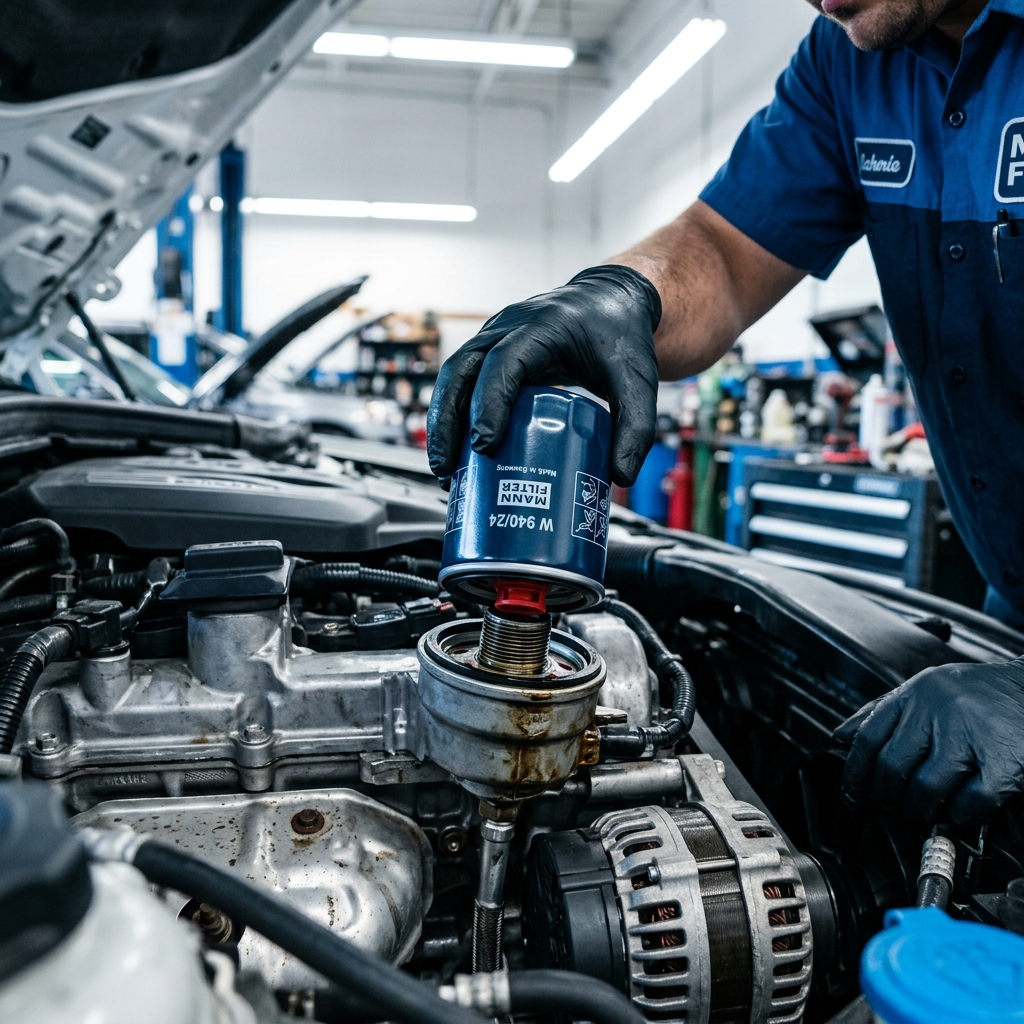
How Often Should You Replace Your Ford Oil Filter and What Does an OEM Filter Cost?
You should replace your Ford oil filter at every oil change, which typically occurs every 5,000 to 10,000 miles or 12 months under guidance from Ford's Intelligent Oil-Life Monitor. OEM Ford Motorcraft oil filters are available; contact us for current pricing, offering exceptional protection for only a minor price difference over lower-cost $4 to $8 aftermarket options.
Maintaining a strict filter replacement schedule ensures that engine oil remains clean and free of abrasive particles. Ford's Intelligent Oil-Life Monitor calculates maintenance intervals based on actual engine operating conditions, including towing frequency, ambient operating temperature, idle time, and trip duration. Vehicles subjected to heavy towing, severe weather, or frequent short drives require more frequent filter replacements to prevent media saturation.
Investing in an OEM filter provides incredible financial value over the life of your vehicle. Considering that standard aftermarket filters cost nearly the same amount as a factory Motorcraft filter, cutting corners on filter quality saves virtually no money while exposing your engine to substantial repair risks. Genuine Motorcraft parts installed at an authorized service dealer also carry a two-year, unlimited-mileage limited warranty that covers both parts and labor.
Frequently Asked Questions About Ford Oil Filters
Q: Who manufactures OEM oil filters for Ford Motor Company?
Ford Motorcraft oil filters are manufactured through official production partnerships with automotive supplier Purolator (Mann+Hummel). These filters are constructed strictly according to proprietary Ford engineering blueprints, specifying exact bypass valve pressures, silicone anti-drainback material, and metal end-cap requirements unique to Ford vehicles.
Q: Does using an aftermarket oil filter automatically void my Ford warranty?
Using an aftermarket oil filter does not automatically void your vehicle warranty. Federal law protects consumer rights to use third-party maintenance parts. However, if an aftermarket filter fails—such as collapsing internally or leaking oil—and causes engine damage, repairs related to that specific filter failure will not be covered under the Ford factory warranty.
Q: What micron rating do Motorcraft oil filters offer?
Motorcraft oil filters are engineered to deliver an 80% to 90% single-pass efficiency rating for particles down to 20 microns. This rating balances effective dirt-trapping capability with high oil flow rates, ensuring adequate lubrication to high-demand engine components like turbochargers and variable valve timing phasers.
Q: Can I change my Ford oil filter without changing the engine oil?
While it is technically possible to unscrew and replace an oil filter without draining the engine oil pan, it is strongly discouraged. Installing a clean filter while leaving old, dirty oil in the crankcase quickly saturates the new filter media with accumulated contaminants, negating the benefits of the fresh filter component.
Q: How can I tell if my current oil filter bypass valve is failing?
Signs of a failing or stuck oil filter bypass valve include low oil pressure warning lights, valvetrain ticking during acceleration, and unusual dark oil contamination shortly after an oil service. If the bypass valve jams open, dirty oil bypasses the media entirely; if it jams shut during cold starts, oil pressure drops significantly.
For dependable vehicle maintenance, genuine OEM parts, and expert service support, stop by our dealership address at Tri State Ford or call our service department at (330) 462-7578 to book your next scheduled oil service today.