Blog

All Maintenance & Service, Expert Repairs & Diagnostics, Genuine Parts & Accessories, Engine Care & Used Vehicle Guides, Financing & Insurance, Buying Guides, Trade-In Advice, Certified Pre-Owned New Vehicle Reviews, Buying Guides, Financing & Insurance, Model Comparisons, Automotive News Maintenance & Service, Battery Care & Diagnostics, Electric Vehicle (EV) Maintenance, Seasonal Maintenance & Service, Warranty & Service Contracts, Repair & Diagnostics, Parts & Components Used Vehicle Guides, Financing & Insurance, Buying Guides, Vehicle Warranty Information, Pre-Owned Automotive News, New Vehicle Reviews, Buying Guides, Financing & Insurance, Seasonal Driving Tips Vehicle Trade-In Advice, Financing & Insurance, Buying Guides, Used Vehicle Guides, New Vehicle Compare Cars Maintenance & Service, Essential Vehicle Care, Preventive Maintenance Tips, Vehicle Longevity Maintenance & Service, Parts & Accessories, Vehicle HVAC Care, Seasonal Vehicle Maintenance, DIY Buying Guides, Financing & Insurance, New Vehicle Reviews, Model Comparisons, Sales & Promotions Used Vehicle Guides, Financing & Insurance, Buying Guides, Pre-Owned Vehicle Sales, Vehicle Maintenance & Service, Brake Systems & Repair, Vehicle Parts & Accessories, Towing & Load New Vehicle Reviews, Buying Guides, Model Comparisons, Financing & Insurance, Inventory & Sales Tips Vehicle Trade-In Tips, Financing & Insurance, Buying Guides, Dealership Sales Strategies, Inventory Maintenance & Service, Vehicle Pickup & Delivery, Mobile Service & On-Site Repairs, Oil Change & Vehicle Sales Events, New Vehicle Pricing & Incentives, Financing & Lease Options, Trade-In & Buying Guides, Financing & Insurance, New Vehicle Reviews, Model Comparisons, Technology & Leasing & Lease Deals, Financing & Insurance, New Vehicle Sales, Commercial Vehicle Leasing, Maintenance & Service, Recall Information, Safety & Reliability, Vehicle Ownership Care, Parts & Maintenance & Service, Warranty & Recalls, Repair & Diagnostics, Parts & Accessories, Vehicle Used Vehicle Guides, Financing & Insurance, Buying Guides, New Vehicle Reviews, Commercial Vehicle Vehicle Sales Process, Financing & Credit Applications, New and Used Vehicle Inventory, Pickup and Community Events & Customer Appreciation, New Vehicle Reviews, Financing & Trade-In Guides, Maintenance & Service, Automotive Technology & Software Updates, Warranty & Recall Service, Mobile Maintenance & Service, Vehicle Ownership Care, Mobile Repair Services, Genuine Parts & Certified New Vehicle Reviews, Buying Guides, Financing & Insurance, Model Comparisons, Automotive Technology Dealership Events & Promotions, Financing & Trade-In Options, Maintenance & Service Specials, Maintenance & Service, Mobile Vehicle Services, Vehicle Care & Ownership, Genuine Parts & Repairs, Maintenance & Service, Vehicle Lighting & Electrical Systems, Automotive Safety & Inspection, OEM Model Comparisons, New Vehicle Reviews, Technology & Innovation, Safety Features, Buying Guides Commercial Truck Sales, Fleet Vehicle Financing, Custom Work Truck Upfits, Commercial Vehicle Commercial Vehicle Sales, Financing & Leasing, Small Business Vehicle Incentives, Fleet Purchasing Commercial Vehicle Sales, Fleet Purchasing & Management, Financing & Leasing for Businesses, New & Community Events, New Vehicle Buying Guides, Financing & Insurance, Maintenance & Service, Local Maintenance & Service, Brake System Care, Vehicle Safety & Inspection, Parts Quality & Replacement, Maintenance & Service, Safety Features, Technology & Innovation, Seasonal Driving Tips, Parts & Maintenance & Service, Tire Care & Repair, Roadside Assistance, Vehicle Safety & Inspections, Maintenance & Service, Vehicle Inspections, Oil Change & Fluid Services, Tire Care & Battery Maintenance & Service, Vehicle Software Updates, Safety Features, Technology & Innovation, Recall & New Vehicle Reviews, Buying Guides, Financing & Insurance, Model Comparisons, Used Vehicle Guides New Vehicle Reviews, Buying Guides, Model Comparisons, Maintenance & Service, Technology & Buying Guides, Financing & Insurance, New Vehicle Reviews, Commercial Fleet Sales, Custom Orders & Buying Guides, New Vehicle Reviews, Financing & Insurance, Commercial Vehicle Sales, Model Commercial Vehicle Sales, Fleet Leasing & Management, Commercial Financing & Tax Incentives, Financing & Insurance, Leasing Benefits, Model Comparisons, Technology & Innovation, Buying Guides Leasing & Financing Options, Buying Guides, Model Comparisons, Negotiation Tips, Inventory & Leasing & Financing Options, Buying Guides, New Vehicle Reviews, Model Comparisons, Technology & Maintenance & Service, Automotive Detailing, Paint Protection & Care, Seasonal Vehicle Care, Maintenance & Service, Automotive Electrical Systems, Battery Care & Replacement, Vehicle Lighting Maintenance & Service, Automotive Fluids & Lubricants, Vehicle Care & Ownership, Dealership Service Maintenance & Service, Automotive Repair, Mobile & Remote Vehicle Service, Warranty & Roadside Maintenance & Service, Brake System Care, Vehicle Safety & Inspection, Automotive Repair Tips, Maintenance & Service, Brake System Care, Vehicle Safety & Inspections, Parts & Repairs, Expert Maintenance & Service, Technology & Innovation, Vehicle Diagnostics & Telematics, Fleet Management Maintenance & Service, Tire Care & Repair, Wheel Alignment & Balancing, Suspension Maintenance, Maintenance & Service, Tire Care & Replacement, Vehicle Safety & Handling, Seasonal Vehicle Maintenance & Service, Tire Care & Replacement, Vehicle Safety & Inspection, Emergency Roadside Maintenance & Service, Vehicle Care & Longevity, Scheduled Service Packages, Oil Changes & Fluid Maintenance & Service, Vehicle Inspection & Diagnostics, Parts & Repairs, Warranty & Resale Value, Maintenance & Service, Vehicle Interior Care, Technology & Innovation in Service, Professional New Vehicle Reviews, Buying Guides, Financing & Insurance, Model Comparisons, Inventory Highlights New Vehicle Reviews, Buying Guides, Financing & Insurance, Model Comparisons, Inventory Updates New Vehicle Reviews, Buying Guides, Technology & Innovation, Safety Features, Seasonal Driving Tips Used Vehicle Guides, Buying Guides, Financing & Insurance, Model Comparisons, Selling Your Car Vehicle Sales Events, New Vehicle Purchasing, Incentives & Discounts, Financing & Pre-Approval, Buying Guides, Financing & Insurance, Used Vehicle Guides, New Vehicle Reviews, Cross-Border Buying Guides, Financing & Insurance, Vehicle Inventory & Offers, Dealership Visit Preparation, Commercial Leasing Options, Business Fleet Solutions, Financing & Leasing Programs, Commercial Commercial Truck Sales, Fleet Purchasing Guides, Financing & Lease Options, Work Truck Community Engagement & Events, New Vehicle Promotions, Financing & Trade-In Options, Maintenance & Community Events & Dealership News, New Vehicle Promotions & Incentives, Maintenance & Service Community Events & Dealership News, New Vehicle Reviews, Financing & Insurance, Maintenance & Custom Ordering & Build Process, New Vehicle Inventory & Offers, Financing & Trade-In Guidance, East Liverpool, OH Ford Dealer East Liverpool, OH Used Cars Financing & Insurance, Buying Guides, Commercial Vehicle Solutions, Fleet Management, Inventory and Financing & Insurance, Buying Guides, New Vehicle Reviews, Used Vehicle Guides, Automotive Sales Financing & Insurance, Buying Guides, New Vehicle Reviews, Used Vehicle Guides, Automotive Sales & Financing & Insurance, Buying Guides, New Vehicle Reviews, Used Vehicle Guides, Model Comparisons Financing & Insurance, Buying Guides, Used Vehicle Guides, New Vehicle Reviews, Automotive Sales Financing & Insurance, Buying Guides, Used Vehicle Guides, Trade-In Tips, New Vehicle Sales Financing & Insurance, Buying Guides, Vehicle Inventory & Offers, Trade-In & Appraisal, Dealership Financing & Insurance, Buying Guides, Vehicle Trade-In Tips, Dealership Sales Process, New Vehicle Leasing & Financing Options, New Vehicle Leasing Guides, Buying Guides, Inventory Spotlight, Trade Leasing Options, Financing & Insurance, New Vehicle Reviews, Buying Guides, Technology & Innovation Leasing Options, Financing & Insurance, New Vehicle Sales, Buying Guides, Vehicle Inventory Maintenance & Service, Air Conditioning Repair, Genuine Parts & Accessories, Dealer-Authorized Maintenance & Service, Automotive Air Conditioning Repair, Vehicle Cooling System Care, Diagnostic Maintenance & Service, Automotive Detailing & Cleaning, Seasonal Vehicle Care, Vehicle Protection & Maintenance & Service, Automotive Detailing & Paint Care, Vehicle Exterior Protection, Paint Repair Maintenance & Service, Automotive Detailing & Protection, Corrosion & Rust Prevention, Paint & Maintenance & Service, Automotive Detailing, Vehicle Care & Protection, Off-Road Vehicle Maintenance & Service, Automotive Electrical Systems, Battery Care & Replacement, Diagnostics & Maintenance & Service, Automotive Glass Repair, Safety Features, Technology & Innovation, Mobile & Maintenance & Service, Automotive Lighting & Electrical, Vehicle Safety & Visibility, DIY Vehicle Maintenance & Service, Automotive Parts & Accessories, Seasonal Vehicle Care, Vehicle Safety & Maintenance & Service, Automotive Parts & Accessories, Vehicle Air Quality & HVAC Care, Preventive Maintenance & Service, Automotive Parts & Accessories, Vehicle Ownership Care, Engine Care & Maintenance & Service, Automotive Parts & Accessories, Vehicle Safety & Repair, Warranty & Maintenance & Service, Automotive Parts & Components, Vehicle Safety & Repair, Warranty & Service Maintenance & Service, Automotive Parts & Repairs, Vehicle Warranty & Protection, Service Center Maintenance & Service, Automotive Repair Tips, Service Team Selection, Warranty & Service Policies, Maintenance & Service, Automotive Repair, Parts & Accessories, Vehicle Ownership Care, Technology & Maintenance & Service, Automotive Repair, Parts & OEM Components, Vehicle Longevity & Care, Service Maintenance & Service, Automotive Technology & Diagnostics, Vehicle Electronics & Sensors, Seasonal Maintenance & Service, Battery Care & Replacement, Vehicle Electrical Systems, Seasonal Vehicle Maintenance & Service, Brake System Care, OEM Parts & Replacement, Vehicle Safety & Inspections, Maintenance & Service, Brake System Care, Vehicle Repair Tips, Automotive Parts & Components, Maintenance & Service, Brake System Care, Vehicle Safety & Inspections, Parts & Components, Maintenance & Service, Brake System Care, Vehicle Safety Inspections, Automotive Repair Tips, OEM Maintenance & Service, Certified Technician Insights, Warranty & Service Coverage, Genuine OEM Maintenance & Service, Cooling System Repairs, Vehicle Ownership Care, Diagnostic & Maintenance & Service, Diagnostic Services, Vehicle Health & Diagnostics, Service Tips & Advice, Maintenance & Service, Engine Care & Performance, Parts & Accessories, Genuine vs. After Maintenance & Service, Paint Protection & Detailing, Vehicle Exterior Care, Seasonal Vehicle Maintenance & Service, Parts & Accessories, Engine Care & Repair, Vehicle Longevity Tips, OEM Parts Maintenance & Service, Parts & Replacements, Vehicle Care Tips, Seasonal Maintenance, DIY Vehicle Maintenance & Service, Recall Updates & Safety Notices, Genuine Parts & Accessories, Truck Care & Maintenance & Service, Repair & Diagnostics, OEM Parts & Accessories, Warranty & Recall Maintenance & Service, Repair & Diagnostics, Parts & Accessories, Vehicle Ownership Care, Service Maintenance & Service, Repair & Diagnostics, Parts & Components, Preventive Care & Tips, Warranty & Maintenance & Service, Repair & Diagnostics, Tire & Wheel Care, Vehicle Safety & Inspection, Parts Maintenance & Service, Repair & Diagnostics, Warranty & Service Coverage, Genuine OEM Parts & Maintenance & Service, Repair & Parts, Vehicle Ownership Care, Safety Features, Technology & Maintenance & Service, Repair & Parts, Vehicle Ownership Care, Transmission Maintenance & Service, Repair Solutions, Vehicle Ownership Care, Parts & Accessories, Diagnostic Maintenance & Service, Repair Tips & Techniques, Vehicle Care & Ownership Maintenance & Service, Safety Features, Automotive Recalls & Repairs, Parts & Warranty Services, Maintenance & Service, Safety Features, Automotive Recalls & Repairs, Technology & Innovation, Maintenance & Service, Safety Features, Automotive Recalls, Vehicle Ownership Care, Parts & Repairs Maintenance & Service, Safety Features, Parts & Repairs, Vehicle Ownership Care, Automotive Service Maintenance & Service, Safety Features, Recall & Repair Updates, Parts & Repairs, Vehicle Ownership Maintenance & Service, Safety Features, Recall & Safety Campaigns, Vehicle Inspection & Repairs, Maintenance & Service, Safety Features, Recall & Warranty Information, Vehicle Diagnostics & Maintenance & Service, Safety Features, Recall Repairs & Safety Campaigns, Parts & Genuine Maintenance & Service, Safety Features, Recalls & Repairs, Parts & Accessories, Vehicle Ownership Maintenance & Service, Safety Features, Repair & Recall Updates, Parts & Components, Vehicle Maintenance & Service, Safety Features, Repair & Replacement, Vehicle Care & Inspection, Parts & Maintenance & Service, Safety Features, Seasonal Driving Tips, Technology & Innovation, Parts & Maintenance & Service, Safety Features, Technology & Innovation, Automotive Electrical Systems, Maintenance & Service, Safety Features, Technology & Innovation, Automotive News, Parts & Repairs Maintenance & Service, Safety Features, Technology & Innovation, Automotive Parts & Accessories, Maintenance & Service, Safety Features, Technology & Innovation, Automotive Recalls, Parts & Repairs Maintenance & Service, Safety Features, Technology & Innovation, Automotive Recalls, Vehicle Maintenance & Service, Safety Features, Technology & Innovation, Automotive Service Tips, Recall & Maintenance & Service, Safety Features, Technology & Innovation, Parts & Repairs, Seasonal Driving Maintenance & Service, Safety Features, Technology & Innovation, Parts & Repairs, Vehicle Ownership Maintenance & Service, Safety Features, Technology & Innovation, Recall & Warranty Information, Maintenance & Service, Safety Features, Technology & Innovation, Repair & Recall Information, Parts Maintenance & Service, Safety Features, Technology & Innovation, Tire Care & Replacement, Maintenance & Service, Safety Features, Vehicle Inspections, DIY Vehicle Care, Repair & Diagnostics Maintenance & Service, Safety Recalls & Repairs, Vehicle Safety & Compliance, Powertrain & Maintenance & Service, Seasonal Driving Tips, Model Comparisons, Technology & Innovation, Safety Maintenance & Service, Seasonal Driving Tips, Safety Features, Technology & Innovation, Automotive Maintenance & Service, Seasonal Driving Tips, Safety Features, Technology & Innovation, Parts & Maintenance & Service, Seasonal Driving Tips, Vehicle Care & Ownership, Brake System Maintenance, Maintenance & Service, Seasonal Driving Tips, Vehicle Care & Ownership, Parts & Accessories, Safety Maintenance & Service, Seasonal Driving Tips, Vehicle Care & Ownership, Safety Features, Maintenance & Service, Seasonal Driving Tips, Vehicle Care & Protection, Brake Maintenance, Tire Maintenance & Service, Seasonal Driving Tips, Vehicle Care & Warranty, Service Specials & Packages, Maintenance & Service, Seasonal Driving Tips, Vehicle Cooling Systems, Automotive Safety Features, Maintenance & Service, Service Scheduling & Convenience, Vehicle Repair & Diagnostics, Parts & Maintenance & Service, Technology & Innovation, Automotive Service Transparency, Digital Vehicle Maintenance & Service, Technology & Innovation, Safety Features, Parts & Warranty, Vehicle Maintenance & Service, Tire Care & Replacement, Seasonal Vehicle Care, Safety Features, Automotive Maintenance & Service, Tire Care & Replacement, Vehicle Safety & Inspections, Seasonal Vehicle Maintenance & Service, Transmission Care & Repair, Vehicle Fluid Services, Automotive Diagnostics, Maintenance & Service, Transmission Care, Repair & Parts, Vehicle Ownership Care, Common Vehicle Maintenance & Service, Vehicle Care Tips, Parts & Accessories, Seasonal Vehicle Maintenance, Maintenance & Service, Vehicle Detailing & Care, Parts & Accessories, Seasonal Vehicle Preparation, Maintenance & Service, Vehicle Detailing & Cosmetic Care, Automotive Cleaning & Protection, Service Maintenance & Service, Vehicle Detailing & Cosmetic Care, Service Scheduling & Convenience, Maintenance & Service, Vehicle Detailing & Protection, Repair & Inspection, Parts & Accessories, Maintenance & Service, Vehicle Detailing & Protection, Vehicle Care Tips, Seasonal Vehicle Maintenance & Service, Vehicle Diagnostics & Repair, Engine Performance & Troubleshooting, Fuel Maintenance & Service, Vehicle Fluids & Lubrication, Engine Care & Repair, Parts & Accessories, Maintenance & Service, Vehicle Ownership Care, Parts & Accessories, Repair & Diagnostics, Certified Maintenance & Service, Vehicle Repair & Diagnostics, Parts & Accessories, DIY Vehicle Care, Safety Maintenance & Service, Vehicle Repair & Diagnostics, Parts & Accessories, Hybrid & Electric Vehicle Maintenance & Service, Vehicle Repair & Diagnostics, Parts & Accessories, Seasonal Driving Tips, Maintenance & Service, Vehicle Repair & Diagnostics, Parts & Accessories, Service Lane Tips & Maintenance & Service, Vehicle Repair & Diagnostics, Parts & Accessories, Towing & Performance Maintenance & Service, Vehicle Repair & Parts, Service Convenience & Customer Care, Roadside Maintenance & Service, Vehicle Repair Tips, Parts & Accessories, Safety Features, Technology & Maintenance & Service, Vehicle Service Warranties, Repair & Coverage Plans, Ownership & Vehicle Model Comparisons, Buying Guides, New Vehicle Reviews, Financing & Insurance, Inventory Updates Model Comparisons, Buying Guides, New Vehicle Reviews, Technology & Innovation, Safety Features Model Comparisons, Buying Guides, Technology & Innovation, Safety Features, Maintenance & Service Model Comparisons, New Vehicle Reviews, Buying Guides, Technology & Innovation, Financing & Model Comparisons, New Vehicle Reviews, Buying Guides, Technology & Innovation, Safety Features Model Comparisons, New Vehicle Reviews, Safety Features, Technology & Innovation, Seasonal Driving Model Comparisons, New Vehicle Reviews, Technology & Innovation, Buying Guides, Maintenance & Model Comparisons, New Vehicle Reviews, Technology & Innovation, Maintenance & Service, Buying Model Comparisons, Towing & Hauling Guides, Maintenance & Service, Technology & Innovation, New New Vehicle Promotions, Buying Guides, Financing & Insurance, New Vehicle Reviews, Inventory New Vehicle Reviews, Buying Guides, Financing & Insurance, Model Comparisons, Automotive Sales New Vehicle Reviews, Buying Guides, Financing & Insurance, Model Comparisons, Commercial & Work New Vehicle Reviews, Buying Guides, Financing & Insurance, Model Comparisons, Vehicle Customization New Vehicle Reviews, Buying Guides, Financing & Insurance, Model Comparisons, Vehicle Inventory New Vehicle Reviews, Buying Guides, Financing & Insurance, New Vehicle Specials, Trade-In & Value New Vehicle Reviews, Buying Guides, Financing & Insurance, Used Vehicle Guides, Inventory Updates New Vehicle Reviews, Buying Guides, Financing & Insurance, Used Vehicle Guides, Model Comparisons New Vehicle Reviews, Buying Guides, Financing & Insurance, Vehicle Inventory & Specials, Model New Vehicle Reviews, Buying Guides, Financing & Insurance, Vehicle Inventory, Model Comparisons New Vehicle Reviews, Buying Guides, Model New Vehicle Reviews, Buying Guides, Model Comparisons, Financing & New Vehicle Reviews, Buying Guides, Safety Features, Technology & Innovation, Model Comparisons New Vehicle Reviews, Buying Guides, Technology & Innovation, Safety Features, Maintenance & Service New Vehicle Reviews, Financing & Insurance, Buying Guides, New Vehicle Specials, Model Comparisons New Vehicle Reviews, Financing & Insurance, Buying Guides, Technology & Innovation, Automotive New Vehicle Reviews, Financing & Insurance, Buying Guides, Used Vehicle Guides, Model Comparisons New Vehicle Reviews, Model Comparisons, Buying Guides, Technology & Innovation, Safety Features New Vehicle Reviews, Model Comparisons, Commercial Truck Guides, Technology & Innovation, New Vehicle Reviews, Model Comparisons, Financing & Insurance, Technology & Innovation, Safety New Vehicle Reviews, Model Comparisons, Off-Road Adventures, Technology & Innovation, Maintenance & New Vehicle Reviews, Model Comparisons, Safety Features, Technology & Innovation, Buying Guides New Vehicle Reviews, Model Comparisons, Technology & Innovation, Financing & Insurance, Maintenance New Vehicle Reviews, Model Comparisons, Technology & Innovation, Safety Features, Buying Guides New Vehicle Reviews, Model Comparisons, Technology & Innovation, Safety Features, Maintenance & New Vehicle Reviews, Off-Road Capabilities, Outdoor Adventure Vehicles, Technology & Innovation, New Vehicle Reviews, Technology & Innovation, Buying Guides, Maintenance & Service, Model New Vehicle Reviews, Technology & Innovation, Buying Guides, Safety Features, Model Comparisons New Vehicle Reviews, Technology & Innovation, Safety Features, Maintenance & Service, Buying Guides New Vehicle Sales, Financing & Incentives, Trade-In & Appraisal, Special Sales Events, Electric New Vehicle Sales, Financing & Incentives, Trade-In & Value Guides, Manufacturer Promotions, New Vehicle Sales, Financing & Insurance, Buying Guides, Manufacturer Incentives & Discounts, New Vehicle Sales, Vehicle Delivery & Logistics, Financing & Credit Applications, Trade-In & Trucks Used Vehicle Guides, Financing & Insurance, Buying Guides, Model Comparisons, Local Dealership Vehicle Sales Events, Financing & Leasing, Trade-In & Trade-Up Guides, New Vehicle Inventory Vehicle Sales Events, New Vehicle Buying Guides, Financing & Incentives, Dealership Inventory Vehicle Sales Events, New Vehicle Pricing, Financing & Credit Applications, Trade-In & Loyalty Vehicle Sales Process, Online Vehicle Purchasing, Financing & Loan Approval, Trade-In & Vehicle Vehicle Sales Promotions, New Vehicle Buying Guides, Financing & Credit Applications, Dealership Vehicle Sales Promotions, New Vehicle Buying Guides, Financing & Incentives, Trade-In & Valuation, Vehicle Sales, Online Car Buying, Financing & Incentives, Trade-In Guides, New Vehicle Delivery
d

Is Ford Pro Fleet Solutions Worth It for Small Business Fleets?

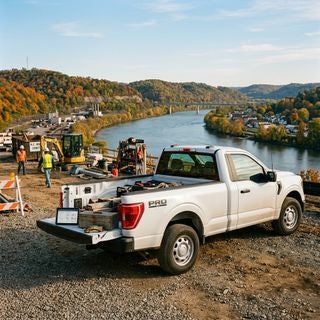
Ford Pro Fleet Solutions is worth the investment for small business fleets because it consolidates commercial vehicles, telematics software, on-site mobile maintenance, and line-of-credit financing into a single ecosystem that actively reduces vehicle downtime and cuts operational overhead. By integrating real-time diagnostic alerts, auto-approved service thresholds, and factory-backed upfitting, small businesses save administrative hours and keep work trucks where they belong—on the job. Managing a commercial operation requires balancing tight jobsite schedules with unpredictable vehicle maintenance. For tradesmen and independent contractors operating along the riverfront bluffs near East Liverpool, lost road time directly impacts job site profitability. Ford Pro addresses this by shifting commercial vehicle management from reactive repairs to predictive maintenance. Connected vehicles continuously stream hardware data to centralize driver behavior, fuel management, and service alerts into one streamlined management portal. Rather than managing separate vendors for vehicle acquisition, upfit equipment, GPS hardware, and credit management, small business owners gain a unified commercial foundation. Whether deploying a single 2026 Ford F-150 Pro pickup for light utility or structuring a fleet of heavy-duty workhorses, the platform minimizes administrative burden. To discuss setting up your commercial account or visiting our showroom, review our East Liverpool showroom address or call our team at (330) 462-7578 to speak directly with our commercial specialists. Table of Contents What Commercial Telematics and Software Features Are Included in Ford Pro Fleet Solutions? What Vehicle Upfits and Work-Ready Vocational Packages Does Ford Pro Offer Tradesmen? What Mobile Service and On-Site Maintenance Capabilities Does Ford Pro Provide? What Commercial Financing and Credit Options Are Available Through Ford Pro FinSimple? How Does Ford Pro Fleet Solutions Compare to Chevrolet Fleet and GM Envolve? Which Local Dealer Serves Commercial Fleet Buyers Near East Liverpool with Dedicated Support? Common Commercial Buyer Questions About Ford Pro Fleet Solutions What Commercial Telematics and Software Features Are Included in Ford Pro Fleet Solutions? Ford Pro Fleet Solutions includes Ford Pro Telematics, Ford Pro Data Services, and the Ford Pro Telematics Drive app, offering real-time GPS tracking, vehicle health diagnostics, fuel consumption auditing, and driver safety scoring. This connected software infrastructure functions via built-in 5G modems or plug-in OBD-II devices for older or non-Ford vehicles in mixed commercial fleets. At the core of the digital software suite is real-time vehicle monitoring. Fleet supervisors receive instant notifications regarding check engine codes, low oil life, battery state of health, and tire pressure drops before minor mechanical wear turns into costly roadside breakdowns. Integrated GPS features allow dispatchers to track asset locations, review historic trip routes, and monitor unnecessary engine idling. Furthermore, optional Asset Tracking hardware devices can be secured to non-vehicle jobsite equipment, tools, and trailers, broadcasting live location data to the same central management dashboard. For operations running mixed vehicle inventories, Ford Pro Data Services delivers raw, manufacturer-grade data feeds directly into third-party enterprise management tools via open REST APIs. This allows fleet owners to maintain standardized accounting and route logistics across every chassis in service. When expanding a commercial fleet on a budget, business owners frequently browse pre-owned Carfax 1-owner commercial vehicles equipped with active modems to integrate pre-owned work vans and trucks into their software network without delay. Real-Time Diagnostics: Instant notifications for fault codes, fluid degradation, and battery performance. Driver Coaching: In-cab alerts for harsh braking, rapid acceleration, speeding, and seatbelt compliance. Fuel & Idling Audits: Detailed reports pinpointing excess idling burn to trim fuel overhead. Mixed Fleet Compatibility: Full hardware support for non-Ford models via plug-in OBD-II modem kits. What Vehicle Upfits and Work-Ready Vocational Packages Does Ford Pro Offer Tradesmen? Ford Pro offers tradesmen tailored vocational packages and custom vehicle upfitting through qualified vehicle modifiers, factory-installed trade packages, and the integrated Ford Pro Vehicle Integration System 2.0. These solutions outfit work trucks and vans with trade-specific interior shelving, ladder racks, utility bodies, and auxiliary controls designed for immediate job site deployment. For electrical, plumbing, and HVAC contractors, the 2026 Ford Transit Cargo Van serves as an adaptable mobile workshop. Low-roof configurations support a maximum payload capacity of up to 4,085 pounds, while high-roof extended models accommodate up to 3,536 pounds of gear alongside full-standing interior work room. When equipped with the 3.5L EcoBoost V6 engine and the Heavy-Duty Trailer Tow Package, the Transit Cargo Van maintains a maximum towing capacity of up to 4,500 pounds, making it capable of hauling utility trailers behind a fully loaded cargo bay. Heavy trades requiring maximum pulling power rely on the Super Duty line. A properly equipped 2026 Ford Super Duty F-250 delivers conventional towing ratings up to 22,000 pounds, providing the strength required for heavy equipment haulers and masonry trailers. The Ford Pro Vehicle Integration System 2.0 allows upfitters to program electronic safety lockouts—such as preventing a vehicle from shifting into drive while a boom arm or lift bed is deployed—without cutting into factory wiring harnesses. Contractors evaluating equipment upgrades can explore our new Ford commercial vehicle inventory, calculate capital flexibility by choosing to value your trade-in, or review specialized chassis specs directly through our dedicated F-Series work truck inventory. What Mobile Service and On-Site Maintenance Capabilities Does Ford Pro Provide? Ford Pro Mobile Service delivers routine commercial maintenance directly to company job sites, parking facilities, or fleet yards using specialized mobile service vans staffed by factory-certified technicians. This remote service capability eliminates the need to shuttle drivers and work trucks to a dealership bay for standard upkeep, maximizing billable working hours. Mobile service units carry specialized fluid extraction gear, diagnostic equipment, and original equipment tools to complete routine upkeep on your premises. Fleet operators can bundle multi-vehicle maintenance during off-peak hours or weekend downtime. Servicing mixed fleets is standard, allowing technicians to handle basic oil and filter changes across all makes and models in your lot. Routine Lubrication: Engine oil and filter replacements using factory-approved fluids. Brake & Tire Upkeep: On-site brake pad replacements, tire rotations, and pressure adjustments. Electrical Diagnostics: Battery health testing, terminal cleaning, and replacement. Software Updates: Over-the-air modules and safety recall updates completed without shop visits. Small business owners operating along commercial corridors in suburban areas like State Route 170 in Calcutta frequently utilize on-site service to keep service vans active during peak business seasons. Utilizing the Ford Mobile Service program keeps work trucks on schedule while technician teams address routine battery maintenance in the field. When adding work-ready trucks to a growing fleet, buyers can also consider our certified pre-owned commercial lineup to balance initial purchase price with factory-backed warranty coverage. What Commercial Financing and Credit Options Are Available Through Ford Pro FinSimple? Ford Pro FinSimple provides dedicated commercial financing, flexible lines of credit, and customized leasing structures tailored specifically to the cash-flow cycles of small businesses and tradesmen. By consolidating vehicle purchases, upfit equipment packages, and ongoing software subscriptions into single monthly statements, business owners streamline accounting processes. A primary advantage for growing businesses is the Commercial Line of Credit (CLOC). Once established, a CLOC allows business owners to add work trucks or vans to their fleet throughout the year without submitting fresh credit applications for every purchase. This preserves working capital for payroll and jobsite materials while ensuring competitive interest rates and structured repayment terms. Small contractors stopping in to review commercial chassis options usually ask whether real-time vehicle health alerts require a paid subscription before they ask about upfit lead times. Our financial team clarifies software trial periods and shows how subscription costs can be wrapped directly into vehicle financing. FinSimple also features Terminal Rental Adjustment Clause (TRAC) leases. A TRAC lease offers flexible monthly terms with no mileage limits or end-of-lease wear-and-tear penalties, giving high-mileage tradesmen clear end-of-term buyout predictions. Business owners ready to establish a commercial lending line can complete an online commercial credit application to initiate the approval process prior to selecting inventory. How Does Ford Pro Fleet Solutions Compare to Chevrolet Fleet and GM Envolve? Among major competitors, Ford Pro uniquely combines manufacturing, telematics, upfitting, servicing, and financing within one company, streamlining fleet management. While Chevrolet Fleet and GM Envolve offer capable commercial trucks and telematics programs, GM relies more heavily on third-party software partners and external upfit integration protocols to match equivalent fleet management functionality. Comparing light-duty work trucks highlights distinct performance advantages. The 2026 Ford F-150 Pro features a starting MSRP of $69,625 and comes standard with a 3.5L engine, SelectShift® transmission, All-wheel drive, and an EPA rating of 17 city / 23 hwy mpg. Equipped to seat 5 with about 53 cu ft of cargo space and a maximum towing capacity of 10,400 lbs, it provides a versatile blend of driver comfort and jobsite hauling power. Fleet Capability / Spec Feature Ford Pro Fleet Solutions Chevrolet Fleet / GM Envolve Telematics Integration Native OEM software with built-in 5G modems Third-party software & OnStar Commercial Upfit Electronics Control Vehicle Integration System 2.0 Traditional body builder wiring splices On-Site Mobile Maintenance Factory-owned mobile service fleet Dealer-dependent mobile offerings Commercial Financing FinSimple single-invoice software & vehicle billing GM Financial commercial accounts Light-Duty Pickup Towing F-150 up to 13,500 lbs max towing Silverado 1500 up to 13,300 lbs max towing Ford's proprietary Vehicle Integration System 2.0 allows upfit equipment to communicate digitally with the truck's central screen, eliminating the need to mount aftermarket switch boxes on the dashboard—a feature GM's body-builder wiring configurations struggle to replicate cleanly. Which Local Dealer Serves Commercial Fleet Buyers Near East Liverpool with Dedicated Support? Tri State Ford serves commercial customers across the region by providing specialized business support, commercial chassis inventory, and extended showroom hours tailored to busy trade schedules. Located conveniently at 1503 Pennsylvania Ave, East Liverpool, OH 43920, our sales team operates until 8:00 PM on Mondays and Thursdays, giving business owners time to review vehicle fleets after jobsites close for the day. Our commercial specialists understand local industry demands, whether your company requires flatbeds for industrial transport along the Ohio River or high-roof Transit vans for residential service routes. We walk commercial buyers through every step of fleet expansion, from selecting powertrain options to arranging TRAC leasing and coordinating final upfit deliveries. By pairing rugged vehicles like the Super Duty F-250 and Transit Cargo Van with the digital management power of Ford Pro Intelligence, Tri State Ford helps local businesses reduce cost-per-mile expenses and maintain total operational control. Common Commercial Buyer Questions About Ford Pro Fleet Solutions Q: Do non-Ford commercial vehicles require aftermarket hardware to use Ford Pro Telematics? Yes, non-Ford vehicles in a mixed commercial fleet require a Ford Pro Plug-In Device attached to their OBD-II port to stream location, fuel, and diagnostic data to the central telematics dashboard. This hardware enables small businesses to track all fleet assets through a single interface without replacing existing working vans or trucks from rival manufacturers. Q: Can vehicle upfit equipment and installation costs be financed together with the truck purchase? Yes, through Ford Pro FinSimple, eligible business owners can bundle the base chassis purchase, qualified upfit equipment packages, shelving installations, and ongoing telematics software subscriptions into a single financing agreement or commercial line of credit. This single-invoice structure streamlines monthly business accounting and preserves upfront operating capital. Q: How does Ford Pro Mobile Service handle environmental waste like spent oil and old fluids? Ford Pro Mobile Service vans are equipped with self-contained environmental recovery systems. Mobile technicians extract used engine oil, coolant, and worn filters directly into sealed holding tanks inside the service van, ensuring full compliance with state environmental disposal standards without leaving any waste or spillage at your place of business. Q: What is the difference between Ford Pro Telematics Essentials and the full software plan? Ford Pro Telematics Essentials is a complimentary program for modem-equipped vehicles that provides core vehicle health alerts, engine diagnostic codes, and dealer service scheduling. The full subscription plan adds real-time GPS tracking, driver behavior monitoring, fuel efficiency analytics, automated maintenance workflows, and in-cab driver coaching alerts. Q: How does the Ford Pro Vehicle Integration System 2.0 improve jobsite safety? The Vehicle Integration System 2.0 allows upfit equipment to interface electronically with factory chassis safety controls. This system enables safety lockouts, such as preventing a driver from shifting out of park while a bucket lift, dump body, or lift gate is active, protecting field operators and reducing expensive equipment damage on work sites. To learn more about outfitting your business fleet or arranging a commercial vehicle consultation, check our dealership directions page or give our commercial vehicle team a call at (330) 462-7578 today. Keep Your Vehicle Running Strong Keep your vehicle performing at its best with our service team: Order Parts Schedule Service Appt © 2026 Tri State Ford. All rights reserved. Vehicle specification data © JATO Dynamics Limited. Ford Pro Fleet Solutions in East Liverpool OH | Tri State Ford
l

How Does Ford Pickup & Delivery Work for Maintenance?

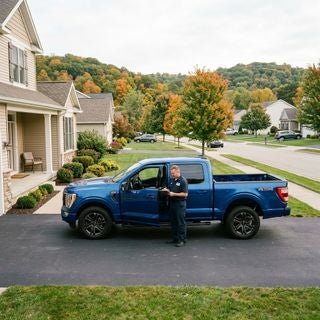
Ford Pickup & Delivery allows eligible vehicle owners to schedule routine maintenance or warranty repairs where a dealership representative retrieves the vehicle from a home or workplace, transports it to the service center for care, and returns it once completed. Routine scheduled maintenance or warranty work often includes complimentary pickup and delivery within a designated local service radius, eliminating the need to wait in the service lounge. The process begins when you schedule a service appointment online, through the Ford App, or by speaking with our service team directly. On the day of your appointment, a certified driver arrives at your designated address to pick up your keys and complete a brief vehicle walk-around. Your vehicle is driven to our specialized service bays, where factory-trained technicians perform the requested maintenance using genuine OEM parts. Throughout the process, you receive status updates via text message or phone call so you know exactly when work begins and ends. Once your vehicle passes our final quality inspection, our team returns it directly to your driveway or parking spot. | Ford PICKUP & DELIVERY PROCESS | | --- | | 1. Schedule Appointment -> Online, via Ford App, or by Phone | | 2. Vehicle Retrieval -> Driver collects keys at home/office | | 3. Factory Service -> Certified techs use OEM Ford parts | | 4. Status Updates -> Real-time notifications sent to you | | 5. Direct Return -> Vehicle delivered back to your door | Vehicle owners navigating the steep elevation changes and riverfront bluffs near East Liverpool rely heavily on well-maintained brakes and suspension components. Having our drivers retrieve your vehicle saves you valuable commuting time along the river corridor while ensuring your truck or SUV receives proper care. To arrange your next service retrieval or learn more about our remote scheduling options, review our official Ford Pickup & Delivery program guidelines, reach out to our service team at (330) 462-7578, or find exact driving routes to our East Liverpool showroom address on Pennsylvania Avenue. Table of Contents How Much Does Pickup and Delivery Cost and Is There a Mileage Limit? Does Tri State Ford Offer Mobile Service at Your Home in East Liverpool? Do Ford Protect Plans and Ford Rewards Points Cover Convenience Fees? What Should You Ask Our Service Team About Timing and Logistics? What Drivers Ask Most About Ford Pickup, Delivery, and Maintenance Keeping Your Ford Running Smoothly Without Interrupting Your Day How Much Does Pickup and Delivery Cost and Is There a Mileage Limit? Many Ford owners benefit from complimentary pickup and delivery services for routine maintenance, making it easier to keep vehicles in top condition without extra transportation costs. While the door-to-door transportation service itself carries no additional surcharge for qualifying appointments, dealerships set local operating boundaries to ensure timely vehicle transit. Most complimentary pickup and delivery programs cover locations within a 15- to 20-mile radius of the dealership. If your home or workplace sits outside this standard boundary, our service team can evaluate logistics on a case-by-case basis or discuss alternative arrangements. Working families residing in suburban communities near State Route 170 in Calcutta frequently utilize this doorstep collection when managing busy work and school calendars. Routine scheduled care like The Works package—which includes a Synthetic Blend oil change, tire rotation, pressure check, brake inspection, and multi-point checkup—can be completed without disrupting your daily routine. For specialty maintenance involving custom fluid flushes, filters, or severe-duty components, you can coordinate specific parts requests in advance by choosing to order OEM Ford parts directly through our service portal. Service Feature Standard Pickup & Delivery Ford Mobile Service:--:--:-- Service Location Dealership Service Bay Customer Driveway / Workplace Distance Boundary Typically 15- to 20-mile radius Local dealer service territory Service Scope Full shop repairs, oil changes, tires, heavy maintenance Light maintenance, oil, filters, batteries, recall updates Doorstep Convenience Vehicle retrieved and returned Technician brings mobile van to you Does Tri State Ford Offer Mobile Service at Your Home in East Liverpool? Yes, Ford Mobile Service sends a factory-trained technician and a fully equipped mobile service van directly to your home or office to complete routine vehicle maintenance on-site. Unlike pickup and delivery—where your vehicle is driven to our central facility—mobile maintenance brings certified diagnostic equipment, oil extraction systems, and specialty tools right to your driveway. Technicians perform a wide variety of routine maintenance tasks without taking your vehicle off your property. Common mobile services include: Synthetic motor oil and filter replacement Engine air filter and cabin air filter installation Battery testing and replacement Tire rotation and air pressure adjustment Brake pad and rotor inspections Select manufacturer safety recall software updates Mobile maintenance provides a practical solution for multi-vehicle households or small business fleet operators who cannot afford to take work trucks off the job site. When you schedule an on-site visit, our technician handles environmental fluid recovery and safety protocols in compliance with factory standards. You can easily schedule a service appointment online or explore how our specialized Ford Mobile Service van handles routine driveway care. Do Ford Protect Plans and Ford Rewards Points Cover Convenience Fees? Ford Protect PremiumCARE and other extended service plans include specific rental and service convenience benefits that offset transportation costs, while Ford Rewards points can be redeemed directly toward eligible maintenance charges. Owners enrolled in the Ford Rewards program accumulate points with every new vehicle purchase or authorized service transaction. These accumulated points may be eligible for use toward certain service charges depending on program terms. Contact the dealership for current Ford Rewards program details and eligibility. | Ford CONVENIENCE & COVERAGE HIGHLIGHTS | | --- | | * Ford Rewards Points -> Redeem for mobile or shop care | | * Ford Protect PremiumCARE -> Includes transportation benefits | | * Manufacturer Coverage -> Covers eligible recall repairs free | | * Roadside Assistance -> Includes towing to authorized store | For extended ownership protection, high-tier Ford Protect extended service plans offer convenience benefits that help cover loaner vehicles or pickup service fees if work requires an extended shop stay. Furthermore, factory warranty repairs and active safety recalls are performed at zero out-of-pocket cost for parts or labor. If emergency towing or breakdown support is required on the road, drivers can contact Ford Roadside Assistance: 1-800-241-3673 to coordinate transportation directly to our authorized service center. What Should You Ask Our Service Team About Timing and Logistics? When organizing service transportation, you should ask our service advisors about estimated turn-around windows, vehicle handoff logistics, and shuttle or loaner availability. Preparing for a smooth appointment involves verifying a few key operational details before our driver arrives. We recommend asking our team the following practical logistics questions: How long will the overall service window take from pickup to return? Do I need to be physically present to hand over the keys, or can a secure drop-box method be arranged? Is a loaner vehicle available if my truck requires complex engine or transmission diagnostics? Are all necessary filters, fluids, or recall parts currently in stock for my specific VIN? Standard light-duty Ford truck maintenance follows a 7,500-mile interval or six-month schedule under normal driving conditions. Adhering to these factory intervals preserves system longevity and maintains warranty compliance. If your vehicle is approaching a seasonal maintenance check, combining routine tire care with routine battery service and testing ensures electrical systems perform reliably during cold winter mornings. What Drivers Ask Most About Ford Pickup, Delivery, and Maintenance Q: How do I schedule Ford Pickup & Delivery for my upcoming oil change? You can schedule pickup and delivery through the Ford App, on our dealership website, or by calling our service desk. During booking, select an available date, specify your preferred pickup location, and detail the maintenance tasks your vehicle requires. Our service coordinator confirms your time slot and sends a notification when your driver is en route. Q: Is there a fee for Ford Pickup & Delivery at Tri State Ford? Pickup and delivery is typically complimentary for qualifying routine maintenance or covered warranty work for eligible Ford owners within our standard local operating radius. Standard charges still apply for the specific oil, filters, or mechanical repairs performed on the vehicle. Our advisors verify eligibility and location boundaries when you book. Q: What maintenance tasks can be completed in my driveway via Ford Mobile Service? Ford Mobile Service handles light routine maintenance including engine oil and filter changes, tire rotations, battery testing and replacements, cabin air filter updates, multi-point safety inspections, and select software recall updates. Heavy mechanical repairs, wheel alignments, and major overhaul work are performed at our central facility. Q: Can I use Ford Rewards points to pay for mobile service appointments? Yes, participating Ford dealerships accept Ford Rewards points as payment for both in-shop service appointments and mobile maintenance visits. You can inform your service advisor prior to billing that you wish to apply your available point balance toward your maintenance total. Q: How far in advance should I book my vehicle pickup appointment? We recommend booking your pickup and delivery appointment three to five business days in advance. Advance booking secures your preferred time slot, guarantees driver availability, and ensures our parts department has all necessary OEM components staged prior to vehicle arrival. Keeping Your Ford Running Smoothly Without Interrupting Your Day Maintaining your Ford truck or SUV does not require sacrificing your productive hours or rearranging your busy calendar. Through factory-backed programs like Ford Pickup & Delivery and Ford Mobile Service, getting professional maintenance from certified technicians using genuine OEM parts is easier than ever. Whether your vehicle needs a routine 7,500-mile interval oil change, tire rotation, battery test, or factory recall update, our team brings dealership-grade care directly to you. To set up your next service retrieval or discuss mobile van scheduling, place a quick call to our service desk or get turn-by-turn routes to our service center location on Pennsylvania Avenue today. © 2026 Tri State Ford. All rights reserved. Ford Pickup & Delivery Service in East Liverpool OH | Tri State Ford
l

How Does Buying a 2027 Ford Out of State Work?

Buying a Ford out of state works by letting the selling dealership collect your home state’s sales tax and handle registration paperwork directly. When you purchase in Ohio as a Pennsylvania or West Virginia resident, the dealer provides a 45-day temporary tag and submits your home state titling documents, allowing you to legally drive home and receive your permanent plates without paying duplicate tax. Crossing state lines to purchase a truck or SUV is a seamless process when working with an experienced multi-state dealer. Under Ohio sales regulations, out-of-state buyers sign an STEC-NR non-resident affidavit at purchase. This legal document verifies that the vehicle is being purchased in Ohio but will be driven to and registered in another home state. The dealership issues a temporary 45-day registration tag, giving you ample time to complete home-state administrative steps while driving legally. For truck shoppers living in nearby communities like Calcutta who routinely haul trailers and equipment across state lines, completing a cross-border deal eliminates administrative friction. Looking ahead to upcoming model releases, Ford has confirmed that retail order banks for the 2027 Ford Super Duty open in May 2026. For 2027, the heavy-duty lineup eliminates the 6.8-liter V8, making the robust 7.3-liter "Godzilla" V8 the standard gasoline engine across most F-250 and F-350 configurations alongside the high-output 6.7-liter Power Stroke diesel. Whether you are reserving an upcoming commercial vehicle or choosing from current lot inventory, the cross-border titling framework ensures your purchase is registered accurately in your home county. To plan your visit or inquire about out-of-state document preparation, you can get turn-by-turn directions to our East Liverpool showroom location, give our sales team a call, or explore our commercial Ford F-Series work truck inventory online. Table of Contents Should You Prioritize Dealerships That Handle Out-of-State Registration and Sales Tax? What Is the Deadline and Process to Transfer Vehicle Registration Across State Lines? What Is the Towing and Payload Capacity of the 2026 Ford F-150 Compared to Class Rivals? What Standard Tech, Screen Sizes, and BlueCruise Features Come on the 2026 Ford F-150? Common Questions About Registering a Ford Purchase Across Ohio, Pennsylvania, and West Virginia How to Take the Next Step on Your Cross-Border Ford Purchase Should You Prioritize Dealerships That Handle Out-of-State Registration and Sales Tax? Prioritizing a dealership that handles out-of-state titling and tax collection is essential because it eliminates the hassle of manually calculating county tax rates, filing out-of-state reciprocity forms, and managing DMV submission deadlines yourself. Multi-state certified dealers calculate your exact local sales tax rate at purchase, incorporate it into your vehicle financing, and submit registration directly to your home state's licensing bureau. Vehicle sales tax is strictly governed by where the vehicle is titled and registered, not by the physical location of the showroom where you sign the contract. Ohio sales tax and related fees vary based on location and transaction details. However, as a non-resident purchasing a vehicle to title in Pennsylvania or West Virginia, you do not pay Ohio's local tax rates. Instead, the dealer calculates your home state’s motor vehicle sales tax rate based on your residential address and submits those funds directly to your home state's revenue department. When buyers from across the state line visit us, the question I get most often is whether they will have to pay Ohio tax and home state tax. I clarify that vehicle sales tax is tied strictly to where the truck is registered, so you pay only your local tax rate once. By letting the dealer coordinate reciprocal tax transfers and title submissions, you avoid paying out-of-pocket tax bills when your home state title arrives. This streamlined process applies equally whether you are financing a new pickup or selecting from our selection of single-owner pre-owned vehicles. What Is the Deadline and Process to Transfer Vehicle Registration Across State Lines? Residents in Ohio, Pennsylvania, and West Virginia have 30 days from the purchase date to complete their vehicle title transfer and obtain permanent state registration plates. The process requires submitting a properly assigned title or Certificate of Origin, proof of active state liability insurance, a physical Vehicle Identification Number inspection, and valid state identification to your home licensing agency. Navigating the 30-day transfer window requires bringing specific documentation to your local licensing office or Deputy Registrar. If you are registering an out-of-state vehicle purchase in Ohio, state law mandates a physical VIN verification inspection conducted by an authorized Deputy Registrar or licensed inspection station to confirm the vehicle numbers match the title document. Pennsylvania residents receiving a 30-day in-transit plate must submit their title application, proof of Pennsylvania insurance, and applicable county fees to a PennDOT agent within the designated window. Staying on top of these deadlines ensures uninterrupted driving privileges, especially if you are placing a factory order for future releases. Ford has announced new OEM-backed configurations for the 2027 Super Duty lineup, including an available Carhartt edition on XLT Crew Cab single-rear-wheel 4x4 models, an expanded Tremor Off-Road Package, and a new XL Off-Road 35-inch Tire Package. Securing your paperwork early keeps your buying experience organized from the day of delivery onward. You can get started today by browsing our current inventory of new Ford trucks and SUVs, reviewing current Ford vehicle incentives and specials, or custom building your new Ford truck to your exact specifications. What Is the Towing and Payload Capacity of the 2026 Ford F-150 Compared to Class Rivals? The 2026 Ford F-150 achieves a class-leading maximum towing capacity of up to 13,500 pounds and a maximum payload capacity of up to 2,440 pounds when properly equipped. These figures outpace key light-duty competitors, providing greater hauling margin for work supplies, livestock trailers, and recreational boats. Comparing these figures against segment rivals highlights the practical advantages of Ford's high-strength, military-grade aluminum-alloy body design. The Chevrolet Silverado 1500 offers a maximum towing capacity of 13,300 pounds and a maximum payload capacity of 2,260 pounds. Meanwhile, the Ram 1500 maxes out around 11,580 pounds of trailering capacity and roughly 2,300 pounds of payload capacity. The F-150 truck’s additional payload and towing margins mean you can haul heavy tools, equipment, or weekend cargo with greater confidence and reduced mechanical strain. Pickup Model Maximum Towing Capacity Maximum Payload Capacity 2026 Ford F-150 13,500 lbs 2,440 lbs Chevrolet Silverado 1500 13,300 lbs 2,260 lbs Ram 1500 11,580 lbs 2,300 lbs For working residents in East Liverpool where hauling riverfront gear, trade tools, or heavy utility loads is part of daily life, having segment-leading bed capacity matters. Whether you require a light-duty workhorse or are considering our certified pre-owned Ford lineup, the F-150 pickup delivers proven towing capability. What Standard Tech, Screen Sizes, and BlueCruise Features Come on the 2026 Ford F-150? Standard technology on the 2026 Ford F-150 includes a 12-inch capacitive touchscreen featuring the SYNC 4 infotainment system and the Ford Co-Pilot360 suite of driver-assist safety features. Hands-free highway driving capability via Ford BlueCruise is available on higher trim tiers including Lariat, King Ranch, and Platinum. The standard 12-inch display running SYNC 4 features wireless Apple CarPlay and Android Auto compatibility, allowing seamless smartphone integration without cluttering the center console with cables. Enhanced voice recognition and cloud-connected navigation keep drivers connected during daily commutes or highway travel. On the safety front, standard Ford Co-Pilot360 technology includes Pre-Collision Assist with Automatic Emergency Braking, Lane-Keeping System, and Auto High-Beam Headlamps to protect your family on every journey. For long highway trips across state lines, available Ford BlueCruise enables true hands-free highway driving on pre-qualified sections of divided highways. The system controls steering, acceleration, and braking while monitoring driver alertness via an infrared camera. Upgrading to a modern truck packed with intelligent safety tech increases daily driving comfort and enhances trade-in value down the road. You can start exploring your upgrade options by evaluating your trade-in value online today. Common Questions About Registering a Ford Purchase Across Ohio, Pennsylvania, and West Virginia Q: Will an out-of-state Ford dealership collect my home state's sales tax at purchase? Dealerships in the Ohio-Pennsylvania-West Virginia tri-state area typically handle precise sales tax calculations and collections for your home county. The tax amount is included in your vehicle financing or purchase total and remitted directly to your state taxing authority, ensuring you do not pay duplicate taxes. Q: What is the sales tax rate when registering a new Ford purchase in Ohio? Ohio imposes a base state sales tax rate of 5.75%, plus additional local county transit taxes ranging between 0.75% and 2.25%. Your total tax rate is determined by the specific Ohio county where you reside and title the vehicle, not where the dealership is located. Q: How long do I have to complete title and registration after buying a car out of state? Buyers in Ohio, Pennsylvania, and West Virginia generally have a 30-day window from the date of purchase to finalize titling, transfer existing plates, or register their vehicle with permanent state license plates. Dealership-issued temporary tags provide valid driving coverage while these state documents are processed. Q: How can I avoid title and VIN verification issues when registering a Ford out of state? To prevent registration delays, confirm that the Vehicle Identification Number on the physical vehicle matches the manufacturer's Certificate of Origin or title paperwork exactly. When bringing an out-of-state vehicle into Ohio, complete the required physical VIN inspection at an authorized Deputy Registrar or inspection station before submitting your title application. Q: Do I need active auto insurance in my home state before driving off the lot? Yes, state law in Ohio, Pennsylvania, and West Virginia requires active auto liability insurance that complies with your home state’s minimum coverage limits before you drive a newly purchased vehicle off the lot. Your sales representative can assist with providing your insurer with the vehicle details to issue an updated binder. To streamline your purchase experience and discuss current pricing and financing options before visiting, consider completing our secure online credit application. How to Take the Next Step on Your Cross-Border Ford Purchase Buying a Ford across state lines does not have to be complicated when you work with a knowledgeable, community-focused dealership team. From calculating exact home-state tax rates to issuing temporary driving tags and submitting title transfers, we handle the administrative heavy lifting so you can enjoy your new vehicle with complete confidence. Whether you are shopping for a powerful light-duty truck, exploring commercial F-Series options, or preparing for upcoming 2027 model releases, our team is ready to guide you through every step of the process. You can get started today by visiting our showroom on Pennsylvania Avenue or calling our team directly at (330) 462-7578 to schedule a test drive. Keep Your Vehicle Running Strong Keep your vehicle performing at its best with our service team: Order Parts Schedule Service Appt © 2026 Tri State Ford. All rights reserved. 2027 Ford Out-of-State Purchase Guide | East Liverpool OH | Tri State Ford

j

DRAFT: 2018 Ford Explorer Rear Suspension & Body Trim Recall Notice for Tri-State Drivers

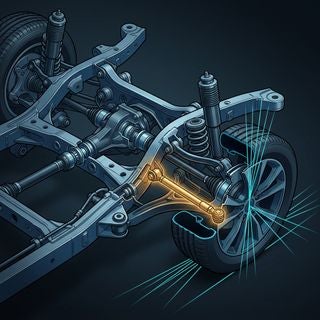
Yes, there is an active safety recall on the 2018 Ford Explorer concerning the rear suspension toe link, alongside a separate recall for exterior roof rail body trim. Ford issued recalls covering 2017 through 2019 model-year Explorer vehicles because a seized cross-axis ball joint in the rear suspension can cause the toe link to fracture. This condition can lead to a sudden loss of rear steering control and increase the risk of a crash. Official safety records catalog these actions under NHTSA campaign 26V101 and Ford recall 26S08. Authorized Ford dealerships perform all necessary inspections and repairs completely free of charge to vehicle owners. Maintaining rear suspension integrity is vital for handling predictability on steep riverfront bluffs and elevation changes around East Liverpool, where road salt and heavy seasonal moisture accelerate undercarriage component stress. A fractured toe link significantly diminishes directional stability, especially when navigating curves or uneven road surfaces. When a toe link breaks, the affected rear wheel can sway out of alignment, causing severe vehicle instability without prior warning to the driver. In addition to the suspension concern, Ford identified issues with the exterior A-pillar and roof rail covers on 2016 through 2019 Explorer models. The retention clips holding these plastic trim pieces can weaken over time, causing the covers to detach while driving. Detached trim presents a road hazard for following motorists and exposes internal mounting points to environmental moisture. If you suspect your vehicle is affected by either the rear suspension or exterior trim recalls, our team can verify your status immediately. Drivers can reach our East Liverpool service center for assistance or speak directly with a service advisor by calling (330) 462-7578 to confirm recall details for your specific vehicle. Table of Contents What Is Wrong With the 2018 Ford Explorer Rear Suspension Toe Link Recall? What Are the Symptoms of a Failing Rear Suspension Toe Link or Loose Body Trim? How Do I Check 2018 Ford Explorer Recall Status by VIN for Free? How Does Ford Repair the Rear Toe Link and Trim Issues Free of Charge? Common Questions About 2018 Ford Explorer Safety Recalls and Service Schedule 2018 Ford Explorer Recall Service What Is Wrong With the 2018 Ford Explorer Rear Suspension Toe Link Recall? The primary mechanical issue in the 2018 Ford Explorer rear suspension recall centers on the rear toe link cross-axis ball joint, which can seize and cause the structural arm to snap under normal load. Toe links are responsible for keeping the rear wheels aligned parallel to the vehicle's centerline. When the outer ball joint seizes due to corrosion or wear, full suspension travel transfers bending stress directly into the toe link shaft rather than allowing smooth rotational movement. Over extended driving, repeated suspension flexing causes metal fatigue in the toe link shaft. Eventually, the shaft can fracture entirely. When a rear toe link fractures, the affected rear wheel pivots freely out of alignment, leading to a sudden loss of steering control. Official defect investigations revealed that earlier recall attempts did not encompass all affected production dates, leading to an expanded recall campaign that includes additional 2018 Explorer models equipped with specific cross-axis ball joint configurations. Winter road conditions introduce persistent challenges for suspension systems. Extended exposure to road salt, combined with slush and temperature swings, accelerates joint seizing in high-mileage vehicles. Vehicles driven on rough pavement or carrying heavy passenger loads experience increased suspension articulation, which compounds stress on compromised ball joints. Because safety recalls are fully covered by the manufacturer, owners should never defer necessary repairs. To assist busy owners with scheduling maintenance, options like Ford Pickup & Delivery service allow your vehicle to be serviced and returned to your driveway without interrupting your daily schedule. What Are the Symptoms of a Failing Rear Suspension Toe Link or Loose Body Trim? A failing rear suspension toe link in a 2018 Ford Explorer typically reveals itself through metallic clunking noises from the rear axle, erratic steering alignment, or a noticeable sway in the rear of the vehicle during lane changes. Loose exterior body trim manifests as heavy wind noise near the windshield pillars, rattling at highway speeds, or visible lifting along the roofline edges. Common observable symptoms of a compromised rear toe link include: Loud metallic clunking or rattling sounds coming from the rear undercarriage over bumps. A wandering rear end that feels loose or misaligned when transitioning between speeds. Rapid or uneven tread wear along the inner or outer edges of the rear tires. The steering wheel sitting off-center while driving straight down a level highway. When technicians inspect an Explorer in the service bay, drivers often report noticing a subtle rear-end drift during highway driving long before any warning lights or visible component damage appear. This alignment instability is particularly noticeable on daily family routes along State Route 170 near Calcutta, where road transitions demand consistent steering response. Symptoms of detached or loose roof rail trim are equally distinct: Persistent whistling or buzzing wind noise near the A-pillar at speeds above 45 mph. Visible gaps between the plastic roof molding and the body sheet metal. Plastic trim pieces flexing or lifting up when pushing gently near the retention clips. Promptly addressing these symptoms prevents secondary vehicle damage. Driving on a cracked toe link risks complete structural separation, while ignored loose trim can tear off completely, causing body panel scratches or creating hazards on public roads. How Do I Check 2018 Ford Explorer Recall Status by VIN for Free? Checking whether your 2018 Ford Explorer has open safety recalls requires locating your 17-digit Vehicle Identification Number (VIN) and submitting it to an official Ford query system. The VIN serves as a unique identifier that tracks complete factory build specifications, open safety campaigns, and warranty service history. You can locate your Explorer's VIN in several quick spots: Visible through the driver's side lower corner of the windshield from outside the vehicle. Printed on the safety certification label inside the driver's side door jamb. Listed on your official vehicle registration document, title card, or auto insurance policy statement. Once you have your 17-digit VIN, you can run a free check online through the official National Highway Traffic Safety Administration recall lookup tool or the Ford owner service portal. Typing your VIN into these official systems instantly displays any open safety campaigns, including NHTSA campaign 26V101 for the rear suspension toe link or body trim service actions. If an open recall is listed, the database will indicate whether the remedy has already been completed or if the vehicle remains eligible for free service. You can also contact an authorized Ford dealership directly. A service advisor can query the Ford database using your VIN, confirm part availability, and book your service appointment in a single quick interaction. How Does Ford Repair the Rear Toe Link and Trim Issues Free of Charge? Authorized Ford service centers resolve the 2018 Explorer recall by removing the factory rear suspension toe links and replacing them with newly designed, heavy-duty structural components at no cost to the vehicle owner. Technicians inspect the rear suspension assembly, replace both the left and right rear toe links with strengthened parts, and perform a complete four-wheel alignment to restore factory handling geometry. The standard step-by-step recall repair procedure includes: Raising the vehicle on a heavy-duty hoist to perform a complete undercarriage inspection. Unbolting the affected rear toe links and inspecting the mounting subframe for wear. Installing upgraded, heavy-duty rear toe links built to withstand full suspension articulation. Performing a precision four-wheel electronic alignment to ensure correct alignment specs. Inspecting exterior A-pillar covers and roof rail trim, applying reinforced retention clips or replacing compromised trim pieces as required. Replacing rear suspension components requires specialized calibration tools to align the rear wheels accurately. Attempting to repair suspension toe links at home or using non-approved aftermarket parts can lead to premature tire wear or improper steering calibration. Authorized Ford service facilities install factory-engineered components designed specifically to eliminate stress fractures. Vehicle owners can easily schedule a service appointment online to reserve a dedicated service bay for recall work. If you prefer to consult with our parts specialists regarding replacement hardware or secondary maintenance items, you can order OEM Ford parts directly through our service portal. Common Questions About 2018 Ford Explorer Safety Recalls and Service Q: Does completing the rear toe link recall affect my Explorer vehicle warranty or future trade value? Completing safety recall repairs at an authorized Ford dealership protects your vehicle's long-term resale value and maintains full vehicle integrity. Recall services are documented directly in official Ford system records, demonstrating to future buyers that key safety items were addressed with genuine factory parts. Performing safety recall work does not void or negatively alter any remaining powertrain or limited component warranties. Q: How long does the rear suspension toe link replacement take in the service bay? The physical replacement of both rear suspension toe links, combined with a comprehensive four-wheel electronic alignment, typically takes between 1.5 and 2 hours to complete. If your Explorer also requires exterior roof rail trim clip replacement, technicians usually complete all work within the same half-day appointment block. Q: Are body trim recalls for roof rail covers also covered free of charge regardless of mileage? Yes, safety recall repairs authorized by Ford are performed completely free of charge to vehicle owners, regardless of vehicle mileage, current warranty status, or whether you are the original owner. If your 2018 Explorer falls within the affected build dates for roof rail trim detachment, the replacement clips or trim covers are provided at zero cost. Q: What routine service items should be inspected alongside a recall repair visit? When your Explorer is on the service hoist for recall work, technicians perform a complimentary multi-point inspection. This check covers critical wear items like front and rear brake pad thickness, tire tread depth, suspension bushings, engine coolant clarity, and routine battery health checks to keep your vehicle operating reliably through cold weather. Q: Can safety recall service be performed without taking time out of my workday? To make safety maintenance as effortless as possible, vehicle owners can take advantage of convenient options like early bird key drop-off, local shuttle assistance, or the Ford Mobile Service program. Mobile service units allow factory-certified technicians to perform eligible recall inspections and light mechanical work right in your driveway or workplace parking lot. Schedule 2018 Ford Explorer Recall Service Promptly completing safety recall repairs ensures your 2018 Ford Explorer remains safe, dependable, and pleasant to drive across all road conditions. Ignoring rear suspension warnings or loose exterior trim compromises vehicle control and risks secondary mechanical damage over time. Because Ford covers all safety recall parts and labor costs entirely, taking action is simple and financially risk-free. Our certified service department utilizes factory-trained technicians, specialized alignment equipment, and genuine OEM components to complete your recall service quickly and accurately. We understand how important your vehicle is to your family's daily routine, and our team is committed to providing transparent service and clear communication throughout your visit. Do not wait to address critical safety components on your vehicle. Connect with our service department at 1503 Pennsylvania Ave to book your service in person, or give our team a quick call at (330) 462-7578 to check your VIN status and reserve your recall service appointment today. © 2026 Tri State Ford. All rights reserved. 2018 Ford Explorer Recall in East Liverpool OH | Tri State Ford
Best Vehicles Under $25K at Tri State Ford: Expert Buyer’s Guide with Sales Manager Nick Pirl

Best Vehicles Under $25K at Tri State Ford: Expert Buyer’s Guide with Sales Manager Nick Pirl Shoppers looking for a used Ford truck under $25,000 can expect an odometer reading between 10,000 and 40,000 miles on a compact Maverick, 40,000 to 80,000 miles on a midsize Ranger, and 75,000 to 130,000 miles on a full-size F-150. Today, we sit down with Nick Pirl, Sales Manager at Tri State Ford. Bringing 9 years of automotive experience, Nick shares his expertise on finding dependable pre-owned vehicles, navigating certified protection programs, and maximizing your buying power. Q: What mileage can you expect on a used Ford truck under $25,000? A: When shoppers ask about mileage expectations for a pre-owned truck under $25,000, the answer comes down to the truck segment and configuration. In the compact market, a pre-owned Ford Maverick in this price range typically arrives with 10,000 to 40,000 miles on the odometer. Because the Maverick is a newer entry into the lineup, finding low-mileage models with remaining factory warranty coverage is very achievable for budget-conscious buyers. If you scale up to a midsize truck like the Ford Ranger, a $25,000 budget usually positions you in a vehicle showing 40,000 to 80,000 miles. For a full-size Ford F-150 equipped with a 3.5L EcoBoost V6 or a 5.0L V8 engine, buyers can generally expect odometer readings between 75,000 and 130,000 miles. These full-size trucks are engineered with high-strength steel frames and military-grade aluminum-alloy bodies designed for long-term durability. To explore available options in our inventory, buyers can look through our current truck inventory online or give our team a quick call to verify incoming trade-ins. If you want to stop in and inspect a truck in person, our showroom location at 1503 Pennsylvania Ave has sales advisors ready to walk you through recent vehicle history reports. Q: What Ford models do you typically see listed under $25,000 on your lot? A: Our pre-owned lineup under $25,000 varies based on trade-ins, but we regularly stock a strong mix of cars, crossovers, and trucks. Compact crossovers like the Ford EcoSport and Ford Escape are frequent fixtures in this price band. A pre-owned Escape provides about 37.5 cu ft of rear cargo space, making it a highly practical choice for daily errands and family road trips. Sedan options like the Ford Fusion also offer fantastic value, delivering spacious five-passenger seating and refined highway cruising capabilities. For truck enthusiasts, pre-owned Ford Maverick models equipped with either the standard hybrid powertrain or the 2.0L EcoBoost engine frequently appear near or just below $25,000. We also see select Ford Ranger pickups and higher-mileage F-150 work trucks that provide tremendous utility for haulers and business owners needing reliable 5,500-lb towing capacity or higher. Many drivers from Calcutta trading in an older vehicle use our online trade-in appraisal tool before visiting. The gently rolling terrain along State Route 170 makes a versatile crossover or compact pickup ideal for local commuting and weekend errands, and applying trade equity can bring higher-trim pre-owned models comfortably under budget. Q: How does the Ford Blue Advantage Certified Pre-Owned program protect used car buyers? A: The Ford Blue Advantage program gives pre-owned vehicle buyers factory-backed peace of mind by offering two distinct tiers of certification: Gold Certified and Blue Certified. A Gold Certified Ford vehicle must be less than 6 years old with fewer than 80,000 miles on the odometer. It undergoes a rigorous 172-point inspection by factory-trained technicians and comes backed by a 12-month / 12,000-mile comprehensive limited warranty alongside a 7-year / 100,000-mile powertrain limited warranty. The Blue Certified tier expands protection to vehicles of any make up to 10 years old with up to 120,000 miles. These models undergo a comprehensive 139-point inspection and include a 90-day / 4,000-mile comprehensive limited warranty. Both tiers provide complimentary 24/7 roadside assistance covering towing, flat-tire changes, fuel delivery, and lockout assistance. "The certification process removes the guesswork from buying pre-owned because factory technicians inspect every major mechanical system before the vehicle ever reaches the lot." Buyers interested in factory-backed pre-owned models can explore our certified pre-owned Ford inventory or look through our single-owner pre-owned vehicles to find models with documented maintenance histories. When you are ready to evaluate a vehicle's comfort and handling, you can easily schedule a test drive online. Q: Are pre-owned Ford SUVs under $25,000 more capable than rival crossovers in this price range? A: Compared to many competitor crossovers in the sub-$25,000 price range, pre-owned Ford SUVs offer a strong mix of performance, towing capability, and passenger space. For example, a late-model Ford Escape Active equipped with an automatic 8-speed transmission delivers a responsive 180 hp and 199 lb-ft of torque from its 1.5L engine, providing spirited acceleration while maintaining an efficient 26 city / 32 hwy fuel economy rating. Many competing subcompact crossovers use continuously variable transmissions, while Ford offers conventional automatic or SelectShift transmissions on many models, Ford builds its crossovers with conventional automatic or SelectShift transmissions for crisp gear shifts. When equipped with available Intelligent All-Wheel Drive, a pre-owned Escape or Bronco Sport handles wet pavement, snow, and light trail driving with confidence. Commuters coming from Boardman who navigate the busy retail corridor along Market Street appreciate how Ford driver-assist features like Ford Co-Pilot360 enhance daily driving safety. The combination of active safety technology, robust powertrain options, and practical cargo layouts allows pre-owned Ford SUVs to offer an exceptionally balanced overall value compared to rival crossovers. Q: What if a buyer finds a Ford priced slightly above $25,000 that fits their needs? A: If a vehicle on our lot is listed slightly above $25,000—say at $26,500 or $27,000—there are several effective ways to bring your total out-of-pocket investment down to meet your target budget. Please contact the dealership for current pricing, available incentives, and financing options. Applying the trade-in value of your current vehicle is often the most impactful way to bridge a small price gap. Even trade equity can lower the taxable purchase price and help make a higher-trim vehicle more accessible. Our sales team works directly with regional banks and credit unions to structure competitive auto loans tailored to your preferred monthly terms. We look at the complete financial picture to ensure you drive home in a vehicle that fits your lifestyle without exceeding your financial boundaries. Q: How often do you refresh your sub-$25,000 pre-owned inventory? A: Pre-owned vehicles priced under $25,000 turn over regularly, which means our inventory turns over continuously throughout the month. We receive new pre-owned arrivals nearly every day through customer trade-ins, off-lease returns, and local vehicle acquisitions. Because demand for affordable trucks and crossovers remains high, popular models like the Ford Maverick or certified Escape crossovers often sell within days of hitting our lot. If you are looking for specific specs or trim packages, staying in touch with our sales team allows us to notify you as soon as a matching vehicle clears our reconditioning and inspection process. We encourage shoppers to browse our new Ford vehicle inventory to compare new vehicle incentives against pre-owned pricing. Business owners requiring commercial capability can also review our new commercial work truck inventory to evaluate heavy-duty fleet solutions. Q: What are your sales hours, and how should shoppers take the next step toward a test drive? A: Our sales department is open Monday and Thursday from 9:00 AM to 8:00 PM, Tuesday, Wednesday, and Friday from 9:00 AM to 6:00 PM, and Saturday from 9:00 AM to 3:00 PM. We are closed on Sundays to allow our team time with their families. These extended evening hours make it convenient to stop by after work for a walk-around and test drive. Taking the next step toward owning a reliable pre-owned Ford is straightforward. You can complete our secure online credit application from home to get pre-approved before your visit, saving valuable time at the dealership. When you are ready to visit, plug our East Liverpool showroom address into your GPS or call us directly at (330) 462-7578. Nick Pirl and our entire sales team look forward to helping you find the perfect vehicle under $25,000! Pricing Pricing by trim Feature Active AWD Active FWD Platinum AWD ST-Line AWD ST-Line Elite AWD 2.0L ST-Line FWD ST-Line Select AWD 2.0L:--:--:--:--:--:--:--:-- Base MSRP $31,750 $30,350 $37,940 $32,595 $38,935 $31,195 $35,015 Destination charge $1,495 $1,495 $1,495 $1,495 $1,495 $1,495 $1,495 Engine & Performance Powertrain specs by trim Feature Active AWD Active FWD Platinum AWD ST-Line AWD ST-Line Elite AWD 2.0L ST-Line FWD ST-Line Select AWD 2.0L:--:--:--:--:--:--:--:-- Engine 1.5L 1.5L 2L 1.5L 2L 1.5L 2L Horsepower 180 hp 180 hp 250 hp 180 hp 250 hp 180 hp 250 hp Torque 199 lb-ft 199 lb-ft 280 lb-ft 199 lb-ft 280 lb-ft 199 lb-ft 280 lb-ft Transmission automatic 8-speed automatic 8-speed SelectShift® automatic 8-speed SelectShift® automatic 8-speed SelectShift® Drivetrain All-wheel drive Front-wheel drive All-wheel drive All-wheel drive All-wheel drive Front-wheel drive All-wheel drive Keep Your Vehicle Running Strong Keep your vehicle performing at its best with our service team: Order Parts Schedule Service © 2026 Tri State Ford. All rights reserved. Vehicle specification data © JATO Dynamics Limited. Affordable Pre-Owned Ford Trucks in East Liverpool OH | Tri State Ford
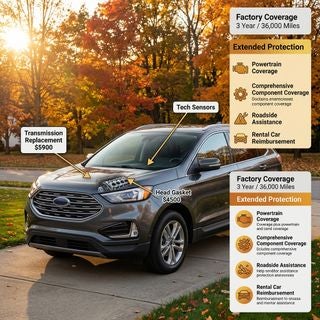
k

Is Buying an Extended Warranty on a Used Car Worth It?

Buying an extended warranty on a used car is worth it if you plan to keep the vehicle past its original factory protection, drive high annual mileage, or purchase a pre-owned model loaded with complex electronics and turbocharged mechanicals. It acts as a direct financial cushion against major unexpected repair bills—such as a $5,900 transmission replacement or a $4,500 head gasket repair—by converting unpredictable mechanical risks into a fixed, manageable ownership expense. When evaluating a pre-owned vehicle, timing and vehicle complexity dictate the true financial return of extended coverage. Modern used cars carry sophisticated drivetrain components, interactive infotainment displays, and advanced safety sensors that require specialized repair techniques and high labor costs. A single primary mechanical or electronic component failure after factory coverage lapses can easily exceed the total upfront purchase price of a vehicle service contract. Every new Ford vehicle leaves the factory backed by a standard 3-year/36,000-mile bumper-to-bumper limited warranty alongside a 5-year/60,000-mile powertrain limited warranty, with coverage ending whichever threshold occurs first. Additionally, factory ownership includes 5-year/60,000-mile roadside assistance that provides 24/7 towing to authorized service facilities, flat-tire changes, battery jump-starts, fuel delivery, and lockout support. Once those factory milestones pass, the owner assumes complete financial responsibility for every mechanical failure, fluid leak, and sensor fault. Unexpected mechanical repairs on aging vehicles represent significant out-of-pocket costs: Transmission replacement: $5,900–$6,400 Head gasket replacement: $4,500+ Radiator repair or replacement: $700–$1,750 Catalytic converter replacement: $933 Securing an extended vehicle service contract before factory coverage ends ensures continuous peace of mind and guards against pre-existing condition exclusions. To explore protected pre-owned models or discuss coverage options in person, you can visit our showroom address at 1503 Pennsylvania Ave or give our sales team a quick call today. Table of Contents What Does a Used Car Extended Warranty Cover Across Exclusionary and Powertrain Plans? How Much Does an Extended Warranty Typically Cost for a Used Car? Is It Cheaper to Buy Used Car Warranty Coverage from a Dealer or Third-Party Provider? Which Used Vehicle Brands Benefit the Most from Extended Coverage? Do You Pay Upfront for Repairs and How Does the Free-Look Period Work for Cancellations? Quick Answers to Key Questions About Buying a Used Car Warranty Drive Home with Complete Pre-Owned Protection at Tri State Ford What Does a Used Car Extended Warranty Cover Across Exclusionary and Powertrain Plans? An exclusionary extended warranty covers every mechanical and electrical component on the vehicle except for a brief, explicit list of excluded routine maintenance and wear items, whereas a powertrain plan covers only the core engine, transmission, transfer case, and drive axle assemblies. Selecting the right coverage level requires understanding how different contract structures handle failure claims: Exclusionary Coverage: This represents the highest level of protection, functioning similarly to a factory bumper-to-bumper warranty. Instead of listing hundreds of covered parts, the contract covers all components except consumables like brake pads, windshield wiper blades, tires, cabin air filters, clutch linings, and cosmetic trim. Stated-Component Coverage: Often categorized as Essential or Premium contracts, these plans specifically itemize every protected component across the air conditioning, steering, suspension, electrical, and fuel systems. Anything not explicitly printed in the contract text remains uncovered. Powertrain Coverage: The baseline protection tier focuses strictly on the major lubricated mechanical systems that move the vehicle, including the engine block, cylinder heads, internal transmission gears, torque converter, differential, and drive shafts. Factory-backed certified pre-owned programs provide clearly defined tier structures that make pre-owned vehicle protection simple. A Ford Gold Certified pre-owned vehicle comes equipped with a 12-month/12,000-mile comprehensive limited warranty covering over 1,000 components, combined with a 7-year/100,000-mile powertrain limited warranty calculated from the original factory in-service date. For broader pre-owned choices, a Ford Blue Certified vehicle carries a 90-day/4,000-mile comprehensive limited warranty paired with complimentary 24/7 roadside assistance. For drivers managing daily commutes through the gently rolling terrain and suburban routes around Calcutta, robust coverage safeguards against the accelerated wear caused by stop-and-go driving and seasonal elevation changes. You can easily explore our single-owner pre-owned vehicles to find models with verifiable maintenance histories, or check your trade-in value online to plan your next upgrade. Engine & Performance Powertrain specs by trim Feature King Ranch 4x4 SuperCrew 5-1/2’ Box King Ranch 4x4 SuperCrew 6-1/2’ Box King Ranch SuperCrew 5-1/2’ Box Lariat 4x4 SuperCrew 5-1/2’ Box Lariat 4x4 SuperCrew 6-1/2’ Box Lariat SuperCrew 5-1/2’ Box Platinum 4x4 SuperCrew 5-1/2’ Box Platinum 4x4 SuperCrew 6-1/2’ Box Platinum SuperCrew 5-1/2’ Box Police Responder 4x4 SuperCrew 5-1/2’ Box Raptor 4x4 SuperCrew 5-1/2’ Box STX 4x4 SuperCab 6-1/2’ Box STX 4x4 SuperCrew 5-1/2’ Box STX SuperCab 6-1/2’ Box STX SuperCrew 5-1/2’ Box Tremor 4x4 SuperCrew 5-1/2’ Box XL 4x4 Regular Cab 6-1/2’ Box XL 4x4 Regular Cab 8’ Box XL 4x4 SuperCab 6-1/2’ Box XL 4x4 SuperCrew 5-1/2’ Box XL 4x4 SuperCrew 6-1/2’ Box XL Regular Cab 6-1/2’ Box XL Regular Cab 8’ Box XL SuperCab 6-1/2’ Box XL SuperCrew 5-1/2’ Box XLT 4x4 SuperCab 6-1/2’ Box XLT 4x4 SuperCrew 5-1/2’ Box XLT 4x4 SuperCrew 6-1/2’ Box XLT SuperCab 6-1/2’ Box XLT SuperCrew 5-1/2’ Box:--:--:--:--:--:--:--:--:--:--:--:--:--:--:--:--:--:--:--:--:--:--:--:--:--:--:--:--:--:--:-- Engine 3.5L 3.5L 3.5L 3.5L 3.5L 3.5L 3.5L 3.5L 3.5L 3.5L 3.5L 2.7L 2.7L 2.7L 2.7L 3.5L 5L 2.7L 2.7L 2.7L 3.5L 5L 2.7L 2.7L 2.7L 2.7L 2.7L 3.5L 2.7L 2.7L Horsepower 400 hp 400 hp 400 hp 400 hp 400 hp 400 hp 400 hp 400 hp 400 hp 400 hp 450 hp 325 hp 325 hp 325 hp 325 hp 400 hp 400 hp 325 hp 325 hp 325 hp 400 hp 400 hp 325 hp 325 hp 325 hp 325 hp 325 hp 400 hp 325 hp 325 hp Torque 500 lb-ft 500 lb-ft 500 lb-ft 500 lb-ft 500 lb-ft 500 lb-ft 500 lb-ft 500 lb-ft 500 lb-ft 500 lb-ft 510 lb-ft 400 lb-ft 400 lb-ft 400 lb-ft 400 lb-ft 500 lb-ft 410 lb-ft 400 lb-ft 400 lb-ft 400 lb-ft 500 lb-ft 410 lb-ft 400 lb-ft 400 lb-ft 400 lb-ft 400 lb-ft 400 lb-ft 500 lb-ft 400 lb-ft 400 lb-ft Transmission SelectShift® SelectShift® SelectShift® SelectShift® SelectShift® SelectShift® SelectShift® SelectShift® SelectShift® SelectShift® SelectShift® SelectShift® SelectShift® SelectShift® SelectShift® SelectShift® SelectShift® SelectShift® SelectShift® SelectShift® SelectShift® SelectShift® SelectShift® SelectShift® SelectShift® SelectShift® SelectShift® SelectShift® SelectShift® SelectShift® Drivetrain All-wheel drive All-wheel drive Rear-wheel drive All-wheel drive All-wheel drive Rear-wheel drive All-wheel drive All-wheel drive Rear-wheel drive All-wheel drive All-wheel drive All-wheel drive All-wheel drive Rear-wheel drive Rear-wheel drive All-wheel drive All-wheel drive All-wheel drive All-wheel drive All-wheel drive All-wheel drive Rear-wheel drive Rear-wheel drive Rear-wheel drive Rear-wheel drive All-wheel drive All-wheel drive All-wheel drive Rear-wheel drive Rear-wheel drive How Much Does an Extended Warranty Typically Cost for a Used Car? An extended warranty for a used car typically costs between $1,500 and $4,500 in total contract value, depending on the vehicle’s age, total odometer mileage, selected coverage tier, and deductible structure. Key factors influencing total contract pricing include: Vehicle Age and Odometer Reading: Higher-mileage pre-owned vehicles present greater mathematical risk for component wear, adjusting contract premiums accordingly. Coverage Scope: Baseline powertrain contracts sit at the lower end of the pricing spectrum, while comprehensive exclusionary coverage requires a higher investment to cover complex technology and high-tech electrical modules. Deductible Structure: Choosing a $100 or $200 per-visit deductible reduces the overall contract cost compared to a $0 deductible option. A per-visit deductible charges a single fee per service appointment regardless of how many covered repairs are performed at once. Pre-owned pickup trucks illustrate how extended protection aligns with long-term vehicle ownership. For example, a pre-owned Ford F-150 equipped with a 3.5L engine, SelectShift® automatic transmission, and All-wheel drive features advanced mechanical components built for heavy work and towing up to 10,400 lbs. With trim levels ranging from functional work configurations like the XL Regular Cab starting around $37,290 MSRP to feature-packed trims like the King Ranch SuperCrew at $69,625 MSRP, adding manufacturer-backed extended coverage preserves the long-term utility of your truck investment. Used truck shoppers evaluating a pre-owned F-150 usually ask whether complex electronics and turbos are included under standard plans before they examine the deductible structure. Drivers looking for factory-backed confidence can browse our certified pre-owned Ford inventory to find vehicles that meet rigorous multi-point inspection standards. Pricing Pricing by trim Feature King Ranch 4x4 SuperCrew 5-1/2’ Box King Ranch 4x4 SuperCrew 6-1/2’ Box King Ranch SuperCrew 5-1/2’ Box Lariat 4x4 SuperCrew 5-1/2’ Box Lariat 4x4 SuperCrew 6-1/2’ Box Lariat SuperCrew 5-1/2’ Box Platinum 4x4 SuperCrew 5-1/2’ Box Platinum 4x4 SuperCrew 6-1/2’ Box Platinum SuperCrew 5-1/2’ Box Police Responder 4x4 SuperCrw 5-1/2’ Box Raptor 4x4 SuperCrew 5-1/2’ Box STX 4x4 SuperCab 6-1/2’ Box STX 4x4 SuperCrew 5-1/2’ Box STX SuperCab 6-1/2’ Box STX SuperCrew 5-1/2’ Box Tremor 4x4 SuperCrew 5-1/2’ Box XL 4x4 Regular Cab 6-1/2’ Box XL 4x4 Regular Cab 8’ Box XL 4x4 SuperCab 6-1/2’ Box XL 4x4 SuperCrew 5-1/2’ Box XL 4x4 SuperCrew 6-1/2’ Box XL Regular Cab 6-1/2’ Box XL Regular Cab 8’ Box XL SuperCab 6-1/2’ Box XL SuperCrew 5-1/2’ Box XLT 4x4 SuperCab 6-1/2’ Box XLT 4x4 SuperCrew 5-1/2’ Box XLT 4x4 SuperCrew 6-1/2’ Box XLT SuperCab 6-1/2’ Box XLT SuperCrew 5-1/2’ Box:--:--:--:--:--:--:--:--:--:--:--:--:--:--:--:--:--:--:--:--:--:--:--:--:--:--:--:--:--:--:-- Base MSRP $69,625 $69,930 $65,825 $63,360 $63,965 $59,560 $72,600 $72,905 $68,800 $52,350 $79,005 $48,655 $51,070 $44,855 $47,190 $64,915 $44,600 $42,305 $45,400 $47,820 $50,475 $39,585 $37,290 $41,600 $43,935 $49,495 $51,915 $54,555 $45,695 $48,055 Destination charge $2,795 $2,795 $2,795 $2,795 $2,795 $2,795 $2,795 $2,795 $2,795 $2,595 $2,795 $2,795 $2,795 $2,795 $2,795 $2,795 $2,795 $2,795 $2,795 $2,795 $2,795 $2,795 $2,795 $2,795 $2,795 $2,795 $2,795 $2,795 $2,795 $2,795 Is It Cheaper to Buy Used Car Warranty Coverage from a Dealer or Third-Party Provider? Buying extended warranty coverage directly through an OEM-backed dealership is generally more cost-effective over time because it eliminates hidden claims restrictions, guarantees repairs with factory-trained technicians using original equipment parts, and avoids out-of-pocket reimbursement headaches. Independent third-party warranty companies often advertise low monthly payments over long terms to appear lower-cost. However, third-party agreements frequently incorporate fine-print limitations, including per-claim payout caps, strict aggregate payout limits, and mandatory approval delays from third-party field adjusters. Furthermore, independent contract administrators often require owners to pay repair facilities out-of-pocket up front and submit manual paperwork for reimbursement later. In contrast, dealership-arranged manufacturer plans like Ford Extended Service Plans (such as PowertrainCARE) offer seamless operational support: Direct shop payments handled over the phone or electronically, leaving you responsible only for your chosen deductible. Guaranteed repair work by factory-certified technicians using genuine OEM replacement parts designed for your vehicle. Nationwide coverage accepted across factory-authorized dealership service bays. Transparent contract terms without hidden claims administrative fees. For commuters working near the riverfront bluffs and industrial corridors of East Liverpool, dependable mechanical protection ensures daily travel remains uninterrupted by unexpected breakdown costs. If you prefer starting fresh with factory-new protection, you can browse our current new Ford inventory or submit an online credit application to secure competitive financing terms. Which Used Vehicle Brands Benefit the Most from Extended Coverage? Used vehicles featuring complex turbocharged engines, high-tech electronic safety systems, active air suspensions, and all-wheel-drive transfer cases benefit the most from extended warranty coverage due to higher labor rates and specialized component replacement costs. Luxury European import brands traditionally incur high repair costs due to specialized diagnostic requirements and expensive imported parts. However, domestic trucks and SUVs packed with modern driver-assist technologies, dynamic engine management, and interactive touchscreen displays also present significant financial exposure once factory coverage lapses. Key vehicle categories where extended coverage delivers clear financial utility include: Turbocharged Crossovers and SUVs: Models like the Ford Escape or Ford Explorer utilize precision-engineered EcoBoost engines and intelligent all-wheel drive, where components like turbocharger assemblies and electronic control modules carry substantial replacement costs. Work-Ready Pickup Trucks: Full-size trucks with heavy-duty towing packages and integrated trailer brake controllers feature high-use mechanical systems that experience continuous torque demands. Tech-Heavy Family Vehicles: Vehicles equipped with lane-keeping assist, adaptive cruise control radar sensors, blind-spot monitoring, and multi-zone climate control modules benefit enormously from exclusionary coverage that protects digital infrastructure. To review current incentive structures across our pre-owned and new lineups, shoppers can review current manufacturer incentives or learn how to start a custom factory order for a tailored build. Do You Pay Upfront for Repairs and How Does the Free-Look Period Work for Cancellations? With reputable dealership-backed coverage, you do not pay upfront for covered repairs because the contract administrator pays the repair facility directly, while a standard 30-day free-look period allows you to cancel the contract for a full 100% refund. Understanding how claims payments and contract cancellations function prevents post-purchase confusion: Direct Facility Payouts: When a covered component experiences a mechanical failure, the repair facility's service advisor submits diagnostic details directly to the coverage administrator. Once authorized, the administrator pays the facility via corporate credit card or direct transfer. The owner pays only the agreed-upon contract deductible. The 30-Day Free-Look Period: State regulations and factory-backed administrators provide a 30-day trial period from the date of purchase. If you review the full contract language and decide to cancel within those first 30 days—provided no claims have been paid—you receive a full refund of the purchase price. Prorated Cancellations After 30 Days: If you decide to cancel after the 30-day window expires, or if you sell the vehicle early, the administrator calculates a prorated refund based on the remaining time or mileage, minus a small administrative cancellation fee (typically $25 to $50). Business owners and fleet operators purchasing heavy-duty work vehicles rely heavily on predictable operational costs and direct payment terms. Business owners can check our heavy-duty work truck inventory to find dependable commercial vehicles backed by clear coverage terms. Fuel Economy Fuel economy and range by trim Feature King Ranch 4x4 SuperCrew 5-1/2’ Box King Ranch 4x4 SuperCrew 6-1/2’ Box King Ranch SuperCrew 5-1/2’ Box Lariat 4x4 SuperCrew 5-1/2’ Box Lariat 4x4 SuperCrew 6-1/2’ Box Lariat SuperCrew 5-1/2’ Box Platinum 4x4 SuperCrew 5-1/2’ Box Platinum 4x4 SuperCrew 6-1/2’ Box Platinum SuperCrew 5-1/2’ Box Police Responder 4x4 SuperCrw 5-1/2’ Box Raptor 4x4 SuperCrew 5-1/2’ Box STX 4x4 SuperCab 6-1/2’ Box STX 4x4 SuperCrew 5-1/2’ Box STX SuperCab 6-1/2’ Box STX SuperCrew 5-1/2’ Box Tremor 4x4 SuperCrew 5-1/2’ Box XL 4x4 Regular Cab 6-1/2’ Box XL 4x4 Regular Cab 8’ Box XL 4x4 SuperCab 6-1/2’ Box XL 4x4 SuperCrew 5-1/2’ Box XL 4x4 SuperCrew 6-1/2’ Box XL Regular Cab 6-1/2’ Box XL Regular Cab 8’ Box XL SuperCab 6-1/2’ Box XL SuperCrew 5-1/2’ Box XLT 4x4 SuperCab 6-1/2’ Box XLT 4x4 SuperCrew 5-1/2’ Box XLT 4x4 SuperCrew 6-1/2’ Box XLT SuperCab 6-1/2’ Box XLT SuperCrew 5-1/2’ Box:--:--:--:--:--:--:--:--:--:--:--:--:--:--:--:--:--:--:--:--:--:--:--:--:--:--:--:--:--:--:-- MPG 17 city / 23 hwy / 19 combined 17 city / 23 hwy / 19 combined 17 city / 25 hwy / 20 combined 17 city / 23 hwy / 19 combined 17 city / 23 hwy / 19 combined 17 city / 25 hwy / 20 combined 17 city / 23 hwy / 19 combined 17 city / 23 hwy / 19 combined 17 city / 25 hwy / 20 combined — 14 city / 18 hwy / 16 combined 18 city / 23 hwy / 20 combined 18 city / 23 hwy / 20 combined 19 city / 25 hwy / 21 combined 19 city / 25 hwy / 21 combined 16 city / 21 hwy / 18 combined 16 city / 24 hwy / 19 combined 18 city / 23 hwy / 20 combined 18 city / 23 hwy / 20 combined 18 city / 23 hwy / 20 combined 17 city / 23 hwy / 19 combined 16 city / 24 hwy / 19 combined 19 city / 25 hwy / 21 combined 19 city / 25 hwy / 21 combined 19 city / 25 hwy / 21 combined 18 city / 23 hwy / 20 combined 18 city / 23 hwy / 20 combined 17 city / 23 hwy / 19 combined 19 city / 25 hwy / 21 combined 19 city / 25 hwy / 21 combined Quick Answers to Key Questions About Buying a Used Car Warranty Q: What is a free-look period on a used car warranty contract? A free-look period is a mandatory 30-day window following contract purchase during which you can thoroughly review all contract terms, exclusions, and conditions. If you choose to cancel within this initial 30-day timeframe and have filed no claims, you receive a full 100% money-back refund without penalty. Q: What specific components are covered under a basic powertrain plan? A basic powertrain plan covers the core internal lubricated components responsible for propelling the vehicle. This includes the engine block, cylinder heads, water pump, oil pump, transmission torque converter, internal gear sets, transfer case assemblies, drive shafts, universal joints, and drive axle differentials. Q: Does an extended warranty on a pre-owned vehicle cover routine maintenance? No, vehicle service contracts do not cover routine wear-and-tear maintenance items. Expenses such as engine oil, oil filters, brake pads, brake rotors, tires, windshield wiper blades, spark plugs, and wheel alignments remain the owner's financial responsibility unless a separate prepaid maintenance plan is purchased. Q: Can the cost of an extended warranty be rolled into vehicle financing? Yes, when purchasing a pre-owned vehicle through a dealership, the cost of a manufacturer-backed or approved extended service contract can be combined into your overall vehicle financing package. This allows you to pay for extended protection through current monthly payment options. Q: Are factory-backed certified pre-owned warranties transferable to a new owner? Yes, manufacturer-backed certified pre-owned warranties and extended service plans are typically fully transferable to a subsequent private buyer if you sell the vehicle before coverage expires. Transferring coverage increases private party resale value and provides immediate buying confidence to the new owner. To discuss warranty terms or review current pre-owned options, shoppers can visit our dealership address or give our sales team a call. Drive Home with Complete Pre-Owned Protection at Tri State Ford Selecting the right extended warranty on a pre-owned truck, SUV, or sedan ensures long-term driving confidence and protects your personal budget against sudden mechanical expense. Whether you choose a factory-backed certified pre-owned vehicle backed by 7-year/100,000-mile powertrain limits or add comprehensive exclusionary coverage to a dependable pre-owned model, matching coverage to your driving habits guarantees total peace of mind on every journey. Our team at Tri State Ford is dedicated to providing transparent vehicle details, straightforward financing guidance, and comprehensive protection options customized to your household budget. Visit our showroom today to test drive our pre-owned vehicle inventory, explore flexible payment plans, and secure lasting protection for your vehicle investment. Keep Your Vehicle Running Strong Keep your vehicle performing at its best with our service team: Order Parts Schedule Service Appt © 2026 Tri State Ford. All rights reserved. Vehicle specification data © JATO Dynamics Limited. Used Car Extended Warranty Options in East Liverpool OH | Tri State Ford
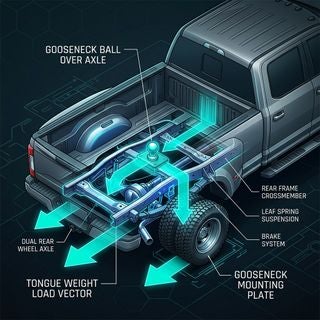
c

How Do You Set Up a 2027 Super Duty for Heavy Gooseneck Towing?

Setting up a 2027 Ford Super Duty for heavy gooseneck towing requires selecting a dual rear wheel configuration, securing a factory-installed gooseneck hitch structure, verifying ball torque, and calibrating tire inflation. A properly equipped dual-wheel model achieves a maximum gooseneck tow rating of up to 40,000 pounds by expanding the rear axle footprint and increasing payload stability for heavy grain carts and livestock trailers. Configuring a Ford Super Duty for demanding agricultural work starts with understanding rear-axle payload dynamics. A gooseneck hitch transfers trailer tongue weight directly over or slightly ahead of the truck's rear axle. When hauling heavy grain or machinery, that downward force can exceed several thousand pounds. Single rear wheel models provide strong performance, capping maximum gooseneck towing around 22,000 to 23,000 pounds depending on cab and axle setup. Choosing a dual rear wheel setup adds two additional tires to the rear axle, which significantly boosts the gross axle weight rating and elevates the maximum available gooseneck towing limit up to 40,000 pounds on properly configured trucks. The extra pair of rear tires dramatically reduces lateral sway and tire sidewall flexing when pulling tall, heavy agricultural loads. Hauling heavy grain loads down the riverfront bluffs near East Liverpool requires maximum control, where extra tire surface area prevents trailer sway on steep grades. The dual-wheel footprint distributes heavy tongue weights across four contact patches, maintaining vehicle balance and preventing rear suspension sag during transit. To prepare the truck bed for heavy towing, the factory 5th-Wheel/Gooseneck Hitch Prep Package integrates a structural cross-member directly into the high-strength steel frame. This setup provides five recessed attachment points in the bed floor, allowing quick installation of the hitch ball and safety chain anchors while preserving a flush bed floor when unhitched. If you need assistance inspecting or setting up your hitch kit, you can obtain driving routes to our East Liverpool facility location or speak directly with our team by giving us a quick call to consult with our heavy-duty truck specialists. Table of Contents Which Engine and Powertrain Options Handle Heavy Agricultural Hauling? What Pre-Season Safety Chain, Pin, and Tire Pressure Checks Are Required? How Do Factory Gooseneck Features, Tech, and Warranties Protect Your Truck? What Post-Harvest Maintenance Is Needed and Can Mobile Service Come to Your Farm? Common Questions About Super Duty Towing Prep and Maintenance Schedule Harvest Towing Prep and Service at Tri State Ford Which Engine and Powertrain Options Handle Heavy Agricultural Hauling? The recommended engine for pulling heavy grain carts and multi-animal livestock trailers is the 6.7L High-Output Power Stroke Turbo Diesel paired with the heavy-duty TorqShift 10-speed automatic transmission. Generating 1,200 lb-ft of torque and 500 horsepower, this powertrain produces massive low-rpm pulling power and incorporates an integrated engine brake to maintain complete control over heavy agricultural payloads. Ford equips the Super Duty lineup with engines tailored to specific agricultural workloads. The standard 6.8L gas V8 and available 7.3L Devictis gas V8 engines deliver reliable performance for medium-duty farm operations, utility equipment, and standard bumper-pull livestock trailers. For severe-duty seasonal work where trailer weights routinely exceed 20,000 pounds, diesel power becomes essential. The standard 6.7L Power Stroke Turbo Diesel provides robust torque, while the High-Output variant steps up output to 1,200 lb-ft of torque, ensuring effortless acceleration when pulling loaded hopper-bottom grain trailers out of soft field lanes. Transmitting that power to the ground requires a heavy-duty drivetrain architecture. The TorqShift 10-speed automatic transmission features selectable drive modes, including Tow/Haul mode, which optimizes gear selection and torque converter lockup under load. On downhill descents, the diesel engine's smart exhaust brake uses variable-geometry turbocharger technology to generate hold-back force, taking strain off the wheel brakes and preventing brake overheat. For operations using single-rear-wheel trucks, the available High-Capacity Trailer Tow Package on F-250 models upgrades the rear axle housing, axle shafts, and suspension springs. This package raises the Gross Combination Weight Rating (GCWR), enabling the F-250 to handle larger gooseneck payloads while maintaining manufacturer durability standards. When servicing your drivetrain or installing severe-duty towing upgrades, farm owners can easily order OEM heavy-duty towing components through our dedicated parts department. What Pre-Season Safety Chain, Pin, and Tire Pressure Checks Are Required? Pre-season agricultural towing inspections require checking safety chain links for distortion, verifying that gooseneck ball locking pins engage cleanly, and setting heavy-duty light truck (LT) rear tires to their maximum cold rating of 80 PSI under full load. Thorough component checks prevent hitch unlatching and reduce tire heat accumulation during long harvest workdays. Before hooking up to a gooseneck trailer for the fall harvest, a complete mechanical inspection of the hitching system is necessary. Examine the gooseneck coupler, safety chain attachment loops, and safety chain hooks for signs of metal fatigue, stress cracking, or severe rust. Safety chain hooks must retain operational spring latches to prevent accidental detachment from the bed tie-down points while in transit across uneven field paths. Inspecting the gooseneck ball and pin mechanism is equally critical: Remove the ball from the bed socket to clear out dirt, chaff, and dried grease from the locking mechanism. Check that internal retention ball bearings move freely and seat firmly when the top latch handle is turned down. Apply a clean layer of high-pressure lithium grease to the ball surface to minimize friction against the trailer coupler. Inspect the coupler pin and locking collar on the trailer to confirm positive mechanical lockup. When area farmers bring their trucks in for pre-harvest inspections, our service technicians prioritize checking the gooseneck ball latching pins for microscopic burrs or corrosion that could prevent full mechanical locking under heavy tongue weight. Tire maintenance directly affects towing stability and load-carrying capacity. Heavy agricultural tongue weight places substantial stress on the truck's rear axle. Heavy-duty light truck tires must be inflated to the cold maximum pressure specified on the driver's door B-pillar label, which is typically 80 PSI for loaded rear tires. Under-inflated rear tires flex excessively under heavy gooseneck tongue weight, causing rapid heat accumulation, irregular tread wear, and compromised vehicle handling. Check cold tire pressures every morning before driving to ensure optimal load capacity and tire longevity. How Do Factory Gooseneck Features, Tech, and Warranties Protect Your Truck? Ford factory gooseneck packages preserve your truck's warranty coverage while integrating specialized trailering technology like Pro Trailer Hitch Assist and a standardized 2-5/16-inch gooseneck ball system. Installing an aftermarket gooseneck hitch does not void your Ford factory warranty, though any component damage caused directly by improper aftermarket installation or vehicle modification will not be covered. The Ford factory gooseneck preparation kit features a high-strength subframe mounted directly to the boxed steel frame rails beneath the pickup bed. This system supports a standard 2-5/16-inch gooseneck ball, which accommodates the vast majority of agricultural, livestock, and commercial gooseneck trailers. For extra-heavy commercial applications, 3-inch ball assemblies are also compatible with specialized heavy-duty couplers. Because the factory hitch subframe is engineered alongside the truck frame, stress distribution is fully validated by Ford chassis engineers. Modern Super Duty models combine heavy iron with intelligent towing tech: Pro Trailer Hitch Assist uses rear tailgate camera vision and ultrasonic sensors to steer, accelerate, and brake the truck automatically into alignment with the trailer coupler socket. Tire Pressure Monitoring System capabilities extend to auxiliary sensors installed on the trailer, displaying real-time trailer tire pressures and temperatures inside the cabin. 360-Degree Camera Package provides digital bird's-eye views around the bed and trailer sides, helping drivers navigate tight farm gates and grain elevator drop zones. PowerScope trailer tow mirrors extend and fold electronically, offering clear views along wide livestock trailers. Questions frequently arise regarding aftermarket hitches and manufacturer warranty protections. Under federal warranty guidelines, adding an aftermarket hitch kit does not automatically void your Ford powertrain or bumper-to-bumper warranties. However, if an aftermarket installation requires cutting frame cross-members or tapping into wiring harnesses, any resulting structural failures or electrical shorts are excluded from warranty coverage. Choosing factory prep options or genuine Ford accessories installed by factory-trained technicians ensures your full manufacturer warranty protection remains completely undisturbed. What Post-Harvest Maintenance Is Needed and Can Mobile Service Come to Your Farm? Post-harvest Super Duty maintenance requires replacing air filters clogged with chaff, servicing diesel fuel filters, inspecting brake system wear, and thoroughly cleaning the undercarriage to prevent corrosion. To keep farm operations moving without logistical delays, certified Ford Commercial Vehicle Centers deploy mobile service vans to perform routine maintenance directly at your location. Working long hours in dusty crop fields and hauling heavy grain trailers subjects heavy-duty trucks to demanding operating conditions. Once the harvest concludes, a comprehensive post-harvest service schedule restores your truck to peak efficiency: Replace engine air filters and cabin air filters to remove accumulated field dust, crop chaff, and fine debris. Service primary and secondary fuel filters on Power Stroke diesel engines to remove water condensate and fuel contaminants gathered during heavy fuel consumption. Inspect front and rear brake pads, rotors, and caliper slides for excessive wear caused by heavy trailer deceleration. Perform comprehensive undercarriage washing to flush out dirt, mud, and corrosive agricultural chemical residue lodged in frame pockets. Inspect differential fluid and transfer case lubricant levels for thermal breakdown resulting from continuous high-load towing. For agricultural operations managing equipment near the rolling farmland around Calcutta, mobile service brings factory-trained technicians straight to the farm lane. Mobile service vans are fully outfitted with professional diagnostic equipment, fluid extraction tools, and OEM parts to complete oil changes, filter replacements, software updates, and routine battery testing and maintenance right on site. You can easily schedule a post-harvest service appointment online or explore our Ford Mobile Service capabilities to minimize farm fleet downtime. Common Questions About Super Duty Towing Prep and Maintenance Q: Does installing a gooseneck hitch myself affect my Ford bumper-to-bumper warranty? Installing a gooseneck hitch yourself does not automatically void your overall Ford factory warranty. Federal warranty regulations state that coverage remains intact unless an aftermarket part or installation directly causes a mechanical, structural, or electrical failure. If frame modifications or improper wiring lead to vehicle damage, those specific repairs will not be covered under warranty. Having factory prep installed or using genuine Ford accessories fitted by certified service technicians prevents potential warranty disputes. Q: What is the main difference between single rear wheel and dual rear wheel setups when hauling livestock trailers? Dual rear wheel configurations feature a wider rear axle track and four rear tires, which significantly reduces lateral vehicle sway when live animals shift weight inside a trailer. While single rear wheel trucks comfortably haul moderate gooseneck loads up to around 22,000 to 23,000 pounds, dual rear wheel models increase gross axle weight ratings and extend maximum gooseneck towing capacity up to 40,000 pounds, providing superior stability on rural roads. Q: How often should diesel fuel filters be replaced when hauling heavy agricultural loads? Fuel filters on Power Stroke diesel engines should generally be replaced every 15,000 to 22,500 miles under standard driving conditions, but heavy seasonal agricultural towing calls for shorter intervals. Operating in dusty field environments and burning larger quantities of fuel under load increases particulate accumulation and water separation in the fuel system. Replacing both primary and secondary fuel filters prior to and immediately following harvest prevents injector wear and maintains engine performance. Q: Why must rear tire pressure be adjusted specifically for fully loaded gooseneck trailers? Gooseneck trailers transfer high vertical tongue weights directly over the truck's rear axle. Setting rear light truck tires to their cold maximum rating of 80 PSI stiffens the tire sidewalls, preventing extreme tread squirm, excessive internal heat build-up, and handling instability under load. Running lower pressures while carrying maximum agricultural payloads accelerates tread breakdown and elevates the risk of tire failure during transport. Q: What is included in the F-250 High-Capacity Trailer Tow Package for heavy-duty pulling? The High-Capacity Trailer Tow Package upgrades select Ford F-250 configurations with a larger rear axle housing, reinforced axle shafts, and upgraded heavy-duty rear springs. These structural enhancements increase the truck's Gross Combination Weight Rating (GCWR), allowing the F-250 to pull heavier gooseneck and fifth-wheel agricultural loads safely while remaining fully within factory-engineered vehicle tolerances. Schedule Harvest Towing Prep and Service at Tri State Ford Preparing your Ford Super Duty for heavy agricultural towing requires precise mechanical inspections, proper tire maintenance, and certified technical care. Our service team at Tri State Ford provides factory-backed gooseneck maintenance, heavy-duty brake checks, diesel engine filter changes, and complete fluid services to ensure your truck delivers reliable performance all season long. Whether you manage a single truck or a full farm fleet, our certified technicians are equipped to support your agricultural operation. You can plan a route to visit our service center in East Liverpool, connect directly with our service desk at (330) 462-7578, or arrange convenient maintenance through our Ford Pick Up & Delivery service options today. © 2026 Tri State Ford. All rights reserved. 2027 Ford Super Duty Towing Setup in East Liverpool OH | Tri State Ford
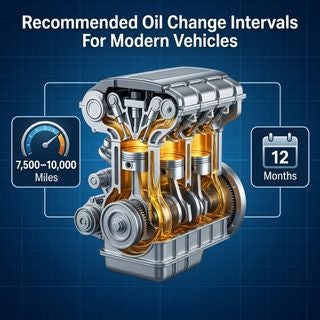
h

How Often Should I Change My Oil

Most modern vehicles using full synthetic or synthetic-blend motor oil require an oil change every 7,500 to 10,000 miles or once every 12 months, whichever arrives first. Advances in engine manufacturing, precise internal tolerances, and modern lubricant chemistry have safely extended service intervals far beyond older maintenance habits for standard daily driving. Automotive engine technology has evolved significantly over the past two decades. Modern powertrains, such as the 2.3L EcoBoost engine in the Ford Explorer or the 1.5L engine in the Ford Escape Hybrid, operate with exceptional thermal efficiency and tight mechanical clearances. These engineering improvements reduce the rate at which combustion byproducts pollute the crankcase, allowing clean motor oil to protect moving parts over longer distances. Distance is only half of the maintenance equation. Engine oil breaks down over time due to exposure to oxygen, ambient moisture, and fuel vapors. A vehicle driven for only 3,000 miles in a calendar year still requires an annual oil and filter refresh. Low-mileage driving along suburban routes around Calcutta often involves short trips that prevent the engine from reaching full operating temperature. When an engine remains cool, condensed water vapor accumulates inside the oil pan rather than evaporating off, creating acidic compounds that harm internal seals over time. Following the exact maintenance schedule outlined by the vehicle manufacturer preserves long-term dependability and maintains factory warranty coverage. To review your specific maintenance schedule or speak with certified technicians, visit our service center on Pennsylvania Avenue or give our team a quick call to discuss your driving routine. Table of Contents Is the 3,000-Mile Oil Change Rule Still Valid for Modern Engines? Normal vs. Severe Service Schedules: What Driving Habits Shorten Oil Life? Conventional vs. Synthetic Oil: What Are Typical Service Intervals? How to Check Motor Oil Correctly and Spot Overdue Symptoms Common Questions About Engine Oil Care and Maintenance Intervals Schedule Reliable Engine Care and Routine Service Is the 3,000-Mile Oil Change Rule Still Valid for Modern Engines? The traditional 3,000-mile oil change rule is no longer necessary for modern vehicles operating under normal driving conditions. Contemporary engines feature advanced metallurgy and precise fuel injection systems that, when paired with high-quality synthetic lubricants, maintain protective viscosity well past 7,500 miles. The 3,000-mile guideline originated decades ago when carbureted engines and basic mineral oils were the industry standard. Older engine designs permitted higher rates of unburnt fuel to wash down cylinder walls into the oil pan. Older mineral oils also suffered from rapid thermal breakdown, losing their ability to lubricate critical components under sustained high heat. Modern synthetic lubricants contain advanced detergent packages, anti-wear additives, and shear-stable base stocks designed to withstand extreme pressure without thinning out prematurely. Changing your motor oil every 3,000 miles on a modern engine running under standard conditions results in unnecessary service expenses and wasted fluid. Automakers engineer modern maintenance schedules around real-world oil degradation rates. Adhering to a 7,500-mile to 10,000-mile service window provides complete engine protection while optimizing your maintenance schedule. Selecting the proper filter is just as critical as choosing the right oil viscosity. A high-efficiency oil filter removes microscopic metal particles and carbon deposits down to tiny micron levels. When performing routine maintenance at home, ordering genuine Ford oil filters and OEM fluids ensures proper bypass valve calibration and continuous oil flow to upper valvetrain components. Normal vs. Severe Service Schedules: What Driving Habits Shorten Oil Life? Severe service maintenance schedules require changing motor oil every 3,000 to 5,000 miles due to operational demands that accelerate fluid contamination and thermal breakdown. Driving patterns that involve frequent short trips, heavy payload hauling, extended idling, or extreme local weather classify a vehicle for severe-duty service intervals. Understanding what constitutes severe service helps protect your engine against premature wear. Automakers define severe driving conditions through several specific operational scenarios: Frequent short trips: Drives under 5 miles in ambient weather, or under 10 miles in freezing temperatures, prevent the engine from reaching steady-state heat, trapping moisture inside the crankcase. Heavy stop-and-go driving: Navigating urban traffic or idling for extended periods increases engine operating hours without accumulating odometer miles. Towing and heavy loads: Hauling trailers or maximum cargo with a truck like the Ford F-150 equipped with the 3.5L EcoBoost engine subjects the motor oil to elevated thermal loads and shearing forces. Harsh terrain and dust: Driving on unpaved gravel roads or navigating steep inclines, such as the riverfront bluffs in East Liverpool, forces the engine to work harder while exposing intake systems to elevated dust levels. During routine service check-ins, drivers frequently ask whether short winter commuting requires earlier oil changes than highway driving. Operating a vehicle during freezing weather without reaching full operating heat creates sludge buildup faster than high-speed turnpike cruising. Reviewing your daily drive pattern with a technician clarifies whether your vehicle benefits from a severe-service maintenance window. Maintaining proper underlying systems also prevents oil degradation; monitoring routine vehicle maintenance and battery health guidelines ensures strong starter engagement during cold-weather startups. Conventional vs. Synthetic Oil: What Are Typical Service Intervals? Full synthetic motor oil typically delivers 7,500 to 10,000 miles of engine protection between changes, whereas conventional mineral oil requires replacement every 3,000 to 5,000 miles. Synthetic blend formulations offer a middle ground, providing reliable wear protection for 5,000 to 7,500 miles under normal driving conditions. Full synthetic oil undergoes a comprehensive chemical refining process that uniformizes molecular structures. This uniformity allows synthetic fluid to flow instantly during freezing cold startups while resisting high-temperature oxidation during summer operation. Conventional oil consists of refined crude mineral fluid with irregular molecular sizes, making it more vulnerable to thermal breakdown, evaporation, and sludge accumulation under heavy engine strain. Modern Ford vehicles utilize an onboard Intelligent Oil-Life Monitor system that removes guesswork from scheduling fluid changes. Rather than relying solely on static mileage tracking, the system continuously analyzes sensor inputs including: Engine operating temperatures and cold-start frequency Total engine revolutions and load factors Extended idling duration and towing hours When the system calculates that fluid life has reached approximately 5%, it displays a "Change Engine Oil Soon" message on the instrument cluster, followed by an "Oil Change Required" alert at 0%. Following these digital prompts guarantees that you replace fluid precisely when required. For drivers managing busy weekly routines, taking advantage of Ford mobile service options allows certified technicians to complete routine oil and filter maintenance directly in your driveway or workplace parking lot. How to Check Motor Oil Correctly and Spot Overdue Symptoms To obtain an accurate motor oil reading, check the dipstick roughly 5 to 10 minutes after turning off a fully warmed-up engine while parked on a level surface. Waiting several minutes allows fluid circulating through the upper cylinder heads to drain back completely into the oil pan. Checking your oil level involves a straightforward step-by-step process: Park the vehicle on flat, level ground and turn off the ignition after the engine reaches normal operating temperature. Allow the engine to rest for 5 to 10 minutes so internal fluid settles into the sump. Open the hood, locate the dipstick handle, pull the dipstick out completely, and wipe it clean with a lint-free rag. Reinsert the dipstick fully into its tube, then pull it back out to inspect the oil level relative to the crosshatched indicators. Verify that the fluid line sits comfortably between the minimum and maximum fill marks. Recognizing early indicators of degraded motor oil prevents expensive internal mechanical damage. Postponing oil changes past recommended limits produces distinct warning signs: Dark, gritty fluid: Fresh oil displays a clear amber color; thick, black, or abrasive fluid indicates heavy carbon accumulation. Valvetrain ticking noises: Depleted oil loses hydraulic film strength, causing metallic tapping or ticking sounds from hydraulic lifters upon startup. Strong fuel odor: An oil level reading above the maximum mark accompanied by a sharp smell of gasoline points to fuel dilution inside the crankcase. Dashboard illuminated alerts: Low oil pressure light warnings or persistent oil maintenance messages signal immediate service requirements. Common Questions About Engine Oil Care and Maintenance Intervals Q: Should motor oil be changed by calendar time even if the vehicle is barely driven? Yes, motor oil must be replaced at least once every 12 months regardless of how few miles appear on the odometer. Over time, stationary oil inside the crankcase absorbs ambient moisture and unburnt fuel byproducts. This chemical reaction creates internal acids and harmful sludge that can corrode engine bearings and degrade internal seals even while the vehicle remains parked inside a garage. Q: Can synthetic motor oil be used in older engines or vehicles previously using conventional oil? Switching to full synthetic motor oil in older vehicles or engines that previously used conventional oil is completely safe and beneficial. Modern synthetic formulations meet rigorous API SP and ILSAC GF-6A performance standards, offering immediate oil pressure during cold engine starts and superior resistance against thermal breakdown without causing seal leaks or internal damage. Q: What does it mean if the oil level is overfull and smells strongly of gasoline? An oil level reading above the full mark paired with a strong gasoline odor indicates fuel dilution inside the crankcase. This condition commonly occurs when vehicles are driven exclusively on short, cold trips or when a fuel injector leaks. Unburnt fuel thins the motor oil, destroying its lubricating properties, and requires immediate fluid replacement to avoid bearing damage. Q: Is it necessary to replace the oil filter during every oil change? Replacing the engine oil filter during every service appointment is essential for long-term engine durability. The oil filter traps microscopic metal particles, dirt, and carbon debris generated during combustion. Leaving a saturated, dirty filter in place forces fresh motor oil through the filter's internal bypass valve, recirculating trapped contaminants directly back into critical engine components. Q: How does Ford’s Intelligent Oil-Life Monitor know when service is due? The Intelligent Oil-Life Monitor calculates fluid degradation by continuously analyzing operational data from the powertrain control module. It evaluates total engine revolutions, ambient operating temperatures, idling time, and towing duration. By calculating real-world engine stress rather than using simple mileage counting, it accurately alerts the driver when oil life reaches 5% remaining capacity. To keep your vehicle running smoothly, you can easily schedule a service appointment online with our certified maintenance team. Schedule Reliable Engine Care and Routine Service Adhering to correct oil change intervals is the single most effective action you can take to preserve engine performance, maximize fuel economy, and ensure long-term vehicle reliability. Whether your daily commute calls for standard 7,500-mile synthetic service or your towing habits require a 5,000-mile severe-duty schedule, maintaining fresh lubricants protects your investment mile after mile. Our factory-trained technicians at Tri State Ford utilize genuine OEM filters and manufacturer-recommended oil viscosities tailored specifically to your engine. Located at 1503 Pennsylvania Ave, East Liverpool, OH 43920, our service center provides complete vehicle maintenance, routine multi-point safety inspections, and transparent care for every driver. Take the next step in protecting your powertrain by exploring our available service slots today. You can get directions to Tri State Ford to plan your visit or give our service department a quick call to speak directly with an advisor about your vehicle's maintenance needs. © 2026 Tri State Ford. All rights reserved. Vehicle specification data © JATO Dynamics Limited. Modern Vehicle Oil Change Intervals in East Liverpool OH | Tri State Ford
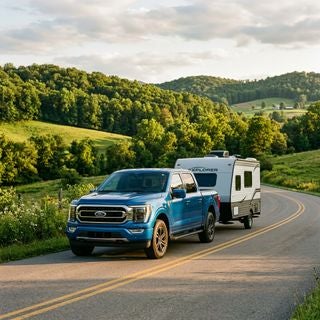
g

What Should You Know Before Buying a Vehicle From a Local Ford Dealer?

Before purchasing a vehicle from a local Ford dealer, buyers should know their exact towing and seating requirements, understand transparent trim pricing, verify available manufacturer incentives, and check factory warranty coverage. Working directly with a local dealership provides access to certified inventory, competitive trade-in valuations, straightforward cross-border registration support, and long-term service. Establishing these practical priorities early ensures a smooth buying experience and maximizes total ownership value. Navigating the vehicle buying process requires clear information regarding model availability and dealership operations. At Tri State Ford, our showroom opens at 9:00 AM six days a week, remaining open until 8:00 PM on Mondays and Thursdays to accommodate evening walk-arounds, and closing at 3:00 PM on Saturdays. That flexibility allows shoppers to evaluate vehicles on their own schedule. Whether you need a workhorse truck or a family crossover, reviewing key vehicle specifications before visiting saves time and simplifies decision-making. Every new Ford comes backed by a 3-year/36,000-mile bumper-to-bumper warranty and a 5-year/60,000-mile powertrain warranty, providing essential peace of mind on regional roads. To streamline your purchase, you can plan your route to our showroom address at 1503 Pennsylvania Ave or give our team a quick phone call to confirm current availability. If you prefer specific factory options, color choices, or trailering packages, you can also start a new Ford factory custom order directly through our team to configure a vehicle that matches your exact daily requirements. Table of Contents Where Should You Start Your Ford Shopping Research and Model Comparison? What Are the Typical Price Ranges Across Ford F-150 Trim Levels? How Can You Maximize Your Trade-In Value and Financing Terms? Can Out-of-State Buyers Easily Purchase a Ford? Why Choose Tri State Ford for Your Next New or Certified Pre-Owned Vehicle? Common Questions About Buying a Vehicle at Tri State Ford Take the Next Step Toward Your Ford at Tri State Ford Where Should You Start Your Ford Shopping Research and Model Comparison? Shoppers planning a vehicle purchase should start their research by comparing body styles, cabin dimensions, fuel economy ratings, and core performance specs on the dealership website before taking a physical test drive. Comparing models online helps narrow down whether a compact crossover, a three-row SUV, or a full-size pickup fits your daily commute and weekend projects. Ford offers a versatile lineup built for diverse driving demands. For daily commuting and efficient travel, the 2026 Ford Escape delivers an EPA-estimated 26 city / 32 hwy mpg with its standard 1.5L engine and 8-speed automatic transmission, while providing about 37.5 cu ft of rear cargo space and an available 2,000-lb towing capacity with starting MSRP at $31,750. Families needing extra passenger seating often point to the 2026 Ford Explorer, which seats six across three rows, offers a 5,000-lb towing capacity, and features a standard 2.3L engine paired with SelectShift technology, starting at $42,585. For demanding job sites and heavy trailering, the 2026 Ford F-150 stands out with a maximum 10,400-lb towing capacity on select builds, about 53 cu ft cargo bed volume, and a powerful 3.5L engine starting at $69,625. You can easily explore our complete selection of new Ford vehicles to compare trims side by side, or review factory-certified pre-owned Ford inventory that includes multi-point inspections and extended limited warranty coverage. Pricing Pricing by trim Feature Active AWD Active FWD Platinum AWD ST-Line AWD ST-Line Elite AWD 2.0L ST-Line FWD ST-Line Select AWD 2.0L:--:--:--:--:--:--:--:-- Base MSRP $31,750 $30,350 $37,940 $32,595 $38,935 $31,195 $35,015 Destination charge $1,495 $1,495 $1,495 $1,495 $1,495 $1,495 $1,495 What Are the Typical Price Ranges Across Ford F-150 Trim Levels? Typical price ranges for the Ford F-150 span from around $40,000 for work-ready base models up into the $80,000 to $85,000 range for high-end luxury and high-performance trims. Final pricing depends heavily on cab style, bed length, drivetrain selection, and functional options packages. Understanding the trim structure helps buyers select the right capability without overspending: XL and STX: Starting around $40,085 to $44,395, these entry-level configurations feature durable cloth seating, the SYNC 4 infotainment system on a 12-inch touchscreen, and essential driver aids, making them ideal workhorses for fleet and entry-level buyers. XLT: Positioned in the $46,730 to $52,000 range, the XLT adds practical mid-tier comfort, advanced towing tech like Pro Trailer Backup Assist, and optional appearance packages. Lariat: Starting near $65,271, the Lariat introduces leather-trimmed heated and ventilated seating, advanced digital displays, and available hands-free BlueCruise highway driving capabilities. Tremor: Priced around $74,652, the Tremor provides dedicated off-road suspension tuning, rugged running boards, and enhanced ground clearance for rough terrain. King Ranch and Platinum: Ranging from $79,568 to $85,358, these luxury trims deliver premium leather upholstery, multi-contour massaging seats, Bang & Olufsen audio, and standard high-output engine options. Raptor: Starting near $85,137, the Raptor features long-travel off-road shocks and specialized hardware designed for extreme trail performance. Choosing the right engine also shapes overall value. The standard 2.7L EcoBoost V6 yields 325 hp and 400 lb-ft of torque while delivering 21 mpg combined, while the 5.0L V8 provides 400 hp and 410 lb-ft of torque. For maximum towing power, the 3.5L EcoBoost V6 delivers 400 hp and 500 lb-ft of torque, while the PowerBoost hybrid combination generates 430 hp and 570 lb-ft of torque alongside an EPA-estimated 23 mpg combined. Buyers can check current manufacturer vehicle offers and incentives to find factory current incentives and financing information on their preferred trim level. Engine & Performance Powertrain specs by trim Feature Active AWD Active FWD Platinum AWD ST-Line AWD ST-Line Elite AWD 2.0L ST-Line FWD ST-Line Select AWD 2.0L:--:--:--:--:--:--:--:-- Engine 1.5L 1.5L 2L 1.5L 2L 1.5L 2L Horsepower 180 hp 180 hp 250 hp 180 hp 250 hp 180 hp 250 hp Torque 199 lb-ft 199 lb-ft 280 lb-ft 199 lb-ft 280 lb-ft 199 lb-ft 280 lb-ft Transmission automatic 8-speed automatic 8-speed SelectShift® automatic 8-speed SelectShift® automatic 8-speed SelectShift® Drivetrain All-wheel drive Front-wheel drive All-wheel drive All-wheel drive All-wheel drive Front-wheel drive All-wheel drive How Can You Maximize Your Trade-In Value and Financing Terms? To maximize trade-in value and secure optimal financing terms, vehicle owners should gather complete maintenance records, provide both key fobs, clean the vehicle thoroughly, and review current auto loan interest rates before visiting the dealership. Taking these steps verifies proper vehicle maintenance and helps appraisers offer a top-tier trade valuation. In Ohio, trading in a vehicle offers a distinct tax advantage. State law applies sales tax only to the difference between your new vehicle purchase price and your trade-in allowance. For example, if you select a new vehicle priced at $40,000 and receive $18,000 for your trade, you pay sales tax strictly on the remaining $22,000. That tax credit saves hundreds of dollars compared to selling a vehicle privately and making a separate purchase. If you still owe money on an existing car loan, our finance team contacts your lender to request a 10-day payoff quote. Positive equity acts directly as a down payment toward your next purchase, while negative equity can often be structured into your new loan agreement. You can quickly value your trade-in online using industry-standard market data, then browse our current new vehicle inventory to combine your trade equity with competitive retail financing terms. Can Out-of-State Buyers Easily Purchase a Ford? Out-of-state buyers can easily purchase a Ford from an Ohio dealership through coordinated cross-border sales tax exemptions, proper temporary transit tags, and complete title transfer documentation. Dealership finance departments regularly structure cross-border transactions so buyers pay sales tax only in their home state and county upon registration. To prevent double taxation, our team completes an official out-of-state tax exemption document at signing, certifying that the vehicle is being transported directly out of state for registration. We structure auto loans to include your home state's exact sales taxes and registration fees, rolling those costs into one transparent monthly payment. For shoppers commuting from Pennsylvania or West Virginia, our staff manages physical notary filings and coordinates required Vehicle Identification Number verifications. Pennsylvania residents should note that state safety inspections must be completed at a certified station within 10 days of receiving Pennsylvania registration tags. Before traveling to the dealership, out-of-state shoppers can start the buying process from home. Completing a secure online auto finance application allows our team to pre-approve your file and calculate home-state taxes before you arrive, ensuring a quick and seamless showroom visit. Why Choose Tri State Ford for Your Next New or Certified Pre-Owned Vehicle? Tri State Ford provides a transparent buying environment focused on personal service, transparent trade appraisals, and comprehensive vehicle selection. Our sales team takes time to understand how you plan to use your vehicle, ensuring you get the exact towing capacity, interior versatility, and technology features your family or job site requires. For drivers navigating the rolling hills and wooded stretches near Beaver Creek along State Route 170 in Calcutta, dependable all-wheel-drive or 4x4 capability is essential for unpredictable winter weather. Likewise, commuters traveling the riverfront bluffs and historic manufacturing corridors along the Ohio River in East Liverpool require rugged durability and comfortable cabins for daily travel. Our local dealership model connects buyers directly to factory-backed warranty support, local trade-in assistance, and long-term vehicle care close to home. If emergency roadside issues occur, new Ford vehicles include manufacturer coverage for 5 years or 60,000 miles. You can reach immediate assistance directly via Ford Roadside Assistance: (800) 241-3673 for flat tire assistance, battery jump-starts, lockout service, and towing support. To get started on your next vehicle, obtain directions to our East Liverpool showroom or give our team a direct phone call to speak with a sales advisor. You can also explore our inventory of single-owner pre-owned vehicles to find high-quality, low-mileage pre-owned options with verified vehicle history reports. Common Questions About Buying a Vehicle at Tri State Ford Q: What paperwork should I bring to the dealership to complete my vehicle purchase? Buyers should bring a valid government-issued driver's license, current proof of auto insurance, and payment for any intended down payment. If you plan to trade in a vehicle, bring the title, registration, all vehicle key fobs, and current loan payoff documentation if the car is currently financed. Q: Can I apply my trade-in value toward a factory custom order? Yes, trade-in equity can be locked in and applied directly as a down payment toward a factory custom build. Our team appraises your current vehicle and structures the trade credit into your final custom order purchasing agreement. Q: What is the main operational difference between all-wheel drive and four-wheel drive on Ford vehicles? All-wheel drive operates automatically, continuously monitoring tire grip and transferring power between front and rear wheels without driver input. Four-wheel drive uses a selectable transfer case, allowing the driver to manually lock front and rear axles for maximum low-speed traction in deep snow, mud, or off-road conditions. Q: How does the Ohio sales tax credit work on a leased or purchased trade-in? When purchasing a vehicle, Ohio law deducts your trade-in's agreed value from the sale price of the new vehicle before sales tax is calculated. This tax credit applies directly to retail purchases, significantly lowering the total state and county tax owed at signing. Q: What safety features come standard on modern Ford vehicles? Most new Ford models include the Ford Co-Pilot360 driver-assist suite as standard equipment. This technology package includes Pre-Collision Assist with Automatic Emergency Braking, pedestrian detection, lane-keeping systems, blind-spot monitoring, and a rearview camera. Take the Next Step Toward Your Ford at Tri State Ford Finding the right truck or SUV comes down to choosing a dependable vehicle backed by transparent local customer service. Whether you need a fuel-efficient crossover for daily commuting or a work-ready truck capable of heavy towing, our team is here to guide you through model selections, trade-in appraisals, and flexible payment plans. Explore our website to research current models, evaluate your trade, or apply for pre-approval. When you are ready for a test drive, visit our showroom at 1503 Pennsylvania Ave or call our sales desk to speak with our staff. We look forward to helping you drive home in a reliable Ford built for your daily life. Keep Your Vehicle Running Strong Keep your vehicle performing at its best with our service team: Order Parts Schedule Service Appt © 2026 Tri State Ford. All rights reserved. Vehicle specification data © JATO Dynamics Limited. Buying a Ford in East Liverpool OH | Tri State Ford
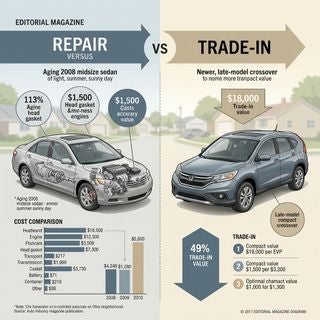
n

Should I Repair My Car or Trade It In?

You should trade in a car when a single unexpected mechanical repair exceeds 50 percent of its current market value, or when annual repair bills outpace twelve months of replacement auto loan payments. If severe undercarriage rust compromises structural integrity or safety components fail repeatedly, trading in prevents continuous financial losses on a depreciating asset. Deciding whether to keep pouring money into an aging vehicle or put that capital toward a replacement is one of the most common financial decisions drivers face. The average age of passenger vehicles on American roads has reached 12.8 years, a record high that reflects how long owners are stretching vehicle lifespans. While routine upkeep like oil changes and fluid flushes averages $400 to $1,200 per year, major mechanical failures—such as a blown head gasket or a failed automatic transmission —frequently cost between $1,000 and $5,000 or more. Commuters navigating the hilly stretches around Calcutta often find that sudden powertrain or suspension failures quickly turn a paid-off vehicle into an unreliable burden. Continuing to fix a car makes financial sense when the body and frame remain structurally sound, the repairs are isolated incidents, and the annual cost of maintenance remains significantly lower than taking on a new loan. However, when repairs arrive in quick succession—such as needing steering work one month, a cooling system rebuild the next, and facing transmission slips shortly after—the vehicle has transitioned from a practical tool to a continuous expense. Evaluating your options with clear figures removes emotion from the decision. You can visit our showroom at 1503 Pennsylvania Ave to consult with our team on trade valuations, or give us a quick call at (330) 462-7578 to discuss your current vehicle's estimated value before committing to a costly repair quote. Table of Contents How Do You Calculate if Repair Costs Exceed Your Car's Value? What Costs Should You Compare Before Buying Another Car? How Do You Calculate Positive or Negative Equity on a Trade-In? How Do Trade-In Quotes in East Liverpool Adjust for Rust and Wear? Common Questions About Vehicle Repairs and Trade-Ins Making the Right Decision for Your Vehicle How Do You Calculate if Repair Costs Exceed Your Car's Value? To calculate whether a repair exceeds actual cash value, obtain a written repair estimate and compare it directly to your vehicle's fair market trade-in value. If the repair estimate surpasses 50 percent of the vehicle's market value—or if accumulated repairs over the past 12 months equal what the car is worth—replacing the vehicle is generally the more prudent choice. Calculating this ratio requires establishing a clear distinction between routine maintenance and major mechanical repairs. The standard 50 percent threshold applies strictly to unexpected component failures, such as replacing a turbocharger, rebuilding a transfer case, or repairing internal engine components. It does not apply to normal wear items like brake pads, tires, or 12-volt batteries, which represent predictable operating expenses rather than structural or mechanical breakdown. Consider a vehicle with an actual cash value of $4,000 that requires a $2,400 engine repair. That repair estimate represents 60 percent of the vehicle's total value. Paying $2,400 out of pocket does not increase the car's market value to $6,400; it simply restores the vehicle to its baseline $4,000 value. That $2,400 investment represents unrecoverable capital that could instead serve as a substantial down payment on a reliable replacement. Before making a final choice on an older vehicle, have a qualified technician perform a comprehensive multi-point inspection rather than diagnosing only the immediate symptom. Identifying upcoming wearable failures—such as worn suspension bushings, aging radiators, or leaking brake lines—prevents you from approving a $1,500 repair today only to face another $2,000 bill three months later. If your vehicle is in our shop, you can easily schedule a service appointment for a complete evaluation, or explore our single-owner pre-owned inventory if the inspection reveals cumulative wear across multiple mechanical systems. What Costs Should You Compare Before Buying Another Car? Comparing replacement vehicle costs requires evaluating the total monthly cost of ownership—including monthly loan principal, interest rates, auto insurance adjustments, fuel economy differences, and registration fees—against your current vehicle's average monthly maintenance expenses. Looking solely at purchase prices ignores the ongoing financial factors that determine real-world affordability. When calculating the cost of a replacement vehicle, gather concrete figures across these core categories: Monthly Loan Principal and Interest: Higher market interest rates increase total borrowing costs. For instance, financing a vehicle at a current market rate over a typical loan term requires calculating the total interest paid over the life of the loan, not just the base payment. Insurance Premiums: Newer, higher-value vehicles carry higher comprehensive and collision insurance premiums than an older, paid-off car carrying basic liability coverage. Fuel Efficiency: Modern engines, such as the 2.7L EcoBoost V6 or 3.5L EcoBoost V6, often deliver significantly better fuel economy than decade-old powertrains, offsetting a portion of the monthly payment through reduced gas spending. Maintenance and Warranty Coverage: A new or certified model eliminates immediate out-of-pocket repair risks thanks to factory coverage, such as Ford's 3-year/36,000-mile bumper-to-bumper warranty and 5-year/60,000-mile powertrain warranty. Running this math side by side reveals the real financial contrast. If your current vehicle is paid off but requires an average of $350 per month in unexpected repairs and scheduled maintenance, taking on a modern vehicle payment may represent a manageable monthly increase while providing total mechanical reliability and advanced safety features like Pre-Collision Assist with Automatic Emergency Braking. If you are ready to evaluate replacement options, you can explore our new vehicle inventory to compare model choices, submit a credit application online to review personalized financing terms, or browse our certified pre-owned Ford inventory for factory-backed confidence at a pre-owned price point. How Do You Calculate Positive or Negative Equity on a Trade-In? You calculate equity by requesting an official 10-day payoff balance from your current lender and comparing that exact figure against your vehicle's professional trade-in appraisal. Positive equity exists when the trade appraisal exceeds your remaining loan balance, while negative equity occurs when you owe more on the loan than the market value of the vehicle. Determining your equity status requires precise numbers rather than online estimates: Obtain the Payoff Amount: Call your auto lender or log into your account to request a formal 10-day payoff quote, which includes the remaining principal and accrued daily interest. Get a Professional Appraisal: Have your vehicle inspected to determine its true wholesale trade value based on mileage, mechanical condition, and physical wear. Calculate the Difference: Subtract the loan payoff quote from the appraised trade value. If your car appraises at $14,000 and your lender payoff quote is $11,000, you have $3,000 in positive equity to apply directly as a down payment on your next purchase, reducing the total amount financed. If your vehicle appraises at $10,000 but your loan payoff is $13,000, you face $3,000 in negative equity. Drivers commuting through the retail corridors of Boardman often accumulate higher annual mileage, which can accelerate depreciation and temporarily create negative equity if financed over longer loan terms. Handling negative equity requires careful planning. You can pay the $3,000 difference out of pocket at signing, or roll the remaining balance into the new vehicle loan if lender loan-to-value limits allow. However, rolling debt forward increases your overall borrowing costs, making it essential to select a replacement vehicle with strong residual value retention, like a Ford F-150. You can value your trade-in online to establish a clear baseline before visiting our showroom. How Do Trade-In Quotes in East Liverpool Adjust for Rust and Wear? Dealership appraisals adjust trade-in quotes based on structural frame rust, mechanical reconditioning requirements, and regional wholesale auction demand. While minor surface cosmetic wear causes minimal deductions, heavy undercarriage corrosion and active powertrain fault codes reduce trade values by the full estimated cost of dealer reconditioning. Vehicles driven on regional winter roads face aggressive road salt exposure. Appraisers distinguish clearly between superficial surface rust and deep structural corrosion: Surface Wear and Minor Cosmetics: Light surface rust on exhaust pipes, minor door dings, or scuffed bumper covers are expected on older vehicles and carry minimal trade-in deductions. Structural Frame Rust: Flaking or compromised frame rails, rusted-through rocker panels, and severely corroded suspension mounting points significantly lower a vehicle's trade value because they present safety hazards and prevent the car from passing standard safety inspections. Mechanical Diagnostics: Active check engine lights, fluid leaks, or worn mechanical components like a slipping 10-speed automatic transmission require reconditioning that is subtracted directly from the top-tier wholesale value. When evaluating trade-ins after heavy winter driving, our technicians check structural frame rails and brake line corrosion first because underbody rust impacts wholesale value far more than minor paint chips. Because dealerships perform reconditioning at internal wholesale labor and parts rates, trading in a vehicle that needs mechanical attention is almost always more cost-effective than paying retail rates at an independent repair shop prior to trading. Common Questions About Vehicle Repairs and Trade-Ins Q: Does the 50 percent rule apply to routine maintenance like tires and brakes? The 50 percent rule applies specifically to unexpected, major mechanical failures rather than scheduled consumable items. Replacing worn tires, brake rotors, spark plugs, or a battery are standard maintenance expenses required to keep any vehicle operating safely. These items should be factored into your normal annual operating budget rather than treated as mechanical failure indicators that trigger an immediate trade-in. However, if routine wear items stack up all at once alongside an unexpected powertrain repair, the combined cost may justify trading the vehicle in. Q: How do monthly auto loan interest rates affect the trade-in comparison? Higher auto loan interest rates increase total borrowing costs, making a paid-off current vehicle more economical to keep if repairs remain minor. When interest rates are elevated, financing a new loan adds more interest expense over the loan term, raising the financial bar for when replacing a vehicle becomes beneficial. Conversely, lower interest rates or manufacturer incentive APR programs reduce total finance charges, narrowing the cost gap between paying for major recurring repairs on an older car and financing a modern replacement. Q: Should non-essential cosmetic damage be repaired before trading in a vehicle? Non-essential cosmetic issues like minor paint scratches, small parking lot dings, or light interior wear should generally be left as-is before trading in. Dealerships can complete reconditioning and minor cosmetic detailing internally at lower wholesale costs than you would pay at a retail body shop. Spending $800 out of pocket for cosmetic paint correction rarely increases your trade-in appraisal by more than $800, resulting in a net loss on the repair investment. Q: What documents should be brought to the dealership when trading in a financed car? Bring your current vehicle registration, proof of auto insurance, driver's license, both sets of keys or remotes, and all maintenance records. If the vehicle is currently financed, bring your lender's contact information, account number, and your most recent account statement showing the loan balance. Having complete service records demonstrates consistent maintenance, which helps appraisers verify mechanical health and maximize your vehicle's trade value. If you need replacement maintenance items before trading, you can order OEM Ford parts directly through our department. Q: How do upcoming major maintenance items over the next 12 months affect my decision? Anticipated maintenance over the next 12 months—such as a timing belt replacement, new tires, or suspension service—should be added to any immediate repair quotes when evaluating costs. If your vehicle needs $1,200 in immediate repairs today and will require $1,800 in scheduled service over the coming year, your true 12-month commitment is $3,000. Comparing that $3,000 total against your vehicle's current market value provides a realistic picture of upcoming ownership costs. You can contact the dealership for current offers or start a custom build order to evaluate replacement options before those maintenance costs come due. Making the Right Decision for Your Vehicle Deciding whether to repair or trade in comes down to objective numbers: compare your total estimated repair bill against your vehicle's actual trade value, factor in upcoming maintenance, and evaluate how a reliable replacement fits your monthly budget. When single mechanical repairs exceed half of what your vehicle is worth—or when ongoing repair bills eclipse the annual cost of a replacement—trading in provides a clear path toward predictable daily transportation. Taking time to gather accurate figures turns a stressful mechanical situation into a straightforward economic decision. At Tri State Ford, our team provides transparent vehicle appraisals, straightforward financing options, and a clear breakdown of your vehicle's equity position so you can choose the right path with complete confidence. When you are ready to evaluate your options, stop by our East Liverpool location for an in-person appraisal, give our staff a call at (330) 462-7578, or explore our current new vehicle inventory online to see how easily you can transition into a dependable Ford built for your daily drive. © 2026 Tri State Ford. All rights reserved. Car Trade-In Advice in East Liverpool OH | Tri State Ford
Is AWD or 4WD Better for Driving in Winter?

All-wheel drive (AWD) is better for most drivers facing typical winter conditions on plowed, mixed-traction roads because it automatically routes torque to all four wheels without driver intervention. Four-wheel drive (4WD) is better for navigating deep, unplowed snow, steep unpaved grades, or severe off-road conditions where a locked transfer case and low-range gearing provide maximum low-speed traction. For everyday winter commuting across variable pavement, AWD delivers superior continuous stability and efficiency. In East Liverpool, where steep riverfront bluffs and sudden elevation changes make winter commutes unpredictable, choosing between these two drivetrains comes down to how and where you drive. An AWD vehicle monitors wheel speed continuously, sending power to the axle with the most grip the instant road conditions deteriorate. This automated response makes AWD exceptionally convenient when transitioning from dry highways to slush-covered neighborhood streets. Drivers do not need to flip switches or predict traction loss before it happens. Traditional 4WD, by contrast, is engineered for heavy-duty utility and maximum mechanical grip. When engaged, a 4WD system locks the front and rear driveshafts together, forcing both axles to turn at the same speed regardless of individual tire traction. This brute force enables 4WD trucks and rugged SUVs to push through heavy snowdrifts and rutted mud that might bog down a lighter crossover. However, because part-time 4WD locks the axles, operating it on dry or merely damp pavement can cause severe drivetrain binding. For personalized guidance on selecting the right drivetrain for your daily route, feel free to give our sales team a quick call at (330) 462-7578 or stop by our showroom at 1503 Pennsylvania Ave to test-drive both configurations in person. Table of Contents How Do All-Wheel Drive and Four-Wheel Drive Differ in Technical Operation? How Do AWD and 4WD Compare in Daily Driving and Snow? Does AWD Help You Stop Faster or Handle Ice Better Than Winter Tires? Should You Choose an AWD Crossover or a 4WD Truck for Ohio Valley Terrain? Common Questions About Winter Drivetrains Which Ford SUV and Truck Models Offer AWD or 4WD? How Do All-Wheel Drive and Four-Wheel Drive Differ in Technical Operation? All-wheel drive uses electronic sensors, hydraulic clutch packs, or a center differential to automatically distribute engine torque between the front and rear axles as road conditions change. Four-wheel drive relies on a heavy-duty mechanical transfer case that locks the front and rear output shafts together, forcing both axles to rotate at identical speeds. Understanding these mechanical distinctions helps drivers select a system that matches their physical driving environment. An AWD system functions through active Electronic Control Units that monitor wheel rotation thousands of times per second. When a tire begins to slip on wet pavement or patch ice, the system commands an internal clutch pack to route engine torque away from the spinning wheel toward the axle with firm traction. Modern AWD setups react in less than 200 milliseconds, adjusting power delivery before the driver even notices a loss of control. Because a center differential allows the front and rear wheels to rotate at different speeds during turns, AWD can remain engaged continuously on dry asphalt without damaging mechanical components. Four-wheel drive operates through a physical transfer case located directly behind the transmission. When the driver selects a 4x4 mode via a dashboard dial or floor lever, a shift fork mechanically locks the front and rear driveshafts. Many traditional 4WD systems offer two distinct operating ranges: 4-High (4H): Delivers full mechanical traction at normal road speeds for driving through deep snow, loose gravel, or heavy slush. 4-Low (4L): Engages lower gear ratios inside the transfer case to multiply engine torque at low speeds, providing the climbing power necessary to navigate steep rocky trails or pull heavy loads out of deep mud. Because part-time 4WD lacks a center differential to absorb speed differences between the front and rear tires when turning, engaging 4x4 on dry roads forces the tires to scrub against the pavement, placing immense stress on axle U-joints and transfer case gears. When you are ready to evaluate how these systems perform on local roads, you can schedule a test drive with our team. If you prefer a pre-owned vehicle, you can browse our single-owner pre-owned selection, or speak with our service department to order genuine maintenance parts for your current vehicle. How Do AWD and 4WD Compare in Daily Driving and Snow? In daily winter driving on variable road surfaces like rain, slush, and light snow, AWD operates continuously in the background to deliver immediate stability and seamless acceleration. Traditional 4WD remains ideal for heavy-duty hauling and deep snowdrifts, but part-time 4WD systems cannot be driven safely on dry or merely wet pavement without risking severe drivetrain damage. Matching drivetrain capabilities to actual road conditions prevents unnecessary mechanical wear while keeping your family secure on every trip. AWD crossovers excel during routine winter commuting because their computer-controlled systems adapt to changing pavement instantly. On a typical morning drive featuring a mix of clear highway, icy bridges, and slushy exit ramps, an AWD system automatically shifts power between axles to maintain forward momentum. Drivers maintain full steering control without worrying about binding drivetrain components during tight parking maneuvers. Furthermore, modern AWD systems disengage the secondary axle when extra traction is unneeded, helping reduce internal friction and preserve overall fuel economy. Traditional 4WD shines when winter weather renders paved roads unrecognizable. In unplowed rural drifts or deep mud, the equal power distribution of a locked transfer case ensures that even if three tires lose traction entirely, the single wheel with grip receives half the engine power to pull the vehicle forward. However, this mechanical rigors comes with daily operating compromises: Driver Management: The operator must monitor road conditions constantly and manually disengage 4WD when returning to clear asphalt. Fuel Drag: Heavy solid axles, thick driveshafts, and robust transfer cases add hundreds of pounds to the vehicle, creating mechanical drag that typically reduces fuel efficiency by 1 to 3 mpg. Low-Speed Binding: Turning tightly in 4WD on high-traction surfaces causes steering wheel chatter and severe mechanical strain. Shoppers evaluating daily commuting needs against heavy winter demands can explore our certified pre-owned Ford inventory to compare versatile AWD crossovers and rugged 4x4 trucks side by side. Does AWD Help You Stop Faster or Handle Ice Better Than Winter Tires? All-wheel drive does not help a vehicle stop faster on icy roads because every modern passenger car, truck, and SUV already utilizes four-wheel braking regardless of its drivetrain configuration. Dedicated winter tires deliver far shorter stopping distances and superior cornering grip on ice because their specialized rubber compounds and engineered siping create physical friction against frozen surfaces. Drivetrains only distribute engine torque; tires create the actual grip between the vehicle and the road. A common driver misconception is assuming that rapid acceleration on a slippery surface equals overall braking and cornering traction. While an AWD system distributes acceleration torque across four contact patches to prevent wheelspin when pulling away from an intersection, it provides zero assistance when you apply the brakes. When stopping on ice, vehicle weight, anti-lock braking system calibration, and tire rubber flexibility dictate the stopping distance. Standard all-season tire compounds stiffen when ambient temperatures drop below 45 degrees Fahrenheit, turning hard and losing the ability to conform to microscopic road textures. Dedicated winter tires solve the fundamental physical limits of cold-weather traction through specialized tire engineering: Flexible Cold-Weather Compounds: Formulated with high silica content to remain soft and pliable in sub-freezing temperatures, maximizing rubber-to-ice contact. High-Density Siping: Cut with thousands of microscopic slits that open under load, creating biting edges that key into snow crystals and ice surfaces. Deep Slush Grooves: Designed with wide circumferential channels that pump slush and standing water away from the contact patch to prevent hydroplaning. Combining an AWD vehicle with dedicated winter tires offers the ultimate winter setup, giving you power delivery to move forward along with the physical grip needed to turn and stop safely. To prepare your vehicle for severe weather, you can schedule a service appointment, use our tire lookup tool to locate cold-weather tires, or check your KBB trade-in value if you are considering upgrading to an AWD model. Should You Choose an AWD Crossover or a 4WD Truck for Ohio Valley Terrain? Choose an AWD crossover if your daily routine consists of suburban commuting, highway travel, and variable winter weather where effortless automatic traction and fuel efficiency matter most. Select a 4WD truck if your work or lifestyle requires heavy towing, high payload capacity, or navigating unplowed back roads and rugged job sites. Aligning your vehicle choice with regional terrain features ensures dependable year-round utility. For suburban drivers navigating the rolling hills and local corridors around Calcutta, an AWD crossover delivers exceptional all-weather capability without sacrificing ride comfort or gas mileage. Vehicles equipped with intelligent AWD provide generous interior passenger room, flexible cargo space, and active driver-assist safety features designed to protect what matters most. The automatic drivetrain seamlessly manages unexpected snow patches on hilly neighborhood streets, allowing parents and commuters to travel with confidence while enjoying responsive highway handling. Conversely, a 4WD truck represents the ultimate workhorse for drivers who encounter severe terrain, haul heavy machinery, or demand extreme off-road clearance. Trucks built with traditional body-on-frame architecture offer superior frame rigidity, solid rear axles, and low-range transfer cases engineered to conquer steep unpaved grades and deep mud. Key considerations when comparing these body styles include: Towing and Cargo Needs: A 4WD truck delivers strong towing capacity and an open bed for hauling heavy equipment, gravel, or winter supplies. Ground Clearance: High-riding 4WD trucks clear deep snowdrifts and rutted trails that could high-center a lower crossover. Efficiency and Convenience: AWD crossovers offer smooth car-like ride quality, easier parking, and lower ownership costs for daily driving. To explore purchasing options that match your monthly budget, you can submit an online credit application to get pre-approved before visiting our showroom. Common Questions About Winter Drivetrains How does AWD work in snow compared to 4WD? Many drivers in snowy regions rely on AWD systems because they enhance traction by automatically adjusting power distribution based on road grip. A 4WD system uses a mechanical transfer case to lock power equally to both axles, providing maximum brute force for driving through deep, unplowed snowdrifts at lower speeds. Do I need winter tires if my SUV has all-wheel drive? Yes. AWD helps your vehicle accelerate by distributing engine power to all four wheels, but it does not improve braking distance or cornering grip on snow and ice. Dedicated winter tires feature soft rubber compounds and engineered siping that provide the physical traction needed to stop and steer safely in freezing weather. Can driving in 4WD on dry pavement cause mechanical damage? Operating a traditional part-time 4WD system on dry asphalt forces the front and rear axles to turn at the exact same speed during turns. Because the tires cannot slip on dry pavement to relieve rotational tension, this binds the drivetrain, which can overheat fluid and shatter axle joints or transfer case gears. Does 4WD hold better resale value than AWD in hilly winter regions? Full-size 4WD trucks and body-on-frame SUVs maintain exceptional resale value due to their heavy towing capacity and commercial utility. However, AWD crossovers maintain equally strong demand and trade-in value among suburban commuters who prioritize automatic winter traction and daily fuel efficiency. Will an AWD vehicle consume more fuel than a front-wheel-drive model? Yes. AWD systems add between 100 and 200 pounds of mechanical components and create slight internal parasitic drag, which typically reduces overall fuel efficiency by 1 to 2 mpg compared to an equivalent two-wheel-drive model. Modern systems minimize this penalty by disconnecting the secondary axle when extra traction is unneeded. Which Ford SUV and Truck Models Offer AWD or 4WD? Ford offers intelligent AWD across versatile crossovers like the Escape and Explorer, while providing rugged 4x4 systems on off-road legends like the Bronco and hard-working F-150 trucks. Matching the right Ford model to your winter driving demands ensures optimal capability, passenger comfort, and long-term durability. Exploring the Ford lineup reveals options tailored to every family size, work requirement, and budget. For compact versatility, the 2026 Ford Escape ST-Line features available intelligent AWD paired with a 1.5L engine and an automatic 8-speed transmission. Starting at an MSRP of $31,750, it achieves an EPA-estimated 26 city / 32 hwy mpg, offers seating for 5, provides about 38 cubic feet of rear cargo space, and delivers a 2,000 lbs towing capacity—making it an ideal, fuel-efficient option for daily winter commutes. Families needing expanded seating and towing capability will appreciate the 2026 Ford Explorer ST-Line. Starting at an MSRP of $42,585, this midsize SUV comes standard with intelligent AWD, a powerful 2.3L EcoBoost® engine, and a SelectShift® transmission. It delivers an EPA-estimated 20 city / 27 hwy mpg, seating for 6 across three rows, about 16 cubic feet of cargo room behind the third row, and a robust 5,000 lbs towing capacity to handle winter trailers with ease. Drivers seeking maximum off-road capability or truck utility have powerful options within the Ford lineup: 2026 Ford Bronco Badlands: Features an advanced 4x4 system with selectable G.O.A.T. Modes® ( Slippery, Off-Road) and up to 13.1 inches of available ground clearance to navigate deep snow drifts effortlessly. 2025 Ford Bronco Sport: Comes standard with 4x4 across all trims, providing 8.8 inches of ground clearance and dedicated terrain settings for dependable foul-weather control. Ford F-150: Offers proven 4x4 configurations with off-road variants like the Raptor providing 9.8 inches of ground clearance, strong towing power, and spacious bed capacity for demanding winter job sites. To experience these vehicles in person, feel free to visit our East Liverpool showroom, give us a quick call at (330) 462-7578, or explore our new Ford inventory online to find your ideal winter vehicle today. © 2026 Tri State Ford. All rights reserved. Vehicle specification data © JATO Dynamics Limited. AWD vs 4WD Winter Driving in East Liverpool OH | Tri State Ford

Escape

Why Do Car Batteries Fail in Cold Weather?

Car batteries fail in sub-freezing temperatures because low thermal energy slows the internal chemical reactions that generate electrical current while simultaneously increasing internal resistance. At 32°F, a standard 12-volt lead-acid battery loses approximately 35% of its starting power, dropping to less than 50% capacity at 0°F. Combined with engine oil thickening in severe cold, the battery must supply up to double the electrical power to turn over a cold crankshaft precisely when its available energy output reaches its annual low point. Inside a traditional automotive battery, lead plates soak in an electrolyte solution of sulfuric acid and water. When you turn the ignition key or press the start button, a chemical reaction transfers electrons between the plates to create electrical current. Cold ambient air slows this ionic exchange, creating a severe bottleneck in power delivery. Older or weak batteries that function adequately during warm summer months frequently fail during the first sudden frost because their chemical efficiency degrades past the threshold required to turn the engine starter motor. Winter driving conditions also introduce significant parasitic electrical loads before the engine even starts. Heated seats, rear window defrosters, blower fans, and steering wheel heaters all demand immediate current from the 12-volt electrical system. For drivers navigating the steep riverfront bluffs around East Liverpool, cold morning starts force the starting system to work against dense, cold motor oil and heavy auxiliary power draws. If a battery is already compromised by age or sulfation, it cannot produce the necessary voltage under load. Proactive battery maintenance prevents sudden winter failure before sub-zero temperatures arrive. Drivers noticing slow cranking or flickering interior lights can reach out to our service advisors by giving us a quick call or stopping by our East Liverpool service facility for a comprehensive voltage and load test. Table of Contents How Does Freezing Weather Affect Battery Capacity and Cold Cranking Amps? Why Do AGM Batteries Withstand Freezing Temperatures Better Than Flooded Batteries? How Does a Battery Maintainer or Trickle Charger Prevent Winter Battery Failure? How Much Electric Vehicle Driving Range Can Cold Weather Impact? Common Questions About Winter Battery Care and Cold-Weather Performance Get Reliable Winter Battery Testing and Replacement How Does Freezing Weather Affect Battery Capacity and Cold Cranking Amps? Freezing weather drastically reduces a battery’s available output power while increasing the mechanical resistance of the engine. The critical metric for measuring winter starting capability is Cold Cranking Amps, which measures the current a fully charged 12-volt battery can deliver for 30 seconds at 0°F while maintaining at least 7.2 volts. Under the official SAE J537 testing protocol, battery performance ratings separate winter capability from warm-weather output. While standard Cranking Amps measures output at a mild 32°F, Cold Cranking Amps subjects the battery to a rigorous 0°F test environment. Understanding this distinction explains why an older battery might start a vehicle effortlessly during autumn but struggle to turn over the engine during a midwinter freeze. Battery Metric Testing Temperature Output Capability at 0°F Primary Purpose Cranking Amps 32°F (0°C) Approximately 65% of rated capacity Measures mild-weather engine starting capability Cold Cranking Amps 0°F (-18°C) 50% or less of rated capacity on weak units Measures severe sub-zero winter starting strength Reserve Capacity 80°F (27°C) Reduced runtime under continuous load Measures emergency electrical supply duration As ambient temperatures drop, motor oil viscosity increases significantly. Thicker oil resists movement across pistons and crankshaft bearings, forcing the starter motor to draw anywhere from 100% to 200% more amperage to rotate the engine at starting speed. If a battery has lost 40% of its rated Cold Cranking Amps due to cold chemical slowdown, it cannot fulfill the elevated starter demand. Engineering guidelines recommend choosing a replacement battery with a rating at least 20% higher than factory minimums if your vehicle frequently parked outdoors in freezing climates. Scheduling routine diagnostic checks ensures your starting system meets OEM specifications before peak winter hits. You can learn more about proper voltage testing and replacement intervals through our specialized battery maintenance guidelines. Why Do AGM Batteries Withstand Freezing Temperatures Better Than Flooded Batteries? Absorbent Glass Mat batteries resist severe freezing conditions far better than traditional flooded batteries because their liquid electrolyte is completely absorbed into micro-fiberglass mat separators. This sealed design prevents electrolyte stratification, lowers internal electrical resistance, and eliminates the risk of internal case cracking caused by expanding fluid. In a standard flooded lead-acid battery, continuous charge cycles can cause water and sulfuric acid to separate, a process known as acid stratification. The heavier acid settles at the bottom of the casing while dilute water remains near the top. If a flooded battery becomes discharged, this top layer of dilute electrolyte can freeze solid at 32°F, expanding and permanently damaging the internal lead plates or cracking the outer plastic case. An AGM battery eliminates liquid separation entirely. Because the electrolyte solution stays tightly bound against thin lead plates inside absorbent glass material, the internal chemical reaction remains consistent across the entire cell surface. Key physical and operational advantages include: Micro-fiberglass mats hold electrolyte in direct contact with lead plates, reducing internal resistance. Sealed cell construction prevents fluid evaporation and liquid acid stratification. Higher vibration resistance protects internal components on rough winter road surfaces. Faster charge acceptance allows the alternator to replenish spent energy more rapidly on short drives. Vehicles equipped with heavy electrical loads, such as a 2026 Ford Explorer or a 2026 Ford F-150 with winter comfort features, rely heavily on rapid charge acceptance. An AGM battery accepts high-current charging from the alternator much faster than a standard flooded unit, ensuring the battery restores its state of charge even during low-speed winter driving. How Does a Battery Maintainer or Trickle Charger Prevent Winter Battery Failure? A smart battery maintainer prevents winter failure by supplying a continuous, low-amperage float charge that offsets natural self-discharge and prevents lead sulfation. By maintaining cell voltage above 12.4 volts during idle periods, a maintainer ensures the chemical electrolyte remains fully active and capable of delivering maximum output. Lead-acid batteries experience natural self-discharge when left parked, losing roughly 10% of their charge per month in mild weather and discharging faster when parasitic electronic draws remain active. Keyless entry receivers, alarm sensors, and engine control modules draw continuous milliamps from the 12-volt battery even when the vehicle is locked and turned off. If battery voltage drops below 12.4 volts, sulfur from the electrolyte begins forming permanent lead sulfate crystals on the internal plates. This process, known as sulfation, permanently reduces total storage capacity. Using a modern smart maintainer provides significant winter protection benefits: Microprocessor controls automatically adjust charge rates based on ambient temperature. Float mode maintains maximum voltage without overcharging or boiling off internal fluids. Prevents electrolyte freezing by keeping the battery at a full state of charge. Desulfation modes help dissolve soft sulfate deposits to restore electrical efficiency. Drivers navigating short suburban commutes along State Route 170 in Calcutta often start their engines, run seat heaters and defrosters for ten minutes, and turn off the vehicle before the alternator can fully restore the energy used during startup. Connecting a smart battery maintainer overnight counteracts these short-trip discharge cycles, extending overall battery lifespan through long stretches of sub-freezing weather. How Much Electric Vehicle Driving Range Can Cold Weather Impact? Cold weather temporarily reduces electric vehicle driving range by approximately 15% to 30% during severe winter conditions. This range reduction stems from decreased lithium-ion cell chemical efficiency combined with the significant energy required to heat the passenger cabin and keep the high-voltage traction battery within its optimal operating temperature window. Lithium ions move more slowly through liquid electrolyte when temperatures drop, increasing internal resistance within the high-voltage battery pack. This temporary chemical slowdown limits maximum available acceleration power and reduces energy recovery from regenerative braking. Furthermore, while internal combustion engines use waste heat to warm the interior, an electric vehicle like a 2026 Ford Escape Plug-In Hybrid or all-electric model must pull energy directly from the traction battery to power high-voltage resistance heaters or heat pumps. Modern battery management systems protect high-voltage packs from permanent degradation through active thermal controls. Charging a freezing lithium-ion cell at high currents can cause lithium plating—a condition where metallic lithium deposits on the anode rather than inserting cleanly into the graphite structure. To prevent permanent damage, onboard control modules automatically limit charging speeds and draw grid power to heat the battery pack before accepting high-rate DC fast charging. To minimize range loss and optimize battery protection during winter, owners can follow proven operational strategies: Precondition the cabin and battery pack while the vehicle remains connected to an external charger. Park inside an enclosed garage whenever possible to buffer against sub-zero wind chills. Utilize heated seats and steering wheel controls, which draw less energy than cabin air heaters. Maintain steady driving speeds to allow thermal management systems to stabilize pack temperatures. Drivers seeking seasonal service inspections or looking to explore new electrification technologies can browse our current manufacturer vehicle specials or explore options to custom order a new vehicle configured with cold-weather packages. Common Questions About Winter Battery Care and Cold-Weather Performance Q: How long should you drive a vehicle to fully recharge the battery after a cold jump start? You should drive continuously at highway speeds for at least 30 to 45 minutes with non-essential electrical accessories turned off after receiving a jump start. This extended runtime allows the alternator to deliver a consistent charging current back into the 12-volt battery. Short trips under 15 minutes or idling in a driveway will not generate sufficient alternator output to fully restore a deeply discharged battery, leaving you vulnerable to another dead battery on your next start. Q: At what ambient temperature does a car battery freeze? A fully charged lead-acid battery will not freeze until ambient temperatures drop below -76°F because its electrolyte solution contains a high concentration of sulfuric acid. However, a fully discharged battery with a voltage reading near 12.0 volts consists mostly of water, causing it to freeze at 32°F. Once internal fluid freezes, expanding ice can bend internal lead plates, rupture internal separators, and crack the outer plastic casing, inflicting permanent structural damage. Q: Why does an engine crank slowly when starting on cold winter mornings? Sluggish engine cranking occurs because extreme cold simultaneously reduces battery current output and thickens motor oil. Sub-freezing temperatures slow the chemical reactions inside your 12-volt lead-acid battery, cutting available Cold Cranking Amps by up to 50%. At the same time, cold motor oil becomes viscous, creating severe mechanical drag across internal engine components that forces the starter motor to draw significantly more electrical power to rotate the crankshaft. Q: Does parking inside a garage really protect battery health during severe cold snaps? Parking inside an enclosed garage provides substantial protection by insulating the vehicle from harsh wind chills and keeping ambient temperatures several degrees warmer than outdoor air. This temperature buffer slows the rate of battery heat loss overnight, preserving available Cold Cranking Amps for morning starts. Garaged parking also reduces the initial energy demand required by cabin heaters and defrosters, allowing the alternator to concentrate its power output on recharging the battery immediately after startup. Q: What is the main difference between Cold Cranking Amps and Cranking Amps? Cold Cranking Amps measures the maximum current a fully charged battery can deliver for 30 seconds at 0°F while maintaining at least 7.2 volts, serving as the industry standard for winter performance. Cranking Amps measures output at 32°F, resulting in a higher numerical rating that reflects mild-weather capability. Always reference the Cold Cranking Amps specification when selecting a replacement battery for reliable operation in freezing climates. If you suspect your starting system is struggling, you can easily schedule a service appointment online for a comprehensive electrical system evaluation. Get Reliable Winter Battery Testing and Replacement Cold weather exposes subtle weaknesses in aging vehicle batteries, turning minor voltage drops into unexpected morning breakdowns. Simple preventative care—such as verifying terminal cleanliness, checking charge system voltage, and testing cold-cranking capability—ensures your vehicle starts dependably throughout the coldest winter months. Our factory-trained technicians at Tri State Ford possess specialized diagnostic equipment to test your battery’s state of health, reserve capacity, and cold-weather performance. If testing reveals a weakened cell, we install genuine Motorcraft batteries built to original equipment specifications, backed by comprehensive nationwide warranty coverage. Do not wait for sub-zero temperatures to leave you stranded. To prepare your vehicle for winter driving, give our service team a quick call, stop by our service center on Pennsylvania Avenue, or conveniently order replacement parts online today. © 2026 Tri State Ford. All rights reserved. Cold Weather Car Battery Tips in East Liverpool OH | Tri State Ford

Contact Us

Fill out this form below and we'll contact you shortly
*Required Fields