
Blog / Maintenance & Service, Parts & Accessories, Vehicle HVAC Care, Seasonal Vehicle Maintenance, DIY

How Does Ford Pickup & Delivery Work for Maintenance?

l


Ford Pickup & Delivery allows eligible vehicle owners to schedule routine maintenance or warranty repairs where a dealership representative retrieves the vehicle from a home or workplace, transports it to the service center for care, and returns it once completed. Routine scheduled maintenance or warranty work often includes complimentary pickup and delivery within a designated local service radius, eliminating the need to wait in the service lounge.

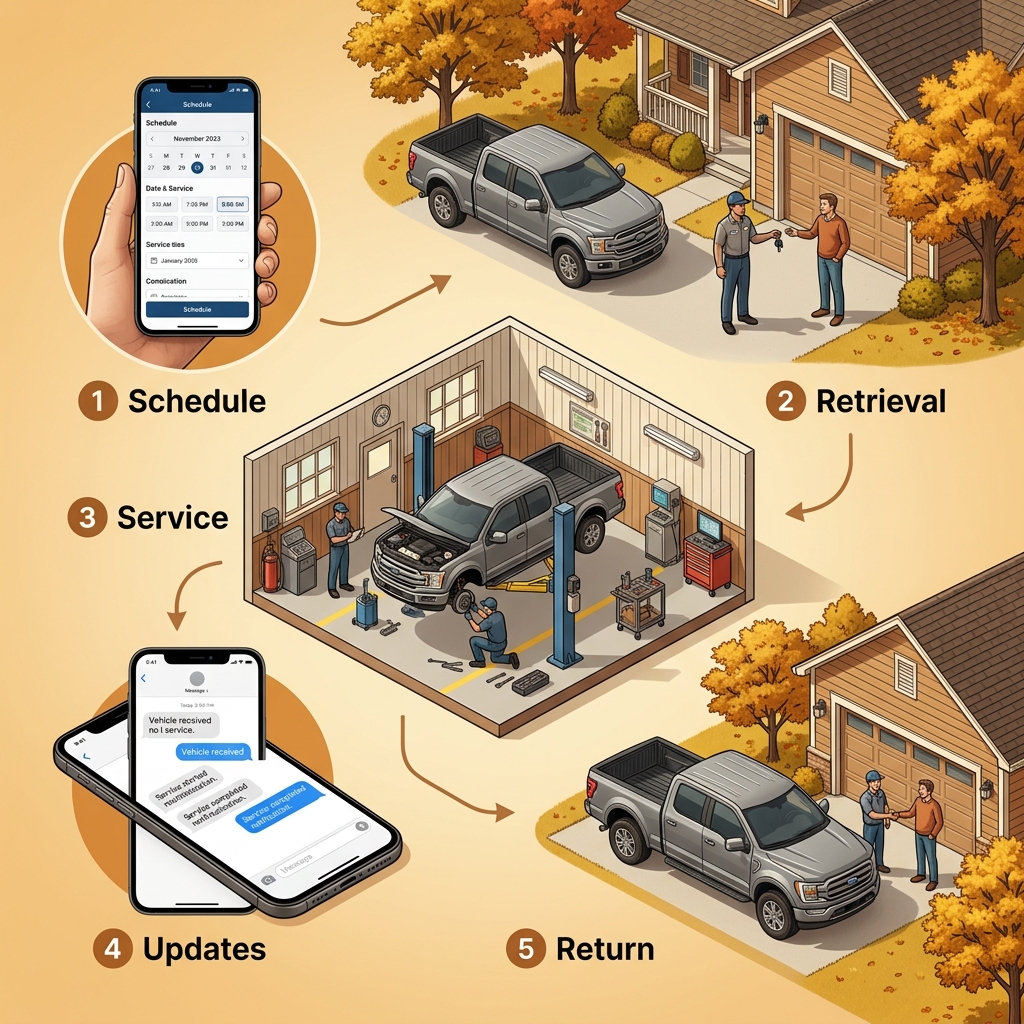
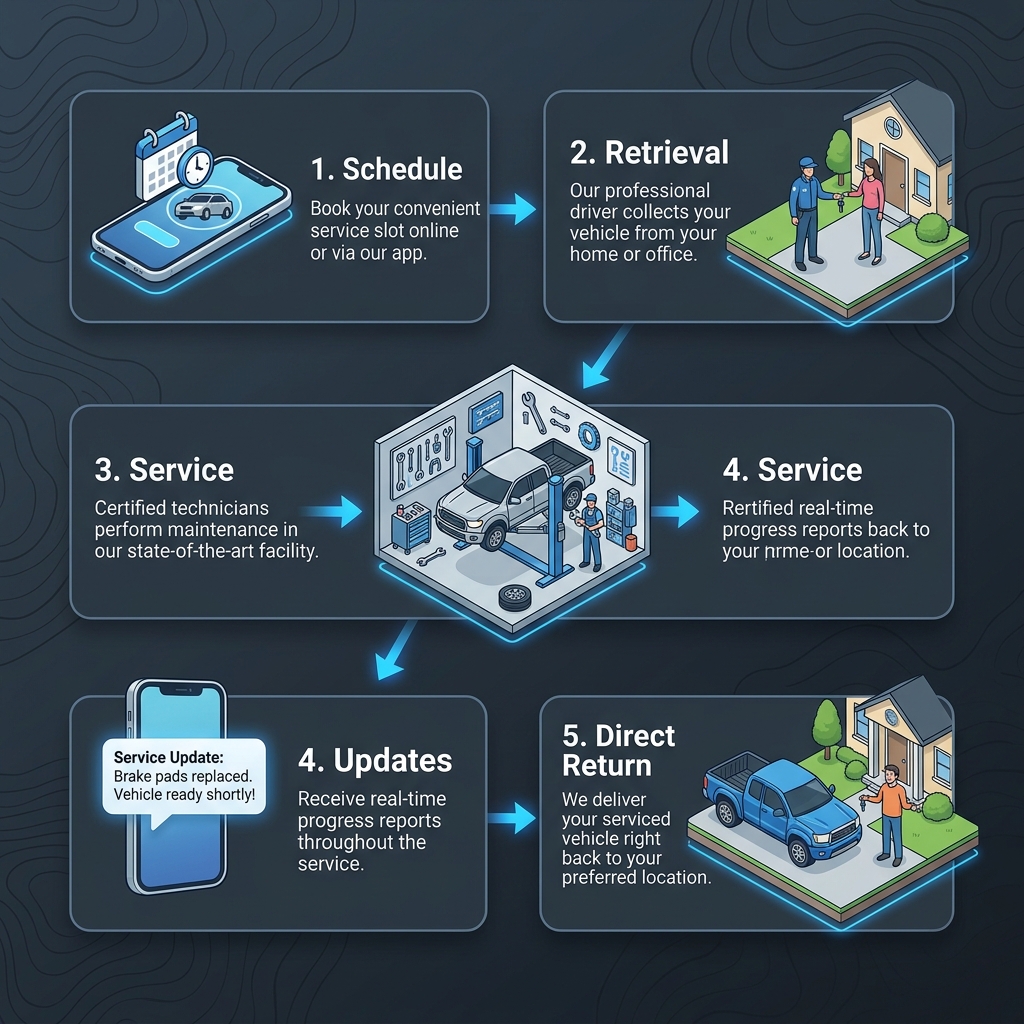
The process begins when you schedule a service appointment online, through the Ford App, or by speaking with our service team directly. On the day of your appointment, a certified driver arrives at your designated address to pick up your keys and complete a brief vehicle walk-around. Your vehicle is driven to our specialized service bays, where factory-trained technicians perform the requested maintenance using genuine OEM parts. Throughout the process, you receive status updates via text message or phone call so you know exactly when work begins and ends. Once your vehicle passes our final quality inspection, our team returns it directly to your driveway or parking spot.

| Ford PICKUP & DELIVERY PROCESS |
| --- |
| 1. Schedule Appointment -> Online, via Ford App, or by Phone |
| 2. Vehicle Retrieval -> Driver collects keys at home/office |
| 3. Factory Service -> Certified techs use OEM Ford parts |
| 4. Status Updates -> Real-time notifications sent to you |
| 5. Direct Return -> Vehicle delivered back to your door |

Vehicle owners navigating the steep elevation changes and riverfront bluffs near East Liverpool rely heavily on well-maintained brakes and suspension components. Having our drivers retrieve your vehicle saves you valuable commuting time along the river corridor while ensuring your truck or SUV receives proper care. To arrange your next service retrieval or learn more about our remote scheduling options, review our official Ford Pickup & Delivery program guidelines, reach out to our service team at (330) 462-7578, or find exact driving routes to our East Liverpool showroom address on Pennsylvania Avenue.

Table of Contents

Infographic showing a 5-step car service process: Schedule, Retrieval, Service, Updates, and Direct Return. (Representative image for illustration purposes only. Actual vehicle may vary based on trim and configuration.)

How Much Does Pickup and Delivery Cost and Is There a Mileage Limit?

Many Ford owners benefit from complimentary pickup and delivery services for routine maintenance, making it easier to keep vehicles in top condition without extra transportation costs.

While the door-to-door transportation service itself carries no additional surcharge for qualifying appointments, dealerships set local operating boundaries to ensure timely vehicle transit. Most complimentary pickup and delivery programs cover locations within a 15- to 20-mile radius of the dealership. If your home or workplace sits outside this standard boundary, our service team can evaluate logistics on a case-by-case basis or discuss alternative arrangements.

Working families residing in suburban communities near State Route 170 in Calcutta frequently utilize this doorstep collection when managing busy work and school calendars. Routine scheduled care like The Works package—which includes a Synthetic Blend oil change, tire rotation, pressure check, brake inspection, and multi-point checkup—can be completed without disrupting your daily routine. For specialty maintenance involving custom fluid flushes, filters, or severe-duty components, you can coordinate specific parts requests in advance by choosing to order OEM Ford parts directly through our service portal.

Service Feature Standard Pickup & Delivery Ford Mobile Service
:-- :-- :--
Service Location Dealership Service Bay Customer Driveway / Workplace
Distance Boundary Typically 15- to 20-mile radius Local dealer service territory
Service Scope Full shop repairs, oil changes, tires, heavy maintenance Light maintenance, oil, filters, batteries, recall updates
Doorstep Convenience Vehicle retrieved and returned Technician brings mobile van to you

Does Tri State Ford Offer Mobile Service at Your Home in East Liverpool?

Yes, Ford Mobile Service sends a factory-trained technician and a fully equipped mobile service van directly to your home or office to complete routine vehicle maintenance on-site.

Unlike pickup and delivery—where your vehicle is driven to our central facility—mobile maintenance brings certified diagnostic equipment, oil extraction systems, and specialty tools right to your driveway. Technicians perform a wide variety of routine maintenance tasks without taking your vehicle off your property. Common mobile services include:

  • Synthetic motor oil and filter replacement
  • Engine air filter and cabin air filter installation
  • Battery testing and replacement
  • Tire rotation and air pressure adjustment
  • Brake pad and rotor inspections
  • Select manufacturer safety recall software updates

Mobile maintenance provides a practical solution for multi-vehicle households or small business fleet operators who cannot afford to take work trucks off the job site. When you schedule an on-site visit, our technician handles environmental fluid recovery and safety protocols in compliance with factory standards. You can easily schedule a service appointment online or explore how our specialized Ford Mobile Service van handles routine driveway care.

Infographic showing a 5-step vehicle service process: Schedule, Retrieval, Service, Updates, and Return. (Representative image for illustration purposes only. Actual vehicle may vary based on trim and configuration.)

Do Ford Protect Plans and Ford Rewards Points Cover Convenience Fees?

Ford Protect PremiumCARE and other extended service plans include specific rental and service convenience benefits that offset transportation costs, while Ford Rewards points can be redeemed directly toward eligible maintenance charges.

Owners enrolled in the Ford Rewards program accumulate points with every new vehicle purchase or authorized service transaction. These accumulated points may be eligible for use toward certain service charges depending on program terms. Contact the dealership for current Ford Rewards program details and eligibility.

| Ford CONVENIENCE & COVERAGE HIGHLIGHTS |
| --- |
| * Ford Rewards Points -> Redeem for mobile or shop care |
| * Ford Protect PremiumCARE -> Includes transportation benefits |
| * Manufacturer Coverage -> Covers eligible recall repairs free |
| * Roadside Assistance -> Includes towing to authorized store |

For extended ownership protection, high-tier Ford Protect extended service plans offer convenience benefits that help cover loaner vehicles or pickup service fees if work requires an extended shop stay. Furthermore, factory warranty repairs and active safety recalls are performed at zero out-of-pocket cost for parts or labor. If emergency towing or breakdown support is required on the road, drivers can contact Ford Roadside Assistance: 1-800-241-3673 to coordinate transportation directly to our authorized service center.

What Should You Ask Our Service Team About Timing and Logistics?

When organizing service transportation, you should ask our service advisors about estimated turn-around windows, vehicle handoff logistics, and shuttle or loaner availability.

Preparing for a smooth appointment involves verifying a few key operational details before our driver arrives. We recommend asking our team the following practical logistics questions:

  1. How long will the overall service window take from pickup to return?
  2. Do I need to be physically present to hand over the keys, or can a secure drop-box method be arranged?
  3. Is a loaner vehicle available if my truck requires complex engine or transmission diagnostics?
  4. Are all necessary filters, fluids, or recall parts currently in stock for my specific VIN?

Standard light-duty Ford truck maintenance follows a 7,500-mile interval or six-month schedule under normal driving conditions. Adhering to these factory intervals preserves system longevity and maintains warranty compliance. If your vehicle is approaching a seasonal maintenance check, combining routine tire care with routine battery service and testing ensures electrical systems perform reliably during cold winter mornings.

What Drivers Ask Most About Ford Pickup, Delivery, and Maintenance

Q: How do I schedule Ford Pickup & Delivery for my upcoming oil change?

You can schedule pickup and delivery through the Ford App, on our dealership website, or by calling our service desk. During booking, select an available date, specify your preferred pickup location, and detail the maintenance tasks your vehicle requires. Our service coordinator confirms your time slot and sends a notification when your driver is en route.

Q: Is there a fee for Ford Pickup & Delivery at Tri State Ford?

Pickup and delivery is typically complimentary for qualifying routine maintenance or covered warranty work for eligible Ford owners within our standard local operating radius. Standard charges still apply for the specific oil, filters, or mechanical repairs performed on the vehicle. Our advisors verify eligibility and location boundaries when you book.

Q: What maintenance tasks can be completed in my driveway via Ford Mobile Service?

Ford Mobile Service handles light routine maintenance including engine oil and filter changes, tire rotations, battery testing and replacements, cabin air filter updates, multi-point safety inspections, and select software recall updates. Heavy mechanical repairs, wheel alignments, and major overhaul work are performed at our central facility.

Q: Can I use Ford Rewards points to pay for mobile service appointments?

Yes, participating Ford dealerships accept Ford Rewards points as payment for both in-shop service appointments and mobile maintenance visits. You can inform your service advisor prior to billing that you wish to apply your available point balance toward your maintenance total.

Q: How far in advance should I book my vehicle pickup appointment?

We recommend booking your pickup and delivery appointment three to five business days in advance. Advance booking secures your preferred time slot, guarantees driver availability, and ensures our parts department has all necessary OEM components staged prior to vehicle arrival.

Keeping Your Ford Running Smoothly Without Interrupting Your Day
Maintaining your Ford truck or SUV does not require sacrificing your productive hours or rearranging your busy calendar. Through factory-backed programs like Ford Pickup & Delivery and Ford Mobile Service, getting professional maintenance from certified technicians using genuine OEM parts is easier than ever.

Whether your vehicle needs a routine 7,500-mile interval oil change, tire rotation, battery test, or factory recall update, our team brings dealership-grade care directly to you. To set up your next service retrieval or discuss mobile van scheduling, place a quick call to our service desk or get turn-by-turn routes to our service center location on Pennsylvania Avenue today.


© 2026 Tri State Ford. All rights reserved.
Ford Pickup & Delivery Service in East Liverpool OH | Tri State Ford
Posted in:

Related Posts

Escape

Why Do Car Batteries Fail in Cold Weather?

.hrizn-rte-content .e-rte-image{border:0;max-width:100%;height:auto} .hrizn-rte-content .e-rte-image.e-imginline{display:inline-block;float:none;margin-left:5px;margin-right:5px;max-width:calc(100% - 10px);vertical-align:bottom} .hrizn-rte-content .e-rte-image.e-imgbreak,.hrizn-rte-content .e-rte-image.e-imgcenter{display:block;float:none;margin:5px auto;max-width:100%} .hrizn-rte-content .e-rte-image.e-imgleft{float:left;margin:0 12px 8px 0;max-width:100%} .hrizn-rte-content .e-rte-image.e-imgright{float:right;margin:0 0 8px 12px;max-width:100%} .hrizn-rte-content figure.e-rte-image{margin:8px auto;max-width:100%} .hrizn-rte-content figure.e-imgleft{float:left;margin:0 12px 8px 0} .hrizn-rte-content figure.e-imgright{float:right;margin:0 0 8px 12px} .hrizn-rte-content figure.e-imgcenter{display:block;margin:8px auto;text-align:center} Car batteries fail in sub-freezing temperatures because low thermal energy slows the internal chemical reactions that generate electrical current while simultaneously increasing internal resistance. At 32°F, a standard 12-volt lead-acid battery loses approximately 35% of its starting power, dropping to less than 50% capacity at 0°F. Combined with engine oil thickening in severe cold, the battery must supply up to double the electrical power to turn over a cold crankshaft precisely when its available energy output reaches its annual low point. Inside a traditional automotive battery, lead plates soak in an electrolyte solution of sulfuric acid and water. When you turn the ignition key or press the start button, a chemical reaction transfers electrons between the plates to create electrical current. Cold ambient air slows this ionic exchange, creating a severe bottleneck in power delivery. Older or weak batteries that function adequately during warm summer months frequently fail during the first sudden frost because their chemical efficiency degrades past the threshold required to turn the engine starter motor. Winter driving conditions also introduce significant parasitic electrical loads before the engine even starts. Heated seats, rear window defrosters, blower fans, and steering wheel heaters all demand immediate current from the 12-volt electrical system. For drivers navigating the steep riverfront bluffs around East Liverpool, cold morning starts force the starting system to work against dense, cold motor oil and heavy auxiliary power draws. If a battery is already compromised by age or sulfation, it cannot produce the necessary voltage under load. Proactive battery maintenance prevents sudden winter failure before sub-zero temperatures arrive. Drivers noticing slow cranking or flickering interior lights can reach out to our service advisors by giving us a quick call or stopping by our East Liverpool service facility for a comprehensive voltage and load test. Table of Contents How Does Freezing Weather Affect Battery Capacity and Cold Cranking Amps? Why Do AGM Batteries Withstand Freezing Temperatures Better Than Flooded Batteries? How Does a Battery Maintainer or Trickle Charger Prevent Winter Battery Failure? How Much Electric Vehicle Driving Range Can Cold Weather Impact? Common Questions About Winter Battery Care and Cold-Weather Performance Get Reliable Winter Battery Testing and Replacement How Does Freezing Weather Affect Battery Capacity and Cold Cranking Amps? Freezing weather drastically reduces a battery’s available output power while increasing the mechanical resistance of the engine. The critical metric for measuring winter starting capability is Cold Cranking Amps, which measures the current a fully charged 12-volt battery can deliver for 30 seconds at 0°F while maintaining at least 7.2 volts. Under the official SAE J537 testing protocol, battery performance ratings separate winter capability from warm-weather output. While standard Cranking Amps measures output at a mild 32°F, Cold Cranking Amps subjects the battery to a rigorous 0°F test environment. Understanding this distinction explains why an older battery might start a vehicle effortlessly during autumn but struggle to turn over the engine during a midwinter freeze. Battery Metric Testing Temperature Output Capability at 0°F Primary Purpose Cranking Amps 32°F (0°C) Approximately 65% of rated capacity Measures mild-weather engine starting capability Cold Cranking Amps 0°F (-18°C) 50% or less of rated capacity on weak units Measures severe sub-zero winter starting strength Reserve Capacity 80°F (27°C) Reduced runtime under continuous load Measures emergency electrical supply duration As ambient temperatures drop, motor oil viscosity increases significantly. Thicker oil resists movement across pistons and crankshaft bearings, forcing the starter motor to draw anywhere from 100% to 200% more amperage to rotate the engine at starting speed. If a battery has lost 40% of its rated Cold Cranking Amps due to cold chemical slowdown, it cannot fulfill the elevated starter demand. Engineering guidelines recommend choosing a replacement battery with a rating at least 20% higher than factory minimums if your vehicle frequently parked outdoors in freezing climates. Scheduling routine diagnostic checks ensures your starting system meets OEM specifications before peak winter hits. You can learn more about proper voltage testing and replacement intervals through our specialized battery maintenance guidelines. Why Do AGM Batteries Withstand Freezing Temperatures Better Than Flooded Batteries? Absorbent Glass Mat batteries resist severe freezing conditions far better than traditional flooded batteries because their liquid electrolyte is completely absorbed into micro-fiberglass mat separators. This sealed design prevents electrolyte stratification, lowers internal electrical resistance, and eliminates the risk of internal case cracking caused by expanding fluid. In a standard flooded lead-acid battery, continuous charge cycles can cause water and sulfuric acid to separate, a process known as acid stratification. The heavier acid settles at the bottom of the casing while dilute water remains near the top. If a flooded battery becomes discharged, this top layer of dilute electrolyte can freeze solid at 32°F, expanding and permanently damaging the internal lead plates or cracking the outer plastic case. An AGM battery eliminates liquid separation entirely. Because the electrolyte solution stays tightly bound against thin lead plates inside absorbent glass material, the internal chemical reaction remains consistent across the entire cell surface. Key physical and operational advantages include: Micro-fiberglass mats hold electrolyte in direct contact with lead plates, reducing internal resistance. Sealed cell construction prevents fluid evaporation and liquid acid stratification. Higher vibration resistance protects internal components on rough winter road surfaces. Faster charge acceptance allows the alternator to replenish spent energy more rapidly on short drives. Vehicles equipped with heavy electrical loads, such as a 2026 Ford Explorer or a 2026 Ford F-150 with winter comfort features, rely heavily on rapid charge acceptance. An AGM battery accepts high-current charging from the alternator much faster than a standard flooded unit, ensuring the battery restores its state of charge even during low-speed winter driving. How Does a Battery Maintainer or Trickle Charger Prevent Winter Battery Failure? A smart battery maintainer prevents winter failure by supplying a continuous, low-amperage float charge that offsets natural self-discharge and prevents lead sulfation. By maintaining cell voltage above 12.4 volts during idle periods, a maintainer ensures the chemical electrolyte remains fully active and capable of delivering maximum output. Lead-acid batteries experience natural self-discharge when left parked, losing roughly 10% of their charge per month in mild weather and discharging faster when parasitic electronic draws remain active. Keyless entry receivers, alarm sensors, and engine control modules draw continuous milliamps from the 12-volt battery even when the vehicle is locked and turned off. If battery voltage drops below 12.4 volts, sulfur from the electrolyte begins forming permanent lead sulfate crystals on the internal plates. This process, known as sulfation, permanently reduces total storage capacity. Using a modern smart maintainer provides significant winter protection benefits: Microprocessor controls automatically adjust charge rates based on ambient temperature. Float mode maintains maximum voltage without overcharging or boiling off internal fluids. Prevents electrolyte freezing by keeping the battery at a full state of charge. Desulfation modes help dissolve soft sulfate deposits to restore electrical efficiency. Drivers navigating short suburban commutes along State Route 170 in Calcutta often start their engines, run seat heaters and defrosters for ten minutes, and turn off the vehicle before the alternator can fully restore the energy used during startup. Connecting a smart battery maintainer overnight counteracts these short-trip discharge cycles, extending overall battery lifespan through long stretches of sub-freezing weather. How Much Electric Vehicle Driving Range Can Cold Weather Impact? Cold weather temporarily reduces electric vehicle driving range by approximately 15% to 30% during severe winter conditions. This range reduction stems from decreased lithium-ion cell chemical efficiency combined with the significant energy required to heat the passenger cabin and keep the high-voltage traction battery within its optimal operating temperature window. Lithium ions move more slowly through liquid electrolyte when temperatures drop, increasing internal resistance within the high-voltage battery pack. This temporary chemical slowdown limits maximum available acceleration power and reduces energy recovery from regenerative braking. Furthermore, while internal combustion engines use waste heat to warm the interior, an electric vehicle like a 2026 Ford Escape Plug-In Hybrid or all-electric model must pull energy directly from the traction battery to power high-voltage resistance heaters or heat pumps. Modern battery management systems protect high-voltage packs from permanent degradation through active thermal controls. Charging a freezing lithium-ion cell at high currents can cause lithium plating—a condition where metallic lithium deposits on the anode rather than inserting cleanly into the graphite structure. To prevent permanent damage, onboard control modules automatically limit charging speeds and draw grid power to heat the battery pack before accepting high-rate DC fast charging. To minimize range loss and optimize battery protection during winter, owners can follow proven operational strategies: Precondition the cabin and battery pack while the vehicle remains connected to an external charger. Park inside an enclosed garage whenever possible to buffer against sub-zero wind chills. Utilize heated seats and steering wheel controls, which draw less energy than cabin air heaters. Maintain steady driving speeds to allow thermal management systems to stabilize pack temperatures. Drivers seeking seasonal service inspections or looking to explore new electrification technologies can browse our current manufacturer vehicle specials or explore options to custom order a new vehicle configured with cold-weather packages. Common Questions About Winter Battery Care and Cold-Weather Performance Q: How long should you drive a vehicle to fully recharge the battery after a cold jump start? You should drive continuously at highway speeds for at least 30 to 45 minutes with non-essential electrical accessories turned off after receiving a jump start. This extended runtime allows the alternator to deliver a consistent charging current back into the 12-volt battery. Short trips under 15 minutes or idling in a driveway will not generate sufficient alternator output to fully restore a deeply discharged battery, leaving you vulnerable to another dead battery on your next start. Q: At what ambient temperature does a car battery freeze? A fully charged lead-acid battery will not freeze until ambient temperatures drop below -76°F because its electrolyte solution contains a high concentration of sulfuric acid. However, a fully discharged battery with a voltage reading near 12.0 volts consists mostly of water, causing it to freeze at 32°F. Once internal fluid freezes, expanding ice can bend internal lead plates, rupture internal separators, and crack the outer plastic casing, inflicting permanent structural damage. Q: Why does an engine crank slowly when starting on cold winter mornings? Sluggish engine cranking occurs because extreme cold simultaneously reduces battery current output and thickens motor oil. Sub-freezing temperatures slow the chemical reactions inside your 12-volt lead-acid battery, cutting available Cold Cranking Amps by up to 50%. At the same time, cold motor oil becomes viscous, creating severe mechanical drag across internal engine components that forces the starter motor to draw significantly more electrical power to rotate the crankshaft. Q: Does parking inside a garage really protect battery health during severe cold snaps? Parking inside an enclosed garage provides substantial protection by insulating the vehicle from harsh wind chills and keeping ambient temperatures several degrees warmer than outdoor air. This temperature buffer slows the rate of battery heat loss overnight, preserving available Cold Cranking Amps for morning starts. Garaged parking also reduces the initial energy demand required by cabin heaters and defrosters, allowing the alternator to concentrate its power output on recharging the battery immediately after startup. Q: What is the main difference between Cold Cranking Amps and Cranking Amps? Cold Cranking Amps measures the maximum current a fully charged battery can deliver for 30 seconds at 0°F while maintaining at least 7.2 volts, serving as the industry standard for winter performance. Cranking Amps measures output at 32°F, resulting in a higher numerical rating that reflects mild-weather capability. Always reference the Cold Cranking Amps specification when selecting a replacement battery for reliable operation in freezing climates. If you suspect your starting system is struggling, you can easily schedule a service appointment online for a comprehensive electrical system evaluation. Get Reliable Winter Battery Testing and Replacement Cold weather exposes subtle weaknesses in aging vehicle batteries, turning minor voltage drops into unexpected morning breakdowns. Simple preventative care—such as verifying terminal cleanliness, checking charge system voltage, and testing cold-cranking capability—ensures your vehicle starts dependably throughout the coldest winter months. Our factory-trained technicians at Tri State Ford possess specialized diagnostic equipment to test your battery’s state of health, reserve capacity, and cold-weather performance. If testing reveals a weakened cell, we install genuine Motorcraft batteries built to original equipment specifications, backed by comprehensive nationwide warranty coverage. Do not wait for sub-zero temperatures to leave you stranded. To prepare your vehicle for winter driving, give our service team a quick call, stop by our service center on Pennsylvania Avenue, or conveniently order replacement parts online today. © 2026 Tri State Ford. All rights reserved. Title Tags Cold Weather Car Battery Tips in East Liverpool OH | Tri State Ford Meta Description Keywords Open Graph Twitter Card Canonical Article Metadata Geographic Targeting { "@context": "https://schema.org", "@graph": [ { "@type": "NewsArticle", "@id": "#article", "headline": "Why Do Car Batteries Fail in Cold Weather?", "datePublished": "2026-08-27T19:16:03.247Z", "dateModified": "2026-08-27T19:19:04.938Z", "author": { "@id": "#author" }, "publisher": { "@id": "#dealer" }, "wordCount": 2153, "description": "Learn why cold weather causes car batteries to fail, how sub-freezing temperatures slow chemical reactions, and why winter engine starts demand extra power." }, { "@type": "AutoDealer", "@id": "#dealer", "name": "Tri State Ford", "url": "https://www.tristateford.net", "telephone": "+13304627578", "sameAs": [ "https://maps.google.com/?cid=1136336406351438323" ], "address": { "@type": "PostalAddress", "streetAddress": "1503 Pennsylvania Ave", "addressLocality": "East Liverpool", "addressRegion": "OH", "postalCode": "43920", "addressCountry": "US" }, "areaServed": { "@type": "GeoCircle", "geoMidpoint": { "@type": "GeoCoordinates", "latitude": "40.6367833", "longitude": "-80.5443033" }, "geoRadius": "48280" }, "geo": { "@type": "GeoCoordinates", "latitude": "40.6367833", "longitude": "-80.5443033" }, "openingHours": [ "Mo 09:00-20:00", "Tu 09:00-18:00", "We 09:00-18:00", "Th 09:00-20:00", "Fr 09:00-18:00", "Sa 09:00-15:00" ] }, { "@type": "FAQPage", "@id": "#faq", "mainEntity": [ { "@type": "Question", "name": "How long should you drive a vehicle to fully recharge the battery after a cold jump start?", "acceptedAnswer": { "@type": "Answer", "text": "You should drive continuously at highway speeds for at least 30 to 45 minutes with non-essential electrical accessories turned off after receiving a jump start. This extended runtime allows the alternator to deliver a consistent charging current back into the 12-volt battery . Short trips under 15 minutes or idling in a driveway will not generate sufficient alternator output to fully restore a deeply discharged battery, leaving you vulnerable to another dead battery on your next start." } }, { "@type": "Question", "name": "At what ambient temperature does a car battery freeze?", "acceptedAnswer": { "@type": "Answer", "text": "A fully charged lead-acid battery will not freeze until ambient temperatures drop below -76°F because its electrolyte solution contains a high concentration of sulfuric acid. However, a fully discharged battery with a voltage reading near 12.0 volts consists mostly of water, causing it to freeze at 32°F. Once internal fluid freezes, expanding ice can bend internal lead plates, rupture internal separators, and crack the outer plastic casing, inflicting permanent structural damage." } }, { "@type": "Question", "name": "Why does an engine crank slowly when starting on cold winter mornings?", "acceptedAnswer": { "@type": "Answer", "text": "Sluggish engine cranking occurs because extreme cold simultaneously reduces battery current output and thickens motor oil. Sub-freezing temperatures slow the chemical reactions inside your 12-volt lead-acid battery , cutting available Cold Cranking Amps by up to 50%. At the same time, cold motor oil becomes viscous, creating severe mechanical drag across internal engine components that forces the starter motor to draw significantly more electrical power to rotate the crankshaft." } }, { "@type": "Question", "name": "Does parking inside a garage really protect battery health during severe cold snaps?", "acceptedAnswer": { "@type": "Answer", "text": "Parking inside an enclosed garage provides substantial protection by insulating the vehicle from harsh wind chills and keeping ambient temperatures several degrees warmer than outdoor air. This temperature buffer slows the rate of battery heat loss overnight, preserving available Cold Cranking Amps for morning starts. Garaged parking also reduces the initial energy demand required by cabin heaters and defrosters, allowing the alternator to concentrate its power output on recharging the battery immediately after startup." } }, { "@type": "Question", "name": "What is the main difference between Cold Cranking Amps and Cranking Amps?", "acceptedAnswer": { "@type": "Answer", "text": "Cold Cranking Amps measures the maximum current a fully charged battery can deliver for 30 seconds at 0°F while maintaining at least 7.2 volts, serving as the industry standard for winter performance. Cranking Amps measures output at 32°F, resulting in a higher numerical rating that reflects mild-weather capability. Always reference the Cold Cranking Amps specification when selecting a replacement battery for reliable operation in freezing climates. If you suspect your starting system is struggling, you can easily schedule a service appointment online for a comprehensive electrical system evaluation." } } ] } ] }
Cinematic photography of a pristine, modern Ford SUV parked along the lush, green banks of the Ohio River in East Liverpool, Ohio, during a vibrant spring morning. The scene features blooming white dogwood trees and budding vegetation, with soft sunlight filtering through a light morning mist. A hig

Unlock Cleaner Car Air: Expert Tips to Beat Ohio’s Toughest Allergy Triggers

Today, we are sitting down with Jim Dinsmore, the Parts Manager at Tri State Ford, who brings an incredible 44 years of automotive expertise to our team. As the blossoms emerge and the air changes across the Ohio Valley, Jim is here to explain why a simple component like the cabin air filter is the most important defense your family has against seasonal allergies. In this interview, he will break down the technical differences between genuine parts and aftermarket alternatives while providing actionable advice on maintaining your vehicle's health during the high-pollen months. Q: Jim, as we move into the peak of the allergy season, why should drivers in our area prioritize their cabin air filters right now? A: That is a question I hear quite often as soon as the trees start budding along the Ohio River waterfront. Many people do not realize that the air inside your vehicle can actually be more concentrated with pollutants than the air outside because the HVAC system pulls in everything from the road and traps it in a small space. In a city like East Liverpool, with our rich industrial heritage and proximity to the river, we deal with a unique mix of road dust, soot, and heavy pollen that can quickly overwhelm an old filter. A fresh cabin air filter acts like the lungs of your Ford, trapping mold spores and exhaust fumes before they ever reach your family in the seats. If you are noticing a layer of dust on your dashboard or if you find yourself sneezing the moment you turn on the vents, your filter is likely past its prime. You can always find our dealership location easily to have a professional take a look at your current filtration status. If you have any specific concerns about the air quality in your particular model, please give our parts team (330) 462-7578 a quick call so we can verify the right part for your specific year and trim level. Q: There is a lot of talk about HEPA technology lately; do the Motorcraft filters we use here actually meet those high standards? A: It is a great point to bring up because the term HEPA gets used as a bit of a buzzword, but the engineering behind Motorcraft filters is very specific to the Ford HVAC housing. Many of the newer filters we stock utilize a multi-layer synthetic media that achieves high-efficiency filtration levels very similar to HEPA standards. These filters are designed to capture microscopic allergens and road dust as small as 0.3 microns, which is significantly smaller than a human hair. We see this technology being especially important for those utilizing our pre-owned work truck selection, where the vehicles often spend time on dusty job sites or gravel roads. Because these filters use a hydrocharging process to magnetize the fibers, they can trap more particles without restricting the airflow that your air conditioning system needs to work efficiently. If you are looking to keep your maintenance costs predictable while ensuring this level of protection, I always suggest checking our current vehicle specials for any parts-related incentives. Our finance department can also help explain how routine maintenance fits into your long-term ownership budget, ensuring you never have to skip these vital health-focused replacements. "After forty-four years in the parts business, I can tell you that a twenty-dollar filter is the difference between a comfortable spring drive and a season spent sneezing behind the wheel." Q: Jim, what do you tell customers who are tempted to grab a non-genuine aftermarket filter from a big-box store instead of a genuine part? A: I like to be very direct about this because a poor fit can actually cause more harm than good. Aftermarket filters often lack the exact OEM tolerances required for a truly airtight seal within the filter housing. When a filter does not fit perfectly, you get what we call bypass air, where the unfiltered, pollen-heavy air simply flows around the gaps and directly into your cabin. This bypass air can also allow debris to enter the blower motor or settle on the evaporator coil, which can lead to mechanical failures down the road. While a non-genuine part might not automatically void your 2026 Ford warranty, any damage caused by restricted airflow or debris bypass from an ill-fitting filter typically will not be covered. We want to make it as easy as possible to stick with the right parts, which is why we offer Ford pickup and delivery for your service needs. If you cannot make it into the shop, our mobile service van can even come to your driveway to handle these routine checks. It is part of our commitment to being the most reliable Ford service provider in the area, ensuring your vehicle stays built tough and runs clean. Q: What are the physical signs drivers might notice when their filter is starting to fail, and how does that impact the rest of the HVAC system? A: One of the first things people notice is a persistent, musty odor that smells a bit like a damp basement every time the air kicks on. This happens because the organic material trapped in the filter, like leaves or insects, begins to rot over time. In suburban areas like Calcutta, where we have a lot of wooded neighborhoods and rolling hills, filters tend to collect more organic debris and mold spores than in strictly urban environments. Beyond the smell, you might notice your windows are taking much longer to defrost or that the airflow feels weak even on the highest setting. When a filter is clogged, the blower motor has to work significantly harder to push air through the restriction, which generates excess heat and can lead to a premature motor failure. To avoid these expensive repairs, you can order the correct parts through our website or book a service visit to have one of our technicians inspect the entire system. We even see this with our new commercial truck inventory, where heavy use in dusty environments can clog a filter in half the usual time, making regular inspections a necessity for business owners. Q: Is there a specific time of year that is best for this maintenance, or a mileage milestone we should be watching? A: Most Ford manuals will suggest a replacement every 15,000 miles to 20,000 miles, but for those of us living in the high-pollen regions of the tri-state area, I recommend a Spring Refresh every single year. Ideally, you want to change the filter in March or April before the heavy pollen season really kicks into gear. This ensures you start the warmest months with maximum airflow and a clean slate for your air conditioning. We often bundle these inspections with other seasonal needs, such as our comprehensive battery testing, since the winter cold can be just as hard on your electrical system as the spring allergens are on your HVAC. You can find these combined savings in our monthly service specials which we update regularly to reflect the needs of the season. For those who are planning ahead and looking at a new vehicle custom order, I always remind them that starting a maintenance log from day one is the best way to preserve the vehicle's long-term value and cabin comfort. Q: For the DIY-minded folks, what are the basic steps for a typical replacement, and when should they call in the pros? A: For many modern Ford vehicles, the cabin air filter is located right behind the glove box. You usually have to lower the glove box by releasing a few retaining tabs, which then exposes a plastic cover. The most critical part of the job is ensuring the airflow arrow on the new filter is pointing in the correct direction, which is typically downward, though you should always check the housing markings. If you find that the cover is stuck or if you see signs of rodent activity, like chewed wiring or nests, that is the moment to stop and bring it to us. Proper maintenance history is actually a big factor in vehicle value, and you can even see how your well-maintained car stacks up by using our online valuation tool. If the process seems a bit daunting, our service center on Pennsylvania Ave is ready to handle it for you in about fifteen minutes. Feel free to reach out at (330) 462-7578 if you want to confirm we have your specific filter in stock before you head over. Jim Dinsmore’s decades of experience highlight a clear truth: the air you breathe while driving is just as important as the oil in your engine. By choosing genuine Motorcraft parts and timing your maintenance with the local allergy cycles, you protect both your family's health and your vehicle's complex HVAC system. Whether you are tackling a DIY replacement or taking advantage of our mobile service, the team at Tri State Ford is here to ensure your spring drives are clear and comfortable. Contact our service department today to schedule your spring refresh and breathe easier all season long. © 2026 Tri State Ford. All rights reserved.

d

Is a Transmission Flush Necessary for Your Ford Vehicle?

A transmission flush is necessary for your Ford vehicle when the fluid becomes contaminated, oxidized, or thermal degradation compromises hydraulic performance. While Ford schedules normal-duty fluid changes at 150,000 miles for modern transmissions like the 10R80, severe operating conditions demand fluid servicing every 30,000 to 60,000 miles. Performing a complete flush exchanges 100% of aged fluid throughout the gear case, lines, and torque converter, protecting internal valve bodies, maintaining precise clutch engagement, and preventing thermal breakdown. Automatic transmission fluid functions as a hydraulic medium, friction modifier, and heat sink simultaneously. Over tens of thousands of miles, thermal cycling and friction debris diminish the fluid's ability to maintain optimal pressure. When fluid breakdown occurs, internal clutch plates experience slippage, shift timing suffers, and internal operating temperatures rise rapidly. Routine fluid maintenance prevents minor varnish buildup from escalating into major mechanical failure, keeping your drivetrain responsive under heavy demands. For drivers who regularly use their trucks for heavy work, following severe duty service guidelines is essential. Severe duty includes frequent towing, carrying heavy cargo loads, commercial extended idling, or driving through steep elevations and extreme ambient temperatures. Local drivers navigating the elevation changes and suburban stop-and-go routes along State Route 170 in Calcutta experience higher transmission thermal stress than typical long-haul highway commuters. Servicing the fluid at recommended severe intervals keeps hydraulic pressures consistent and prevents premature wear on critical internal components. When you notice delayed engagement, harsh shifting between gears, or elevated transmission fluid temperatures on your instrument cluster, schedule an inspection promptly. You can find our East Liverpool facility directions online, or call our service department directly at (330) 462-7578 to speak with a factory-trained service advisor about your vehicle's maintenance needs. Table of Contents Is Doing Multiple Drain and Fills Equivalent to a Full Transmission Flush? What Equipment and Processes Are Involved in a Ford Transmission Flush? How Fresh Fluid Extends the Operating Life of Your Ford Transmission Why a Transmission Flush Costs More Than a Standard Engine Oil Change Why Schedule Your Transmission Service at Tri State Ford in East Liverpool? Frequently Asked Questions About Ford Transmission Flushes Keeping Your Ford Drivetrain Dependable for the Road Ahead Is Doing Multiple Drain and Fills Equivalent to a Full Transmission Flush? Performing multiple drain-and-fill procedures is not equivalent to a professional transmission flush because a standard pan drain removes only 30% to 40% of the total fluid volume. The remaining majority stays trapped inside the torque converter, fluid cooler, and hydraulic control lines. Even if a technician drains and refills the pan three consecutive times, old contaminated fluid remains mixed with the new fluid, achieving only roughly 80% to 85% dilution while consuming significantly more fluid and labor time. When a technician unbolts the transmission pan or removes the drain plug, only the fluid resting inside the oil pan evacuates. Modern Ford transmissions, including modern 6-speed and 10-speed automatic units, hold between 10 and 14 quarts of specialized fluid. A basic pan drop releases roughly 4 to 5 quarts. The contaminated fluid trapped in the torque converter contains suspended clutch material, microscopic metallic particles, and degraded friction additives that immediately mix with and contaminate the newly added fluid. Service Method Fluid Volume Exchanged Torque Converter Cleared? Cooler Lines Evacuated? Labor & Fluid Efficiency Standard Pan Drain 30% - 40% No No Low (Leaves old fluid behind) Triple Drain & Fill 80% - 85% Partial (via dilution) Partial (via dilution) Poor (Requires 15+ quarts & repeated labor) Professional Flush 95% - 100% Yes Yes High (Complete single-step exchange) When truck owners ask our service team whether multiple drain-and-fills do the same job as a full flush, we show them how a standard pan drop leaves several quarts of old fluid trapped inside the torque converter and cooler lines. A professional fluid exchange machine connects directly to the transmission cooling loop. As the vehicle's internal pump runs, the equipment uses fluid pressure to displace degraded fluid while simultaneously injecting clean, factory-specified fluid at the exact same rate. This process fully purges the system without leaving dirty fluid behind. Attempting to achieve fluid cleanliness through repeated pan drains increases long-term maintenance costs without delivering complete system restoration. Purchasing multiple short-interval fluid fills requires extra shop time and extra containers of specialized fluid. Using our online portal to order genuine Motorcraft parts ensures you get the exact filters, gaskets, and fluids engineered specifically for your Ford's transmission model. What Equipment and Processes Are Involved in a Ford Transmission Flush? A Ford transmission flush utilizes specialized inline fluid exchange equipment that connects directly to the vehicle's transmission cooling circuit to cycle out dirty fluid while introducing fresh fluid under controlled pressure. The process involves preliminary diagnostic testing, fluid temperature verification, inline fluid exchange, pan filter service when applicable, and accurate fluid level verification using Ford factory diagnostic protocols. The procedure begins with a preliminary inspection and road test to verify current transmission operation and scan for stored diagnostic trouble codes. Technicians bring the transmission up to operating temperature, as accurate fluid exchange and level setting depend on specific thermal parameters. The fluid exchange machine attaches to the cooler inlet and outlet lines. By operating in series with the transmission's internal oil pump, the exchange machine safely transfers clean fluid into the system while capturing old, oxidized fluid without over-pressurizing delicate internal seals or solenoids. Technicians attach inline quick-connect adapters to the transmission fluid cooler lines. The fluid exchange machine monitors system flow and matches incoming clean fluid to outgoing waste fluid. Fresh Motorcraft MERCON ULV fluid replaces contaminated fluid throughout the gear set, torque converter, and cooling lines. The technician accesses the transmission pan to clean internal magnets and install a fresh filter when required by vehicle architecture. The system undergoes thermal level verification using Ford diagnostic tools to guarantee exact fluid volume. Proper equipment operation ensures that sensitive electronic shift solenoids and complex valve bodies remain free from debris during service. On high-mileage vehicles where maintenance has been deferred, factory-trained technicians inspect fluid condition prior to service to confirm that a complete exchange is appropriate for the transmission's mechanical state. To simplify your service visit, Tri State Ford provides flexible scheduling options designed around your busy day. Customers can take advantage of our convenient pickup and delivery service options to have their vehicle serviced and returned without taking time away from work or family commitments. How Fresh Fluid Extends the Operating Life of Your Ford Transmission Fresh transmission fluid extends operating life by maintaining exact hydraulic pressure, reducing thermal friction, preventing internal varnish accumulation, and protecting delicate clutch friction materials. Clean fluid contains active chemical additives that suppress foaming, prevent corrosion on internal copper and steel alloys, and keep rubber seals pliable to prevent internal pressure losses. Over time, high operating temperatures cause transmission fluid to oxidize, turning from a bright translucent pink or red to dark brown or black. Oxidized fluid loses its shear stability, meaning it thins out under extreme pressure and high temperatures. Thin, degraded fluid allows metal-to-metal contact on planetary gear sets and bearings, accelerating mechanical wear. Fresh synthetic fluid maintains its viscosity under extreme loads, ensuring a protective hydrodynamic film remains between sliding metal components. Commuters navigating daily stop-and-go traffic around Market Street in Boardman subject their transmissions to continuous thermal cycling and frequent gear shifts. This type of driving breaks down friction modifiers faster than steady highway cruising. Fresh fluid restores precise clutch plate friction properties, preventing subtle slippage that generates localized heat spikes. Lower internal operating temperatures directly correlate with extended component longevity for valve bodies, torque converter clutches, and internal seals. Regular fluid exchanges yield substantial long-term economic benefits by protecting your vehicle against major powertrain repairs. Investing in preventative fluid maintenance at recommended intervals costs a fraction of a full transmission overhaul or replacement, maintaining your vehicle's resale value and driving dependability for years to come. Why a Transmission Flush Costs More Than a Standard Engine Oil Change A transmission flush costs more than a standard engine oil change because it requires significantly higher fluid capacity, specialized full-synthetic fluid formulations, dedicated fluid exchange machinery, and specialized technician labor time. While a routine engine oil change typically replaces 5 to 6 quarts of oil, a complete transmission fluid flush utilizes 10 to 14 quarts of specialized fluid along with complex inline hookup procedures. The high cost of transmission service stems directly from fluid chemistry, material volume, and labor complexity: Fluid Volume: Transmissions require double or triple the fluid volume of a standard engine oil sump to fill the pan, torque converter, valve body, and cooler circuit. Fluid Specification: Advanced formulations like Motorcraft MERCON ULV utilize precise synthetic base stocks and friction modifiers engineered specifically for high-gear-count automatics. Equipment & Labor: Technicians must connect specialized exchange machinery, monitor live diagnostic temperature data, and perform specialized fluid level verification procedures. <strong>FLUID SERVICE COMPARISON BREAKDOWN</strong> | ENGINE OIL CHANGE | TRANSMISSION FLUSH SERVICE | | --- | --- | | • 5 to 6 Quarts Capacity | • 10 to 14 Quarts Capacity | | • Gravity Drain Pan Sump | • Inline Machine Fluid Exchange | | • Standard Filter Replacement | • Specialized OEM Synthetic Fluid | | • Simple Dipstick Level Check | • Thermal Diagnostic Level Check | Accurately checking and setting the fluid level on modern Ford transmissions requires factory diagnostic software. Many late-model transmissions do not feature a traditional under-hood dipstick; instead, technicians must monitor transmission fluid temperature via diagnostic tools and check fluid standpipes underneath the vehicle at specific thermal thresholds. Investing in correct service procedures protects your drivetrain from costly damage caused by improper fluid levels or non-compliant universal fluids. You can easily schedule a maintenance appointment online with our certified service team to ensure your transmission receives precise, factory-aligned care. Why Schedule Your Transmission Service at Tri State Ford in East Liverpool? Scheduling your transmission flush at Tri State Ford guarantees that your vehicle is serviced by factory-certified technicians using genuine Motorcraft fluids and specialized Ford exchange equipment. Independent repair shops frequently utilize universal multi-vehicle fluids that fail to match the precise viscosity and friction coefficient requirements of modern Ford transmissions like the 10R80 or 6R80. Our service department follows strict Ford technical service bulletins and engineering guidelines during every fluid exchange. Using non-spec fluid can lead to harsh gear engagement, torque converter shudder, accelerated clutch wear, and potential warranty complications. Our team utilizes genuine Motorcraft MERCON ULV fluid formulated specifically for your vehicle's exact transmission architecture, protecting your factory warranty and maintaining shift quality. Beyond transmission maintenance, our technicians perform comprehensive multi-point inspections during your visit to identify potential issues before they cause road trouble. From checking brake pad thickness to conducting routine battery and electrical system checks, we ensure your entire vehicle remains dependable. We know your time is valuable, which is why we offer flexible maintenance options tailored to your schedule. For routine upkeep and minor services, ask our service team about our mobile service capabilities, bringing certified Ford care directly to your driveway or workplace. Frequently Asked Questions About Ford Transmission Flushes Q: Does a transmission flush clean or replace the filter in a Ford vehicle? Did you know that some Ford transmissions have easily accessible filters, while others require more involved procedures for replacement? On models with a removable pan, technicians drop the pan, clean internal collection magnets, and replace the filter element alongside the fluid exchange service. On sealed units or designs where the filter is internal, fluid exchange purges suspended debris from the system. Q: Can a transmission flush cause shifting issues on high-mileage Ford vehicles? A transmission flush will not damage a healthy transmission, but on extremely high-mileage vehicles that have never received fluid maintenance, a pressurized flush can dislodge heavy sludge deposits into sensitive valve body passages. In cases where fluid is severely burnt or heavy friction debris is present in the pan, factory technicians may recommend a traditional pan drain and filter change rather than a high-pressure flush. Q: How long does a professional transmission flush take at the dealership? A professional transmission flush service typically takes between 1 and 2 hours at our dealership. This timeframe accounts for initial vehicle diagnostics, bringing the transmission up to operating thermal thresholds, connecting inline exchange machinery, performing the full fluid exchange, servicing the pan filter when applicable, and executing final diagnostic fluid level checks. Q: Do independent mechanics use genuine Motorcraft fluid for Ford flushes? Independent mechanics frequently use universal multi-vehicle transmission fluids supplied in bulk to cover multiple vehicle makes. While these fluids claim broad compatibility, modern Ford transmissions require exact fluid specifications such as Motorcraft MERCON ULV. Using non-OEM universal fluid can cause shift hesitation, internal shudder, and premature wear on clutch packs. Q: How do I know if my Ford transmission fluid needs to be replaced? Common indicators that your transmission fluid requires replacement include dark or burnt-smelling fluid, delayed gear engagement, harsh or clunky shifting, shuddering during acceleration, or elevated transmission temperatures on your dashboard display. Following your owner's manual maintenance schedule or servicing fluid every 30,000 to 60,000 miles for severe duty prevents these degradation symptoms. Keeping Your Ford Drivetrain Dependable for the Road Ahead Maintaining clean transmission fluid is one of the most effective steps you can take to protect your vehicle's longevity, fuel efficiency, and driving performance. Whether you use your truck for daily family transportation, heavy trailer towing, or job site hauling, routine fluid maintenance prevents internal heat damage and keeps your automatic transmission shifting smoothly. When you bring your vehicle to Tri State Ford, our factory-trained service technicians ensure every step of your transmission flush is completed to strict Ford engineering standards. From precise thermal level checks to genuine Motorcraft synthetic fluids, we provide transparent, high-quality care that keeps your vehicle performing at its best. Take the next step in protecting your drivetrain today. View our dealership map page for easy directions to our service center, or give our service advisors a call at (330) 462-7578 to reserve your maintenance appointment. © 2026 Tri State Ford. All rights reserved. Title Tags Transmission Flush Services in East Liverpool OH | Tri State Ford Meta Description Keywords Open Graph Twitter Card Canonical Article Metadata Geographic Targeting { "@context": "https://schema.org", "@graph": [ { "@type": "NewsArticle", "@id": "#article", "headline": "Is a Transmission Flush Necessary for Your Ford Vehicle?", "datePublished": "2026-09-04T21:02:44.546Z", "dateModified": "2026-09-04T21:04:48.190Z", "author": { "@id": "#author" }, "publisher": { "@id": "#dealer" }, "wordCount": 2396, "description": "Learn when a transmission flush is necessary for your Ford vehicle, including recommended service intervals and signs of fluid degradation." }, { "@type": "AutoDealer", "@id": "#dealer", "name": "Tri State Ford", "url": "https://www.tristateford.net", "telephone": "+13304627578", "sameAs": [ "https://maps.google.com/?cid=1136336406351438323" ], "address": { "@type": "PostalAddress", "streetAddress": "1503 Pennsylvania Ave", "addressLocality": "East Liverpool", "addressRegion": "OH", "postalCode": "43920", "addressCountry": "US" }, "areaServed": { "@type": "GeoCircle", "geoMidpoint": { "@type": "GeoCoordinates", "latitude": "40.6367833", "longitude": "-80.5443033" }, "geoRadius": "48280" }, "geo": { "@type": "GeoCoordinates", "latitude": "40.6367833", "longitude": "-80.5443033" }, "openingHours": [ "Mo 09:00-20:00", "Tu 09:00-18:00", "We 09:00-18:00", "Th 09:00-20:00", "Fr 09:00-18:00", "Sa 09:00-15:00" ] }, { "@type": "FAQPage", "@id": "#faq", "mainEntity": [ { "@type": "Question", "name": "Does a transmission flush clean or replace the filter in a Ford vehicle?", "acceptedAnswer": { "@type": "Answer", "text": "Did you know that some Ford transmissions have easily accessible filters, while others require more involved procedures for replacement? On models with a removable pan, technicians drop the pan, clean internal collection magnets, and replace the filter element alongside the fluid exchange service. On sealed units or designs where the filter is internal, fluid exchange purges suspended debris from the system." } }, { "@type": "Question", "name": "Can a transmission flush cause shifting issues on high-mileage Ford vehicles?", "acceptedAnswer": { "@type": "Answer", "text": "A transmission flush will not damage a healthy transmission, but on extremely high-mileage vehicles that have never received fluid maintenance, a pressurized flush can dislodge heavy sludge deposits into sensitive valve body passages. In cases where fluid is severely burnt or heavy friction debris is present in the pan, factory technicians may recommend a traditional pan drain and filter change rather than a high-pressure flush." } }, { "@type": "Question", "name": "How long does a professional transmission flush take at the dealership?", "acceptedAnswer": { "@type": "Answer", "text": "A professional transmission flush service typically takes between 1 and 2 hours at our dealership. This timeframe accounts for initial vehicle diagnostics, bringing the transmission up to operating thermal thresholds, connecting inline exchange machinery, performing the full fluid exchange, servicing the pan filter when applicable, and executing final diagnostic fluid level checks." } }, { "@type": "Question", "name": "Do independent mechanics use genuine Motorcraft fluid for Ford flushes?", "acceptedAnswer": { "@type": "Answer", "text": "Independent mechanics frequently use universal multi-vehicle transmission fluids supplied in bulk to cover multiple vehicle makes. While these fluids claim broad compatibility, modern Ford transmissions require exact fluid specifications such as Motorcraft MERCON ULV . Using non-OEM universal fluid can cause shift hesitation, internal shudder, and premature wear on clutch packs." } }, { "@type": "Question", "name": "How do I know if my Ford transmission fluid needs to be replaced?", "acceptedAnswer": { "@type": "Answer", "text": "Common indicators that your transmission fluid requires replacement include dark or burnt-smelling fluid, delayed gear engagement, harsh or clunky shifting, shuddering during acceleration, or elevated transmission temperatures on your dashboard display. Following your owner's manual maintenance schedule or servicing fluid every 30,000 to 60,000 miles for severe duty prevents these degradation symptoms." } } ] } ] }