
A free auto parts store code scan is not accurate enough to fix a car because it only retrieves a generic diagnostic code, not a definitive repair instruction. While a basic code reader identifies which system or sensor flagged an out-of-spec reading, it cannot perform bi-directional component testing, evaluate electrical wiring, or detect underlying mechanical failures, making targeted professional diagnostic testing necessary to avoid replacing functional parts.
Basic hand-held code readers used at retail parts stores plug into a vehicle's onboard port to read standard OBD-II powertrain codes. These budget tools read static alphanumeric strings—such as P0171 for a lean fuel mixture or P0301 for a cylinder misfire—and display generic descriptions. However, a code reader cannot command vehicle actuators, run active system self-tests, or access proprietary modules such as body control units, anti-lock braking systems, or advanced safety networks.
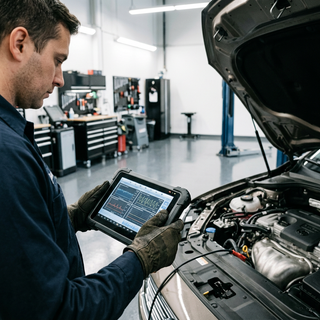
By contrast, professional diagnostic scan tools used by dealership technicians provide multi-system access, bi-directional control, and real-time live data graphing. Professional tools allow technicians to manually trigger fuel injectors, cycle purge valves, adjust idle speeds, and read specialized manufacturer data streams. For daily suburban commuters negotiating the rolling terrain around Calcutta, relying solely on an unverified parts store code printout often leads to buying unnecessary replacement sensors while leaving the true cause of the malfunction untreated.
When a check engine light appears, visiting our dealership facility at 1503 Pennsylvania Ave gives you access to advanced factory diagnostic equipment. Rather than blindly swapping parts, our team can verify system operation, test sensor voltages, and ensure you only order genuine OEM replacement parts when a physical component failure is truly confirmed. If you have questions about an active dashboard light, give our service team a quick call to discuss proper testing options.
Table of Contents
- Why Doesn't an OBD-II Trouble Code Point Directly to the Broken Part?
- What Is Freeze Frame Data in Vehicle Diagnostics?
- How Do Mechanical Failures and Bad Wiring Harnesses Trigger False Engine Codes?
- How Does an EVAP System Smoke Test Differ From Reading Trouble Codes?
- Why Does the Same Trouble Code Reappear After Installing a New Part?
- Why Do Service Departments Charge Diagnostic Fees for Trouble Code Inspections?
- Common Diagnostic Questions from Local Drivers
- Professional Diagnostic Support at Tri State Ford
Why Doesn't an OBD-II Trouble Code Point Directly to the Broken Part?
An OBD-II diagnostic trouble code does not point directly to a broken part because it only indicates that a specific electrical circuit or monitored operational parameter has operated outside programmed thresholds under federal 40 CFR 86.010-18 regulations. The code identifies the symptom detected by the engine control module, leaving technicians to investigate whether the root cause is a failed component, a wiring fault, a vacuum leak, or a mechanical defect.
Vehicle control units continually monitor sensor inputs using predefined voltage windows. When a reading falls above or below the expected range for a designated duration, the module logs a specific diagnostic trouble code (DTC). For example, code P0301 indicates a misfire detected on cylinder 1. While many drivers assume this code requires replacing the cylinder 1 spark plug, the misfire can stem from numerous distinct causes:
- A worn or fouled spark plug failing to ignite the air-fuel mixture
- A cracked or shorted ignition coil boot preventing voltage transfer
- A clogged or electrically faulted fuel injector starving the combustion chamber
- Low mechanical cylinder compression caused by a leaking valve or worn piston rings
- A vacuum leak near the intake runner altering the local air-fuel ratio
Control modules also differentiate between pending codes and confirmed codes. A pending code is recorded when a fault occurs during a single driving cycle, allowing the module to track potential issues without immediately illuminating the dashboard light. If the same fault persists across consecutive driving cycles, the module establishes a confirmed code and turns on the malfunction indicator lamp. Because a single fault code represents an entire operational system rather than an individual piece of hardware, systematic elimination testing remains essential for accurate repair.

What Is Freeze Frame Data in Vehicle Diagnostics?
Freeze frame data is a stored snapshot of real-time engine operating parameters captured automatically by the control module at the exact instant a diagnostic trouble code is triggered. It preserves crucial environmental and mechanical variables—including engine RPM, vehicle speed, engine load percentage, calculated fuel trims, and coolant temperature—giving technicians the exact context needed to replicate and diagnose the fault.
Analyzing freeze frame data allows technicians to determine whether an engine issue occurs under cold start conditions, during high-speed highway cruising, or while idling at a stoplight. For instance, if a lean air-fuel code P0171 is recorded alongside fuel trims exceeding positive 20 percent at idle, but those trims normalize at higher engine speeds, the freeze frame context strongly suggests a vacuum leak rather than a failing fuel pump.
- Engine Speed (RPM): Identifies whether the fault occurred at idle or high engine load.
- Coolant Temperature: Reveals if the issue is tied to engine warm-up or thermal expansion.
- Short-Term and Long-Term Fuel Trims: Shows how the control module adjusted fuel delivery to compensate for abnormal air ratios.
- Vehicle Speed and Calculated Load: Pinpoints whether acceleration, towing, or flat-road cruising triggered the warning lamp.
Our service advisors often see drivers clear warning lights with a basic hand-held scanner before visiting the shop, which erases this stored freeze frame record. Clearing the code wipes out the operational snapshot, forcing technicians to start from scratch or wait for the fault to recur before comprehensive testing can begin.
How Do Mechanical Failures and Bad Wiring Harnesses Trigger False Engine Codes?
Mechanical engine failures and physical wiring harness defects trigger false or misleading engine codes because electronic control units monitor component health strictly through electrical voltage signals. When damaged wiring, corroded ground terminals, or physical mechanical wear disrupt those electrical signals or airflow dynamics, the control module interprets the anomaly as a failing sensor even when the sensor itself is fully functional.
An electrical signal travels through a circuit consisting of power leads, harness connectors, internal sensor elements, and ground returns. If a wiring harness rubs against an engine bracket and chafes, the exposed copper can short to ground or create high electrical resistance. That resistance alters the return voltage received by the engine control module, causing it to set a sensor fault code. Replacing the sensor accomplishes nothing because the underlying wiring short remains untouched.
Mechanical failures distort sensor readings in a similar manner. Stretched timing chains, sticking internal engine valves, or heavy carbon accumulation across intake ports alter cylinder pressure and airflow velocity. When an engine experiences a mechanical vacuum drop or mechanical timing slip, sensors correctly report the abnormal conditions to the control module. The control module then flags codes for mass airflow sensors, manifold absolute pressure sensors, or oxygen sensors—not because those electronic sensors are broken, but because they are reporting true physical distortion caused by a mechanical breakdown. Drivers commuting through heavy stop-and-go traffic near Boardman often encounter wiring harness wear due to long-term engine bay heat cycling and vibration, illustrating why circuit verification must precede part replacement.
How Does an EVAP System Smoke Test Differ From Reading Trouble Codes?
An EVAP trouble code only alerts you to an unmetered air leak or pressure loss within the evaporative emissions control system, whereas a smoke test physically pinpoints the precise location of the leak by introducing pressurized, visible vapor into the sealed fuel vapor lines.
The evaporative emissions system captures volatile fuel vapors from the gas tank and routes them through a charcoal canister to be burned cleanly during engine operation. To monitor system integrity, the vehicle's computer performs automated pressure decay tests. If the system fails to hold vacuum, the computer logs codes such as P0442 for a small leak or P0455 for a large leak.
| Diagnostic Method | Capabilities | Limitations | Primary Purpose |
|---|---|---|---|
| EVAP Code Reading | Identifies system pressure failure; stores code | Cannot locate physical hole, crack, or loose fitting | Confirms an evaporative leak exists |
| Diagnostic Smoke Machine | Delivers dense, low-pressure vapor through lines; illuminates tiny cracks | Requires specialized shop equipment and connections | Visually isolates exact leak location |
Relying solely on an EVAP trouble code frequently leads drivers to replace the gas cap or purge valve unnecessarily. In many cases, the true source of the leak is a hairline crack in a plastic vapor line, a degraded filler neck gasket, or a rusted charcoal canister fitting. A diagnostic smoke machine pumps dense vapor mixed with specialized dye into the sealed system at low pressure. As smoke escapes from the precise point of failure, technicians can instantly spot the leak location without guessing or replacing functional components.
Why Does the Same Trouble Code Reappear After Installing a New Part?
A diagnostic trouble code reappears after installing a new part when the underlying root cause—such as damaged electrical wiring, clogged vacuum passages, poor ground connections, or uncalibrated software—was never resolved during the initial part swap.
Replacing a component based strictly on a fault code treats the symptom recorded by the computer rather than the conditions that caused the symptom. Common reasons a trouble code returns after a part installation include:
- Unresolved Circuit Defects: The new sensor cannot transmit accurate data if the wiring harness has internal corrosion, a backed-out pin connector, or high ground resistance.
- Secondary System Contamination: Installing a new mass airflow sensor will not fix a code if oil residue from a crankcase breather immediately coats the fresh sensing element.
- Missing System Recalibrations: Modern vehicles often require adaptive relearn procedures or bi-directional calibration commands using a professional scan tool after replacing throttle bodies, sensors, or actuators.
- Misdiagnosed Root Cause: Replacing an oxygen sensor when the true issue is a cracked exhaust manifold leaking ambient air upstream forces the computer to log the same fault code during subsequent monitor sweeps.
Systematic diagnosis prevents this repetitive cycle by verifying signal integrity, mechanical soundness, and control module responses before any new component is installed.
Why Do Service Departments Charge Diagnostic Fees for Trouble Code Inspections?
Service departments charge diagnostic fees because retrieving a code is merely the initial step in a multi-stage physical and electrical testing process performed by trained automotive technicians. The fee covers dedicated technical labor, factory scan equipment, multi-meter circuit testing, and specialized diagnostic instruments required to accurately isolate a vehicle's true root cause.
A quick code scan takes less than a minute, but interpreting that code and proving which component failed requires extensive technical expertise. Diagnostic testing involves retrieving stored freeze frame parameters, performing guided factory pinpoint routines, inspecting wiring schematics, testing circuit voltages, and conducting mechanical pressure or smoke tests. Paying for targeted diagnostic labor protects vehicle owners from wasting hundreds of dollars on unneeded replacement parts through trial-and-error guessing.
When you bring your vehicle to our East Liverpool facility, our certified technicians connect factory-grade scan tools to evaluate complete live data streams and perform active bi-directional component tests. If your check engine light is active, schedule a service appointment online or contact our team directly at (330) 462-7578 to ensure your vehicle receives accurate, professional diagnostic care.
Common Diagnostic Questions from Local Drivers
Q: What is the difference between a steady check engine light and a flashing check engine light?
A steady check engine light indicates an illuminated fault that requires professional inspection but allows brief, cautious driving. A flashing check engine light signals a severe active engine misfire that allows unburned fuel to pour into the exhaust system, creating extreme heat that can rapidly destroy the catalytic converter. If your warning light begins flashing, you should immediately reduce engine load, pull over safely, and arrange vehicle transport to avoid catastrophic exhaust or engine damage.
Q: Can a loose gas cap cause a check engine light to turn on?
A loose or damaged gas cap prevents the evaporative emissions control system from sealing properly, causing the engine control module to detect a pressure leak and trigger a fault code. Tightening the gas cap securely resolves the physical leak, though it typically takes several complete driving cycles for the control module to run its automated self-test routine and turn off the dashboard light.
Q: Will clearing a trouble code fix the vehicle's underlying problem?
Clearing a trouble code only resets the dashboard light and erases stored freeze frame data from the control module's memory. It does not repair electrical short circuits, fix mechanical wear, or seal vacuum leaks. If the underlying fault remains uncorrected, the engine control module will detect the anomaly during its next monitoring cycle and re-illuminate the light.
Q: Why does my car drive normally even though the check engine light is illuminated?
Modern engine control units use pre-programmed default values to maintain operation when certain sensor inputs fail, allowing the vehicle to operate in a fail-safe mode. Although the vehicle may feel normal during casual driving, running on default software maps reduces fuel efficiency, increases tailpipe emissions, and can gradually accelerate wear on secondary emissions hardware over time.
Q: How long does a thorough diagnostic inspection take at a service center?
A comprehensive diagnostic inspection typically takes between one and two hours depending on the complexity of the fault. Technicians must pull stored module data, execute guided factory pinpoint test procedures, verify circuit voltages with digital meters, and physically test mechanical components to confirm the exact failure point before recommending repairs.
Professional Diagnostic Support at Tri State Ford
Understanding why a trouble code doesn't tell the whole story saves vehicle owners time and money by preventing unnecessary parts replacement. Diagnostic codes serve as helpful signposts, pointing technicians toward a monitored system, but confirming the exact failure requires professional testing tools, circuit verification, and trained mechanical expertise.
At Tri State Ford, our factory-trained service technicians utilize advanced diagnostic equipment to isolate electrical and mechanical issues quickly and accurately. Whether your vehicle requires pinpoint circuit testing, live data stream analysis, or specialized system smoke testing, our team provides transparent, expert care to keep your vehicle running dependably. Contact our service department today to address your check engine light with trusted, thorough diagnostic support.