
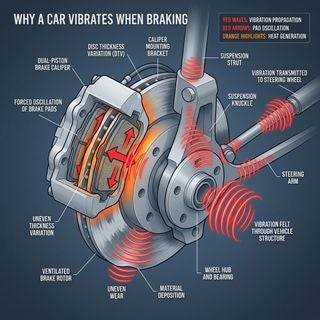
A car vibrates when braking primarily due to disc thickness variation across warped brake rotors, which causes the brake pads to bounce unevenly against the rotor surface. Sticking caliper pistons, uneven pad wear, loose wheel lug nuts, out-of-balance tires, or worn front suspension components like ball joints and tie rods can also cause or magnify this shaking under braking load.
When you press the brake pedal, hydraulic fluid pushes the brake caliper pistons outward, clamping the brake pads tightly against both sides of the spinning metal brake rotor. This friction converts forward momentum into kinetic heat, slowing your vehicle down. When all components are in good working order, the rotor surface is flat and parallel, producing smooth deceleration. If the rotor develops uneven thickness or runout, the pads lose constant friction contact, sending violent vibrations back through the hydraulic brake lines and vehicle frame.
The location of the vibration often points directly to the source of the mechanical issue:
- A pulsating brake pedal usually indicates uneven wear or thermal warping on the rear brake rotors, as fluid pressure shifts back into the pedal hydraulic circuit.
- A shaking steering wheel during deceleration points to front brake rotor thickness variation, since front rotors handle up to 70 percent of total stopping force and transfer kinetic movement directly into the steering geometry.
- Body-wide shaking that occurs only at highway speeds can indicate a combination of sticking calipers, unbalanced wheel assemblies, or degraded suspension bushings.
Ignoring braking vibration accelerates wear across your vehicle's entire stopping system. Persistent shuddering places severe stress on wheel bearings, steering linkages, and suspension struts. According to NHTSA data on vehicle component failures, brake-related defects are cited in roughly 22 percent of crashes caused by mechanical failure. Addressing brake shudder as soon as it appears preserves vehicle control and prevents costly secondary repairs. If you notice pedal pulsation or steering wobble, stop by our service center on Pennsylvania Avenue or give our team a quick call to get a professional evaluation and ensure your vehicle's safety.
 Table of Contents
- How Do Warped Rotors and Disc Thickness Variation Cause Pedal Pulsation?
- How Do Sticking Calipers and Brake Pad Issues Cause Braking Vibration?
- What Mechanical Components Besides Brakes Can Cause Shaking During Braking?
- How Much Does It Cost to Replace Brake Pads and Rotors Versus Resurfacing?
- Frequently Asked Questions About Vehicle Shaking When Braking
- Schedule Professional Brake Inspection and Maintenance
How Do Warped Rotors and Disc Thickness Variation Cause Pedal Pulsation?
Warped rotors and disc thickness variation cause pedal pulsation because uneven high and low spots on the metal disc force hydraulic brake fluid back through the caliper pistons into the pedal circuit. As the rotor turns between the pads, the varying thickness causes the caliper piston to extend and retract rapidly, creating rhythmic pressure pulses felt directly under your foot.
Rotors rarely bend out of shape like a warped piece of plastic. Instead, rotor warping usually stems from uneven thermal expansion or pad material deposition. Hard braking generates extreme friction, pushing rotor temperatures above 600 degrees Fahrenheit. If you hold the brake pedal down continuously while stopped after a heavy braking event, hot brake pad friction material can transfer onto one specific spot on the rotor disc. This localized layer of material creates a microscopic high spot. Over thousands of miles, that high spot creates additional friction, building up localized heat and wearing the metal unevenly until disc thickness variation develops.
Lateral runout represents another distinct rotor defect that creates braking shudder. Lateral runout occurs when the rotor does not spin perfectly true relative to the wheel hub axis, wobbling side-to-side as it rotates. Common causes of lateral runout include:
- Rust or debris trapped between the wheel hub face and the rotor hat during previous service.
- Improperly torqued lug nuts that distort the thin hat section of the brake rotor.
- Excessive bearing play inside a worn wheel hub assembly.
When lateral runout is present, the rotor disc pushes against the inner and outer brake pads alternately with every tire rotation. This side-to-side deflection creates severe pulsation in the brake pedal and can generate a distinct metallic scrubbing sound during light braking application.
How Do Sticking Calipers and Brake Pad Issues Cause Braking Vibration?
Sticking caliper guide pins or seized pistons maintain continuous pad contact against the rotor, generating extreme frictional heat that distorts the metal disc and causes heavy shuddering. When a caliper operates correctly, internal rubber square-cut seals retract the piston slightly when you release the pedal, allowing the pads to clear the rotor surface.
Corrosion, road salt, or dried slider grease can cause caliper slide pins to bind inside their rubber boots. When slide pins seize, the caliper cannot center itself over the rotor, forcing the inner brake pad to drag constantly against the disc surface. This friction generates localized thermal stress, blue heat-discoloration on the rotor face, and severe vibration that intensifies as brake components reach elevated operating temperatures.
Brake pad defects also directly contribute to braking shudder without rotor damage being the sole cause:
- Glazed brake pads occur when friction material overheats beyond its rated temperature ceiling, hardening the pad surface into a glassy, slick texture that slips and grabs violently across the rotor face.
- Uneven pad wear, where one side of the pad friction material thins down to the steel backing plate, allows raw metal-on-metal grinding that gouges deep grooves into the rotor face.
- Contaminated pad surfaces from leaking axle grease, brake fluid, or road debris disrupt friction continuity, causing the pad to grab sporadically under heavy hydraulic pressure.
When brake pads drag continuously, friction temperatures can degrade the internal bonding resins within the pad material. This thermal breakdown leaves sticky, uneven deposits across the rotor, exacerbating vehicle vibration every time you slow down.
What Mechanical Components Besides Brakes Can Cause Shaking During Braking?
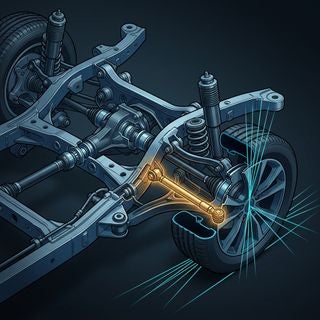
Suspension and steering components—including worn control arm bushings, bad ball joints, loose tie rod ends, degraded wheel bearings, and unbalanced tires—can cause vehicle shaking during braking by allowing wheel assemblies to shift when weight transfers forward. When you slow down, forward inertia loads the front suspension, pushing wheel components forward and outwards.
If steering or suspension joints have excess mechanical play, the front wheels can wobble or oscillate under heavy braking pressure, mimicking the exact symptoms of a warped rotor. Worn lower control arm bushings permit the entire hub assembly to move backward under braking load, altering front wheel toe and caster angles. Loose tie rod ends allow front wheels to flutter side-to-side, transferring violent shaking into the steering column.
Non-brake mechanical issues that frequently cause or amplify braking vibration include:
- Out-of-balance or bent wheel rims that wobble at specific road speeds and shake heavily under braking force.
- Separated tire treads or uneven tire tread wear, which create rhythmic hop patterns that intensify when hydraulic pressure loads the suspension.
- Degraded strut mounts and worn shock absorbers that fail to dampen wheel hop during hard deceleration stops.
- Loose or improperly torqued lug nuts that allow the wheel rim to shift against the wheel hub face.
Suburban commuter driving over varying road surfaces puts steady stress on steering linkages and control arm bushings. For instance, navigating rolling suburban hills around Calcutta along State Route 170 demands consistent brake application on downhill grades, placing heavy forward weight transfers on front control arm bushings. When replacing worn front-end components or performing brake overhauls, installing genuine OEM replacement parts ensures factory-spec tolerances, precise fitment, and long-term durability for your vehicle's steering geometry.

How Much Does It Cost to Replace Brake Pads and Rotors Versus Resurfacing?
Replacing brake pads and rotors on a single axle typically costs between $250 and $500 for parts and labor, while machining or resurfacing existing rotors generally costs $100 to $200 per axle if enough rotor thickness remains above the minimum discard specification. Total costs vary based on vehicle classification, rotor material type, and labor requirements.
Resurfacing—often called turning rotors—uses a precision brake lathe to cut away microscopic layers of metal, restoring a flat, parallel surface free from lateral runout and friction deposits. Technicians measure rotor thickness using a micrometer before machining. Every rotor housing has a minimum discard thickness stamped directly onto the casting. If turning the rotor removes enough metal to drop below this minimum specification (typically leaving less than 30 to 60 thousandths of an inch of usable material), resurfacing is unsafe. Thin rotors cannot dissipate friction heat effectively, leading to rapid re-warping and potential structural cracking.
Key economic factors to evaluate when choosing between turning or replacing rotors include:
- Rotor overall condition: Deep rust pitting, stress fractures, or heavy heat grooves mean the rotor must be replaced rather than resurfaced.
- Axle balancing requirements: Replacing pads and rotors across both wheels on an axle guarantees symmetrical stopping power and consistent pedal feel.
- Long-term value: Modern rotors are designed thinner to save vehicle weight, meaning many current rotors lack sufficient metal margin for safe lathe resurfacing.
Navigating the steep riverfront bluffs in East Liverpool requires complete confidence in your vehicle's stopping capability. Installing fresh rotors alongside new brake pads eliminates old wear patterns, prevents immediate pad contamination, and provides quiet, reliable deceleration across varied terrain.
Frequently Asked Questions About Vehicle Shaking When Braking
Q: What is the most common cause of steering wheel shake during braking?
Warped front brake rotors or disc thickness variation on the front axle are the primary causes of steering wheel shake during deceleration. Because the front brakes provide the majority of vehicle stopping power, uneven high spots on front rotors push rhythmically against the caliper pads, sending kinetic energy directly up through the steering knuckle, tie rods, and steering column.
Q: Can loose wheel lug nuts cause a car to vibrate when applying the brakes?
Yes, loose wheel lug nuts permit the wheel assembly to wobble on the hub, producing pronounced vibration under braking load. Loose fasteners also apply uneven clamping pressure across the rotor hat, artificially flexing the metal rotor disc and causing temporary or permanent lateral runout that mimics a warped rotor while creating a severe wheel separation hazard.
Q: Is it safe to drive a car that vibrates when braking?
Driving a vehicle with braking vibration is not safe because shaking reduces pad-to-rotor friction contact, increasing total stopping distances. Persistent vibration damages wheel bearings, suspension bushings, and steering joints over time, and severe vibration caused by loose lug nuts or sticking calipers can lead to component failure or loss of vehicle control.
Q: What is the difference between pedal pulsation and steering wheel vibration?
Pedal pulsation specifically indicates thickness variation or runout on the rear brake rotors pushing hydraulic fluid backward through the brake lines into your foot. Steering wheel vibration points directly to front brake, front suspension, or steering linkage issues, as front wheel movement transfers mechanical motion directly into the steering system.
Q: Why should brake pads always be replaced when installing new rotors?
Old brake pads develop uneven wear grooves and friction material patterns that mirror the surface defects of the old rotors. Installing old pads onto smooth, new rotors prevents proper pad bedding, reduces initial braking efficiency, generates noise, and transfers old friction deposits onto the new rotor face, causing premature vibration.
Schedule Professional Brake Inspection and Maintenance
If your vehicle exhibits pedal pulsation, steering wheel shake, or grinding noises during deceleration, our factory-certified service center is ready to help. Our technicians use precision diagnostic tools, micrometers, and dial indicators to measure rotor runout, inspect caliper slide pin operation, and evaluate front suspension bushings to isolate the exact cause of braking vibration.
We install genuine OEM brake components engineered specifically for your vehicle, ensuring quiet operation, proper heat dissipation, and long-lasting stopping performance. Whether your vehicle requires precision rotor resurfacing, new brake pads, caliper pin lubrication, or front suspension repairs, our service team delivers transparent recommendations and reliable care.
Do not compromise your family's road safety with vibrating or fading brakes. To restore smooth, dependable stopping power, stop by our East Liverpool service department, give us a quick call, or easily schedule a service appointment online today.