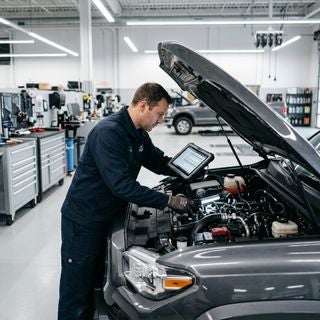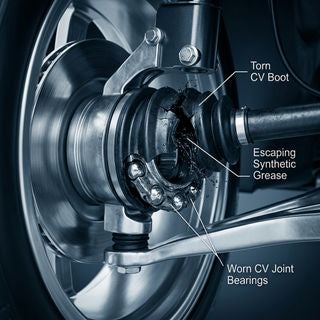

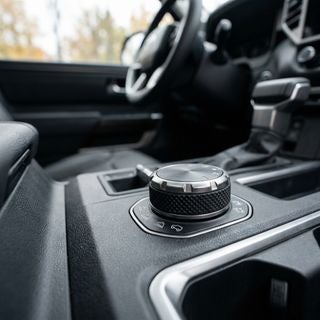
Preparing a Ford four-wheel-drive system for winter requires inspecting the transfer case and differential fluid levels, testing electronic or vacuum-operated axle engagement actuators, verifying battery output, and checking tire tread depth. Technicians also confirm that terrain management features like Slippery mode function correctly. Completing these checks before sub-freezing temperatures arrive prevents component binding, sluggish front-axle engagement, and unexpected traction loss on frozen roads.
Early winter weather brings sudden freeze-thaw cycles, packed snow, and river valley fog that turn local asphalt slick without warning. A four-wheel-drive truck or SUV relies on mechanical and electronic coordination between the transmission, transfer case, front differential, and wheel hubs. If fluid inside the transfer case is degraded or contaminated with moisture, low ambient temperatures increase fluid viscosity, causing delayed mechanical engagement when switching from two-wheel drive to four-wheel drive.
A thorough pre-winter checkup evaluates every component involved in transferring torque:
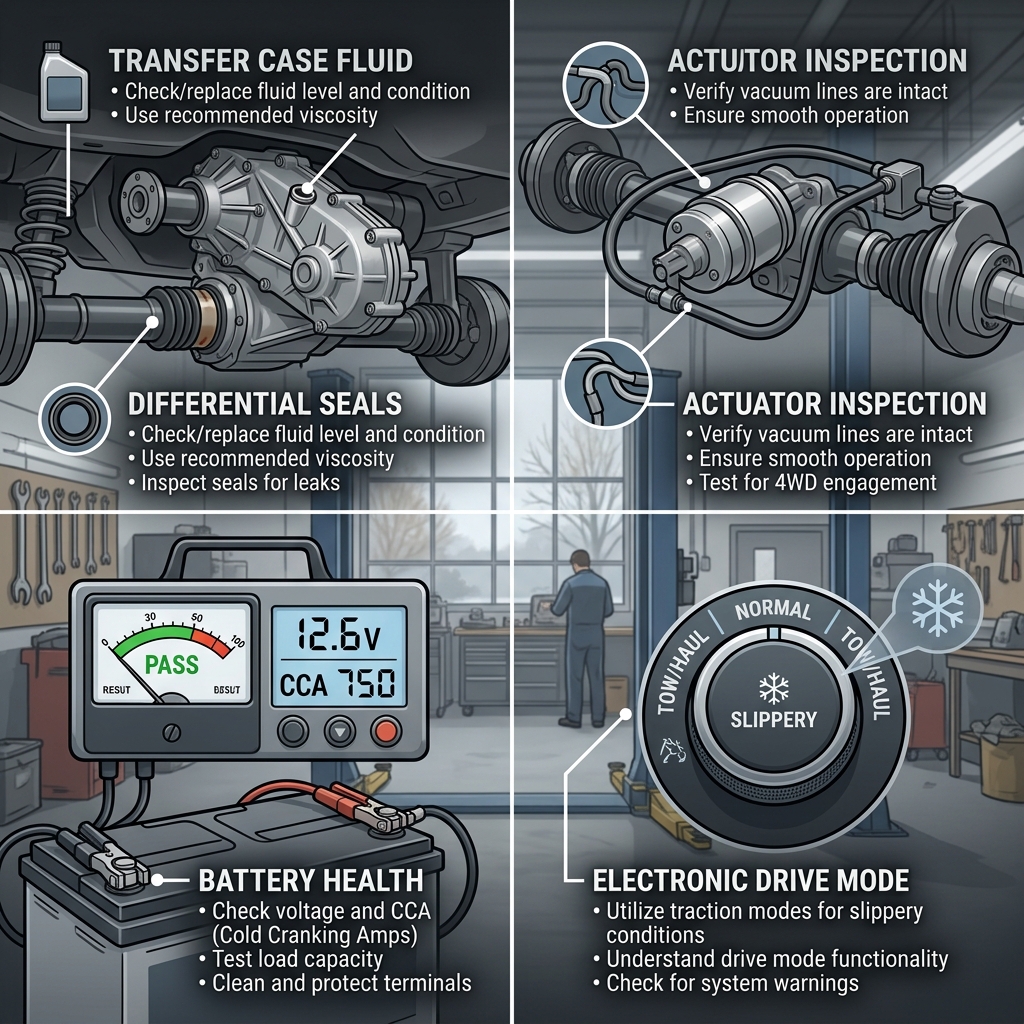
- Transfer Case and Differential Fluid: Inspecting fluid levels and checking for dark color or metal shavings that signal internal wear.
- Hub Engagement Motors and Actuators: Testing integrated wheel ends and vacuum lines to ensure prompt front axle locking is functioning properly.
- Drive Mode Electronics: Running diagnostic checks on drive mode switches to verify communication with the powertrain control module.
- Battery Cold-Cranking Capacity: Measuring battery voltage under load, as electronic four-wheel-drive actuators draw significant electrical power during engagement.
- Undercarriage and Fastener Condition: Checking protective skid plates and differential housing seals for signs of seepage or road-salt corrosion.
Drivers navigating rolling elevation changes along State Route 170 in Calcutta depend on immediate front-wheel traction when pulling onto snow-dusted highways. If an actuator fails or transfer case fluid breaks down, drivers may find themselves stranded in rear-wheel drive when road conditions deteriorate. To keep your truck or SUV performing dependably in freezing conditions, you can stop by our East Liverpool facility or give our service department (330) 462-7578 to confirm current appointment availability.
Table of Contents
- What Maintenance and Fluid Specifications Are Recommended for Ford Transfer Cases?
- How Fast Does Ford Intelligent 4WD Adjust Power Distribution on Slick Ice?
- Is 4WD Auto Safer Than 4WD High on Roads with Patchy Ice and Dry Pavement?
- Does Having Four-Wheel Drive Eliminate the Need for Winter Tires in Cold Weather?
- How Much Does a Winter 4WD Inspection Cost for a Ford Truck or SUV?
- Common Questions About Ford 4WD Winter Operation
- Where Can Ford Owners Arrange a Local Pre-Winter Inspection?
What Maintenance and Fluid Specifications Are Recommended for Ford Transfer Cases?
Ford transfer cases require specialized lubricants like Motorcraft MERCON LV or dedicated Motorcraft Transfer Case Fluid, with inspections recommended every 10,000 miles and fluid replacement typically scheduled between 30,000 miles and 60,000 miles depending on operating severity. Using non-approved lubricants or neglecting fluid changes leads to fluid oxidation, premature clutch pack wear, and internal gear scoring in severe winter cold.
The transfer case is responsible for splitting engine torque between the front and rear axles. Modern Ford vehicles employ electronically controlled transfer cases equipped with internal multi-plate clutch packs. These internal clutches engage seamlessly to direct power forward whenever rear-wheel slip is detected. Over time, thermal cycles, towing friction, and normal mechanical wear break down the fluid's additive package. Degraded fluid loses its ability to lubricate internal chain drives and planetary gear sets, increasing mechanical friction when ambient temperatures fall below freezing.
When servicing a Ford transfer case, technicians follow precise factory maintenance procedures:
- Draining old lubricant and inspecting magnet drain plugs for fine metal particles.
- Checking vent hoses for blockages that could cause pressure buildup and seal leaks.
- Refilling the transfer case with exact quantities of factory-specified Motorcraft fluid.
- Inspecting output shaft seals and front driveshaft universal joints for play or fluid weeping.
- Cycling the four-wheel-drive system through 4H and 4L settings to verify smooth actuator movement and silent gear mesh.
Vehicles subjected to heavy trailering or frequent operation in mud and deep snow require shorter maintenance intervals. For example, a 2026 Ford F-150 4x4 equipped with the 3.5L EcoBoost V6 and SelectShift® automatic transmission can tow up to 10,400 lbs, placing heavy thermal stress on transfer case fluid during summer hauling that can manifest as rough engagement when winter arrives. To maintain peak driveline performance, owners can schedule a service appointment with our factory-trained team or order genuine Motorcraft fluids and components directly from our parts department.
How Fast Does Ford Intelligent 4WD Adjust Power Distribution on Slick Ice?
Ford Intelligent 4WD samples vehicle sensor data every 16 milliseconds and can dynamically transfer up to 100 percent of available engine torque to either the front or rear axle before wheel slip occurs. By continuously analyzing wheel speed, throttle position, steering wheel angle, and yaw rates, the system pre-emptively distributes power to maintain vehicle stability on icy roads.
Unlike traditional four-wheel-drive setups that require manual driver activation after traction is lost, Intelligent 4WD operates proactively. On models like the 2026 Ford Explorer 4WD, powered by the 2.3L EcoBoost engine and SelectShift® transmission, sensors monitor small changes in driver input and surface friction. If the system detects sudden throttle application while accelerating on a frost-covered bridge deck, it instantly energizes an electromagnetic clutch inside the power transfer unit. This locks the front driveline into action within milliseconds, stabilizing the vehicle before the driver notices wheelspin.
Electronic drive modes further refine how this power transfer behaves in winter:
- Slippery Mode: Calibrates the accelerator pedal response to prevent abrupt power delivery, adjusts transmission shift points to reduce wheel torque, and increases stability control intervention.
- Deep Snow/Sand Mode: Adjusts traction control parameters to allow momentum-building wheelspin while maintaining active torque balance across both axles.
- Trail Mode: Tailors wheel-end braking and throttle mapping on select two-wheel-drive configurations to assist with low-traction off-road navigation.
On models like the 2026 Ford Bronco 4x4, standard four-wheel drive works in tandem with selectable G.O.A.T. Modes (Goes Over Any Type of Terrain) to manage slick conditions automatically. When Slippery mode is selected, electronic control units soften throttle mapping and optimize front-to-rear power distribution, giving drivers maximum steering control across slush, black ice, and packed snow.
Is 4WD Auto Safer Than 4WD High on Roads with Patchy Ice and Dry Pavement?
Using 4A (4WD Auto) is safer and mechanically superior to 4H (4WD High) when driving on winter roads that alternate between icy patches and clear, dry asphalt. In 4A mode, an electronically controlled clutch continuously varies front-wheel power on demand, whereas 4H mechanically locks the front and rear driveshafts together at a rigid 50/50 split, causing severe driveline binding on high-traction dry pavement.
Mechanical driveline binding occurs because front tires must travel along a wider turning arc than rear tires during cornering. On dry asphalt, tires grip the road surface firmly, preventing the front and rear axles from slipping to relieve rotational speed differences. Driving in 4H on dry pavement places immense torque strain on the transfer case chain, front differential gears, and axle shafts, often resulting in vehicle hopping or hard steering resistance.
| Drivetrain Mode | Surface Application | Front/Rear Power Split | Driveline Binding Risk on Dry Pavement |
|---|---|---|---|
| :-- | :-- | :-- | :-- |
| 4A (4WD Auto) | Patchy ice, slush, dry pavement | Variable (0/100 to 50/50 on demand) | None (clutch slips during turns) |
| 4H (4WD High) | Continuous deep snow, unpaved ice | Fixed 50/50 split | High (causes mechanical strain and binding) |
| 4L (4WD Low) | Deep mud, steep off-road grades | Fixed 50/50 split with gear reduction | Extreme (strictly for low-speed off-road use) |
When our service advisors walk truck owners through seasonal driving tips, we explain that leaving a vehicle in 4A during changing winter conditions provides seamless traction without risking driveline damage. Operating in 4A mode uses slightly more fuel than two-wheel drive due to mechanical rotation of front driveline components, but it provides immediate, automatic front-wheel torque the moment a tire hits unexpected black ice.
Does Having Four-Wheel Drive Eliminate the Need for Winter Tires in Cold Weather?
Having four-wheel drive does not eliminate the need for winter tires because four-wheel drive only enhances forward acceleration and traction under engine power, whereas winter tires provide necessary cornering grip and stopping capability on snow and ice. All four-wheel-drive vehicles rely on tire tread compounds and siping to brake and steer effectively on frozen road surfaces.
Four-wheel drive helps a vehicle accelerate out of deep snow or climb slick grades by sending torque to all four wheel positions. However, when a driver applies the brakes or turns the steering wheel, every passenger vehicle relies entirely on the friction coefficient of its four tire contact patches. Standard all-season tire rubber hardens at ambient temperatures below 45 degrees Fahrenheit, turning stiff and losing flexibility. Winter tires utilize specialized soft silica tread compounds that remain pliable in sub-zero cold, combined with thousands of microscopic tread sipes that bite directly into packed snow and ice.
Key safety differences between four-wheel drive and dedicated winter tires include:
- Braking Distance: Four-wheel drive provides zero assistance during braking; dedicated winter tires can reduce stopping distances on ice by up to 30 percent compared to standard tires.
- Lateral Steering Control: Winter tires maintain directional control through curves where hard all-season tires slide sideways, regardless of four-wheel-drive engagement.
- Slush Evacuation: Wide, directional winter tread grooves channel thick road slush away from the footprint to prevent dangerous hydroplaning.
Maintaining correct tire pressures and tread depth above 4/32 inch is critical for all-wheel-drive and four-wheel-drive powertrains. Uneven tire wear or differing inflation pressures change rolling circumference between axles, placing continuous strain on transfer case clutch packs. Vehicle owners can utilize our online tire finder tool to select winter tires matching their vehicle's exact specifications, or schedule a drive in a 4WD vehicle to evaluate current handling characteristics firsthand.
How Much Does a Winter 4WD Inspection Cost for a Ford Truck or SUV?
A comprehensive winter four-wheel-drive system inspection for a Ford truck or SUV may vary in price; please contact our service department for current pricing. This specialized service covers diagnostic fluid analysis, vacuum line pressure checks, electronic hub actuator testing, transfer case shift motor operation, and undercarriage fastener verification.
Investing in a pre-winter inspection protects expensive driveline assemblies against major mechanical failure. Identifying a torn vacuum hub line or a leaking transfer case shaft seal early costs significantly less than replacing a damaged differential or burned-out internal clutch pack later in the season. During a winter inspection, factory-trained technicians connect diagnostic scan tools to monitor live data from the transfer case control module, ensuring electrical signals reach engagement solenoids without fault codes.
A standard winter four-wheel-drive inspection covers key multi-system checks:
- Diagnostic System Scan: Checking control modules for active or stored fault codes related to four-wheel-drive electronics.
- Fluid Clarity and Level Checks: Inspecting fluid quality inside the transfer case, front differential, and rear axle housing.
- Vacuum and Mechanical Actuator Testing: Verifying that integrated wheel end hubs lock and release smoothly without vacuum leaks.
- Transfer Case Shift Motor Test: Cycling the electronic motor through 4H and 4L ranges to verify swift gear engagement.
- Underbody Visual Inspection: Checking driveshaft universal joints, CV axle boots, and skid plate mountings for wear or looseness.
Business owners operating commercial fleets rely heavily on four-wheel-drive reliability to maintain winter schedules. For fleet managers reviewing options for heavy-duty fleet additions, exploring our new work truck models provides access to reliable F-Series pickups built to handle severe winter hauling.
Common Questions About Ford 4WD Winter Operation
Q: Can I engage 4H mode while driving at highway speeds?
Yes, Ford shift-on-the-fly four-wheel-drive systems allow drivers to shift from 2H into 4H at speeds up to 55 mph, provided the rear wheels are not actively slipping at the moment of engagement. However, 4H should only be engaged when travelling on continuously slippery surfaces like deep snow or loose gravel, never on clear dry asphalt.
Q: What does a flashing 4x4 light on my instrument cluster mean?
A flashing 4x4 indicator light signals that the electronic control module attempted to engage the four-wheel-drive system but could not confirm mechanical lockup. This issue is often caused by a vacuum line leak, a sticking integrated wheel end hub actuator, or a slow transfer case shift motor, requiring a quick diagnostic scan by factory technicians.
Q: Why does my vehicle make a binding or crowhopping noise during tight turns in 4H?
Crowhopping occurs because 4H mechanically locks the front and rear driveshafts to rotate at identical speeds. During a tight turn, front tires must spin faster than rear tires; on high-traction pavement, the driveline binds and forces the tires to hop. Shifting into 4A or back into 2H on clear pavement resolves this stress immediately.
Q: Does driving in 4WD mode reduce my Ford's fuel economy?
Operating in 4A or 4H mode increases mechanical drag across the front axle, driveshaft, and transfer case components, which slightly reduces fuel economy by approximately 1 to 2 mpg compared to two-wheel drive. Using four-wheel drive selectively on slick roads balances winter safety with efficient fuel usage.
Q: How often should front and rear differential fluids be changed on a Ford 4x4?
Ford factory maintenance schedules generally recommend replacing front and rear differential fluids every 30,000 miles to 60,000 miles, or sooner if the axle assemblies are frequently submerged in water or subjected to heavy trailer towing in severe winter conditions.
Where Can Ford Owners Arrange a Local Pre-Winter Inspection?
Ford owners can arrange a comprehensive pre-winter vehicle inspection at Tri State Ford, located at 1503 Pennsylvania Ave, East Liverpool, OH 43920. Our service department is fully equipped with Ford specialized diagnostic computers, factory-certified technicians, and genuine Motorcraft replacement parts to ensure your truck or SUV is completely prepared for cold weather.
Navigating the steep riverfront bluffs along the Ohio River in East Liverpool requires reliable braking, healthy tires, and responsive four-wheel-drive engagement during frosty morning commutes. Our factory-trained technicians conduct thorough multi-point checks that evaluate battery cold-cranking health, transfer case fluid condition, brake pad friction thickness, and drive mode module calibration. Documenting every inspection in Ford's central database protects your original factory warranty coverage and preserves long-term vehicle resale value.
Before freezing temperatures and icy road conditions settle across the region, taking time for routine maintenance gives you complete confidence behind the wheel. You can get clear directions to our location to visit our service center, or call (330) 462-7578 to speak directly with our service advisors and reserve your pre-winter inspection date.
© 2026 Tri State Ford. All rights reserved.