

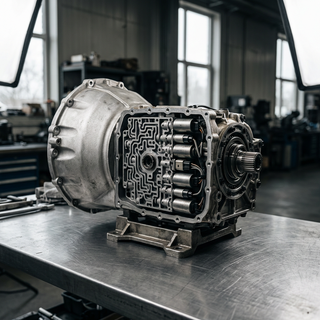
Blog / Maintenance & Service, Expert Repairs & Diagnostics, Genuine Parts & Accessories, Engine Care &

Is a Ford Protect Extended Service Plan Worth Buying for Truck Transmission Protection?

d

Is a Ford Protect Extended Service Plan Worth Buying for Truck Transmission Protection?

Is a Ford Protect Extended Service Plan Worth Buying for Truck Transmission Protection?

A Ford Protect Extended Service Plan is worth the investment for truck owners planning to keep their pickup beyond the factory 5-year/60,000-mile powertrain warranty, because major internal transmission repairs routinely exceed the plan's cost. With internal mechanical repairs or full unit replacements on modern transmissions running thousands of dollars, a factory-backed plan provides guaranteed repair coverage using genuine components installed by factory-trained technicians without out-of-pocket exposure beyond your chosen deductible.

In my decade running our service department, truck owners often weigh coverage options right around their scheduled maintenance checkups. Factory powertrain protection offers solid initial security, but modern heavy-duty drivetrains operate under demanding conditions. When hauling heavy loads or navigating steep river valley climbs, internal heat and mechanical stress build up over tens of thousands of miles. A Ford Protect plan covers key mechanical assemblies like the planetary gear sets, valve body, torque converter, and electronic control solenoids. Unlike many third-party service contracts that dispute diagnostic charges or require salvaged internal parts, a Ford plan covers diagnostic labor and uses direct factory parts.

Modern pickup electronics also integrate heavily with the powertrain control modules. If low electrical voltage triggers communication faults or erratic solenoid switching, our technicians run comprehensive electrical checks, including routine battery service testing, before diving into mechanical tear-downs. If you want to consult directly with our service advisers about plan coverage, you can give our team a quick phone call or stop by our service desk at 1503 Pennsylvania Ave to review vehicle-specific options.

Table of Contents

Common Warning Signs of Ford Truck Transmission Trouble

The earliest warning signs of transmission distress in Ford trucks include delayed gear engagement, harsh upshifts between specific gears, shuddering under steady cruising speeds, and unexpected hesitation during deceleration. Catching these drivability symptoms early prevents localized mechanical wear, such as clutch plate glazing or valve body contamination, from spreading metal debris through the fluid passages and ruining the planetary gear sets.

Gear engagement delays often become noticeable when shifting from park into drive or reverse after the truck sits overnight. A noticeable two-to-three-second pause followed by an abrupt clunk indicates that line pressure is bleeding off internally. On the road, drivers frequently notice erratic behavior when the gearbox transitions between third, fourth, and fifth gears, or when slowing down to a complete stop and feeling a hard bump as the gearbox drops into first gear. Another frequent complaint is a sudden sensation like driving over highway rumble strips under light throttle between 35 and 55 mph.

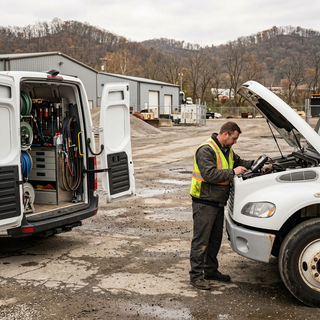
Ignoring these early symptoms leads to increased friction and high internal operating temperatures. Metal shavings from dragging clutch packs quickly circulate through the oil cooler and lodge in fine valve body bores. For truck owners managing busy work schedules who cannot make an immediate trip to our shop for minor inspections or preliminary diagnostic scans, our Ford mobile service unit can handle routine inspections, select recall checks, and scheduled maintenance directly in your driveway or job site.
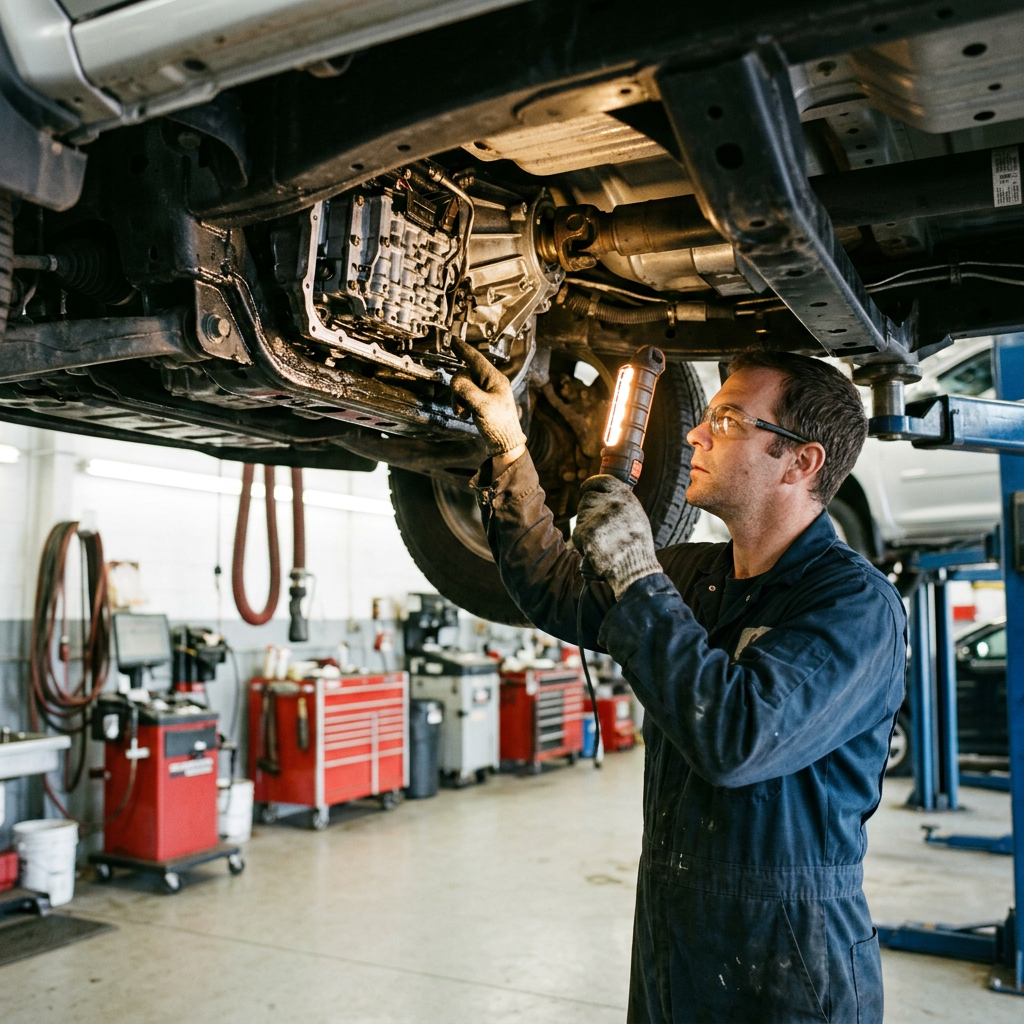
Mechanic holding a work light to inspect the undercarriage and transmission of an elevated car in a repair shop. (Representative image for illustration purposes only. Actual vehicle may vary based on trim and configuration.)

What Causes Shuddering, Vibration, and Harsh Shifts in Ford 10-Speed Transmissions?

Shuddering and harsh shifting in the 10R80 10-speed automatic transmission stem primarily from torque converter clutch slippage, degraded fluid viscosity, sticking valve body solenoids, or internal sleeve migration within earlier CDF clutch drum assemblies. When these mechanical or hydraulic faults develop, the transmission control module cannot maintain precise clutch apply pressures, leading to harsh clunks, gear hunting, and persistent low-frequency vibration.

The CDF clutch drum issue represents the most significant mechanical failure point on units manufactured before mid-August 2022. Inside earlier iterations of the drum, the internal cylindrical bushing sleeve lacked a positive mechanical stop. Under continuous heat cycles and hydraulic pressure, this sleeve could walk or slide axially along the shaft. As the sleeve moved out of position, it partially blocked critical hydraulic oil feed passages. This fluid restriction causes pressure loss across the C, D, and F clutch packs, resulting in severe gear slipping, delayed shifts, and intermittent neutral dropouts under load. Ford subsequently updated the assembly by engineering a revised drum with a machined retention lip that prevents the sleeve from wandering.

Shudder during steady-speed cruising often points to the torque converter lockup clutch slipping as friction material glazes or automatic transmission fluid shears down over time. Contaminated fluid causes variable force solenoids in the main control valve body to stick, producing erratic hydraulic pressure spikes. For truck owners experiencing these driveability issues across the elevation changes along the riverfront bluffs in East Liverpool, scheduling a prompt diagnosis is essential. To keep your workday uninterrupted during multi-day repairs, you can utilize our pickup and delivery service to have your truck collected from your home or office and returned once repairs are complete.

How Ford's Adaptive Transmission Shift Scheduling Software Works

Ford's adaptive shift scheduling software uses continuous algorithmic learning inside the transmission control module to match clutch pressure delivery and shift points to real-time driver inputs, vehicle weight, and driving conditions. The system monitors throttle position, engine load, brake switch activation, and road incline, automatically altering shift timing to balance fuel economy, passenger comfort, and acceleration responsiveness.

During normal operation, the control software records internal clutch engagement timing down to milliseconds. As mechanical components bed in and fluid properties fluctuate with temperature, the software updates its adaptive pressure tables to ensure smooth shifts. However, rapid changes in vehicle usage, such as switching from empty highway commuting to towing a heavy equipment trailer up steep grades, can cause temporary shifting hesitation while the module recalculates optimal clutch apply pressures.

Problems arise when owners mistake mechanical clutch slippage for adaptive software learning. If a transmission consistently bangs into gear or slips between third and fifth gear regardless of drive mode, the issue lies in internal hydraulic leakage or solenoid wear rather than software recalibration. In our shop, our technicians begin diagnosis by checking for diagnostic trouble codes, evaluating real-time shift adaptations using specialized diagnostic software, and clearing the adaptive shift tables only after mechanical hydraulic integrity has been confirmed.

Primary Failure Points of the Ford 6R80 Six-Speed and Lessons Learned

The primary failure point of the 6R80 six-speed automatic transmission was the molded lead frame assembly inside the main control valve body, which housed the output shaft speed sensor and range selector electronics. When electrical signal degradation occurred between the speed sensor and the powertrain control module, the system lost vehicle speed data, frequently causing the transmission to downshift unexpectedly into first gear at highway speeds.

This abrupt downshift presented serious drivability concerns, prompting factory safety recalls and warranty extensions on affected models, including 2015 through 2017 trucks. The remedy centered on powertrain software calibrations to prevent uncommanded first-gear lockouts if the speed sensor signal drops, along with physical replacement of the molded lead frame and connector sleeve when diagnostic codes confirmed circuit failure. Beyond the lead frame, high-mileage 6R80 units occasionally developed cracks in the forward clutch drum weld and suffered torque converter clutch wear from extended fluid service intervals.

The engineering lessons gained from the 6R80 directly influenced subsequent transmission generations:

  • Upgraded electrical connector seals that resist long-term thermal embrittlement
  • Advanced fail-safe software protocols that hold the current gear ratio if sensor signals degrade
  • Stricter fluid filtration standards and refined fluid formulations to prevent internal varnish buildup
  • Redesigned internal pressure circuits to safeguard hydraulic stability across severe duty cycles

Remanufactured Ford OEM 10R80 Transmissions Versus Aftermarket Rebuilds

A genuine remanufactured Ford OEM 10R80 transmission pricing varies by application and availability, whereas an independent aftermarket rebuild also varies before labor charges. While options may vary by provider, a factory remanufactured unit provides complete assembly-line precision, mandatory engineering updates, and superior nationwide warranty backing.

When our service department installs a genuine factory remanufactured transmission, the unit arrives directly from Ford with every engineering revision pre-installed, including the updated CDF clutch drum featuring the machined retention lip, fully tested variable force solenoids, and a pre-calibrated valve body. In contrast, local independent rebuilds often reuse marginally worn planetary gear sets, shafts, or electronic solenoids to keep the parts bill lower. If an aftermarket shop fails to install the revised drum assembly or misaligns internal Teflon seals, the transmission can develop identical shifting failures within a few thousand miles.

Furthermore, genuine Ford remanufactured powertrain assemblies carry a nationwide warranty that covers both parts and labor at any authorized dealership across the country. If an aftermarket unit fails while you are traveling out of state, independent shop warranties rarely cover out-of-area labor or towing expenses. For commercial fleets and DIY operators seeking replacement hardware, our department provides direct access to factory assemblies when you order genuine Ford parts through our catalog.

Transmission Symptoms and Repair Steps to Discuss with Our Service Team

Accurate diagnosis starts with an open, detailed discussion between you and our service department regarding exactly when, where, and how your truck exhibits transmission symptoms. When bringing your truck in, documenting engine operating temperature, specific gear changes, towing loads, and weather conditions helps our technicians reproduce the condition quickly and verify the root cause.

When you bring your vehicle in, we follow a comprehensive diagnostic and repair process:

  1. Connecting factory diagnostic equipment to pull stored diagnostic trouble codes and review transmission freeze-frame data.
  2. Inspecting transmission fluid level and condition to check for burnt fluid or microscopic metal contamination.
  3. Conducting a technician road test while recording live transmission control module data parameters.
  4. Performing a technical service bulletin review to check for applicable software calibration updates or mechanical campaigns.
  5. Providing a transparent repair estimate detailing whether the fix requires a software update, a main valve body overhaul, or a complete unit replacement.

Local driving habits play a major role in powertrain wear. For contractors towing heavy landscaping trailers through the rolling terrain around Calcutta, elevated fluid temperatures can accelerate clutch wear faster than steady highway driving. If your truck experiences sudden downshifts, slipping, or shuddering on the road, emergency transport can be arranged through Ford Roadside Assistance: 1-800-241-3673, which provides authorized towing directly to our repair bays. To have our certified technicians inspect your drivetrain and protect your truck for years to come, schedule a service appointment online with our team, contact our service desk directly by calling (330) 462-7578, or visit us at Tri State Ford located at 1503 Pennsylvania Ave.

© 2026 Tri State Ford. All rights reserved.

Ford Protect Plans in East Liverpool, OH | Tri State Ford
Posted in:

Related Posts

d

How Do You Prepare Your Car for a Winter Road Trip?

How Do You Prepare Your Car for a Winter Road Trip? Preparing your car for a long winter road trip requires testing your battery under load, verifying that tire tread depth is at least 4/32 of an inch, adjusting cold tire pressure to match the door jamb placard, and checking that engine coolant provides freeze protection down to sub-zero temperatures. You must also replace worn wiper blades with winter-grade units, fill the reservoir with de-icing washer fluid rated to -20 degrees Fahrenheit or lower, confirm that all exterior lights and defrosters operate properly, and pack a winter emergency traction kit. Taking care of these mechanical systems before departure prevents cold-weather stalling, loss of steering control, and reduced visibility during severe winter storms. Long highway stretches and regional elevation changes put extra strain on mechanical components. Cold air contracts the air inside tires, thickens drivetrain lubricants, and weakens the chemical output of starting batteries. When temperatures drop below freezing, small maintenance oversights that go unnoticed during mild autumn commutes quickly become roadside emergencies. Salt-belt travel adds corrosive road grime that cakes onto windshields and undercarriage hardware, making visibility and braking components work harder than usual. Navigating the steep riverfront bluffs of East Liverpool during an icy cold snap demonstrates how quickly road grip changes when sleet coats pavement. Vehicles equipped with active safety systems, such as Ford Co-Pilot360 with Pre-Collision Assist, rely on clean sensors and reliable tire contact patches to assist drivers on slick roadways. Ensuring that cameras and radar sensors remain clear of road slush is just as vital as checking mechanical hardware. Our factory-trained technicians at Tri State Ford inspect every vital system to keep your vehicle running smoothly through the harshest conditions. If you want a complete multi-point inspection before traveling, you can find our service center by getting turn-by-turn directions to our facility, or you can give our dedicated advisors a quick call at (330) 462-7578 to ask about our pre-trip diagnostic checks. Table of Contents How Do You Test Antifreeze Concentration and Freeze Point for Sub-Zero Travel? What Are the Tread Depth, Cold Inflation, and 3PMSF Standards for Winter Tires? Which Cold-Weather Fluids, Wipers, and Battery Tests Prevent Winter Breakdowns? What Emergency Supplies and Packing Checks Keep Family Travel Safe? Winter Travel Preparation FAQs: Inspection Timing and Severe Weather Gear Schedule Your Pre-Trip Winter Inspection at Tri State Ford How Do You Test Antifreeze Concentration and Freeze Point for Sub-Zero Travel? You test antifreeze concentration and freeze point at home by drawing a sample of cool engine coolant into an optical refractometer or a calibrated hydrometer from the translucent expansion tank. A standard 50/50 ratio of ethylene glycol to distilled water protects an engine against freezing down to -34 degrees Fahrenheit, whereas a heavy-duty 60/40 mixture extends freeze protection down to -62 degrees Fahrenheit for severe sub-zero travel. Never remove the radiator cap or expansion tank pressure relief cap on an engine that is hot or running. Pressurized boiling coolant causes severe steam burns. Wait until the engine block has cooled completely to room temperature before loosening the cap. Using a clean hydrometer, squeeze the rubber bulb, insert the pick-up tube into the coolant overflow tank, and draw enough fluid to suspend the internal float or indicator needles. The float level indicates the freezing point on an easy-to-read scale. Alternatively, an optical refractometer requires placing just two drops of coolant onto the testing prism, closing the cover plate, and looking through the eyepiece toward a light source to read the sharp shadow line indicating the freeze point and glycol percentage. A basic visual check is not enough because worn antifreeze can retain its bright yellow, orange, or green color while losing its thermal resilience and corrosion inhibitors. Weak coolant allows ice crystals to form inside the narrow radiator cores and heater matrix. When slush forms inside the cooling circuit, the engine overheats rapidly because frozen fluid blocks the water pump from circulating liquid through the block. If prolonged exposure drops temperatures below the liquid's freeze threshold, expanding ice can split aluminum radiator tanks, blow out expansion plugs, or crack engine block castings. Maintaining an exact mixture protects water pump seals and aluminum cylinder heads from internal pitting. If testing reveals that your coolant freeze threshold is above -20 degrees Fahrenheit, the cooling system needs an immediate drain and refill with fresh antifreeze meeting Ford engineering specifications. If you are preparing for seasonal maintenance and need factory-approved fluids, you can order genuine Motorcraft antifreeze and cooling components directly from our parts counter. If you are evaluating a replacement sport utility vehicle with advanced all-weather capabilities for family journeys, you can also schedule a test drive in an all-wheel-drive model to experience its stability firsthand. What Are the Tread Depth, Cold Inflation, and 3PMSF Standards for Winter Tires? Winter driving requires a minimum tire tread depth of 4/32 of an inch to maintain basic bite on packed snow, though 5/32 to 6/32 of an inch is recommended to channel away slush and reduce highway hydroplaning. Tires must always be set to the exact cold inflation pressure printed on the driver door jamb placard, compensating for the standard drop of 1 to 2 PSI for every 10-degree Fahrenheit drop in ambient outside temperature. Checking remaining tread depth at home is simple using standard pocket change: Place a quarter head-first into the center tread grooves; if the top of George Washington's head is covered, your tires possess at least 4/32 of an inch of tread. Place a penny head-first into the tread grooves; if the top of Abraham Lincoln's head is visible, your tires are below the legal minimum of 2/32 of an inch and must be replaced immediately. Inspect outer and inner shoulders for uneven wear, cupping, cuts, or sidewall impact bulges that could trigger high-speed blowouts in freezing conditions. Tires stamped with the Three-Peak Mountain Snowflake ( 3PMSF) symbol have passed standardized testing measuring acceleration on medium-packed snow. While standard tires bearing only the Mud and Snow ( M+S) badge simply have specific tread pattern void ratios, tires with the 3PMSF rating incorporate cold-weather rubber polymers that remain flexible below 45 degrees Fahrenheit. This flexibility ensures the sipes continue opening and closing over ice. However, all-weather 3PMSF tires do not match dedicated winter tires when stopping or cornering on sheet ice. Our service team frequently hears travelers ask whether factory tires provide adequate grip on icy highways or if a trip across northern passes demands dedicated winter rubber. We examine tread depth across all four wheels and check the date codes to ensure rubber compounds have not hardened with age. If your tires show severe wear, you can use our online tire finder tool to select brand-specific winter or all-weather options, or you can book a service appointment to have our technicians perform high-speed balancing and a four-wheel alignment before you leave. Which Cold-Weather Fluids, Wipers, and Battery Tests Prevent Winter Breakdowns? Preventing winter breakdowns requires filling the washer reservoir with de-icing fluid rated to at least -20 degrees Fahrenheit, replacing cracked wiper blades with beam-style winter blades, and performing an electronic battery conductance test. Sub-freezing temperatures weaken an automotive battery by up to 50 percent while demanding nearly double the electrical current to crank an engine against cold, viscous motor oil. Summer bug-wash formulas contain minimal alcohol and freeze solid at 32 degrees Fahrenheit, which can crack the plastic washer fluid reservoir, burst under-hood fluid lines, and burn out the small electric washer pump motor. Winter-rated fluids blend methanol and specialized detergents that dissolve road salt crust without refreezing on cold glass. Upgrading to beam-style winter wiper blades eliminates exposed metal joints that pack with wet snow, allowing the silicone or rubber blade to maintain even pressure across the windshield. Automotive batteries lose chemical efficiency as temperatures plunge. A battery that starts an engine without hesitation in warm weather can fail completely after parking overnight in sub-zero air. A proper diagnostic test measures cold cranking amps under an applied electrical load, confirming whether the internal lead plates can deliver starting voltage without a steep internal voltage drop. Technicians also clean the lead terminals, inspect the heavy ground cables, and ensure the alternator delivers a steady 13.8 to 14.5 volts to replenish the battery during short daytime driving cycles. Vehicles such as the Ford Explorer and Ford Escape feature automated defroster sequences and heated mirrors that place significant electrical loads on the charging system during winter commutes. Reviewing our comprehensive battery maintenance and diagnostic guidance helps you spot warning signs like slow engine turnover, dimming interior lights, or corrosion around battery hold-down clamps before you head onto remote highways. What Emergency Supplies and Packing Checks Keep Family Travel Safe? A winter roadside emergency kit must contain heavy-duty jumper cables, a compact folding snow shovel, an ice scraper with a brass or composite edge, a bright LED flashlight with spare lithium batteries, and traction material like non-clumping clay kitty litter. In addition, pack heavy wool blankets, a compact first-aid kit, high-calorie non-perishable snacks, a portable USB power bank for phones, and drinking water stored in an insulated cooler so it resists freezing. Drivers traveling through suburban Calcutta along State Route 170 know that open fields can create sudden wind gusts and blowing snowdrifts that cut visibility and strand vehicles unexpectedly. Preparing an emergency kit ensures that you and your passengers stay warm and safe if forced to wait for roadside assistance during a heavy snowfall. When packing your vehicle, keep heavy gear placed low and centered over the rear axle to maintain predictable handling and steady brake balance. Avoid stacking heavy luggage higher than the rear seatbacks, where loose items could turn into dangerous projectiles during sudden highway braking maneuvers. A 2026 Ford Explorer provides about 16 cubic feet of dedicated luggage room behind the third row and up to 5,000 lbs of towing capacity when equipped with Intelligent 4WD, while a 2026 Ford Escape delivers about 38 cubic feet of rear cargo space, offering a spacious cargo area for all your family gear without crowding passenger seating. Packing your vehicle thoughtfully keeps emergency tools, warm jackets, and road flares easily accessible without unloading luggage on an icy shoulder. Winter Travel Preparation FAQs: Inspection Timing and Severe Weather Gear Q: How far in advance of a winter road trip should an inspection be scheduled? You should schedule a pre-trip inspection one to two weeks before departure. This time window provides ample room for certified technicians to diagnose potential mechanical issues, source any specialized replacement parts, and perform essential maintenance like brake pad replacement, cooling system flushes, or wheel alignments without disrupting your planned departure date. Q: What is the risk of lowering tire pressure to gain traction in winter conditions? Lowering tire pressure on modern radial tires reduces overall winter traction on public roads by causing the center of the tread to cup inward. This inward cupping lifts critical biting edges away from the pavement and prevents sipes from clearing slush, while simultaneously increasing the risk of rim damage and tire overheating at highway speeds. Q: Can summer windshield washer fluid damage wiper systems in freezing weather? Summer washer fluid contains water-based detergents that freeze solid inside the washer tank, lines, and spray nozzles when temperatures drop below freezing. This expansion can crack the reservoir, pop fluid line junctions apart behind the cowl, and burn out the electric washer pump motor if the driver repeatedly attempts to spray frozen jets. Q: What should you do if your vehicle breaks down in severe winter weather? If your vehicle stalls or leaves the roadway in freezing weather, stay inside the cabin to retain body warmth and avoid exposure to passing traffic. Keep the exhaust pipe clear of snowdrifts to avoid carbon monoxide buildup if running the engine intermittently for heat, activate your hazard flashers, and call Ford Roadside Assistance: 1-800-241-3673 for authorized emergency recovery. Q: Why does engine oil viscosity matter when traveling to sub-zero climates? Engine oil thickens in severe cold, which slows fluid circulation through the valve train and increases mechanical resistance against the starter motor during cold starts. Using the manufacturer-recommended winter viscosity grade, such as full synthetic 5W-20 or 5W-30, ensures immediate oil pressurization and protects critical internal engine components from metal-to-metal wear during frigid starts. Schedule Your Pre-Trip Winter Inspection at Tri State Ford A thorough mechanical inspection ensures your vehicle stays dependable, comfortable, and safe through freezing weather and long road trips. From verifying battery health and antifreeze freeze points to checking tire tread depth and brake rotor wear, taking care of these vital components ahead of time provides peace of mind on every snowy mile. Our certified Ford technicians understand the unique demands of cold-weather driving and use only genuine Motorcraft parts engineered for your vehicle. We help you prepare your car for any winter adventure, providing dependable performance for your family journeys. Get ready for your next getaway by checking driving directions to our service center at 1503 Pennsylvania Ave, or connect with our team directly by placing a call to our service advisors at (330) 462-7578 to book your pre-trip service appointment today. © 2026 Tri State Ford. All rights reserved. Vehicle specification data © JATO Dynamics Limited. Winter Car Prep in East Liverpool, OH | Tri State Ford

5

What Is the Average Annual Maintenance and Repair Cost for a Ford Explorer?

What Is the Average Annual Maintenance and Repair Cost for a Ford Explorer? The average annual maintenance and repair cost for a Ford Explorer is approximately $732, placing it right in line with midsize three-row SUV segment benchmarks. Owners typically experience an unscheduled repair frequency of just 0.2 visits per year, which is lower than the 0.4 annual average for the midsize SUV category. While routine maintenance accounts for scheduled visits, major system failures remain relatively uncommon when factory service schedules are followed. Routine preventative maintenance makes up the majority of those yearly expenditures during early ownership. Standard scheduled tasks like engine oil changes, tire rotations, multi-point visual inspections, and fluid top-offs cost roughly $200 to $350 annually during the first three years. As the odometer accumulates miles, routine wear items like cabin air filters, engine air filters, wiper blades, and brake pads gradually expand the annual budget. Unscheduled mechanical repairs account for the remaining balance. Industry tracking indicates a 14% probability that an unscheduled repair on an Explorer will be classified as a major issue, defined as a repair exceeding three times the average annual cost. Maintaining factory service intervals minimizes this risk, as our certified technicians identify minor fluid degradation or joint wear before it damages major mechanical assemblies. For drivers commuting along State Route 170 near Calcutta, regional elevation changes and winter road treatments place extra demands on suspension components and braking hardware. Staying current on scheduled undercarriage inspections preserves factory tolerances and avoids premature component degradation. Drivers can drop by our dealership at 1503 Pennsylvania Ave, East Liverpool, OH 43920 to consult with our factory-certified technicians or give our team (330) 462-7578 to discuss model-specific maintenance schedules. Table of Contents 2027 Ford Explorer 5-Year Ownership Costs: Depreciation, Fuel, and Insurance Can Basic Ford Explorer Maintenance Be Handled as DIY to Save Money? What Are the Most Common Long-Term Repairs and EcoBoost Turbo Concerns Over 5 to 10 Years? Towing Demands and Long-Term Service: How 5,000 Pounds of Pulling Affects Maintenance Common Questions About Ford Explorer Ownership and Service Costs Plan Your Ford Explorer Ownership Experience with Tri State Ford 2027 Ford Explorer 5-Year Ownership Costs: Depreciation, Fuel, and Insurance Over a five-year ownership cycle driving 15,000 miles per year, a 2027 Ford Explorer incurs an estimated total cost of ownership ranging from roughly $57,000 to $73,000, depending on trim and powertrain selection. Depreciation represents the largest individual expenditure, followed closely by fuel, financing, insurance, and routine mechanical maintenance. The entry-level 2027 Ford Explorer starts with a base MSRP of $38,680 for the Active RWD 100A configuration, while the Active 4WD 100A carries a base MSRP of $40,680, each with a $1,795 destination charge. Stepping up through the lineup, the Active RWD 200A lists at $40,615, the Active 4WD 200A at $42,615, the ST-Line RWD at $44,415, the ST-Line 4WD at $46,415, the Tremor 4WD starting at $49,415, the Platinum at $50,875, the Platinum 4WD at $52,875, the performance-tuned ST at $53,875, and the ST 4WD at $55,875. Five-year depreciation is roughly $22,000 to $25,000 on standard Active trims and exceeds $30,000 on upper trims like the ST. In segment comparisons, the Explorer retains value slightly behind the Toyota Highlander and Honda Pilot, which shed around 38% to 42% over five years, but outpaces domestic rivals like the Chevrolet Traverse and Dodge Durango. Operating costs over 75,000 miles reflect efficient standard powertrains and reasonable insurance ratings: Fuel Expenses: The standard 2.3L EcoBoost four-cylinder paired with the SelectShift automatic achieves an EPA-rated 20 city / 28 hwy / 23 combined in rear-wheel-drive configurations like the Active RWD 100A, Active RWD 200A, and ST-Line RWD. Equipping four-wheel drive shifts those numbers to 20 city / 27 hwy / 23 combined on the Active 4WD 100A, Active 4WD 200A, ST-Line 4WD, and Platinum 4WD. The high-output 3.0L EcoBoost V6 delivers 17 city / 25 hwy / 20 combined on the rear-wheel-drive ST and 17 city / 24 hwy / 20 combined on the ST 4WD, while the trail-ready Tremor 4WD checks in at 18 city / 22 hwy / 20 combined. Over five years, fuel budgets typically range from $12,500 to $15,000 based on standard pump averages. Insurance Costs: Annual full-coverage insurance premiums for the Explorer average between $1,650 and $1,980 for a driver with a clean record, or roughly $138 to $165 monthly. Standard safety gear, including Pre-Collision Assist with Automatic Emergency Braking, the Blind Spot Information System, and Lane-Keeping System, helps keep underwriting risk competitive with segment averages. Factory Protection: Every new Explorer comes guarded by Ford factory warranties, including a 3-year/36,000-mile bumper-to-bumper limited warranty, a 5-year/60,000-mile powertrain warranty, and a 5-year/unlimited-mile corrosion warranty. Ford roadside assistance provides towing to the nearest authorized Ford service center, flat tire changes, battery jump-starts, and lockout assistance. You can reach manufacturer dispatch directly via Ford Roadside Assistance: (800) 241-3673, ensuring factory-backed emergency support. Ford also provides a one-year subscription to the Ford Security Package starting from the original warranty date. Shoppers evaluating long-term budgets can explore our new Ford inventory to cross-reference equipment packages and window stickers across every available Explorer configuration. 2027 Ford Explorer Pricing Pricing by trim Trim Base MSRP Destination charge Active 4WD 100A $40,680 $1,795 Active 4WD 200A $42,615 $1,795 Active RWD 100A $38,680 $1,795 Active RWD 200A $40,615 $1,795 Platinum $50,875 $1,795 Platinum 4WD $52,875 $1,795 ST $53,875 $1,795 ST 4WD $55,875 $1,795 ST-LINE 4WD $46,415 $1,795 ST-LINE RWD $44,415 $1,795 Tremor 4WD Starting at $49,415 $1,795 Utility Police Interceptor 4x4 $49,050 $1,795 2027 Ford Explorer Fuel Economy Fuel economy and range by trim Trim MPG Active 4WD 100A 20 city / 27 hwy / 23 combined Active 4WD 200A 20 city / 27 hwy / 23 combined Active RWD 100A 20 city / 28 hwy / 23 combined Active RWD 200A 20 city / 28 hwy / 23 combined Platinum 20 city / 28 hwy / 23 combined Platinum 4WD 20 city / 27 hwy / 23 combined ST 17 city / 25 hwy / 20 combined ST 4WD 17 city / 24 hwy / 20 combined ST-LINE 4WD 20 city / 27 hwy / 23 combined ST-LINE RWD 20 city / 28 hwy / 23 combined Tremor 4WD 18 city / 22 hwy / 20 combined Utility Police Interceptor 4x4 — Can Basic Ford Explorer Maintenance Be Handled as DIY to Save Money? Routine preventative maintenance on a Ford Explorer can be completed at home to save 50% to 70% on standard labor charges. Tasks like swapping engine air filters, replacing cabin air filters, installing fresh wiper blades, exchanging 12-volt starting batteries, and performing basic oil changes require straightforward hand tools and basic mechanical knowledge. However, advanced systems like electronic parking brakes, pressurized cooling loops, and transmission fluid checks require specialized diagnostic interfaces that make professional workshop service preferable. The simplest do-it-yourself maintenance items deliver high financial returns with minimal investment in garage equipment: Engine and Cabin Air Filters: Replacing the engine air filter requires popping four metal retaining clips on the airbox housing, lifting the lid, removing the pleated element, and dropping in an authentic Motorcraft replacement. The cabin air filter sits behind the passenger glove compartment, requiring only the dampener cord to be disconnected and the glovebox dropped down. Completing both tasks at home takes under 20 minutes and saves significant workshop labor fees. Wiper Blade Replacement: Standard front and rear wiper assemblies utilize simple pinch-tab or hook connectors that release by hand. Changing blades twice a year preserves clear outward visibility through harsh northeastern weather without requiring a dealership appointment. Battery Replacement: Replacing the group-size 12-volt battery requires a 10 mm socket wrench to loosen the terminal clamps (negative terminal first, positive second) and an 8 mm wrench for the hold-down bracket. After installing a fresh unit, the Battery Monitoring System should be reset so the alternator charging profile matches the new battery's internal resistance. Engine oil and filter changes represent another popular home task, though the Explorer requires proper ramp clearance and oil catch basins. The 2.3L EcoBoost engine uses 6.0 quarts of synthetic-blend or full-synthetic 5W-30 engine oil meeting Ford specification WSS-M2C961-A1. Performing an oil drain and filter replacement at home requires standard jack stands, an oil filter wrench, and a drain pan. Brake pad and rotor replacement falls into an intermediate category. Standard front or rear brake pad replacement averages between $248 and $305 per axle at a certified shop, where parts cost roughly $126 and labor accounts for $122 to $179. Adding replacement rotors increases the axle cost to between $450 and $600. While mechanically inclined owners can compress caliper pistons and bolt in new pads, modern Explorers incorporate an Electronic Parking Brake on the rear axle. Servicing rear pads at home requires entering a dedicated "Brake Maintenance Mode" via steering wheel dashboard menus or an OBD-II scanner to retract the electric caliper servos; forcing the caliper pistons back mechanically without engaging service mode will strip the electronic actuator gears. When vehicle shoppers prefer an Explorer that has already undergone comprehensive factory screening, our inventory of CARFAX 1-Owner pre-owned vehicles offers documented service histories showing whether prior upkeep was handled at certified service bays. What Are the Most Common Long-Term Repairs and EcoBoost Turbo Concerns Over 5 to 10 Years? Over 5 to 10 years of ownership, total cumulative maintenance and repair expenses for a Ford Explorer average approximately $9,000 to $9,800, with mechanical demands concentrating heavily past the 75,000-mile mark. While the initial five years demand only $2,100 to $2,800 in scheduled fluid services and minor wear items, the second five years bring major wearable mechanical items into play, including suspension bushings, wheel bearings, cooling systems, and ignition hardware. Turbocharger longevity on both the 2.3L EcoBoost and the 3.0L EcoBoost V6 depends heavily on oil lubrication quality. Because exhaust gases spin the turbine wheel at speeds surpassing 150,000 RPM under heavy boost, operating temperatures within the center bearing cartridge are extreme. The most common EcoBoost turbocharger concerns center around oil coking in the narrow oil feed lines and bearing journal wear. If oil changes are neglected or low-grade conventional oils are used, heat-degraded oil bakes onto the internal bearing surfaces, restricting oil flow and causing premature shaft play. Utilizing full-synthetic motor oils and replacing spark plugs every 30,000 to 45,000 miles help prevent cylinder misfires that could otherwise dump unburned fuel into the exhaust turbine. Long-term mileage milestones beyond 80,000 miles also bring several predictable repair items: Brake Rotors and Friction Surfaces: Heavy three-row SUVs cycle immense thermal energy into braking hardware. Rotors generally require replacement every two pad cycles due to grooving or lateral runout caused by high heat cycling. Front Wheel Hub Bearing Assemblies: Road impacts and moisture eventually break down internal bearing seals, resulting in a low rumbling or humming noise that changes pitch while turning at highway speeds. Cooling System Components: Thermostat housings, coolant bypass valves, and auxiliary water pumps on EcoBoost engines can develop small seepage points around plastic hose necks and gasket seals after years of thermal expansion and contraction. Suspension Bushings and Ball Joints: Front lower control arm bushings and sway bar end links carry the weight of a 4,300-pound curb weight over pavement imperfections, eventually developing rubber tears that cause front-end clunks over road seams. To safeguard vehicle health, owners can easily order original Motorcraft parts directly from our parts department to ensure direct OEM fitment. For drivers looking to purchase an older model with factory warranty protection, our inventory of certified pre-owned Ford models includes thorough 139-point or 172-point mechanical inspections and comprehensive limited warranty coverage. 2027 Ford Explorer Engine & Performance Powertrain specs by trim Feature Active 4WD 100A Active 4WD 200A Active RWD 100A Active RWD 200A Platinum Platinum 4WD Standard engine 2.3L 2.3L 2.3L 2.3L 2.3L 2.3L Horsepower 300 hp 300 hp 300 hp 300 hp 300 hp 300 hp Torque 310 lb-ft 310 lb-ft 310 lb-ft 310 lb-ft 310 lb-ft 310 lb-ft Transmission SelectShift® SelectShift® SelectShift® SelectShift® SelectShift® SelectShift® Drivetrain Four-wheel drive Four-wheel drive Rear-wheel drive Rear-wheel drive Rear-wheel drive Four-wheel drive Engine & Performance (continued) Feature ST ST 4WD ST-LINE 4WD ST-LINE RWD Tremor 4WD Utility Police Interceptor 4x4 Standard engine 3L 3L 2.3L 2.3L 2.3L 3.3L Horsepower 400 hp 400 hp 300 hp 300 hp 300 hp 318 hp Torque 415 lb-ft 415 lb-ft 310 lb-ft 310 lb-ft 310 lb-ft 260 lb-ft Transmission SelectShift® SelectShift® SelectShift® SelectShift® SelectShift® SelectShift Drivetrain Rear-wheel drive Four-wheel drive Four-wheel drive Rear-wheel drive Four-wheel drive Four-wheel drive Towing Demands and Long-Term Service: How 5,000 Pounds of Pulling Affects Maintenance Properly equipped with the factory Class III Trailer Tow Package, the 2027 Ford Explorer delivers a maximum towing capacity of 5,000 lbs across its entire lineup. Pulling campers, utility trailers, or boats near that maximum weight rating increases thermal stress across the powertrain, prompting Ford to mandate severe-duty maintenance intervals to prevent accelerated wear on the transmission, transfer case, and differentials. Towing places severe mechanical demands across several critical vehicle systems: Transmission Fluid Degradation: Pulling 5,000 pounds causes the torque converter in the 10-speed automatic transmission to generate significantly more heat under sustained hill climbs. Transmission fluid exposed to elevated operating temperatures oxidizes faster, reducing lubricating properties. While normal-duty schedules suggest transmission fluid exchanges at 150,000 miles, regular towing warrants fluid exchanges every 30,000 to 45,000 miles. Rear Differential and Transfer Case Fluids: The rear differential and intelligent four-wheel-drive power transfer unit process sustained high torque loads when towing. Heavy trailering degrades gear lubricants, requiring differential oil drain-and-fill services far sooner than typical highway-only operation. Brake Pad and Rotor Consumption: Stopping a combined vehicle-and-trailer mass accelerates brake friction material wear. Towing on hilly secondary roads can cut brake pad lifespan in half, making frequent rotor thickness checks essential. Tire Wear and Alignment: Towing increases rear axle tongue load, compressing rear coil springs and altering rear wheel camber angles. Rotating tires every 5,000 miles prevents irregular inner-shoulder tread feathering. Families heading toward Mill Creek MetroParks near Canfield Township with a travel trailer or boat will appreciate how smoothly the Explorer manages heavy tongue loads. When hauling seasonal cargo, scheduling preventative fluid services helps avoid mid-season mechanical stress. You can easily schedule a service appointment online with our certified technicians, or if you are considering stepping into a fresh vehicle with updated towing hardware, our team can help you value your trade-in vehicle to evaluate equity toward your next family hauler. Common Questions About Ford Explorer Ownership and Service Costs Q: What is the recommended routine maintenance schedule for a Ford Explorer? Ford outlines scheduled maintenance intervals primarily every 10,000 miles or 12 months under normal driving conditions, monitored by the Intelligent Oil-Life Monitor system. Every 10,000 miles, the vehicle requires an engine oil and filter change, tire rotation, brake inspection, and multi-point vehicle check. At 20,000 miles, the cabin air filter requires replacement. At 30,000 miles, the engine air filter should be swapped, and the fuel system inspected. Spark plugs on turbocharged EcoBoost engines should be replaced at 60,000 to 70,000 miles for optimal combustion, while engine coolant and automatic transmission fluids should be exchanged by 100,000 miles, or earlier under severe operating conditions. Q: How does winter driving and road salt impact Explorer maintenance in northeastern Ohio? Operating in a severe salt-belt environment accelerates exterior corrosion on exposed metal chassis components, brake caliper slide pins, and exhaust hangers. Road salt brine can cause caliper guide pins to seize within their brackets, leading to uneven brake pad wear and premature rotor scoring. Road grit also degrades exposed suspension bushings and rubber ball joint boots over repeated freeze-thaw cycles. We recommend regular undercarriage pressure washes throughout winter months and an annual visual chassis inspection to lubricate caliper pins and protect steel brake lines. Q: How do cold winter temperatures affect the Explorer's 12-volt battery? Sub-freezing temperatures reduce a 12-volt automotive battery's chemical reaction speed, cutting available cold cranking amps by up to 30% to 50% during prolonged freezes while the engine requires thicker oil to turn over. Explorers equipped with modern digital instrument clusters, heated seats, and advanced driver aids draw substantial reserve capacity on startup. Testing battery state of health before freezing temperatures arrive prevents unexpected no-start conditions. Drivers experiencing slow engine cranks can view our battery testing and replacement guide for diagnostic advice. Q: Can I have routine Explorer scheduled maintenance performed at my home or office? Yes, routine maintenance including engine oil and filter changes, tire rotations, multi-point visual safety checks, wiper blade installations, and battery replacements can be completed at your driveway or workplace through Ford Mobile Service options. Certified technicians bring factory-approved tools and genuine Motorcraft parts directly to your location, providing identical warranty compliance and certified documentation without requiring you to visit a dealership service bay. Q: What manufacturer warranty coverage comes standard with a new Ford Explorer? Every new Ford Explorer includes a 3-year/36,000-mile bumper-to-bumper limited warranty covering factory defects in materials or workmanship, alongside a 5-year/60,000-mile powertrain limited warranty protecting the engine, transmission, and drive axles. Additionally, Ford provides a 5-year/unlimited-mile corrosion warranty against sheet metal perforation and 5 years or 60,000 miles of 24/7 roadside assistance. Customers planning their purchase budget can contact us for current financing information before selecting their vehicle. Plan Your Ford Explorer Ownership Experience with Tri State Ford Managing Ford Explorer ownership costs is simple when pairing preventative maintenance with factory-certified service support. Whether you plan to handle basic air filter replacements in your own garage or rely on our factory-trained master technicians for scheduled transmission and differential fluid flushes, consistent upkeep protects resale value and ensures long-term powertrain durability. Our team at Tri State Ford is ready to assist you through every stage of vehicle ownership, from selecting the ideal trim with the right towing hardware to structuring your service plans. Visit our showroom and service facility located at 1503 Pennsylvania Ave, East Liverpool, OH 43920, or give our team (330) 462-7578 today to schedule your next maintenance check or test drive. © 2026 Tri State Ford. All rights reserved. Vehicle specification data © JATO Dynamics Limited. Ford Explorer Costs in East Liverpool, OH | Tri State Ford

3

How Does Ford Mobile Service Work for Commercial Fleets?

How Does Ford Mobile Service Work for Commercial Fleets? Ford Mobile Service deploys factory-trained technicians directly to your company yard, warehouse, or jobsite in specially outfitted mobile service vans. Our technicians handle scheduled maintenance, light mechanical repairs, diagnostic evaluations, and manufacturer software updates right where your vehicles are parked. Instead of assigning drivers to shuttle trucks to a physical garage and waiting in line, your business schedules on-site appointments during scheduled downtime, keeping your commercial assets road-ready without taking vehicles off their daily routes. Managing a busy lineup of work vehicles requires balancing tight delivery schedules, jobsite commitments, and constant preventative care. When an asset leaves your staging area for maintenance, the hidden costs add up fast: secondary chase vehicles, driver hourly wages spent sitting in waiting rooms, and disrupted route timing. With our mobile service, our team schedules visits around your operating rhythm, servicing vehicles in batches during planned yard stops or between shifts. Our mobile units are equipped with commercial-grade fluid extraction systems, onboard power generators, pneumatic tools, air compressors, and factory calibration equipment. Whether your business operates a local delivery group of Ford Transit vans or runs heavy haulers from our F-Series work truck selection, our mobile technicians carry the specialized tooling required for commercial duty cycles. For local contractors balancing projects near State Route 170 in Calcutta, having scheduled maintenance roll directly onto your lot eliminates route disruptions before morning crews roll out. To discuss setting up a routine commercial care schedule or check our current service perimeter, give our commercial advisors (330) 462-7578 a call. You can also map a route to our service department at 1503 Pennsylvania Ave to coordinate multi-vehicle account setups with our fleet specialists. Table of Contents Can Ford Mobile Service Operate Indoors in a Company Warehouse or Garage? Which Routine Maintenance and Commercial Fleet Services Can Be Performed On-Site? Do Mobile Technicians Have Access to Dealership Diagnostic Systems? How Mobile Maintenance Cuts Fleet Downtime and Supports Mixed Makes with Omnicraft What Do Fleet Managers Need to Know About Ford Mobile Service? Streamline Your Commercial Maintenance Schedule with On-Site Fleet Care Can Ford Mobile Service Operate Indoors in a Company Warehouse or Garage? Indoor service is possible only when a warehouse or garage provides adequate clearance, stable flooring, ventilation, and safe access for the technician. The indoor space must offer adequate overhead door clearance for our tall-roof mobile service vans, a level concrete floor capable of supporting safe jacking, proper airflow, and a facility policy that permits standard commercial automotive fluids on the property. INDOOR FLEET SERVICE CHECKLIST Physical Clearance 10 to 12 feet of overhead door and ceiling clearance for mobile vans Flooring Surface Flat, reinforced concrete clean of debris and rated for commercial jacks Staging Footprint Minimum 4 to 6 feet of perimeter space around each serviced vehicle Facility Ventilation Active air exchange or open bay doors during diagnostic engine cycling Environmental Safety Approved indoor fluid transfer policy and available fire suppression equipment To accommodate our specialized service vans, an indoor facility generally needs a minimum of 10 to 12 feet of vertical clearance at the entry doors and inside the work envelope. Service vans carry internal storage racks, heavy-duty fluid reservoirs, and roof-mounted safety lighting that exceed standard passenger vehicle heights. Staging areas must also provide at least four to six feet of perimeter space around each fleet vehicle so technicians can maneuver tire-handling equipment, roll-around tool cabinets, and digital diagnostic carts without obstruction. Environmental protection is built directly into our on-site processes. Our technicians use closed-loop, vacuum-assisted fluid extraction systems that pull motor oil, transmission fluid, and engine coolant directly through the dipstick tube or sealed access ports into onboard waste recovery tanks. This eliminates open-air gravity pans and drastically lowers the risk of spills on your warehouse floor. Technicians also lay down heavy-duty absorbent containment mats and carry commercial spill kits to comply with property management and industrial health standards. When your warehouse team needs to prepare staging zones or confirm vehicle fitment, you can review our on-site capabilities through our dedicated mobile service overview. If your in-house fleet staff requires replacement filters, hardware, or shop supplies for their own daily checks, you can quickly order commercial maintenance parts through our parts department to keep your staging area fully stocked. Which Routine Maintenance and Commercial Fleet Services Can Be Performed On-Site? Our mobile service handles preventative maintenance, wear-and-tear component replacements, safety inspections, diagnostic troubleshooting, and software-driven recall remedies right at your facility. These capabilities cover up to 80 percent of the routine service events that keep work trucks and cargo vans running through demanding commercial duty cycles. ON-SITE MOBILE SERVICE CAPABILITIES Lubrication & Engine Health Full synthetic and diesel oil changes, oil filters, engine air filters, fuel water separators Brake & Friction Service Pad replacement, rotor replacement, caliper service, hydraulic fluid checks Electrical & Starting Systems Battery conductance testing, AGM/lead-acid replacement, terminal service, alternators Running Gear & Vision Tire rotations, electronic balance checks, tire pressure monitoring reset, wiper sets Diagnostics & Compliance Check engine light diagnostics, factory software updates, safety recall procedures Routine fluid intervals are the foundation of on-site service. Mobile technicians conduct comprehensive oil and filter services on gasoline engines, such as the 3.5L EcoBoost in the Ford F-150, as well as high-capacity Power Stroke turbo diesel engines powering the Ford Super Duty platform. Technicians replace engine air filters, cabin microfilters, and diesel fuel water separators before dirty elements harm fuel efficiency or wear down high-pressure injection pumps. Brake friction components take a beating in urban stop-and-go driving and hilly terrain. Technicians measure pad friction thickness with digital gauges, inspect rotor runout, and replace worn pads and rotors directly on your lot. Mobile vans also carry complete tire service gear, enabling technicians to rotate heavy-ply commercial tires, set cold inflation pressures to load specifications, and reset the Tire Pressure Monitoring System (TPMS) across every axle. To keep commercial vehicles from missing mandated operational windows, dispatchers can schedule fleet service online to book mobile maintenance blocks. Major structural overhauls, internal transmission rebuilds, frame straightening, and tasks requiring multi-post vehicle lifts remain assigned to our main service center, but mobile care handles the regular upkeep that prevents those catastrophic breakdowns. Do Mobile Technicians Have Access to Dealership Diagnostic Systems? Every mobile technician operates with the same factory-level computer diagnostic hardware and proprietary software programs used inside our dealership service bays. Rather than carrying generic handheld code readers that only display basic trouble codes, our mobile units connect directly to Ford Motor Company's engineering database using cloud-linked ruggedized laptops and specialized interface hardware. Our technicians run FDRS (Ford Diagnostic & Repair System) and the legacy IDS (Integrated Diagnostic System) through a genuine Ford VCM 3 (Vehicle Communication Module) vehicle interface. This setup allows technicians to read proprietary controller area network (CAN-bus) live data streams, test individual sensors, and command bidirectional component activations. If a delivery van triggers an illuminated wrench light or enters an engine limp mode, our mobile technician isolates the failing module, checks live pressure readings, and verifies wiring harness voltage on-site. These systems give our mobile units full module programming authority. Technicians can execute: Powertrain Control Module (PCM) software updates to refine transmission shift schedules and engine idle stability Body Control Module (BCM) configurations for auxiliary lighting and upfit electrical circuits Anti-lock braking system calibrations following hydraulic or wheel-speed sensor service Key-fob programming and fleet telematics gateway modem module synchronizations Manufacturer recalls involving module flashes, high-voltage battery software monitoring updates on electric models like the E-Transit, and communications updates are routinely resolved directly on your staging lot. Because our diagnostic tools update over secure cellular networks with real-time factory technical service bulletins, your commercial assets receive identical technical accuracy whether serviced in our shop or parked at your warehouse. How Mobile Maintenance Cuts Fleet Downtime and Supports Mixed Makes with Omnicraft Mobile fleet maintenance slashes non-productive downtime by servicing vehicles when they are naturally parked, eliminating the compounding labor costs of vehicle transport. For operations supporting manufacturing and industrial sites along the river bluffs in East Liverpool, scheduling maintenance between operational runs means zero lost billable hours for drivers and work crews. When a company relies solely on fixed service facilities, the cost of an oil change or brake inspection includes driver wages, fuel burn, and the loss of a revenue-generating vehicle for half a day. Batching mobile service on-site resets this dynamic. While your crews complete paperwork, rest overnight, or load inventory for the next morning, our technicians service three, five, or ten vehicles in a single visit. Dispatchers preserve their scheduled operating hours, vehicle wear from non-revenue travel drops to zero, and your overall fleet availability climbs. FLEET SERVICE METHOD COMPARISON Operational Factor Dealership Bay vs. On-Site Mobile Care Driver Transit Hours 1 to 2 paid driver hours per vehicle vs. 0 driver hours with on-site service Chase Vehicles Required Requires a second driver and chase truck vs. zero external logistics Vehicle Staging Time Sits in off-site holding queue vs. stays parked on company property until finished Service Scheduling Window Strictly during regular shop hours vs. flexible windows during fleet idle time Mixed-Make Support Often requires multiple brand dealers vs. unified care using Motorcraft & Omnicraft Many commercial fleets operate mixed vehicle inventories, combining Ford work trucks with vans and chassis cabs from other manufacturers. Through Ford's Omnicraft parts line, our mobile technicians carry certified, precision-engineered replacement parts designed specifically for non-Ford makes. Omnicraft supplies high-grade brake pads, rotors, starters, alternators, filters, and suspension parts backed by manufacturer warranties. Pairing Omnicraft with genuine Motorcraft components for your Ford vehicles allows you to consolidate all your preventative care into one single mobile vendor. Your fleet administrator handles one service invoice, maintains unified maintenance logs, and avoids juggling accounts across multiple independent repair facilities. What Do Fleet Managers Need to Know About Ford Mobile Service? Q: How many vehicles does my business need to schedule a mobile service visit? A single urgent diagnostic visit and scheduled batch maintenance for dozens of units can both fit into a fleet’s on-site service plan. While servicing multiple vehicles during a single visit maximizes your yard efficiency and technician staging time, single-vehicle visits are regularly scheduled for time-sensitive recalls or critical fluid intervals. Scheduling requirements and travel perimeters depend on technician availability, so contacting our service department allows us to build an appointment window tailored to your lot size. Q: Can mobile technicians service commercial electric vehicles like the E-Transit? Yes, our mobile technicians are certified to perform scheduled maintenance, software updates, and light mechanical repairs on commercial electric vehicles like the Ford E-Transit and F-150 Lightning. On-site EV services include multi-point safety inspections, high-voltage cooling system checks, 12-volt accessory battery testing, cabin air filter replacement, tire rotations, and brake friction maintenance. Mobile technicians also connect factory diagnostic systems to monitor battery cell state-of-health and complete high-voltage battery management software recalibrations right at your fleet charging depot. Q: What happens if an on-site inspection reveals a major mechanical issue? If a technician uncovers severe wear or heavy component failures during an inspection, we document the issue with digital measurements and photographs for your fleet coordinator. The technician establishes whether the vehicle remains safe to operate or requires immediate grounding. For heavy repairs exceeding mobile capabilities, such as transmission replacements, head gaskets, or structural frame alignment, our mobile coordinator helps arrange transport and schedules direct priority entry into our commercial dealership service bays. Q: How do cold winter temperatures and road salt affect mobile maintenance scheduling? Sub-freezing winter weather and heavy road salt usage accelerate undercarriage corrosion and severely strain electrical starting systems. Cold temperatures reduce battery cranking amperage, making proactive conductance testing vital before freezing weather hits. Our commercial battery testing advice explains how our technicians detect failing cells before work trucks fail to crank on winter mornings. If bitter weather or ice storms prevent safe outdoor repairs, mobile visits can transition inside your heated warehouse or be rescheduled to keep technicians safe and equipment operating properly. Q: Is there an added trip charge for scheduling Ford Mobile Service at our facility? Please contact our service department for current mobile service availability and any applicable fees for your location. Your business pays only for the standard parts and labor required for the specific maintenance, inspections, or mechanical repairs performed on your vehicles. Warranty repairs and software-based safety recalls performed on-site are covered according to manufacturer terms with no mobile dispatch fee charged to your commercial account. Streamline Your Commercial Maintenance Schedule with On-Site Fleet Care Protecting commercial vehicle uptime requires a proactive maintenance partner that works around your operating hours rather than disrupting them. Ford Mobile Service from Tri State Ford brings certified technicians, factory-grade diagnostic computers, and original equipment parts straight to your business location. Whether your fleet operates cargo vans, diesel haulers, or mixed-make utility trucks, our mobile units eliminate transit waste and keep your drivers focused on their jobs. Take the friction out of your fleet maintenance schedule by speaking with our commercial service team today. Give us a quick call to set up your company profile, review recurring batch maintenance options, or reserve an upcoming service date. If you prefer to discuss fleet maintenance management in person or inspect our dedicated commercial truck facilities, drop a pin to our service center location and let our commercial team build a maintenance schedule that keeps your business moving forward. © 2026 Tri State Ford. All rights reserved. Vehicle specification data © JATO Dynamics Limited. Ford Mobile Service in East Liverpool, OH | Tri State Ford