
How Does Ford Mobile Service Work for Commercial Fleets?
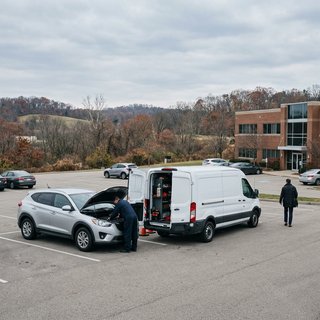
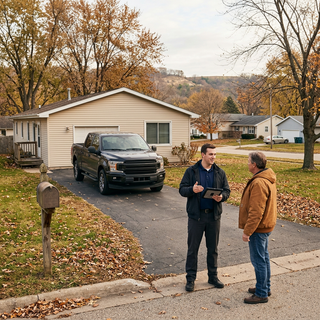
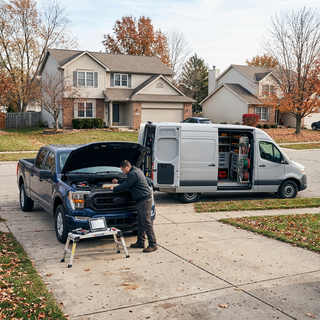
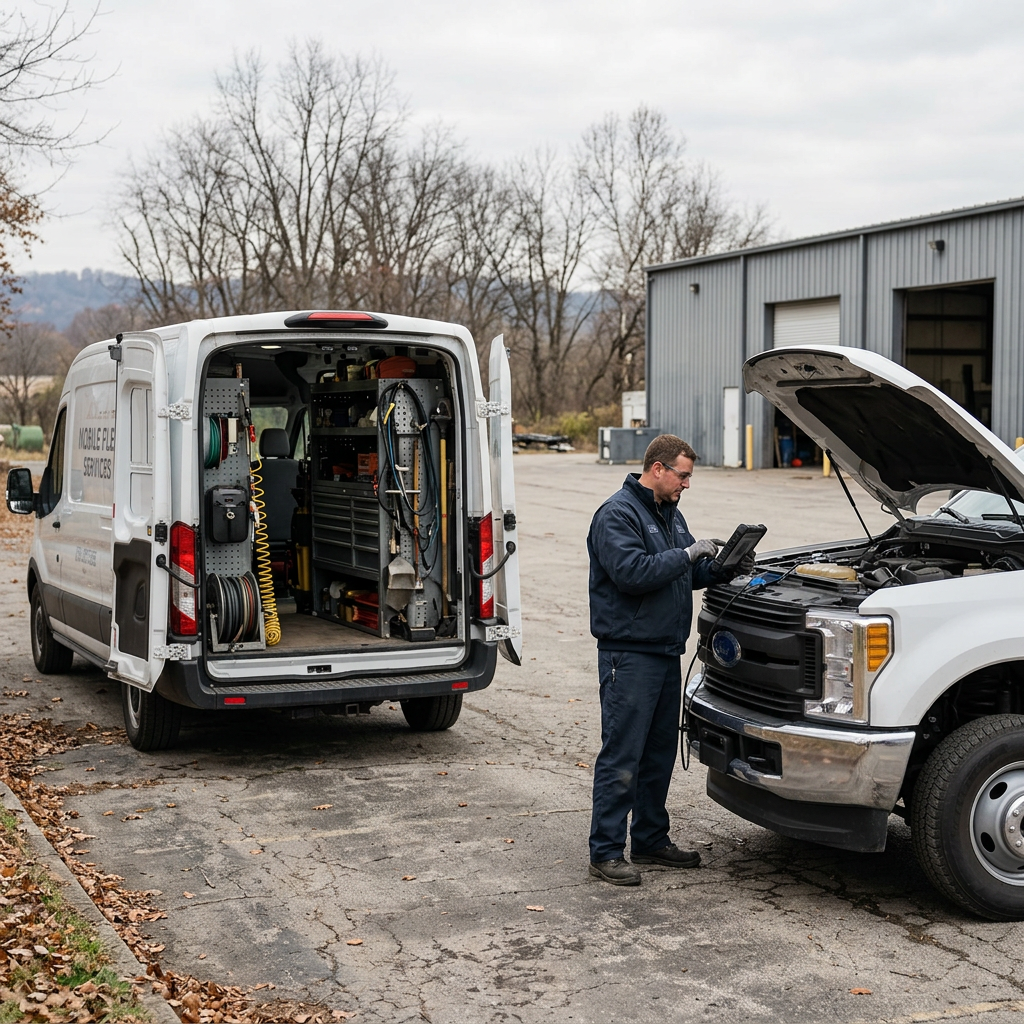
Ford Mobile Service deploys factory-trained technicians directly to your company yard, warehouse, or jobsite in specially outfitted mobile service vans. Our technicians handle scheduled maintenance, light mechanical repairs, diagnostic evaluations, and manufacturer software updates right where your vehicles are parked. Instead of assigning drivers to shuttle trucks to a physical garage and waiting in line, your business schedules on-site appointments during scheduled downtime, keeping your commercial assets road-ready without taking vehicles off their daily routes.
Managing a busy lineup of work vehicles requires balancing tight delivery schedules, jobsite commitments, and constant preventative care. When an asset leaves your staging area for maintenance, the hidden costs add up fast: secondary chase vehicles, driver hourly wages spent sitting in waiting rooms, and disrupted route timing. With our mobile service, our team schedules visits around your operating rhythm, servicing vehicles in batches during planned yard stops or between shifts.
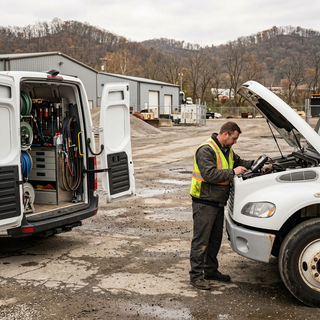
Our mobile units are equipped with commercial-grade fluid extraction systems, onboard power generators, pneumatic tools, air compressors, and factory calibration equipment. Whether your business operates a local delivery group of Ford Transit vans or runs heavy haulers from our F-Series work truck selection, our mobile technicians carry the specialized tooling required for commercial duty cycles. For local contractors balancing projects near State Route 170 in Calcutta, having scheduled maintenance roll directly onto your lot eliminates route disruptions before morning crews roll out.
To discuss setting up a routine commercial care schedule or check our current service perimeter, give our commercial advisors (330) 462-7578 a call. You can also map a route to our service department at 1503 Pennsylvania Ave to coordinate multi-vehicle account setups with our fleet specialists.
Table of Contents
- Can Ford Mobile Service Operate Indoors in a Company Warehouse or Garage?
- Which Routine Maintenance and Commercial Fleet Services Can Be Performed On-Site?
- Do Mobile Technicians Have Access to Dealership Diagnostic Systems?
- How Mobile Maintenance Cuts Fleet Downtime and Supports Mixed Makes with Omnicraft
- What Do Fleet Managers Need to Know About Ford Mobile Service?
- Streamline Your Commercial Maintenance Schedule with On-Site Fleet Care
Can Ford Mobile Service Operate Indoors in a Company Warehouse or Garage?
Indoor service is possible only when a warehouse or garage provides adequate clearance, stable flooring, ventilation, and safe access for the technician. The indoor space must offer adequate overhead door clearance for our tall-roof mobile service vans, a level concrete floor capable of supporting safe jacking, proper airflow, and a facility policy that permits standard commercial automotive fluids on the property.
INDOOR FLEET SERVICE CHECKLIST
| Physical Clearance | 10 to 12 feet of overhead door and |
|---|---|
| ceiling clearance for mobile vans | |
| Flooring Surface | Flat, reinforced concrete clean of debris |
| and rated for commercial jacks | |
| Staging Footprint | Minimum 4 to 6 feet of perimeter space |
| around each serviced vehicle | |
| Facility Ventilation | Active air exchange or open bay doors |
| during diagnostic engine cycling | |
| Environmental Safety | Approved indoor fluid transfer policy and |
| available fire suppression equipment |
To accommodate our specialized service vans, an indoor facility generally needs a minimum of 10 to 12 feet of vertical clearance at the entry doors and inside the work envelope. Service vans carry internal storage racks, heavy-duty fluid reservoirs, and roof-mounted safety lighting that exceed standard passenger vehicle heights. Staging areas must also provide at least four to six feet of perimeter space around each fleet vehicle so technicians can maneuver tire-handling equipment, roll-around tool cabinets, and digital diagnostic carts without obstruction.
Environmental protection is built directly into our on-site processes. Our technicians use closed-loop, vacuum-assisted fluid extraction systems that pull motor oil, transmission fluid, and engine coolant directly through the dipstick tube or sealed access ports into onboard waste recovery tanks. This eliminates open-air gravity pans and drastically lowers the risk of spills on your warehouse floor. Technicians also lay down heavy-duty absorbent containment mats and carry commercial spill kits to comply with property management and industrial health standards.
When your warehouse team needs to prepare staging zones or confirm vehicle fitment, you can review our on-site capabilities through our dedicated mobile service overview. If your in-house fleet staff requires replacement filters, hardware, or shop supplies for their own daily checks, you can quickly order commercial maintenance parts through our parts department to keep your staging area fully stocked.
Which Routine Maintenance and Commercial Fleet Services Can Be Performed On-Site?
Our mobile service handles preventative maintenance, wear-and-tear component replacements, safety inspections, diagnostic troubleshooting, and software-driven recall remedies right at your facility. These capabilities cover up to 80 percent of the routine service events that keep work trucks and cargo vans running through demanding commercial duty cycles.
ON-SITE MOBILE SERVICE CAPABILITIES
| Lubrication & Engine Health | Full synthetic and diesel oil changes, |
|---|---|
| oil filters, engine air filters, fuel | |
| water separators | |
| Brake & Friction Service | Pad replacement, rotor replacement, |
| caliper service, hydraulic fluid checks | |
| Electrical & Starting Systems | Battery conductance testing, AGM/lead-acid |
| replacement, terminal service, alternators | |
| Running Gear & Vision | Tire rotations, electronic balance checks, |
| tire pressure monitoring reset, wiper sets | |
| Diagnostics & Compliance | Check engine light diagnostics, factory |
| software updates, safety recall procedures |
Routine fluid intervals are the foundation of on-site service. Mobile technicians conduct comprehensive oil and filter services on gasoline engines, such as the 3.5L EcoBoost in the Ford F-150, as well as high-capacity Power Stroke turbo diesel engines powering the Ford Super Duty platform. Technicians replace engine air filters, cabin microfilters, and diesel fuel water separators before dirty elements harm fuel efficiency or wear down high-pressure injection pumps.
Brake friction components take a beating in urban stop-and-go driving and hilly terrain. Technicians measure pad friction thickness with digital gauges, inspect rotor runout, and replace worn pads and rotors directly on your lot. Mobile vans also carry complete tire service gear, enabling technicians to rotate heavy-ply commercial tires, set cold inflation pressures to load specifications, and reset the Tire Pressure Monitoring System (TPMS) across every axle.
To keep commercial vehicles from missing mandated operational windows, dispatchers can schedule fleet service online to book mobile maintenance blocks. Major structural overhauls, internal transmission rebuilds, frame straightening, and tasks requiring multi-post vehicle lifts remain assigned to our main service center, but mobile care handles the regular upkeep that prevents those catastrophic breakdowns.
Do Mobile Technicians Have Access to Dealership Diagnostic Systems?
Every mobile technician operates with the same factory-level computer diagnostic hardware and proprietary software programs used inside our dealership service bays. Rather than carrying generic handheld code readers that only display basic trouble codes, our mobile units connect directly to Ford Motor Company's engineering database using cloud-linked ruggedized laptops and specialized interface hardware.
Our technicians run FDRS (Ford Diagnostic & Repair System) and the legacy IDS (Integrated Diagnostic System) through a genuine Ford VCM 3 (Vehicle Communication Module) vehicle interface. This setup allows technicians to read proprietary controller area network (CAN-bus) live data streams, test individual sensors, and command bidirectional component activations. If a delivery van triggers an illuminated wrench light or enters an engine limp mode, our mobile technician isolates the failing module, checks live pressure readings, and verifies wiring harness voltage on-site.
These systems give our mobile units full module programming authority. Technicians can execute:
- Powertrain Control Module (PCM) software updates to refine transmission shift schedules and engine idle stability
- Body Control Module (BCM) configurations for auxiliary lighting and upfit electrical circuits
- Anti-lock braking system calibrations following hydraulic or wheel-speed sensor service
- Key-fob programming and fleet telematics gateway modem module synchronizations
Manufacturer recalls involving module flashes, high-voltage battery software monitoring updates on electric models like the E-Transit, and communications updates are routinely resolved directly on your staging lot. Because our diagnostic tools update over secure cellular networks with real-time factory technical service bulletins, your commercial assets receive identical technical accuracy whether serviced in our shop or parked at your warehouse.
How Mobile Maintenance Cuts Fleet Downtime and Supports Mixed Makes with Omnicraft
Mobile fleet maintenance slashes non-productive downtime by servicing vehicles when they are naturally parked, eliminating the compounding labor costs of vehicle transport. For operations supporting manufacturing and industrial sites along the river bluffs in East Liverpool, scheduling maintenance between operational runs means zero lost billable hours for drivers and work crews.
When a company relies solely on fixed service facilities, the cost of an oil change or brake inspection includes driver wages, fuel burn, and the loss of a revenue-generating vehicle for half a day. Batching mobile service on-site resets this dynamic. While your crews complete paperwork, rest overnight, or load inventory for the next morning, our technicians service three, five, or ten vehicles in a single visit. Dispatchers preserve their scheduled operating hours, vehicle wear from non-revenue travel drops to zero, and your overall fleet availability climbs.
FLEET SERVICE METHOD COMPARISON
| Operational Factor | Dealership Bay vs. On-Site Mobile Care |
|---|---|
| Driver Transit Hours | 1 to 2 paid driver hours per vehicle vs. |
| 0 driver hours with on-site service | |
| Chase Vehicles Required | Requires a second driver and chase truck |
| vs. zero external logistics | |
| Vehicle Staging Time | Sits in off-site holding queue vs. stays |
| parked on company property until finished | |
| Service Scheduling Window | Strictly during regular shop hours vs. |
| flexible windows during fleet idle time | |
| Mixed-Make Support | Often requires multiple brand dealers vs. |
| unified care using Motorcraft & Omnicraft |
Many commercial fleets operate mixed vehicle inventories, combining Ford work trucks with vans and chassis cabs from other manufacturers. Through Ford's Omnicraft parts line, our mobile technicians carry certified, precision-engineered replacement parts designed specifically for non-Ford makes. Omnicraft supplies high-grade brake pads, rotors, starters, alternators, filters, and suspension parts backed by manufacturer warranties.
Pairing Omnicraft with genuine Motorcraft components for your Ford vehicles allows you to consolidate all your preventative care into one single mobile vendor. Your fleet administrator handles one service invoice, maintains unified maintenance logs, and avoids juggling accounts across multiple independent repair facilities.
What Do Fleet Managers Need to Know About Ford Mobile Service?
Q: How many vehicles does my business need to schedule a mobile service visit?
A single urgent diagnostic visit and scheduled batch maintenance for dozens of units can both fit into a fleet’s on-site service plan. While servicing multiple vehicles during a single visit maximizes your yard efficiency and technician staging time, single-vehicle visits are regularly scheduled for time-sensitive recalls or critical fluid intervals. Scheduling requirements and travel perimeters depend on technician availability, so contacting our service department allows us to build an appointment window tailored to your lot size.
Q: Can mobile technicians service commercial electric vehicles like the E-Transit?
Yes, our mobile technicians are certified to perform scheduled maintenance, software updates, and light mechanical repairs on commercial electric vehicles like the Ford E-Transit and F-150 Lightning. On-site EV services include multi-point safety inspections, high-voltage cooling system checks, 12-volt accessory battery testing, cabin air filter replacement, tire rotations, and brake friction maintenance. Mobile technicians also connect factory diagnostic systems to monitor battery cell state-of-health and complete high-voltage battery management software recalibrations right at your fleet charging depot.
Q: What happens if an on-site inspection reveals a major mechanical issue?
If a technician uncovers severe wear or heavy component failures during an inspection, we document the issue with digital measurements and photographs for your fleet coordinator. The technician establishes whether the vehicle remains safe to operate or requires immediate grounding. For heavy repairs exceeding mobile capabilities, such as transmission replacements, head gaskets, or structural frame alignment, our mobile coordinator helps arrange transport and schedules direct priority entry into our commercial dealership service bays.
Q: How do cold winter temperatures and road salt affect mobile maintenance scheduling?
Sub-freezing winter weather and heavy road salt usage accelerate undercarriage corrosion and severely strain electrical starting systems. Cold temperatures reduce battery cranking amperage, making proactive conductance testing vital before freezing weather hits. Our commercial battery testing advice explains how our technicians detect failing cells before work trucks fail to crank on winter mornings. If bitter weather or ice storms prevent safe outdoor repairs, mobile visits can transition inside your heated warehouse or be rescheduled to keep technicians safe and equipment operating properly.
Q: Is there an added trip charge for scheduling Ford Mobile Service at our facility?
Please contact our service department for current mobile service availability and any applicable fees for your location. Your business pays only for the standard parts and labor required for the specific maintenance, inspections, or mechanical repairs performed on your vehicles. Warranty repairs and software-based safety recalls performed on-site are covered according to manufacturer terms with no mobile dispatch fee charged to your commercial account.
Streamline Your Commercial Maintenance Schedule with On-Site Fleet Care
Protecting commercial vehicle uptime requires a proactive maintenance partner that works around your operating hours rather than disrupting them. Ford Mobile Service from Tri State Ford brings certified technicians, factory-grade diagnostic computers, and original equipment parts straight to your business location. Whether your fleet operates cargo vans, diesel haulers, or mixed-make utility trucks, our mobile units eliminate transit waste and keep your drivers focused on their jobs.
Take the friction out of your fleet maintenance schedule by speaking with our commercial service team today. Give us a quick call to set up your company profile, review recurring batch maintenance options, or reserve an upcoming service date. If you prefer to discuss fleet maintenance management in person or inspect our dedicated commercial truck facilities, drop a pin to our service center location and let our commercial team build a maintenance schedule that keeps your business moving forward.