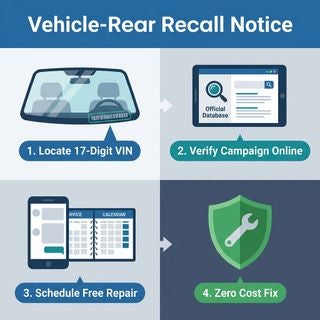
When you receive a vehicle recall notification, locate your 17-character VIN on your vehicle or registration card, verify the campaign status through official recall databases, and contact an authorized dealership to schedule a free repair. Federal law requires vehicle manufacturers to correct safety defects and noncompliance issues without charging owners for parts or labor, regardless of whether your vehicle is still under its original factory warranty.
An official recall is issued when a manufacturer or federal safety regulators determine that a vehicle component fails to meet safety standards or creates an unreasonable safety risk on the road. These campaigns cover a wide range of issues, including mechanical steering linkages, fuel lines prone to leaks, software glitches in anti-lock braking systems, and sensor faults within driver-assist features like blind spot monitoring. When automakers file a campaign with federal regulators, each recall receives an official NHTSA campaign number to track remedy completion rates across every registered vehicle.
Checking your vehicle for active campaigns requires verifying your vehicle identification number rather than relying strictly on the model year or trim name. You can find this 17-digit code stamped on the lower driver-side corner of the windshield, visible from outside the vehicle, as well as on the driver-side door jamb sticker, state registration card, and insurance documentation. Entering this sequence into official online databases or tracking software like the Ford App reveals any uncompleted safety repairs assigned to your exact vehicle.
When a notification arrives in your mailbox, review the documentation carefully for specific operational details. The notice explains the underlying technical defect, describes potential safety hazards, outlines the official repair remedy, and states whether replacement parts are currently available at service departments. To confirm open campaign status or arrange an appointment, you can reach our service team at (330) 462-7578 or visit our East Liverpool facility location for professional assistance.
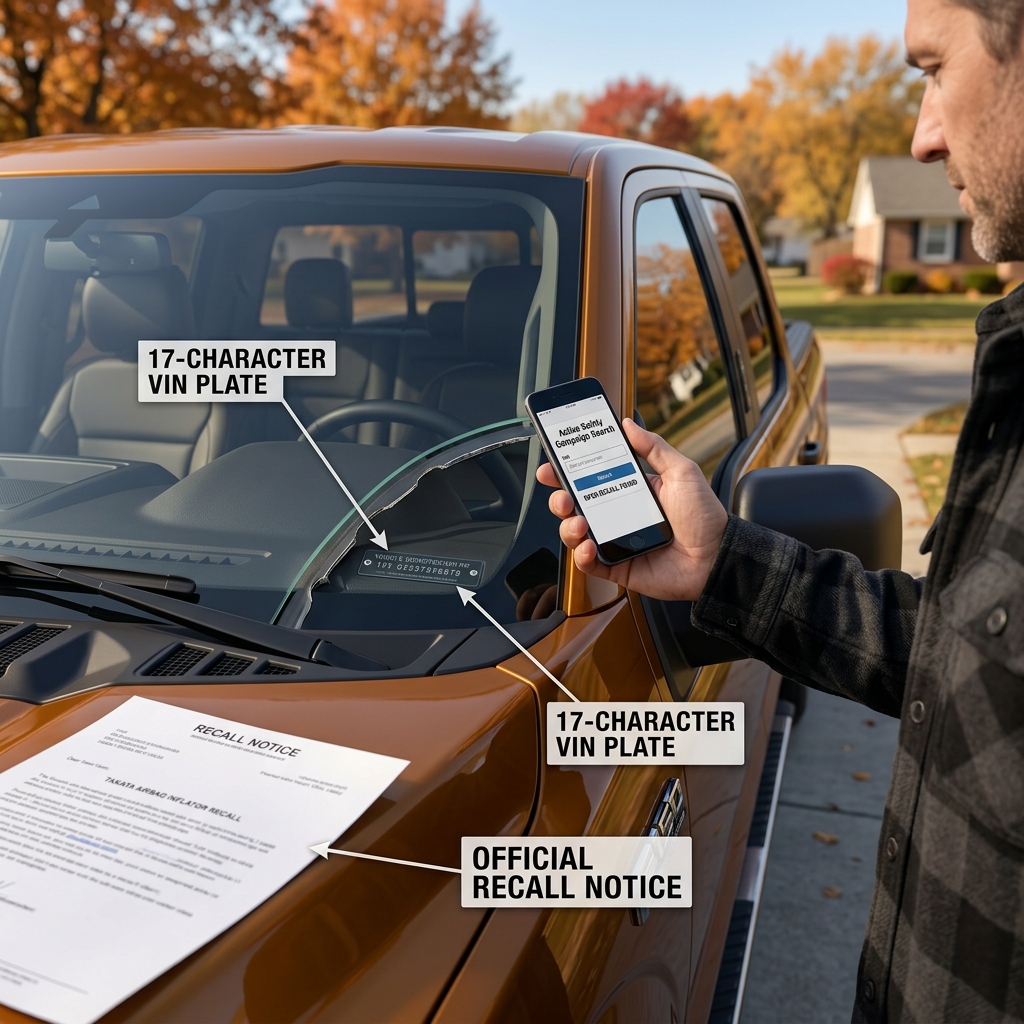
Table of Contents
- Is It Safe to Drive Your Vehicle After Receiving a Recall Notice or Do Not Drive Warning?
- What Should You Do If Recall Parts Are Backordered or Not Yet Available?
- How Long Do Recall Repairs Take, and Are Towing or Rental Expenses Covered?
- How Do You Claim Pre-Recall Repair Reimbursements and Resolve Dealership Refusals?
- Questions Drivers Ask Most About Recall Repairs and Service Logistics
- Schedule Your Free Recall Inspection and Service
Is It Safe to Drive Your Vehicle After Receiving a Recall Notice or Do Not Drive Warning?
You can typically continue driving your vehicle after receiving a standard recall notice unless the manufacturer or safety regulators issue an explicit "Do Not Drive" or "Park Outside" advisory. Standard recalls involve minor mechanical adjustments or routine control module updates that allow normal operation while replacement components are being manufactured and routed to your local service center.
Understanding the severity level listed on your recall notice determines whether continued driving poses an immediate risk to your family:
- Standard Safety Recall: Permits regular vehicle operation while you schedule a convenient service appointment. Components are replaced during a standard shop visit without immediate hazard under typical driving conditions.
- Park Outside Advisory: Indicates an electrical or fuel system defect that could trigger a vehicle fire even when the engine is turned off and the ignition key is removed. Vehicles subject to this warning should be parked in open driveways away from garages, carports, and residential structures until the free repair is completed.
- Do Not Drive Warning: Signals an urgent, high-risk mechanical or structural defect that could cause sudden control loss, severe injury, or vehicle destruction. Critical examples include degraded Takata airbag inflators subject to rupture, fractured steering columns, and sudden hydraulic master cylinder failures.
If your vehicle notice contains a "Do Not Drive" instruction, immediately pull off the road or leave the vehicle parked in a safe space. Do not attempt to drive the vehicle to the dealership for repair. Contact the manufacturer's emergency support line or your dealer's service lane right away to arrange flatbed transportation. Service advisors can log your 17-character VIN into the priority queue and explain alternative transportation arrangements available while your car is held for service.
For drivers commuting along State Route 170 in Calcutta, keeping steering, braking, and occupant protection systems operating properly is vital for navigating local traffic safely. Drivers evaluating vehicle performance after a system update or inspection can coordinate with our staff when scheduling a vehicle evaluation session to ensure every safety component functions as intended.
What Should You Do If Recall Parts Are Backordered or Not Yet Available?
If a recall notification indicates that replacement parts are backordered or not yet available, review the interim safety guidance provided in the notice, confirm your contact details with the manufacturer, and monitor official recall portals for inventory updates. Dealerships cannot perform permanent remedies until factory-approved components arrive, but service advisors can document your vehicle in the national distribution queue.
Automakers frequently issue safety recall announcements before replacement assemblies are fully manufactured in quantities sufficient to service millions of affected vehicles. During this initial phase, the manufacturer sends an interim notice informing owners of the safety issue while factories scale up production of redesigned components. When replacement parts arrive at regional distribution centers, a follow-up letter instructs owners to book an appointment for the free repair.
While waiting for replacement parts to clear backorder status, follow these practical steps to protect your vehicle and stay informed:
- Read the interim notice thoroughly to identify any temporary operational adjustments, such as disabling a specific feature or avoiding heavy cargo loads.
- Contact your authorized dealer to register your 17-character VIN on the parts backorder list, ensuring components are reserved as soon as shipments arrive.
- Verify that your current mailing address and phone number are updated with the vehicle manufacturer to receive prompt notification when remedies become available.
- Check official recall lookup tools every few weeks to monitor campaign status updates for your vehicle.
When owners bring a vehicle into the service lane after getting a notice, they usually ask whether the fix requires leaving the vehicle all day or if it can be completed while they wait in the lounge. Service advisors can review the specific technical service guidelines to explain expected timelines and component availability. If your vehicle requires routine maintenance while waiting for recall parts, ordering replacement components through our dedicated parts department ensures your vehicle stays in prime running condition.
How Long Do Recall Repairs Take, and Are Towing or Rental Expenses Covered?
Most recall repairs take between one and two hours for software flashes or simple component swaps, while complex mechanical work can require several days. If your recall notice specifies a "Do Not Drive" warning, manufacturers typically cover flatbed towing to the dealership, and many offer pre-approved rental car or loaner vehicle coverage during extended component delays.
The time required to complete a recall depends entirely on the technical scope of the bulletin:
| Repair Category | Typical Duration | Repair Process Overview |
|---|---|---|
| :-- | :-- | :-- |
| Electronic Module Reprogramming | 30 to 60 Minutes | Technicians connect factory diagnostic tools to reflash control software for engine, transmission, or Ford Co-Pilot360 modules. |
| Minor Hardware Replacement | 1 to 2 Hours | Involves swapping accessible components like door latches, wiring harnesses, tail lamp assemblies, or seatbelt anchors. |
| Major Mechanical Overhaul | 4 to 8+ Hours | Requires significant disassembly, such as replacing fuel tanks, steering racks, brake master cylinders, or internal engine assemblies. |
When a severe recall involves a "Do Not Drive" or "Park Outside" directive, vehicle manufacturers arrange and pay for flatbed towing directly to an authorized service facility. Operating a vehicle under an active stop-drive order voids roadside assistance protections for driven miles, so utilizing manufacturer-funded flatbed transport protects both occupant safety and vehicle integrity.
If replacement components are delayed or if a repair requires more than a single day in the service bay, automakers routinely reimburse out-of-pocket rental car expenses or provide complimentary loaner vehicles. To qualify for rental reimbursement, the rental must be pre-authorized through the dealership service department or manufacturer customer care team. Always retain itemized rental agency receipts, rental agreements, and official service work orders to submit with your reimbursement claim.
How Do You Claim Pre-Recall Repair Reimbursements and Resolve Dealership Refusals?
To claim reimbursement for repairs paid out-of-pocket before a recall was announced, submit your original itemized repair invoice, proof of payment, and work order directly to the manufacturer customer care department. If a dealership refuses to perform an open recall repair, request a written explanation from the service manager, contact the manufacturer national customer support line, and report the refusal directly to federal safety regulators.
Under federal regulations, vehicle owners who paid for repairs to fix a defect prior to an official recall announcement are entitled to full financial reimbursement from the automaker. To process a successful refund claim, gather the following required documentation:
- An itemized repair invoice showing the vehicle identification number, date of service, specific parts installed, and labor performed.
- Proof of payment, such as a canceled check, credit card statement, or paid dealer receipt confirming out-of-pocket costs.
- Documentation demonstrating that the prior repair directly addressed the exact mechanical or electrical fault identified in the subsequent safety campaign.
- A copy of your official state vehicle registration proving ownership at the time the repair was completed.
If an authorized dealer refuses to perform a free recall repair, understand that federal law mandates franchise dealerships complete open safety recalls on affected vehicles regardless of vehicle age, mileage, or warranty status. Refusals occasionally stem from miscommunications regarding part availability or regional dealer scope, but dealers cannot decline valid recall work.
To resolve a refusal, ask to speak directly with the dealership service director to clarify campaign details. If the issue remains unresolved, contact the automaker's national customer assistance center to open a formal case file. You can also file an official complaint with the National Highway Traffic Safety Administration online or by calling the Vehicle Safety Hotline at 888-327-4236. Seeking authorized local Ford dealership support ensures your vehicle receives certified care backed by factory standards.
Questions Drivers Ask Most About Recall Repairs and Service Logistics
Q: How do I verify if my vehicle has an open recall?
You can verify open recalls by entering your 17-character VIN into official safety lookup tools online or through mobile applications like the Ford App. Your VIN is located on the lower driver-side windshield and state registration card. The search results show any uncompleted safety campaigns associated with your specific vehicle.
Q: Do safety recall repairs expire if I wait too long?
Safety recall campaigns for mechanical components, structural assemblies, and software modules do not expire and remain active for the life of the vehicle. Federal law mandates free repairs regardless of vehicle age or mileage. The primary exception involves tire recalls, which must be claimed within 60 days of owner notification.
Q: Will an open recall affect my vehicle history report or resale value?
Open safety recalls appear on vehicle history reports as uncompleted safety campaigns until an authorized franchise dealership completes the repair. Having the free remedy performed updates official databases, clearing the record on future history checks and protecting vehicle safety and market value.
Q: Can software-related recalls be updated without a physical shop visit?
Certain module updates can be completed remotely through Over-The-Air software installations if your vehicle supports connected vehicle technology. However, recalls requiring hardware inspections, physical module recalibrations, or mechanical adjustments still require a dedicated appointment at an authorized service bay.
Q: What should I do if I suspect a safety defect that has not been recalled yet?
Document the specific failure symptoms and file a detailed safety complaint online with federal regulators or by calling the Vehicle Safety Hotline at 888-327-4236. Individual complaints are analyzed by safety engineers to investigate recurring technical patterns and determine whether a new safety recall is necessary.
Schedule Your Free Recall Inspection and Service
Resolving an open safety recall promptly protects your family on every journey, preserves mechanical reliability, and keeps your vehicle compliant with federal safety standards. Because all recall remedies are completely free of charge and performed by factory-certified technicians using genuine OEM parts, getting your vehicle updated is simple and stress-free.
Commuters traveling toward the commercial hubs around Boardman rely on fully functioning safety systems during daily highway driving. If your vehicle requires routine electrical checks or module updates alongside recall work, routine battery maintenance guide details can help keep your electrical system operating smoothly in all weather conditions.
Our dedicated team at Tri State Ford is ready to assist you with VIN verification, parts availability checks, and quick service scheduling. You can get started today by scheduling a service appointment online or by giving our service advisors a call at (330) 462-7578. You can also visit our service center to speak with our certified staff in person and ensure your vehicle stays safe on the road.
© 2026 Tri State Ford. All rights reserved.