
Blog / Maintenance & Service, Expert Repairs & Diagnostics, Genuine Parts & Accessories, Engine Care &

Does Oil Filter Quality Actually Matter for Your Engine?

cx

Oil filter quality directly impacts long-term engine survival because high-grade filters capture abrasive microscopic particles while preserving steady oil flow, whereas sub-standard filters restrict pressure, rupture under stress, or pass unfiltered debris through an open bypass valve. A vehicle engine depends on clean lubricant circulating at correct pressures across high-friction components such as camshafts, bearings, and cylinder walls. Choosing a precision-engineered filter keeps harmful metal shavings, carbon buildup, and dust away from internal components during everyday commutes and heavy towing.

Modern engines operate under tight internal tolerances and higher oil pressures than older designs. A budget oil filter built with thin end caps or inconsistent filter media can collapse prematurely, allowing grit to circulate freely through the block. Over thousands of miles, unfiltered contaminants act like liquid sandpaper, gradually wearing down metal surfaces and creating costly mechanical play.

The filter canister serves as the primary line of defense for the entire lubrication system. Motorcraft oil filters and quality OEM-specification alternatives are built to withstand high thermal strain and engine vibration without warping or leaking around the mounting base. Choosing the right filter during routine oil changes preserves proper oil circulation, protects factory powertrain warranties, and supports peak engine efficiency.

Drivers looking for expert maintenance support can reach out to our service advisors by giving us a quick call or visiting our East Liverpool service center for complete vehicle inspections.

Table of Contents

What Technical Features and Micron Ratings Determine an Oil Filter's Efficiency?

An oil filter's efficiency is determined by its micron rating, structural housing integrity, filter media composition, and internal valve construction. The primary metric used to measure filtration capability is the micron rating, which identifies the smallest particle size the filter media can reliably trap during normal oil circulation. Human hair measures roughly 70 microns in diameter, while engine-damaging debris often ranges between 10 and 40 microns.

Technical Feature Standard Filter Specification Premium / OEM Filter Specification Performance Impact
Micron Capture Size 30 to 40 microns 10 to 20 microns Traps smaller abrasive particles before engine wear occurs
Media Material Resin-impregnated cellulose paper Full synthetic glass-fiber blend Increases dirt-holding capacity and flow rates
Anti-Drainback Valve Nitrile rubber High-temp silicone Prevents dry starts after overnight parking
Canister Pressure Rating 200 to 250 psi burst threshold 300 to 350 psi burst threshold Prevents housing expansion during extreme cold starts

A lower micron rating means the filter traps smaller specks of soot and metal dust. However, filtration efficiency must always be balanced against fluid resistance. If a filter media is engineered with pores that are too dense, it restricts oil flow and creates a pressure drop across the filter core.

Our technicians frequently point out that restricting oil flow too severely can force the internal safety bypass valve open prematurely, sending unmanaged oil around the filter element. Premium filters solve this balance by using structured pleating and high-efficiency synthetic fibers, achieving fine particle capture down to 20 microns without compromising oil pressure.
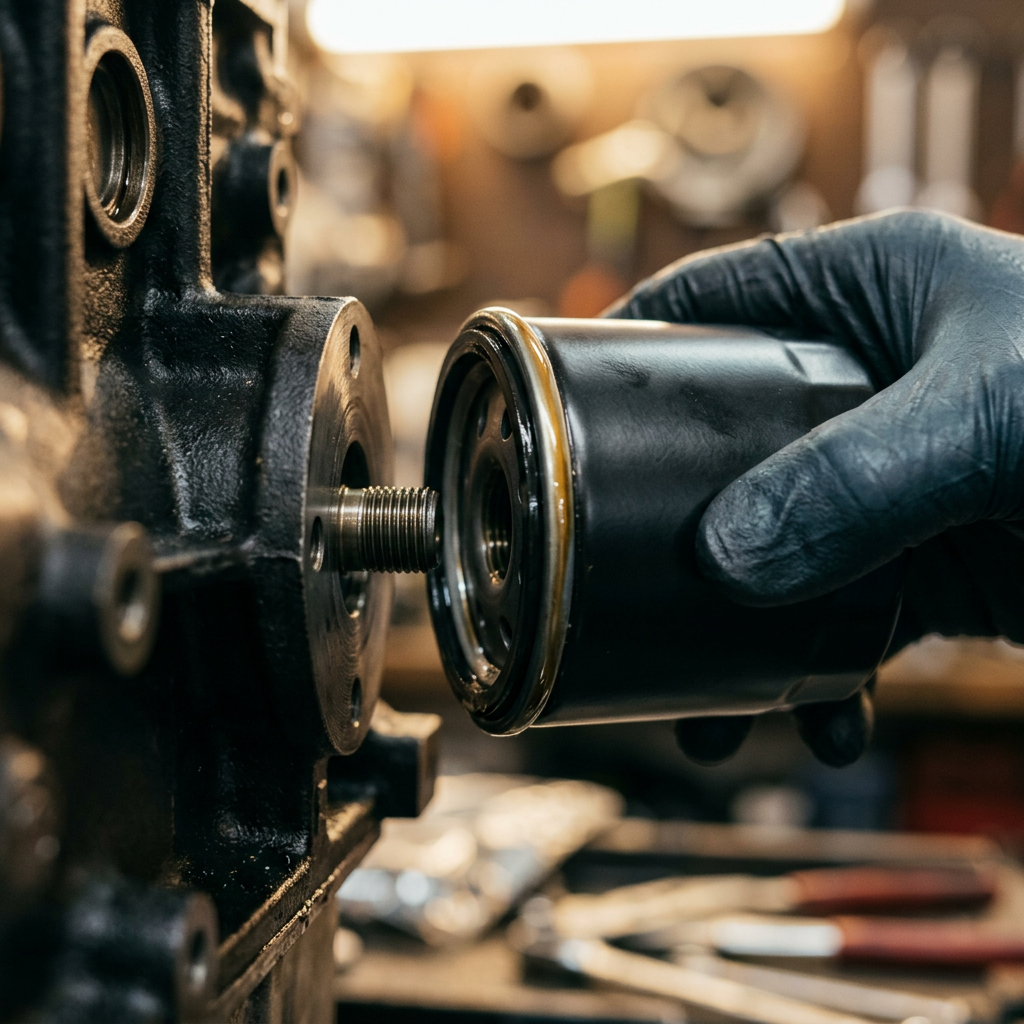
Gloved hand aligning a new black oil filter onto the threaded stud of a metal engine block. (Representative image for illustration purposes only. Actual vehicle may vary based on trim and configuration.)

Synthetic vs. Cellulose Media: How Long Does Synthetic Filter Media Last?

High-performance synthetic media operates effectively between 10,000 and 20,000 miles under normal driving conditions, outlasting traditional cellulose media, which typically breaks down after 3,000 to 5,000 miles. Synthetic filter media is woven from engineered glass and synthetic fibers that create a three-dimensional matrix for trapping debris, whereas cellulose filters rely on natural wood pulp paper.

Cellulose fibers absorb moisture and weaken over time when exposed to hot engine oil and combustion byproducts. As cellulose media degrades, its pores expand or clog unevenly, leading to restricted oil flow and reduced dirt-holding capacity. Synthetic media offers several technical advantages for long-term engine protection:

  • Synthetic fibers maintain consistent structural density when exposed to synthetic motor oils and elevated operating temperatures.
  • Synthetic pleats feature lower flow resistance, allowing oil to circulate rapidly during freezing winter cold starts.
  • The multi-layer synthetic design captures more total grams of contaminants before reaching fluid capacity limits.

Drivers making frequent trips along State Route 170 around Calcutta benefit from synthetic filter media because short trips and stop-and-go driving generate elevated moisture and carbon condensation inside the oil pan. Using extended-life synthetic media ensures the oil filter maintains full filtering efficiency throughout modern multi-thousand-mile service intervals.

Internal Components: What Does an Anti-Drainback Valve Do and Why Is Dirty Oil Better Than No Oil?

An anti-drainback valve retains engine oil inside the filter canister and upper engine galleries when the ignition turns off, preventing severe dry-start friction when restarting the vehicle. Without a functional anti-drainback valve, gravity causes oil to drain back into the oil pan while the vehicle sits idle. Upon restarting, the engine operates for several critical seconds with empty oil passages while the pump refills the system.

High-quality filters utilize a soft, heat-resistant silicone anti-drainback valve that stays pliable across thousands of thermal cycles. Lower-cost filters often use basic nitrile rubber valves, which harden, crack, and lose their sealing ability under continuous heat exposure.

The filter's bypass valve serves as an essential mechanical safeguard when the main filter media becomes clogged or when cold oil is too thick to pass through the pleats quickly. When differential pressure across the media exceeds factory tolerances, the bypass valve opens to allow oil to flow directly to vital engine components without passing through the media core.

Circulating dirty oil temporarily is far better than starving the engine of lubricant entirely, because complete oil starvation causes immediate metal-on-metal scoring, bearing failure, and total engine seizure within minutes. When replacing your filter during routine service, selecting genuine OEM replacement parts ensures the internal relief valves are calibrated to your engine's exact pressure requirements.

Are Cheap Oil Filters Prone to Leaking, Bursting, or Media Breakdown?

Economy oil filters are significantly more susceptible to gasket leaks, canister distortion, and media rupture because they utilize thinner steel housings, lower-grade rubber seals, and fragile paper end caps. Cold morning start-ups generate sudden oil pressure spikes as thick lubricant moves through narrow passages. High pressure can bow thin canister bases or blow out weak mounting gaskets on low-cost filters.

Internal media failure presents an even greater risk than external leaks. When cheap cellulose paper breaks down under heat and chemical degradation, the pleats can tear or collapse inward under fluid pressure. Ruptured media sheds loose paper fibers into the oil stream and allows unfiltered contaminants to reach sensitive engine components:

  • Variable valve timing solenoids can become clogged with shed fibers, leading to rough idling and loss of engine power.
  • Crankshaft and camshaft bearings suffer accelerated surface abrasion from circulating metal fragments.
  • Loose gasket material or collapsed end caps can block internal oil channels, causing localized oil starvation.

Investing in a well-constructed oil filter protects your engine against sudden structural failures and long-term mechanical wear.

How Do You Confirm an Aftermarket Oil Filter Meets OEM Specifications?

Confirming an aftermarket oil filter meets original equipment manufacturer standards requires cross-referencing the filter maker's technical lookup guide to verify burst pressure tolerance, micron efficiency, and bypass valve pressure ratings. Vehicle manufacturers establish precise engineering limits for oil pressure, flow volume, and filtration efficiency to protect specific engine configurations.

When evaluating an alternative filter brand, review the manufacturer's specification sheet to confirm the following criteria:

  1. Bypass Valve Calibration: Verify that the relief valve opening pressure matches your engine's factory rating, typically set between 8 and 18 psi depending on engine design.
  2. Thread and Sealing Gasket Dimensions: Ensure the mounting thread size, pitch, and rubber gasket diameter exactly match the engine filter adapter.
  3. Filter Efficiency Rating: Confirm the filter captures fine particles with a proven percentage rating at a specified micron size, such as 99% efficiency at 20 microns.
  4. Structural Burst Strength: Check that the steel canister is rated to withstand cold-start pressure spikes exceeding 300 psi.

Choosing a factory-approved filter built specifically for your Ford vehicle eliminates compatibility guesswork and ensures every internal component performs to original specifications.

Common Questions About Engine Oil Filter Performance and Maintenance

Q: How much more expensive is a premium oil filter compared to a standard filter?

Standard entry-level oil filters are generally less expensive than premium extended-life synthetic oil filters, so contact us for current pricing. Paying a small difference during an oil change delivers significantly higher dirt-holding capacity, stronger canister housing construction, and durable silicone valves that protect your engine over thousands of miles.

Q: What happens when the Ford Intelligent Oil-Life Monitor displays a warning?

The Intelligent Oil-Life Monitor evaluates vehicle usage, ambient operating temperatures, and engine hours to calculate fluid life accurately. When the system displays "Change Engine Oil Soon," approximately 5% oil life remains. When "Oil Change Required" appears, oil life has reached 0%, and replacing both the engine oil and oil filter is required immediately to maintain engine protection.

Q: Can a clogged oil filter cause oil pressure warnings on the dashboard?

Yes, a severely clogged filter can trigger an oil pressure warning light if the media becomes completely saturated and the internal bypass valve fails to open properly. Restricted oil flow drops overall pressure inside the engine galleries, activating the oil pressure sender unit. Drivers experiencing an oil pressure light should stop the vehicle safely and check fluid levels immediately.

Q: Why isn't a lower micron rating always better for an oil filter?

A full-flow oil filter must balance particle capture against continuous fluid volume. An extremely low micron rating can restrict oil flow too severely, causing an undesirable pressure drop across the filter core. If flow is overly restricted, the safety bypass valve opens and routes unfiltered oil straight to critical engine components.

Q: How often should an oil filter be replaced on a Ford vehicle?

The oil filter should be replaced at every single oil change interval. Following your owner's manual or vehicle message center ensures that fresh engine oil is never pushed through a dirty, saturated filter canister. Owners can easily schedule a service appointment online to have expert technicians inspect their vehicle and replace the filter with genuine OEM parts.

Protect Your Engine with Professional Maintenance

Your engine's health depends on consistent lubrication and reliable filtration during every drive. Using high-quality oil filters ensures that harmful abrasives stay out of critical engine components, preserving horsepower, fuel efficiency, and long-term durability. Our factory-trained service technicians at Tri State Ford specialize in comprehensive vehicle maintenance, using genuine Motorcraft filters and recommended synthetic lubricants designed specifically for your vehicle.

Whether you drive daily along the riverfront in East Liverpool or commute across the tri-state area, keeping up with routine maintenance protects your vehicle investment. Contact our team by calling (330) 462-7578 or get directions to our East Liverpool dealership to schedule your next oil and filter service today.
© 2026 Tri State Ford. All rights reserved.

Oil Filter Quality in East Liverpool OH | Tri State Ford
Posted in:

Related Posts

x

How Often Should You Schedule a Ford Brake Inspection?

You should schedule a Ford brake inspection every 10,000 miles or at every scheduled oil change, whichever occurs first. Routine checks allow technicians to evaluate friction material thickness and hydraulic system integrity before severe wear occurs. However, you should arrange an immediate inspection if you hear continuous squealing or grinding, feel pedal softness or steering wheel shudder during deceleration, or see an active brake warning light on your dashboard. Following a consistent inspection schedule ensures that minor wear is identified before it damages surrounding components. While the 10,000-mile interval serves as a reliable baseline for general driving, real-world conditions often dictate more frequent checkups. For instance, commuting through stop-and-go traffic along State Route 170 in Calcutta places higher demand on friction materials than steady highway cruising. Heavier vehicles like the 2026 Ford F-150 equipped with a 3.5L engine also transfer substantial kinetic energy into heat during braking, which accelerates pad wear when carrying heavy cargo or towing. Specific warning signs indicate that your braking system requires attention prior to your next scheduled service interval: Continuous high-pitched squealing or harsh metal-on-metal grinding noises when applying pressure to the pedal A spongy, soft, or unusually low brake pedal that sinks closer to the floorboard than normal Steering wheel pulsation, chassis shudder, or vehicle pulling to one side while slowing down A sharp burning odor near the wheel wells following hard stops Illumination of the red brake system light or yellow anti-lock braking system light on the instrument cluster Prompt attention to these symptoms prevents minor pad wear from turning into costly rotor scoring or caliper failure. To speak directly with our factory-trained service team, give us a quick call or stop by our East Liverpool facility for an in-person diagnostic review. Table of Contents What Is Included in a Ford Multi-Point Brake Inspection? How Many Miles Do Original Ford Motorcraft Brake Pads Last? Why Does Brake Fluid Need to Be Flushed Periodically in Ford Vehicles? What Are the Costs of Ford Brake Replacement and Rotor Resurfacing? Common Questions About Ford Brake Maintenance Proactive Ford Service Keeps Every Journey Safe What Is Included in a Ford Multi-Point Brake Inspection? A Ford multi-point brake inspection includes a complete technical evaluation of brake pad lining thickness, rotor surface integrity, caliper pin sliding action, hydraulic fluid moisture levels, brake line flexible hoses, and parking brake mechanism operation. Technicians remove all four wheels to measure friction components against factory minimum tolerances and inspect internal mechanical linkages. During the evaluation, technicians perform detailed measurements and physical checks across several core assemblies: Brake Pad Lining Thickness: Technicians use precision calipers to measure remaining friction material on inner and outer pads. Any lining measuring at or below 2 mm requires immediate replacement to ensure safe stopping power and prevent metal backing plates from contacting the disc. Rotor Condition and Thickness: Rotors are checked for minimum disc thickness, lateral runout, and surface defects such as deep grooves, heat cracks, or heavy corrosion ridges along the outer lip. Caliper and Hardware Operation: Inspection covers caliper slide pins, rubber dust boots, piston seals, and anti-rattle clips to ensure even pressure application and prevent sticking. Hydraulic Lines and Fluid Quality: Flexible rubber hoses and hard steel lines are checked for cracking, chafing, fluid seepage, or rust. Brake fluid is tested for chemical moisture absorption and clarity. Parking Brake Linkage: Technicians verify cable tension, electronic actuator functionality, and parking brake shoe lining condition on rear drum-in-hat or caliper-integrated setups. Our technicians routinely show vehicle owners physical wear measurements on precision gauges during routine service walk-throughs to provide full clarity on remaining pad life. For owners balancing busy work schedules, scheduling Ford mobile service options brings certified maintenance care directly to your driveway or workplace. How Many Miles Do Original Ford Motorcraft Brake Pads Last? Original Ford Motorcraft brake pads typically last between 40,000 and 60,000 miles under standard driving conditions, though actual lifespan ranges from 30,000 to 70,000 miles based on compound selection, vehicle weight, and driving habits. Heavy cargo loads, frequent mountain braking, or urban traffic shorten pad longevity. The material formulation of Motorcraft friction linings plays a major role in operating characteristics and durability: Motorcraft Ceramic Brake Pads: Formulated primarily from dense ceramic compounds and non-ferrous filler materials, ceramic pads deliver exceptionally quiet operation, minimal brake dust accumulation on wheels, and consistent pedal feel during daily commuting. They are standard equipment on everyday family vehicles like the 2026 Ford Explorer equipped with a 2.3L engine and SelectShift® transmission. Motorcraft Semi-Metallic Brake Pads: Engineered with steel, iron, and copper fibers embedded in synthetic resin, semi-metallic pads offer superior heat transfer, higher friction coefficients under extreme thermal loads, and maximum fade resistance. These are ideal for heavy-duty hauling or towing up to 10,400 lbs in a 2026 Ford F-150 or track-focused performance in a 2026 Ford Mustang. Navigating steep riverfront bluffs and hill climbs across East Liverpool increases friction temperatures, making semi-metallic compounds particularly effective for local trucks and heavy SUVs. To keep your vehicle operating at factory standards without disturbing your calendar, utilize Ford pick-up and delivery service to have your vehicle serviced and returned directly to your home. Why Does Brake Fluid Need to Be Flushed Periodically in Ford Vehicles? Brake fluid must be flushed every three years in Ford vehicles because hydraulic fluid is hygroscopic and naturally absorbs moisture from atmospheric humidity over time. Excess water lowers the boiling point of the fluid, causing a soft brake pedal during hard stops and accelerating internal oxidation throughout calipers and ABS valves. The hydraulic braking system relies on incompressible liquid to transfer force from the brake pedal to the wheel calipers. As brake fluid ages and absorbs ambient moisture through microscopic pores in flexible rubber hoses and reservoir caps, its thermal stability degrades significantly: Vapor Lock and Thermal Fade: Heavy or prolonged braking creates extreme friction temperatures at the caliper. Water-contaminated brake fluid boils at a much lower temperature than fresh fluid, producing vapor bubbles within the sealed hydraulic lines. Because vapor compresses under pressure while liquid does not, the brake pedal sinks toward the floor, resulting in sudden pedal fade or increased stopping distances. Internal Component Corrosion: Moisture trapped inside the hydraulic system reacts with iron and aluminum components. Over time, this leads to internal pitting on caliper pistons, valve bore degradation inside the anti-lock braking system hydraulic control unit, and premature degradation of master cylinder seals. Periodic flushes completely remove contaminated fluid, flush out microscopic metallic debris, and replenish anti-corrosion additives that keep internal hydraulic seals flexible and pressure-tight. What Are the Costs of Ford Brake Replacement and Rotor Resurfacing? Replacing both front and rear Ford brake pads and rotors generally varies by vehicle class, rotor dimensions, and axle requirements. Resurfacing rotors also varies by vehicle and labor requirements, whereas replacing rotors with new factory parts depends on parts and installation needs. Contact the dealership for current pricing. Deciding whether to resurface or replace worn rotors depends on precise measurements taken during the inspection process: Maintenance Consideration Rotor Resurfacing (Lathing) Full Rotor Replacement Primary Requirement Rotor thickness must exceed discard limit Required when rotor is cracked, warped, or thin Typical Part / Labor Cost $30 to $60 per rotor (labor only) $80 to $200 per rotor (plus installation labor) Surface Finish Outcome Restores smooth parallel friction surface Returns assembly to factory original disc specs Ideal Application Minor surface scoring or light rust buildup Heavy grooving, heat checking, or severe runout Rotor resurfacing involves mounting the brake disc to a precision machine lathe that shaves away a thin layer of metal, removing surface irregularities and light heat checking. Resurfacing is only viable if the final disc thickness remains safely above the minimum thickness specification cast directly into the rotor housing. If a rotor is machined below this limit, it loses the structural mass required to dissipate heat effectively, leading to rapid warpage and thermal failure. When installing new friction components, using genuine OEM parts ensures exact mechanical fitment, factory-matched noise dampening shims, and optimal thermal performance. Vehicle owners looking to perform maintenance or replace worn components can order genuine Motorcraft brake parts directly through our service center. Common Questions About Ford Brake Maintenance Q: How long does a Ford brake inspection take at the dealership? A standard Ford multi-point brake inspection typically takes 30 to 45 minutes when performed by a factory-trained technician. If the inspection is completed alongside routine maintenance, such as an oil change or tire rotation, the total service appointment usually lasts between one and two hours. Q: Is a brake inspection included in the Ford Works service package? Yes, the Ford Works maintenance package includes a visual and dimensional brake inspection alongside a synthetic blend oil change, filter replacement, tire rotation, pressure check, battery test, and comprehensive fluid check. It provides a complete diagnostic assessment of vital safety components in a single visit. Q: What causes a steering wheel to shake when applying Ford brakes? Steering wheel vibration during braking is usually caused by uneven rotor surface wear or lateral runout, often referred to as warped rotors. High thermal stress or uneven caliper clamping pressure creates variation in rotor thickness, causing the pads to skip across the disc surface and transfer pulsations through the steering system. Q: Can I drive safely if my Ford brake wear indicator light comes on? You should schedule a service appointment as soon as possible when the brake warning light illuminates. While the light indicates that brake pad lining thickness has reached a critical threshold or fluid level is low, continuing to drive risks rotor damage, elevated stopping distances, and potential hydraulic power loss. Q: How does towing a heavy trailer impact Ford brake maintenance schedules? Towing heavy loads significantly increases thermal friction and kinetic energy transfer, causing brake pads to wear down much faster than during unladen driving. Ford recommends inspecting friction materials at every 5,000 to 7,500 miles if you routinely tow trailers or haul heavy cargo. Proactive Ford Service Keeps Every Journey Safe Keeping your braking system in peak operational condition is essential for highway safety, predictable vehicle handling, and long-term component durability. Routine inspections eliminate guesswork by tracking pad wear rates, monitoring rotor thickness, and identifying hydraulic fluid degradation before performance suffers. Our service center provides the factory tools, specialized diagnostic equipment, and genuine Motorcraft parts required to keep your Ford performing exactly as the engineers intended. Whether you need a routine multi-point check, fluid flush, or full pad and rotor replacement, our certified service team is ready to assist. To preserve your vehicle's stopping performance and enjoy complete peace of mind on the road, schedule a service appointment online today. You can also visit our East Liverpool service center or speak directly with an advisor by giving us a quick call to discuss your maintenance needs. © 2026 Tri State Ford. All rights reserved. Vehicle specification data © JATO Dynamics Limited. Ford Brake Inspection in East Liverpool OH | Tri State Ford

5

What Determines the Total Cost of a Brake Repair?

The total cost of a brake repair is determined by the specific components being serviced, the quality and material of the replacement parts, your vehicle's electronic features, and local labor rates. A basic pad replacement costs far less than a full system overhaul involving new brake rotors, rebuilt calipers, hydraulic flushes, and electronic sensor recalibrations. When drivers evaluate repair estimates, understanding the mechanical scope of the job prevents unexpected costs. Servicing a single axle with standard friction materials requires significantly fewer shop hours and components than replacing damaged rotors and hydraulic hardware on all four wheels. Vehicle design also plays a massive role in final pricing. Heavy-duty trucks and modern SUVs equipped with sophisticated safety tech require specialized servicing procedures compared to older compact sedans. Driving environment directly influences how quickly these braking components wear down. For example, navigating the steep riverfront bluffs around East Liverpool places higher thermal strain on friction pads and rotors than flat highway driving. Contin uous braking down sharp grades accelerates wear, often requiring full rotor replacements rather than simple pad refreshes. If you notice squealing sounds, a soft pedal, or steering vibration when stopping, our technicians can evaluate your entire system and outline exact service requirements before any work begins. You can check our East Liverpool service center location or give our service desk a quick call at (330) 462-7578 to discuss your braking needs. Table of Contents What Components Are Serviced in a Pad Swap Versus a Complete Brake Overhaul? Which Brake Pad Material Lasts the Longest Under Normal Driving Conditions? Why Do Electronic Parking Brakes and Safety Systems Increase Rear Brake Costs? Why Do Labor Rates and Repair Overhead Vary Between Shops? Does Taking a Car to an Independent Shop Void the Manufacturer Warranty? What Buyers Ask Most About Brake Service What Components Are Serviced in a Pad Swap Versus a Complete Brake Overhaul? A simple pad swap replaces only the friction pads on an existing rotor that still meets minimum factory thickness specifications. In contrast, a complete brake overhaul replaces the pads, brake rotors, hardware clips, pin boots, and includes a full brake fluid flush to restore factory stopping performance. Choosing between a pad swap and a complete overhaul depends on the condition of your vehicle's underlying hardware. During a basic service, technicians install fresh friction pads into the existing caliper brackets while leaving the current rotors in place. This option is only viable when the existing disc surfaces are smooth, free of deep scoring, and thick enough to safely absorb heat without warping. A complete overhaul addresses the entire mechanical assembly to eliminate brake noise and uneven wear patterns: Brake pads: High-friction material assemblies replaced across both wheels on the axle set. Brake rotors: Disc assemblies either resurfaced on a precision lathe or replaced with new original equipment rotors. Hardware kits: Stainless steel abutment clips, anti-rattle springs, and guide pin boots installed to maintain smooth pad movement. Hydraulic fluid: Exhausted fluid bled out and replenished with fresh DOT 3 or DOT 4 fluid to prevent internal pedal sponge. Neglecting worn hardware during a repair often causes new pads to stick or wear prematurely. Routine system inspections during regular maintenance—such as when you schedule a service appointment for routine maintenance or routine battery service insights —help identify thin pads before they damage expensive metal rotors. For added flexibility, our team also provides Ford Mobile Service options that can handle routine inspections directly at your home or workplace. Which Brake Pad Material Lasts the Longest Under Normal Driving Conditions? Ceramic brake pads generally provide the longest service life during standard daily commuting because their dense, hard compound resists thermal breakdown and physical wear better than organic or semi-metallic options. Selecting the right brake pad compound involves balancing overall pad longevity, stopping bite, noise control, and dust creation. Auto manufacturers and service technicians categorize friction materials into three primary compound classes: Pad Compound Service Life Expectancy Primary Strength Ideal Driving Scenario Non-Asbestos Organic 25,000 to 35,000 miles Extremely quiet operation Light city driving and mild climates Semi-Metallic 30,000 to 50,000 miles High heat dissipation and heavy bite Heavy-duty towing and truck hauling Ceramic 50,000 to 70,000 miles Long wear life and low dust Daily commuting and family travel While semi-metallic pads deliver high thermal conduction necessary for severe towing duties in an F-150, their metallic strands wear down rotor surfaces faster and produce noticeable brake dust. Organic pads offer soft, quiet stopping power but deteriorate quickly under high heat. For typical suburban commuting along State Route 170 in Calcutta, ceramic compounds strike the ultimate balance for crossover vehicles like the Ford Escape or Explorer. Their ceramic fibers handle continuous stop-and-go driving without grinding down the rotors, keeping maintenance intervals spread farther apart. Why Do Electronic Parking Brakes and Safety Systems Increase Rear Brake Costs? Modern electronic parking brakes require specialized diagnostic scan tools to retract electric servo motors before rear pads can be removed, while integrated Advanced Driver Assistance Systems may demand camera or radar recalibration after brake service. Unlike traditional hand-lever parking brakes that use simple mechanical cables, an electronic parking brake relies on electric actuators bolted directly onto the rear brake calipers. When servicing rear brakes on vehicles equipped with this technology, technicians must connect a diagnostic tool to put the brake system into service mode. Attempting to force the rear caliper piston back manually without disengaging the actuator will strip the internal gear mechanism, requiring a complete replacement of the electric motor assembly. Additionally, modern active safety equipment interacts directly with the hydraulic braking system. Technologies like Pre-Collision Assist with Automatic Emergency Braking rely on wheel speed sensors, electronic stability control modules, and hydraulic valves to apply full stopping force automatically during emergency scenarios. When technicians service rotors, hub assemblies, or wheel speed sensors, these driver-assist systems must be checked to confirm proper sensor alignment. The extra labor steps, specialized diagnostic equipment, and software calibration procedures required for these systems account for why modern rear brake services carry higher overall price tags than older mechanical systems. Why Do Labor Rates and Repair Overhead Vary Between Shops? Labor rates reflect a shop's operational overhead, specialized equipment investments, and the technical certification of its mechanics. Dealership service centers invest heavily in factory training, OEM specialized tools, and genuine original equipment parts, leading to higher labor rates compared to basic independent garages. When comparing estimates between repair facilities, the hourly labor rate is only one part of the equation. Service quality and job efficiency depend directly on technical expertise and diagnostic equipment: Technician training: Factory-certified technicians undergo continuous training on specific vehicle architectures, allowing them to diagnose complex brake faults faster and perform repairs accurately the first time. Specialized tooling: Factory scan tools, precision bench lathes, and vehicle-specific calibration rigs require substantial shop investment but ensure components meet strict original tolerances. Parts quality: Dealerships install exact-fit OEM parts built to original engineering standards rather than budget aftermarket friction pads that may vibrate or squeal. Choosing a facility that uses original factory components ensures all clips, shims, and friction compounds match your vehicle's factory engineering specifications. When replacing worn pads or rotors, vehicle owners can easily order OEM replacement parts directly through our service department to guarantee component quality. Does Taking a Car to an Independent Shop Void the Manufacturer Warranty? Having routine maintenance or brake repairs performed at an independent shop does not void an original manufacturer warranty, as long as appropriate service procedures are followed and quality parts are installed. Federal law protects consumer rights to choose where maintenance work is completed without losing warranty coverage. Under the Magnuson-Moss Warranty Act, vehicle manufacturers cannot invalidate a vehicle's factory warranty simply because maintenance was completed by an independent repair facility or by the vehicle owner. However, maintaining clear records and using proper components is essential to protect your coverage: Detailed record keeping: Always retain receipts and itemized invoices showing service dates, mileage, and specific parts installed. Quality standards: Ensure replacement brake components meet or exceed original equipment specifications. Proper installation: If an independent shop installs incorrect components or damages hydraulic or electronic systems during a brake job, warranty coverage will not cover the resulting repairs. For vehicle owners who prefer complete peace of mind, having service performed at an authorized dealership guarantees that factory-trained technicians carry out work according to manufacturer guidelines using genuine parts. Reviewing monthly manufacturer service offers can also make certified dealer maintenance surprisingly affordable while ensuring your warranty coverage remains completely uncompromised. What Buyers Ask Most About Brake Service Q: How often should brake fluid be flushed during routine maintenance? Brake fluid absorbs moisture over time, which lowers its boiling point and causes internal corrosion in hydraulic lines. Vehicle manufacturers generally recommend flushing brake fluid every 2 to 3 years or every 30,000 to 45,000 miles. Flushing contaminated fluid keeps hydraulic brake calipers functioning smoothly and protects expensive anti-lock braking system valves. Q: Why are new brake hardware kits necessary when changing pads? Hardware kits include replacement stainless steel abutment clips, anti-rattle springs, and rubber guide pin boots. Reusing old, corroded clips allows rust buildup to pinch new pads, causing uneven friction wear, squealing, and sticking calipers. Installing fresh hardware ensures smooth pad movement within the bracket and prolongs overall brake life. Q: Can worn front brakes cause steering wheel vibration during highway driving? Yes, excessive steering wheel wobble when applying the brakes at highway speeds usually points to warped brake rotors or severe thickness variation across the rotor face. When heat causes uneven wear or metal distortion on the disc surface, the brake pads grip inconsistently, transmitting mechanical pulses through the suspension directly to the steering column. Q: Is it safe to replace brake pads on only one side of an axle? Brake components must always be replaced in complete axle sets across both wheels on an axle. Servicing only one side creates uneven braking force between the left and right wheels, causing the vehicle to pull dangerously toward one side during sudden emergency stops and causing premature wear on hydraulic components. Q: How do I know if my vehicle needs rotor replacement instead of resurfacing? A technician measures the current thickness of the brake rotor using a precision micrometer. If machining the disc to remove grooves or rust drops its total thickness below the manufacturer minimum specifications etched into the rotor hub, the disc must be replaced rather than resurfaced to prevent heat cracking or severe brake fade. To keep your vehicle stopping safely and smoothly on local roads, trust our certified technicians to deliver transparent assessments and expert care. Stop by our service desk location today or reach out to our service team at (330) 462-7578 to schedule your thorough multi-point brake inspection. © 2026 Tri State Ford. All rights reserved. Brake Repair Cost Factors in East Liverpool OH | Tri State Ford

d

How Does Ford Mobile Service Work?

Ford Mobile Service brings certified vehicle maintenance directly to your driveway or workplace by dispatching factory-trained technicians in custom-outfitted service vans. The technician arrives during your scheduled time window, brings specialized diagnostic tools and genuine parts, completes the maintenance on site, and leaves your parking space clean without requiring you to visit a dealership service bay. Owners can book an appointment through the Ford App, online, or by giving our team a quick call at (330) 462-7578. When the service van arrives at your home, the technician performs the requested maintenance right in your driveway, whether you own a 2026 Ford Escape with the 1.5L EcoBoost engine or a heavy-duty 2026 Ford F-150 featuring the 3.5L EcoBoost V6. Our mobile units operate as fully functional extensions of our main garage, carrying fluid extraction systems, pneumatic tools, and original equipment manufacturer components. For drivers navigating the steep riverfront bluffs around East Liverpool, having routine maintenance performed on site saves valuable commuting time while preserving complete vehicle reliability. If an inspection reveals a larger repair that requires heavy hydraulic lifts, our staff can seamlessly transfer your vehicle to our dealership facility on Pennsylvania Avenue. Table of Contents Does Ford Mobile Service Cost More Than Bringing Your Vehicle to the Dealership? What Services and Maintenance Can Ford Mobile Service Perform in Your Driveway? Is Driveway Mobile Service as Fast as Bringing Your Vehicle to a Dealer Bay? Which Service Program Is Recommended for Major Engine or Transmission Repairs? How Do Ford Rewards Points Work for Driveway Oil Changes and Maintenance? Common Questions About Ford Mobile Service Convenient Driveway Maintenance Tailored to Your Schedule Does Ford Mobile Service Cost More Than Bringing Your Vehicle to the Dealership? Ford Mobile Service costs the exact same price as bringing your vehicle into a physical service bay, with no extra convenience fees or travel surcharges added for driveway appointments. Routine maintenance items like oil changes, tire rotations, and battery installations carry identical retail pricing whether completed in a dealer workshop or in your driveway. Participating dealerships structure mobile maintenance to match standard retail pricing sheets, ensuring transparent pricing across all maintenance channels. By choosing our Ford Mobile Service program, owners eliminate personal transit costs, fuel consumption, and lost work time without paying a premium for at-home care. Identical Retail Rates: Oil changes, cabin air filter replacements, and fluid top-offs cost the same rate on site as they do in the shop. Zero Travel Surcharges: Standard maintenance visits inside our designated service radius do not incur mileage fees or house-call dispatch costs. Full Coupon Eligibility: Current offers and eligible benefits may vary; contact the dealership for current service pricing and eligibility. Our service advisors frequently hear owners ask whether mobile vans carry factory diagnostic tools and genuine Motorcraft parts. Every mobile appointment utilizes the same diagnostic hardware, software updates, and factory-certified filters that our master technicians use inside the main facility. What Services and Maintenance Can Ford Mobile Service Perform in Your Driveway? Ford Mobile Service can complete routine fluid changes, filter replacements, battery installations, brake pad renewals, tire rotations, multi-point vehicle inspections, lamp replacements, software updates, and minor recall repairs directly in your driveway. The mobile van is equipped to handle roughly eighty percent of standard recommended vehicle maintenance schedules on site. The equipment installed inside each service van allows certified technicians to perform clean, spill-free maintenance on popular family vehicles like the 2026 Ford Explorer equipped with the 2.3L EcoBoost engine. Waste oil is vacuum-extracted through sealed equipment into onboard holding tanks, preventing any fluid drips on your pavement. Engine Oil and Filter Service: Complete drain or vacuum extraction of engine oil with new Motorcraft® filter installation. Brake System Care: Inspection and replacement of front or rear brake pads and rotors, along with brake fluid checks. Battery Testing and Replacement: Diagnostic testing of cold-cranking amps and full installation of a new Motorcraft® battery. Tire Maintenance: Four-wheel tire rotations, air pressure adjustments, and tread depth evaluations. Filters and Wipers: Replacement of engine air filters, cabin air filters, and windshield wiper blades. System Software and Recalls: Wireless modules allow technicians to flash powertrain control software and address eligible safety recalls. For busy families balancing school routines and work schedules around Calcutta, scheduling a mobile appointment online keeps your daily driver in peak mechanical condition without disturbing your family calendar. Is Driveway Mobile Service as Fast as Bringing Your Vehicle to a Dealer Bay? Driveway mobile service saves total vehicle owner time compared to a dealer bay visit because it completely eliminates driving time, check-in lines, and waiting room stays. While the physical labor time required for a technician to replace brake pads or change engine oil is virtually identical, the overall time commitment for the vehicle owner drops from several hours to a few minutes. When a vehicle enters a traditional service lane, it undergoes intake queuing, staging, and parking moves before and after the actual repair. Mobile technicians work continuously on a single vehicle from the moment they park in your driveway until the job is finished. Zero Transit Time: You do not spend time driving to a facility or arranging shuttle rides back home. No Line Delays: Work starts immediately upon the technician's scheduled arrival window. Uninterrupted Productivity: Owners can continue working from home or managing household tasks while service takes place outside. During routine battery evaluations, mobile technicians perform a digital load test and charging system check. If your vehicle shows slow cranking symptoms, reviewing our battery service guide provides helpful technical details on battery lifespans before your driveway appointment. Which Service Program Is Recommended for Major Engine or Transmission Repairs? Ford Pickup & Delivery or a direct in-bay appointment is recommended for major engine, transmission, or heavy suspension overhaul work because these complex jobs require heavy-duty hydraulic vehicle lifts, engine cranes, and specialized shop machinery. Mobile service vans handle light mechanical repairs, while full-facility bays accommodate deep mechanical teardowns. When a vehicle experiences severe mechanical issues involving powertrain removals or frame-level repairs, mobile service technicians recommend bringing the truck or SUV into a dedicated service bay. Through Ford Pickup & Delivery, a dealership team member picks up your vehicle from your home, leaves a loaner if arranged, takes your vehicle to the main repair facility, and returns it once master technicians complete the heavy overhaul. Complex shop repairs rely on direct access to heavy workshop tools, including: Two-Post and Four-Wheel Hydraulic Lifts: Required for complete transmission drops, transfer case removals, and subframe access. Heavy Machinery: Hydraulic presses, tire mounting and high-speed balancing machines, and engine hoists. Fluid Flushing Stations: Commercial-grade equipment for complete transmission fluid flushes and heavy cooling system flushes. If your vehicle requires deep mechanical overhaul parts, our team handles ordering OEM Ford parts directly from factory distribution hubs to ensure exact fitment and full warranty compliance. How Do Ford Rewards Points Work for Driveway Oil Changes and Maintenance? Ford Rewards points can be redeemed directly toward driveway oil changes, tire rotations, and mobile maintenance at the exact same conversion values used inside dealership service departments. Points earned from a new vehicle purchase or previous maintenance visits apply toward your invoice, lowering or completely covering your out-of-pocket costs. Point redemption values vary by service and vehicle; contact the dealership for current Ford Rewards redemption details. Technicians or service advisors process your reward points digitally at the time of booking or upon completion of the driveway visit. Flexible Redemption: Apply points to full maintenance invoices or use them toward eligible charges alongside standard payment methods. Automatic Point Earning: Every driveway service visit earns new reward points on all eligible parts and labor costs. Fleet and Work Truck Support: Local business owners managing a commercial commercial Ford F-Series work trucks fleet can combine rewards points across multiple vehicles to reduce fleet operating expenses. Common Questions About Ford Mobile Service Q: Do I need a paved driveway for Ford Mobile Service? A: A clean, level surface such as a concrete driveway, asphalt parking pad, or firm parking space is required so the technician can safely place jack stands, wheel chocks, and service equipment. Technicians cannot perform raised-vehicle work on steep inclines, soft soil, or loose gravel. Q: What happens if it rains or snows on my scheduled mobile service day? A: Mobile service vans are outfitted to operate in light rain or cold conditions, but severe weather, heavy snow, or dangerous lightning may require rescheduling. If weather prevents safe driveway work, our team contacts you to pick up the vehicle or adjust your appointment window. Q: Can Ford Mobile Service complete open safety recalls on my vehicle? A: Many software flashes, module updates, light wiring harness inspections, and minor hardware replacements under open factory recalls can be completed right in your driveway. Complex recalls requiring major component teardowns must still be scheduled inside our main service center. Q: Do I need to stay outside with the technician while work is performed? A: You do not need to stand outside during the appointment. Once you unlock the vehicle and hand over the key fob, you can return indoors while the technician completes the scheduled work, runs diagnostics, and cleans the work area. Q: How do I verify if my address qualifies for mobile driveway maintenance? A: Coverage is based on distance from our main facility and technician scheduling availability across local zip codes. You can confirm eligibility by entering your address in the Ford App or calling our service desk directly at (330) 462-7578 to check your street address. Convenient Driveway Maintenance Tailored to Your Schedule Over 90% of routine maintenance tasks can be completed right in your driveway with Ford Mobile Service, offering unmatched convenience without compromising quality. By combining driveway convenience with transparent retail pricing, original equipment parts, and full Ford Rewards integration, maintaining your vehicle has never been easier. Whether your household requires a routine oil change on a 2026 Ford Escape, a brake service on a 2026 Ford Explorer, or routine maintenance on a 2026 Ford F-150, our certified technicians deliver expert service without interrupting your busy day. Book your next mobile maintenance appointment online or visit our service center address to speak with our service team today. © 2026 Tri State Ford. All rights reserved. Vehicle specification data © JATO Dynamics Limited. Ford Mobile Service in East Liverpool OH | Tri State Ford