

An OBD-II diagnostic trouble code does not specify which part needs to be replaced. Instead, a code identifies a specific system, circuit, or operational threshold where the vehicle computer detected readings outside normal parameters. Determining the exact failing component requires hands-on physical inspection, electrical testing, and live sensor monitoring to distinguish between a broken part, a failed sensor, a wiring defect, or a mechanical engine issue.
Modern vehicles contain dozens of electronic sensors constantly transmitting operational data to the powertrain control module. When a sensor reports a value that falls outside pre-programmed parameters for a set duration, the module stores a five-character code and illuminates the check engine light. A code such as P0171 indicates that the system is running lean on bank one, meaning the engine computer is detecting excess oxygen in the exhaust. That lean condition could stem from a torn intake boot, a stuck-open purge valve, low fuel pressure, or a leaking vacuum hose. Replacing the oxygen sensor simply because it reported the lean mixture wastes money without resolving the underlying air or fuel imbalance.
Relying solely on a code reader leads drivers to replace perfectly functioning components. Diagnostic trouble codes serve as a starting map for professional technicians rather than a direct prescription. Proper vehicle care involves using specialized diagnostic equipment to trace electrical continuity, check vacuum integrity, and monitor live sensor signals under real load conditions. To get a precise diagnosis for your vehicle, visit our East Liverpool service center or contact our team directly at (330) 462-7578 to speak with a factory-certified technician.
Table of Contents
- What Information Is Contained Within a Standard 5-Digit DTC?
- Why Can Multiple Trouble Codes or Wiring Issues Mask the Real Problem?
- Can a Clogged Catalytic Converter Cause Codes That Look Like Engine Misfires?
- How Much Does Professional Diagnostic Testing Cost and How Does It Save Money?
- Does Replacing the Part Named in a Trouble Code Fix Your Vehicle?
- Frequently Asked Questions About Vehicle Diagnostics
- Schedule Comprehensive Vehicle Diagnostics at Tri State Ford
What Information Is Contained Within a Standard 5-Digit DTC?
A standard five-character Diagnostic Trouble Code ( DTC) contains structured data that reveals the affected vehicle system, whether the code is standardized or manufacturer-specific, and the precise subsystem experiencing an anomaly. Each position in the alphanumeric code narrows down the electrical or mechanical monitoring parameter without pinpointing the exact physical component failure.
Understanding how a five-digit code is constructed helps clarify what the vehicle computer is actually reporting. The Society of Automotive Engineers established a uniform structure for all OBD-II compliant vehicles:
- First Character (System Category): A letter designating the primary system. P represents the Powertrain (engine, transmission, and fuel systems), B denotes the Body (airbags, climate control, lighting), C covers the Chassis (anti-lock brakes, steering, suspension), and U signifies Network and Communication systems.
- Second Character (Code Type): A number indicating standardized versus enhanced diagnostic definitions. A 0 or 2 represents a generic code standardized across all vehicle manufacturers, whereas a 1 or 3 indicates a manufacturer-specific code tailored to proprietary software logic.
- Third Character (Subsystem Category): A number identifying the specific vehicle subsystem. Within powertrain codes, 1 and 2 specify fuel or air metering, 3 indicates the ignition system or misfire detection, 4 covers auxiliary emission controls, 5 relates to vehicle speed and idle control, 6 points to computer output circuits, and 7 or 8 references the transmission system.
- Fourth and Fifth Characters (Fault Identifier): A two-digit number pinpointing the specific failure condition, such as a particular cylinder misfire or a circuit high/low voltage state.
For example, code P0301 translates to a powertrain system fault ( P), generic standard ( 0), ignition or misfire subsystem ( 3), occurring specifically on cylinder one ( 01). While this structure directs attention to cylinder one, it does not reveal whether the misfire stems from a worn spark plug, a failed ignition coil, a clogged fuel injector, or lost cylinder compression. Drivers noticing an active warning light can schedule a professional diagnostic appointment to have certified technicians analyze stored codes alongside live system data.
Why Can Multiple Trouble Codes or Wiring Issues Mask the Real Problem?
Multiple trouble codes and wiring defects mask the underlying problem because modern vehicle control units rely on shared electrical circuits, common sensor grounds, and cascading feedback loops. A single physical failure—such as a corroded ground wire, a blown fuse, or a damaged harness—can alter reference voltages across several sensors simultaneously, triggering a cascade of false diagnostic codes for completely functional parts.
When an engine management system detects an initial failure, secondary systems often react to compensate for the malfunction. An unmetered vacuum leak creates an improper air-fuel ratio, prompting the powertrain control module to log a P0171 lean condition. As the engine computer attempts to correct the fuel mixture by adjusting fuel delivery, combustion becomes unstable, subsequently setting a P0300 random misfire code. Replacing ignition components based on the misfire code leaves the vacuum leak active, causing the replacement parts to foul quickly while the original issue persists.
Vehicle computers record diagnostic data in distinct stages that aid in sorting primary faults from secondary reactions:
- Pending Codes: Stored when the control module detects an operational anomaly during a single driving cycle. Pending codes do not immediately illuminate the check engine light, as the computer waits to verify whether the fault persists across subsequent drive cycles.
- Confirmed Codes: Established when an anomaly recurs across mandatory evaluation cycles, illuminating the malfunction indicator lamp on the instrument cluster.
- Freeze-Frame Data: A stored snapshot of real-time engine parameters captured at the exact moment a code sets. This includes engine speed, coolant temperature, fuel trim percentage, vehicle speed, and intake manifold pressure.
Reviewing freeze-frame data allows technicians to determine whether multiple codes occurred simultaneously or developed sequentially over time. Physical wiring damage, such as a chafed harness touching an engine block, can pull sensor reference lines to ground and set five or six unrelated sensor codes at once. Identifying these electrical anomalies requires digital multimeters and circuit testing before attempting to order OEM replacement parts for components that may be entirely healthy.
Can a Clogged Catalytic Converter Cause Codes That Look Like Engine Misfires?
A clogged catalytic converter can directly cause fault codes that resemble primary engine misfires by creating excessive exhaust backpressure that prevents cylinders from expelling spent gases. This trapped exhaust gas dilutes the incoming air-fuel charge during the intake stroke, resulting in incomplete combustion and triggering random cylinder misfire codes like P0300.
Inside a catalytic converter, a dense ceramic honeycomb substrate processes engine exhaust to reduce harmful emissions. Over time, internal melting from unburned fuel or heavy carbon accumulation can block the narrow passages within the substrate. When exhaust flow is restricted, spent gases back up into the exhaust manifold and cylinder head. During the exhaust stroke, the piston encounters high physical resistance pushing against trapped exhaust. When the intake valve opens for the next cycle, residual exhaust gas occupies space intended for fresh air and fuel, causing misfires across multiple cylinders.
Diagnosing this condition requires distinguishing between a primary misfire that damages the converter and a restricted converter that causes misfires:
- Primary Misfire leading to Converter Damage: Raw fuel from a failing spark plug enters the hot catalytic converter, igniting inside the substrate and melting the ceramic core. In this scenario, misfire codes like P0301 appear first, followed later by a P0420 catalyst efficiency code.
- Converter Restriction leading to Misfires: Physical internal collapse or carbon clogging creates backpressure first, generating a P0420 or catalyst pressure condition before secondary P0300 random misfire codes appear due to poor cylinder scavenging.
Technicians verify exhaust restrictions by removing the upstream oxygen sensor and connecting a dedicated pressure gauge to measure exhaust manifold backpressure. Normal backpressure remains below 1.5 PSI at engine idle and below 3.0 PSI at 2,500 RPM. When driving across the gently rolling hills around Calcutta, high engine loads can make an exhaust restriction noticeably worse, causing severe power loss when trying to accelerate up grade.
How Much Does Professional Diagnostic Testing Cost and How Does It Save Money?
A professional vehicle diagnostic test typically costs between $85 and $150 at independent repair facilities and $100 to $250 at factory-authorized dealerships, representing roughly one to one-and-a-half hours of certified technician labor. This investment saves vehicle owners hundreds or thousands of dollars by accurately identifying the root cause of a failure before replacing expensive components unnecessarily.
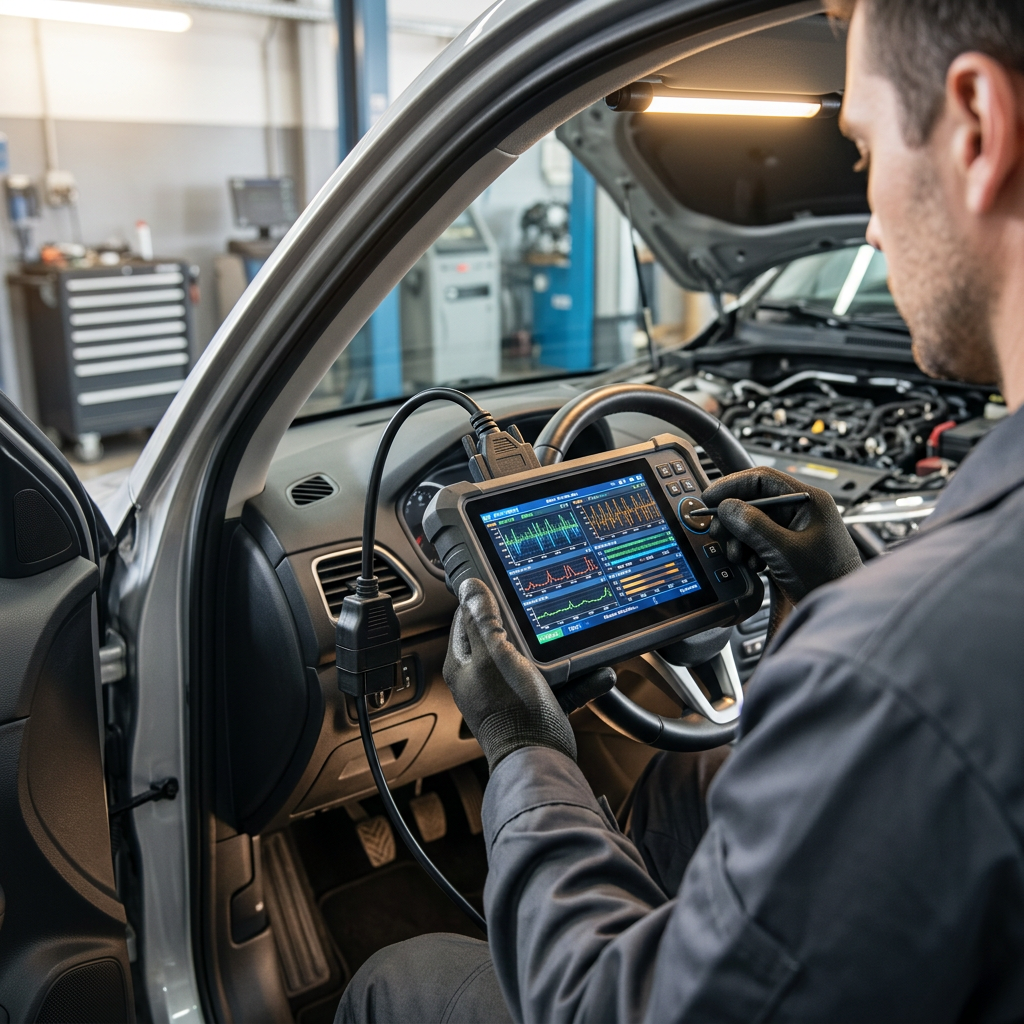
A basic code scan offered by retail auto parts stores merely retrieves the five-digit alphanumeric string stored in computer memory. A full professional diagnostic testing session goes significantly deeper, utilizing specialized equipment to test components directly. Diagnostic testing includes connecting advanced scan tools to monitor live-data streams, checking sensor signal waveforms with digital oscilloscopes, performing smoke tests to locate vacuum or evaporative emissions leaks, and executing pinpoint pin-out voltage checks at harness connectors.
Consider the financial comparison between guessing based on a code and investing in proper diagnosis:
- Scenario A (Parts Replacement Based on Code): A vehicle sets code P0135, defined as an oxygen sensor heater circuit malfunction. Assuming the sensor is bad, a car owner purchases and installs a new OEM oxygen sensor for $200. The check engine light returns immediately because the actual cause was a melted wiring harness or a $5 blown circuit fuse. Total spent: $205+ with the problem unresolved.
- Scenario B (Professional Pinpoint Diagnostics): A certified technician charges $120 for a diagnostic testing session. The technician checks voltage at the oxygen sensor connector, identifies zero voltage supply, traces the circuit back to a blown fuse caused by a pinched wire, repairs the wire, and replaces the fuse. Total spent: $125 with the vehicle fully repaired.
Our service advisors frequently observe drivers arriving with a stored P0300 code assuming they need four new ignition coils, only for our diagnostic pinpoint testing to reveal a simple vacuum leak at an intake manifold gasket. Spending money on systematic diagnosis eliminates trial-and-error parts replacement, protecting your repair budget while ensuring long-term vehicle reliability.
Does Replacing the Part Named in a Trouble Code Fix Your Vehicle?
Replacing the part named in a trouble code description fails to fix the vehicle problem in a substantial number of cases because diagnostic codes identify system conditions rather than broken parts. A code definition describes the symptom detected by an electronic control unit, leaving the underlying cause—whether electrical, mechanical, or sensor-related—unresolved until thorough diagnostic testing is performed.
A common example involves code P0420, defined as "Catalyst System Efficiency Below Threshold." The code name mentions the catalytic converter, leading many drivers to assume the converter must be replaced immediately. In practice, a P0420 code sets when the downstream oxygen sensor detects oxygen levels fluctuating too rapidly behind the catalyst. That condition can be caused by an upstream exhaust manifold leak drawing in outside air, a contaminated oxygen sensor, a sticking fuel injector, or an engine misfire. Replacing a $1,200 catalytic converter while ignoring an air leak or an rich-running fuel condition will destroy the new converter in short order.
A complete repair process follows a structured path beyond part installation:
- Code Extraction and Freeze-Frame Analysis: Retrieving stored, pending, and historical codes while recording operational metrics at the time of failure.
- Pinpoint Component and Circuit Testing: Using specialized tools to verify ground integrity, power supply, signal output, and physical mechanical function.
- Targeted Repair or Component Replacement: Fixing the verified root cause, whether it is a sensor, wiring repair, hose replacement, or internal engine component.
- Verification and Drive Cycle Reset: Clearing stored codes and performing a controlled test drive under conditions matching the original freeze-frame data to verify that all onboard monitors complete and the fault does not recur.
When navigating steep riverfront bluffs near East Liverpool, a vehicle that has only had a code cleared without root-cause repair will quickly trigger the check engine light again under heavy climb conditions. Before spending money on unneeded components, visit our service department location or give our service advisors a call to discuss your vehicle's symptoms. You can also explore current service offers and specials to save on essential routine maintenance and professional diagnostic testing.
Frequently Asked Questions About Vehicle Diagnostics
Q: What is the difference between a pending code and a confirmed code?
A pending trouble code indicates that the engine control module detected a system malfunction during a single driving cycle, but the fault has not yet persisted long enough to confirm a persistent failure. A confirmed code occurs after the same fault is detected across multiple consecutive driving cycles, which then officially triggers the check engine light on your dashboard.
Q: Why does a check engine light flash instead of staying solid?
A flashing check engine light indicates a severe engine misfire that is actively allowing unburned fuel to pass into the exhaust system. This raw fuel ignites inside the catalytic converter, driving temperatures above safe operating thresholds and causing irreversible thermal damage to the converter substrate within minutes. Drivers should reduce speed immediately and pull over safely when the light flashes.
Q: Can a weak or dying car battery cause random trouble codes to appear?
Yes, low system voltage or a failing battery can cause vehicle control modules to record multiple spurious trouble codes. Electronic sensors rely on stable reference voltages from the engine control unit; when battery voltage drops during cranking or driving, sensors send erratic signals that the computer interprets as system faults across chassis, body, and powertrain circuits.
Q: What is freeze-frame data and how do technicians use it?
Freeze-frame data is an automated snapshot of vehicle sensor parameters recorded by the engine control module at the exact instant a diagnostic trouble code is triggered. It captures operational metrics including engine speed, vehicle speed, engine load, fuel trim values, and coolant temperature. Technicians review this data to recreate the exact driving conditions under which an intermittent fault occurred.
Q: Will clearing a trouble code with an OBD-II scanner fix my car for an emissions inspection?
Clearing a trouble code with a basic scanner resets the check engine light, but it also erases all internal OBD-II readiness monitors. State emissions inspection programs check whether these readiness monitors have completed their self-diagnostic cycles. The vehicle computer will register an "incomplete" status until the vehicle is driven through specific drive cycles, at which point any unaddressed fault will illuminate the check engine light again.
Schedule Comprehensive Vehicle Diagnostics at Tri State Ford
Accurate vehicle repair begins with thorough, professional diagnostics rather than guesswork. Diagnostic trouble codes provide valuable direction, but identifying the true cause of an illuminated check engine light requires expert inspection, advanced diagnostic tools, and pinpoint electrical testing. Addressing warning lights promptly prevents minor sensor or vacuum issues from escalating into costly mechanical repairs.
Our factory-trained service technicians at Tri State Ford possess the specialized scanning equipment, factory technical databases, and hands-on experience necessary to diagnose complex driveability issues correctly the first time. Whether your vehicle displays a steady warning light or experiences subtle performance changes, our service team provides transparent evaluation and dependable repair solutions tailored to your vehicle's exact needs.
Take the next step in protecting your vehicle's performance and long-term reliability. To book a diagnostic evaluation, call our team at (330) 462-7578, visit our service center at 1503 Pennsylvania Ave in East Liverpool, or use our convenient online service scheduling portal to reserve your appointment today.