

Blog / Maintenance & Service, Expert Repairs & Diagnostics, Genuine Parts & Accessories, Engine Care &

Is a Mobile Oil Change Service Worth It?

f

Is a Mobile Oil Change Service Worth It?

A mobile oil change service is worth it because it delivers professional-grade vehicle maintenance directly to your driveway or workplace without service fee markups, saving up to two hours of driving and waiting room downtime. By utilizing factory-certified technicians who arrive with specialized containment systems and genuine manufacturer parts, vehicle owners maintain complete warranty protection while eliminating the hassle, mess, and scheduling conflicts of traditional auto shop visits.

Taking care of routine engine maintenance should fit seamlessly into a busy week. For working professionals and families managing busy schedules around Calcutta, having a professional service van pull right up to the house turns a mandatory chore into a hands-off task. You do not need to rearrange your morning commute, coordinate rides, or sit in a customer lounge while waiting for an oil change. The technician handles the entire procedure outside while you stay focused on your work or family priorities inside.

Beyond time savings, mobile care delivers complete transparency and peace of mind. You can watch the service take place on your own property and verify that factory-recommended oil grades and OEM filters go directly into your engine. When you want to combine convenient at-home care with expert dealership support, our team at Tri State Ford is always ready to assist. You can reach our team directly at (330) 462-7578 or drop by our convenient East Liverpool location to learn more about our complete service offerings.

Table of Contents

How Does a Mobile Oil Change Work and What Tools Do Technicians Bring?

A mobile oil change operates as a fully equipped rolling service bay where a certified technician brings custom fluid extraction units, vehicle lifts, new Motorcraft oil, and OEM filters directly to your vehicle. The technician performs a complete drain and refill, replaces the filter, conducts a multi-point inspection, and safely secures all used fluids without taking your vehicle off-site.

Mobile service vans carry high-capacity pneumatic vacuum pumps, specialized low-profile hydraulic jacks, heavy-duty jack stands, and zero-drip oil containment systems designed to prevent any fluid from touching your driveway. Whether servicing a commuter crossover or a hard-working truck from our F-Series work truck inventory, the technician selects the precise oil viscosity and filter type required for your exact engine. For example, a heavy-duty pickup powered by a 3.5L engine paired with a SelectShift automatic transmission requires specific fluid volumes and filter specifications that mobile technicians have stocked and ready before arriving at your door.

The service process follows strict technical standards:

  • Setting up spill-prevention matting under the engine bay.
  • Extracting or draining used engine oil directly into sealed, spill-proof storage containers.
  • Installing a factory-certified filter replacement using proper torque specifications.
  • Refilling the crankcase with premium synthetic blend or full synthetic oil matching OEM standards.
  • Executing a visual checkup covering battery health, belt wear, hose integrity, and tire pressure.

Every component used during mobile care meets or exceeds original manufacturer standards. Owners who prefer maintaining their own vehicles can easily order genuine OEM parts online through our dealership, but choosing mobile service gives you those exact high-quality components installed with professional precision right at home.
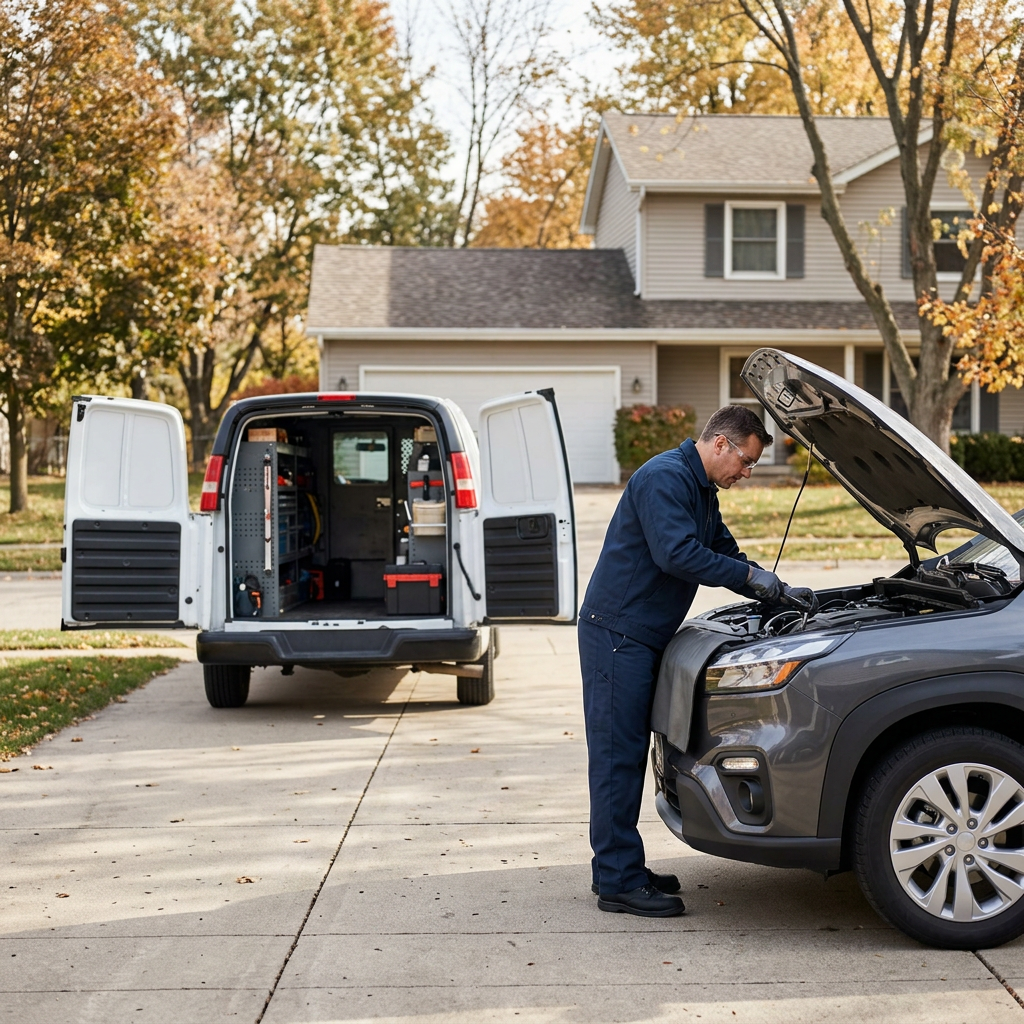
A mechanic in a blue uniform inspects a gray SUV engine in a driveway, with a mobile service van parked behind. (Representative image for illustration purposes only. Actual vehicle may vary based on trim and configuration.)

Are There Extra Travel Fees for Mobile Mechanics Coming to Your Location?

Most dealership-backed mobile oil change programs build travel costs directly into flat-rate maintenance pricing or offer complimentary travel within a designated service radius. Independent mobile mechanics may charge a standalone travel fee varies by service area depending on distance, but factory-supported mobile services eliminate surprise trip charges for standard scheduled maintenance.

Transparent pricing is a core priority for modern vehicle care. For drivers living along the riverfront bluffs or navigating steep residential driveways in East Liverpool, mobile service brings factory-level maintenance straight to your street without hidden mileage surcharges. Before any work begins, you receive a clear price quote that outlines the exact cost of the oil, filter, labor, and routine checkup steps.

Mobile maintenance packages often package routine care into comprehensive options like The Works, which bundles a synthetic-blend oil change, tire rotation, pressure check, brake inspection, fluid top-off, and battery test into a single transparent price. Because travel costs within the local service area are covered as part of the overall owner experience, mobile service delivers remarkable financial value alongside unmatched convenience.

Can Mobile Services Handle Full Synthetic Oil Changes for High-Performance Engines?

High-performance and EcoBoost engines require precise synthetic oil formulations, which mobile technicians carry to ensure optimal engine protection on-site. Mobile service units carry premium synthetic formulations designed to withstand high thermal stress, protecting turbochargers and internal engine components just as effectively as a traditional service bay.

Modern turbocharged engines require high-grade synthetic lubricants that flow quickly at cold startup and resist breaking down under high operating temperatures. Whether your vehicle is equipped with a high-output 2.3L engine or a fuel-efficient 1.5L engine paired with an automatic 8-speed transmission, mobile vans stock the exact synthetic viscosity specified in your owner manual. Utilizing full synthetic oil preserves engine power, protects critical turbo bearings, and optimizes fuel economy across every driving condition.

During a mobile appointment, technicians follow strict fluid-handling protocols to ensure clean filling without contamination. You can easily schedule a service appointment online to select full synthetic protection, ensuring your vehicle receives the exact high-performance lubricants it needs to run reliably for years to come.

Does Using a Mobile Maintenance Service Void Your Vehicle's Factory Warranty?

Using a mobile maintenance service does not void your vehicle's factory warranty under federal protection granted by the Magnuson-Moss Warranty Act. As long as the service uses manufacturer-compliant fluids and filters while maintaining clear digital records, your vehicle retains full warranty coverage.

Federal warranty law strictly prohibits manufacturers or dealers from voiding a vehicle warranty simply because scheduled maintenance was performed outside a traditional dealership workshop or by a mobile provider. Key warranty protections include:

  1. Freedom of Service Choice: Owners can choose where and how routine maintenance is performed without invalidating bumper-to-bumper or powertrain warranties.
  2. Parts Protection: Warranties remain fully intact as long as replacement filters and oils meet original manufacturer performance specifications.
  3. Digital Record Keeping: Mobile appointments log detailed service histories, documenting exact dates, mileage, oil types, and inspection results.

Utilizing our official Ford Mobile Service program provides an extra layer of confidence, as all completed work updates directly into your central vehicle history record. That digital paper trail satisfies every factory warranty requirement while giving future buyers verified proof of proper vehicle upkeep.

Mobile Oil Change vs. DIY: Is Professional Mobile Service Safer and More Convenient?

Professional mobile oil service is significantly safer and cleaner than DIY maintenance because certified technicians use heavy-duty jack stands, spill-containment mats, and sealed fluid recovery units that eliminate dangerous vehicle lifts and toxic waste disposal hassles. While changing oil yourself saves a small amount in labor, mobile service provides professional multi-point safety checks, proper torque verification, and certified environmental recycling without any physical strain or cleanup.

Changing motor oil in a residential driveway carries real safety risks and technical challenges. Crawling under a vehicle raised on portable ramps or consumer hydraulic jacks creates safety hazards, while overtightening a drain plug can strip oil pan threads and cause expensive engine damage. Furthermore, collecting and transporting used motor oil to an approved recycling center takes extra time and risks messy spills inside your personal vehicle.

Mobile technicians bring professional equipment and environmental controls directly to you. In addition to changing your oil safely, the technician performs essential preventive maintenance checks that DIYers often skip, such as testing electrical charging systems. If your vehicle shows signs of slow starting or low voltage, the technician can perform a comprehensive check and guide you through expert battery service options before a weak battery leaves you stranded.

Common Questions About Mobile Maintenance and Scheduled Service

Q: How much time does a mobile oil change save compared to visiting a service center?

A mobile oil change takes roughly 20 to 30 minutes of on-site service time while your vehicle remains parked in your driveway or office spot. By eliminating round-trip driving, service desk check-ins, and sitting in a lounge, you save between 60 and 90 minutes of active time compared to a conventional shop visit.

Q: What additional checks take place during a mobile oil change appointment?

A standard mobile oil change includes a comprehensive multi-point inspection covering vital safety components. The technician checks windshield washer fluid, engine coolant, and brake fluid levels, inspects belts and hoses for cracking, measures tire tread depth and inflation pressure, and tests battery health to ensure overall vehicle reliability.

Q: Can I schedule mobile service using the Ford App?

Yes, owners can schedule mobile appointments directly through the Ford App. The mobile platform sends automated maintenance notifications based on your vehicle mileage, displays full service history, and connects you directly with your preferred local dealership to select convenient mobile service times.

Q: What happens if my vehicle needs major repairs during a mobile oil service?

If a technician identifies a complex mechanical issue during the mobile inspection that requires a lift or specialized shop machinery, they will document the issue clearly. Our dealership can then arrange complimentary pickup and delivery to bring your vehicle to our service facility, complete the required repair, and return it safely to your driveway.

Q: How is emergency roadside assistance handled if my vehicle breaks down on the road?

For unexpected roadside emergencies, flat tires, or battery failures while traveling, official manufacturer roadside protection provides dedicated support. You can call Ford Roadside Assistance at 1-800-241-3673 for immediate, 24/7 emergency dispatch, towing to authorized service facilities, and factory-backed repair assistance wherever you are.

Taking proactive care of your vehicle has never been simpler. Whether you prefer the total convenience of mobile driveway service or need a comprehensive checkup at our shop, our expert service team is dedicated to keeping your vehicle running safely and smoothly. Contact our service department today at (330) 462-7578 or stop by our Tri State Ford service department to reserve your next maintenance appointment.

© 2026 Tri State Ford. All rights reserved.

Vehicle specification data © JATO Dynamics Limited.

Mobile Oil Change Services in East Liverpool OH | Tri State Ford
Posted in:

Related Posts

5

What Is the Average Annual Maintenance and Repair Cost for a Ford Explorer?

What Is the Average Annual Maintenance and Repair Cost for a Ford Explorer? The average annual maintenance and repair cost for a Ford Explorer is approximately $732, placing it right in line with midsize three-row SUV segment benchmarks. Owners typically experience an unscheduled repair frequency of just 0.2 visits per year, which is lower than the 0.4 annual average for the midsize SUV category. While routine maintenance accounts for scheduled visits, major system failures remain relatively uncommon when factory service schedules are followed. Routine preventative maintenance makes up the majority of those yearly expenditures during early ownership. Standard scheduled tasks like engine oil changes, tire rotations, multi-point visual inspections, and fluid top-offs cost roughly $200 to $350 annually during the first three years. As the odometer accumulates miles, routine wear items like cabin air filters, engine air filters, wiper blades, and brake pads gradually expand the annual budget. Unscheduled mechanical repairs account for the remaining balance. Industry tracking indicates a 14% probability that an unscheduled repair on an Explorer will be classified as a major issue, defined as a repair exceeding three times the average annual cost. Maintaining factory service intervals minimizes this risk, as our certified technicians identify minor fluid degradation or joint wear before it damages major mechanical assemblies. For drivers commuting along State Route 170 near Calcutta, regional elevation changes and winter road treatments place extra demands on suspension components and braking hardware. Staying current on scheduled undercarriage inspections preserves factory tolerances and avoids premature component degradation. Drivers can drop by our dealership at 1503 Pennsylvania Ave, East Liverpool, OH 43920 to consult with our factory-certified technicians or give our team (330) 462-7578 to discuss model-specific maintenance schedules. Table of Contents 2027 Ford Explorer 5-Year Ownership Costs: Depreciation, Fuel, and Insurance Can Basic Ford Explorer Maintenance Be Handled as DIY to Save Money? What Are the Most Common Long-Term Repairs and EcoBoost Turbo Concerns Over 5 to 10 Years? Towing Demands and Long-Term Service: How 5,000 Pounds of Pulling Affects Maintenance Common Questions About Ford Explorer Ownership and Service Costs Plan Your Ford Explorer Ownership Experience with Tri State Ford 2027 Ford Explorer 5-Year Ownership Costs: Depreciation, Fuel, and Insurance Over a five-year ownership cycle driving 15,000 miles per year, a 2027 Ford Explorer incurs an estimated total cost of ownership ranging from roughly $57,000 to $73,000, depending on trim and powertrain selection. Depreciation represents the largest individual expenditure, followed closely by fuel, financing, insurance, and routine mechanical maintenance. The entry-level 2027 Ford Explorer starts with a base MSRP of $38,680 for the Active RWD 100A configuration, while the Active 4WD 100A carries a base MSRP of $40,680, each with a $1,795 destination charge. Stepping up through the lineup, the Active RWD 200A lists at $40,615, the Active 4WD 200A at $42,615, the ST-Line RWD at $44,415, the ST-Line 4WD at $46,415, the Tremor 4WD starting at $49,415, the Platinum at $50,875, the Platinum 4WD at $52,875, the performance-tuned ST at $53,875, and the ST 4WD at $55,875. Five-year depreciation is roughly $22,000 to $25,000 on standard Active trims and exceeds $30,000 on upper trims like the ST. In segment comparisons, the Explorer retains value slightly behind the Toyota Highlander and Honda Pilot, which shed around 38% to 42% over five years, but outpaces domestic rivals like the Chevrolet Traverse and Dodge Durango. Operating costs over 75,000 miles reflect efficient standard powertrains and reasonable insurance ratings: Fuel Expenses: The standard 2.3L EcoBoost four-cylinder paired with the SelectShift automatic achieves an EPA-rated 20 city / 28 hwy / 23 combined in rear-wheel-drive configurations like the Active RWD 100A, Active RWD 200A, and ST-Line RWD. Equipping four-wheel drive shifts those numbers to 20 city / 27 hwy / 23 combined on the Active 4WD 100A, Active 4WD 200A, ST-Line 4WD, and Platinum 4WD. The high-output 3.0L EcoBoost V6 delivers 17 city / 25 hwy / 20 combined on the rear-wheel-drive ST and 17 city / 24 hwy / 20 combined on the ST 4WD, while the trail-ready Tremor 4WD checks in at 18 city / 22 hwy / 20 combined. Over five years, fuel budgets typically range from $12,500 to $15,000 based on standard pump averages. Insurance Costs: Annual full-coverage insurance premiums for the Explorer average between $1,650 and $1,980 for a driver with a clean record, or roughly $138 to $165 monthly. Standard safety gear, including Pre-Collision Assist with Automatic Emergency Braking, the Blind Spot Information System, and Lane-Keeping System, helps keep underwriting risk competitive with segment averages. Factory Protection: Every new Explorer comes guarded by Ford factory warranties, including a 3-year/36,000-mile bumper-to-bumper limited warranty, a 5-year/60,000-mile powertrain warranty, and a 5-year/unlimited-mile corrosion warranty. Ford roadside assistance provides towing to the nearest authorized Ford service center, flat tire changes, battery jump-starts, and lockout assistance. You can reach manufacturer dispatch directly via Ford Roadside Assistance: (800) 241-3673, ensuring factory-backed emergency support. Ford also provides a one-year subscription to the Ford Security Package starting from the original warranty date. Shoppers evaluating long-term budgets can explore our new Ford inventory to cross-reference equipment packages and window stickers across every available Explorer configuration. 2027 Ford Explorer Pricing Pricing by trim Trim Base MSRP Destination charge Active 4WD 100A $40,680 $1,795 Active 4WD 200A $42,615 $1,795 Active RWD 100A $38,680 $1,795 Active RWD 200A $40,615 $1,795 Platinum $50,875 $1,795 Platinum 4WD $52,875 $1,795 ST $53,875 $1,795 ST 4WD $55,875 $1,795 ST-LINE 4WD $46,415 $1,795 ST-LINE RWD $44,415 $1,795 Tremor 4WD Starting at $49,415 $1,795 Utility Police Interceptor 4x4 $49,050 $1,795 2027 Ford Explorer Fuel Economy Fuel economy and range by trim Trim MPG Active 4WD 100A 20 city / 27 hwy / 23 combined Active 4WD 200A 20 city / 27 hwy / 23 combined Active RWD 100A 20 city / 28 hwy / 23 combined Active RWD 200A 20 city / 28 hwy / 23 combined Platinum 20 city / 28 hwy / 23 combined Platinum 4WD 20 city / 27 hwy / 23 combined ST 17 city / 25 hwy / 20 combined ST 4WD 17 city / 24 hwy / 20 combined ST-LINE 4WD 20 city / 27 hwy / 23 combined ST-LINE RWD 20 city / 28 hwy / 23 combined Tremor 4WD 18 city / 22 hwy / 20 combined Utility Police Interceptor 4x4 — Can Basic Ford Explorer Maintenance Be Handled as DIY to Save Money? Routine preventative maintenance on a Ford Explorer can be completed at home to save 50% to 70% on standard labor charges. Tasks like swapping engine air filters, replacing cabin air filters, installing fresh wiper blades, exchanging 12-volt starting batteries, and performing basic oil changes require straightforward hand tools and basic mechanical knowledge. However, advanced systems like electronic parking brakes, pressurized cooling loops, and transmission fluid checks require specialized diagnostic interfaces that make professional workshop service preferable. The simplest do-it-yourself maintenance items deliver high financial returns with minimal investment in garage equipment: Engine and Cabin Air Filters: Replacing the engine air filter requires popping four metal retaining clips on the airbox housing, lifting the lid, removing the pleated element, and dropping in an authentic Motorcraft replacement. The cabin air filter sits behind the passenger glove compartment, requiring only the dampener cord to be disconnected and the glovebox dropped down. Completing both tasks at home takes under 20 minutes and saves significant workshop labor fees. Wiper Blade Replacement: Standard front and rear wiper assemblies utilize simple pinch-tab or hook connectors that release by hand. Changing blades twice a year preserves clear outward visibility through harsh northeastern weather without requiring a dealership appointment. Battery Replacement: Replacing the group-size 12-volt battery requires a 10 mm socket wrench to loosen the terminal clamps (negative terminal first, positive second) and an 8 mm wrench for the hold-down bracket. After installing a fresh unit, the Battery Monitoring System should be reset so the alternator charging profile matches the new battery's internal resistance. Engine oil and filter changes represent another popular home task, though the Explorer requires proper ramp clearance and oil catch basins. The 2.3L EcoBoost engine uses 6.0 quarts of synthetic-blend or full-synthetic 5W-30 engine oil meeting Ford specification WSS-M2C961-A1. Performing an oil drain and filter replacement at home requires standard jack stands, an oil filter wrench, and a drain pan. Brake pad and rotor replacement falls into an intermediate category. Standard front or rear brake pad replacement averages between $248 and $305 per axle at a certified shop, where parts cost roughly $126 and labor accounts for $122 to $179. Adding replacement rotors increases the axle cost to between $450 and $600. While mechanically inclined owners can compress caliper pistons and bolt in new pads, modern Explorers incorporate an Electronic Parking Brake on the rear axle. Servicing rear pads at home requires entering a dedicated "Brake Maintenance Mode" via steering wheel dashboard menus or an OBD-II scanner to retract the electric caliper servos; forcing the caliper pistons back mechanically without engaging service mode will strip the electronic actuator gears. When vehicle shoppers prefer an Explorer that has already undergone comprehensive factory screening, our inventory of CARFAX 1-Owner pre-owned vehicles offers documented service histories showing whether prior upkeep was handled at certified service bays. What Are the Most Common Long-Term Repairs and EcoBoost Turbo Concerns Over 5 to 10 Years? Over 5 to 10 years of ownership, total cumulative maintenance and repair expenses for a Ford Explorer average approximately $9,000 to $9,800, with mechanical demands concentrating heavily past the 75,000-mile mark. While the initial five years demand only $2,100 to $2,800 in scheduled fluid services and minor wear items, the second five years bring major wearable mechanical items into play, including suspension bushings, wheel bearings, cooling systems, and ignition hardware. Turbocharger longevity on both the 2.3L EcoBoost and the 3.0L EcoBoost V6 depends heavily on oil lubrication quality. Because exhaust gases spin the turbine wheel at speeds surpassing 150,000 RPM under heavy boost, operating temperatures within the center bearing cartridge are extreme. The most common EcoBoost turbocharger concerns center around oil coking in the narrow oil feed lines and bearing journal wear. If oil changes are neglected or low-grade conventional oils are used, heat-degraded oil bakes onto the internal bearing surfaces, restricting oil flow and causing premature shaft play. Utilizing full-synthetic motor oils and replacing spark plugs every 30,000 to 45,000 miles help prevent cylinder misfires that could otherwise dump unburned fuel into the exhaust turbine. Long-term mileage milestones beyond 80,000 miles also bring several predictable repair items: Brake Rotors and Friction Surfaces: Heavy three-row SUVs cycle immense thermal energy into braking hardware. Rotors generally require replacement every two pad cycles due to grooving or lateral runout caused by high heat cycling. Front Wheel Hub Bearing Assemblies: Road impacts and moisture eventually break down internal bearing seals, resulting in a low rumbling or humming noise that changes pitch while turning at highway speeds. Cooling System Components: Thermostat housings, coolant bypass valves, and auxiliary water pumps on EcoBoost engines can develop small seepage points around plastic hose necks and gasket seals after years of thermal expansion and contraction. Suspension Bushings and Ball Joints: Front lower control arm bushings and sway bar end links carry the weight of a 4,300-pound curb weight over pavement imperfections, eventually developing rubber tears that cause front-end clunks over road seams. To safeguard vehicle health, owners can easily order original Motorcraft parts directly from our parts department to ensure direct OEM fitment. For drivers looking to purchase an older model with factory warranty protection, our inventory of certified pre-owned Ford models includes thorough 139-point or 172-point mechanical inspections and comprehensive limited warranty coverage. 2027 Ford Explorer Engine & Performance Powertrain specs by trim Feature Active 4WD 100A Active 4WD 200A Active RWD 100A Active RWD 200A Platinum Platinum 4WD Standard engine 2.3L 2.3L 2.3L 2.3L 2.3L 2.3L Horsepower 300 hp 300 hp 300 hp 300 hp 300 hp 300 hp Torque 310 lb-ft 310 lb-ft 310 lb-ft 310 lb-ft 310 lb-ft 310 lb-ft Transmission SelectShift® SelectShift® SelectShift® SelectShift® SelectShift® SelectShift® Drivetrain Four-wheel drive Four-wheel drive Rear-wheel drive Rear-wheel drive Rear-wheel drive Four-wheel drive Engine & Performance (continued) Feature ST ST 4WD ST-LINE 4WD ST-LINE RWD Tremor 4WD Utility Police Interceptor 4x4 Standard engine 3L 3L 2.3L 2.3L 2.3L 3.3L Horsepower 400 hp 400 hp 300 hp 300 hp 300 hp 318 hp Torque 415 lb-ft 415 lb-ft 310 lb-ft 310 lb-ft 310 lb-ft 260 lb-ft Transmission SelectShift® SelectShift® SelectShift® SelectShift® SelectShift® SelectShift Drivetrain Rear-wheel drive Four-wheel drive Four-wheel drive Rear-wheel drive Four-wheel drive Four-wheel drive Towing Demands and Long-Term Service: How 5,000 Pounds of Pulling Affects Maintenance Properly equipped with the factory Class III Trailer Tow Package, the 2027 Ford Explorer delivers a maximum towing capacity of 5,000 lbs across its entire lineup. Pulling campers, utility trailers, or boats near that maximum weight rating increases thermal stress across the powertrain, prompting Ford to mandate severe-duty maintenance intervals to prevent accelerated wear on the transmission, transfer case, and differentials. Towing places severe mechanical demands across several critical vehicle systems: Transmission Fluid Degradation: Pulling 5,000 pounds causes the torque converter in the 10-speed automatic transmission to generate significantly more heat under sustained hill climbs. Transmission fluid exposed to elevated operating temperatures oxidizes faster, reducing lubricating properties. While normal-duty schedules suggest transmission fluid exchanges at 150,000 miles, regular towing warrants fluid exchanges every 30,000 to 45,000 miles. Rear Differential and Transfer Case Fluids: The rear differential and intelligent four-wheel-drive power transfer unit process sustained high torque loads when towing. Heavy trailering degrades gear lubricants, requiring differential oil drain-and-fill services far sooner than typical highway-only operation. Brake Pad and Rotor Consumption: Stopping a combined vehicle-and-trailer mass accelerates brake friction material wear. Towing on hilly secondary roads can cut brake pad lifespan in half, making frequent rotor thickness checks essential. Tire Wear and Alignment: Towing increases rear axle tongue load, compressing rear coil springs and altering rear wheel camber angles. Rotating tires every 5,000 miles prevents irregular inner-shoulder tread feathering. Families heading toward Mill Creek MetroParks near Canfield Township with a travel trailer or boat will appreciate how smoothly the Explorer manages heavy tongue loads. When hauling seasonal cargo, scheduling preventative fluid services helps avoid mid-season mechanical stress. You can easily schedule a service appointment online with our certified technicians, or if you are considering stepping into a fresh vehicle with updated towing hardware, our team can help you value your trade-in vehicle to evaluate equity toward your next family hauler. Common Questions About Ford Explorer Ownership and Service Costs Q: What is the recommended routine maintenance schedule for a Ford Explorer? Ford outlines scheduled maintenance intervals primarily every 10,000 miles or 12 months under normal driving conditions, monitored by the Intelligent Oil-Life Monitor system. Every 10,000 miles, the vehicle requires an engine oil and filter change, tire rotation, brake inspection, and multi-point vehicle check. At 20,000 miles, the cabin air filter requires replacement. At 30,000 miles, the engine air filter should be swapped, and the fuel system inspected. Spark plugs on turbocharged EcoBoost engines should be replaced at 60,000 to 70,000 miles for optimal combustion, while engine coolant and automatic transmission fluids should be exchanged by 100,000 miles, or earlier under severe operating conditions. Q: How does winter driving and road salt impact Explorer maintenance in northeastern Ohio? Operating in a severe salt-belt environment accelerates exterior corrosion on exposed metal chassis components, brake caliper slide pins, and exhaust hangers. Road salt brine can cause caliper guide pins to seize within their brackets, leading to uneven brake pad wear and premature rotor scoring. Road grit also degrades exposed suspension bushings and rubber ball joint boots over repeated freeze-thaw cycles. We recommend regular undercarriage pressure washes throughout winter months and an annual visual chassis inspection to lubricate caliper pins and protect steel brake lines. Q: How do cold winter temperatures affect the Explorer's 12-volt battery? Sub-freezing temperatures reduce a 12-volt automotive battery's chemical reaction speed, cutting available cold cranking amps by up to 30% to 50% during prolonged freezes while the engine requires thicker oil to turn over. Explorers equipped with modern digital instrument clusters, heated seats, and advanced driver aids draw substantial reserve capacity on startup. Testing battery state of health before freezing temperatures arrive prevents unexpected no-start conditions. Drivers experiencing slow engine cranks can view our battery testing and replacement guide for diagnostic advice. Q: Can I have routine Explorer scheduled maintenance performed at my home or office? Yes, routine maintenance including engine oil and filter changes, tire rotations, multi-point visual safety checks, wiper blade installations, and battery replacements can be completed at your driveway or workplace through Ford Mobile Service options. Certified technicians bring factory-approved tools and genuine Motorcraft parts directly to your location, providing identical warranty compliance and certified documentation without requiring you to visit a dealership service bay. Q: What manufacturer warranty coverage comes standard with a new Ford Explorer? Every new Ford Explorer includes a 3-year/36,000-mile bumper-to-bumper limited warranty covering factory defects in materials or workmanship, alongside a 5-year/60,000-mile powertrain limited warranty protecting the engine, transmission, and drive axles. Additionally, Ford provides a 5-year/unlimited-mile corrosion warranty against sheet metal perforation and 5 years or 60,000 miles of 24/7 roadside assistance. Customers planning their purchase budget can contact us for current financing information before selecting their vehicle. Plan Your Ford Explorer Ownership Experience with Tri State Ford Managing Ford Explorer ownership costs is simple when pairing preventative maintenance with factory-certified service support. Whether you plan to handle basic air filter replacements in your own garage or rely on our factory-trained master technicians for scheduled transmission and differential fluid flushes, consistent upkeep protects resale value and ensures long-term powertrain durability. Our team at Tri State Ford is ready to assist you through every stage of vehicle ownership, from selecting the ideal trim with the right towing hardware to structuring your service plans. Visit our showroom and service facility located at 1503 Pennsylvania Ave, East Liverpool, OH 43920, or give our team (330) 462-7578 today to schedule your next maintenance check or test drive. © 2026 Tri State Ford. All rights reserved. Vehicle specification data © JATO Dynamics Limited. Ford Explorer Costs in East Liverpool, OH | Tri State Ford

3

How Does Ford Mobile Service Work for Commercial Fleets?

How Does Ford Mobile Service Work for Commercial Fleets? Ford Mobile Service deploys factory-trained technicians directly to your company yard, warehouse, or jobsite in specially outfitted mobile service vans. Our technicians handle scheduled maintenance, light mechanical repairs, diagnostic evaluations, and manufacturer software updates right where your vehicles are parked. Instead of assigning drivers to shuttle trucks to a physical garage and waiting in line, your business schedules on-site appointments during scheduled downtime, keeping your commercial assets road-ready without taking vehicles off their daily routes. Managing a busy lineup of work vehicles requires balancing tight delivery schedules, jobsite commitments, and constant preventative care. When an asset leaves your staging area for maintenance, the hidden costs add up fast: secondary chase vehicles, driver hourly wages spent sitting in waiting rooms, and disrupted route timing. With our mobile service, our team schedules visits around your operating rhythm, servicing vehicles in batches during planned yard stops or between shifts. Our mobile units are equipped with commercial-grade fluid extraction systems, onboard power generators, pneumatic tools, air compressors, and factory calibration equipment. Whether your business operates a local delivery group of Ford Transit vans or runs heavy haulers from our F-Series work truck selection, our mobile technicians carry the specialized tooling required for commercial duty cycles. For local contractors balancing projects near State Route 170 in Calcutta, having scheduled maintenance roll directly onto your lot eliminates route disruptions before morning crews roll out. To discuss setting up a routine commercial care schedule or check our current service perimeter, give our commercial advisors (330) 462-7578 a call. You can also map a route to our service department at 1503 Pennsylvania Ave to coordinate multi-vehicle account setups with our fleet specialists. Table of Contents Can Ford Mobile Service Operate Indoors in a Company Warehouse or Garage? Which Routine Maintenance and Commercial Fleet Services Can Be Performed On-Site? Do Mobile Technicians Have Access to Dealership Diagnostic Systems? How Mobile Maintenance Cuts Fleet Downtime and Supports Mixed Makes with Omnicraft What Do Fleet Managers Need to Know About Ford Mobile Service? Streamline Your Commercial Maintenance Schedule with On-Site Fleet Care Can Ford Mobile Service Operate Indoors in a Company Warehouse or Garage? Indoor service is possible only when a warehouse or garage provides adequate clearance, stable flooring, ventilation, and safe access for the technician. The indoor space must offer adequate overhead door clearance for our tall-roof mobile service vans, a level concrete floor capable of supporting safe jacking, proper airflow, and a facility policy that permits standard commercial automotive fluids on the property. INDOOR FLEET SERVICE CHECKLIST Physical Clearance 10 to 12 feet of overhead door and ceiling clearance for mobile vans Flooring Surface Flat, reinforced concrete clean of debris and rated for commercial jacks Staging Footprint Minimum 4 to 6 feet of perimeter space around each serviced vehicle Facility Ventilation Active air exchange or open bay doors during diagnostic engine cycling Environmental Safety Approved indoor fluid transfer policy and available fire suppression equipment To accommodate our specialized service vans, an indoor facility generally needs a minimum of 10 to 12 feet of vertical clearance at the entry doors and inside the work envelope. Service vans carry internal storage racks, heavy-duty fluid reservoirs, and roof-mounted safety lighting that exceed standard passenger vehicle heights. Staging areas must also provide at least four to six feet of perimeter space around each fleet vehicle so technicians can maneuver tire-handling equipment, roll-around tool cabinets, and digital diagnostic carts without obstruction. Environmental protection is built directly into our on-site processes. Our technicians use closed-loop, vacuum-assisted fluid extraction systems that pull motor oil, transmission fluid, and engine coolant directly through the dipstick tube or sealed access ports into onboard waste recovery tanks. This eliminates open-air gravity pans and drastically lowers the risk of spills on your warehouse floor. Technicians also lay down heavy-duty absorbent containment mats and carry commercial spill kits to comply with property management and industrial health standards. When your warehouse team needs to prepare staging zones or confirm vehicle fitment, you can review our on-site capabilities through our dedicated mobile service overview. If your in-house fleet staff requires replacement filters, hardware, or shop supplies for their own daily checks, you can quickly order commercial maintenance parts through our parts department to keep your staging area fully stocked. Which Routine Maintenance and Commercial Fleet Services Can Be Performed On-Site? Our mobile service handles preventative maintenance, wear-and-tear component replacements, safety inspections, diagnostic troubleshooting, and software-driven recall remedies right at your facility. These capabilities cover up to 80 percent of the routine service events that keep work trucks and cargo vans running through demanding commercial duty cycles. ON-SITE MOBILE SERVICE CAPABILITIES Lubrication & Engine Health Full synthetic and diesel oil changes, oil filters, engine air filters, fuel water separators Brake & Friction Service Pad replacement, rotor replacement, caliper service, hydraulic fluid checks Electrical & Starting Systems Battery conductance testing, AGM/lead-acid replacement, terminal service, alternators Running Gear & Vision Tire rotations, electronic balance checks, tire pressure monitoring reset, wiper sets Diagnostics & Compliance Check engine light diagnostics, factory software updates, safety recall procedures Routine fluid intervals are the foundation of on-site service. Mobile technicians conduct comprehensive oil and filter services on gasoline engines, such as the 3.5L EcoBoost in the Ford F-150, as well as high-capacity Power Stroke turbo diesel engines powering the Ford Super Duty platform. Technicians replace engine air filters, cabin microfilters, and diesel fuel water separators before dirty elements harm fuel efficiency or wear down high-pressure injection pumps. Brake friction components take a beating in urban stop-and-go driving and hilly terrain. Technicians measure pad friction thickness with digital gauges, inspect rotor runout, and replace worn pads and rotors directly on your lot. Mobile vans also carry complete tire service gear, enabling technicians to rotate heavy-ply commercial tires, set cold inflation pressures to load specifications, and reset the Tire Pressure Monitoring System (TPMS) across every axle. To keep commercial vehicles from missing mandated operational windows, dispatchers can schedule fleet service online to book mobile maintenance blocks. Major structural overhauls, internal transmission rebuilds, frame straightening, and tasks requiring multi-post vehicle lifts remain assigned to our main service center, but mobile care handles the regular upkeep that prevents those catastrophic breakdowns. Do Mobile Technicians Have Access to Dealership Diagnostic Systems? Every mobile technician operates with the same factory-level computer diagnostic hardware and proprietary software programs used inside our dealership service bays. Rather than carrying generic handheld code readers that only display basic trouble codes, our mobile units connect directly to Ford Motor Company's engineering database using cloud-linked ruggedized laptops and specialized interface hardware. Our technicians run FDRS (Ford Diagnostic & Repair System) and the legacy IDS (Integrated Diagnostic System) through a genuine Ford VCM 3 (Vehicle Communication Module) vehicle interface. This setup allows technicians to read proprietary controller area network (CAN-bus) live data streams, test individual sensors, and command bidirectional component activations. If a delivery van triggers an illuminated wrench light or enters an engine limp mode, our mobile technician isolates the failing module, checks live pressure readings, and verifies wiring harness voltage on-site. These systems give our mobile units full module programming authority. Technicians can execute: Powertrain Control Module (PCM) software updates to refine transmission shift schedules and engine idle stability Body Control Module (BCM) configurations for auxiliary lighting and upfit electrical circuits Anti-lock braking system calibrations following hydraulic or wheel-speed sensor service Key-fob programming and fleet telematics gateway modem module synchronizations Manufacturer recalls involving module flashes, high-voltage battery software monitoring updates on electric models like the E-Transit, and communications updates are routinely resolved directly on your staging lot. Because our diagnostic tools update over secure cellular networks with real-time factory technical service bulletins, your commercial assets receive identical technical accuracy whether serviced in our shop or parked at your warehouse. How Mobile Maintenance Cuts Fleet Downtime and Supports Mixed Makes with Omnicraft Mobile fleet maintenance slashes non-productive downtime by servicing vehicles when they are naturally parked, eliminating the compounding labor costs of vehicle transport. For operations supporting manufacturing and industrial sites along the river bluffs in East Liverpool, scheduling maintenance between operational runs means zero lost billable hours for drivers and work crews. When a company relies solely on fixed service facilities, the cost of an oil change or brake inspection includes driver wages, fuel burn, and the loss of a revenue-generating vehicle for half a day. Batching mobile service on-site resets this dynamic. While your crews complete paperwork, rest overnight, or load inventory for the next morning, our technicians service three, five, or ten vehicles in a single visit. Dispatchers preserve their scheduled operating hours, vehicle wear from non-revenue travel drops to zero, and your overall fleet availability climbs. FLEET SERVICE METHOD COMPARISON Operational Factor Dealership Bay vs. On-Site Mobile Care Driver Transit Hours 1 to 2 paid driver hours per vehicle vs. 0 driver hours with on-site service Chase Vehicles Required Requires a second driver and chase truck vs. zero external logistics Vehicle Staging Time Sits in off-site holding queue vs. stays parked on company property until finished Service Scheduling Window Strictly during regular shop hours vs. flexible windows during fleet idle time Mixed-Make Support Often requires multiple brand dealers vs. unified care using Motorcraft & Omnicraft Many commercial fleets operate mixed vehicle inventories, combining Ford work trucks with vans and chassis cabs from other manufacturers. Through Ford's Omnicraft parts line, our mobile technicians carry certified, precision-engineered replacement parts designed specifically for non-Ford makes. Omnicraft supplies high-grade brake pads, rotors, starters, alternators, filters, and suspension parts backed by manufacturer warranties. Pairing Omnicraft with genuine Motorcraft components for your Ford vehicles allows you to consolidate all your preventative care into one single mobile vendor. Your fleet administrator handles one service invoice, maintains unified maintenance logs, and avoids juggling accounts across multiple independent repair facilities. What Do Fleet Managers Need to Know About Ford Mobile Service? Q: How many vehicles does my business need to schedule a mobile service visit? A single urgent diagnostic visit and scheduled batch maintenance for dozens of units can both fit into a fleet’s on-site service plan. While servicing multiple vehicles during a single visit maximizes your yard efficiency and technician staging time, single-vehicle visits are regularly scheduled for time-sensitive recalls or critical fluid intervals. Scheduling requirements and travel perimeters depend on technician availability, so contacting our service department allows us to build an appointment window tailored to your lot size. Q: Can mobile technicians service commercial electric vehicles like the E-Transit? Yes, our mobile technicians are certified to perform scheduled maintenance, software updates, and light mechanical repairs on commercial electric vehicles like the Ford E-Transit and F-150 Lightning. On-site EV services include multi-point safety inspections, high-voltage cooling system checks, 12-volt accessory battery testing, cabin air filter replacement, tire rotations, and brake friction maintenance. Mobile technicians also connect factory diagnostic systems to monitor battery cell state-of-health and complete high-voltage battery management software recalibrations right at your fleet charging depot. Q: What happens if an on-site inspection reveals a major mechanical issue? If a technician uncovers severe wear or heavy component failures during an inspection, we document the issue with digital measurements and photographs for your fleet coordinator. The technician establishes whether the vehicle remains safe to operate or requires immediate grounding. For heavy repairs exceeding mobile capabilities, such as transmission replacements, head gaskets, or structural frame alignment, our mobile coordinator helps arrange transport and schedules direct priority entry into our commercial dealership service bays. Q: How do cold winter temperatures and road salt affect mobile maintenance scheduling? Sub-freezing winter weather and heavy road salt usage accelerate undercarriage corrosion and severely strain electrical starting systems. Cold temperatures reduce battery cranking amperage, making proactive conductance testing vital before freezing weather hits. Our commercial battery testing advice explains how our technicians detect failing cells before work trucks fail to crank on winter mornings. If bitter weather or ice storms prevent safe outdoor repairs, mobile visits can transition inside your heated warehouse or be rescheduled to keep technicians safe and equipment operating properly. Q: Is there an added trip charge for scheduling Ford Mobile Service at our facility? Please contact our service department for current mobile service availability and any applicable fees for your location. Your business pays only for the standard parts and labor required for the specific maintenance, inspections, or mechanical repairs performed on your vehicles. Warranty repairs and software-based safety recalls performed on-site are covered according to manufacturer terms with no mobile dispatch fee charged to your commercial account. Streamline Your Commercial Maintenance Schedule with On-Site Fleet Care Protecting commercial vehicle uptime requires a proactive maintenance partner that works around your operating hours rather than disrupting them. Ford Mobile Service from Tri State Ford brings certified technicians, factory-grade diagnostic computers, and original equipment parts straight to your business location. Whether your fleet operates cargo vans, diesel haulers, or mixed-make utility trucks, our mobile units eliminate transit waste and keep your drivers focused on their jobs. Take the friction out of your fleet maintenance schedule by speaking with our commercial service team today. Give us a quick call to set up your company profile, review recurring batch maintenance options, or reserve an upcoming service date. If you prefer to discuss fleet maintenance management in person or inspect our dedicated commercial truck facilities, drop a pin to our service center location and let our commercial team build a maintenance schedule that keeps your business moving forward. © 2026 Tri State Ford. All rights reserved. Vehicle specification data © JATO Dynamics Limited. Ford Mobile Service in East Liverpool, OH | Tri State Ford

c

How Can You Get Car Maintenance Done Without Missing Work?

How Can You Get Car Maintenance Done Without Missing Work? You can keep your Ford running smoothly while minimizing workday interruption by utilizing Ford Mobile Service at your workplace, booking complimentary Ford Pickup & Delivery, or taking advantage of secure after-hours key drop facilities. These remote scheduling options can help reduce traditional service lobby wait times by bringing certified auto maintenance directly to your parking spot or transporting your vehicle back and forth while you remain on the clock. For working professionals navigating daily drives down State Route 170 from suburban communities like Calcutta, taking time off for routine vehicle care is often inconvenient. Automotive manufacturers and local service centers have restructured ownership care to eliminate schedule conflicts entirely. Instead of sitting in a waiting room or arranging rides between shifts, vehicle owners can leverage three primary workday options: Mobile On-Site Maintenance: A factory-trained technician drives a equipped service van to your office or worksite to perform essential fluid changes, filter updates, and tire care directly in the parking lot. Valet Pickup and Delivery: Dealership representatives collect your truck, SUV, or sedan directly from your work location, handle required maintenance or repairs at the shop, and return it before your shift ends. After-Hours Key Drop-Off: Drivers drop off their vehicle early in the morning before business hours or late at night using a secure key vault, allowing technicians to perform service during standard operating hours while providing digital updates remotely. Whether you need a quick engine check or standard maintenance, our team at Tri State Ford makes keeping your vehicle healthy seamless. To coordinate your next maintenance visit around your work week, reach out directly at (330) 462-7578 or drop by our service center location to speak with an advisor. Table of Contents What Services Are Included in Mobile Repair and Is There an Extra Fee? How Does Dealership Valet Pickup Work and Do You Need to Be Present? Which Is Faster for Work Schedules: Valet Pickup or Mobile Service? Where Is the Key Drop Box Located for After-Hours Vehicle Drop-Offs? Common Questions About Workday Vehicle Maintenance Options Schedule Convenient Ford Maintenance What Services Are Included in Mobile Repair and Is There an Extra Fee? Ford Mobile Service covers routine scheduled maintenance and light repairs, including engine oil and filter replacements, tire rotations, brake pad replacements, battery testing, wiper blade updates, fluid top-offs, multi-point safety inspections, and recall updates. For vehicles located within standard operational zones, mobile maintenance is typically billed at normal shop rates without added convenience fees. Mobile service vans function as remote service bays, equipped with commercial fluid extraction systems, pneumatic lifts, specialized hand tools, diagnostic equipment, and genuine Motorcraft parts. This equipment allows certified technicians to complete essential care tasks safely and cleanly in commercial parking lots without leaving behind oil drips or waste. Key maintenance tasks performed directly at your job site include: Routine Fluid Maintenance: Synthetic or blend engine oil changes, engine coolant adjustments, transmission fluid checks, and windshield washer reservoir refills. Brake System Care: Front and rear brake pad replacements, rotor inspections, and brake fluid line health assessments. Tire and Wheel Services: Four-wheel tire rotations, air pressure adjustments, tread depth evaluations, and tire wear diagnostics. Electrical and Battery Service: Diagnostic battery health testing, battery terminal cleaning, complete battery replacements, and vehicle software updates. Filter and Accessory Updates: Engine air filter replacements, cabin air filter updates, and wiper blade swaps. Transparent pricing remains a central priority for remote care. Most mobile service programs charge standard labor rates and retail parts costs identical to an in-shop visit. You receive an itemized digital estimate before work begins, allowing complete price clarity before approving any service. To lock in your preferred appointment window, utilize our online service scheduling portal. If you prefer performing basic maintenance tasks yourself or need specific components, you can also explore ordering genuine Ford parts direct from our dealership. How Does Dealership Valet Pickup Work and Do You Need to Be Present? Valet pickup and delivery involves a dealership representative arriving at your designated workplace or home address, exchanging keys, driving your vehicle to the service center for maintenance, and returning it upon completion. You only need to be present for a quick 60-second handoff at the beginning and end of the appointment, though contactless pickup options can often be arranged if work meetings restrict your availability. The Ford Pickup & Delivery workflow is engineered for minimal work interruption: Online or Phone Scheduling: You select a convenient pickup time and specify your vehicle's physical location. Representative Arrival: On service day, a designated dealership driver arrives during your chosen timeframe and notifies you via text message or phone call. Vehicle Inspection and Handover: A brief initial walk-around is performed to document vehicle condition before keys are transferred. Off-Site Repair and Digital Updates: Technicians perform scheduled services at the dealership, sending digital multipoint inspection reports and repair videos straight to your mobile device. Contactless Payment: You review your invoice and submit payment securely through your phone or computer. Return Delivery: The representative delivers your serviced vehicle back to your parking lot and returns your keys. Most dealerships offer complimentary pickup and delivery for qualifying warranty work or standard maintenance within a designated radius, typically 10 to 20 miles from the dealer facility. For services requiring extended shop stays, loaner vehicles can often be arranged during the pickup process. Our service team often notes that commuters scheduling valet service appreciate receiving digital multipoint inspection updates directly to their phones while working, keeping them fully informed without stepping away from their desks. To take advantage of this complimentary convenience, learn more about our Ford Pickup & Delivery program and verify service availability for your work location. Which Is Faster for Work Schedules: Valet Pickup or Mobile Service? Mobile service is generally faster for workday schedules because maintenance begins the moment the technician arrives at your vehicle, avoiding transit travel times and dealership intake lines. However, valet pickup remains the necessary choice when your vehicle requires complex mechanical overhauls, major powertrain repairs, or specialized equipment like wheel alignment machines and heavy shop hoists. Comparing both options helps determine the best fit for your daily schedule: Option Feature Mobile On-Site Service Valet Pickup & Delivery Primary Location Your work parking lot / driveway Dealership service center Typical Downtime 30 to 60 minutes on site 2 to 4 hours (includes transit) Eligible Services Oil changes, batteries, filters, brakes All mechanical, recall, and heavy repairs Vehicle Transit Vehicle remains parked at your work Driven to dealer facility and back Equipment Access Specialized mobile van tools Full dealership workshop and hoists For professionals working near commercial hubs around Market Street in Boardman, choosing mobile service for an oil change or air filter replacement means your vehicle never leaves its space. The entire job is completed while you attend meetings or complete tasks indoors. When a battery dies unexpectedly in the parking structure, requesting a dedicated Ford Mobile Service van allows a technician to handle routine battery testing and replacement right where the car is parked, restoring your vehicle before your workday ends. Where Is the Key Drop Box Located for After-Hours Vehicle Drop-Offs? Our after-hours key drop box is located directly adjacent to the main service department entrance, positioned under exterior security lighting for safe, round-the-clock access. This secure setup allows shift workers, early risers, and late commuters to drop off their vehicle outside regular business hours without needing staff assistance. Using the night drop facility involves simple steps designed for vehicle security and clear communication: Park in Designated Areas: Park your vehicle in a well-lit designated service visitor space near the service bays. Locate the Drop Station: Walk to the illuminated drop box near the main service entrance doors. Fill Out the Envelope: Retrieve a heavy-duty key drop envelope from the dispenser box. Print your contact details, vehicle make, model, and requested services clearly on the envelope face. Lock and Deposit: Lock your vehicle doors, place the key fob inside the envelope, seal it securely, and slide it through the reinforced drop slot into the internal vault. Once service staff open the facility in the morning, an advisor retrieves the key vault envelopes, checks the vehicle into the scheduling system, and contacts you via phone or text to confirm the service plan before work begins. This process ensures your vehicle gets first-tier positioning in the daily service queue. Common Questions About Workday Vehicle Maintenance Options Q: How do I prepare my vehicle for a workplace mobile service visit? Select a relatively flat, open parking space that allows sufficient clearance around your vehicle for the service van. Ensure your vehicle is parked in a publicly accessible area rather than a gated structure with height restrictions, and leave your contact number so the technician can coordinate key access upon arrival. Q: Is Ford Roadside Assistance available if my vehicle breaks down on the way to work? Yes, manufacturer-backed emergency support is available for eligible vehicles during their coverage period. If you experience a flat tire, dead battery, or unexpected breakdown during your morning commute, you can request support by contacting Ford Roadside Assistance: 1-800-241-3673. Certified technicians will respond to provide towing to an authorized dealership, jump-starts, or roadside repairs using genuine components. Q: Can I approve additional repair recommendations remotely while working? Yes, digital multi-point inspection reports are sent directly to your smartphone or email address. These reports include clear photos, video overviews from the technician, and transparent pricing for any recommended maintenance, allowing you to approve or decline specific items with a single tap from your desk. Q: What happens if a mobile inspection reveals a complex mechanical issue? If a mobile technician identifies a major issue requiring specialized workshop machinery—such as extended transmission work or heavy suspension overhauls—the technician documents the finding. Our service center will then coordinate complimentary valet pickup or assist in scheduling a workshop visit to address the repair at our main facility. Q: How far in advance should workday service appointments be scheduled? Booking 3 to 5 business days in advance ensures access to your preferred time window for mobile visits or valet pickup. While urgent repairs can often be accommodated sooner, advance booking secures reserved technician time aligned precisely with your work calendar. Schedule Convenient Ford Maintenance Maintaining your vehicle should never require burning PTO or disrupting your busy work schedule. With flexible mobile care options, complimentary valet pickup, and secure key drop availability, getting certified auto care is simpler than ever. Our factory-trained technicians use only genuine parts and advanced diagnostic tools to keep your Ford running at peak performance. Take control of your workday maintenance routine today. Get in touch with our expert team by giving us a call at (330) 462-7578 or set up directions to visit our East Liverpool facility at your convenience. We look forward to providing the hassle-free service you deserve. © 2026 Tri State Ford. All rights reserved. Car Maintenance Services in East Liverpool OH | Tri State Ford