

How Do You Handle a Check Engine Light During a Road Trip?
When your check engine light illuminates during a road trip, inspect your dashboard gauges immediately for critical oil pressure or coolant temperature warnings. If the amber symbol remains steady and your vehicle drives smoothly, continue toward the next exit, confirm the fuel filler cap is tight, and schedule diagnostic service promptly. If the symbol flashes or the vehicle shudders, ease off the accelerator, pull off at a secure location, shut down the engine, and contact Ford Roadside Assistance: 1-800-241-3673 to prevent severe catalytic converter damage.
Highway driving places constant demands on your vehicle, especially when carrying passengers and luggage. If the warning symbol turns on while you are traveling, managing the situation calmly prevents unnecessary roadside hazards. Never slam on your brakes or pull onto an active highway shoulder if the vehicle is driving normally. An active shoulder exposes your family to high-speed traffic. Instead, maintain a steady cruising speed, look for the nearest well-lit rest stop or highway exit, and evaluate how the vehicle feels beneath you.
Checking the cluster tells you whether the vehicle faces an immediate mechanical emergency or an emissions-related fault. Keep an eye out for changes in throttle response, unusual transmission shifts, or warning chimes. If your route brings you back toward our facility, you can find our service bay by mapping directions to our East Liverpool location. If you notice any unusual engine roughness while passing nearby, give our technicians a quick phone call so we can prepare a diagnostic bay for your arrival.
Table of Contents
- What Does Your Dash Tell You: Light Color and Steady vs. Flashing Warnings
- How Does a Loose Gas Cap Trigger the Light and How Long Until It Resets?
- How Do OBD-II Diagnostic Trouble Codes Work to Identify Engine Problems?
- Free Auto Parts Store Scans vs. Portable Pocket Scanners on the Road
- Common Road Trip Questions About Check Engine Warnings
- Schedule Certified Diagnostic Service at Tri State Ford
What Does Your Dash Tell You: Light Color and Steady vs. Flashing Warnings
Modern passenger vehicles use standardized amber or yellow dashboard illumination for the check engine symbol, reserving red warning lights for immediate safety hazards like braking loss, oil pressure drops, or severe engine overheating. The color distinction helps drivers differentiate between an advisory maintenance warning and an active mechanical failure.
Understanding how the malfunction indicator behaves determines whether you can travel to your destination or need to stop right away:
- Steady Amber Light: Signals that the powertrain control module detected an emissions, sensor, or performance fault that does not pose an immediate danger of catastrophic engine failure. You can generally finish your immediate drive to a service facility, provided engine temperature and oil pressure remain stable.
- Flashing Amber Light: Warns of an active, severe engine misfire. When unburned gasoline dumps directly into the exhaust stream, temperatures inside the catalytic converter can exceed normal operating thresholds within seconds, risking fire and permanent exhaust destruction.
- Red Oil Can or Battery Light: Indicates an urgent loss of lubrication pressure or charging system failure requiring you to safely stop the vehicle and turn off the ignition immediately.
- Red Temperature Gauge Indicator: Warns of extreme engine coolant temperatures that can warp cylinder heads or blow head gaskets if operation continues.
Ascending the steep riverfront bluffs in East Liverpool places extra load on the powertrain, which can cause an existing, marginal ignition coil to fail under stress. If your dash light transitions from steady to flashing while climbing a grade, ease off the accelerator immediately to reduce engine load. Reduce your speed, select a safe pull-off point well away from moving traffic, and switch off the engine to allow the exhaust system to cool down.
How Does a Loose Gas Cap Trigger the Light and How Long Until It Resets?
A loose, missing, or worn fuel filler cap causes a pressure drop in the evaporative emission control system, triggering an error code because gasoline vapors escape into the atmosphere. Once you tighten the cap or clean the seal, the check engine light usually turns off automatically after two to three complete, error-free drive cycles, which typically takes between 30 and 100 miles of mixed driving.
The evaporative emissions system traps gasoline fumes in a specialized charcoal canister, periodically routing those vapors into the intake manifold to burn cleanly. Modern engine computers run automated vacuum and pressure decay tests on this closed system during highway cruising or after cold engine starts. If the fuel tank cannot hold proper vacuum, the computer flags an evaporative leak code such as P0455 for a major leak or P0456 for a minor leak.
If your light appears shortly after leaving a fuel station, take these inspection steps at your next scheduled stop:
- Turn the ignition off and open the fuel door to inspect the gas cap or capless filler seal.
- Check the rubber gasket on the cap for cracking, dirt buildup, flat spots, or dry rot.
- Reinstall the cap and turn it firmly until you hear the internal mechanism click, ensuring an airtight seal.
- Clean away any dirt, sand, or debris caught inside the seal ring on capless systems using a clean cloth or a funnel nozzle.
Even after you correct the seal, the onboard computer does not clear the warning light instantly. Federal emissions standards require the control module to verify system integrity across multiple drive cycles. A drive cycle requires starting the vehicle cold, driving through varied city and highway speeds, and allowing the engine to return to ambient temperatures. If the light remains on after three days of normal operation, a technician should inspect the purge valve, vapor canister, and vent lines.
How Do OBD-II Diagnostic Trouble Codes Work to Identify Engine Problems?
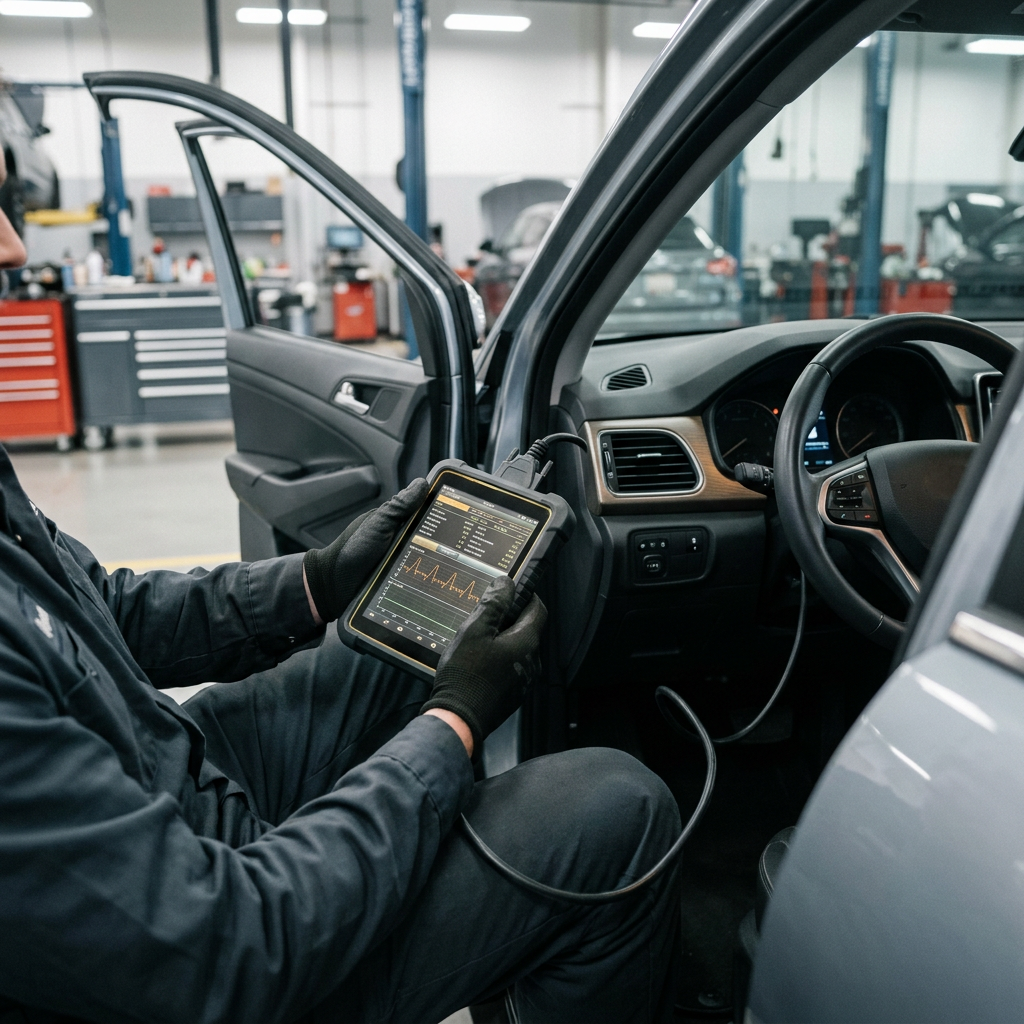
Onboard Diagnostics II systems use an array of electronic sensors to continuously track powertrain performance, logging a standardized five-character diagnostic trouble code whenever operating parameters exceed factory thresholds across specific test cycles. These alphanumeric codes identify the specific circuit or system experiencing abnormal data, giving technicians an exact starting point for troubleshooting.
Every standardized code follows a deliberate naming convention established by the Society of Automotive Engineers:
- First Character (System Category): A "P" designates the powertrain (engine, transmission, fuel, and emissions), "B" represents body systems (airbags and climate control), "C" covers chassis components (brakes and steering), and "U" flags network communication bus errors.
- Second Character (Code Type): A "0" indicates a standardized generic code common across all vehicle manufacturers, whereas a "1" indicates an automaker-specific manufacturer code.
- Third Character (Subsystem): Numbers from 1 through 8 designate the specific mechanical subsystem, such as fuel metering (1 or 2), ignition system and misfires (3), auxiliary emission controls (4), speed control and idle systems (5), computer output circuits (6), or transmission controls (7 and 8).
- Fourth and Fifth Characters (Fault Designation): The final two digits pinpoint the specific component fault, such as a P0301 code indicating a misfire specifically localized to cylinder number one.
When a trouble code sets, the computer records a snapshot of sensor data called freeze-frame data. This log documents vehicle speed, engine speed, coolant temperature, fuel trim percentages, and throttle position at the precise millisecond the fault occurred. When maintaining heavy commercial haulers and work vehicles from our F-Series work-ready lineup, technicians rely heavily on freeze-frame logs to isolate intermittent electrical faults from mechanical component wear, ensuring business vehicles return to work without repeat visits.
Free Auto Parts Store Scans vs. Portable Pocket Scanners on the Road
Major auto parts retail chains provide complimentary code scans in their parking lots using handheld code readers, but keeping a personal pocket scanner in your glove box offers immediate peace of mind without detouring from your travel route. A basic handheld reader costs between $20 and $40, while compact Bluetooth and Wi-Fi adapters that transmit diagnostic data directly to a smartphone app range from $30 to $120.
Relying on a free scan from an auto parts store can help you identify a pending code, but counter staff are retail associates rather than certified diagnostic technicians. A scanner only reads the symptom code; it does not test underlying wiring or dynamic sensor readings. For instance, receiving a P0420 catalyst efficiency code does not automatically mean your catalytic converter is broken. An upstream exhaust leak, a fouled oxygen sensor, or a leaking fuel injector can produce identical exhaust gas readings. Replacing parts based solely on code descriptions often leads to unnecessary expense without fixing the actual problem.
A portable pocket scanner remains a practical tool for any road trip. Carrying your own device allows you to retrieve stored codes, read pending trouble codes, and check whether a fault is related to simple evaporative emissions or an active mechanical cylinder misfire. When hauling camping gear along State Route 170 in Calcutta, having an onboard scanner lets you confirm whether a dash warning requires an immediate stop or simply a scheduled maintenance inspection when you return home. If testing reveals a damaged fuel line seal, an aged oxygen sensor, or a worn gas cap, you can easily order genuine replacement components directly from our certified parts counter.
Common Road Trip Questions About Check Engine Warnings
Q: Can you keep driving with a steady check engine light if the car seems normal?
Yes, you can safely continue driving to your next stop or service destination if the light is solid amber and your vehicle displays normal power, temperature, and fluid levels. A steady light indicates an emissions or sensor variation that does not present an immediate risk of engine shutdown. Avoid aggressive acceleration, avoid heavy towing, and arrange a complete diagnostic inspection as soon as practical to prevent secondary component wear.
Q: What is the first thing you should do when the check engine light turns on while driving?
Glance at your primary instrument cluster to evaluate your coolant temperature gauge, oil pressure warning lamp, and battery indicator. Next, observe whether the check engine symbol is steady or flashing while listening for pinging, knocking, or engine roughness. If all gauges read within normal ranges and the vehicle responds normally to the throttle, continue driving calmly toward the nearest highway exit or rest area.
Q: What is the difference between a pending code and a confirmed trouble code?
A pending code records an abnormal sensor reading that has occurred during a single drive cycle but has not yet met the threshold to illuminate the dashboard light. The engine control module requires most emissions-related faults to occur during two consecutive drive cycles before confirming the fault code and turning on the malfunction indicator lamp. If the problem does not repeat during the second operating cycle, the pending code clears automatically.
Q: Why does my vehicle run rough immediately after refueling at a gas station?
Rough idling or extended cranking after filling your fuel tank points to an evaporative emissions purge valve that is stuck in an open position. When the valve fails to seal, fuel vapors enter the engine intake uncontrolled while you pump gas, over-saturating the combustion chambers with raw vapor. This creates a temporary flooded condition that causes stumbling until the excess fuel vapors clear from the manifold.
Q: Does clearing an engine trouble code with a pocket scanner fix the mechanical problem?
Clearing a code with a scanner only erases the recorded fault history from computer memory; it does not repair the underlying component fault. Once you reset the system, the vehicle enters an unready state for emissions testing. As soon as the powertrain control module completes its automated diagnostic drive cycles, the sensors will detect the unaddressed condition and illuminate the malfunction light again.
Schedule Certified Diagnostic Service at Tri State Ford
Resolving an illuminated check engine warning requires accurate diagnostic equipment, factory-calibrated testing procedures, and specialized automotive expertise. Our factory-trained technicians look past simple error codes, analyzing live sensor telemetry, fuel trim numbers, and freeze-frame records to correct the root cause of your warning light on the first visit.
When you return from your trip or notice an active dashboard alert, you can quickly schedule a service appointment online to reserve a dedicated diagnostic bay. For roadside concerns or immediate technical advice, contact our service team at (330) 462-7578. You can also visit our repair center in person by setting your navigation to 1503 Pennsylvania Ave, East Liverpool, OH 43920, where our team is ready to restore your vehicle to peak operating condition.