To fix an oil leak on a 2026 Ford, you must clean the engine bay, identify the exact origin using fluorescent ultraviolet dye or inspection powder, replace the compromised gasket or fitting, and refill the crankcase to the proper level. Minor seeps at the valve cover or oil pan require installing a new pre-formed seal or applying Motorcraft High Performance Engine RTV Silicone, whereas pressurized leaks along turbocharger oil feed lines require replacing degraded line fittings and copper seals before fluid loss harms internal components.
Identifying an engine oil leak early prevents thermal damage and protects critical engine components from lubrication starvation. Fresh engine oil appears amber or light brown with a slick feel, whereas older oil turns dark brown or black. If oil drips onto hot exhaust manifolds, it generates a harsh burning odor and light white smoke under the hood. Continuing to drive with severe oil loss can lead to low oil pressure warnings, premature bearing wear, or severe engine overheating.
When inspecting a leak at home, place a clean sheet of white cardboard directly beneath the engine crossmember overnight. Engine oil leaves a distinct dark brown or black stain, distinguishing it from red transmission fluid or pink coolant. If you notice persistent puddling, check the dipstick level before starting the vehicle to ensure sufficient oil remains in the crankcase.
For persistent or high-pressure leaks, professional diagnostic equipment provides the most accurate answer. You can visit our service department at 1503 Pennsylvania Ave for a comprehensive multi-point inspection, or give our service team a quick call at (330) 462-7578 to discuss observed symptoms with a certified technician.
Table of Contents
- What Are the Common Causes and Leak Points on Ford EcoBoost Engines?
- 2026 Ford F-150 vs Ram 1500: Which Truck Offers Better Oil Leak Resistance?
- How to Inspect Your Ford for Oil Leaks and Check for Safety Recalls
- Can You Use an Extended Warranty to Cover Ford Oil Leak Repairs?
- Frequently Asked Questions About Ford Engine Oil Leaks
- Schedule Professional Oil Leak Diagnostics
What Are the Common Causes and Leak Points on Ford EcoBoost Engines?
Common oil leak points on Ford EcoBoost engines center around high-heat and high-pressure zones, including the valve cover gaskets, lower oil pan mating surfaces, timing chain covers, and turbocharger oil supply lines. Modern forced-induction engines subject engine seals to rapid thermal expansion and contraction cycles, which causes rubber gaskets to harden and RTV sealant bonds to degrade over extended mileage.
On the 2.0L EcoBoost engine, which powers versatile crossover models like the 2026 Ford Escape with standard all-wheel drive, primary leak points include the front timing cover seal and the valve cover perimeter gasket. Over time, crankcase pressure can force oil past hardened valve cover corner seals, allowing oil to pool around spark plug wells or seep down the front engine cover. The 2.0L EcoBoost in the 2026 Ford Explorer also requires careful inspection around the front crankshaft seal, where road debris and heat can accelerate rubber breakdown.
The twin-turbocharged 3.5L EcoBoost V6 presents a distinct set of potential leak areas due to its tight engine bay packaging and elevated turbocharger operating temperatures:
- Vacuum Pump Seal: On older 3.5L engine architectures, the mechanical vacuum pump mounted to the rear of the passenger-side cylinder head can develop a slow oil seep that drips directly onto the transmission bell housing.
- Turbocharger Oil Lines: High exhaust gas temperatures near the turbochargers can degrade the small rubber O-rings and crush washers on the oil feed and return lines, causing oil to vaporize against the exhaust piping.
- Composite Oil Pan Sealant: Certain previous-generation engine designs utilized composite plastic oil pans sealed with liquid RTV sealant. Repeated heat cycles caused minor pan flexing, leading to slow seeps along the lower engine block rail. Recent Ford engine designs have addressed this by utilizing updated pan structures and press-in-place gaskets.
When truck owners bring an EcoBoost into our service bay with an oil leak, our technicians usually check the rear vacuum pump and valve covers before looking at the lower oil pan. Driving across varied elevations, such as the rolling hills around State Route 170 in Calcutta, puts steady load on the turbocharger cooling and lubrication system. Maintaining clean engine oil and replacing PCV valves at recommended intervals relieves excess crankcase pressure, protecting internal seals across all EcoBoost engine configurations.
2026 Ford F-150 vs Ram 1500: Which Truck Offers Better Oil Leak Resistance?
The 2026 Ford F-150 offers exceptional long-term oil leak resistance by pairing refined engine sealing techniques with durable metal oil pans and press-in-place synthetic rubber gaskets across its powertrain lineup. While Ram 1500 trucks historically relied on standard stamped steel or cast aluminum oil pans, earlier generations of full-size trucks faced persistent valve cover and oil cooler adapter leaks. Modern Ford engineering focuses on heavy-duty crankcase ventilation and robust gasket designs built for heavy towing and demanding commercial service.
In full-size work trucks, engine oil integrity directly impacts productivity and long-term durability. The 2026 Ford F-150 equipped with the 3.5L EcoBoost V6 delivers an impressive 10,400 lbs towing capacity, supported by a heavy-duty engine oil cooler and a precise SelectShift® automatic transmission. To withstand high oil pressures during heavy hauling, Ford utilizes engineered press-in gaskets at major engine mating surfaces rather than relying solely on liquid sealant beads, preventing the gasket distortion that affected older truck engines.
To keep work fleets running smoothly without unexpected downtime, proper maintenance of cooling and lubrication systems remains essential. You can explore our current new work truck lineup to see how modern Ford powertrains are configured for heavy-duty work, or check out our complete new truck inventory to compare cab styles and engine options built to handle rigorous regional workloads.

How to Inspect Your Ford for Oil Leaks and Check for Safety Recalls
Performing an accurate DIY oil leak inspection requires a systematic approach to trace fluid back to its highest point of origin on the engine assembly. Gravity causes leaking oil to travel downward and backward along the chassis frame rails while driving, which often makes a minor valve cover leak appear as a major oil pan failure underneath the vehicle.
Follow this step-by-step diagnostic process to isolate an oil leak:
- Clean the Engine Bay: Spray a dedicated automotive degreaser over the dirty lower engine surfaces and rinse carefully with low-pressure water, taking care to avoid delicate electrical connectors.
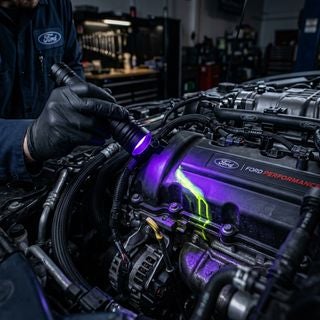
- Apply Leak Detection Powder or UV Dye: Dust suspected leak areas with aerosol leak detection powder, or pour a bottle of fluorescent engine oil UV dye directly into the oil filler cap.
- Run the Engine: Idle the vehicle for 10 to 15 minutes, or drive a short distance to allow oil pressure to build up within the engine galleries.
- Inspect with an Ultraviolet Light: Shine a blacklight around timing covers, valve cover rails, and oil filter housings. The fluorescent dye will glow brightly at the exact crack or gasket breach where fluid emerges.
If a previous repair attempt failed to fix the issue, your vehicle may have been misdiagnosed. Misdiagnoses frequently occur when residual oil from a upper engine leak accumulates around the rear main seal or transmission torque converter housing. Requesting a UV dye tracer test ensures technicians verify the top-most active leak source before replacing expensive structural components.
In some cases, oil leaks stem from specific factory service actions or safety recalls rather than normal wear. For instance, manufacturer safety recalls have previously addressed missing cylinder head ball plugs on select 2.0L EcoBoost and 2.3L EcoBoost engines that could allow oil to escape near hot exhaust manifolds. You can check your vehicle's safety recall status at any time by entering your 17-character Vehicle Identification Number (VIN) into the official Ford owner portal or the NHTSA recall lookup tool. Drivers navigating daily trips near Market Street in Boardman can rely on authorized Ford service centers to complete all recall repairs free of charge.
 Can You Use an Extended Warranty to Cover Ford Oil Leak Repairs?
Official Ford Protect Extended Service Plans cover major engine oil leak repairs, including the replacement of oil pan gaskets, valve cover seals, timing cover gaskets, and internal engine oil seals damaged through normal operational wear. Coverage eligibility depends on the specific plan tier selected at contract activation:
- PowertrainCARE: Covers fundamental mechanical components, including internal engine seals, oil pump assemblies, and cylinder head gaskets across 29 core powertrain parts.
- BaseCARE: Expands coverage to 84 mechanical components, adding steering gear housing seals and primary engine cooling hardware.
- ExtraCARE: Protects 113 key parts, covering complex electronic sensors, fuel systems, and engine accessory seals.
- PremiumCARE: Comprehensive bumper-to-bumper protection covering over 1,000 components, including high-tech engine sensors, turbocharger oil lines, and complete gasket sets.
Warranty claims require proof that the vehicle was maintained according to the recommended service schedule published in the owner manual. Failing to perform regular oil changes can lead to sludge buildup, which restricts crankcase ventilation and damages internal seals. Keep all oil change receipts and maintenance logs organized to ensure seamless claim processing when service is required.
Component damage resulting from aftermarket engine modifications, improper installation, or pre-existing conditions prior to contract coverage is not covered under extended warranty terms. When repairing an active leak, using genuine factory components preserves engine tolerances and ensures precise fitment. You can schedule a service appointment with our factory-trained technicians to inspect covered components, or order genuine OEM parts directly through our service department for approved maintenance tasks.
Frequently Asked Questions About Ford Engine Oil Leaks
Q: Can a failing vacuum pump cause an oil leak on a 3.5L EcoBoost engine?
Yes, on earlier 3.5L EcoBoost V6 engine designs, the mechanical vacuum pump attached to the back of the passenger-side cylinder head can develop an oil leak at its mounting seal. As the seal degrades, engine oil seeps out and drips down onto the top of the transmission housing, often mimicking a leaking valve cover gasket or rear main seal failure.
Q: Is it safe to drive my Ford if it has a minor oil leak?
You can drive short distances with a slow oil seep provided you regularly check the dipstick and maintain proper oil levels in the crankcase. However, if oil leaks directly onto hot exhaust components, creates a strong burning smell, or causes the low oil pressure light to illuminate, you should pull over immediately and switch off the engine to prevent severe mechanical damage or thermal hazards.
Q: What should I do if a technician misdiagnoses my vehicle's oil leak?
If an initial repair fails to stop an oil leak, request a comprehensive ultraviolet dye test to trace the fluid's exact path from the highest point on the engine. Ask the service advisor to review official Technical Service Bulletins related to your specific engine code, which often outline updated diagnostic steps for complex leaks around timing covers, turbo oil lines, and oil pan seals.
Q: How do I know if my Ford oil leak is covered by a factory recall?
You can verify recall eligibility by locating your 17-character VIN on your registration card or driver-side dashboard and entering it into the official Ford support website or the NHTSA recall tool. If an active safety recall applies to your engine's oil system, an authorized Ford dealership will perform the necessary inspection and component replacement at no cost to you.
Q: What is the difference between fresh engine oil and other leaking fluids?
Fresh engine oil has an amber or light brown appearance with a slick feel, turning dark brown or black as it ages. Red or dark pink fluid indicates automatic transmission or power steering fluid, clear light brown or blue fluid with a sweet odor points to engine coolant, and clear thin fluid near the passenger side footwell is typically harmless air conditioning condensation.
Schedule Professional Oil Leak Diagnostics
Addressing an engine oil leak promptly protects your vehicle's mechanical reliability, maintains resale value, and ensures your engine remains fully lubricated under heavy driving loads. Whether your vehicle requires a simple valve cover gasket replacement, updated turbocharger oil line fittings, or a complete multi-point inspection, professional diagnostic care provides lasting peace of mind on local roads and work sites.
Our factory-certified technicians utilize specialized diagnostic tools, genuine Motorcraft fluids, and precise OEM replacement seals engineered specifically for your vehicle's powertrain. You can get directions to Tri State Ford to drop off your vehicle for expert care, or give our team a call at (330) 462-7578 to speak directly with a knowledgeable service advisor. If you are also considering an upgraded truck or SUV while your vehicle is in for service, feel free to schedule a test drive online today.