
Blog / Used Vehicle Guides, Financing & Insurance, Buying Guides, Trade-In Advice, Certified Pre-Owned

What Should You Know Before Buying a New Vehicle from Tri State Ford?

8

Before buying a new vehicle from Tri State Ford, shoppers should know that current inventory, available promotional APR financing through Ford Credit, trade-in valuations, and available vehicle incentives shape your final purchase terms. Reviewing window stickers, verifying available driver-assist technologies, and starting an online pre-approval streamline the showroom experience and ensure transparent transaction details.

Navigating the new vehicle market requires a clear understanding of vehicle options, financing paths, and trade-in opportunities. When you prepare for a vehicle purchase, establishing your total budget and determining key capability requirements—such as towing capacity or cargo space—allows our team to guide you toward the right trim and package.

Confirming documentation upfront helps ensure a smooth purchase process. Bringing a valid driver's license, current auto insurance documentation, and recent income verification if applying for financing allows our team to process paperwork efficiently. For shoppers trading in an existing vehicle, bringing the title, current registration, and all factory keys ensures an accurate on-site evaluation.

Before making the drive to our showroom, shoppers can explore our current new vehicle inventory online to check available trims, exterior colors, and optional equipment packages. Finding our dealership is simple when you map out your route to our East Liverpool facility , or you can give our sales team a quick call at (330) 462-7578 to confirm vehicle availability before your test drive.

Table of Contents

What Lease Incentives and Financing Rates Does Ford Offer for New Vehicles?

Ford Credit offers promotional financing interest rates—that vary by model, term, and qualification for eligible buyers on select new models—alongside structured retail lease programs and factory customer cash incentives. Lease programs incorporate defined annual mileage terms, initial acquisition structures, and residual value projections to deliver predictable monthly payments.

Promotional APR offers allow buyers to minimize interest expenses over standard loan durations ranging from 36 to 72 months. Financing incentives vary by model year, trim selection, and customer credit profile. For buyers who prefer lower upfront commitments or want to upgrade vehicles every few years, factory lease options provide flexible terms with mileage allowances tailored to daily commuting or family travel requirements.

Incentive Category Typical Program Structure Primary Buyer Benefit
Promotional APR Financing Rates from 0% APR to 3.9% APR for select terms Lowers total interest paid over loan life
Retail Lease Offer 24- to 36-month terms with low monthly rates Provides predictable payments and easy upgrades
Regional Customer Cash Factory rebates applied to transaction price Direct reduction in final vehicle cost
Custom Factory Order Incentives Price protection and current program locking Secures preferred specs without lot compromises

Evaluating auto loan options before visiting the dealership helps align your financing path with your household financial goals. Completing an online credit application establishes clear budget parameters, enabling our finance department to structure competitive loan or lease terms. If you prefer a specific exterior color or rare package combination, utilizing our custom factory order tool allows you to lock in eligible incentives while tailoring a truck or SUV to your exact specifications. Additionally, trading in your current vehicle using our instant cash offer program provides a firm trade allowance that can be applied directly as a cash down payment.
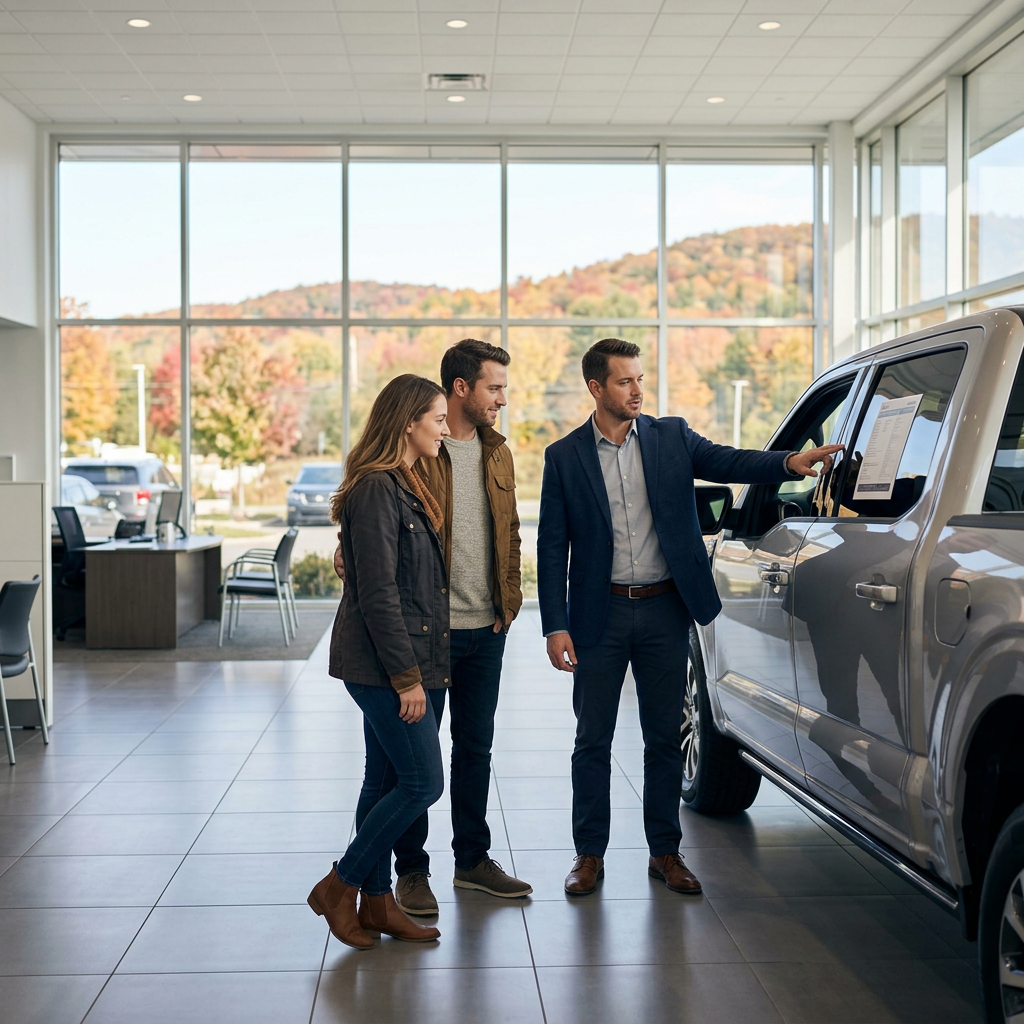
Car salesman showing features on a silver truck's window sticker to a young couple in a dealership. (Representative image for illustration purposes only. Actual vehicle may vary based on trim and configuration.)

Is Ford BlueCruise Hands-Free Highway Driving Available on 2027 Ford Models?

Yes, Ford BlueCruise hands-free highway driving is available on selected 2027 Ford models, including the F-150, Explorer, Expedition, and Mustang Mach-E. Operating across more than 130,000 miles of pre-mapped, divided highways called Blue Zones, the system manages acceleration, braking, and steering while requiring drivers to keep their eyes on the road ahead.

The 2027 model year expands hands-free capability with upgraded software releases that refine overall lane-positioning performance. Automatic Lane Change allows the vehicle to execute safe lane transitions when traffic slows without driver turn-signal activation, while In-Lane Repositioning subtly shifts the vehicle away from oversized commercial trucks in adjacent lanes. For truck buyers, 2027 marks the debut of BlueCruise with Towing on equipped F-150 pickups, enabling hands-free highway control while hauling trailers weighing up to 10,000 lbs.

Drivers can choose flexible activation plans depending on their usage needs:

  • Annual Subscription Plan: Provides continuous service following an initial trial period.
  • Monthly Subscription Plan: Offers flexible, pay-as-you-go activation for seasonal road trips.
  • One-Time Purchase Option: Bundles long-term hardware and service access at initial vehicle purchase.

An infrared driver-facing camera continuously tracks eye gaze and head position to ensure attentiveness. If a driver looks away from the roadway, visual and audible alerts prompt immediate driver re-engagement. If you are researching reliable pre-owned options before upgrading to new driver-assist tech, you can browse our pre-owned single-owner vehicle inventory to inspect models equipped with proven driver-assist safety suites.

Which Truck Has Better Fuel Economy: Ford F-150 PowerBoost or Chevy Silverado Duramax?

The Chevrolet Silverado Duramax diesel carries a higher EPA highway rating at up to 26 mpg combined, whereas the Ford F-150 PowerBoost full hybrid delivers 23 mpg combined while providing standard four-wheel drive and built-in mobile electrical generation. The decision between the two comes down to highway diesel cruising efficiency versus all-around hybrid versatility and onboard job site power.

The F-150 PowerBoost pairs a twin-turbo 3.5L EcoBoost V6 engine with a 47 hp electric motor integrated into a 10-speed automatic transmission, generating 430 hp and 570 lb-ft of torque. Beyond solid fuel efficiency, the PowerBoost hybrid features Pro Power Onboard, supplying 2.4 kW or an optional 7.2 kW of exportable AC electrical power through bed outlets to run power tools, compressors, or recreational camping equipment without bringing an external generator.

Performance Metric Ford F-150 3.5L PowerBoost Hybrid Chevy Silverado 3.0L Duramax Diesel
EPA Fuel Economy Rating 22 city / 24 hwy / 23 combined MPG 23 city / 29 hwy / 26 combined MPG
Horsepower Output 430 hp 305 hp
Torque Rating 570 lb-ft 495 lb-ft
Standard Onboard Power 2.4 kW (expandable to 7.2 kW) Traditional 120V outlet options only
Maximum Towing Capacity Up to 13,500 lbs Up to 13,300 lbs

While the Silverado Duramax excels during steady, uninterrupted interstate cruising, the F-150 PowerBoost delivers superior horsepower, higher low-end torque, and unmatched utility for work crews and outdoor adventures. Drivers navigating the steep riverfront bluffs in East Liverpool benefit from the instant low-end electric torque assist during uphill acceleration. To explore high-quality pre-owned options backed by thorough inspection standards, review our certified pre-owned Ford lineup to view late-model pickups equipped with advanced hybrid and EcoBoost powertrains.

What Is the Starting Price for the 2027 Ford F-150 Lightning Electric Truck?

The 2027 Ford F-150 Lightning electric truck starts at an estimated $52,000 MSRP for commercial Pro trims, while retail-focused XLT and Flash models start between $65,000 MSRP and $72,000 MSRP. Top-tier Lariat and Platinum editions extend the luxury and performance range from $79,000 MSRP to over $87,000 MSRP.

Equipped with dual electric motors and standard four-wheel drive across every trim, the F-150 Lightning delivers 775 lb-ft of instant torque. Standard-range battery models output 452 hp with an EPA-estimated range of 240 miles, while extended-range battery setups boost horsepower to 580 hp and extend driving range up to 320 miles on a full charge.

Key functional advantages of the F-150 Lightning include:

  • Mega Power Frunk: Offers about 14 cubic feet of secure, lockable front trunk storage with a 400-lb payload limit and built-in power outlets.
  • Pro Power Onboard: Delivers up to 9.6 kW of exportable electricity through 11 power outlets distributed across the cab, frunk, and bed.
  • Towing and Hauling Power: Pulls up to 10,000 lbs of trailer weight when equipped with the Max Trailer Tow Package.
  • DC Fast Charging: Restores battery capacity from 15% to 80% in approximately 32 to 39 minutes at public fast-charging stations.

The F-150 Lightning blends full-size truck utility with quiet electric performance, making it a capable choice for work or recreation.

Can I Estimate My Trade-In Value Before Visiting Tri State Ford?

Yes, buyers can estimate their trade-in value online before visiting Tri State Ford by submitting their vehicle identification number (VIN), current odometer mileage, exterior condition details, and optional equipment through our digital appraisal tool. Estimating trade value online establishes a clear financial baseline for your current vehicle prior to an in-person inspection.

Online valuation tools analyze recent regional auction data, wholesale transactions, and live retail market listings to calculate a realistic trade equity estimate. Having this information organized before visiting our showroom speeds up final contract discussions and clarifies your net vehicle purchase amount.

To ensure your vehicle receives a top-tier appraisal during the final on-site physical walk-around, complete these preparation steps:

  1. Clean Interior and Exterior Surfaces: Wash away road grime and detail the cabin to ensure body panels and seat upholstery are easily inspected.
  2. Resolve Simple Cosmetic and Functional Flaws: Replace burnt-out light bulbs, top off vital fluids, and install fresh wiper blades to eliminate obvious maintenance flags.
  3. Gather Full Maintenance Records: Compile paper invoices and service logs to prove proper engine, transmission, and brake care according to factory schedules.
  4. Locate Factory Accessories: Bring both original key fobs, owner's manual booklets, cargo covers, and carpeted floor mats.

Commuters traveling along State Route 170 in Calcutta often see strong trade allowances when their vehicles show consistent documented maintenance. Before stopping in for an appraisal, you can use our online trade-in valuation tool to receive an initial valuation quote from home.

Common Questions About Buying and Financing a Vehicle at Tri State Ford

Q: How do current manufacturer incentives affect my monthly lease or purchase payment?

Factory incentives, such as regional customer cash rebates or low promotional APR financing rates, directly reduce either the overall loan balance or the monthly interest charge on a vehicle purchase. Applying rebates as a capital reduction on a lease lowers the base payment, while low promotional interest rates preserve cash by reducing long-term finance charges.

Q: What documentation do I need to bring to complete an auto loan application?

When applying for vehicle financing, buyers should bring a valid driver's license, proof of current auto insurance, recent pay stubs or proof of income, and a current utility bill to verify residential address. If you are trading in a vehicle, bring the vehicle title or current loan payoff statement, registration card, and all factory keys.

Q: Can I custom order a new Ford model if my preferred trim is not on the lot?

Yes, custom ordering allows you to build a new Ford truck, SUV, or crossover to your exact specification directly from the factory. Custom ordering lets you select specific engine configurations, paint colors, interior seating options, and capability packages while locking in eligible factory price protections and current incentive programs.

Q: What is the difference between purchasing with a loan and leasing a new Ford?

Purchasing a vehicle with an auto loan means you build full equity over time and own the vehicle outright once the loan is paid off, with no annual mileage limits or wear-and-tear restrictions. Leasing allows you to pay for the vehicle's projected depreciation over a shorter 24- to 36-month term, offering lower monthly payments and simple vehicle upgrades every few years.

Q: How does a vehicle trade-in reduce state sales tax on a replacement purchase?

In Ohio, the appraised trade-in value of your current vehicle is deducted directly from the gross purchase price of the replacement vehicle before sales tax is calculated. This state trade-in tax allowance lowers your total taxable balance, saving you cash out-of-pocket during transaction closing.

To review current incentive structures across our vehicle lineup, explore our current manufacturer offers before scheduling your showroom visit.

Where Is Tri State Ford in East Liverpool and How Can You Contact Our Sales Team?

Tri State Ford is located at 1503 Pennsylvania Ave, East Liverpool, OH 43920, providing convenient sales access for drivers across the tri-state area. Our sales team is ready to answer your questions regarding inventory selection, custom orders, trade-in appraisals, and current financing offers.

Our sales department is open Monday, Tuesday, and Thursday from 9:00 AM to 7:00 PM, Wednesday and Friday from 9:00 AM to 5:00 PM, and Saturday from 9:00 AM to 3:00 PM. Plan your visit by getting directions to our East Liverpool showroom address, or contact our sales line at (330) 462-7578 to speak with a sales advisor and schedule your test drive today.

Keep your vehicle performing at its best with our service team:


© 2026 Tri State Ford. All rights reserved.

New Vehicle Buying Guide in East Liverpool OH | Tri State Ford
Posted in:

Related Posts

f

Should You Choose OEM or Aftermarket Parts for Vehicle Repairs?

Original Equipment Manufacturer (OEM) parts are manufactured directly by or for the vehicle automaker to meet exact factory specifications, dimensions, and material standards. Aftermarket parts are built by third-party companies with varying levels of quality and fitment. Choosing OEM replacement parts guarantees flawless fit, structural integrity, and full factory warranty protection without guesswork, making them the recommended option for mechanical performance and long-term vehicle dependability. When maintaining or repairing a vehicle, component quality directly impacts safety, vehicle operation, and long-term durability. Original Equipment Manufacturer components are identical to the original components installed on the vehicle during initial factory assembly. Because they are engineered specifically for precise vehicle dimensions, installing factory parts eliminates fitment issues and protects crucial mechanical systems. Drivers can confirm part specifications by contacting our service team or visiting our service center location. Aftermarket alternatives often present lower initial costs, but they are built to universal standards to accommodate multiple vehicle makes and model variations. This generalized approach can lead to minor design variations, slight clearance discrepancies, and inconsistent material strength. Over time, these small differences can cause premature component wear, reduced fuel efficiency, or unwanted noise and vibration. Selecting genuine replacement components preserves factory engineering integrity and safeguards ongoing warranty coverage. Vehicle owners looking to maintain top mechanical performance can start by giving a quick call to our service advisors or conveniently scheduling a service appointment online. Table of Contents What Is the Difference Between OEM and Aftermarket Parts? Why Are OEM Parts More Expensive, and What Design Advantages Do They Offer? Which Auto Components Are Best Purchased as OEM Rather Than Aftermarket? Do Insurance Policies Cover OEM Replacement Parts After an Accident? How Do Aftermarket Parts Affect Vehicle Warranties and Emissions Compliance? Common Questions About OEM and Aftermarket Parts Protect Your Vehicle with Genuine Factory Parts at Tri State Ford What Is the Difference Between OEM and Aftermarket Parts? OEM parts are manufactured using the exact specifications, tooling, and materials designated by the original vehicle automaker, ensuring an identical match to factory components. Aftermarket parts are produced by independent companies that create non-factory alternatives, often modifying structural designs or material compositions to lower manufacturing costs or fit a broader spectrum of vehicles. Understanding the technical distinctions between these two manufacturing approaches helps vehicle owners make informed repair choices. The primary differences involve manufacturing standards, testing protocols, component fitment, and ongoing support: Engineering and Specifications: OEM components, such as Motorcraft parts engineered for Ford and Lincoln vehicles, adhere strictly to initial factory blueprints. Aftermarket manufacturers develop parts through reverse engineering, which can introduce subtle dimensional variances. Quality Control and Testing: Factory replacement parts undergo rigorous multi-stage laboratory testing and real-world durability evaluations. Third-party aftermarket components vary widely in quality control, with some lacking formal testing certification. Selection Process: Choosing factory components is straightforward because there is typically only one designated part for a specific vehicle year, trim, and engine configuration. Selecting aftermarket parts requires evaluating dozens of competing brands with differing specifications. Warranty Backing: Genuine factory parts come backed by comprehensive manufacturer warranty terms, whereas aftermarket warranties depend entirely on individual third-party suppliers. Drivers navigating the moderately elevated terrain and rolling hills around Calcutta benefit from replacement parts engineered specifically to handle original chassis loads without premature wear. Factory parts preserve original vehicle dynamics, safety systems, and towing capabilities. Buyers exploring custom builds or specialized options can also review our custom factory build options to learn more about original component configurations. Why Are OEM Parts More Expensive, and What Design Advantages Do They Offer? OEM parts carry a higher price tag because their cost includes initial vehicle engineering development, extensive safety crash testing, precise tooling, and strict quality control licensing. Aftermarket manufacturers avoid these upfront research and development expenses, allowing them to offer lower purchase prices by utilizing lower-grade materials or broad-fitment designs. The price differential reflects significant engineering advantages that benefit the driver over the lifespan of the vehicle: Component Factor OEM Replacement Parts Generic Aftermarket Parts Material Standards High-grade alloys, precise polymer blends Variable material grades Dimensional Fit Exact factory tolerances Multi-vehicle compromise fit Electronic Calibration Plug-and-play factory programming Potential calibration errors Warranty Protection current warranty coverage Variable (often limited terms) Resale Value Impact Preserves original vehicle value May diminish trade-in value Factory replacement parts deliver guaranteed fitment and seamless system integration, eliminating the trial-and-error often associated with third-party components. For example, Motorcraft replacement parts carry a current warranty coverage that includes labor coverage, offering substantial long-term financial security. Investing in genuine components also maintains vehicle resale value and vehicle history appeal. Maintaining comprehensive factory maintenance records with original components helps preserve trade equity, which owners can evaluate anytime using our instant value appraisal tool. Which Auto Components Are Best Purchased as OEM Rather Than Aftermarket? Complex electrical sensors, structural body collision panels, engine control units, ignition modules, and internal transmission components yield the highest benefit when purchased as OEM parts due to their strict integration requirements. While minor cosmetic items or basic wear accessories may be suitable for aftermarket selection, critical mechanical and electronic systems require exact factory specifications to operate safely. Components that should always be replaced with genuine factory parts include: Advanced Driver-Assist Sensors: Modules supporting blind spot monitoring, lane-keeping assistance, adaptive cruise control, and pre-collision braking require exact factory housing dimensions and radar signal transmission values. Powertrain Control Modules: Engine control units and transmission solenoids rely on proprietary software architecture that aftermarket modules frequently fail to replicate accurately. Collision and Body Panels: Crumple zones, high-strength steel crossmembers, and aluminum body panels are engineered to absorb impact energy in accordance with federal motor vehicle safety standards. Internal Engine Components: Timing chains, head gaskets, and fuel injectors demand exact thermal expansion characteristics and pressure tolerances. When vehicle owners ask our technicians about replacing complex sensors, our advisors see that trying to clear error codes with uncalibrated third-party modules usually leads to secondary diagnostic visits. Using genuine factory components ensures that critical vehicle systems communicate seamlessly without triggering false dashboard alerts or unexpected system failures. Do Insurance Policies Cover OEM Replacement Parts After an Accident? Standard auto insurance policies typically cover aftermarket or reconditioned repair parts by default following an accident, unless the policyholder has purchased an optional OEM parts endorsement rider. Insurance providers often select non-factory or reconditioned collision components to minimize total claim settlement costs. Understanding insurance coverage details helps vehicle owners protect their vehicle integrity during accident recovery: Policy Terms: Standard comprehensive and collision coverage policies specify that repairs may utilize "like kind and quality" parts, which typically means certified aftermarket components. OEM Parts Endorsement: Many insurance carriers offer an optional policy add-on that explicitly guarantees the use of brand-new original manufacturer components for covered repairs. State Regulations: State guidelines vary regarding collision repair disclosures, often requiring body shops to notify owners if non-OEM parts are listed on the repair estimate. Out-of-Pocket Options: If an insurance estimate specifies generic aftermarket body panels, policyholders can choose to pay the price difference out of pocket to receive genuine factory sheet metal and lighting assemblies. Drivers along the Ohio River corridor in East Liverpool who face collision repairs after severe riverfront weather should review their policy riders to ensure structural body panels are replaced with genuine factory sheet metal. Owners or repair facilities looking for authentic replacement components can streamline collision repairs by ordering genuine OEM parts online. How Do Aftermarket Parts Affect Vehicle Warranties and Emissions Compliance? Under federal regulations, installing an aftermarket part does not automatically void a vehicle warranty or emissions coverage, but warranty claims for secondary damage caused by a failed third-party component can be legally denied. Automobile manufacturers cannot cancel an overall vehicle warranty simply because non-factory components are installed, but they are not obligated to cover repairs for failures directly linked to those parts. Federal regulations set clear parameters for emissions compliance and warranty enforcement: Emissions Performance Warranty: Under 40 CFR 85.2105, a manufacturer may deny an emissions warranty claim involving an uncertified aftermarket part only if it demonstrates that the component directly caused the vehicle to fail emissions standards. Aftermarket Part Certification: Under 40 CFR 85.2117, certified aftermarket emissions components must be backed by their respective manufacturers to ensure proper function without exceeding federal emissions thresholds. Secondary Mechanical Damage: If an uncertified aftermarket oil filter collapses and causes oil starvation, engine repairs will not be covered under the manufacturer warranty. Magnuson-Moss Warranty Act: This federal law protects consumers by requiring automakers to prove that an aftermarket component caused a failure before denying warranty coverage for that specific repair. Maintaining complete service documentation and using factory-certified components prevents warranty disputes and keeps emissions systems operating at peak efficiency. Drivers seeking guidance on vehicle maintenance can get directions to our East Liverpool service center, learn more by calling our service experts at (330) 462-7578, or save on essential maintenance by exploring our current service specials. Common Questions About OEM and Aftermarket Parts Q: Will using an aftermarket oil filter or air filter void my original vehicle warranty? A: Installing an aftermarket filter does not void your vehicle warranty. Under federal law, automakers cannot deny warranty coverage simply because a non-factory filter was used. However, if a low-quality aftermarket filter fails mechanically and causes internal engine damage, the cost to repair that secondary damage will not be covered under the manufacturer warranty. Q: What warranty coverage comes with genuine Motorcraft replacement parts? A: Genuine Motorcraft replacement parts feature a current warranty coverage that includes both part replacement and labor coverage when installed at an authorized service center. This coverage provides complete protection without mileage limits, giving vehicle owners reliable long-term peace of mind. Q: How can I verify whether my auto insurance policy pays for original factory parts after a crash? A: You can verify your coverage level by reviewing your auto insurance declaration page or contacting your insurance agent directly. Look specifically for an OEM parts coverage endorsement rider, which guarantees that collision repair estimates specify brand-new factory replacement components rather than reconditioned or third-party body panels. Q: What does CAPA certification mean on an aftermarket collision component? A: CAPA (Certified Automotive Parts Association) certification indicates that an aftermarket body panel, bumper, or lighting assembly has undergone independent laboratory testing. This testing verifies that the part's fit, structural integrity, and corrosion resistance closely match factory standards, offering a higher quality baseline than uncertified generic parts. Q: What happens if an aftermarket part causes damage to a major vehicle component? A: If an aftermarket component fails and damages an adjacent factory system, the vehicle manufacturer will deny warranty coverage for the resulting repairs. The vehicle owner must then seek compensation directly from the aftermarket part manufacturer or pay for the required mechanical repairs out of pocket. Protect Your Vehicle with Genuine Factory Parts at Tri State Ford Choosing genuine factory replacement parts is the best way to safeguard your vehicle's performance, safety systems, and long-term resale value. While generic options may appear budget-friendly initially, OEM components eliminate fitting guesswork and deliver backed durability with comprehensive warranty coverage. Our certified service team uses authentic factory parts engineered specifically for your model to ensure smooth operation on every drive. Contact our service advisors today to discuss your maintenance needs or order factory-direct components for your next service visit. © 2026 Tri State Ford. All rights reserved. OEM vs Aftermarket Auto Parts in East Liverpool OH | Tri State Ford

x

Which Used Vehicles Are Best for Ohio Valley Winters?

The best used vehicles for Ohio Valley winters are compact and midsize all-wheel-drive crossovers and four-wheel-drive trucks, led by models like the Ford Bronco Sport, Ford Explorer, Subaru Outback, and Ford F-150. These vehicles deliver essential winter traction, at least 7 to 8 inches of ground clearance to clear unplowed drifts, and active driver-assist technology necessary for handling freezing rain, slush, and icy river-valley inclines. Navigating cold weather requires a vehicle that balances sure-footed mechanical capability with passenger comfort and daily practicality. Crossovers like the pre-owned Ford Edge and Ford Bronco Sport provide versatile all-wheel drive systems that automatically engage when road sensors detect wheel slippage. For larger families requiring third-row seating, cargo space, and serious hauling muscle, midsize and full-size options like the Ford Explorer offer Intelligent 4WD and robust towing capacity to haul trailers or equipment through deep snow. Selecting the right used car or truck means looking beyond basic drivetrain labels. High ground clearance prevents vehicles from getting hung up on deep snow ruts, while modern driver-assist features like electronic stability control and blind-spot monitoring help maintain steering control on slick pavement. Having ample space for the whole family along with winter comfort features like heated front seats, remote start, and smartphone integration ensures every cold-weather commute remains stress-free. At Tri State Ford, our pre-owned inventory features thoroughly inspected SUVs and trucks engineered to handle freezing temperatures and challenging roads. You can explore current manufacturer vehicle offers online, speak directly with our sales team at (330) 462-7578, or stop by our showroom on Pennsylvania Avenue to test drive a winter-ready vehicle today. Table of Contents What Drivetrain and Ground Clearance Features Work Best on Snowy Ohio Valley Roads? Does Adding All-Wheel Drive Significantly Increase the Purchase Price of a Used Vehicle? How Does the Subaru Outback Compare to the Honda CR-V for Winter Driving in East Liverpool? What Essential Safety Features and Winter Tire Timing Keep Drivers Secure? Frequently Asked Questions About Used Winter Vehicles Find Your Next Winter-Ready Vehicle at Tri State Ford What Drivetrain and Ground Clearance Features Work Best on Snowy Ohio Valley Roads? Full-time all-wheel drive (AWD) and selectable four-wheel drive (4WD) paired with a minimum ground clearance of 7 to 8 inches offer the strongest traction and drift clearance on winter roads. Drivetrain systems that proactively distribute engine torque across all four wheels before slippage occurs maintain momentum through heavy slush, unplowed side streets, and freezing rain. Mechanical power delivery determines how a vehicle reacts when surface grip drops unexpectedly. Automatic AWD continuously monitors wheel speed, throttle position, and steering angles to route power where grip exists. For heavier towing tasks and deep snow, selectable 4WD systems lock the front and rear axles together to deliver maximum push through difficult terrain. Ground clearance plays an equally vital role in preventing vehicles from becoming stuck. Standard sedans with less than 6 inches of ride height act like snowplows in deep drifts, packing snow under the chassis until the drive wheels lose contact with the road. Elevated ride heights prevent this high-centering effect: Ford Bronco Sport: Features up to 8.8 inches of ground clearance when equipped with available all-terrain tires, alongside standard G.O.A.T. Modes including Slippery mode to modulate throttle sensitivity on ice. Ford Explorer: Built with standard Intelligent 4WD on rugged trims like the Tremor, combining elevated clearance with selectable terrain management settings. Ford Edge: Offers standard AWD with an elevated seating position, combining car-like handling with SUV snow clearance. The gently rolling suburban hills and elevated neighborhood streets around Calcutta present sharp elevation changes during winter storms, making high clearance and quick-reacting AWD essential for climbing driveways and navigating icy state routes. Commercial buyers and property owners needing commercial hauling capability during winter months can also check our used Ford F-Series work truck inventory or browse our certified pre-owned Ford lineup for factory-backed peace of mind. Does Adding All-Wheel Drive Significantly Increase the Purchase Price of a Used Vehicle? Adding all-wheel drive can increase the purchase price of a used vehicle compared to a front-wheel-drive model of similar age and mileage. However, that upfront premium is largely recovered at trade-in because pre-owned AWD crossovers and trucks retain significantly higher resale value in northern winter climates. While a higher initial price tag requires a modest adjustment in budgeting, buyers gain substantial long-term value through improved safety, reduced risk of winter accidents, and stronger overall demand when it comes time to sell. In cold-weather regions, used front-wheel-drive vehicles depreciate faster on secondary markets, whereas AWD models remain sought after year-round. When buyers compare pre-owned SUVs on our lot, they frequently ask whether the AWD price bump pays for itself over time. Our sales specialists point out that the combination of retained equity at trade-in, superior winter traction, and lower accident risk makes AWD one of the most cost-effective feature upgrades a driver can choose. To help balance your initial investment, flexible auto financing solutions can help tailor a plan to your needs. Shoppers considering either a late-model pre-owned vehicle or a brand-new Ford inventory option can fill out our secure online credit application and calculate their current vehicle's worth using our simple KBB trade-in valuation tool before visiting the dealership. How Does the Subaru Outback Compare to the Honda CR-V for Winter Driving in East Liverpool? The Subaru Outback delivers superior deep-snow and icy incline performance over the Honda CR-V due to its continuous Subaru Symmetrical AWD and standard 8.7 inches of ground clearance. While the Honda CR-V offers high fuel efficiency and a comfortable interior, its slip-activated Real-Time AWD system delays power transfer until wheel spin is detected. Evaluating these two popular pre-owned crossovers highlights key differences in mechanical design and winter handling: Feature Subaru Outback Honda CR-V AWD System Type Continuous Symmetrical AWD Slip-Activated Real-Time AWD Ground Clearance 8.7 inches 7.8 to 8.2 inches Incline Power Transfer Proactive / Always Active Reactive / Post-Slip Deep Snow Traction Excellent Moderate The steep riverfront bluffs and winding hills throughout East Liverpool demand immediate torque delivery when starting from a full stop on icy grades. The Outback's continuous AWD keeps mechanical power applied to all four wheels constantly, preventing dangerous backward slide on frozen hills. In contrast, the CR-V's front-wheel-bias system must detect front tire slippage before routing hydraulic pressure to the rear wheels, which can cause brief wheel spin on slick pavement. For buyers who want an alternative crossover with robust winter engineering, pre-owned Ford models bridge this gap effectively. The Ford Bronco Sport matches top-tier ground clearance with up to 8.8 inches and provides targeted terrain driving modes, while the Ford Explorer adds midsize passenger room, an available 3.5L EcoBoost V6 or 2.3L EcoBoost engine, superior towing capacity, and standard Intelligent 4WD. What Essential Safety Features and Winter Tire Timing Keep Drivers Secure? Essential winter safety features include Electronic Stability Control, Anti-lock Braking Systems, heated exterior mirrors, and active driver-assist features like lane-keeping assist and automatic emergency braking. Drivers in eastern Ohio should install dedicated winter tires in mid-to-late November when average temperatures consistently drop below 45°F, switching back to all-season tires in early April. Modern safety technology relies on a combination of mechanical chassis control and optical sensors. Features like Ford Co-Pilot360 continuously scan surrounding traffic to assist drivers during low-visibility snowstorms. However, Ford guidance notes that drivers should clear packed snow and road salt off the vehicle's grilles, bumpers, and windshield before driving, as accumulation can block the radar sensors and cameras needed for driver-assist systems to operate. Tire rubber compound chemistry is just as critical as your vehicle's drivetrain: All-Season Tires: Standard tread compounds begin to harden below 45°F, losing flexibility and reducing tire grip even on dry asphalt. Winter Tires: Formulated with specialized silica compounds that remain soft in sub-freezing temperatures, offering up to 30 percent shorter stopping distances on packed snow and ice. Pre-Drive Remote Prep: Utilizing remote start systems and heated windshield wiper de-icers melts packed ice off the glass, preserving wiper blades and ensuring maximum visibility. Combining proactive tire seasonal changes with modern electronic traction management ensures your used SUV or truck delivers maximum grip and control through every winter storm. Frequently Asked Questions About Used Winter Vehicles Q: Is all-wheel drive better than four-wheel drive for daily winter driving? All-wheel drive is generally better for everyday winter commutes on mixed road surfaces because it operates automatically without driver intervention. AWD systems smoothly transition power between wheels as surface grip changes from dry pavement to unexpected slush or black ice. Four-wheel drive is ideal for heavy-duty applications, off-road driving, or deep, unplowed snow drifts where locking front and rear axles provides maximum pushing power at lower speeds. Q: How much ground clearance do I need for unplowed winter roads? A vehicle should ideally have at least 7 to 8 inches of ground clearance to navigate typical Ohio Valley winter snowstorms without scraping the undercarriage. Lower ride heights can cause a car to become high-centered on packed snow ruts or heavy street-plow berms. Crossovers like the Ford Bronco Sport offer up to 8.8 inches of clearance, allowing drivers to pass over unplowed snow safely. Q: Do I still need winter tires if my used vehicle has all-wheel drive? While all-wheel drive helps your vehicle accelerate and gain traction on slippery roads, it does not improve braking distance or lateral cornering grip on ice. Dedicated winter tires feature soft rubber compounds and dense siping that bite into snow and ice, significantly reducing stopping distances compared to standard all-season tires regardless of whether your vehicle is FWD, AWD, or 4WD. Q: What should I inspect on a used vehicle before buying it for winter? When evaluating a pre-owned winter vehicle, inspect the battery health, brake pad thickness, heater and defroster operation, and undercarriage condition for severe rust or corrosion caused by road salt. Additionally, check that all-wheel-drive fluids have been serviced, tire tread depth is well above minimum safety thresholds, and driver-assist cameras or sensors integrated into the windshield and bumpers are free of glass cracks or body damage. Q: How does towing capacity affect winter utility in a used truck or SUV? A higher towing capacity indicates a stronger frame, more powerful engine torque, and heavy-duty transmission cooling, all of which benefit winter vehicle performance. Vehicles engineered for towing handle the extra strain of driving through deep snow, hauling heavy winter gear, or pulling utility trailers in cold conditions with greater durability and engine responsiveness. If you are currently researching pre-owned options, you can explore pre-owned Carfax 1-Owner vehicles online or use our custom vehicle order tool to explore factory specifications. Find Your Next Winter-Ready Vehicle at Tri State Ford Selecting a high-quality used vehicle equipped for severe winter weather provides safety, driving confidence, and peace of mind for you and your family. Whether you require a compact AWD crossover for daily commuting, a spacious three-row SUV for family road trips, or a rugged 4WD pickup built for tough jobs, Tri State Ford carries a wide selection of inspected pre-owned models built to handle severe weather. Our sales team is dedicated to helping you find the right vehicle, explore flexible financing packages, and maximize your trade-in value. We invite you to view our pre-owned inventory online, get directions to our East Liverpool showroom, or give our team a call at (330) 462-7578 to schedule your winter test drive today. Keep Your Vehicle Running Strong Keep your vehicle performing at its best with our service team: Order Parts Schedule Service Appt © 2026 Tri State Ford. All rights reserved. Winters?">
d

Should You Buy a Ford Explorer or Ford Expedition for Your Family?

If you need an agile midsize SUV for daily commutes, seating for up to seven, and standard towing capabilities up to 5,000 pounds, choose the Ford Explorer. If you require spacious adult third-row seating, maximum cargo volume, or heavy-duty towing up to 9,600 pounds for large campers, the full-size Ford Expedition is the right fit for your household. Choosing between these two three-row SUVs comes down to how your family uses interior space and power every day. The Ford Explorer is engineered on a unibody platform that delivers responsive handling and easy parking maneuverability. It easily handles daily school drop-offs and errands while offering a comfortable ride across local suburban streets. Families commuting around State Route 170 in Calcutta often prefer the balanced footprint of the Explorer because it fits effortlessly into standard residential garages while retaining three rows of flexible seating. The Ford Expedition is a body-on-frame full-size SUV designed for maximum utility, passenger room, and muscle. It provides expansive legroom across all three rows and carries larger cargo items without compromising passenger comfort. When you are planning long-distance highway trips or hauling heavy recreational equipment, the Expedition delivers truck-based strength with smooth cabin refinement. At Tri State Ford, our team helps you compare both models side by side on our lot to determine which dimensions and capability levels align with your budget and lifestyle. You can explore our new Ford vehicle inventory online to see current arrivals, or visit our East Liverpool showroom for a personal walk-around. If you have preliminary questions about trim availability or feature packages, feel free to give our team a call before making the trip. Table of Contents What Are the Key Differences in Size, Seating, and Third-Row Space? How Much Cargo Space Does Each SUV Offer Behind the Third Row? What Size Travel Trailer Can You Tow with the Explorer vs. Expedition? Which SUV Trims, Engines, and BlueCruise Tech Offer the Best Value? Quick Answers for Families Comparing the Explorer and Expedition Find Your Next Family SUV What Are the Key Differences in Size, Seating, and Third-Row Space? The Ford Explorer offers a midsize footprint seating up to seven passengers with 32 inches of third-row legroom, ideal for children and teenagers, while the full-size Ford Expedition seats up to eight passengers with 36 inches of third-row legroom that comfortably accommodates full-grown adults on extended road trips. Inside the Ford Explorer, seating configurations depend on your trim choice. Most models feature standard second-row captain's chairs that seat six people total, while an available second-row bench seat expands capacity to seven. The Explorer features an E-Z Entry second-row seat mechanism that slides forward at the touch of a button, allowing passengers to climb into the rear row with minimal effort. While the third row is comfortable for kids and younger family members, adults will notice the lower seat height on longer drives. The Ford Expedition expands interior room dramatically. Available in standard-wheelbase and extended MAX lengths, the Expedition offers expansive shoulder room, hip room, and headroom across all three rows. Second-row seats slide forward and backward to balance legroom between rows, and the third row provides 36 inches of legroom so adults can sit comfortably without their knees touching the front seatback. Power-folding third-row seats come available on higher trims, letting you reconfigure the rear cabin instantly when switching between carpooling and cargo duty. For drivers looking at pre-owned vehicle options, exploring pre-owned single-owner models provides a great opportunity to find well-maintained Explorer and Expedition SUVs with proven maintenance records and low mileage. How Much Cargo Space Does Each SUV Offer Behind the Third Row? The Ford Explorer provides about 18 cubic feet of cargo space behind its third row, which accommodates grocery bags or a compact stroller, whereas the standard Ford Expedition supplies nearly 23 cubic feet and the extended Expedition MAX offers over 37 cubic feet to fit full-sized double strollers and large luggage sets without folding seats down. Cargo versatility is essential for busy households juggling athletic gear, luggage, and everyday supplies. In the Ford Explorer, maximum cargo capacity reaches about 86 cubic feet when both the second and third rows are folded flat. The rear cargo floor includes a hidden underfloor storage compartment to keep smaller items organized and out of sight. A reversible cargo load floor with a plastic surface helps protect interior carpeting when transporting wet sports gear or muddy boots. The Ford Expedition provides superior overall hauling volume. With all seats folded flat, the standard Expedition opens up nearly 109 cubic feet of cargo room, while the Expedition MAX expands total capacity to over 123 cubic feet. When comparing third-row cargo specs against competitive full-size models like the Chevrolet Tahoe, the numbers show a close matchup. The Chevrolet Tahoe offers approximately 25 cubic feet behind its third row, slightly topping the standard Expedition's 23 cubic feet. However, families needing maximum space behind the rear seats find that the Ford Expedition MAX easily outperforms the Tahoe by offering over 37 cubic feet of dedicated rear storage. If you are thinking about upgrading your current vehicle to gain more rear cargo space, you can use our instant cash offer tool to get a fast appraisal on your trade-in. You can also view our certified pre-owned Ford inventory for late-model options that include factory-backed warranty coverage. What Size Travel Trailer Can You Tow with the Explorer vs. Expedition? The Ford Explorer safely hauls single-axle travel trailers, pop-up campers, or lightweight boats weighing up to its 5,000-pound maximum rating, while the Ford Expedition can pull larger dual-axle travel trailers, heavy campers, and horse trailers rated up to 9,600 pounds when properly equipped. Every Ford Explorer comes standard with a Class III Trailer Tow Package, making it ready for towing duty right off the lot. Powered by either the standard 2.3-liter EcoBoost I-4 engine producing 300 horsepower or the available 3.0-liter EcoBoost V6 producing 400 horsepower, the Explorer easily handles pop-up campers, jet skis, and lightweight travel trailers with dry weights around 3,500 to 4,000 pounds. This setup leaves an adequate safety margin for gear, water tanks, and passengers. For heavy-duty recreational towing, the Ford Expedition delivers exceptional muscle. Powered by a standard 3.5-liter EcoBoost V6 engine paired with a 10-speed automatic transmission, standard-wheelbase 4x4 models equipped with the available Heavy-Duty Trailer Tow Package achieve a maximum towing capacity of 9,600 pounds. The Expedition MAX is rated to tow up to 9,000 pounds in 4x4 configuration. Advanced towing technology like Pro Trailer Backup Assist and Pro Trailer Hitch Assist takes the stress out of lining up the hitch ball and backing your trailer into tight campsites or boat ramps along the Ohio River in East Liverpool. To streamline your purchase experience and lock in competitive financing rates before visiting our showroom, you can submit our secure online credit application from home. Which SUV Trims, Engines, and BlueCruise Tech Offer the Best Value? For most families, the Explorer ST-Line and Expedition Platinum represent outstanding value by combining essential driver-assist technologies, premium interior appointments, and access to Ford BlueCruise hands-free highway driving. In the Explorer lineup, the ST-Line trim balances sporty appearance features with practical everyday equipment. It includes synthetic leather seating, a 13.2-inch center touchscreen powered by the Ford Digital Experience infotainment system, and a comprehensive suite of safety features through Ford Co-Pilot360. Drivers wanting maximum performance can step up to the Explorer ST, which comes standard with the 400-horsepower 3.0-liter EcoBoost V6 engine and sport-tuned suspension. For off-road enthusiasts, the Explorer Tremor trim adds an off-road suspension that raises ground clearance to over 8 inches, along with steel underbody skid plates and all-terrain tires. The Expedition lineup begins with the well-equipped Active trim and progresses to luxury-level variants like the Platinum and King Ranch. Under the hood, the 3.5-liter EcoBoost V6 engine has earned a strong reputation for long-term durability when maintained with routine oil changes and scheduled service. Higher trims offer an optional High-Output version of the 3.5-liter engine that boosts output to 440 horsepower and 510 lb-ft of torque. Both vehicles offer available Ford BlueCruise hands-free highway driving technology. Operating on pre-mapped highways across North America, BlueCruise manages steering, braking, and acceleration while keeping the vehicle centered in its lane. The system includes Lane Change Assist and In-Lane Repositioning to reduce driver fatigue during long interstate road trips. Before finalizing your vehicle choice, utilize our trade-in valuation tool to calculate the current equity in your present vehicle toward a new SUV purchase. Quick Answers for Families Comparing the Explorer and Expedition Q: Will a double stroller fit behind the third row of a Ford Explorer? The Ford Explorer's 18 cubic feet of cargo space behind the third row fits a standard side-by-side double stroller, though space is limited. Parents often need to stand the stroller upright or fold down one side of the 50/50 split third row for easier loading. The Ford Expedition provides nearly 23 cubic feet in standard length and over 37 cubic feet in MAX length, allowing double strollers to lie flat with plenty of room remaining for diaper bags and groceries. Q: Is the 3.5L EcoBoost engine reliable in the Ford Expedition? The 3.5-liter EcoBoost V6 engine in the Ford Expedition is a highly reliable powertrain engineered for heavy-duty performance. Twin-turbocharged technology delivers strong low-end torque for quick acceleration and towing. Proper vehicle maintenance, including regular oil changes, air filter replacements, and timely spark plug services, helps ensure long-term mechanical durability and consistent fuel efficiency over high mileage. Q: Does Ford BlueCruise hands-free driving come standard on either SUV? Ford BlueCruise hands-free driving is not standard on base models of either SUV, but it is available on select higher trim levels. On the Ford Explorer, BlueCruise capability can be equipped on ST-Line, Platinum, and ST trims. On the Ford Expedition, BlueCruise comes available on upper trims like the Platinum and King Ranch, providing hands-free highway driving on prequalified section split highways across North America. Q: Which SUV has more cargo space behind the third row: Expedition or Chevrolet Tahoe? The Chevrolet Tahoe provides slightly more standard rear cargo space at approximately 25 cubic feet compared to the standard-wheelbase Ford Expedition's 23 cubic feet. However, buyers who choose the extended-wheelbase Ford Expedition MAX gain over 37 cubic feet of cargo room behind the third row, comfortably surpassing the standard Tahoe for overall family storage capability. Q: What size travel trailer can you tow with a Ford Explorer? A properly equipped Ford Explorer with its standard Class III Trailer Tow Package can tow travel trailers weighing up to its 5,000-pound maximum capacity. This rating allows you to pull single-axle travel trailers, pop-up campers, teardrop trailers, and lightweight utility or boat trailers. For safe towing, always verify that the trailer's loaded weight—including fluids and cargo—stays below the 5,000-pound threshold. Find Your Next Family SUV Selecting the right family SUV comes down to evaluating your daily seating requirements, cargo habits, and towing expectations. The Ford Explorer delivers nimble handling, efficient engine performance, and comfortable three-row seating in a garage-friendly midsize package. The Ford Expedition provides maximum interior volume, adult-friendly third-row legroom, and heavy-duty towing capability for larger families and bigger outdoor adventures. Our sales team at Tri State Ford is ready to walk you through trim options, explain available driver-assist technologies, and organize back-to-back test drives so you can evaluate both cabins in person. Visit our dealership located at 1503 Pennsylvania Ave in East Liverpool, or reach out directly by calling (330) 462-7578 to speak with a sales advisor today. We look forward to helping you drive home in the ideal Ford SUV for your family. Keep Your Vehicle Running Strong Keep your vehicle performing at its best with our service team: Order Parts Schedule Service Appt © 2026 Tri State Ford. All rights reserved. Ford Explorer vs Expedition in East Liverpool OH | Tri State Ford