

Does Oil Filter Quality Actually Affect Engine Life?
Oil filter quality directly impacts engine life by trapping microscopic abrasive particles before they circulate through precision engine components. A high-quality filter maintains structural integrity, retains fine debris down to 20 microns, and preserves steady oil flow under heavy engine loads. Substandard or clogged filters allow dirt to bypass filtration or restrict oil pressure, causing accelerated wear on bearings, crankshafts, and camshafts over time.
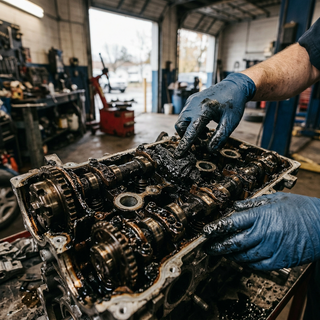
Engine oil acts as the primary lubricant and coolant for moving internal parts. As oil flows through the engine, it collects metallic dust, combustion soot, and microscopic debris. Without an effective filter in place, these hard contaminants act like abrasive grit against engine bearings, cylinder walls, and valve trains. Over thousands of miles, unfiltered microscopic particles gradually erode precision clearances, reducing oil pressure and shortening the overall operating life of the powerplant.
Commuters navigating daily drives along State Route 170 near Calcutta often ask our technicians during routine oil changes whether premium filters are truly necessary. Practical experience shows that consistent filtration quality prevents subtle, cumulative internal erosion that leads to major mechanical repairs. Ford equips modern vehicles with an Intelligent Oil-Life Monitor that calculates maintenance intervals based on real-world driving conditions. To protect engine longevity, replacing the oil filter at every indicated oil change is essential.
For expert vehicle maintenance located at 1503 Pennsylvania Ave, East Liverpool, OH 43920, you can get step-by-step directions to our East Liverpool service center or give our service team a call directly at (330) 462-7578 to consult with a technician.
Table of Contents
- What Is a Micron Rating on an Oil Filter and Why Isn't Lower Always Better?
- Synthetic vs Cellulose Filter Media: Which Protects Engine Components Better?
- What Is an Oil Filter Bypass Valve and How Does It Protect Your Engine?
- How Do Extended-Performance Oil Filters Differ from Basic Options to Prevent Repairs?
- Does Using an Aftermarket Oil Filter Void Your Warranty or Risk Internal Breakdown?
- Answers to Common Questions About Engine Oil Filters and Ford Service
What Is a Micron Rating on an Oil Filter and Why Isn't Lower Always Better?
A micron rating measures the smallest size of particle, in micrometers, that an oil filter media can trap from circulating engine oil. A lower micron rating is not automatically better because an overly restrictive filter can choke oil flow, triggering the internal bypass valve and allowing dirty, unfiltered oil to flood engine bearings.
One micrometer equals one-millionth of a meter or roughly 1/25,400th of an inch. A human hair averages 70 microns in diameter, whereas particles as small as 10 to 20 microns can slip into the microscopic clearances between crankshaft journals and engine bearings, causing scoring over time. Evaluating a filter requires balancing three distinct performance metrics:
- Filtration efficiency: The percentage of particles at a specific micron size trapped during fluid passage.
- Flow rate: The volume of oil allowed to pass through the media per minute without excessive fluid restriction.
- Dirt-holding capacity: The total amount of debris the media can hold before oil pressure drops.
Achieving an ultra-low micron rating with basic materials requires making the media pores extremely dense. Small media pores create high flow resistance, especially when engine oil is cold and thick during initial startup. When oil flow is restricted, pressure drops downstream. The lubrication system responds by opening the bypass valve to protect the engine from oil starvation, allowing unfiltered oil to circulate. Premium filters balance particle capture, fluid throughput, and total capacity in accordance with Society of Automotive Engineers standards such as SAE J1858.
Synthetic vs Cellulose Filter Media: Which Protects Engine Components Better?
Synthetic filter media protects engine components far better than conventional cellulose media by using engineered synthetic micro-glass fibers that capture smaller particles with higher efficiency while maintaining lower flow restriction. Synthetic media also offers double the dirt-holding capacity and resists high-temperature chemical degradation during extended oil change intervals.
Conventional cellulose filter media consists of natural wood pulp paper fibers with irregular shapes and inconsistent pore sizes. Under heat, moisture, and chemical exposure from engine combustion, cellulose paper fibers swell, harden, and break down over time. Synthetic media features laboratory-engineered micro-glass or polyester fibers woven into a dense, uniform structure. This design enables "depth filtration," trapping contaminants throughout the thickness of the material rather than relying solely on the surface layer.
Key Media Performance Differences
- Trapping efficiency: Synthetic media captures particles as small as 15 to 20 microns at over 99% efficiency, whereas standard cellulose paper filters typically capture 30 to 40 micron particles at lower overall efficiency rates.
- Flow capability: Micro-glass fibers are significantly thinner than paper fibers, leaving larger open pathways for oil to flow freely during cold starts.
- Thermal and chemical resistance: Modern turbocharged EcoBoost engines operate under intense heat. Synthetic media withstands severe thermal stress and extended drain schedules up to 10,000 miles without tearing or degrading.
When servicing your vehicle, utilizing OEM-spec media ensures proper oil flow and filtration depth. Drivers performing home maintenance can conveniently order factory-approved components through our portal for ordering OEM Motorcraft parts to maintain factory performance standards.
What Is an Oil Filter Bypass Valve and How Does It Protect Your Engine?
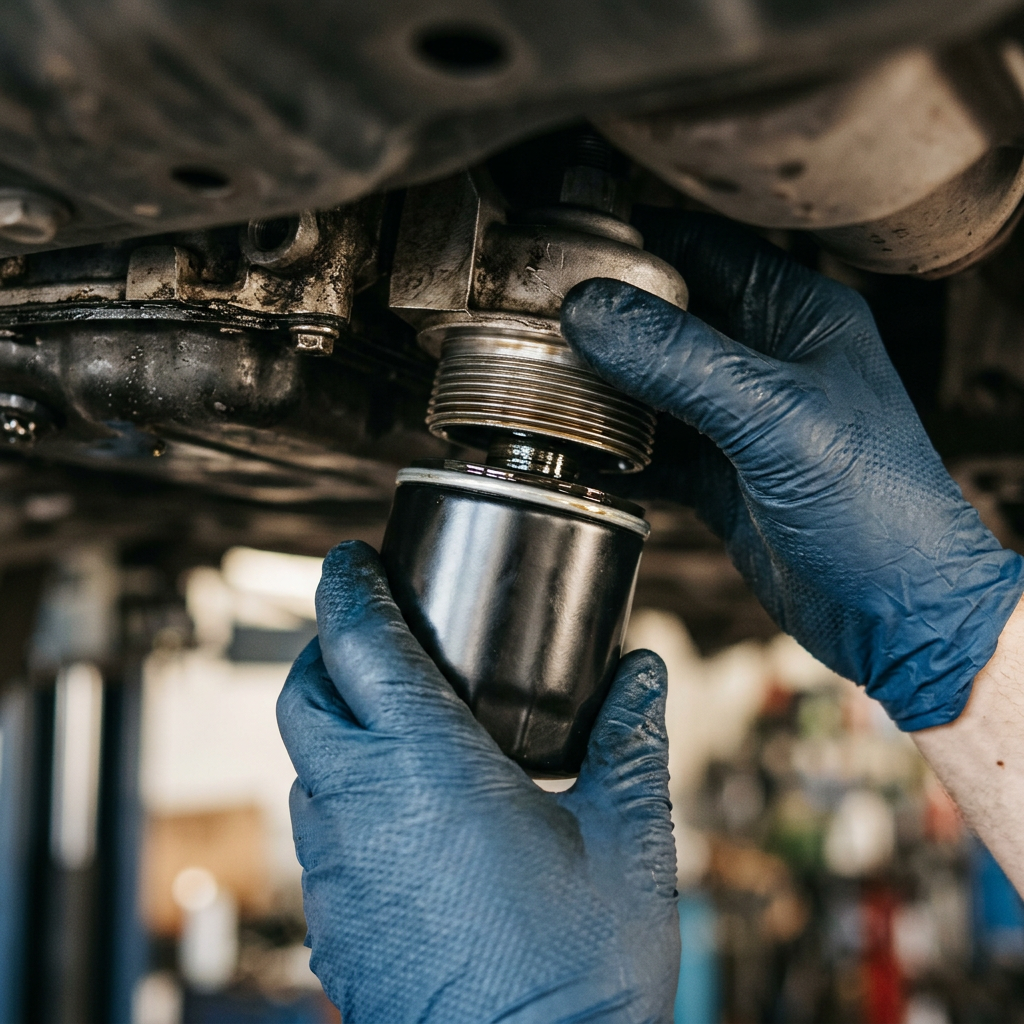
An oil filter bypass valve is a spring-loaded safety mechanism that opens when the pressure differential between the filter's inlet and outlet exceeds a safe threshold. It protects the engine by prioritizing oil volume over oil cleanliness, ensuring moving components never suffer total oil starvation during cold starts or severe filter blockage.
The oil pump forces fluid into the outer chamber of the filter housing, through the filter media, and out the center core to the engine. If the filter media becomes heavily clogged with debris or if cold oil is too viscous to pass quickly, pressure builds up on the inlet side. Once this pressure differential reaches a factory-calibrated limit—typically between 8 PSI and 15 PSI—the spring compresses, opening the valve and allowing oil to bypass the media directly to the engine bearings.
During sub-zero winter morning starts in Boardman, engine oil thickens considerably. Without a functioning bypass valve, dense oil would be unable to pass through the filter media quickly enough, causing several seconds of destructive friction before fluid pressure normalizes.
Working alongside the bypass valve is the anti-drainback valve, a flexible seal located behind the filter inlet holes. It prevents oil from draining out of the filter canister back into the oil pan when the engine is turned off. A durable silicone anti-drainback valve remains soft and pliable across extreme temperature ranges, preventing "dry starts" by maintaining immediate oil pressure upon ignition.
How Do Extended-Performance Oil Filters Differ from Basic Options to Prevent Repairs?
Extended-performance oil filters differ from basic filters by incorporating heavy-gauge steel canisters, synthetic micro-glass filtration media, wire-mesh media reinforcement, and high-temp silicone valves engineered for extended drain intervals. These heavy-duty components resist structural collapse, hold twice as much debris, and maintain proper pressure, preventing costly engine repairs caused by bearing wear and oil pressure loss.
| Component Feature | Basic Filter | Extended-Performance Filter |
|---|---|---|
| Canister Strength | Standard thin-gauge steel | Heavy-gauge steel rated above 300 PSI burst pressure |
| Filter Media | Organic cellulose paper | Synthetic micro-glass with wire-mesh backing |
| Anti-Drainback Valve | Nitrile rubber | Premium silicone anti-drainback valve |
| Service Rating | 3,000 to 5,000 miles | 10,000 miles or more |
| End Cap Construction | Glued composite or paper | Stamped steel or heavy synthetic composite |
Using a basic filter beyond its rated capacity risks media saturation. Once saturated, the filter operates in continuous bypass mode, circulating microscopic grit that scores camshaft lobes, turbocharger shaft bearings, and variable camshaft timing phasers. Keeping up with filter replacements using high-grade components protects internal mechanical tolerances. Owners can ensure timely maintenance by scheduling a service appointment online with our factory-trained technicians.
Does Using an Aftermarket Oil Filter Void Your Warranty or Risk Internal Breakdown?
Under the federal Magnuson-Moss Warranty Act, using an aftermarket oil filter does not void a vehicle's factory warranty unless the dealer or manufacturer proves that the specific aftermarket filter caused the engine failure. However, installing low-quality or incorrectly specified filters carries a high risk of internal breakdown, including media shredding and improper bypass valve calibration.
Federal law protects consumer choice in routine vehicle maintenance. Vehicle owners may choose replacement parts as long as the part meets original equipment specifications for flow rate, burst strength, and filtration efficiency. However, if an inferior filter collapses, tears, or leaks, the vehicle warranty will not cover the resulting internal engine repairs.
Substandard paper filter media can deteriorate under sustained thermal stress, shedding loose fibers into the lubrication stream. These loose fibers and circulating sludge travel directly to sensitive engine components, clogging narrow passages in variable valve timing solenoids, oil pressure sensors, and turbocharger oil supply lines. Severe media restriction leads to sustained low oil pressure, triggering dash warning lights and accelerating wear.
To avoid installation failures, always inspect the mounting engine pad to ensure the old rubber gasket did not remain stuck to the filter housing—a condition called "double-gasketing" that causes immediate, severe oil loss upon engine startup. Hand-tighten spin-on filters according to specification, and select factory-tested filters like Motorcraft designed specifically for your Ford engine's flow requirements.
Answers to Common Questions About Engine Oil Filters and Ford Service
Q: How often should an engine oil filter be replaced?
Ford recommends replacing the engine oil filter at every oil change, as directed by your vehicle's Intelligent Oil-Life Monitor. For most modern Ford vehicles driven under normal conditions, this interval ranges between 7,500 and 10,000 miles or once per year. Replacing the filter every time you change the oil ensures fresh dirt-holding capacity and prevents accumulated debris from contaminating fresh fluid.
Q: What are the signs of a clogged or failing oil filter?
Key warning signs of a failing or restricted oil filter include an illuminated oil pressure warning light, dark or sludgy oil on the dipstick, unusual metallic clattering from the engine during acceleration, and elevated operating temperatures. If the oil pressure warning light comes on while driving, safely pull over immediately and turn off the engine to prevent severe mechanical damage.
Q: What is the difference between spin-on and cartridge oil filters?
A spin-on oil filter is a self-contained metal canister containing the filter media, anti-drainback valve, and bypass mechanism, which threads directly onto the engine block. A cartridge oil filter consists of a replaceable paper or synthetic filter element that drops into an engine-mounted housing, utilizing a reusable cap and new rubber O-rings. Both perform identical filtration functions when properly matched to the engine design.
Q: Can an oil filter cause oil pressure problems?
An improper or severely clogged oil filter can cause low oil pressure if the internal media collapses or if the bypass valve fails to open under high restriction. Conversely, installing an incorrectly sized filter with an improper bypass pressure setting can alter flow dynamics within the lubrication system, potentially triggering diagnostic trouble codes or insufficient bearing lubrication.
Q: Why should routine multi-point inspections include battery testing alongside oil changes?
Routine maintenance is most effective when treating the vehicle as a complete system. Testing the battery during an oil service identifies weak cells before cold weather causes sudden starting failure. Combining oil filter replacements with battery checks, fluid top-offs, and tire pressure adjustments ensures total operational reliability for every drive.
Maintaining proper engine lubrication with high-quality filtration is one of the most effective ways to ensure long-term vehicle durability. Whether you need routine maintenance or specific replacement parts, our team provides transparent, trusted service using factory-certified components. You can reach our service team directly at (330) 462-7578, schedule your visit online, or drop by by getting directions to our East Liverpool location. We are also happy to assist with comprehensive electrical checks including routine battery service and testing during your next visit.