Blog / Used Vehicle Guides, Financing & Insurance, Buying Guides, Trade-In Advice, Certified Pre-Owned

Which Ford Pickup Truck Should You Buy: Maverick, Ranger, or F-150?

f

Which Ford Pickup Truck Should You Buy: Maverick, Ranger, or F-150?

You should buy the Ford Maverick if you want ultra-efficient daily commuting with light hauling, the Ford Ranger if you need balanced midsize muscle for towing recreational gear, or the Ford F-150 if maximum payload, full-size interior space, and heavy-duty trailering are non-negotiable requirements. Choosing the right truck depends on matching bed dimensions, towing limits, and daily driving costs to your specific lifestyle.

Comparing pickup trucks across different size classes comes down to how you plan to use the vehicle every day. Compact, midsize, and full-size trucks each serve distinct driving demands, from navigating tight parking lots to pulling heavy machinery. The Ford pickup lineup provides a clear ladder of capability, allowing buyers to select exact towing ratings, cabin configurations, and bed lengths without paying for extra vehicle footprint they do not need.

At Tri State Ford, our team helps drivers compare these three trucks side by side to evaluate cabin seating, bed utility, and highway performance in real-world conditions. Whether you need a fuel-sipping hybrid for daily cross-town drives or a high-capacity tow vehicle for work equipment, finding the right match starts with understanding key specs. You can easily plan your visit by getting directions to our dealership or giving our sales specialists a quick call at (330) 462-7578 to check current showroom availability.

Table of Contents

How Do Dimensions, Garage Fit, and Plywood Bed Capacity Compare Across Ford Truck Models?

The compact Ford Maverick measures roughly 200 inches long and fits easily in standard residential garages, while the midsize Ranger spans 211 inches and the full-size F-150 requires a larger bay at over 209 to 243 inches depending on cab setup. Neither the Maverick nor the Ranger can lay a 4x8 sheet of plywood flat between their wheel arches, but both utilize built-in bed slots and adjustable tailgate angles to carry sheet goods elevated above the wheel wells.

Vehicle footprint is often the first deciding factor for buyers evaluating home garage space and daily maneuverability. The Maverick features an overall width of about 73 inches without mirrors and a height of 68 inches, making it as effortless to park in suburban tight spaces around Boardman as a midsize crossover. The Ranger increases width to roughly 76 inches and height to 74 inches, offering higher ground clearance while remaining garage-friendly for most standard home bays. By contrast, the full-size F-150 measures about 80 inches wide excluding mirrors, requiring wider parking spaces and a deep garage bay to park indoors comfortably.

Interior dimensions reveal significant differences in passenger volume and second-row legroom across the three platforms:

  • Ford Maverick: Offers 36 inches of rear legroom, providing comfortable seating for up to five passengers in a compact crew-cab layout.
  • Ford Ranger: Delivers 35 inches of rear legroom with standard four-door seating, engineered for comfortable family trips and crew transport.
  • Ford F-150: SuperCrew models lead the class with nearly 44 inches of rear legroom, delivering full-size executive stretch-out space for adult passengers.

Bed cargo functionality varies directly with total length. The Maverick features a 4.5-foot bed with 33 cubic feet of volume, designed with multi-position tailgate supports that line up with internal bed side slots to balance 4x8 plywood sheets flat across the wheel wells. The Ranger carries a 5-foot bed providing increased cargo volume, while the F-150 offers 5.5-foot, 6.5-foot, and 8-foot bed options capable of laying 4x8 building materials flat across the floor between the wheel arches. Shoppers can start comparing physical bed layouts by exploring our new Ford inventory or reviewing single-owner pre-owned trucks available on our lot.
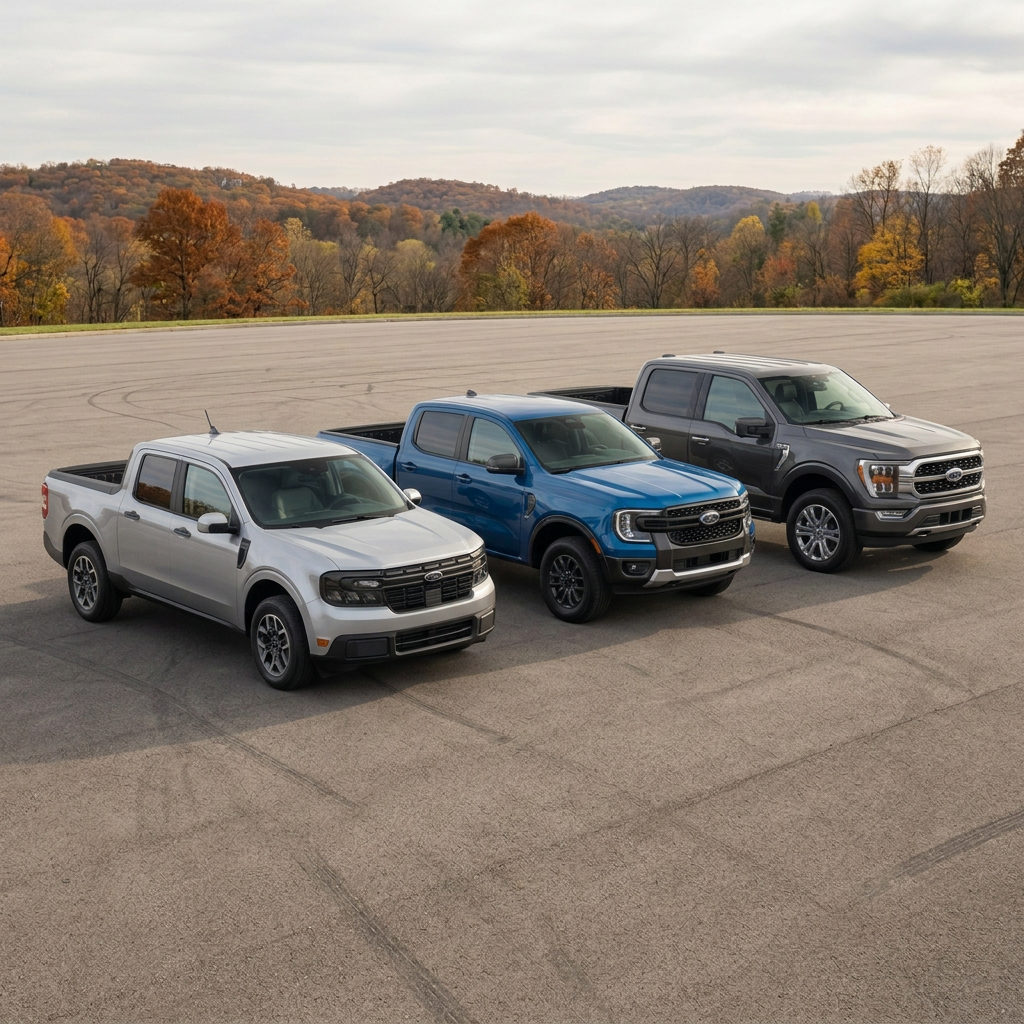
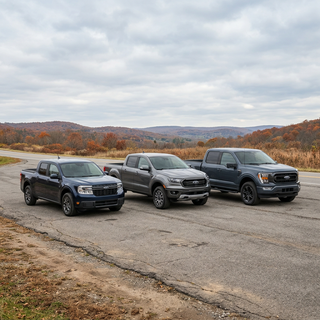
Three Ford pickup trucks in silver, blue, and dark gray parked on an asphalt lot with autumn trees in the background. (Representative image for illustration purposes only. Actual vehicle may vary based on trim and configuration.)

What Engine Options, Fuel Economy Ratings, and Tow Packages Are Available Across the Lineup?

The Ford Maverick delivers up to 42 mpg city with its standard 2.5-liter hybrid engine and reaches a 4,000-pound towing limit when spec'd with the optional 4K Tow Package. The Ranger offers a 2.3-liter EcoBoost producing 270 horsepower and tows up to 7,500 pounds with the Trailer Tow Package, while the F-150 tops out at 13,500 pounds of conventional towing and 2,440 pounds of payload when equipped with the 3.5-liter EcoBoost V6.

Powertrain choices directly dictate how each truck balances fuel efficiency against heavy pulling power. The Maverick's standard 2.5-liter hybrid front-wheel-drive powertrain yields an EPA-estimated 42 mpg city, 35 mpg highway, and 38 mpg combined, making it an exceptional option for high-mileage commuters. Buyers seeking extra traction can opt for the 2.0-liter EcoBoost four-cylinder engine with all-wheel drive. Standard Maverick models feature a 2,000-pound towing capacity, but selecting the optional 4K Tow Package adds upgraded engine cooling, key axle gear ratios, and a trailer brake controller to double maximum towing capacity to 4,000 pounds.

The midsize Ranger moves up to dedicated truck engines, featuring a standard 2.3-liter EcoBoost engine generating 270 horsepower and 310 lb-ft of torque paired with a 10-speed automatic transmission. Available engine upgrades include a 2.7-liter EcoBoost V6 and a high-output 3.0-liter EcoBoost V6 in the Ranger Raptor. Fuel economy for the 2.3-liter EcoBoost reaches up to 21 mpg city and 25 mpg highway. When equipped with the available Trailer Tow Package, the Ranger hauls up to 7,500 pounds, easily handling heavy ski boats, campers, and utility trailers.

The full-size F-150 offers the broadest array of engine setups, ranging from efficient V6 engines to high-capacity V8s and hybrid options:

  • 3.5-liter EcoBoost V6: Produces 400 horsepower and 500 lb-ft of torque, delivering maximum conventional towing up to 13,500 pounds when properly configured.
  • Maximum Payload Capacity: Reaches up to 2,440 pounds on properly equipped configurations, perfect for heavy job site materials, gravel loads, and commercial slide-in equipment.

Buyers researching pre-owned capability ratings can also inspect options by checking our certified pre-owned Ford inventory to find factory-inspected models equipped with towing packages.

How Do Fully Loaded Maverick Prices and Long-Term Maintenance Costs Compare to the Ranger and F-150?

A top-tier, fully loaded Ford Maverick Lariat AWD is available at MSRP, overlapping directly with entry to mid-level Ford Ranger pricing. Annual routine maintenance and repair costs average approximately $500 for a Maverick due to smaller fluid capacities, lighter braking components, and compact tires, whereas an F-150 averages roughly $788 per year.

Price overlapping between top-tier compact trucks and mid-tier midsize trucks is a common consideration for buyers. A fully equipped Maverick Lariat featuring all-wheel drive, synthetic leather seating, advanced driver-assist systems, and the 4K Tow Package lands in a similar price bracket as a midsize Ranger XLT. Choosing between them comes down to prioritizing high-end interior luxuries and maximum fuel economy against higher raw towing capacity and greater ground clearance.

Long-term ownership expenses also favor smaller truck platforms for everyday drivers:

  • Ford Maverick Ownership Costs: Averages around $500 annually in routine maintenance. Compact tire sizes cost less to replace, fluid capacities are smaller during routine oil services, and lighter curb weight reduces wear on brake pads and suspension components.
  • Ford F-150 Ownership Costs: Averages around $788 annually for repair and scheduled service. Larger tire footprints, heavy-duty brake rotors, high-capacity transmission and differential fluids, and larger engine oil capacities increase routine service totals over time.

For local drivers navigating the rolling terrain around Calcutta near Beaver Creek State Park, a lightweight, efficient truck like the Maverick or Ranger keeps routine upkeep low while providing ample capability for weekend fishing trips and trail equipment hauling. Evaluating your current vehicle's market value is a great starting point when budgeting for a new truck, and you can quickly start by valuing your trade-in vehicle online.

Finding the Right Ford Truck Configuration for Your Needs

Selecting the ideal Ford truck configuration requires matching your primary daily driving demands with your heaviest weekly haul or weekend trailer load. Commuters seeking maximum efficiency should target a Maverick Hybrid, active outdoor enthusiasts will find the Ranger midsize footprint optimal, and contractors or heavy-equipment towers require the unmatched cab volume and payload of an F-150.

To narrow down the choice, consider these common buyer profiles:

  1. The Daily Commuter and DIYer: The Ford Maverick is ideal if you commute long distances across state lines, need to park in suburban garages, and carry home improvement supplies, lawn equipment, or bicycles on weekends.
  2. The Outdoor Adventurer: The Ford Ranger fits drivers who need dedicated four-wheel-drive capability, ground clearance for off-road trails, and up to 7,500 pounds of towing capacity for midsize travel trailers or boat launches without the bulk of a full-size truck.
  3. The Heavy Hauler and Tradesperson: The Ford F-150 is necessary if you routinely haul heavy commercial payloads, tow livestock or enclosed equipment trailers over 8,000 pounds, or require maximum rear-seat room for adult passengers and crew members.

Matching cab configurations, bed lengths, and optional tow packages ensures you purchase a truck that handles your toughest tasks without paying for unnecessary size. Commercial operators and business owners can view targeted specs by viewing available new work trucks in our inventory.

Common Buyer Questions About the Ford Maverick, Ranger, and F-150

Q: What package is required for the Maverick to achieve its maximum 4,000 lb towing limit?

The Maverick requires the optional 4K Tow Package paired with either the 2.0-liter EcoBoost engine or an all-wheel-drive powertrain. Standard models without this package are limited to a 2,000-pound towing capacity. The package adds heavy-duty engine cooling, a trailer hitch receiver with a seven-pin connector, upgraded drive axle gears, and an integrated trailer brake controller.

Q: Can a 4x8 sheet of plywood fit flat in the bed of a Ford Ranger or Maverick?

Neither the Maverick nor the Ranger allows a standard 4x8 sheet of plywood to lie completely flat on the bed floor between the rear wheel arches. However, both trucks feature molded bed slots and adjustable tailgate positioners designed specifically to secure 4x8 building materials elevated above the wheel wells for stable transport. The full-size F-150 can lay 4x8 sheets completely flat on the bed floor.

Q: How much wider is the F-150 compared to the Ranger and Maverick?

The F-150 measures approximately 80 inches wide excluding mirrors, making it roughly 4 inches wider than the midsize Ranger at 76 inches wide and nearly 7 inches wider than the compact Maverick at 73 inches wide. This extra width translates directly into wider shoulder room and greater center console storage inside the cabin, but requires more clearance when maneuvering in narrow parking bays.

Q: Which Ford truck delivers the best fuel economy for daily highway driving?

The Maverick equipped with the 2.5-liter hybrid powertrain leads the lineup with EPA estimates of 42 mpg city and 35 mpg highway. By comparison, a 2.3-liter EcoBoost Ranger achieves up to 25 mpg highway, while an F-150 yields up to 24 mpg highway depending on engine and axle configuration.

Q: How long does an online credit application take to complete before visiting the showroom?

Completing our secure pre-approval application online takes under ten minutes when you have basic income, employment, and identification details ready. Submitting your finance profile ahead of time accelerates your showroom visit and allows our team to present personalized loan or lease options immediately upon arrival. You can save time at the dealership by submitting an online credit application today.

Test Drive and Finance Your Ford Maverick, Ranger, or F-150

Tri State Ford makes comparing the Maverick, Ranger, and F-150 straightforward with side-by-side inventory walkarounds and tailored financing options. Scheduling a test drive on our showroom floor allows you to evaluate cab comfort, bed accessibility, and road handling firsthand.

Our finance specialists work with nationwide and local lenders to secure terms aligned with your household budget. Whether you plan to purchase a compact hybrid, lease a midsize Ranger, or build a heavy-duty F-150 work truck, our team guides you through every step of the sales process.

Visit our sales floor at 1503 Pennsylvania Ave in East Liverpool to see all three trucks in person. You can get step-by-step driving directions by getting directions to our dealership, talk directly with a product expert by calling (330) 462-7578, or reserve your spot on the calendar when you schedule a personal test drive online.

Keep your vehicle performing at its best with our service team:


© 2026 Tri State Ford. All rights reserved.

Ford Pickup Truck Options in East Liverpool OH | Tri State Ford
Posted in:

Related Posts

g

How Do You Choose the Right Used Car as a First-Time Buyer?

How Do You Choose the Right Used Car as a First-Time Buyer? The best used vehicle for a first-time buyer is a well-maintained compact car, crossover, or versatile small truck with between 60,000 and 100,000 miles, complete service records, and proven driver-assist safety systems. Choosing the right vehicle requires balancing realistic mileage limits, verifying past maintenance history, calculating total ownership expenses beyond the sticker price, and securing affordable financing tailored to your established budget. Navigating the pre-owned market for your first vehicle can feel overwhelming, but focusing on practical core capabilities keeps the process clear and straightforward. Compact vehicles like a pre-owned crossover or a versatile compact pickup like a used Ford Maverick offer easy maneuvering, practical interior room, and modern safety technology without the high price tag of a brand-new model. For daily travel across the riverfront bluffs and inland hills in East Liverpool, finding a vehicle that combines strong fuel efficiency with dependable handling gives new drivers long-term confidence behind the wheel. Evaluating individual condition and long-term operating costs is far more critical than simply shopping by model name alone. A properly maintained vehicle with slightly higher mileage often delivers greater reliability than a lower-mileage car that suffered from deferred maintenance or inconsistent care. Prioritizing vehicles equipped with standard driver-assist capabilities, thorough inspection reports, and transparent history records ensures your initial automotive investment remains safe, comfortable, and budget-friendly for years to come. When you are ready to explore reliable pre-owned options in person, you can easily visit our dealership showroom located at 1503 Pennsylvania Ave, East Liverpool, OH 43920 or reach out directly to our sales team at (330) 462-7578 to speak with a knowledgeable advisor. Table of Contents What Mileage Range and Maintenance History Should First-Time Car Buyers Look For? What Out-of-Pocket Costs and Fuel Differences Should You Expect Beyond the Sticker Price? How Can First-Time Buyers Secure Auto Financing with No Credit History? Which Safety Features Matter Most and How Do You Verify Vehicle Safety Systems? Common First-Time Buyer Questions About Used Vehicles and Financing Take the Next Step Toward Your First Vehicle at Tri State Ford What Mileage Range and Maintenance History Should First-Time Car Buyers Look For? A target mileage range between 60,000 and 100,000 miles offers the ideal sweet spot for first-time buyers by providing significant purchase price savings while retaining extensive remaining service life. Verifying comprehensive routine maintenance history is essential to ensure critical components like timing belts, cooling systems, and driveline fluids were serviced on schedule. Odometer mileage only tells part of a vehicle's story. A vehicle driven primarily on open highways accumulates far less mechanical wear per mile than one subjected to constant stop-and-go city driving. When evaluating potential vehicles, look for documented service records showing regular oil changes, tire rotations, and scheduled fluid flushes. Vehicles reaching the 100,000-mile mark typically require specific major service items, including spark plug replacements, coolant flushes, transmission fluid changes, and suspension component inspections. Confirming whether these key services have already been performed helps prevent unexpected maintenance expenses immediately following your purchase. Selecting a certified pre-owned vehicle provides an additional layer of security for first-time shoppers. Certified programs require vehicles to undergo rigorous multi-point mechanical and safety inspections before being offered for sale, ensuring that brakes, tires, steering linkage, and engine performance meet strict factory standards. These vehicles frequently include extended powertrain warranty coverage, offering invaluable peace of mind to buyers who want to avoid surprise repair costs during their first years of vehicle ownership. You can easily view our current selection of verified pre-owned options by exploring our certified pre-owned Ford inventory online. Our team notices that first-time buyers evaluating used vehicles usually inspect overall cabin room and daily utility before asking about specific financing terms. Vehicles such as a pre-owned Ford Escape or Ford Bronco Sport deliver excellent versatility for carrying active gear or commuting, making thorough maintenance verification even more valuable for long-term ownership. What Out-of-Pocket Costs and Fuel Differences Should You Expect Beyond the Sticker Price? First-time buyers should budget an additional 10% to 15% above the vehicle's agreed purchase price to cover essential out-of-pocket costs such as state sales tax, title transfer fees, license plate registration, and dealer documentation charges. Additionally, choosing between a compact sedan and a compact SUV can account for an annual fuel expenditure difference of $200 to $450 depending on driving habits and powertrain selection. Understanding the complete financial picture prevents costly surprises when finalizing your purchase. Beyond the initial transaction fees, ongoing ownership expenses include insurance premiums, seasonal maintenance, and daily fuel consumption. Insurance costs vary based on driver age, location, and the specific vehicle identification number, making it wise to request insurance estimates before committing to a purchase. Fuel economy plays a continuous role in your monthly budget. For daily driving around the rolling suburban terrain of State Route 170 in Calcutta, selecting an efficient powertrain significantly reduces operating expenses. A compact sedan typically achieves higher highway efficiency, but modern compact trucks and crossovers equipped with advanced hybrid tech close that gap effectively. For example, a Ford Maverick equipped with the standard 2.5-liter hybrid FWD setup delivers an EPA-estimated 42 mpg city and 35 mpg highway, providing exceptional efficiency alongside a practical 4-foot-5-inch pickup bed with about 33 cubic feet of cargo volume. Trading in an existing family vehicle is a practical strategy to offset these initial out-of-pocket costs and lower your required loan balance. You can get a clear picture of your current vehicle's worth right now when you value your trade online through our simple evaluation tool. How Can First-Time Buyers Secure Auto Financing with No Credit History? First-time buyers without established credit history can successfully secure auto financing by applying with a qualified co-signer, providing a down payment of 15% to 20%, and supplying proof of steady income and employment. Demonstrating financial stability through verifiable pay stubs and personal references gives auto lenders the confidence needed to approve competitive loan terms. Lacking an established credit score is a common challenge for young adults and first-time car buyers, but it does not have to stand in the way of purchasing a dependable used vehicle. Financing institutions look at the complete financial picture rather than a credit score alone. Bringing standard documentation—including recent pay stubs, utility bills verifying your physical residence, bank statements, and a valid driver's license—speeds up the approval process and demonstrates reliability to underwriters. Placing a larger down payment reduces the total amount borrowed, which lowers the lender's risk and directly decreases your monthly payment obligations. A substantial down payment also helps protect you against negative equity, ensuring that your loan balance stays aligned with the vehicle's resale value over time. Working with a dedicated automotive finance department allows you to explore multiple lending channels, including specialized first-time buyer programs designed specifically to help build positive credit history. Taking time to organize your documentation and calculate a comfortable monthly budget allows you to approach the purchase process with confidence. To review available financing options customized to your circumstances, you can complete our secure online credit application from home before visiting the dealership. Which Safety Features Matter Most and How Do You Verify Vehicle Safety Systems? Essential safety features for first-time car buyers include electronic stability control, anti-lock brakes, side-curtain airbags, and active driver-assist technologies such as pre-collision assist with automatic emergency braking and blind-spot monitoring. Verifying that these systems operate properly requires checking dashboard indicator lights during engine startup, running a diagnostic scan, and completing a thorough test drive. Modern safety technology significantly reduces collision risks for newer drivers. Features like electronic stability control —which became mandatory on all light passenger vehicles starting in the 2012 model year—help prevent skids and loss of control in adverse weather conditions. Advanced driver-assist systems utilize forward-facing cameras and radar sensors to monitor traffic patterns, alert drivers to potential hazards, and apply braking force automatically if an impact is imminent. When shopping for a pre-owned Ford Bronco Sport or Ford Escape, verifying the inclusion of Ford Co-Pilot360 tech gives drivers enhanced awareness on busy roadways. Testing and inspecting safety systems is a vital step in the used car shopping process. During your initial walkaround and test drive, ensure that all dashboard warning lights turn on briefly when the ignition key is turned to the ON position and extinguish once the engine runs. If warning lights like the ABS or airbag indicator remain illuminated, the system requires professional diagnosis. Furthermore, camera and radar sensors mounted behind the windshield or front grille must be clean and properly aligned; windshield replacements or prior body repairs can sometimes require system recalibration. If you decide that a factory-fresh model with the very latest active safety technology best fits your needs, you can explore specialized options like a new vehicle custom order directly through our team. You can also review current inventory and contact our team for up-to-date pricing and availability. Common First-Time Buyer Questions About Used Vehicles and Financing Q: What additional out-of-pocket fees should buyers budget for beyond the car purchase price? In many states, additional fees like sales tax and registration can add up to 15% more than the vehicle's sticker price, a crucial factor for first-time buyers to consider. These administrative costs are separate from the vehicle price and are standard across automotive purchases. Factoring these figures into your total budget early ensures a smooth financing process without unexpected upfront payment demands at signing. Q: What major maintenance services are typically needed around 100,000 miles? At 100,000 miles, standard maintenance schedules typically require replacing spark plugs, performing a cooling system flush, replacing transmission fluid, and inspecting brake lines, belts, and suspension components. On vehicles equipped with a timing belt, replacement is usually mandated around this interval to prevent severe engine damage. Verifying whether a pre-owned vehicle has already undergone these scheduled services helps you avoid immediate maintenance bills after purchase. Q: How do annual routine maintenance costs compare between popular compact models? Annual routine maintenance costs for mainstream compact sedans and crossovers are very comparable, generally averaging between $350 and $450 per year for standard items like synthetic oil changes, tire rotations, air filter replacements, and brake pad service. Choosing a vehicle with widely available OEM parts keeps routine upkeep simple and affordable over years of ownership. Q: What is the annual fuel cost difference between a compact sedan and a compact SUV? A compact crossover typically uses between 10% and 20% more fuel than a traditional compact sedan due to its higher ride height, elevated aerodynamic drag, and increased curb weight. Driving 15,000 miles per year usually results in higher annual fuel costs for the crossover, though modern hybrid options can reduce that difference. Q: How can a buyer verify if a used vehicle driver-assist system is functioning properly? Buyers can verify system function by ensuring all diagnostic lights illuminate during startup and turn off completely once running, conducting a diagnostic code scan with an OBD-II tool, and testing blind-spot and lane-keeping features on a test drive. Choosing certified pre-owned vehicles or requesting a professional pre-purchase inspection confirms that sensor calibration and safety modules operate according to original factory specifications. To compare pre-owned selections against factory-fresh inventory options, feel free to explore new Ford lineup options or browse our current inventory of pre-owned single-owner vehicles to find the best fit for your budget. Take the Next Step Toward Your First Vehicle at Tri State Ford Finding the ideal first vehicle comes down to selecting a reliable, well-maintained model that fits your lifestyle and monthly budget without unexpected ownership expenses. Whether you choose an efficient compact truck, a practical crossover, or a reliable pre-owned sedan, taking a methodical approach to mileage, safety verification, and credit approval ensures complete confidence in your decision. Our experienced team is here to guide you through every step of the purchasing process with zero pressure, helping you compare models, explore flexible auto financing options, and find the right vehicle for your daily drive. You can get simple driving route details to visit our showroom by pulling up our dealership directions online, or give our sales staff a quick call today to schedule your first test drive. Keep Your Vehicle Running Strong Keep your vehicle performing at its best with our service team: Order Parts Schedule Service Appt © 2026 Tri State Ford. All rights reserved. Used Cars for First-Time Buyers in East Liverpool OH | Tri State Ford

f

Is a Used AWD Car Worth Buying Over FWD?

A used AWD car is worth buying over FWD if you frequently drive on icy, snowy, or unpaved roads where four-wheel traction helps you accelerate without slipping. For drivers operating primarily on dry or treated paved roads, a used FWD vehicle provides superior fuel economy, lower upfront purchase costs, and lower long-term maintenance expenses. Choosing between all-wheel drive and front-wheel drive on the pre-owned market comes down to weighing physical mechanical advantages against overall ownership expenses. Front-wheel-drive vehicles package the engine and transmission over the front driven wheels, creating a lighter layout that maximizes interior cabin room while delivering efficient performance. All-wheel-drive systems build upon this layout by adding a transfer case, drive shaft, and rear differential to route engine torque to all four wheels when sensors detect slippage. On the pre-owned market, an AWD system typically adds a price premium between $1,000 and $2,500 compared to an equivalent FWD model. Furthermore, the additional mechanical components add 150 to 300 pounds of curb weight, which lowers fuel efficiency by 1 to 3 mpg depending on the vehicle class. At Tri State Ford, our team helps you evaluate your driving routines to select the right drivetrain for your household. You can drop by our showroom at 1503 Pennsylvania Ave to inspect our pre-owned lineup in person, give our sales department a quick call at (330) 462-7578 to ask about current arrivals, or fill out an online credit application to get pre-approved before your visit. Table of Contents What Is the Main Difference Between AWD and FWD in a Used Vehicle? Does AWD Make a Used Car Safer on Winter Roads and Heavy Snow? How Much More Does a Used AWD Car Cost Compared to FWD? What Additional Maintenance Components and Towing Capabilities Come with AWD? When Does Used AWD Make More Sense for Driving Around East Liverpool? Common Questions About Buying a Used AWD or FWD Vehicle What Is the Main Difference Between AWD and FWD in a Used Vehicle? The primary difference between AWD and FWD in a used vehicle lies in mechanical torque distribution: FWD routes engine power strictly to the front two wheels via a transaxle, whereas AWD uses a transfer case, center coupling, and rear differential to route power dynamically to all four wheels when traction loss is detected. In a front-wheel-drive configuration, the front tires bear responsibility for both steering the vehicle and putting engine power onto the pavement. This consolidated layout eliminates the need for a long drive shaft running to the back of the vehicle, which reduces curb weight and allows engineers to design flat interior floorboards with generous passenger legroom. Because FWD drivetrains feature fewer moving parts, they suffer less mechanical friction, contributing to strong everyday fuel economy. All-wheel-drive drivetrains monitor wheel speed continuously through electronic sensors. When the front wheels lose traction on wet leaves, mud, or snow, an electronically controlled clutch pack or viscous coupling engages within milliseconds to send engine torque to the rear axle. Advanced systems can vary torque delivery continuously between front and rear axles to optimize cornering stability even on dry pavement. Pre-owned Ford crossovers demonstrate these drivetrain differences clearly: The 2026 Ford Escape Active AWD utilizes a 1.5L EcoBoost® engine producing 180 hp and 199 lb-ft of torque mated to an automatic 8-speed transmission, providing active four-wheel grip during inclement weather. Front-wheel-drive variants of the same crossover deliver lighter curb weights and lower initial purchase points. Higher-tier models like the Ford Escape ST-Line Elite AWD equip a 2.0L EcoBoost® engine yielding 250 hp and 280 lb-ft of torque through a SelectShift® automatic transmission for responsive passing power. Truck options such as the 2026 Ford Maverick offer a 2.5L hybrid powertrain in both FWD and AWD configurations, giving pre-owned buyers freedom to choose between maximum efficiency or four-wheel traction. When shopping for pre-owned crossovers or trucks, you can explore pre-owned single-owner models for documented maintenance histories, check current manufacturer vehicle offers for incentives, or review custom order options if you prefer ordering a brand-new vehicle built to your exact specifications. Does AWD Make a Used Car Safer on Winter Roads and Heavy Snow? All-wheel drive enhances winter safety primarily during acceleration and hill climbing by engaging four contact patches to prevent wheel spin on snow and ice. However, AWD does not reduce braking distances or improve cornering grip on slick pavement, as stopping performance depends entirely on tire tread compound and braking technology. Many drivers assume that an AWD badge guarantees total winter immunity, but four-wheel propulsion only assists in getting a vehicle moving from a stop or keeping momentum through slush and unplowed drifts. When you apply the brakes on an icy road, every modern vehicle uses four-wheel braking regardless of its drivetrain configuration. Consequently, an AWD crossover and a FWD sedan equipped with identical tires will take the same distance to come to a complete stop from highway speeds. Modern active safety features work alongside physical drivetrains to maintain vehicle stability: Ford Co-Pilot360™ combines Electronic Stability Control, Anti-lock Braking Systems, and traction management to correct directional skids before they escalate. Midsize SUVs like the 2026 Ford Explorer feature Intelligent 4WD paired with the Terrain Management System™, offering a dedicated Slippery drive mode that adjusts throttle mapping and transmission shift points for snow-covered roads. Off-road capability increases further on models like the 2026 Ford Bronco Sport Badlands, which equips Advanced 4x4 technology with a twin-clutch rear drive unit to send power to individual rear wheels. For commuters tackling elevated routes across Calcutta, where sudden winter lake-effect bursts create slushy hill climbs along State Route 170, active four-wheel traction provides valuable confidence when pulling out into traffic. To ensure complete peace of mind when navigating seasonal weather, buyers can browse our certified pre-owned inventory to find rigorously inspected vehicles backed by factory warranty coverage. How Much More Does a Used AWD Car Cost Compared to FWD? On the pre-owned market, an AWD vehicle costs between $1,000 and $2,500 more upfront than an equivalent FWD model of the same year, trim, and mileage. Beyond the initial purchase price, AWD models carry a 1 to 3 mpg fuel economy penalty and slightly higher long-term maintenance costs. The overall financial calculation between FWD and AWD involves three distinct factors: Upfront Purchase Price: All-wheel-drive models command higher resale values on used car lots because regional demand for winter-capable vehicles remains strong. Fuel Costs Over Time: Because an AWD system adds 150 to 300 pounds of drivetrain mass and creates additional rotational drag, it consumes slightly more fuel per mile. For example, while a 2026 Ford Escape Platinum AWD Hybrid achieves an EPA-estimated 39 mpg combined, FWD hybrid variants often gain 1 to 2 extra miles per gallon. Resale and Trade-In Equity: While you pay more for AWD initially, you recover a significant portion of that investment when trading the vehicle in years later, as pre-owned buyers in cold climates prioritize four-wheel traction. Evaluating these ownership costs helps you select a vehicle that fits your monthly household budget. If you plan to upgrade from your current vehicle, you can utilize our online trade-in valuation tool to receive an instant appraisal estimate that can be applied directly toward your down payment. What Additional Maintenance Components and Towing Capabilities Come with AWD? An AWD drivetrain requires periodic fluid servicing for the transfer case and rear differential unit, alongside regular inspections of additional CV boots, universal joints, and center drive shafts. For towing, AWD delivers superior launch traction on steep or slippery ramps, though overall towing capacity is determined by chassis structure, engine cooling, and suspension design. Maintaining an all-wheel-drive vehicle involves servicing several mechanical components that do not exist on front-wheel-drive cars: Transfer Case / Power Transfer Unit (PTU): Takes engine torque from the transaxle and routes it backward to the rear drive shaft. The gear oil inside requires periodic replacement to prevent thermal breakdown. Rear Differential Assembly: Converts the longitudinal rotation of the drive shaft into lateral rotation for the rear axle shafts. Like the PTU, its gear fluid must be changed according to manufacturer maintenance intervals. Drive Shaft and CV Axles: Four axle shafts and a multi-piece drive shaft utilize flexible rubber boots to protect universal joints from road debris and salt corrosion. Tire Matching Requirements: All four tires on an AWD vehicle must share matching tread depth and overall diameter. Replacing only one or two worn tires creates rotational speed variances that put continuous mechanical stress on the center transfer case. Families comparing pre-owned crossovers on our lot often ask whether all-wheel drive adds noticeable maintenance costs before learning that differential fluid exchanges occur at extended factory intervals. When it comes to trailering, all-wheel drive provides a major advantage when pulling heavy loads from a standstill on low-traction surfaces. Pulling a small fishing boat up a slippery, algae-covered concrete launch ramp or hauling a utility trailer over wet gravel tracks causes front tires on a FWD vehicle to spin helplessly. AWD engages all four wheels immediately, preventing wheel spin and providing smooth, controlled momentum. However, maximum total tow weight remains governed by chassis ratings, engine output, and cooling capacity rather than drivetrain layout alone. When Does Used AWD Make More Sense for Driving Around East Liverpool? East Liverpool's steep riverfront bluffs and frequent winter snowfalls make AWD vehicles particularly advantageous for local drivers facing challenging road conditions. FWD remains ideal if your route consists mostly of flat, well-maintained arterial roads where fuel savings take priority. The topography along the Ohio River corridor features sharp elevation shifts and winding bluff climbs that become treacherous during winter snowstorms or freezing rain. Accelerating up a steep, icy grade in a front-wheel-drive car transfers vehicle weight toward the rear wheels, lifting weight off the front drive tires and reducing available traction. An all-wheel-drive system solves this issue by transferring torque to the rear axle, taking advantage of that weight transfer to push the vehicle smoothly up the incline. Pre-owned Ford crossovers excel in these riverfront environments: Compact options like a pre-owned Ford Escape Active AWD deliver agile urban handling paired with automatic foul weather traction. Midsize crossovers like a pre-owned Ford Edge provide a heavier curb weight and wider stance that stabilize the chassis during high-wind river crossings. Three-row models like the Ford Explorer offer standard rear-wheel-drive balance with available Intelligent 4WD, ensuring plenty of passenger room and towing strength for weekend trips along the river. If your daily driving consists primarily of flat, well-plowed highway stretches, a front-wheel-drive model equipped with quality tires provides dependable service while maximizing fuel economy. If your routine requires climbing steep side streets before snowplows arrive, investing in a pre-owned AWD model is a practical decision. Common Questions About Buying a Used AWD or FWD Vehicle Q: Does an AWD system add significant weight to a pre-owned vehicle? An AWD system typically adds 150 to 300 pounds to a vehicle's curb weight due to the transfer case, rear differential, drive shaft, and rear axle shafts. This extra mass slightly reduces fuel efficiency by 1 to 3 mpg compared to a front-wheel-drive counterpart. Q: Can you put two new tires on an AWD car instead of four? Replacing only two tires on an AWD vehicle is not recommended because uneven tire circumference forces the center differential or clutch pack to slip continuously. This rotational speed variance causes mechanical strain, elevated operating temperatures, and potential transfer case failure. Q: Is FWD sufficient for light snow if the vehicle has good winter tires? A FWD vehicle equipped with dedicated winter tires frequently outperforms an AWD vehicle on all-season tires when stopping and turning on snow. Dedicated winter rubber compounds remain flexible in sub-freezing temperatures, providing essential tread grip for everyday winter commutes. Q: Does AWD increase maximum towing capacity over FWD? All-wheel drive does not automatically increase a vehicle's maximum tow rating, as total capacity depends on frame strength, engine torque, transmission cooling, and brake size. However, AWD provides crucial launch traction when pulling a trailer up steep, wet, or unpaved inclines. Q: What documentation is required when financing a used AWD vehicle at the dealership? Buyers applying for pre-owned vehicle financing should bring a valid driver's license, recent pay stubs or proof of income, a utility bill for address verification, and a current auto insurance quote. Gathering these documents in advance helps our finance team process your credit approval quickly. When you are ready to explore pre-owned crossovers or compare new models in person, our team at Tri State Ford is here to guide you through every step of the buying process. You can visit our East Liverpool dealership to test drive our pre-owned selection, call us directly at (330) 462-7578 to speak with a sales specialist, or browse our new Ford models online to see the latest four-wheel-drive technology today. Keep Your Vehicle Running Strong Keep your vehicle performing at its best with our service team: Order Parts Schedule Service Appt © 2026 Tri State Ford. All rights reserved. Used AWD vs FWD Cars in East Liverpool OH | Tri State Ford
f

Should You Choose OEM or Aftermarket Parts for Vehicle Repairs?

Original Equipment Manufacturer (OEM) parts are manufactured directly by or for the vehicle automaker to meet exact factory specifications, dimensions, and material standards. Aftermarket parts are built by third-party companies with varying levels of quality and fitment. Choosing OEM replacement parts guarantees flawless fit, structural integrity, and full factory warranty protection without guesswork, making them the recommended option for mechanical performance and long-term vehicle dependability. When maintaining or repairing a vehicle, component quality directly impacts safety, vehicle operation, and long-term durability. Original Equipment Manufacturer components are identical to the original components installed on the vehicle during initial factory assembly. Because they are engineered specifically for precise vehicle dimensions, installing factory parts eliminates fitment issues and protects crucial mechanical systems. Drivers can confirm part specifications by contacting our service team or visiting our service center location. Aftermarket alternatives often present lower initial costs, but they are built to universal standards to accommodate multiple vehicle makes and model variations. This generalized approach can lead to minor design variations, slight clearance discrepancies, and inconsistent material strength. Over time, these small differences can cause premature component wear, reduced fuel efficiency, or unwanted noise and vibration. Selecting genuine replacement components preserves factory engineering integrity and safeguards ongoing warranty coverage. Vehicle owners looking to maintain top mechanical performance can start by giving a quick call to our service advisors or conveniently scheduling a service appointment online. Table of Contents What Is the Difference Between OEM and Aftermarket Parts? Why Are OEM Parts More Expensive, and What Design Advantages Do They Offer? Which Auto Components Are Best Purchased as OEM Rather Than Aftermarket? Do Insurance Policies Cover OEM Replacement Parts After an Accident? How Do Aftermarket Parts Affect Vehicle Warranties and Emissions Compliance? Common Questions About OEM and Aftermarket Parts Protect Your Vehicle with Genuine Factory Parts at Tri State Ford What Is the Difference Between OEM and Aftermarket Parts? OEM parts are manufactured using the exact specifications, tooling, and materials designated by the original vehicle automaker, ensuring an identical match to factory components. Aftermarket parts are produced by independent companies that create non-factory alternatives, often modifying structural designs or material compositions to lower manufacturing costs or fit a broader spectrum of vehicles. Understanding the technical distinctions between these two manufacturing approaches helps vehicle owners make informed repair choices. The primary differences involve manufacturing standards, testing protocols, component fitment, and ongoing support: Engineering and Specifications: OEM components, such as Motorcraft parts engineered for Ford and Lincoln vehicles, adhere strictly to initial factory blueprints. Aftermarket manufacturers develop parts through reverse engineering, which can introduce subtle dimensional variances. Quality Control and Testing: Factory replacement parts undergo rigorous multi-stage laboratory testing and real-world durability evaluations. Third-party aftermarket components vary widely in quality control, with some lacking formal testing certification. Selection Process: Choosing factory components is straightforward because there is typically only one designated part for a specific vehicle year, trim, and engine configuration. Selecting aftermarket parts requires evaluating dozens of competing brands with differing specifications. Warranty Backing: Genuine factory parts come backed by comprehensive manufacturer warranty terms, whereas aftermarket warranties depend entirely on individual third-party suppliers. Drivers navigating the moderately elevated terrain and rolling hills around Calcutta benefit from replacement parts engineered specifically to handle original chassis loads without premature wear. Factory parts preserve original vehicle dynamics, safety systems, and towing capabilities. Buyers exploring custom builds or specialized options can also review our custom factory build options to learn more about original component configurations. Why Are OEM Parts More Expensive, and What Design Advantages Do They Offer? OEM parts carry a higher price tag because their cost includes initial vehicle engineering development, extensive safety crash testing, precise tooling, and strict quality control licensing. Aftermarket manufacturers avoid these upfront research and development expenses, allowing them to offer lower purchase prices by utilizing lower-grade materials or broad-fitment designs. The price differential reflects significant engineering advantages that benefit the driver over the lifespan of the vehicle: Component Factor OEM Replacement Parts Generic Aftermarket Parts Material Standards High-grade alloys, precise polymer blends Variable material grades Dimensional Fit Exact factory tolerances Multi-vehicle compromise fit Electronic Calibration Plug-and-play factory programming Potential calibration errors Warranty Protection current warranty coverage Variable (often limited terms) Resale Value Impact Preserves original vehicle value May diminish trade-in value Factory replacement parts deliver guaranteed fitment and seamless system integration, eliminating the trial-and-error often associated with third-party components. For example, Motorcraft replacement parts carry a current warranty coverage that includes labor coverage, offering substantial long-term financial security. Investing in genuine components also maintains vehicle resale value and vehicle history appeal. Maintaining comprehensive factory maintenance records with original components helps preserve trade equity, which owners can evaluate anytime using our instant value appraisal tool. Which Auto Components Are Best Purchased as OEM Rather Than Aftermarket? Complex electrical sensors, structural body collision panels, engine control units, ignition modules, and internal transmission components yield the highest benefit when purchased as OEM parts due to their strict integration requirements. While minor cosmetic items or basic wear accessories may be suitable for aftermarket selection, critical mechanical and electronic systems require exact factory specifications to operate safely. Components that should always be replaced with genuine factory parts include: Advanced Driver-Assist Sensors: Modules supporting blind spot monitoring, lane-keeping assistance, adaptive cruise control, and pre-collision braking require exact factory housing dimensions and radar signal transmission values. Powertrain Control Modules: Engine control units and transmission solenoids rely on proprietary software architecture that aftermarket modules frequently fail to replicate accurately. Collision and Body Panels: Crumple zones, high-strength steel crossmembers, and aluminum body panels are engineered to absorb impact energy in accordance with federal motor vehicle safety standards. Internal Engine Components: Timing chains, head gaskets, and fuel injectors demand exact thermal expansion characteristics and pressure tolerances. When vehicle owners ask our technicians about replacing complex sensors, our advisors see that trying to clear error codes with uncalibrated third-party modules usually leads to secondary diagnostic visits. Using genuine factory components ensures that critical vehicle systems communicate seamlessly without triggering false dashboard alerts or unexpected system failures. Do Insurance Policies Cover OEM Replacement Parts After an Accident? Standard auto insurance policies typically cover aftermarket or reconditioned repair parts by default following an accident, unless the policyholder has purchased an optional OEM parts endorsement rider. Insurance providers often select non-factory or reconditioned collision components to minimize total claim settlement costs. Understanding insurance coverage details helps vehicle owners protect their vehicle integrity during accident recovery: Policy Terms: Standard comprehensive and collision coverage policies specify that repairs may utilize "like kind and quality" parts, which typically means certified aftermarket components. OEM Parts Endorsement: Many insurance carriers offer an optional policy add-on that explicitly guarantees the use of brand-new original manufacturer components for covered repairs. State Regulations: State guidelines vary regarding collision repair disclosures, often requiring body shops to notify owners if non-OEM parts are listed on the repair estimate. Out-of-Pocket Options: If an insurance estimate specifies generic aftermarket body panels, policyholders can choose to pay the price difference out of pocket to receive genuine factory sheet metal and lighting assemblies. Drivers along the Ohio River corridor in East Liverpool who face collision repairs after severe riverfront weather should review their policy riders to ensure structural body panels are replaced with genuine factory sheet metal. Owners or repair facilities looking for authentic replacement components can streamline collision repairs by ordering genuine OEM parts online. How Do Aftermarket Parts Affect Vehicle Warranties and Emissions Compliance? Under federal regulations, installing an aftermarket part does not automatically void a vehicle warranty or emissions coverage, but warranty claims for secondary damage caused by a failed third-party component can be legally denied. Automobile manufacturers cannot cancel an overall vehicle warranty simply because non-factory components are installed, but they are not obligated to cover repairs for failures directly linked to those parts. Federal regulations set clear parameters for emissions compliance and warranty enforcement: Emissions Performance Warranty: Under 40 CFR 85.2105, a manufacturer may deny an emissions warranty claim involving an uncertified aftermarket part only if it demonstrates that the component directly caused the vehicle to fail emissions standards. Aftermarket Part Certification: Under 40 CFR 85.2117, certified aftermarket emissions components must be backed by their respective manufacturers to ensure proper function without exceeding federal emissions thresholds. Secondary Mechanical Damage: If an uncertified aftermarket oil filter collapses and causes oil starvation, engine repairs will not be covered under the manufacturer warranty. Magnuson-Moss Warranty Act: This federal law protects consumers by requiring automakers to prove that an aftermarket component caused a failure before denying warranty coverage for that specific repair. Maintaining complete service documentation and using factory-certified components prevents warranty disputes and keeps emissions systems operating at peak efficiency. Drivers seeking guidance on vehicle maintenance can get directions to our East Liverpool service center, learn more by calling our service experts at (330) 462-7578, or save on essential maintenance by exploring our current service specials. Common Questions About OEM and Aftermarket Parts Q: Will using an aftermarket oil filter or air filter void my original vehicle warranty? A: Installing an aftermarket filter does not void your vehicle warranty. Under federal law, automakers cannot deny warranty coverage simply because a non-factory filter was used. However, if a low-quality aftermarket filter fails mechanically and causes internal engine damage, the cost to repair that secondary damage will not be covered under the manufacturer warranty. Q: What warranty coverage comes with genuine Motorcraft replacement parts? A: Genuine Motorcraft replacement parts feature a current warranty coverage that includes both part replacement and labor coverage when installed at an authorized service center. This coverage provides complete protection without mileage limits, giving vehicle owners reliable long-term peace of mind. Q: How can I verify whether my auto insurance policy pays for original factory parts after a crash? A: You can verify your coverage level by reviewing your auto insurance declaration page or contacting your insurance agent directly. Look specifically for an OEM parts coverage endorsement rider, which guarantees that collision repair estimates specify brand-new factory replacement components rather than reconditioned or third-party body panels. Q: What does CAPA certification mean on an aftermarket collision component? A: CAPA (Certified Automotive Parts Association) certification indicates that an aftermarket body panel, bumper, or lighting assembly has undergone independent laboratory testing. This testing verifies that the part's fit, structural integrity, and corrosion resistance closely match factory standards, offering a higher quality baseline than uncertified generic parts. Q: What happens if an aftermarket part causes damage to a major vehicle component? A: If an aftermarket component fails and damages an adjacent factory system, the vehicle manufacturer will deny warranty coverage for the resulting repairs. The vehicle owner must then seek compensation directly from the aftermarket part manufacturer or pay for the required mechanical repairs out of pocket. Protect Your Vehicle with Genuine Factory Parts at Tri State Ford Choosing genuine factory replacement parts is the best way to safeguard your vehicle's performance, safety systems, and long-term resale value. While generic options may appear budget-friendly initially, OEM components eliminate fitting guesswork and deliver backed durability with comprehensive warranty coverage. Our certified service team uses authentic factory parts engineered specifically for your model to ensure smooth operation on every drive. Contact our service advisors today to discuss your maintenance needs or order factory-direct components for your next service visit. © 2026 Tri State Ford. All rights reserved. OEM vs Aftermarket Auto Parts in East Liverpool OH | Tri State Ford