Blog / Maintenance & Service, Expert Repairs & Diagnostics, Genuine Parts & Accessories, Engine Care &

How Do You Manage Routine Maintenance on a Ford Vehicle?

;

Managing routine maintenance on a Ford vehicle requires following the software-driven Intelligent Oil-Life Monitor alerts, adhering to recommended mileage intervals in your owner's manual, and completing regular multi-point inspections to ensure optimal vehicle performance and longevity. Standard upkeep centers on timely synthetic oil changes, tire rotations every 7,500 miles, brake inspections, and replacing air filters to maintain mechanical reliability, proper fuel economy, and long-term engine performance.

Staying on top of scheduled service keeps your truck or SUV performing efficiently through varying driving conditions. For residents navigating the gently rolling hills and daily traffic around Calcutta, maintaining clean fluids and balanced tires helps prevent premature component wear on hilly suburban routes.

Vehicle owners can establish a practical maintenance routine by relying on professional service care. Drivers can easily navigate to our East Liverpool service facility at 1503 Pennsylvania Ave or give our service department a quick call at (330) 462-7578 to set up a personalized vehicle maintenance plan.

Table of Contents

How Does the Ford Intelligent Oil-Life Monitor Determine Service Intervals?

The Ford Intelligent Oil-Life Monitor determines service intervals by continuously tracking engine operating temperature, idling hours, vehicle speed, ambient climate, and trailering loads through real-time powertrain sensor algorithm software. Instead of relying on a rigid distance counter, the system calculates actual oil degradation and signals when an oil change is required between 3,000 and 10,000 miles.

Operating conditions directly dictate how quickly the oil monitor counts down to zero percent life:

  • Normal Driving: Gentle highway cruising, light passenger loads, and mild weather allow service intervals between 7,500 and 10,000 miles.
  • Severe Driving: Frequent trailering, heavy cargo hauling, stop-and-go city commuting, or driving in steep terrain accelerates oil breakdown, triggering service alerts between 5,000 and 7,500 miles.
  • Extreme Driving: Sustained high-load hauling, extended engine idling on job sites, or operating in dusty environments prompts required service between 3,000 and 5,000 miles.

Our service advisors regularly see truck owners hauling heavy trailers who are surprised to find their oil life percentage drops faster than during regular highway commuting. For high-capability models like the 2026 Ford F-150 equipped with the 3.5L EcoBoost engine and SelectShift® transmission, adhering to these monitor alerts protects internal engine timing and turbocharger components from thermal breakdown.

When your dashboard display signals that an oil change is due, you can schedule a service appointment online to keep your engine properly lubricated. Drivers who prefer performing basic upkeep in their home garage can also order genuine factory parts matched specifically to their vehicle's VIN.
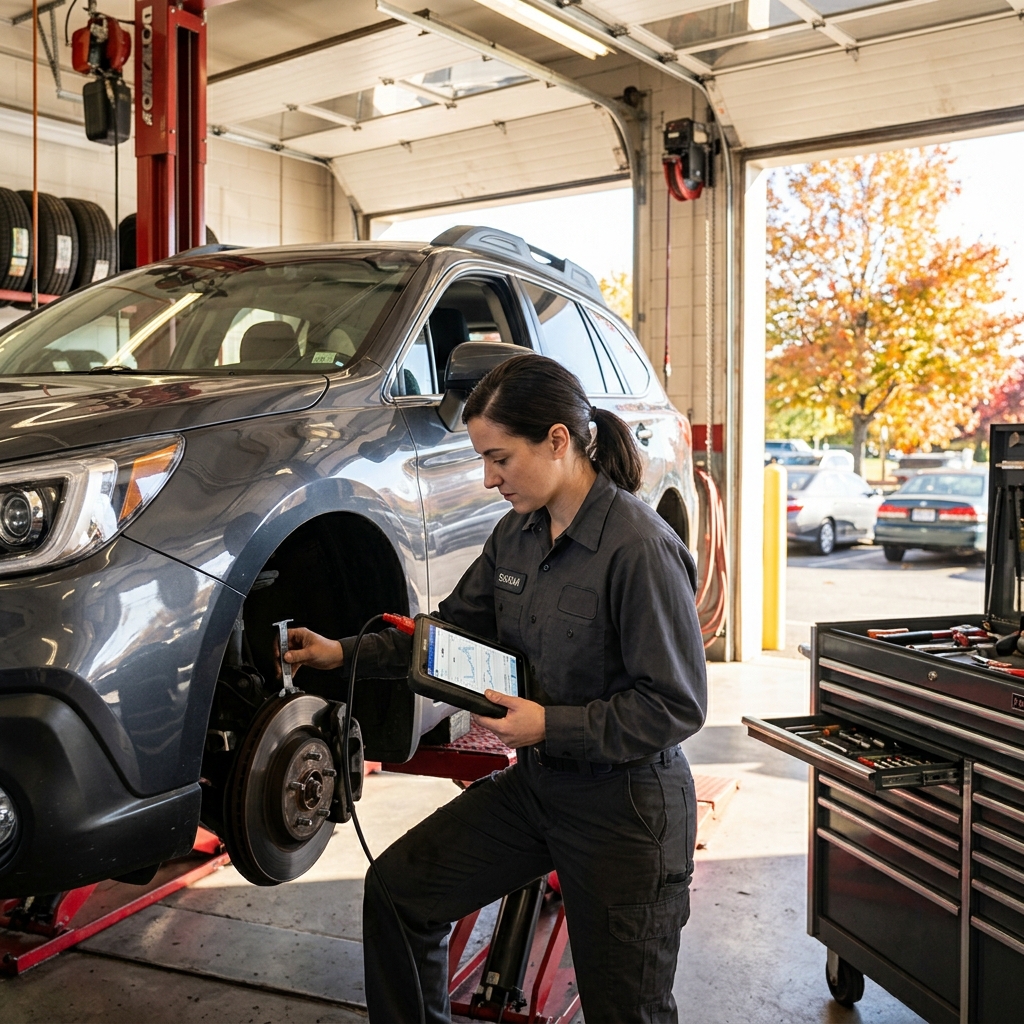
Female auto mechanic using a diagnostic tablet while inspecting the brake system of a gray SUV on a hydraulic lift. (Representative image for illustration purposes only. Actual vehicle may vary based on trim and configuration.) 

What Services Are Offered Through Quick Lane at Ford Dealerships?

Quick Lane service at Ford dealerships provides essential routine vehicle maintenance without requiring an advance appointment, covering fluid renewals, tire care, brake services, and battery replacements. Factory-trained technicians complete these rapid-turnaround maintenance items on all vehicle makes and models using original equipment components while performing a comprehensive multi-point inspection.

Key maintenance services available through Quick Lane include:

  • Motorcraft synthetic blend or full synthetic oil and filter replacements.
  • Tire pressure adjustments, digital balancing, tire rotation, and tread depth measurements.
  • Visual brake inspections, rotor surface measuring, and pad thickness evaluations.
  • Electrical system diagnostics, including professional battery testing and replacement to handle extreme summer heat and cold winter weather.
  • Wiper blade installations, cabin air filter replacements, engine air filter renewals, and top-offs for essential vehicle fluids.

For hardworking vehicle owners and daily commuters who need fast, dependable service care, stopping by a local Ford service center delivers reliable upkeep that fits into a busy schedule without sacrificing quality.

What Are the Benefits of Dealership Service Over Independent Shops?

Servicing your vehicle at a Ford dealership ensures all maintenance and repair work is performed by factory-certified technicians utilizing specialized diagnostic software, genuine Motorcraft parts, and direct factory warranty integration. Dealership technicians complete regular, specialized training on Ford engine architectures, hybrid systems, and high-voltage electric powertrains.

Advanced technical benefits include:

  • Proprietary Diagnostic Software: Dealership service bays utilize the Integrated Diagnostic System (IDS) and Ford Diagnosis and Repair System (FDRS). These diagnostic suites connect directly to control modules through the OBD-II port to read technical diagnostic trouble codes, reflash powertrain control modules, and perform factory software updates.
  • Factory Part Quality: Dealerships install genuine Motorcraft components manufactured to exact original specifications. These parts carry a 2-year, unlimited-mileage limited warranty that covers both parts and labor at authorized Ford dealers nationwide.
  • Automated Vehicle History: Every maintenance service and repair completed at an authorized dealer is logged automatically into Ford's centralized vehicle service history database, preserving future resale value and simplifying future warranty claims.

What Does a Ford 30,000-Mile Service Cost and What Coverage Does Ford Protect Offer?

A standard Ford 30,000-mile maintenance service pricing may vary depending on model requirements, covering oil and filter replacement, cabin and engine air filter updates, tire rotation, and full mechanical system checks. Long-term mechanical coverage can be secured through a Ford Protect Extended Service Plan, which covers mechanical components past the standard factory warranty.

During a 30,000-mile service visit, technicians perform major maintenance renewals:

  1. Synthetic motor oil replacement and fresh Motorcraft oil filter installation.
  2. Engine air filter and cabin air filter replacements to ensure proper engine intake airflow and clean interior cabin air.
  3. Four-wheel tire inspection and tire rotation to maintain even tread wear.
  4. Comprehensive inspection of fuel lines, cooling system hoses, steering tie-rod ends, suspension ball joints, and brake pads and rotors.

For models like the 2026 Ford Ranger equipped with the 2.3L EcoBoost engine, completing these 30,000-mile service milestones keeps the powertrain operating at peak efficiency.

To guard against unexpected repair costs after your standard 3-year/36,000-mile bumper-to-bumper warranty and 5-year/60,000-mile powertrain warranty expire, Ford Protect coverage plans offer extended reassurance. Options like Ford Protect PremiumCARE cover over 1,000 key components—including engine, transmission, steering, suspension, air conditioning, and electrical systems—Contact the dealership for current plan terms and payment information.

How Can You Schedule Service Online or Arrange Pickup and Delivery at Tri State Ford?

You can schedule service online by visiting the Tri State Ford service portal, entering your vehicle year, model, and mileage, selecting required maintenance tasks, and reserving an available appointment time. Vehicle owners can also arrange door-to-door maintenance without taking time out of their workday.

For residents navigating the riverfront terrain around East Liverpool, our dealership offers complimentary Ford Pickup & Delivery service for qualifying maintenance visits. Our service team picks up your truck or SUV directly from your residence or office, completes all requested repairs at our service center using genuine parts, and returns your vehicle when work is finished. We also provide customer shuttle transportation and a comfortable customer lounge equipped with Wi-Fi and complimentary beverages.
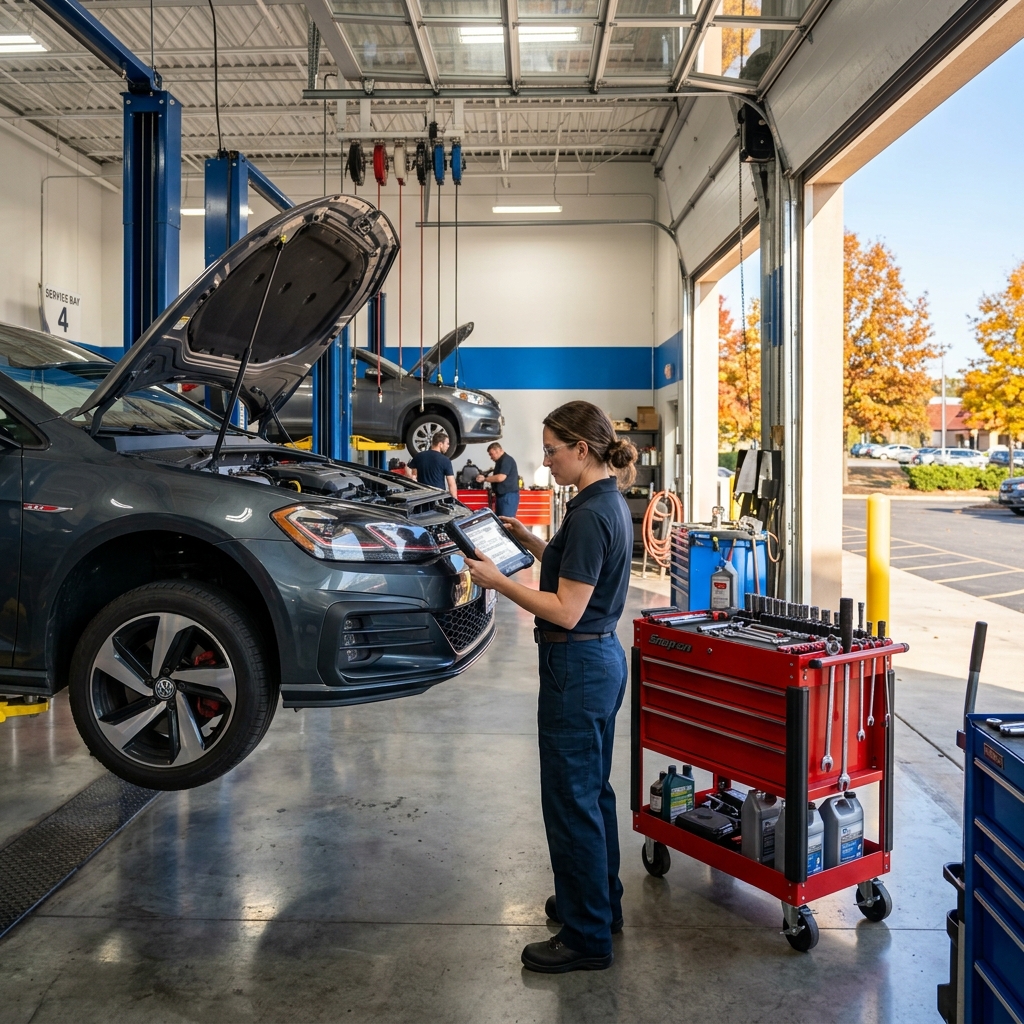
Female mechanic using a diagnostic tablet while inspecting a car on a hydraulic lift in an auto repair shop. (Representative image for illustration purposes only. Actual vehicle may vary based on trim and configuration.)

Common Questions About Servicing Your Ford Vehicle at Tri State Ford

Q: How often should I rotate the tires on my Ford F-150?

Tires on a Ford F-150 should be rotated every 7,500 miles, which conveniently coincides with every routine oil change visit. Regular tire rotation ensures even tread wear across all four tires, prolongs overall tire life, and helps maintain optimal traction and handling on both rear-wheel drive and four-wheel drive configurations.

Q: What happens if I ignore the Intelligent Oil-Life Monitor warning?

Ignoring the Intelligent Oil-Life Monitor warning allows degraded oil to remain in your engine, leading to reduced lubrication, increased friction, sludge accumulation, and potential internal component damage. Running engine oil past the zero percent life indicator accelerates wear on timing components and bearing surfaces and may compromise your 5-year/60,000-mile powertrain warranty coverage.

Q: Are genuine Motorcraft components used for routine maintenance?

Yes, our service department installs genuine Motorcraft components for routine maintenance and repair services. Motorcraft filters, spark plugs, synthetic fluids, and brake friction materials are built specifically to Ford original equipment specifications and come backed by a 2-year unlimited-mileage limited warranty.

Q: Are loaner vehicles available for extended service appointments?

Tri State Ford offers service loaner vehicles for qualifying extended mechanical repair appointments and major warranty work. Service advisors can confirm loaner vehicle availability and eligibility criteria when you schedule your appointment in advance.

Q: What paperwork or items should I bring to my service appointment?

When arriving for a scheduled maintenance appointment, bring your primary vehicle key fob and any locking lug nut keys if your wheels are equipped with custom security locks. If you hold a Ford Protect Extended Service Plan, having your policy documentation or registered Ford account details helps our team process coverage seamlessly.

Maintaining your Ford truck, SUV, or crossover is straightforward when you rely on factory-certified diagnostic equipment, genuine parts, and experienced technicians. Vehicle owners can easily get directions to our service bay for routine maintenance or lock in a convenient service time by calling our team at (330) 462-7578 today.


© 2026 Tri State Ford. All rights reserved.
Vehicle specification data © JATO Dynamics Limited.

Ford Vehicle Maintenance in East Liverpool OH | Tri State Ford
Posted in:

Related Posts

f

What Determines the Total Cost of a Brake Repair?

The total cost of a brake repair depends primarily on which components need replacement, the quality tier of the replacement parts, and the specific labor required for your vehicle's setup. A basic service replacing only friction pads costs significantly less than a full overhaul that includes new rotors, refurbished calipers, hardware replacement, and a complete brake fluid flush. Brake systems rely on multiple components working together to safely slow down your vehicle. When you press the brake pedal, hydraulic pressure forces the caliper to press friction pads against a rotating metal disk called a rotor. Over time, friction wears down the pad material, while heat and mechanical pressure stress the rotors. A simple brake job may only require installing fresh friction pads on an otherwise healthy system. However, if inspection reveals scored rotors, leaking caliper seals, or contaminated fluid, the repair scope expands to return the system to factory safety standards. Parts selection also accounts for major price differences across service quotes. Replacement friction components range from value options to original-equipment specification parts engineered specifically for your vehicle. High-grade friction materials cost more upfront, but they deliver superior stopping power, reduced brake dust, and longer component life. Additionally, labor complexity varies depending on your vehicle's drive layout, rust exposure from regional road treatments, and whether specialized diagnostic tools are required to reset electronic system components. For drivers needing a physical inspection or customized estimate, visiting our service team at 1503 Pennsylvania Ave in East Liverpool will provide a complete breakdown of component health. If you hear unexpected squealing or feel pedal vibration, give our service department a quick call to discuss system performance before minor pad wear turns into major rotor damage. Table of Contents Why Do Brake Repair Quotes Vary Between Auto Shops? What Is the Price Difference Between Organic, Semi-Metallic, and Ceramic Brake Pads? What Is the Cost Difference Between Resurfacing Rotors and Replacing Them? Why Do Initial Quotes Often Change After a Brake Inspection? How Often Should Front Brake Pads Be Replaced Compared to Rear Pads? Do Aftermarket Brake Components Void Your Vehicle Warranty? Common Questions About Brake Repair Costs Schedule Trusted Brake Care at Tri State Ford Why Do Brake Repair Quotes Vary Between Auto Shops? Brake repair quotes vary between auto repair shops because each business calculates labor rates based on local overhead, technician certification levels, and the exact scope of parts included in the estimate. A lower quote frequently covers only basic aftermarket pad installation on a single axle, while a comprehensive estimate includes factory-spec parts, rotor resurfacing or replacement, new hardware, and complete fluid care. The definition of a standard brake job differs across service facilities. Posted prices at independent garages often show a baseline for replacing pad sets on a single axle. When comparing estimates, examining the itemized breakdown reveals whether the price covers pad installation alone or includes crucial secondary maintenance. Proper brake service requires cleaning and lubricating caliper slide pins, replacing anti-rattle hardware clips, and inspecting hydraulic lines. Skipping these detail steps saves short-term labor costs but often leads to premature pad wear, uneven braking, and persistent noise. Technician expertise and facility tooling directly influence shop labor rates. Dealership service centers employ factory-trained technicians who specialize in specific vehicle lineups, utilizing specialized equipment to service complex systems like modern electronic parking brake modules and advanced anti-lock braking controls. Independent repair shops may offer lower hourly labor fees, but they may use generic multi-fit parts tiers. Understanding what is included in your estimate ensures you pay for lasting safety rather than a temporary fix. To maintain optimal stopping performance, you can schedule a service appointment with our technicians for a complete diagnostic evaluation. If you prefer carrying out your own maintenance using factory-approved components, you can easily order original parts directly through our dealership parts counter. Service Level Typical Scope of Included Parts Primary Pricing Drivers Long-Term Service Benefit Basic Pad Replacement Friction pads only value parts, fast turn time Lowest immediate cost for high-margin vehicles Full Axle Service Friction pads, hardware clips, slide pin lube OEM-spec pads, hardware kit labor Prevents uneven pad wear and brake chatter Comprehensive System Overhaul Pads, new rotors, caliper rebuild, fluid flush Premium pads, replacement rotors, full system bleed Restores factory stopping distances and pedal feel What Is the Price Difference Between Organic, Semi-Metallic, and Ceramic Brake Pads? The price difference between brake pad materials reflects their composition and durability, with organic pads being the most affordable, semi-metallic pads sitting in the middle price tier, and ceramic pads commanding the highest cost. Organic pad sets are generally the most affordable, semi-metallic sets fall in the middle, and high-performance ceramic pad sets are typically the most expensive for parts alone. Non-asbestos organic pads are manufactured from materials such as rubber, glass, kevlar, and resin bonding agents. Because these materials are softer, organic pads operate quietly and produce smooth initial pedal response, making them suitable for light daily commuting. However, they wear out faster than other options, create substantial brake dust, and degrade rapidly under high heat, requiring more frequent replacement over the life of your vehicle. Semi-metallic brake pads consist of 30 to 65 percent metal filings, including steel, iron, and copper, combined with synthetic lubricants. This metal composition makes semi-metallic pads extremely durable and efficient at dissipating heat away from the braking system. They are ideal for heavy-duty applications, such as towing trailers or hauling heavy bed payloads, though they generate more rotor wear and audible noise than organic or ceramic alternatives. Ceramic brake pads combine dense ceramic fibers with copper compounds to deliver exceptional heat resistance and consistent stopping power across wide temperature ranges. They produce fine, light-colored dust that does not stick to aluminum wheels and offer long service life with minimal rotor abrasion. While ceramic pads require a higher initial investment, their durability and quiet operation make them a preferred choice for modern passenger cars and family SUVs. What Is the Cost Difference Between Resurfacing Rotors and Replacing Them? Resurfacing brake rotors typically costs less than replacing them, whereas installing replacement rotors generally costs more in parts and labor. While resurfacing reduces initial costs by machining away minor surface imperfections, replacement becomes necessary when rotors wear past minimum safety thickness or develop deep heat cracks. Rotor resurfacing, also known as turning, involves mounting the rotor on a precision lathe to shave off a thin layer of metal, smoothing out light grooves and removing minor warpage. This process creates a pristine surface for new brake pads to grip properly, eliminating pedal pulsation without the expense of purchasing new castings. However, turning a rotor thins the disc material, reducing its ability to absorb and dissipate heat during hard braking. Modern vehicles are increasingly built with lighter, thinner rotors designed to optimize vehicle weight and fuel value. These components often have narrower discard thickness tolerances, meaning they can rarely survive more than one resurfacing cycle before dropping below manufacturer safety specifications. When a rotor is worn too thin, machining it creates a safety risk because the thinned metal can warp rapidly or fracture under intense thermal stress. Deciding between resurfacing and replacement comes down to measured thickness and overall rotor condition. Our advisors see that daily driving around the stop-and-go corridors of State Route 170 in Calcutta frequently causes localized heat buildup on rotors. If an inspection shows sufficient discard thickness remaining, machining provides an economical solution. If severe rust pitting or deep thermal scoring is present, installing fresh replacement rotors ensures reliable, noise-free braking performance over thousands of miles. Why Do Initial Quotes Often Change After a Brake Inspection? Initial brake repair estimates often change after a physical inspection because phone or online quotes only assume a standard pad replacement on an otherwise healthy system. Once a technician removes the wheels, hidden issues such as uneven rotor wear, seized caliper pins, contaminated brake fluid, or damaged hardware frequently require additional parts and service. Visual inspection from outside the wheel assembly provides limited information about internal system wear. Phone estimates rely on the driver's description of symptom noises, which may sound like simple friction indicator squealing but actually stem from metal-to-metal contact. Once the vehicle is hoisted on a service lift and calipers are detached, technicians measure rotor thickness with micrometers and inspect inner pad linings that cannot be seen while mounted. Mechanical components exposed to moisture and road deicing chemicals often exhibit hidden degradation. Guide pins can seize inside caliper brackets due to rust buildup, preventing friction pads from retracting properly after you release the brake pedal. When calipers drag, they overheat the assembly, ruin new pads within months, and boil the hydraulic fluid inside the lines. Identifying these secondary failures during teardown protects you from leaving the shop with unaddressed safety issues. Transparent communication prevents unexpected invoice surprises when physical inspections reveal extra wear. Reliable facilities contact vehicle owners directly after hands-on disassembly, detailing why additional components—such as fresh caliper hardware or hydraulic fluid service—are necessary. Providing clear photos or physical measurements helps drivers understand the exact condition of their stopping equipment before any additional work begins. How Often Should Front Brake Pads Be Replaced Compared to Rear Pads? Front brake pads typically require replacement every 30,000 to 50,000 miles, whereas rear brake pads often last between 50,000 and 70,000 miles under normal driving conditions. Front brakes wear out faster because weight transfers toward the front axle during deceleration, forcing front calipers and pads to absorb roughly 70 percent of the vehicle's total stopping force. Vehicle weight distribution during braking creates a natural imbalance in wear rates between front and rear axles. When you press the pedal, kinetic energy forces the vehicle's mass forward, pressing the front tires firmly onto the pavement. To match this kinetic force, front brake pads and rotors are designed with larger surface areas and thicker friction linings than rear components, yet they still wear faster due to the heavier workload. Rear brake systems handle less stopping pressure, but modern vehicle technology has altered traditional wear patterns. Many current cars and crossovers utilize electronic brake force distribution systems that dynamically adjust hydraulic pressure to the rear axle under light pedal effort, keeping the chassis flat during gentle stops. Additionally, vehicle traction control and stability management systems selectively apply individual rear brakes to correct sway or slip, which can accelerate rear pad wear in bad weather. Navigating steep riverfront bluffs along the Ohio River in East Liverpool places elevated strain on front braking systems during downhill descents. Heavy vehicle loads, aggressive driving habits, and frequent stop-and-go commuting further accelerate friction material loss across both axles. Having your pad thickness checked during routine oil changes and tire rotations ensures you catch uneven wear before metal backings scratch your rotors. Do Aftermarket Brake Components Void Your Vehicle Warranty? Installing aftermarket brake components does not automatically void your original vehicle manufacturer warranty under federal law. However, if a non-original aftermarket component directly causes damage to a covered factory part, the manufacturer can legally deny warranty coverage for that specific failure. Under the federal Magnuson-Moss Warranty Act, auto manufacturers cannot void a bumper-to-bumper or powertrain warranty simply because an owner used non-original replacement parts for maintenance. You have the legal right to service your vehicle at independent facilities or install third-party brake components. The burden of proof rests on the vehicle manufacturer to demonstrate that an aftermarket component directly caused a system failure before refusing a warranty claim. Potential warranty conflicts arise when low-quality aftermarket parts fail and damage surrounding assembly units. For example, if an unapproved aftermarket brake pad disintegrates under heat and damages an original-equipment anti-lock brake sensor or hydraulic caliper, the repair for that sensor or caliper will not be covered under factory warranty. Conversely, installing aftermarket rear pads will never invalidate factory warranty coverage on an engine, transmission, or electrical module. Using original-equipment components, such as factory-spec Motorcraft pads and rotors engineered for Ford models, provides complete assurance that all system parts match strict vehicle tolerances. If you are interested in acquiring a new vehicle, our team can help you build a custom new Ford vehicle order with complete factory warranty protections. For immediate maintenance questions or to review your current coverage, give our team a call or visit our service department at our local East Liverpool showroom. Common Questions About Brake Repair Costs Q: What proportion of a brake job cost is parts versus labor? On average, replacement parts represent 40 to 60 percent of a total brake repair invoice, while shop labor accounts for the remaining 40 to 60 percent. This ratio fluctuates based on vehicle complexity, local labor rates, and component selection. Basic pad swaps involve lower parts expenses, while jobs requiring new rotors, specialized electronic parking brake service modes, or complete hydraulic flushes increase labor time and overall cost. Q: Does an electronic parking brake increase brake service labor costs? Servicing vehicles with an electronic parking brake can slightly increase shop labor time because technicians must put the rear brake calipers into service mode using a diagnostic scanner before retracting the pistons. Attempting to force caliper pistons back manually without activating service mode can destroy internal electric actuator motors, resulting in costly component repairs beyond basic pad replacement. Q: Is brake fluid replacement included in a standard brake job quote? Brake fluid flushes are generally quoted as a separate service from routine pad and rotor replacements. Over time, glycol-based brake fluid absorbs moisture from the atmosphere, lowering its boiling point and inducing corrosion inside internal master cylinder bores and caliper lines. Most vehicle manufacturers recommend flushing fluid every two years or 30,000 miles to preserve responsive pedal feel. Q: How do driving habits in hilly terrain affect brake replacement intervals? Driving regularly in hilly or mountainous terrain forces brakes to dissipate extreme heat during long downhill descents, significantly accelerating friction pad wear and thermal rotor expansion. Drivers who frequently navigate steep inclines may need fresh front pads every 20,000 to 30,000 miles compared to highway commuters who coast smoothly and experience much longer pad lifespans. Q: Does Ford offer any warranty on replacement brake pads? Ford offers warranty coverage on replacement parts through its Motorcraft program, which includes a limited lifetime brake pad guarantee on eligible friction sets for consumer vehicles. This coverage covers replacement pads if the friction material wears out under normal driving conditions, though it explicitly excludes labor installation charges and secondary components like rotors or calipers. Schedule Trusted Brake Care at Tri State Ford Maintaining your vehicle's braking performance is essential for keeping your family safe on every daily commute and weekend trip. Understanding the variables behind brake repair pricing helps you make informed choices about your vehicle's maintenance needs, ensuring you receive high-quality parts and expert installation at transparent rates. Our factory-trained technicians use genuine original-equipment parts engineered to deliver precise fitment, quiet stopping power, and long-term durability. Whether you require a routine pad thickness check, rotor resurfacing, or a complete hydraulic service, our service center provides clear inspections and reliable estimates upfront. Contact our team today to schedule your next service appointment and enjoy complete peace of mind on the road. © 2026 Tri State Ford. All rights reserved. Affordable Brake Repair in East Liverpool OH | Tri State Ford
f

Why Does Ford Technician Certification Matter for Vehicle Repairs?

Ford technician certification matters because modern Ford vehicles utilize complex network architectures, specialized computer module programming, and exact mechanical tolerances that require brand-specific technical expertise. A certified technician completes structured factory instruction to accurately diagnose electronic trouble codes, service high-voltage electric or EcoBoost powertrains, and execute manufacturer recall procedures without trial-and-error part replacement, protecting overall vehicle performance and supporting factory warranty coverage. Vehicles today function as mobile computer networks. A single Ford truck or SUV can contain up to 80 individual electronic control units communicating across high-speed controller area network (CAN-bus) lines. When an engine management light or safety system warning appears, standard multi-brand diagnostic code readers often display generic failure codes that miss underlying Ford-specific module errors. A technician who has completed manufacturer certification understands how these proprietary systems interact, allowing for precise fault isolation and correct repair procedures. Beyond digital diagnostics, mechanical standards on components such as twin-independent variable camshaft timing systems, 10-speed automatic transmissions, and integrated trailer brake controllers demand exact torque specifications and specialized assembly techniques. Factory-trained service specialists receive hands-on instruction using official shop manuals and specialized service tools engineered exclusively for Ford lineups. This specialized training reduces diagnostic time, prevents unnecessary component replacements, and ensures every repair restores the vehicle to original factory engineering standards. For complete ownership care and specialized diagnostics, local drivers can visit our service center on Pennsylvania Avenue to speak directly with our team. If you notice unusual drivability symptoms or require routine maintenance, give us a call at (330) 462-7578 or schedule a service appointment online at your convenience. Table of Contents What Specific Training and Requirements Define a Ford-Trained Technician? What Is Required to Achieve advanced Ford service training status? Why Are Factory Diagnostic Tools and Module Updates Essential for Modern Fords? Can a Mechanic Be Both ASE Certified and Ford Trained? Will Servicing a Ford at an Independent Shop Void the Factory Warranty? Common Questions About Ford Technical Training and Vehicle Service Schedule Factory-Trained Service at Tri State Ford What Specific Training and Requirements Define a Ford-Trained Technician? A Ford-trained technician is defined by completing structured educational tracks administered through Ford Motor Company, combining online technical modules, hands-on classroom instruction, and practical dealership experience. Candidates progress through technical career entry programs like STST (Service Technician Specialty Training) or college-level ASSET (Automotive Student Service Educational Training) courses to master Ford-specific electrical wiring, powertrain management, and chassis control systems. The path to factory credentialing involves multiple structured training tiers: STST Curriculum: Instructor-led classroom and web-based training modules focusing on specific vehicle systems, including engine repair, automatic transmissions, steering and suspension, climate control, and advanced electronics. ASSET Program: A two-year college program partnering higher education institutions with Ford dealerships, balancing classroom instruction with paid dealership co-op work experience. advanced Ford training: A streamlined pathway allowing experienced mechanics holding Automotive Service Excellence certifications to gain credit for general knowledge while completing Ford-specific technical coursework. introductory technical training: An introductory partnership connecting high schools and technical centers with Ford web-based training modules to build foundational knowledge. dealership apprenticeship: A formal dealership apprenticeship structure encompassing 18 to 24 months of training, incorporating about 2,000 hours of hands-on experience and roughly 400 hours of classroom learning across gas, hybrid, and electric vehicle systems. The daily commute across the rolling hills along State Route 170 in Calcutta subjects brake rotors, suspension bushings, and transmission clutches to continuous load shifts. Technicians trained directly by the manufacturer understand how these regional driving conditions accelerate wear on specific Ford components. Rather than relying on generic service guidelines, certified mechanics apply exact fluid specifications, updated software recalibrations, and genuine Motorcraft components tailored to maintain vehicle durability. To maintain vehicle performance without disrupting your daily routine, our team offers options like Ford Mobile Service for light maintenance at your home or workplace. For those performing their own routine maintenance, you can also order genuine OEM Ford parts directly through our service center. What Is Required to Achieve advanced Ford service training status? Achieving advanced Ford service training status requires a technician to earn and continuously maintain Master status across three core specialty tracks—chassis, powertrain, and electronics—for five consecutive calendar years. This credential represents the highest level of service expertise achievable within the Ford dealership network, demanding hundreds of hours of advanced coursework and regular practical examinations. To earn Master certification in each individual track, technicians must complete all foundational and advanced classroom labs, pass comprehensive written examinations, and demonstrate hands-on diagnostic proficiency. The requirements across the three core areas include: Powertrain Master Track: Mastery of engine overhaul procedures, turbocharger diagnostics, fuel-injection mapping, and multi-speed automatic transmission rebuilding. Chassis Master Track: Advanced certification in anti-lock braking systems, electronic stability controls, power steering calibrations, four-wheel-drive transfer cases, and air suspension systems. Electrical/Electronics Master Track: Comprehensive expertise in body control modules, multiplex wiring diagnostics, CAN-bus network troubleshooting, and Ford Co-Pilot360 driver-assist radar and camera alignments. Holding Senior Master status is not a one-time achievement. Vehicle technology evolves rapidly with new model years, introducing updated electrical architectures, high-voltage battery management systems, and over-the-air software capabilities. Senior Master technicians must complete annual update courses and recertification exams every year to retain their active status. Our service team observes that drivers coming in with intricate electrical or multi-system warnings benefit from having Senior Master technicians analyze the live data stream. When complex drivability issues arise, having top-tier technical expertise available ensures accurate fault identification on the first visit. For added maintenance convenience, owners can utilize Ford Pick-Up & Delivery to have their vehicle serviced by our trained staff without leaving home. Why Are Factory Diagnostic Tools and Module Updates Essential for Modern Fords? Factory diagnostic tools and software module updates are essential because contemporary Ford vehicles rely on complex computer software to operate engine management, safety sensors, transmission shift points, and cabin electronics. Specialized diagnostic hardware like the FDRS (Ford Diagnostic & Repair System) and IDS (Integrated Diagnostic Software) interfaces directly with factory servers to read proprietary diagnostic trouble codes and perform computer module reflash updates. General aftermarket scan tools used by non-affiliated repair facilities typically read only generic OBD-II emission codes. While an aftermarket tool might indicate a generic misfire, factory diagnostic software can isolate whether the issue stems from an injector driver signal, a variable camshaft solenoid fault, or a software calibration mismatch inside the powertrain control module. Computer module updates perform several critical functions on modern vehicles: Software Reflashing: Installing updated manufacturer code to fix drivability glitches, improve shift quality, or optimize fuel delivery without physical part replacement. Sensor Calibration: Aligning radar units, camera modules, and steering angle sensors following alignment or bumper service to ensure Ford Co-Pilot360 features function accurately. Guided Component Testing: Executing automated diagnostic sequences that test individual solenoids, relays, and actuators under precise operating conditions. Key and Module Initialization: Security handshake programming required when installing new engine computers, body control modules, or key fobs. Navigating the riverfront slopes in East Liverpool places sustained loads on vehicle transmissions and hill-descent systems. When software updates become available to refine clutch engagement or braking assist software under heavy loads, factory diagnostic equipment ensures those updates are applied correctly. Non-subscribed repair facilities without active access to Ford technical databases cannot reflash or update these proprietary vehicle computers. Can a Mechanic Be Both ASE Certified and Ford Trained? Automotive mechanics can hold both Automotive Service Excellence (ASE) certifications and official Ford factory training credentials simultaneously. Many professional dealership technicians carry active ASE certifications alongside their specialized manufacturer credentials to demonstrate both general automotive knowledge and brand-specific technical expertise. The National Institute for Automotive Service Excellence (ASE) evaluates a technician's understanding of general mechanical and electrical principles through standardized national examinations. ASE certifications cover universal system fundamentals across all vehicle makes and models, such as basic hydraulics, electrical testing theory, and mechanical steering geometry. In contrast, Ford factory training builds upon general mechanical skill by focusing exclusively on Ford engineering, component designs, and proprietary electronic systems. The table below outlines how these two professional credentials complement each other: Certification Type Governing Body Primary Focus Area Testing and Verification ASE Certification National Institute for Automotive Service Excellence Universal automotive repair principles, industry-standard diagnostics, and general mechanical theory across all vehicle brands. Standardized national written exams and verified two-year hands-on work experience requirement. Ford Factory Training Ford Motor Company Technical Career Entry System Brand-specific vehicle architectures, FDRS software reflash procedures, EcoBoost engine diagnostics, and Ford warranty standards. Proctored web modules, hands-on regional center training labs, and mandatory annual update testing. Ford's FAST (Ford Accepted Service Training) program specifically recognizes active ASE certifications, granting experienced mechanics course equivalency credits for general automotive fundamentals. This allows skilled mechanics to transition into specialized Ford training tracks faster, mastering model-specific software and diagnostic tools without repeating entry-level mechanical instruction. Will Servicing a Ford at an Independent Shop Void the Factory Warranty? Servicing a Ford vehicle at an independent repair shop does not void your factory warranty, provided routine maintenance is performed according to manufacturer guidelines and detailed service records are preserved. Under the federal Magnuson-Moss Warranty Act, automobile manufacturers cannot invalidate a vehicle's factory warranty simply because maintenance was completed by a non-dealership facility or using high-quality aftermarket parts. To protect your warranty coverage when using independent service facilities, vehicle owners must keep complete documentation for every maintenance procedure. Essential record-keeping practices include: Detailed Invoices: Retaining receipts that state the date, vehicle mileage, vin number, specific service performed, and exact part numbers installed. Correct Part Specifications: Ensuring non-OEM oil filters, air filters, and synthetic fluids meet the exact Ford material specifications listed in your owner's manual. Maintenance Schedule Adherence: Completing oil changes, tire rotations, spark plug replacements, and fluid flushes within the recommended mileage and time intervals. While routine maintenance like oil changes and tire rotations can legally be performed at independent shops, factory warranty repairs, safety recall campaigns, and complex software reflash procedures must be completed by an authorized Ford dealership. If an independent shop installs an incorrect component or damages a system during repair, any secondary damage caused by that improper service will not be covered under the factory warranty. Using authorized dealership service eliminates documentation friction during future warranty claims because every service record, factory software update, and genuine Motorcraft part installation is automatically logged directly into Ford's centralized vehicle history database. Common Questions About Ford Technical Training and Vehicle Service What specific training and requirements define a Ford-Trained Technician? Ford's technical training program includes comprehensive web modules, rigorous exams, and practical labs to ensure technician proficiency. Training paths like STST and ASSET cover brand-specific electrical networks, EcoBoost powertrains, and high-voltage systems. Can independent shops perform Ford software and computer module updates? Independent shops can only perform module updates if they maintain active subscriptions to Ford's proprietary FDRS or IDS software and possess compatible vehicle communication hardware. Non-subscribed independent shops cannot reflash or calibrate Ford computer modules. What is required to achieve advanced Ford service training status? Earning Senior Master status requires a technician to maintain Master credentials across chassis, powertrain, and electrical specialty tracks for five consecutive years. Technicians must also complete annual update courses on new model year technologies to keep their Senior Master credential active. Can a mechanic be both ASE certified and Ford trained? Mechanics frequently hold both credentials. ASE certification validates general automotive repair knowledge across all vehicle makes, while Ford factory training provides brand-specific expertise on Ford engineering, diagnostic software, and repair procedures. Will servicing a Ford at an independent shop void the factory warranty? Routine service at an independent shop does not void the factory warranty under federal law, provided maintenance meets manufacturer standards and receipts are kept. However, official warranty repair work and recall campaigns must be performed at an authorized dealership. For additional guidance on maintaining your vehicle's performance, view our routine battery testing and replacement guides online. If you need expert diagnostic support, you can reach our team directly at (330) 462-7578 or get step-by-step driving routes for finding our East Liverpool dealership. Schedule Factory-Trained Service at Tri State Ford Maintaining the safety, performance, and long-term value of your Ford requires specialized equipment and up-to-date technical training. From complex computer module reprogramming to routine brake and suspension care, relying on certified service professionals ensures every repair is executed according to exact manufacturer engineering standards. Contact our team today to schedule your next maintenance appointment and keep your vehicle running smoothly for years to come. © 2026 Tri State Ford. All rights reserved. Ford Technician Certification Benefits in East Liverpool OH | Tri State Ford
d

What Causes a Car to Make a Clicking Noise?

A vehicle clicking noise is primarily caused by low electrical current during startup, wear in rotating suspension or drivetrain components, or mechanical clearance issues inside the engine. A rapid click when turning the ignition key points to a weak battery or bad electrical connections, while rhythmic clicking during tight turns signals a failing constant velocity joint, and steady ticking from under the hood indicates valvetrain wear or low oil pressure. Understanding the specific conditions under which a noise occurs helps pinpoint the underlying issue before minor mechanical wear turns into an unexpected vehicle breakdown. Automotive clicking sounds generally fall into four distinct operational categories: Starting System Failures: Rapid or single clicking when attempting to crank the engine, tied to battery voltage drops, terminal corrosion, or starter motor degradation. Drivetrain and Steering Anomalies: Metallic clicking or popping that accelerates with vehicle speed, especially while turning, usually originating from damaged axle boots or worn joints. Engine Mechanical Ticking: Rhythmic ticking synced directly with engine speed (RPM), stemming from hydraulic valve lifters, low oil pressure, or high-pressure fuel injectors. Brake and Wheel Assembly Issues: Clicking heard during low-speed braking or coasting, caused by loose brake pad retaining clips, shifting pads, or debris behind the dust shield. East Liverpool's riverfront bluffs and steep grade changes put consistent mechanical strain on constant velocity joints and steering components, making drivetrain clicks easy to identify during daily driving. When an unfamiliar noise develops, getting a professional system check ensures your vehicle remains reliable and safe. You can drop by our East Liverpool service center at 1503 Pennsylvania Ave or give our team a quick call at (330) 462-7578 to speak directly with an expert diagnostic technician. Table of Contents Why Does a Car Make a Rapid Clicking Noise When Starting? How Do You Tell If a Clicking Start Is Battery or Starter Related? What Is the Difference Between Clicking When Turning and Engine Ticking? Is It Cheaper to Replace Just a CV Boot or the Entire CV Axle? Common Diagnostic Questions About Vehicle Clicking Noises Schedule Professional Vehicle Diagnostic Service Why Does a Car Make a Rapid Clicking Noise When Starting? A rapid clicking sound during vehicle startup occurs when the starter solenoid rapidly engages and disengages because it lacks sufficient electrical amperage from the battery. This rapid cycling happens when battery voltage drops below the required operating threshold, cable terminals suffer from corrosion, or an alternator failure prevents the battery from maintaining its electrical charge reserve. When you turn the ignition key or press the start button, the vehicle electrical system sends power to the starter solenoid coil. The solenoid requires a continuous flow of high amperage to hold the starter energizing plunger in place against its internal return spring. If electrical resistance is high or battery charge is depleted, the electrical circuit energizes the solenoid briefly, but the immediate voltage drop forces the spring to push the plunger back. This continuous cycle of rapid engagement and release creates the fast, machine-gun clicking sound under the hood. Common root causes for rapid starting clicks include: Undersized or depleted battery voltage resulting from age or cold weather capacity loss. Heavy buildup of lead sulfate or corrosion on positive and negative battery terminals. Loose or frayed ground straps between the engine block and chassis. Internal diode failure inside the charging system that leaves the battery undercharged during regular driving. Drivers frequently ask our service advisors whether a rapid click automatically means the starter motor is destroyed, when in reality a simple electrical system test resolves the issue nearly nine times out of ten. Replacing compromised cables or installing genuine Ford battery and electrical parts online restores full cranking power and protects your starter motor from premature wear. How Do You Tell If a Clicking Start Is Battery or Starter Related? To determine if a clicking start stems from the battery or the starter motor, observe cabin lighting behavior and the rhythm of the click during ignition. A rapid multi-click accompanied by dimming interior lights or flickering digital displays points to a depleted battery or poor terminal connection, whereas a single loud click with full dashboard brightness indicates a failed starter solenoid or jammed starter motor. Diagnosing the difference between electrical power loss and starter hardware failure requires checking how the vehicle responds under electrical load. Turn on the vehicle headlights and attempt to crank the engine: Battery or Connection Issues: Headlights will dim significantly or shut off entirely when key engagement occurs. The starting sound presents as a fast series of light clicks. Voltage drop testing across the battery posts usually reveals output under 10.5 volts during load. Starter Motor Issues: Headlights remain strong and clear without flickering. The starting sound presents as a single heavy metallic knock or click as the starter solenoid attempts to engage a worn starter armature or damaged flywheel ring gear. If a weak battery is suspected, jump-starting the vehicle offers immediate diagnostic feedback. Attach positive jumper cables to positive terminals on both vehicles, then clamp the negative cable to an unpainted metal ground on the vehicle needing assistance. Allow the donor vehicle to run for several minutes to transfer surface charge. If the vehicle starts right up after charging, the starter motor is functioning properly, and attention should turn to routine battery maintenance and voltage diagnostics to determine if the battery or charging system needs replacement. What Is the Difference Between Clicking When Turning and Engine Ticking? The core difference between turning clicks and engine ticks lies in what triggers the sound and how its rhythm responds to vehicle movement. Clicking while turning originates in the drivetrain—specifically worn constant velocity joints—and speeds up with wheel rotation, whereas engine ticking stems from internal valvetrain components or fuel injectors and speeds up directly with engine RPM, even while the vehicle is sitting in park. Suburban commuters navigating State Route 170 through Calcutta often spot constant velocity joint clicking when turning sharply into shopping center parking lots under acceleration. Dissecting the characteristics of each noise helps isolate the mechanical system involved: Drivetrain Clicking Characteristics Noise correlates directly with vehicle ground speed, not engine engine revs. Sound intensifies during hard cornering or low-speed turning maneuvers. Caused by worn outer ball bearings inside a constant velocity joint after protective rubber boots split and lose lubrication. Pitch remains steady, but frequency increases as wheel rotation speeds up. Engine Ticking Characteristics Noise correlates directly with engine engine revs (RPM) and remains audible while idling in neutral or park. Sound originates beneath the valve covers or near the intake manifold. Caused by mechanical clearance in hydraulic valve lifters, low engine oil pressure, worn rocker arms, or normal operation of high-pressure direct fuel injectors. Adding engine oil can quiet valvetrain ticking if the oil dipstick shows low fluid levels, as proper oil volume restores hydraulic pressure inside the lifters. Brake hardware can also create localized clicking. Loose brake pad retaining clips allow pads to shift inside calipers when changing direction from drive to reverse, producing a single metallic click that should be inspected during regular service. Is It Cheaper to Replace Just a CV Boot or the Entire CV Axle? Replacing an entire constant velocity axle assembly is generally more cost-effective and reliable than replacing only a torn boot once clicking has begun. While a rubber boot replacement kit costs less in standalone parts, installing it requires identical labor steps to remove the axle shaft, and an actively clicking joint has already suffered permanent metallic damage from lost grease and road debris. When a flexible rubber boot cracks, grease flings outward onto suspension parts while dirt and water enter the bearing housing. This contamination rapidly abrades internal steel bearings and raceways. Comparing the service options highlights why complete replacement is standard practice: Repair Consideration Boot Replacement Only Complete CV Axle Assembly Initial Parts Cost Lower initial cost for rubber boot kit Moderate cost for complete factory axle shaft Labor Hours Required High (requires full disassembly and cleaning) Moderate (direct bolt-in replacement) Fixes Active Clicking? No (cannot repair internal metal wear) Yes (replaces all joint bearings entirely) Long-Term Reliability Risk of premature joint failure remains Full factory component life restored Attempting to save on parts by installing a boot over an already noisy joint leaves damaged bearings inside the drivetrain. Continued driving on a severely worn joint risks complete axle separation, which causes an immediate loss of power to the drive wheels and potential damage to nearby suspension steering arms. To protect your vehicle, you can schedule a service appointment online to have our technicians inspect your drive axles. Common Diagnostic Questions About Vehicle Clicking Noises Q: Can a failing alternator cause a car to click when starting? A damaged alternator fails to recharge the battery while the engine runs, steadily draining reserve battery capacity. Once electrical storage drops below necessary amperage, attempting to turn the ignition key results in a rapid clicking sound as the starter solenoid repeatedly cycles without sufficient power to turn the engine over. Q: Will adding engine oil stop a valve lifter ticking noise? Adding engine oil stops valvetrain ticking only if the noise is caused by low oil level or low oil pressure. Topping off engine oil restores hydraulic pressure to the lifters, but if the noise stems from mechanical wear, internal varnish, or sludge buildup, physical component replacement is necessary. Q: How do you jump-start a car that makes a rapid clicking noise? Connect positive jumper cables to positive battery terminals on both vehicles, then clamp the negative cable to an unpainted metal ground on the engine block of the vehicle with the dead battery. Allow the donor vehicle engine to run for several minutes to transfer charge before attempting to turn the ignition key. Q: Is it safe to drive a vehicle with a noisy CV joint? Driving with an actively clicking constant velocity joint is unsafe because internal bearing failure can cause the drive axle shaft to detach from the wheel hub assembly. Complete joint failure leads to immediate loss of vehicle drive power and potential steering control issues. Q: Why does my vehicle make a clicking sound after turning off the engine? Clicking or pinging sounds immediately after engine shutoff are caused by hot metal components contracting as they cool down. The exhaust manifold, catalytic converter, and heat shields expand under operating heat and emit light metallic clicks as ambient air cools the exhaust system. Schedule Professional Vehicle Diagnostic Service Resolving a vehicle clicking noise quickly prevents minor electrical drain or suspension joint wear from turning into unexpected roadside breakdowns. Our factory-trained service department provides complete battery load testing, drivetrain inspections, and engine diagnostics using specialized OEM equipment to pinpoint exact mechanical causes. Vehicle owners backed by Ford factory protection enjoy standard roadside assistance benefits, including emergency jump-starts and towing support to authorized service facilities. If you encounter an unexpected battery failure on the road, contact Ford Roadside Assistance: 1-800-241-3673 for quick dispatch support. Our service center provides comprehensive care tailored to your daily schedule: Factory-certified technicians using original equipment parts. Advanced diagnostic computers that analyze electrical systems and engine sensors. Comfortable customer lounge area with complimentary connectivity. Convenient online booking and transparent repair estimates. Whether you need a quick battery swap, axle replacement, or local maintenance assistance through our convenient Ford Mobile Service options, our team is ready to help. Visit our dealership address at 1503 Pennsylvania Ave, East Liverpool, OH 43920 or call our service desk directly at (330) 462-7578 to reserve your diagnostic appointment today. © 2026 Tri State Ford. All rights reserved. Car Clicking Noise Diagnostics in East Liverpool OH | Tri State Ford