Blog / Maintenance & Service, Essential Vehicle Care, Preventive Maintenance Tips, Vehicle Longevity

Is a Transmission Flush Necessary for Your Ford Vehicle?

d


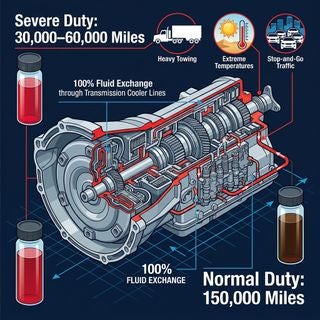
A transmission flush is necessary for your Ford vehicle when the fluid becomes contaminated, oxidized, or thermal degradation compromises hydraulic performance. While Ford schedules normal-duty fluid changes at 150,000 miles for modern transmissions like the 10R80, severe operating conditions demand fluid servicing every 30,000 to 60,000 miles. Performing a complete flush exchanges 100% of aged fluid throughout the gear case, lines, and torque converter, protecting internal valve bodies, maintaining precise clutch engagement, and preventing thermal breakdown.

Automatic transmission fluid functions as a hydraulic medium, friction modifier, and heat sink simultaneously. Over tens of thousands of miles, thermal cycling and friction debris diminish the fluid's ability to maintain optimal pressure. When fluid breakdown occurs, internal clutch plates experience slippage, shift timing suffers, and internal operating temperatures rise rapidly. Routine fluid maintenance prevents minor varnish buildup from escalating into major mechanical failure, keeping your drivetrain responsive under heavy demands.

For drivers who regularly use their trucks for heavy work, following severe duty service guidelines is essential. Severe duty includes frequent towing, carrying heavy cargo loads, commercial extended idling, or driving through steep elevations and extreme ambient temperatures. Local drivers navigating the elevation changes and suburban stop-and-go routes along State Route 170 in Calcutta experience higher transmission thermal stress than typical long-haul highway commuters. Servicing the fluid at recommended severe intervals keeps hydraulic pressures consistent and prevents premature wear on critical internal components.

When you notice delayed engagement, harsh shifting between gears, or elevated transmission fluid temperatures on your instrument cluster, schedule an inspection promptly. You can find our East Liverpool facility directions online, or call our service department directly at (330) 462-7578 to speak with a factory-trained service advisor about your vehicle's maintenance needs.

Table of Contents

Is Doing Multiple Drain and Fills Equivalent to a Full Transmission Flush?

Performing multiple drain-and-fill procedures is not equivalent to a professional transmission flush because a standard pan drain removes only 30% to 40% of the total fluid volume. The remaining majority stays trapped inside the torque converter, fluid cooler, and hydraulic control lines. Even if a technician drains and refills the pan three consecutive times, old contaminated fluid remains mixed with the new fluid, achieving only roughly 80% to 85% dilution while consuming significantly more fluid and labor time.

When a technician unbolts the transmission pan or removes the drain plug, only the fluid resting inside the oil pan evacuates. Modern Ford transmissions, including modern 6-speed and 10-speed automatic units, hold between 10 and 14 quarts of specialized fluid. A basic pan drop releases roughly 4 to 5 quarts. The contaminated fluid trapped in the torque converter contains suspended clutch material, microscopic metallic particles, and degraded friction additives that immediately mix with and contaminate the newly added fluid.

Service Method Fluid Volume Exchanged Torque Converter Cleared? Cooler Lines Evacuated? Labor & Fluid Efficiency
Standard Pan Drain 30% - 40% No No Low (Leaves old fluid behind)
Triple Drain & Fill 80% - 85% Partial (via dilution) Partial (via dilution) Poor (Requires 15+ quarts & repeated labor)
Professional Flush 95% - 100% Yes Yes High (Complete single-step exchange)

When truck owners ask our service team whether multiple drain-and-fills do the same job as a full flush, we show them how a standard pan drop leaves several quarts of old fluid trapped inside the torque converter and cooler lines. A professional fluid exchange machine connects directly to the transmission cooling loop. As the vehicle's internal pump runs, the equipment uses fluid pressure to displace degraded fluid while simultaneously injecting clean, factory-specified fluid at the exact same rate. This process fully purges the system without leaving dirty fluid behind.

Attempting to achieve fluid cleanliness through repeated pan drains increases long-term maintenance costs without delivering complete system restoration. Purchasing multiple short-interval fluid fills requires extra shop time and extra containers of specialized fluid. Using our online portal to order genuine Motorcraft parts ensures you get the exact filters, gaskets, and fluids engineered specifically for your Ford's transmission model.

What Equipment and Processes Are Involved in a Ford Transmission Flush?

A Ford transmission flush utilizes specialized inline fluid exchange equipment that connects directly to the vehicle's transmission cooling circuit to cycle out dirty fluid while introducing fresh fluid under controlled pressure. The process involves preliminary diagnostic testing, fluid temperature verification, inline fluid exchange, pan filter service when applicable, and accurate fluid level verification using Ford factory diagnostic protocols.

The procedure begins with a preliminary inspection and road test to verify current transmission operation and scan for stored diagnostic trouble codes. Technicians bring the transmission up to operating temperature, as accurate fluid exchange and level setting depend on specific thermal parameters. The fluid exchange machine attaches to the cooler inlet and outlet lines. By operating in series with the transmission's internal oil pump, the exchange machine safely transfers clean fluid into the system while capturing old, oxidized fluid without over-pressurizing delicate internal seals or solenoids.

  • Technicians attach inline quick-connect adapters to the transmission fluid cooler lines.
  • The fluid exchange machine monitors system flow and matches incoming clean fluid to outgoing waste fluid.
  • Fresh Motorcraft MERCON ULV fluid replaces contaminated fluid throughout the gear set, torque converter, and cooling lines.
  • The technician accesses the transmission pan to clean internal magnets and install a fresh filter when required by vehicle architecture.
  • The system undergoes thermal level verification using Ford diagnostic tools to guarantee exact fluid volume.

Proper equipment operation ensures that sensitive electronic shift solenoids and complex valve bodies remain free from debris during service. On high-mileage vehicles where maintenance has been deferred, factory-trained technicians inspect fluid condition prior to service to confirm that a complete exchange is appropriate for the transmission's mechanical state.

To simplify your service visit, Tri State Ford provides flexible scheduling options designed around your busy day. Customers can take advantage of our convenient pickup and delivery service options to have their vehicle serviced and returned without taking time away from work or family commitments.


How Fresh Fluid Extends the Operating Life of Your Ford Transmission

Fresh transmission fluid extends operating life by maintaining exact hydraulic pressure, reducing thermal friction, preventing internal varnish accumulation, and protecting delicate clutch friction materials. Clean fluid contains active chemical additives that suppress foaming, prevent corrosion on internal copper and steel alloys, and keep rubber seals pliable to prevent internal pressure losses.

Over time, high operating temperatures cause transmission fluid to oxidize, turning from a bright translucent pink or red to dark brown or black. Oxidized fluid loses its shear stability, meaning it thins out under extreme pressure and high temperatures. Thin, degraded fluid allows metal-to-metal contact on planetary gear sets and bearings, accelerating mechanical wear. Fresh synthetic fluid maintains its viscosity under extreme loads, ensuring a protective hydrodynamic film remains between sliding metal components.

Commuters navigating daily stop-and-go traffic around Market Street in Boardman subject their transmissions to continuous thermal cycling and frequent gear shifts. This type of driving breaks down friction modifiers faster than steady highway cruising. Fresh fluid restores precise clutch plate friction properties, preventing subtle slippage that generates localized heat spikes. Lower internal operating temperatures directly correlate with extended component longevity for valve bodies, torque converter clutches, and internal seals.

Regular fluid exchanges yield substantial long-term economic benefits by protecting your vehicle against major powertrain repairs. Investing in preventative fluid maintenance at recommended intervals costs a fraction of a full transmission overhaul or replacement, maintaining your vehicle's resale value and driving dependability for years to come.


Why a Transmission Flush Costs More Than a Standard Engine Oil Change

A transmission flush costs more than a standard engine oil change because it requires significantly higher fluid capacity, specialized full-synthetic fluid formulations, dedicated fluid exchange machinery, and specialized technician labor time. While a routine engine oil change typically replaces 5 to 6 quarts of oil, a complete transmission fluid flush utilizes 10 to 14 quarts of specialized fluid along with complex inline hookup procedures.

The high cost of transmission service stems directly from fluid chemistry, material volume, and labor complexity:

  • Fluid Volume: Transmissions require double or triple the fluid volume of a standard engine oil sump to fill the pan, torque converter, valve body, and cooler circuit.
  • Fluid Specification: Advanced formulations like Motorcraft MERCON ULV utilize precise synthetic base stocks and friction modifiers engineered specifically for high-gear-count automatics.
  • Equipment & Labor: Technicians must connect specialized exchange machinery, monitor live diagnostic temperature data, and perform specialized fluid level verification procedures.
<strong>FLUID SERVICE COMPARISON BREAKDOWN</strong>

| ENGINE OIL CHANGE | TRANSMISSION FLUSH SERVICE |
| --- | --- |
| • 5 to 6 Quarts Capacity | • 10 to 14 Quarts Capacity |
| • Gravity Drain Pan Sump | • Inline Machine Fluid Exchange |
| • Standard Filter Replacement | • Specialized OEM Synthetic Fluid |
| • Simple Dipstick Level Check | • Thermal Diagnostic Level Check |

Accurately checking and setting the fluid level on modern Ford transmissions requires factory diagnostic software. Many late-model transmissions do not feature a traditional under-hood dipstick; instead, technicians must monitor transmission fluid temperature via diagnostic tools and check fluid standpipes underneath the vehicle at specific thermal thresholds.

Investing in correct service procedures protects your drivetrain from costly damage caused by improper fluid levels or non-compliant universal fluids. You can easily schedule a maintenance appointment online with our certified service team to ensure your transmission receives precise, factory-aligned care.

Why Schedule Your Transmission Service at Tri State Ford in East Liverpool?

Scheduling your transmission flush at Tri State Ford guarantees that your vehicle is serviced by factory-certified technicians using genuine Motorcraft fluids and specialized Ford exchange equipment. Independent repair shops frequently utilize universal multi-vehicle fluids that fail to match the precise viscosity and friction coefficient requirements of modern Ford transmissions like the 10R80 or 6R80.

Our service department follows strict Ford technical service bulletins and engineering guidelines during every fluid exchange. Using non-spec fluid can lead to harsh gear engagement, torque converter shudder, accelerated clutch wear, and potential warranty complications. Our team utilizes genuine Motorcraft MERCON ULV fluid formulated specifically for your vehicle's exact transmission architecture, protecting your factory warranty and maintaining shift quality.

Beyond transmission maintenance, our technicians perform comprehensive multi-point inspections during your visit to identify potential issues before they cause road trouble. From checking brake pad thickness to conducting routine battery and electrical system checks, we ensure your entire vehicle remains dependable.

We know your time is valuable, which is why we offer flexible maintenance options tailored to your schedule. For routine upkeep and minor services, ask our service team about our mobile service capabilities, bringing certified Ford care directly to your driveway or workplace.

Frequently Asked Questions About Ford Transmission Flushes

Q: Does a transmission flush clean or replace the filter in a Ford vehicle?

Did you know that some Ford transmissions have easily accessible filters, while others require more involved procedures for replacement? On models with a removable pan, technicians drop the pan, clean internal collection magnets, and replace the filter element alongside the fluid exchange service. On sealed units or designs where the filter is internal, fluid exchange purges suspended debris from the system.

Q: Can a transmission flush cause shifting issues on high-mileage Ford vehicles?

A transmission flush will not damage a healthy transmission, but on extremely high-mileage vehicles that have never received fluid maintenance, a pressurized flush can dislodge heavy sludge deposits into sensitive valve body passages. In cases where fluid is severely burnt or heavy friction debris is present in the pan, factory technicians may recommend a traditional pan drain and filter change rather than a high-pressure flush.

Q: How long does a professional transmission flush take at the dealership?

A professional transmission flush service typically takes between 1 and 2 hours at our dealership. This timeframe accounts for initial vehicle diagnostics, bringing the transmission up to operating thermal thresholds, connecting inline exchange machinery, performing the full fluid exchange, servicing the pan filter when applicable, and executing final diagnostic fluid level checks.

Q: Do independent mechanics use genuine Motorcraft fluid for Ford flushes?

Independent mechanics frequently use universal multi-vehicle transmission fluids supplied in bulk to cover multiple vehicle makes. While these fluids claim broad compatibility, modern Ford transmissions require exact fluid specifications such as Motorcraft MERCON ULV. Using non-OEM universal fluid can cause shift hesitation, internal shudder, and premature wear on clutch packs.

Q: How do I know if my Ford transmission fluid needs to be replaced?

Common indicators that your transmission fluid requires replacement include dark or burnt-smelling fluid, delayed gear engagement, harsh or clunky shifting, shuddering during acceleration, or elevated transmission temperatures on your dashboard display. Following your owner's manual maintenance schedule or servicing fluid every 30,000 to 60,000 miles for severe duty prevents these degradation symptoms.

Keeping Your Ford Drivetrain Dependable for the Road Ahead

Maintaining clean transmission fluid is one of the most effective steps you can take to protect your vehicle's longevity, fuel efficiency, and driving performance. Whether you use your truck for daily family transportation, heavy trailer towing, or job site hauling, routine fluid maintenance prevents internal heat damage and keeps your automatic transmission shifting smoothly.

When you bring your vehicle to Tri State Ford, our factory-trained service technicians ensure every step of your transmission flush is completed to strict Ford engineering standards. From precise thermal level checks to genuine Motorcraft synthetic fluids, we provide transparent, high-quality care that keeps your vehicle performing at its best.

Take the next step in protecting your drivetrain today. View our dealership map page for easy directions to our service center, or give our service advisors a call at (330) 462-7578 to reserve your maintenance appointment.

© 2026 Tri State Ford. All rights reserved.


Transmission Flush Services in East Liverpool OH | Tri State Ford
Posted in:

Related Posts

Pouring engine oil during vehicle maintenance

How Often Does Ford Recommend Changing Your Oil

Many drivers still think every Ford needs an oil change every 3,000 miles, but that is not always true for newer models. Ford now uses updated, data-driven maintenance guidance, and many vehicles include an Intelligent Oil-Life Monitor that helps track when service is actually needed based on real driving habits. Under normal driving conditions, the usual Ford oil change interval is often 7,500 to 10,000 miles or about once a year. Still, there is no one answer for every driver. The right timing can depend on your model, your mileage, and how you use your vehicle, which is why checking your owner’s manual and dashboard reminders matters. Ford Oil Change Interval and When It May Change For many newer Ford vehicles, oil service is based on both mileage and driving conditions. A vehicle that spends most of its time on the highway may go longer between oil changes, while one used for short trips, towing, or stop-and-go driving may need service sooner. Drivers who face more demanding conditions may need oil changes closer to 3,000 to 5,000 miles. This can apply to towing, hauling heavy loads, driving off-road, taking frequent short trips, or dealing with very hot or very cold weather. In these situations, engine oil can wear down faster, which is why service timing may change. The Ford Intelligent Oil-Life Monitor helps make this easier by tracking how the vehicle is driven and alerting you when service is due. That gives Ford owners a more useful guide than relying only on a fixed mileage number. What Else Happens During Routine Ford Maintenance At Tri State Ford’s service department, an oil change visit often includes more than just fresh oil and a new filter. Routine service may also include a tire rotation, a multi-point inspection, and checking important fluids and wear items to help make sure your Ford is ready for daily driving around East Liverpool and beyond. As your mileage goes up, your vehicle may also need added maintenance like an air filter replacement, brake fluid service, or spark plug replacement, depending on your model and factory service schedule. Visiting Tri State Ford for routine maintenance can help you stay on top of those items and spot smaller concerns before they turn into more costly repairs. Why Service Your Ford at Tri State Ford Keeping up with maintenance is easier when you have a service team that knows your vehicle. At Tri State Ford, drivers near East Liverpool can get oil changes, tire rotations, brake service, battery checks, fluid exchanges, and other routine service from technicians familiar with Ford maintenance needs. Whether your vehicle is ready for service now or you are planning ahead, Tri State Ford makes it easy to stay on schedule. You can schedule service, call us, or contact us online to ask questions about your Ford oil change interval and plan your next visit. FAQs How often does Ford recommend changing oil? For many newer Ford vehicles, the standard Ford oil change interval is 7,500 to 10,000 miles, or once a year, under normal driving conditions. Your owner’s manual and Oil-Life Monitor can help you follow the right schedule. What is the Ford Intelligent Oil-Life Monitor? It is a system in many Ford vehicles that tracks driving habits and alerts you when oil service is due. This helps match oil change timing to real driving conditions. Do I need oil changes more often in severe driving conditions? Yes. Drivers who tow, take frequent short trips, drive in heavy traffic, or face very hot or cold weather may need oil changes sooner, sometimes as often as every 3,000 to 5,000 miles. What happens during a Ford oil change service? A routine visit often includes an oil and filter change, tire rotation, and a multi-point inspection. Other maintenance items may come up based on your mileage and model. Can I schedule Ford service at Tri State Ford? Yes. Tri State Ford can help with oil changes, inspections, and other routine maintenance so you can keep your Ford on schedule.

Article image

Essential Maintenance Tasks for Your 2026 Ford F-150 to Ensure Longevity

Essential Maintenance Tasks for Your 2026 Ford F-150 to Ensure Longevity Owning a 2026 Ford F-150 means relying on a truck designed for durability and versatility. To keep your F-150 running smoothly for many years, regular maintenance is essential. Proper care not only extends the life of your truck but also preserves its performance and safety, particularly for drivers in rural communities like Independence Township, PA, where dependable vehicles are a must. Understanding which maintenance tasks are critical will help you avoid costly repairs and keep your F-150 ready for any challenge. One of the most important routine services is regular oil and filter changes. The 2026 F-150’s engine, whether equipped with the 5.0L V8 or the 2.7L EcoBoost, depends on clean oil to lubricate internal components and prevent wear. Ford recommends changing the oil approximately every 7,500 miles under normal driving conditions, but if you frequently navigate the hilly terrain of Knox Township, OH, or haul heavy loads, more frequent changes may be necessary. Ignoring oil changes can lead to sludge buildup, reduced engine efficiency, and premature engine damage. Brake inspections and maintenance are another vital aspect of ownership. The F-150’s braking system requires periodic checks to ensure pads, rotors, and fluid levels are in good condition. For those driving in Smith Township, PA, where rural roads can be rough and unpredictable, maintaining robust brakes is especially critical for safety. Brake fluid should be inspected annually and replaced as needed, while pads and rotors generally require replacement every 25,000 to 50,000 miles depending on driving habits. Tire care, including regular rotation, balancing, and alignment, is essential to extend tire life and maintain handling. The rough, rolling roads of Raccoon Township, PA, stress tires differently than smooth city streets, making routine inspections crucial. Rotating tires every 5,000 to 7,000 miles, checking tire pressure monthly, and replacing tires when tread wears below recommended levels will help prevent uneven wear and improve fuel efficiency. Other key maintenance tasks include inspecting and replacing air filters, which protect your engine from dust and debris, and checking coolant levels to prevent overheating. The 2026 F-150 uses a sophisticated cooling system that should be flushed and refilled according to the recommended schedule to avoid corrosion and maintain optimal engine temperature. Regular battery checks and timely replacement contribute to reliable starts and electrical system health. Given the colder winters that can impact vehicles in Independence Township, PA, maintaining battery health is vital to prevent unexpected failures. Additionally, transmission fluid and filter service ensure smooth shifting and protect transmission components from damage, especially important in trucks used for towing or heavy-duty work. By adhering to these essential maintenance tasks and entrusting your F-150 to certified technicians at Tri State Ford, you ensure your truck remains dependable for years to come. For expert service and genuine Ford parts tailored to your truck’s specific needs, get directions to Tri State Ford or call us at (330) 462-7578 to schedule your next maintenance appointment. Proper upkeep is the key to keeping your F-150 ready for work and family life in East Liverpool andsurrounding areas. Table of Contents Understanding the Recommended Maintenance Schedule for the 2026 Ford F-150 Estimating Annual Maintenance Costs and How to Manage Them Efficiently Maximizing Your F-150’s Performance: Tips to Avoid Common Reliability Issues Accessing and Utilizing Your 2026 Ford F-150 Owner’s Manual for Maintenance Understanding the Recommended Maintenance Schedule for the 2026 Ford F-150 Maintaining your 2026 Ford F-150 according to its recommended service intervals is essential for preserving its reliability and extending its lifespan. Ford’s maintenance schedule is designed to address the specific needs of the F-150’s engines, transmissions, brakes, and other key components, ensuring optimal performance in a variety of driving conditions, whether on rural roads around Knox Township or work sites near Independence Township. The maintenance plan for the 2026 F-150 typically divides tasks into mileage or time-based intervals, with common service milestones occurring every 5,000 to 10,000 miles. For instance, routine oil and filter changes are generally recommended every 7,500 miles under normal driving conditions. Using genuine Ford oil filters and the correct grade of motor oil is critical to protect your engine’s components and maintain fuel efficiency. In more demanding environments, like construction zones in Raccoon Township, more frequent oil changes might be advisable to prevent premature wear. Brake inspections and fluid replacement are also scheduled regularly, often every 20,000 to 30,000 miles, depending on usage. Since the F-150 may be tasked with towing heavy loads or hauling cargo, especially in rural communities like Smith Township, monitoring brake wear closely is vital for safety. Your brake pads, rotors, and brake fluid condition should be checked by certified technicians who understand the demands of a work truck. Other key maintenance activities include cabin and engine air filter replacements, tire rotations every 7,500 miles to promote even tire wear, and thorough inspections of belts, hoses, and cooling system components. Transmission fluid changes typically occur at longer intervals, around every 60,000 miles, but should be verified based on your specific driving habits and local conditions. Ford’s onboard maintenance reminders and the digital owner’s manual provide personalized alerts that help you stay on track, reducing the risk of overlooking critical service tasks. For owners near East Liverpool, these tools combined with expert service from Tri State Ford’s certified technicians ensure your F-150 receives factory-recommended care using genuine parts. Adhering to the maintenance schedule not only safeguards your truck’s performance but also helps maintain warranty protections. For detailed guidance on your specific F-150 model, consult the owner’s manual or speak with the service department at Tri State Ford. Proper maintenance keeps your truck ready to handle the toughest jobs and family errands with confidence. Explore our Truck Inventory to learn more about the latest models supported by these service standards. Estimating Annual Maintenance Costs and How to Manage Them Efficiently Owning a 2026 Ford F-150 involves routine maintenance expenses that vary depending on usage, driving conditions, and adherence to the recommended service schedule. On average, annual maintenance costs for an F-150 typically range between $400 and $700. This includes essential services such as oil changes, tire rotations, brake inspections, fluid top-offs, and filter replacements. More extensive maintenance like brake pad replacements, battery checks, and air conditioning servicing may occur less frequently but should be factored into your budget. Effectively managing these costs begins with preventive care. Regular oil and filter changes every 7,500 miles help maintain engine health and avoid costly repairs down the line. Tire rotations every 7,500 to 10,000 miles promote even tire wear, extending tire life and improving safety on rural roads. Brake system inspections should be routine, especially if you frequently tow heavy loads or drive on varied terrain, such as in Knox Township or Independence Township. Utilizing genuine Ford parts and certified technicians ensures repairs and maintenance deliver lasting results and preserve your truck’s performance. Scheduling maintenance appointments promptly at the first sign of wear or unusual noises can prevent minor issues from escalating. Additionally, taking advantage of service reminders and loyalty programs offered by Tri State Ford can help keep maintenance on track and more affordable. By staying proactive and following the prescribed maintenance plan, drivers in Smith Township and Raccoon Township can enjoy dependable performance while controlling upkeep expenses efficiently. This approach not only protects your investment but also enhances your F-150’s longevity and reliability for years to come. Maximizing Your F-150’s Performance: Tips to Avoid Common Reliability Issues Maintaining peak performance in your 2026 Ford F-150 requires addressing common reliability concerns through regular care and attention. One key area is the engine’s health—keeping up with oil changes using genuine Ford motor oil and replacing filters ensures smooth operation and prevents premature wear. Pay close attention to the cooling system as well; overheating can lead to costly repairs, so timely coolant flushes and radiator inspections are essential. Transmission care is another critical factor. Regular transmission fluid checks and changes help avoid shifting issues that some F-150 owners have reported. Additionally, addressing suspension and brake system maintenance early can prevent safety hazards and costly repairs down the line. Electrical system checks, including battery health and wiring inspections, reduce the risk of unexpected failures. Staying ahead of these maintenance tasks, especially in rural areas like Knox Township where road conditions can be demanding, safeguards your truck’s reliability. Routine inspections and using OEM parts during repairs maintain factory standards, helping your F-150 deliver dependable performance mile after mile. Regular service visits at trusted centers keep your truck running smoothly and minimize the risk of downtime. Accessing and Utilizing Your 2026 Ford F-150 Owner’s Manual for Maintenance Your 2026 Ford F-150 owner’s manual is an essential resource for understanding the specific maintenance tasks and schedules designed to keep your truck running smoothly. This comprehensive guide outlines recommended service intervals, fluid specifications, and component care instructions tailored to your model’s engine and drivetrain. For practical maintenance, the manual details procedures for oil changes, tire rotations, brake inspections, and more, ensuring you follow manufacturer best practices. Ford provides the latest owner’s manual online in both HTML and PDF formats, allowing easy access from any device. This digital availability is invaluable for drivers in communities like East Liverpool and Knox Township, where quick reference during routine checks or emergent issues can save time. Utilizing the manual ensures you perform maintenance accurately and helps you communicate effectively with certified technicians at Tri State Ford. For additional support or questions about maintenance specifics, you can always call us at (330) 462-7578 or visit us in person. For directions, please get directions to Tri State Ford. Proper use of your owner’s manual is a key step and a crucial part of maintaining your F-150’s reliability and longevity. © 2026 Tri State Ford. All rights reserved.

4

Tri-State Tradesmen Upfit Guide: Q&A With Tri State Ford Sales Manager Nick Pirl

.hrizn-rte-content .e-rte-image{border:0;max-width:100%;height:auto} .hrizn-rte-content .e-rte-image.e-imginline{display:inline-block;float:none;margin-left:5px;margin-right:5px;max-width:calc(100% - 10px);vertical-align:bottom} .hrizn-rte-content .e-rte-image.e-imgbreak,.hrizn-rte-content .e-rte-image.e-imgcenter{display:block;float:none;margin:5px auto;max-width:100%} .hrizn-rte-content .e-rte-image.e-imgleft{float:left;margin:0 12px 8px 0;max-width:100%} .hrizn-rte-content .e-rte-image.e-imgright{float:right;margin:0 0 8px 12px;max-width:100%} .hrizn-rte-content figure.e-rte-image{margin:8px auto;max-width:100%} .hrizn-rte-content figure.e-imgleft{float:left;margin:0 12px 8px 0} .hrizn-rte-content figure.e-imgright{float:right;margin:0 0 8px 12px} .hrizn-rte-content figure.e-imgcenter{display:block;margin:8px auto;text-align:center} Tri-State Tradesmen Upfit Guide: Q&A With Tri State Ford Sales Manager Nick Pirl Tri-State contractors upfit the 2026 Ford Super Duty by pairing factory-integrated high-amp upfitter switches and the Ford Pro Vehicle Integration System 2.0 with heavy-duty chassis configurations engineered for maximum payload and towing. To explain how local tradesmen can bundle custom equipment, service beds, and commercial financing into a single work-ready vehicle, we spoke with Nick Pirl, Sales Manager at Tri State Ford, who brings 9 years of commercial truck experience to local business owners. Q: How can Tri-State contractors upfit the 2026 Ford Super Duty for heavy job site demands? A: Tri-State tradesmen can configure a 2026 Ford Super Duty for demanding work sites by taking advantage of factory-engineered upfitter mounting points, heavy-duty electrical architectures, and modular frame rails designed for seamless body attachment. Whether a business needs a custom service body, a hydraulic dump bed, or specialized crane equipment, the Super Duty chassis eliminates aftermarket cutting or splicing. Ford equips these trucks with dedicated wiring harnesses, heavy-duty alternators, and clean frame side rails that allow upfitters to install equipment quickly while maintaining factory structural integrity. When contractors visit our showroom along the Ohio River corridor, we walk them through the structural options that match their daily workflow. A contractor hauling concrete and heavy machinery near the river bluffs in East Liverpool requires a different frame height, axle ratio, and suspension package than a trade team running service calls on flatter suburban roads. By choosing pre-drilled frame mounting holes and factory-installed auxiliary battery setups, local business owners ensure their work trucks deliver long-term reliability without compromising factory warranty coverage. To start planning your fleet build, stop by our showroom location or give our commercial vehicle team a direct call to review available chassis configurations. Q: What factory integration and upfitter switch features simplify controlling equipment like plows and service beds? A: Ford simplifies equipment control by building six factory-installed overhead upfitter switches directly into the Super Duty cab, connected to an under-hood power distribution box with fused circuits ranging from 10 to 40 amps. Rather than mounting aftermarket control boxes on the dashboard or drilling through the firewall, operators can control exterior lighting, salt spreaders, winches, and hydraulic plows with clean, factory-fused switches. These switches operate on both ignition-operated and constant-battery power modes, allowing crews to power job-site accessories without keeping the key in the ignition. Beyond mechanical switches, the 2026 Super Duty features the Ford Pro Vehicle Integration System 2.0, which allows upfitters to map digital equipment controls directly onto the central 12-inch touchscreen display. When commercial buyers step into the cab on our lot, the first feature they ask to see is how seamlessly auxiliary lighting, lift gates, and PTO systems integrate into the digital interface. This digital integration eliminates messy cab wiring, provides safety lockout features while the vehicle is in motion, and reduces installation labor time at the upfitter shop. For tradesmen who want to explore pre-owned work trucks or versatile fleet additions alongside new builds, reviewing our pre-owned single-owner vehicle inventory offers dependable options that feature factory-installed towing packages and auxiliary control systems. Q: How does Ford Pro support trade-specific upfitting and integrated control of work-site equipment? A: Ford Pro supports trade-specific builds by connecting commercial buyers directly with Ford Qualified Vehicle Modifiers and providing integrated software tools that link truck electronics with job-site hardware. Through Ford Pro Telematics and integrated power export systems like Pro Power Onboard, tradesmen can turn their Super Duty truck into a mobile power station capable of supplying up to 2.0 kW of clean electricity directly from the truck bed. Electricians, plumbers, and general contractors can run high-draw power tools, battery chargers, and air compressors without lugging heavy gas generators to every job site. The Ford Pro ecosystem also coordinates the entire vehicle build process from factory order to final delivery. By working directly with certified upfitters during the ordering phase, we ensure that body modifications, ladder racks, and interior tool storage systems meet strict weight distribution standards. That level of coordination means your truck arrives at the job site complete, fully calibrated, and ready to generate revenue on day one. "When your commercial truck is engineered to power tools and operate specialized equipment straight from the touchscreen, your cab becomes a true mobile command center." Local business owners looking to upgrade their current fleet can evaluate trade values by utilizing our online trade valuation tool before browsing our new work truck lineup or checking specific options in our F-Series commercial inventory. Q: What payload and towing capacities should tradesmen compare between F-250 and F-350 models? A: Tradesmen comparing the F-250 and F-350 should focus on maximum payload requirements and heavy trailer demands to determine which model fits their operational needs. The 2026 Ford F-250 delivers a maximum payload of approximately 4,200 lbs, with conventional towing capacities reaching up to 22,000 lbs and gooseneck towing up to 23,000 lbs when properly equipped. This makes the F-250 an ideal choice for contractors hauling utility trailers, light skid steers, and moderate tool payloads across the gently rolling hills surrounding Calcutta. For heavier industrial applications, upgrading to the F-350 single-rear-wheel configuration increases maximum payload to roughly 5,300 lbs, with conventional towing expanding to 30,000 lbs and gooseneck towing reaching 38,000 lbs. Contractors requiring maximum haul capability can choose the F-350 dual-rear-wheel model equipped with the gas Heavy-Duty Payload Package, which delivers a maximum payload of up to 8,000 lbs and a maximum available gooseneck towing rating of up to 40,000 lbs. Pairing these capacities with the 7.3L V8 gas engine or the 6.7L Power Stroke® Turbo Diesel backed by the TorqShift® 10-speed automatic transmission gives commercial owners uncompromised pulling power. Contractors searching for fleet flexibility or pre-inspected commercial units can also explore our certified pre-owned Ford selection to find heavy-duty trucks that carry thorough factory inspection standards. Q: What local dealership financing options allow East Liverpool contractors to bundle a Super Duty chassis with upfits and telematics? A: Commercial buyers can bundle a 2026 Ford Super Duty chassis, custom upfit equipment, body modifications, and Ford Pro Telematics hardware into a single, unified commercial loan or line of credit through Ford Pro FinSimple financing. Rather than taking out separate lines of credit for the truck chassis, the service body, and digital fleet tracking software, our commercial finance department consolidates every element into one monthly invoice. This streamlined structure helps business owners preserve working capital, simplify bookkeeping, and establish consistent cash flow forecasting. Commercial lines of credit offer flexible master loan agreements that scale as your business grows, allowing contractors to add vehicles and equipment throughout the year without re-applying each time. Financing terms can be customized to match seasonal revenue cycles, with options for master leases, municipal financing, or traditional purchase notes. Our team works directly with business owners to structure plans that align equipment depreciation with operating budgets. To jumpstart the process before visiting our dealership, commercial clients can submit our secure online credit application or evaluate versatile cargo alternatives by browsing our commercial Transit van selection. Q: How can commercial buyers inspect inventory, value trades, and order a Super Duty at Tri State Ford? A: Commercial buyers can inspect current Super Duty inventory, evaluate trade-in vehicles, and configure factory-custom orders by working directly with our dedicated commercial vehicle team at Tri State Ford. We begin with a comprehensive site-need analysis to evaluate your payload, towing, and electrical power demands, ensuring every chassis spec matches your upfit requirements before placing an order. Our team guides business owners through factory build dates, upfitter delivery timelines, and available commercial incentives to streamline your vehicle acquisition. Whether you are looking to purchase a single work truck or expand an entire commercial fleet, taking the next step is straightforward. You can view current heavy-duty availability by searching our new work vehicle inventory online today. To sit down with our commercial sales specialists in person, map out your drive to our showroom or give our staff a quick call to schedule a dedicated commercial consultation. Keep Your Vehicle Running Strong Keep your vehicle performing at its best with our service team: Order Parts Schedule Service Appt © 2026 Tri State Ford. All rights reserved. Title Tags 2026 Ford Super Duty Upfits in East Liverpool OH | Tri State Ford Meta Description Keywords Open Graph Twitter Card Canonical Article Metadata Geographic Targeting { "@context": "https://schema.org", "@graph": [ { "@type": "NewsArticle", "@id": "#article", "headline": "Tri-State Tradesmen Upfit Guide: Q&A With Tri State Ford Sales Manager Nick Pirl", "datePublished": "2026-09-04T14:28:03.847Z", "dateModified": "2026-09-04T14:29:54.517Z", "author": { "@id": "#author" }, "publisher": { "@id": "#dealer" }, "wordCount": 1380, "description": "Sales Manager Nick Pirl details how local contractors can upfit the 2026 Ford Super Duty with custom equipment and factory-integrated electrical architecture." }, { "@type": "AutoDealer", "@id": "#dealer", "name": "Tri State Ford", "url": "https://www.tristateford.net", "telephone": "+13304627578", "sameAs": [ "https://maps.google.com/?cid=1136336406351438323" ], "address": { "@type": "PostalAddress", "streetAddress": "1503 Pennsylvania Ave", "addressLocality": "East Liverpool", "addressRegion": "OH", "postalCode": "43920", "addressCountry": "US" }, "areaServed": { "@type": "GeoCircle", "geoMidpoint": { "@type": "GeoCoordinates", "latitude": "40.6367833", "longitude": "-80.5443033" }, "geoRadius": "48280" }, "geo": { "@type": "GeoCoordinates", "latitude": "40.6367833", "longitude": "-80.5443033" }, "openingHours": [ "Mo 09:00-20:00", "Tu 09:00-18:00", "We 09:00-18:00", "Th 09:00-20:00", "Fr 09:00-18:00", "Sa 09:00-15:00" ] }, { "@type": "FAQPage", "@id": "#faq", "mainEntity": [ { "@type": "Question", "name": "How can Tri-State contractors upfit the 2026 Ford Super Duty for heavy job site demands?", "acceptedAnswer": { "@type": "Answer", "text": "Tri-State tradesmen can configure a 2026 Ford Super Duty for demanding work sites by taking advantage of factory-engineered upfitter mounting points, heavy-duty electrical architectures, and modular frame rails designed for seamless body attachment. Whether a business needs a custom service body, a hydraulic dump bed, or specialized crane equipment, the Super Duty chassis eliminates aftermarket cutting or splicing. Ford equips these trucks with dedicated wiring harnesses, heavy-duty alternators, and clean frame side rails that allow upfitters to install equipment quickly while maintaining factory structural integrity. When contractors visit our showroom along the Ohio River corridor, we walk them through the structural options that match their daily workflow. A contractor hauling concrete and heavy machinery near the river bluffs in East Liverpool requires a different frame height, axle ratio, and suspension package than a trade team running service calls on flatter suburban roads. By choosing pre-drilled frame mounting holes and factory-installed auxiliary battery setups, local business owners ensure their work trucks deliver long-term reliability without compromising factory warranty coverage. To start planning your fleet build, stop by our showroom location or give our commercial vehicle team a direct call to review available chassis configurations." } }, { "@type": "Question", "name": "What factory integration and upfitter switch features simplify controlling equipment like plows and service beds?", "acceptedAnswer": { "@type": "Answer", "text": "Ford simplifies equipment control by building six factory-installed overhead upfitter switches directly into the Super Duty cab, connected to an under-hood power distribution box with fused circuits ranging from 10 to 40 amps . Rather than mounting aftermarket control boxes on the dashboard or drilling through the firewall, operators can control exterior lighting, salt spreaders, winches, and hydraulic plows with clean, factory-fused switches. These switches operate on both ignition-operated and constant-battery power modes, allowing crews to power job-site accessories without keeping the key in the ignition. Beyond mechanical switches, the 2026 Super Duty features the Ford Pro Vehicle Integration System 2.0, which allows upfitters to map digital equipment controls directly onto the central 12-inch touchscreen display. When commercial buyers step into the cab on our lot, the first feature they ask to see is how seamlessly auxiliary lighting, lift gates, and PTO systems integrate into the digital interface. This digital integration eliminates messy cab wiring, provides safety lockout features while the vehicle is in motion, and reduces installation labor time at the upfitter shop. For tradesmen who want to explore pre-owned work trucks or versatile fleet additions alongside new builds, reviewing our pre-owned single-owner vehicle inventory offers dependable options that feature factory-installed towing packages and auxiliary control systems." } }, { "@type": "Question", "name": "How does Ford Pro support trade-specific upfitting and integrated control of work-site equipment?", "acceptedAnswer": { "@type": "Answer", "text": "Ford Pro supports trade-specific builds by connecting commercial buyers directly with Ford Qualified Vehicle Modifiers and providing integrated software tools that link truck electronics with job-site hardware. Through Ford Pro Telematics and integrated power export systems like Pro Power Onboard , tradesmen can turn their Super Duty truck into a mobile power station capable of supplying up to 2.0 kW of clean electricity directly from the truck bed. Electricians, plumbers, and general contractors can run high-draw power tools, battery chargers, and air compressors without lugging heavy gas generators to every job site. The Ford Pro ecosystem also coordinates the entire vehicle build process from factory order to final delivery. By working directly with certified upfitters during the ordering phase, we ensure that body modifications, ladder racks, and interior tool storage systems meet strict weight distribution standards. That level of coordination means your truck arrives at the job site complete, fully calibrated, and ready to generate revenue on day one. > \"When your commercial truck is engineered to power tools and operate specialized equipment straight from the touchscreen, your cab becomes a true mobile command center.\" Local business owners looking to upgrade their current fleet can evaluate trade values by utilizing our online trade valuation tool before browsing our new work truck lineup or checking specific options in our F-Series commercial inventory ." } }, { "@type": "Question", "name": "What payload and towing capacities should tradesmen compare between F-250 and F-350 models?", "acceptedAnswer": { "@type": "Answer", "text": "Tradesmen comparing the F-250 and F-350 should focus on maximum payload requirements and heavy trailer demands to determine which model fits their operational needs. The 2026 Ford F-250 delivers a maximum payload of approximately 4,200 lbs , with conventional towing capacities reaching up to 22,000 lbs and gooseneck towing up to 23,000 lbs when properly equipped. This makes the F-250 an ideal choice for contractors hauling utility trailers, light skid steers, and moderate tool payloads across the gently rolling hills surrounding Calcutta. For heavier industrial applications, upgrading to the F-350 single-rear-wheel configuration increases maximum payload to roughly 5,300 lbs , with conventional towing expanding to 30,000 lbs and gooseneck towing reaching 38,000 lbs . Contractors requiring maximum haul capability can choose the F-350 dual-rear-wheel model equipped with the gas Heavy-Duty Payload Package , which delivers a maximum payload of up to 8,000 lbs and a maximum available gooseneck towing rating of up to 40,000 lbs . Pairing these capacities with the 7.3L V8 gas engine or the 6.7L Power Stroke® Turbo Diesel backed by the TorqShift® 10-speed automatic transmission gives commercial owners uncompromised pulling power. Contractors searching for fleet flexibility or pre-inspected commercial units can also explore our certified pre-owned Ford selection to find heavy-duty trucks that carry thorough factory inspection standards." } }, { "@type": "Question", "name": "What local dealership financing options allow East Liverpool contractors to bundle a Super Duty chassis with upfits and telematics?", "acceptedAnswer": { "@type": "Answer", "text": "Commercial buyers can bundle a 2026 Ford Super Duty chassis, custom upfit equipment, body modifications, and Ford Pro Telematics hardware into a single, unified commercial loan or line of credit through Ford Pro FinSimple financing. Rather than taking out separate lines of credit for the truck chassis, the service body, and digital fleet tracking software, our commercial finance department consolidates every element into one monthly invoice. This streamlined structure helps business owners preserve working capital, simplify bookkeeping, and establish consistent cash flow forecasting. Commercial lines of credit offer flexible master loan agreements that scale as your business grows, allowing contractors to add vehicles and equipment throughout the year without re-applying each time. Financing terms can be customized to match seasonal revenue cycles, with options for master leases, municipal financing, or traditional purchase notes. Our team works directly with business owners to structure plans that align equipment depreciation with operating budgets. To jumpstart the process before visiting our dealership, commercial clients can submit our secure online credit application or evaluate versatile cargo alternatives by browsing our commercial Transit van selection ." } }, { "@type": "Question", "name": "How can commercial buyers inspect inventory, value trades, and order a Super Duty at Tri State Ford?", "acceptedAnswer": { "@type": "Answer", "text": "Commercial buyers can inspect current Super Duty inventory, evaluate trade-in vehicles, and configure factory-custom orders by working directly with our dedicated commercial vehicle team at Tri State Ford. We begin with a comprehensive site-need analysis to evaluate your payload, towing, and electrical power demands, ensuring every chassis spec matches your upfit requirements before placing an order. Our team guides business owners through factory build dates, upfitter delivery timelines, and available commercial incentives to streamline your vehicle acquisition. Whether you are looking to purchase a single work truck or expand an entire commercial fleet, taking the next step is straightforward. You can view current heavy-duty availability by searching our new work vehicle inventory online today. To sit down with our commercial sales specialists in person, map out your drive to our showroom or give our staff a quick call to schedule a dedicated commercial consultation." } } ] } ] }