Blog

How Does Ford Brake Maintenance Work on 2027 Models?

5

Ford brake maintenance on 2027 models relies on vehicle-specific scheduled maintenance protocols outlined in the owner's manual rather than a single universal mileage interval. Proper system health requires monthly visual checks of fluid levels and friction pad thickness, combined with comprehensive inspections during routine maintenance visits to evaluate pad wear, rotor condition, hydraulic lines, and electronic parking brake actuators.

Every Ford vehicle is engineered for specific performance demands, meaning maintenance timing varies based on driving habits, cargo loads, and vehicle design. For example, drivers handling suburban stop-and-go trips around Calcutta experience different pad wear patterns than highway commuters. Regular evaluations ensure that friction components, hydraulic fluid, and mechanical hardware are serviced before safety or stopping distances are compromised.

During routine vehicle checkups, technicians monitor brake pad friction depth, rotor surface condition, and hydraulic fluid clarity. Keeping brake fluid between the MIN and MAX lines on the reservoir prevents air from entering the hydraulic lines while signaling whether friction pads are thinning. If you operate heavy-duty trucks or commercial fleet vehicles, review our new F-Series work trucks for capability specifications, or visit our East Liverpool facility for complete system maintenance. You can also reach our service desk directly at (330) 462-7578 to discuss recommended maintenance schedules.

Table of Contents

What Does Ford’s Multi-Point Brake System Inspection Cover?

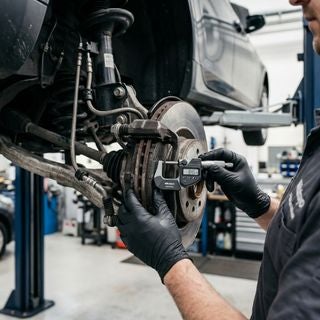
A Ford multi-point brake system inspection systematically evaluates friction pad thickness, rotor surface integrity, hydraulic lines, caliper hardware, brake fluid moisture levels, and electronic parking brake actuators. Certified technicians inspect every component from the master cylinder down to the wheel assemblies to ensure optimal stopping performance and mechanical safety.

The multi-point inspection process covers key mechanical and hydraulic components:

  • Brake Pads and Shoes: Technicians measure friction material thickness across inner and outer pads, checking for uneven wear that indicates sticking caliper pins or frozen pistons.
  • Brake Rotors and Drums: Inspection includes checking rotor face surfaces for deep scoring, heat checking, rust ridge formation, and measuring total thickness against factory minimum discard specs.
  • Calipers and Hardware: Service staff inspect caliper slide pins, rubber dust boots, and hydraulic piston seals for fluid leaks, corrosion, or mechanical binding.
  • Brake Lines and Hoses: Flexible rubber brake hoses and rigid metal lines are examined for cracking, chafing, external corrosion, or swelling under pressure.
  • Brake Fluid Reservoir and Condition: Technicians test hydraulic fluid for moisture content, copper contamination, and proper level within the master cylinder reservoir.
  • Electronic Parking Brake (EPB): Inspection verifies electronic motor engagement, wiring harness integrity, and proper control module diagnostic status.

Thorough evaluations catch minor wear items before they lead to rotor damage or hydraulic pressure loss. When replacement components are required, ordering genuine Motorcraft brake parts guarantees that pad friction formulations and rotor metallurgy match original factory standards.
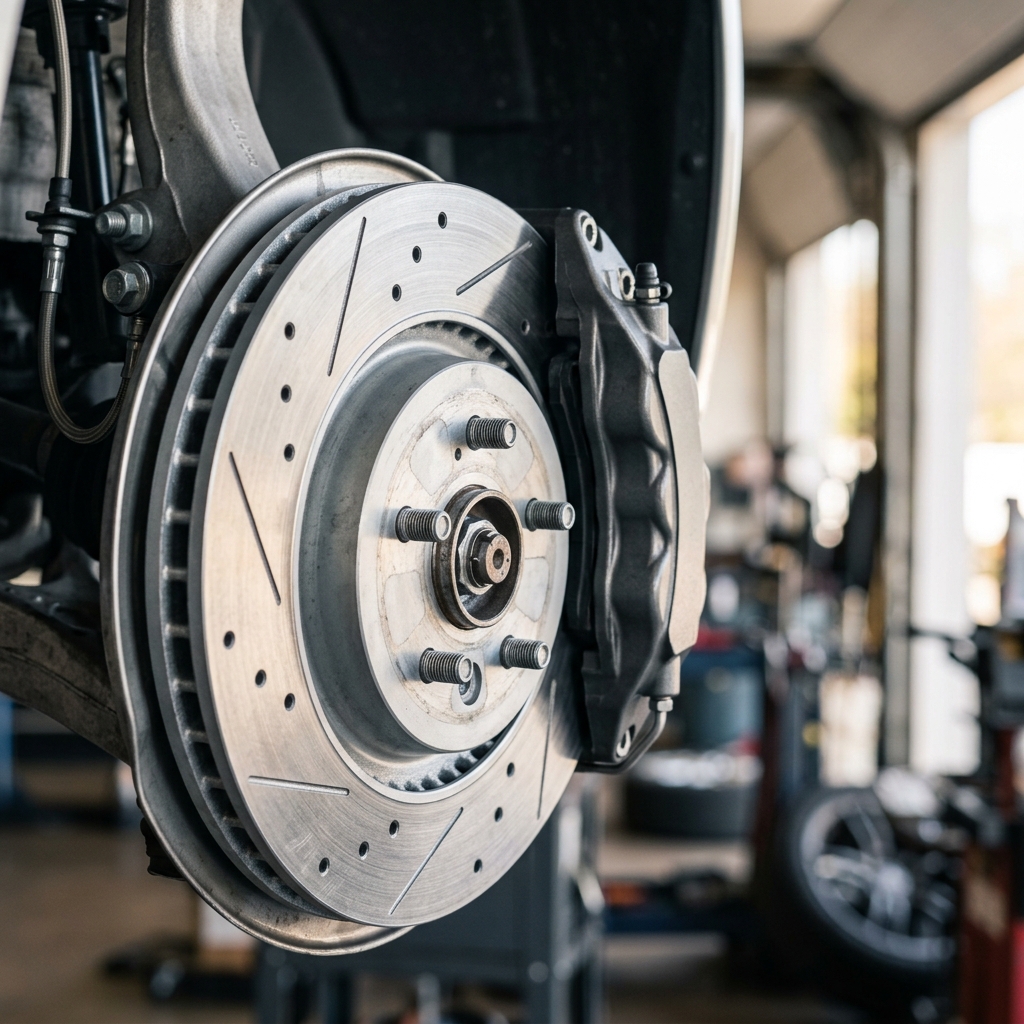
 Close-up of a slotted and drilled performance car brake rotor with caliper inside an auto repair shop. (Representative image for illustration purposes only. Actual vehicle may vary based on trim and configuration.)

What Is the Minimum Safe Thickness for Ford Brake Pads and Fluid Specs?

The minimum safe friction material thickness for Ford brake pads is 3 millimeters for standard replacement recommendations, while friction material measured at or below 2 millimeters represents an immediate safety hazard requiring urgent pad replacement. Modern Ford vehicles require Motorcraft High Performance DOT 4 LV low-viscosity brake fluid to support high-speed electronic anti-lock braking and stability control systems.

New Ford brake pads typically feature between 10 and 12 millimeters of friction lining when installed. As mileage accumulates, friction material wears down through normal deceleration. Mechanical wear indicators or integrated electronic sensors warn drivers when pad material approaches minimum thresholds. Operating a vehicle with brake pads worn below 2 millimeters increases stopping distances significantly and risks metal-to-metal contact between the pad backing plate and rotor face, causing severe scoring and costly rotor replacement.

Hydraulic brake fluid plays an equally vital role in stopping capability. Motorcraft High Performance DOT 4 LV fluid is specifically formulated with low-viscosity properties that flow efficiently through small valve orifices in advanced anti-lock brake actuators and AdvanceTrac stability systems. Because brake fluid is hygroscopic—meaning it absorbs moisture from the atmosphere over time—moisture buildup lowers the fluid's boiling point. Dark fluid or fluid levels that consistently drop below the MIN line indicate moisture contamination, fluid breakdown, or internal hydraulic leaks that demand immediate professional attention.

Why Are Ford F-150 Brake Service Costs Higher Than Ford Escape Costs?

Ford F-150 brake service costs exceed Ford Escape service costs due to larger heavy-duty brake rotors, expanded pad friction surface areas, multi-piston caliper assemblies, and higher torque assembly requirements needed to handle heavy payload and towing strains. These larger, commercial-grade components require specialized service procedures and greater raw material mass compared to compact crossover braking hardware.

Full-size trucks like the Ford F-150 are engineered to bring heavy vehicle weights plus up to 14,000 lbs of towed trailer load to a complete stop safely. Managing that level of kinetic energy requires massive thermal dissipation capacity. F-150 brake rotors feature thicker cast-iron walls, internal cooling vanes, and wider friction surfaces than those on lighter vehicles. In contrast, compact crossovers such as the Ford Escape use smaller single-piston calipers and lighter rotors designed for efficient passenger transport.

Frequent stop-and-go travel along busy commercial corridors in Boardman places different thermal strains on compact crossovers compared to heavy-duty trucks hauling equipment. When truck owners ask why service costs differ between vehicle classes, our technicians explain that full-size truck rotors feature thicker cooling vanes and heavier cast-iron mass designed specifically for intense heat dissipation.

Maintaining heavy-duty truck systems often involves specialized maintenance schedules. Owners can coordinate service through Ford Mobile Service options for convenient maintenance at their job site, or bundle routine brake checks alongside routine battery service to ensure complete electrical and mechanical reliability.

How Do Electronic Parking Brakes and Brake Service Mode Affect Maintenance?

Ford Electronic Parking Brakes require putting the vehicle into Brake Service Mode before servicing rear brake pads or rotors to electronically retract the caliper motor actuators and prevent severe internal piston damage. Servicing rear brakes without retracting these electric motors can destroy the electronic parking brake assembly and disrupt electronic stability calibration.

Placing a Ford vehicle into Brake Service Mode follows a specific manual sequence:

  1. Turn the ignition on (engine off).
  2. Press and hold the accelerator pedal all the way to the floor.
  3. Push and hold the electronic parking brake switch down in the release position.
  4. Turn the ignition off, then turn it back on within 5 seconds while continuing to hold the accelerator pedal and parking brake switch.
  5. Wait for the instrument cluster warning light and message to confirm that Brake Service Mode is active before releasing the controls.

Once service mode is activated, the electric parking brake motors drive the internal spindle pistons back into the caliper housing. This allows service technicians to compress the hydraulic caliper piston safely using standard press tools. After new rear pads and rotors are installed, the system must be taken out of service mode using a similar command sequence to re-engage the electronic actuators properly.

Independent technicians servicing Ford electronic parking brakes must utilize compatible OBD-II diagnostic scan tools to communicate with control modules, clear trouble codes, and perform recalibration procedures on steering angle or parking brake position sensors. Vehicle owners can easily schedule a service appointment online to have electronic rear brake service performed using factory-certified diagnostic equipment.
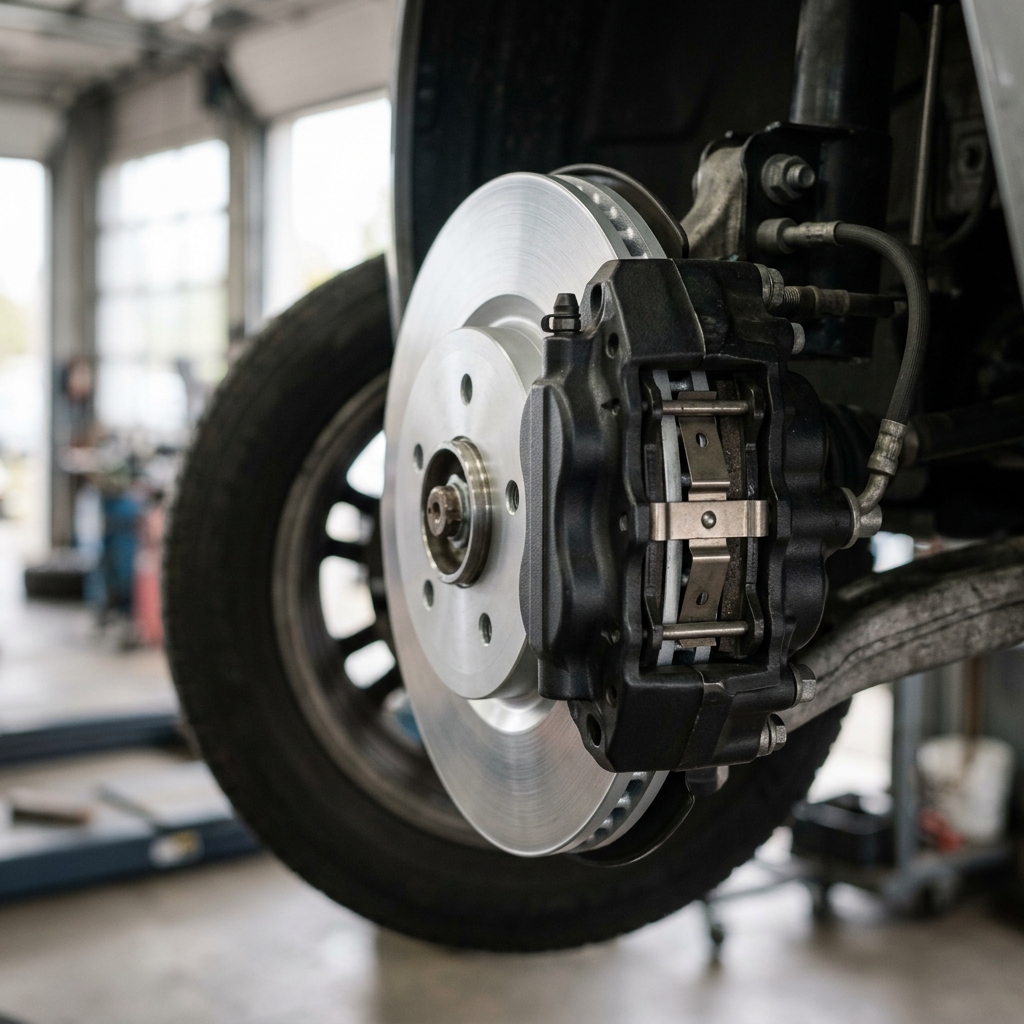
Newly installed brake rotor and black caliper assembly on a vehicle lifted in an auto repair shop. (Representative image for illustration purposes only. Actual vehicle may vary based on trim and configuration.)

How Does Regenerative Braking Impact Ford Hybrid and EV Brake Wear?

Regenerative braking significantly reduces mechanical pad and rotor wear on Ford hybrid and electric vehicles by utilizing the electric drive motor to slow the vehicle down while capturing kinetic energy to recharge the high-voltage battery. Because the electric motor handles routine deceleration, traditional friction brakes are engaged primarily during hard stops, emergency braking, or complete vehicle halts.

On hybrid models like the Ford Escape Hybrid or fully electric vehicles, friction pads can last twice as long as pads on conventional gas-powered vehicles. However, reduced physical use introduces unique maintenance considerations. Because mechanical calipers and pads engage less frequently, brake rotors are more susceptible to surface rust, oxidation, and slide pin binding caused by road salt, rain, and environmental exposure.

Regular maintenance for hybrid and electric vehicle braking systems focuses heavily on preventive cleaning and lubrication. Technicians inspect caliper slide pins, clean rotor surfaces, and verify that friction pads move freely within their mounting brackets. Hydraulic brake fluid in hybrid and electric vehicles also requires periodic testing, as moisture can accumulate in the fluid over time even if mechanical friction wear remains minimal.

C ommon Questions About Ford Brake Inspections and Maintenance

Q: Do independent mechanics need special diagnostic tools to reset Ford electronic brake systems?

Yes, independent repair facilities require compatible OBD-II scan tools capable of entering Ford Brake Service Mode and recalibrating electronic parking brake actuators or steering angle sensors. Without proper tool integration, servicing rear calipers can damage electronic motor drives or trigger persistent cluster warning lights.

Q: What type of brake fluid is specified for 2027 Ford vehicles?

Most 2027 Ford vehicles specify Motorcraft High Performance DOT 4 LV brake fluid. The low-viscosity formula ensures rapid hydraulic response through small valve orifices in advanced anti-lock braking systems and electronic stability controls, particularly during sub-freezing winter weather.

Q: How often should Ford brake fluid be checked and evaluated?

Ford recommends inspecting brake fluid levels monthly and conducting a comprehensive fluid condition check during every routine oil change. Fluid should be tested for moisture accumulation and replaced whenever it appears dark or falls below the MIN reservoir line to prevent internal corrosion and pedal softness.

Q: What signs indicate that my Ford brake rotors need resurfacing or replacement?

Key indicators include steering wheel pulsation during braking, audible grinding noises, visible scoring on the rotor face, or localized blue discoloration caused by excessive heat build-up. Technicians measure rotor thickness against factory minimum discard limits to determine if resurfacing or complete rotor replacement is required.

Q: Is routine brake pad wear covered under Ford standard factory warranties?

Routine friction pad wear from normal vehicle operation is considered a standard maintenance item and is not covered under bumper-to-bumper or powertrain warranties. However, component failures caused by manufacturing defects in calipers, master cylinders, or hydraulic lines are covered within applicable warranty terms.

For complete peace of mind on every journey, trust our factory-trained technicians at Tri State Ford located at 1503 Pennsylvania Ave, East Liverpool, OH 43920. View our service center directions or give our team a call directly at (330) 462-7578 to keep your braking system operating with total confidence.

© 2026 Tri State Ford. All rights reserved.

Vehicle specification data © JATO Dynamics Limited.

Ford Brake Maintenance Services in East Liverpool OH | Tri State Ford

Recommended Posts

l

Is Servicing a 2027 Ford at a Dealership Worth the Higher Price?

.hrizn-rte-content .e-rte-image { border: 0;max-width: 100%;height: auto } .hrizn-rte-content .e-rte-image.e-imginline { display: inline-block;float: none;margin-left: 5px;margin-right: 5px;max-width: calc(100% - 10px);vertical-align: bottom } .hrizn-rte-content .e-rte-image.e-imgbreak, .hrizn-rte-content .e-rte-image.e-imgcenter { display: block;float: none;margin: 5px auto;max-width: 100% } .hrizn-rte-content .e-rte-image.e-imgleft { float: left;margin: 0 12px 8px 0;max-width: 100% } .hrizn-rte-content .e-rte-image.e-imgright { float: right;margin: 0 0 8px 12px;max-width: 100% } .hrizn-rte-content figure.e-rte-image { margin: 8px auto;max-width: 100% } .hrizn-rte-content figure.e-imgleft { float: left;margin: 0 12px 8px 0 } .hrizn-rte-content figure.e-imgright { float: right;margin: 0 0 8px 12px } .hrizn-rte-content figure.e-imgcenter { display: block;margin: 8px auto;text-align: center } Servicing a 2027 Ford at a dealership is worth the higher initial price for complex electrical repairs, safety recalls, and warranty-backed maintenance, even though independent shops often charge less for routine fluid changes. Dealership service provides factory-trained technicians, proprietary diagnostic equipment, and direct factory-server connectivity for software flashes, helping ensure long-term vehicle reliability and preserving warranty coverage without unexpected out-of-pocket expenses. Drivers evaluating overall ownership costs often compare upfront repair estimates with the long-term protection offered by specialized factory care. While independent repair facilities may offer lower posted hourly rates, dealership technicians work on specific models daily and follow official technical service bulletins. A June 2026 report citing Ford research indicated that average maintenance costs can vary between dealerships and independent shops. This demonstrates that dealer care is not systematically more expensive when evaluating the full scope of routine vehicle maintenance. Mode rn vehicles, such as the 2027 Ford Explorer equipped with a 2.3L EcoBoost engine and a SelectShift® transmission, feature interconnected electronic control modules that govern safety systems, fuel delivery, and engine management. Diagnosing complex issues on these platforms requires accurate sensor calibration and direct factory programming. When routine maintenance or specialized repairs are performed at our service center location, every procedure strictly aligns with engineered factory guidelines. Choosing factory service also provides complete records in Ford's centralized vehicle database, which helps protect resale value and simplifies warranty administration. When you reach out to (330) 462-7578, our advisors can review your vehicle's full maintenance history and check for open safety recalls or outstanding module updates in one step. Table of Contents How Do Ford Dealership Labor Rates Compare to Independent Repair Shops? What Diagnostic Systems and Software Updates Do Dealership Technicians Use? Does Servicing Your Vehicle at an Independent Shop Void the Ford Warranty? Do Independent Repair Shops Use Genuine Ford Motorcraft Parts? Which Maintenance Services Are Best Handled at a Dealership Versus an Independent Shop? Essential Questions About Ford Service and Maintenance Options Maintaining Long-Term Reliability for Your Ford Vehicle How Do Ford Dealership Labor Rates Compare to Independent Repair Shops? Ford dealership labor rates can vary depending on regional economic factors and service specialization, and independent repair facilities may have different hourly rates. While independent mechanics feature lower base labor rates, higher dealership rates account for ongoing factory technician certifications, specialized repair tooling, and dedicated customer amenities. A 2026 Jacksonville-area service comparison estimated local Ford dealer labor and major scheduled service costs that varied based on vehicle model, required parts, labor hours, and local market conditions. However, actual totals vary based on vehicle model, required parts, labor hours, and local market conditions. Lower hourly rates do not automatically equal lower total repair costs if a non-specialized mechanic requires additional diagnostic time to resolve complex powertrain or electrical issues. Dealership service department pricing reflects significant investments in facility overhead and specialized training programs: Master-certified technicians complete regular factory training on current powertrain architectures and high-voltage electrical platforms. Specialized hydraulic lifts, wheel alignment racks, and recalibration rigs ensure exact physical setup. Direct connectivity to factory technical databases provides exact repair time estimates based on standardized labor guides. Built-in multi-point inspection procedures catch minor component wear before it leads to roadside mechanical failure. For drivers managing daily commutes across the elevated rolling terrain and back roads around Calcutta, keeping suspension components and brake systems maintained with exact factory specs prevents accelerated component wear. Visiting our local Ford dealership service department ensures every task is completed efficiently by technicians who specialize in your specific model. What Diagnostic Systems and Software Updates Do Dealership Technicians Use? Ford dealership technicians utilize proprietary Ford Diagnostic and Repair System (FDRS) software and Integrated Diagnostic System (IDS) hardware platforms connected directly to factory servers for vehicle system updates and module programming. Independent repair facilities lack automated factory links, relying instead on generic third-party scan tools or purchased aftermarket subscriptions that may not support real-time module flashing. Modern vehicles contain dozens of interconnected computers managing driver-assist features, transmission shift logic, infotainment operations, and engine timing. When a sensor detects an anomaly, diagnosing the root cause requires software capable of reading proprietary diagnostic trouble codes and analyzing live data streams. Dealership service bays connect directly to Ford engineering databases to install firmware updates, clear false fault codes, and complete technical service bulletin procedures. Key differences between factory service technology and independent shop equipment include: Direct factory server connection provides immediate updates to powertrain control modules and safety controllers. Proprietary FDRS diagnostics execute guided tests engineered specifically for each vehicle model year. Automated alignment tool integration recalibrates radar units and cameras for lane-keeping and blind spot monitoring systems. Immediate access to technical service bulletins allows technicians to address known factory software issues without guessing. Third-party shops can purchase temporary access to certain software packages, but they do not automatically receive real-time factory alerts or automated service bulletin pushes. Relying on outdated scan software can result in incomplete diagnostic testing or misdiagnosed electrical faults. Does Servicing Your Vehicle at an Independent Shop Void the Ford Warranty? Having a 2027 Ford serviced at an independent repair shop does not void the manufacturer warranty, provided all scheduled maintenance is performed according to factory specifications and supported by detailed service records. The federal Magnuson-Moss Warranty Act protects vehicle owners from having their warranty coverage denied simply because routine maintenance was performed outside a franchised dealership. The 2027 Ford F-150 includes a 3-year/36,000-mile limited warranty alongside a 5-year/60,000-mile powertrain warranty. To maintain full coverage under these programs, owners must ensure that oil changes, filter replacements, and fluid flushes occur within the specified mileage and time intervals outlined in the official owner's manual. If an independent shop uses non-compliant fluids or improperly installs a filter that subsequently causes engine damage, warranty coverage for that specific failure may be affected. To keep your factory warranty intact when using third-party repair facilities, maintain a thorough record-keeping system: Save itemized receipts showing exact part numbers, fluid specifications, and service dates. Ensure the vehicle identification number and current odometer mileage are clearly printed on every repair order. Follow the official Ford scheduled maintenance guide rather than generic shop recommendations. Keep detailed logs of all self-performed maintenance, including receipts for purchased parts and fluids. While independent service keeps your basic warranty active, factory recall campaigns and covered warranty repairs are typically completed at an authorized Ford dealership. Drivers preparing for a custom factory vehicle order or reviewing current manufacturer service specials can consult our service department to verify how routine care plans align with factory warranty guidelines. Do Independent Repair Shops Use Genuine Ford Motorcraft Parts? Independent repair shops usually default to aftermarket components to keep estimates lower, but they can order and install genuine Motorcraft parts when specifically requested by the customer. Ford dealerships install engineered Motorcraft and original equipment parts exclusively, ensuring exact fitment, factory tolerances, and full warranty backing on every replacement part. Original equipment parts are designed and tested by Ford engineers to meet strict performance and durability standards. Aftermarket manufacturers often create standardized parts designed to fit multiple vehicle makes and models, which can lead to slight variations in material quality, noise levels, and wear rates. Installing genuine parts maintains original factory specifications for fuel efficiency, braking performance, and vehicle safety. Feature / Benefit Genuine Motorcraft / OEM Parts Generic Aftermarket Parts Engineering Fit Exact vehicle-specific dimensions Multi-vehicle standardized dimensions Factory Warranty Coverage Covered by 2-year/unlimited-mileage warranty Varies by manufacturer and retailer Quality Control Rigorous manufacturer testing Broad range of material standards Availability Stocked at authorized dealership parts counters Sourced from third-party auto parts distributors When you order genuine Motorcraft parts online through our parts center, every component carries a 2-year/unlimited-mileage limited warranty that covers both parts and labor when installed at an authorized dealership. This warranty protection offers peace of mind that low-cost aftermarket alternatives cannot match. Which Maintenance Services Are Best Handled at a Dealership Versus an Independent Shop? Safety recall repairs, complex module programming, warranty-covered repairs, and high-voltage hybrid service are best handled at a dealership, whereas basic tasks like tire rotations or wiper blade changes can be performed by an independent shop. Dealerships possess the specialized equipment and direct manufacturer support necessary to resolve intricate mechanical and electronic issues quickly. Routine service tasks compare across service providers in several distinct ways: Safety Recalls and Warranty Work: Must be performed at an authorized dealership to receive full coverage at no charge to the owner. Powertrain Diagnostics and Module Flashing: Best completed at a dealership using FDRS equipment connected to factory servers. Brake Replacement and Suspension Service: Can be handled by independent shops, though dealership installation ensures genuine Motorcraft friction materials and exact sensor calibration. Oil Changes and Tire Maintenance: Suitable for independent facilities, provided factory-grade oil viscosity and certified filters are utilized. For daily commuters traveling along the busy commercial stretches of Boardman, keeping a rigid service schedule prevents unpredicted downtime. Ford also offers complimentary Ford Mobile Service for eligible routine maintenance items, allowing certified technicians to handle select services right in your driveway or workplace parking lot. When your vehicle requires technical attention, visiting our East Liverpool facility ensures complete access to specialized tools and factory-trained personnel. You can call our service team to ask about specific vehicle systems or easily schedule a service appointment online at your convenience. Essential Questions About Ford Service and Maintenance Options Q: How does Ford Mobile Service operate for routine vehicle maintenance? Ford Mobile Service dispatches a factory-trained technician equipped with specialized tools directly to your home or workplace to complete qualifying maintenance. Eligible services include oil and filter changes, brake inspections, tire rotations, cabin air filter replacements, and software updates. This program offers the same genuine Motorcraft parts and factory expertise found in our dealership service bays, allowing you to maintain your vehicle without taking time out of your busy workday. Q: Why do hourly labor rates vary between different automotive service centers? Labor rates vary based on regional living costs, facility overhead, specialized equipment investments, and technician certification requirements. Dealership service departments invest heavily in proprietary diagnostic hardware, continuous factory training, and comfortable customer lounges. These investments ensure complex electronic systems and powertrain components are serviced correctly according to official factory repair guidelines, reducing overall diagnostic time and preventing repeat visits. Q: Can independent mechanics complete official Ford safety recall repairs for free? Independent mechanics typically do not complete official Ford safety recall repairs free of charge. Recall repairs are generally performed by authorized brand dealerships to ensure that updated parts and factory-approved repair procedures are used. If your vehicle has an open safety recall, an authorized dealership will complete the required inspection, software flash, or component replacement at no cost to you. Q: What documentation must owners maintain to safeguard their factory warranty? Vehicle owners should retain itemized repair orders and parts receipts showing the date of service, current odometer reading, vehicle identification number, and specific fluids or part numbers used. These records prove that routine maintenance was performed at the correct mileage intervals specified in the owner's manual. Keeping organized paper or digital records protects your warranty coverage if a component failure requires verification of prior maintenance history. Q: Are vehicle software updates automatically performed during regular dealership maintenance? Dealership technicians check for open module updates and technical service bulletins whenever your vehicle is connected to the Ford Diagnostic and Repair System (FDRS) during scheduled service visits. If an update is recommended for your powertrain control module, transmission controller, or safety systems, technicians can install the latest factory firmware directly. This proactive software maintenance helps optimize fuel efficiency, shift quality, and overall vehicle performance over time. Maintaining Long-Term Reliability for Your Ford Vehicle Keeping your vehicle running safely requires choosing the right service partner for routine care and complex repairs alike. While independent repair shops offer a viable option for quick, basic services, the specialized tools, factory-trained technicians, and genuine Motorcraft parts available at the dealership deliver unmatched precision and long-term protection. Investing in proper factory maintenance helps protect your vehicle's resale value, preserves your factory warranty, and gives you complete confidence on every journey. When your Ford requires routine maintenance, diagnostic inspection, or recall service, our team is ready to deliver fast, transparent care. Explore our available maintenance packages and book your next appointment through our convenient online service scheduling tool today. © 2026 Tri State Ford. All rights reserved. Vehicle specification data © JATO Dynamics Limited. Title Tags 2027 Ford Servicing in East Liverpool OH | Tri State Ford Meta Description Keywords Open Graph Twitter Card Canonical Article Metadata Geographic Targeting { "@context": "https://schema.org", "@graph": [ { "@type": "NewsArticle", "@id": "#article", "headline": "Is Servicing a 2027 Ford at a Dealership Worth the Higher Price?", "datePublished": "2026-09-24T12:48:22.548Z", "dateModified": "2026-09-24T12:51:01.614Z", "author": { "@id": "#author" }, "publisher": { "@id": "#dealer" }, "wordCount": 2156, "description": "Servicing a 2027 Ford at a dealership provides factory diagnostics and warranty protection, offering distinct value compared to independent repair shops." }, { "@type": "AutoDealer", "@id": "#dealer", "name": "Tri State Ford", "url": "https://www.tristateford.net", "telephone": "+13304627578", "sameAs": [ "https://maps.google.com/?cid=1136336406351438323" ], "address": { "@type": "PostalAddress", "streetAddress": "1503 Pennsylvania Ave", "addressLocality": "East Liverpool", "addressRegion": "OH", "postalCode": "43920", "addressCountry": "US" }, "areaServed": { "@type": "GeoCircle", "geoMidpoint": { "@type": "GeoCoordinates", "latitude": "40.6367833", "longitude": "-80.5443033" }, "geoRadius": "48280" }, "geo": { "@type": "GeoCoordinates", "latitude": "40.6367833", "longitude": "-80.5443033" }, "openingHours": [ "Mo 09:00-20:00", "Tu 09:00-18:00", "We 09:00-18:00", "Th 09:00-20:00", "Fr 09:00-18:00", "Sa 09:00-15:00" ] }, { "@type": "FAQPage", "@id": "#faq", "mainEntity": [ { "@type": "Question", "name": "How does Ford Mobile Service operate for routine vehicle maintenance?", "acceptedAnswer": { "@type": "Answer", "text": "Ford Mobile Service dispatches a factory-trained technician equipped with specialized tools directly to your home or workplace to complete qualifying maintenance. Eligible services include oil and filter changes, brake inspections, tire rotations, cabin air filter replacements, and software updates. This program offers the same genuine Motorcraft parts and factory expertise found in our dealership service bays, allowing you to maintain your vehicle without taking time out of your busy workday." } }, { "@type": "Question", "name": "Why do hourly labor rates vary between different automotive service centers?", "acceptedAnswer": { "@type": "Answer", "text": "Labor rates vary based on regional living costs, facility overhead, specialized equipment investments, and technician certification requirements. Dealership service departments invest heavily in proprietary diagnostic hardware, continuous factory training, and comfortable customer lounges. These investments ensure complex electronic systems and powertrain components are serviced correctly according to official factory repair guidelines, reducing overall diagnostic time and preventing repeat visits." } }, { "@type": "Question", "name": "Can independent mechanics complete official Ford safety recall repairs for free?", "acceptedAnswer": { "@type": "Answer", "text": "Independent mechanics cannot perform official Ford safety recall repairs free of charge. Federal law requires safety recall repairs to be completed by authorized brand dealerships to guarantee that updated parts and factory-approved repair procedures are used. If your vehicle has an open safety recall, an authorized dealership will complete the required inspection, software flash, or component replacement at no cost to you." } }, { "@type": "Question", "name": "What documentation must owners maintain to safeguard their factory warranty?", "acceptedAnswer": { "@type": "Answer", "text": "Vehicle owners should retain itemized repair orders and parts receipts showing the date of service, current odometer reading, vehicle identification number, and specific fluids or part numbers used. These records prove that routine maintenance was performed at the correct mileage intervals specified in the owner's manual. Keeping organized paper or digital records protects your warranty coverage if a component failure requires verification of prior maintenance history." } }, { "@type": "Question", "name": "Are vehicle software updates automatically performed during regular dealership maintenance?", "acceptedAnswer": { "@type": "Answer", "text": "Dealership technicians check for open module updates and technical service bulletins whenever your vehicle is connected to the Ford Diagnostic and Repair System (FDRS) during scheduled service visits. If an update is recommended for your powertrain control module, transmission controller, or safety systems, technicians can install the latest factory firmware directly. This proactive software maintenance helps optimize fuel efficiency, shift quality, and overall vehicle performance over time." } } ] } ] }

d

Is It Smart to Buy a Used Car With a Minor Accident History?

.hrizn-rte-content .e-rte-image { border: 0;max-width: 100%;height: auto } .hrizn-rte-content .e-rte-image.e-imginline { display: inline-block;float: none;margin-left: 5px;margin-right: 5px;max-width: calc(100% - 10px);vertical-align: bottom } .hrizn-rte-content .e-rte-image.e-imgbreak, .hrizn-rte-content .e-rte-image.e-imgcenter { display: block;float: none;margin: 5px auto;max-width: 100% } .hrizn-rte-content .e-rte-image.e-imgleft { float: left;margin: 0 12px 8px 0;max-width: 100% } .hrizn-rte-content .e-rte-image.e-imgright { float: right;margin: 0 0 8px 12px;max-width: 100% } .hrizn-rte-content figure.e-rte-image { margin: 8px auto;max-width: 100% } .hrizn-rte-content figure.e-imgleft { float: left;margin: 0 12px 8px 0 } .hrizn-rte-content figure.e-imgright { float: right;margin: 0 0 8px 12px } .hrizn-rte-content figure.e-imgcenter { display: block;margin: 8px auto;text-align: center } Buying a pre-owned vehicle with a documented minor accident history is a smart financial move if the car retains a clean title, suffered no structural frame damage or airbag deployment, and received high-quality repairs. Because reported cosmetic damage creates an potentially lower market value compared to identical clean-history vehicles, informed buyers can secure substantial savings on a completely safe, reliable automobile. Navigating the pre-owned market requires balancing price advantage against vehicle condition. When a vehicle history report notes minor damage—such as a scraped bumper from parallel parking or a shallow door dent from a shopping cart—the actual structural integrity of the automobile remains untouched. For commuters traveling along State Route 170 through Calcutta, acquiring a late-model pre-owned vehicle with minor cosmetic history offers modern technology and dependable performance without the higher purchase price of a flawless history report. The primary benefit of considering these vehicles is value optimization. You pay significantly less upfront for minor surface blemishes that may have already been professionally restored to original factory specifications. Furthermore, pre-owned inventory with clean titles and light past damage still qualifies for standard auto loans and full insurance coverage. To explore our current selection of thoroughly vetted pre-owned models, buyers can visit our showroom location or give our sales team a quick call to discuss specific vehicle history reports and background records. Table of Contents What Qualifies as a Minor Accident on a Vehicle History Report? How Does Past Minor Body Damage Affect Modern Safety Systems and Structural Alignment? What Tools and Inspection Techniques Detect Hidden Repairs and Long-Term Frame Bends? Does a Previous Minor Accident Impact Insurance Coverage, Financing, and Future Trade-In Value? Frequently Asked Questions About Buying Used Vehicles With Reported Damage How to Confidently Evaluate and Purchase a Reliable Pre-Owned Vehicle What Qualifies as a Minor Accident on a Vehicle History Report? A minor accident entry on a vehicle history report indicates light cosmetic damage to outer body panels, light assemblies, or bumper covers without structural unibody distortion or mechanical component failure. Insurance companies and reporting agencies classify collisions under roughly $3,000 in repair costs with zero airbag deployment as minor incidents. Vehicle history services aggregate VIN-based records from state motor vehicle departments, law enforcement accident filings, insurance claim databases, and certified collision repair facilities. When a vehicle is involved in a low-speed impact, the event is categorized based on severity metrics: Cosmetic Exterior Damage: Minor scratches, shallow door dings, or scraped bumper covers that require simple refinishing or panel replacement. Non-Structural Component Repair: Replacing cracked headlight housings, side mirrors, or exterior trim pieces that do not alter the vehicle chassis. Zero Airbag Deployment: Collisions where impact forces were insufficient to trigger primary safety restraint systems. Intact Unibody Frame: No bending, cracking, or compromise to the core structural frame rails or passenger safety cage. Understanding these distinctions helps shoppers separate minor cosmetic incidents from serious collisions. A vehicle that suffered a parking lot scrape and received a replacement bumper cover remains mechanically identical to one with an unblemished record. Buyers looking at newer model years can also review current manufacturer incentives on new models or explore a custom vehicle factory order if they prefer a brand-new build with zero history entries. How Does Past Minor Body Damage Affect Modern Safety Systems and Structural Alignment? A minor cosmetic collision does not compromise overall vehicle safety as long as modern driver-assist sensors located inside bumper covers and grilles are properly recalibrated during body repair. Modern vehicles rely on precise unibody engineering and electronic safety networks that require professional attention after any front or rear impact. Contemporary automobiles use unibody construction where outer sheet metal, crumple zones, and frame rails function as an integrated safety cell. In low-speed impacts, impact-absorbing bumper bars capture collision energy before forces reach the primary frame. However, because modern vehicles incorporate advanced driver-assistance technology—such as Pre-Collision Assist, blind-spot radar modules, and ultrasonic parking sensors—even a light bumper tap can misalign critical monitoring hardware. When evaluating a pre-owned vehicle with previous front or rear bumper work, verification of camera and sensor calibration is essential. If radar brackets are tilted by even a single degree during panel replacement, features like adaptive cruise control or automatic emergency braking can deliver false alerts or fail to detect obstacles correctly. Professional repair documentation should confirm that electronic safety systems underwent digital re-alignment alongside physical panel fitting. What Tools and Inspection Techniques Detect Hidden Repairs and Long-Term Frame Bends? Automotive technicians utilize digital paint depth gauges, electronic wheel alignment racks, and three-dimensional laser frame measuring systems to verify underlying structural integrity and reveal hidden body filler. A thorough pre-purchase inspection on a hoist exposes inconsistencies between a vehicle history summary and real-world condition. Buyers evaluating pre-owned models on our lot frequently ask how to verify if a reported bumper collision reached the underlying unibody. Professional technicians follow a systematic physical and digital inspection process: Digital Paint Depth Gauges: Measuring paint thickness in mils across every panel identifies underlying body filler, heavy primer layers, or aftermarket resprays. Computerized 3D Laser Frame Measuring: Mounting the vehicle on an alignment rack uses laser targets to measure factory datum points, confirming frame rails and unibody dimensions remain within millimeter tolerances. Seam Sealer and Weld Inspection: Examining engine bay seams, trunk floors, and door jambs reveals whether factory seam sealers are intact or if aftermarket welding and cutting occurred. Wheel Alignment and Suspension Geometry: Digital alignment checks confirm that camber, caster, and toe settings meet factory specifications, ruling out bent control arms or subframe shifts. Poorly executed repairs leave noticeable warning signs, including uneven panel gaps, water intrusion inside headlight housings, overspray on rubber door seals, and premature rust along unsealed panel edges. Confirming precise alignment and clean factory seams ensures the automobile will perform reliably for miles to come. Does a Previous Minor Accident Impact Insurance Coverage, Financing, and Future Trade-In Value? A vehicle with a reported minor accident on a clean title remains fully eligible for standard auto financing and comprehensive insurance coverage, though it experiences a modest reduction in resale market value. Because total loss branding is absent, lenders evaluate the vehicle using standard loan-to-value guidelines. Insurance underwriters make no distinction between a clean-history vehicle and one with a clean-title minor damage report when offering collision, liability, and comprehensive coverage. Because the title remains normal (non-branded), major auto insurance carriers issue standard policies without elevated premium surcharges. From a financing perspective, auto lenders issue loans based on official wholesale and retail valuation guides. While minor damage history lowers the baseline book value slightly, borrowers secure standard interest rates and loan terms. To streamline your purchase, you can complete our secure online credit application to review financing parameters tailored to your budget. When it comes to future trade-in value, vehicles with prior damage entries trade at a slight discount compared to clean-history equivalents. However, because you purchase the vehicle at a lower market value initially, the net depreciation curve mirrors that of any other pre-owned automobile. Local drivers negotiating the riverfront bluffs and hill climbs of East Liverpool can easily calculate their potential equity by taking advantage of our online tool to value your trade-in before visiting our dealership. Frequently Asked Questions About Buying Used Vehicles With Reported Damage Q: What is the main difference between a minor accident and structural damage on a Carfax report? Vehicle history reports often classify minor accidents as incidents involving only superficial damage, which rarely affects the car's mechanical performance or safety features. Structural damage entries indicate that the central unibody, frame rails, roof pillars, or main crash supports were bent, cracked, or compromised, severely impacting crash protection and resale value. Q: Can I fully insure a used car that has a minor accident listed on its record? Yes, insurance companies provide complete coverage—including liability, collision, and comprehensive plans—for vehicles with minor accident histories, provided the title remains clean and non-branded. Because cosmetic repairs do not alter the vehicle's legal status or structural integrity, premium rates remain consistent with standard market standards. Q: How much does a minor accident lower a used car's purchase price? A reported minor accident typically reduces a used car's market value by 10 to 15 percent compared to an equivalent clean-history vehicle. This initial price discount offers significant savings for buyers while providing identical mechanical reliability when proper body repairs have been completed. Q: How can I confirm that driver-assist sensors were properly calibrated after a minor collision repair? Verification requires reviewing the repair facility's detailed work order to ensure digital camera and radar sensor recalibration procedures were performed. During a test drive, you should also test driver-assist systems like lane-keeping alerts and blind-spot monitoring to confirm they operate smoothly without warning lights. Q: Does a past minor accident prevent a car from being financed by a bank? No, national lenders and credit unions regularly finance pre-owned vehicles with minor damage entries on clean titles. Standard loan terms apply because the vehicle carries a normal title status rather than a branded salvage or reconstructed designation. You can explore our latest new vehicle selection or browse our single-owner pre-owned vehicles to find a model that fits your finance plans. How to Confidently Evaluate and Purchase a Reliable Pre-Owned Vehicle Acquiring a pre-owned vehicle with a minor accident record allows smart shoppers to maximize their purchasing power without sacrificing safety, modern features, or long-term durability. By verifying repair documentation, confirming clean title status, and ensuring electronic driver-assist systems are properly calibrated, you can drive home in a high-value automobile with total peace of mind. At Tri State Ford, every pre-owned automobile undergoes a comprehensive physical and mechanical inspection by our certified technicians before reaching our inventory lot. We provide transparent vehicle history reports on every car, truck, and SUV so you can review background details with complete confidence. When you are ready to take the next step, our team is here to assist you through every stage of the buying process: Explore our high-quality certified pre-owned inventory to find rigorously inspected vehicles backed by factory warranty coverage. Get turnkey directions to our East Liverpool dealership to inspect our pre-owned lineup in person. Reach out to our friendly sales team by giving us a quick call to schedule your test drive today. Keep Your Vehicle Running Strong Keep your vehicle performing at its best with our service team: Order Parts Schedule Service Appt © 2026 Tri State Ford. All rights reserved. Title Tags Used Cars with Minor Accident History in East Liverpool OH | Tri State Ford Meta Description Keywords Open Graph Twitter Card Canonical Article Metadata Geographic Targeting { "@context": "https://schema.org", "@graph": [ { "@type": "NewsArticle", "@id": "#article", "headline": "Is It Smart to Buy a Used Car With a Minor Accident History?", "datePublished": "2026-09-24T12:10:28.804Z", "dateModified": "2026-09-24T12:12:13.754Z", "author": { "@id": "#author" }, "publisher": { "@id": "#dealer" }, "wordCount": 1759, "description": "Buying a used car with a minor accident history can offer significant price discounts while delivering a safe, reliable vehicle with a clean title." }, { "@type": "AutoDealer", "@id": "#dealer", "name": "Tri State Ford", "url": "https://www.tristateford.net", "telephone": "+13304627578", "sameAs": [ "https://maps.google.com/?cid=1136336406351438323" ], "address": { "@type": "PostalAddress", "streetAddress": "1503 Pennsylvania Ave", "addressLocality": "East Liverpool", "addressRegion": "OH", "postalCode": "43920", "addressCountry": "US" }, "areaServed": { "@type": "GeoCircle", "geoMidpoint": { "@type": "GeoCoordinates", "latitude": "40.6367833", "longitude": "-80.5443033" }, "geoRadius": "48280" }, "geo": { "@type": "GeoCoordinates", "latitude": "40.6367833", "longitude": "-80.5443033" }, "openingHours": [ "Mo 09:00-20:00", "Tu 09:00-18:00", "We 09:00-18:00", "Th 09:00-20:00", "Fr 09:00-18:00", "Sa 09:00-15:00" ] }, { "@type": "FAQPage", "@id": "#faq", "mainEntity": [ { "@type": "Question", "name": "What is the main difference between a minor accident and structural damage on a Carfax report?", "acceptedAnswer": { "@type": "Answer", "text": "Vehicle history reports often classify minor accidents as incidents involving only superficial damage, which rarely affects the car's mechanical performance or safety features. Structural damage entries indicate that the central unibody, frame rails, roof pillars, or main crash supports were bent, cracked, or compromised, severely impacting crash protection and resale value." } }, { "@type": "Question", "name": "Can I fully insure a used car that has a minor accident listed on its record?", "acceptedAnswer": { "@type": "Answer", "text": "Yes, insurance companies provide complete coverage—including liability, collision, and comprehensive plans—for vehicles with minor accident histories, provided the title remains clean and non-branded. Because cosmetic repairs do not alter the vehicle's legal status or structural integrity, premium rates remain consistent with standard market standards." } }, { "@type": "Question", "name": "How much does a minor accident lower a used car's purchase price?", "acceptedAnswer": { "@type": "Answer", "text": "A reported minor accident typically reduces a used car's market value by 10 to 15 percent compared to an equivalent clean-history vehicle. This initial price discount offers significant savings for buyers while providing identical mechanical reliability when proper body repairs have been completed." } }, { "@type": "Question", "name": "How can I confirm that driver-assist sensors were properly calibrated after a minor collision repair?", "acceptedAnswer": { "@type": "Answer", "text": "Verification requires reviewing the repair facility's detailed work order to ensure digital camera and radar sensor recalibration procedures were performed. During a test drive, you should also test driver-assist systems like lane-keeping alerts and blind-spot monitoring to confirm they operate smoothly without warning lights." } }, { "@type": "Question", "name": "Does a past minor accident prevent a car from being financed by a bank?", "acceptedAnswer": { "@type": "Answer", "text": "No, national lenders and credit unions regularly finance pre-owned vehicles with minor damage entries on clean titles. Standard loan terms apply because the vehicle carries a normal title status rather than a branded salvage or reconstructed designation. You can explore our latest new vehicle selection or browse our single-owner pre-owned vehicles to find a model that fits your finance plans." } } ] } ] }

5

What Does a Check Engine Light Actually Mean?

.hrizn-rte-content .e-rte-image { border: 0;max-width: 100%;height: auto } .hrizn-rte-content .e-rte-image.e-imginline { display: inline-block;float: none;margin-left: 5px;margin-right: 5px;max-width: calc(100% - 10px);vertical-align: bottom } .hrizn-rte-content .e-rte-image.e-imgbreak, .hrizn-rte-content .e-rte-image.e-imgcenter { display: block;float: none;margin: 5px auto;max-width: 100% } .hrizn-rte-content .e-rte-image.e-imgleft { float: left;margin: 0 12px 8px 0;max-width: 100% } .hrizn-rte-content .e-rte-image.e-imgright { float: right;margin: 0 0 8px 12px;max-width: 100% } .hrizn-rte-content figure.e-rte-image { margin: 8px auto;max-width: 100% } .hrizn-rte-content figure.e-imgleft { float: left;margin: 0 12px 8px 0 } .hrizn-rte-content figure.e-imgright { float: right;margin: 0 0 8px 12px } .hrizn-rte-content figure.e-imgcenter { display: block;margin: 8px auto;text-align: center } On a Ford vehicle, a steady Service Engine Soon or check-engine light indicates that the onboard diagnostics system has detected an operational fault within the engine or emissions-control systems. It serves as a standardized warning that the vehicle's engine control unit has recorded a diagnostic trouble code, which requires scanning and pinpoint evaluation to determine the specific cause. Modern vehicles rely on continuous electronic monitoring to maintain steady performance, proper fuel delivery, and clean exhaust output. When a sensor reads data outside of factory parameters, the computer turns on the dashboard warning lamp to alert the driver. It is important to distinguish between different dashboard indicators. A steady check-engine light signifies a general emissions or engine sensor concern, whereas a powertrain fault indicator—often represented by a wrench icon—signals an issue with the transmission, engine, or drive system. In areas like East Liverpool, where steep riverfront bluffs and rolling hills place additional stress on engine performance during heavy climbs, keeping emissions systems working properly helps maintain steady power and fuel efficiency. If your dashboard warning turns on while traveling local roads, stopping by for an inspection is the best way to catch minor component wear before it turns into a costly repair. You can check our location map for straightforward turn-by-turn driving routes, or give our service department a quick call to speak directly with an advisor. Table of Contents When Is It Safe to Drive with a Check Engine Light, and When Should You Stop Immediately? What Are the Most Common Reasons Your Check Engine Light Comes On? What Do OBD-II Diagnostic Trouble Codes Mean and How Do Scanners Read Them? Why Shouldn't You Buy Parts Based Solely on an OBD-II Code? Can Ignoring a Check Engine Light Cause Your Vehicle to Fail Inspection or Risk Major Damage? What Drivers Ask Most About Check Engine Diagnostics and Service Protect Your Vehicle with Certified Diagnostic Care When Is It Safe to Drive with a Check Engine Light, and When Should You Stop Immediately? Driving with a steady check-engine light is generally safe for short distances to reach a service facility, provided the vehicle shows no loss of power, unusual noises, or rough idling. However, if the check-engine light is continuously flashing, you must pull over safely and turn off the engine immediately to prevent severe engine damage. A flashing warning light indicates an active, severe engine misfire. When an engine misfires, unburned fuel passes directly through the combustion chamber into the exhaust system. This raw fuel ignites inside the high-temperature catalytic converter, causing internal temperatures to surge rapidly. Continued driving during an active misfire can melt the internal ceramic catalyst elements within minutes, turning a routine ignition repair into a major exhaust replacement. If your dashboard light begins flashing while on the road, bring the vehicle to a complete stop in a safe area away from traffic. Turn off the ignition to protect engine components. For emergency vehicle transport and breakdown support, rely exclusively on Ford Roadside Assistance at (800) 241-3673. This manufacturer-backed program offers dedicated towing service directly to authorized service centers, protecting your factory warranty coverage and ensuring your vehicle receives care from specialized technicians who use genuine OEM components. Our service team can assist in coordinating incoming roadside transport to ensure your vehicle is evaluated as soon as it arrives. What Are the Most Common Reasons Your Check Engine Light Comes On? The most common reasons for a check-engine light illumination include a loose fuel cap, a failing oxygen sensor, a worn mass airflow sensor, fouled spark plugs, or an aging catalytic converter. These components directly govern fuel metering, air intake, ignition timing, and exhaust gas treatment. Because the onboard diagnostic computer monitors dozens of interconnected sensors, several everyday mechanical issues can trigger the same warning lamp: Loose or Damaged Fuel Cap: A fuel cap that is cracked, worn, or insufficiently tightened prevents the evaporative emissions system from sealing properly, allowing fuel vapors to escape. Failing Oxygen Sensor: Oxygen sensors measure unburned oxygen in the exhaust. Ignoring a degraded sensor can cause the engine to burn up to 40 percent more fuel and eventually damage downstream exhaust components. Worn Mass Airflow Sensor: This sensor monitors the volume of air entering the engine intake. A dirty or failing sensor disrupts the air-fuel ratio, leading to rough idling, hesitation, and poor gas mileage. Ignition Faults and Fouled Spark Plugs: Worn plugs or failing ignition coils prevent complete fuel combustion, leading to misfires that allow raw fuel into the exhaust stream. Exhaust and Catalytic Converter Degradation: Over time, unaddressed misfires or oil consumption can clog internal exhaust passages, restricting engine airflow and reducing power. During routine stop-and-go driving through suburban areas like Calcutta along State Route 170, a compromised sensor often reveals itself through sluggish acceleration or reduced fuel mileage long before complete component failure occurs. Addressing minor sensor codes early keeps your engine running smoothly and efficiently. What Do OBD-II Diagnostic Trouble Codes Mean and How Do Scanners Read Them? Diagnostic trouble codes generated by the OBD-II system are five-character alphanumeric designations that identify the specific electrical circuit or system where an operational fault occurred. The initial letter indicates the broad vehicle system, followed by four numbers that specify the precise nature of the error. Every modern light-duty vehicle utilizes a standardized diagnostic framework that stores error data inside the engine control module. Technicians access this stored information by connecting a professional scan tool to the standardized diagnostic port located under the driver's side dashboard. Understanding the structure of an OBD-II code reveals how the vehicle categorizes issues: First Character (System Category): The letter P designates powertrain systems (engine, fuel, and transmission), B indicates body systems (climate control, airbags, seating), C covers chassis functions (brakes, steering, suspension), and U represents network and wiring communications. Second Character (Code Type): A 0 indicates a standardized code shared across all auto manufacturers, while a 1 indicates a manufacturer-specific code tailored to Ford system design. Third Character (Subsystem): Numbers 1 through 8 pinpoint the specific subsystem, such as fuel metering, ignition systems, or auxiliary emission controls. Fourth and Fifth Characters (Fault Index): These final digits designate the precise circuit fault or sensor condition detected by the computer. While basic code readers retrieve these alphanumeric strings, advanced diagnostic scanners capture freeze-frame data—a snapshot of engine speed, coolant temperature, fuel pressure, and throttle position at the exact moment the fault occurred. Why Shouldn't You Buy Parts Based Solely on an OBD-II Code? You should not buy replacement components based solely on an OBD-II trouble code because codes report circuit conditions rather than definitively diagnosing a failed part. Pinpoint testing is required to isolate whether an error is caused by a bad sensor, a broken wire, a vacuum leak, or a mechanical engine issue. Replacing components based on code definitions alone often leads to unnecessary expenses without resolving the underlying problem. For example, a trouble code indicating a lean fuel mixture could stem from a leaking intake manifold gasket, a cracked vacuum hose, a weak fuel pump, or a clogged fuel filter—none of which are fixed by installing a new sensor. Professional technicians use diagnostic trouble codes as starting points for targeted testing rather than final purchase orders. Pinpoint diagnostics involve measuring electrical resistance with digital multimeters, testing vacuum integrity, inspecting physical wiring harnesses, and evaluating live data streams during engine operation. Drivers who visit our service center after scanning their vehicle at a store often ask why clearing a code or replacing a listed sensor did not turn the light off permanently. Performing complete diagnostic testing ensures you replace only the exact component that requires attention. When genuine replacements are required, sourcing factory components through our genuine OEM Ford parts catalog guarantees proper fitment, original performance specs, and backed warranty protection. Can Ignoring a Check Engine Light Cause Your Vehicle to Fail Inspection or Risk Major Damage? Ignoring an active check-engine light will cause an automatic failure during official state emissions inspections and risks causing extensive, high-cost damage to primary engine and exhaust components. Unresolved engine misfires and incorrect fuel ratios rapidly degrade exhaust catalysts and internal engine surfaces. State emissions programs rely on the vehicle's internal computer to verify that all systems are functioning within clean air standards. An illuminated warning lamp immediately halts the inspection process. Furthermore, simply clearing error codes right before an inspection will not work. The computer maintains internal readiness monitors that track specific vehicle self-tests across extended driving conditions. If error codes were recently cleared or if the vehicle battery was disconnected, those monitors reset to an incomplete status. Ford vehicles may indicate monitor status through dashboard warning behavior; if the Service Engine Soon light remains on after the ignition is turned to the on position without starting the engine, the computer's readiness monitors may not have completed their required drive cycles. To ensure your vehicle passes required testing and stays running dependably, you can easily schedule a service appointment online to have our certified technicians resolve underlying issues and verify system readiness. What Drivers Ask Most About Check Engine Diagnostics and Service Q: Can a loose gas cap really cause the check engine light to turn on? A: A loose, cracked, or improperly sealed fuel cap allows vapors to escape from the evaporative emissions system, triggering a diagnostic fault code. Tightening the cap until it clicks fixes the seal, though it may take several normal driving cycles for the computer to complete its self-test and clear the warning light automatically. Q: What is the difference between a check engine light and a powertrain warning light? A: The check-engine light monitors engine performance and emissions systems, whereas a powertrain warning lamp—typically shaped like a wrench icon—signals a fault within the engine, transmission, four-wheel-drive, or all-wheel-drive systems. Ford recommends stopping driving when the powertrain warning light turns on to avoid driveline damage. Q: Why does the check engine light flash eight times when turning on the ignition? A: When you turn the ignition switch to the on position without starting the engine and the Service Engine Soon light flashes eight times before remaining solid, it indicates that the onboard readiness monitors have not completed their diagnostic self-checks following a code clear or battery disconnect. Q: How long does a full engine diagnostic evaluation take at the service center? A: A comprehensive engine diagnostic evaluation typically takes about an hour to complete. Technicians read stored error codes, analyze live engine sensor stream values, perform voltage tests, and inspect physical lines to identify the exact root cause of the warning light. Q: Will disconnecting the battery permanently clear my check engine light? A: Disconnecting the vehicle battery temporarily clears stored trouble codes from computer memory, but it does not fix the underlying mechanical or electrical fault. Once the engine control module completes its normal system self-tests during driving, the check-engine light will illuminate again if the problem remains. We welcome you to visit our East Liverpool facility for professional system testing. You can also reach our advisors directly at (330) 462-7578 if you have additional questions regarding warning lights or routine battery service guidance. Protect Your Vehicle with Certified Diagnostic Care Taking prompt action when a dashboard warning lamp appears keeps minor maintenance needs from turning into major mechanical repairs. From simple fuel cap checks to complex sensor diagnostics, maintaining complete system integrity ensures your vehicle remains reliable, fuel-efficient, and safe for every trip across the tri-state area. If your dashboard light is on or you want complete peace of mind before your next state inspection, trust our factory-trained service team to get you back on the road safely with clear answers and genuine quality care. © 2026 Tri State Ford. All rights reserved. Title Tags Check Engine Light Insight in East Liverpool OH | Tri State Ford Meta Description Keywords Open Graph Twitter Card Canonical Article Metadata Geographic Targeting { "@context": "https://schema.org", "@graph": [ { "@type": "NewsArticle", "@id": "#article", "headline": "What Does a Check Engine Light Actually Mean?", "datePublished": "2026-09-23T15:41:47.120Z", "dateModified": "2026-09-23T15:43:59.511Z", "author": { "@id": "#author" }, "publisher": { "@id": "#dealer" }, "wordCount": 1979, "description": "A check engine light indicates an engine or emissions system fault. Learn what diagnostic codes mean and why prompt inspection prevents costly vehicle damage." }, { "@type": "AutoDealer", "@id": "#dealer", "name": "Tri State Ford", "url": "https://www.tristateford.net", "telephone": "+13304627578", "sameAs": [ "https://maps.google.com/?cid=1136336406351438323" ], "address": { "@type": "PostalAddress", "streetAddress": "1503 Pennsylvania Ave", "addressLocality": "East Liverpool", "addressRegion": "OH", "postalCode": "43920", "addressCountry": "US" }, "areaServed": { "@type": "GeoCircle", "geoMidpoint": { "@type": "GeoCoordinates", "latitude": "40.6367833", "longitude": "-80.5443033" }, "geoRadius": "48280" }, "geo": { "@type": "GeoCoordinates", "latitude": "40.6367833", "longitude": "-80.5443033" }, "openingHours": [ "Mo 09:00-20:00", "Tu 09:00-18:00", "We 09:00-18:00", "Th 09:00-20:00", "Fr 09:00-18:00", "Sa 09:00-15:00" ] }, { "@type": "FAQPage", "@id": "#faq", "mainEntity": [ { "@type": "Question", "name": "Can a loose gas cap really cause the check engine light to turn on?", "acceptedAnswer": { "@type": "Answer", "text": "A loose, cracked, or improperly sealed fuel cap allows vapors to escape from the evaporative emissions system, triggering a diagnostic fault code. Tightening the cap until it clicks fixes the seal, though it may take several normal driving cycles for the computer to complete its self-test and clear the warning light automatically." } }, { "@type": "Question", "name": "What is the difference between a check engine light and a powertrain warning light?", "acceptedAnswer": { "@type": "Answer", "text": "The check-engine light monitors engine performance and emissions systems, whereas a powertrain warning lamp—typically shaped like a wrench icon—signals a fault within the engine, transmission, four-wheel-drive, or all-wheel-drive systems. Ford recommends stopping driving when the powertrain warning light turns on to avoid driveline damage." } }, { "@type": "Question", "name": "Why does the check engine light flash eight times when turning on the ignition?", "acceptedAnswer": { "@type": "Answer", "text": "When you turn the ignition switch to the on position without starting the engine and the Service Engine Soon light flashes eight times before remaining solid, it indicates that the onboard readiness monitors have not completed their diagnostic self-checks following a code clear or battery disconnect." } }, { "@type": "Question", "name": "How long does a full engine diagnostic evaluation take at the service center?", "acceptedAnswer": { "@type": "Answer", "text": "A comprehensive engine diagnostic evaluation typically takes about an hour to complete. Technicians read stored error codes, analyze live engine sensor stream values, perform voltage tests, and inspect physical lines to identify the exact root cause of the warning light." } }, { "@type": "Question", "name": "Will disconnecting the battery permanently clear my check engine light?", "acceptedAnswer": { "@type": "Answer", "text": "Disconnecting the vehicle battery temporarily clears stored trouble codes from computer memory, but it does not fix the underlying mechanical or electrical fault. Once the engine control module completes its normal system self-tests during driving, the check-engine light will illuminate again if the problem remains. We welcome you to visit our East Liverpool facility for professional system testing. You can also reach our advisors directly at (330) 462-7578 if you have additional questions regarding warning lights or routine battery service guidance ." } } ] } ] }