Blog / Used Vehicle Guides, Financing & Insurance, Buying Guides, Trade-In Advice, Certified Pre-Owned

Should You Buy a Ford Explorer or Ford Expedition for Your Family?

d

If you need an agile midsize SUV for daily commutes, seating for up to seven, and standard towing capabilities up to 5,000 pounds, choose the Ford Explorer. If you require spacious adult third-row seating, maximum cargo volume, or heavy-duty towing up to 9,600 pounds for large campers, the full-size Ford Expedition is the right fit for your household.

Choosing between these two three-row SUVs comes down to how your family uses interior space and power every day. The Ford Explorer is engineered on a unibody platform that delivers responsive handling and easy parking maneuverability. It easily handles daily school drop-offs and errands while offering a comfortable ride across local suburban streets. Families commuting around State Route 170 in Calcutta often prefer the balanced footprint of the Explorer because it fits effortlessly into standard residential garages while retaining three rows of flexible seating.

The Ford Expedition is a body-on-frame full-size SUV designed for maximum utility, passenger room, and muscle. It provides expansive legroom across all three rows and carries larger cargo items without compromising passenger comfort. When you are planning long-distance highway trips or hauling heavy recreational equipment, the Expedition delivers truck-based strength with smooth cabin refinement.

At Tri State Ford, our team helps you compare both models side by side on our lot to determine which dimensions and capability levels align with your budget and lifestyle. You can explore our new Ford vehicle inventory online to see current arrivals, or visit our East Liverpool showroom for a personal walk-around. If you have preliminary questions about trim availability or feature packages, feel free to give our team a call before making the trip.

Table of Contents

What Are the Key Differences in Size, Seating, and Third-Row Space?

The Ford Explorer offers a midsize footprint seating up to seven passengers with 32 inches of third-row legroom, ideal for children and teenagers, while the full-size Ford Expedition seats up to eight passengers with 36 inches of third-row legroom that comfortably accommodates full-grown adults on extended road trips.

Inside the Ford Explorer, seating configurations depend on your trim choice. Most models feature standard second-row captain's chairs that seat six people total, while an available second-row bench seat expands capacity to seven. The Explorer features an E-Z Entry second-row seat mechanism that slides forward at the touch of a button, allowing passengers to climb into the rear row with minimal effort. While the third row is comfortable for kids and younger family members, adults will notice the lower seat height on longer drives.

The Ford Expedition expands interior room dramatically. Available in standard-wheelbase and extended MAX lengths, the Expedition offers expansive shoulder room, hip room, and headroom across all three rows. Second-row seats slide forward and backward to balance legroom between rows, and the third row provides 36 inches of legroom so adults can sit comfortably without their knees touching the front seatback. Power-folding third-row seats come available on higher trims, letting you reconfigure the rear cabin instantly when switching between carpooling and cargo duty.

For drivers looking at pre-owned vehicle options, exploring pre-owned single-owner models provides a great opportunity to find well-maintained Explorer and Expedition SUVs with proven maintenance records and low mileage.
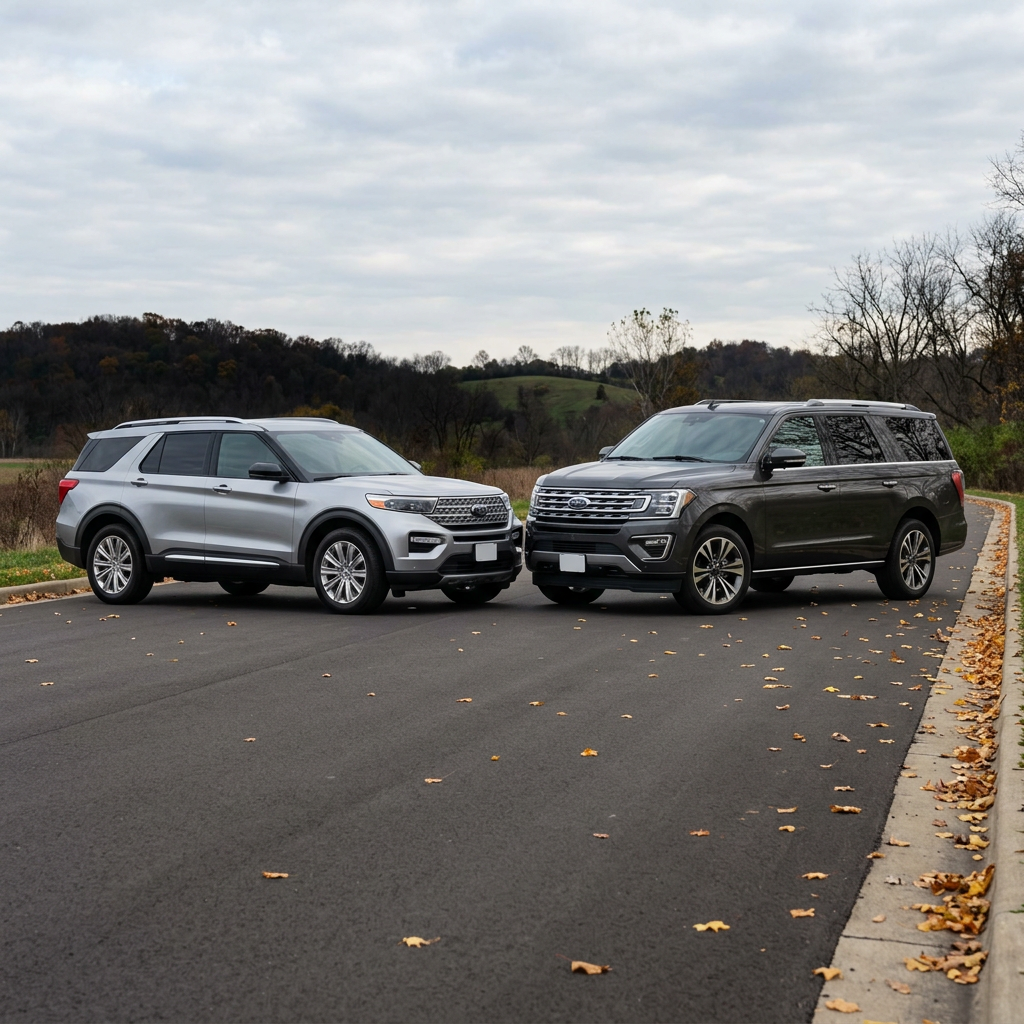
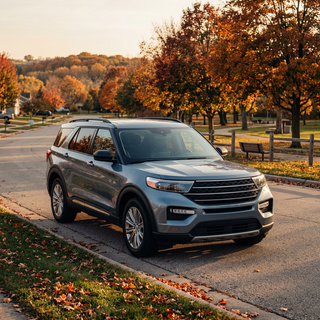
A silver Ford Explorer and a dark gray Ford Expedition parked side by side on an asphalt road in autumn. (Representative image for illustration purposes only. Actual vehicle may vary based on trim and configuration.)

How Much Cargo Space Does Each SUV Offer Behind the Third Row?

The Ford Explorer provides about 18 cubic feet of cargo space behind its third row, which accommodates grocery bags or a compact stroller, whereas the standard Ford Expedition supplies nearly 23 cubic feet and the extended Expedition MAX offers over 37 cubic feet to fit full-sized double strollers and large luggage sets without folding seats down.

Cargo versatility is essential for busy households juggling athletic gear, luggage, and everyday supplies. In the Ford Explorer, maximum cargo capacity reaches about 86 cubic feet when both the second and third rows are folded flat. The rear cargo floor includes a hidden underfloor storage compartment to keep smaller items organized and out of sight. A reversible cargo load floor with a plastic surface helps protect interior carpeting when transporting wet sports gear or muddy boots.

The Ford Expedition provides superior overall hauling volume. With all seats folded flat, the standard Expedition opens up nearly 109 cubic feet of cargo room, while the Expedition MAX expands total capacity to over 123 cubic feet. When comparing third-row cargo specs against competitive full-size models like the Chevrolet Tahoe, the numbers show a close matchup. The Chevrolet Tahoe offers approximately 25 cubic feet behind its third row, slightly topping the standard Expedition's 23 cubic feet. However, families needing maximum space behind the rear seats find that the Ford Expedition MAX easily outperforms the Tahoe by offering over 37 cubic feet of dedicated rear storage.

If you are thinking about upgrading your current vehicle to gain more rear cargo space, you can use our instant cash offer tool to get a fast appraisal on your trade-in. You can also view our certified pre-owned Ford inventory for late-model options that include factory-backed warranty coverage.

What Size Travel Trailer Can You Tow with the Explorer vs. Expedition?

The Ford Explorer safely hauls single-axle travel trailers, pop-up campers, or lightweight boats weighing up to its 5,000-pound maximum rating, while the Ford Expedition can pull larger dual-axle travel trailers, heavy campers, and horse trailers rated up to 9,600 pounds when properly equipped.

Every Ford Explorer comes standard with a Class III Trailer Tow Package, making it ready for towing duty right off the lot. Powered by either the standard 2.3-liter EcoBoost I-4 engine producing 300 horsepower or the available 3.0-liter EcoBoost V6 producing 400 horsepower, the Explorer easily handles pop-up campers, jet skis, and lightweight travel trailers with dry weights around 3,500 to 4,000 pounds. This setup leaves an adequate safety margin for gear, water tanks, and passengers.

For heavy-duty recreational towing, the Ford Expedition delivers exceptional muscle. Powered by a standard 3.5-liter EcoBoost V6 engine paired with a 10-speed automatic transmission, standard-wheelbase 4x4 models equipped with the available Heavy-Duty Trailer Tow Package achieve a maximum towing capacity of 9,600 pounds. The Expedition MAX is rated to tow up to 9,000 pounds in 4x4 configuration. Advanced towing technology like Pro Trailer Backup Assist and Pro Trailer Hitch Assist takes the stress out of lining up the hitch ball and backing your trailer into tight campsites or boat ramps along the Ohio River in East Liverpool.

To streamline your purchase experience and lock in competitive financing rates before visiting our showroom, you can submit our secure online credit application from home.

Which SUV Trims, Engines, and BlueCruise Tech Offer the Best Value?

For most families, the Explorer ST-Line and Expedition Platinum represent outstanding value by combining essential driver-assist technologies, premium interior appointments, and access to Ford BlueCruise hands-free highway driving.

In the Explorer lineup, the ST-Line trim balances sporty appearance features with practical everyday equipment. It includes synthetic leather seating, a 13.2-inch center touchscreen powered by the Ford Digital Experience infotainment system, and a comprehensive suite of safety features through Ford Co-Pilot360. Drivers wanting maximum performance can step up to the Explorer ST, which comes standard with the 400-horsepower 3.0-liter EcoBoost V6 engine and sport-tuned suspension. For off-road enthusiasts, the Explorer Tremor trim adds an off-road suspension that raises ground clearance to over 8 inches, along with steel underbody skid plates and all-terrain tires.

The Expedition lineup begins with the well-equipped Active trim and progresses to luxury-level variants like the Platinum and King Ranch. Under the hood, the 3.5-liter EcoBoost V6 engine has earned a strong reputation for long-term durability when maintained with routine oil changes and scheduled service. Higher trims offer an optional High-Output version of the 3.5-liter engine that boosts output to 440 horsepower and 510 lb-ft of torque.

Both vehicles offer available Ford BlueCruise hands-free highway driving technology. Operating on pre-mapped highways across North America, BlueCruise manages steering, braking, and acceleration while keeping the vehicle centered in its lane. The system includes Lane Change Assist and In-Lane Repositioning to reduce driver fatigue during long interstate road trips.

Before finalizing your vehicle choice, utilize our trade-in valuation tool to calculate the current equity in your present vehicle toward a new SUV purchase.

Quick Answers for Families Comparing the Explorer and Expedition

Q: Will a double stroller fit behind the third row of a Ford Explorer?

The Ford Explorer's 18 cubic feet of cargo space behind the third row fits a standard side-by-side double stroller, though space is limited. Parents often need to stand the stroller upright or fold down one side of the 50/50 split third row for easier loading. The Ford Expedition provides nearly 23 cubic feet in standard length and over 37 cubic feet in MAX length, allowing double strollers to lie flat with plenty of room remaining for diaper bags and groceries.

Q: Is the 3.5L EcoBoost engine reliable in the Ford Expedition?

The 3.5-liter EcoBoost V6 engine in the Ford Expedition is a highly reliable powertrain engineered for heavy-duty performance. Twin-turbocharged technology delivers strong low-end torque for quick acceleration and towing. Proper vehicle maintenance, including regular oil changes, air filter replacements, and timely spark plug services, helps ensure long-term mechanical durability and consistent fuel efficiency over high mileage.

Q: Does Ford BlueCruise hands-free driving come standard on either SUV?

Ford BlueCruise hands-free driving is not standard on base models of either SUV, but it is available on select higher trim levels. On the Ford Explorer, BlueCruise capability can be equipped on ST-Line, Platinum, and ST trims. On the Ford Expedition, BlueCruise comes available on upper trims like the Platinum and King Ranch, providing hands-free highway driving on prequalified section split highways across North America.

Q: Which SUV has more cargo space behind the third row: Expedition or Chevrolet Tahoe?

The Chevrolet Tahoe provides slightly more standard rear cargo space at approximately 25 cubic feet compared to the standard-wheelbase Ford Expedition's 23 cubic feet. However, buyers who choose the extended-wheelbase Ford Expedition MAX gain over 37 cubic feet of cargo room behind the third row, comfortably surpassing the standard Tahoe for overall family storage capability.

Q: What size travel trailer can you tow with a Ford Explorer?

A properly equipped Ford Explorer with its standard Class III Trailer Tow Package can tow travel trailers weighing up to its 5,000-pound maximum capacity. This rating allows you to pull single-axle travel trailers, pop-up campers, teardrop trailers, and lightweight utility or boat trailers. For safe towing, always verify that the trailer's loaded weight—including fluids and cargo—stays below the 5,000-pound threshold.

Find Your Next Family SUV

Selecting the right family SUV comes down to evaluating your daily seating requirements, cargo habits, and towing expectations. The Ford Explorer delivers nimble handling, efficient engine performance, and comfortable three-row seating in a garage-friendly midsize package. The Ford Expedition provides maximum interior volume, adult-friendly third-row legroom, and heavy-duty towing capability for larger families and bigger outdoor adventures.

Our sales team at Tri State Ford is ready to walk you through trim options, explain available driver-assist technologies, and organize back-to-back test drives so you can evaluate both cabins in person. Visit our dealership located at 1503 Pennsylvania Ave in East Liverpool, or reach out directly by calling (330) 462-7578 to speak with a sales advisor today. We look forward to helping you drive home in the ideal Ford SUV for your family.

Keep your vehicle performing at its best with our service team:


© 2026 Tri State Ford. All rights reserved.

Ford Explorer vs Expedition in East Liverpool OH | Tri State Ford
Posted in:

Related Posts

f

Can You Trade In a Car With an Unpaid Loan Balance?

You can trade in a vehicle with an unpaid loan balance. The dealership handles the payoff process directly with your existing lender, subtracting your remaining balance from the vehicle's agreed market trade-in value. If your vehicle is worth more than what you owe, the remaining positive balance serves as equity toward your down payment; if you owe more than the trade value, the unpaid difference can be paid out of pocket or included in your new vehicle loan. Trading in a financed vehicle is a standard transaction managed daily by finance teams. When you bring a vehicle with an active auto loan to Tri State Ford, you do not need to clear the debt independently before shopping for your next vehicle. Our team coordinates directly with your financial institution to secure an accurate account payoff and manage the lien release paperwork on your behalf. To begin the evaluation, our vehicle appraisers determine the fair market value of your current ride based on its age, mileage, overall physical condition, and local market demand. Simultaneously, our finance department obtains an official 10-day payoff statement from your lender. This statement accounts for your principal balance plus daily accrued interest charges up through the anticipated settlement date. Once both values are established, calculating your net trade position is straightforward: Positive Equity: Your vehicle's valuation exceeds your loan balance. For example, if your trade value is an example amount and your payoff is an example amount, you have a positive equity amount in positive equity to apply directly toward reducing the price or principal of your next purchase. Negative Equity: Your vehicle's valuation is lower than your remaining payoff amount. For instance, if your trade value is $14,000 but your loan balance is $17,000, you have a positive equity amount in negative equity (often called being "upside down" or "underwater"). Understanding this balance before signing purchase documents allows you to structure financing that fits your household budget. If you want to review your options in person or schedule a professional appraisal, you can find our showroom location at 1503 Pennsylvania Ave, East Liverpool, OH 43920, or call our team directly at (330) 462-7578 to speak with a financing specialist. Table of Contents How Does Trading In a Financed Vehicle Work and Who Pays Off the Loan? What Is Negative Equity and How Does Rolling It Over Into a New Car Loan Work? What Are the Long-Term Financial Risks of Repeatedly Rolling Over Auto Loans? What Happens to GAP Insurance on a Trade-In and Does It Cover Rolled-Over Negative Equity? How Does Selling a Financed Vehicle Privately Compare to Trading It In? Common Questions About Trading In a Financed Vehicle Plan Your Financed Vehicle Trade-In at Tri State Ford How Does Trading In a Financed Vehicle Work and Who Pays Off the Loan? Trading in a financed vehicle works by allowing the purchasing dealership to pay off your existing loan balance directly to your lender while transferring your vehicle's ownership title. You do not need to write a check to your original lienholder prior to trading in, as the dealership handles the electronic or paper draft transfer as part of the sales contract. When buyers ask our finance team about trading in a financed vehicle, the question we answer first is whether the payoff balance matches their monthly account statement. Monthly statements display your remaining balance on a specific billing date, but auto loans accrue interest on a daily basis. To ensure the loan is cleared down to the exact penny, our finance department contacts your lienholder to request a formal 10-day payoff quote. This 10-day window accounts for daily interest accumulation during the time required for funds to transfer between financial institutions. Once the payoff figure is established, the transaction proceeds through three structured steps: Trade Value Valuation: Our appraisal team inspects your trade-in and establishes its current wholesale market value. Lien Satisfaction: Tri State Ford sends funds directly to your existing lender to satisfy the 10-day payoff amount, freeing the vehicle's title from the original lienholder. Contract Integration: Your net trade balance (positive equity credited or negative equity added) is applied to your new sales agreement. For drivers making regular commutes down Market Street toward Boardman, having our team handle loan payoff logistics eliminates time spent sitting on hold with bank representatives or tracking title documents through the state bureau of motor vehicles. Once the paperwork is signed, your obligation to the original loan terminates as soon as the lender processes the dealer's draft. If you are ready to explore your vehicle options, you can browse our selection of new Ford vehicles online, submit an online credit application to secure pre-approval, or check out our durable Ford Transit commercial vans for commercial work needs. What Is Negative Equity and How Does Rolling It Over Into a New Car Loan Work? Negative equity occurs when the payoff amount on your current vehicle loan is higher than the vehicle's actual trade-in market value. Rolling over negative equity means taking that unpaid deficit and adding it directly into the loan principal of the new vehicle you are purchasing. When a vehicle depreciates faster than the loan principal is paid down, negative equity is created. This situation frequently happens during the first two to three years of a long-term financing agreement, as new vehicles experience their steep curve of depreciation early in ownership. NEGATIVE EQUITY ROLLOVER CALCULATION EXAMPLE Agreed Trade Valuation: $16,000 Existing Lender 10-Day Payoff Quote: - $19,500 Unpaid Deficit (Negative Equity): - an example amount Base Price of New Vehicle: $32,000 Added Rolled-Over Deficit: + an example amount Total New Loan Principal (before fees): $35,500 As illustrated above, adding an example amount of previous vehicle debt increases your starting loan principal on the replacement vehicle. Financial institutions evaluate rollover requests based on strict Loan-to-Value (LTV) ratios. LTV is the percentage calculated by dividing the total financing amount by the wholesale value or MSRP of the new vehicle. Lenders set maximum LTV limits—often between 110% and 125%—to restrict how much extra debt can be attached to an asset. High-value, durable vehicles with strong resale retainment offer better LTV flexibility for accommodating a rollover. For example, local small business owners and contractors negotiating elevated terrain along State Route 170 near Calcutta frequently look at our dependable Ford F-Series lineup or explore our new work truck inventory because these platform trucks maintain strong resale value over time. To offset negative equity without borrowing extra money, buyers can contribute a cash down payment or apply manufacturer rebate incentives directly against the trade deficit. Alternatively, choosing high-quality pre-owned Carfax 1-owner vehicles can help stabilize initial depreciation and minimize total debt exposure. What Are the Long-Term Financial Risks of Repeatedly Rolling Over Auto Loans? According to recent studies, over 30% of car buyers unknowingly increase their debt by rolling negative equity into new auto loans repeatedly. Over time, this compounding debt increases your monthly obligation, forces longer repayment terms, elevates total interest charges, and limits future vehicle trading flexibility. When you roll negative equity from one contract into another, you pay interest on both the purchase price of your new vehicle and the unpaid balance of your previous vehicle. If you trade vehicles every two to three years while consistently carrying over unpaid balances, the cumulative debt can quickly outpace normal vehicle depreciation curves. COMPOUNDING DEBT CYCLE OVER MULTIPLE VEHICLE TRADES Initial Vehicle Purchase: $25,000 Loan Balance Trade-In 1 Deficit: + a positive equity amount Rolled into Vehicle 2 Vehicle 2 Starting Principal: $31,000 ($28,000 MSRP + a positive equity amount Deficit) Trade-In 2 Deficit: + $5,500 Rolled into Vehicle 3 Vehicle 3 Starting Principal: $39,500 ($34,000 MSRP + $5,500 Deficit) The long-term financial consequences of consecutive loan rollovers include: Elevated Monthly Payments: A larger total financed amount directly increases your required monthly payment, putting extra strain on your monthly budget. Extended Loan Terms: Lenders may require 72-month or 84-month financing terms to keep monthly payments manageable, which slows principal reduction and keeps you underwater longer. Higher Cumulative Interest: Paying interest across extended loan terms on inflated principal balances substantially raises the total cost of owning your vehicle. Restricted Trading Flexibility: Excessive debt can push your Loan-to-Value ratio past lender approval thresholds, preventing you from trading until significant cash is paid toward the loan balance. Breaking a compounding loan cycle requires deliberate financing strategies. Keeping your current vehicle until the loan principal drops below its wholesale market value eliminates negative equity entirely. If an immediate vehicle replacement is necessary, applying cash down payments, selecting vehicles with high residual value retainment, or shopping from our certified pre-owned Ford inventory —which includes factory warranty coverage—can help realign your debt with actual market value. What Happens to GAP Insurance on a Trade-In and Does It Cover Rolled-Over Negative Equity? Guaranteed Asset Protection (GAP) insurance attached to your old loan automatically terminates upon trade-in loan payoff, making you eligible for a prorated refund on unearned premiums. Standard GAP policies purchased on a replacement vehicle cover total loss valuation gaps but explicitly exclude negative equity carried over from prior auto loans. When you trade in a vehicle with an active auto loan that includes GAP protection, paying off the loan satisfies the original financing contract. Because the policy coverage ends with the loan, any upfront premium paid for months you will not use must be refunded to you by the policy provider. Our finance team can assist you in filing for a prorated GAP refund during your trade-in paperwork process. HOW STANDARD GAP INSURANCE TREATS ROLLED-OVER NEGATIVE EQUITY Base Vehicle Market Value at Total Loss Event: $22,000 Total Financed Balance (Includes $4,000 Prior Negative Equity): $28,000 Primary Auto Insurance Settlement Check: - $22,000 Remaining Debt Difference: $6,000 Standard GAP Policy Payout (Covers Base Vehicle Gap Only): - $2,000 Excluded Balance Customer Owes Out-of-Pocket: $4,000 (Uncovered Prior Rolled-Over Negative Equity) A common misconception is that purchasing GAP insurance on a new vehicle protects rolled-over debt from past vehicles. Standard GAP policies are designed to cover the difference between your primary auto insurer's actual cash value settlement and the primary loan balance tied directly to that specific vehicle. Insurance guidelines restrict GAP payouts from covering previous loan carryovers, extended service contracts, or unpaid late fees. If a total loss accident occurs, your GAP coverage pays the difference up to the vehicle's market value limit, but leaves the rolled-over debt balance unpaid. To assess your current trade position and see where your loan balance stands relative to market value, you can use our online trade-in valuation tool before finalizing your purchase plans. How Does Selling a Financed Vehicle Privately Compare to Trading It In? Selling a financed vehicle privately can yield a higher gross selling price than a dealer trade valuation, but requires you to arrange loan satisfaction out of pocket before your lender releases the clear title to the private buyer. Trading in at a dealership eliminates private title coordination, protects you from transaction fraud, and offers state sales tax advantages. COMPARISON: PRIVATE SALE VS. DEALERSHIP TRADE-IN WITH FINANCED LOAN TRANSACTION FEATURE PRIVATE SALE DEALERSHIP TRADE-IN Sale Valuation Price Often Higher Wholesale Market Wholesale Title Release Process Complex / Delayed Immediate / Handled Lien Satisfaction Out-of-Pocket Cash First Handled Direct Sales Tax Offset Not Applicable Applicable in Ohio Fraud / Payment Risk Buyer Payment Risks Secure Dealer Draft Selling a vehicle privately with an active lien requires clear communication with your buyer and lender. Because the financial institution holds the physical or electronic title until the payoff draft clears, private buyers are often reluctant to hand over cash or personal checks without receiving a clean title immediately. If your buyer is financing through a separate bank, coordinating lien releases across two external financial institutions can take weeks. Furthermore, if your vehicle has negative equity, you must pay the shortfall balance in cash to your lender before they will release the title to the buyer. Trading in your vehicle at Tri State Ford avoids these obstacles completely: State Sales Tax Savings: In Ohio, trade-in value is deducted from the purchase price of your replacement vehicle before sales tax is calculated. For instance, if you purchase a $35,000 vehicle and trade in your car for an example amount, you only pay sales tax on the remaining $20,000 difference—saving hundreds of dollars in tax obligations. Seamless Lien Settlement: Our team remits electronic payment to your lender immediately, eliminating waiting periods and paperwork hassles for you. Safety and Convenience: You avoid meeting buyers privately, arranging test drives with strangers, or handling unverified funds. If you are ready to evaluate your trade-in options and streamline your next vehicle purchase, you can visit our dealership or give our staff a call at (330) 462-7578 to discuss your financing options. Common Questions About Trading In a Financed Vehicle Q: What is a 10-day payoff quote for a vehicle trade-in? A 10-day payoff quote is an official statement generated by your current auto lender detailing the exact dollar amount required to satisfy your loan contract completely within a ten-day window. This figure includes your unpaid principal balance plus daily accrued interest calculations and processing fees. Finance departments request a 10-day window to ensure that funds transferred electronically or mailed via check satisfy the lien without leaving micro-balances due to daily interest accumulation. Q: How do I request a refund for GAP insurance after trading in my car? You can request a prorated GAP insurance refund by submitting a formal cancellation form along with proof of loan payoff to your GAP policy administrator or selling dealer. When you trade in your vehicle, our finance office provides a copy of the dealer trade agreement and payoff confirmation showing the original financing has been satisfied. Unearned premiums calculated from the date of loan payoff are returned via check or credited to your account according to policy terms. Q: Can I trade in a financed vehicle if my credit score has dropped? You can trade in a financed vehicle even if your credit score has dropped since taking out your original loan. A lower credit score may affect the interest rates and loan terms offered by lenders on your replacement vehicle financing contract. Providing a cash down payment, choosing a vehicle with strong book value retainment, or clearing existing negative equity out of pocket improves lender approval odds and secures better rate tiers. Q: What paperwork do I need to bring when trading in a financed vehicle? When trading in a vehicle with an active loan, you should bring your current vehicle registration card, account information for your current auto lender, a recent account statement, valid driver's licenses for all named title holders, all sets of ignition keys and remote key fobs, and proof of current auto insurance. If you have positive equity, bringing the physical title is helpful if held in your possession, though our team can request title releases electronically from lienholders. Q: How does a trade-in tax credit work on a financed car? State trade-in tax credits apply to the total agreed market trade valuation of your trade vehicle, regardless of whether you owe money on an existing auto loan. The full market trade value is subtracted from the gross sales price of your new vehicle before state and local sales taxes are calculated. Even if you have negative equity that must be added back into the loan principal, your trade-in allowance reduces your taxable purchase total. Plan Your Financed Vehicle Trade-In at Tri State Ford Trading in a vehicle you still owe money on is a manageable, routine transaction when guided by an experienced finance department. Whether you hold positive equity that can reduce your next loan principal or face negative equity that requires strategic contract structuring, understanding your options allows you to make confident purchasing decisions. Our team at Tri State Ford provides transparent vehicle appraisals, straightforward 10-day loan payoff coordination, and competitive financing packages tailored to your budget. To take the next step toward your upgrade, explore our online inventory, get pre-approved through our online credit application, or visit our showroom at 1503 Pennsylvania Ave, East Liverpool, OH 43920 to speak with our staff today. Keep Your Vehicle Running Strong Keep your vehicle performing at its best with our service team: Order Parts Schedule Service Appt © 2026 Tri State Ford. All rights reserved. Trade In Cars with Loans in East Liverpool OH | Tri State Ford

d

What Is the Best Used Family Vehicle to Buy Right Now?

The best used family vehicle to buy right now is a late-model midsize or full-size three-row crossover like a pre-owned Ford Explorer, Ford Expedition, or Toyota Highlander, which balances three-row seating, advanced driver-assist technology, and strong value retention. These four- to five-year-old crossovers offer robust towing capacity, flexible cargo configurations, and modern safety features at a fraction of their original retail price. Choosing a pre-owned family vehicle requires matching interior space, safety credentials, and long-term operating costs to your household's daily routine. Midsize three-row crossovers have become the preferred choice for growing families because they combine car-like handling with the seating versatility and all-weather traction of traditional SUVs. A four-year-old vehicle has already experienced its steepest initial depreciation curve while retaining modern infotainment and driver-assist capabilities. At Tri State Ford, our pre-owned lineup offers space for the whole family alongside Ford quality. Families shopping for dependable transport can visit our East Liverpool showroom to compare seating layouts and cargo dimensions in person, give our team a call at (330) 462-7578, or explore our new Ford inventory to evaluate current features against pre-owned options. Five top pre-owned family vehicles worth inspecting this weekend include: Ford Explorer: A versatile midsize crossover offering seating for six or seven, up to 5,000 lbs of towing capacity, and intelligent all-wheel drive. Ford Expedition: A full-size SUV providing seating for up to eight passengers, expansive cargo volume, and maximum towing power for heavy trailers. Toyota Highlander: A reliable midsize crossover known for conservative engineering, low annual repair frequency, and available hybrid efficiency. Honda Pilot: A spacious three-row crossover featuring a refined V6 engine, generous passenger legroom, and comfortable long-distance highway manners. Ford Bronco Sport: A flexible compact crossover tailored for active smaller families requiring lower ground-clearance compromises and outdoor utility. Table of Contents What Are the Best Used 3-Row SUVs for Families and Which Offers the Most Cargo Space? Which Used Three-Row SUVs Near East Liverpool Are Available Under $30,000? How Much Value Does a Family Vehicle Lose After 5 Years, and How Do Long-Term Maintenance Costs Compare? How Do Child Seat LATCH Anchors and Safety Ratings Differ Across Family Vehicles? Common Questions About Buying a Used Family SUV How Can Shoppers Test Drive and Finance Available Used Family SUVs This Weekend? What Are the Best Used 3-Row SUVs for Families and Which Offers the Most Cargo Space? Top used three-row SUVs for families include the Ford Explorer, Ford Expedition, Toyota Highlander, Honda Pilot, and Kia Telluride, with full-size models like the Ford Expedition leading the class in total storage by providing 23 cubic feet of cargo volume behind the third row and expanding to over 108 cubic feet with rear seats folded. When evaluating three-row family crossovers, cargo volume behind the third row dictates how much gear you can carry while utilizing every passenger seat. Midsize crossovers average between 16 and 18 cubic feet of rear storage space, which accommodates standard grocery runs or light luggage. When maximum utility is required, full-size body-on-frame SUVs offer significantly expanded dimensions. Midsize choices like a pre-owned Explorer Active or ST-Line deliver a practical balance of efficiency and interior room. The Ford Explorer provides 16 cubic feet of storage behind the rearmost seats, expanding to 86 cubic feet with second- and third-row seats folded flat. Powered by a standard 2.3L EcoBoost® engine or an available 3.0L EcoBoost® V6 paired with a SelectShift® 10-speed automatic transmission, the Explorer supports a standard 5,000 lbs towing capacity and a 1,467 lbs maximum payload rating across most trim levels. Shoppers seeking single-owner documentation can browse our CARFAX 1-Owner pre-owned inventory to locate well-maintained vehicles. For additional multi-point inspection coverage and factory-backed protection, buyers can also view our certified pre-owned Ford lineup. To compare how popular three-row models measure up in rear cargo volume: Ford Expedition: Provides 23 cubic feet behind the third row, expanding to 108 cubic feet total. Chevrolet Traverse: Delivers 23 cubic feet behind the third row, expanding to 98 cubic feet total. Honda Pilot: Offers 18 cubic feet behind the third row, expanding to 87 cubic feet total. Ford Explorer: Features 16 cubic feet behind the third row, expanding to 86 cubic feet total. Toyota Highlander: Includes 16 cubic feet behind the third row, expanding to 84 cubic feet total. Dimensions & Capacity Capacity and dimensions by trim Feature Active 4WD Active 4WD 100A Active RWD Active RWD 100A Platinum Platinum 4WD Seating 6 6 6 6 6 6 Cargo 16.3 cu ft 16.3 cu ft 16.3 cu ft 16.3 cu ft 16.3 cu ft 16.3 cu ft Curb weight 4,303 lbs 4,303 lbs 4,303 lbs 4,303 lbs 4,303 lbs 4,303 lbs Towing 5,000 lbs 5,000 lbs 5,000 lbs 5,000 lbs 5,000 lbs 5,000 lbs Payload 1,467 lbs 1,467 lbs 1,467 lbs 1,467 lbs 1,467 lbs 1,467 lbs Dimensions & Capacity (continued) Feature ST ST 4WD ST-LINE 4WD ST-LINE RWD Tremor 4WD Utility Police Interceptor 4x4 Seating 6 6 7 7 6 7 Cargo 16.3 cu ft 16.3 cu ft 16.3 cu ft 16.3 cu ft 16.3 cu ft 52.0 cu ft Curb weight 4,631 lbs 4,631 lbs 4,303 lbs 4,303 lbs 4,424 lbs 4,732 lbs Towing 5,000 lbs 5,000 lbs 5,000 lbs 5,000 lbs 5,000 lbs 3,500 lbs Payload 1,139 lbs 1,139 lbs 1,467 lbs 1,467 lbs 1,346 lbs 2,108 lbs Which Used Three-Row SUVs Near East Liverpool Are Available Under $30,000? Pre-owned three-row family SUVs priced under $30,000 typically include 2021 to 2023 model-year crossovers like the Ford Explorer, Toyota Highlander, and Honda Pilot, with current pricing available upon request. For families commuting along the Ohio River bluffs in East Liverpool, finding a capable three-row crossover under $30,000 provides all-weather traction and multi-row seating without pushing monthly financing past budget limits. Vehicles in this price bracket represent an attractive balance of modern vehicle architecture and remaining service life. Shopping in the $20,000 to $30,000 price range allows buyers to access four-wheel drive or all-wheel drive drivetrains, active driver-assist technologies, and user-friendly smartphone integration. These late-model pre-owned vehicles deliver the core safety standards and cabin connectivity expected by modern drivers while avoiding the steeper depreciation curve associated with brand-new vehicle purchases. Key advantages of choosing a pre-owned three-row SUV under $30,000 include: Lower Capital Cost: Lower initial purchase prices translate directly into reduced principal loan balances and lower monthly payments. Modern Safety Tech: Vehicles from model years 2021 through 2023 include standard automated emergency braking, lane-keeping systems, and blind-spot monitoring. Predictable Value: The majority of initial vehicle value loss has already occurred, helping stabilize vehicle equity over subsequent ownership years. How Much Value Does a Family Vehicle Lose After 5 Years, and How Do Long-Term Maintenance Costs Compare? Family SUVs experience an average total depreciation of 40% to 50% over their first five years of ownership, while independent repair data shows the Toyota Highlander averages $489 in annual maintenance expenses compared to $542 per year for the Honda Pilot. Depreciation represents the single largest cost of vehicle ownership during the first three years. By year five, the rate of value loss flattens significantly, making a 4- to 6-year-old pre-owned crossover a cost-effective purchasing option. Evaluating long-term maintenance patterns alongside depreciation helps buyers estimate their total cost of ownership over a multi-year loan term. When comparing long-term maintenance between popular three-row crossovers, the Toyota Highlander demonstrates a slight edge in repair frequency over the Honda Pilot. Highlander owners report an average of 0.3 unscheduled repair shop visits annually, compared to 0.5 visits per year for the Pilot. Both models maintain a modest 13% probability of an individual repair being classified as major. For hybrid buyers, a pre-owned Toyota Highlander Hybrid frequently surpasses 200,000 miles with routine fluid changes and periodic cooling fan maintenance for the hybrid battery system. Pre-owned Ford crossovers like the Explorer offer competitive long-term ownership value. Featuring proven powertrain engineering, durable SelectShift® transmissions, and widely available replacement components, the Explorer provides straightforward maintenance requirements. Base MSRP figures for new Explorer models range from $38,465 for the Explorer Active RWD up to $56,905 for the performance-oriented Explorer ST 4WD, plus a $1,795 destination charge. To plan your budget effectively, shoppers can use our online trade-in appraisal tool to estimate the current value of their existing vehicle before visiting our finance desk. Pricing Pricing by trim Trim Base MSRP Destination charge Active 4WD $42,585 $1,795 Active 4WD 100A $40,465 $1,795 Active RWD $40,585 $1,795 Active RWD 100A $38,465 $1,795 Platinum $50,965 $1,795 Platinum 4WD $52,965 $1,795 ST $54,905 $1,795 ST 4WD $56,905 $1,795 ST-LINE 4WD $47,155 $1,795 ST-LINE RWD $45,155 $1,795 Tremor 4WD $48,965 $1,795 Utility Police Interceptor 4x4 $48,550 $1,695 How Do Child Seat LATCH Anchors and Safety Ratings Differ Across Family Vehicles? Minivans feature complete LATCH hardware across all second- and third-row seating positions, whereas most midsize three-row SUVs equip complete lower anchor sets primarily on second-row outboard seats while using top tethers for third-row installations. Understanding LATCH (Lower Anchors and Tethers for Children) hardware configurations is essential for parents installing child safety seats. Lower anchors consist of rigid metal bars located in the seat bight, designed for use up to a combined child-and-seat weight limit of 65 pounds. Once a child exceeds that limit, the car seat must be secured using the vehicle's seat belt system. Top tether anchors restrict forward head movement during a sudden impact and should always be utilized with forward-facing car seats. In most midsize three-row crossovers, accessing the third row requires sliding or tumbling the second-row seats forward. Because installed child seats prevent second-row seats from folding, families utilizing multiple car seats often prefer second-row captain's chairs to maintain a pass-through center aisle to the rearmost row. For parents driving kids across the rolling suburban hills near Calcutta, active driver-assist safety suites provide vital daily protection. Top-rated family crossovers, including the Ford Explorer, Subaru Ascent, Honda Pilot, and Toyota Highlander, consistently earn Top Safety Pick+ ratings from the IIHS and 5-Star Overall Safety Ratings from the NHTSA. Driver-assist technology like Ford Co-Pilot360™ incorporates essential active safety features: Pre-Collision Assist with Automatic Emergency Braking: Scans the road ahead to detect potential vehicle or pedestrian collisions and automatically applies braking force if necessary. Blind Spot Information System (BLIS®): Monitors hard-to-see rear quarter zones and alerts drivers to approaching vehicles during lane changes. Lane-Keeping System: Detects lane markings and provides gentle steering wheel feedback if the vehicle begins drifting out of its travel lane. Common Questions About Buying a Used Family SUV Q: Can buyers get pre-approved for used family vehicle financing online before visiting? A: Yes, shoppers can complete our secure online credit application to pre-qualify for current financing options before visiting the showroom. Getting pre-approved establishes a clear vehicle budget, clarifies loan terms, and speeds up the delivery process at the dealership. Q: Are three-row family SUVs available with hybrid powertrains in the pre-owned market? A: Yes, pre-owned three-row crossovers like the Toyota Highlander Hybrid and Ford Explorer Hybrid provide multi-row passenger seating alongside improved city and highway fuel economy. Hybrid powertrains utilize regenerative braking, which helps extend brake pad life over extended ownership. Q: How much cargo space is available behind the third row in a midsize SUV versus a full-size SUV? A: Midsize three-row crossovers like the Ford Explorer provide approximately 16 cubic feet of cargo volume behind the third row, which is suitable for daily errands. Full-size SUVs like the Ford Expedition expand rear storage to nearly 23 cubic feet behind the rearmost seats. Q: What documents should shoppers bring when purchasing a pre-owned vehicle? A: Buyers should bring a valid driver's license, current proof of auto insurance, recent pay stubs or proof of income, and proof of residence such as a recent utility bill. Bringing these documents ensures our finance team can process your approval quickly. Q: Does a higher-mileage pre-owned SUV still offer reliable daily performance? A: Well-maintained pre-owned crossovers with over 100,000 miles can deliver reliable service when supported by documented maintenance histories. Vehicles engineered with proven engines, robust transmissions, and regular fluid service schedules maintain mechanical integrity over extended ownership periods. How Can Shoppers Test Drive and Finance Available Used Family SUVs This Weekend? Shoppers can check immediate pre-owned vehicle availability by reviewing online inventory, calling our sales team directly, or visiting our dealership in person to inspect available family SUVs. Our experienced sales staff is ready to help you evaluate seating configurations, demonstrate active safety technologies, and compare cargo dimensions across our pre-owned lineup. Whether you are looking for a fuel-efficient midsize crossover or a spacious full-size SUV, our team provides transparent information and current financing information available from our team. When you are ready to take the next step toward your family's next vehicle, visit our showroom location at 1503 Pennsylvania Ave, call our sales department directly at (330) 462-7578, or schedule a test drive online today. Keep Your Vehicle Running Strong Keep your vehicle performing at its best with our service team: Order Parts Schedule Service Appt © 2026 Tri State Ford. All rights reserved. Vehicle specification data © JATO Dynamics Limited. Used Family SUVs in East Liverpool OH | Tri State Ford
f

What Is the Minimum Down Payment Required for a Used Car Loan?

There is no universal minimum down payment required to finance a used car. While financial experts typically recommend putting down **10% down ** of the vehicle’s purchase price, many lenders approve qualified buyers for low-down-payment options, or even zero dollars down, based on credit profile, income stability, debt-to-income ratio, and the specific vehicle being financed. When evaluating a used car loan application, lenders calculate a key financial metric called the loan-to-value (LTV) ratio. The LTV compares the total loan amount against the official clean wholesale value or market value of the vehicle. A larger cash down payment lowers the loan balance relative to the car's value, reducing the financial risk for the lender. As a result, buyers who provide a solid upfront contribution often secure lower interest rates and easier loan approval terms. However, for buyers with strong credit history and steady proof of income, lenders frequently waive strict minimum down payment requirements altogether. Beyond the baseline vehicle purchase price, buyers must also account for out-of-door costs, which include state sales tax, title transfer fees, registration charges, and dealer documentation fees. A modest cash down payment—such as $500 or $1,000—often covers these initial administrative fees so they do not have to be rolled into the total financed amount. For working professionals and suburban families commuting along State Route 170 near Calcutta, keeping upfront loan costs balanced ensures manageable monthly payments over the full financing term. At Tri State Ford, our team works directly with national banks, regional credit unions, and specialized auto lenders to structure flexible payment plans tailored to your financial goals. Whether you have a substantial trade-in or limited cash on hand, you can visit our East Liverpool showroom location or give us a quick call at (330) 462-7578 to explore customized used-car financing options. Table of Contents Can You Finance a Used Car with Zero Dollars Down? Can You Get a Low-Down-Payment Used Car Loan with Credit Below 600? How Does Every $1,000 Down Lower Your Monthly Payment and Total Interest? What Does It Mean to Be Upside Down on a Low-Down-Payment Used Car Loan? How Do Trade-In Equity and current offers Reduce Cash Required Upfront? Common Questions About Low-Down-Payment Used Car Financing Can You Finance a Used Car with Zero Dollars Down? Yes, you can finance a used car with zero dollars down if you meet lender underwriting criteria, such as a strong credit score and sufficient verifiable income. However, financing 100% of the purchase price increases your overall loan balance, monthly payments, and total interest paid over the life of the loan. Zero-down financing options are primarily extended to buyers in prime or super-prime credit tiers, typically defined as credit scores of 661 to 850. Lenders offering zero-down auto loans closely review an applicant's debt-to-income (DTI) ratio, job stability, and credit history to ensure the borrower can comfortably handle higher monthly payments. Because the lender is taking on 100% of the vehicle's purchase price risk, zero-down loans may carry different annual percentage rates ( APRs) depending on lender and credit profile. Higher Monthly Payments: Borrowing the full purchase price without an upfront reduction results in larger monthly installments across the entire repayment term. Increased Total Interest: Paying interest on a larger principal balance raises the total cost of financing over 48-month, 60-month, or 72-month terms. Higher Initial Loan-to-Value Ratio: Starting a loan at 100% or more of the vehicle's retail value leaves less margin for normal market depreciation. Shoppers exploring low upfront costs often examine our wide selection of quality CARFAX 1-Owner pre-owned inventory to find well-maintained vehicles that hold strong retail value. Experian industry reports show that while zero-down used car financing is widely available, bringing even a modest upfront payment noticeably lowers a borrower's interest rate tier. Our experienced finance department can compare multiple lender offers side-by-side, helping you decide whether a zero-down agreement or a small cash down payment works best for your monthly budget. Buyers who ultimately decide to compare pre-owned savings against new model incentives can also view our brand-new Ford inventory online. Can You Get a Low-Down-Payment Used Car Loan with Credit Below 600? Borrowers with credit scores below 600 can secure a used car loan with a modest down payment, but lenders typically require at least $1,000 or 10% down to offset risk. Lower credit scores place applicants into subprime credit tiers, where higher interest rates mean a down payment is essential to keeping monthly payments manageable. According to Experian automotive finance data, average used car interest rates vary significantly across credit tiers: Credit Score Tier Rating Classification Average Used Car APR 781 – 850 Super Prime 7.70% APR 661 – 780 Prime 9.65% APR 601 – 660 Near Prime 14.11% APR 501 – 600 Subprime 19.00% APR 300 – 500 Deep Subprime 21.85% APR When evaluating applications with credit scores below 600, subprime lenders look beyond credit scores alone. They analyze verifiable monthly income, length of employment, utility bill stability, and current debt obligations. Supplying an upfront cash down payment or trade-in value demonstrates financial commitment and lowers the lender's exposure, which dramatically improves approval odds. Adding a qualified co-borrower with established credit can also help secure lower interest rates and reduce required cash at signing. Choosing high-quality pre-owned vehicles also strengthens subprime applications. Vehicles backed by rigorous reconditioning programs, such as our certified pre-owned Ford inventory featuring Ford Blue Advantage coverage, provide lenders with confidence regarding asset reliability and retained value. Completing a confidential online credit application allows our finance specialists to pre-qualify your file and identify lenders that specialize in low-down-payment subprime approvals. How Does Every $1,000 Down Lower Your Monthly Payment and Total Interest? Every $1,000 put down on a used car loan reduces the monthly payment by approximately $15 to $20 on a standard 60-month loan term. Over the course of the loan, that initial cash contribution also saves hundreds of dollars in total interest charges by reducing the principal loan balance. To see how an upfront down payment shapes total financing costs, consider a $20,000 used vehicle loan financed at a 9.65% APR over a 60-month term: Larger down payments can reduce the amount financed, which may lower monthly payments and total interest paid over the life of the loan. As shown in the table, putting 10% down ($2,000) on a $20,000 vehicle lowers the monthly payment by $42 compared to financing with zero down. Furthermore, it cuts total interest charges by $529 over five years. Because a lower loan balance decreases the lender's loan-to-value ratio, submitting a down payment may also qualify you for a lower interest rate bracket, yielding even greater long-term savings. Planning ahead and factoring initial costs into your budget ensures long-term vehicle affordability. When evaluating total ownership expense, buyers can also explore current manufacturer vehicle offers and specials to lower initial vehicle costs and maximize the value of every dollar invested upfront. What Does It Mean to Be Upside Down on a Low-Down-Payment Used Car Loan? Being upside down on a used car loan—also known as having negative equity—means owing more on the loan than the vehicle is currently worth on the market. Financing a vehicle with little or zero money down increases this risk because normal depreciation occurs faster than the principal balance is paid off during the early months. When a vehicle is purchased with zero down and additional costs like sales tax and documentation fees are rolled into the loan principal, the initial loan balance immediately exceeds the car's wholesale value. For example, if you finance $18,000 on a used SUV with a market value of $16,000, you begin the loan with $2,000 of negative equity. If you need to sell or trade in the vehicle after two years, you must pay off that remaining unpaid balance before title transfer can occur. Trade-In Challenges: Negative equity must either be paid out-of-pocket or rolled into a new auto loan, increasing future monthly payments. Insurance Gaps During Total Loss: In the event of an accident where the car is declared a total loss, standard auto insurance only pays current market value, leaving the owner responsible for paying off the remaining unpaid loan balance. Extended Repayment Terms: Choosing 72-month or 84-month financing terms lowers monthly payments but slows principal reduction, extending the time spent upside down. Drivers navigating daily commutes along the Ohio River around East Liverpool can protect themselves from negative equity by opting for shorter loan terms, providing a modest cash down payment, or adding Guaranteed Asset Protection ( GAP coverage). GAP insurance covers the financial difference between an insurance payout and the remaining loan balance if a vehicle is totaled, offering financial security for low-down-payment loans. How Do Trade-In Equity and current offers Reduce Cash Required Upfront? Positive trade-in equity and dealer incentives count directly toward down payment requirements, allowing buyers to reduce or completely eliminate out-of-pocket cash needed at signing. If your current vehicle is worth more than what you owe on it, that difference acts just like cash towards your purchase. For instance, if your trade-in vehicle has a market value of $7,000 and your remaining loan payoff is $5,000, you possess $2,000 in positive equity. When applied to your next purchase, that $2,000 satisfies a 10% down payment requirement on a $20,000 used vehicle without requiring any out-of-pocket cash from your bank account. Combining trade-in equity with manufacturer promotional allowances further reduces the net amount financed, securing lower monthly payments and favorable LTV approval terms. To streamline the low-down-payment buying process, bring these key documents to the dealership: Proof of Income: Recent pay stubs or W-2 forms verifying steady monthly earnings. Proof of Residence: A recent utility bill or bank statement confirming your physical address. Trade-In Paperwork: Vehicle title, current registration, and loan payoff statement if applicable. Valid Driver’s License & Insurance: Active driver's license and current auto insurance card. Preparing these materials in advance speeds up loan underwriting and helps our finance desk secure fast approvals. You can determine your vehicle's current equity today using our online Kelley Blue Book trade-in valuation tool or request a firm purchasing offer through our instant cash offer tool before visiting our showroom. Common Questions About Low-Down-Payment Used Car Financing Q: How long does a credit application take when applying for used car financing? An online credit application typically takes less than ten minutes to complete. Once submitted, our finance team reviews your credit profile and submits it to our network of lenders, often generating approval options within thirty to sixty minutes during regular business hours. Bringing complete documentation—including pay stubs, proof of residence, and trade-in information—helps expedite the final underwriting verification process. Q: Can I roll sales tax and licensing fees into my used car loan? Yes, many lenders permit qualified buyers to finance state sales tax, title transfer, and registration charges directly into the total loan balance. However, rolling administrative fees into the loan increases your principal balance and loan-to-value ratio, which may slightly raise monthly payments and total interest costs. Buyers choosing low-down-payment financing often prefer paying taxes and fees upfront to keep loan amounts manageable. Q: Does a co-borrower help secure a low-down-payment auto loan? Adding a creditworthy co-borrower significantly strengthens an auto loan application, particularly for applicants with credit scores below 600 or limited credit history. A co-borrower assumes joint legal responsibility for loan repayment, which reduces lender risk. This financial backing often helps secure approval with a smaller cash down payment, lower interest rates, and more flexible loan term options. Q: Is GAP insurance necessary when financing a used car with zero money down? While GAP insurance is optional, it is highly recommended when financing a used vehicle with little or zero money down. Because new loans begin at maximum loan-to-value ratios, standard collision insurance may not fully cover your remaining loan balance if the car is declared a total loss in an accident. GAP coverage pays the difference between market value and loan payoff, protecting you from unexpected debt. Q: How do lender loan-to-value limits affect used car approvals? Lenders establish maximum loan-to-value (LTV) limits, usually capped between 100% and 125% of a used vehicle’s clean wholesale book value. The LTV caps the maximum amount a lender will finance, including vehicle price, taxes, warranties, and fees. If a vehicle's selling price or add-ons exceed the lender's LTV cap, a cash down payment or trade-in equity is required to cover the difference. Q: What steps should I take first if I want to buy a used car with little money down? Your first step should be calculating your trade-in equity and submitting a secure finance pre-qualification application online. Knowing your borrowing power and estimated monthly payment range allows you to shop our pre-owned inventory with complete confidence. You can confirm current vehicle availability or speak with our finance team by stopping by our East Liverpool dealership address or calling us at (330) 462-7578 to schedule a test drive today. Keep Your Vehicle Running Strong Keep your vehicle performing at its best with our service team: Order Parts Schedule Service Appt © 2026 Tri State Ford. All rights reserved. Used Car Financing Options in East Liverpool OH | Tri State Ford