

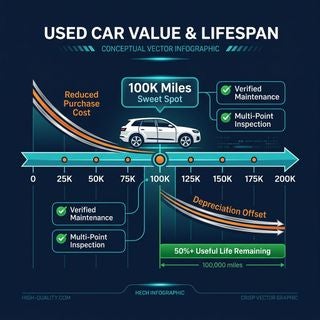
Buying a used car with 100,000 miles is a smart financial decision when the vehicle has a documented service history and passes a comprehensive mechanical evaluation. Modern engineering standards mean properly maintained vehicles easily operate beyond 200,000 miles, allowing a 100,000-mile vehicle to deliver half or more of its total service life at a strong value.
The historic belief that 100,000 miles marks the end of a vehicle's useful life is an outdated remnant from decades past. Advanced powertrain manufacturing, precision tolerances, and synthetic lubricants allow modern engines and transmissions to stay in top working order far longer than older designs. Choosing a vehicle at this milestone allows you to bypass the steepest portion of the vehicle depreciation curve, translating into lower monthly payments, reduced vehicle insurance premiums, and exceptional overall value.
For buyers navigating the suburban State Route 170 corridor in Calcutta, a well-maintained pre-owned SUV or truck with 100,000 miles offers reliable everyday transportation, ample cargo space for school runs, and robust towing capability for weekend trips. The key to securing a quality vehicle at this mileage lies in reviewing vehicle history records to confirm regular oil changes, timely fluid flushes, and scheduled belt replacements.
At Tri State Ford, our pre-owned selection undergoes rigorous multi-point inspections so you can shop with total confidence. If you want to check out our pre-owned lineup in person, you can easily find our showroom location, reach out directly by giving our sales team a quick call at (330) 462-7578, or start your buying journey from home by filling out an online credit application today.
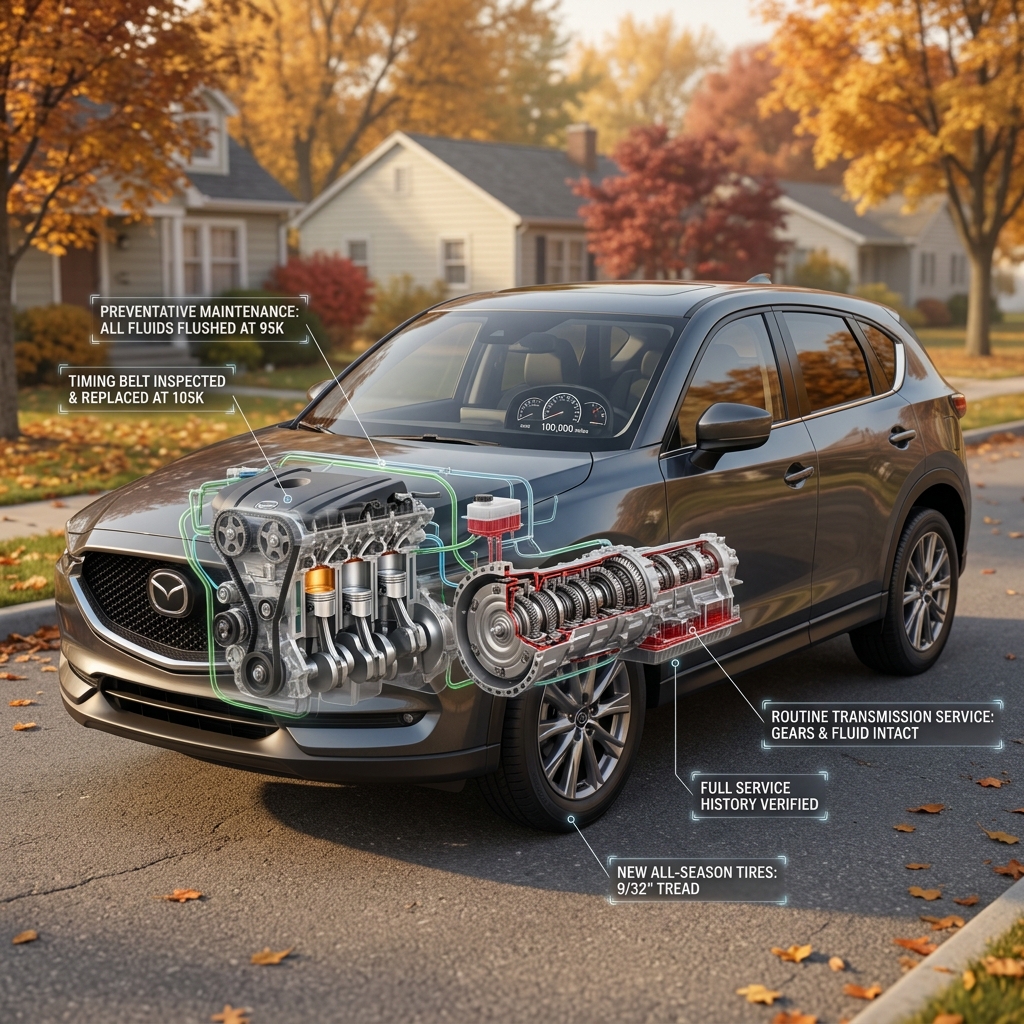
Table of Contents
- Which Vehicle Brands and Engine Designs Reliably Exceed 200,000 Miles?
- 100,000 Highway Miles vs. 50,000 City Miles: Which Used Car Is the Better Value?
- At What Mileage Mark Does Vehicle Depreciation Slow Down the Most?
- What Mechanical Components and Fluid Inspections Reveal True 100,000-Mile Vehicle Health?
- Understanding Extended Warranty Coverage: Inclusionary vs. Exclusionary Policies
- Common Questions About Buying High-Mileage Used Vehicles
- Find Your Next Reliable Pre-Owned Vehicle at Tri State Ford
Which Vehicle Brands and Engine Designs Reliably Exceed 200,000 Miles?
Naturally aspirated four-cylinder engines, under-stressed V6 configurations, and heavy-duty V8 powertrains paired with simple automatic transmissions consistently demonstrate the mechanical endurance needed to exceed 200,000 miles. Engineering designs that prioritize durable iron or reinforced aluminum engine blocks, timing chains rather than timing belts, and proven fuel delivery systems routinely outlast over-boosted or highly complex engine setups.
When evaluating long-term dependability, Ford's engineering lineup stands out for rugged capability and sustained longevity. Built tough powertrains like the naturally aspirated 3.5L Duratec V6, the durable 2.5L iVCT inline-four, and the legendary 5.0L Coyote V8 feature robust metallurgy designed to handle decades of heavy use. Combined with heavy-duty cooling systems and smooth-shifting 10-speed automatic or 6-speed automatic transmissions, these powertrains handle daily commuter demands, heavy cargo loads, and trailer hauling without premature wear.
In addition to Ford’s proven engine families, trucks and full-size SUVs built on body-on-frame platforms consistently reach high mileage totals. Models like the Ford F-150 and Ford Expedition offer the structural strength, high towing capacity, and spacious seating required for active family lifestyles and heavy-duty work schedules. Selecting an engine design built for high-mileage longevity gives you dependable performance and long-term peace of mind on every journey.
If you are exploring your buying options or comparing new versus pre-owned values across our inventory, take a moment to review our current manufacturer specials to find the right vehicle for your family budget.
100,000 Highway Miles vs. 50,000 City Miles: Which Used Car Is the Better Value?
A used vehicle with 100,000 highway miles generally represents a better mechanical value and a smarter purchase than a vehicle with 50,000 city-driven miles. Highway driving allows the engine and transmission to operate at stable operating temperatures with minimal gear shifting, reducing wear on internal components, brakes, and suspension parts.
Stop-and-go city driving inflicts far more severe wear per mile on a vehicle's powertrain and chassis. Commuters navigating dense traffic, such as the frequent stop-and-go conditions along Market Street in Boardman, subject their vehicles to thousands of additional gear shifts, constant brake application, extended engine idling, and repeated starter motor cycles. City driving also exposes the suspension to frequent potholes and curb strikes, accelerating wear on struts, ball joints, and control arm bushings.
In contrast, highway miles are accrued with the engine turning at a low, steady RPM while constant airflow keeps engine coolant and transmission fluid within ideal operating ranges. A 100,000-mile highway cruiser often exhibits pristine seat upholstery, minimal wear on brake rotors, and clean internal engine components.
When evaluating pre-owned vehicles, verifying ownership history is critical. To shop vehicles with documented histories, explore our inventory of one-owner pre-owned vehicles. If you are upgrading from your current ride, you can also value your current trade-in online to see how much equity you can apply toward your purchase.
At What Mileage Mark Does Vehicle Depreciation Slow Down the Most?
Vehicle depreciation flattens significantly between the 100,000-mile and 120,000-mile marks, creating an ideal buying window where future equity loss remains minimal over years of ownership. While a new car experiences its steepest value drop during the first three to five years, a 100,000-mile vehicle has already absorbed that initial financial drop.
The following list outlines how vehicle depreciation typically progresses across a vehicle's life cycle:
- Years 1 to 3: Rapid initial depreciation, where a vehicle can lose 30% to 50% of its original retail value.
- Miles 50,000 to 80,000: Moderate depreciation as factory powertrain warranties expire and secondary market pricing establishes a baseline.
- Miles 100,000 to 120,000: Depreciation flattens dramatically; vehicle valuation shifts from age and mileage metrics to functional mechanical condition and physical appearance.
- Miles 120,000 and beyond: Value stabilizes into a flat floor, where well-maintained vehicles retain strong resale value based purely on utility and driving reliability.
Buying a pre-owned vehicle past the 100,000-mile mark protects your investment from sudden drops in valuation. Should you decide to sell or trade the vehicle several years later, the minimal difference between your purchase price and future value ensures an exceptionally low cost of ownership.
For buyers who prefer zero previous mileage and complete factory warranty coverage, custom ordering remains an attractive path. You can explore those options by designing a personalized build through our page for custom ordering a new Ford.
What Mechanical Components and Fluid Inspections Reveal True 100,000-Mile Vehicle Health?
A professional pre-purchase evaluation focusing on engine compression and fluid condition provides an accurate assessment of a 100,000-mile vehicle's health. Comprehensive fluid checks reveal how well prior owners maintained the internal components, while compression testing verifies cylinder sealing, valve health, and piston ring integrity.
When inspecting a pre-owned candidate on the lot, paying close attention to vital mechanical indicators ensures you make an informed decision:
- Transmission Fluid: Healthy automatic transmission fluid exhibits a clear pink or red hue. Dark, burnt-smelling fluid indicates excessive heat buildup, clutch pack friction, or deferred maintenance.
- Engine Oil and Coolant: Oil should be free of milky emulsion, which signals a head gasket breach. Coolant should be clean and bright without rust scale or oil film floating in the reservoir.
- Engine Cylinder Compression: Uniform compression pressure across all cylinders confirms that internal engine combustion chambers maintain tight mechanical sealing.
- Timing Belt and Water Pump: On engines equipped with timing belts rather than chains, service records should confirm replacement between 60,000 and 105,000 miles. Interference engine designs risk severe valve damage if a worn belt breaks.
- Suspension and Brake Components: Struts, shock absorbers, control arm bushings, and brake rotors should be inspected for fluid leaks, excessive play, or deep heat scoring.
- Undercarriage Frame Integrity: Inspecting the frame rails, floor pans, and brake lines ensures the vehicle remains structurally sound and free of severe rust damage.
Taking time to verify these mechanical checkpoints guarantees that your pre-owned purchase is ready for years of dependable family transportation. To compare pre-owned value against fresh factory options, check out our new vehicle information to see all current incentives available today.
Understanding Extended Warranty Coverage: Inclusionary vs. Exclusionary Policies
Securing an extended warranty policy on a 100,000-mile vehicle offers financial protection against unexpected mechanical repairs and helps manage your long-term ownership costs. Understanding the distinction between inclusionary and exclusionary warranty policies is essential when choosing the right coverage plan for your budget.
An exclusionary warranty policy offers the most comprehensive coverage available for high-mileage vehicles. Instead of listing every individual part that is covered, an exclusionary contract covers all mechanical and electrical components on the vehicle except for a brief, specific list of excluded items. Exclusions typically consist of basic wear items such as brake pads, wiper blades, spark plugs, tires, and routine maintenance fluids. Because anything not explicitly excluded is covered, exclusionary plans deliver maximum confidence and leave zero guesswork regarding repair claims.
An inclusionary warranty policy operates under the opposite framework. This type of plan only covers the specific components explicitly named inside the contract document. If an unlisted part fails—such as a specialized electronic sensor or power window motor—the repair cost falls entirely on the vehicle owner. While inclusionary plans often carry a lower upfront price tag, their restricted component lists mean less total protection compared to exclusionary options.
For buyers seeking maximum peace of mind in a pre-owned vehicle, Ford Certified Pre-Owned vehicles offer exceptional factory-backed protection. Certified models pass a detailed 139-point or 172-point inspection and include factory-backed warranty benefits, such as a 12-month/12,000-mile comprehensive warranty or a 7-year/100,000-mile powertrain warranty. Explore our current pre-owned inventory by browsing our certified pre-owned Ford lineup.
Common Questions About Buying High-Mileage Used Vehicles
Q: What major service items should be completed on a car at 100,000 miles?
At 100,000 miles, a complete service update typically includes replacing spark plugs, flushing the engine coolant, replacing air and cabin filters, and servicing the transmission fluid and differential lubricants. On engines equipped with a timing belt, replacing both the belt and the water pump is critical to prevent engine damage. A thorough inspection of the suspension struts, brake pads, rotors, serpentine drive belts, and battery health should also be performed.
Q: How much does a comprehensive 100,000-mile service cost?
A comprehensive 100,000-mile service typically ranges between $500 and $1,500 depending on the vehicle layout, engine size, and specific maintenance requirements. Basic fluid flushes, spark plug replacements, and multi-point inspections sit on the lower end of the price spectrum, while vehicles requiring a timing belt and water pump replacement push total costs toward the higher end. Purchasing a vehicle that already has documented service records for these items saves you immediate out-of-pocket expense.
Q: What happens if a timing belt fails on a high-mileage engine?
If a timing belt breaks on an interference engine design, the engine's camshaft stops turning while the crankshaft continues to rotate. This causes the rising pistons to collide directly with open intake and exhaust valves. This mechanical impact results in bent valves, damaged pistons, and severe cylinder head destruction, frequently requiring a complete engine rebuild or replacement. Verifying timing belt replacement history on 100,000-mile vehicles is crucial.
Q: Can regular fluid changes prevent major mechanical failures past 100,000 miles?
Regular fluid changes are the single most effective way to extend the lifespan of an engine, transmission, and differential past 100,000 miles. Over time, vital fluids break down due to thermal heat stress and become contaminated with microscopic metal particles and carbon debris. Flushing and replacing engine oil, transmission fluid, brake fluid, and engine coolant removes abrasive contaminants and restores essential corrosion inhibitors, protecting precision internal surfaces from premature wear.
Q: Does financing a 100,000-mile vehicle require a larger down payment?
Financing a 100,000-mile vehicle does not automatically mandate a larger down payment, though putting money down helps secure more favorable loan terms and lower monthly payments. Most auto lenders evaluate loan approval based on your overall credit profile, debt-to-income ratio, and the vehicle's book value. Providing a down payment lowers the loan-to-value ratio, which helps lower your interest rate and shortens your overall financing term.
Find Your Next Reliable Pre-Owned Vehicle at Tri State Ford
Buying a pre-owned vehicle with 100,000 miles is a practical, value-driven strategy that delivers reliable transportation without the heavy depreciation of a new car purchase. By focusing on proven engine designs, verified service histories, and thorough mechanical evaluations, you can drive home in a quality truck, SUV, or sedan that is fully prepared to serve your family for years to come.
Our team at Tri State Ford is dedicated to helping you find the right vehicle for your daily lifestyle and budget. We invite you to explore our pre-owned lot, test-drive our pre-owned selection, and discuss customized auto financing options with our finance specialists.
Ready to take the next step toward your next vehicle? You can visit our showroom at 1503 Pennsylvania Ave, East Liverpool, OH 43920, speak directly with our team by calling (330) 462-7578, or start exploring your options online to browse our new Ford inventory and pre-owned models today.
Keep Your Vehicle Running Strong
Keep your vehicle performing at its best with our service team:
© 2026 Tri State Ford. All rights reserved.