
Blog / Maintenance & Service, Safety Features, Technology & Innovation, Automotive Recalls, Vehicle

What You Should Know About the 2026 Ford Escape Rollaway Safety Recall

Photorealistic automotive photography, a sleek 2026 Ford Escape crossover SUV, parked on a slight incline in a quiet residential suburban driveway, three-quarter front view, metallic silver paint finish, late afternoon golden hour lighting, long soft shadows, warm natural light reflecting off the po

What You Should Know About the 2026 Ford Escape Rollaway Safety Recall

Ford Motor Company has issued a safety recall for certain 2026 Ford Escape vehicles because of a technical glitch in the **integrated park module**. This specific issue can prevent the transmission from properly locking into the Park position even when the driver moves the shifter accordingly. If the vehicle does not secure itself in Park, there is a significant risk of a rollaway, which increases the possibility of a crash or injury after the driver has exited the cabin. This campaign, identified by Ford as recall **25C69**, is an expansion of a previous safety action and is designed to ensure all affected crossovers comply with Federal Motor Vehicle Safety Standard No. 114 regarding rollaway prevention.

Our team is currently prioritizing these repairs to keep our local families safe on the road. Because this is a safety-critical issue, we offer several ways to make the repair process as easy as possible for you. If you are busy with work or family commitments in East Liverpool, you can take advantage of Ford pickup and delivery for your service appointment. For those who prefer we come to them, Ford mobile service can often handle software-based updates right in your driveway. Keeping your vehicle up to date with safety standards is our top priority, and you can always find a Ford dealership near me to get expert advice on any open campaigns.

If you are concerned about the safety of your vehicle, I recommend engaging the electronic parking brake every single time you park until the repair is completed. This adds a manual layer of security that bypasses the integrated park module's potential failure point. If you need to find our service bay, getting directions to our East Liverpool location is the fastest way to get your Escape in front of a certified technician. You can also give us a quick call to check for parts availability or to ask any specific questions about how this recall affects your daily drive.

## How to Check If Your Escape Is Affected by Recall 25C69

Do you know where to find the 17-digit alphanumeric code that identifies your specific vehicle? This Vehicle Identification Number, or VIN, is the only way to confirm if your 2026 Escape is part of the **25C69** campaign. I often talk to owners who aren't sure where to look, so I usually point them to the driver’s side doorframe or the lower corner of the windshield on the driver’s side. You can also find this number on your insurance card or vehicle registration forms. Once you have that 17-digit code, you can enter it into the official NHTSA recall lookup tool or the Ford owner portal to see a full list of active safety recalls for your crossover.

In my experience, staying organized with your vehicle's documentation helps speed up any service visit. While we are checking your VIN for safety recalls, our team can also look at your overall maintenance history to ensure your powertrain is in top shape. If you use your vehicle for more than just a suburban commute in Calcutta, such as hauling gear for a small business, we can also provide information on maintaining a used work truck inventory or managing a fleet of vehicles. Our finance department is also available to discuss extended service plans that can help cover costs once your factory warranty expires.

Many customers ask me if they should wait for a letter in the mail before scheduling their repair. While Ford began mailing interim notification letters in May 2026, you do not have to wait for the physical mail to arrive if your VIN shows up as "incomplete" on the lookup tool. If you are managing multiple vehicles for a local business, we can help you track the recall status for your entire truck inventory to ensure every driver stays safe. Safety recalls never expire, but addressing a rollaway risk early is always the best way to protect your family and your investment.

Table of Contents

The Step-by-Step Recall Repair Process at Our Tri State Ford Service Center

The primary remedy for the 2026 Ford Escape rollaway issue involves a critical software update to the **Secondary On Board Diagnostic Module C (SOBDMC)**. This update recalibrates how the vehicle communicates with the park module to ensure the transmission locks securely when the driver shifts into Park. At our service center, our certified technicians connect your vehicle to Ford's diagnostic system to perform this update, which is provided free of charge to the owner. In some cases, the repair might also involve inspecting the shift cable bushing to ensure it hasn't become detached or damaged.

When you arrive for your appointment, we perform a multi-point inspection to ensure other vital systems are functioning correctly. This is a great time to check on your **basic 3 years / 36,000 miles** bumper-to-bumper coverage and see if any other routine items need attention. You can easily schedule a service appointment online to find a time that fits your schedule. If we find that you need replacement components like a new air filter or wiper blades during the inspection, our team can order genuine Ford parts directly from the manufacturer to maintain the integrity of your Escape.

We also want to make sure you are getting the best value during your visit, so I always recommend checking our manufacturer monthly service specials for discounts on common maintenance. For example, if your vehicle is nearing a mileage milestone, we can perform a comprehensive battery service or a brake check while the recall software is being updated. Most recall software updates take less than an hour, but we will always give you a clear time estimate when you check in so you can plan your day accordingly.
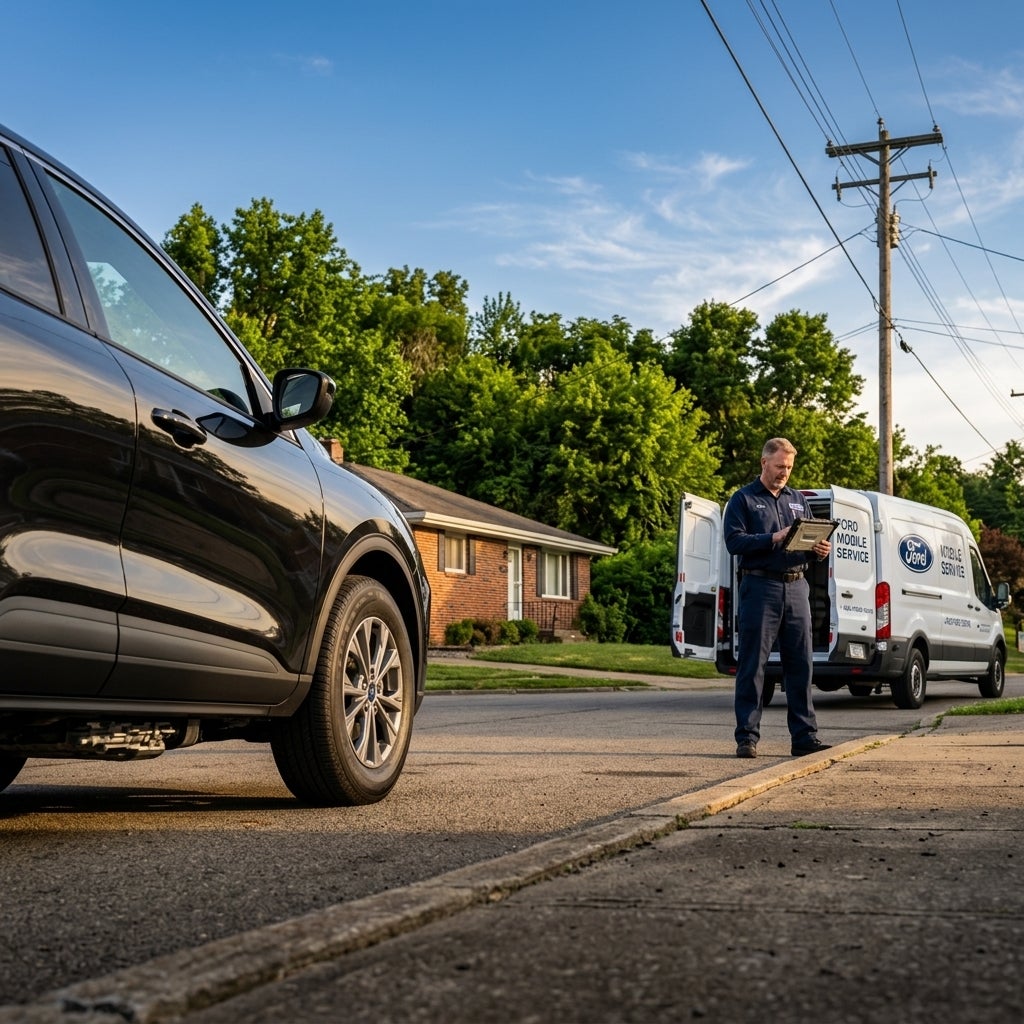
​2026 Ford Escape crossover, parked on a modest asphalt driveway of a 1950s ranch-style brick home in East Liverpool, Ohio, late afternoon sun of a warm June day, lush green deciduous trees and overgrown shrubs in the background, a middle-aged male technician in a Ford service uniform standing beside

Exploring the Fuel Economy and Maintenance of the 2026 Escape Hybrid

Owners of the **2026 Escape PHEV** or the standard hybrid model often find that maintenance needs differ slightly from traditional gas engines. The **2.5L iVCT Atkinson Cycle I-4 hybrid** powertrain is built for efficiency, delivering an EPA-estimated **42 city / 36 hwy** in the standard hybrid configuration. Because these vehicles rely on a blend of electric and gas power, we focus heavily on the health of the regenerative braking system and the high-voltage battery cooling system during routine checkups. These components are essential for maintaining that high fuel economy over the life of the vehicle.

Living in a salt-belt region means we have to be extra vigilant about undercarriage cleanliness. The heavy road salt used during our cold winters can lead to corrosion on exposed components, so we recommend regular underbody flushes. Furthermore, local owners should be aware of EV winter range loss; on the coldest days, you might see a range decrease between **15% and 30%**. If you are looking for a vehicle with different capabilities, we can show you our new work truck inventory or discuss the rugged durability of our transit work vans for business needs.

To help you stay on top of these specialized maintenance tasks, we frequently offer manufacturer vehicle specials that cover hybrid-specific inspections and fluid changes. Keeping your hybrid system healthy not only saves you money at the pump but also protects your **powertrain 5 years / 60,000 miles** warranty coverage. Whether you are driving the **Active** trim with the **1.5L I3** engine or a high-efficiency hybrid, our technicians have the specific training and tools required to keep your Escape running at its peak performance through every season.

Cabin Utility and Cargo Space Maintenance: Escape vs. RAV4

A family recently asked me how the interior utility of their Escape would hold up against a rival like the RAV4 after several years of heavy use. While the Toyota RAV4 offers roughly **about 70 cubic feet** of maximum cargo volume, the 2026 Ford Escape is very competitive with up to **65.4 cu-ft** of available space behind the first row. In my experience, the way you maintain that space matters more than a few extra inches of volume. Using the available **Easy Access Cargo Shade** and **All-Weather Floor Mats** helps protect the interior from the mud and snow we often deal with in Calcutta.

If you are planning to use your crossover for weekend trips or outdoor recreation, we can help you customize your setup. You can look into a new vehicle custom order to get the exact interior protectors and cargo organizers you need from the factory. For those who need even more utility for work or heavy towing, we can compare the Escape's capabilities to our truck inventory. Our technicians are experts at installing genuine Ford accessories like trailer hitches or roof racks that expand your vehicle's versatility without compromising safety.

Maintaining the interior tech is just as important as the mechanical parts. The available **13.2-inch center display** with **SYNC 4** requires periodic software updates to stay fast and responsive. If you find yourself needing more power for professional hauling, you might want to explore the F-Series work inventory to see how a dedicated work platform handles heavy loads. No matter which Ford you drive, keeping the cabin clean and the software updated ensures that your vehicle remains a dependable partner for your daily adventures.

Scheduling Your Free Recall Repair and Routine Maintenance in East Liverpool

I have noticed that many drivers wait until their next oil change to address safety recalls, but the rollaway risk is something that should be handled immediately. This repair is entirely free, and our team is committed to getting you in and out of the shop as quickly as possible. When you come in for the **25C69** update, we can also perform a full diagnostic check on your **1.5L EcoBoost** or hybrid engine to ensure everything is running smoothly. This proactive approach helps maintain the value of your vehicle and ensures you are covered by the **roadside 5 years / 60,000 miles** assistance program if an emergency ever arises.

If you are considering a different vehicle after your repair is finished, we can help you get an instant cash offer for your current Escape. This gives you a transparent starting point for your next steps without any pressure. For those ready to visit us today, our service center address is easy to find, and our team is ready to help you navigate the recall process from start to finish. You can reach us at (330) 462-7578 to speak directly with a service advisor and get your 2026 Escape back to peak safety.

Our commitment to the local community means we treat every vehicle as if it were our own. Whether you are coming in for a complex safety recall or just a simple tire rotation, you can trust that we use only genuine parts and manufacturer-approved procedures. We look forward to helping you keep your Ford on the road safely for many years to come.


© 2026 Tri State Ford. All rights reserved.

Posted in:

Recommended Posts

Illustrated Autumn Vehicle Readiness Checklist detailing battery, wiper, tire, and belt inspection tips for a car. (Representative image for illustration purposes only. Actual vehicle may vary based on trim and configuration.)

What I Tell Drivers About Getting Vehicles Ready for Autumn Weather

What I Tell Drivers About Getting Vehicles Ready for Autumn Weather You should start getting your vehicle ready for fall weather in late August or early September before ambient temperatures consistently drop below 50 degrees Fahrenheit. Preparing your car early ensures weak batteries, worn wiper blades, and soft tire pressures are corrected before cold rain, wet leaves, and early morning frosts hit local roads, while also beating the winter service rush at the dealership. When Should You Start Getting Your Vehicle Ready for Fall Weather? The ideal window for autumn vehicle preparation begins during the tail end of summer, ideally between late August and mid-September. Ambient temperatures begin fluctuating during these weeks, causing thermal contraction in your tires and placing initial cold-start stress on your electrical system. Handling maintenance before the autumn equinox guarantees that your vehicle is fully conditioned before daylight hours shorten and wet leaves make road surfaces slick. Getting ahead of the seasonal transition also helps you avoid peak wait times when the first hard frost triggers a sudden rush for service. Early preparation is particularly important because cold morning starts require higher amperage from your battery just as chemical reactions inside the battery cells slow down. Furthermore, rubber components like wiper blades and serpentine belts that survived summer heat can rapidly harden, crack, or chatter when exposed to damp, 40-degree mornings. By inspecting these wear items early, you prevent minor degradation from turning into an unexpected breakdown on your morning commute. Our team at Tri State Ford makes seasonal maintenance straightforward whether you are swinging by for a rapid multi-point inspection or dropping off your vehicle for comprehensive care. If you need to drop off your vehicle, our service center location on Pennsylvania Ave is easy to reach, or you can give us a quick call at (330) 462-7578 to speak directly with our service desk. Table of Contents What Items Belong on Your Essential Fall Maintenance Checklist? Why Is Fall the Ideal Season to Schedule Preventive Auto Care? What Should You Request When Booking a Professional Fall Service Visit? Which Seasonal Prep Tasks Are Safe to Do Yourself Versus Professional Service? What Must-Have Items Belong in Your Autumn Emergency Kit and Service Records? What Items Belong on Your Essential Fall Maintenance Checklist? A thorough fall car maintenance checklist focuses on the vital systems that handle cold, wet, and dark driving conditions: battery health, tire traction, brake efficiency, fluid protection, and exterior lighting. Systematically evaluating these key areas prevents cold-weather failures and maintains vehicle control on unpredictable autumn pavement. Battery and Charging System: Test cold-cranking amps and clean corrosion from terminal posts to ensure reliable morning starts. Tires and Tread Depth: Measure tread depth across all four tires, check for uneven wear, and adjust inflation pressure to match door-jamb specifications. Wiper Blades and Washer Fluid: Replace streaking wiper blades and top off the fluid reservoir with a cold-weather washer formula that will not freeze on the windshield. Brake System: Inspect brake pads, rotors, and fluid condition to maintain short stopping distances on wet leaves and frosty roads. Exterior Lighting: Verify function for all headlights, taillights, brake lights, and turn signals to maximize visibility during shorter autumn days. Belts and Hoses: Inspect engine rubber for cracking, fraying, or soft spots that worsen when temperatures drop. Tires require extra vigilance in the autumn because tire pressure drops approximately 1 to 2 PSI for every 10-degree drop in outside temperature. A tire that was properly inflated at 85 degrees in July can easily be underinflated by 4 to 5 PSI by October. For vehicles like the 2026 Ford Escape featuring All-wheel drive and a 1.5L EcoBoost engine, maintaining correct tire pressure ensures the intelligent AWD system properly distributes torque across wet roads. Inspecting tread depth is equally critical; while 2/32 inch is the legal limit, a minimum tread depth of 4/32 inch is strongly recommended for safely channeling water and mud away from your tire footprint. Brake condition directly impacts family safety when autumn rain turns dry pavement into a slick surface. We check pad thickness to ensure at least 4 mm of friction material remains, while verifying that brake fluid is clean and free of moisture contamination. If your vehicle needs routine upkeep, you can easily schedule a service appointment with our factory-trained technicians, or order genuine Ford parts through our dedicated parts department. Why Is Fall the Ideal Season to Schedule Preventive Auto Care? Fall provides a balanced climate window where environmental stress on your vehicle is moderate, making it the most cost-effective and practical time to catch mechanical wear before severe winter weather sets in. Summer heat breaks down engine oil, degrades battery fluid, and bakes wiper rubber, leaving major components vulnerable right as cold weather arrives. Addressing these issues in autumn restores protective fluid barriers and replaces compromised components before sub-freezing temperatures amplify mechanical strain. Scheduling preventive service during autumn also protects major mechanical systems from cascading failures. For instance, replacing a worn serpentine belt in September prevents an alternator or water pump failure on a freezing night. Similarly, replacing aged engine coolant ensures your cooling system maintains proper anti-freeze protection down to sub-zero temperatures while preventing internal engine corrosion. The 2026 Ford Explorer with its 2.3L EcoBoost engine and SelectShift® automatic transmission relies on precise fluid viscosities to deliver smooth power and efficient heating to the cabin, making seasonal fluid verifications essential. Drivers navigating the rolling elevation along State Route 170 in Calcutta particularly benefit from fall brake and suspension checkups, where damp autumn leaves on hilly stretches test vehicle stability every single morning. To make maintaining your vehicle completely hassle-free, our dealership offers Ford Pick Up & Delivery service, allowing us to pick up your vehicle from your home or office, complete all needed autumn maintenance, and return it directly to you. What Should You Request When Booking a Professional Fall Service Visit? When booking a professional fall service visit, you should request a comprehensive pre-winter multi-point inspection that includes a digital battery conductance load test, brake pad and rotor measurement, cooling system hydrometer test, and a complete HVAC defroster check. Requesting a systematic inspection ensures that hidden issues like microscopic belt cracks, weak battery cells, or moisture-contaminated brake fluid are identified before severe weather arrives. During a professional fall checkup, our factory-certified technicians perform targeted diagnostics that go beyond basic visual checks: Battery Conductance Load Testing: Measuring actual cold-cranking performance against factory ratings rather than relying solely on static voltage. Cooling System Protection Analysis: Testing antifreeze concentration to ensure freeze protection down to minus 20 degrees Fahrenheit or lower. Brake Hydraulics and Hardware Inspection: Measuring pad thickness in millimeters, checking rotor runout, and testing brake fluid for moisture content. HVAC and Defroster Calibration: Verifying heater core performance, cabin air filter cleanliness, and air-blend door operation to guarantee clear windshield defogging. Undercarriage and Suspension Check: Inspecting shocks, struts, ball joints, and protective boots before road salt season begins. Because cold weather places extraordinary electrical demand on modern vehicles—powering seat warmers, heated steering wheels, defrosters, and headlights simultaneously—knowing the exact condition of your charging system is paramount. You can explore complete details on charging system checks and routine battery testing and maintenance to understand how our certified technicians evaluate battery reserve capacity. ​ Which Seasonal Prep Tasks Are Safe to Do Yourself Versus Professional Service? Basic seasonal prep tasks like checking tire pressure, inspecting wiper blades, topping off washer fluid, testing exterior lights, and changing the cabin air filter are safe and simple to perform at home. Complex diagnostics—including battery load testing, brake pad thickness measurements, cooling system flushes, and suspension alignments—require specialized equipment, calibrated tools, and professional expertise to execute safely and accurately. Doing your own basic maintenance offers a practical way to stay connected with your vehicle’s condition between professional service visits. You can easily test tire tread depth at home using a standard quarter: insert the coin upside down into the center tread groove, and if the top of Washington's head is covered by tread, your tires have more than 4/32 inch of tread depth remaining. Likewise, checking wiper blades for small tears and topping off your windshield washer reservoir with a winter blend takes only a few minutes in your driveway. When tasks involve hydraulic pressure, high electrical amperage, or precision alignment, professional service is essential. Tasks like changing DOT 4 brake fluid every three years require proper system bleeding to prevent air lock, while evaluating high-output charging systems on a heavy-duty truck like the 2026 Ford F-150 with its 3.5L EcoBoost engine requires professional diagnostic tools. For customers who prefer expert care delivered to their driveway, our Ford Mobile Service options allow our certified technicians to complete routine maintenance directly at your location. ​ What Must-Have Items Belong in Your Autumn Emergency Kit and Service Records? An autumn emergency car kit should contain essential safety supplies for warmth, visibility, traction, and communication, stored securely inside the passenger cabin rather than locked in the trunk. Keeping a dedicated folder or digital record of your fall maintenance receipts and safety kit updates helps you track component lifespans, maintain complete warranty compliance, and preserve optimal resale value over time. A well-equipped emergency kit for fall and early winter includes: Warmth and Protection: Heavy fleece blankets, waterproof gloves, thermal hats, and disposable hand warmers. Visibility and Signaling: A high-lumen LED flashlight with extra batteries, reflective hazard triangles, and a high-visibility safety vest. Traction and Recovery: A compact folding snow shovel, traction mats, non-clumping clay litter or sand, and heavy-duty jumper cables or a portable lithium jump-starter pack. Communication and First Aid: A fully charged USB power bank, extra phone charging cables, bottled water, non-perishable protein snacks, and a compact first-aid kit. Always store your emergency kit in the rear seat area or under a seating row rather than in the trunk, as rear-end collisions or frozen trunk locks can make trunk-stored items inaccessible during an emergency. If you ever experience an unexpected roadside failure, remember that Ford Roadside Assistance: (800) 241-3673 provides manufacturer-backed towing, jump-starts, and flat tire changes directly to an authorized service facility. Drivers traversing the steep riverfront bluffs around East Liverpool know how quickly autumn weather can turn rainy streets into challenging drives. Tracking your maintenance history and emergency gear ensures total peace of mind wherever the road takes you. When you are ready for expert vehicle care, feel free to stop by our service center location on Pennsylvania Ave or give our service department a quick call at (330) 462-7578 to keep your vehicle running smoothly all season long. © 2026 Tri State Ford. All rights reserved. Vehicle specification data © JATO Dynamics Limited. Title Tags Meta Description Keywords Open Graph Twitter Card Canonical Article Metadata Geographic Targeting

What is the best Ford for a family of four?

The 2026 Ford Explorer is a strong Ford SUV for a family of four heading into the fall sports season. It delivers an ideal balance of two-row daily comfort and third-row versatility, providing 16 cubic feet of rear cargo space behind the third row and up to 86 cubic feet with rear seats folded. Its standard 2.3L EcoBoost engine, available intelligent four-wheel drive, and comfortable seating configuration give growing families the exact blend of interior cabin space, fuel economy, and game-day capability they need without stepping up to a full-size frame. For a family of four, vehicle dimensions dictate daily usability. While a compact crossover like the 2026 Ford Escape offers agile city handling and an efficient 1.5L EcoBoost engine, its two-row layout limits seating options when grandparents join for weekend games or when kids want to bring teammates along. On the other end of the spectrum, the full-size 2026 Ford Expedition provides immense passenger room and up to 123 cubic feet of maximum cargo volume in the MAX configuration, but its larger footprint requires a bigger garage and higher fuel budget. The 2026 Ford Explorer sits right in the sweet spot for four-person households, serving as a nimble daily commuter that easily transforms into a weekend sports shuttle. Inside the cabin, a four-person family benefits immediately from flexible seating options. The 2026 Ford Explorer Active 100A trim features standard second-row captain's chairs, creating a designated personal space for each child along with a center pass-through corridor. This aisle makes it simple for kids to access the third row or reach back for gear without unbuckling. When weekend tournaments require extra gear capacity, the 50/50 split-folding third row drops completely flat at the pull of a lever, expanding the trunk area into an expansive floor for folding chairs, pop-up canopy tents, and large equipment bags. Families visiting our dealership showroom can compare seating layouts in person to see how easily child seats and booster bases install using standard LATCH anchors. If you want to check current availability or set up an afternoon test loop with your family, give our team a quick call at (330) 462-7578 to speak with a sales specialist. Table of Contents Is the Ford Explorer big enough for kids and sports gear? How does the Expedition MAX handle football pads and team gear? What Ford Explorer trim levels fit family needs and compare to rivals? How do you order custom sports packages and all-weather mats for your Ford SUV? Frequently Asked Questions About Ford SUVs for Fall Sports Families Find the Ideal Family SUV for Fall Sports Is the Ford Explorer big enough for kids and sports gear? With spacious seating and cargo configurations, the 2026 Ford Explorer accommodates all your kids' sports gear comfortably. With a cargo length measuring roughly 23 inches behind the third row, 55 inches behind the second row, and over 84 inches behind the front seats, the load floor accommodates long gear like sticks, bats, canopy frames, and goalie trunks with ease. When navigating weekly soccer practices around Calcutta, parents frequently need a vehicle that separates muddy cleats and damp practice jerseys from primary seating areas. The 2026 Ford Explorer achieves this with a wide rear hatch opening and a low liftover height, allowing younger athletes to load their own gear bags after games. Behind the third-row seatbacks, the 16 cubic feet of storage area easily holds two standard equipment duffels alongside a rolling cooler. When extra space is required for away-game road trips, folding down one side of the third row retains seating for five while instantly doubling the rear cargo area. In addition to physical storage volume, passenger connectivity plays a huge role in keeping young athletes comfortable during back-to-back weekend games. Across the 2026 Ford Explorer lineup, power access is built into all three rows. Second- and third-row passengers benefit from accessible USB-C charging ports on Active 4WD and higher trims, letting kids recharge phones and handheld devices on long drives between tournament venues. Smart interior storage cubbies, deep door pockets, and durable cup holders in every row help keep drink bottles and snacks off the floor. Cargo Behind Third Row: 16 cubic feet of upright storage for daily backpacks and sports duffels. Cargo Behind Second Row: About 47 cubic feet with the third row folded flat for large equipment trunks and coolers. Maximum Cargo Capacity: Up to 86 cubic feet with all rear passenger rows lowered for large gear hauling. Maximum Towing Capacity: Up to 5,000 lbs when properly equipped for pulling utility trailers or small camper setups. To explore how your family's gear fits into the back of a new SUV, you can browse our new Ford vehicle inventory online to compare available interior colors and seating layouts. ​ How does the Expedition MAX handle football pads and team gear? The 2026 Ford Expedition MAX handles heavy football shoulder pads, helmet trunks, and multi-player gear bags effortlessly by offering an expanded wheel-base frame with 37 cubic feet of dedicated cargo space behind the third row alone. Unlike standard three-row SUVs that require folding down seats to swallow bulky sports gear, the Expedition MAX keeps all three passenger rows upright while leaving ample room in the back for an entire team's gear. For youth football programs, travel soccer squads, and multi-sport families, gear volume adds up quickly. Heavy padded equipment, catching gear, team water coolers, and sideline benches require significant flat storage area. The 2026 Ford Expedition MAX Platinum offers 85 cubic feet of space behind the second row and a massive 123 cubic feet of maximum cargo volume behind the front seats. Its flat load floor is wide enough to lay rigid equipment trunks side by side, eliminating the need to stack heavy bags on top of fragile helmets or personal backpacks. When carpooling teammates to away games, seat count and safety hardware matter just as much as trunk volume. The 2026 Ford Expedition MAX seats up to eight passengers in spacious comfort, providing adult-sized legroom across all three rows. Parents and coaches securing younger athletes will appreciate standard LATCH attachments across all outboard seating positions in both the second and third rows. This makes anchoring multiple child safety seats or booster seats fast and simple, ensuring every passenger rides securely. Extended Length Design: Adds roughly one foot of overall body length compared to the standard Expedition, directly expanding rear cargo depth. Power-Folding Rear Seats: Available power-fold third-row seatbacks lower in seconds at the touch of a trunk-mounted button. Robust Towing Performance: A 3.5L EcoBoost V6 engine paired with a SelectShift automatic transmission delivers standard rear-wheel drive or available four-wheel drive with available towing ratings up to 9,000 lbs. Versatile Cargo Management: Lower hidden storage compartments keep smaller accessories, cleats, and first-aid kits organized beneath the main floor. Parents looking for heavy-duty family haulers with complete peace of mind can explore our certified pre-owned Ford inventory to find multi-row models equipped with factory warranty protection and rigorous inspection standards. ​ What Ford Explorer trim levels fit family needs and compare to rivals? The 2026 Ford Explorer lineup features value-focused family trims starting with the Active RWD 100A at a $38,465 base MSRP, comparing favorably with key three-row competitors like the Honda Pilot while delivering a standard 300 hp turbocharged engine and a $1,795 destination charge across the board. Every trim level is built to offer solid standard value, allowing families to pick the precise feature set that fits their monthly budget. Comparing the 2026 Ford Explorer against competitors reveals a strong balance of standard performance and interior value. While rivals often charge extra for upgraded engines to achieve passing power on highway commutes around Boardman, the Explorer includes its punchy 2.3L EcoBoost engine generating 310 lb-ft of torque as standard equipment on Active, ST-Line, Tremor, and Platinum models. For drivers seeking high-performance highway response, the Explorer ST steps up to a twin-turbo 3.0L EcoBoost V6 pushing 400 hp and 415 lb-ft of torque, backed by a SelectShift automatic transmission and available sport-tuned suspension. Trim Level Base MSRP Engine Horsepower Torque Standard Drivetrain Active RWD 100A $38,465 2.3L EcoBoost 300 hp 310 lb-ft Rear-wheel drive Active 4WD 100A $40,465 2.3L EcoBoost 300 hp 310 lb-ft All-wheel drive Active RWD $40,585 2.3L EcoBoost 300 hp 310 lb-ft Rear-wheel drive Active 4WD $42,585 2.3L EcoBoost 300 hp 310 lb-ft All-wheel drive ST-Line RWD $45,155 2.3L EcoBoost 300 hp 310 lb-ft Rear-wheel drive ST-Line 4WD $47,155 2.3L EcoBoost 300 hp 310 lb-ft All-wheel drive Tremor 4WD $48,965 2.3L EcoBoost 300 hp 310 lb-ft All-wheel drive Platinum $50,965 2.3L EcoBoost 300 hp 310 lb-ft Rear-wheel drive Platinum 4WD $52,965 2.3L EcoBoost 300 hp 310 lb-ft All-wheel drive ST $54,905 3.0L EcoBoost 400 hp 415 lb-ft Rear-wheel drive ST 4WD $56,905 3.0L EcoBoost 400 hp 415 lb-ft All-wheel drive Families seeking value can look at the Active 4WD at $42,585 base MSRP, which adds intelligent four-wheel drive for confident traction on slippery morning roads or grass parking lots at athletic fields. Upgrading to the ST-Line 4WD at $47,155 base MSRP brings aggressive exterior styling, dark trim accents, and upgraded interior tech without forcing buyers into a higher engine price point. If you are planning to upgrade your current family vehicle before sport season begins, you can check out our pre-owned single-owner inventory for low-mileage options, or use our online trade-in appraisal tool to estimate the current market value of your trade. Pricing Pricing by trim Feature Active 4WD Active 4WD 100A Active RWD Active RWD 100A Platinum Platinum 4WD ST ST 4WD ST-LINE 4WD ST-LINE RWD Tremor 4WD Utility Police Interceptor 4x4 Base MSRP $42,585 $40,465 $40,585 $38,465 $50,965 $52,965 $54,905 $56,905 $47,155 $45,155 $48,965 $48,550 Destination charge $1,795 $1,795 $1,795 $1,795 $1,795 $1,795 $1,795 $1,795 $1,795 $1,795 $1,795 $1,695 Engine & Performance Powertrain specs by trim Feature Active 4WD Active 4WD 100A Active RWD Active RWD 100A Platinum Platinum 4WD ST ST 4WD ST-LINE 4WD ST-LINE RWD Tremor 4WD Utility Police Interceptor 4x4 Engine 2.3L 2.3L 2.3L 2.3L 2.3L 2.3L 3L 3L 2.3L 2.3L 2.3L 3.3L Horsepower 300 hp 300 hp 300 hp 300 hp 300 hp 300 hp 400 hp 400 hp 300 hp 300 hp 300 hp 318 hp Torque 310 lb-ft 310 lb-ft 310 lb-ft 310 lb-ft 310 lb-ft 310 lb-ft 415 lb-ft 415 lb-ft 310 lb-ft 310 lb-ft 310 lb-ft 260 lb-ft Transmission SelectShift® SelectShift® SelectShift® SelectShift® SelectShift® SelectShift® SelectShift® SelectShift® SelectShift® SelectShift® SelectShift® SelectShift Drivetrain All-wheel drive All-wheel drive Rear-wheel drive Rear-wheel drive Rear-wheel drive All-wheel drive Rear-wheel drive All-wheel drive All-wheel drive Rear-wheel drive All-wheel drive All-wheel drive ​ How do you order custom sports packages and all-weather mats for your Ford SUV? You can order custom sports appearance packages, specialized off-road hardware, and official factory protection accessories directly through our dealership sales department or custom order portal. Factory custom ordering ensures your family SUV arrives from the assembly plant with the exact exterior trim, seating layout, and gear protection tools you want, eliminating any need to compromise on color or option packages. When building a 2026 Ford Explorer for fall sports duty, protective accessories make a huge difference in keeping your vehicle's carpet clean. Custom-fit all-weather floor liners engineered by Ford cover the footwells in all three rows, featuring raised perimeter edges that trap mud, rain, melted snow, and field turf. In the rear cargo area, custom rubber cargo tray liners protect the carpet beneath wet gear bags and heavy equipment trunks. These accessories can be ordered through our parts desk or added directly into your vehicle's purchase order. For buyers who want sportier styling or enhanced off-road capabilities, specialized packages add unique features right from the factory. Appearance upgrades like the Sinister Package bring gloss black wheels and custom dark accents, while the off-road-focused Tremor 4WD model adds steel skid plates, off-road suspension tuning, and a Torsen limited-slip rear axle for navigating unpaved facility parking lots. Step 1: Select Model & Trim: Choose between versatile models like the Explorer or Expedition based on your family's seating and cargo needs. Step 2: Choose Drivetrain & Packages: Select available intelligent four-wheel drive and opt for sports appearance packages or tow packages. Step 3: Add Interior Floor Protection: Include factory custom-fit all-weather liners and heavy-duty cargo trays to safeguard interior carpets. Step 4: Finalize Order Details: Contact our F&I specialists for current financing information and track your vehicle's build progress directly from the factory. Ready to design your ideal sports-season SUV? You can start a custom factory order online, use our online tire finder tool to select all-season rubber, or submit an online financing application to get pre-approved before your test drive. ​ Frequently Asked Questions About Ford SUVs for Fall Sports Families Q: Is the Ford Explorer or Ford Expedition better for hauling sports gear? An EPA rating of 20 city / 27 hwy and a starting MSRP of $38,465 make the 2026 Ford Explorer a practical choice for everyday family use. However, if you frequently haul large team equipment trunks or transport up to eight players, the 2026 Ford Expedition MAX provides superior cargo capacity with 37 cubic feet behind the third row and up to 123 cubic feet total. Q: Can the Ford Explorer tow a sports trailer or camper? Yes, a properly equipped 2026 Ford Explorer offers a maximum towing capacity of up to 5,000 lbs. This allows families to easily pull utility trailers loaded with team gear, lawn equipment, or small recreational campers for weekend sports tournaments. Q: What is the main difference between standard Expedition and Expedition MAX models? The primary difference is overall length and rear cargo capacity. The 2026 Ford Expedition MAX adds approximately one foot of extended length, expanding rear cargo volume behind the third row to 37 cubic feet compared to the standard Expedition's 21 cubic feet, making it ideal for hauling bulky sports bags without folding down passenger seats. Q: Are all-weather floor mats included from the factory on Ford SUVs? Standard equipment varies by trim level, but official custom-fit all-weather floor liners and rubber cargo protectors can be included in any new vehicle order or purchased directly through our dealership parts department. These liners feature deep channels and raised borders designed to protect interior carpets from mud, water, and grass. Q: How long does a custom factory order take for a new Ford SUV? Custom factory order timelines vary based on production schedules, trim selections, and optional package availability. When you place a custom build order through our team, we provide regular status updates as your SUV moves from scheduling to assembly and final transport to our showroom. Find the Ideal Family SUV for Fall Sports Choosing the right Ford SUV transforms chaotic fall sports schedules into smooth, stress-free family trips. Whether you choose the agile, three-row 2026 Ford Explorer with its comfortable seating for six or seven, or step up to the spacious 2026 Ford Expedition MAX for maximum team gear capacity, our sales team is here to help you select the exact vehicle, drivetrain, and accessory packages your family needs. At Tri State Ford, we take pride in offering a straightforward purchasing process and current pricing information available from our team. From exploring custom appearance packages to fitting all-weather floor liners that shield your vehicle from mud and turf, our experienced staff walks you through every step of selecting and customizing your next Ford SUV. When you are ready to test-drive a new SUV with your family, stop by our East Liverpool dealership showroom or give our team a quick call at (330) 462-7578 to schedule your test drive today. Keep Your Vehicle Running Strong Keep your vehicle performing at its best with our service team: Order Parts Schedule Service Appt © 2026 Tri State Ford. All rights reserved. Vehicle specification data © JATO Dynamics Limited. Title Tags Meta Description Keywords Open Graph Twitter Card Canonical Article Metadata Geographic Targeting

What Vehicle Maintenance Is Needed Before Back-to-School Season?

Essential back-to-school vehicle maintenance requires inspecting tires, testing battery capacity, checking brake pads and rotors, replacing engine and cabin air filters, inspecting wiper blades, and topping off essential vehicle fluids. Summer heat accelerates battery wear and fluid degradation, while upcoming school-zone traffic requires prompt braking response and clear road visibility. Completing these inspections before daily carpooling begins prevents unexpected vehicle breakdowns during busy morning routines. Preparing your car for the upcoming academic calendar involves addressing both safety components and routine wear items. Summer driving exposes engine oil, coolant, and brake fluid to sustained high temperatures. Over time, engine oil loses viscosity and coolant protective additives deplete. Checking fluid levels and condition ensures your engine maintains proper operating temperatures during idling in pick-up lines and stop-and-go driving. Ford maintenance guidance recommends replacing brake fluid every three years regardless of mileage. Moisture naturally enters the hydraulic braking system over time, which lowers the boiling point of the fluid and reduces stopping efficiency. For drivers carrying students along busy corridors like State Route 170 in Calcutta, fresh brake fluid preserves firm pedal feel and protects anti-lock braking system hydraulic components. Electrical systems also demand immediate attention before autumn arrives. Battery chemical reactions accelerate during warm summer weather, causing internal grid corrosion and water loss. A battery that functioned adequately during June may fail suddenly when cooler morning temperatures arrive. Having a technician conduct a conductance load test reveals whether your battery maintains sufficient cold-cranking capacity to handle autumn starts. To schedule your seasonal vehicle inspection, reach out to our team with a quick call or find our service center location to prepare your vehicle for school-year driving. Table of Contents What Is Included in a Back-to-School Vehicle Maintenance Safety Checklist? How Do Recommended Tire Pressure and Tread Depth Protect Fall Commutes? How Does DIY Back-to-School Maintenance Cost Compare to Professional Service? What Items Belong in a Back-to-School Emergency Car Kit? Common Questions About Back-to-School Vehicle Maintenance Schedule Your Pre-School Service Check What Is Included in a Back-to-School Vehicle Maintenance Safety Checklist? A thorough back-to-school safety checklist evaluates brake system condition, battery charge capacity, tire tread depth and pressure, exterior lighting functionality, windshield wiper performance, and engine and cabin air filtration. Conducting a comprehensive multi-point inspection verifies that critical safety equipment functions correctly before daily drop-off schedules begin. Braking components represent the primary line of defense in school zones and residential neighborhoods. Technicians measure brake pad friction material thickness to ensure pads retain adequate surface material above mechanical wear indicators. Rotors are inspected for heat scoring, grooves, or lateral runout that causes pedal pulsation. The vehicle checklist also prioritizes optical clarity and external communication. Every exterior bulb must function properly to alert surrounding drivers during early morning twilight commutes: Headlights (low and high beams) for illuminating pedestrians and road signs in dim lighting Brake lights and center high-mounted stop light to signal quick stops in heavy traffic Turn signals and hazard flashers for clear lane-change and emergency communication Reverse lights to warn pedestrians when backing out of crowded school parking spots Filtration systems directly impact both mechanical longevity and cabin comfort. Service schedules specify replacing engine air filters every 15,000 to 30,000 miles depending on local road conditions. A clean engine filter prevents dirt from entering the intake tract, maintaining optimal combustion efficiency. Concurrently, replacing the cabin air filter every 20,000 miles prevents dust, mold spores, and autumn pollen from circulating through the climate control system. For larger family vehicles such as the 2026 Ford Explorer, equipped with a 2.3L engine and a SelectShift® transmission, clean filtration systems ensure the 16 cubic feet of cargo space behind the third row stays free of external odors. Drivers looking to complete routine filter or wiper replacements can conveniently order OEM Ford parts directly through our service department. ​ How Do Recommended Tire Pressure and Tread Depth Protect Fall Commutes? Maintaining cold tire inflation within the recommended 30 to 35 PSI range and preserving tread depth above 4/32 of an inch prevents hydroplaning and shortens stopping distances on damp roads. As ambient outdoor temperatures drop in late summer and early autumn, tire pressure decreases by approximately 1 PSI for every 10-degree Fahrenheit drop in temperature. Tire tread channels standing water away from the contact patch where rubber meets pavement. While the legal minimum tread depth is 2/32 of an inch, driving on tires worn to this limit severely compromises wet-surface traction. Testing tread depth with an American penny offers a quick gauge: inserting the coin upside down into the tread groove should cover the top of Lincoln's head. If the top of his head remains fully visible, the tread has dropped below 2/32 of an inch and requires immediate tire replacement. Correct tire inflation directly affects fuel efficiency and tread wear patterns. Under-inflated tires increase rolling resistance, causing rubber to flex excessively and build up heat along the outer shoulders. Over-inflated tires reduce the contact patch size, leading to accelerated center-tread wear and a harsher ride quality over road imperfections. Routine tire rotations performed every 5,000 to 7,500 miles distribute wear evenly across all four positions. Front tires endure additional lateral stress from steering input and weight transfer during braking. Rotating tires periodically extends total tread life. For drivers navigating suburban routes and wet park roads near Mill Creek Park in Boardman, proper tire care in models like the 2026 Ford Escape with its 1.5L engine and all-wheel drive ensures predictable cornering stability during rainy autumn commutes. How Does DIY Back-to-School Maintenance Cost Compare to Professional Service? DIY maintenance eliminates shop labor expenses on basic procedures like replacing wiper blades, swapping air filters, and topping off washer fluid, reducing direct out-of-pocket spending on simple parts by 50% to 70%. Professional dealership service delivers factory-trained technical expertise, computerized diagnostic equipment, original equipment manufacturer parts warranties, and systematic multi-point safety checks that DIY tasks cannot replicate. Simple maintenance procedures are well within the capability of home mechanics using basic hand tools. Swapping engine and cabin air filters takes minutes and requires no specialized machinery. Likewise, replacing worn wiper blades or clearing minor battery terminal corrosion with a wire brush and baking soda solution protects electrical connections without repair shop fees. However, complex systems demand specialized tools and technical training to service correctly. Modern vehicle maintenance requires diagnostic equipment to interact with electronic control modules, recalibrate driver-assist sensors, and perform hydraulic fluid flushes safely: Maintenance Task Recommended Approach Key Technical Requirement Cabin & Engine Air Filters DIY Safe Basic hand tools / manual clip release Windshield Wiper Blades DIY Safe Direct blade-arm adapter engagement Battery Terminal Cleaning DIY Safe Wire brush & anti-corrosion spray Brake Fluid Flush Professional Service Pressure bleeder & ABS module cycling Battery Load Testing Professional Service Digital conductance load tester Wheel Alignment Professional Service Computerized 4-wheel alignment rig Families preparing their 2026 Ford F-150 with its 3.5L engine and 10,400-lb towing capacity usually ask our technicians to check brake pad thickness and rotor condition before evaluating battery reserve capacity. Professional technicians inspect caliper slides, hydraulic hoses, and hardware to ensure braking systems perform reliably under load. To keep your vehicle covered during unexpected road delays, owners can contact Ford Roadside Assistance at 1-800-241-3673 for factory-backed towing and emergency support. Drivers looking to stay on schedule can easily schedule a service appointment online, review our professional battery replacement advice, or request certified maintenance delivered directly to their driveway via Ford Mobile Service options. ​ What Items Belong in a Back-to-School Emergency Car Kit? An effective back-to-school emergency car kit includes heavy-duty jumper cables or a lithium jump starter pack, a calibrated tire pressure gauge, an LED flashlight with fresh batteries, a first-aid kit, reflective safety triangles, bottled water, non-perishable snacks, a blanket, and a dedicated mobile phone charger. Storing these supplies inside your vehicle provides protection during unexpected electrical failures, flat tires, or roadside delays. Autumn weather brings unpredictable rain and declining morning light, making visibility items essential. Reflective hazard triangles or battery-operated LED flares alert approaching motorists if your vehicle disables along an unlit roadside. A heavy-duty LED flashlight provides clear illumination when checking tire inflation or under-hood fluid levels in the dark. Emergency power equipment eliminates reliance on passing motorists for minor battery failures. Portable lithium jump packs store enough electrical energy to start an engine multiple times on a single charge while fitting compactly into a glove compartment or side door pocket. Paired with a digital tire pressure gauge and a compact 12-volt tire inflator, drivers can address low tire pressure warnings without searching for a gas station air pump. Organizing emergency gear inside structured cargo organizers keeps passenger space clean and prevents loose items from shifting during travel. Utilizing dedicated storage areas—such as the 53 cubic feet of bed cargo space in an F-150 or the 38 cubic feet behind the rear seats of an Escape—ensures emergency items remain accessible without crowding school backpacks, sports gear, or instruments. Common Questions About Back-to-School Vehicle Maintenance Q: How often should I replace my vehicle's cabin air filter? Ford maintenance schedules specify replacing the cabin air filter every 20,000 miles, or approximately every two years. If your daily school commute includes dusty unpaved roads or high-pollen areas, replacing the filter annually maintains maximum heating and air conditioning airflow while keeping airborne allergens out of the passenger compartment. Q: Why is brake fluid maintenance important before the school year starts? Ford factory guidance recommends replacing brake fluid every three years regardless of vehicle mileage. Over time, brake fluid absorbs moisture from ambient air, which lowers its boiling temperature and creates internal corrosion inside hydraulic calipers and anti-lock braking system valves. Fresh fluid ensures firm pedal feel and reliable stopping performance during stop-and-go school zone traffic. Q: What tire tread depth is necessary for safe school-year driving? Tire tread should measure at least 4/32 of an inch to safely channel water and prevent hydroplaning during heavy autumn rainstorms. While 2/32 of an inch represents the legal wear limit, tires worn to that degree require significantly longer stopping distances on wet pavement and should be replaced immediately. Q: How does summer heat affect car battery performance heading into autumn? High summer temperatures accelerate chemical reactions inside automotive lead-acid batteries, causing internal plate degradation and electrolyte fluid loss. As ambient temperatures drop in late summer and early fall, the weakened battery struggles to provide necessary engine cranking amps, leading to sudden battery failure during morning starts. Q: Can I perform my own back-to-school vehicle maintenance at home? Basic maintenance items including windshield wiper replacement, engine and cabin air filter swaps, tire pressure adjustments, and battery terminal cleaning are safe DIY projects. Complex services such as brake fluid flushes, computerized wheel alignments, and battery conductance load testing require professional diagnostic equipment and certified technician training to execute safely. Schedule Your Pre-School Service Check Completing essential vehicle maintenance before the academic calendar begins protects your family and keeps your daily routine running smoothly. Inspecting tires, testing battery capacity, replacing aging filters, and checking brake system wear prevents minor component fatigue from developing into morning vehicle breakdowns. Our service department provides comprehensive vehicle inspections, OEM Ford parts, and certified technician expertise for all your maintenance requirements. Whether your vehicle requires routine fluid changes or a detailed multi-point safety check, our team delivers transparent service you can rely on. Call our team directly at (330) 462-7578 or get driving directions to Tri State Ford at 1503 Pennsylvania Ave, East Liverpool, OH 43920 to reserve your back-to-school service appointment today. © 2026 Tri State Ford. All rights reserved. Vehicle specification data © JATO Dynamics Limited. Title Tags Meta Description Keywords Open Graph Twitter Card Canonical Article Metadata Geographic Targeting