

Blog

What to Do When Your Car Battery Is Low and How to Recharge It

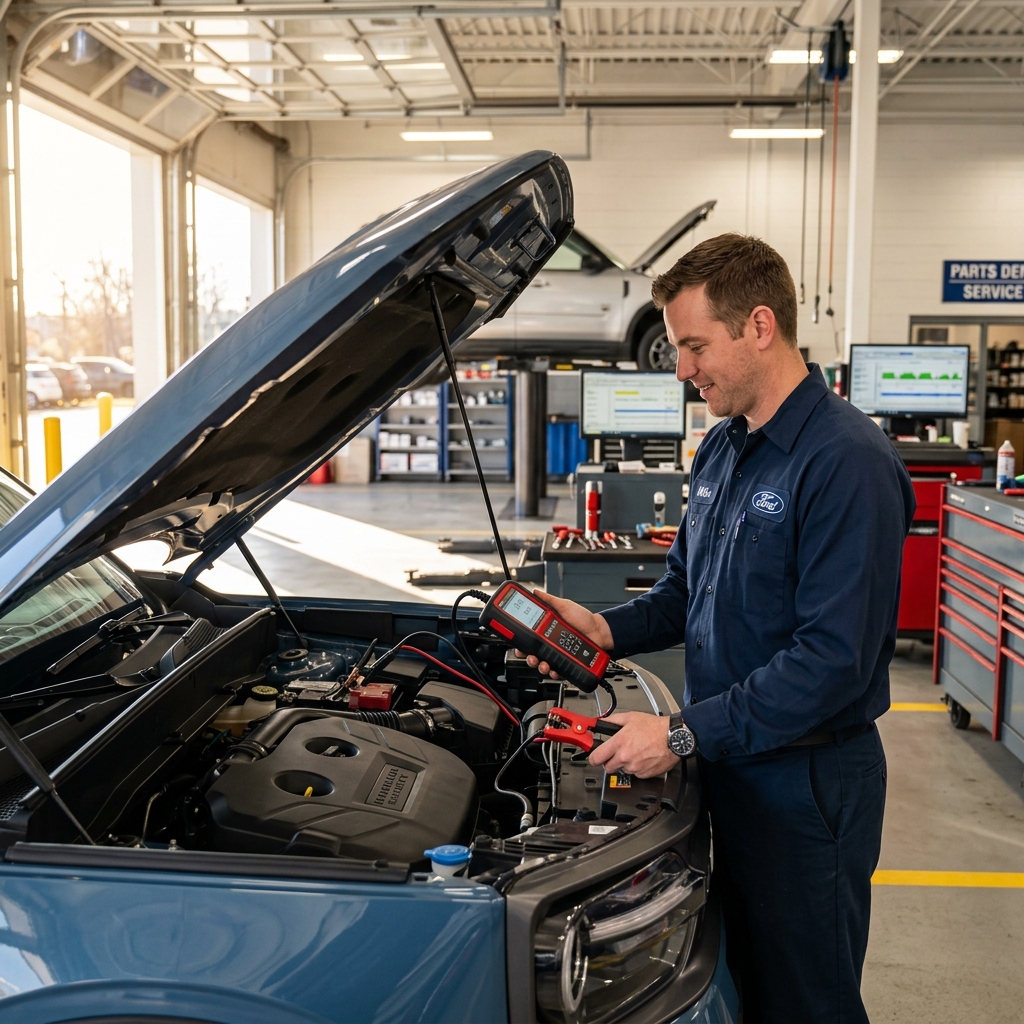
A technician in a Ford uniform testing a car battery with a diagnostic device in a modern auto service garage.

What to Do When Your Car Battery Is Low and How to Recharge It

Understanding Low Car Batteries and When They Can Be Recharged

I have spent 10 years in the service department managing vehicle electrical systems, and I can tell you that a weak battery is one of the most common issues drivers face. Many people do not realize their battery is failing until they turn the key and hear nothing but a clicking sound. When a car battery drops below its optimal charge, it struggles to supply the 12.6 volts required to power your vehicle's starter motor and onboard computers. If you catch the warning signs early, you can often save yourself from being stranded on the side of the road.

In my experience, a low battery can absolutely be recharged if the internal chemistry of the cells remains healthy. Lead-acid batteries rely on a chemical reaction between lead plates and sulfuric acid to store energy, and this process is reversible. However, if a battery is left in a deeply discharged state for too long, lead sulfate crystals build up on the plates in a process called sulfation, which permanently ruins its capacity. If you suspect your vehicle's starting system is beginning to struggle, you can reach our service team at (330) 462-7578 to discuss your options. For drivers who prefer to have a certified technician run a full diagnostic check on their vehicle's charging system, we recommend stopping by our service center at 1503 Pennsylvania Ave to get a definitive health report.

Now, when it comes to the daily commute, cold winter mornings can severely degrade battery performance. The chemical reactions inside the battery slow down dramatically when the temperature drops, while the engine oil thickens, requiring more power to crank. If your battery is already weak, a single freezing night can be enough to prevent your car from starting.

Table of Contents

What Happens When a Car Battery is Low and Can It Be Recharged?

When your vehicle's battery charge is depleted, you will notice several distinct warning signs before the vehicle dies completely. The most obvious indicator is a slow engine crank, where the starter motor sounds sluggish and takes much longer than usual to turn over. You might also notice that your headlights look unusually dim at idle but brighten slightly when you press the gas pedal and raise the engine RPMs. Inside the cabin, your dashboard lights may flicker, your power windows might roll up slowly, or your radio might reset itself unexpectedly.

Whether a low battery can be successfully recharged depends on its overall physical condition and age. If the battery is relatively new and was simply drained by leaving a dome light on overnight, an external charger can easily restore it to full strength. However, if the battery is more than three to five years old and has gone through multiple deep discharge cycles, the internal components have likely degraded to the point where it can no longer hold a charge. Relying on your vehicle's alternator to recharge a completely flat battery is a mistake, as the alternator is designed to maintain a healthy battery, not pump high-amperage current into a dead one for hours. Overworking the alternator this way can overheat its internal diodes, leading to an expensive secondary repair.

If you are experiencing these starting issues, it is best to seek professional guidance rather than risking a breakdown. You can find detailed advice on maintaining your electrical system by checking out our dedicated battery service page. If we determine that your battery is past the point of recovery, you can easily browse and order parts directly through our website to secure a high-quality Motorcraft replacement built specifically for your vehicle.

​

What is a Parasitic Draw on a Vehicle Battery?

Another important thing to know about battery health is that your vehicle never completely shuts off. Even when the ignition is off and the keys are out, a small amount of electrical current is always being drawn to maintain the memory on your clock, radio, and engine control modules. This normal, continuous drain is minimal, usually measuring under 50 milliamps on modern vehicles. A parasitic draw occurs when a computer module fails to go to sleep, or an electrical component remains stuck in the "on" state, pulling a much higher current that can completely drain a healthy battery in a matter of days.

Common culprits of parasitic draw include glovebox or trunk lights that stay illuminated because of a misaligned switch, aftermarket car alarms, or corroded wiring harnesses that create a bridge to ground. Diagnosing a parasitic draw requires a digital multimeter hooked up in series with the negative battery terminal to measure the milliamp draw while pulling individual fuses one by one until the current drop is located. Our service technicians use advanced diagnostic equipment to pinpoint these hidden electrical leaks quickly, saving you from the frustration of a mystery dead battery every morning.

While keeping your current vehicle's electrical system in top shape is vital, some drivers eventually decide it is time to transition into a newer model with advanced power-management systems. If you are considering an upgrade, you can design a vehicle with the exact features you want through our new vehicle custom order portal. To make your next vehicle service or upgrade more affordable, we always recommend looking over our current inventory or checking our used vehicle specials for excellent opportunities on dependable transportation.

​

How Do Battery Reserve Capacity Minutes Work?

Many customers wonder about the technical specifications printed on their battery labels and what they actually mean for daily driving. While most people are familiar with Cold Cranking Amps, another critical metric is the reserve capacity. This spec represents the number of minutes a fully charged battery can continuously discharge a 25-amp current at 80 degrees Fahrenheit before its terminal voltage drops down to a critical 10.5 volts. In simple terms, reserve capacity tells you how long your car can run on battery power alone if your alternator suddenly fails while you are driving.

For families navigating the rolling hills of Calcutta, having a healthy reserve capacity provides an invaluable safety net. If your charging system stops working while you are driving home in the evening, a battery with a high reserve capacity ensures you have enough electrical power to run your headlights, windshield wipers, and hazard lights long enough to pull over safely. A standard passenger car battery typically offers a reserve capacity of roughly 80 to 120 minutes, while heavy-duty commercial batteries can go much higher.

If you drive a larger commercial vehicle or work truck, managing your battery's reserve capacity is even more critical due to the extra electrical demands of heavy equipment. For those managing a local fleet, you can explore our specialized used work truck inventory to find highly capable commercial vehicles. We also carry a robust selection of heavy-duty haulers in our F-Series work inventory, as well as versatile transport options in our Transit work vans lineup to keep your business moving reliably.

​

Can You Replace a Standard Flooded Battery with an AGM Battery?

One thing I always tell customers about battery replacement is that you have options when it comes to technology. Standard flooded lead-acid batteries have been the industry norm for decades, but Absorbent Glass Mat, or AGM, batteries represent a significant technological leap forward. AGM batteries utilize thin fiberglass mats saturated with electrolyte squeezed tightly between the lead plates. This design makes them highly spill-proof, exceptionally resistant to vibration, and capable of recharging up to five times faster than standard flooded options.

You can safely replace a standard flooded battery with an AGM battery to get better reliability and longer service life, but there is a catch. Modern vehicles use smart charging systems that adjust the alternator's output based on the specific chemistry, age, and temperature of the battery. Because AGM batteries have lower internal resistance and different charging profiles than flooded batteries, you must have the vehicle's engine control module reprogrammed to recognize the new battery type. Failing to register the new AGM battery can result in overcharging, which will quickly cook the expensive new unit and shorten its lifespan.

If you are ready to upgrade your vehicle's starting reliability, our factory-trained technicians can handle both the physical installation and the computer reprogramming. To make this process as seamless as possible, you can easily schedule service online at a time that works for your family's busy schedule. For local drivers who are short on time, we also offer our convenient Ford pick up and delivery service, allowing us to fetch your vehicle, perform the battery service, and return it directly to your driveway.
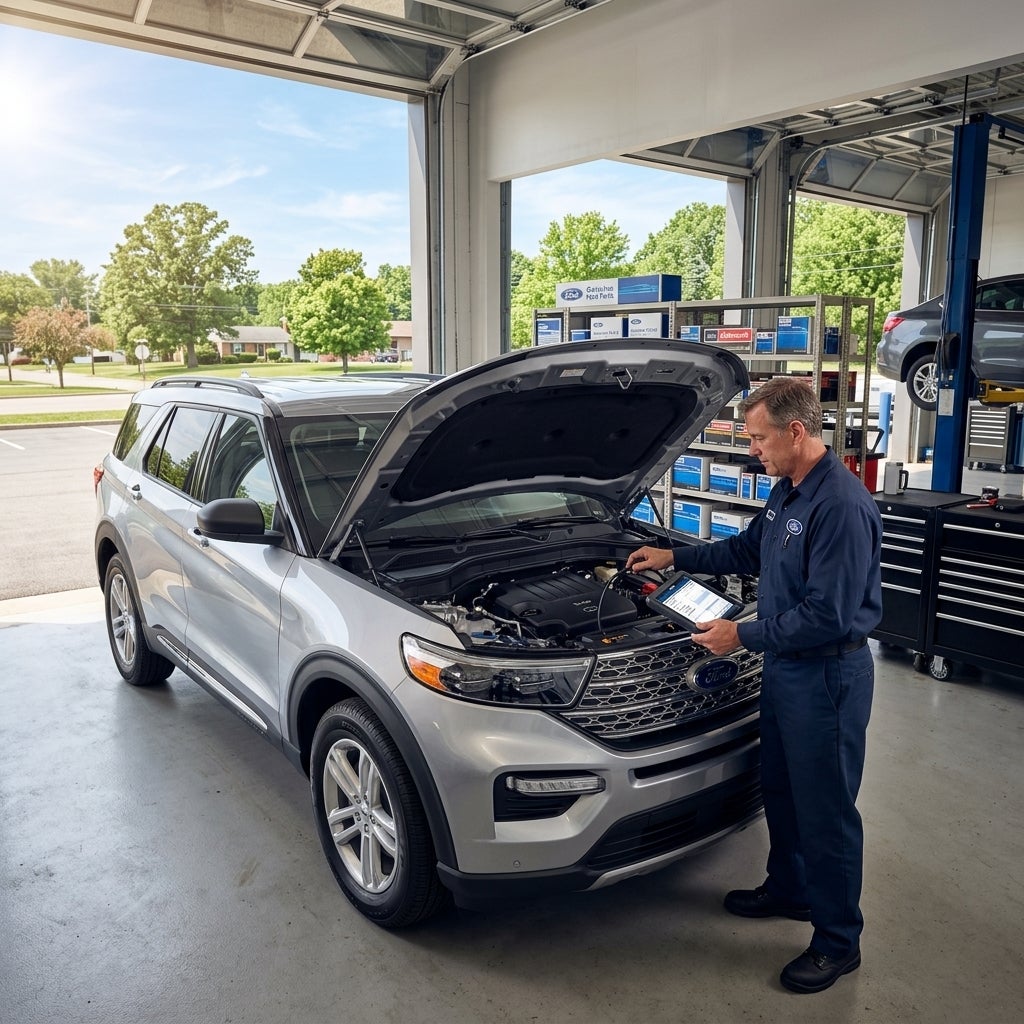
​Wide-angle shot, exterior, professional service bay at a local Ford dealership in East Liverpool, Ohio, late morning, Friday, June 19, 2026, warm early summer sunlight, bright blue sky with light wispy clouds, a silver Ford Explorer with its hood propped open is the focal point, a factory-trained te

What is the Difference Between a Trickle Charger and a Smart Battery Charger?

Let me explain how different charging technologies affect your battery's lifespan. If you have a vehicle that sits idle for long periods, using an external charger is the best way to prevent the battery from draining. However, the tool you choose matters. A traditional trickle charger applies a continuous, low-amperage current, typically around 1 to 2 amps, to the battery indefinitely. Because it does not monitor the battery's state of charge, a trickle charger will keep pushing current even after the battery is full, which can boil away the electrolyte and ruin the internal cells if left connected too long.

In contrast, a smart battery charger utilizes microprocessor technology to monitor the battery's voltage and adjust the charge rate dynamically. A smart charger typically operates in three distinct stages:

  • Bulk Charge: Delivers a constant, maximum current to safely bring the battery up to roughly 80% capacity.
  • Absorption Charge: Slowly lowers the current while holding the voltage steady to safely top off the remaining 20%.
  • Float/Maintenance Mode: Drops the voltage to a safe level to maintain the charge without overcharging, allowing you to leave it connected all winter.

Using a smart charger is highly recommended for maintaining vehicles that are stored during the colder months in East Liverpool, where the riverfront dampness and freezing temperatures can accelerate battery self-discharge. If you are looking to keep your vehicle in peak operating condition, we invite you to browse our current manufacturer monthly service specials for great deals on maintenance. For those interested in a mobile solution, our Ford mobile service van can bring professional maintenance and diagnostics right to your home or office.

​

How Do You Safely Clean Corrosion Off Car Battery Terminals?

This is something we see a lot with vehicles that come into our service bays. Over time, sulfuric acid gas venting from inside the battery reacts with the metal terminals, creating a crusty, white, green, or blue deposit known as lead sulfate or copper sulfate. This corrosion acts as an electrical insulator, restricting the flow of current from the battery to the starter motor and preventing your alternator from properly recharging the battery while you drive.

Fortunately, cleaning this buildup is a straightforward process that you can safely do at home with a few simple steps:

  1. Safety First: Always wear safety glasses and protective gloves, as battery corrosion contains highly acidic compounds.
  2. Disconnect the Cables: Use a wrench to disconnect the negative terminal first, followed by the positive terminal, to prevent accidental short circuits.
  3. Apply Cleaning Solution: Mix one tablespoon of baking soda into a cup of hot water and pour it directly over the corroded terminals to neutralize the acid.
  4. Scrub and Dry: Use a stiff wire brush to scrub the terminals and cable clamps until the metal is clean and shiny, then rinse with clean water and dry thoroughly.
  5. Protect the Metal: Apply a thin layer of petroleum jelly or terminal protector spray to the clean metal to prevent future moisture and acid buildup before reconnecting the cables.

If your battery is constantly corroding around the terminals, it may be a sign of internal gases leaking past the terminal seals, which means the battery is reaching the end of its life. For drivers in Boardman who commute daily, ensuring a clean, reliable electrical connection is essential for hassle-free travel. If you are considering trading in your vehicle rather than dealing with ongoing maintenance, you can get a quick, fair estimate using our KBB instant cash offer tool. If you need help finding the right replacement parts, including batteries or tires, you can utilize our online tire finder to keep your vehicle riding smoothly on local roads.

​

How Much Does Professional Car Battery Installation Cost?

From my experience, many drivers prefer the peace of mind that comes with professional installation. While changing a battery might seem like a simple task, modern vehicles are packed with sensitive electronics that can easily be damaged by a sudden power loss or an accidental spark. If a battery is connected backward, even for a split second, it can blow expensive main fuses or fry delicate onboard computer modules. Professional installation at our service center ensures the job is done safely, with all terminal connections torqued to factory specifications and the charging system thoroughly tested.

The cost of professional installation typically ranges from $10 to $50 for labor, depending on the complexity of your vehicle's engine bay layout. Some modern vehicles have batteries tucked away under the fender lining, inside the trunk, or beneath the passenger seat, which requires significantly more labor to access. When you have your battery replaced at Tri State Ford, our technicians also perform a starting and charging system test to verify that your alternator is producing the correct voltage and that there are no hidden parasitic draws draining your new battery.

If you suspect your battery is starting to fail, do not wait for a cold morning to leave you stranded. You can find our operating hours and get easy-to-follow directions to our service center by visiting our location and hours page. Our dedicated service team is always here to provide the professional vehicle care you deserve to keep your family moving safely on every journey.


© 2026 Tri State Ford. All rights reserved.
Recommended Posts

Escape

Why Do Car Batteries Fail in Cold Weather?

.hrizn-rte-content .e-rte-image{border:0;max-width:100%;height:auto} .hrizn-rte-content .e-rte-image.e-imginline{display:inline-block;float:none;margin-left:5px;margin-right:5px;max-width:calc(100% - 10px);vertical-align:bottom} .hrizn-rte-content .e-rte-image.e-imgbreak,.hrizn-rte-content .e-rte-image.e-imgcenter{display:block;float:none;margin:5px auto;max-width:100%} .hrizn-rte-content .e-rte-image.e-imgleft{float:left;margin:0 12px 8px 0;max-width:100%} .hrizn-rte-content .e-rte-image.e-imgright{float:right;margin:0 0 8px 12px;max-width:100%} .hrizn-rte-content figure.e-rte-image{margin:8px auto;max-width:100%} .hrizn-rte-content figure.e-imgleft{float:left;margin:0 12px 8px 0} .hrizn-rte-content figure.e-imgright{float:right;margin:0 0 8px 12px} .hrizn-rte-content figure.e-imgcenter{display:block;margin:8px auto;text-align:center} Car batteries fail in sub-freezing temperatures because low thermal energy slows the internal chemical reactions that generate electrical current while simultaneously increasing internal resistance. At 32°F, a standard 12-volt lead-acid battery loses approximately 35% of its starting power, dropping to less than 50% capacity at 0°F. Combined with engine oil thickening in severe cold, the battery must supply up to double the electrical power to turn over a cold crankshaft precisely when its available energy output reaches its annual low point. Inside a traditional automotive battery, lead plates soak in an electrolyte solution of sulfuric acid and water. When you turn the ignition key or press the start button, a chemical reaction transfers electrons between the plates to create electrical current. Cold ambient air slows this ionic exchange, creating a severe bottleneck in power delivery. Older or weak batteries that function adequately during warm summer months frequently fail during the first sudden frost because their chemical efficiency degrades past the threshold required to turn the engine starter motor. Winter driving conditions also introduce significant parasitic electrical loads before the engine even starts. Heated seats, rear window defrosters, blower fans, and steering wheel heaters all demand immediate current from the 12-volt electrical system. For drivers navigating the steep riverfront bluffs around East Liverpool, cold morning starts force the starting system to work against dense, cold motor oil and heavy auxiliary power draws. If a battery is already compromised by age or sulfation, it cannot produce the necessary voltage under load. Proactive battery maintenance prevents sudden winter failure before sub-zero temperatures arrive. Drivers noticing slow cranking or flickering interior lights can reach out to our service advisors by giving us a quick call or stopping by our East Liverpool service facility for a comprehensive voltage and load test. Table of Contents How Does Freezing Weather Affect Battery Capacity and Cold Cranking Amps? Why Do AGM Batteries Withstand Freezing Temperatures Better Than Flooded Batteries? How Does a Battery Maintainer or Trickle Charger Prevent Winter Battery Failure? How Much Electric Vehicle Driving Range Can Cold Weather Impact? Common Questions About Winter Battery Care and Cold-Weather Performance Get Reliable Winter Battery Testing and Replacement How Does Freezing Weather Affect Battery Capacity and Cold Cranking Amps? Freezing weather drastically reduces a battery’s available output power while increasing the mechanical resistance of the engine. The critical metric for measuring winter starting capability is Cold Cranking Amps, which measures the current a fully charged 12-volt battery can deliver for 30 seconds at 0°F while maintaining at least 7.2 volts. Under the official SAE J537 testing protocol, battery performance ratings separate winter capability from warm-weather output. While standard Cranking Amps measures output at a mild 32°F, Cold Cranking Amps subjects the battery to a rigorous 0°F test environment. Understanding this distinction explains why an older battery might start a vehicle effortlessly during autumn but struggle to turn over the engine during a midwinter freeze. Battery Metric Testing Temperature Output Capability at 0°F Primary Purpose Cranking Amps 32°F (0°C) Approximately 65% of rated capacity Measures mild-weather engine starting capability Cold Cranking Amps 0°F (-18°C) 50% or less of rated capacity on weak units Measures severe sub-zero winter starting strength Reserve Capacity 80°F (27°C) Reduced runtime under continuous load Measures emergency electrical supply duration As ambient temperatures drop, motor oil viscosity increases significantly. Thicker oil resists movement across pistons and crankshaft bearings, forcing the starter motor to draw anywhere from 100% to 200% more amperage to rotate the engine at starting speed. If a battery has lost 40% of its rated Cold Cranking Amps due to cold chemical slowdown, it cannot fulfill the elevated starter demand. Engineering guidelines recommend choosing a replacement battery with a rating at least 20% higher than factory minimums if your vehicle frequently parked outdoors in freezing climates. Scheduling routine diagnostic checks ensures your starting system meets OEM specifications before peak winter hits. You can learn more about proper voltage testing and replacement intervals through our specialized battery maintenance guidelines. Why Do AGM Batteries Withstand Freezing Temperatures Better Than Flooded Batteries? Absorbent Glass Mat batteries resist severe freezing conditions far better than traditional flooded batteries because their liquid electrolyte is completely absorbed into micro-fiberglass mat separators. This sealed design prevents electrolyte stratification, lowers internal electrical resistance, and eliminates the risk of internal case cracking caused by expanding fluid. In a standard flooded lead-acid battery, continuous charge cycles can cause water and sulfuric acid to separate, a process known as acid stratification. The heavier acid settles at the bottom of the casing while dilute water remains near the top. If a flooded battery becomes discharged, this top layer of dilute electrolyte can freeze solid at 32°F, expanding and permanently damaging the internal lead plates or cracking the outer plastic case. An AGM battery eliminates liquid separation entirely. Because the electrolyte solution stays tightly bound against thin lead plates inside absorbent glass material, the internal chemical reaction remains consistent across the entire cell surface. Key physical and operational advantages include: Micro-fiberglass mats hold electrolyte in direct contact with lead plates, reducing internal resistance. Sealed cell construction prevents fluid evaporation and liquid acid stratification. Higher vibration resistance protects internal components on rough winter road surfaces. Faster charge acceptance allows the alternator to replenish spent energy more rapidly on short drives. Vehicles equipped with heavy electrical loads, such as a 2026 Ford Explorer or a 2026 Ford F-150 with winter comfort features, rely heavily on rapid charge acceptance. An AGM battery accepts high-current charging from the alternator much faster than a standard flooded unit, ensuring the battery restores its state of charge even during low-speed winter driving. How Does a Battery Maintainer or Trickle Charger Prevent Winter Battery Failure? A smart battery maintainer prevents winter failure by supplying a continuous, low-amperage float charge that offsets natural self-discharge and prevents lead sulfation. By maintaining cell voltage above 12.4 volts during idle periods, a maintainer ensures the chemical electrolyte remains fully active and capable of delivering maximum output. Lead-acid batteries experience natural self-discharge when left parked, losing roughly 10% of their charge per month in mild weather and discharging faster when parasitic electronic draws remain active. Keyless entry receivers, alarm sensors, and engine control modules draw continuous milliamps from the 12-volt battery even when the vehicle is locked and turned off. If battery voltage drops below 12.4 volts, sulfur from the electrolyte begins forming permanent lead sulfate crystals on the internal plates. This process, known as sulfation, permanently reduces total storage capacity. Using a modern smart maintainer provides significant winter protection benefits: Microprocessor controls automatically adjust charge rates based on ambient temperature. Float mode maintains maximum voltage without overcharging or boiling off internal fluids. Prevents electrolyte freezing by keeping the battery at a full state of charge. Desulfation modes help dissolve soft sulfate deposits to restore electrical efficiency. Drivers navigating short suburban commutes along State Route 170 in Calcutta often start their engines, run seat heaters and defrosters for ten minutes, and turn off the vehicle before the alternator can fully restore the energy used during startup. Connecting a smart battery maintainer overnight counteracts these short-trip discharge cycles, extending overall battery lifespan through long stretches of sub-freezing weather. How Much Electric Vehicle Driving Range Can Cold Weather Impact? Cold weather temporarily reduces electric vehicle driving range by approximately 15% to 30% during severe winter conditions. This range reduction stems from decreased lithium-ion cell chemical efficiency combined with the significant energy required to heat the passenger cabin and keep the high-voltage traction battery within its optimal operating temperature window. Lithium ions move more slowly through liquid electrolyte when temperatures drop, increasing internal resistance within the high-voltage battery pack. This temporary chemical slowdown limits maximum available acceleration power and reduces energy recovery from regenerative braking. Furthermore, while internal combustion engines use waste heat to warm the interior, an electric vehicle like a 2026 Ford Escape Plug-In Hybrid or all-electric model must pull energy directly from the traction battery to power high-voltage resistance heaters or heat pumps. Modern battery management systems protect high-voltage packs from permanent degradation through active thermal controls. Charging a freezing lithium-ion cell at high currents can cause lithium plating—a condition where metallic lithium deposits on the anode rather than inserting cleanly into the graphite structure. To prevent permanent damage, onboard control modules automatically limit charging speeds and draw grid power to heat the battery pack before accepting high-rate DC fast charging. To minimize range loss and optimize battery protection during winter, owners can follow proven operational strategies: Precondition the cabin and battery pack while the vehicle remains connected to an external charger. Park inside an enclosed garage whenever possible to buffer against sub-zero wind chills. Utilize heated seats and steering wheel controls, which draw less energy than cabin air heaters. Maintain steady driving speeds to allow thermal management systems to stabilize pack temperatures. Drivers seeking seasonal service inspections or looking to explore new electrification technologies can browse our current manufacturer vehicle specials or explore options to custom order a new vehicle configured with cold-weather packages. Common Questions About Winter Battery Care and Cold-Weather Performance Q: How long should you drive a vehicle to fully recharge the battery after a cold jump start? You should drive continuously at highway speeds for at least 30 to 45 minutes with non-essential electrical accessories turned off after receiving a jump start. This extended runtime allows the alternator to deliver a consistent charging current back into the 12-volt battery. Short trips under 15 minutes or idling in a driveway will not generate sufficient alternator output to fully restore a deeply discharged battery, leaving you vulnerable to another dead battery on your next start. Q: At what ambient temperature does a car battery freeze? A fully charged lead-acid battery will not freeze until ambient temperatures drop below -76°F because its electrolyte solution contains a high concentration of sulfuric acid. However, a fully discharged battery with a voltage reading near 12.0 volts consists mostly of water, causing it to freeze at 32°F. Once internal fluid freezes, expanding ice can bend internal lead plates, rupture internal separators, and crack the outer plastic casing, inflicting permanent structural damage. Q: Why does an engine crank slowly when starting on cold winter mornings? Sluggish engine cranking occurs because extreme cold simultaneously reduces battery current output and thickens motor oil. Sub-freezing temperatures slow the chemical reactions inside your 12-volt lead-acid battery, cutting available Cold Cranking Amps by up to 50%. At the same time, cold motor oil becomes viscous, creating severe mechanical drag across internal engine components that forces the starter motor to draw significantly more electrical power to rotate the crankshaft. Q: Does parking inside a garage really protect battery health during severe cold snaps? Parking inside an enclosed garage provides substantial protection by insulating the vehicle from harsh wind chills and keeping ambient temperatures several degrees warmer than outdoor air. This temperature buffer slows the rate of battery heat loss overnight, preserving available Cold Cranking Amps for morning starts. Garaged parking also reduces the initial energy demand required by cabin heaters and defrosters, allowing the alternator to concentrate its power output on recharging the battery immediately after startup. Q: What is the main difference between Cold Cranking Amps and Cranking Amps? Cold Cranking Amps measures the maximum current a fully charged battery can deliver for 30 seconds at 0°F while maintaining at least 7.2 volts, serving as the industry standard for winter performance. Cranking Amps measures output at 32°F, resulting in a higher numerical rating that reflects mild-weather capability. Always reference the Cold Cranking Amps specification when selecting a replacement battery for reliable operation in freezing climates. If you suspect your starting system is struggling, you can easily schedule a service appointment online for a comprehensive electrical system evaluation. Get Reliable Winter Battery Testing and Replacement Cold weather exposes subtle weaknesses in aging vehicle batteries, turning minor voltage drops into unexpected morning breakdowns. Simple preventative care—such as verifying terminal cleanliness, checking charge system voltage, and testing cold-cranking capability—ensures your vehicle starts dependably throughout the coldest winter months. Our factory-trained technicians at Tri State Ford possess specialized diagnostic equipment to test your battery’s state of health, reserve capacity, and cold-weather performance. If testing reveals a weakened cell, we install genuine Motorcraft batteries built to original equipment specifications, backed by comprehensive nationwide warranty coverage. Do not wait for sub-zero temperatures to leave you stranded. To prepare your vehicle for winter driving, give our service team a quick call, stop by our service center on Pennsylvania Avenue, or conveniently order replacement parts online today. © 2026 Tri State Ford. All rights reserved. Title Tags Cold Weather Car Battery Tips in East Liverpool OH | Tri State Ford Meta Description Keywords Open Graph Twitter Card Canonical Article Metadata Geographic Targeting { "@context": "https://schema.org", "@graph": [ { "@type": "NewsArticle", "@id": "#article", "headline": "Why Do Car Batteries Fail in Cold Weather?", "datePublished": "2026-08-27T19:16:03.247Z", "dateModified": "2026-08-27T19:19:04.938Z", "author": { "@id": "#author" }, "publisher": { "@id": "#dealer" }, "wordCount": 2153, "description": "Learn why cold weather causes car batteries to fail, how sub-freezing temperatures slow chemical reactions, and why winter engine starts demand extra power." }, { "@type": "AutoDealer", "@id": "#dealer", "name": "Tri State Ford", "url": "https://www.tristateford.net", "telephone": "+13304627578", "sameAs": [ "https://maps.google.com/?cid=1136336406351438323" ], "address": { "@type": "PostalAddress", "streetAddress": "1503 Pennsylvania Ave", "addressLocality": "East Liverpool", "addressRegion": "OH", "postalCode": "43920", "addressCountry": "US" }, "areaServed": { "@type": "GeoCircle", "geoMidpoint": { "@type": "GeoCoordinates", "latitude": "40.6367833", "longitude": "-80.5443033" }, "geoRadius": "48280" }, "geo": { "@type": "GeoCoordinates", "latitude": "40.6367833", "longitude": "-80.5443033" }, "openingHours": [ "Mo 09:00-20:00", "Tu 09:00-18:00", "We 09:00-18:00", "Th 09:00-20:00", "Fr 09:00-18:00", "Sa 09:00-15:00" ] }, { "@type": "FAQPage", "@id": "#faq", "mainEntity": [ { "@type": "Question", "name": "How long should you drive a vehicle to fully recharge the battery after a cold jump start?", "acceptedAnswer": { "@type": "Answer", "text": "You should drive continuously at highway speeds for at least 30 to 45 minutes with non-essential electrical accessories turned off after receiving a jump start. This extended runtime allows the alternator to deliver a consistent charging current back into the 12-volt battery . Short trips under 15 minutes or idling in a driveway will not generate sufficient alternator output to fully restore a deeply discharged battery, leaving you vulnerable to another dead battery on your next start." } }, { "@type": "Question", "name": "At what ambient temperature does a car battery freeze?", "acceptedAnswer": { "@type": "Answer", "text": "A fully charged lead-acid battery will not freeze until ambient temperatures drop below -76°F because its electrolyte solution contains a high concentration of sulfuric acid. However, a fully discharged battery with a voltage reading near 12.0 volts consists mostly of water, causing it to freeze at 32°F. Once internal fluid freezes, expanding ice can bend internal lead plates, rupture internal separators, and crack the outer plastic casing, inflicting permanent structural damage." } }, { "@type": "Question", "name": "Why does an engine crank slowly when starting on cold winter mornings?", "acceptedAnswer": { "@type": "Answer", "text": "Sluggish engine cranking occurs because extreme cold simultaneously reduces battery current output and thickens motor oil. Sub-freezing temperatures slow the chemical reactions inside your 12-volt lead-acid battery , cutting available Cold Cranking Amps by up to 50%. At the same time, cold motor oil becomes viscous, creating severe mechanical drag across internal engine components that forces the starter motor to draw significantly more electrical power to rotate the crankshaft." } }, { "@type": "Question", "name": "Does parking inside a garage really protect battery health during severe cold snaps?", "acceptedAnswer": { "@type": "Answer", "text": "Parking inside an enclosed garage provides substantial protection by insulating the vehicle from harsh wind chills and keeping ambient temperatures several degrees warmer than outdoor air. This temperature buffer slows the rate of battery heat loss overnight, preserving available Cold Cranking Amps for morning starts. Garaged parking also reduces the initial energy demand required by cabin heaters and defrosters, allowing the alternator to concentrate its power output on recharging the battery immediately after startup." } }, { "@type": "Question", "name": "What is the main difference between Cold Cranking Amps and Cranking Amps?", "acceptedAnswer": { "@type": "Answer", "text": "Cold Cranking Amps measures the maximum current a fully charged battery can deliver for 30 seconds at 0°F while maintaining at least 7.2 volts, serving as the industry standard for winter performance. Cranking Amps measures output at 32°F, resulting in a higher numerical rating that reflects mild-weather capability. Always reference the Cold Cranking Amps specification when selecting a replacement battery for reliable operation in freezing climates. If you suspect your starting system is struggling, you can easily schedule a service appointment online for a comprehensive electrical system evaluation." } } ] } ] }

Explorer

Is End-of-Model-Year the Best Time to Buy a Ford?

Yes, the end-of-model-year transition period is typically the best time to purchase a new Ford vehicle because manufacturers and dealerships combine current offers and financing options to help move outgoing inventory. Buyers who shop during this window can review current vehicle information on proven trucks and SUVs while retaining full factory warranty coverage. During this seasonal transition, vehicle manufacturers shift focus toward incoming inventory, creating substantial pricing incentives on current-year stock. Financing offers often feature available financing options, dramatically lowering the overall cost of ownership. For families looking for space for the whole family and proven durability, securing an outgoing model year delivers exceptional long-term value without compromising on modern technology or safety features. Our sales team at Tri State Ford works directly with buyers to identify the ideal vehicle configuration while maximizing all applicable national and regional incentives. Whether you are reviewing tow ratings or evaluating cabin dimensions, visiting our showroom address allows you to compare models side-by-side. If you have immediate questions about vehicle specs, giving our team a quick call connects you straight to a product specialist. Whether you are picking out custom package options or utilizing our online tire lookup tool to inspect wheel size configurations, our team ensures every buyer takes delivery with complete confidence. Table of Contents What Savings Can Buyers Expect During Late-Summer Clearance Peak Events? Which Ford Explorer Trim and Engine Setup Is Best for Towing? What Is the Maximum Towing Capacity Across the Ford F-150 Lineup? What Should Buyers Know About Finding New Ford Models in Stock? Where Is Tri State Ford Located in East Liverpool? Common Questions About Ford End-of-Model-Year Clearance Sales Take the Next Step Toward Your Clearance Deal at Tri State Ford What Savings Can Buyers Expect During Late-Summer Clearance Peak Events? Late-summer clearance events yield peak savings through stacked factory incentives, including available financing offers, available customer offers on select trucks, available incentives, and deferred first payments. Total savings reach their highest level between late July and October as dealerships make room for incoming model-year shipments. Factory incentive programs during late-summer clearance events feature some of the strongest financing and cash packages of the calendar year. On core models like the 2026 Ford F-150, factory rebates can reach up to $5,000 on select trim levels, while three-row SUVs like the 2026 Ford Explorer offer up to $4,500 in customer cash incentives. Select models also qualify for promotional financing structures through Ford Credit, such as 0% APR for 36 months paired with a complimentary 2-year premium maintenance plan and $1,000 in down payment assistance. Shopping outgoing model years also provides strategic advantages regarding trim configurations and mechanical builds. For example, buyers looking at full-size pickups can secure outgoing model options before factory equipment packages shift for subsequent years. High-demand trim levels like the F-150 King Ranch 4x4 SuperCrew 5-1/2’ Box starting at MSRP $69,625 or the well-equipped F-150 XL Regular Cab 8’ Box starting at MSRP $37,290 offer comprehensive feature suites backed by proven powertrains. Furthermore, buyers considering compact crossovers have a final opportunity to select remaining stock of the 2026 Ford Escape before lineup transitions occur. 0% APR promotional financing for 36 months on eligible model configurations Up to $5,000 in factory customer cash rebates on select full-size trucks Up to $4,500 in factory customer cash rebates on select three-row SUVs available incentives when financing through Ford Credit available financing options on approved credit Complimentary 2-year/25,000-mile premium maintenance coverage on qualifying models To streamline your purchase experience during peak clearance events, shoppers can complete an online credit application from home to secure fast pre-approval. Additionally, if you plan to trade in a vehicle or explore high-quality pre-owned options, reviewing our pre-owned Carfax 1-owner inventory gives you complete transparency into past vehicle ownership histories. Pricing Pricing by trim Feature King Ranch 4x4 SuperCrew 5-1/2’ Box King Ranch 4x4 SuperCrew 6-1/2’ Box King Ranch SuperCrew 5-1/2’ Box Lariat 4x4 SuperCrew 5-1/2’ Box Lariat 4x4 SuperCrew 6-1/2’ Box Lariat SuperCrew 5-1/2’ Box Platinum 4x4 SuperCrew 5-1/2’ Box Platinum 4x4 SuperCrew 6-1/2’ Box Platinum SuperCrew 5-1/2’ Box Police Responder 4x4 SuperCrew 5-1/2’ Box Raptor 4x4 SuperCrew 5-1/2’ Box STX 4x4 SuperCab 6-1/2’ Box STX 4x4 SuperCrew 5-1/2’ Box STX SuperCab 6-1/2’ Box STX SuperCrew 5-1/2’ Box Tremor 4x4 SuperCrew 5-1/2’ Box XL 4x4 Regular Cab 6-1/2’ Box XL 4x4 Regular Cab 8’ Box XL 4x4 SuperCab 6-1/2’ Box XL 4x4 SuperCrew 5-1/2’ Box XL 4x4 SuperCrew 6-1/2’ Box XL Regular Cab 6-1/2’ Box XL Regular Cab 8’ Box XL SuperCab 6-1/2’ Box XL SuperCrew 5-1/2’ Box XLT 4x4 SuperCab 6-1/2’ Box XLT 4x4 SuperCrew 5-1/2’ Box XLT 4x4 SuperCrew 6-1/2’ Box XLT SuperCab 6-1/2’ Box XLT SuperCrew 5-1/2’ Box:--:--:--:--:--:--:--:--:--:--:--:--:--:--:--:--:--:--:--:--:--:--:--:--:--:--:--:--:--:--:-- Base MSRP $69,625 $69,930 $65,825 $63,360 $63,965 $59,560 $72,600 $72,905 $68,800 $52,350 $79,005 $48,655 $51,070 $44,855 $47,190 $64,915 $44,600 $42,305 $45,400 $47,820 $50,475 $39,585 $37,290 $41,600 $43,935 $49,495 $51,915 $54,555 $45,695 $48,055 Destination charge $2,795 $2,795 $2,795 $2,795 $2,795 $2,795 $2,795 $2,795 $2,795 $2,595 $2,795 $2,795 $2,795 $2,795 $2,795 $2,795 $2,795 $2,795 $2,795 $2,795 $2,795 $2,795 $2,795 $2,795 $2,795 $2,795 $2,795 $2,795 $2,795 $2,795 Engine & Performance Powertrain specs by trim Feature King Ranch 4x4 SuperCrew 5-1/2’ Box King Ranch 4x4 SuperCrew 6-1/2’ Box King Ranch SuperCrew 5-1/2’ Box Lariat 4x4 SuperCrew 5-1/2’ Box Lariat 4x4 SuperCrew 6-1/2’ Box Lariat SuperCrew 5-1/2’ Box Platinum 4x4 SuperCrew 5-1/2’ Box Platinum 4x4 SuperCrew 6-1/2’ Box Platinum SuperCrew 5-1/2’ Box Police Responder 4x4 SuperCrw 5-1/2’ Box Raptor 4x4 SuperCrew 5-1/2’ Box STX 4x4 SuperCab 6-1/2’ Box STX 4x4 SuperCrew 5-1/2’ Box STX SuperCab 6-1/2’ Box STX SuperCrew 5-1/2’ Box Tremor 4x4 SuperCrew 5-1/2’ Box XL 4x4 Regular Cab 6-1/2’ Box XL 4x4 Regular Cab 8’ Box XL 4x4 SuperCab 6-1/2’ Box XL 4x4 SuperCrew 5-1/2’ Box XL 4x4 SuperCrew 6-1/2’ Box XL Regular Cab 6-1/2’ Box XL Regular Cab 8’ Box XL SuperCab 6-1/2’ Box XL SuperCrew 5-1/2’ Box XLT 4x4 SuperCab 6-1/2’ Box XLT 4x4 SuperCrew 5-1/2’ Box XLT 4x4 SuperCrew 6-1/2’ Box XLT SuperCab 6-1/2’ Box XLT SuperCrew 5-1/2’ Box:--:--:--:--:--:--:--:--:--:--:--:--:--:--:--:--:--:--:--:--:--:--:--:--:--:--:--:--:--:--:-- Engine 3.5L 3.5L 3.5L 3.5L 3.5L 3.5L 3.5L 3.5L 3.5L 3.5L 3.5L 2.7L 2.7L 2.7L 2.7L 3.5L 5L 2.7L 2.7L 2.7L 3.5L 5L 2.7L 2.7L 2.7L 2.7L 2.7L 3.5L 2.7L 2.7L Horsepower 400 hp 400 hp 400 hp 400 hp 400 hp 400 hp 400 hp 400 hp 400 hp 400 hp 450 hp 325 hp 325 hp 325 hp 325 hp 400 hp 400 hp 325 hp 325 hp 325 hp 400 hp 400 hp 325 hp 325 hp 325 hp 325 hp 325 hp 400 hp 325 hp 325 hp Torque 500 lb-ft 500 lb-ft 500 lb-ft 500 lb-ft 500 lb-ft 500 lb-ft 500 lb-ft 500 lb-ft 500 lb-ft 500 lb-ft 510 lb-ft 400 lb-ft 400 lb-ft 400 lb-ft 400 lb-ft 500 lb-ft 410 lb-ft 400 lb-ft 400 lb-ft 400 lb-ft 500 lb-ft 410 lb-ft 400 lb-ft 400 lb-ft 400 lb-ft 400 lb-ft 400 lb-ft 500 lb-ft 400 lb-ft 400 lb-ft Transmission SelectShift® SelectShift® SelectShift® SelectShift® SelectShift® SelectShift® SelectShift® SelectShift® SelectShift® SelectShift® SelectShift® SelectShift® SelectShift® SelectShift® SelectShift® SelectShift® SelectShift® SelectShift® SelectShift® SelectShift® SelectShift® SelectShift® SelectShift® SelectShift® SelectShift® SelectShift® SelectShift® SelectShift® SelectShift® SelectShift® Drivetrain All-wheel drive All-wheel drive Rear-wheel drive All-wheel drive All-wheel drive Rear-wheel drive All-wheel drive All-wheel drive Rear-wheel drive All-wheel drive All-wheel drive All-wheel drive All-wheel drive Rear-wheel drive Rear-wheel drive All-wheel drive All-wheel drive All-wheel drive All-wheel drive All-wheel drive All-wheel drive Rear-wheel drive Rear-wheel drive Rear-wheel drive Rear-wheel drive All-wheel drive All-wheel drive All-wheel drive Rear-wheel drive Rear-wheel drive Which Ford Explorer Trim and Engine Setup Is Best for Towing? The Ford Explorer ST trim equipped with the twin-turbo 3.0L EcoBoost V6 engine producing 400 hp and 415 lb-ft of torque is the top setup for towing, delivering effortless highway passing power and robust pulling capability up to the maximum 5,000 lbs limit. While every 2026 Ford Explorer model comes factory-engineered for versatility, engine choice directly dictates towing response when pulling travel trailers or recreation equipment. The standard 2.3L EcoBoost four-cylinder engine—found on the Active, ST-Line, Tremor, and Platinum trims—generates 300 hp and 310 lb-ft of torque, delivering a impressive maximum tow rating of 5,000 lbs when properly equipped. However, upgrading to the 3.0L EcoBoost V6 engine on the ST trim increases torque output by 105 lb-ft, providing immediate low-end grunt that reduces engine strain on steep hill climbs. Inside the cabin, the Explorer offers versatile utility for gear-heavy trips. The cargo area provides about 16 cubic feet of storage behind the third row, expanding to roughly 47 cubic feet with the third row folded, and reaching up to 86 cubic feet of maximum cargo volume with all rear passenger rows lowered. Standard second-row captain's chairs on select trims create an open center aisle, allowing children easy passage to the rear seats while maintaining comfortable individual seating positions. For families navigating the rolling hills around Calcutta while pulling a boat or camper, the added low-end pull of the 3.0L V6 makes highway merging seamless and stable. If you are comparing new and pre-owned multi-row SUVs for family road trips, exploring our certified pre-owned Ford lineup provides exceptional factory-backed confidence. What Is the Maximum Towing Capacity Across the Ford F-150 Lineup? The maximum conventional towing capacity of the Ford F-150 reaches 13,500 lbs when properly equipped with the 3.5L EcoBoost V6 engine and the Max Trailer Tow Package. Achieving top-tier towing performance across the F-150 lineup depends on matching the right engine, rear axle ratio, cab configuration, and factory towing equipment. The twin-turbo 3.5L EcoBoost V6 generates 400 hp and 500 lb-ft of torque, making it the premier choice for hauling heavy machinery or heavy-duty trailers. For buyers interested in advanced efficiency alongside heavy capability, the 3.5L PowerBoost Hybrid setup provides up to 12,700 lbs of maximum towing capacity while supplying integrated electrical generator power directly from the truck bed. 3.5L EcoBoost V6: 400 hp / 500 lb-ft torque — Maximum conventional towing up to 13,500 lbs 3.5L PowerBoost Hybrid V6: 430 hp / 570 lb-ft torque — Maximum conventional towing up to 12,700 lbs 5.0L Coyote V8: 400 hp / 410 lb-ft torque — Maximum conventional towing up to 13,000 lbs 2.7L EcoBoost V6: 325 hp / 400 lb-ft torque — Maximum conventional towing up to 10,100 lbs In addition to towing capacity, payload ratings play a critical role in truck utility. Select F-150 configurations support payload capacities up to 1,945 lbs, allowing work teams to haul cargo, tools, and heavy gear in the truck bed with confidence. Advanced trailer technology—including integrated trailer brake controllers, smart hitch systems, and dynamic hitch assist—simplifies hitching and reversing maneuvers. When truck shoppers evaluate F-150 configurations on our lot, they often compare the hybrid's auxiliary power outlets against the raw pulling capacity of the 3.5L EcoBoost before settling on a trim. Before visiting our showroom, taking advantage of our instant trade-in appraisal tool helps you determine the trade equity of your current vehicle to apply directly toward your upgrade. Dimensions & Capacity Capacity and dimensions by trim Feature King Ranch 4x4 SuperCrew 5-1/2’ Box King Ranch 4x4 SuperCrew 6-1/2’ Box King Ranch SuperCrew 5-1/2’ Box Lariat 4x4 SuperCrew 5-1/2’ Box Lariat 4x4 SuperCrew 6-1/2’ Box Lariat SuperCrew 5-1/2’ Box Platinum 4x4 SuperCrew 5-1/2’ Box Platinum 4x4 SuperCrew 6-1/2’ Box Platinum SuperCrew 5-1/2’ Box Police Responder 4x4 SuperCrw 5-1/2’ Box Raptor 4x4 SuperCrew 5-1/2’ Box STX 4x4 SuperCab 6-1/2’ Box STX 4x4 SuperCrew 5-1/2’ Box STX SuperCab 6-1/2’ Box STX SuperCrew 5-1/2’ Box Tremor 4x4 SuperCrew 5-1/2’ Box XL 4x4 Regular Cab 6-1/2’ Box XL 4x4 Regular Cab 8’ Box XL 4x4 SuperCab 6-1/2’ Box XL 4x4 SuperCrew 5-1/2’ Box XL 4x4 SuperCrew 6-1/2’ Box XL Regular Cab 6-1/2’ Box XL Regular Cab 8’ Box XL SuperCab 6-1/2’ Box XL SuperCrew 5-1/2’ Box XLT 4x4 SuperCab 6-1/2’ Box XLT 4x4 SuperCrew 5-1/2’ Box XLT 4x4 SuperCrew 6-1/2’ Box XLT SuperCab 6-1/2’ Box XLT SuperCrew 5-1/2’ Box:--:--:--:--:--:--:--:--:--:--:--:--:--:--:--:--:--:--:--:--:--:--:--:--:--:--:--:--:--:--:-- Seating 5 5 5 5 5 5 5 5 5 5 5 5 5 5 5 5 3 3 6 6 6 3 3 6 6 6 6 6 6 6 Cargo 52.8 cu ft 62.3 cu ft 52.8 cu ft 52.8 cu ft 62.3 cu ft 52.8 cu ft 52.8 cu ft 62.3 cu ft 52.8 cu ft 52.8 cu ft 52.8 cu ft 62.3 cu ft 52.8 cu ft 62.3 cu ft 52.8 cu ft — 62.3 cu ft 77.4 cu ft 62.3 cu ft 52.8 cu ft 62.3 cu ft 62.3 cu ft 77.4 cu ft 62.3 cu ft 52.8 cu ft 62.3 cu ft 52.8 cu ft 62.3 cu ft 62.3 cu ft 52.8 cu ft Curb weight 5,096 lbs 5,143 lbs 5,096 lbs 5,020 lbs 5,122 lbs 5,020 lbs 5,096 lbs 5,143 lbs 5,096 lbs 5,020 lbs 5,710 lbs 4,895 lbs 4,941 lbs 4,641 lbs 4,687 lbs 5,267 lbs 4,655 lbs 4,679 lbs 4,895 lbs 4,941 lbs 5,122 lbs 4,391 lbs 4,396 lbs 4,641 lbs 4,687 lbs 4,895 lbs 4,941 lbs 5,122 lbs 4,641 lbs 4,687 lbs Towing 10,400 lbs 10,800 lbs 10,400 lbs 9,300 lbs 9,200 lbs 9,300 lbs 10,400 lbs 10,800 lbs 10,400 lbs — 8,200 lbs 7,400 lbs 7,500 lbs 7,500 lbs 7,600 lbs 9,300 lbs 9,400 lbs 7,500 lbs 7,400 lbs 7,500 lbs 9,200 lbs 9,000 lbs 7,400 lbs 7,500 lbs 7,600 lbs 7,400 lbs 7,500 lbs 9,200 lbs 7,500 lbs 7,600 lbs Payload 1,945 lbs 2,000 lbs 1,945 lbs 2,020 lbs 2,020 lbs 2,020 lbs 1,945 lbs 2,000 lbs 1,945 lbs 2,030 lbs 1,410 lbs 1,600 lbs 1,650 lbs 1,670 lbs 1,685 lbs 1,725 lbs 1,740 lbs 1,715 lbs 1,600 lbs 1,650 lbs 2,020 lbs 1,810 lbs 1,775 lbs 1,670 lbs 1,685 lbs 1,600 lbs 1,650 lbs 2,020 lbs 1,670 lbs 1,685 lbs What Should Buyers Know About Finding New Ford Models in Stock? Finding new Ford models in stock during clearance sales requires checking live dealer inventory early in the event cycle, as high-demand trim levels and popular equipment packages sell rapidly once factory discounts apply. During major clearance events, vehicle availability changes daily as buyers take advantage of stacked cash rebates and promotional APR rates. Outgoing model-year stock includes popular options across the entire Ford lineup. Compact SUV shoppers can explore models like the 2026 Ford Escape Active AWD featuring a starting MSRP of $31,750, an efficient 1.5L engine, an automatic 8-speed transmission, and EPA fuel economy ratings of 26 city / 32 hwy MPG. Those needing maximum passenger room can look toward the 2026 Ford Expedition, which comfortably accommodates up to eight passengers and delivers robust towing capabilities for large recreational trailers. Review current inventory online to verify vehicle availability and trim specifications. Compare powertrain options, drive types (such as All-wheel drive or four-wheel drive), and package equipment. Check for active clearance incentives, including cash rebates, low APR financing, and down payment support. Schedule an in-person test drive to evaluate interior cabin space, seating comfort, and visibility. Secure pre-approval online to finalize paperwork efficiently when taking delivery. Modern Ford vehicles deliver intuitive connectivity through user-friendly infotainment systems, seamless smartphone integration, and standard driver-assist features designed to protect your family. From responsive touchscreens to advanced lane-keeping systems, Ford's technology keeps you connected on the go while prioritizing driver confidence. Browsing our current new Ford inventory gives you direct access to live vehicle listings, window stickers, and current clearance pricing from the comfort of home. Where Is Tri State Ford Located in East Liverpool? Tri State Ford is located at 1503 Pennsylvania Ave, East Liverpool, OH 43920, situated conveniently along the Ohio River corridor to serve vehicle buyers across the entire tri-state region. Our dealership location provides easy access for vehicle shoppers traveling along major regional routes. Nestled among the riverfront bluffs and rolling hills of East Liverpool, our dealership features an extensive selection of new Ford trucks, family-friendly SUVs, and certified pre-owned vehicles. Our dedicated sales department offers a relaxed, professional environment where you can research vehicle specs, explore financing options, and test-drive your favorite models. Straightforward sales process focused on your personal budget and vehicle needs Full selection of new Ford trucks, crossovers, multi-row SUVs, and commercial vehicles On-site vehicle financing specialists offering competitive auto loan terms Certified technicians using genuine Ford parts for all ongoing care needs Comfortable customer lounge with modern amenities and helpful support staff Whether you are shopping for a rugged pickup durable for work or a spacious SUV ready for rural roads and weekend getaways, our team is dedicated to delivering an exceptional experience. Visiting our showroom allows you to explore vehicle cabins in person, test child seat fits, and experience Ford’s proven quality firsthand. Common Questions About Ford End-of-Model-Year Clearance Sales Q: Do clearance incentives apply to factory custom orders or only in-stock vehicles? End-of-model-year clearance rebates and promotional financing rates apply primarily to remaining in-stock vehicles present on the dealer lot. Because clearance sales focus on clearing existing factory inventory to make space for incoming shipments, factory cash back and promotional APR offers are tied directly to eligible outgoing model-year VINs. However, buyers interested in incoming model years can still explore national order-bank programs and current retail customer offers with our finance team. Q: What paperwork should I bring to speed up my financing decision? To complete your purchase quickly during a clearance event, bring a valid driver's license, your current vehicle registration and insurance card, recent pay stubs or proof of income, and proof of residence such as a recent utility bill. If you intend to trade in your current vehicle, bring the vehicle title or lien payoff information along with all keys and owner's manuals. Having these documents organized enables our finance team to finalize your approval without unnecessary delays. Q: Can I combine trade-in equity with end-of-model-year cash rebates? Yes, positive trade-in equity can be combined directly with factory cash rebates, down payment assistance, and promotional finance offers. Applying trade equity alongside current offers reduces your total loan balance, lowers your taxable purchase price in eligible jurisdictions, and significantly decreases your monthly payment structure. Our team provides transparent trade evaluations so you know your exact trade value before finalizing your vehicle deal. Q: How does the Ford 2-year premium maintenance plan benefit new vehicle buyers? Select end-of-model-year clearance offers include a complimentary 2-year or 25,000-mile Ford Premium Maintenance Plan. This factory-backed coverage covers routine scheduled maintenance services, including engine oil and filter changes, tire rotations, and multi-point inspections performed by factory-certified technicians using genuine parts. Having scheduled care covered for the first two years reduces routine ownership costs and ensures your vehicle maintains optimal mechanical condition from day one. Q: Are lease deals better during end-of-model-year clearance events compared to standard finance offers? End-of-model-year clearance events feature highly competitive lease programs alongside standard finance offers. Manufacturer lease specials during late summer often incorporate elevated residual values and lease cash incentives, resulting in lower monthly payments on outgoing inventory. Depending on your annual driving habits and budget preferences, our finance specialists can present side-by-side comparisons of purchase financing versus lease options so you can choose the optimal financial path. When you are ready to explore current vehicle availability or test-drive a new Ford truck or SUV, finding our East Liverpool showroom location is simple, or you can give our sales team (330) 462-7578 to speak directly with an advisor today. Take the Next Step Toward Your Clearance Deal at Tri State Ford Securing an end-of-model-year clearance vehicle at Tri State Ford ensures you take home a durable, feature-packed truck or SUV at exceptional purchase value. With stacked factory rebates, competitive financing options, and a broad selection of inventory, there has never been a better time to upgrade your daily commute or family transport. Our team is committed to delivering a transparent, stress-free vehicle buying experience from start to finish. From evaluating trade-in values to walking through smart technology features inside the cabin, we are here to support every step of your research. Visit our showroom on Pennsylvania Ave today, test-drive your preferred Ford model, and take advantage of peak clearance savings before outgoing inventory is gone. Keep Your Vehicle Running Strong Keep your vehicle performing at its best with our service team: Order Parts Schedule Service Appt © 2026 Tri State Ford. All rights reserved. Vehicle specification data © JATO Dynamics Limited. Title Tags Affordable Ford Deals in East Liverpool OH | Tri State Ford Meta Description Keywords Open Graph Twitter Card Canonical Article Metadata Geographic Targeting { "@context": "https://schema.org", "@graph": [ { "@type": "NewsArticle", "@id": "#article", "headline": "Is End-of-Model-Year the Best Time to Buy a Ford?", "datePublished": "2026-08-27T12:19:27.858Z", "dateModified": "2026-08-27T12:21:58.867Z", "author": { "@id": "#author" }, "publisher": { "@id": "#dealer" }, "wordCount": 3903, "description": "End-of-model-year clearance sales offer major savings on new Ford vehicles by combining factory rebates, low APR financing, and dealer discounts." }, { "@type": "AutoDealer", "@id": "#dealer", "name": "Tri State Ford", "url": "https://www.tristateford.net", "telephone": "+13304627578", "sameAs": [ "https://maps.google.com/?cid=1136336406351438323" ], "address": { "@type": "PostalAddress", "streetAddress": "1503 Pennsylvania Ave", "addressLocality": "East Liverpool", "addressRegion": "OH", "postalCode": "43920", "addressCountry": "US" }, "areaServed": { "@type": "GeoCircle", "geoMidpoint": { "@type": "GeoCoordinates", "latitude": "40.6367833", "longitude": "-80.5443033" }, "geoRadius": "48280" }, "geo": { "@type": "GeoCoordinates", "latitude": "40.6367833", "longitude": "-80.5443033" }, "openingHours": [ "Mo 09:00-20:00", "Tu 09:00-18:00", "We 09:00-18:00", "Th 09:00-20:00", "Fr 09:00-18:00", "Sa 09:00-15:00" ] }, { "@type": "FAQPage", "@id": "#faq", "mainEntity": [ { "@type": "Question", "name": "Do clearance incentives apply to factory custom orders or only in-stock vehicles?", "acceptedAnswer": { "@type": "Answer", "text": "End-of-model-year clearance rebates and promotional financing rates apply primarily to remaining in-stock vehicles present on the dealer lot. Because clearance sales focus on clearing existing factory inventory to make space for incoming shipments, factory cash back and promotional APR offers are tied directly to eligible outgoing model-year VINs. However, buyers interested in incoming model years can still explore national order-bank programs and current retail customer offers with our finance team." } }, { "@type": "Question", "name": "What paperwork should I bring to speed up my financing decision?", "acceptedAnswer": { "@type": "Answer", "text": "To complete your purchase quickly during a clearance event, bring a valid driver's license, your current vehicle registration and insurance card, recent pay stubs or proof of income, and proof of residence such as a recent utility bill. If you intend to trade in your current vehicle, bring the vehicle title or lien payoff information along with all keys and owner's manuals. Having these documents organized enables our finance team to finalize your approval without unnecessary delays." } }, { "@type": "Question", "name": "Can I combine trade-in equity with end-of-model-year cash rebates?", "acceptedAnswer": { "@type": "Answer", "text": "Yes, positive trade-in equity can be combined directly with factory cash rebates, down payment assistance, and promotional finance offers. Applying trade equity alongside clearance discounts reduces your total loan balance, lowers your taxable purchase price in eligible jurisdictions, and significantly decreases your monthly payment structure. Our team provides transparent trade evaluations so you know your exact trade value before finalizing your vehicle deal." } }, { "@type": "Question", "name": "How does the Ford 2-year premium maintenance plan benefit new vehicle buyers?", "acceptedAnswer": { "@type": "Answer", "text": "Select end-of-model-year clearance offers include a complimentary 2-year or 25,000-mile Ford Premium Maintenance Plan. This factory-backed coverage covers routine scheduled maintenance services, including engine oil and filter changes, tire rotations, and multi-point inspections performed by factory-certified technicians using genuine parts. Having scheduled care covered for the first two years reduces routine ownership costs and ensures your vehicle maintains optimal mechanical condition from day one." } }, { "@type": "Question", "name": "Are lease deals better during end-of-model-year clearance events compared to standard finance offers?", "acceptedAnswer": { "@type": "Answer", "text": "End-of-model-year clearance events feature highly competitive lease programs alongside standard finance offers. Manufacturer lease specials during late summer often incorporate elevated residual values and lease cash incentives, resulting in lower monthly payments on outgoing inventory. Depending on your annual driving habits and budget preferences, our finance specialists can present side-by-side comparisons of purchase financing versus lease options so you can choose the optimal financial path. When you are ready to explore current vehicle availability or test-drive a new Ford truck or SUV, finding our East Liverpool showroom location is simple, or you can give our sales team (330) 462-7578 to speak directly with an advisor today." } } ] } ] }
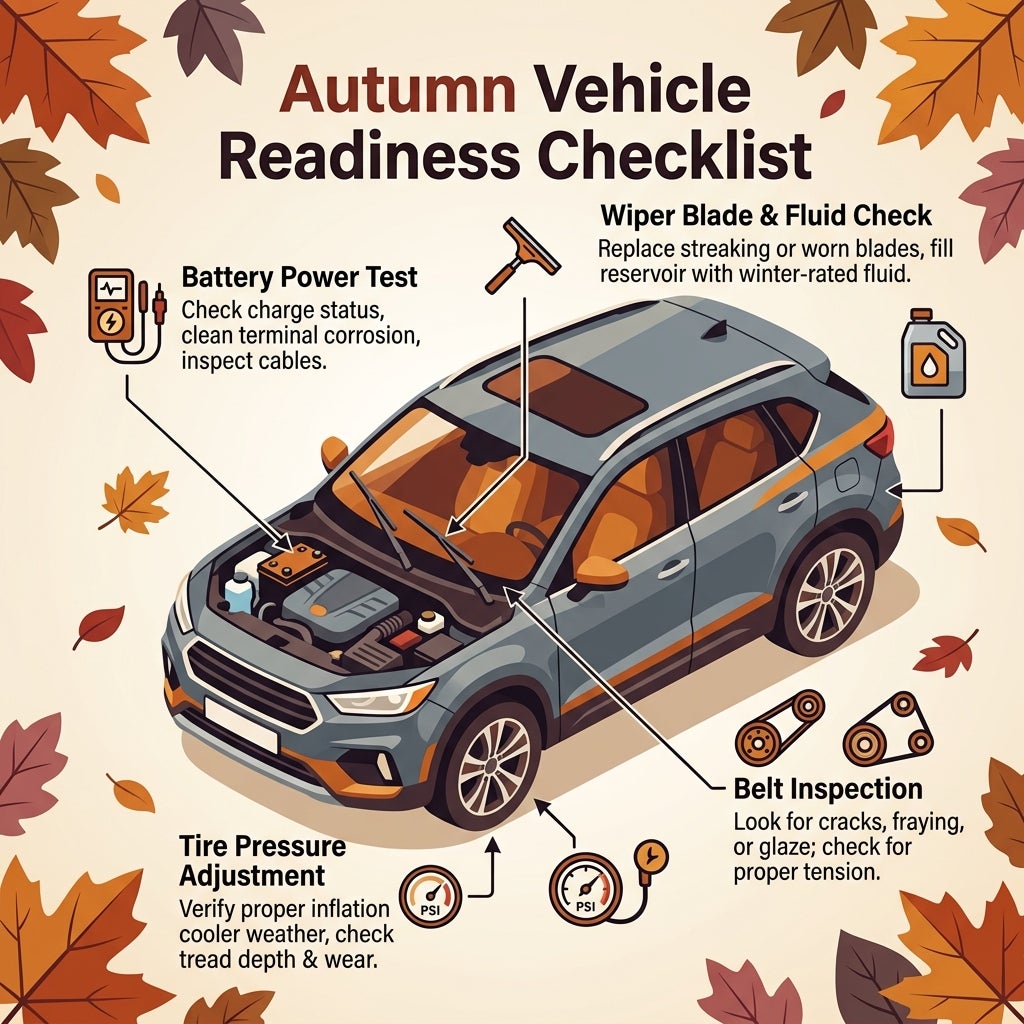
Illustrated Autumn Vehicle Readiness Checklist detailing battery, wiper, tire, and belt inspection tips for a car. (Representative image for illustration purposes only. Actual vehicle may vary based on trim and configuration.)

What I Tell Drivers About Getting Vehicles Ready for Autumn Weather

What I Tell Drivers About Getting Vehicles Ready for Autumn Weather You should start getting your vehicle ready for fall weather in late August or early September before ambient temperatures consistently drop below 50 degrees Fahrenheit. Preparing your car early ensures weak batteries, worn wiper blades, and soft tire pressures are corrected before cold rain, wet leaves, and early morning frosts hit local roads, while also beating the winter service rush at the dealership. When Should You Start Getting Your Vehicle Ready for Fall Weather? The ideal window for autumn vehicle preparation begins during the tail end of summer, ideally between late August and mid-September. Ambient temperatures begin fluctuating during these weeks, causing thermal contraction in your tires and placing initial cold-start stress on your electrical system. Handling maintenance before the autumn equinox guarantees that your vehicle is fully conditioned before daylight hours shorten and wet leaves make road surfaces slick. Getting ahead of the seasonal transition also helps you avoid peak wait times when the first hard frost triggers a sudden rush for service. Early preparation is particularly important because cold morning starts require higher amperage from your battery just as chemical reactions inside the battery cells slow down. Furthermore, rubber components like wiper blades and serpentine belts that survived summer heat can rapidly harden, crack, or chatter when exposed to damp, 40-degree mornings. By inspecting these wear items early, you prevent minor degradation from turning into an unexpected breakdown on your morning commute. Our team at Tri State Ford makes seasonal maintenance straightforward whether you are swinging by for a rapid multi-point inspection or dropping off your vehicle for comprehensive care. If you need to drop off your vehicle, our service center location on Pennsylvania Ave is easy to reach, or you can give us a quick call at (330) 462-7578 to speak directly with our service desk. Table of Contents What Items Belong on Your Essential Fall Maintenance Checklist? Why Is Fall the Ideal Season to Schedule Preventive Auto Care? What Should You Request When Booking a Professional Fall Service Visit? Which Seasonal Prep Tasks Are Safe to Do Yourself Versus Professional Service? What Must-Have Items Belong in Your Autumn Emergency Kit and Service Records? What Items Belong on Your Essential Fall Maintenance Checklist? A thorough fall car maintenance checklist focuses on the vital systems that handle cold, wet, and dark driving conditions: battery health, tire traction, brake efficiency, fluid protection, and exterior lighting. Systematically evaluating these key areas prevents cold-weather failures and maintains vehicle control on unpredictable autumn pavement. Battery and Charging System: Test cold-cranking amps and clean corrosion from terminal posts to ensure reliable morning starts. Tires and Tread Depth: Measure tread depth across all four tires, check for uneven wear, and adjust inflation pressure to match door-jamb specifications. Wiper Blades and Washer Fluid: Replace streaking wiper blades and top off the fluid reservoir with a cold-weather washer formula that will not freeze on the windshield. Brake System: Inspect brake pads, rotors, and fluid condition to maintain short stopping distances on wet leaves and frosty roads. Exterior Lighting: Verify function for all headlights, taillights, brake lights, and turn signals to maximize visibility during shorter autumn days. Belts and Hoses: Inspect engine rubber for cracking, fraying, or soft spots that worsen when temperatures drop. Tires require extra vigilance in the autumn because tire pressure drops approximately 1 to 2 PSI for every 10-degree drop in outside temperature. A tire that was properly inflated at 85 degrees in July can easily be underinflated by 4 to 5 PSI by October. For vehicles like the 2026 Ford Escape featuring All-wheel drive and a 1.5L EcoBoost engine, maintaining correct tire pressure ensures the intelligent AWD system properly distributes torque across wet roads. Inspecting tread depth is equally critical; while 2/32 inch is the legal limit, a minimum tread depth of 4/32 inch is strongly recommended for safely channeling water and mud away from your tire footprint. Brake condition directly impacts family safety when autumn rain turns dry pavement into a slick surface. We check pad thickness to ensure at least 4 mm of friction material remains, while verifying that brake fluid is clean and free of moisture contamination. If your vehicle needs routine upkeep, you can easily schedule a service appointment with our factory-trained technicians, or order genuine Ford parts through our dedicated parts department. Why Is Fall the Ideal Season to Schedule Preventive Auto Care? Fall provides a balanced climate window where environmental stress on your vehicle is moderate, making it the most cost-effective and practical time to catch mechanical wear before severe winter weather sets in. Summer heat breaks down engine oil, degrades battery fluid, and bakes wiper rubber, leaving major components vulnerable right as cold weather arrives. Addressing these issues in autumn restores protective fluid barriers and replaces compromised components before sub-freezing temperatures amplify mechanical strain. Scheduling preventive service during autumn also protects major mechanical systems from cascading failures. For instance, replacing a worn serpentine belt in September prevents an alternator or water pump failure on a freezing night. Similarly, replacing aged engine coolant ensures your cooling system maintains proper anti-freeze protection down to sub-zero temperatures while preventing internal engine corrosion. The 2026 Ford Explorer with its 2.3L EcoBoost engine and SelectShift® automatic transmission relies on precise fluid viscosities to deliver smooth power and efficient heating to the cabin, making seasonal fluid verifications essential. Drivers navigating the rolling elevation along State Route 170 in Calcutta particularly benefit from fall brake and suspension checkups, where damp autumn leaves on hilly stretches test vehicle stability every single morning. To make maintaining your vehicle completely hassle-free, our dealership offers Ford Pick Up & Delivery service, allowing us to pick up your vehicle from your home or office, complete all needed autumn maintenance, and return it directly to you. What Should You Request When Booking a Professional Fall Service Visit? When booking a professional fall service visit, you should request a comprehensive pre-winter multi-point inspection that includes a digital battery conductance load test, brake pad and rotor measurement, cooling system hydrometer test, and a complete HVAC defroster check. Requesting a systematic inspection ensures that hidden issues like microscopic belt cracks, weak battery cells, or moisture-contaminated brake fluid are identified before severe weather arrives. During a professional fall checkup, our factory-certified technicians perform targeted diagnostics that go beyond basic visual checks: Battery Conductance Load Testing: Measuring actual cold-cranking performance against factory ratings rather than relying solely on static voltage. Cooling System Protection Analysis: Testing antifreeze concentration to ensure freeze protection down to minus 20 degrees Fahrenheit or lower. Brake Hydraulics and Hardware Inspection: Measuring pad thickness in millimeters, checking rotor runout, and testing brake fluid for moisture content. HVAC and Defroster Calibration: Verifying heater core performance, cabin air filter cleanliness, and air-blend door operation to guarantee clear windshield defogging. Undercarriage and Suspension Check: Inspecting shocks, struts, ball joints, and protective boots before road salt season begins. Because cold weather places extraordinary electrical demand on modern vehicles—powering seat warmers, heated steering wheels, defrosters, and headlights simultaneously—knowing the exact condition of your charging system is paramount. You can explore complete details on charging system checks and routine battery testing and maintenance to understand how our certified technicians evaluate battery reserve capacity. ​ Which Seasonal Prep Tasks Are Safe to Do Yourself Versus Professional Service? Basic seasonal prep tasks like checking tire pressure, inspecting wiper blades, topping off washer fluid, testing exterior lights, and changing the cabin air filter are safe and simple to perform at home. Complex diagnostics—including battery load testing, brake pad thickness measurements, cooling system flushes, and suspension alignments—require specialized equipment, calibrated tools, and professional expertise to execute safely and accurately. Doing your own basic maintenance offers a practical way to stay connected with your vehicle’s condition between professional service visits. You can easily test tire tread depth at home using a standard quarter: insert the coin upside down into the center tread groove, and if the top of Washington's head is covered by tread, your tires have more than 4/32 inch of tread depth remaining. Likewise, checking wiper blades for small tears and topping off your windshield washer reservoir with a winter blend takes only a few minutes in your driveway. When tasks involve hydraulic pressure, high electrical amperage, or precision alignment, professional service is essential. Tasks like changing DOT 4 brake fluid every three years require proper system bleeding to prevent air lock, while evaluating high-output charging systems on a heavy-duty truck like the 2026 Ford F-150 with its 3.5L EcoBoost engine requires professional diagnostic tools. For customers who prefer expert care delivered to their driveway, our Ford Mobile Service options allow our certified technicians to complete routine maintenance directly at your location. ​ What Must-Have Items Belong in Your Autumn Emergency Kit and Service Records? An autumn emergency car kit should contain essential safety supplies for warmth, visibility, traction, and communication, stored securely inside the passenger cabin rather than locked in the trunk. Keeping a dedicated folder or digital record of your fall maintenance receipts and safety kit updates helps you track component lifespans, maintain complete warranty compliance, and preserve optimal resale value over time. A well-equipped emergency kit for fall and early winter includes: Warmth and Protection: Heavy fleece blankets, waterproof gloves, thermal hats, and disposable hand warmers. Visibility and Signaling: A high-lumen LED flashlight with extra batteries, reflective hazard triangles, and a high-visibility safety vest. Traction and Recovery: A compact folding snow shovel, traction mats, non-clumping clay litter or sand, and heavy-duty jumper cables or a portable lithium jump-starter pack. Communication and First Aid: A fully charged USB power bank, extra phone charging cables, bottled water, non-perishable protein snacks, and a compact first-aid kit. Always store your emergency kit in the rear seat area or under a seating row rather than in the trunk, as rear-end collisions or frozen trunk locks can make trunk-stored items inaccessible during an emergency. If you ever experience an unexpected roadside failure, remember that Ford Roadside Assistance: (800) 241-3673 provides manufacturer-backed towing, jump-starts, and flat tire changes directly to an authorized service facility. Drivers traversing the steep riverfront bluffs around East Liverpool know how quickly autumn weather can turn rainy streets into challenging drives. Tracking your maintenance history and emergency gear ensures total peace of mind wherever the road takes you. When you are ready for expert vehicle care, feel free to stop by our service center location on Pennsylvania Ave or give our service department a quick call at (330) 462-7578 to keep your vehicle running smoothly all season long. © 2026 Tri State Ford. All rights reserved. Vehicle specification data © JATO Dynamics Limited. Title Tags Meta Description Keywords Open Graph Twitter Card Canonical Article Metadata Geographic Targeting