

Blog / Maintenance & Service, Tire Care & Repair, Wheel Alignment & Balancing, Suspension Maintenance,

Restoring Smooth Performance Through Precision Tire Balancing

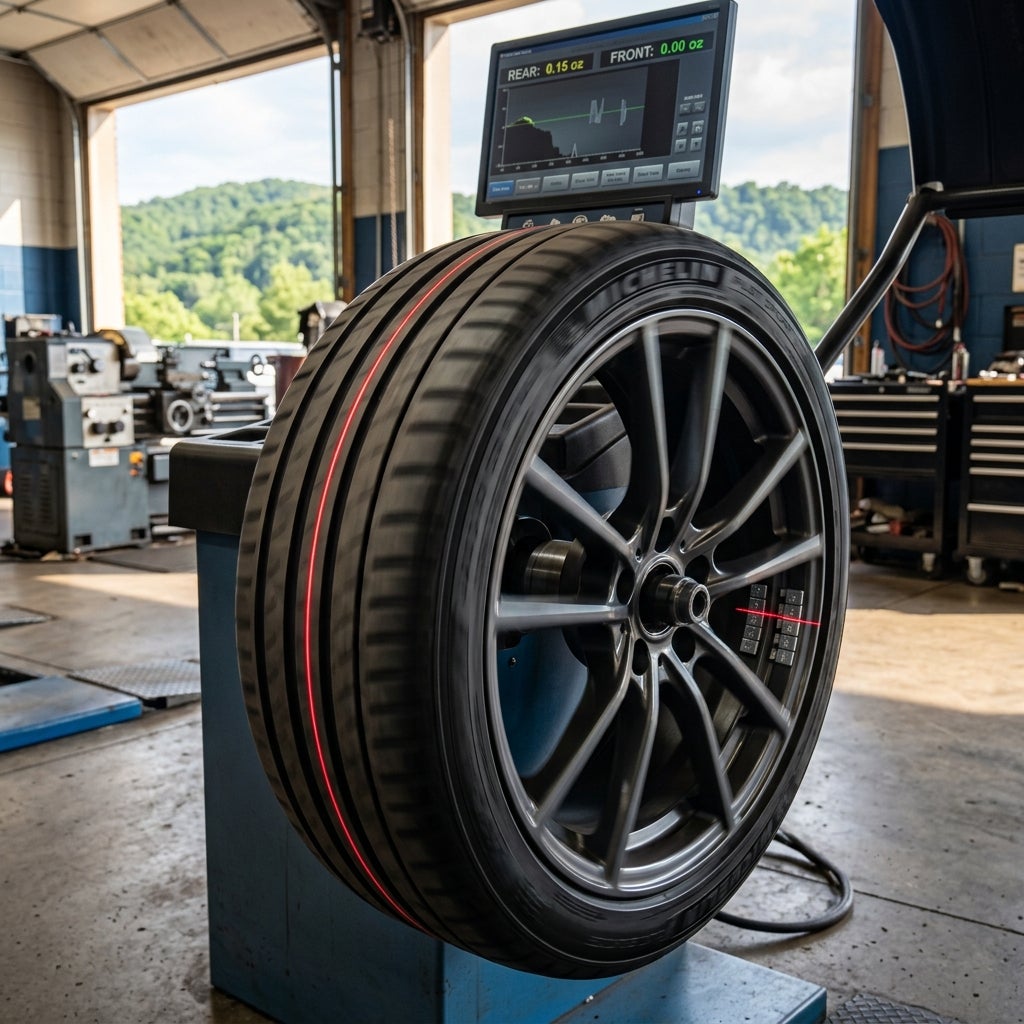
Close-up shot of a modern automotive tire and sleek alloy rim mounted on a high-precision digital balancing machine, the tire spinning with a slight motion blur to suggest speed and smoothness, a glowing red laser diagnostic line projected across the deep black rubber tread, small silver adhesive co

Restoring Smooth Performance Through Precision Tire Balancing

Maintaining a smooth ride on the road involves more than just keeping your tires inflated. Tire balancing is the process of equalizing the weight of the combined tire and wheel assembly so that it spins smoothly at high speeds. Even a tiny weight discrepancy—sometimes as small as a fraction of an ounce—can create enough centrifugal force to cause noticeable vibrations. When the weight is distributed unevenly, the tire develops "heavy spots" that hit the pavement with more force than the rest of the tread, leading to a shaky steering wheel and premature wear on your suspension components.

Our team often sees vehicles come in where the driver assumes a shake is just part of the car aging, but it is usually a sign that the lead weights or adhesive strips on the rim have shifted or fallen off. We use specialized machinery to spin the assembly and identify these imbalances with extreme precision. By adding small counterweights to the wheel, we ensure the center of gravity is perfectly aligned with the axis of rotation. This service is a fundamental part of routine maintenance that protects your investment in high-quality rubber and keeps your daily drives across the river into West Virginia feeling stable and controlled.

If you have noticed a new shimmy in your seat or steering wheel, it is a good idea to schedule a service appointment to have your balance checked. Neglecting this simple step can lead to cupping, a type of uneven tread wear that eventually requires you to replace the tires much sooner than expected. For those driving into the area from across the state line, our East Liverpool service center is conveniently located to handle these quick diagnostic checks. If you have questions about a specific vibration you are feeling, feel free to give our technicians a quick call at (330) 462-7578 for professional advice.

Table of Contents

Identifying Common Symptoms of Unbalanced Tires and Weight Distribution

How do you know when your tires have lost their equilibrium? The most frequent indicator is a vibration that seems to "wake up" once you reach highway speeds. Unlike a bent rim or a bad wheel bearing, which might growl or shake at all speeds, a balance issue typically has a specific "sweet spot"—often between 45 mph and 60 mph—where the vibration is most violent. If the shake is felt primarily in the steering wheel, the problem is likely with the front tires. If the vibration is felt in the seat or the floorboards, it usually points to the rear assembly.

Beyond the physical sensation of shaking, you can often see the evidence of imbalance through visual inspections of the tread. Look for "patchy" wear patterns where some areas of the tread are deeper than others. This occurs because the unbalanced tire is literally bouncing down the road, making uneven contact with the asphalt. This constant hopping doesn't just ruin the tire; it puts unnecessary stress on your shocks and struts, which are forced to work overtime to dampen the extra movement. For residents in Calcutta who deal with the rolling hills and changing elevations of northeastern Ohio, maintaining a balanced tire is crucial for keeping the vehicle's footprint consistent and safe.

If your tread has already reached the point of no return due to long-term neglect, you can use our online tire search tool to find a fresh set matched to your specific Ford model. We also carry a full inventory of suspension components if the vibrations have caused wear on other parts; you can order genuine Ford parts directly through our website. For those considering a different vehicle altogether due to mounting maintenance needs, we can help you get a KBB instant cash offer for your current car to see where you stand.​

Technical Differences Between Static and Dynamic Balancing Methods

Precision maintenance requires choosing the right tool for the job, and tire balancing generally falls into two categories: static and dynamic. Static balancing is the most basic form, often referred to as "bubble balancing." In this method, the tire is placed on a vertical spindle. If one side is heavier, it will tilt. The technician then places a weight on the opposite side to level it out. While this addresses vertical movement (the "up and down" hop), it is rarely sufficient for modern vehicles with wide tires and high-speed capabilities.

Dynamic balancing is the industry standard we use for the majority of our customers. This process involves an electronic balancer that spins the wheel at high speeds to measure weight distribution across two planes: lateral (side-to-side) and radial (up-and-down). This identifies "wobble" or "shimmy" that static balancing simply cannot detect. By placing weights on both the inner and outer flanges of the wheel, we create a truly balanced rotation that remains stable even at 70 mph. This level of precision is especially important for heavy-duty applications, such as those found in our new truck inventory, where the larger mass of the wheel can amplify even minor imbalances.

For commercial operators and business owners using our new work truck inventory, dynamic balancing is non-negotiable for long-term reliability. A heavy-duty F-Series truck carrying a full payload puts massive pressure on the tires; if they aren't balanced across both planes, the resulting heat buildup can lead to premature tire failure. If you are managing a fleet or a personal work vehicle, our finance department can discuss service contract options that help bundle these routine maintenance needs into a predictable budget, ensuring your equipment stays on the road and out of the shop.
​2026 Ford Bronco Sport Heritage, nostalgic aesthetic, Robin’s Egg Blue paint with an Oxford White roof and grille, parked on a gravel landing beside the Ohio River in East Liverpool, wide-angle ground-level shot, early morning spring light, misty river atmosphere, lush green riparian vegetation, bud

Advanced Road Force Balancing for Specialized Driving Conditions

Sometimes, a standard dynamic balance isn't enough to solve a persistent vibration. This is where road force balancing comes into play. While a traditional balancer spins the tire in the air, a road force balancer uses a large "load roller" to press against the tire, simulating the weight of the vehicle and the force of the road. This specialized diagnostic tool can detect "force variation," which is a fancy way of saying it finds hard spots in the tire's internal structure or slight inconsistencies in the rim's roundness that a spin-balancer would miss.

This service is particularly valuable for high-performance vehicles or those with low-profile tires, which have less sidewall to absorb imperfections. It is also a lifesaver for heavy-duty haulers. If you are frequently towing through the steep riverfront bluffs of East Liverpool, the sheer amount of weight on your rear axle makes tire uniformity critical. Road force balancing can tell a technician to "match mount" the tire—rotating it on the rim so the lowest point of the wheel aligns with the highest point of the tire—effectively canceling out structural irregularities.

Balancing TypeBest Use CaseKey Benefit
StaticSmall trailers, spare tiresSimple vertical correction
DynamicStandard passenger cars, SUVsCorrects both hop and wobble
Road ForcePerformance cars, heavy trucksSimulates real-world driving

We often recommend this advanced service for our specialized work truck inventory to ensure the smoothest possible operation under load. You can often find savings on these specialized services by checking our current vehicle service offers. Whether you are driving a precision-tuned Mustang or a rugged F-150 from our truck inventory, road force balancing provides the ultimate assurance that your tires are perfectly round and ready for the road.

Distinguishing Balancing Needs from Proper Wheel Alignment Service

A common point of confusion for many drivers is the difference between balancing and alignment. While both affect your ride quality and tire life, they address completely different mechanical issues. Think of balancing as a fix for the tire and wheel itself, while alignment is a fix for the vehicle’s suspension system. If your car is vibrating, you likely need a balance. If your car is pulling to one side or the steering wheel is crooked while you are driving straight, you almost certainly need an alignment.

Alignment involves adjusting the angles of the wheels—known as camber, caster, and toe—so they are perfectly parallel to each other and perpendicular to the ground. This is often necessary after hitting a deep pothole or a curb, which are common hazards for those navigating the industrial backroads of Chester. If you ignore a bad alignment, your tires will develop "feathering" or one-sided wear, which no amount of balancing can fix. We recommend checking your alignment every time you get new tires or if you notice your Ford isn't tracking straight.

  • Balancing: Fixes vibrations; involves adding weights to the rim.
  • Alignment: Fixes pulling and crooked steering; involves adjusting suspension angles.
  • Tire Rotation: Moves tires to different positions to ensure even wear across all four.

To help keep these services affordable, we frequently offer monthly service specials that combine these essential maintenance tasks. If you are tight on time, our mobile service van can even come to your home or workplace for certain light maintenance needs. Beyond tires, remember that other components like your electrical system need attention too; we provide expert battery testing and replacement to ensure your vehicle starts reliably every morning.

Common Questions Regarding Tire Vibrations and Maintenance Intervals

One of the most frequent questions we hear from families during a multi-point inspection is how often they should actually have their tires balanced. As a general rule of thumb, you should have your tires balanced every 5,000 to 7,500 miles. A great way to remember this is to simply request a balance every time you have your oil changed or your tires rotated. However, if you feel a vibration before that interval is up, don't wait—small imbalances can quickly turn into expensive suspension repairs if left unchecked.

Another common concern involves the quality of the tires themselves. While it is tempting to go with the lowest-priced option, premium tires often stay in balance longer because they are manufactured with higher consistency and better materials. Entry-level tires may have more internal variations that cause them to go out of balance as the rubber wears down. Regardless of the tire you choose, keeping them balanced is the best way to ensure you get every mile of life out of them.

Quick Answers for Your Next Visit

Q: If I can only afford one service right now, should I choose balancing or alignment? If your main symptom is a vibration or shaking, prioritize balancing. If your car is pulling to the side or the steering wheel is off-center, prioritize the alignment. However, if you see rapid, uneven tread wear, you likely need both to prevent destroying your tires.

Q: Can I balance my own tires at home with a DIY kit? While bubble balancers exist for home use, they only provide a static balance. Modern vehicles require the precision of an electronic dynamic balancer to ensure safety at highway speeds. It is always safer to have a professional technician handle the calibration.

Q: Why did my tire go out of balance so suddenly? The most common reason for a sudden imbalance is losing a wheel weight after hitting a bump. Another possibility is "mud packing," where dried mud or snow gets stuck inside the rim, acting as an unintended weight.

Q: Does road force balancing take longer than a standard balance? Yes, it typically takes a bit more time because the technician must run a diagnostic cycle with the load roller and may need to reposition the tire on the rim. However, for persistent vibrations, the extra time is well worth the result.

If you are ready to experience a smoother, quieter ride, our East Liverpool location is ready to help. You can also start a custom vehicle order if you want a Ford factory-built exactly to your specifications, including your choice of performance wheels and tires. For any other questions, feel free to give our service desk a quick call at (330) 462-7578 today.

© 2026 Tri State Ford. All rights reserved.

Posted in:

Recommended Posts

h

How Often Should I Change My Oil

.hrizn-rte-content .e-rte-image{border:0;max-width:100%;height:auto} .hrizn-rte-content .e-rte-image.e-imginline{display:inline-block;float:none;margin-left:5px;margin-right:5px;max-width:calc(100% - 10px);vertical-align:bottom} .hrizn-rte-content .e-rte-image.e-imgbreak,.hrizn-rte-content .e-rte-image.e-imgcenter{display:block;float:none;margin:5px auto;max-width:100%} .hrizn-rte-content .e-rte-image.e-imgleft{float:left;margin:0 12px 8px 0;max-width:100%} .hrizn-rte-content .e-rte-image.e-imgright{float:right;margin:0 0 8px 12px;max-width:100%} .hrizn-rte-content figure.e-rte-image{margin:8px auto;max-width:100%} .hrizn-rte-content figure.e-imgleft{float:left;margin:0 12px 8px 0} .hrizn-rte-content figure.e-imgright{float:right;margin:0 0 8px 12px} .hrizn-rte-content figure.e-imgcenter{display:block;margin:8px auto;text-align:center} Most modern vehicles using full synthetic or synthetic-blend motor oil require an oil change every 7,500 to 10,000 miles or once every 12 months, whichever arrives first. Advances in engine manufacturing, precise internal tolerances, and modern lubricant chemistry have safely extended service intervals far beyond older maintenance habits for standard daily driving. Automotive engine technology has evolved significantly over the past two decades. Modern powertrains, such as the 2.3L EcoBoost engine in the Ford Explorer or the 1.5L engine in the Ford Escape Hybrid, operate with exceptional thermal efficiency and tight mechanical clearances. These engineering improvements reduce the rate at which combustion byproducts pollute the crankcase, allowing clean motor oil to protect moving parts over longer distances. Distance is only half of the maintenance equation. Engine oil breaks down over time due to exposure to oxygen, ambient moisture, and fuel vapors. A vehicle driven for only 3,000 miles in a calendar year still requires an annual oil and filter refresh. Low-mileage driving along suburban routes around Calcutta often involves short trips that prevent the engine from reaching full operating temperature. When an engine remains cool, condensed water vapor accumulates inside the oil pan rather than evaporating off, creating acidic compounds that harm internal seals over time. Following the exact maintenance schedule outlined by the vehicle manufacturer preserves long-term dependability and maintains factory warranty coverage. To review your specific maintenance schedule or speak with certified technicians, visit our service center on Pennsylvania Avenue or give our team a quick call to discuss your driving routine. Table of Contents Is the 3,000-Mile Oil Change Rule Still Valid for Modern Engines? Normal vs. Severe Service Schedules: What Driving Habits Shorten Oil Life? Conventional vs. Synthetic Oil: What Are Typical Service Intervals? How to Check Motor Oil Correctly and Spot Overdue Symptoms Common Questions About Engine Oil Care and Maintenance Intervals Schedule Reliable Engine Care and Routine Service Is the 3,000-Mile Oil Change Rule Still Valid for Modern Engines? The traditional 3,000-mile oil change rule is no longer necessary for modern vehicles operating under normal driving conditions. Contemporary engines feature advanced metallurgy and precise fuel injection systems that, when paired with high-quality synthetic lubricants, maintain protective viscosity well past 7,500 miles. The 3,000-mile guideline originated decades ago when carbureted engines and basic mineral oils were the industry standard. Older engine designs permitted higher rates of unburnt fuel to wash down cylinder walls into the oil pan. Older mineral oils also suffered from rapid thermal breakdown, losing their ability to lubricate critical components under sustained high heat. Modern synthetic lubricants contain advanced detergent packages, anti-wear additives, and shear-stable base stocks designed to withstand extreme pressure without thinning out prematurely. Changing your motor oil every 3,000 miles on a modern engine running under standard conditions results in unnecessary service expenses and wasted fluid. Automakers engineer modern maintenance schedules around real-world oil degradation rates. Adhering to a 7,500-mile to 10,000-mile service window provides complete engine protection while optimizing your maintenance schedule. Selecting the proper filter is just as critical as choosing the right oil viscosity. A high-efficiency oil filter removes microscopic metal particles and carbon deposits down to tiny micron levels. When performing routine maintenance at home, ordering genuine Ford oil filters and OEM fluids ensures proper bypass valve calibration and continuous oil flow to upper valvetrain components. Normal vs. Severe Service Schedules: What Driving Habits Shorten Oil Life? Severe service maintenance schedules require changing motor oil every 3,000 to 5,000 miles due to operational demands that accelerate fluid contamination and thermal breakdown. Driving patterns that involve frequent short trips, heavy payload hauling, extended idling, or extreme local weather classify a vehicle for severe-duty service intervals. Understanding what constitutes severe service helps protect your engine against premature wear. Automakers define severe driving conditions through several specific operational scenarios: Frequent short trips: Drives under 5 miles in ambient weather, or under 10 miles in freezing temperatures, prevent the engine from reaching steady-state heat, trapping moisture inside the crankcase. Heavy stop-and-go driving: Navigating urban traffic or idling for extended periods increases engine operating hours without accumulating odometer miles. Towing and heavy loads: Hauling trailers or maximum cargo with a truck like the Ford F-150 equipped with the 3.5L EcoBoost engine subjects the motor oil to elevated thermal loads and shearing forces. Harsh terrain and dust: Driving on unpaved gravel roads or navigating steep inclines, such as the riverfront bluffs in East Liverpool, forces the engine to work harder while exposing intake systems to elevated dust levels. During routine service check-ins, drivers frequently ask whether short winter commuting requires earlier oil changes than highway driving. Operating a vehicle during freezing weather without reaching full operating heat creates sludge buildup faster than high-speed turnpike cruising. Reviewing your daily drive pattern with a technician clarifies whether your vehicle benefits from a severe-service maintenance window. Maintaining proper underlying systems also prevents oil degradation; monitoring routine vehicle maintenance and battery health guidelines ensures strong starter engagement during cold-weather startups. Conventional vs. Synthetic Oil: What Are Typical Service Intervals? Full synthetic motor oil typically delivers 7,500 to 10,000 miles of engine protection between changes, whereas conventional mineral oil requires replacement every 3,000 to 5,000 miles. Synthetic blend formulations offer a middle ground, providing reliable wear protection for 5,000 to 7,500 miles under normal driving conditions. Full synthetic oil undergoes a comprehensive chemical refining process that uniformizes molecular structures. This uniformity allows synthetic fluid to flow instantly during freezing cold startups while resisting high-temperature oxidation during summer operation. Conventional oil consists of refined crude mineral fluid with irregular molecular sizes, making it more vulnerable to thermal breakdown, evaporation, and sludge accumulation under heavy engine strain. Modern Ford vehicles utilize an onboard Intelligent Oil-Life Monitor system that removes guesswork from scheduling fluid changes. Rather than relying solely on static mileage tracking, the system continuously analyzes sensor inputs including: Engine operating temperatures and cold-start frequency Total engine revolutions and load factors Extended idling duration and towing hours When the system calculates that fluid life has reached approximately 5%, it displays a "Change Engine Oil Soon" message on the instrument cluster, followed by an "Oil Change Required" alert at 0%. Following these digital prompts guarantees that you replace fluid precisely when required. For drivers managing busy weekly routines, taking advantage of Ford mobile service options allows certified technicians to complete routine oil and filter maintenance directly in your driveway or workplace parking lot. How to Check Motor Oil Correctly and Spot Overdue Symptoms To obtain an accurate motor oil reading, check the dipstick roughly 5 to 10 minutes after turning off a fully warmed-up engine while parked on a level surface. Waiting several minutes allows fluid circulating through the upper cylinder heads to drain back completely into the oil pan. Checking your oil level involves a straightforward step-by-step process: Park the vehicle on flat, level ground and turn off the ignition after the engine reaches normal operating temperature. Allow the engine to rest for 5 to 10 minutes so internal fluid settles into the sump. Open the hood, locate the dipstick handle, pull the dipstick out completely, and wipe it clean with a lint-free rag. Reinsert the dipstick fully into its tube, then pull it back out to inspect the oil level relative to the crosshatched indicators. Verify that the fluid line sits comfortably between the minimum and maximum fill marks. Recognizing early indicators of degraded motor oil prevents expensive internal mechanical damage. Postponing oil changes past recommended limits produces distinct warning signs: Dark, gritty fluid: Fresh oil displays a clear amber color; thick, black, or abrasive fluid indicates heavy carbon accumulation. Valvetrain ticking noises: Depleted oil loses hydraulic film strength, causing metallic tapping or ticking sounds from hydraulic lifters upon startup. Strong fuel odor: An oil level reading above the maximum mark accompanied by a sharp smell of gasoline points to fuel dilution inside the crankcase. Dashboard illuminated alerts: Low oil pressure light warnings or persistent oil maintenance messages signal immediate service requirements. Common Questions About Engine Oil Care and Maintenance Intervals Q: Should motor oil be changed by calendar time even if the vehicle is barely driven? Yes, motor oil must be replaced at least once every 12 months regardless of how few miles appear on the odometer. Over time, stationary oil inside the crankcase absorbs ambient moisture and unburnt fuel byproducts. This chemical reaction creates internal acids and harmful sludge that can corrode engine bearings and degrade internal seals even while the vehicle remains parked inside a garage. Q: Can synthetic motor oil be used in older engines or vehicles previously using conventional oil? Switching to full synthetic motor oil in older vehicles or engines that previously used conventional oil is completely safe and beneficial. Modern synthetic formulations meet rigorous API SP and ILSAC GF-6A performance standards, offering immediate oil pressure during cold engine starts and superior resistance against thermal breakdown without causing seal leaks or internal damage. Q: What does it mean if the oil level is overfull and smells strongly of gasoline? An oil level reading above the full mark paired with a strong gasoline odor indicates fuel dilution inside the crankcase. This condition commonly occurs when vehicles are driven exclusively on short, cold trips or when a fuel injector leaks. Unburnt fuel thins the motor oil, destroying its lubricating properties, and requires immediate fluid replacement to avoid bearing damage. Q: Is it necessary to replace the oil filter during every oil change? Replacing the engine oil filter during every service appointment is essential for long-term engine durability. The oil filter traps microscopic metal particles, dirt, and carbon debris generated during combustion. Leaving a saturated, dirty filter in place forces fresh motor oil through the filter's internal bypass valve, recirculating trapped contaminants directly back into critical engine components. Q: How does Ford’s Intelligent Oil-Life Monitor know when service is due? The Intelligent Oil-Life Monitor calculates fluid degradation by continuously analyzing operational data from the powertrain control module. It evaluates total engine revolutions, ambient operating temperatures, idling time, and towing duration. By calculating real-world engine stress rather than using simple mileage counting, it accurately alerts the driver when oil life reaches 5% remaining capacity. To keep your vehicle running smoothly, you can easily schedule a service appointment online with our certified maintenance team. Schedule Reliable Engine Care and Routine Service Adhering to correct oil change intervals is the single most effective action you can take to preserve engine performance, maximize fuel economy, and ensure long-term vehicle reliability. Whether your daily commute calls for standard 7,500-mile synthetic service or your towing habits require a 5,000-mile severe-duty schedule, maintaining fresh lubricants protects your investment mile after mile. Our factory-trained technicians at Tri State Ford utilize genuine OEM filters and manufacturer-recommended oil viscosities tailored specifically to your engine. Located at 1503 Pennsylvania Ave, East Liverpool, OH 43920, our service center provides complete vehicle maintenance, routine multi-point safety inspections, and transparent care for every driver. Take the next step in protecting your powertrain by exploring our available service slots today. You can get directions to Tri State Ford to plan your visit or give our service department a quick call to speak directly with an advisor about your vehicle's maintenance needs. © 2026 Tri State Ford. All rights reserved. Vehicle specification data © JATO Dynamics Limited. Title Tags Modern Vehicle Oil Change Intervals in East Liverpool OH | Tri State Ford Meta Description Keywords Open Graph Twitter Card Canonical Article Metadata Geographic Targeting { "@context": "https://schema.org", "@graph": [ { "@type": "NewsArticle", "@id": "#article", "headline": "How Often Does a Modern Vehicle Actually Need an Oil Change?", "datePublished": "2026-08-29T20:26:59.455Z", "dateModified": "2026-08-29T20:28:48.963Z", "author": { "@id": "#author" }, "publisher": { "@id": "#dealer" }, "wordCount": 1893, "description": "Modern vehicles using synthetic oil typically require oil changes every 7,500 to 10,000 miles or once a year, making the old 3,000-mile rule obsolete." }, { "@type": "AutoDealer", "@id": "#dealer", "name": "Tri State Ford", "url": "https://www.tristateford.net", "telephone": "+13304627578", "sameAs": [ "https://maps.google.com/?cid=1136336406351438323" ], "address": { "@type": "PostalAddress", "streetAddress": "1503 Pennsylvania Ave", "addressLocality": "East Liverpool", "addressRegion": "OH", "postalCode": "43920", "addressCountry": "US" }, "areaServed": { "@type": "GeoCircle", "geoMidpoint": { "@type": "GeoCoordinates", "latitude": "40.6367833", "longitude": "-80.5443033" }, "geoRadius": "48280" }, "geo": { "@type": "GeoCoordinates", "latitude": "40.6367833", "longitude": "-80.5443033" }, "openingHours": [ "Mo 09:00-20:00", "Tu 09:00-18:00", "We 09:00-18:00", "Th 09:00-20:00", "Fr 09:00-18:00", "Sa 09:00-15:00" ] }, { "@type": "FAQPage", "@id": "#faq", "mainEntity": [ { "@type": "Question", "name": "Should motor oil be changed by calendar time even if the vehicle is barely driven?", "acceptedAnswer": { "@type": "Answer", "text": "Yes, motor oil must be replaced at least once every 12 months regardless of how few miles appear on the odometer. Over time, stationary oil inside the crankcase absorbs ambient moisture and unburnt fuel byproducts. This chemical reaction creates internal acids and harmful sludge that can corrode engine bearings and degrade internal seals even while the vehicle remains parked inside a garage." } }, { "@type": "Question", "name": "Can synthetic motor oil be used in older engines or vehicles previously using conventional oil?", "acceptedAnswer": { "@type": "Answer", "text": "Switching to full synthetic motor oil in older vehicles or engines that previously used conventional oil is completely safe and beneficial. Modern synthetic formulations meet rigorous API SP and ILSAC GF-6A performance standards, offering immediate oil pressure during cold engine starts and superior resistance against thermal breakdown without causing seal leaks or internal damage." } }, { "@type": "Question", "name": "What does it mean if the oil level is overfull and smells strongly of gasoline?", "acceptedAnswer": { "@type": "Answer", "text": "An oil level reading above the full mark paired with a strong gasoline odor indicates fuel dilution inside the crankcase. This condition commonly occurs when vehicles are driven exclusively on short, cold trips or when a fuel injector leaks. Unburnt fuel thins the motor oil, destroying its lubricating properties, and requires immediate fluid replacement to avoid bearing damage." } }, { "@type": "Question", "name": "Is it necessary to replace the oil filter during every oil change?", "acceptedAnswer": { "@type": "Answer", "text": "Replacing the engine oil filter during every service appointment is essential for long-term engine durability. The oil filter traps microscopic metal particles, dirt, and carbon debris generated during combustion. Leaving a saturated, dirty filter in place forces fresh motor oil through the filter's internal bypass valve, recirculating trapped contaminants directly back into critical engine components." } }, { "@type": "Question", "name": "How does Ford’s Intelligent Oil-Life Monitor know when service is due?", "acceptedAnswer": { "@type": "Answer", "text": "The Intelligent Oil-Life Monitor calculates fluid degradation by continuously analyzing operational data from the powertrain control module. It evaluates total engine revolutions, ambient operating temperatures, idling time, and towing duration. By calculating real-world engine stress rather than using simple mileage counting, it accurately alerts the driver when oil life reaches 5% remaining capacity. To keep your vehicle running smoothly, you can easily schedule a service appointment online with our certified maintenance team." } } ] } ] }

g

What Should You Know Before Buying a Vehicle From a Local Ford Dealer?

.hrizn-rte-content .e-rte-image{border:0;max-width:100%;height:auto} .hrizn-rte-content .e-rte-image.e-imginline{display:inline-block;float:none;margin-left:5px;margin-right:5px;max-width:calc(100% - 10px);vertical-align:bottom} .hrizn-rte-content .e-rte-image.e-imgbreak,.hrizn-rte-content .e-rte-image.e-imgcenter{display:block;float:none;margin:5px auto;max-width:100%} .hrizn-rte-content .e-rte-image.e-imgleft{float:left;margin:0 12px 8px 0;max-width:100%} .hrizn-rte-content .e-rte-image.e-imgright{float:right;margin:0 0 8px 12px;max-width:100%} .hrizn-rte-content figure.e-rte-image{margin:8px auto;max-width:100%} .hrizn-rte-content figure.e-imgleft{float:left;margin:0 12px 8px 0} .hrizn-rte-content figure.e-imgright{float:right;margin:0 0 8px 12px} .hrizn-rte-content figure.e-imgcenter{display:block;margin:8px auto;text-align:center} Before purchasing a vehicle from a local Ford dealer, buyers should know their exact towing and seating requirements, understand transparent trim pricing, verify available manufacturer incentives, and check factory warranty coverage. Working directly with a local dealership provides access to certified inventory, competitive trade-in valuations, straightforward cross-border registration support, and long-term service. Establishing these practical priorities early ensures a smooth buying experience and maximizes total ownership value. Navigating the vehicle buying process requires clear information regarding model availability and dealership operations. At Tri State Ford, our showroom opens at 9:00 AM six days a week, remaining open until 8:00 PM on Mondays and Thursdays to accommodate evening walk-arounds, and closing at 3:00 PM on Saturdays. That flexibility allows shoppers to evaluate vehicles on their own schedule. Whether you need a workhorse truck or a family crossover, reviewing key vehicle specifications before visiting saves time and simplifies decision-making. Every new Ford comes backed by a 3-year/36,000-mile bumper-to-bumper warranty and a 5-year/60,000-mile powertrain warranty, providing essential peace of mind on regional roads. To streamline your purchase, you can plan your route to our showroom address at 1503 Pennsylvania Ave or give our team a quick phone call to confirm current availability. If you prefer specific factory options, color choices, or trailering packages, you can also start a new Ford factory custom order directly through our team to configure a vehicle that matches your exact daily requirements. Table of Contents Where Should You Start Your Ford Shopping Research and Model Comparison? What Are the Typical Price Ranges Across Ford F-150 Trim Levels? How Can You Maximize Your Trade-In Value and Financing Terms? Can Out-of-State Buyers Easily Purchase a Ford? Why Choose Tri State Ford for Your Next New or Certified Pre-Owned Vehicle? Common Questions About Buying a Vehicle at Tri State Ford Take the Next Step Toward Your Ford at Tri State Ford Where Should You Start Your Ford Shopping Research and Model Comparison? Shoppers planning a vehicle purchase should start their research by comparing body styles, cabin dimensions, fuel economy ratings, and core performance specs on the dealership website before taking a physical test drive. Comparing models online helps narrow down whether a compact crossover, a three-row SUV, or a full-size pickup fits your daily commute and weekend projects. Ford offers a versatile lineup built for diverse driving demands. For daily commuting and efficient travel, the 2026 Ford Escape delivers an EPA-estimated 26 city / 32 hwy mpg with its standard 1.5L engine and 8-speed automatic transmission, while providing about 37.5 cu ft of rear cargo space and an available 2,000-lb towing capacity with starting MSRP at $31,750. Families needing extra passenger seating often point to the 2026 Ford Explorer, which seats six across three rows, offers a 5,000-lb towing capacity, and features a standard 2.3L engine paired with SelectShift technology, starting at $42,585. For demanding job sites and heavy trailering, the 2026 Ford F-150 stands out with a maximum 10,400-lb towing capacity on select builds, about 53 cu ft cargo bed volume, and a powerful 3.5L engine starting at $69,625. You can easily explore our complete selection of new Ford vehicles to compare trims side by side, or review factory-certified pre-owned Ford inventory that includes multi-point inspections and extended limited warranty coverage. Pricing Pricing by trim Feature Active AWD Active FWD Platinum AWD ST-Line AWD ST-Line Elite AWD 2.0L ST-Line FWD ST-Line Select AWD 2.0L:--:--:--:--:--:--:--:-- Base MSRP $31,750 $30,350 $37,940 $32,595 $38,935 $31,195 $35,015 Destination charge $1,495 $1,495 $1,495 $1,495 $1,495 $1,495 $1,495 What Are the Typical Price Ranges Across Ford F-150 Trim Levels? Typical price ranges for the Ford F-150 span from around $40,000 for work-ready base models up into the $80,000 to $85,000 range for high-end luxury and high-performance trims. Final pricing depends heavily on cab style, bed length, drivetrain selection, and functional options packages. Understanding the trim structure helps buyers select the right capability without overspending: XL and STX: Starting around $40,085 to $44,395, these entry-level configurations feature durable cloth seating, the SYNC 4 infotainment system on a 12-inch touchscreen, and essential driver aids, making them ideal workhorses for fleet and entry-level buyers. XLT: Positioned in the $46,730 to $52,000 range, the XLT adds practical mid-tier comfort, advanced towing tech like Pro Trailer Backup Assist, and optional appearance packages. Lariat: Starting near $65,271, the Lariat introduces leather-trimmed heated and ventilated seating, advanced digital displays, and available hands-free BlueCruise highway driving capabilities. Tremor: Priced around $74,652, the Tremor provides dedicated off-road suspension tuning, rugged running boards, and enhanced ground clearance for rough terrain. King Ranch and Platinum: Ranging from $79,568 to $85,358, these luxury trims deliver premium leather upholstery, multi-contour massaging seats, Bang & Olufsen audio, and standard high-output engine options. Raptor: Starting near $85,137, the Raptor features long-travel off-road shocks and specialized hardware designed for extreme trail performance. Choosing the right engine also shapes overall value. The standard 2.7L EcoBoost V6 yields 325 hp and 400 lb-ft of torque while delivering 21 mpg combined, while the 5.0L V8 provides 400 hp and 410 lb-ft of torque. For maximum towing power, the 3.5L EcoBoost V6 delivers 400 hp and 500 lb-ft of torque, while the PowerBoost hybrid combination generates 430 hp and 570 lb-ft of torque alongside an EPA-estimated 23 mpg combined. Buyers can check current manufacturer vehicle offers and incentives to find factory current incentives and financing information on their preferred trim level. Engine & Performance Powertrain specs by trim Feature Active AWD Active FWD Platinum AWD ST-Line AWD ST-Line Elite AWD 2.0L ST-Line FWD ST-Line Select AWD 2.0L:--:--:--:--:--:--:--:-- Engine 1.5L 1.5L 2L 1.5L 2L 1.5L 2L Horsepower 180 hp 180 hp 250 hp 180 hp 250 hp 180 hp 250 hp Torque 199 lb-ft 199 lb-ft 280 lb-ft 199 lb-ft 280 lb-ft 199 lb-ft 280 lb-ft Transmission automatic 8-speed automatic 8-speed SelectShift® automatic 8-speed SelectShift® automatic 8-speed SelectShift® Drivetrain All-wheel drive Front-wheel drive All-wheel drive All-wheel drive All-wheel drive Front-wheel drive All-wheel drive How Can You Maximize Your Trade-In Value and Financing Terms? To maximize trade-in value and secure optimal financing terms, vehicle owners should gather complete maintenance records, provide both key fobs, clean the vehicle thoroughly, and review current auto loan interest rates before visiting the dealership. Taking these steps verifies proper vehicle maintenance and helps appraisers offer a top-tier trade valuation. In Ohio, trading in a vehicle offers a distinct tax advantage. State law applies sales tax only to the difference between your new vehicle purchase price and your trade-in allowance. For example, if you select a new vehicle priced at $40,000 and receive $18,000 for your trade, you pay sales tax strictly on the remaining $22,000. That tax credit saves hundreds of dollars compared to selling a vehicle privately and making a separate purchase. If you still owe money on an existing car loan, our finance team contacts your lender to request a 10-day payoff quote. Positive equity acts directly as a down payment toward your next purchase, while negative equity can often be structured into your new loan agreement. You can quickly value your trade-in online using industry-standard market data, then browse our current new vehicle inventory to combine your trade equity with competitive retail financing terms. Can Out-of-State Buyers Easily Purchase a Ford? Out-of-state buyers can easily purchase a Ford from an Ohio dealership through coordinated cross-border sales tax exemptions, proper temporary transit tags, and complete title transfer documentation. Dealership finance departments regularly structure cross-border transactions so buyers pay sales tax only in their home state and county upon registration. To prevent double taxation, our team completes an official out-of-state tax exemption document at signing, certifying that the vehicle is being transported directly out of state for registration. We structure auto loans to include your home state's exact sales taxes and registration fees, rolling those costs into one transparent monthly payment. For shoppers commuting from Pennsylvania or West Virginia, our staff manages physical notary filings and coordinates required Vehicle Identification Number verifications. Pennsylvania residents should note that state safety inspections must be completed at a certified station within 10 days of receiving Pennsylvania registration tags. Before traveling to the dealership, out-of-state shoppers can start the buying process from home. Completing a secure online auto finance application allows our team to pre-approve your file and calculate home-state taxes before you arrive, ensuring a quick and seamless showroom visit. Why Choose Tri State Ford for Your Next New or Certified Pre-Owned Vehicle? Tri State Ford provides a transparent buying environment focused on personal service, transparent trade appraisals, and comprehensive vehicle selection. Our sales team takes time to understand how you plan to use your vehicle, ensuring you get the exact towing capacity, interior versatility, and technology features your family or job site requires. For drivers navigating the rolling hills and wooded stretches near Beaver Creek along State Route 170 in Calcutta, dependable all-wheel-drive or 4x4 capability is essential for unpredictable winter weather. Likewise, commuters traveling the riverfront bluffs and historic manufacturing corridors along the Ohio River in East Liverpool require rugged durability and comfortable cabins for daily travel. Our local dealership model connects buyers directly to factory-backed warranty support, local trade-in assistance, and long-term vehicle care close to home. If emergency roadside issues occur, new Ford vehicles include manufacturer coverage for 5 years or 60,000 miles. You can reach immediate assistance directly via Ford Roadside Assistance: (800) 241-3673 for flat tire assistance, battery jump-starts, lockout service, and towing support. To get started on your next vehicle, obtain directions to our East Liverpool showroom or give our team a direct phone call to speak with a sales advisor. You can also explore our inventory of single-owner pre-owned vehicles to find high-quality, low-mileage pre-owned options with verified vehicle history reports. Common Questions About Buying a Vehicle at Tri State Ford Q: What paperwork should I bring to the dealership to complete my vehicle purchase? Buyers should bring a valid government-issued driver's license, current proof of auto insurance, and payment for any intended down payment. If you plan to trade in a vehicle, bring the title, registration, all vehicle key fobs, and current loan payoff documentation if the car is currently financed. Q: Can I apply my trade-in value toward a factory custom order? Yes, trade-in equity can be locked in and applied directly as a down payment toward a factory custom build. Our team appraises your current vehicle and structures the trade credit into your final custom order purchasing agreement. Q: What is the main operational difference between all-wheel drive and four-wheel drive on Ford vehicles? All-wheel drive operates automatically, continuously monitoring tire grip and transferring power between front and rear wheels without driver input. Four-wheel drive uses a selectable transfer case, allowing the driver to manually lock front and rear axles for maximum low-speed traction in deep snow, mud, or off-road conditions. Q: How does the Ohio sales tax credit work on a leased or purchased trade-in? When purchasing a vehicle, Ohio law deducts your trade-in's agreed value from the sale price of the new vehicle before sales tax is calculated. This tax credit applies directly to retail purchases, significantly lowering the total state and county tax owed at signing. Q: What safety features come standard on modern Ford vehicles? Most new Ford models include the Ford Co-Pilot360 driver-assist suite as standard equipment. This technology package includes Pre-Collision Assist with Automatic Emergency Braking, pedestrian detection, lane-keeping systems, blind-spot monitoring, and a rearview camera. Take the Next Step Toward Your Ford at Tri State Ford Finding the right truck or SUV comes down to choosing a dependable vehicle backed by transparent local customer service. Whether you need a fuel-efficient crossover for daily commuting or a work-ready truck capable of heavy towing, our team is here to guide you through model selections, trade-in appraisals, and flexible payment plans. Explore our website to research current models, evaluate your trade, or apply for pre-approval. When you are ready for a test drive, visit our showroom at 1503 Pennsylvania Ave or call our sales desk to speak with our staff. We look forward to helping you drive home in a reliable Ford built for your daily life. Keep Your Vehicle Running Strong Keep your vehicle performing at its best with our service team: Order Parts Schedule Service Appt © 2026 Tri State Ford. All rights reserved. Vehicle specification data © JATO Dynamics Limited. Title Tags Buying a Ford in East Liverpool OH | Tri State Ford Meta Description Keywords Open Graph Twitter Card Canonical Article Metadata Geographic Targeting { "@context": "https://schema.org", "@graph": [ { "@type": "NewsArticle", "@id": "#article", "headline": "What Should You Know Before Buying a Vehicle From a Local Ford Dealer?", "datePublished": "2026-08-29T20:11:08.347Z", "dateModified": "2026-08-29T20:13:02.025Z", "author": { "@id": "#author" }, "publisher": { "@id": "#dealer" }, "wordCount": 2158, "description": "Learn essential tips for buying a vehicle from a local Ford dealer, including understanding warranty coverage, trim pricing, trade-in valuations, and custom orders." }, { "@type": "AutoDealer", "@id": "#dealer", "name": "Tri State Ford", "url": "https://www.tristateford.net", "telephone": "+13304627578", "sameAs": [ "https://maps.google.com/?cid=1136336406351438323" ], "address": { "@type": "PostalAddress", "streetAddress": "1503 Pennsylvania Ave", "addressLocality": "East Liverpool", "addressRegion": "OH", "postalCode": "43920", "addressCountry": "US" }, "areaServed": { "@type": "GeoCircle", "geoMidpoint": { "@type": "GeoCoordinates", "latitude": "40.6367833", "longitude": "-80.5443033" }, "geoRadius": "48280" }, "geo": { "@type": "GeoCoordinates", "latitude": "40.6367833", "longitude": "-80.5443033" }, "openingHours": [ "Mo 09:00-20:00", "Tu 09:00-18:00", "We 09:00-18:00", "Th 09:00-20:00", "Fr 09:00-18:00", "Sa 09:00-15:00" ] }, { "@type": "FAQPage", "@id": "#faq", "mainEntity": [ { "@type": "Question", "name": "What paperwork should I bring to the dealership to complete my vehicle purchase?", "acceptedAnswer": { "@type": "Answer", "text": "Buyers should bring a valid government-issued driver's license, current proof of auto insurance, and payment for any intended down payment. If you plan to trade in a vehicle, bring the title, registration, all vehicle key fobs, and current loan payoff documentation if the car is currently financed." } }, { "@type": "Question", "name": "Can I apply my trade-in value toward a factory custom order?", "acceptedAnswer": { "@type": "Answer", "text": "Yes, trade-in equity can be locked in and applied directly as a down payment toward a factory custom build. Our team appraises your current vehicle and structures the trade credit into your final custom order purchasing agreement." } }, { "@type": "Question", "name": "What is the main operational difference between all-wheel drive and four-wheel drive on Ford vehicles?", "acceptedAnswer": { "@type": "Answer", "text": "All-wheel drive operates automatically, continuously monitoring tire grip and transferring power between front and rear wheels without driver input. Four-wheel drive uses a selectable transfer case, allowing the driver to manually lock front and rear axles for maximum low-speed traction in deep snow, mud, or off-road conditions." } }, { "@type": "Question", "name": "How does the Ohio sales tax credit work on a leased or purchased trade-in?", "acceptedAnswer": { "@type": "Answer", "text": "When purchasing a vehicle, Ohio law deducts your trade-in's agreed value from the sale price of the new vehicle before sales tax is calculated. This tax credit applies directly to retail purchases, significantly lowering the total state and county tax owed at signing." } }, { "@type": "Question", "name": "What safety features come standard on modern Ford vehicles?", "acceptedAnswer": { "@type": "Answer", "text": "Most new Ford models include the Ford Co-Pilot360 driver-assist suite as standard equipment. This technology package includes Pre-Collision Assist with Automatic Emergency Braking , pedestrian detection, lane-keeping systems, blind-spot monitoring, and a rearview camera." } } ] } ] }

n

Should I Repair My Car or Trade It In?

.hrizn-rte-content .e-rte-image{border:0;max-width:100%;height:auto} .hrizn-rte-content .e-rte-image.e-imginline{display:inline-block;float:none;margin-left:5px;margin-right:5px;max-width:calc(100% - 10px);vertical-align:bottom} .hrizn-rte-content .e-rte-image.e-imgbreak,.hrizn-rte-content .e-rte-image.e-imgcenter{display:block;float:none;margin:5px auto;max-width:100%} .hrizn-rte-content .e-rte-image.e-imgleft{float:left;margin:0 12px 8px 0;max-width:100%} .hrizn-rte-content .e-rte-image.e-imgright{float:right;margin:0 0 8px 12px;max-width:100%} .hrizn-rte-content figure.e-rte-image{margin:8px auto;max-width:100%} .hrizn-rte-content figure.e-imgleft{float:left;margin:0 12px 8px 0} .hrizn-rte-content figure.e-imgright{float:right;margin:0 0 8px 12px} .hrizn-rte-content figure.e-imgcenter{display:block;margin:8px auto;text-align:center} You should trade in a car when a single unexpected mechanical repair exceeds 50 percent of its current market value, or when annual repair bills outpace twelve months of replacement auto loan payments. If severe undercarriage rust compromises structural integrity or safety components fail repeatedly, trading in prevents continuous financial losses on a depreciating asset. Deciding whether to keep pouring money into an aging vehicle or put that capital toward a replacement is one of the most common financial decisions drivers face. The average age of passenger vehicles on American roads has reached 12.8 years, a record high that reflects how long owners are stretching vehicle lifespans. While routine upkeep like oil changes and fluid flushes averages $400 to $1,200 per year, major mechanical failures—such as a blown head gasket or a failed automatic transmission —frequently cost between $1,000 and $5,000 or more. Commuters navigating the hilly stretches around Calcutta often find that sudden powertrain or suspension failures quickly turn a paid-off vehicle into an unreliable burden. Continuing to fix a car makes financial sense when the body and frame remain structurally sound, the repairs are isolated incidents, and the annual cost of maintenance remains significantly lower than taking on a new loan. However, when repairs arrive in quick succession—such as needing steering work one month, a cooling system rebuild the next, and facing transmission slips shortly after—the vehicle has transitioned from a practical tool to a continuous expense. Evaluating your options with clear figures removes emotion from the decision. You can visit our showroom at 1503 Pennsylvania Ave to consult with our team on trade valuations, or give us a quick call at (330) 462-7578 to discuss your current vehicle's estimated value before committing to a costly repair quote. Table of Contents How Do You Calculate if Repair Costs Exceed Your Car's Value? What Costs Should You Compare Before Buying Another Car? How Do You Calculate Positive or Negative Equity on a Trade-In? How Do Trade-In Quotes in East Liverpool Adjust for Rust and Wear? Common Questions About Vehicle Repairs and Trade-Ins Making the Right Decision for Your Vehicle How Do You Calculate if Repair Costs Exceed Your Car's Value? To calculate whether a repair exceeds actual cash value, obtain a written repair estimate and compare it directly to your vehicle's fair market trade-in value. If the repair estimate surpasses 50 percent of the vehicle's market value—or if accumulated repairs over the past 12 months equal what the car is worth—replacing the vehicle is generally the more prudent choice. Calculating this ratio requires establishing a clear distinction between routine maintenance and major mechanical repairs. The standard 50 percent threshold applies strictly to unexpected component failures, such as replacing a turbocharger, rebuilding a transfer case, or repairing internal engine components. It does not apply to normal wear items like brake pads, tires, or 12-volt batteries, which represent predictable operating expenses rather than structural or mechanical breakdown. Consider a vehicle with an actual cash value of $4,000 that requires a $2,400 engine repair. That repair estimate represents 60 percent of the vehicle's total value. Paying $2,400 out of pocket does not increase the car's market value to $6,400; it simply restores the vehicle to its baseline $4,000 value. That $2,400 investment represents unrecoverable capital that could instead serve as a substantial down payment on a reliable replacement. Before making a final choice on an older vehicle, have a qualified technician perform a comprehensive multi-point inspection rather than diagnosing only the immediate symptom. Identifying upcoming wearable failures—such as worn suspension bushings, aging radiators, or leaking brake lines—prevents you from approving a $1,500 repair today only to face another $2,000 bill three months later. If your vehicle is in our shop, you can easily schedule a service appointment for a complete evaluation, or explore our single-owner pre-owned inventory if the inspection reveals cumulative wear across multiple mechanical systems. What Costs Should You Compare Before Buying Another Car? Comparing replacement vehicle costs requires evaluating the total monthly cost of ownership—including monthly loan principal, interest rates, auto insurance adjustments, fuel economy differences, and registration fees—against your current vehicle's average monthly maintenance expenses. Looking solely at purchase prices ignores the ongoing financial factors that determine real-world affordability. When calculating the cost of a replacement vehicle, gather concrete figures across these core categories: Monthly Loan Principal and Interest: Higher market interest rates increase total borrowing costs. For instance, financing a vehicle at a current market rate over a typical loan term requires calculating the total interest paid over the life of the loan, not just the base payment. Insurance Premiums: Newer, higher-value vehicles carry higher comprehensive and collision insurance premiums than an older, paid-off car carrying basic liability coverage. Fuel Efficiency: Modern engines, such as the 2.7L EcoBoost V6 or 3.5L EcoBoost V6, often deliver significantly better fuel economy than decade-old powertrains, offsetting a portion of the monthly payment through reduced gas spending. Maintenance and Warranty Coverage: A new or certified model eliminates immediate out-of-pocket repair risks thanks to factory coverage, such as Ford's 3-year/36,000-mile bumper-to-bumper warranty and 5-year/60,000-mile powertrain warranty. Running this math side by side reveals the real financial contrast. If your current vehicle is paid off but requires an average of $350 per month in unexpected repairs and scheduled maintenance, taking on a modern vehicle payment may represent a manageable monthly increase while providing total mechanical reliability and advanced safety features like Pre-Collision Assist with Automatic Emergency Braking. If you are ready to evaluate replacement options, you can explore our new vehicle inventory to compare model choices, submit a credit application online to review personalized financing terms, or browse our certified pre-owned Ford inventory for factory-backed confidence at a pre-owned price point. How Do You Calculate Positive or Negative Equity on a Trade-In? You calculate equity by requesting an official 10-day payoff balance from your current lender and comparing that exact figure against your vehicle's professional trade-in appraisal. Positive equity exists when the trade appraisal exceeds your remaining loan balance, while negative equity occurs when you owe more on the loan than the market value of the vehicle. Determining your equity status requires precise numbers rather than online estimates: Obtain the Payoff Amount: Call your auto lender or log into your account to request a formal 10-day payoff quote, which includes the remaining principal and accrued daily interest. Get a Professional Appraisal: Have your vehicle inspected to determine its true wholesale trade value based on mileage, mechanical condition, and physical wear. Calculate the Difference: Subtract the loan payoff quote from the appraised trade value. If your car appraises at $14,000 and your lender payoff quote is $11,000, you have $3,000 in positive equity to apply directly as a down payment on your next purchase, reducing the total amount financed. If your vehicle appraises at $10,000 but your loan payoff is $13,000, you face $3,000 in negative equity. Drivers commuting through the retail corridors of Boardman often accumulate higher annual mileage, which can accelerate depreciation and temporarily create negative equity if financed over longer loan terms. Handling negative equity requires careful planning. You can pay the $3,000 difference out of pocket at signing, or roll the remaining balance into the new vehicle loan if lender loan-to-value limits allow. However, rolling debt forward increases your overall borrowing costs, making it essential to select a replacement vehicle with strong residual value retention, like a Ford F-150. You can value your trade-in online to establish a clear baseline before visiting our showroom. How Do Trade-In Quotes in East Liverpool Adjust for Rust and Wear? Dealership appraisals adjust trade-in quotes based on structural frame rust, mechanical reconditioning requirements, and regional wholesale auction demand. While minor surface cosmetic wear causes minimal deductions, heavy undercarriage corrosion and active powertrain fault codes reduce trade values by the full estimated cost of dealer reconditioning. Vehicles driven on regional winter roads face aggressive road salt exposure. Appraisers distinguish clearly between superficial surface rust and deep structural corrosion: Surface Wear and Minor Cosmetics: Light surface rust on exhaust pipes, minor door dings, or scuffed bumper covers are expected on older vehicles and carry minimal trade-in deductions. Structural Frame Rust: Flaking or compromised frame rails, rusted-through rocker panels, and severely corroded suspension mounting points significantly lower a vehicle's trade value because they present safety hazards and prevent the car from passing standard safety inspections. Mechanical Diagnostics: Active check engine lights, fluid leaks, or worn mechanical components like a slipping 10-speed automatic transmission require reconditioning that is subtracted directly from the top-tier wholesale value. When evaluating trade-ins after heavy winter driving, our technicians check structural frame rails and brake line corrosion first because underbody rust impacts wholesale value far more than minor paint chips. Because dealerships perform reconditioning at internal wholesale labor and parts rates, trading in a vehicle that needs mechanical attention is almost always more cost-effective than paying retail rates at an independent repair shop prior to trading. Common Questions About Vehicle Repairs and Trade-Ins Q: Does the 50 percent rule apply to routine maintenance like tires and brakes? The 50 percent rule applies specifically to unexpected, major mechanical failures rather than scheduled consumable items. Replacing worn tires, brake rotors, spark plugs, or a battery are standard maintenance expenses required to keep any vehicle operating safely. These items should be factored into your normal annual operating budget rather than treated as mechanical failure indicators that trigger an immediate trade-in. However, if routine wear items stack up all at once alongside an unexpected powertrain repair, the combined cost may justify trading the vehicle in. Q: How do monthly auto loan interest rates affect the trade-in comparison? Higher auto loan interest rates increase total borrowing costs, making a paid-off current vehicle more economical to keep if repairs remain minor. When interest rates are elevated, financing a new loan adds more interest expense over the loan term, raising the financial bar for when replacing a vehicle becomes beneficial. Conversely, lower interest rates or manufacturer incentive APR programs reduce total finance charges, narrowing the cost gap between paying for major recurring repairs on an older car and financing a modern replacement. Q: Should non-essential cosmetic damage be repaired before trading in a vehicle? Non-essential cosmetic issues like minor paint scratches, small parking lot dings, or light interior wear should generally be left as-is before trading in. Dealerships can complete reconditioning and minor cosmetic detailing internally at lower wholesale costs than you would pay at a retail body shop. Spending $800 out of pocket for cosmetic paint correction rarely increases your trade-in appraisal by more than $800, resulting in a net loss on the repair investment. Q: What documents should be brought to the dealership when trading in a financed car? Bring your current vehicle registration, proof of auto insurance, driver's license, both sets of keys or remotes, and all maintenance records. If the vehicle is currently financed, bring your lender's contact information, account number, and your most recent account statement showing the loan balance. Having complete service records demonstrates consistent maintenance, which helps appraisers verify mechanical health and maximize your vehicle's trade value. If you need replacement maintenance items before trading, you can order OEM Ford parts directly through our department. Q: How do upcoming major maintenance items over the next 12 months affect my decision? Anticipated maintenance over the next 12 months—such as a timing belt replacement, new tires, or suspension service—should be added to any immediate repair quotes when evaluating costs. If your vehicle needs $1,200 in immediate repairs today and will require $1,800 in scheduled service over the coming year, your true 12-month commitment is $3,000. Comparing that $3,000 total against your vehicle's current market value provides a realistic picture of upcoming ownership costs. You can contact the dealership for current offers or start a custom build order to evaluate replacement options before those maintenance costs come due. Making the Right Decision for Your Vehicle Deciding whether to repair or trade in comes down to objective numbers: compare your total estimated repair bill against your vehicle's actual trade value, factor in upcoming maintenance, and evaluate how a reliable replacement fits your monthly budget. When single mechanical repairs exceed half of what your vehicle is worth—or when ongoing repair bills eclipse the annual cost of a replacement—trading in provides a clear path toward predictable daily transportation. Taking time to gather accurate figures turns a stressful mechanical situation into a straightforward economic decision. At Tri State Ford, our team provides transparent vehicle appraisals, straightforward financing options, and a clear breakdown of your vehicle's equity position so you can choose the right path with complete confidence. When you are ready to evaluate your options, stop by our East Liverpool location for an in-person appraisal, give our staff a call at (330) 462-7578, or explore our current new vehicle inventory online to see how easily you can transition into a dependable Ford built for your daily drive. © 2026 Tri State Ford. All rights reserved. Title Tags Car Trade-In Advice in East Liverpool OH | Tri State Ford Meta Description Keywords Open Graph Twitter Card Canonical Article Metadata Geographic Targeting { "@context": "https://schema.org", "@graph": [ { "@type": "NewsArticle", "@id": "#article", "headline": "When Should You Trade In a Car Instead of Repairing It?", "datePublished": "2026-08-28T20:45:14.422Z", "dateModified": "2026-08-28T20:47:11.422Z", "author": { "@id": "#author" }, "publisher": { "@id": "#dealer" }, "wordCount": 2170, "description": "Learn key financial thresholds for trading in an aging vehicle instead of repairing it, such as when repair costs exceed 50 percent of its market value." }, { "@type": "AutoDealer", "@id": "#dealer", "name": "Tri State Ford", "url": "https://www.tristateford.net", "telephone": "+13304627578", "sameAs": [ "https://maps.google.com/?cid=1136336406351438323" ], "address": { "@type": "PostalAddress", "streetAddress": "1503 Pennsylvania Ave", "addressLocality": "East Liverpool", "addressRegion": "OH", "postalCode": "43920", "addressCountry": "US" }, "areaServed": { "@type": "GeoCircle", "geoMidpoint": { "@type": "GeoCoordinates", "latitude": "40.6367833", "longitude": "-80.5443033" }, "geoRadius": "48280" }, "geo": { "@type": "GeoCoordinates", "latitude": "40.6367833", "longitude": "-80.5443033" }, "openingHours": [ "Mo 09:00-20:00", "Tu 09:00-18:00", "We 09:00-18:00", "Th 09:00-20:00", "Fr 09:00-18:00", "Sa 09:00-15:00" ] }, { "@type": "FAQPage", "@id": "#faq", "mainEntity": [ { "@type": "Question", "name": "Does the 50 percent rule apply to routine maintenance like tires and brakes?", "acceptedAnswer": { "@type": "Answer", "text": "The 50 percent rule applies specifically to unexpected, major mechanical failures rather than scheduled consumable items. Replacing worn tires, brake rotors, spark plugs, or a battery are standard maintenance expenses required to keep any vehicle operating safely. These items should be factored into your normal annual operating budget rather than treated as mechanical failure indicators that trigger an immediate trade-in. However, if routine wear items stack up all at once alongside an unexpected powertrain repair, the combined cost may justify trading the vehicle in." } }, { "@type": "Question", "name": "How do monthly auto loan interest rates affect the trade-in comparison?", "acceptedAnswer": { "@type": "Answer", "text": "Higher auto loan interest rates increase total borrowing costs, making a paid-off current vehicle more economical to keep if repairs remain minor. When interest rates are elevated, financing a new loan adds more interest expense over the loan term, raising the financial bar for when replacing a vehicle becomes beneficial. Conversely, lower interest rates or manufacturer incentive APR programs reduce total finance charges, narrowing the cost gap between paying for major recurring repairs on an older car and financing a modern replacement." } }, { "@type": "Question", "name": "Should non-essential cosmetic damage be repaired before trading in a vehicle?", "acceptedAnswer": { "@type": "Answer", "text": "Non-essential cosmetic issues like minor paint scratches, small parking lot dings, or light interior wear should generally be left as-is before trading in. Dealerships can complete reconditioning and minor cosmetic detailing internally at lower wholesale costs than you would pay at a retail body shop. Spending $800 out of pocket for cosmetic paint correction rarely increases your trade-in appraisal by more than $800, resulting in a net loss on the repair investment." } }, { "@type": "Question", "name": "What documents should be brought to the dealership when trading in a financed car?", "acceptedAnswer": { "@type": "Answer", "text": "Bring your current vehicle registration, proof of auto insurance, driver's license, both sets of keys or remotes, and all maintenance records. If the vehicle is currently financed, bring your lender's contact information, account number, and your most recent account statement showing the loan balance. Having complete service records demonstrates consistent maintenance, which helps appraisers verify mechanical health and maximize your vehicle's trade value. If you need replacement maintenance items before trading, you can order OEM Ford parts directly through our department." } }, { "@type": "Question", "name": "How do upcoming major maintenance items over the next 12 months affect my decision?", "acceptedAnswer": { "@type": "Answer", "text": "Anticipated maintenance over the next 12 months—such as a timing belt replacement, new tires, or suspension service—should be added to any immediate repair quotes when evaluating costs. If your vehicle needs $1,200 in immediate repairs today and will require $1,800 in scheduled service over the coming year, your true 12-month commitment is $3,000. Comparing that $3,000 total against your vehicle's current market value provides a realistic picture of upcoming ownership costs. You can check current manufacturer specials or start a custom build order to evaluate replacement options before those maintenance costs come due." } } ] } ] }