

Blog / Maintenance & Service, Tire Care & Repair, Roadside Assistance, Vehicle Safety & Inspections,

How Do You Know If Your Vehicle Is Ready for Winter?

f

A vehicle is winter-ready when its 12-volt battery maintains strong Cold Cranking Amps under load, tire tread depth exceeds 6/32-inch on flexible rubber, coolant mixture tests to -34 degrees Fahrenheit freeze protection, and windshield wipers clear slush without streaking effectively. If an engine cranks slowly, tire pressure warnings trigger after a temperature drop, or heating response lags, critical maintenance is required before severe winter weather sets in.

Driving across the region brings challenging cold-weather conditions, from navigating steep riverfront bluffs in East Liverpool during icy morning commutes to handling freezing rain along regional highways. Sub-freezing temperatures stress every mechanical system in a vehicle. Engine oil thickens, battery chemical output drops, and rubber components lose elasticity. Ensuring your vehicle is prepared requires evaluating core systems before snow and ice arrive on local roads.

Proactive seasonal care keeps your vehicle operating dependably when temperatures drop. A comprehensive multi-point check identifies aging components before they fail on cold mornings. Drivers seeking professional vehicle evaluation can visit our service center location or give our service team a call at (330) 462-7578 to confirm their car is fully prepared for cold weather.

Table of Contents

What Are the Main Signs Your Vehicle Isn't Ready for Winter Weather?

A vehicle shows clear warning signs of winter unreadiness through hesitant engine starting, dimming exterior lighting, degraded wiper blade action, persistent low tire pressure alerts, and insufficient cabin heat. Ignoring these early mechanical signals drastically increases the risk of cold-weather breakdowns and compromised roadway traction.

Five specific mechanical indicators demonstrate that a vehicle requires immediate maintenance before winter weather worsens:

  • Engine Cranking Delays: Cold weather reduces 12-volt battery power output while motor oil thickens, creating heavy electrical resistance during ignition. If the starter turns over sluggishly or makes a metallic clicking sound, the battery or charging system is failing.
  • Dimming Exterior and Interior Lights: Weak electrical output from an aging battery or worn alternator causes headlights and cabin displays to flicker or dim, especially when idling at intersections.
  • Wiper Blade Streaking and Squeaking: Cold temperatures harden natural rubber wiper elements, causing tearing, chatter, and poor windshield clearing during snowstorms. Hardened rubber cannot conform to windshield glass curves, leaving dangerous blind spots.
  • Low Tire Pressure Monitoring Alerts: Ambient temperature drops cause internal tire air pressure to drop by roughly 1 PSI for every 10 degrees Fahrenheit decrease. Driving on underinflated tires reduces fuel economy, accelerates tread wear, and compromises traction on wet roads.
  • Slow Defroster and Heater Output: A sticking thermostat, low coolant levels, or air pockets in the heater core lead to cold cabin air and slow windshield defrosting, creating severe visibility hazards during winter storms.

Addressing these warning signs early protects your engine and ensures family safety during harsh weather. Vehicle owners can review current factory maintenance information for seasonal service savings or order genuine Ford parts online to replace worn wiper blades and air filters.

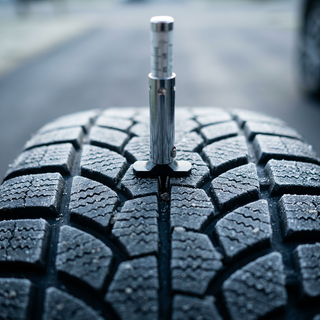
Close-up of a frost-covered winter car tire with deep tread patterns. (Representative image for illustration purposes only. Actual vehicle may vary based on trim and configuration.)

What Tire Tread Depth and Rubber Compound Limits Impact Winter Traction?

Safe winter driving requires a minimum tire tread depth of 6/32-inch to channel snow and slush away from the contact patch, as opposed to the 2/32-inch legal limit for dry pavement. Furthermore, standard all-season rubber compounds begin stiffening at 45 degrees Fahrenheit, causing a significant loss of road grip regardless of remaining tread depth.

Tire performance in winter conditions depends on two distinct factors: tread geometry and rubber chemistry. Tread grooves physically clear standing water, slush, and packed snow. When tread wears down below 4/32-inch, tires lose the ability to evacuate slush, leading to hydroplaning. Measuring tread depth using a specialized depth gauge across inner, center, and outer tread ribs ensures even tire wear.

The rubber compound itself plays an equally crucial role. All-season tires use tread formulations designed for high-temperature durability, but these compounds harden when temperatures drop below 45 degrees Fahrenheit. As the rubber stiffens, it loses flexibility, reducing friction on cold asphalt. Winter tires and winter-rated all-weather tires use specialized silica-rich compounds that remain pliable in sub-freezing temperatures, providing shorter stopping distances on ice.

Sub-freezing squalls across the rolling hills and State Route 170 elevation changes around Calcutta demand maximum tire grip. Capable vehicles like the 2026 Ford Escape with All-Wheel Drive or the 2026 Ford Explorer with 4x4 rely directly on flexible rubber compounds and adequate tread depth to transmit engine torque to icy pavement safely.

How Do You Test Battery Cold Cranking Amps to Avoid Winter Failure?

Automotive battery cold performance is evaluated by measuring Cold Cranking Amps ( CCA), which quantifies the number of amperes a 12-volt battery delivers at 0 degrees Fahrenheit for 30 seconds while maintaining at least 7.2 volts. Passenger vehicles operating in cold climates typically require a battery rated between 600 to 800 CCA to guarantee reliable engine starting.

At 32 degrees Fahrenheit, a standard lead-acid or AGM battery loses approximately 20% of its available starting power. When temperatures fall to 0 degrees Fahrenheit, battery output drops by roughly 50%. At the same time, cold engine oil thickens, requiring up to twice as much current to turn the crankshaft. This combination makes winter the most common season for sudden battery failure.

Professional battery testing goes beyond simple voltage measurement. Service technicians use digital conductance testers to measure internal resistance and cold-cranking capacity under simulated load. Batteries older than three to five years should undergo routine conductance testing before winter.

If test results indicate reduced cold-cranking capacity, replacing the unit prevents unexpected strandings. Vehicle owners can schedule specialized battery inspection and service to verify electrical health, or explore new vehicle options by booking time to schedule a test drive in an All-Wheel Drive Ford model equipped with advanced winter packages.

What Antifreeze Mixture and Coolant Tools Protect Your Engine in Sub-Freezing Weather?

Engine coolant freezing point protection is tested using an optical refractometer or a hydrometer, which measures fluid specific gravity to determine exact temperature limits. A standard 50/50 ratio of ethylene glycol antifreeze to distilled water protects against freezing down to -34 degrees Fahrenheit, while a 70/30 winter concentration lowers protection to -84 degrees Fahrenheit.

An optical refractometer provides the most accurate measurement of coolant health. By placing a drop of coolant on the refractometer prism and looking through the eyepiece, technicians measure light refraction to read exact freezing and boiling thresholds. While floating-bulb hydrometers are also used, they are sensitive to fluid temperature variations and can give misleading readings if the coolant is warm.

Maintaining the proper coolant mixture is vital for engine longevity. Water alone expands when freezing, which can crack engine blocks, burst radiator cores, and rupture heater hoses. Antifreeze prevents freezing while raising the boiling point and providing anti-corrosion additives that protect internal aluminum and cast-iron engine components.

Coolant ratios should never exceed 70% antifreeze concentrate. Pure antifreeze freezes at a higher temperature than a glycol-water mixture and has poor heat-transfer properties. Over time, protective corrosion inhibitors break down, making regular fluid testing and factory-recommended flushes essential for winter preparation.

What Specific Maintenance Checks Are Included in a Standard Winter Inspection Package?

A standard winter car inspection package incorporates comprehensive diagnostics across electrical systems, braking components, tires, thermal fluids, windshield visibility gear, and drive belts. Each inspection systematically evaluates critical components under sub-freezing operating conditions to prevent winter breakdowns.

Professional technicians complete a thorough winter inspection checklist covering key vehicle systems:

  • Electrical & Battery Diagnostics: Conductance testing to measure Cold Cranking Amps against factory ratings, checking terminal posts for lead-acid corrosion, and verifying alternator charging voltage output.
  • Tire & Suspension Audit: Measuring tread depth across all four tires using a digital depth gauge, inspecting sidewalls for cracking or impact bulges, setting cold inflation pressures, and checking wheel alignment.
  • Cooling System & Thermal Protection: Refractometer testing of coolant freeze point, pressure testing radiator caps and cooling lines for microscopic leaks, and verifying thermostat opening operation.
  • Brake System Assessment: Measuring brake pad friction material thickness, inspecting rotors for rust pitting or heat scoring, and testing brake fluid moisture content to prevent pedal fade.
  • Visibility & Safety Equipment: Checking wiper arm spring tension, inspecting wiper blade rubber elements, filling the washer reservoir with winter de-icer fluid, testing rear defroster grid heating, and auditing exterior light bulb operation.
  • Underhood Belts & Hoses: Measuring drive belt tension, inspecting serpentine belts for rubber cracking, and checking heater hose flexibility to ensure reliable engine cooling.

A complete seasonal inspection identifies minor wear before it causes major repairs in cold weather. Drivers can easily book a winter maintenance appointment online to have factory-trained technicians inspect their vehicle.

Quick Answers to Common Winter Vehicle Maintenance Questions

Q: How do cold temperatures affect electric vehicle battery range?

Cold ambient temperatures temporarily reduce electric vehicle driving range by 15% to 30% on severe winter days due to slowed lithium-ion chemical reactions and increased cabin heating power demands. Ford electric vehicle owners can mitigate cold-weather range loss by preconditioning the cabin and battery while plugged into a charger before departure and utilizing heated seats and steering wheels, which use significantly less energy than cabin climate blowers.

Q: Can all-season tires be used safely through an Ohio winter?

All-season tires remain suitable for light snow provided tread depth exceeds 6/32-inch and temperatures remain moderate. However, because all-season tread compounds begin stiffening at 45 degrees Fahrenheit, dedicated winter tires or 3-Peak Mountain Snowflake rated all-weather tires provide superior stopping distances and cornering stability on packed snow and icy surfaces during prolonged sub-freezing conditions.

Q: Why does a tire pressure light turn on during the first cold morning of winter?

Pneumatic tire pressure drops by approximately 1 PSI for every 10 degrees Fahrenheit decrease in ambient air temperature due to thermal gas contraction. When overnight temperatures plunge, tire pressure frequently drops below the vehicle's minimum threshold, triggering the tire pressure monitoring system indicator. Drivers should adjust pressures when tires are cold according to the vehicle door jamb label.

Q: What should be stored in a vehicle emergency winter kit?

A properly equipped winter emergency kit should contain heavy-duty jumper cables, a durable ice scraper with a snow brush, a flashlight with extra batteries, a collapsible shovel, thermal blankets, and a tow strap. Carrying non-perishable snacks, bottled water, and a portable phone power bank provides vital safety support if stranded in remote cold-weather locations.

Q: How often should windshield wiper blades be replaced in cold climates?

Windshield wiper blades operating in cold climates should be replaced every 6 to 12 months, or immediately when streaking, chattering, or tearing occurs. Freezing temperatures harden wiper rubber, while heavy snow accumulation and windshield ice accelerate edge wear. Installing beam-style winter wiper blades with protective rubber covers prevents ice buildup within the wiper frame.

Schedule Your Winter Maintenance Inspection

Ensuring your vehicle is fully prepared for sub-freezing weather requires proactive maintenance before snow and ice arrive on local roads. Taking simple preventative steps—such as testing battery Cold Cranking Amps, verifying coolant freeze protection, and inspecting tire tread—prevents unexpected breakdowns and keeps your family safe all season long.

If emergency roadside issues occur during severe weather, eligible Ford owners benefit from manufacturer-backed emergency support by contacting Ford Roadside Assistance: 1-800-241-3673 for towing, flat tire replacement, fuel delivery, and jump-starts.

Our factory-trained technicians at Tri State Ford use genuine OEM parts and specialized diagnostic tools to ensure your vehicle handles tough winter driving with complete confidence. Visit our dealership at 1503 Pennsylvania Ave, East Liverpool, OH 43920 or reach our service team directly at (330) 462-7578 to schedule your comprehensive winter inspection today.

© 2026 Tri State Ford. All rights reserved.

Vehicle specification data © JATO Dynamics Limited.

Winter Vehicle Maintenance in East Liverpool OH | Tri State Ford
Posted in:

Related Posts

j

What Maintenance Is Included in Ford's The Works Package?

Ford's The Works Package is a comprehensive preventative service that includes a Motorcraft synthetic blend oil change, oil filter replacement, tire rotation with pressure adjustment, digital battery test, vital fluid top-offs, and an 83-point vehicle inspection. The service covers essential mechanical and safety systems, including brake pad thickness, drive belts, cooling hoses, cabin and engine air filters, exterior lighting, wiper blades, and steering components. Keeping up with scheduled vehicle maintenance ensures long-term powertrain reliability and protects major vehicle systems against unexpected wear. During every appointment, factory-trained technicians drain worn engine oil and install a fresh Motorcraft filter designed to trap microscopic abrasives before they circulate through the engine block. Technicians then rotate all four tires to distribute tread wear evenly across both axles, setting tire pressures to the exact specifications listed on the driver-side door jamb. The comprehensive 83-point vehicle checkup covers vital safety and mechanical components: Brake System Diagnostics: Inspection of brake pad friction material thickness, rotor surfaces, brake calipers, hydraulic lines, and parking brake engagement. Battery Health Analysis: Digital testing of cold cranking amps, voltage stability, and charging system performance to detect failing cells before a breakdown occurs. Fluid Inspection and Refill: Checking and topping off engine coolant, windshield washer fluid, brake fluid, and power steering fluid. Belts and Hoses Check: Visual examination of serpentine drive belts, radiator hoses, and heater lines for cracking, fraying, or heat-induced degradation. Filter and Visibility Checks: Inspection of engine and cabin air filters, wiper blade rubber, headlight and taillight operation, and steering alignment signals. For drivers commuting through the rolling hills along State Route 170 in Calcutta, regular tire rotations and brake system checks help maintain consistent handling and stopping capability on hilly roads. When owners bring their trucks or SUVs in for service, our technicians review the tire tread depth report and battery health printout with them to confirm every system is ready for the road. To keep your Ford running smoothly, you can drop by our East Liverpool service center or give our service team a quick call to check current appointment availability. Table of Contents Why Are Motorcraft OEM Parts Preferred Over Aftermarket Filters and Oils? How Does The Works Package Compare to Quick-Lube Shops and Competitor Dealers? What Are the Primary Advantages of Getting The Works Package at Tri State Ford in East Liverpool? How Does Regular Routine Maintenance Protect Warranty and Resale Value for 2026 Ford Owners? How Often Should Your Ford Undergo The Works Service Package? Common Maintenance Questions About Ford's The Works Package Why Are Motorcraft OEM Parts Preferred Over Aftermarket Filters and Oils? Motorcraft OEM parts are engineered specifically to match the strict engineering tolerances, fluid flow rates, and internal valve pressures of Ford engines. Aftermarket filters and universal lubricants often rely on generic multi-fit designs that can cause oil pressure variance, insufficient filtration, or premature fluid breakdown under heavy operating stress. Engineered directly by Ford, Motorcraft synthetic blend and full synthetic oils utilize tailored additive packages designed to inhibit thermal oxidation and sludge accumulation inside high-output powertrains like the 3.5L EcoBoost V6. Turbocharged engines generate intense heat inside the center bearing housing, demanding engine oil that maintains consistent viscosity without thinning out. Motorcraft oil formulations protect critical turbo bearings and valvetrain components during demanding driving conditions. Oil filter construction highlights key differences between original equipment and generic aftermarket components: Pressure Relief Valves: Motorcraft oil filters feature precise pressure-relief bypass valves that maintain oil flow to critical engine components during cold starts, preventing oil starvation. Anti-Drainback Protection: Silicone anti-drainback valves prevent engine oil from siphoning back into the oil pan when the engine is turned off, ensuring immediate lubrication upon startup. Filter Media Quality: Dense synthetic media fibers capture dirt and metal particles without restricting oil pressure or collapsing under high engine RPMs. Exact Thread Fitment: Precision-machined base plates prevent oil leaks and ensure a tight seal against the filter housing mounting surface. Choosing original equipment components ensures your vehicle receives exact-fit replacement parts built for your specific powertrain. You can preserve your vehicle's factory performance standards by scheduling your service appointment online or by ordering genuine parts directly from our team to ensure quality and compatibility. How Does The Works Package Compare to Quick-Lube Shops and Competitor Dealers? The Works Package delivers superior maintenance thoroughness by combining factory-certified technicians and vehicle-specific Motorcraft parts with an 83-point mechanical inspection, whereas independent quick-lube outlets typically rely on generic aftermarket parts and fast-turnover service bays. Unlike drive-thru lube shops that focus solely on fast oil drains, Ford dealership maintenance includes detailed vehicle health reporting and official record logging directly into Ford's national database. Independent quick-lube shops frequently use universal oil filters and bulk non-OEM fluids that may fail to meet specific manufacturer viscosity or friction specifications. Their staff often lack brand-specific diagnostic training, increasing the risk of stripped oil pan drain plugs, overfilled crankcases, or overlooked mechanical wear. In contrast, factory-trained technicians understand the exact service requirements of every Ford vehicle, whether performing routine care on a 2026 Ford F-150 or carrying out multi-point inspections on heavy-duty commercial vans. When compared to competitor dealership programs such as Chevrolet Certified Service or Ram Express Lane, The Works Package provides exceptional value by bundling multi-system maintenance into a single streamlined visit. Ford owners also earn Ford Rewards points on every service purchase, which can be accumulated and redeemed toward future routine maintenance visits or vehicle accessories. Maintenance Service Feature Ford The Works Package Independent Quick-Lube Shops Engine Parts Used Factory Motorcraft OEM filters and fluids Generic multi-fit aftermarket parts Technician Training Factory-trained Ford specialists General service technicians Inspection Scope Comprehensive 83-point safety check Basic visual check Warranty Integration Direct logging to Ford national registry Manual or unrecorded receipts Rewards Program Earns Ford Rewards points Third-party or none What Are the Primary Advantages of Getting The Works Package at Tri State Ford in East Liverpool? Getting The Works Package at Tri State Ford gives local drivers access to factory-certified technicians, specialized diagnostic equipment, and official warranty record tracking in one convenient facility. Located along the Ohio River, our service department provides dedicated customer care tailored to the daily driving demands of our local community. Our service bay utilizes Ford specialized diagnostic computers capable of reading vehicle control module codes, checking active recall statuses, and applying over-the-air module software updates during routine visits. Independent repair shops do not possess these specialized tools, leaving potential electronic or module updates unaddressed during standard oil changes. Furthermore, every service performed at our dealership is automatically entered into Ford's central service database, creating a complete, verifiable maintenance history linked to your vehicle's VIN. To make regular maintenance as smooth as possible for busy schedules, we offer convenient customer care options that fit your daily routine: Specialized Ford Equipment: Diagnostic tools built specifically to analyze Ford engine, transmission, and electronic systems. Factory-Certified Technicians: Service professionals who undergo continuous manufacturer training on current and late-model Ford powertrains. Service History Tracking: Automatic logging of every oil change, tire rotation, and brake inspection into official warranty records. Customer Convenience: Comfortable waiting facilities, transparent service explanations, and simple online scheduling. Vehicle owners who cannot bring their vehicle to the dealership can take advantage of Ford Pick Up & Delivery service, allowing our team to pick up your vehicle, complete routine maintenance, and return it directly to your home or office. How Does Regular Routine Maintenance Protect Warranty and Resale Value for 2026 Ford Owners? Adhering to recommended maintenance schedules protects your 3-year/36,000-mile bumper-to-bumper and 5-year/60,000-mile powertrain warranties by maintaining clear service records in Ford's national network. Complete dealership service records verify that your engine, transmission, and braking systems received proper care, preventing warranty claim disputes caused by fluid neglect or improper non-OEM parts. If a mechanical issue arises during the warranty coverage period, manufacturer claims adjusters verify whether the vehicle underwent required oil changes and fluid checks at designated mileage intervals. Using non-approved aftermarket oil filters or incorrect oil viscosities can lead to engine damage that may not be covered under warranty terms. Having The Works Package performed on schedule ensures that only factory-approved Motorcraft fluids and filters enter your engine, keeping your warranty protections fully intact. Documented dealership maintenance also enhances future vehicle resale value. Buyers searching for pre-owned trucks, commercial vans, or SUVs favor vehicles with complete, dealership-verified service histories. A clean service record logged in the CARFAX and Ford database shows prospective buyers that the vehicle received consistent maintenance, commanding a higher trade-in or resale price when you decide to upgrade. How Often Should Your Ford Undergo The Works Service Package? Ford recommends scheduling The Works Package every 5,000 to 7,500 miles or every six months, whichever comes first under normal driving conditions. Vehicles operated under severe conditions—such as frequent towing, heavy payload hauling, extensive idling, or driving in extreme temperatures—should undergo service closer to 3,000 to 5,000-mile intervals. Following a consistent 5,000 to 7,500-mile service schedule aligns your engine oil change interval with routine tire rotations. Front tires experience distinct wear patterns compared to rear tires due to steering forces and engine weight distribution. Rotating tires at every oil change promotes even tread wear across all four tires, maximizing tread life and protecting all-wheel-drive differential components from uneven tire circumference strain. Seasonal weather changes also impact maintenance timing. Severe winter cold puts heavy strain on vehicle batteries, reducing cold cranking amps while freezing temperatures thicken engine oil during initial startups. Scheduling a vehicle checkup before severe weather arrives allows technicians to test battery health and check fluid condition before harsh weather hits. Drivers interested in specialized battery health assessments can review our battery testing and replacement guidelines for detailed warning signs. If brought-in shop visits do not fit your schedule, exploring the Ford Mobile Service program allows routine maintenance to be completed directly in your driveway or business parking lot. Common Maintenance Questions About Ford's The Works Package Q: Does The Works package include a replacement engine air filter? The standard maintenance bundle includes a detailed visual check of your engine air filter and cabin air filter, but replacement filter parts and installation carry a separate charge. If our technician discovers heavy dirt, dust, or debris buildup during the checkup, they will present the filter to you and recommend a fresh Motorcraft replacement filter to maintain engine airflow and interior air quality. Q: Can I use my Ford Rewards points to pay for service? Yes, accumulated Ford Rewards points earned from vehicle purchases or prior service visits can be applied directly toward your maintenance bill at Tri State Ford. You can redeem points to cover routine service packages, replacement wiper blades, fresh batteries, or other maintenance needs, reducing your out-of-pocket ownership costs. Q: Can I upgrade to full synthetic motor oil during my service appointment? Yes, while the standard package includes Motorcraft synthetic blend oil, you can request an upgrade to Motorcraft full synthetic oil. Full synthetic oil provides enhanced resistance to thermal breakdown, making it an excellent choice for vehicles facing heavy trailer towing, extreme summer heat, or frequent stop-and-go driving. Q: How long does a typical service appointment take to complete? A standard package visit usually takes between 45 and 60 minutes to complete the oil change, tire rotation, digital battery test, and 83-point inspection. Our technicians work efficiently to perform every inspection step thoroughly, allowing you to relax in our lounge or arrange scheduled pickup and delivery options. Q: How does severe seasonal weather affect maintenance schedules? Cold winter weather combined with heavy road salt exposure accelerates battery fluid drain and undercarriage corrosion. Drivers who frequently navigate severe winter roads or heavy jobsite mud should follow a tighter 5,000-mile service interval to ensure brake components, suspension joints, and battery terminals remain clean and fully functional. Ready to give your vehicle the factory-backed care it deserves? Visit our dealership at 1503 Pennsylvania Ave to speak with our service team, or give our service advisors a call at (330) 462-7578 to reserve your next service date. © 2026 Tri State Ford. All rights reserved. Vehicle specification data © JATO Dynamics Limited. Ford The Works Package Service in East Liverpool, OH | Tri State Ford

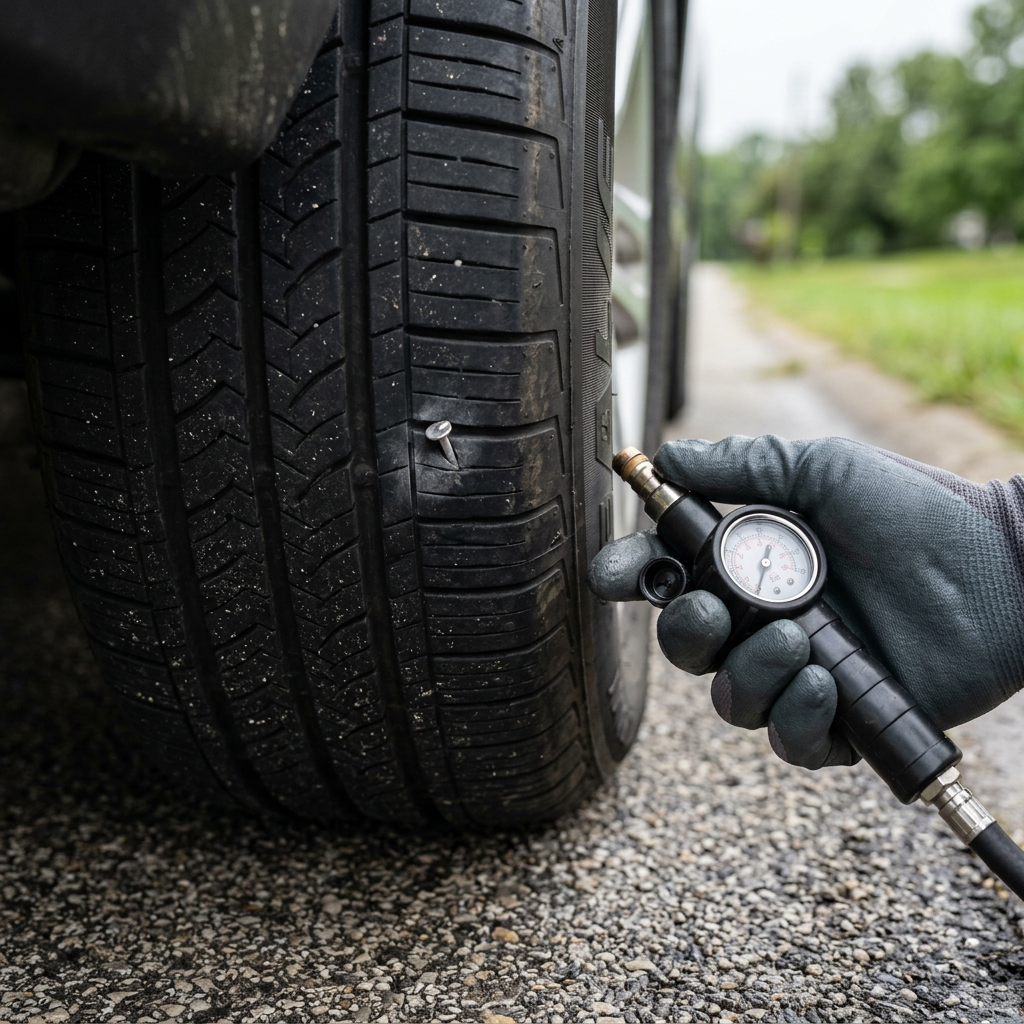
A nail embedded in a car tire's tread while a gloved hand holds a pressure gauge nearby. (Representative image for illustration purposes only. Actual vehicle may vary based on trim and configuration.)

Immediate Steps to Take When You Spot a Nail in Your Tire

Finding a sharp piece of metal embedded in your tread is a stressful moment, but taking the correct immediate actions can protect both your safety and the structural integrity of your tire. If you notice a puncture while driving, the most important step is to maintain control of your vehicle. Gently ease off the accelerator, keep a firm grip on the steering wheel, and signal to pull over to a safe, level area away from active traffic. Avoid slamming on the brakes, as sudden deceleration on an underinflated tire can cause the vehicle to pull sharply to one side or result in a complete loss of control. Once your vehicle is safely parked on a flat surface with the parking brake engaged and your hazard lights flashing, you can perform a visual inspection. Look closely at the tire to locate the object, but do not attempt to pull the nail or screw out yourself. Leaving the object in place is critical because it often acts as a temporary plug, slowing down the rate of air loss. Removing it on the roadside can lead to rapid deflation, leaving you completely stranded. If you hear a clear hissing sound, the tire is actively losing air at a fast rate, and you should not attempt to drive the vehicle any further. If you have a tire pressure gauge in your glovebox, check the current pressure and compare it to the recommended specification listed on the placard inside your driver-side door jamb. Do not use the maximum pressure number printed on the tire sidewall. If the tire is already flat or the pressure is dropping rapidly, driving on it will cause severe, irreversible internal damage. In this situation, you should install your temporary spare tire if your vehicle is equipped with one, checking its sidewall for speed and distance limitations. If you do not have a spare or feel unsafe changing a tire on the roadside, you should call for professional assistance. For drivers who need immediate help with a punctured tire, you can contact Ford Roadside Assistance: 800-241-3673 to have a certified technician dispatched to your location. If your tire is holding air and you are close to our service center, you can safely head directly to us. You can easily get directions to our service center to have our team inspect the damage. If you prefer to plan ahead and secure a specific time slot for an inspection, you can schedule a service appointment online or give our team a quick call to discuss your options. Table of Contents Understanding the Hidden Dangers of Driving with a Tire Puncture Evaluating Tire Damage: Can It Be Repaired or Must It Be Replaced? The Industry-Standard Process for a Safe and Permanent Tire Repair The True Cost of Fixing a Punctured Tire Versus Replacing It Common Questions About Handling Nail Punctures and Tire Safety Schedule Expert Tire Service and Maintenance Understanding the Hidden Dangers of Driving with a Tire Puncture Operating a vehicle with a nail in the tire introduces serious safety hazards that go far beyond a slow leak. When a tire loses air pressure, its physical shape changes, causing the tread to flex excessively and increase friction against the road surface. This friction generates extreme internal heat, which can quickly degrade the rubber compounds and weaken the internal steel belts and polyester cords. Over time, this thermal and structural stress can lead to a sudden, catastrophic blowout at highway speeds, placing you and your passengers in immediate danger. Underinflation also drastically alters how your vehicle handles during everyday driving. A tire with low pressure cannot properly support the weight of the vehicle, which leads to sluggish steering response, reduced traction, and significantly longer braking distances. This instability becomes particularly dangerous when navigating wet pavement or making sudden lane changes to avoid an obstacle. If your vehicle is equipped with a Tire Pressure Monitoring System, the warning light on your dashboard will illuminate when pressure drops 25% or more below the recommended level. However, because this system is designed to alert you after significant air loss has already occurred, it should never replace regular manual pressure checks. Ignoring a puncture also risks causing permanent damage to other expensive components of your vehicle. Driving even a short distance on an underinflated tire can ruin the tire's sidewall beyond repair, forcing a replacement when a simple patch might have sufficed. Furthermore, severe tire vibrations or driving on a flat tire can bend your wheel rim, damage the TPMS sensor, and place undue stress on your suspension and steering components. Keeping your tires properly maintained is the best way to preserve your vehicle's safety and longevity over years of daily commutes. ​ Evaluating Tire Damage: Can It Be Repaired or Must It Be Replaced? Determining whether a punctured tire can be safely repaired or if it must be replaced depends on several strict safety criteria established by tire manufacturers and industry standards. The most critical factor is the precise location of the puncture. A tire can only be repaired if the puncture is located entirely within the crown tread area. The outer shoulder zones and the sidewalls experience intense flexing, high heat, and extreme stress during cornering and braking. Because of these forces, patches and plugs will not hold in these areas, making any repair attempt highly dangerous and prone to sudden failure. The size and extent of the damage also dictate the repairability of the tire. Industry guidelines state that a puncture can be repaired only if the damage is 1/4 inch or smaller in diameter. If the nail entered at an extreme angle, or if the puncture is larger than this limit, the structural steel belts inside the tire have been compromised, and the tire must be replaced. Additionally, a single tire can typically only be repaired up to three times over its lifespan, provided that the punctures are not in the same tread rib and are spaced at least 16 inches apart. Repairable Criteria: Puncture is located within the central tread area (at least one inch away from the shoulder). Puncture diameter is 1/4 inch or smaller. The tire has not been driven on while flat or severely underinflated. Remaining tread depth is greater than 2/32 inch. Replacement Required: Puncture is located in the sidewall, shoulder, or belt edge. Puncture diameter exceeds 1/4 inch. Internal inspection reveals structural damage, creased inner liners, or exposed cords. The tire is worn down to 2/32 inch of remaining tread depth. Before any repair can be approved, the tire must be completely demounted from the wheel rim so a technician can inspect the inner liner. If a tire was driven on while flat, the inner rubber will often show signs of creasing, scouring, or a buildup of rubber dust, indicating that the internal structure has disintegrated. If you need a replacement, you can browse new vehicle specials to see how we maintain our high standards of service. For those looking to upgrade their entire setup, we can also help you value your trade-in or assist you in sourcing hard-to-find components. If you plan to perform your own maintenance, you can easily order parts online through our dedicated department. ​ The Industry-Standard Process for a Safe and Permanent Tire Repair A proper, permanent tire repair is a multi-step technical process that requires specialized tools and training. Many drivers are tempted to use cheap, external plug kits sold at auto parts stores as a permanent fix. However, these on-the-wheel plug repairs are highly unreliable and considered dangerous by major tire manufacturers. An external plug does not seal the inner liner of the tire, which allows moisture to seep into the internal steel belts, causing them to rust and eventually separate from the surrounding rubber. The industry-standard method for a safe and permanent repair is a combination patch-and-plug procedure, which must be performed from the inside out. First, the technician demounts the tire from the wheel rim to conduct a thorough internal inspection of the casing. Next, the puncture channel is drilled out from the inside to clean away damaged steel wires and create a clean, uniform path. The rubber surrounding the puncture on the inner liner is then thoroughly buffed and cleaned to create a textured surface that will bond securely with chemical vulcanizing cement. Once the preparation is complete, the technician applies the vulcanizing fluid and inserts a one-piece patch-and-plug unit through the injury from the inside. The rubber stem of the patch-and-plug fills the puncture channel to block moisture and road debris, while the circular patch seals the inner liner to prevent air from escaping. The technician uses a specialized rolling tool to press the patch firmly into place, sealing the bond. Finally, the excess stem on the outside of the tire is cut flush with the tread, and the tire is remounted, balanced, and checked for leaks before being reinstalled on your vehicle. This meticulous repair process is especially critical for commercial and heavy-duty vehicles that carry substantial loads. Hardworking professionals driving work trucks around Calcutta require tires that can withstand demanding conditions without failing. Whether you rely on heavy-duty vehicles from our used work truck inventory, operate robust models from our F-Series work inventory, or manage deliveries using spacious options from our Transit work vans, ensuring your tires are repaired to professional standards is vital to keeping your business moving safely. ​ The True Cost of Fixing a Punctured Tire Versus Replacing It When faced with a nail in your tire, comparing the financial aspects of a professional repair versus a full tire replacement is a natural step. A standard patch-and-plug repair at a professional service center is highly cost-effective, typically ranging from twenty to fifty dollars. This affordable fee covers the labor of demounting the tire, performing the internal safety inspection, preparing the rubber, and installing the vulcanizing patch-and-plug unit. Because this service is so inexpensive, it is always the preferred option whenever a puncture meets the safety criteria for a repair. In contrast, replacing a tire is a more significant investment. The cost of a new tire varies widely depending on the brand, size, and vehicle type, and the purchase must also factor in additional fees for mounting, wheel balancing, and environmental disposal. Furthermore, if your vehicle is equipped with an all-wheel-drive system, replacing just one damaged tire can cause driveline strain due to differences in tread depth. In many cases, manufacturers recommend replacing tires in pairs or full sets of four to maintain proper traction and prevent damage to the transfer case, which multiplies the overall cost. While a replacement is more expensive upfront, attempting to repair a tire that should be retired is a dangerous compromise that can lead to costly accidents. For drivers operating commercial vehicles or managing fleets in East Liverpool, unexpected downtime due to tire failure can quickly erode business profits. Investing in high-quality tires and professional maintenance is the most reliable way to protect your vehicle and your budget over the long haul. If your tire cannot be safely patched, our service center can help you find the perfect replacement. You can utilize our online tool to order tires by year, make, and model to ensure a precise fit for your vehicle. We also offer rotating promotions, so be sure to check our manufacturer vehicle specials to find excellent value on maintenance and parts. For businesses looking to expand their fleet, we invite you to explore our new work truck inventory to keep your operations running smoothly. ​ Common Questions About Handling Nail Punctures and Tire Safety Understanding how to manage tire punctures can save you time, money, and stress on the road. Below are some of the most common questions our service team receives regarding tire damage and safety. Q: Is it safe to drive to a service center with a nail in my tire if the tire is not flat? If the tire is holding its recommended air pressure and the vehicle feels completely stable, you can typically drive a short distance at moderate speeds to a nearby service center. Avoid driving on the highway, and monitor your dashboard warning lights closely. If you notice any pulling, vibration, or a sudden drop in pressure, pull over immediately and call for assistance. Q: Can a puncture in the tire shoulder or sidewall be repaired? No, punctures in these areas can never be safely repaired. The shoulder and sidewall experience intense flexing and heat buildup while the vehicle is in motion. A patch applied to these zones will eventually fail, which can lead to a sudden and dangerous blowout. Tires with damage in these areas must be replaced. Q: What should I do if my tire pressure monitoring system light comes on? If the warning light illuminates, pull over safely as soon as possible to inspect your tires. Check the air pressure in all four tires with a manual gauge and inflate them to the recommended levels shown on the vehicle placard. If the light remains on or a tire is visibly low, have the tire inspected by a professional technician to locate any hidden punctures. Q: Can I use an emergency aerosol tire sealant as a permanent fix? No, aerosol sealants are strictly temporary, emergency solutions designed to help you reach the nearest repair shop. These sealants do not structurally repair the puncture and can degrade the tire's inner liner over time. Additionally, the liquid residue can damage your TPMS sensor and must be thoroughly cleaned out by a technician during a proper repair. Q: How can I get my tire inspected if I cannot drive my vehicle to the shop? If your tire is completely flat or you feel unsafe driving, you do not have to worry about transport logistics. We offer convenient options like Ford pick up and delivery service to handle your maintenance needs without interrupting your busy day. You can also explore our truck inventory or browse our used vehicle specials to see how we support our local community with comprehensive automotive care. ​ Schedule Expert Tire Service and Maintenance At Tri State Ford, we are committed to keeping your vehicle running safely and dependably for all your daily commutes and weekend adventures. Our state-of-the-art service center is staffed by factory-trained, certified technicians who understand the exact specifications of your vehicle. Whether you need a quick tire patch, a wheel alignment, or a brand-new set of tires, we use specialized diagnostic equipment and genuine OEM parts to ensure every job is completed to the highest safety standards. We know your time is valuable, which is why we offer flexible options to fit your busy schedule. If you prefer to have our team come to you, our convenient Ford mobile service can handle select maintenance tasks right in your driveway. We also invite you to explore our manufacturer monthly service specials to find great savings on routine care like oil changes, brake repairs, and battery service. If you are considering a new ride, you can also schedule a test drive to experience our latest models firsthand. Our service center is located at 1503 Pennsylvania Ave, East Liverpool, OH 43920, making it easy for drivers across Boardman and the surrounding areas to access trusted care. If you have any questions or need to coordinate roadside support, please give our service team a quick call today. You can also get directions to our dealership and stop by at your convenience. Let us help you keep your vehicle safe, reliable, and ready for the road ahead. © 2026 Tri State Ford. All rights reserved.

g

How Does Ford Mobile Service Work for Commercial Fleets?

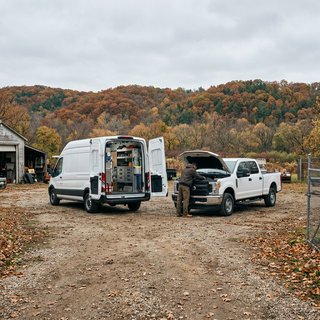
Ford Mobile Service brings factory-trained technicians, official diagnostic software, and specialized tools directly to your business location or staging yard. Designed to eliminate vehicle transportation downtime, fully equipped mobile service vans complete routine scheduled maintenance, safety recall updates, and system diagnostics on-site. This allows commercial operators to keep their trucks and vans working without taking drivers off their daily routes. When managing fleet operations around the riverfront bluffs in East Liverpool, taking vehicles off the road for routine oil changes or brake service directly impacts daily productivity. Mobile servicing solves this challenge by sending a fully outfitted Ford service van directly to your depot, office, or job site. Whether your company runs cargo vans or heavy-duty pickups, certified technicians perform maintenance according to factory procedures without requiring your staff to drop off or pick up vehicles. Fleet administrators can schedule appointments during off-peak hours or while vehicles sit parked between shifts. To review available commercial vehicles in our lineup, examine new commercial F-Series work trucks for your business operational needs. For specific questions regarding service area dispatch, reach out by calling (330) 462-7578 or visit our East Liverpool facility to speak directly with our commercial account team. Table of Contents What Maintenance and Repair Work Can Ford Mobile Service Perform On-Site? Are Mobile Service Technicians Fully Factory-Trained by Ford? How Does Ford Telematics Integrate with Mobile Fleet Servicing? Are Fleet standard rates Available for Routine Mobile Maintenance Contracts? How Does Ford Mobile Service Compare to Third-Party Independent Mechanics and Warranty Rules? Frequently Asked Questions About Mobile Fleet Maintenance Keep Your Fleet Moving with Tri State Ford Mobile Service What Maintenance and Repair Work Can Ford Mobile Service Perform On-Site? Routine maintenance tasks like oil changes and brake inspections can be completed on-site, minimizing downtime for your fleet vehicles. On-site capabilities include engine oil and filter changes, tire rotations, brake pad and rotor servicing, battery testing and replacement, wiper blade installation, fluid top-offs, software updates, and comprehensive multi-point inspections. Routine care for work vehicles like the Ford Transit Cargo Van, F-150, and Super Duty ensures long-term powertrain durability and prevents costly breakdowns. Modern Ford commercial vehicles use an Intelligent Oil-Life Monitor to calculate oil change intervals based on engine load, idling time, and ambient operating conditions rather than strict mileage markers. Mobile technicians clear system alerts, reset service monitors, and inspect high-wear components using specialized equipment carried right in the service van. Our service team frequently sees fleet managers batching oil changes and a multi-point inspection for three or four vans simultaneously during early morning hours before drivers dispatch. Major mechanical overhauls, such as internal engine repairs or full transmission rebuilds, still require specialized vehicle lifts and are handled inside our main service center bays. You can easily schedule a mobile service appointment for your work vehicles or order genuine Motorcraft parts directly through our service portal. Are Mobile Service Technicians Fully Factory-Trained by Ford? Every Ford Mobile Service technician holds the exact same factory certifications and technical qualifications as master technicians working inside our dealership service bays. They undergo rigorous OEM training programs covering advanced electrical diagnostics, mechanical repairs, powertrain systems, and specialized commercial upfit equipment. Mobile service technicians utilize official Ford diagnostic software to interface directly with vehicle control modules. This ensures electronic diagnostics, module reprogramming, and technical service updates match precise factory standards. Local trade professionals along State Route 170 in Calcutta rely on this level of factory expertise to keep their work vans in top operating condition without taking time away from active customer contracts. By sending factory-certified professionals directly to your location, your business receives dealership-grade service quality right at your doorstep. To learn more about how on-site appointments operate, review our mobile service program options to align service intervals with your fleet schedule. How Does Ford Telematics Integrate with Mobile Fleet Servicing? Ford Telematics™ uses built-in vehicle modems to stream real-time diagnostic codes, battery charge levels, fluid statuses, and oil life indicators directly to a centralized management dashboard. This connected data pipeline identifies maintenance needs automatically, alerting fleet managers to service requirements before minor diagnostic fault codes turn into major mechanical failures. When integrated with mobile servicing, connected vehicle data streamlines maintenance logistics. Fleet administrators can view 60 days of diagnostic history, monitor fault indicators across multiple vehicles, and book mobile service visits directly through the management application. Because the technician arrives at your site already knowing the exact diagnostic code and vehicle history, they bring the precise tools and replacement filters needed for the job, maximizing turnaround speed and vehicle uptime. Are Fleet standard rates Available for Routine Mobile Maintenance Contracts? Commercial fleet accounts and businesses utilizing structured fleet service agreements gain access to standardized pricing, commercial parts allowances, and streamlined billing options for routine mobile care. Enrolling vehicles in unified fleet care programs reduces administrative paperwork by consolidating multiple service invoices into simplified commercial accounts. Volume maintenance plans allow small businesses to control operational costs through predictable, scheduled maintenance expenses. By combining routine services—such as oil changes, cabin air filter replacements, and brake pads—across several fleet vehicles during a single mobile visit, businesses help manage total labor costs and eliminate the indirect costs of driver idle time and lost working hours. How Does Ford Mobile Service Compare to Third-Party Independent Mechanics and Warranty Rules? Ford Mobile Service uses genuine Motorcraft® parts and factory-certified diagnostic equipment, ensuring full protection of your vehicle’s factory warranty without complex record-keeping burdens. While federal law permits third-party mechanics to perform routine maintenance without automatically voiding factory warranties, any warranty repairs, recall fixes, or module updates must be performed by authorized Ford technicians using OEM components to maintain coverage. Service Factor Ford Mobile Service Third-Party Mobile Repair Parts Used Genuine Motorcraft® parts OEM certified Universal aftermarket parts Diagnostic Equipment Official Ford factory diagnostic tools Generic multi-brand code scanners Technician Training OEM factory-certified technicians General automotive certification Warranty Work Authorized to perform factory warranty fixes Cannot perform official warranty repairs System Software Direct access to factory software updates Limited software flashing capability Choosing factory-backed mobile care ensures every replacement battery, filter, and brake component matches original engineering specifications. For guidance on electrical system care, check out our routine battery testing and maintenance guidance to prevent winter starting issues across your commercial lineup. Frequently Asked Questions About Mobile Fleet Maintenance Q: What physical job site conditions are required for a mobile service van to perform maintenance? Mobile technicians need a flat, clear surface such as a paved parking lot, concrete pad, or dedicated staging area with adequate workspace surrounding the vehicle. Technicians arrive equipped with fluid containment systems and spill-prevention tools, leaving your work site clean and fully compliant with environmental regulations. Q: Can Ford Mobile Service handle official safety recall repairs on commercial vans and trucks? On-site mobile technicians can complete many safety recall procedures, software recalibrations, and minor component updates directly at your facility. When scheduling, provide your vehicle identification number so our service team can verify whether the specific recall work qualifies for mobile completion. Q: Are non-Ford commercial vehicles eligible for routine mobile servicing? Mobile technicians can perform basic preventive care, including oil changes, fluid checks, and tire rotations, on mixed-brand commercial fleets using high-quality approved components. However, specialized diagnostic software updates and warranty-covered repairs remain exclusive to Ford vehicles. Q: How far in advance should a business schedule a mobile fleet service visit? Booking routine service several days in advance allows our team to coordinate multi-vehicle servicing during your planned fleet downtime. Scheduling ahead ensures we reserve a convenient time slot and prep exact OEM filters and fluids for your specific engine configurations. Q: How do mobile technicians handle environmental waste during oil changes and fluid flushes? Mobile units carry onboard fluid extraction and storage systems that safely capture used engine oil, coolant, and hydraulic fluids. All recovered materials are transported back to our central recycling facility following strict environmental safety standards, keeping your workplace clean and compliant. For additional information or assistance with dispatch arrangements, drop by our local East Liverpool facility or give our service management team a call at (330) 462-7578. Keep Your Fleet Moving with Tri State Ford Mobile Service Protecting your business profitability starts with keeping your work trucks and vans operational. Tri State Ford provides fully equipped mobile maintenance units that deliver certified technicians, OEM Motorcraft parts, and diagnostic technology straight to your business location. Prevent unexpected breakdowns, eliminate driver travel hours, and maintain your factory warranties without disrupting daily commercial operations. Contact our commercial service advisors today to establish a customized mobile maintenance schedule tailored specifically to your fleet needs. © 2026 Tri State Ford. All rights reserved. Vehicle specification data © JATO Dynamics Limited. Ford Mobile Service in East Liverpool OH | Tri State Ford