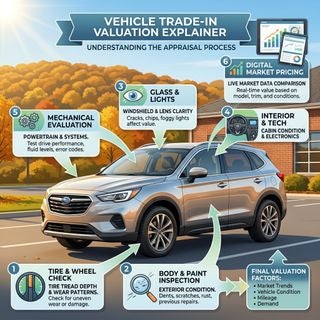


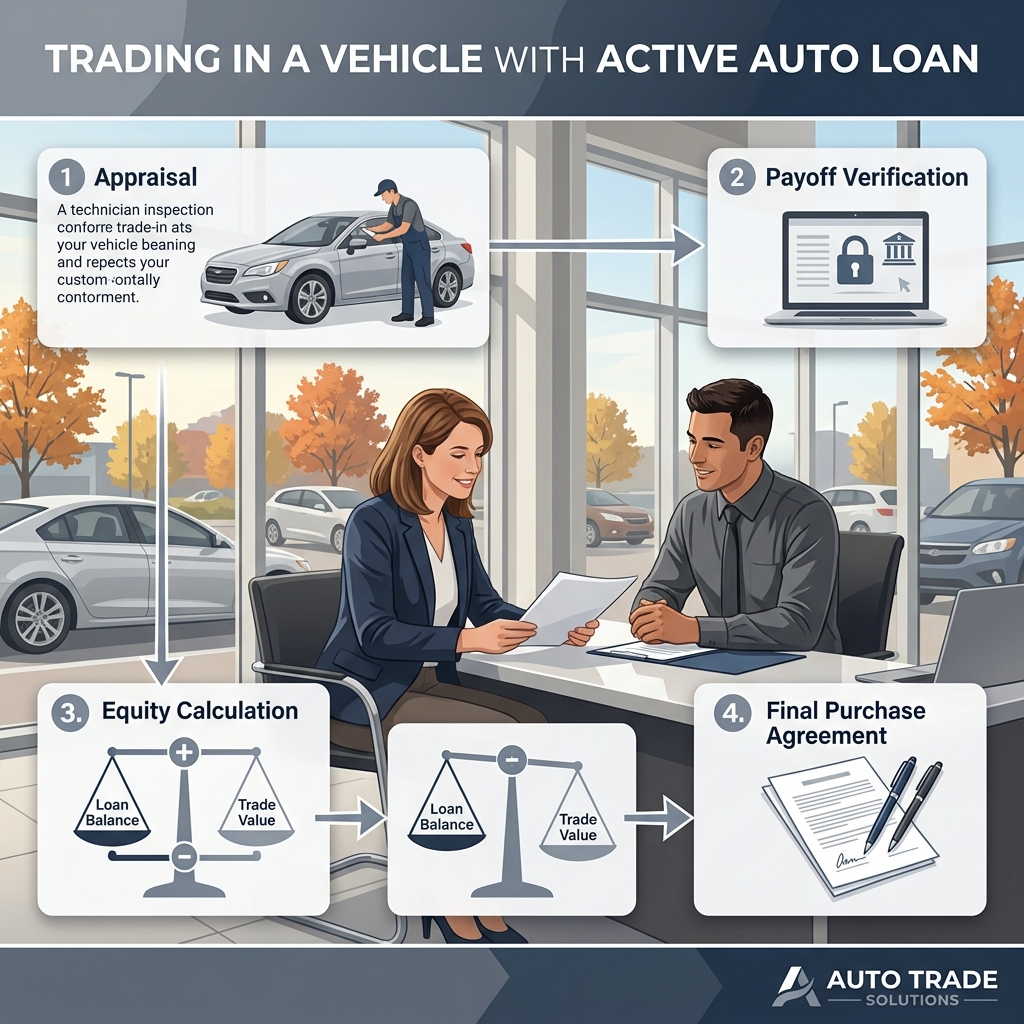
You do not need to pay off an active auto loan before trading in your vehicle at a dealership. The dealer contacts your financial institution directly to request a 10-day payoff quote, settles the remaining lien balance, and manages the title transfer paperwork. If your vehicle’s current market value exceeds the loan balance, the resulting positive equity serves as a cash down payment toward your next vehicle purchase.
Managing a trade-in with an existing loan balance is a routine daily transaction for finance departments. When you bring a financed vehicle to our showroom on Pennsylvania Avenue, our team initiates a direct verification with your lender. This step determines the precise payoff figure, including accrued daily interest. Once the trade value is locked in, the purchase agreement clearly outlines how the remaining debt is processed.
If you owe less than the total trade appraisal, the positive equity is deducted from the purchase price of your new truck or SUV. For example, if a vehicle appraises for $18,000 and your loan payoff is $14,000, you have $4,000 in positive equity to lower the total amount financed on your replacement vehicle. The dealership issues payment directly to your lender to release the title, completing the transaction without requiring you to clear the balance out of pocket beforehand.
Drivers preparing to trade in a financed vehicle should gather their current lender account number, the loan customer service phone number, and current registration. If you want to verify your payoff details before visiting or need guidance on what documentation to bring along, you can give our team a quick call to walk through the process.
Table of Contents
- Should You Pay Off Your Car Loan Before Trading It In?
- How Negative Equity and Loan Rollovers Work During a Trade-In
- Does Ohio Offer Sales Tax Savings on Vehicle Trade-Ins?
- Managing Pending Payments, Vehicle Reconditioning, and Lien Title Transfers
- Common Questions About Trading In a Financed Vehicle
- Maximize Your Trade-In Value and Finance Your Next Ford
Should You Pay Off Your Car Loan Before Trading It In?
Paying off your auto loan prior to trading in your vehicle is entirely optional and often financially unnecessary. Clearing the loan beforehand simplifies title handling by placing a clean title in your hands, but using substantial liquid savings to pay off a low-interest auto loan can unnecessarily deplete cash reserves needed for a down payment or emergency funds.
Evaluating whether to clear the balance comes down to your available cash, current interest rates, and equity position. Paying down a loan balance until the payoff falls below the vehicle's market value prevents carrying debt into your next vehicle contract. However, if your funds are better utilized as a cash down payment to secure a better interest rate on a new Ford Expedition equipped with Ford Co-Pilot360 or a Ford F-150 with a 3.5L EcoBoost V6, letting the dealership process the payoff during the sale preserves your cash flexibility.
Suburban commuters traveling State Route 170 from nearby Calcutta often evaluate whether to trade in an active loan or clear the title early when shopping for a vehicle with enhanced cargo space and towing capacity for family trips. The key benefit of trading in with an active loan is convenience. The dealership takes over the administrative burden of transferring funds to the lienholder, verifying title releases, and ensuring state titling compliance.
Before deciding to pay off your balance early, compare your loan interest rate against current financing incentives. You can complete our online credit application to see how your current equity position aligns with available loan terms, or explore our pre-owned Carfax 1-owner inventory if you want to apply existing equity toward a reliable late-model vehicle.
How Negative Equity and Loan Rollovers Work During a Trade-In
Negative equity occurs when your current loan payoff balance is higher than the actual market trade-in value of your vehicle. When you trade in an upside-down vehicle, the unpaid balance does not disappear; it must either be paid out of pocket at signing or rolled into the financing contract of your replacement vehicle, subject to lender approval limits.
Rolling negative equity into a new vehicle loan increases the overall principal balance beyond the vehicle's selling price. Lenders evaluate these transactions using loan-to-value limits, which typically cap total borrowing between 110% and 125% of the new vehicle's book or invoice value. If a vehicle appraises for $12,000 but the loan payoff is $16,000, the $4,000 shortfall is added to the new loan. On a new vehicle purchase, adding several thousand dollars of rolled-over debt can result in higher monthly payments and increased interest costs over time.
To mitigate the impact of negative equity during a trade-in, consider selecting a replacement vehicle that offers strong value retention or manufacturer rebates that help offset the balance shortfall. Commercial buyers looking at our Ford F-Series work truck inventory or retail shoppers browsing our certified pre-owned Ford lineup often utilize down payments or factory incentives to absorb remaining balance shortfalls, keeping the new loan within standard financing guidelines.
Key strategies for managing negative equity include:
- Providing a cash down payment to cover part or all of the negative equity gap.
- Selecting a model with substantial factory rebates to absorb the equity shortfall.
- Choosing a shorter loan term to pay down principal faster and avoid remaining underwater long-term.
- Delaying the trade-in for several months while making extra principal-only payments on your current loan.

Does Ohio Offer Sales Tax Savings on Vehicle Trade-Ins?
Ohio tax law allows a sales tax credit equal to the full agreed trade-in allowance of your vehicle when purchased through a licensed dealership. This tax credit applies directly to the agreed price of the replacement vehicle, reducing the total amount subject to state and local sales tax regardless of whether your existing loan has positive or negative equity.
The sales tax credit is calculated strictly on the trade-in allowance value negotiated for your vehicle, independent of the outstanding loan payoff balance. For instance, if you agree on a $20,000 trade-in value for your current vehicle when purchasing a $45,000 Ford Explorer, Ohio sales tax is calculated only on the remaining $25,000 difference. If your local sales tax rate is 6.75%, this trade-in allowance saves you $1,350 in state sales tax compared to buying the new vehicle without a trade-in.
Even if you carry negative equity on your trade-in vehicle, you still receive the full sales tax reduction on the trade allowance. The remaining loan debt is handled as a separate financial obligation in the transaction statement. This tax structure provides a distinct financial advantage over private-party sales, where buyers cannot offer state sales tax credit offsets on your purchase.
Shoppers commuting along Market Street from Boardman frequently take advantage of trade-in tax offsets when upgrading to a multi-row SUV designed for family safety and suburban driving. To check how your trade value translates into direct savings, look through our selection of new Ford models and submit your details through our Instant Cash Offer valuation tool for an estimated trade allowance.
Managing Pending Payments, Vehicle Reconditioning, and Lien Title Transfers
Continuing your regularly scheduled auto loan payment is essential if your trade-in transaction takes place near your payment due date. Because lien payoffs take approximately 3 to 5 business days for financial institutions to process and record, missing a payment while a trade is pending can trigger late fees or a negative mark on your credit report.
If your scheduled payment processes right before or during the dealership's payoff distribution, an overpayment will occur. Lenders automatically audit account balances once the payoff check clears. Any excess funds resulting from your recent payment are refunded directly to you by the lender, typically via check or direct deposit within 10 to 15 business days.
Addressing minor cosmetic details prior to your trade appraisal can help maximize your vehicle's appraisal value without wasting money on unneeded repairs. Professional detailing, clearing personal belongings, fixing small windshield chips, and ensuring all owner's manuals and keys are present provide a solid return on effort. Expensive mechanical overhauls rarely yield a dollar-for-dollar increase in trade value, as dealership reconditioning facilities handle major repairs more cost-effectively.
Transferring a title with a lien is handled entirely by the dealership team during a trade-in. When selling to a private party, you must manually request a 10-day payoff quote, pay the bank in full, wait up to several weeks for the lienholder to release the paper title, and then arrange a title transfer with the buyer at a local registrar office. Trading in at a dealership eliminates these delays, as the dealer settles the lien directly with the lender and processes electronic title releases through state agency portals.
Common Questions About Trading In a Financed Vehicle
Q: Does paying off a car loan lower your credit score temporarily?
Paying off an auto loan can cause a minor, temporary dip in your credit score because closing an active installment account reduces your overall credit mix and lowers the average age of your active accounts. This score adjustment is normal and typically stabilizes within a few months as your updated credit profile records ongoing, on-time payments on your replacement auto loan or remaining accounts.
Q: What is the maximum negative equity a lender will allow you to roll over?
Most automotive lenders cap maximum loan-to-value ratios between 110% and 125% of the replacement vehicle's total invoice or retail value. This percentage sets the ceiling for how much negative equity, warranty products, and registration fees can be added to the new loan balance based on borrower creditworthiness and vehicle value.
Q: How does positive equity lower your monthly payment on a new vehicle?
Positive equity acts as an immediate down payment that reduces the net purchase price of your replacement vehicle. By lowering the total principal balance you need to borrow, positive equity directly reduces your monthly interest charges and lowers your required monthly installment payment over the term of the loan.
Q: Can you trade in a vehicle if you currently have a high interest rate on your loan?
You can trade in a vehicle regardless of the interest rate on your existing loan contract. When the dealership appraises the vehicle and processes the transaction, the full outstanding payoff balance is remitted to your current lender, completely closing that account and ending its associated interest rate.
Q: How do you transfer a car title to a private buyer when a lien exists?
Transferring a titled vehicle with a lien to a private buyer requires obtaining a formal 10-day payoff quote, receiving full funds from the buyer, remitting payment to your lender, and waiting several weeks for the bank to send the paper title release. Once received, both parties must sign the released title at a title office or notary. Trading in at a dealership avoids this waiting period because the dealer handles lien clearance directly with the bank.
If you have specific questions about structuring your current vehicle loan into a new purchase, our finance center services team can walk you through exact payoff numbers and credit options.
Maximize Your Trade-In Value and Finance Your Next Ford
Navigating a trade-in with an active auto loan is simple when you have clear payoff numbers, an accurate trade appraisal, and an experienced finance team managing the paperwork. Whether you have positive equity to apply as a down payment or need options for managing a remaining loan balance, taking the right steps ensures a smooth transition into your next vehicle.
At Tri State Ford, we handle all communication with your current lender, process state trade-in tax savings, and help you find a durable, family-friendly vehicle durable and dependable for daily driving and weekend adventures. Bringing your account details, registration, and both sets of keys to your visit ensures your trade evaluation is completed promptly.
To take the next step toward your replacement vehicle, you can start by using our online trade evaluation tool to estimate your current vehicle value. When you are ready for a test drive or a complete line-by-line trade quote, visit our dealership in East Liverpool or speak directly with our sales team by calling (330) 462-7578 today.
Keep Your Vehicle Running Strong
Keep your vehicle performing at its best with our service team:
© 2026 Tri State Ford. All rights reserved.