

Blog / Maintenance & Service, Brake System Care, Vehicle Safety & Inspections, Parts & Repairs, Expert

Recognizing When Your Ford Needs Brake Service

Article image

Recognizing When Your Ford Needs Brake Service

Your Ford’s braking system plays a vital role in keeping you and your family safe on the roads of East Liverpool and surrounding communities like Raccoon Township and Center Township. Because brakes endure constant wear and tear, especially in varied driving conditions, it’s essential to recognize the signs that your vehicle requires brake maintenance or repair. Catching these early can prevent costly damage and ensure your Ford remains dependable for years to come.

Brakes operate through friction, using brake pads pressing against rotors to slow or stop your vehicle. Over time, this friction material wears down, reducing braking efficiency. One of the clearest indicators your Ford needs brake service is a noticeable change in how your vehicle stops. If you find yourself pressing the brake pedal harder or feeling like your stopping distance has increased, it’s time to have your brakes inspected. These subtle changes often signal thinning brake pads or early rotor wear, which, if left unattended, can compromise your vehicle’s safety.

Another common sign is unusual noises during braking. A sharp squeal or high-pitched screech often means the brake pads have worn close to their limit. Most Ford brake pads come equipped with wear indicators designed to emit this sound as a warning. Ignoring this could lead to metal-on-metal contact, causing harsh grinding noises and potentially damaging the rotors. This kind of damage usually results in more extensive repairs, including rotor replacement, which increases maintenance costs and downtime.

Visual inspection can sometimes reveal brake wear before symptoms become more severe. If you can see through your wheels, check the brake pads’ thickness — anything less than about 3 millimeters means it’s time for replacement. At Tri State Ford, our certified technicians can perform thorough brake inspections that include measuring pad thickness and rotor condition, as well as examining brake fluid levels and system integrity.

Changes in brake pedal feel also offer important clues. A pedal that feels soft, spongy, or unusually low can indicate fluid issues or air in the brake lines, both of which require immediate attention. In East Liverpool’s mixed urban and suburban driving environments, brake fluid can degrade faster due to frequent stops and temperature fluctuations. Regular brake fluid maintenance is crucial to avoid brake fade and maintain consistent pedal response.

If you notice any of these signs or simply want peace of mind, trust the experienced team at Tri State Ford to provide expert brake service. Our ASE-certified technicians use genuine Ford parts to ensure your braking system performs reliably under local conditions. For professional brake care, get directions to Tri State Ford or (330) 462-7578 to schedule your brake inspection and service today. Taking action early protects your investment and keeps your Ford performing safely on every drive.

Table of Contents

Identifying Common Signs of Brake Wear on Your Ford

Recognizing the early signs of brake wear is essential to maintaining the safety and reliability of your Ford vehicle. One of the most frequent indicators is a persistent high-pitched squealing noise when applying the brakes. This noise often comes from a built-in metal wear indicator on the brake pads designed to alert you before the pads become dangerously thin. If you hear this sound consistently, it’s a clear sign your brake pads need inspection.

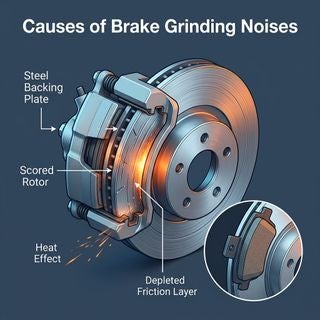
More severe than squealing, a grinding or scraping noise typically means the brake pads have worn down completely, and the metal backing is now making contact with the rotors. This metal-on-metal friction not only reduces braking effectiveness but can quickly damage the rotors, leading to more costly repairs.

Changes in brake pedal feel also point to brake system issues. If the pedal feels softer or spongier than usual, or if it requires pressing further down to engage the brakes, it often indicates worn pads or potential air in the brake lines. Additionally, if you experience vibrations or pulsations through the pedal or steering wheel during braking, this is usually a sign of warped rotors, which often develop from uneven pad wear or overheating.

Another critical symptom is your Ford pulling to one side when braking. Uneven brake pad wear or caliper problems can cause this, affecting vehicle control and safety. Lastly, increased stopping distances should never be ignored. As pads wear down, less friction material means longer distance required to stop, a hazard especially noticeable in wet or slippery conditions.

Regularly checking for these signs helps prevent brake failure and costly damage. For dependable, expert service tailored to your Ford’s specific needs, trust Tri State Ford’s certified technicians to keep your brakes in top condition. Whether you drive a Ford truck or a family SUV, timely brake maintenance ensures safety and peace of mind on every trip. For heavy-duty models, explore our Truck Inventory to find vehicles built for long-lasting performance with reliable braking systems.

Understanding Ford Brake Warning Lights and Their Meanings

Your Ford’s dashboard brake warning lights are crucial indicators designed to alert you to potential issues within your braking system. Recognizing these signals early ensures timely maintenance and prevents costly repairs or safety risks. Most Ford vehicles feature distinct brake-related lights, each reflecting a different concern.

A common brake warning light is the solid red brake symbol, often shaped like a circle with an exclamation mark or the word "BRAKE." This light can indicate several issues: the parking brake may be engaged, brake fluid could be low, or there might be a more serious problem like worn brake pads or a hydraulic failure. If this light stays on while driving, it’s important to have your brakes inspected promptly.

Another important light is the ABS warning indicator, usually labeled “ABS.” This light comes on when the anti-lock braking system detects a fault. While your regular brakes may still work, ABS assists in maintaining steering control during hard braking, especially on slippery roads. A malfunctioning ABS system reduces braking efficiency in emergency situations, so professional diagnosis is recommended.

Some newer Ford models include brake pad wear sensors that trigger a dashboard light when pads approach the end of their lifespan. This warning helps prevent rotor damage by prompting timely pad replacement.

Ignoring these warning lights can lead to brake failure or more expensive repairs. If any brake-related indicator appears, it’s wise to have an ASE-certified technician at Tri State Ford perform a thorough brake system evaluation to ensure safe and reliable stopping power.

How to Inspect Your Ford’s Brake Pads for Safety and Performance

Regularly inspecting your Ford’s brake pads is a practical step you can take to maintain reliable braking and extend the lifespan of your system. Start by parking your vehicle on a flat surface and turning the steering wheel to gain better visibility of the brake components through the wheel spokes. Using a flashlight, look for the brake pads positioned around the rotor. The key focus is the thickness of the friction material—the part that presses against the rotor to slow your vehicle.

New brake pads generally measure between 10 and 12 millimeters in thickness. When this friction material wears down to about 3 millimeters or less, it’s time to plan for replacement. If you notice the pads are thinner than this benchmark, or if the metal backing plate is visible, the pads have worn too far and could compromise your Ford’s stopping power.

For a more thorough check, safely raise the vehicle with a jack and remove the wheel. This allows you to inspect both the inner and outer brake pads, as inner pads often wear faster. While inspecting, examine the rotor surface for grooves, scoring, or discoloration—signs that could require rotor resurfacing or replacement.

Performing these inspections at least twice a year or during regular tire rotations can help you catch wear early. If you’re unsure about your findings or notice uneven pad wear, it’s important to have your brakes evaluated by certified technicians who can accurately measure pad thickness and assess overall brake health. This proactive approach ensures your Ford’s brakes stay effective and safe on the roads.

Maintaining Your Ford’s Brake Fluid and Its Importance

Brake fluid plays a crucial role in your Ford’s braking system by transferring the force from your foot on the brake pedal directly to the brake components at the wheels. Over time, brake fluid can absorb moisture from the air, which reduces its effectiveness and increases the risk of corrosion within brake lines and calipers. This moisture buildup also lowers the fluid’s boiling point, potentially causing a soft or spongy brake pedal feel and decreased stopping power, especially during heavy braking or in hilly areas like those around East Liverpool and Raccoon Township.

Regular brake fluid maintenance is essential to keep your system functioning reliably. Industry standards recommend flushing and replacing brake fluid every two years or as outlined in your Ford’s maintenance guide. Doing so prevents corrosion, maintains consistent hydraulic pressure, and ensures your brakes respond precisely when needed.

If you notice a soft pedal, brake warning lights, or fluid discoloration, it’s time to have your brake fluid inspected. Trust the ASE-certified technicians at Tri State Ford for expert brake fluid service that protects your vehicle’s safety and longevity. For expert brake fluid maintenance, get directions to Tri State Ford or call us at (330) 462-7578 to schedule your brake fluid service and keep your Ford operating safely on roads throughout East Liverpool, OH, and nearby communities.

© 2026 Tri State Ford. All rights reserved.

Posted in:

Related Posts

d

Expert Braking Insights: Why Is My Car Making a Grinding Noise When I Brake?

.hrizn-rte-content .e-rte-image{border:0;max-width:100%;height:auto} .hrizn-rte-content .e-rte-image.e-imginline{display:inline-block;float:none;margin-left:5px;margin-right:5px;max-width:calc(100% - 10px);vertical-align:bottom} .hrizn-rte-content .e-rte-image.e-imgbreak,.hrizn-rte-content .e-rte-image.e-imgcenter{display:block;float:none;margin:5px auto;max-width:100%} .hrizn-rte-content .e-rte-image.e-imgleft{float:left;margin:0 12px 8px 0;max-width:100%} .hrizn-rte-content .e-rte-image.e-imgright{float:right;margin:0 0 8px 12px;max-width:100%} .hrizn-rte-content figure.e-rte-image{margin:8px auto;max-width:100%} .hrizn-rte-content figure.e-imgleft{float:left;margin:0 12px 8px 0} .hrizn-rte-content figure.e-imgright{float:right;margin:0 0 8px 12px} .hrizn-rte-content figure.e-imgcenter{display:block;margin:8px auto;text-align:center} Expert Braking Insights: Why Is My Car Making a Grinding Noise When I Brake? A harsh, metallic grinding noise during braking almost always indicates that your brake pad friction material is completely depleted, causing the steel backing plate to scrape directly against the rotor. To explain the mechanical causes, safety risks, and repair expectations behind these sounds, we sat down with Matt Shaw, Service Manager at Tri State Ford, who brings 10 years of specialized automotive service experience to drivers seeking trusted vehicle care. Q: What primary mechanical issues cause a car to make a grinding noise when braking? A: A grinding noise during braking is primarily caused by brake pads wearing down to their steel backing plates, which then scrape directly against the cast-iron rotor surfaces. While friction material depletion accounts for the vast majority of cases, severe grinding can also stem from road debris such as small stones lodged between the dust shield and the rotor, or broken caliper mounting hardware rubbing against rotating components. When you press the brake pedal, the hydraulic caliper clamps the brake pads against the spinning rotor to slow your vehicle. Under normal conditions, friction material made of semi-metallic or organic compounds absorbs that intense contact safely. Once that layer wears past its minimum thickness, the remaining steel backing plate contacts the rotor directly. This steel-on-steel friction creates immediate scoring, severe heat buildup, and a dramatic drop in stopping power. Drivers navigating the rolling elevation changes near State Route 170 in Calcutta frequently notice this sound on downhill descents, where thermal stress accelerates pad wear. In other instances, the noise presents suddenly without prior wear symptoms. A piece of loose gravel caught between the brake rotor and the metal dust shield can produce a piercing rasp or scraping sound that changes with wheel speed rather than pedal pressure. Foreign objects in the caliper assembly or missing anti-rattle clips can also allow components to shift and rub. If you suspect severe pad wear or backing plate contact, you can reach our East Liverpool service center on Pennsylvania Avenue or give our service team a call for a quick diagnostic walk-through and expert advice. Q: Do ceramic brake pads eliminate grinding noises completely? A: Ceramic brake pads virtually eliminate high-frequency squeals and dust-related noise during normal operation, but they cannot eliminate metal-on-metal grinding if the pad wears down to its backing plate. Because ceramic pads still rely on a hard steel backing plate for structural mounting in the caliper, driving on fully depleted friction material will produce the exact same damaging metallic friction against the rotor as semi-metallic pads. The primary benefit of ceramic friction formulations lies in their composition, which uses dense ceramic compounds and embedded copper or synthetic fibers instead of coarse steel strands. This design dampens noise frequencies above human hearing thresholds and generates light-colored dust that does not stick readily to wheels. Under everyday driving conditions, high-grade ceramic pads operate significantly quieter than high-metallic alternatives. However, no friction formulation exempts a braking system from mechanical wear. Once the ceramic layer wears below 2 millimeters, the mechanical wear indicator or the steel plate itself will contact the rotor. Expecting ceramic pads to prevent metal grinding after complete wear is a common misconception. Maintaining quiet, responsive stopping performance requires replacing pads before the friction material disappears, which you can support by ordering genuine OEM brake components tailored specifically to your vehicle specifications. Q: How far can you safely drive on grinding brakes before catastrophic failure occurs? A: You should not drive a vehicle with grinding brakes beyond the few miles required to reach a certified repair facility. Extended driving on worn backing plates can cause caliper pistons to overextend beyond their fluid seals, leading to complete hydraulic fluid loss and sudden brake failure. "When you hear metal grinding against metal, your stopping distance is already compromised and every extra mile risks turning a basic pad service into a complete hydraulic overhaul." Continuing to press steel against cast iron creates extreme localized friction heat. This thermal spike can warp the rotor, crack the friction surfaces, and boil the brake fluid inside the caliper lines. Vaporized fluid creates air pockets in the sealed hydraulic circuit, causing the brake pedal to sink to the floor without generating stopping pressure. Additionally, the intense heat can scorch caliper piston boots, causing rubber seals to melt and leak fluid directly onto the hot disc. If severe grinding occurs unexpectedly while you are far from home or stranded on the road, utilizing Ford Roadside Assistance: 1-800-241-3673 provides towing support directly to a qualified service bay. During emergency vehicle evaluations, technicians perform comprehensive safety checks, including routine electrical and battery checks, to verify that all electronic safety systems function properly before putting the vehicle back on the road. Q: Can severe grinding brakes cause a vehicle to pull to one side while stopping? A: Severe grinding can cause a vehicle to pull toward one side during braking whenever friction levels or hydraulic caliper pressures become unequal across an axle. When one brake pad wears down to its metal backing plate before the opposing side, or if a caliper slide pin seizes due to extreme friction heat, the uneven stopping force pulls the steering wheel toward the side with stronger friction or binding. Unequal wear patterns frequently develop when caliper slide pins lack proper lubrication or when a caliper piston sticks inside its bore. The stuck pad remains pinned against the rotor while driving, grinding away its friction layer at double the normal rate. When you apply the brakes, the side with intact friction material grips effectively, while the metal-on-metal side slides with reduced efficiency. This differential torque creates a noticeable yaw moment that pulls the front end off course. Drivers negotiating steep riverfront bluffs in East Liverpool near the Ohio River often notice this pull immediately on downhill stops, as weight shifts forward and exaggerates axle imbalances. Inspecting caliper slide pins, hardware boots, and hydraulic lines prevents one-sided binding from destroying rotors prematurely. For added convenience when dealing with braking issues at home or work, exploring Ford Mobile Service options allows certified technicians to perform remote maintenance inspections directly in your driveway. Q: Why do new brake pads sometimes squeak after installation, and how does that differ from grinding? A: New brake pads sometimes produce a high-pitched squeak during their initial break-in period due to microscopic surface vibrations, light glazing, or a lack of dampening lubricant behind the backing plate. That high-frequency squeal is fundamentally different from a harsh, low-frequency metal grinding sound, which indicates physical gouging and heavy mechanical contact between steel and rotor iron. During the initial bedding-in phase, new pad material transfers a thin, uniform layer of friction compound onto the smooth rotor surface. Until that transfer layer fully stabilizes across several dozen moderate stops, light vibration frequencies can resonate through the caliper frame as a squeak. Technicians mitigate this sound by applying specialized anti-squeal dampening shims and high-temperature silicone grease to the rear backing contact points during assembly. Grinding, by contrast, is never a normal break-in sound. A grinding noise signifies deep structural gouging, uneven rotor scoring, or severe mechanical interference. If a newly serviced brake system produces a harsh metal-on-metal sound, it typically means an anti-rattle clip was installed improperly or a mounting bolt has loosened. Drivers who prefer seamless maintenance scheduling can take advantage of Ford Pick Up & Delivery service to have their vehicle transported to the shop and returned after a complete inspection. Q: What should drivers expect regarding brake replacement service costs and professional inspections? A: Professional brake service costs vary based on whether you require a simple pad replacement or a full pad-and-rotor overhaul per axle, with routine maintenance costing significantly less than repairing damaged calipers and gouged rotors. A comprehensive brake inspection includes measuring pad thickness in millimeters, evaluating rotor surface variation, checking caliper slide operation, and testing hydraulic fluid condition. When caught early, replacing brake pads on a single axle remains a straightforward, cost-effective maintenance item. However, allowing pads to grind down to their steel backing plates quickly cuts deep grooves into the rotors, making resurfacing impossible and requiring full rotor replacement. In severe cases, extreme heat damages the caliper assembly itself, requiring fluid flushes and new hydraulic hardware that increases total repair expenses. During a professional inspection at our convenient East Liverpool facility, factory-trained technicians measure remaining friction depth against original manufacturer tolerances. Catching wear before metal-on-metal contact protects your rotors and ensures reliable stopping distance. If you hear unexpected braking sounds or want peace of mind before a long trip, (330) 462-7578 is available for quick questions, or you can get started by scheduling your service appointment online today. © 2026 Tri State Ford. All rights reserved. Title Tags Brake Grinding Noise Repair in East Liverpool OH | Tri State Ford Meta Description Keywords Open Graph Twitter Card Canonical Article Metadata Geographic Targeting { "@context": "https://schema.org", "@graph": [ { "@type": "NewsArticle", "@id": "#article", "headline": "Expert Braking Insights: Why Is My Car Making a Grinding Noise When I Brake?", "datePublished": "2026-09-11T18:40:51.880Z", "dateModified": "2026-09-11T18:42:37.227Z", "author": { "@id": "#author" }, "publisher": { "@id": "#dealer" }, "wordCount": 1464, "description": "A grinding noise when braking usually indicates worn brake pads scraping against rotors or trapped debris, reducing stopping power and requiring repair." }, { "@type": "AutoDealer", "@id": "#dealer", "name": "Tri State Ford", "url": "https://www.tristateford.net", "telephone": "+13304627578", "sameAs": [ "https://maps.google.com/?cid=1136336406351438323" ], "address": { "@type": "PostalAddress", "streetAddress": "1503 Pennsylvania Ave", "addressLocality": "East Liverpool", "addressRegion": "OH", "postalCode": "43920", "addressCountry": "US" }, "areaServed": { "@type": "GeoCircle", "geoMidpoint": { "@type": "GeoCoordinates", "latitude": "40.6367833", "longitude": "-80.5443033" }, "geoRadius": "48280" }, "geo": { "@type": "GeoCoordinates", "latitude": "40.6367833", "longitude": "-80.5443033" }, "openingHours": [ "Mo 09:00-20:00", "Tu 09:00-18:00", "We 09:00-18:00", "Th 09:00-20:00", "Fr 09:00-18:00", "Sa 09:00-15:00" ] }, { "@type": "FAQPage", "@id": "#faq", "mainEntity": [ { "@type": "Question", "name": "What primary mechanical issues cause a car to make a grinding noise when braking?", "acceptedAnswer": { "@type": "Answer", "text": "A grinding noise during braking is primarily caused by brake pads wearing down to their steel backing plates, which then scrape directly against the cast-iron rotor surfaces. While friction material depletion accounts for the vast majority of cases, severe grinding can also stem from road debris such as small stones lodged between the dust shield and the rotor, or broken caliper mounting hardware rubbing against rotating components. When you press the brake pedal, the hydraulic caliper clamps the brake pads against the spinning rotor to slow your vehicle. Under normal conditions, friction material made of semi-metallic or organic compounds absorbs that intense contact safely. Once that layer wears past its minimum thickness, the remaining steel backing plate contacts the rotor directly. This steel-on-steel friction creates immediate scoring, severe heat buildup, and a dramatic drop in stopping power. Drivers navigating the rolling elevation changes near State Route 170 in Calcutta frequently notice this sound on downhill descents, where thermal stress accelerates pad wear. In other instances, the noise presents suddenly without prior wear symptoms. A piece of loose gravel caught between the brake rotor and the metal dust shield can produce a piercing rasp or scraping sound that changes with wheel speed rather than pedal pressure. Foreign objects in the caliper assembly or missing anti-rattle clips can also allow components to shift and rub. If you suspect severe pad wear or backing plate contact, you can reach our East Liverpool service center on Pennsylvania Avenue or give our service team a call for a quick diagnostic walk-through and expert advice." } }, { "@type": "Question", "name": "Do ceramic brake pads eliminate grinding noises completely?", "acceptedAnswer": { "@type": "Answer", "text": "Ceramic brake pads virtually eliminate high-frequency squeals and dust-related noise during normal operation, but they cannot eliminate metal-on-metal grinding if the pad wears down to its backing plate. Because ceramic pads still rely on a hard steel backing plate for structural mounting in the caliper, driving on fully depleted friction material will produce the exact same damaging metallic friction against the rotor as semi-metallic pads. The primary benefit of ceramic friction formulations lies in their composition, which uses dense ceramic compounds and embedded copper or synthetic fibers instead of coarse steel strands. This design dampens noise frequencies above human hearing thresholds and generates light-colored dust that does not stick readily to wheels. Under everyday driving conditions, high-grade ceramic pads operate significantly quieter than high-metallic alternatives. However, no friction formulation exempts a braking system from mechanical wear. Once the ceramic layer wears below 2 millimeters, the mechanical wear indicator or the steel plate itself will contact the rotor. Expecting ceramic pads to prevent metal grinding after complete wear is a common misconception. Maintaining quiet, responsive stopping performance requires replacing pads before the friction material disappears, which you can support by ordering genuine OEM brake components tailored specifically to your vehicle specifications." } }, { "@type": "Question", "name": "How far can you safely drive on grinding brakes before catastrophic failure occurs?", "acceptedAnswer": { "@type": "Answer", "text": "You should not drive a vehicle with grinding brakes beyond the few miles required to reach a certified repair facility. Extended driving on worn backing plates can cause caliper pistons to overextend beyond their fluid seals, leading to complete hydraulic fluid loss and sudden brake failure. > \"When you hear metal grinding against metal, your stopping distance is already compromised and every extra mile risks turning a basic pad service into a complete hydraulic overhaul.\" Continuing to press steel against cast iron creates extreme localized friction heat. This thermal spike can warp the rotor, crack the friction surfaces, and boil the brake fluid inside the caliper lines. Vaporized fluid creates air pockets in the sealed hydraulic circuit, causing the brake pedal to sink to the floor without generating stopping pressure. Additionally, the intense heat can scorch caliper piston boots, causing rubber seals to melt and leak fluid directly onto the hot disc. If severe grinding occurs unexpectedly while you are far from home or stranded on the road, utilizing Ford Roadside Assistance: 1-800-241-3673 provides towing support directly to a qualified service bay. During emergency vehicle evaluations, technicians perform comprehensive safety checks, including routine electrical and battery checks , to verify that all electronic safety systems function properly before putting the vehicle back on the road." } }, { "@type": "Question", "name": "Can severe grinding brakes cause a vehicle to pull to one side while stopping?", "acceptedAnswer": { "@type": "Answer", "text": "Severe grinding can cause a vehicle to pull toward one side during braking whenever friction levels or hydraulic caliper pressures become unequal across an axle. When one brake pad wears down to its metal backing plate before the opposing side, or if a caliper slide pin seizes due to extreme friction heat, the uneven stopping force pulls the steering wheel toward the side with stronger friction or binding. Unequal wear patterns frequently develop when caliper slide pins lack proper lubrication or when a caliper piston sticks inside its bore. The stuck pad remains pinned against the rotor while driving, grinding away its friction layer at double the normal rate. When you apply the brakes, the side with intact friction material grips effectively, while the metal-on-metal side slides with reduced efficiency. This differential torque creates a noticeable yaw moment that pulls the front end off course. Drivers negotiating steep riverfront bluffs in East Liverpool near the Ohio River often notice this pull immediately on downhill stops, as weight shifts forward and exaggerates axle imbalances. Inspecting caliper slide pins, hardware boots, and hydraulic lines prevents one-sided binding from destroying rotors prematurely. For added convenience when dealing with braking issues at home or work, exploring Ford Mobile Service options allows certified technicians to perform remote maintenance inspections directly in your driveway." } }, { "@type": "Question", "name": "Why do new brake pads sometimes squeak after installation, and how does that differ from grinding?", "acceptedAnswer": { "@type": "Answer", "text": "New brake pads sometimes produce a high-pitched squeak during their initial break-in period due to microscopic surface vibrations, light glazing, or a lack of dampening lubricant behind the backing plate. That high-frequency squeal is fundamentally different from a harsh, low-frequency metal grinding sound, which indicates physical gouging and heavy mechanical contact between steel and rotor iron. During the initial bedding-in phase, new pad material transfers a thin, uniform layer of friction compound onto the smooth rotor surface. Until that transfer layer fully stabilizes across several dozen moderate stops, light vibration frequencies can resonate through the caliper frame as a squeak. Technicians mitigate this sound by applying specialized anti-squeal dampening shims and high-temperature silicone grease to the rear backing contact points during assembly. Grinding, by contrast, is never a normal break-in sound. A grinding noise signifies deep structural gouging, uneven rotor scoring, or severe mechanical interference. If a newly serviced brake system produces a harsh metal-on-metal sound, it typically means an anti-rattle clip was installed improperly or a mounting bolt has loosened. Drivers who prefer seamless maintenance scheduling can take advantage of Ford Pick Up & Delivery service to have their vehicle transported to the shop and returned after a complete inspection." } }, { "@type": "Question", "name": "What should drivers expect regarding brake replacement service costs and professional inspections?", "acceptedAnswer": { "@type": "Answer", "text": "Professional brake service costs vary based on whether you require a simple pad replacement or a full pad-and-rotor overhaul per axle, with routine maintenance costing significantly less than repairing damaged calipers and gouged rotors. A comprehensive brake inspection includes measuring pad thickness in millimeters, evaluating rotor surface variation, checking caliper slide operation, and testing hydraulic fluid condition. When caught early, replacing brake pads on a single axle remains a straightforward, cost-effective maintenance item. However, allowing pads to grind down to their steel backing plates quickly cuts deep grooves into the rotors, making resurfacing impossible and requiring full rotor replacement. In severe cases, extreme heat damages the caliper assembly itself, requiring fluid flushes and new hydraulic hardware that increases total repair expenses. During a professional inspection at our convenient East Liverpool facility , factory-trained technicians measure remaining friction depth against original manufacturer tolerances. Catching wear before metal-on-metal contact protects your rotors and ensures reliable stopping distance. If you hear unexpected braking sounds or want peace of mind before a long trip, (330) 462-7578 is available for quick questions, or you can get started by scheduling your service appointment online today. --- © 2026 Tri State Ford. All rights reserved." } } ] } ] }