Blog

How Do You Know When Your Car Battery Needs Replacement?

l

A car battery needs replacement when it shows persistent physical or electrical warning signs, including slow engine cranking, rapid starter clicking, dimming headlights, swollen casing, or resting voltage below 12.4 volts. Conventional 12-volt automotive batteries typically last 3 to 5 years before chemical degradation reduces their ability to hold a charge. If your vehicle requires frequent jump-starts or displays a battery warning light, physical inspection and digital load testing confirm whether internal cell failure requires immediate replacement.

Understanding battery health keeps your vehicle dependable during early morning starts and severe seasonal weather. Cold winter morning commutes along State Route 170 in Calcutta put heavy strain on aging battery chemistry, causing low chemical reactivity that reveals underlying weakness. When internal lead plates sulfating over time lose storage capacity, the battery can no longer deliver the necessary cold-cranking amps to spin the starter motor reliably.

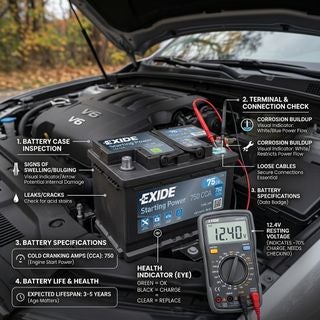
Recognizing early failure prevents unexpected vehicle lockouts and protects sensitive onboard computers. Modern vehicles rely on steady electrical current to power steering controls, safety modules, and infotainment displays. When voltage drops below operational thresholds, electronic systems register communication errors and reset driver preferences. Inspecting battery terminals for white or blue powder corrosion, checking for bulging case walls from internal heat, and noting sluggish engine turns are effective ways to spot trouble early.

Our service team at Tri State Ford provides complete battery diagnostics and replacement services using original equipment components. Drivers can easily visit our East Liverpool service center at 1503 Pennsylvania Ave, East Liverpool, OH 43920, or call (330) 462-7578 to speak directly with a technician. If you prefer performing your own replacement, you can also order a genuine Motorcraft battery built specifically for your model's electrical specification.
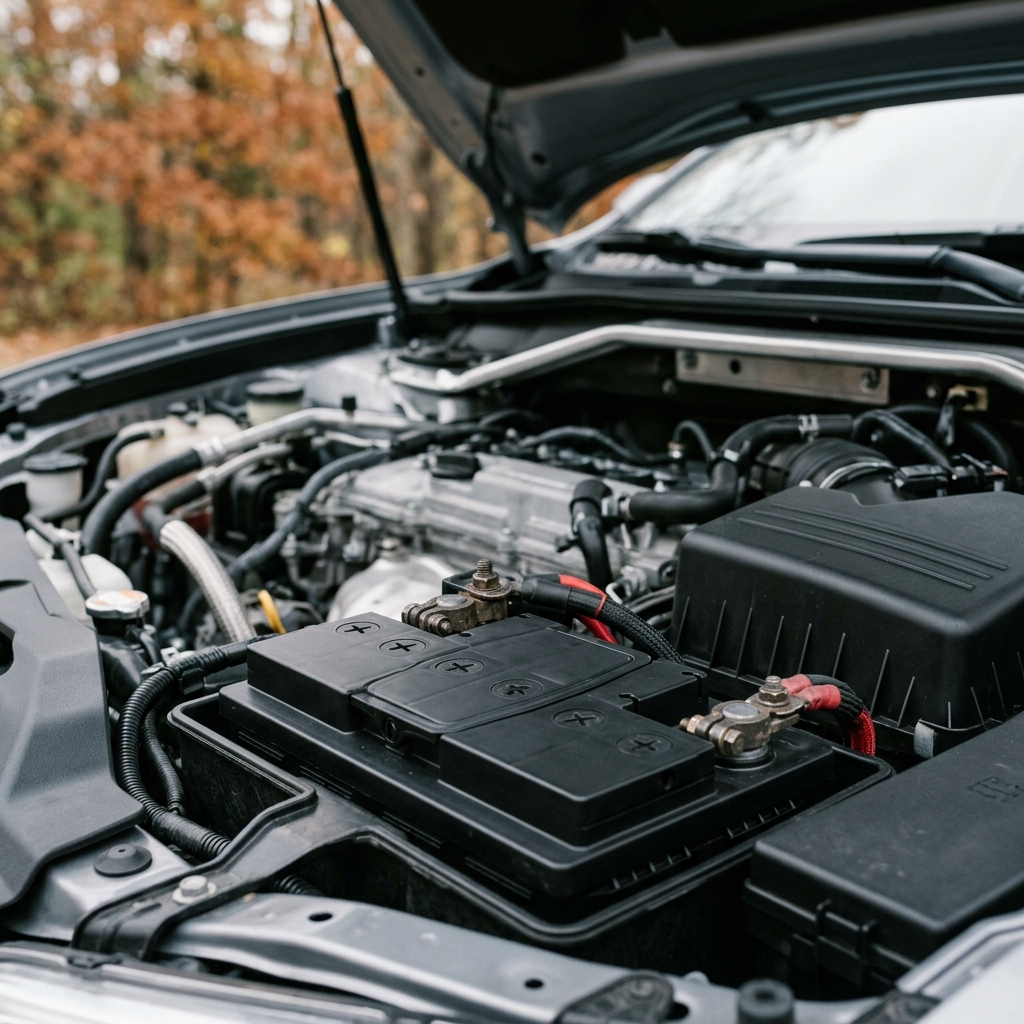
 Close-up view of a car battery with terminals installed inside a clean vehicle engine compartment. (Representative image for illustration purposes only. Actual vehicle may vary based on trim and configuration.)

Table of Contents

What Are the Early Warning Signs and Symptoms That Your Battery Is Failing?

The early warning signs of a failing car battery include a slow or labored engine crank, dimming cabin and headlight illumination at idle, rapid clicking sounds upon turning the key, unexpected electrical resets, and visual battery case distortion or corrosion. Identifying these subtle operational changes allows drivers to schedule maintenance before complete voltage depletion leaves them stranded.

Sluggish engine starting is often the first mechanical symptom drivers observe. When turning the ignition key or pressing the start button, the engine turns over slowly rather than delivering a quick, energetic spin. This occurs because internal resistance increases as the battery ages, limiting the instantaneous current delivered to the starter solenoid. In models equipped with auto start-stop systems, such as the 2026 Ford Explorer with its 2.3L EcoBoost engine, a degrading 12-volt battery will cause the control computer to disable automatic engine shutoffs at traffic stops to preserve essential cranking reserve.

Electrical anomalies across cabin accessories provide additional diagnostic signals:

  • Headlights and dashboard instrument backlights flicker or dim when idling, returning to full brightness only when revving the engine.
  • Power windows roll up slower than usual, or power seat motors sound strained under load.
  • Digital clocks and radio channel presets reset unexpectedly after starting the engine.
  • Dashboard indicator lamps, including the battery charging icon or check engine light, illuminate due to low line voltage during start-up.
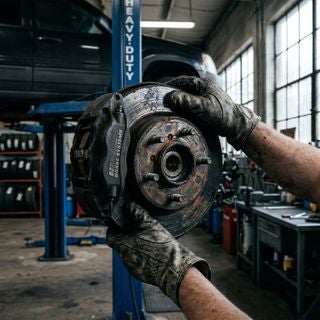
  • Physical battery inspection reveals powdery corrosion surrounding terminal posts, a bulging polymer casing, or a sulfurous rotten-egg odor caused by gas venting during overheating.

Frequent short trips around retail hubs near Market Street in Boardman do not allow the alternator enough run time to fully recharge a weakened battery, accelerating plate sulfation. Drivers noticing these symptoms can schedule professional battery service and testing to verify chemical capacity before total failure occurs.

How Do You Test a Car Battery Using a Digital Multimeter?

Testing a car battery with a digital multimeter requires measuring resting open-circuit voltage across the terminals with the engine off, followed by monitoring voltage drop while cranking the engine. A fully charged, healthy 12-volt battery displays a resting voltage of 12.6 volts or higher, whereas a reading below 12.0 volts indicates severe discharge or cell depletion.

To perform a resting voltage test, follow a precise sequence:

  1. Turn off the ignition, switch off all interior lights and accessories, and let the vehicle sit undisturbed for at least 30 minutes to eliminate surface charge.
  2. Set the digital multimeter dial to measure direct current voltage, selecting the DC volts setting at the 20-volt scale.
  3. Connect the red positive multimeter lead to the positive battery terminal post, then attach the black negative lead to the negative terminal post.
  4. Observe the numerical reading displayed on the multimeter screen to evaluate the state of charge.

Interpreting resting voltage measurements relies on precise technical thresholds:

  • 12.6 volts to 12.8 volts: The battery is at 100% full charge and chemically stable.
  • 12.4 volts: The state of charge is approximately 75%, representing acceptable operational reserve.
  • 12.2 volts: The charge has dropped to 50%, indicating the battery requires immediate charging or diagnostic attention.
  • 11.9 volts or lower: The battery is fully discharged, indicating internal plate degradation or a shorted cell.

After recording resting voltage, conduct a cranking voltage test with an assistant to turn the key. Watch the multimeter display during engine ignition. In healthy condition, line voltage should not drop below 9.6 volts at 70°F during a 15-second start cycle. If voltage plunges below this standard during cranking, the battery lacks sufficient internal current capacity and requires replacement, regardless of its static resting voltage.
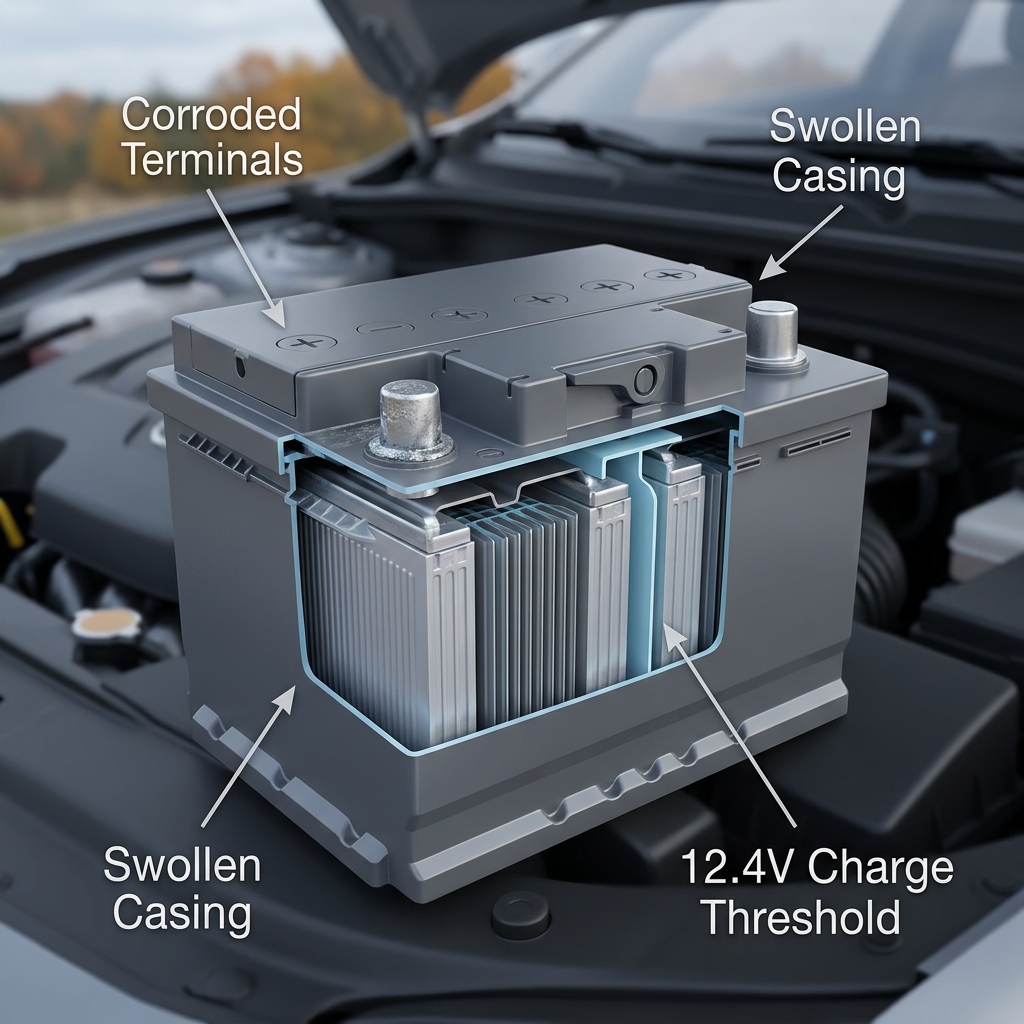
Diagram of a car battery cutaway showing swollen casing, corroded terminals, and internal 12.4V charge threshold. (Representative image for illustration purposes only. Actual vehicle may vary based on trim and configuration.)

Can a Bad Battery Ruin a Good Alternator and Vehicle Electronics?

A severely degraded or shorted battery can damage a healthy alternator and cause electrical glitches across onboard vehicle modules by forcing the charging system to operate under continuous maximum output. Because the alternator is designed to maintain electrical system voltage and top off consumed cranking energy rather than constantly charge a dead battery, continuous high-amp output generates excessive heat that degrades internal diodes and stator windings.

When a battery develops shorted internal cells, its internal electrical resistance drops dramatically, creating an artificial power sink. The alternator's voltage regulator responds by driving field current to maximum capacity in an effort to bring system voltage back to standard operating thresholds. Prolonged heat buildup from this continuous heavy duty cycles breaks down diode bridges and leads to premature alternator failure. Vehicles equipped with high-draw accessories, such as the 2026 Ford F-150 PowerBoost Hybrid with its 3.5L PowerBoost V6 powertrain and SelectShift transmission, rely on precise voltage management across both high-voltage and 12-volt accessory networks.

Voltage fluctuations from a failing battery also introduce electrical noise and low-voltage spikes into vehicle communications. Sensitive control units—including powertrain modules, anti-lock braking computers, and infotainment systems—require steady direct current. Drops in line voltage below critical thresholds cause control modules to log false fault codes, trigger warning lights, and enter limp-home protective modes.

Maintaining fresh battery equipment protects the entire charging ecosystem. Drivers interested in maintaining factory engineering integrity can review service information on service components or explore custom factory builds when evaluating long-term vehicle maintenance requirements.

What Is the Lifespan of a Car Battery and Are AGM Batteries Worth the Extra Cost?

The average operational lifespan of a standard flooded 12-volt car battery ranges between 3 to 5 years, depending on climate conditions, driving habits, and maintenance care. Upgrading to an Absorbent Glass Mat (AGM) battery costs more initially but provides up to double the operational cycle life, faster recharge acceptance, and superior resistance to extreme temperature swings and mechanical vibration.

Standard flooded lead-acid batteries utilize liquid electrolyte sloshing around lead plates. Over time, heat causes water evaporation, while thermal cycling causes active lead material to shed from the plates, settling at the bottom of the casing as sludge. In cold winter climates, sub-freezing temperatures reduce chemical reaction speeds, cutting cranking power by up to 50 percent just when cold engine oil demands maximum turning energy.

AGM batteries replace liquid acid with fiberglass mesh mats that absorb electrolyte liquid, sandwiching it tightly between lead plates under compression. Key technical advantages of AGM technology include:

  • Extended service durability, routinely lasting 4 to 7 years under typical driving demands.
  • Up to three times the deep-cycling capacity of flooded batteries, supporting heavy accessory loads and modern idle stop-start systems.
  • Superior cold-weather performance, maintaining higher voltage discharge under sub-freezing conditions.
  • Spill-proof, maintenance-free sealed construction that eliminates terminal acid corrosion and gas venting under normal operation.
  • Faster current absorption from the alternator, shortening recharge time during brief drives.

For vehicle owners driving models like the 2026 Ford Escape Hybrid with its 1.5L EcoBoost engine and automatic 8-speed transmission, maintaining stable low-voltage power is critical for hybrid control handoffs. Upgrading to an AGM battery is a practical choice for drivers seeking long-term reliability against harsh weather.

Common Questions About Car Battery Diagnosis and Maintenance

Q: Why does a bad car battery cause a rapid clicking sound when turning the key?

The rapid clicking sound occurs when a battery has sufficient resting voltage to energize the starter solenoid, but lacks the amperage required to rotate the heavy starter motor shaft. As the solenoid engages, the massive current draw causes system voltage to plummet immediately. This sudden voltage loss disengages the solenoid spring, creating a cycle of rapid engagement and release that produces the fast chatter sound under the hood.

Q: Can a failing car battery trigger a check engine light on my dashboard?

Yes, fluctuating voltage from a weakened battery frequently triggers a check engine light. Modern electronic control modules constantly monitor system voltage levels. When voltage drops during engine cranking or idle, communication delays between sensors and processing units can occur, causing diagnostic codes for low voltage or sensor circuit malfunctions to set in computer memory.

Q: How long should you drive a vehicle to recharge a low battery after a jump-start?

After jump-starting a vehicle, drive continuously for at least 30 consecutive minutes at highway speeds without frequent stopping to allow the alternator time to replenish surface charge. However, if the battery failed due to internal cell damage or age-related sulfation, charging from the alternator will not restore full cranking capacity, requiring professional diagnostic testing to confirm battery health.

Q: Does extreme winter weather ruin a car battery faster than summer heat?

Summer heat is actually the primary cause of internal chemical damage, accelerating plate corrosion and electrolyte evaporation inside the battery. However, winter freezing temperatures expose that damage by slowing chemical reaction speeds, reducing available cranking power by up to half while engine oil thickens, requiring maximum electrical output precisely when the battery is weakest.

Q: How can you visually inspect a car battery for signs of physical failure?

Visually inspect the battery by examining the plastic case for bulging, swollen sides caused by internal heat build-up or overcharging. Inspect terminal posts and cable clamps for white, green, or blue powdery corrosion, which impedes electrical conductivity. Finally, inspect the battery tray for wet fluid residue or a strong sulfur smell, indicating case cracking or electrolyte leakage.

How Can You Extend Your Battery Life and Get Trusted Warranty Care?

Extending automotive battery life requires routine maintenance focused on electrical cleanliness, secure mounting, and limiting parasitic drain. Keeping terminal connectors tight and free of corrosive oxidation prevents high electrical resistance that forces the alternator to overwork. Ensuring the battery hold-down clamp is properly torqued eliminates chassis vibration that breaks down internal lead plates and separates active material during everyday driving.

Driving habits significantly influence battery longevity. Frequent short trips under five miles prevent the charging system from fully replacing the energy consumed during engine start-up. Periodically taking longer continuous drives allows the alternator to complete a full recharge cycle. Additionally, disconnecting aftermarket plug-in accessories, verifying interior dome lights are off, and parking inside a garage during winter extremes protects chemical stability over time.

When replacement becomes necessary, choosing manufacturer-backed parts provides clear warranty protection. Most original equipment replacement batteries come with a 3-year free replacement warranty period, followed by prorated coverage that reduces replacement expenses based on service age. This warranty coverage protects your investment and ensures that any manufacturing defects are handled without hassle.

Our factory-trained technicians at Tri State Ford possess the specialized equipment required to test, register, and replace batteries across all vehicle systems. You can visit our East Liverpool service center for a multi-point electrical inspection, call (330) 462-7578 to speak with an advisor, or schedule a service appointment online to keep your vehicle starting with complete confidence.


© 2026 Tri State Ford. All rights reserved.
Vehicle specification data © JATO Dynamics Limited.

Car Battery Replacement in East Liverpool OH | Tri State Ford

Recommended Posts

l

How Dangerous Is Driving With a Bad Wheel Bearing?

.hrizn-rte-content .e-rte-image { border: 0;max-width: 100%;height: auto } .hrizn-rte-content .e-rte-image.e-imginline { display: inline-block;float: none;margin-left: 5px;margin-right: 5px;max-width: calc(100% - 10px);vertical-align: bottom } .hrizn-rte-content .e-rte-image.e-imgbreak, .hrizn-rte-content .e-rte-image.e-imgcenter { display: block;float: none;margin: 5px auto;max-width: 100% } .hrizn-rte-content .e-rte-image.e-imgleft { float: left;margin: 0 12px 8px 0;max-width: 100% } .hrizn-rte-content .e-rte-image.e-imgright { float: right;margin: 0 0 8px 12px;max-width: 100% } .hrizn-rte-content figure.e-rte-image { margin: 8px auto;max-width: 100% } .hrizn-rte-content figure.e-imgleft { float: left;margin: 0 12px 8px 0 } .hrizn-rte-content figure.e-imgright { float: right;margin: 0 0 8px 12px } .hrizn-rte-content figure.e-imgcenter { display: block;margin: 8px auto;text-align: center } Driving with a bad wheel bearing is extremely dangerous because component wear rapidly escalates from minor noise to severe structural hub failure and complete loss of vehicle control. As friction generates intense thermal buildup inside an unlubricated bearing assembly, internal steel rollers pit and degrade, which can lock the hub solid or snap the wheel spindle at highway speeds. Immediate repair is necessary to prevent catastrophic mechanical failure on the road. When internal bearing seals break down, heat discolors the hub housing and melts away remaining protective grease. This excessive thermal expansion damages nearby braking components and corrupts signals to the wheel speed sensor. Technical evaluations cited by the National Highway Traffic Safety Administration indicate that vehicles operating with confirmed bearing failure are several times more likely to experience single-vehicle loss-of-control incidents on dry pavement compared to properly maintained vehicles. Neglecting early symptoms allows structural play to develop at the tire tread. Once clearance exceeds 0.004 in, steering precision degrades, causing the vehicle to pull unexpectedly across lane lines. Continued operation under heavy lateral loads risks shearing the hub assembly entirely, allowing the wheel unit to separate from the steering knuckle. Drivers who notice severe grinding sounds or steering instability should immediately park the vehicle and contact our team at (330) 462-7578 to arrange professional transportation rather than continuing to drive. For safety inspections and certified wheel service, drivers can visit our service center on Pennsylvania Ave. Table of Contents What Are the Early Warning Signs of a Failing Wheel Bearing? What Causes Wheel Bearings to Fail? How Do You Tell a Bad Wheel Bearing From a Bad CV Joint? Is It Cheaper to Replace Just the Wheel Bearing or the Full Hub Assembly? Can You Replace a Wheel Bearing Yourself at Home? Frequently Asked Questions About Wheel Bearing Repairs at Tri State Ford What Are the Early Warning Signs of a Failing Wheel Bearing? The earliest warning sign of a failing wheel bearing is a low-frequency humming, growling, or roaring sound that changes pitch in direct proportion to road speed rather than engine RPM. This noise typically grows louder when shifting vehicle weight during turns, indicating increased side loading on the damaged internal steel races. As internal race surface damage expands, mechanical harshness translates into physical shaking. Drivers frequently feel a distinct shimmy through the steering wheel at sustained speeds between 45 to 75 mph. If left unchecked, the wobble destabilizes wheel alignment, creating rapid and uneven tread wear across the tire face. A low growling sound that intensifies during gradual lane changes when weight transfers away from the affected wheel side. Steering wheel chatter or floorboard vibration that persists regardless of transmission gear selection. Illuminated dashboard warning lights for the Anti-Lock Braking System or electronic stability control caused by sensor air-gap variations. Excessive looseness or mechanical play when a lifted tire is manually rocked at the 12 and 6 o'clock positions. Technicians evaluating vehicles on the lift often perform a hands-on spin test while gripping the coil spring. Mechanical roughness inside the hub transmits subtle tactile vibrations directly through the suspension structure long before major wheel slop is visible. When replacement components are required, vehicle owners can easily order OEM Ford wheel bearings and hub assemblies online to maintain factory fit and strength standards. What Causes Wheel Bearings to Fail? Wheel bearings primarily fail due to moisture intrusion past damaged rubber seals, loss of protective grease, severe road impacts, and high-mileage metal fatigue. Once water penetrates the internal bearing cavity, protective lubricants break down, allowing raw steel rollers to rub directly against pitted race tracks. Environmental contamination poses a constant challenge for wheel assemblies. In suburban communities like Calcutta, winter road salt runoff and standing surface water frequently wash past worn outer seals, accelerating internal corrosion and pitting steel surfaces. Mechanical shocks from striking deep potholes, hitting curbs, or navigating rough unpaved roads also score internal bearing races, establishing localized hot spots that rapidly degrade during daily driving. Improper installation procedures during past brake or suspension maintenance represent another frequent cause of premature failure. Over-tightening or under-tightening the main spindle nut alters internal pre-load tolerances, crushing roller elements or permitting damaging axial movement. Using genuine replacement hardware torque-checked to precise factory engineering specifications ensures proper thermal clearance and long-term durability. How Do You Tell a Bad Wheel Bearing From a Bad CV Joint? A bad wheel bearing produces a continuous, speed-dependent growling or humming sound that changes intensity with vehicle speed, whereas a worn constant velocity (CV) joint creates a sharp clicking, popping, or snapping noise during low-speed turns. Identifying the exact rotational sound helps pinpoint whether repairs belong to the hub assembly or the drive axle assembly. Wheel bearing noise remains present whether accelerating or coasting, changing pitch as vehicle velocity rises. Loading the suspension during sweeping highway curves shifts weight onto the outer wheel, increasing the growl if the outer bearing is damaged. Conversely, CV joint noise specifically occurs when drive torque is applied through sharp steering angles, such as turning into tight parking spaces along commercial strips in Boardman. Physical inspections under the vehicle provide clear mechanical confirmation. A torn rubber CV boot leaking dark grease onto suspension arms points directly to joint contamination, whereas wheel bearing wear shows as axial runout, magnetic ABS tone ring corrosion, or localized heat discoloration around the hub center without external axle grease leaks. Is It Cheaper to Replace Just the Wheel Bearing or the Full Hub Assembly? Replacing a complete wheel hub assembly is almost always cheaper in total repair cost than replacing an individual press-in wheel bearing because bolt-on assemblies drastically reduce specialized shop labor time. While an individual bearing press unit may carry a slightly lower standalone parts price, the additional labor required to remove, press, and reinstall traditional bearings balances out any initial parts savings. Installing a traditional standalone bearing requires complete removal of the steering knuckle from the vehicle. Technicians must use specialized hydraulic press machinery, bearing splitters, and pullers to force the worn bearing out of the housing bore without scoring internal steel walls. This extensive disassembly process significantly increases shop labor hours and risks damaging surrounding suspension components or wheel speed sensors. Repair Aspect Press-In Wheel Bearing Complete Hub Assembly Labor Complexity High (Requires knuckle removal) Low (Direct bolt-on service) Specialized Tools Needed Hydraulic press & bearing puller Standard hand & torque tools Integrated Sensors Transferred or purchased separate Includes factory-calibrated ABS sensor Total Installation Time Extended shop labor hours Streamlined installation process Long-Term Reliability Dependent on press alignment precision Factory-sealed pre-set internal clearances Modern vehicles increasingly utilize pre-sealed, integrated wheel hub units that bolt directly to the steering knuckle. These complete assemblies come pre-lubricated with factory-calibrated bearing pre-load tolerances and include a brand-new wheel speed sensor. Choosing a complete hub unit ensures all wear surfaces are refreshed simultaneously, protecting your braking systems and providing long-term driving peace of mind. Can You Replace a Wheel Bearing Yourself at Home? Replacing a bolt-on wheel hub assembly at home is possible for advanced DIY mechanics equipped with heavy-duty tools, but pressing individual bearing races out of a steering knuckle requires industrial machinery that makes professional service necessary for most vehicle owners. Undertaking a home repair presents severe physical and safety challenges. Main axle spindle nuts are secured under massive torque loads, often requiring high-torque impact wrenches or long breaker bars to break free. Furthermore, rust accumulation along axle splines and steering knuckle bores frequently welds metal surfaces together, demanding specialized pullers to prevent damaging fragile aluminum steering components. Heavy-duty calibrated torque wrench capable of achieving accurate axle nut tension. Axle hub puller and slide hammer tools to free seized splines without hammering steel shafts. Hydraulic shop press and bearing race drivers for press-in style bearing configurations. High-temp anti-seize compound and new factory spindle retention hardware. Attempting to force bearing races into place with hammers or improvised tools risks misaligning internal steel rollers, leading to immediate bearing failure within a few hundred miles. Professional service ensures every mounting bolt, brake caliper bracket, and axle nut receives exact factory torque, keeping safety systems functioning as designed. Frequently Asked Questions About Wheel Bearing Repairs at Tri State Ford Q: Can a failing wheel bearing cause my ABS warning light to turn on? Yes, a failing wheel bearing can trigger your ABS light because excessive hub movement disrupts the precise gap between the wheel speed sensor and its internal magnetic ring. When bearing wear allows play beyond 0.004 in, the sensor generates erratic voltage signals, leading the brake control module to log a fault code and disable stability features until serviced. Q: How long can I safely drive after wheel bearing noise starts? You should schedule service immediately once wheel bearing noise begins, as driving beyond initial symptoms risks sudden bearing seizure or hub structural failure. While some bearings degrade over 1,000 miles, thermal expansion from friction can cause rapid hub collapse without further warning, making prompt inspection essential for road safety. Q: Should wheel bearings be replaced in pairs? While replacing wheel bearings in pairs is not strictly mandatory, technicians often recommend replacing both axle sides simultaneously if they have covered identical mileage and driving conditions. Because both front or rear hubs experience similar road impacts and thermal cycles, the opposite side bearing frequently exhibits similar wear shortly after the first fails. Q: Why does my bearing noise change when I turn the steering wheel? Wheel bearing noise changes during turns because steering shifts vehicle weight onto or away from the damaged side, altering physical pressure on internal steel rollers. Turning right loads the left wheel assembly, making a worn left bearing roar louder, while turning left unloads that side and softens the growling sound. Q: What happens if a wheel bearing seizes completely while driving? If a wheel bearing seizes completely while driving, friction welding locks the hub solid, stopping wheel rotation instantly or snapping the outer axle spindle. This sudden lockup causes dramatic steering pull, severe tire drag, and potential loss of vehicle control, emphasizing the importance of addressing bearing symptoms at the first warning sign. To keep your vehicle operating smoothly and safely, schedule your next vehicle maintenance with our factory-trained service technicians. You can give our team a quick call to discuss any warning sounds or schedule a service appointment online at your convenience. For hands-on vehicle inspections and professional diagnostic care, visit our East Liverpool service facility today. © 2026 Tri State Ford. All rights reserved. Title Tags Wheel Bearing Repair in East Liverpool OH | Tri State Ford Meta Description Keywords Open Graph Twitter Card Canonical Article Metadata Geographic Targeting { "@context": "https://schema.org", "@graph": [ { "@type": "NewsArticle", "@id": "#article", "headline": "How Dangerous Is Driving With a Bad Wheel Bearing?", "datePublished": "2026-09-18T12:51:15.140Z", "dateModified": "2026-09-18T12:52:38.858Z", "author": { "@id": "#author" }, "publisher": { "@id": "#dealer" }, "wordCount": 1781, "description": "Driving with a bad wheel bearing poses severe safety risks, including loss of steering control and wheel separation. Immediate repair is crucial." }, { "@type": "AutoDealer", "@id": "#dealer", "name": "Tri State Ford", "url": "https://www.tristateford.net", "telephone": "+13304627578", "sameAs": [ "https://maps.google.com/?cid=1136336406351438323" ], "address": { "@type": "PostalAddress", "streetAddress": "1503 Pennsylvania Ave", "addressLocality": "East Liverpool", "addressRegion": "OH", "postalCode": "43920", "addressCountry": "US" }, "areaServed": { "@type": "GeoCircle", "geoMidpoint": { "@type": "GeoCoordinates", "latitude": "40.6367833", "longitude": "-80.5443033" }, "geoRadius": "48280" }, "geo": { "@type": "GeoCoordinates", "latitude": "40.6367833", "longitude": "-80.5443033" }, "openingHours": [ "Mo 09:00-20:00", "Tu 09:00-18:00", "We 09:00-18:00", "Th 09:00-20:00", "Fr 09:00-18:00", "Sa 09:00-15:00" ] }, { "@type": "FAQPage", "@id": "#faq", "mainEntity": [ { "@type": "Question", "name": "Can a failing wheel bearing cause my ABS warning light to turn on?", "acceptedAnswer": { "@type": "Answer", "text": "Yes, a failing wheel bearing can trigger your ABS light because excessive hub movement disrupts the precise gap between the wheel speed sensor and its internal magnetic ring. When bearing wear allows play beyond 0.004 in , the sensor generates erratic voltage signals, leading the brake control module to log a fault code and disable stability features until serviced." } }, { "@type": "Question", "name": "How long can I safely drive after wheel bearing noise starts?", "acceptedAnswer": { "@type": "Answer", "text": "You should schedule service immediately once wheel bearing noise begins, as driving beyond initial symptoms risks sudden bearing seizure or hub structural failure. While some bearings degrade over 1,000 miles, thermal expansion from friction can cause rapid hub collapse without further warning, making prompt inspection essential for road safety." } }, { "@type": "Question", "name": "Should wheel bearings be replaced in pairs?", "acceptedAnswer": { "@type": "Answer", "text": "While replacing wheel bearings in pairs is not strictly mandatory, technicians often recommend replacing both axle sides simultaneously if they have covered identical mileage and driving conditions. Because both front or rear hubs experience similar road impacts and thermal cycles, the opposite side bearing frequently exhibits similar wear shortly after the first fails." } }, { "@type": "Question", "name": "Why does my bearing noise change when I turn the steering wheel?", "acceptedAnswer": { "@type": "Answer", "text": "Wheel bearing noise changes during turns because steering shifts vehicle weight onto or away from the damaged side, altering physical pressure on internal steel rollers. Turning right loads the left wheel assembly, making a worn left bearing roar louder, while turning left unloads that side and softens the growling sound." } }, { "@type": "Question", "name": "What happens if a wheel bearing seizes completely while driving?", "acceptedAnswer": { "@type": "Answer", "text": "If a wheel bearing seizes completely while driving, friction welding locks the hub solid, stopping wheel rotation instantly or snapping the outer axle spindle. This sudden lockup causes dramatic steering pull, severe tire drag, and potential loss of vehicle control, emphasizing the importance of addressing bearing symptoms at the first warning sign. To keep your vehicle operating smoothly and safely, schedule your next vehicle maintenance with our factory-trained service technicians. You can give our team a quick call to discuss any warning sounds or schedule a service appointment online at your convenience. For hands-on vehicle inspections and professional diagnostic care, visit our East Liverpool service facility today. --- © 2026 Tri State Ford. All rights reserved." } } ] } ] }

l

Should You Trade In Your Truck Now? Q&A Guide

.hrizn-rte-content .e-rte-image { border: 0;max-width: 100%;height: auto } .hrizn-rte-content .e-rte-image.e-imginline { display: inline-block;float: none;margin-left: 5px;margin-right: 5px;max-width: calc(100% - 10px);vertical-align: bottom } .hrizn-rte-content .e-rte-image.e-imgbreak, .hrizn-rte-content .e-rte-image.e-imgcenter { display: block;float: none;margin: 5px auto;max-width: 100% } .hrizn-rte-content .e-rte-image.e-imgleft { float: left;margin: 0 12px 8px 0;max-width: 100% } .hrizn-rte-content .e-rte-image.e-imgright { float: right;margin: 0 0 8px 12px;max-width: 100% } .hrizn-rte-content figure.e-rte-image { margin: 8px auto;max-width: 100% } .hrizn-rte-content figure.e-imgleft { float: left;margin: 0 12px 8px 0 } .hrizn-rte-content figure.e-imgright { float: right;margin: 0 0 8px 12px } .hrizn-rte-content figure.e-imgcenter { display: block;margin: 8px auto;text-align: center } Should You Trade In Your Truck Now? Q&A Guide Major truck repairs like complete transmission rebuilds, total engine overhauls, and extensive structural frame or body rust remediation are rarely worth paying for out-of-pocket before trading in a pickup. Dealerships perform reconditioning tasks at wholesale labor and internal parts costs, meaning a truck owner almost never recovers dollar-for-dollar what they spend on heavy mechanical repairs right before an appraisal. Today, we sit down with Nick Pirl, Sales Manager at Tri State Ford, who brings 9 years of automotive experience helping local drivers evaluate trade-in values and navigate smart vehicle upgrades. Q: What major truck repairs are not worth fixing before a trade-in? A: Major mechanical repairs—specifically complete engine replacements, full transmission rebuilds, major head gasket overhauls, and extensive chassis rust remediation—are almost never worth paying for prior to a trade-in. When a truck owner spends thousands of dollars at retail repair rates to fix a blown engine or slipping transmission, the appraisal offer rarely increases by that full outlay. Dealership reconditioning teams address internal mechanical issues and cosmetic work at wholesale shop rates and OEM parts pricing at internal costs, allowing us to absorb necessary repairs much more efficiently than a retail customer can. Minor reconditioning, on the other hand, is usually worth completing if it costs very little. Addressing minor items like replacing a burned-out headlight bulb, fixing a small windshield chip, topping off fluids, or giving the cab a thorough cleaning helps present the vehicle in its best light. If your truck has a lit check engine light caused by an expensive mechanical failure, bringing it to our appraisal bay as is is usually the smartest financial move. Drivers can find our East Liverpool showroom location easily or give our team a quick call to get an honest upfront appraisal on a truck with existing mechanical issues. Q: Is now a good time to trade in a used truck? A: Yes, current market conditions continue to make now a very favorable time to trade in a pre-owned pickup. High ongoing regional demand for full-size pickups and capable work trucks keeps trade-in values elevated, particularly for well-maintained half-ton models and heavy-duty trucks. When high trade equity is combined with available factory incentives on new trucks, trading immediately allows truck owners to lock in strong valuation before seasonal market shifts or mileage accumulation lower the vehicle's worth. Truck values in the Midwest remain resilient because buyers actively seek reliable haulers capable of managing heavy utility tasks, towing boats, or handling winter weather. If you currently hold positive equity—meaning your truck’s market value exceeds your remaining loan balance—that difference acts as a direct cash down payment on your next vehicle. Owners who want to upgrade can explore our Carfax 1-owner used inventory for high-quality replacements or review our certified pre-owned Ford selection to secure factory warranty coverage alongside competitive trade valuations. Q: At what mileage does a pickup lose the most trade-in value? A: A pickup truck experiences its steepest trade-in value drops at three major mileage thresholds: 36,000 miles, 60,000 miles, and 100,000 miles. The first drop occurs when the standard 3-year/36,000-mile bumper-to-bumper warranty expires, transitioning the vehicle out of late-model factory coverage. The second drop at 60,000 miles coincides with the end of the factory 5-year/60,000-mile powertrain warranty, while crossing 100,000 miles represents the psychological hurdle where wholesale buyers and retail shoppers discount values significantly due to anticipated component wear. Staying below these critical milestones when trading in yields higher appraisal numbers. For instance, a 2026 Ford F-150 trim like the STX 4x4 SuperCrew 5-1/2’ Box with a base MSRP of $51,070 plus a $2,795 destination charge, or a Lariat 4x4 SuperCrew 5-1/2’ Box at $63,360 base MSRP, retains significantly stronger resale value when traded prior to hitting six figures on the odometer. Higher trims such as the King Ranch 4x4 SuperCrew 5-1/2’ Box at $69,625 base MSRP or Platinum 4x4 SuperCrew 5-1/2’ Box at $72,600 base MSRP also benefit immensely from being traded while factory coverage remains active. To help truck owners plan their timing, we make it simple to check your current valuation using our online tool to estimate your trade-in value from home. We even offer Ford Pickup & Delivery service for convenient door-to-door appraisal assistance, and buyers can complete a secure online credit application to streamline their trade-and-buy process. "Trading your truck before it crosses major mileage milestones keeps thousands of dollars of equity in your pocket rather than leaving it on the table." Q: What factors determine your truck's actual appraisal value? A: A truck's actual trade-in value is determined by a combination of physical condition, total mileage, cab and bed configuration, drivetrain, regional market demand, and vehicle history. Physical condition accounts for body panels, paint finish, interior wear, frame integrity, and mechanical soundness, while vehicle history reports verify regular maintenance and an accident-free record. Desirable configurations like four-wheel drive, crew cab body styles, and proven powertrains consistently command higher trade offers in the Midwest market. Specific mechanical equipment heavily influences resale value as well. A 2026 Ford F-150 equipped with the 3.5L EcoBoost® V6 engine, SelectShift® 10-speed automatic transmission, and a 10,400-lb towing capacity holds strong demand among buyers who need genuine working capability. Added features like SYNC® 4 infotainment, Pro Power Onboard, or safety suites like Ford Co-Pilot360™ add measurable market value compared to basic work trucks. For business owners and fleet operators looking to upgrade their working vehicles, reviewing our new work truck commercial inventory provides clear insights into how heavy-duty configurations and commercial gear impact resale equity. Q: What are the financial and safety risks of selling privately versus trading in? A: Selling a truck privately carries substantial risks including fraudulent payment attempts, personal safety hazards during test drives with strangers, title transfer mistakes, and unexpected legal liability after the transaction. When an individual lists a truck independently, they assume full responsibility for managing lien payoffs, verifying buyer funds, meeting strangers at unfamiliar locations, and handling complex legal title paperwork without professional assistance. Trading in your truck eliminates these liabilities completely. The dealership manages all lender communications, issues direct payoff funds to clear any active auto loan, transfers official title documentation correctly with the state, and applies all state tax savings directly to your deal. In Ohio, when you trade in a vehicle toward a replacement purchase, you only pay state sales tax on the net price difference between the trade allowance and the new vehicle's price, saving hundreds or thousands of dollars that private sales cannot offer. Q: How should a truck owner in East Liverpool get an accurate read on local trade value? A: The most accurate way to determine your truck's true trade-in value is to combine an instant online market valuation with a brief in-person physical appraisal at a local dealership. While automated online pricing tools deliver an initial baseline range using regional auction data, an in-person evaluation allows a professional appraiser to verify your vehicle’s specific options, trim upgrades, clean maintenance history, and overall condition. Local market demand along the Ohio River corridor heavily favors well-equipped pickups capable of navigating steep riverfront bluffs and handling seasonal weather. Bringing your truck directly to the showroom gives appraisers the opportunity to see premium equipment firsthand, such as heavy-duty towing packages, upgraded wheels, or clean undercarriages free of severe salt corrosion. Truck owners preparing for an appraisal can explore our complete new pickup truck inventory online to see how local demand translates directly into strong trade-in offers. Q: How do you apply your trade-in equity toward a new Ford? A: Applying your trade-in equity toward a new vehicle is a seamless process where positive equity directly reduces the final sale price and the total amount financed on your purchase. Once our appraisal team establishes your truck’s trade value, any remaining balance on an existing auto loan is paid off by the dealer, and the net equity is applied directly as a down payment toward your chosen replacement. Suburban commuters traveling along State Route 170 from nearby Calcutta often find that applying strong trade-in equity helps lower their monthly payments substantially while securing advanced driver-assist features and modern fuel efficiency. To start the trade-in process today, shoppers can visit our dealership showroom on Pennsylvania Avenue, speak with our sales staff by giving us a quick call, or browse our latest new Ford inventory from the comfort of home. Pricing Pricing by trim Feature King Ranch 4x4 SuperCrew 5-1/2’ Box King Ranch 4x4 SuperCrew 6-1/2’ Box King Ranch SuperCrew 5-1/2’ Box Lariat 4x4 SuperCrew 5-1/2’ Box Lariat 4x4 SuperCrew 6-1/2’ Box Lariat SuperCrew 5-1/2’ Box Platinum 4x4 SuperCrew 5-1/2’ Box Platinum 4x4 SuperCrew 6-1/2’ Box Platinum SuperCrew 5-1/2’ Box Police Responder 4x4 SuperCrw 5-1/2’ Box Raptor 4x4 SuperCrew 5-1/2’ Box STX 4x4 SuperCab 6-1/2’ Box STX 4x4 SuperCrew 5-1/2’ Box STX SuperCab 6-1/2’ Box STX SuperCrew 5-1/2’ Box Tremor 4x4 SuperCrew 5-1/2’ Box XL 4x4 Regular Cab 6-1/2’ Box XL 4x4 Regular Cab 8’ Box XL 4x4 SuperCab 6-1/2’ Box XL 4x4 SuperCrew 5-1/2’ Box XL 4x4 SuperCrew 6-1/2’ Box XL Regular Cab 6-1/2’ Box XL Regular Cab 8’ Box XL SuperCab 6-1/2’ Box XL SuperCrew 5-1/2’ Box XLT 4x4 SuperCab 6-1/2’ Box XLT 4x4 SuperCrew 5-1/2’ Box XLT 4x4 SuperCrew 6-1/2’ Box XLT SuperCab 6-1/2’ Box XLT SuperCrew 5-1/2’ Box:--:--:--:--:--:--:--:--:--:--:--:--:--:--:--:--:--:--:--:--:--:--:--:--:--:--:--:--:--:--:-- Base MSRP $69,625 $69,930 $65,825 $63,360 $63,965 $59,560 $72,600 $72,905 $68,800 $52,350 $79,005 $48,655 $51,070 $44,855 $47,190 $64,915 $44,600 $42,305 $45,400 $47,820 $50,475 $39,585 $37,290 $41,600 $43,935 $49,495 $51,915 $54,555 $45,695 $48,055 Destination charge $2,795 $2,795 $2,795 $2,795 $2,795 $2,795 $2,795 $2,795 $2,795 $2,595 $2,795 $2,795 $2,795 $2,795 $2,795 $2,795 $2,795 $2,795 $2,795 $2,795 $2,795 $2,795 $2,795 $2,795 $2,795 $2,795 $2,795 $2,795 $2,795 $2,795 Engine & Performance Powertrain specs by trim Feature King Ranch 4x4 SuperCrew 5-1/2’ Box King Ranch 4x4 SuperCrew 6-1/2’ Box King Ranch SuperCrew 5-1/2’ Box Lariat 4x4 SuperCrew 5-1/2’ Box Lariat 4x4 SuperCrew 6-1/2’ Box Lariat SuperCrew 5-1/2’ Box Platinum 4x4 SuperCrew 5-1/2’ Box Platinum 4x4 SuperCrew 6-1/2’ Box Platinum SuperCrew 5-1/2’ Box Police Responder 4x4 SuperCrw 5-1/2’ Box Raptor 4x4 SuperCrew 5-1/2’ Box STX 4x4 SuperCab 6-1/2’ Box STX 4x4 SuperCrew 5-1/2’ Box STX SuperCab 6-1/2’ Box STX SuperCrew 5-1/2’ Box Tremor 4x4 SuperCrew 5-1/2’ Box XL 4x4 Regular Cab 6-1/2’ Box XL 4x4 Regular Cab 8’ Box XL 4x4 SuperCab 6-1/2’ Box XL 4x4 SuperCrew 5-1/2’ Box XL 4x4 SuperCrew 6-1/2’ Box XL Regular Cab 6-1/2’ Box XL Regular Cab 8’ Box XL SuperCab 6-1/2’ Box XL SuperCrew 5-1/2’ Box XLT 4x4 SuperCab 6-1/2’ Box XLT 4x4 SuperCrew 5-1/2’ Box XLT 4x4 SuperCrew 6-1/2’ Box XLT SuperCab 6-1/2’ Box XLT SuperCrew 5-1/2’ Box:--:--:--:--:--:--:--:--:--:--:--:--:--:--:--:--:--:--:--:--:--:--:--:--:--:--:--:--:--:--:-- Engine 3.5L 3.5L 3.5L 3.5L 3.5L 3.5L 3.5L 3.5L 3.5L 3.5L 3.5L 2.7L 2.7L 2.7L 2.7L 3.5L 5L 2.7L 2.7L 2.7L 3.5L 5L 2.7L 2.7L 2.7L 2.7L 2.7L 3.5L 2.7L 2.7L Horsepower 400 hp 400 hp 400 hp 400 hp 400 hp 400 hp 400 hp 400 hp 400 hp 400 hp 450 hp 325 hp 325 hp 325 hp 325 hp 400 hp 400 hp 325 hp 325 hp 325 hp 400 hp 400 hp 325 hp 325 hp 325 hp 325 hp 325 hp 400 hp 325 hp 325 hp Torque 500 lb-ft 500 lb-ft 500 lb-ft 500 lb-ft 500 lb-ft 500 lb-ft 500 lb-ft 500 lb-ft 500 lb-ft 500 lb-ft 510 lb-ft 400 lb-ft 400 lb-ft 400 lb-ft 400 lb-ft 500 lb-ft 410 lb-ft 400 lb-ft 400 lb-ft 400 lb-ft 500 lb-ft 410 lb-ft 400 lb-ft 400 lb-ft 400 lb-ft 400 lb-ft 400 lb-ft 500 lb-ft 400 lb-ft 400 lb-ft Transmission SelectShift® SelectShift® SelectShift® SelectShift® SelectShift® SelectShift® SelectShift® SelectShift® SelectShift® SelectShift® SelectShift® SelectShift® SelectShift® SelectShift® SelectShift® SelectShift® SelectShift® SelectShift® SelectShift® SelectShift® SelectShift® SelectShift® SelectShift® SelectShift® SelectShift® SelectShift® SelectShift® SelectShift® SelectShift® SelectShift® Drivetrain All-wheel drive All-wheel drive Rear-wheel drive All-wheel drive All-wheel drive Rear-wheel drive All-wheel drive All-wheel drive Rear-wheel drive All-wheel drive All-wheel drive All-wheel drive All-wheel drive Rear-wheel drive Rear-wheel drive All-wheel drive All-wheel drive All-wheel drive All-wheel drive All-wheel drive All-wheel drive Rear-wheel drive Rear-wheel drive Rear-wheel drive Rear-wheel drive All-wheel drive All-wheel drive All-wheel drive Rear-wheel drive Rear-wheel drive Keep Your Vehicle Running Strong Keep your vehicle performing at its best with our service team: Order Parts Schedule Service Appt © 2026 Tri State Ford. All rights reserved. Vehicle specification data © JATO Dynamics Limited. Title Tags Trade In Your Truck in East Liverpool OH | Tri State Ford Meta Description Keywords Open Graph Twitter Card Canonical Article Metadata Geographic Targeting { "@context": "https://schema.org", "@graph": [ { "@type": "NewsArticle", "@id": "#article", "headline": "Should You Trade In Your Truck Now? Q&A Guide", "datePublished": "2026-09-18T12:19:57.051Z", "dateModified": "2026-09-18T12:22:35.880Z", "author": { "@id": "#author" }, "publisher": { "@id": "#dealer" }, "wordCount": 2340, "description": "Learn why major repairs are rarely worth fixing before a truck trade-in, and how dealerships evaluate vehicles with existing mechanical issues." }, { "@type": "AutoDealer", "@id": "#dealer", "name": "Tri State Ford", "url": "https://www.tristateford.net", "telephone": "+13304627578", "sameAs": [ "https://maps.google.com/?cid=1136336406351438323" ], "address": { "@type": "PostalAddress", "streetAddress": "1503 Pennsylvania Ave", "addressLocality": "East Liverpool", "addressRegion": "OH", "postalCode": "43920", "addressCountry": "US" }, "areaServed": { "@type": "GeoCircle", "geoMidpoint": { "@type": "GeoCoordinates", "latitude": "40.6367833", "longitude": "-80.5443033" }, "geoRadius": "48280" }, "geo": { "@type": "GeoCoordinates", "latitude": "40.6367833", "longitude": "-80.5443033" }, "openingHours": [ "Mo 09:00-20:00", "Tu 09:00-18:00", "We 09:00-18:00", "Th 09:00-20:00", "Fr 09:00-18:00", "Sa 09:00-15:00" ] }, { "@type": "FAQPage", "@id": "#faq", "mainEntity": [ { "@type": "Question", "name": "What major truck repairs are not worth fixing before a trade-in?", "acceptedAnswer": { "@type": "Answer", "text": "Major mechanical repairs—specifically complete engine replacements, full transmission rebuilds, major head gasket overhauls, and extensive chassis rust remediation—are almost never worth paying for prior to a trade-in. When a truck owner spends thousands of dollars at retail repair rates to fix a blown engine or slipping transmission, the appraisal offer rarely increases by that full outlay. Dealership reconditioning teams address internal mechanical issues and cosmetic work at wholesale shop rates and discounted OEM parts pricing, allowing us to absorb necessary repairs much more efficiently than a retail customer can. Minor reconditioning, on the other hand, is usually worth completing if it costs very little. Addressing minor items like replacing a burned-out headlight bulb, fixing a small windshield chip, topping off fluids, or giving the cab a thorough cleaning helps present the vehicle in its best light. If your truck has a lit check engine light caused by an expensive mechanical failure, bringing it to our appraisal bay as is is usually the smartest financial move. Drivers can find our East Liverpool showroom location easily or give our team a quick call to get an honest upfront appraisal on a truck with existing mechanical issues." } }, { "@type": "Question", "name": "Is now a good time to trade in a used truck?", "acceptedAnswer": { "@type": "Answer", "text": "Yes, current market conditions continue to make now a very favorable time to trade in a pre-owned pickup. High ongoing regional demand for full-size pickups and capable work trucks keeps trade-in values elevated, particularly for well-maintained half-ton models and heavy-duty trucks. When high trade equity is combined with available factory incentives on new trucks, trading immediately allows truck owners to lock in strong valuation before seasonal market shifts or mileage accumulation lower the vehicle's worth. Truck values in the Midwest remain resilient because buyers actively seek reliable haulers capable of managing heavy utility tasks, towing boats, or handling winter weather. If you currently hold positive equity—meaning your truck’s market value exceeds your remaining loan balance—that difference acts as a direct cash down payment on your next vehicle. Owners who want to upgrade can explore our Carfax 1-owner used inventory for high-quality replacements or review our certified pre-owned Ford selection to secure factory warranty coverage alongside competitive trade valuations." } }, { "@type": "Question", "name": "At what mileage does a pickup lose the most trade-in value?", "acceptedAnswer": { "@type": "Answer", "text": "A pickup truck experiences its steepest trade-in value drops at three major mileage thresholds: 36,000 miles , 60,000 miles , and 100,000 miles . The first drop occurs when the standard 3-year/36,000-mile bumper-to-bumper warranty expires, transitioning the vehicle out of late-model factory coverage. The second drop at 60,000 miles coincides with the end of the factory 5-year/60,000-mile powertrain warranty , while crossing 100,000 miles represents the psychological hurdle where wholesale buyers and retail shoppers discount values significantly due to anticipated component wear. Staying below these critical milestones when trading in yields higher appraisal numbers. For instance, a 2026 Ford F-150 trim like the STX 4x4 SuperCrew 5-1/2’ Box with a base MSRP of $51,070 plus a $2,795 destination charge, or a Lariat 4x4 SuperCrew 5-1/2’ Box at $63,360 base MSRP, retains significantly stronger resale value when traded prior to hitting six figures on the odometer. Higher trims such as the King Ranch 4x4 SuperCrew 5-1/2’ Box at $69,625 base MSRP or Platinum 4x4 SuperCrew 5-1/2’ Box at $72,600 base MSRP also benefit immensely from being traded while factory coverage remains active. To help truck owners plan their timing, we make it simple to check your current valuation using our online tool to estimate your trade-in value from home. We even offer Ford Pickup & Delivery service for convenient door-to-door appraisal assistance, and buyers can complete a secure online credit application to streamline their trade-and-buy process. > \"Trading your truck before it crosses major mileage milestones keeps thousands of dollars of equity in your pocket rather than leaving it on the table.\"" } }, { "@type": "Question", "name": "What factors determine your truck's actual appraisal value?", "acceptedAnswer": { "@type": "Answer", "text": "A truck's actual trade-in value is determined by a combination of physical condition, total mileage, cab and bed configuration, drivetrain, regional market demand, and vehicle history. Physical condition accounts for body panels, paint finish, interior wear, frame integrity, and mechanical soundness, while vehicle history reports verify regular maintenance and an accident-free record. Desirable configurations like four-wheel drive, crew cab body styles, and proven powertrains consistently command higher trade offers in the Midwest market. Specific mechanical equipment heavily influences resale value as well. A 2026 Ford F-150 equipped with the 3.5L EcoBoost® V6 engine, SelectShift® 10-speed automatic transmission, and a 10,400-lb towing capacity holds strong demand among buyers who need genuine working capability. Added features like SYNC® 4 infotainment, Pro Power Onboard , or safety suites like Ford Co-Pilot360™ add measurable market value compared to basic work trucks. For business owners and fleet operators looking to upgrade their working vehicles, reviewing our new work truck commercial inventory provides clear insights into how heavy-duty configurations and commercial gear impact resale equity." } }, { "@type": "Question", "name": "What are the financial and safety risks of selling privately versus trading in?", "acceptedAnswer": { "@type": "Answer", "text": "Selling a truck privately carries substantial risks including fraudulent payment attempts, personal safety hazards during test drives with strangers, title transfer mistakes, and unexpected legal liability after the transaction. When an individual lists a truck independently, they assume full responsibility for managing lien payoffs, verifying buyer funds, meeting strangers at unfamiliar locations, and handling complex legal title paperwork without professional assistance. Trading in your truck eliminates these liabilities completely. The dealership manages all lender communications, issues direct payoff funds to clear any active auto loan, transfers official title documentation correctly with the state, and applies all state tax savings directly to your deal. In Ohio, when you trade in a vehicle toward a replacement purchase, you only pay state sales tax on the net price difference between the trade allowance and the new vehicle's price, saving hundreds or thousands of dollars that private sales cannot offer." } }, { "@type": "Question", "name": "How should a truck owner in East Liverpool get an accurate read on local trade value?", "acceptedAnswer": { "@type": "Answer", "text": "The most accurate way to determine your truck's true trade-in value is to combine an instant online market valuation with a brief in-person physical appraisal at a local dealership. While automated online pricing tools deliver an initial baseline range using regional auction data, an in-person evaluation allows a professional appraiser to verify your vehicle’s specific options, trim upgrades, clean maintenance history, and overall condition. Local market demand along the Ohio River corridor heavily favors well-equipped pickups capable of navigating steep riverfront bluffs and handling seasonal weather. Bringing your truck directly to the showroom gives appraisers the opportunity to see premium equipment firsthand, such as heavy-duty towing packages, upgraded wheels, or clean undercarriages free of severe salt corrosion. Truck owners preparing for an appraisal can explore our complete new pickup truck inventory online to see how local demand translates directly into strong trade-in offers." } }, { "@type": "Question", "name": "How do you apply your trade-in equity toward a new Ford?", "acceptedAnswer": { "@type": "Answer", "text": "Applying your trade-in equity toward a new vehicle is a seamless process where positive equity directly reduces the final sale price and the total amount financed on your purchase. Once our appraisal team establishes your truck’s trade value, any remaining balance on an existing auto loan is paid off by the dealer, and the net equity is applied directly as a down payment toward your chosen replacement. Suburban commuters traveling along State Route 170 from nearby Calcutta often find that applying strong trade-in equity helps lower their monthly payments substantially while securing advanced driver-assist features and modern fuel efficiency. To start the trade-in process today, shoppers can visit our dealership showroom on Pennsylvania Avenue , speak with our sales staff by giving us a quick call , or browse our latest new Ford inventory from the comfort of home." } } ] } ] }
l

How Do You Diagnose a Fluid Leak Under Your Car?

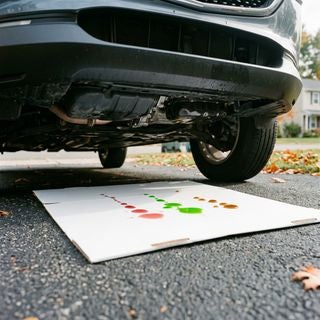
.hrizn-rte-content .e-rte-image { border: 0;max-width: 100%;height: auto } .hrizn-rte-content .e-rte-image.e-imginline { display: inline-block;float: none;margin-left: 5px;margin-right: 5px;max-width: calc(100% - 10px);vertical-align: bottom } .hrizn-rte-content .e-rte-image.e-imgbreak, .hrizn-rte-content .e-rte-image.e-imgcenter { display: block;float: none;margin: 5px auto;max-width: 100% } .hrizn-rte-content .e-rte-image.e-imgleft { float: left;margin: 0 12px 8px 0;max-width: 100% } .hrizn-rte-content .e-rte-image.e-imgright { float: right;margin: 0 0 8px 12px;max-width: 100% } .hrizn-rte-content figure.e-rte-image { margin: 8px auto;max-width: 100% } .hrizn-rte-content figure.e-imgleft { float: left;margin: 0 12px 8px 0 } .hrizn-rte-content figure.e-imgright { float: right;margin: 0 0 8px 12px } .hrizn-rte-content figure.e-imgcenter { display: block;margin: 8px auto;text-align: center } Diagnosing a vehicle fluid leak involves placing a clean sheet of light-colored cardboard under your engine bay overnight, examining the fluid's color, consistency, and odor, and matching its drip pattern to specific mechanical components beneath the chassis. Engine oil appears amber to black with a slippery feel, coolant is bright green or pink with a distinctly sweet aroma, and transmission fluid shows red or maroon. Identifying these characteristics narrows down whether the issue stems from the engine, cooling system, transmission, or braking components. When you notice wet spots or puddle marks on your driveway, performing a quick visual inspection helps prevent serious mechanical damage. Park your vehicle on a flat, level surface and allow the engine to cool down completely. Slide a clean piece of white cardboard or heavy paper directly beneath the engine and transmission area before leaving it overnight. In the morning, pull the cardboard out and evaluate the fluid using three key indicators: color, texture, and location relative to the front bumper and axles. Observing where the puddle sits on the cardboard gives immediate clues about its origin. Leaks dripping from the front-center usually point to the radiator, water pump, or oil pan. Fluid pooling near the middle of the vehicle closer to the front seats often traces back to the transmission pan or transfer case. Wetness concentrated near the wheels indicates potential issues with brake calipers, brake lines, or power steering rack boots. Drivers navigating the rolling hills around Calcutta frequently notice fluid seeps after parking on inclined driveways, which can cause settling fluids to run along underbody splash shields before dropping onto the pavement. If you notice persistent puddles or an unfamiliar fluid mark, you can check our East Liverpool service center address or give our certified technicians a quick call to discuss a professional inspection. Table of Contents How Do You Identify a Vehicle Fluid Leak by Its Color and Texture? Where Do the Most Common Vehicle Fluid Leaks Originate Under a Car? What Symptoms Indicate a Power Steering Fluid Leak? Can a Fluid Leak Cause a Vehicle Fire? How Much Does It Cost to Fix an Engine Oil Leak? Common Questions About Vehicle Fluid Leaks and Repairs How Do You Identify a Vehicle Fluid Leak by Its Color and Texture? You identify a vehicle fluid leak by matching its color, viscosity, and scent to the vehicle's essential operating fluids: slick amber or black liquid indicates engine oil, sweet-smelling bright green or orange fluid is coolant, thin red or maroon liquid is transmission fluid, and clear to light yellow slippery fluid near the wheels points to brake fluid. Every automotive fluid is engineered with specific colors, chemical additives, and weight profiles to perform designated tasks, making visual identification straightforward once you know what to look for: Engine Oil: Fresh engine oil ranges from translucent golden amber to light brown, while used oil turns dark brown or black with a thick, slippery consistency and a heavy petroleum smell. It drops under the front-center of the vehicle near the oil pan or engine block. Engine Coolant (Antifreeze): Coolant features vibrant fluorescent colors including bright green, orange, pink, yellow, blue, or purple. It has a watery, slightly slippery feel and a noticeable sweet, syrupy smell. Coolant pools near the front radiator area or lower hose connections and leaves a chalky white residue when dried on warm metal. Automatic Transmission Fluid: Fresh transmission fluid, such as MERCON LV, appears bright red or pink and has a smooth, oily feel. As it ages, it darkens to maroon or reddish-brown. Leaks drop under the center of the chassis beneath the transmission casing or cooler lines. Brake Fluid: Brake fluid, such as DOT 4 brake fluid, is clear to light yellow or pale amber. It feels slick and thin to the touch but requires immediate clean-up because it can strip exterior vehicle paint. Leaks gather near the wheels, along frame-mounted brake lines, or beneath the brake master cylinder at the firewall. Power Steering Fluid: Power steering fluid usually displays a clear, light amber, or pinkish color with an oily consistency similar to light hydraulic fluid. It seeps near the front bumper, power steering pump, or steering rack. Differential and Transfer Case Gear Oil: Gear oil is dark brown or black with a heavy, thick viscosity and a sharp, distinctive sulfur or rotten-egg odor. Leaks gather under the center transfer case or rear axle housing. Windshield Washer Fluid: Washer fluid appears bright blue, green, or orange with a watery consistency and a mild alcohol or window-cleaner scent. Leaks show up directly beneath the washer reservoir or front bumper assembly. Reviewing current maintenance information allows you to stay ahead of routine fluid flushes, gasket replacements, and filter changes before minor seeps become major repairs. Where Do the Most Common Vehicle Fluid Leaks Originate Under a Car? The most common vehicle fluid leaks originate beneath the engine oil pan, valve cover gaskets, radiator hose fittings, transmission oil pan, and wheel hydraulic components where heat and vibration degrade rubber seals over time. Understanding where fluid lines and component housings meet helps isolate seeps before they turn into costly mechanical breakdowns. The engine bay contains numerous gaskets and pressurized seals. Upper leaks often stem from a worn valve cover gasket, causing oil to seep down the side of the engine block. Lower engine leaks usually originate at the oil pan gasket, oil drain plug washer, or front and rear crankshaft seals. Cooling system leaks frequently start at upper and lower radiator hoses, water pump shaft seals, thermostat housings, or plastic radiator end tanks. Transmission fluid leaks generally come from the transmission pan gasket, cooler line quick-connect fittings, or output shaft seals where drive axles enter the transaxle assembly. One notable exception to vehicle leaks is clear water dripping beneath the front passenger side dash area. Commuters who bring their vehicles in after noticing puddles often ask whether clear water dripping on the passenger side requires immediate repair, but our service technicians quickly confirm when it is simply normal HVAC condensation. When you run your air conditioning or windshield defroster, the system extracts moisture from cabin air and drains clean water safely through a rubber tube onto the ground. If you are exploring custom equipment or planning routine maintenance additions, browsing custom vehicle configuration options provides insight into factory-installed heavy-duty cooling packages and protective skid plates. What Symptoms Indicate a Power Steering Fluid Leak? A power steering fluid leak is primarily indicated by a loud whining or groaning noise when turning the steering wheel, noticeably stiffer steering at low speeds, and clear to reddish oily spots dripping beneath the front axle area. Hydraulic power steering systems rely on pressurized fluid to assist steering movement. When a hose, reservoir seal, or steering rack boot begins to seep, fluid pressure drops and allows air into the system. This aeration causes the power steering pump to produce a high-pitched whining noise that grows louder when you turn the wheel toward full lock during parking maneuvers. Other noticeable symptoms of a power steering leak include: Jerky or uneven resistance in the steering wheel while navigating turns. Slow or sluggish return of the steering wheel to the center position after completing a curve. Wet, oily residue accumulating along hydraulic high-pressure hoses or power steering pump fittings. Low fluid levels inside the clear power steering reservoir under the hood. Ignoring low power steering fluid can cause the hydraulic pump to run dry, resulting in metal-on-metal friction that destroys the internal pump vanes. Promptly inspecting the fluid level and repairing damaged lines preserves steering responsiveness and prevents complete pump failure. Can a Fluid Leak Cause a Vehicle Fire? Yes, a fluid leak can cause a vehicle fire when flammable liquids like engine oil, transmission fluid, power steering fluid, or fuel drip onto extremely hot engine parts like exhaust manifolds or catalytic converters. Exhaust system components operate at extreme temperatures that frequently exceed 600°F and can reach over 1,000°F under heavy load or towing conditions. Petroleum-based lubricants and hydraulic fluids have auto-ignition temperatures within this operating range. When a pressurized power steering hose or leaking valve cover gasket sprays oil directly onto hot exhaust headers, the fluid can vaporize and instantly ignite into an engine bay fire. Crucial warning signs that require immediate action include: A strong, acrid smell of burning oil or fuel inside the passenger cabin. Wisps of white or blue smoke rising from beneath the hood or undercarriage while idling or stopped in traffic. An illuminated red brake warning light or specific display messages like BRAKE FLUID LEVEL LOW on the instrument cluster. Rapidly dropping fluid gauges or warning lights indicating loss of engine oil pressure. If you observe smoke or smell burning fluid while driving, safely pull off the road, turn off the ignition immediately to cut electrical power and fluid pressure, and move away from the vehicle. Exploring service and parts information helps you keep vital seals, fuel lines, and brake system components in optimal working condition. How Much Does It Cost to Fix an Engine Oil Leak? Fixing an engine oil leak typically costs between $50 and $150 for simple repairs like an oil filter or drain plug seal replacement, $200 to $600 for a valve cover gasket or oil pan gasket, and $1,200 or more for intensive repairs such as a rear main seal. The total repair cost depends primarily on labor time rather than parts cost. While replacement rubber gaskets or silicone seals are relatively inexpensive, accessing those seals often requires removing steering linkages, subframes, or engine covers: Drain Plug Washer or Oil Filter Seal: $50 to $150. Corrected easily during a routine oil and filter change. Valve Cover Gasket Replacement: $200 to $450. Requires removing upper intake components and spark plug coils to replace the rubber perimeter seal. Oil Pan Gasket Replacement: $300 to $650. May require lowering the front subframe or crossmember to drop the oil pan. Timing Cover Gasket Replacement: $500 to $900. Demands removing drive belts, pulleys, and front engine covers. Rear Main Seal Replacement: $1,200 to $1,800+. Requires separating the transmission from the engine block to reach the seal behind the flywheel or flexplate. Commuters traveling along Market Street in Boardman benefit from addressing minor engine oil seeps early during routinely scheduled oil changes, preventing engine bay smoke during heavy stop-and-go driving. Catching small oil seeps during routine multi-point inspections prevents severe oil loss that can cause internal engine damage. You can easily schedule a service appointment online to have certified technicians inspect your vehicle's engine seals. Common Questions About Vehicle Fluid Leaks and Repairs Q: How can you tell the difference between fresh engine oil and transmission fluid? Fresh engine oil features a translucent amber or golden appearance with a petroleum scent and a slick feel. Automatic transmission fluid displays a bright red or pink color with a smoother, lighter consistency. While aged engine oil turns dark brown or black, old transmission fluid darkens to maroon or dark reddish-brown, making them easy to differentiate when wiped onto a clean white paper towel. Q: Is it safe to drive with a minor power steering fluid leak? Driving short distances with a minor power steering leak is possible if fluid levels remain adequate, but running the system dry risks severe pump damage and sudden heavy steering resistance. As hydraulic fluid drops below the minimum reservoir mark, air enters the lines and accelerates pump wear. Checking the reservoir level before driving and addressing the leak promptly prevents complete steering system failure. Q: What should you do immediately if you suspect a flammable fluid leak under the hood? Safely pull off the roadway, turn off the ignition immediately to stop fluid pressure, and evacuate all passengers away from the vehicle. Avoid opening the hood if smoke or flames are visible, as introducing fresh oxygen can accelerate an engine bay fire. Contact emergency services or Ford Roadside Assistance at 1-800-241-3673 for towing support backed by factory warranty coverage and authorized service center care. Q: Why does an engine coolant leak leave a powdery residue when it dries? Engine coolant contains chemical anti-corrosion additives and organic compounds dissolved in water. When leaking coolant contacts warm engine components, the water content evaporates quickly, leaving behind a crusty white or colored mineral powder around hose clamps, water pump housings, or radiator seams. Spotting this residue helps technicians pinpoint slow cooling system leaks before engine overheating occurs. Q: How long does a certified technician take to diagnose a fluid leak? Most certified technicians complete a comprehensive fluid leak diagnosis within one hour using ultraviolet dye, pressure testing, and multi-point visual checks. Diagnostic dye is added to the suspected fluid system, the engine is run briefly, and an ultraviolet lamp reveals the precise origin of the seep behind heat shields or engine covers. Maintaining your vehicle's seals, hoses, and fluid levels protects mechanical performance and ensures family safety on every trip. Whether you need an engine oil leak diagnosed, a cooling system pressure test, or routine fluid maintenance, our factory-trained technicians use genuine OEM parts engineered specifically for your vehicle. Visit our dealership location, order genuine Ford parts for home maintenance, or give our service team a call to keep your car running safely and dependably. © 2026 Tri State Ford. All rights reserved. Title Tags Diagnosing Fluid Leaks in East Liverpool OH | Tri State Ford Meta Description Keywords Open Graph Twitter Card Canonical Article Metadata Geographic Targeting { "@context": "https://schema.org", "@graph": [ { "@type": "NewsArticle", "@id": "#article", "headline": "How Do You Diagnose a Fluid Leak Under Your Car?", "datePublished": "2026-09-17T13:40:29.356Z", "dateModified": "2026-09-17T13:42:12.104Z", "author": { "@id": "#author" }, "publisher": { "@id": "#dealer" }, "wordCount": 2259, "description": "Learn how to diagnose a vehicle fluid leak by analyzing the color, consistency, and location of drips collected on cardboard placed under your car." }, { "@type": "AutoDealer", "@id": "#dealer", "name": "Tri State Ford", "url": "https://www.tristateford.net", "telephone": "+13304627578", "sameAs": [ "https://maps.google.com/?cid=1136336406351438323" ], "address": { "@type": "PostalAddress", "streetAddress": "1503 Pennsylvania Ave", "addressLocality": "East Liverpool", "addressRegion": "OH", "postalCode": "43920", "addressCountry": "US" }, "areaServed": { "@type": "GeoCircle", "geoMidpoint": { "@type": "GeoCoordinates", "latitude": "40.6367833", "longitude": "-80.5443033" }, "geoRadius": "48280" }, "geo": { "@type": "GeoCoordinates", "latitude": "40.6367833", "longitude": "-80.5443033" }, "openingHours": [ "Mo 09:00-20:00", "Tu 09:00-18:00", "We 09:00-18:00", "Th 09:00-20:00", "Fr 09:00-18:00", "Sa 09:00-15:00" ] }, { "@type": "FAQPage", "@id": "#faq", "mainEntity": [ { "@type": "Question", "name": "How can you tell the difference between fresh engine oil and transmission fluid?", "acceptedAnswer": { "@type": "Answer", "text": "Fresh engine oil features a translucent amber or golden appearance with a petroleum scent and a slick feel. Automatic transmission fluid displays a bright red or pink color with a smoother, lighter consistency. While aged engine oil turns dark brown or black, old transmission fluid darkens to maroon or dark reddish-brown, making them easy to differentiate when wiped onto a clean white paper towel." } }, { "@type": "Question", "name": "Is it safe to drive with a minor power steering fluid leak?", "acceptedAnswer": { "@type": "Answer", "text": "Driving short distances with a minor power steering leak is possible if fluid levels remain adequate, but running the system dry risks severe pump damage and sudden heavy steering resistance. As hydraulic fluid drops below the minimum reservoir mark, air enters the lines and accelerates pump wear. Checking the reservoir level before driving and addressing the leak promptly prevents complete steering system failure." } }, { "@type": "Question", "name": "What should you do immediately if you suspect a flammable fluid leak under the hood?", "acceptedAnswer": { "@type": "Answer", "text": "Safely pull off the roadway, turn off the ignition immediately to stop fluid pressure, and evacuate all passengers away from the vehicle. Avoid opening the hood if smoke or flames are visible, as introducing fresh oxygen can accelerate an engine bay fire. Contact emergency services or Ford Roadside Assistance at 1-800-241-3673 for towing support backed by factory warranty coverage and authorized service center care." } }, { "@type": "Question", "name": "Why does an engine coolant leak leave a powdery residue when it dries?", "acceptedAnswer": { "@type": "Answer", "text": "Engine coolant contains chemical anti-corrosion additives and organic compounds dissolved in water. When leaking coolant contacts warm engine components, the water content evaporates quickly, leaving behind a crusty white or colored mineral powder around hose clamps, water pump housings, or radiator seams. Spotting this residue helps technicians pinpoint slow cooling system leaks before engine overheating occurs." } }, { "@type": "Question", "name": "How long does a certified technician take to diagnose a fluid leak?", "acceptedAnswer": { "@type": "Answer", "text": "Most certified technicians complete a comprehensive fluid leak diagnosis within one hour using ultraviolet dye, pressure testing, and multi-point visual checks. Diagnostic dye is added to the suspected fluid system, the engine is run briefly, and an ultraviolet lamp reveals the precise origin of the seep behind heat shields or engine covers. Maintaining your vehicle's seals, hoses, and fluid levels protects mechanical performance and ensures family safety on every trip. Whether you need an engine oil leak diagnosed, a cooling system pressure test, or routine fluid maintenance, our factory-trained technicians use genuine OEM parts engineered specifically for your vehicle. Visit our dealership location , order genuine Ford parts for home maintenance, or give our service team a call to keep your car running safely and dependably. --- © 2026 Tri State Ford. All rights reserved." } } ] } ] }