
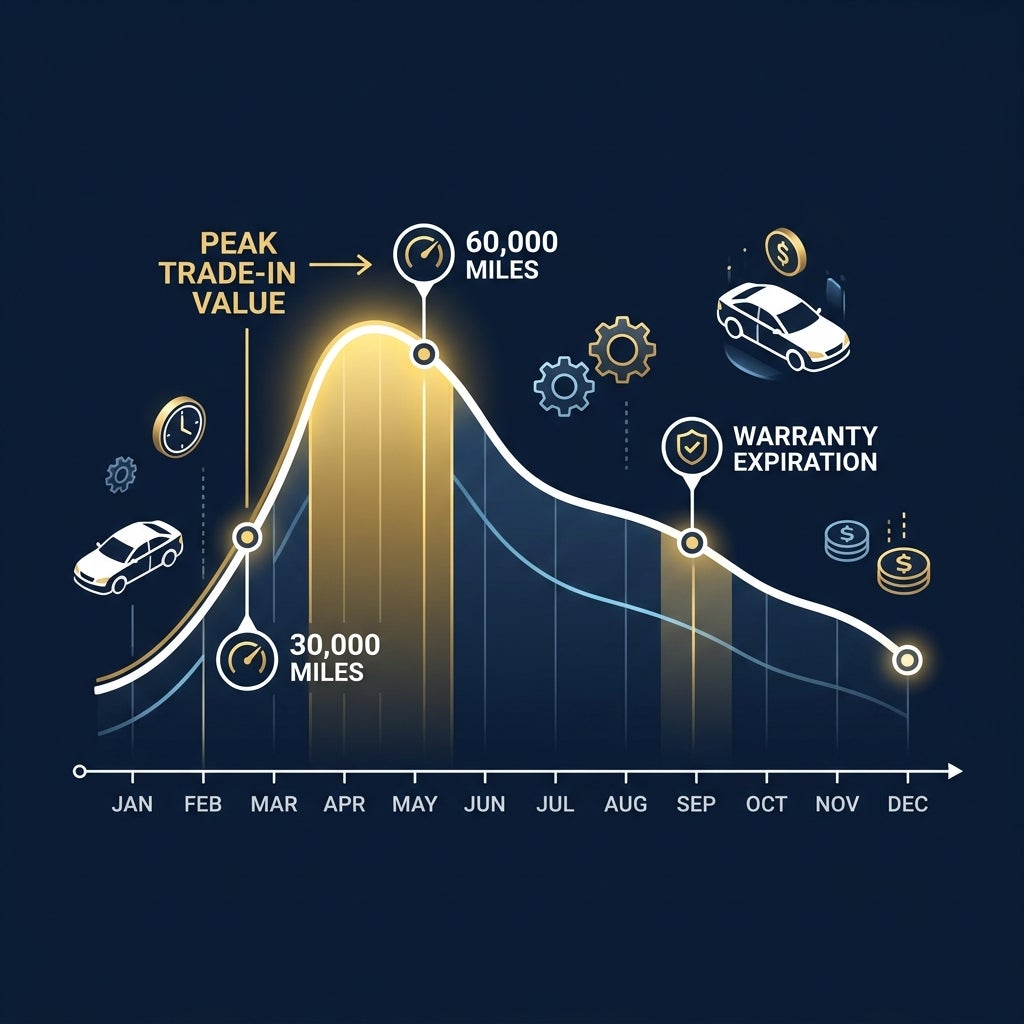
The best time to trade in your vehicle is during late winter and early spring, specifically between February and April, when tax refund demand drives wholesale values up and dealer appetite for used inventory peaks. Secondary ideal timing includes trading right before major mileage thresholds like 30,000 or 60,000 miles, or just prior to factory warranty expiration. Selling during these specific windows secures maximum equity before depreciation steps down further.
Timing a trade-in properly keeps money in your pocket and gives you the maximum equity toward your next purchase. Wholesale market data consistently shows that pre-owned vehicle values follow a seasonal arc across the country. Values hit a seasonal low in January, rebound sharply during spring tax season, plateau through early summer, and slowly ease downward through late autumn. Trading in during the spring rush positions your car when pre-owned demand is strongest, helping you secure a top-dollar appraisal.
Your personal vehicle lifecycle also dictates timing. Vehicle equity drops in predictable stages based on age, odometer readings, and mechanical warranty status. Upgrading before expensive scheduled service visits or major component replacements prevents out-of-pocket repair bills that never return a dollar-for-dollar increase on appraisal value. Combining favorable market demand with key lifecycle milestones ensures you trade at peak value.
Our team at Tri State Ford makes transferring your vehicle equity simple, direct, and straightforward. Whether you want to transition into an expansive SUV with space for the whole family or start a new vehicle custom order tailored to your lifestyle, we evaluate your trade using live market data. If you have questions about your vehicle's current appraisal value, give our team a quick call or stop by our showroom address on Pennsylvania Ave to get a transparent appraisal.
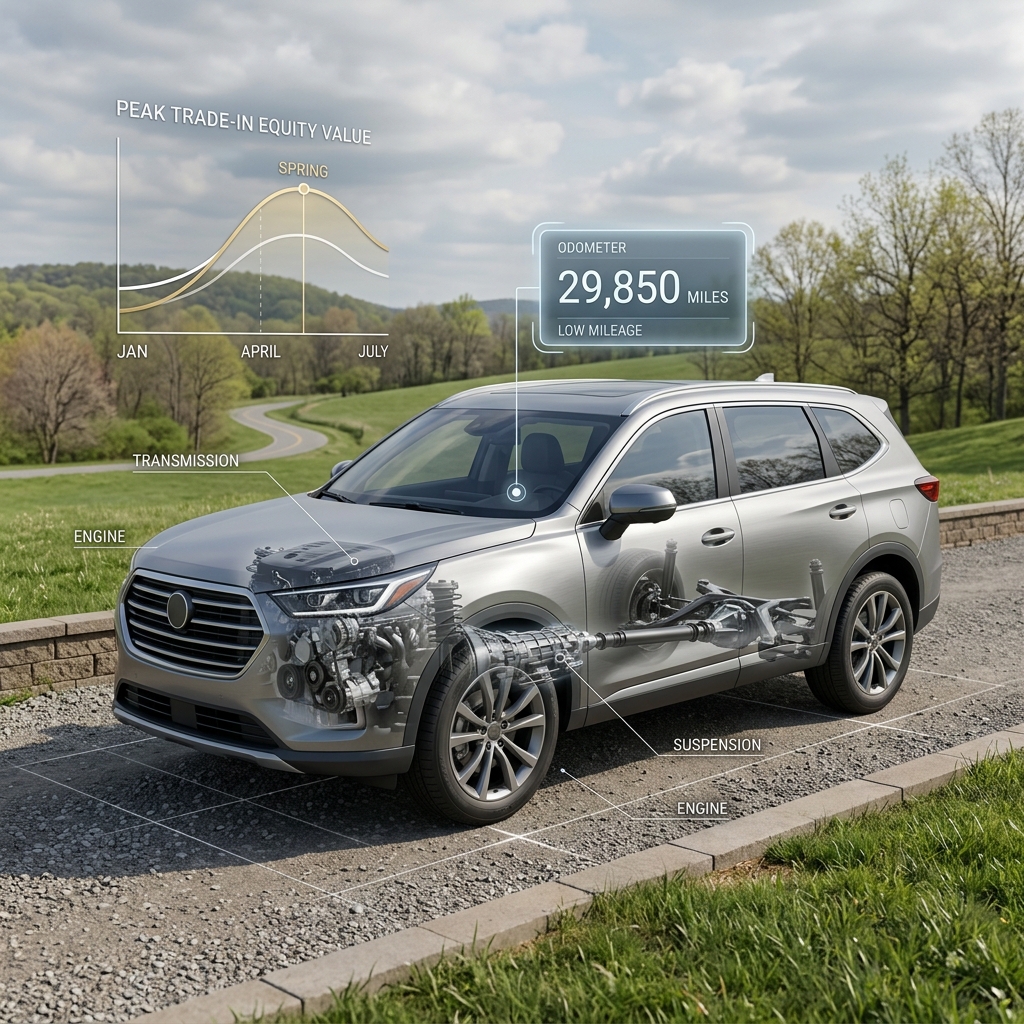
Table of Contents
- How Do Mileage Milestones, Year-One Depreciation, and Vehicle Age Affect Value?
- Should You Trade In Before Factory Warranty Expiration or Major Maintenance?
- What Time of the Month and Season Offers the Best Trade-In Negotiations?
- How Does Ohio Trade-In Sales Tax Credit Save You Money on Your Next Purchase?
- What Are the Risks of Selling Privately vs Using Online Instant Estimates?
- Answers to Common Questions About Vehicle Trade-Ins
How Do Mileage Milestones, Year-One Depreciation, and Vehicle Age Affect Value?
A new vehicle loses between 15% and 20% of its total retail value during its first year on the road, with the single steepest drop occurring the moment it leaves the lot. After that initial first-year drop, annual depreciation settles into a steady pace of roughly 10% to 15% per year, while specific odometer milestones create sudden downward adjustments in trade-in value.
Understanding depreciation milestones allows you to time your trade-in right before significant value drops occur. The first major odometer threshold arrives at 30,000 to 40,000 miles. Vehicles in this bracket command premium trade-in appraisals because dealerships can easily recondition them into top-tier pre-owned inventory with minimal reconditioning expense. A three-year-old vehicle with under 36,000 miles represents a sweet spot for resale value, retaining a high percentage of its original value while staying well within standard factory warranty limits.
The second major milestone occurs between 60,000 and 70,000 miles. At this stage, vehicles enter a secondary value band where buyers expect complete service records and fresh wear-and-tear components. The final sharp drop occurs when an odometer crosses 100,000 miles. Once a vehicle passes six figures on the dash, wholesale buyers and retail shoppers view it differently, and many dealerships route high-mileage trades directly to wholesale auctions rather than retail lots, resulting in lower appraisal offers.
Drivers commuting daily along State Route 170 in suburban Calcutta rack up miles quickly on gentle rolling hills, making it critical to watch those odometer markers close. If your odometer is approaching 30,000 or 60,000 miles, trading in now secures maximum return before the next depreciation step down. You can explore our new Ford inventory to see the latest models equipped with Ford Co-Pilot360 driver-assist features and modern technology. We also invite you to review current Ford vehicle specials or check out pre-owned single-owner vehicles to find a reliable upgrade that matches your household budget.
| Mileage Window | Depreciation Impact | Appraisal Status | Primary Dealer Resale Path |
|---|---|---|---|
| Under 30,000 Miles | Low (Initial steep drop completed) | Maximum Value | Prime Certified Pre-Owned Retail |
| 30,000 to 60,000 Miles | Moderate (Steady annual curve) | Strong Value | High-Grade Pre-Owned Retail |
| 60,000 to 100,000 Miles | Accelerated (Maintenance wear considerations) | Fair Value | Budget-Friendly Retail Lot |
| Over 100,000 Miles | Heavy (Significant steep drop) | Reduced Value | Wholesale Auction / Trade Entry |
Should You Trade In Before Factory Warranty Expiration or Major Maintenance?
Trading in your car before its factory warranty expires yields higher appraisal offers because dealerships can market and recondition the vehicle with minimal financial risk. Most modern Ford vehicles carry a 3-year/36,000-mile bumper-to-bumper warranty alongside a 5-year/60,000-mile powertrain warranty, providing broad protection that enhances retail value on the pre-owned market.
Selling a vehicle while original warranty coverage remains active gives the acquiring dealership a distinct reconditioning advantage. Dealers can inspect, service, and certify warranty-backed cars faster and with greater buyer confidence. This allows us to pass that value directly back to you in your trade-in offer. Once a car crosses out of its bumper-to-bumper or powertrain warranty windows, potential buyers and appraisers must account for future mechanical repair risks, which naturally lowers the baseline appraisal calculation.
Major maintenance intervals present another crucial timing factor. Reaching a 60,000-mile service interval or a 100,000-mile milestone usually requires substantial maintenance investments, including new tires, complete brake replacements, transmission fluid flushes, and spark plug changes. Spending heavy out-of-pocket money on routine maintenance right before trading in rarely increases your car's appraisal dollar-for-dollar. For example, spending considerable money on new tires and brake service right before an appraisal might only increase the trade offer by a fraction of that expenditure.
Trading in immediately prior to these major service dates saves you money by turning that impending maintenance expense into down-payment equity for a fresh vehicle. Upgrading to a newer model equipped with Ford’s proven quality means enjoying new vehicle dependability, modern smartphone integration, and refreshed bumper-to-bumper coverage. You can explore our certified pre-owned Ford lineup to see how factory warranty backing provides long-term peace of mind.
What Time of the Month and Season Offers the Best Trade-In Negotiations?
The final three days of any month consistently provide the best environment for trade-in price negotiations because sales teams work to hit monthly volume targets and manufacturer sales thresholds. Dealerships striving to meet monthly performance goals are often willing to adjust trade-in appraisal allowances upward to finalize a deal before the calendar turns.
Seasonal timing reinforces monthly sales cycles. The absolute strongest quarter for trade-in values runs from late February through mid-April. During this spring window, federal tax refunds flow into buyer bank accounts, sparking peak retail demand for quality pre-owned vehicles. To meet this surge in customer demand, dealerships actively build used inventory, driving wholesale appraisal values higher than during any other season.
- Late Winter / Early Spring (February–April): Peak trade-in value driven by tax refund shoppers and high used inventory demand.
- Late Spring / Summer (May–July): Solid, stable trade-in values with strong family demand for summer vacation vehicles.
- Early Autumn (August–October): Value begins gradual softening as incoming new model year inventory shifts focus to inventory turnover.
- Late Autumn / Early Winter (November–January): Seasonal low point for pre-owned trade values due to holiday slowdowns and cold weather foot traffic.
Commuters driving daily along Market Street near retail centers in Boardman know that vehicle readiness matters when market demand peaks. When seasonal buyer demand rises across northern Ohio, dealerships need reliable trades to fill showroom lots. Bringing your vehicle in during these high-demand months allows you to leverage market timing for a higher payout. You can quickly start the process from home when you value your trade-in online using current market evaluation tools.
How Does Ohio Trade-In Sales Tax Credit Save You Money on Your Next Purchase?
The Ohio trade-in sales tax credit saves you money by deducting the full agreed appraisal value of your trade-in vehicle directly from the total purchase price of your new vehicle before state and local sales taxes are calculated. This statutory tax credit provides substantial savings that are completely unavailable when selling a car through a private transaction.
To understand how this tax advantage works in real-world numbers, consider a buyer purchasing a new Ford SUV with an agreed price of $40,000 while trading in a current vehicle valued at $15,000. Under Ohio tax law, the state and local sales tax rates apply only to the net difference of $25,000 rather than the full $40,000 purchase price. Assuming a combined state and local tax rate of 7%, paying tax on $25,000 results in a sales tax bill of $1,750. Without the trade-in credit, sales tax on the full $40,000 purchase price would equal $2,800. Trading in saves the buyer $1,050 in direct cash outlays on sales tax alone.
- Agreed Vehicle Purchase Price: $40,000
- Trade-In Appraisal Allowance: -$15,000
- Taxable Net Difference: $25,000
- Sales Tax Obligation (at 7% combined rate): $1,750 (a direct savings of $1,050 compared to paying full tax)
This tax structure levels the playing field when comparing dealer trade-in offers against private buyer offers. Even if a private buyer offers a slightly higher purchase price on paper, the lack of a trade-in tax credit means the private sale often yields less net money once you calculate the higher sales tax paid on your next car. Combining state tax advantages with flexible dealership vehicle financing simplifies your transaction into a single, seamless step. You can prepare your financing path in advance by filling out our online credit application page to secure quick pre-approval.
What Are the Risks of Selling Privately vs Using Online Instant Estimates?
Selling a vehicle privately carries significant personal safety risks, payment fraud exposures, time-consuming administrative hassles, and legal liability concerns that do not exist when trading in at an authorized dealership. Private sellers must manage public listings, field constant messaging from uninterested shoppers, schedule test drives with total strangers, and manually navigate title transfer paperwork at county clerk offices.
Payment security represents one of the largest risks in private automotive sales. Fraudulent cashier's checks, wire transfer scams, and reversed digital payments target private sellers every day. Furthermore, if a hidden mechanical defect appears shortly after a private transaction, private sellers frequently face uncomfortable buyer disputes or small-claims legal threats. Selling privately also requires you to handle existing lien payoffs yourself, contacting your lender to obtain payoff quotes, tracking title releases, and managing bank delays while keeping your buyer waiting.
Instant online car buying websites promise a fast alternative, but their initial digital estimates are rarely guaranteed initial payout numbers. Online valuation algorithms generate an optimistic automated quote based on unverified user inputs. Once you arrive at a drop-off center or an inspector arrives at your driveway, physical reconditioning inspections frequently drop that initial offer downward for minor paint chips, tire wear, wheel scuffs, or interior wear.
Trading your vehicle directly to Tri State Ford eliminates these friction points entirely. Our certified appraisers evaluate your vehicle transparently in person, honor transparent live-market valuations, and handle all payoff paperwork directly with your lender. Whether your vehicle is a rugged truck with exceptional towing capacity built for heavy trailers or a practical family crossover built for weekend getaways, we provide an honest, binding offer. You can start with an official appraisal today when you request a KBB instant cash offer directly through our website.
Answers to Common Questions About Vehicle Trade-Ins
Q: What happens if I owe more on my current vehicle loan than the vehicle is worth? Owing more on your auto loan than your vehicle's current appraisal value is known as negative equity. When trading in a vehicle with negative equity, you can choose to pay the remaining balance out of pocket at closing, or in many cases, roll that remaining balance into the financing of your new Ford vehicle. Rolling negative equity into your new loan consolidates your payments into one monthly bill, though it increases your new loan principal. Our financing team works with multiple lenders to help structure options that keep your monthly payment manageable.
Q: Do I need to replace worn tires or repair minor body damage before trading in my car? You generally do not need to replace tires, repair minor paint scratches, or fix small door dings prior to trading in your car. Dealerships maintain dedicated service facilities and order reconditioning parts at wholesale rates, meaning we can complete repairs far more cost-effectively than an individual retail customer paying retail shop rates. Spending hundreds of dollars on retail repairs right before trading in rarely increases your vehicle's appraisal value by an equivalent amount.
Q: What paperwork and items do I need to bring when trading in my vehicle? When arriving to trade in your vehicle, bring your physical valid driver's license, current state registration card, and current auto insurance card. If you own the vehicle outright, bring the physical vehicle title. If you have an active auto loan, bring your lender account details or a current loan payoff statement. Finally, make sure to bring all sets of factory keys, key fobs, owner's manuals, and any specialized equipment like wheel lock keys or navigation software cards.
Q: How long does an in-person trade-in appraisal take at the dealership? A complete in-person trade-in appraisal at Tri State Ford typically takes roughly 20 to 30 minutes. During this time, our pre-owned inventory appraisal team conducts a physical walk-around inspection, verifies vehicle options, checks mechanical operation, and reviews local live-market pricing data. While our appraisers inspect your current vehicle, you can browse our showroom floor or test drive new Ford models.
Q: Can I trade in a vehicle if my spouse or co-buyer is not physically present? If both your name and your spouse or co-buyer's name appear on the vehicle title joined by the word "AND," both registered owners must be physically present to sign the title transfer paperwork. If the names on the title are separated by the word "OR," either named owner can legally sign the title transfer documents independently. If you are unsure how your vehicle title is structured, our team can review your title document or registration beforehand to confirm who needs to be present.
When you are ready to explore your vehicle trade-in options and upgrade to a reliable Ford vehicle, our team is here to assist you every step of the way. Bring your current vehicle to our dealership address at 1503 Pennsylvania Ave for a straightforward appraisal. You can also give our team a quick call to discuss current trade incentives or schedule an appointment with our sales staff today.
Keep Your Vehicle Running Strong
Keep your vehicle performing at its best with our service team:
© 2026 Tri State Ford. All rights reserved.