
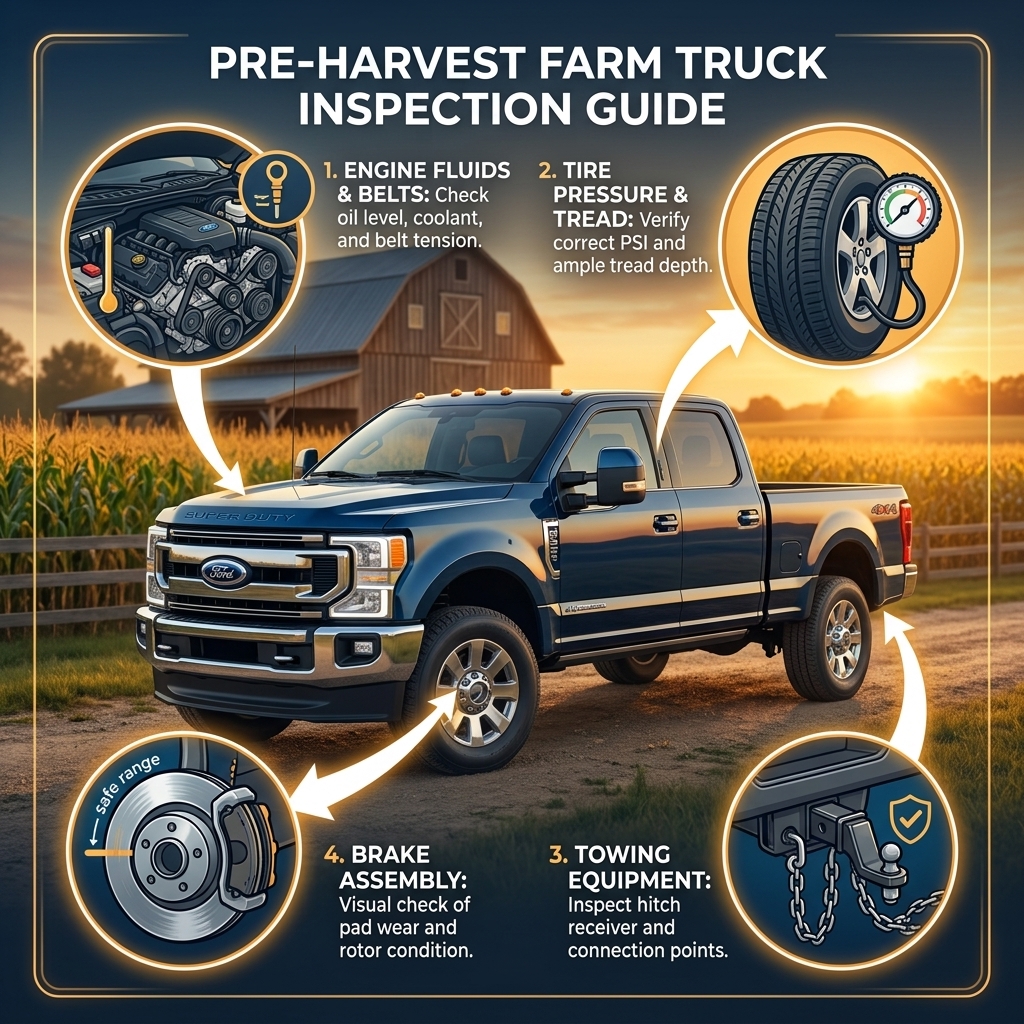
Preparing a farm truck for harvest season requires a systematic inspection starting with cold under-hood fluids and drive belts, moving to cab safety gear, performing a full static and applied air brake pressure test, conducting a perimeter walk-around of tires, frame, and towing hitches, and concluding with an operational road test under load.
Late-summer agricultural hauling presents some of the most demanding working conditions of the year for tri-state producers. When grain haulers and support pickups are pulled out of summer storage to transport hundreds of bushels of corn or soybeans, every mechanical system experiences sudden, continuous stress. High ambient heat, heavy gross vehicle weights, and unpaved farm lanes rapidly expose minor mechanical weaknesses. A neglected hose or an unadjusted brake slack adjuster can turn a routine run into an expensive delay right when elevator lines are longest and harvest windows are tightest.
Comprehensive pre-harvest preparation focuses on preventative care that protects powertrain integrity and keeps commercial haulers legally compliant. For operators running severe-duty workhorses like the 2026 Ford F-150 with its 3.5L engine, SelectShift® automatic transmission, and maximum towing rating up to 10,400 lbs, or heavy-duty platform trucks like the 2026 Ford Super Duty F-250, catching wear early protects your investment and ensures predictable stopping power under load.
Taking time to perform structured maintenance before fields are opened prevents sudden mechanical failures. Our team at Tri State Ford works directly with local agricultural operators to keep heavy equipment, grain haulers, and support fleets performing reliably throughout the harvest rush. You can visit our service center location on Pennsylvania Avenue or give our service desk a quick call to discuss specialized commercial truck maintenance before field operations begin.
Table of Contents
- Why Inspect Early and What Is the Best Pre-Harvest Truck Inspection Order?
- What Is the Real Cost of Harvest Downtime and How Do You Apply for Tri-State Overweight Permits?
- What Critical Brake Checks and Air Line Tests Keep Loaded Grain Haulers Safe?
- Why Is a Loaded Road Test Essential and How Do You Spot a Harvest-Ready Service Shop?
- Common Pre-Harvest Farm Truck Service Questions Answered
- Keep Your Grain Moving with Pre-Harvest Heavy-Duty Maintenance
Why Inspect Early and What Is the Best Pre-Harvest Truck Inspection Order?
Inspecting farm trucks three to four weeks before harvest allows enough lead time to source replacement parts and complete repairs without risking field delays, following a strict 5-step sequence from under-hood cold diagnostics to an operational road test under load.
When local farm crews bring their grain haulers into our service bays before late August, the most common issue we find is deferred maintenance caused by skipping systematic checks. A haphazard inspection often catches visible items like tire tread while missing hidden cooling system leaks or air brake pressure drops. Sticking to a disciplined, front-to-back and top-to-bottom sequence guarantees that no secondary component is overlooked.
The 5-Step Pre-Harvest Inspection Sequence
- Cold Under-Hood Diagnostics: Begin with a completely cold engine before thermal expansion masks accurate fluid levels or pressure loss. Check engine oil, transmission fluid, power steering fluid, hydraulic reservoirs, and coolant condition. Visually inspect serpentine and V-belts using a mirror and flashlight. Look for micro-cracking across ribs, glazing from high alternator load slippage, edge fraying, or dry rot. If you observe three or more cracks in a three-inch span, replace the belt immediately.
- Cab & Safety Gear Compliance: Step into the cab to confirm proper operation of windshield wipers, washer fluid pumps, defroster controls, and horns. Verify required safety equipment, including a securely mounted 5 B:C rated fire extinguisher with an intact seal, three red reflective warning triangles, and spare electrical fuses matching the central junction box.
- Air Brake System & Pressure Testing: Build system pressure to governor cut-out, typically between 120–145 PSI. Drain primary and secondary air reservoirs to clear accumulated oil emulsion and moisture. Conduct static and applied leak-down tests, and check low-air warning buzzers alongside automatic parking brake controls.
- Exterior Perimeter Walk-Around: Walk clockwise around the rig to inspect steer and dual tires for proper inflation pressure, tread depth, and sidewall cracking. Check wheel ends for loose lug nuts, verifying torque specs between 150–165 lb-ft on heavy pickups. Inspect leaf springs for cracked or shifted main leaves, frame rails for stress cracks, and fifth-wheel locking jaws or pintle hitches for excessive play.
- Operational Road Test Under Load: Finish with a test drive carrying weight to evaluate power delivery, automatic transmission shifting under torque, cooling fan engagement, and foundation brake balance.
Understanding coolant chemistry is equally vital during hot late-summer operations. Extended Life Coolant ( ELC), which uses Nitrated Organic Acid Technology, creates a durable protective layer on cylinder liners to prevent cavitation during heavy pulling. Mixing conventional silicate coolants with ELC dilutes corrosion inhibitors and causes chemical gelation that clogs radiator cores. To maintain your fleet efficiently, you can schedule a pre-harvest inspection appointment online or order OEM Motorcraft replacement parts directly through our service desk.
What Is the Real Cost of Harvest Downtime and How Do You Apply for Tri-State Overweight Permits?
Hauling downtime during peak harvest carries an estimated financial cost between $150 and $500 per hour due to idle labor, elevator wait penalties, and crop degradation, while seasonal overweight permits must be submitted online through state department of transportation portals prior to moving heavy loads on state-maintained roads.
When a fully loaded grain truck suffers a blown radiator hose or an overheated brake chamber on a narrow county road, the financial loss extends far beyond the repair bill. A single stalled truck can halt combine operations in the field, leaving harvest crews idle while grain sits in hoppers during unpredictable late-summer weather windows. Calculating lost labor efficiency, fuel wasted in idling support equipment, and missed elevator delivery slots shows why proactive maintenance yields a massive return on investment.
Navigating legal weight limits is another critical component of harvest preparation. Tri-state producers frequently haul across state lines, requiring an understanding of regional overweight permit procedures:
- Ohio Agricultural Permits: The Ohio Department of Transportation provides seasonal agricultural permits online. These permits allow gross vehicle weight allowances above standard statutory limits for designated commodities on state routes during active harvest periods. Applicants must detail truck axle configurations, licensed GVWR, and primary haul routes.
- Pennsylvania Agricultural Permits: PennDOT manages seasonal agricultural hauling authorizations through its Automated Permit Routing and Analysis System portal. Farmers must submit vehicle registration data, overall axle spacings, and specific county route details to secure overweight travel privileges.
- West Virginia Agricultural Exemptions: The West Virginia Division of Highways handles agricultural overweight permits through its online transport portal. Producers must identify vehicle configurations and maintain approved routing documentation inside the cab at all times.
Maintaining valid permit documentation alongside current registration and proof of commercial insurance inside the cab protects drivers from unexpected out-of-service citations during roadside inspections. Proper vehicle preparation ensures grain trucks hauling across gently rolling hills toward regional elevators around Calcutta remain within legal safety thresholds while operating at maximum efficiency.
What Critical Brake Checks and Air Line Tests Keep Loaded Grain Haulers Safe?
Pre-harvest air brake inspections require charging the system to governor cut-out between 120–145 PSI, shutting off the engine, applying the foot brake, and confirming that air pressure loss does not exceed 4 PSI per minute for combination vehicles or 3 PSI per minute for single trucks.
Brake safety is paramount when moving heavy agricultural loads down steep grades or through busy rural intersections. Overloaded grain trailers push foundation brakes to their thermal limits, making daily air system care and friction material checks essential.
+------------------------------------+------------------------------------+------------------------------------+
| Inspection Area                    | Standard Parameter                 | Out-of-Service Failure Limit       |
+------------------------------------+------------------------------------+------------------------------------+
| Disc Brake Pad Thickness           | New pad depth (approx. 1/2 inch)   | Less than 1/4 inch remaining       |
| Drum Brake Shoe Friction Lining    | New shoe lining depth              | Less than 1/4 inch at shoe center  |
| Combination Applied Air Leakage    | Engine off, pedal held firm        | Pressure drop exceeding 4 PSI/min  |
| Single Truck Static Air Leakage    | Engine off, brakes released        | Pressure drop exceeding 2 PSI/min  |
+------------------------------------+------------------------------------+------------------------------------+
Moisture and oil accumulation in air brake lines pose severe risks to relay valves and spring brake chambers. Draining air tanks daily prevents sludge buildup that leads to valve sticking or freeze-ups during late-fall temperature drops. Foundation brake components also demand direct mechanical measurement:
- Friction Lining Thickness: Friction material on drum brake shoes must measure greater than 1/4 inch at the center of the shoe. Hydraulic disc brake pads must also maintain at least 1/4 inch of usable material above the backing plate.
- Brake Drum & Rotor Surface: Inspect drums for deep heat checking, scoring deeper than 1/16 inch, or structural stress cracks extending to the outer rim edge.
- Slack Adjuster Stroke & Greasing: Automatic slack adjusters must be checked weekly during peak harvest and lubricated monthly or every 5,000 miles using high-temperature grease. Excessive pushrod travel drastically reduces stopping power under maximum payload.
Proper brake maintenance is critical when navigating steep riverfront bluffs along the Ohio River in East Liverpool, where controlled stopping power prevents hazardous runaway situations on severe downhill grades.
Why Is a Loaded Road Test Essential and How Do You Spot a Harvest-Ready Service Shop?
A loaded road test is essential because static driveway checks cannot replicate the heat, frame flex, and torque demands created under real agricultural payloads, while a harvest-ready service facility provides heavy-duty lifts, specialized electronic diagnostics, and fast parts turnarounds.
Skipping an operational test drive under load leaves critical questions unanswered. An engine may idle quietly in the driveway, but under the strain of a full load, weak water pumps fail, transmission clutches slip, and cooling fan clutches fail to engage when temperatures rise. Testing the truck under actual load conditions reveals hidden performance deficits before the vehicle enters field service.
During a pre-harvest road test, drivers should monitor specific operational indicators:
- Cooling System Response: Observe engine temperature gauges under load to verify that the cooling fan clutch engages predictably as thermal thresholds are reached.
- Transmission Shifting: Ensure automatic transmissions shift smoothly without hesitation or gear hunting when pulling heavy weight up inclines.
- Brake Modulation: Test for steering pull, vibration, or pushrod binding during firm pedal applications.
Identifying a harvest-ready service provider ensures your fleet receives professional care when time is limited. A qualified commercial shop features heavy-duty vehicle lifts, computerized brake testers, coolant refractometers, and battery diagnostic tools capable of testing high-amp cold cranking capabilities. You can review our heavy-duty battery testing and replacement guide to learn how high-heat summer operations impact electrical reliability.
Common Pre-Harvest Farm Truck Service Questions Answered
Q: Why should farm trucks be inspected before harvest starts?
Pre-season inspections identify worn components, degraded fluids, cracked belts, and air brake leaks before heavy work demands begin. Catching mechanical issues early prevents unexpected field breakdowns that can cost between $150 and $500 per hour in lost productivity and elevator delays during tight harvest windows.
Q: Can I skip the road test if the truck looks fine during a driveway check?
No, a static driveway inspection cannot replicate the thermal expansion, engine torque, and air brake stress experienced under max payload. Only a road test under load reveals whether cooling fan clutches engage properly, transmissions shift smoothly, and foundation brakes operate without fading under real working conditions.
Q: How often should brake slack adjusters be lubricated during harvest season?
Automatic slack adjusters on heavy farm trucks and grain trailers should be visually checked weekly during active hauling and lubricated at least once a month or every 5,000 miles. Using high-temperature chassis grease keeps the internal ratchet mechanism operating smoothly and prevents pushrod stroke over-travel.
Q: What is the maximum acceptable air brake leak-down rate for a combination farm truck?
For a combination farm truck and grain trailer, static air pressure loss with the engine off and brakes released should not exceed 3 PSI per minute. With the foot brake fully applied and system pressure charged, pressure loss must not exceed 4 PSI per minute.
Q: How do mobile service options support farm operations before harvest?
Mobile service brings factory-trained technicians directly to your farm or storage yard to perform routine maintenance, fluid checks, battery load tests, and safety inspections. To simplify pre-season care, explore our Ford mobile service capabilities to schedule on-site fleet maintenance before field work begins.
Keep Your Grain Moving with Pre-Harvest Heavy-Duty Maintenance
Thorough pre-harvest preparation protects your farm trucks, preserves operational momentum, and ensures your grain fleet stays on the road throughout late-summer hauling. By adhering to a strict inspection sequence, maintaining brake systems, securing necessary state overweight permits, and testing vehicles under actual load, tri-state producers can eliminate preventable mechanical downtime.
Our team at Tri State Ford is dedicated to supporting local agricultural operations with trusted commercial service, genuine Motorcraft parts, and expert technician care. Whether you manage a single haul truck or a multi-vehicle support fleet, taking care of maintenance today protects your crop investment tomorrow. Stop by our East Liverpool service facility or contact our service desk at (330) 462-7578 to schedule your pre-harvest truck inspection today.
Connect with us


- Automotive News, New Vehicle Reviews, Buying Guides, Financing & Insurance, Seasonal Driving Tips
- Buying Guides, Financing & Insurance, New Vehicle Reviews, Model Comparisons, Sales & Promotions
- Buying Guides, Financing & Insurance, New Vehicle Reviews, Model Comparisons, Technology & Innovation
- Buying Guides, Financing & Insurance, Used Vehicle Guides, New Vehicle Reviews, Cross-Border Purchasing
- Buying Guides, Financing & Insurance, Vehicle Inventory & Offers, Dealership Visit Preparation, Trade-In & Valuation
- Buying Guides, New Vehicle Reviews, Financing & Insurance, Commercial Vehicle Sales, Model Comparisons
- Commercial Leasing Options, Business Fleet Solutions, Financing & Leasing Programs, Commercial Vehicle Inventory, Business Vehicle Acquisition
- Commercial Truck Sales, Fleet Purchasing Guides, Financing & Lease Options, Work Truck Customization, New Vehicle Inventory
- Commercial Truck Sales, Fleet Vehicle Financing, Custom Work Truck Upfits, Commercial Vehicle Buying Guides, Used Commercial Truck Inventory
- Commercial Vehicle Sales, Financing & Leasing, Small Business Vehicle Incentives, Fleet Purchasing Guides, Tax Benefits for Vehicle Buyers
- Commercial Vehicle Sales, Fleet Leasing & Management, Commercial Financing & Tax Incentives, Upfitting & Customization Solutions, Trade & Lease Programs
- Commercial Vehicle Sales, Fleet Purchasing & Management, Financing & Leasing for Businesses, New & Used Work Truck Inventory, Commercial Truck Ordering Process
- Community Engagement & Events, New Vehicle Promotions, Financing & Trade-In Options, Maintenance & Service, Used Vehicle Offers
- Community Events & Customer Appreciation, New Vehicle Reviews, Financing & Trade-In Guides, Maintenance & Service Specials, Commercial & Work Truck Solutions
- Community Events & Dealership News, New Vehicle Promotions & Incentives, Maintenance & Service Specials, Financing & Trade-In Guidance, Family-Friendly Dealership Experiences
- Community Events & Dealership News, New Vehicle Reviews, Financing & Insurance, Maintenance & Service, Work Trucks & Commercial Vehicles
- Community Events, New Vehicle Buying Guides, Financing & Insurance, Maintenance & Service, Local Dealership News
- Compare Cars
- Custom Ordering & Build Process, New Vehicle Inventory & Offers, Financing & Trade-In Guidance, Manufacturer Incentives & Rebates, Vehicle Purchase & Order Tracking
- Dealership Events & Promotions, Financing & Trade-In Options, Maintenance & Service Specials, Community Involvement & Charity, New & Used Vehicle Buying Guides
- East Liverpool, OH Ford Dealer
- East Liverpool, OH Used Cars
- Financing & Insurance, Buying Guides, Commercial Vehicle Solutions, Fleet Management, Inventory and Availability
- Financing & Insurance, Buying Guides, New Vehicle Reviews, Used Vehicle Guides, Automotive Sales & Inventory
- Financing & Insurance, Buying Guides, New Vehicle Reviews, Used Vehicle Guides, Automotive Sales Strategies
- Financing & Insurance, Buying Guides, New Vehicle Reviews, Used Vehicle Guides, Model Comparisons
- Financing & Insurance, Buying Guides, Used Vehicle Guides, Trade-In Tips, New Vehicle Sales
- Financing & Insurance, Buying Guides, Vehicle Inventory & Offers, Trade-In & Appraisal, Dealership Services
- Financing & Insurance, Buying Guides, Vehicle Trade-In Tips, Dealership Sales Process, New Vehicle Promotions
- Financing & Insurance, Leasing Benefits, Model Comparisons, Technology & Innovation, Buying Guides
- Leasing & Financing Options, Buying Guides, Model Comparisons, Negotiation Tips, Inventory & Specials
- Leasing & Financing Options, Buying Guides, New Vehicle Reviews, Model Comparisons, Technology & Innovation
- Leasing & Financing Options, New Vehicle Leasing Guides, Buying Guides, Inventory Spotlight, Trade
- Leasing & Lease Deals, Financing & Insurance, New Vehicle Sales, Commercial Vehicle Leasing, Vehicle Trade-In & Purchase Options
- Leasing Options, Financing & Insurance, New Vehicle Reviews, Buying Guides, Technology & Innovation
- Leasing Options, Financing & Insurance, New Vehicle Sales, Buying Guides, Vehicle Inventory
- Maintenance & Service, Air Conditioning Repair, Genuine Parts & Accessories, Dealer-Authorized Service, Vehicle Ownership Care
- Maintenance & Service, Automotive Air Conditioning Repair, Vehicle Cooling System Care, Diagnostic & Leak Detection, Seasonal Vehicle Maintenance
- Maintenance & Service, Automotive Detailing & Cleaning, Seasonal Vehicle Care, Vehicle Protection & Preservation, Service Center Expertise
- Maintenance & Service, Automotive Detailing & Paint Care, Vehicle Exterior Protection, Paint Repair & Restoration, Parts & Accessories Installation
- Maintenance & Service, Automotive Detailing & Protection, Corrosion & Rust Prevention, Paint & Exterior Care, Professional Vehicle Care
- Maintenance & Service, Automotive Detailing, Paint Protection & Care, Seasonal Vehicle Care, Professional Vehicle Servicing
- Maintenance & Service, Automotive Detailing, Vehicle Care & Protection, Off-Road Vehicle Maintenance, Parts & Repairs
- Maintenance & Service, Automotive Electrical Systems, Battery Care & Replacement, Diagnostics & Repairs, Electric Vehicle Maintenance
- Maintenance & Service, Automotive Electrical Systems, Battery Care & Replacement, Vehicle Lighting & Electrical Issues, Roadside Assistance & Emergency Services
- Maintenance & Service, Automotive Fluids & Lubricants, Vehicle Care & Ownership, Dealership Service & Repairs, Preventive Maintenance
- Maintenance & Service, Automotive Glass Repair, Safety Features, Technology & Innovation, Mobile & Convenient Service
- Maintenance & Service, Automotive Lighting & Electrical, Vehicle Safety & Visibility, DIY Vehicle Care, Parts & Accessories
- Maintenance & Service, Automotive Parts & Accessories, Seasonal Vehicle Care, Vehicle Safety & Visibility, Professional Auto Service
- Maintenance & Service, Automotive Parts & Accessories, Vehicle Air Quality & HVAC Care, Preventive Vehicle Maintenance, Service Tips & FAQs
- Maintenance & Service, Automotive Parts & Accessories, Vehicle Ownership Care, Engine Care & Protection, Warranty & Service Contracts
- Maintenance & Service, Automotive Parts & Accessories, Vehicle Safety & Repair, Warranty & Coverage, Service Specials & Offers
- Maintenance & Service, Automotive Parts & Components, Vehicle Safety & Repair, Warranty & Service Coverage, Preventative Vehicle Care
- Maintenance & Service, Automotive Parts & Repairs, Vehicle Warranty & Protection, Service Center Tips, Cost-Effective Vehicle Care
- Maintenance & Service, Automotive Repair, Mobile & Remote Vehicle Service, Warranty & Roadside Assistance, OEM Parts & Service Specials
- Maintenance & Service, Automotive Repair, Parts & Accessories, Vehicle Ownership Care, Technology & Innovation in Service
- Maintenance & Service, Automotive Technology & Diagnostics, Vehicle Electronics & Sensors, Seasonal Vehicle Care, Parts & Repairs
- Maintenance & Service, Automotive Technology & Software Updates, Warranty & Recall Service, Mobile Vehicle Repair & Convenience, Customer Service & Transparency
- Maintenance & Service, Battery Care & Diagnostics, Electric Vehicle (EV) Maintenance, Seasonal Vehicle Care, Automotive Electrical Systems
- Maintenance & Service, Battery Care & Replacement, Vehicle Electrical Systems, Seasonal Vehicle Maintenance, Professional Automotive Repairs
- Maintenance & Service, Brake System Care, OEM Parts & Replacement, Vehicle Safety & Inspections, Expert Technician Services
- Maintenance & Service, Brake System Care, Vehicle Safety & Inspection, Automotive Repair Tips, Service Financing & Convenience
- Maintenance & Service, Brake System Care, Vehicle Safety & Inspection, Parts Quality & Replacement, Heavy Duty Vehicle Maintenance
- Maintenance & Service, Brake System Care, Vehicle Safety & Inspections, Parts & Components, Professional Automotive Services
- Maintenance & Service, Brake System Care, Vehicle Safety & Inspections, Parts & Repairs, Expert Tips & Advice
- Maintenance & Service, Brake Systems & Repair, Vehicle Parts & Accessories, Towing & Load Management, Seasonal Driving Tips
- Maintenance & Service, Certified Technician Insights, Warranty & Service Coverage, Genuine OEM Parts, Service Center Selection Guidance
- Maintenance & Service, Cooling System Repairs, Vehicle Ownership Care, Diagnostic & Troubleshooting, Automotive Parts & Components
- Maintenance & Service, Diagnostic Services, Vehicle Health & Diagnostics, Service Tips & Advice, Check Engine Light Solutions
- Maintenance & Service, Engine Care & Performance, Parts & Accessories, Genuine vs. After
- Maintenance & Service, Essential Vehicle Care, Preventive Maintenance Tips, Vehicle Longevity Strategies, Truck Maintenance Essentials
- Maintenance & Service, Expert Repairs & Diagnostics, Genuine Parts & Accessories, Engine Care & Performance, Vehicle Ownership & Care
- Maintenance & Service, Mobile Vehicle Services, Vehicle Care & Ownership, Genuine Parts & Repairs, Seasonal Maintenance Tips
- Maintenance & Service, Paint Protection & Detailing, Vehicle Exterior Care, Seasonal Vehicle Maintenance, Professional Auto Detailing
- Maintenance & Service, Parts & Accessories, Engine Care & Repair, Vehicle Longevity Tips, OEM Parts Benefits
- Maintenance & Service, Parts & Accessories, Vehicle HVAC Care, Seasonal Vehicle Maintenance, DIY Vehicle Maintenance
- Maintenance & Service, Parts & Replacements, Vehicle Care Tips, Seasonal Maintenance, DIY Vehicle Maintenance
- Maintenance & Service, Recall Information, Safety & Reliability, Vehicle Ownership Care, Parts & Repairs
- Maintenance & Service, Recall Updates & Safety Notices, Genuine Parts & Accessories, Truck Care & Maintenance Tips
- Maintenance & Service, Repair & Diagnostics, OEM Parts & Accessories, Warranty & Recall Information, Vehicle Care & Ownership Tips
- Maintenance & Service, Repair & Diagnostics, Parts & Accessories, Vehicle Ownership Care, Service Plans & Extended Warranty
- Maintenance & Service, Repair & Diagnostics, Parts & Components, Preventive Care & Tips, Warranty & Recalls
- Maintenance & Service, Repair & Parts, Vehicle Ownership Care, Safety Features, Technology & Innovation
- Maintenance & Service, Repair & Parts, Vehicle Ownership Care, Transmission
- Maintenance & Service, Repair Solutions, Vehicle Ownership Care, Parts & Accessories, Diagnostic Tips
- Maintenance & Service, Repair Tips & Techniques, Vehicle Care & Ownership
- Maintenance & Service, Safety Features, Automotive Recalls & Repairs, Parts & Warranty Services, Vehicle Ownership Care
- Maintenance & Service, Safety Features, Automotive Recalls, Vehicle Ownership Care, Parts & Repairs
- Maintenance & Service, Safety Features, Parts & Repairs, Vehicle Ownership Care, Automotive Service Tips
- Maintenance & Service, Safety Features, Recall & Repair Updates, Parts & Repairs, Vehicle Ownership Care
- Maintenance & Service, Safety Features, Recall & Safety Campaigns, Vehicle Inspection & Repairs, Vehicle Ownership Care
- Maintenance & Service, Safety Features, Recall & Warranty Information, Vehicle Diagnostics & Repair, Certified Service & Genuine Parts
- Maintenance & Service, Safety Features, Recall Repairs & Safety Campaigns, Parts & Genuine Components, Vehicle Ownership Care
- Maintenance & Service, Safety Features, Recalls & Repairs, Parts & Accessories, Vehicle Ownership Care
- Maintenance & Service, Safety Features, Repair & Recall Updates, Parts & Components, Vehicle Ownership Care
- Maintenance & Service, Safety Features, Repair & Replacement, Vehicle Care & Inspection, Parts & Accessories
- Maintenance & Service, Safety Features, Seasonal Driving Tips, Technology & Innovation, Parts & Repairs
- Maintenance & Service, Safety Features, Technology & Innovation, Automotive Electrical Systems, Parts & Repairs
- Maintenance & Service, Safety Features, Technology & Innovation, Automotive Parts & Accessories, Seasonal Driving Tips
- Maintenance & Service, Safety Features, Technology & Innovation, Automotive Recalls, Parts & Repairs
- Maintenance & Service, Safety Features, Technology & Innovation, Automotive Recalls, Vehicle Ownership Care
- Maintenance & Service, Safety Features, Technology & Innovation, Automotive Service Tips, Recall & Repair Updates
- Maintenance & Service, Safety Features, Technology & Innovation, Parts & Repairs, Seasonal Driving Tips
- Maintenance & Service, Safety Features, Technology & Innovation, Parts & Repairs, Vehicle Ownership Care
- Maintenance & Service, Safety Features, Technology & Innovation, Recall & Warranty Information, Vehicle Care & Repairs
- Maintenance & Service, Safety Features, Technology & Innovation, Repair & Recall Information, Parts & Vehicle Care
- Maintenance & Service, Safety Features, Technology & Innovation, Seasonal Driving Tips, Parts & Repairs
- Maintenance & Service, Safety Features, Technology & Innovation, Tire Care & Replacement, Diagnostic & Repair Services
- Maintenance & Service, Safety Features, Vehicle Inspections, DIY Vehicle Care, Repair & Diagnostics
- Maintenance & Service, Safety Recalls & Repairs, Vehicle Safety & Compliance, Powertrain & Drivetrain Maintenance, Towing & Hauling Maintenance
- Maintenance & Service, Seasonal Driving Tips, Model Comparisons, Technology & Innovation, Safety Features
- Maintenance & Service, Seasonal Driving Tips, Safety Features, Technology & Innovation, Parts & Repairs
- Maintenance & Service, Seasonal Driving Tips, Vehicle Care & Ownership, Brake System Maintenance, Tire & Wheel Care
- Maintenance & Service, Seasonal Driving Tips, Vehicle Care & Ownership, Parts & Accessories, Safety Features
- Maintenance & Service, Seasonal Driving Tips, Vehicle Care & Ownership, Safety Features, Professional Repair & Service Techniques
- Maintenance & Service, Seasonal Driving Tips, Vehicle Care & Protection, Brake Maintenance, Tire Care & Safety
- Maintenance & Service, Seasonal Driving Tips, Vehicle Care & Warranty, Service Specials & Packages, Automotive Repair Insights
- Maintenance & Service, Seasonal Driving Tips, Vehicle Cooling Systems, Automotive Safety Features, Parts & Repairs
- Maintenance & Service, Service Scheduling & Convenience, Vehicle Repair & Diagnostics, Parts & Accessories, Fleet & Commercial Vehicle Service
- Maintenance & Service, Technology & Innovation, Automotive Service Transparency, Digital Vehicle Inspections, Vehicle Ownership Care
- Maintenance & Service, Technology & Innovation, Safety Features, Parts & Warranty, Vehicle Ownership Care
- Maintenance & Service, Technology & Innovation, Vehicle Diagnostics & Telematics, Fleet Management Solutions, Parts & Accessories
- Maintenance & Service, Tire Care & Repair, Roadside Assistance, Vehicle Safety & Inspections, Automotive Parts & Replacements
- Maintenance & Service, Tire Care & Repair, Wheel Alignment & Balancing, Suspension Maintenance, Vehicle Performance Optimization
- Maintenance & Service, Tire Care & Replacement, Seasonal Vehicle Care, Safety Features, Automotive Service Tips
- Maintenance & Service, Tire Care & Replacement, Vehicle Safety & Handling, Seasonal Vehicle Preparation, Drivetrain & Tire Maintenance
- Maintenance & Service, Tire Care & Replacement, Vehicle Safety & Inspection, Emergency Roadside Assistance, Automotive Parts & Accessories
- Maintenance & Service, Tire Care & Replacement, Vehicle Safety & Inspections, Seasonal Vehicle Maintenance, Automotive Parts & Accessories
- Maintenance & Service, Transmission Care & Repair, Vehicle Fluid Services, Automotive Diagnostics, Warranty & Resale Value Maintenance
- Maintenance & Service, Transmission Care, Repair & Parts, Vehicle Ownership Care, Common Vehicle Issues
- Maintenance & Service, Vehicle Care & Longevity, Scheduled Service Packages, Oil Changes & Fluid Top-offs, Tire & Brake Maintenance
- Maintenance & Service, Vehicle Care Tips, Parts & Accessories, Seasonal Vehicle Maintenance, Service Specials & Packages
- Maintenance & Service, Vehicle Detailing & Care, Parts & Accessories, Seasonal Vehicle Preparation, Service Scheduling & Convenience
- Maintenance & Service, Vehicle Detailing & Cosmetic Care, Automotive Cleaning & Protection, Service Scheduling & Preparation, Vehicle Ownership Care
- Maintenance & Service, Vehicle Detailing & Cosmetic Care, Service Scheduling & Convenience, Seasonal Vehicle Care, Vehicle Ownership Tips
- Maintenance & Service, Vehicle Detailing & Protection, Repair & Inspection, Parts & Accessories, Vehicle Care & Warranty
- Maintenance & Service, Vehicle Detailing & Protection, Vehicle Care Tips, Seasonal Vehicle Maintenance, Dealership Service Benefits
- Maintenance & Service, Vehicle Diagnostics & Repair, Engine Performance & Troubleshooting, Fuel System Care, Preventative Maintenance Strategies
- Maintenance & Service, Vehicle Fluids & Lubrication, Engine Care & Repair, Parts & Accessories, Professional Vehicle Care
- Maintenance & Service, Vehicle Inspection & Diagnostics, Parts & Repairs, Warranty & Resale Value, Service Specials & Convenience
- Maintenance & Service, Vehicle Interior Care, Technology & Innovation in Service, Professional Detailing, Seasonal Vehicle Care
- Maintenance & Service, Vehicle Ownership Care, Mobile Repair Services, Genuine Parts & Certified Technicians, Electric Vehicle Maintenance
- Maintenance & Service, Vehicle Ownership Care, Parts & Accessories, Repair & Diagnostics, Certified Technician Insights
- Maintenance & Service, Vehicle Pickup & Delivery, Mobile Service & On-Site Repairs, Oil Change & Fluid Care, Vehicle Care Technology & Apps
- Maintenance & Service, Vehicle Repair & Diagnostics, Parts & Accessories, DIY Vehicle Care, Safety & Reliability Tips
- Maintenance & Service, Vehicle Repair & Diagnostics, Parts & Accessories, Hybrid & Electric Vehicle Care, Seasonal Vehicle Care
- Maintenance & Service, Vehicle Repair & Diagnostics, Parts & Accessories, Seasonal Driving Tips, Battery Care & Replacement
- Maintenance & Service, Vehicle Repair & Diagnostics, Parts & Accessories, Service Lane Tips & Insights, Vehicle Ownership Care
- Maintenance & Service, Vehicle Repair & Diagnostics, Parts & Accessories, Towing & Performance Care, Mobile & Convenient Service Options
- Maintenance & Service, Vehicle Repair & Parts, Service Convenience & Customer Care, Roadside Assistance & Support, Vehicle Ownership Tips
- Maintenance & Service, Vehicle Repair Tips, Parts & Accessories, Safety Features, Technology & Innovation
- Maintenance & Service, Vehicle Service Warranties, Repair & Coverage Plans, Ownership & Vehicle Care, Automotive Service Tips
- Maintenance & Service, Vehicle Software Updates, Safety Features, Technology & Innovation, Recall & Warranty Information
- Maintenance & Service, Warranty & Recalls, Repair & Diagnostics, Parts & Accessories, Vehicle Ownership & Care
- Model Comparisons, Buying Guides, New Vehicle Reviews, Financing & Insurance, Inventory Updates
- Model Comparisons, Buying Guides, New Vehicle Reviews, Technology & Innovation, Safety Features
- Model Comparisons, Buying Guides, Technology & Innovation, Safety Features, Maintenance & Service
- Model Comparisons, New Vehicle Reviews, Buying Guides, Technology & Innovation, Safety Features
- Model Comparisons, New Vehicle Reviews, Safety Features, Technology & Innovation, Seasonal Driving Tips
- Model Comparisons, New Vehicle Reviews, Technology & Innovation, Buying Guides, Maintenance & Service
- Model Comparisons, New Vehicle Reviews, Technology & Innovation, Safety Features, Buying Guides
- Model Comparisons, Towing & Hauling Guides, Maintenance & Service, Technology & Innovation, New Vehicle Reviews
- New Vehicle Promotions, Buying Guides, Financing & Insurance, New Vehicle Reviews, Inventory Highlights
- New Vehicle Reviews, Buying Guides, Financing & Insurance, Model Comparisons, Automotive News
- New Vehicle Reviews, Buying Guides, Financing & Insurance, Model Comparisons, Automotive Sales Strategies
- New Vehicle Reviews, Buying Guides, Financing & Insurance, Model Comparisons, Automotive Technology & Innovation
- New Vehicle Reviews, Buying Guides, Financing & Insurance, Model Comparisons, Commercial & Work Truck Sales
- New Vehicle Reviews, Buying Guides, Financing & Insurance, Model Comparisons, Inventory Highlights
- New Vehicle Reviews, Buying Guides, Financing & Insurance, Model Comparisons, Inventory Updates
- New Vehicle Reviews, Buying Guides, Financing & Insurance, Model Comparisons, Used Vehicle Guides
- New Vehicle Reviews, Buying Guides, Financing & Insurance, Model Comparisons, Vehicle Inventory Updates
- New Vehicle Reviews, Buying Guides, Financing & Insurance, New Vehicle Specials, Trade-In & Value Estimation
- New Vehicle Reviews, Buying Guides, Financing & Insurance, Used Vehicle Guides, Model Comparisons
- New Vehicle Reviews, Buying Guides, Financing & Insurance, Vehicle Inventory & Specials, Model Comparisons
- New Vehicle Reviews, Buying Guides, Financing & Insurance, Vehicle Inventory, Model Comparisons
- New Vehicle Reviews, Buying Guides, Model Comparisons, Financing &
- New Vehicle Reviews, Buying Guides, Model Comparisons, Financing & Insurance, Inventory & Sales
- New Vehicle Reviews, Buying Guides, Model Comparisons, Maintenance & Service, Technology & Innovation
- New Vehicle Reviews, Buying Guides, Safety Features, Technology & Innovation, Model Comparisons
- New Vehicle Reviews, Buying Guides, Technology & Innovation, Safety Features, Maintenance & Service
- New Vehicle Reviews, Buying Guides, Technology & Innovation, Safety Features, Seasonal Driving Tips
- New Vehicle Reviews, Financing & Insurance, Buying Guides, New Vehicle Specials, Model Comparisons
- New Vehicle Reviews, Financing & Insurance, Buying Guides, Technology & Innovation, Automotive Inventory Updates
- New Vehicle Reviews, Financing & Insurance, Buying Guides, Used Vehicle Guides, Model Comparisons
- New Vehicle Reviews, Model Comparisons, Buying Guides, Technology & Innovation, Safety Features
- New Vehicle Reviews, Model Comparisons, Commercial Truck Guides, Technology & Innovation, Maintenance & Service
- New Vehicle Reviews, Model Comparisons, Financing & Insurance, Technology & Innovation, Safety Features
- New Vehicle Reviews, Model Comparisons, Off-Road Adventures, Technology & Innovation, Maintenance & Service
- New Vehicle Reviews, Model Comparisons, Safety Features, Technology & Innovation, Buying Guides
- New Vehicle Reviews, Model Comparisons, Technology & Innovation, Financing & Insurance, Maintenance & Service
- New Vehicle Reviews, Model Comparisons, Technology & Innovation, Safety Features, Buying Guides
- New Vehicle Reviews, Model Comparisons, Technology & Innovation, Safety Features, Maintenance & Service
- New Vehicle Reviews, Off-Road Capabilities, Outdoor Adventure Vehicles, Technology & Innovation, Local Driving Destinations
- New Vehicle Reviews, Technology & Innovation, Buying Guides, Safety Features, Model Comparisons
- New Vehicle Reviews, Technology & Innovation, Safety Features, Maintenance & Service, Buying Guides
- New Vehicle Sales, Financing & Incentives, Trade-In & Appraisal, Special Sales Events, Electric Vehicle Purchasing
- New Vehicle Sales, Financing & Incentives, Trade-In & Value Guides, Manufacturer Promotions, Commercial Vehicle Sales
- New Vehicle Sales, Financing & Insurance, Buying Guides, Manufacturer Incentives & Discounts, Trade-In & Vehicle Valuation
- New Vehicle Sales, Vehicle Delivery & Logistics, Financing & Credit Applications, Trade-In & Vehicle Valuation, Commercial Vehicle Sales
- Tips
- Trucks
- Uncategorized
- Used Vehicle Guides, Buying Guides, Financing & Insurance, Model Comparisons, Selling Your Car
- Used Vehicle Guides, Financing & Insurance, Buying Guides, Model Comparisons, Local Dealership Highlights
- Used Vehicle Guides, Financing & Insurance, Buying Guides, New Vehicle Reviews, Commercial Vehicle Sales
- Used Vehicle Guides, Financing & Insurance, Buying Guides, Pre-Owned Vehicle Sales, Vehicle Trade-In & Appraisal
- Used Vehicle Guides, Financing & Insurance, Buying Guides, Vehicle Warranty Information, Pre-Owned Vehicle Sales
- Vehicle Sales Events, Financing & Leasing, Trade-In & Trade-Up Guides, New Vehicle Inventory Highlights, Dealership Buying Experience
- Vehicle Sales Events, New Vehicle Buying Guides, Financing & Incentives, Dealership Inventory Highlights, Commercial Vehicle Sales
- Vehicle Sales Events, New Vehicle Pricing & Incentives, Financing & Lease Options, Trade-In & Appraisal Guides, Dealership Buying Experience
- Vehicle Sales Events, New Vehicle Pricing, Financing & Credit Applications, Trade-In & Loyalty Programs, Leasing vs Buying Guides
- Vehicle Sales Events, New Vehicle Purchasing, Incentives & Discounts, Financing & Pre-Approval, Trade-In & Appraisal Guidance
- Vehicle Sales Process, Financing & Credit Applications, New and Used Vehicle Inventory, Pickup and Delivery Services, Online Vehicle Purchasing
- Vehicle Sales Process, Online Vehicle Purchasing, Financing & Loan Approval, Trade-In & Vehicle Valuation, Vehicle Delivery Services
- Vehicle Sales Promotions, New Vehicle Buying Guides, Financing & Credit Applications, Dealership Inventory Highlights, Model Pricing Comparisons
- Vehicle Sales Promotions, New Vehicle Buying Guides, Financing & Incentives, Trade-In & Valuation, Dealership Sales Events
- Vehicle Sales, Online Car Buying, Financing & Incentives, Trade-In Guides, New Vehicle Delivery Services, Youngstown Dealership
- Vehicle Trade-In Advice, Financing & Insurance, Buying Guides, Used Vehicle Guides, New Vehicle Sales
- Vehicle Trade-In Tips, Financing & Insurance, Buying Guides, Dealership Sales Strategies, Inventory & Specials