
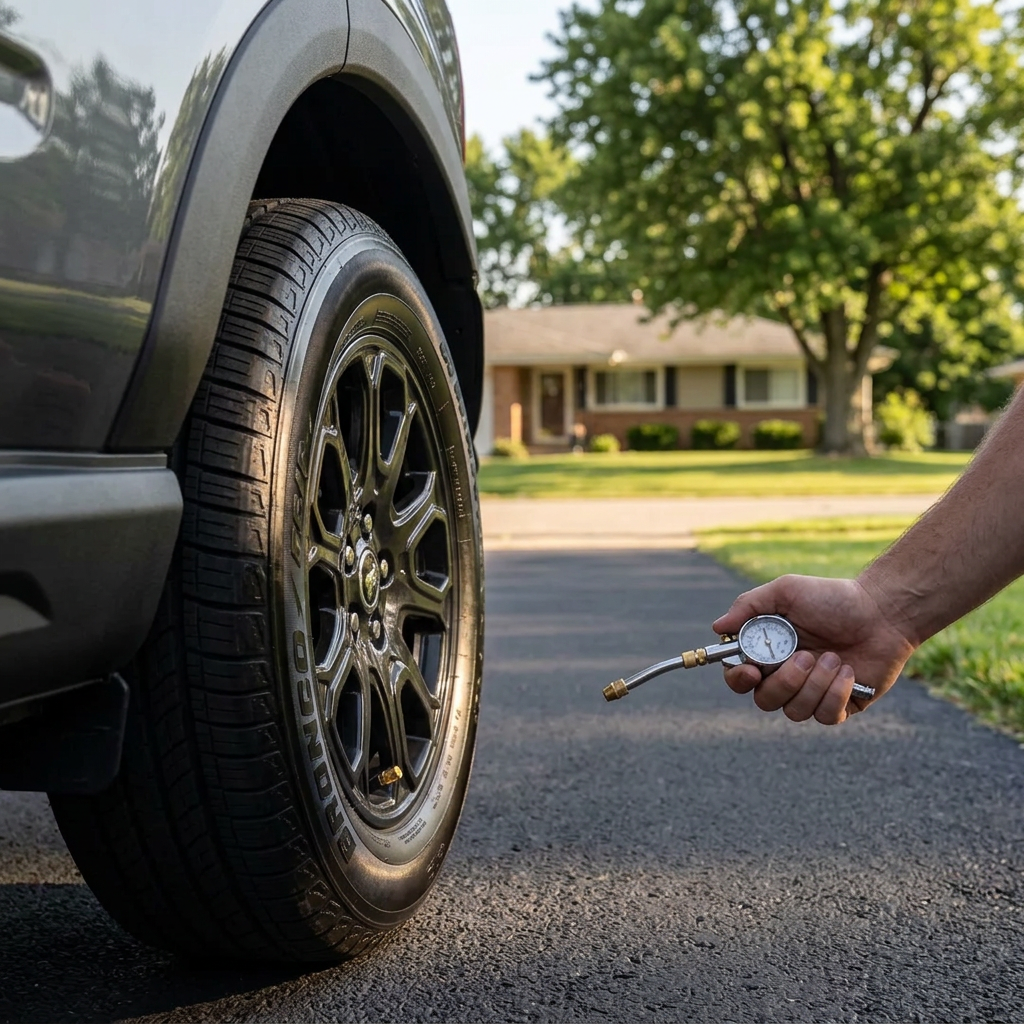
Proper tire inflation remains critical right up to the moment old rubber is discarded. When a tire is worn or slowly leaking, drivers often wonder what pressure they should maintain while waiting for a replacement appointment. The short answer is that you should always aim to hold the vehicle manufacturer’s recommended cold inflation pressure, which typically falls between 28 psi and 36 psi for standard passenger cars [source name: NeoTires – What Tire PSI Should My Tires Be?]. Setting the pressure to this exact specification ensures the tire maintains its proper shape, protecting your steering components and wheels from unnecessary stress on the road.
Ignoring tire pressure because a replacement is imminent can lead to accelerated wear on suspension parts and compromise your safety. For those preparing to replace their tires, utilizing our online tire finder tool allows you to select the precise size and speed rating required for your vehicle. Once you have selected your new set, scheduling a tire inspection online ensures our certified technicians can mount and balance them efficiently.
If you prefer to speak with an expert about which tread pattern fits your driving habits, giving us a call at (330) 462-7578 is a convenient way to get direct assistance. For drivers who want to drop in for a quick pressure check, finding our East Liverpool service center is straightforward, as we are located right on Pennsylvania Ave.
Table of Contents
- Determining the Minimum Safe PSI and the Risks of Severe Under-Inflation
- Evaluating Puncture Damage to Decide Between Repair and Replacement
- Preparing Your Low-Pressure Tire Before Driving to the Service Center
- How to Properly Use a Tire Pressure Gauge at Home
- Common Questions About Emergency Tire Care and Pressure Maintenance
- Trust Tri State Ford for Your Professional Tire Care and Replacement Needs
Determining the Minimum Safe PSI and the Risks of Severe Under-Inflation
Operating a vehicle with severely under-inflated tires compromises safety long before the tire goes completely flat. A tire is considered functionally flat and entirely unsafe to drive on when the pressure drops below 20 psi. At this extremely low level, the tire bead can easily separate from the wheel rim, resulting in an immediate loss of steering control and potential wheel damage.
Low pressure increases the tire’s contact patch with the road, which generates excessive heat. This thermal buildup weakens the internal rubber compounds and cords, often leading to a catastrophic blowout at highway speeds. For drivers navigating the rolling hills near Beaver Creek in Calcutta, maintaining proper pressure is essential to handle the elevated terrain and winding roads safely.
Larger vehicles require even greater vigilance regarding minimum safety thresholds. If you drive a model from our light-duty truck inventory, the recommended cold pressure is typically higher, often ranging from 35 psi to 45 psi depending on the payload [source name: NeoTires – What Tire PSI Should My Tires Be?]. The same standard applies to heavy-duty hauling, where drivers operating new commercial work trucks must strictly adhere to the higher inflation limits listed on the door placard to support heavy cargo safely. Even if you are currently waiting on our custom vehicle orders to arrive, keeping your current vehicle’s tires above the absolute minimum safety threshold of 25 psi is vital for daily driving security.
Evaluating Puncture Damage to Decide Between Repair and Replacement
Many drivers assume that any nail or screw in a tire automatically means purchasing a costly replacement. In reality, industry standards permit safe repairs under specific conditions. A puncture can typically be patched and plugged if the damage is confined to the central tread area and does not exceed a quarter of an inch in diameter. The tire must also have a healthy tread depth and show no signs of being driven on while severely under-inflated.
Punctures located on the tire shoulder or sidewall cannot be safely repaired under any circumstances. The sidewall experiences constant flexing during cornering and braking, which prevents a patch or plug from holding securely over time. If a tire has been driven on while flat, the internal structure is likely compromised, making a replacement the only safe option.
When a replacement is necessary, ordering original equipment manufacturer parts ensures your vehicle receives tires that match its original handling and safety specifications. While some vehicle owners consider valuing a vehicle online when facing multiple maintenance needs, replacing a single damaged tire is a straightforward process that protects your overall investment. If you are planning for a larger service visit or need to replace a full set of tires, our finance department can assist with flexible payment options to keep your vehicle maintenance on track.
Preparing Your Low-Pressure Tire Before Driving to the Service Center
Waking up to a glowing yellow dashboard warning light requires immediate diagnostic action before you head out onto the road. If you discover a tire has lost pressure, you should inflate it to the recommended placard level using a portable compressor or a nearby station pump before driving. Driving even a short distance on a tire that is significantly low can cause permanent internal damage to the casing, rendering an otherwise repairable puncture completely useless.
After inflating the tire, wait a few minutes and use a manual gauge to confirm the pressure is holding steady. If you hear a rapid hissing sound or watch the pressure drop quickly, do not attempt to drive the vehicle to a repair shop. In these severe cases, installing your spare tire or calling for professional retrieval is the only safe course of action.
For drivers who prefer professional assistance at home, scheduling our convenient mobile service van can bring certified technicians directly to your driveway to handle minor tire issues or perform our routine battery testing and replacement. You can also check our monthly service specials online to find current savings on common maintenance items. If you experience a flat tire on the road, utilizing Ford Roadside Assistance: 1-800-241-3673 provides peace of mind with manufacturer-backed support, ensuring your vehicle is towed to an authorized service center where genuine parts and brand-specific expertise are guaranteed.
How to Properly Use a Tire Pressure Gauge at Home
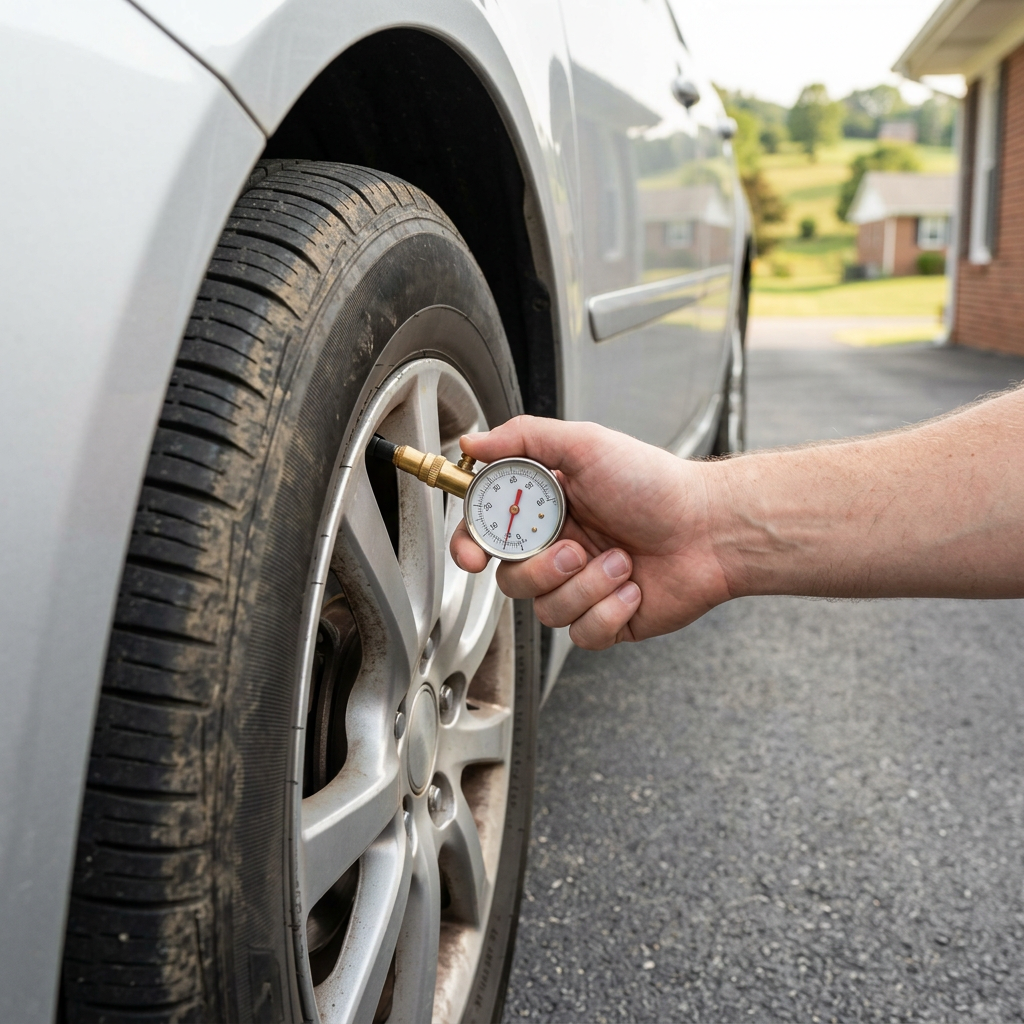
Have you ever checked your tire pressure only to get a different reading every time you press the gauge? Achieving an accurate measurement requires a specific technique and a reliable tool, whether you use a digital, dial, or traditional pencil-style gauge. Always perform this check when the tires are cold, meaning the vehicle has been parked for at least three hours or driven less than one mile [source name: Nokian Tyres – Tire Pressure Tips].
To begin, unscrew the small plastic valve cap from the tire’s valve stem and place it in a secure spot like your pocket. Press the nozzle of your tire pressure gauge firmly and straight onto the valve stem until the hissing sound of escaping air stops completely. Read the measurement displayed on the screen, dial, or sliding scale, and repeat the process two or three times to ensure consistency.
Once you have your reading, compare it directly to the recommended cold pressure listed on your driver-side door jamb placard [source name: TirePressureTips.com – What tire pressure should you have (2026)]. If the pressure is low, add air in short bursts; if it is too high, press the small center pin inside the valve stem to release air. Keeping your tires properly inflated is a universal necessity, whether you are driving an older model or checking out our vehicle specials. For larger vehicles, such as those found in our light-duty truck inventory, checking the rear tires is especially critical when preparing to haul a heavy load.
Common Questions About Emergency Tire Care and Pressure Maintenance
Q: If my low tire is still above 25 psi, do I need to replace it immediately?
If your tire pressure is above 25 psi but below the recommended level on your door placard, you do not necessarily need to replace the tire immediately, provided there is no structural damage. However, you should inflate it to the correct pressure right away and monitor it closely for any rapid drops. If the tire repeatedly loses air or has a visible puncture, you should schedule a professional inspection to determine if a repair or replacement is required.
Q: Where exactly on my vehicle can I find the correct psi recommendation?
The correct cold tire pressure recommendation is located on a silver or white placard on the driver-side door jamb [source name: TirePressureTips.com – What tire pressure should you have (2026)]. This sticker lists the exact specifications determined by the manufacturer for both the front and rear tires. You can also find this information detailed in your vehicle’s owner’s manual, but you should never use the maximum pressure number printed on the tire sidewall itself [source name: Nokian Tyres – Tire Pressure Tips].
Q: What driving habits help keep a low‑pressure tire safer until I can replace it?
If you must drive a short distance on a tire that is holding air but slightly below its recommended pressure, limit your speed to under 50 mph and avoid sudden braking or sharp cornering. Choose the most direct route to the service center and avoid rough roads or potholes that could pinch the under-inflated sidewall against the wheel rim. For heavy-duty vehicles like F-Series work trucks or commercial Transit work vans, avoiding any cargo loading while a tire is low is critical to prevent sudden structural failure.
Q: How does outdoor temperature affect my tire pressure throughout the day?
Tire pressure typically changes by about 1 psi to 2 psi for every 10-degree Fahrenheit change in outdoor temperature [source name: Tactic Engineering – The Complete Guide to Tire Pressure]. When temperatures drop overnight, the air inside your tires contracts, which often triggers the low tire pressure warning light on cold mornings. While the pressure may rise slightly as you drive and the tires warm up, you should still check and adjust them to the recommended cold pressure.
Q: Can I mix different tire brands or tread patterns on my vehicle?
It is highly recommended to keep matching tire brands, models, and tread depths on all four wheels to ensure balanced traction and predictable handling. Mixing different tire types can cause uneven grip, especially in wet conditions, and can place unnecessary strain on all-wheel-drive systems. While exploring our manufacturer vehicle specials is a great step when planning for a new vehicle, keeping your current vehicle’s tires properly matched is the safest choice for daily driving.
Trust Tri State Ford for Your Professional Tire Care and Replacement Needs
Maintaining proper tire pressure is one of the simplest yet most effective ways to protect your vehicle’s safety, handling, and fuel efficiency. Whether you are handling the daily commute down Market Street in Boardman or navigating local neighborhood routes, keeping your tires inflated to the correct manufacturer specifications prevents premature wear and keeps your family secure on the road. When you notice a persistent slow leak, uneven tread wear, or sidewall damage, trusting factory-trained technicians is the best way to ensure a precise repair or a high-quality replacement.
At Tri State Ford, our service team is dedicated to providing transparent, reliable care using genuine parts designed specifically for your vehicle. If your busy schedule makes it difficult to visit us in person, you can take advantage of our convenient vehicle pickup and delivery service, allowing us to service your tires without disrupting your day. For those who prefer to drop off their vehicle, finding your local Ford service center is easy, and you can get turn-by-step navigation directly to our physical dealership at 1503 Pennsylvania Ave, East Liverpool, OH 43920.
If you notice a low-pressure warning, contact our service team for assistance. Protect your vehicle’s performance by calling our service advisors at (330) 462-7578 or scheduling your next tire maintenance appointment online today.
© 2026 Tri State Ford. All rights reserved.
Trading with Confidence: Expert Trade-In Advice from Tri State Ford
Trading in your current vehicle can feel like a complex process, but arriving at the dealership with the right knowledge changes the entire experience. We sat down with Nick Pirl, Sales Manager at Tri State Ford, who brings 9 years of automotive expertise to help clarify how vehicle appraisals work. In this interview, he shares practical strategies to maximize your vehicle’s value, organize your paperwork, and transition smoothly into your next purchase.
Q: How can I build confidence when trading in my vehicle?
A: Here at Tri State Ford, we focus on making the trade-in process as transparent and straightforward as possible for every customer who walks through our doors. Building confidence starts with understanding that your current vehicle is a liquid asset with real market value, not just a negotiation afterthought. When you treat the trade-in as an independent business transaction, you reclaim your negotiating power and feel much more in control of the entire process. Preparing your vehicle both cosmetically and mechanically before you visit us is one of the easiest ways to ensure you get a fair and honest assessment.
We always recommend that drivers take a few simple steps to get their vehicles ready, such as having the car detailed and addressing minor cosmetic issues like burnt-out bulbs or small paint chips. If you want to explore what your trade-in could help you purchase, you can browse our new Ford inventory or look through our commercial vehicle selection to see what we have available. We also offer options for customizing your next vehicle online if you prefer to build a vehicle to your exact specifications. To find the best value, you can check out our current national Ford incentives, explore our new vehicle specials, or browse our pre-owned specials. If you have any questions or want to stop by, you can find our showroom on Pennsylvania Avenue or give our team (330) 462-7578 to speak with us directly.
Q: Why is a dealer’s trade-in offer different from Kelley Blue Book private party value?
A: One of the first things we look at during an appraisal is the difference between wholesale and retail market dynamics. A private party value represents what one individual might pay another in a direct sale, whereas a dealership’s trade-in offer is based on wholesale pricing. When we acquire a trade-in, we assume all the financial risks, immediate reconditioning costs, marketing expenses, and administrative overhead required to prepare that vehicle for its next owner. For families navigating the rolling hills near Calcutta, an older SUV might have accumulated some typical wear and tear that we have to recondition before resale. These reconditioning costs, along with the risk of the vehicle sitting on our lot, are factored directly into our initial appraisal.
According to Kelley Blue Book, the single biggest factor in a trade-in offer is a vehicle’s mileage, because higher odometer readings directly reduce resale value by accelerating depreciation. We also look closely at trim levels and factory options, which can significantly boost your vehicle’s value. For example, if you are trading up to a new F-150 Lariat which starts at $59,560, or a Platinum starting at $68,800, knowing how your current vehicle’s options affect its value is key. To get a realistic baseline before you visit us, you can use our online trade appraisal tool or get a certified offer through our Instant Cash Offer page. This helps you understand the market variables before you even set foot on our lot, and you can also browse our one-owner used inventory to see how we price and present similar high-quality vehicles.
Q: How much more money can you actually make selling a car privately versus trading it in?
A: It is a very common scenario when a driver compares the potential return of a private sale against the convenience of a dealership trade-in. While a private sale can sometimes yield ten to twenty percent more money on paper, it requires you to manage advertising, answer inquiries, schedule test drives with strangers, and handle all the complex transaction paperwork. Many sellers find that the time, effort, and safety concerns associated with a private sale quickly erode that paper premium. Additionally, trading your vehicle to a licensed dealership in Ohio offers a significant financial benefit that you cannot get in a private transaction.
Under Ohio law, when you trade in a vehicle at a dealership, the value of your trade-in is deducted from the purchase price of your replacement vehicle before sales tax is calculated. This tax break directly offsets a large portion of the difference between a private sale price and a dealer’s trade-in offer. If you are preparing your vehicle to maximize its trade-in value, making sure the vehicle is mechanically sound by using our tire finder page or checking our battery replacement advice can prevent easy deductions during the appraisal. Once you have a clear idea of your vehicle’s value, you can submit an online credit application to streamline the purchasing process and secure your financing ahead of time.
Q: What does it mean to have negative equity, and how does it affect a trade-in?
A: Many of our customers feel a bit of tension when they realize they owe more on their current auto loan than the vehicle is actually worth. This situation, commonly known as having negative equity or being underwater, is a very frequent occurrence in the automotive industry. When you trade in a vehicle with negative equity, that outstanding balance does not simply disappear; it must be resolved as part of the new transaction. You can choose to pay the difference out of pocket to clear the balance, or you can roll that negative equity into your new auto loan.
Rolling negative equity into a new loan is a common option, but it will increase your new monthly payments and your overall loan balance. If you find yourself in this situation, we can help you evaluate your options carefully to find a solution that protects your long-term financial health. While you are waiting to build equity, keeping your current car running smoothly with our service offers is a smart financial move. If you are ready to explore a replacement, we offer convenient pickup and delivery options for sales and service, and we make scheduling a test drive simple and hassle-free.
“Negative equity is not a roadblock to getting a safer vehicle; it just requires a transparent, step-by-step plan to manage the numbers.”
Q: How can I prepare my paperwork to make the trade-in process straightforward and stress-free?
A: Gathering the correct documentation is actually one of the most effective ways to reduce anxiety and speed up the appraisal process. When you arrive at the dealership with organized records, you eliminate ambiguity and prevent unexpected delays during the transaction. You should bring your vehicle’s title, the current registration, all sets of keys, and a ten-day payoff quote from your current lender if you still have an active loan. Presenting a complete folder of service records is also incredibly powerful, as it proves to our appraisers that the vehicle has been responsibly maintained.
A documented maintenance history reduces the estimated reconditioning costs we must factor into our offer, which directly translates to a stronger bid for your vehicle. This level of preparation is especially important for business owners trading in commercial vehicles, where maintenance history directly impacts utility and value. If you are looking to upgrade your business fleet, you can explore our commercial truck inventory to see what options are available. We maintain a robust F-Series work truck selection for heavy-duty needs, as well as versatile Transit commercial vans designed to keep your business moving efficiently.
Q: What questions should I ask a dealer to ensure I am getting a fair trade-in offer?
A: When I’m helping someone navigate the appraisal process, I always encourage them to ask direct, specific questions about how we arrived at our valuation. A reputable dealership should be completely transparent about their math and willing to explain every detail of the offer. You should ask the appraiser to break down any deductions they made for reconditioning, such as tire wear, cosmetic blemishes, or mechanical issues. You should also ask how local market demand and current wholesale auction data are influencing the offer for your specific make and model.
Asking these questions shifts the conversation from a subjective negotiation to an objective, data-driven discussion. It also gives you the confidence to verify that the dealer is treating your vehicle as a valuable asset. If you are trading in an older vehicle to get into a capable pickup, you can browse our new Ford truck inventory to find a model that matches your needs. We also offer convenient mobile service options to make maintaining your next vehicle easier than ever, ensuring you can keep its future trade-in value high without disrupting your busy schedule.
Q: How can I feel confident evaluating my next vehicle and reducing decision anxiety?
A: How do you know you are making the right choice for your family when selecting your next vehicle? Reducing decision anxiety comes down to matching the vehicle’s concrete capabilities and specifications directly to your daily lifestyle and driving habits. Whether you are commuting along Market Street in Boardman or planning a weekend trip, matching the powertrain to your daily drive is essential. For example, if you need a high-demand pickup, the F-150 offers a robust 3.5L engine paired with a 10-speed automatic transmission, delivering 382 hp and 500 lb-ft of torque with a towing capacity of up to 12,800 lbs.
If a mainstream crossover fits your lifestyle better, the Escape features a 1.5L engine and an 8-speed automatic transmission, producing 180 hp and 199 lb-ft of torque while achieving an efficient 27 city / 34 hwy rating. For larger families, the Explorer provides spacious seating for seven, a 2.3L engine, and a 10-speed automatic transmission that delivers 300 hp and 310 lb-ft of torque. Taking the time to test drive these models and review their specifications ensures you make an informed, stress-free decision. When you are ready to take the next step, you can visit our physical showroom, contact our finance center to discuss your options, or call our team at (330) 462-7578 to schedule a personalized consultation.
Pricing
Pricing by trim
| Feature | King Ranch | Lariat | Platinum | Police Responder | Raptor | STX | Tremor | XL | XLT |
|---|---|---|---|---|---|---|---|---|---|
| Base MSRP | $65,825 | $59,560 | $68,800 | $52,350 | $79,005 | $41,855 | $64,915 | $37,290 | $44,695 |
| Destination charge | $2,795 | $2,795 | $2,795 | $2,795 | $2,795 | $2,795 | $2,795 | $2,795 | $2,795 |
Engine & Performance
Powertrain specs by trim
| Feature | King Ranch | Lariat | Platinum | Police Responder | Raptor | STX | Tremor | XL | XLT |
|---|---|---|---|---|---|---|---|---|---|
| Engine | 3.5L | 5.0L | 3.5L | 3.5L | 3.5L | 2.7L | 3.5L | 2.7L | 2.7L |
| Horsepower | 382 hp | 400 hp | 382 hp | 400 hp | 450 hp | 325 hp | 382 hp | 325 hp | 325 hp |
| Torque | 500 lb-ft | 410 lb-ft | 500 lb-ft | 500 lb-ft | 510 lb-ft | 400 lb-ft | 500 lb-ft | 400 lb-ft | 400 lb-ft |
| Transmission | 10-speed automatic | 10-speed automatic | 10-speed automatic | 10-speed automatic | 10-speed automatic | 10-speed automatic | 10-speed automatic | 10-speed automatic | 10-speed automatic |
| Drivetrain | Rear-wheel drive | Rear-wheel drive | Rear-wheel drive | Four-wheel Drive | Four-wheel Drive | Rear-wheel drive | Four-wheel Drive | Rear-wheel drive | Rear-wheel drive |
Keep Your Vehicle Running Strong
Keep your vehicle performing at its best with our service team:
© 2026 Tri State Ford. All rights reserved.
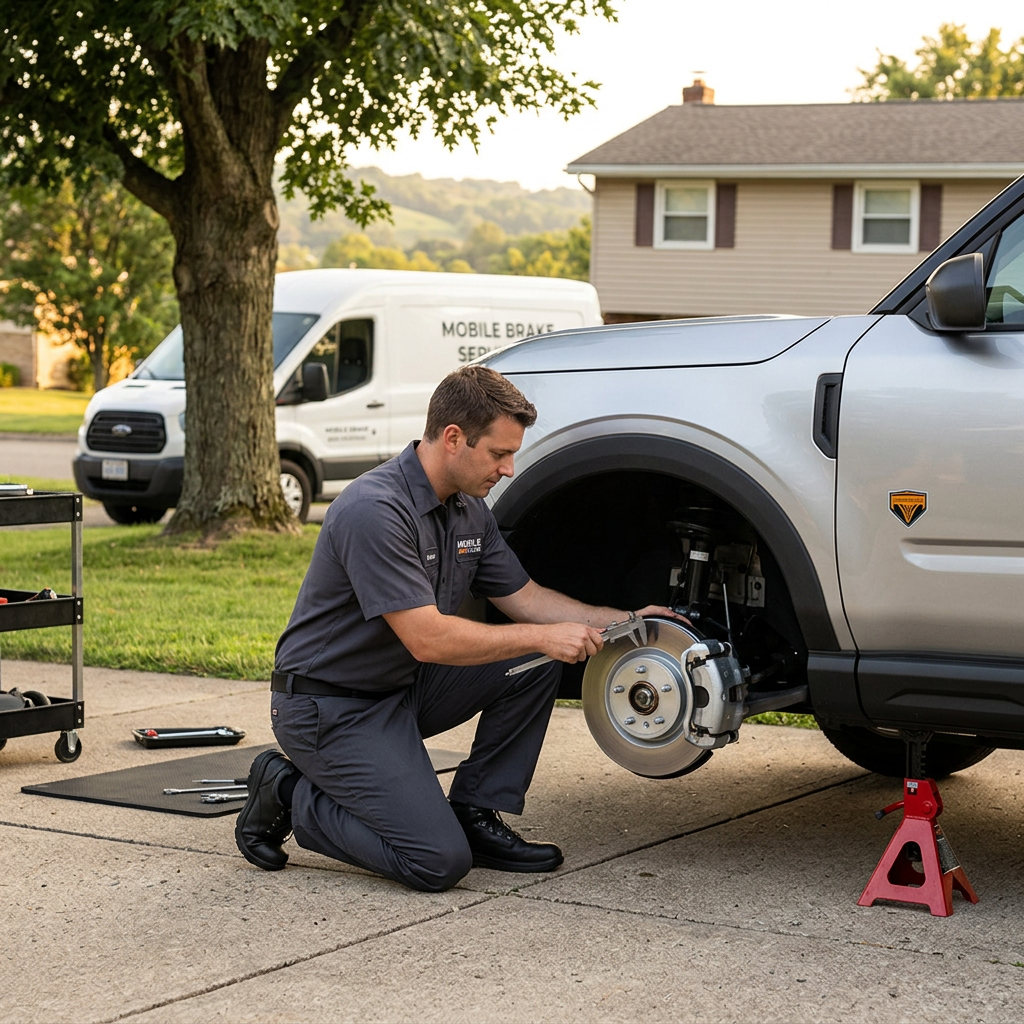
What You Need to Know About Changing Your Brakes: My Take as a Service Manager
## Understanding Your Ford Stopping Power and Real-World Brake Wear
Every time you press your brake pedal, a complex system of hydraulic pressure and friction materials works instantly to bring your vehicle to a safe stop. As a service manager with ten years of experience, I see firsthand how local driving conditions affect these critical components. The steep riverfront bluffs in East Liverpool require your braking system to work much harder than it would on flat, open highways. This constant downhill braking generates intense heat, which naturally accelerates the wear on your friction linings.
To keep your vehicle stopping safely, Ford service guidance recommends that your entire braking system be inspected by a certified technician every six months or 6,000 miles. Regular check-ups allow us to measure your remaining lining thickness before it reaches a critical stage. If you have been searching for a reliable local service department, we are here to help. Our factory-trained technicians understand the exact specifications of your vehicle, ensuring your safety is never compromised.
When your vehicle is due for an inspection, we strive to make the process as convenient as possible for your family’s busy schedule. You can easily schedule a service appointment online in just a few clicks. For those with tight schedules, we also offer convenient valet pick up and delivery service for your maintenance needs. Alternatively, our specialized mobile service van can bring the shop directly to your driveway. If you prefer to drop your vehicle off in person, you can easily find our service center location right on Pennsylvania Ave, or give us a quick call to speak with a technician.
Table of Contents
- What Is the Average Lifespan of Brake Pads in Miles
- Should You Replace Front Brake Pads or Both Axles at Once
- What Brake Pedal Changes and Warning Signs Signal It Is Time for Service
- Why Replacing Brake Rotors Adds to Your Total Service Bill
- How Driving Habits and Professional Calibration Keep Your Ford Safe
What Is the Average Lifespan of Brake Pads in Miles
How long your brake pads last is one of the most common questions my team gets in the service bay. Under normal driving conditions, most brake pads should be replaced every 25,000 to 70,000 miles. This wide range exists because your daily driving environment, vehicle weight, and pad materials play a massive role in overall longevity. For example, a commuter spending most of their time on flat highways will get much closer to the higher end of that mileage spectrum.
When looking at brand-specific standards, most Ford brake pads last between 40,000 and 70,000 kilometers under normal operating conditions. This translates to roughly 25,000 to 43,000 miles of reliable stopping performance. If you drive a heavier vehicle, such as one of the work trucks from our new truck inventory, the extra mass requires more force to stop, which naturally reduces pad life. Managing a commercial fleet from our F-Series commercial truck selection means your vehicles carry heavy payloads, requiring more frequent brake inspections to avoid downtime.
If you prefer to handle minor maintenance yourself, you can also order genuine Motorcraft parts directly from our team. Using original equipment manufacturer components ensures that the replacement pads match the exact compound and density originally engineered for your vehicle. Selecting aftermarket alternatives often results in excessive brake dust, annoying squeals, and a significantly shorter operational lifespan.
Should You Replace Front Brake Pads or Both Axles at Once
While it might seem convenient to swap out all four brake pads at the same time, doing so is often an unnecessary expense. Your front and rear brakes operate under completely different workloads due to the physics of stopping. When you apply the brakes, the weight of your vehicle shifts forward, placing up to 75% of the stopping burden on the front axle. Because of this forward weight transfer, front brake pads typically need replacement around 40,000 to 50,000 miles, while rear brake pads on the same vehicle usually last 20% to 30% longer.
On the rolling hills near State Route 170 in Calcutta, the constant elevation changes put a heavy load on your vehicle’s front axle during deceleration. This is why we almost always see front pads wearing down much faster than the rears for local drivers. We recommend replacing your brake pads in pairs across the same axle to maintain balanced stopping force, but you only need to service both axles simultaneously if inspections show that both front and rear linings have reached their wear limits.
Our certified technicians measure the friction material on both axles during every routine multi-point inspection. Even if you are planning a custom factory order for a new vehicle, understanding these maintenance patterns helps you plan for long-term ownership costs. If you manage fleet vehicles, our finance department can assist with commercial service payment options to keep your maintenance budget predictable. This is especially useful when maintaining heavy-duty models found in our new work truck inventory, where safety and uptime are critical to your daily business operations.
What Brake Pedal Changes and Warning Signs Signal It Is Time for Service
Imagine you are driving home and notice that your brake pedal feels unusually soft or requires you to press it much closer to the floor than normal. A spongy or cushiony pedal is a major warning sign that your braking system needs immediate professional attention. This change in pedal feel often points to air in the hydraulic lines, low brake fluid, or severely worn friction material that forces the caliper pistons to extend beyond their normal range.
Most modern vehicles start with new brake pads measuring about 10 to 12 mm of friction material. We typically recommend planning a replacement when the pad thickness wears down to 3 mm, and you must replace them immediately if they reach 2 mm or less. Many brake pads feature built-in metal wear indicators that emit a high-pitched squeak when the material gets thin. If you ignore this squeaking and begin to hear a harsh, metallic grinding noise, the friction material is completely gone, and the steel backing plates are actively scraping against your iron rotors.
To keep your vehicle running safely, be sure to check our current service offers for current current service pricing. Our team is equipped to handle all of your vehicle’s essential needs, whether you need a brake check or routine battery testing and replacement. If you feel a distinct vibration through the steering wheel or brake pedal when slowing down, your rotors may be warped or unevenly worn. If you decide it is time to transition into a different vehicle instead of performing major repairs, we can help you value your trade-in online using our instant valuation tool.

Why Replacing Brake Rotors Adds to Your Total Service Bill
When customers review their repair estimates, the cost of replacing rotors often catches them off guard. Brake rotors are heavy, precision-machined metal discs that experience extreme thermal stress every time you slow down. While brake pads are designed as soft wear items, rotors are much harder, but they still wear down over time. We recommend replacing your brake pads and rotors roughly every 50,000 miles, though they should be inspected about every 30,000 miles to catch deep grooves or heat damage early.
Replacing rotors adds to your service bill because of the high cost of the physical parts and the additional labor required to remove the calipers and brackets. While some older or thicker rotors can be resurfaced on a brake lathe, many modern rotors are engineered to be lightweight and thin, meaning they often cannot be machined safely. Installing brand-new pads onto a grooved, warped, or thin rotor will cause the new pads to wear out prematurely and can lead to annoying pedal pulsations.
Keeping your braking system in top shape is especially important for commercial operators, such as those running vehicles from our used work truck inventory. Heavy hauling and towing place massive thermal demands on the rotors, making high-quality replacements essential for safety. While we highlight maintenance savings over new vehicle offers, investing in quality rotors and professional installation is the best way to avoid costly repeat repairs down the road.
How Driving Habits and Professional Calibration Keep Your Ford Safe
Extending the life of your braking system does not require mechanical training; it simply starts with adjusting how you drive every day. One of the easiest habits to adopt is coasting to reduce speed before applying the brakes, which significantly reduces friction and heat buildup. Avoiding tailgating is another excellent practice, as it prevents the need for sudden, aggressive stops that rapidly accelerate pad wear. Additionally, clearing unnecessary heavy cargo out of your vehicle reduces the total mass your brakes must control.
Some vehicle owners consider changing their own brake pads at home, but modern braking systems carry significant risks for DIY garage work. Many newer models feature electronic parking brakes that require specialized scan tools to place the calipers into service mode. Forcing these calipers back manually without the proper software can easily destroy the expensive internal electric motors. Furthermore, improper torque on caliper bolts or failing to properly lubricate the slide pins can lead to uneven pad wear, brake dragging, or even complete caliper failure on the road.
Our professional service team uses the 30-30-30 rule as a benchmark, checking your pads, rotors, and brake fluid every 30,000 miles to ensure everything is operating in perfect harmony. Keeping up with maintenance is far more cost-effective than searching for current manufacturer information after a major mechanical breakdown. Let our factory-trained technicians handle your next brake service safely, giving you complete peace of mind during your daily travels.
© 2026 Tri State Ford. All rights reserved.
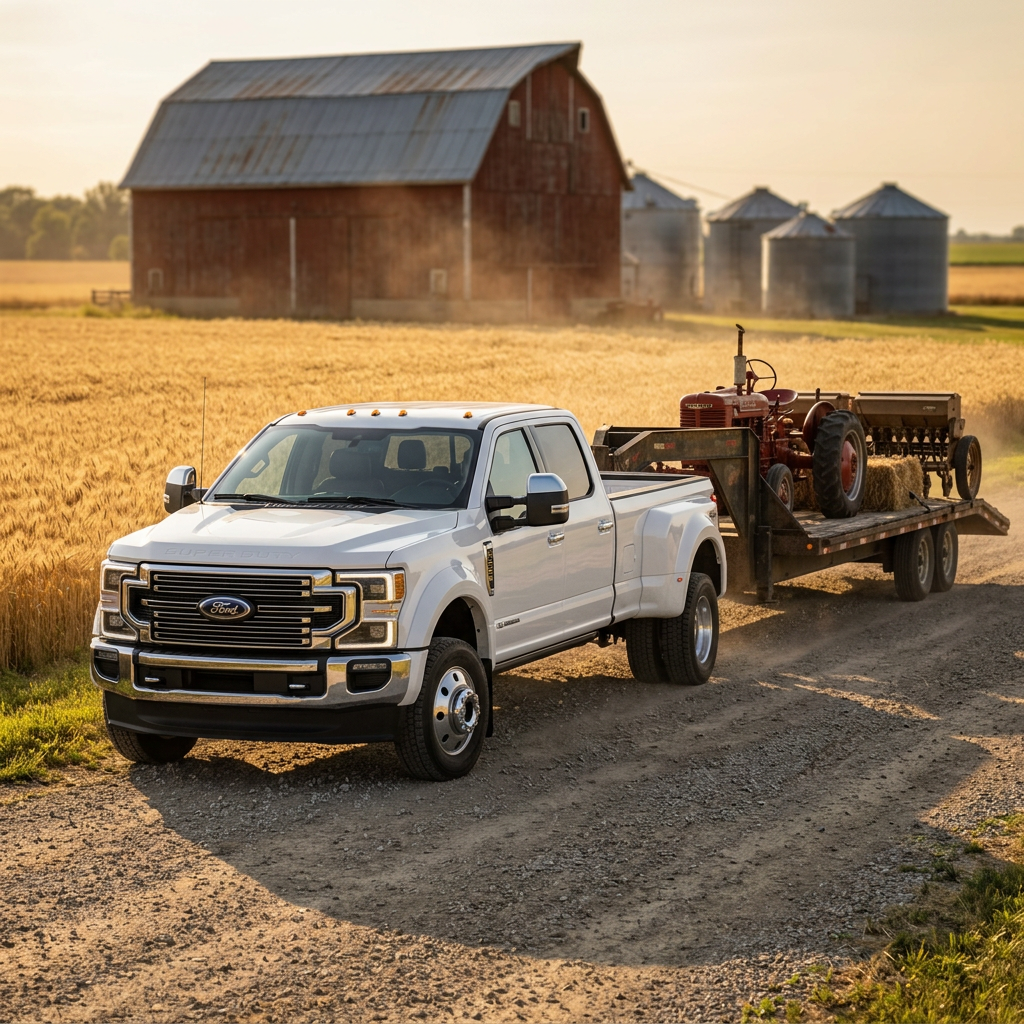
Why Local Farmers are Upgrading to the 2026 Ford F-350 for Mid-Summer Harvest Prep
## Preparing for the Mid-Summer Harvest with the 2026 Ford F-350
I am Nick Pirl, Sales Manager at Tri State Ford, and over my nine years of helping folks find the right work vehicles, I have learned that timing is everything. Mid-summer is a critical window for agricultural operations, and preparing your equipment ahead of the rush makes all the difference when the crops are ready. If you are looking for a reliable partner to handle the heaviest demands of the season, our team is ready to show you how the latest heavy-duty lineup can transform your daily operations. You can find us easily by checking the map to our physical showroom or give us a quick call to discuss your specific work requirements.
The agricultural properties and elevated valley terrain around Calcutta require vehicles that do not back down from steep grades or heavy payloads. As the harvest season approaches, farmers are realizing that older equipment might not cut it under tight deadlines. Upgrading to a modern heavy-duty truck ensures you stay on schedule without worrying about mechanical setbacks. For busy professionals who cannot take time away from the fields, we make the buying and ownership experience seamless. We offer convenient options like valet pickup and delivery for your vehicle needs, and we can even bring maintenance directly to your farm with our specialized on-site mobile vehicle care. If you have been searching for a reliable local commercial vehicle source, our showroom is fully equipped to help you gear up for the busy season ahead.
Table of Contents
- How the 2026 Ford F-350 Towing and Payload Capacity Handles Heavy Farm Equipment
- Comparing the 2026 Ford F-350 Gas and Power Stroke Diesel Engine Options
- Evaluating the Price Difference Between Gas and Diesel Engines on the 2026 F-350
- Maximizing Your Farm Write-Offs with the Section 179 Tax Deduction and F-350 GVWR
- Why Farmers Upgrade to the 2026 F-350 Super Duty Over Half-Ton Pickups
How the 2026 Ford F-350 Towing and Payload Capacity Handles Heavy Farm Equipment
Now, when it comes to hauling heavy gravity wagons, seed tenders, and massive livestock trailers, you need a truck built for extreme physical demands. The 2026 Ford F-350 is designed to handle these exact agricultural challenges with ease. When configured properly with dual rear wheels and the gas engine, this heavy-duty workhorse offers a maximum payload capacity of up to 8,000 pounds. This massive payload rating means you can load up the bed with heavy tools, fuel tanks, or feed bags without stressing the suspension or compromising vehicle control.
Navigating the steep riverfront bluffs and Appalachian elevation changes in East Liverpool requires robust frame construction and dependable braking power. The truck’s high-strength steel chassis and heavy-duty axles provide a solid foundation for pulling massive gooseneck trailers through uneven pasture gates and onto paved state routes. To make hooking up these large rigs simpler, the optional 5th-Wheel/Gooseneck Hitch Prep Package provides factory-installed under-bed frame brackets and a bed-mounted 7-pin connector, allowing you to drop in a ball and secure your trailer in minutes.
For those looking to trade in a lighter truck or expand their current commercial fleet, we offer a wide variety of high-quality pre-owned options. You can explore our single-owner used vehicle inventory to find dependable heavy-duty models that are ready for the field. We also make sure our buyers get the best possible value, which is why we encourage you to check our current manufacturer vehicle incentives before making a decision. To keep your investment running strong through the grueling harvest months, you can also take advantage of our monthly manufacturer service promotions for expert care.
Comparing the 2026 Ford F-350 Gas and Power Stroke Diesel Engine Options
Let’s talk about the engine options available for work-focused buyers, who can choose from four distinct powerplants engineered to match specific agricultural demands. The standard engine on the entry-level XL trim is a 6.8-liter gas V8 that generates 405 horsepower and 445 lb-ft of torque, paired with a heavy-duty TorqShift-G 10-speed SelectShift automatic transmission designed to deliver power early in the rev range. If you need more gas-powered muscle, the available 7.3-liter gas V8 steps things up to 430 horsepower and 485 lb-ft of torque, providing excellent mid-range pulling power for moderate towing duties.
For the ultimate in heavy-duty capability, the diesel lineup delivers unmatched torque and efficiency under continuous load. The standard 6.7-liter turbo diesel V8 pumps out 475 horsepower, while the top-tier high-output 6.7-liter turbo diesel V8 pushes performance to a massive 500 horsepower and 1,200 lb-ft of torque. This high-output Power Stroke diesel is the go-to choice for farmers who regularly pull the heaviest multi-implement haulers or fully loaded grain wagons across soft fields and up steep highway ramps.
Finding the exact combination of engine, bed length, and cab style is easy when you work with our sales team. You can easily browse our new Ford inventory online to see what configurations we have available on the lot today. If you prefer a highly specific setup, such as a dual-rear-wheel regular cab with the high-output diesel, we can help you submit a new vehicle custom order directly to the factory. To narrow down your search specifically to heavy-duty pickups, feel free to explore our dedicated new truck inventory page to find the perfect match for your farm.
Evaluating the Price Difference Between Gas and Diesel Engines on the 2026 F-350
Many customers wonder about the price difference between gas and diesel engines, which represents a significant upfront financial decision that requires careful calculation. Choosing the diesel engine typically adds several thousand dollars to the manufacturer’s suggested retail price, reflecting the complex engineering and robust components required to produce high torque. For example, the base XL Crew Cab short bed with the standard gas engine starts at an MSRP of about $51,495, while premium trims like the Platinum Crew Cab 4WD can start around $80,265 before adding diesel power. Buyers must weigh this initial cost against the long-term benefits of superior fuel efficiency under heavy loads and exceptional resale value.
Diesel engines excel at maintaining fuel economy when pulling heavy loads, making them highly cost-effective for farms that log high annual towing miles. The immense torque also reduces strain on the transmission, which can translate to fewer mechanical issues over years of hard labor. However, for farms that primarily use their trucks for shorter utility runs, light hauling, and stationary power supply, the standard gas engines offer a lower entry cost and simpler maintenance requirements that might make better financial sense.
Our team is here to help you analyze these costs and find a payment structure that fits your farm’s operating budget. You can start by checking our external new commercial vehicle inventory to compare current pricing on gas and diesel models. If you have an older truck to trade in, you can get a quick, reliable valuation using our online trade-in appraisal tool to see how much equity you can apply to your new purchase. Once you have a clear picture of your trade-in value, our finance department specialists can walk you through customized commercial purchasing options.
Maximizing Your Farm Write-Offs with the Section 179 Tax Deduction and F-350 GVWR
Another important thing to know about buying a new work truck is how it affects your tax planning and agricultural business write-offs. Under the current tax guidelines, the Section 179 tax deduction allows qualifying agricultural businesses to immediately write off up to $2,560,000 of eligible equipment placed in service during the year. This deduction begins to phase out once total qualifying equipment purchases exceed $4,090,000. Because heavy-duty work trucks are primary business assets, they represent an excellent opportunity to reduce your overall tax liability while modernizing your fleet.
Vehicle weight plays a critical role in determining how much of the purchase price you can deduct immediately. Vehicles with a Gross Vehicle Weight Rating (GVWR) between 6,000 and 14,000 pounds qualify for substantial immediate write-offs, while passenger-focused SUVs in this weight class are subject to a specific $32,000 limitation. The F-350 easily surpasses these minimum thresholds, with a standard GVWR of 10,500 lbs and a Gross Combined Weight Rating of 21,000 lbs. This commercial-grade rating means that when the truck is used more than 50% for business, it qualifies as a non-passenger work vehicle, allowing you to deduct the full purchase price in the first year.
To take advantage of these tax savings before the year-end deadline, our team can help you secure the right vehicle and financing quickly. You can get a head start on the paperwork by submitting our secure online credit application from the comfort of your home. We also encourage you to browse our external inventory of new commercial work trucks to find models that meet the exact weight ratings your business needs. To maximize your savings even further, be sure to keep an eye on our current new vehicle pricing for promotional offers on our heavy-duty lineup.
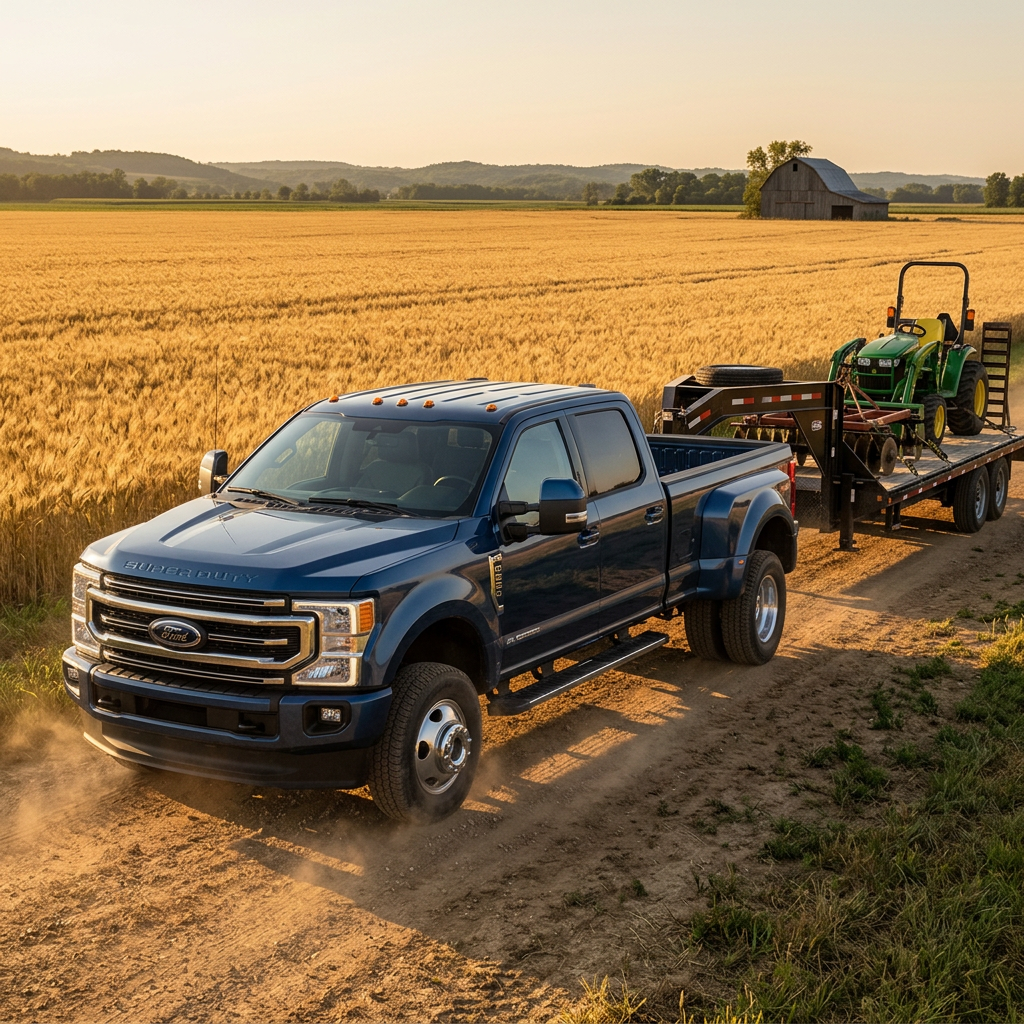
Why Farmers Upgrade to the 2026 F-350 Super Duty Over Half-Ton Pickups
One thing I always tell customers about choosing a heavy-duty truck over a light-duty option is that half-ton pickups quickly reach their physical limits under the demanding conditions of a busy farm. A standard light-duty truck typically tops out around 13,000 pounds of towing capacity, which is insufficient for hauling loaded grain wagons, large tractors, or multi-bale hay trailers. Upgrading to the heavy-duty chassis of the F-350 provides the structural rigidity, advanced cooling systems, and heavy-duty braking needed to pull up to 38,000 pounds safely. This massive capability gap ensures that you can move your largest implements without putting excessive wear on your vehicle.
Durability and long-term peace of mind are also major factors when choosing a heavy-duty truck for agricultural work. Every new model comes backed by a comprehensive manufacturer warranty, including a basic bumper-to-bumper warranty of 3 years or 36,000 miles, a powertrain warranty of 5 years or 60,000 miles, and corrosion protection for 5 years with unlimited miles. In addition to these strong warranty terms, owners benefit from manufacturer-backed emergency support. If you ever run into an issue in the field or on the road, you can rely on manufacturer-backed roadside assistance or use the direct helpline at Ford Roadside Assistance: 1-800-241-3673 to coordinate towing, flat tire changes, or fuel delivery directly to an authorized service center.
Making the switch to a heavy-duty truck is a straightforward process that starts with evaluating your current vehicle’s worth. Our team can help you easily value your trade-in online to see how much value you can carry over toward an upgrade. When you are ready to explore the lineup in person and find the right truck for your farm, stop by our showroom to speak with our experienced sales staff.
Keep Your Vehicle Running Strong
Keep your vehicle performing at its best with our service team:
© 2026 Tri State Ford. All rights reserved.
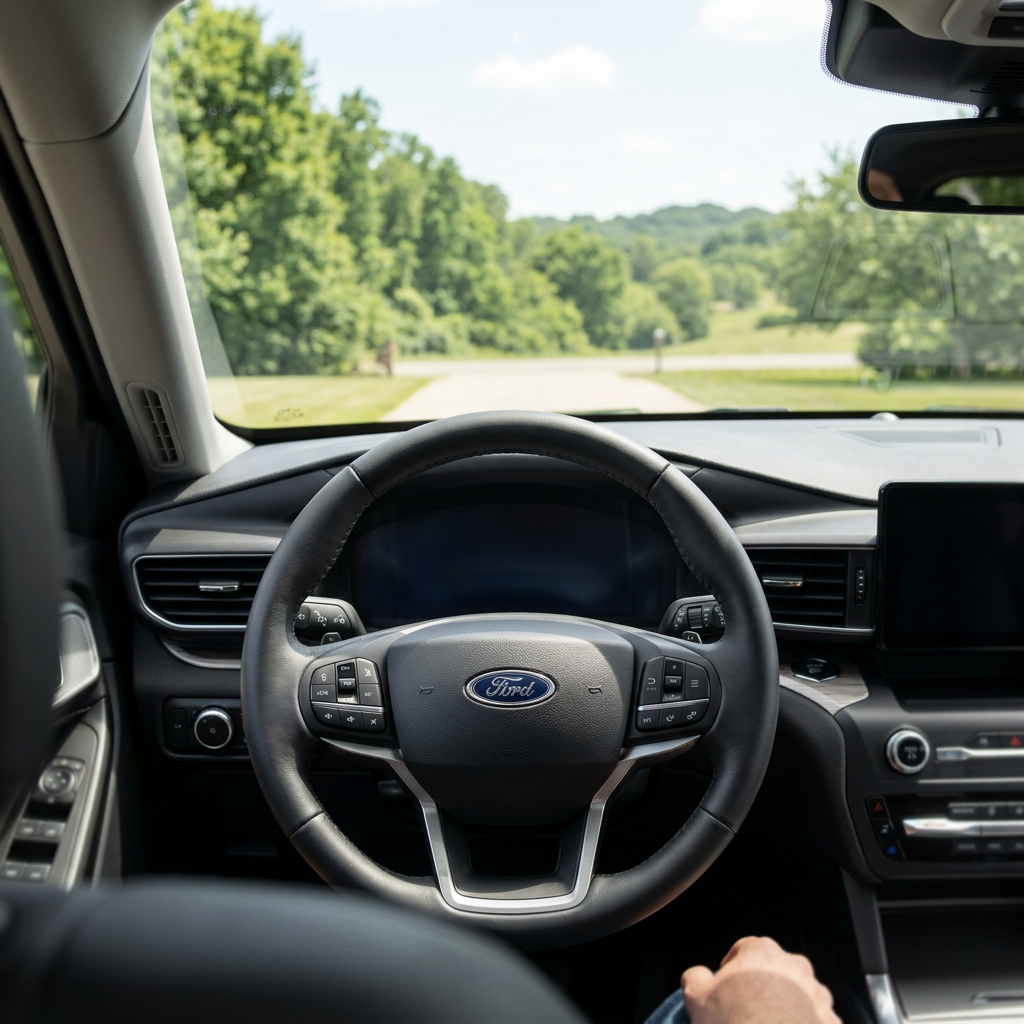
A safety recall has been issued for certain 2025 and 2026 Ford Bronco Sport SUVs due to a software-related issue that can cause the digital instrument panel cluster to remain completely blank upon vehicle startup [1, 3]. This campaign, assigned National Highway Traffic Safety Administration campaign number 25V540 and Ford internal recall number 25SC3, affects approximately 229,609 vehicles in the United States [3, 6]. The total includes roughly 128,607 Bronco Sport SUVs and 101,002 Bronco SUVs manufactured between March 7, 2024, and November 3, 2025 [2, 3, 6].
For owners navigating State Route 170 in Calcutta, driving with a blank screen makes it impossible to see critical safety information, such as the speedometer, system warning lights, and driver-assist indicators [1, 4]. This lack of vital display information significantly increases the risk of an accident on local roads [1]. Because safety is a paramount concern, Ford is offering a complete software remedy free of charge to all affected owners [1, 4].
To make this safety update as convenient as possible, our team at Tri State Ford provides flexible service options. If you prefer to have the software update completed at your home or workplace, you can take advantage of our certified Ford Mobile Service program. Alternatively, we offer a complimentary Ford Pick Up & Delivery service, where we will collect your vehicle, perform the update at our certified facility, and return it directly to you. To coordinate your recall repair, you can reach out to our service advisors by making a quick call or by locating a certified Ford dealership near me to find our convenient service center.
Table of Contents
- The Technical Cause Behind the Blank Screen Malfunction
- Step-by-Step Instructions to Check Your Vehicle for Active Recalls
- Resolving the Software Defect with Certified Ford Service
- Local Service Support for Bronco Sport Owners
- Common Questions About the Bronco Sport Digital Display Issues
- Proactive Maintenance and Recall Support at Tri State Ford
The Technical Cause Behind the Blank Screen Malfunction
What exactly causes a digital dashboard to remain dark upon turning the key or pressing the start button? According to the official safety documentation submitted to federal regulators, the issue stems from a timing conflict within the vehicle’s electronic architecture [1, 6]. During the instrument panel cluster sleep entry sequence, which occurs after the vehicle is shut down, a Controller Area Network (CAN) wakeup interrupt can occur within an incredibly narrow timeframe [1, 6]. This interruption causes a memory protection fault in the module, which ultimately leaves the screen blank when the vehicle is restarted [1, 6].
While the Bronco Sport is highly regarded for its mechanical reliability and rugged performance, its sophisticated digital components require precise software calibration to function correctly. For instance, models equipped with the standard 1.5-liter EcoBoost engine, which generates 180 horsepower and 200 lb-ft of torque, or the high-output 2-liter EcoBoost engine paired with an 8-speed automatic transmission, rely on the digital cluster to monitor engine temperatures, oil pressure, and transmission gear selection. When the software fails to initialize, the driver is left without these crucial diagnostics [1, 4].
Our service department is fully equipped to handle both digital software updates and physical mechanical repairs. While our factory-trained technicians perform the necessary electronic flash to resolve this defect, you can also consult our team to order parts for routine maintenance or wear-and-tear items. If you are planning for future vehicle needs, you can also connect with our finance department to discuss maintenance coverage plans, or explore our robust truck inventory if you are considering adding a heavy-duty work vehicle to your household.
Step-by-Step Instructions to Check Your Vehicle for Active Recalls
Determining whether your specific SUV is affected by this campaign involves a simple, structured verification process. Because recalls are tied directly to individual Vehicle Identification Numbers (VINs) rather than broad model years, checking your 17-character alphanumeric code is the most reliable way to confirm if your vehicle requires a software update. You can locate your VIN on the lower left of your windshield, viewable from outside the vehicle, or on your state registration and insurance cards.
Once you have located your VIN, follow these steps to verify your status:
- Visit the official Ford recall lookup tool or the federal safety database.
- Enter the 17-character VIN exactly as it appears, ensuring you do not confuse the number “0” with the letter “O.”
- Review the results to see if recall 25SC3 is listed as “unrepaired.” If the system displays a message indicating zero unrepaired recalls, your vehicle is currently up to date.
If you find that your vehicle is included in this campaign, scheduling an appointment promptly is highly recommended. For owners who are evaluating their current driving needs during this process, our team can help you explore a new vehicle custom order to configure an SUV with the latest technological features. You can also view our manufacturer vehicle specials or check our current new vehicle specials and used vehicle specials to see how we support local drivers with available maintenance and upgrade options.
Resolving the Software Defect with Certified Ford Service
Addressing this software-related instrument cluster issue requires a specialized update performed by certified technicians [1, 4]. The remedy involves connecting your SUV to our advanced diagnostic computer system and flashing the instrument panel cluster module with the latest software version [1, 4]. This updated software disables the memory protection feature that causes the startup fault, ensuring that your digital display initializes correctly every time you start the vehicle.
Because this is an official safety recall, the entire software update is performed completely free of charge to the owner [1, 4]. Our certified technicians have undergone rigorous training to understand the complex electrical systems of the Bronco Sport, ensuring that the software installation is seamless and does not interfere with other onboard technologies, such as driver-assist systems or engine management modules.
While your vehicle is in our shop for the recall update, our service team can also perform a comprehensive multi-point inspection to ensure your vehicle is prepared for changing weather conditions. We can easily bundle your software update with other essential services, such as a professional battery service to prevent cold-weather starting issues. We encourage you to check our manufacturer monthly service specials for seasonal offers before you schedule service online with our team.
Local Service Support for Bronco Sport Owners
When our service team assists local SUV owners, we focus on making recall repairs as seamless and stress-free as possible. For commuters heading down Market Street in Boardman, having a dependable digital display is essential for a safe daily drive. Our service center is fully staffed with factory-certified technicians who use only genuine OEM parts and approved software, guaranteeing that your vehicle is repaired to the exact standards set by the manufacturer.
In addition to software updates, our service department is your go-to resource for all aspects of vehicle care, from routine oil changes and brake inspections to complex drivetrain diagnostics. We understand that your time is valuable, which is why we coordinate our schedules to minimize your wait time and keep your vehicle operating at peak performance.
If you are considering whether to keep your current SUV or transition into a different vehicle, our team can assist you with a professional evaluation. We can help you secure a KBB Instant Cash Offer to determine the current market value of your vehicle. For commercial drivers or business owners, we can also provide details on our specialized fleet options, including our F-Series work inventory and versatile Transit work vans.
Common Questions About the Bronco Sport Digital Display Issues
Many local drivers have reached out to our service department with questions about dashboard display malfunctions. Below are answers to some of the most common inquiries we receive regarding this safety campaign.
Q: Is there a safety recall for the Ford Bronco Sport instrument cluster?
Yes, there is an active safety recall for certain 2025 and 2026 model year Bronco Sport vehicles [2, 3]. The campaign addresses a software error that can cause the digital instrument cluster to remain completely blank when starting the vehicle [1, 3].
Q: What is the starting MSRP of the mid-tier Outer Banks trim?
The mid-tier Outer Banks trim starts at approximately $34,995, offering a sophisticated blend of premium interior comfort and rugged capability. Regardless of which trim level you drive, all safety recall repairs are performed entirely free of charge at our dealership [1, 4].
Q: What should I do if my screen goes blank while driving?
If your digital display goes blank while you are driving, you should safely pull over to the side of the road as soon as possible. Driving without a functional speedometer or warning indicators is unsafe, and you should contact Ford Roadside Assistance: 1-800-241-3673 to have your vehicle safely transported to our service center.
Q: Can I have recall work done at any authorized Ford dealership?
Yes, any authorized Ford dealership can perform this recall service at no cost to you [1, 4]. Our certified service center is fully authorized to complete the software flash and update your vehicle’s records in the official database.
Q: How long does the software update take to complete?
The diagnostic connection and software installation typically take less than an hour to complete. However, we recommend contacting our service team in advance to ensure we have a dedicated service bay ready for your vehicle.
If you are visiting our facility for recall work, you can also take advantage of our other specialized services, such as using our online tire finder tool to select a new set of all-season tires. While our technicians work on your vehicle, you are welcome to explore our heavy-duty commercial options, including our used work truck inventory or our new work truck inventory to see the latest commercial solutions.
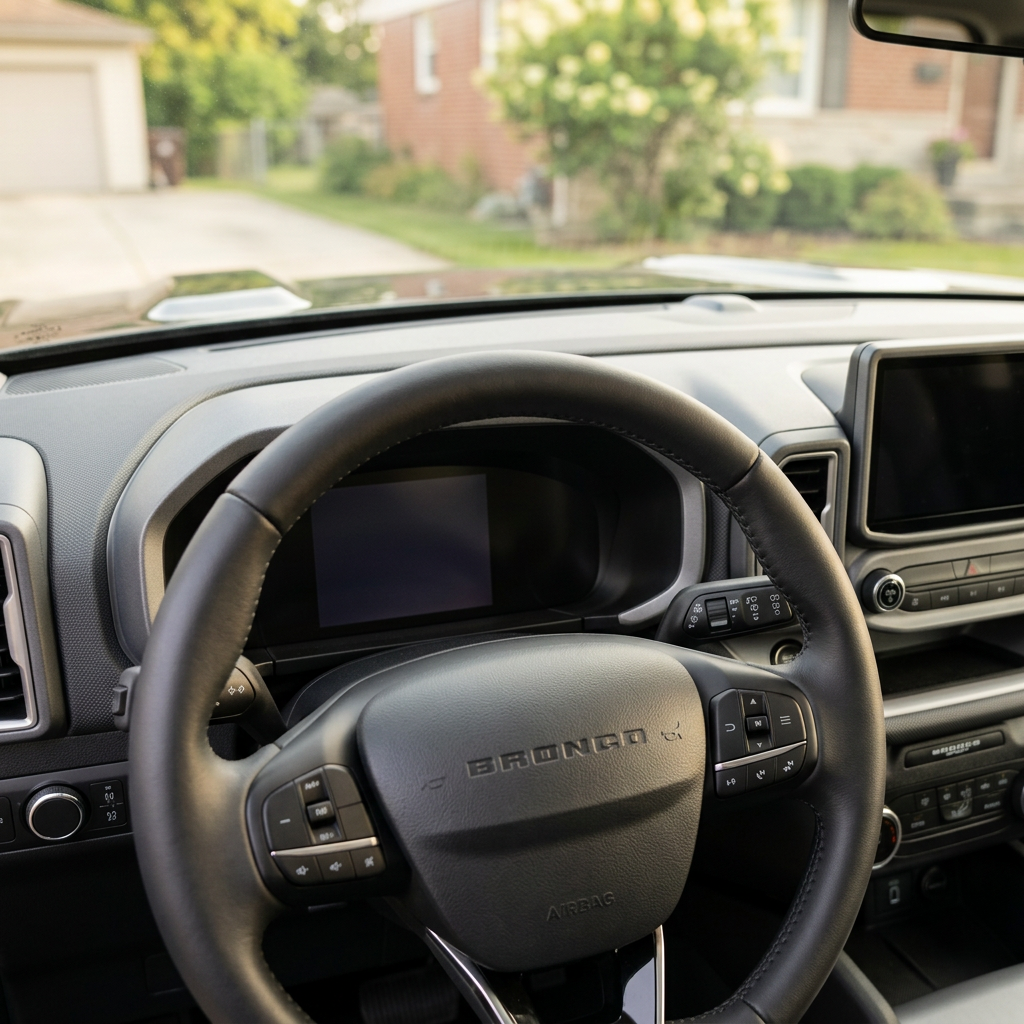
Proactive Maintenance and Recall Support at Tri State Ford
Maintaining the safety and reliability of your vehicle is our top priority at Tri State Ford. Our team is dedicated to providing transparent, efficient, and expert service to ensure your SUV remains ready for any journey. By addressing safety recalls promptly, you protect your family and preserve the long-term performance of your vehicle [1].
Our modern service facility is staffed by factory-trained technicians who utilize state-of-the-art diagnostic equipment to perform software updates, electronic repairs, and routine maintenance. We make it easy to stay on top of your vehicle’s needs with clear communication, honest advice, and manufacturer-backed service quality.
If your Bronco Sport is affected by this digital display recall, we encourage you to contact us today to schedule your free software update [1, 4]. You can reach our service advisors directly by calling (330) 462-7578, or you can find directions to Tri State Ford to visit our service center at 1503 Pennsylvania Ave, East Liverpool, OH 43920. While you are here, we can also show you our rugged truck inventory and discuss how we can help keep your vehicle running like new for years to come.
© 2026 Tri State Ford. All rights reserved.
2026 Ford Explorer ST vs 2026 Jeep Cherokee Limited

Choosing the perfect midsize SUV for your household involves balancing everyday utility with the performance needed for weekend getaways. This head-to-head comparison evaluates the spacious, high-performance 2026 Ford Explorer ST against the compact, hybrid-powered 2026 Jeep Cherokee Limited. We will examine how their cabin dimensions, engine capabilities, safety technologies, and overall value align with your family’s driving needs.
Table of Contents
- Which SUV Offers More Space for Family Outings?
- Engine Power and Handling for Fishing Trips and Hill Drives
- Tech Features That Simplify Life
- Safety Systems Designed for Commutes and Weekend Road Trips
- Smart Spending: Comparing Price, Value, and Ownership Costs for Suburban Families
- Warranty, Maintenance, and Local Service Support for East Liverpool and Boardman Drivers
- Which SUV Fits Your Lifestyle Better? Buyer FAQs for the 2026 Ford Explorer ST vs Jeep Cherokee Limited
- Choosing the Perfect SUV for Your Next Family Adventure
Table of Contents
Why Families Are Choosing the 2026 Ford Explorer ST and Jeep Cherokee Limited
One of the first things families look for in a new SUV is how well it balances daily routines with weekend adventures. The 2026 Ford Explorer ST is engineered specifically for active households that require three-row versatility but refuse to compromise on driving excitement. As a high-performance flagship, the Explorer ST represents a purposeful blend of track-inspired performance and daily usability, designed to turn mundane school runs into engaging drives. It targets the enthusiast parent who values a commanding road presence, athletic styling, and robust capability. This performance-oriented pedigree is backed by authentic engineering, offering a heavily revised sport-tuned suspension and heavy-duty performance brakes designed for dynamic road handling.
On the other side of this comparison, the 2026 Jeep Cherokee Limited returns to the market as a hybrid-only compact-to-midsize crossover. Positioned as a practical alternative for daily commuters, it prioritizes fuel efficiency and urban maneuverability. While the Cherokee Limited offers standard four-wheel drive and a comfortable cabin, it operates in a smaller segment, catering primarily to empty nesters or smaller households who do not require third-row seating. It represents a major strategic shift toward delivering more content and simplified trim structures, but it lacks the sheer presence and utility of a true midsize three-row vehicle.
For families managing busy schedules, ownership convenience is just as important as vehicle performance. At Tri State Ford, we aim to make vehicle maintenance completely hassle-free. Our customers can take advantage of our convenient valet pickup and delivery service to have their vehicle serviced without interrupting their workday. Additionally, we provide on-site maintenance for routine tasks through our mobile service program, bringing certified technicians directly to your driveway. If you are searching for a trusted local Ford dealership, our team is always ready to assist you with expert care and transparent communication.
When it comes to efficiency, these two models take very different paths. The Explorer ST features a traditional gas powertrain delivering 18 city / 25 hwy / 21 combined MPG. The Cherokee Limited utilizes a hybrid system with a 1.08 kWh battery, achieving 42 city / 33 hwy / 37 combined MPG. While the hybrid Cherokee offers lower fuel consumption for daily driving, the Explorer ST counters with significantly greater size, power, and utility, making it the more capable choice for active families who need a vehicle that can grow with them.
Dimensions & Capacity
Capacity and dimensions by trim
| Specification | 2026 Ford Explorer ST | 2026 Jeep Cherokee Limited |
|---|---|---|
| Seating | 6 | 5 |
| Cargo | 16.3 cu ft | 33.6 cu ft |
| Curb weight | 4,631 lbs | 4,340 lbs |
| Towing | 5,000 lbs | 3,500 lbs |
| Payload | 1,519 lbs | 850 lbs |
Which SUV Offers More Space for Family Outings?
When I’m helping families choose the right vehicle, cabin space and seating flexibility always top the priority list. The Explorer ST is a true three-row midsize SUV designed to accommodate growing families with its standard 6-passenger seating configuration. The cabin features standard second-row captain’s chairs with an E-Z Entry system, allowing quick access to the third row. For those who need maximum passenger capacity, the optional Second Row Bench With E-Z Entry and Armrest is available at no extra charge, converting the vehicle into a highly versatile 7-passenger hauler. This flexibility makes it easy to balance passenger comfort with cargo needs, whether you are loading up sports gear or packing for a long road trip.
The Cherokee Limited is strictly a two-row, 5-passenger vehicle. While it offers a comfortable second row, it lacks the extra seating capacity required for carpools, larger families, or unexpected guests. The Explorer ST also excels in carrying heavy loads, boasting a robust payload capacity of 1,519 lbs and a maximum towing capacity of 5,000 lbs, making it highly capable of hauling trailers or recreational gear. The Cherokee Limited is limited to an 850 lbs payload capacity and a 3,500 lbs towing capacity, which restricts its usefulness for heavier outdoor recreational activities.
For busy shopping days at the retail and business hub in Boardman, the generous payload capacity and flexible seating configuration of the Explorer ST make hauling large purchases effortless. While the Cherokee Limited offers a respectable about 34 cu ft of cargo space behind its second row, the Explorer ST provides a dedicated about 16 cu ft behind its third row, which expands dramatically when the power-folding rear seats are lowered. If you are ready to upgrade your family’s transport, you can start the process by securing a trade-in estimate online to see what your current vehicle is worth in today’s market.
Engine & Performance
Powertrain specs by trim
| Specification | 2026 Ford Explorer ST | 2026 Jeep Cherokee Limited |
|---|---|---|
| Engine | 3.0L | 1.6L |
| Horsepower | 385 hp | 210 hp |
| Torque | 415 lb-ft | 230 lb-ft |
| Transmission | 10-speed automatic | EVT |
| Drivetrain | Rear-wheel drive | Four-wheel Drive |
Engine Power and Handling for Fishing Trips and Hill Drives
From my experience behind the wheel, the mechanical character of these two SUVs could not be more different. The Explorer ST is built on a performance-first foundation, featuring a standard 3.0L twin-turbocharged EcoBoost V6 engine. This potent powerplant produces an impressive 385 hp and 415 lb-ft of torque, delivering rapid acceleration and effortless highway passing power. Paired with a responsive 10-speed automatic transmission featuring paddle shifters, the Explorer ST behaves like a sport sedan, offering a dynamic and engaging driving experience that makes every trip memorable.
The Cherokee Limited takes a much more conservative approach, utilizing a 1.6L hybrid four-cylinder engine paired with an electronic variable transmission ( EVT). This system generates a combined 210 hp and 230 lb-ft of torque. While the hybrid setup is highly efficient around town, it lacks the muscular power and immediate throttle response needed for spirited driving or heavy hauling. The Cherokee Limited comes standard with Four-wheel Drive, whereas the Explorer ST features a sporty Rear-wheel drive layout as standard, with intelligent four-wheel drive available for enhanced traction on challenging road surfaces.
The gently rolling hills of Calcutta are perfect for family drives, where the sport-tuned suspension and responsive handling of the Explorer ST shine. Its lowered ride height and stiffer dampers keep the vehicle composed through tight curves, while upgraded performance brakes with red-painted calipers provide exceptional stopping power. To experience this athletic performance firsthand, we encourage you to arrange to take a test drive at our dealership and feel the difference that genuine performance engineering makes.
Tech Features That Simplify Life
A direct comparison of the modern cockpits reveals two distinct approaches to in-vehicle technology. The Explorer ST comes equipped with the cutting-edge Ford Digital Experience with Google built-in, which seamlessly integrates Google Maps, Google Assistant, and the Google Play Store directly into the infotainment system. This setup allows drivers to use natural voice commands to control navigation, media, and cabin temperature without taking their eyes off the road. The centerpiece of the dashboard is a brilliant 13.2-inch Center Touchscreen, complemented by a highly customizable 12.3-inch Digital Instrument Cluster that displays vital driving information clearly.
To elevate the cabin experience, the optional ST Sun and Sound Package adds a premium B&O Sound System by Bang & Olufsen featuring 14 speakers and 980 watts of power, along with multicontour front seats with active motion massaging. Standard wireless Apple CarPlay and Android Auto ensure effortless smartphone mirroring, while the available Ford Connectivity Package provides seven years of high-speed 5G cellular connectivity and an unlimited Wi-Fi hotspot for up to ten devices.
The Cherokee Limited features a 12.3-inch Uconnect 5 Touchscreen Display and a smaller 10.25-inch Digital Cluster Display. It includes wireless smartphone integration and a wireless charging pad, but its standard audio system is a basic 6-speaker setup. To get a comparable premium audio experience, buyers must purchase the optional Tech Group, which upgrades the vehicle to a 9-speaker Alpine sound system. While the Cherokee’s technology is highly functional, the Explorer ST offers larger screens, more advanced Google integration, and a significantly more immersive premium audio experience right out of the box.
Safety Systems Designed for Commutes and Weekend Road Trips
Many of our customers prioritize driver-assistance features that protect their most precious cargo. The Explorer ST delivers exceptional peace of mind with its standard Ford Co-Pilot360 Assist 2.0 suite. This comprehensive package includes advanced active safety technologies such as Adaptive Cruise Control with Stop-and-Go, Lane Centering, and Speed Sign Recognition. It also features a 360-Degree Camera with Split View with front and rear washers, making parking and maneuvering in tight spaces incredibly simple.
Additional standard safety equipment on the Explorer ST includes Pre-Collision Assist with Automatic Emergency Braking, Intersection Assist, and BLIS with Cross-Traffic Alert featuring Exit Warning and Trailer Coverage. For long highway journeys, the Explorer ST offers available BlueCruise Hands-Free Highway Driving with a standard 90-day trial, allowing for relaxed, hands-free driving on compatible pre-mapped roadways. This outstanding commitment to passenger safety is backed by a prestigious Top Safety Pick+ rating from the Insurance Institute for Highway Safety (IIHS).
The Cherokee Limited also comes well-equipped with standard safety features, including Active Driving Assist, Adaptive Cruise Control with Stop and Go, and Active Lane Management. It features a comprehensive 10-airbag system and blind-spot monitoring. However, the Cherokee lacks specialized trailer coverage for its blind-spot system unless you purchase the optional Trailer Tow Group, and it does not offer a hands-free highway driving system comparable to Ford’s advanced BlueCruise technology. For families who tow trailers or spend significant time on the highway, the Explorer ST provides superior, more comprehensive safety coverage.
Pricing
Manufacturer-listed pricing per trim, across compared vehicles.
| 2026 Ford Explorer ST Trim | MSRP | 2026 Jeep Cherokee Limited Trim | MSRP |
|---|---|---|---|
| ST | $54,905 | Limited | $40,500 |
Smart Spending: Comparing Price, Value, and Ownership Costs for Suburban Families
Subsequent comparisons inevitably lead to the bottom line, where we must evaluate standard features against the total investment. The Explorer ST starts at a base MSRP of $54,905 with a destination charge of $1,795. The Cherokee Limited is positioned in a lower price tier, starting at a base MSRP of $40,500 with a destination charge of $1,995. While the Cherokee has a lower initial purchase price, it is important to consider what you are getting for your money.
The Explorer ST is a much larger, more powerful vehicle that offers three rows of seating, nearly double the horsepower, and significantly higher towing and payload capacities. For growing families, the utility of a three-row SUV prevents the need to upgrade to a larger vehicle just a few years down the road, representing a smarter long-term investment. Furthermore, the Explorer ST comes standard with premium features like heated and ventilated Miko suede sport seats, a heated flat-bottom steering wheel, and a premium B&O audio system—amenities that often cost extra or are unavailable on compact crossovers.
When evaluating the overall value of your purchase, trading in your current vehicle can significantly lower your monthly payments. Our finance team can help you get an accurate estimate of your current vehicle’s worth using our online trade-in tool. This simple step helps you maximize your buying power and transition smoothly into a highly capable family SUV that fits your budget.
Warranty, Maintenance, and Local Service Support for East Liverpool and Boardman Drivers
Long-term peace of mind depends heavily on the manufacturer support and local maintenance resources available after you drive off the lot. The Explorer ST is backed by a comprehensive manufacturer warranty package, ensuring that your investment is fully protected against unexpected repairs. For added convenience, our dealership offers specialized care to keep your Ford running at its best for years to come.
When your vehicle requires routine maintenance, you can easily schedule your next service appointment online to find a time that fits your busy schedule. We also encourage our customers to browse our maintenance offers to save on common services like oil changes, tire rotations, and expert battery testing and replacement services. Our factory-trained technicians use only genuine OEM parts, ensuring your vehicle receives the precise care it deserves.
In the event of an unexpected roadside emergency, Ford owners are never left stranded. Every new Ford vehicle includes comprehensive manufacturer-backed roadside assistance, providing professional towing, flat tire changes, and fuel delivery. If you ever need help on the road, you can contact Ford Roadside Assistance: 1-800-241-3673 for immediate, reliable support from certified professionals who know your vehicle inside and out.
Which SUV Fits Your Lifestyle Better? Buyer FAQs for the 2026 Ford Explorer ST vs Jeep Cherokee Limited
To help simplify your shopping journey, we have compiled the most common questions families ask when comparing these two models. Our goal is to provide clear, honest, and data-backed answers to help you make the most informed decision for your household.
Is the 2026 Ford Explorer ST worth the price premium over the 2026 Jeep Cherokee Limited?
Yes, for families who need space, power, and long-term utility, the Explorer ST is well worth the investment. It provides three rows of seating for up to seven passengers, a potent 385 hp twin-turbo V6 engine, and a 5,000 lbs towing capacity. The Cherokee Limited is a much smaller, two-row compact crossover with 210 hp and a 3,500 lbs towing limit. The Explorer ST also includes a complimentary driving program at the Ford Performance Racing School, adding unique enthusiast value.
Which SUV has more cargo space for active families?
While the Cherokee Limited offers about 34 cu ft of cargo space behind its second row, the Explorer ST is the more versatile cargo hauler overall. With its third-row seats folded flat, the Explorer ST provides a massive cargo area that easily accommodates large strollers, sports gear, and luggage. It also features a standard power liftgate and an available Cargo Area Management System to keep your items secure.
Which model has better real-world towing capabilities?
The Explorer ST is the clear winner for towing, offering a standard 5,000 lbs towing capacity backed by a Class III Trailer Tow Package, which includes a hitch receiver and 7-wire harness. This setup is ideal for hauling boats, campers, or utility trailers. The Cherokee Limited has a maximum towing capacity of 3,500 lbs, which requires purchasing the optional Trailer Tow Group to match its peak rating.
How do the hybrid and gas powertrains compare for daily commuting?
The Cherokee Limited’s hybrid powertrain is highly efficient, delivering 42 city / 33 hwy / 37 combined MPG, making it a great choice for fuel-conscious daily commuters. However, the Explorer ST’s 3.0L EcoBoost V6 provides a far more engaging and confident drive, especially when merging onto busy highways or navigating hilly terrain. The Explorer ST balances its performance with a respectable 25 hwy MPG, offering a great blend of speed and efficiency.
If you would like to explore these features in person, you can find our showroom location online or give our friendly team a quick call to get your questions answered. We invite you to explore our current new vehicles or check out our up-to-date online catalog from the comfort of your home. When you are ready to take the next step, you can conveniently apply for financing online to get pre-approved.
Fuel Economy
Fuel economy and range by trim
| Specification | 2026 Ford Explorer ST | 2026 Jeep Cherokee Limited |
|---|---|---|
| MPG | 18 city / 25 hwy / 21 combined | 42 city / 33 hwy / 37 combined |
Choosing the Perfect SUV for Your Next Family Adventure
Ultimately, choosing between these two SUVs comes down to matching your family’s daily needs with the right level of capability. The 2026 Jeep Cherokee Limited is a highly efficient, well-appointed compact hybrid that excels at daily commuting and urban errands. However, for growing families who require spacious seating, robust towing power, and advanced safety features, the 2026 Ford Explorer ST emerges as the clear, uncompromised choice.
With its muscular twin-turbo V6 engine, standard three-row seating, and track-tested Ford Performance pedigree, the Explorer ST is built to handle everything from the daily school run to weekend camping trips with ease. It offers the perfect combination of athletic performance, cabin refinement, and family-focused versatility that compact crossovers simply cannot match.
At Tri State Ford, we are proud to serve our local community with transparent pricing, expert service, and a welcoming, family-friendly atmosphere. We invite you to visit our showroom, meet our dedicated staff, and take the Explorer ST for a test drive today to see why it is a strong SUV for your family’s next adventure.
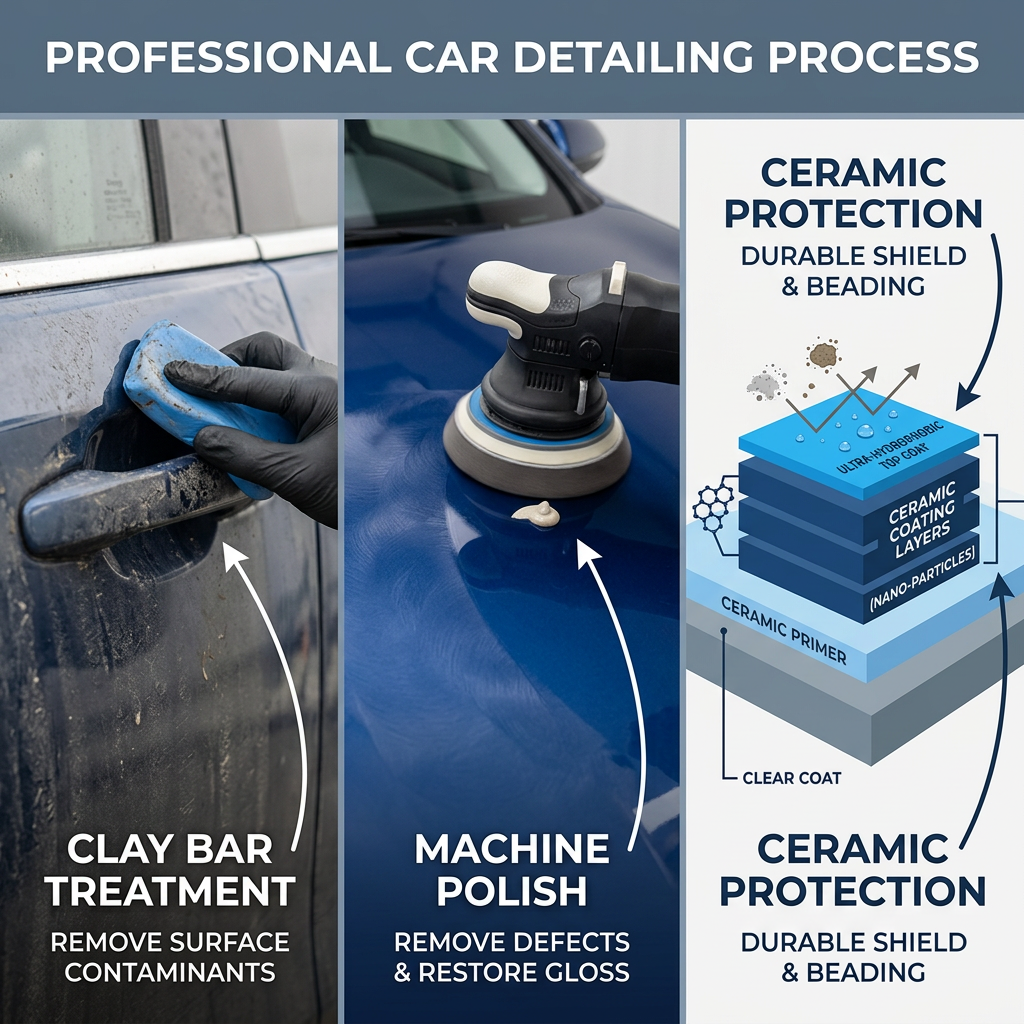
A professional car detail is a comprehensive cleaning and restoration process that goes far beyond a standard run through a local car wash. In East Liverpool, local vehicle owners typically see professional detailing rates range from contact us for current pricing for standard packages. The total cost of the service reflects the labor, professional-grade cleaning compounds, and specialized equipment required to deep-clean every surface of your vehicle.
Several local factors influence the final quote you receive. Local specialty providers, such as a local detailing provider, offer full detail packages available with current pricing based on vehicle type [7]. In comparison, regional operations in northeastern Ohio, such as a regional detailing provider, price interior-only services at $125 for cars and $140 for larger utility vehicles, with separate exterior services priced at $120 to $135. Premium treatments, including clay bar decontamination, machine polishing, and multi-year ceramic paint protection, will increase these baseline rates.
Investing in regular cosmetic maintenance is highly practical for protecting your vehicle’s long-term value. For drivers negotiating the steep riverfront bluffs and industrial areas of East Liverpool, vehicles regularly collect heavy layers of road grime, soot, and river valley moisture. Leaving these elements on your paint can lead to premature clear coat failure, paint oxidation, and underbody rust, ultimately compromising your vehicle’s appearance and structural integrity.
If you want to protect your vehicle from these environmental elements, you can find our service department located at 1503 Pennsylvania Ave, East Liverpool, OH 43920. To discuss custom care options or check our current service availability, feel free to give our service advisors a quick call.
Table of Contents
- What is Typically Included in a Basic Car Detailing Service
- How Vehicle Size Shapes Your Auto Detailing Bill
- Bundled Full Details vs. Individual Interior and Exterior Services
- Preparing Your Vehicle Before a Professional Detail
- Common Questions About Professional Car Detailing
- Scheduling Your Professional Detail at Tri State Ford
What is Typically Included in a Basic Car Detailing Service
A basic professional car detail focuses on refreshing both the interior and exterior of your vehicle. While a quick automated wash only clears away loose surface dust, a basic detail involves meticulous hand-cleaning of the most visible surfaces. This service typically costs between $50 and $150 nationally, depending on the size of the vehicle, and serves as an excellent intermediate maintenance step between deep restorations.
On the exterior of the vehicle, a standard basic detail includes a thorough hand wash of the body panels, cleaning of the wheel wells, and a detailed scrubbing of the wheels to dissolve baked-on brake dust. The technician will dry the vehicle using soft microfiber towels to prevent swirl marks, clean the exterior glass to a streak-free finish, and apply a premium tire dressing to restore a clean satin look. Many basic packages also include a hand-applied spray wax or light sealant to provide a temporary layer of protection against UV rays and light road grime.
On the inside, the technician focuses on removing daily dust and light debris. A typical basic interior service includes:
- Thorough vacuuming of all carpeted areas, floor mats, and seats
- Wiping down hard plastic, vinyl, and metal dashboard trim surfaces
- Cleaning the inside windows and rearview mirrors
- Emptying the ash trays and wiping out the cup holders
To maintain your vehicle’s mechanical and cosmetic health in one visit, you can easily schedule a service appointment online. We recommend checking our rotating current service specials for seasonal maintenance discounts. If your vehicle has been sitting for a long period, you can also request a comprehensive battery service or ask about our convenient Ford mobile service options to have routine maintenance performed right in your driveway.
How Vehicle Size Shapes Your Auto Detailing Bill
Does a larger vehicle mean a higher detailing bill? Absolutely. Detailing rates scale directly with the physical size and configuration of your vehicle because larger cabins and body panels require significantly more labor, time, and specialized cleaning products. A compact sedan can often be detailed in two to three hours, whereas a three-row SUV or a full-size commercial vehicle can easily require five to eight hours of continuous, detailed labor.
The physical surface area of your vehicle dictates the amount of paint correction, waxing, and interior extraction required. For example, a small commuter car has minimal carpeted floor space and a compact dashboard. In contrast, a large utility vehicle or a minivan features expansive cargo areas, multiple rows of seating, complex folding seat mechanisms, and high-reach roof panels that require ladders to polish safely. To illustrate these differences, regional detailing benchmarks reflect distinct pricing tiers:
| Vehicle Class | Est. Detailing Time | Typical Basic Detail | Typical Full Detail |
|---|---|---|---|
| Compact / Sedan | 1.5 to 3 Hours | contact us for current pricing | contact us for current pricing |
| Small / Mid-Size SUV | 3 to 5 Hours | contact us for current pricing | contact us for current pricing |
| Large SUV / Truck / Van | 5 to 8 Hours | $80 to $110 | contact us for current pricing |
For families navigating the rolling hills and suburban neighborhoods of Calcutta, larger utility vehicles frequently accumulate heavy mud, pet hair, and food crumbs that require deep carpet extraction. If you are maintaining a specialized vehicle, you can explore our new vehicle custom order options to learn more about durable factory interior materials. We also encourage you to browse our current manufacturer vehicle specials, new vehicle specials, and used vehicle specials to find vehicles equipped with easy-to-clean all-weather utility packages.
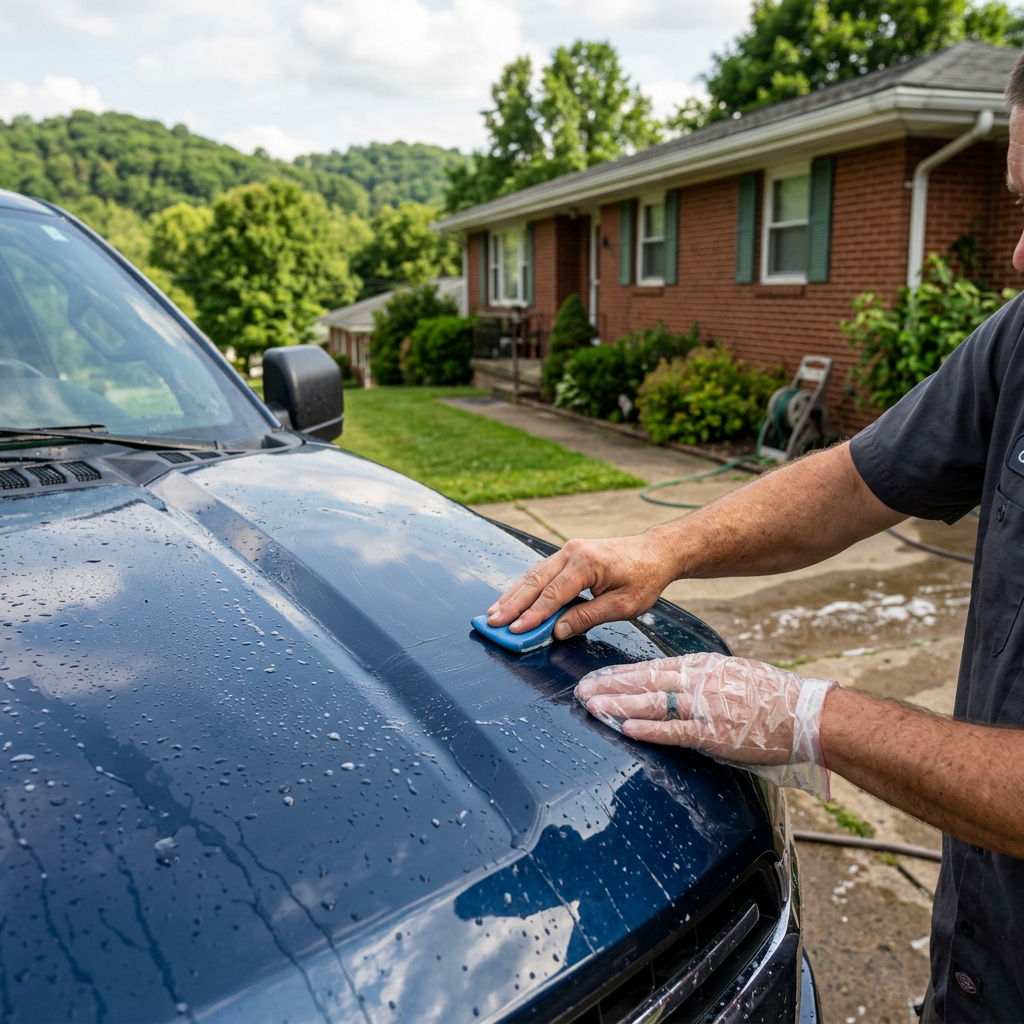
Bundled Full Details vs. Individual Interior and Exterior Services
When scheduling cosmetic maintenance, many vehicle owners wonder if they should purchase interior and exterior detailing services separately or choose a bundled full-detail package. In almost all cases, choosing a bundled package is highly cost-effective. Purchasing a standalone interior detail typically costs $75 to $200, while a standalone exterior detail runs $100 to $250. When combined as a bundle, a full detail generally costs based on vehicle and service needs, saving you a significant amount compared to booking the services individually.
A bundled service also ensures a more consistent aesthetic and structural result for your vehicle. When our technicians perform a complete detail, they follow a systematic process that prevents cross-contamination. For example, they will thoroughly wash and decontaminate the exterior paint before deep-cleaning the cabin, ensuring that no dust or overspray from exterior polishing lands on freshly shampooed carpets.
For heavy-duty work vehicles, keeping both the cabin and exterior clean is vital for professional presentation and preventing corrosion. If you need replacement floor liners or protective cargo trays to keep your cabin clean, you can order parts directly from our department. For business owners managing commercial fleets, we offer a robust truck inventory and specialized new work truck inventory designed to withstand rugged daily use.
Preparing Your Vehicle Before a Professional Detail
To ensure your detailing appointment goes smoothly and your technicians can focus on deep-cleaning, proper preparation is key. Detailing shops require customers to remove all personal items from the cabin, glove box, and cargo areas before dropping off the vehicle. This preparation allows the cleaning team to immediately begin vacuuming and shampooing without the risk of misplacing your personal belongings.
Before you arrive at your scheduled appointment, take a few minutes to complete this simple checklist:
- Remove all loose trash, water bottles, and paper from the door pockets and console
- Take out valuable personal electronics, charging cords, and sunglasses
- Remove infant car seats so the technicians can deep-clean the upholstery underneath
- Clear out the trunk or rear cargo area completely
If you are preparing a vehicle for sale or evaluating its current condition, a professional detail can significantly improve its market appeal. Local owners can utilize our online tool to get a KBB instant cash offer to see how cosmetic care impacts value. Our finance department can assist with any ownership transition questions, and if you are looking for a highly capable vehicle to replace your current ride, you can browse our heavy-duty truck inventory to find a model equipped with durable, easy-to-clean vinyl flooring.
Common Questions About Professional Car Detailing
Q: How long does a full professional car detailing service take?
A: A full professional detail typically takes between 3 to 5 hours to complete. This timeframe can extend to 8 hours or more for oversized vehicles, heavy commercial trucks, or cabins requiring intensive stain and pet hair removal.
Q: What is the difference between a standard car wax and a ceramic coating?
A: A standard wax or polymer sealant provides a temporary protective barrier that lasts about 2 to 6 months. A professional ceramic coating is a silica-based liquid polymer that chemically bonds with your vehicle’s clear coat, providing durable paint protection and a high-gloss finish that can last for several years.
Q: How often should I have my vehicle professionally detailed?
A: For most daily drivers, we recommend scheduling a professional detail twice a year. Getting a full detail in the spring removes accumulated winter road salt, while a fall detail applies a protective wax barrier to shield your paint from upcoming winter weather.
Q: Can professional detailing remove deep scratches from my paint?
A: Professional detailing packages that include machine polishing and paint correction can remove light surface scratches, swirl marks, and oxidation that sit in the clear coat. However, deep scratches that have penetrated through the clear coat into the primer or bare metal will require specialized body shop repair.
Q: Are detailing services covered under my manufacturer warranty?
A: Cosmetic detailing, vacuuming, and waxing are considered elective maintenance and are not covered under the manufacturer’s new vehicle limited warranty. If you manage a fleet, you can explore our used work truck inventory, check our F-Series work inventory, or view our Transit work vans to find durable commercial options built for easy maintenance.
Scheduling Your Professional Detail at Tri State Ford
Maintaining a clean vehicle is a highly effective way to protect your automotive investment and preserve its long-term reliability. From deep interior carpet extraction to precision exterior paint sealing, our factory-trained service technicians are here to provide professional, transparent care for your car, truck, or SUV. We use specialized, high-quality products that are fully compatible with your vehicle’s factory finishes.
For busy commuters driving between Boardman and local employment centers, coordinating your maintenance visit is entirely hassle-free. If you are unable to bring your vehicle to our service lane during regular business hours, you can utilize our secure after-hours key drop box located right next to our main service entrance. We also offer a comprehensive Ford pick up & delivery program for qualifying maintenance visits, allowing you to keep your vehicle in top condition without interrupting your daily schedule.
If you are ready to restore your vehicle’s clean finish, we invite you to take the next step today. You can find our complete operating hours and get step-by-step driving directions to our service lane by visiting our Ford dealership near me resource page. To secure your preferred appointment date and time, please use our online scheduling portal or contact our service coordinators directly at (330) 462-7578 to speak with an advisor.
© 2026 Tri State Ford. All rights reserved.
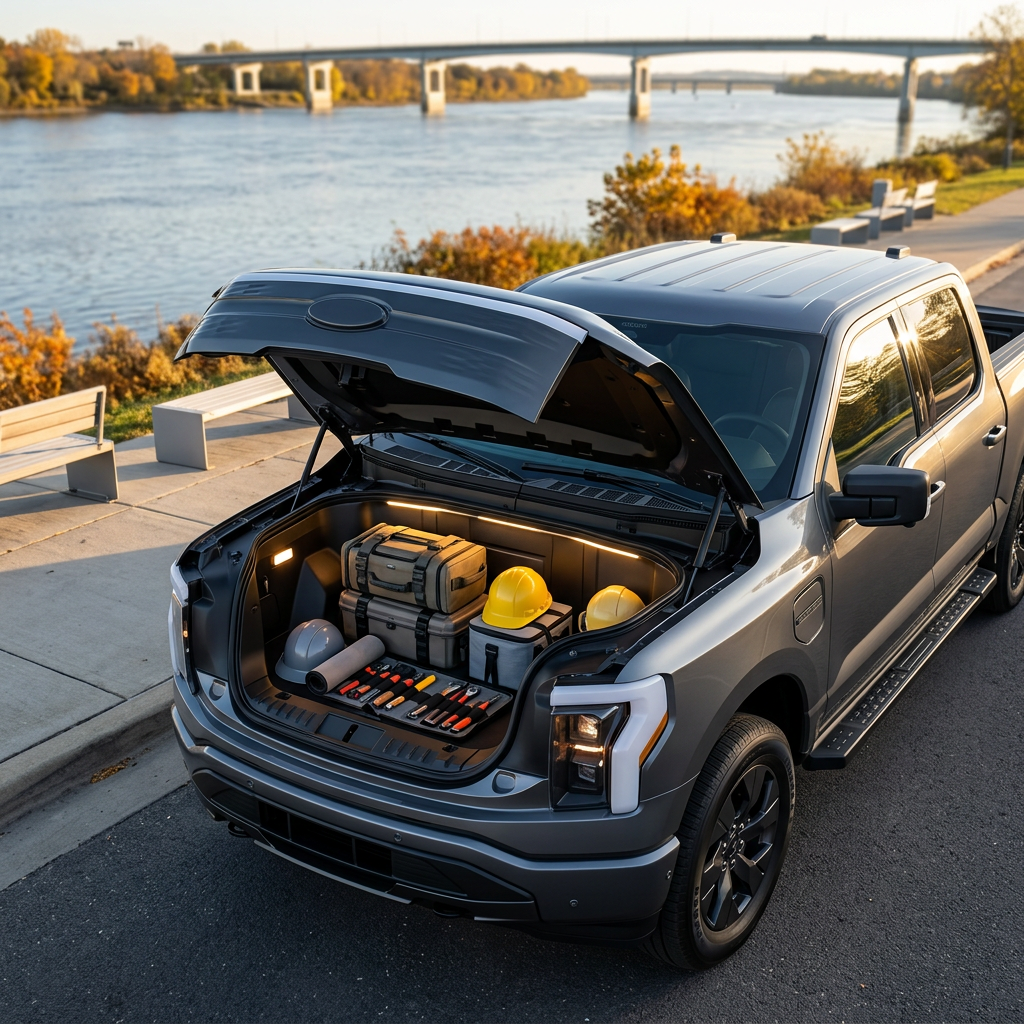
The traditional pickup truck design has always forced a compromise between open-bed utility and secure, dry storage. The Mega Power Frunk completely changes this dynamic by transforming the empty space under the hood into a secure cargo hold. With about 14 cubic feet of lockable, weatherproof storage, this forward compartment provides the same volume as a standard midsize sedan trunk [Lasco Ford – 2026 Ford F-150 Lightning Overview, Akins Ford – Ford Mega Power Frunk]. It allows you to keep groceries, luggage, or expensive tools safe from both the elements and passing eyes without sacrificing any space in the truck bed [Ford F-150 Lightning: il frunk resisted a un Orso Kodiak].
Whether you are loading up fresh purchases near the Ohio River waterfront in East Liverpool or packing heavy tools for a job site, this front trunk offers unmatched convenience [Ford F-150 Lightning: il frunk resisted a un Orso Kodiak]. It is completely sealed, fully insulated, and features a built-in drainage system [Ford F-150 Lightning: il frunk resisted a un Orso Kodiak, Item Fits – Ford F-150 Lightning Cargo Space Calculator]. This means you can pack it with loose ice for a weekend tailgate, and when the day is done, simply drain the water away [Borgman Ford Sales Blog].
At Tri State Ford, we want to make sure you experience this innovation firsthand. If you are looking for a trusted local Ford dealer, our team is ready to guide you through the latest electric truck features. We offer convenient options like our vehicle pickup and delivery service and our certified mobile service option to ensure your buying and ownership experience is entirely seamless. If you want to discuss inventory availability or have questions about how electric trucks fit your daily routine, consider giving our sales team a quick call at (330) 462-7578 or getting directions to our showroom located at 1503 Pennsylvania Ave.
Table of Contents
- Physical Dimensions and Real-World Capacity of the Lightning Front Trunk
- Powering Your Projects and Tailgates with the Mega Power Frunk Outlets
- F-150 Lightning vs Silverado EV: Front Trunk and Utility Comparison
- Navigating EV Tax Credits and Purchasing Your F-150 Lightning
- Quick Answers About the Ford F-150 Lightning Cargo Space
- Find Your 2026 Ford F-150 Lightning at Tri State Ford
Physical Dimensions and Real-World Capacity of the Lightning Front Trunk
The physical layout of this front cargo area is engineered to accommodate bulky, heavy items that would typically clutter the passenger cabin. The compartment measures roughly 42 inches in width, 24 inches in depth, and has a maximum height of around 24 inches. These dimensions are specifically optimized to hold two full-size carry-on bags alongside a bag of golf clubs. Because the compartment is shaped to maximize usable floor space, you can easily load larger coolers, toolboxes, or hardware supplies that would otherwise slide around in an open cargo bed [Ford F-150 Lightning: il frunk resiste a un orso kodiak].
Weight limits are equally impressive, as the front trunk boasts a 400-pound weight rating [ItemFits – Ford F-150 Lightning Cargo Space Calculator, Wikipedia – Ford F-150 Lightning]. This heavy-duty capacity means you can haul heavy bags of concrete, industrial equipment, or heavy luggage without worrying about structural strain. The low, bumper-level opening eliminates the need to hoist heavy items over a high truck fender, saving your back during daily loading [Borgman Ford Sales Blog].
If you are ready to upgrade your current ride to a more capable vehicle, we make the trade-in process straightforward. You can use our instant cash valuation tool to see what your current vehicle is worth before you visit. We invite you to explore our current new vehicle offers or browse our inventory of certified one-owner used vehicles to find the perfect fit for your lifestyle.
Powering Your Projects and Tailgates with the Mega Power Frunk Outlets
Having a massive, lockable storage space is only half of the story when it comes to the utility under the hood. The front trunk acts as a mobile power station, equipped with four 120-volt power outlets and two USB ports [Borgman Ford Sales Blog]. These outlets are integrated into the Pro Power Onboard system, delivering a combined output of 2,400 watts of exportable electricity directly from the truck’s high-voltage battery. This capability turns the front compartment into a highly functional workstation or the ultimate hub for outdoor recreation [Ford F-150 Lightning: il frunk resiste a un orso kodiak].
For residents in Calcutta who frequently travel State Route 170 or head out to Beaver Creek for weekend fishing trips, having a secure, weatherproof space to lock up gear while powering accessories is a game-changer. You can plug in a television, an electric grill, or a portable refrigerator for a family tailgate without needing a noisy, smelly gas generator [Borgman Ford Sales Blog]. On the job site, the system easily runs heavy-duty power tools, battery chargers, and work lights, allowing you to keep your workspace clean and organized [Ford F-150 Lightning: il frunk resiste a un orso kodiak].
Our team at Tri State Ford is proud to offer a wide range of highly capable vehicles designed for both work and play. You can easily browse our new Ford truck inventory online to find a model equipped with these advanced power features. For commercial buyers, we also maintain our selection of commercial-grade work trucks and our dedicated inventory of F-Series work trucks to keep your business moving forward.
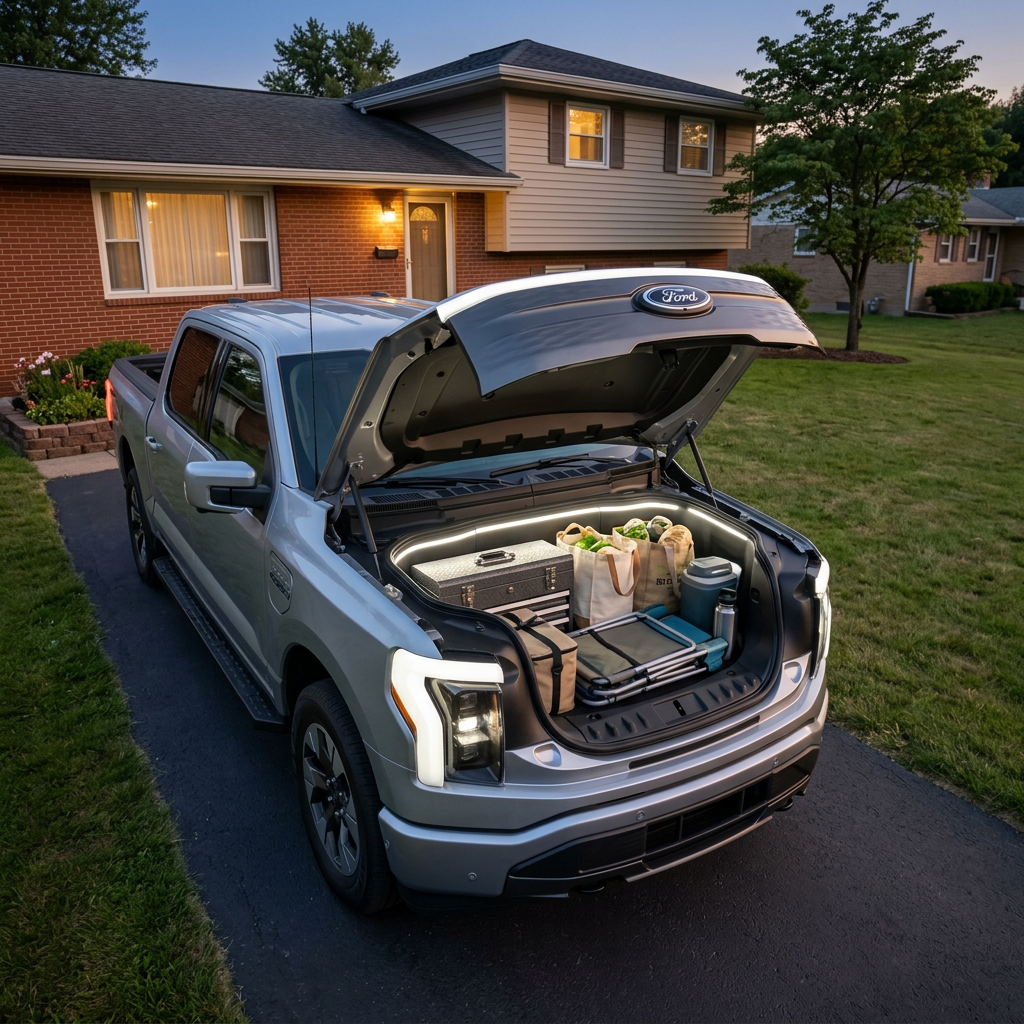
F-150 Lightning vs Silverado EV: Front Trunk and Utility Comparison
While many modern electric trucks now offer some form of front trunk, a close look at the design details reveals a massive difference in daily usability. The Chevrolet Silverado EV features a front trunk, but its opening is positioned much higher, requiring you to lift heavy cargo all the way over the front grille [Borgman Ford Sales Blog]. In contrast, the Ford design opens all the way down to the bumper level [Borgman Ford Sales Blog]. This low liftover height makes loading heavy boxes, suitcases, or tools significantly easier, especially when negotiating uneven ground [Borgman Ford Sales Blog].
The utility advantage extends to overall hauling capacity as well. The lighter chassis of the Ford truck allows for a much higher maximum payload capacity of up to 2,235 pounds [Borgman Ford Sales Blog]. The exceptionally heavy Silverado EV, burdened by its massive battery pack, maxes out its payload capacity between 1,400 and 1,500 pounds [Borgman Ford Sales Blog]. This means the Ford can actually haul significantly more weight in its bed and front trunk combined [Borgman Ford Sales Blog]. Furthermore, Ford preserves driver convenience with the intuitive SYNC 4 infotainment system, which features standard wireless Apple CarPlay and Android Auto compatibility [Borgman Ford Sales Blog]. Chevrolet has does not offer these smartphone interfaces in the same way, so drivers may need to use the vehicle’s built-in system [Borgman Ford Sales Blog].
To see how these practical design choices translate to real-world capability, we invite you to explore our newest electric truck inventory. You can also view national manufacturer specials or check out our new commercial work trucks to find the exact configuration that fits your hauling needs.
Navigating EV Tax Credits and Purchasing Your F-150 Lightning
Understanding the current landscape of electric vehicle incentives is an important step when planning your purchase. The federal IRC §30D New Clean Vehicle Credit, along with the IRC §25E Previously-Owned Clean Vehicle Credit and the IRC §45W Qualified Commercial Clean Vehicle Credit, were officially terminated by Public Law 119-21 on July 4, 2025. These credits are no longer available for any vehicles acquired after September 30, 2025.
The only exception to this rule is for buyers who are taking possession of a vehicle that was acquired on or before September 30, 2025, under a binding written contract with a qualifying deposit or payment. If your transaction falls under this pre-existing contract scenario, we recommend consulting with our team and your tax professional to verify your specific eligibility and timing details.
Even without these historical federal tax incentives, the long-term savings on fuel and the sheer utility of an electric truck make it a highly competitive financial choice. We are committed to helping you find financing options that fit your budget. You can start the buying process from home by filling out our secure online credit application. To make your purchase even more accessible, we highly recommend valuing your trade-in online to see how much equity you can apply toward our complete Ford truck inventory.
Quick Answers About the Ford F-150 Lightning Cargo Space
Before you visit our showroom, our team is happy to provide clear answers to the most common questions we receive about electric truck capabilities. If you are researching ownership details, you can explore our specialized electric vehicle battery advice or check out our monthly manufacturer service offers. For any questions regarding purchase options, our friendly auto finance department is always available to assist.
Q: What is the maximum weight capacity of the F-150 Lightning front trunk?
The front trunk is engineered with a robust cargo floor that can support a maximum payload capacity of up to 400 pounds [ItemFits – Ford F-150 Lightning Cargo Space Calculator, Wikipedia – Ford F-150 Lightning]. This high weight rating makes it easy to transport heavy tools, luggage, or supplies safely under the hood.
Q: Does the front trunk have a built-in drain plug?
Yes, the compartment features a convenient, one-way drain plug at the bottom of the cargo floor [ItemFits – Ford F-150 Lightning Cargo Space Calculator, Borgman Ford Sales Blog]. This allows you to easily wash out dirt and debris or use the insulated space as a large party cooler filled with ice [Ford F-150 Lightning: il frunk resiste a un orso kodiak, Borgman Ford Sales Blog].
Q: How many power outlets are located inside the front trunk?
The compartment is equipped with four 120-volt AC household-style outlets and two USB ports, which include one USB-A and one USB-C port [Borgman Ford Sales Blog]. These outlets are fully integrated into the truck’s exportable power system for maximum convenience.
Q: What is the maximum power output available in the front trunk?
The outlets inside the front trunk can deliver up to 2,400 watts of exportable electricity. This provides ample power to run multiple appliances, charging stations, or heavy-duty power tools simultaneously.
Q: How does cold weather affect the battery performance and range of the truck?
Local owners in our area typically see a temporary range loss of between 15% and 30% on the coldest winter days. To help maximize your range during freezing temperatures, we recommend utilizing cabin preconditioning while the truck is still plugged in at home.
Find Your 2026 Ford F-150 Lightning at Tri State Ford
The innovative front trunk is just one of many features that make this electric truck an outstanding choice for families and professionals alike. From its impressive towing capabilities to its advanced cabin technology, it is built to handle the demands of your daily drive. Every model comes backed by an 8-year/100,000-mile high-voltage battery warranty to give you complete peace of mind on every journey [2025 Ford F-150® Lightning® | Electric Truck | Ford.com]. Additionally, you have access to Ford Roadside Assistance: 1-800-241-3673 for brand-specific expertise, towing, and flat-tire support wherever you travel [2025 Ford F-150® Lightning® | Electric Truck | Ford.com]. Whether you choose a model with the Standard-Range Battery or the Extended-Range Battery, you are investing in a vehicle designed for lasting durability [Borgman Ford Sales Blog].
Our team at Tri State Ford is dedicated to helping you find the perfect vehicle for your lifestyle. If you do not see the exact trim or color configuration you want in our current inventory, we can assist you by submitting a new custom vehicle order to build a truck tailored to your exact specifications.
We invite you to take the next step toward driving home the right truck. Stop by our East Liverpool showroom to see our inventory in person, or get in touch with our friendly sales team by giving us a call at (330) 462-7578 today to schedule your test drive.
Keep Your Vehicle Running Strong
Keep your vehicle performing at its best with our service team:
© 2026 Tri State Ford. All rights reserved.

Seasonal Car Care: Expert Maintenance Q&A with Tri State Ford
To keep your vehicle running safely and efficiently through every shift in northeastern Ohio weather, timing your service visits is just as important as tracking your odometer. We sat down with Matt Shaw, Service Manager at Tri State Ford, who brings 10 years of automotive care experience to help explain how seasonal maintenance protects your investment. In this interview, Matt shares practical advice on winterization, battery care, and tire inspections to keep your Ford dependable year-round.
Q: How does seasonal car maintenance protect your vehicle differently than regular mileage-based service?
A: Mileage-based service is designed around predictable mechanical wear, focusing on items like engine oil degradation or spark plug life over specific distances. For instance, a 2026 Ford F-150 running under normal conditions typically requires an oil and filter change approximately every 7,500 miles. Seasonal maintenance, on the other hand, is dictated by the calendar and local weather patterns rather than the odometer. It addresses how extreme temperature swings, moisture, and road salt affect components like rubber seals, fluids, and electrical systems before they cause a breakdown.
Our service technicians often notice that owners confuse these two schedules, assuming that a car driven only a few thousand miles a year can skip winter or summer preparation. If a vehicle sits or only makes short trips, moisture builds up in the engine oil and fluids degrade over time, which is why we recommend changing the oil at least once a year regardless of mileage. If you want to make sure your vehicle is ready for the upcoming season, you can easily schedule a service appointment online to have our team perform a comprehensive check.
We also offer options to make this process as convenient as possible for local families. You can take advantage of our mobile service options to have routine inspections completed right in your driveway, or check our current current service offers to save on essential preventative care. If you prefer to speak with our team directly about your vehicle’s specific needs, feel free to give us a quick call or stop by our service center at 1503 Pennsylvania Ave, East Liverpool, OH 43920 for personalized assistance.
Q: What core items should always be on a driver’s seasonal maintenance checklist?
A: Every effective seasonal checklist must prioritize the systems most vulnerable to temperature extremes, starting with visibility and engine cooling. Windshield wipers and washer fluid are your first line of defense against sudden storms or road grime. Ford’s official maintenance guidelines suggest inspecting and cleaning or replacing wiper blades at least every six months to prevent streaking and ensure clear visibility. Additionally, the engine cooling system requires a precise mixture of antifreeze and water, typically a 50/50 ratio, to prevent freezing in winter and boil overs during hot summer days.
Tires and batteries represent the next critical tier of seasonal care. Cold weather naturally causes tire pressure to drop, while summer heat accelerates internal battery corrosion and fluid evaporation. Checking battery connections and cleaning off any white or blue-green terminal corrosion every six months helps maintain a strong electrical connection. If you drive a commercial vehicle, such as a model from our heavy-duty truck lineup, maintaining these basic systems is vital to avoiding costly downtime on the job.
For those who prefer to handle minor replacements at home, you can easily order genuine OEM components directly through our department. Replacing cabin and engine air filters on a seasonal basis keeps your engine running efficiently and ensures clean air inside the passenger cabin.
Q: How can a routine seasonal tire inspection prevent major steering and suspension problems?
A: Tires are the only point of contact between your vehicle and the road, making them an invaluable diagnostic tool for the rest of your chassis. During a seasonal tire inspection, we do not just look at the tread depth; we analyze the specific wear patterns across the tread face. For example, feathering or rapid wear on the inner edges of the tires usually indicates that the wheel alignment is off or that suspension bushings are beginning to fail. Catching these alignment issues early prevents uneven tire wear from ruining a set of tires prematurely and protects sensitive steering linkages from excessive stress.
The rolling hills around Calcutta require precise steering response and reliable suspension control, especially when navigating changing road conditions. When a vehicle hits a deep pothole or runs over rough gravel roads, the impact can bend control arms, damage struts, or throw off the alignment. If these issues are ignored, they can lead to loose steering, vehicle pulling, or a spongy brake pedal feel. For local businesses operating a fleet of utility vans or vehicles from our commercial inventory, routine tire and chassis inspections are a cost-effective way to ensure safety and longevity.
If the cost of steering and suspension repairs on an older vehicle starts to rival its overall worth, some owners choose to transition to a newer model instead. In those situations, you can use our digital tool to obtain an instant valuation for your current vehicle, helping you make an informed financial decision for your family.
“A single hard pothole hit on our local roads can throw off your alignment, and ignoring that slight steering pull will ruin a brand-new set of tires in just a few months.”
Q: How do winter vehicle prep priorities change in heavy snow and salt-belt regions?
A: Operating a vehicle in a salt-belt region with prolonged sub-freezing temperatures requires a much more aggressive approach to winterization than in milder climates. Heavy winter road-salt use locally can quickly accelerate undercarriage corrosion and degrade brake lines if the underbody is not washed regularly. We recommend thorough underbody rinses throughout the winter to clear away salt residue from suspension components, fasteners, and brake calipers before rust can seize moving parts.
For electric vehicle owners, the cold weather introduces unique operational challenges, including a typical winter range loss of between 15% and 30% on the coldest days. To mitigate this range reduction, we advise owners to utilize cabin preconditioning while the vehicle is still plugged into a home charger and to park in a garage whenever possible to keep the battery temperature stable. Whether you drive an electric vehicle or a traditional gas-powered model, having the right tires is critical for winter safety. You can use our online tool to find and order winter-rated tires specifically designed to maintain flexibility and grip when temperatures drop below freezing.
If your busy schedule makes it difficult to bring your vehicle to the shop before the first winter storm, we can help coordinate your seasonal maintenance. Our team offers a convenient valet service option where we pick up your vehicle, perform the necessary inspections, and return it to you. This service is especially helpful for local businesses managing commercial vehicles or those looking to maintain their fleet of pre-owned commercial vehicles during the demanding winter months.
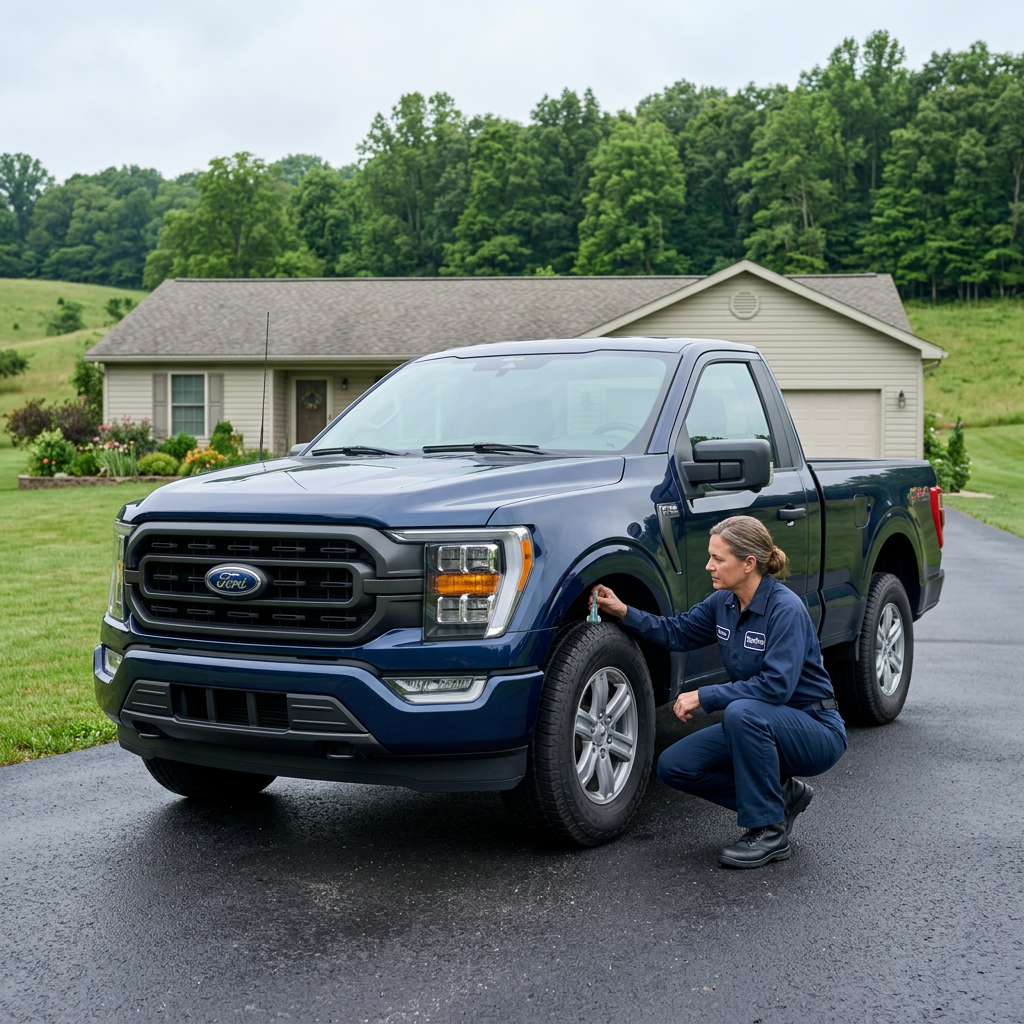
Q: What are the best simple DIY maintenance tasks owners can perform between service visits?
A: There are several simple, simple maintenance tasks that any vehicle owner can perform at home to keep their vehicle running safely between professional service visits. Checking your windshield washer fluid level every month is a quick task that ensures you do not run out of fluid during a heavy rainstorm or snowy commute. It is also important to regularly inspect your wiper blades for any signs of cracking, tearing, or streaking, and replace them immediately if they are no longer clearing the glass effectively.
Another valuable DIY habit is performing a monthly visual walk-around of your vehicle to check for exterior damage, fluid leaks on the driveway, and proper tire inflation. Keeping your vehicle clean, especially washing off road salt and mud from the wheel wells, is a cost-effective way to protect the paint and prevent rust from starting on the lower body panels. Navigating the steep riverfront bluffs of East Liverpool can expose your vehicle to a lot of road debris and grit, making regular washing an essential part of paint preservation.
If you are searching for a trusted partner to handle the more complex service items that require specialized tools, looking for a reputable local Ford service center is the best way to ensure your vehicle receives certified care. Keeping up with these small details ensures that whether you drive a compact SUV or a model from our rugged pickup truck inventory, your vehicle remains dependable for years to come.
Q: How does seasonal temperature fluctuation affect battery health and how can we monitor it?
A: Extreme temperature fluctuations are incredibly taxing on car batteries, with summer heat actually causing more long-term damage than winter cold. High summer temperatures accelerate internal chemical reactions and cause the battery’s liquid electrolyte to evaporate, which permanently weakens its capacity. When winter arrives, the cold temperatures thicken the engine oil and require the battery to work much harder to crank the engine, often exposing the damage that was done during the hot summer months.
To monitor your battery health over time, pay close attention to how your vehicle behaves during startup. Slow engine cranking, dimming headlights when the engine is idling, or intermittent electrical issues are all common warning signs that your battery is reaching the end of its life. We recommend having a professional load test performed on your battery at least twice a year, typically in the spring and fall, to measure its actual cold cranking amps and verify its health before extreme weather sets in.
If a routine inspection reveals that your vehicle requires more extensive electrical repairs or a complete battery system replacement, we strive to make the process as stress-free as possible. Our team can assist you in finding flexible payment options through our automotive finance center to ensure your necessary maintenance fits comfortably within your household budget. Taking a proactive approach to battery care is the best way to guarantee your vehicle starts reliably every single morning, no matter what the weather brings.
© 2026 Tri State Ford. All rights reserved.
For businesses operating around the steep riverfront bluffs of East Liverpool, the choice between these two platforms comes down to the daily demands of the job site. Both models serve as the backbone for heavy-duty commercial fleets, but they are engineered with distinct structural differences. Deciding which chassis cab fits your crew requires analyzing the balance between raw hauling power and daily maneuverability.
At Tri State Ford, we specialize in helping regional business owners find the exact configuration to maximize their daily productivity. The foundation of both platforms starts with proven commercial powertrains. Buyers can choose between the heavy-duty 7.3L gas V8 engine, which produces 335 hp and 468 lb-ft of torque, and the legendary 6.7L Power Stroke diesel V8 engine, generating 330 hp and 950 lb-ft of torque. Both engines are paired with the heavy-duty TorqShift 10-speed automatic transmission, engineered to handle constant heavy loads without overheating.
Finding the right truck shouldn’t complicate your work week. If you are ready to compare these models side by side, you can find our showroom at 1503 Pennsylvania Ave to speak with a commercial vehicle specialist. For quick answers about current availability or custom setups, feel free to give our commercial sales team a call. We also understand that keeping your crew on the job is your top priority, which is why we support local businesses with our convenient Ford Pick Up & Delivery service and our on-site Ford Mobile Service program to handle routine maintenance directly at your headquarters. When looking for a dedicated local Ford commercial dealer, our team is committed to keeping your fleet running strong.
Table of Contents
- Towing Performance and Gooseneck Capacity Differences
- Payload Capacity and Axle Upgrades for Commercial Hauling
- Standard GVWR Ratings and Ohio Weight Compliance Rules
- Analyzing the Financial Value of Upgrading to an F-450
- Ordering and Designing Custom Upfits for Your Work Truck
- Quick Answers for Commercial Truck Buyers
- Secure Your Next Commercial Workhorse at Tri State Ford
Towing Performance and Gooseneck Capacity Differences
Navigating the rolling hills around Calcutta with a fully loaded trailer requires a powertrain that doesn’t hesitate on steep inclines. The differences in towing capacities between these two heavy-duty platforms are substantial, especially when configuring the truck for fifth-wheel or gooseneck applications. While both trucks can easily pull heavy equipment, the larger platform is designed specifically to handle heavy-duty commercial trailers with maximum stability.
When properly equipped, the smaller chassis cab platform offers impressive pulling power, but the larger model reaches a class-leading maximum towing capacity of up to 40,000 pounds when equipped with the 6.7L Power Stroke diesel V8 regular cab, and a gooseneck adapter. This massive capability ensures that transport operators can haul heavy excavators, multi-axle trailers, or commercial flatbeds without exceeding legal limits. The standard dual-rear-wheel configuration on the larger chassis provides a wider, more stable footprint that significantly reduces trailer sway when hauling heavy machinery at highway speeds.
Contractors looking to expand their fleet can explore our selection of high-quality one-owner used trucks to find reliable workhorses with proven histories. We also encourage buyers to take advantage of our rotating current offers to maximize their purchasing power. To keep your current vehicles performing reliably under heavy towing demands, be sure to check our latest manufacturer service specials for professional maintenance support.
Payload Capacity and Axle Upgrades for Commercial Hauling
Heavy-duty hauling involves more than just pulling a trailer; it requires a chassis that can support massive vertical weight. The maximum payload capacity of a properly equipped chassis cab is a critical metric for contractors installing heavy dump bodies, service cranes, or utility beds. The smaller platform offers a highly competitive maximum payload capacity of up to 8,300 pounds when properly configured, making it an excellent choice for medium-duty service bodies.
Upgrading to the larger chassis cab increases the payload ceiling significantly, offering a maximum capacity of up to 9,890 pounds. This extra headroom is made possible by several key mechanical upgrades. The larger model comes standard with a wide-track front axle rated up to 7,500 pounds, compared to the smaller model’s standard front axle rating of 6,000 pounds. This wider front stance not only supports heavier front-end upfits like snowplows or heavy-duty brush guards, but it also allows the front wheels to turn sharper, giving the larger truck a tighter turning radius than its smaller sibling despite its larger footprint.
If you are planning to upgrade your commercial setup, our team can help by valuing your trade-in to provide a transparent, competitive offer toward your next purchase. You can also browse our new inventory online to view the latest chassis cab configurations we have available. To get a quick, quick valuation on your current work truck, use our online Kelley Blue Book Instant Cash Offer tool from the comfort of your office.
Standard GVWR Ratings and Ohio Weight Compliance Rules
Contractors visiting our showroom often ask how to configure their trucks to stay compliant with Ohio CDL weight thresholds. Navigating commercial vehicle weight regulations is a crucial part of purchasing a new work platform. The smaller chassis cab is highly versatile because it can be configured with a gross vehicle weight rating (GVWR) that stays under the commercial driver’s license (CDL) limit, which is highly beneficial for businesses that employ drivers without specialized commercial licenses.
The larger chassis cab features a standard Class 4 GVWR of 16,500 pounds. Operating a vehicle in this weight class requires careful consideration of your combined weight ratings (GCWR) when pulling a trailer. If the combined rating of the truck and trailer exceeds 26,000 pounds, the driver may be subject to CDL requirements. Our experienced commercial team is trained to help you spec your vehicle correctly to ensure your business stays compliant with all local and state weight regulations.
You can view our current new commercial truck inventory online to find vehicles already configured for immediate commercial use. We also offer rotating manufacturer vehicle specials to help local businesses secure competitive pricing on their next fleet addition. For ongoing fleet support, our technicians are always available to provide expert commercial battery advice and other essential preventative maintenance.
Analyzing the Financial Value of Upgrading to an F-450
Choosing to invest in the larger chassis cab platform requires a clear understanding of the return on investment for your business. While the larger model comes with a higher initial purchase price, the long-term financial benefits can be substantial for operations that regularly push their equipment to the limit. The heavy-duty commercial brakes, larger wheels, and reinforced frame of the larger platform are designed to withstand continuous heavy-duty cycles, which can translate to less wear and tear over the life of the vehicle.
For businesses that only occasionally haul near maximum capacity, the smaller chassis cab remains a highly cost-effective and versatile option. It delivers exceptional durability while offering slightly lower operating costs and a lower initial purchase price. Our team is dedicated to providing transparent, pressure-free advice to help you select the platform that aligns perfectly with your business budget and operational needs.
To streamline your purchase process, you can complete our secure credit application online to get pre-approved before visiting the dealership. Our dedicated finance department works with a variety of commercial lenders to discuss current financing options for your business. We also invite you to explore our used vehicle specials to find excellent values on pre-owned commercial models.
Ordering and Designing Custom Upfits for Your Work Truck
Building the perfect work truck requires close collaboration between the dealership and certified upfitting partners. Whether you need a rugged steel dump body, a specialized mechanics body with a hydraulic crane, or a durable flatbed, both platforms are designed for seamless integration with industry-standard upfits. The standard clean cab-to-axle dimensions and pre-wired auxiliary switches make the installation process efficient and reliable.
The smaller chassis cab offers flexible regular-cab wheelbase choices of 145 inches, 169 inches, 193 inches, and 205 inches to accommodate a wide variety of body lengths. When you custom-order your truck, we work directly with certified pool-account upfitters to ensure your vehicle is delivered to our lot ready for use. This direct pathway shortens delivery times and ensures that all installed equipment meets strict safety standards.
If you are ready to design your next commercial vehicle, you can custom-order a new Ford directly through our website to select your preferred engine, cab style, and wheelbase. You can also view our used work truck inventory to see ready-to-go options currently available. Our extensive lineup includes everything from our standard new truck inventory and specialized F-Series work truck inventory to versatile Transit commercial vans. Before sending your crew out on the road, remember that you can also order commercial tires designed to handle heavy payloads through our parts department. If you prefer to discuss your upfit requirements in person, stop by our physical dealership location or call (330) 462-7578 to speak with our commercial truck team today.
Quick Answers for Commercial Truck Buyers
Q: What is the main structural difference between the F-350 and F-450 Chassis Cab?
The larger chassis cab features a standard wide-track front axle rated up to 7,500 pounds, heavier-duty commercial brakes, and standard dual rear wheels. The smaller chassis cab typically utilizes a narrower front axle rated at 6,000 pounds and is available in both single-rear-wheel and dual-rear-wheel configurations, offering more flexibility for lighter upfits.
Q: Does the F-450 Chassis Cab require a commercial driver’s license (CDL) to operate in Ohio?
The truck itself has a standard GVWR of 16,500 pounds, which does not require a CDL to drive on its own. However, if you couple the truck with a heavy trailer and your gross combination weight rating (GCWR) exceeds 26,000 pounds, the driver may need a Class A CDL depending on the specific trailer weight.
Q: Which engine option is recommended for heavy-duty commercial upfits?
The 6.7L Power Stroke diesel V8 is highly recommended for heavy service bodies and constant towing due to its 950 lb-ft of torque. For lighter applications or municipal fleets looking to minimize initial purchase costs, the 7.3L gas V8 offers excellent reliability and 468 lb-ft of torque.
Q: Can I order a custom wheelbase length for my commercial work truck?
Yes. The smaller chassis cab regular-cab models offer wheelbase options ranging from 145 inches to 205 inches to match specific body lengths. Our commercial team can help you select the exact wheelbase required for your dump body or utility bed.
Q: Are commercial upfits covered under the standard Ford manufacturer warranty?
The standard Ford warranty covers the chassis, powertrain, and factory-installed components. The upfitted body and specialized equipment (such as cranes, dump beds, or liftgates) are covered separately by their respective manufacturers, though choosing a certified upfitter ensures seamless integration and high-quality installation.
Secure Your Next Commercial Workhorse at Tri State Ford
Selecting the right commercial platform is a critical business decision that impacts your daily productivity and long-term bottom line. Whether your operations require the versatile payload capacity of the smaller chassis cab or the class-leading towing capability of the larger platform, our team is here to guide you through the selection process. We are committed to providing the honest, straightforward support that local business owners deserve.
Our commercial vehicle specialists can help you compare cabin layouts, evaluate upfit options, and coordinate with certified upfitters to build a truck designed specifically for your daily tasks. From configuring the ideal wheelbase to navigating state weight compliance rules, we ensure every detail is handled professionally.
We invite you to take the next step in growing your business by visiting our showroom to explore our commercial lineup in person. You can also get started online by submitting a commercial credit application or browsing our current inventory from your office. Let our team show you why contractors across the region trust us to deliver the reliable, hard-working vehicles their businesses depend on.
Keep Your Vehicle Running Strong
Keep your vehicle performing at its best with our service team:
© 2026 Tri State Ford. All rights reserved.
Connect with us


- Automotive News, New Vehicle Reviews, Buying Guides, Financing & Insurance, Seasonal Driving Tips
- Buying Guides, Financing & Insurance, New Vehicle Reviews, Model Comparisons, Sales & Promotions
- Buying Guides, Financing & Insurance, New Vehicle Reviews, Model Comparisons, Technology & Innovation
- Buying Guides, Financing & Insurance, Vehicle Inventory & Offers, Dealership Visit Preparation, Trade-In & Valuation
- Commercial Leasing Options, Business Fleet Solutions, Financing & Leasing Programs, Commercial Vehicle Inventory, Business Vehicle Acquisition
- Commercial Truck Sales, Fleet Purchasing Guides, Financing & Lease Options, Work Truck Customization, New Vehicle Inventory
- Commercial Truck Sales, Fleet Vehicle Financing, Custom Work Truck Upfits, Commercial Vehicle Buying Guides, Used Commercial Truck Inventory
- Commercial Vehicle Sales, Financing & Leasing, Small Business Vehicle Incentives, Fleet Purchasing Guides, Tax Benefits for Vehicle Buyers
- Commercial Vehicle Sales, Fleet Leasing & Management, Commercial Financing & Tax Incentives, Upfitting & Customization Solutions, Trade & Lease Programs
- Commercial Vehicle Sales, Fleet Purchasing & Management, Financing & Leasing for Businesses, New & Used Work Truck Inventory, Commercial Truck Ordering Process
- Community Engagement & Events, New Vehicle Promotions, Financing & Trade-In Options, Maintenance & Service, Used Vehicle Offers
- Community Events & Customer Appreciation, New Vehicle Reviews, Financing & Trade-In Guides, Maintenance & Service Specials, Commercial & Work Truck Solutions
- Community Events & Dealership News, New Vehicle Promotions & Incentives, Maintenance & Service Specials, Financing & Trade-In Guidance, Family-Friendly Dealership Experiences
- Community Events & Dealership News, New Vehicle Reviews, Financing & Insurance, Maintenance & Service, Work Trucks & Commercial Vehicles
- Community Events, New Vehicle Buying Guides, Financing & Insurance, Maintenance & Service, Local Dealership News
- Compare Cars
- Dealership Events & Promotions, Financing & Trade-In Options, Maintenance & Service Specials, Community Involvement & Charity, New & Used Vehicle Buying Guides
- East Liverpool, OH Ford Dealer
- East Liverpool, OH Used Cars
- Financing & Insurance, Buying Guides, Commercial Vehicle Solutions, Fleet Management, Inventory and Availability
- Financing & Insurance, Buying Guides, New Vehicle Reviews, Used Vehicle Guides, Automotive Sales & Inventory
- Financing & Insurance, Buying Guides, New Vehicle Reviews, Used Vehicle Guides, Automotive Sales Strategies
- Financing & Insurance, Buying Guides, New Vehicle Reviews, Used Vehicle Guides, Model Comparisons
- Financing & Insurance, Buying Guides, Used Vehicle Guides, Trade-In Tips, New Vehicle Sales
- Financing & Insurance, Buying Guides, Vehicle Inventory & Offers, Trade-In & Appraisal, Dealership Services
- Financing & Insurance, Buying Guides, Vehicle Trade-In Tips, Dealership Sales Process, New Vehicle Promotions
- Financing & Insurance, Leasing Benefits, Model Comparisons, Technology & Innovation, Buying Guides
- Leasing & Financing Options, Buying Guides, Model Comparisons, Negotiation Tips, Inventory & Specials
- Leasing & Financing Options, Buying Guides, New Vehicle Reviews, Model Comparisons, Technology & Innovation
- Leasing & Financing Options, New Vehicle Leasing Guides, Buying Guides, Inventory Spotlight, Trade
- Leasing & Lease Deals, Financing & Insurance, New Vehicle Sales, Commercial Vehicle Leasing, Vehicle Trade-In & Purchase Options
- Leasing Options, Financing & Insurance, New Vehicle Reviews, Buying Guides, Technology & Innovation
- Leasing Options, Financing & Insurance, New Vehicle Sales, Buying Guides, Vehicle Inventory
- Maintenance & Service, Air Conditioning Repair, Genuine Parts & Accessories, Dealer-Authorized Service, Vehicle Ownership Care
- Maintenance & Service, Automotive Air Conditioning Repair, Vehicle Cooling System Care, Diagnostic & Leak Detection, Seasonal Vehicle Maintenance
- Maintenance & Service, Automotive Detailing & Cleaning, Seasonal Vehicle Care, Vehicle Protection & Preservation, Service Center Expertise
- Maintenance & Service, Automotive Detailing & Paint Care, Vehicle Exterior Protection, Paint Repair & Restoration, Parts & Accessories Installation
- Maintenance & Service, Automotive Detailing & Protection, Corrosion & Rust Prevention, Paint & Exterior Care, Professional Vehicle Care
- Maintenance & Service, Automotive Detailing, Paint Protection & Care, Seasonal Vehicle Care, Professional Vehicle Servicing
- Maintenance & Service, Automotive Detailing, Vehicle Care & Protection, Off-Road Vehicle Maintenance, Parts & Repairs
- Maintenance & Service, Automotive Electrical Systems, Battery Care & Replacement, Diagnostics & Repairs, Electric Vehicle Maintenance
- Maintenance & Service, Automotive Electrical Systems, Battery Care & Replacement, Vehicle Lighting & Electrical Issues, Roadside Assistance & Emergency Services
- Maintenance & Service, Automotive Fluids & Lubricants, Vehicle Care & Ownership, Dealership Service & Repairs, Preventive Maintenance
- Maintenance & Service, Automotive Glass Repair, Safety Features, Technology & Innovation, Mobile & Convenient Service
- Maintenance & Service, Automotive Lighting & Electrical, Vehicle Safety & Visibility, DIY Vehicle Care, Parts & Accessories
- Maintenance & Service, Automotive Parts & Accessories, Seasonal Vehicle Care, Vehicle Safety & Visibility, Professional Auto Service
- Maintenance & Service, Automotive Parts & Accessories, Vehicle Air Quality & HVAC Care, Preventive Vehicle Maintenance, Service Tips & FAQs
- Maintenance & Service, Automotive Parts & Accessories, Vehicle Ownership Care, Engine Care & Protection, Warranty & Service Contracts
- Maintenance & Service, Automotive Parts & Accessories, Vehicle Safety & Repair, Warranty & Coverage, Service Specials & Offers
- Maintenance & Service, Automotive Parts & Components, Vehicle Safety & Repair, Warranty & Service Coverage, Preventative Vehicle Care
- Maintenance & Service, Automotive Parts & Repairs, Vehicle Warranty & Protection, Service Center Tips, Cost-Effective Vehicle Care
- Maintenance & Service, Automotive Repair, Mobile & Remote Vehicle Service, Warranty & Roadside Assistance, OEM Parts & Service Specials
- Maintenance & Service, Automotive Repair, Parts & Accessories, Vehicle Ownership Care, Technology & Innovation in Service
- Maintenance & Service, Automotive Technology & Diagnostics, Vehicle Electronics & Sensors, Seasonal Vehicle Care, Parts & Repairs
- Maintenance & Service, Automotive Technology & Software Updates, Warranty & Recall Service, Mobile Vehicle Repair & Convenience, Customer Service & Transparency
- Maintenance & Service, Battery Care & Diagnostics, Electric Vehicle (EV) Maintenance, Seasonal Vehicle Care, Automotive Electrical Systems
- Maintenance & Service, Battery Care & Replacement, Vehicle Electrical Systems, Seasonal Vehicle Maintenance, Professional Automotive Repairs
- Maintenance & Service, Brake System Care, OEM Parts & Replacement, Vehicle Safety & Inspections, Expert Technician Services
- Maintenance & Service, Brake System Care, Vehicle Safety & Inspection, Automotive Repair Tips, Service Financing & Convenience
- Maintenance & Service, Brake System Care, Vehicle Safety & Inspection, Parts Quality & Replacement, Heavy Duty Vehicle Maintenance
- Maintenance & Service, Brake System Care, Vehicle Safety & Inspections, Parts & Components, Professional Automotive Services
- Maintenance & Service, Brake System Care, Vehicle Safety & Inspections, Parts & Repairs, Expert Tips & Advice
- Maintenance & Service, Brake Systems & Repair, Vehicle Parts & Accessories, Towing & Load Management, Seasonal Driving Tips
- Maintenance & Service, Certified Technician Insights, Warranty & Service Coverage, Genuine OEM Parts, Service Center Selection Guidance
- Maintenance & Service, Cooling System Repairs, Vehicle Ownership Care, Diagnostic & Troubleshooting, Automotive Parts & Components
- Maintenance & Service, Diagnostic Services, Vehicle Health & Diagnostics, Service Tips & Advice, Check Engine Light Solutions
- Maintenance & Service, Engine Care & Performance, Parts & Accessories, Genuine vs. After
- Maintenance & Service, Essential Vehicle Care, Preventive Maintenance Tips, Vehicle Longevity Strategies, Truck Maintenance Essentials
- Maintenance & Service, Expert Repairs & Diagnostics, Genuine Parts & Accessories, Engine Care & Performance, Vehicle Ownership & Care
- Maintenance & Service, Mobile Vehicle Services, Vehicle Care & Ownership, Genuine Parts & Repairs, Seasonal Maintenance Tips
- Maintenance & Service, Parts & Accessories, Engine Care & Repair, Vehicle Longevity Tips, OEM Parts Benefits
- Maintenance & Service, Parts & Accessories, Vehicle HVAC Care, Seasonal Vehicle Maintenance, DIY Vehicle Maintenance
- Maintenance & Service, Parts & Replacements, Vehicle Care Tips, Seasonal Maintenance, DIY Vehicle Maintenance
- Maintenance & Service, Recall Information, Safety & Reliability, Vehicle Ownership Care, Parts & Repairs
- Maintenance & Service, Recall Updates & Safety Notices, Genuine Parts & Accessories, Truck Care & Maintenance Tips
- Maintenance & Service, Repair & Diagnostics, OEM Parts & Accessories, Warranty & Recall Information, Vehicle Care & Ownership Tips
- Maintenance & Service, Repair & Diagnostics, Parts & Accessories, Vehicle Ownership Care, Service Plans & Extended Warranty
- Maintenance & Service, Repair & Diagnostics, Parts & Components, Preventive Care & Tips, Warranty & Recalls
- Maintenance & Service, Repair & Parts, Vehicle Ownership Care, Safety Features, Technology & Innovation
- Maintenance & Service, Repair & Parts, Vehicle Ownership Care, Transmission
- Maintenance & Service, Repair Solutions, Vehicle Ownership Care, Parts & Accessories, Diagnostic Tips
- Maintenance & Service, Repair Tips & Techniques, Vehicle Care & Ownership
- Maintenance & Service, Safety Features, Automotive Recalls & Repairs, Parts & Warranty Services, Vehicle Ownership Care
- Maintenance & Service, Safety Features, Parts & Repairs, Vehicle Ownership Care, Automotive Service Tips
- Maintenance & Service, Safety Features, Recall & Repair Updates, Parts & Repairs, Vehicle Ownership Care
- Maintenance & Service, Safety Features, Recall & Safety Campaigns, Vehicle Inspection & Repairs, Vehicle Ownership Care
- Maintenance & Service, Safety Features, Recall & Warranty Information, Vehicle Diagnostics & Repair, Certified Service & Genuine Parts
- Maintenance & Service, Safety Features, Recall Repairs & Safety Campaigns, Parts & Genuine Components, Vehicle Ownership Care
- Maintenance & Service, Safety Features, Recalls & Repairs, Parts & Accessories, Vehicle Ownership Care
- Maintenance & Service, Safety Features, Repair & Recall Updates, Parts & Components, Vehicle Ownership Care
- Maintenance & Service, Safety Features, Repair & Replacement, Vehicle Care & Inspection, Parts & Accessories
- Maintenance & Service, Safety Features, Technology & Innovation, Automotive Parts & Accessories, Seasonal Driving Tips
- Maintenance & Service, Safety Features, Technology & Innovation, Automotive Recalls, Parts & Repairs
- Maintenance & Service, Safety Features, Technology & Innovation, Automotive Recalls, Vehicle Ownership Care
- Maintenance & Service, Safety Features, Technology & Innovation, Automotive Service Tips, Recall & Repair Updates
- Maintenance & Service, Safety Features, Technology & Innovation, Parts & Repairs, Seasonal Driving Tips
- Maintenance & Service, Safety Features, Technology & Innovation, Parts & Repairs, Vehicle Ownership Care
- Maintenance & Service, Safety Features, Technology & Innovation, Recall & Warranty Information, Vehicle Care & Repairs
- Maintenance & Service, Safety Features, Technology & Innovation, Repair & Recall Information, Parts & Vehicle Care
- Maintenance & Service, Safety Features, Technology & Innovation, Seasonal Driving Tips, Parts & Repairs
- Maintenance & Service, Safety Features, Technology & Innovation, Tire Care & Replacement, Diagnostic & Repair Services
- Maintenance & Service, Safety Features, Vehicle Inspections, DIY Vehicle Care, Repair & Diagnostics
- Maintenance & Service, Safety Recalls & Repairs, Vehicle Safety & Compliance, Powertrain & Drivetrain Maintenance, Towing & Hauling Maintenance
- Maintenance & Service, Seasonal Driving Tips, Model Comparisons, Technology & Innovation, Safety Features
- Maintenance & Service, Seasonal Driving Tips, Safety Features, Technology & Innovation, Parts & Repairs
- Maintenance & Service, Seasonal Driving Tips, Vehicle Care & Ownership, Brake System Maintenance, Tire & Wheel Care
- Maintenance & Service, Seasonal Driving Tips, Vehicle Care & Ownership, Parts & Accessories, Safety Features
- Maintenance & Service, Seasonal Driving Tips, Vehicle Care & Ownership, Safety Features, Professional Repair & Service Techniques
- Maintenance & Service, Seasonal Driving Tips, Vehicle Care & Protection, Brake Maintenance, Tire Care & Safety
- Maintenance & Service, Seasonal Driving Tips, Vehicle Cooling Systems, Automotive Safety Features, Parts & Repairs
- Maintenance & Service, Service Scheduling & Convenience, Vehicle Repair & Diagnostics, Parts & Accessories, Fleet & Commercial Vehicle Service
- Maintenance & Service, Technology & Innovation, Automotive Service Transparency, Digital Vehicle Inspections, Vehicle Ownership Care
- Maintenance & Service, Technology & Innovation, Safety Features, Parts & Warranty, Vehicle Ownership Care
- Maintenance & Service, Technology & Innovation, Vehicle Diagnostics & Telematics, Fleet Management Solutions, Parts & Accessories
- Maintenance & Service, Tire Care & Repair, Roadside Assistance, Vehicle Safety & Inspections, Automotive Parts & Replacements
- Maintenance & Service, Tire Care & Repair, Wheel Alignment & Balancing, Suspension Maintenance, Vehicle Performance Optimization
- Maintenance & Service, Tire Care & Replacement, Seasonal Vehicle Care, Safety Features, Automotive Service Tips
- Maintenance & Service, Tire Care & Replacement, Vehicle Safety & Handling, Seasonal Vehicle Preparation, Drivetrain & Tire Maintenance
- Maintenance & Service, Tire Care & Replacement, Vehicle Safety & Inspection, Emergency Roadside Assistance, Automotive Parts & Accessories
- Maintenance & Service, Tire Care & Replacement, Vehicle Safety & Inspections, Seasonal Vehicle Maintenance, Automotive Parts & Accessories
- Maintenance & Service, Transmission Care & Repair, Vehicle Fluid Services, Automotive Diagnostics, Warranty & Resale Value Maintenance
- Maintenance & Service, Transmission Care, Repair & Parts, Vehicle Ownership Care, Common Vehicle Issues
- Maintenance & Service, Vehicle Care & Longevity, Scheduled Service Packages, Oil Changes & Fluid Top-offs, Tire & Brake Maintenance
- Maintenance & Service, Vehicle Care Tips, Parts & Accessories, Seasonal Vehicle Maintenance, Service Specials & Packages
- Maintenance & Service, Vehicle Detailing & Care, Parts & Accessories, Seasonal Vehicle Preparation, Service Scheduling & Convenience
- Maintenance & Service, Vehicle Detailing & Cosmetic Care, Automotive Cleaning & Protection, Service Scheduling & Preparation, Vehicle Ownership Care
- Maintenance & Service, Vehicle Detailing & Cosmetic Care, Service Scheduling & Convenience, Seasonal Vehicle Care, Vehicle Ownership Tips
- Maintenance & Service, Vehicle Detailing & Protection, Vehicle Care Tips, Seasonal Vehicle Maintenance, Dealership Service Benefits
- Maintenance & Service, Vehicle Diagnostics & Repair, Engine Performance & Troubleshooting, Fuel System Care, Preventative Maintenance Strategies
- Maintenance & Service, Vehicle Fluids & Lubrication, Engine Care & Repair, Parts & Accessories, Professional Vehicle Care
- Maintenance & Service, Vehicle Inspection & Diagnostics, Parts & Repairs, Warranty & Resale Value, Service Specials & Convenience
- Maintenance & Service, Vehicle Ownership Care, Mobile Repair Services, Genuine Parts & Certified Technicians, Electric Vehicle Maintenance
- Maintenance & Service, Vehicle Ownership Care, Parts & Accessories, Repair & Diagnostics, Certified Technician Insights
- Maintenance & Service, Vehicle Repair & Diagnostics, Parts & Accessories, DIY Vehicle Care, Safety & Reliability Tips
- Maintenance & Service, Vehicle Repair & Diagnostics, Parts & Accessories, Hybrid & Electric Vehicle Care, Seasonal Vehicle Care
- Maintenance & Service, Vehicle Repair & Diagnostics, Parts & Accessories, Seasonal Driving Tips, Battery Care & Replacement
- Maintenance & Service, Vehicle Repair & Diagnostics, Parts & Accessories, Service Lane Tips & Insights, Vehicle Ownership Care
- Maintenance & Service, Vehicle Repair & Diagnostics, Parts & Accessories, Towing & Performance Care, Mobile & Convenient Service Options
- Maintenance & Service, Vehicle Repair & Parts, Service Convenience & Customer Care, Roadside Assistance & Support, Vehicle Ownership Tips
- Maintenance & Service, Vehicle Repair Tips, Parts & Accessories, Safety Features, Technology & Innovation
- Maintenance & Service, Vehicle Service Warranties, Repair & Coverage Plans, Ownership & Vehicle Care, Automotive Service Tips
- Maintenance & Service, Vehicle Software Updates, Safety Features, Technology & Innovation, Recall & Warranty Information
- Maintenance & Service, Warranty & Recalls, Repair & Diagnostics, Parts & Accessories, Vehicle Ownership & Care
- Model Comparisons, Buying Guides, New Vehicle Reviews, Financing & Insurance, Inventory Updates
- Model Comparisons, Buying Guides, New Vehicle Reviews, Technology & Innovation, Safety Features
- Model Comparisons, Buying Guides, Technology & Innovation, Safety Features, Maintenance & Service
- Model Comparisons, New Vehicle Reviews, Safety Features, Technology & Innovation, Seasonal Driving Tips
- Model Comparisons, New Vehicle Reviews, Technology & Innovation, Buying Guides, Maintenance & Service
- Model Comparisons, New Vehicle Reviews, Technology & Innovation, Safety Features, Buying Guides
- Model Comparisons, Towing & Hauling Guides, Maintenance & Service, Technology & Innovation, New Vehicle Reviews
- New Vehicle Promotions, Buying Guides, Financing & Insurance, New Vehicle Reviews, Inventory Highlights
- New Vehicle Reviews, Buying Guides, Financing & Insurance, Model Comparisons, Automotive News
- New Vehicle Reviews, Buying Guides, Financing & Insurance, Model Comparisons, Automotive Sales Strategies
- New Vehicle Reviews, Buying Guides, Financing & Insurance, Model Comparisons, Automotive Technology & Innovation
- New Vehicle Reviews, Buying Guides, Financing & Insurance, Model Comparisons, Commercial & Work Truck Sales
- New Vehicle Reviews, Buying Guides, Financing & Insurance, Model Comparisons, Inventory Highlights
- New Vehicle Reviews, Buying Guides, Financing & Insurance, Model Comparisons, Used Vehicle Guides
- New Vehicle Reviews, Buying Guides, Financing & Insurance, Model Comparisons, Vehicle Inventory Updates
- New Vehicle Reviews, Buying Guides, Financing & Insurance, New Vehicle Specials, Trade-In & Value Estimation
- New Vehicle Reviews, Buying Guides, Financing & Insurance, Used Vehicle Guides, Model Comparisons
- New Vehicle Reviews, Buying Guides, Financing & Insurance, Vehicle Inventory & Specials, Model Comparisons
- New Vehicle Reviews, Buying Guides, Financing & Insurance, Vehicle Inventory, Model Comparisons
- New Vehicle Reviews, Buying Guides, Model Comparisons, Financing &
- New Vehicle Reviews, Buying Guides, Model Comparisons, Financing & Insurance, Inventory & Sales
- New Vehicle Reviews, Buying Guides, Model Comparisons, Maintenance & Service, Technology & Innovation
- New Vehicle Reviews, Buying Guides, Safety Features, Technology & Innovation, Model Comparisons
- New Vehicle Reviews, Buying Guides, Technology & Innovation, Safety Features, Seasonal Driving Tips
- New Vehicle Reviews, Financing & Insurance, Buying Guides, New Vehicle Specials, Model Comparisons
- New Vehicle Reviews, Financing & Insurance, Buying Guides, Technology & Innovation, Automotive Inventory Updates
- New Vehicle Reviews, Financing & Insurance, Buying Guides, Used Vehicle Guides, Model Comparisons
- New Vehicle Reviews, Model Comparisons, Buying Guides, Technology & Innovation, Safety Features
- New Vehicle Reviews, Model Comparisons, Financing & Insurance, Technology & Innovation, Safety Features
- New Vehicle Reviews, Model Comparisons, Off-Road Adventures, Technology & Innovation, Maintenance & Service
- New Vehicle Reviews, Model Comparisons, Safety Features, Technology & Innovation, Buying Guides
- New Vehicle Reviews, Model Comparisons, Technology & Innovation, Financing & Insurance, Maintenance & Service
- New Vehicle Reviews, Model Comparisons, Technology & Innovation, Safety Features, Buying Guides
- New Vehicle Reviews, Model Comparisons, Technology & Innovation, Safety Features, Maintenance & Service
- New Vehicle Reviews, Off-Road Capabilities, Outdoor Adventure Vehicles, Technology & Innovation, Local Driving Destinations
- New Vehicle Reviews, Technology & Innovation, Buying Guides, Safety Features, Model Comparisons
- New Vehicle Reviews, Technology & Innovation, Safety Features, Maintenance & Service, Buying Guides
- New Vehicle Sales, Financing & Incentives, Trade-In & Appraisal, Special Sales Events, Electric Vehicle Purchasing
- New Vehicle Sales, Financing & Incentives, Trade-In & Value Guides, Manufacturer Promotions, Commercial Vehicle Sales
- New Vehicle Sales, Financing & Insurance, Buying Guides, Manufacturer Incentives & Discounts, Trade-In & Vehicle Valuation
- New Vehicle Sales, Vehicle Delivery & Logistics, Financing & Credit Applications, Trade-In & Vehicle Valuation, Commercial Vehicle Sales
- Tips
- Trucks
- Uncategorized
- Used Vehicle Guides, Buying Guides, Financing & Insurance, Model Comparisons, Selling Your Car
- Used Vehicle Guides, Financing & Insurance, Buying Guides, Model Comparisons, Local Dealership Highlights
- Used Vehicle Guides, Financing & Insurance, Buying Guides, New Vehicle Reviews, Commercial Vehicle Sales
- Used Vehicle Guides, Financing & Insurance, Buying Guides, Pre-Owned Vehicle Sales, Vehicle Trade-In & Appraisal
- Used Vehicle Guides, Financing & Insurance, Buying Guides, Vehicle Warranty Information, Pre-Owned Vehicle Sales
- Vehicle Sales Events, Financing & Leasing, Trade-In & Trade-Up Guides, New Vehicle Inventory Highlights, Dealership Buying Experience
- Vehicle Sales Events, New Vehicle Buying Guides, Financing & Incentives, Dealership Inventory Highlights, Commercial Vehicle Sales
- Vehicle Sales Events, New Vehicle Pricing & Incentives, Financing & Lease Options, Trade-In & Appraisal Guides, Dealership Buying Experience
- Vehicle Sales Events, New Vehicle Pricing, Financing & Credit Applications, Trade-In & Loyalty Programs, Leasing vs Buying Guides
- Vehicle Sales Events, New Vehicle Purchasing, Incentives & Discounts, Financing & Pre-Approval, Trade-In & Appraisal Guidance
- Vehicle Sales Process, Financing & Credit Applications, New and Used Vehicle Inventory, Pickup and Delivery Services, Online Vehicle Purchasing
- Vehicle Sales Promotions, New Vehicle Buying Guides, Financing & Credit Applications, Dealership Inventory Highlights, Model Pricing Comparisons
- Vehicle Sales Promotions, New Vehicle Buying Guides, Financing & Incentives, Trade-In & Valuation, Dealership Sales Events
- Vehicle Sales, Online Car Buying, Financing & Incentives, Trade-In Guides, New Vehicle Delivery Services, Youngstown Dealership
- Vehicle Trade-In Advice, Financing & Insurance, Buying Guides, Used Vehicle Guides, New Vehicle Sales
- Vehicle Trade-In Tips, Financing & Insurance, Buying Guides, Dealership Sales Strategies, Inventory & Specials