

When temperatures rise, a fully functioning climate control system is essential for comfortable local travel. Whether navigating the daily commute or embarking on weekend outdoor activities, a weak air conditioning system can turn any drive into an uncomfortable chore. Many drivers do not realize that automotive climate control relies on precise pressure balances to function. When the refrigerant charge drops even slightly, the system loses its cooling efficiency, forcing the compressor to work harder and increasing wear on internal components.
For those driving a family-oriented SUV like the 2026 Ford Explorer, maintaining the dual-zone or tri-zone climate control is key to keeping all seven passengers comfortable. Our factory-trained technicians understand the exact pressure specifications and refrigerant capacities required for every model in the lineup. To ensure your vehicle is ready for high temperatures, you can schedule a service appointment online with our experienced team.
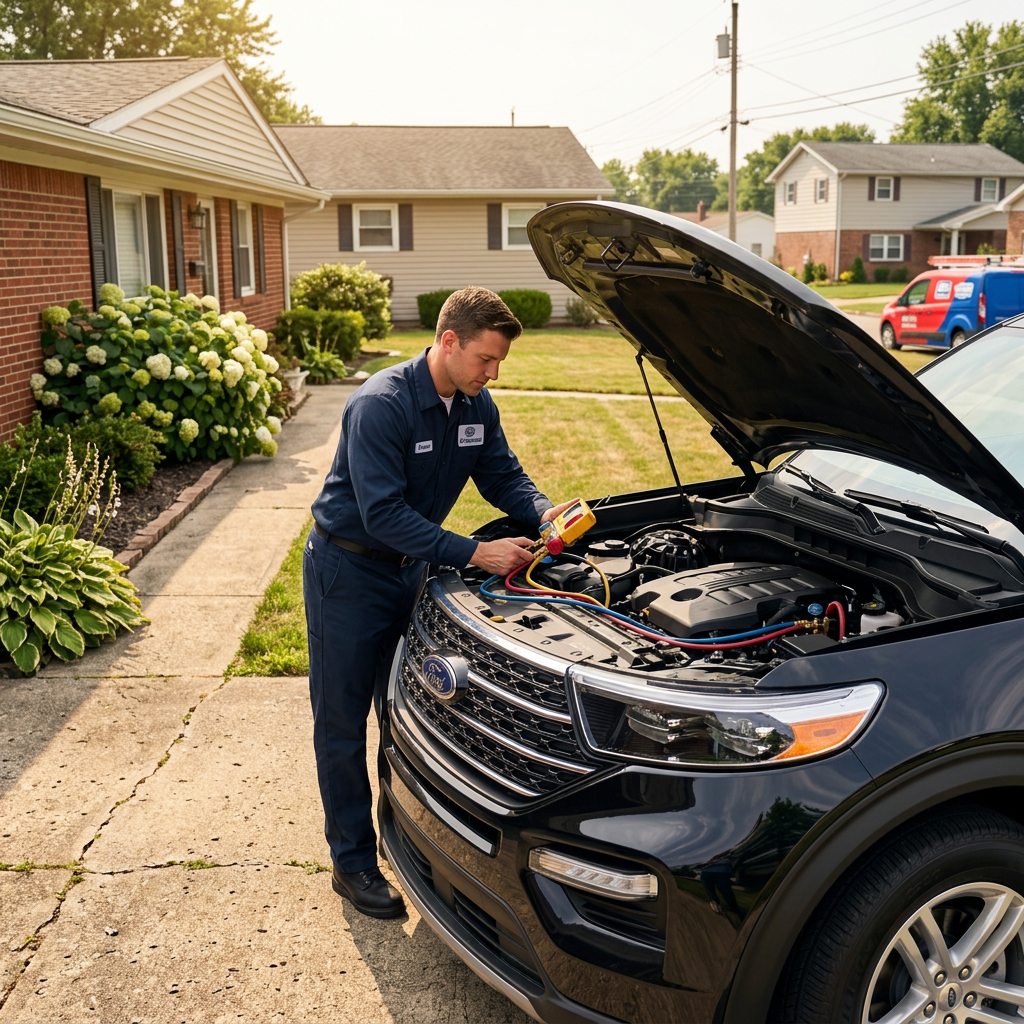
Our technicians utilize specialized diagnostic equipment to evaluate your system’s operating pressures, check for leaks, and restore peak performance. If you are experiencing weak airflow, warm air from the vents, or unusual noises when the system cycles on, it is time for a professional assessment. We make it easy to keep up with routine maintenance by offering service offers on common maintenance items.
If you are busy managing school schedules or work commitments, we offer convenient options to fit your routine. You can take advantage of our valet pickup and delivery service to have your vehicle serviced without leaving your home, or utilize our mobile service van for on-site maintenance. For comprehensive vehicle care, our team can also perform a diagnostic check on your vehicle’s electrical system, including professional battery testing and replacement to prevent unexpected summer breakdowns. If you prefer to stop by in person, you can find our location details and get directions to our service center on Pennsylvania Avenue. We are proud to serve as your dedicated local Ford service destination, providing transparent pricing and expert care. Feel free to give our service team a quick call to discuss your vehicle’s needs.
Table of Contents
- Understanding Normal Low and High Side Pressures in Your Car AC System
- Why You Cannot Put R-134a Refrigerant Into an R-1234yf System
- The Cost Difference and Chemistry Behind R-1234yf Versus R-134a
- What is Black Death and How Does It Destroy a Car Air Conditioning System
- Why Professional Mechanics Pull a Deep Vacuum Before Recharging Your AC
- How Certified Service Teams Detect Microscopic Refrigerant Leaks
- Maintaining Your Ford AC System Year Round and Common Questions
Understanding Normal Low and High Side Pressures in Your Car AC System
An automotive air conditioning system operates in a continuous loop, divided into a low-pressure side and a high-pressure side. The compressor acts as the heart of this loop, drawing in low-pressure refrigerant gas, compressing it into a high-pressure gas, and pumping it through the rest of the system. To diagnose cooling issues accurately, technicians connect a manifold gauge set to the service ports on both sides of the system to monitor these distinct pressures.
Under normal operating conditions at an ambient outdoor temperature of 85 degrees Fahrenheit, a healthy air conditioning system should display specific pressure ranges:
- Low-side pressure should typically read between 25 psi and 45 psi.
- High-side pressure should typically read between 130 psi and 250 psi.
These target values are not static; they fluctuate based on the ambient outdoor temperature. As the outside temperature rises, the pressures on both sides of the system naturally increase. For example, on a mild 70-degree day, the high-side pressure might sit around 150 psi, but when temperatures climb past 95 degrees, that same high-side reading can safely rise above 250 psi.
When a system is underperforming, the relationship between these two pressure readings provides vital diagnostic clues. If both the high-side and low-side pressures are below normal specifications, it almost always points to a low volume of refrigerant, which is typically caused by a slow leak. Conversely, if the low-side pressure is unusually high while the high-side pressure remains low, the refrigerant is not being compressed properly. This specific pressure profile usually indicates a failing compressor or a faulty internal compressor bypass valve.
For DIY enthusiasts looking to perform their own basic inspections, using correct, high-quality replacement components is critical. You can easily order genuine OEM parts directly through our dealership to ensure a perfect fit. For older out-of-warranty vehicles, keeping up with these repairs helps protect your investment and maintains the vehicle’s long-term value.
Why You Cannot Put R-134a Refrigerant Into an R-1234yf System
It is illegal and physically impossible to safely charge an R-1234yf system with R-134a refrigerant. While both chemicals serve the same basic cooling purpose, they possess entirely different chemical structures, operating characteristics, and environmental profiles. Modern vehicles are engineered from the ground up to use one specific refrigerant type, and mixing them can cause catastrophic mechanical failure.
To prevent accidental cross-contamination, manufacturers design the service ports with physical safeguards. Systems built for R-1234yf utilize unique, model-specific service couplers that will not physically connect to R-134a charging hoses. Trying to bypass these physical barriers with aftermarket adapters is highly discouraged.
The two refrigerants require completely different synthetic lubricating oils to circulate through the system. R-134a typically relies on standard polyalkylene glycol oil, whereas R-1234yf systems require specialized, highly stable lubricants designed to resist breakdown under specific thermal conditions. Introducing the wrong refrigerant prevents the oil from mixing properly, starving the compressor of lubrication and leading to rapid mechanical failure.
If you drive a modern vehicle, keeping the climate control system serviced with the correct factory-specified refrigerant is essential for protecting your warranty. Our certified technicians have the specialized recovery and recharging equipment required to service modern climate systems safely and legally.
The Cost Difference and Chemistry Behind R-1234yf Versus R-134a
The transition from R-134a to R-1234yf was driven entirely by environmental regulations aimed at reducing automotive emissions. The older refrigerant, R-134a, is a hydrofluorocarbon with a high Global Warming Potential rating of 1,430, meaning it remains in the atmosphere for years if leaked. In contrast, R-1234yf is a hydrofluoroolefin with a Global Warming Potential rating of less than 1, breaking down in the atmosphere in just a few days.
This environmental benefit comes with a significantly higher material cost. Producing R-1234yf involves a highly complex, multi-stage chemical synthesis process protected by strict chemical patent licensing. Additionally, because R-1234yf is classified as mildly flammable, manufacturing facilities and service centers must utilize specialized, explosion-proof handling and recovery equipment, which increases overall service costs.
For local business owners operating commercial vehicles, maintaining passenger comfort is a key part of daily operations. Keeping the climate control system in top shape ensures your team stays productive throughout the day. Whether you are managing a single vehicle or a larger commercial fleet, keeping up with scheduled cooling system inspections prevents costly downtime during the hottest months of the year.
What is Black Death and How Does It Destroy a Car Air Conditioning System
In the automotive service industry, “black death” refers to a catastrophic internal failure of the air conditioning compressor. This severe condition occurs when the internal pistons, valves, or swash plates of the compressor begin to disintegrate due to extreme heat, age, or lack of lubrication. As these metal components grind against one another, they shave off microscopic metal particles.
These metallic shavings mix with the compressor’s lubricating oil, turning it into a highly abrasive, black, sludge-like paste. Driven by the high-pressure side of the system, this destructive mixture circulates through every single component of the air conditioning loop, including:
- The condenser
- The receiver-drier or accumulator
- The expansion valve or orifice tube
- The evaporator core inside the dashboard
Once this abrasive sludge coats the internal walls of these components, it plugs the tiny passages inside the condenser and expansion valve. Because the sludge cannot be completely flushed out of modern, parallel-flow condensers, correcting this issue requires replacing almost every component in the climate control loop. Simply installing a new compressor without replacing the contaminated lines and heat exchangers will cause the new compressor to fail almost immediately as the residual metal debris cycles back into it.
Preventing this costly failure requires immediate attention to early warning signs. If you notice loud clicking, metallic rattling, or squealing noises when turning on your climate control, have the system inspected by professionals immediately to catch compressor wear before it contaminates the entire system.
Why Professional Mechanics Pull a Deep Vacuum Before Recharging Your AC
Before introducing new refrigerant into any air conditioning system, a professional technician must connect a specialized vacuum pump to pull a deep vacuum on the closed loop. This critical step serves two primary purposes: removing non-condensable air and boiling off residual moisture.
When a system is opened for repairs or develops a leak, ambient air enters the lines. Air contains nitrogen and oxygen, which cannot be condensed by the automotive system. If left inside, these non-condensables occupy valuable space, raise system pressures to dangerous levels, and severely reduce cooling efficiency.
More importantly, ambient air contains moisture. When water vapor mixes with chemical refrigerants and synthetic compressor oils, a chemical reaction occurs that creates highly corrosive hydrochloric and hydrofluoric acids. These acids eat away at the aluminum tubing from the inside out and chemically degrade the compressor oil, leading to premature mechanical failure.
To remove this moisture, the vacuum pump lowers the internal system pressure to a near-perfect vacuum. At this ultra-low pressure, the boiling point of water drops below room temperature, causing any residual moisture inside the lines to boil, turn into water vapor. The vacuum pump then draws this vapor out of the system, leaving the internal lines completely dry, clean, and ready for a precise charge of fresh refrigerant.
How Certified Service Teams Detect Microscopic Refrigerant Leaks
Because automotive air conditioning systems operate under high pressures, even a microscopic pinhole leak in a hose, fitting, or heat exchanger can cause the refrigerant charge to deplete over time. Finding these tiny leaks requires specialized tools and diagnostic techniques.
One of the most common and effective methods is the use of ultraviolet fluorescent dye. A technician injects a small amount of specialized UV dye into the system along with a partial refrigerant charge. As the system operates, the dye circulates with the oil and escapes through any leak points. By scanning the lines, connections, and components with a high-intensity blacklight, the technician can easily spot the glowing dye residue at the exact source of the leak.
For leaks that are hidden from view, such as those inside the dashboard evaporator core, technicians utilize electronic leak detectors, often called “sniffers.” These highly sensitive handheld devices feature an electronic sensor that detects the specific chemical molecules of halogenated refrigerants. By passing the probe near service valves, hose crimps, or the dashboard vents, the technician can pinpoint the presence of escaping gas down to a fraction of an ounce per year.
Maintaining Your Ford AC System Year Round and Common Questions
Proper maintenance of your vehicle’s climate control system is a year-round responsibility. One of the best ways to preserve the health of your system is to run the air conditioning for at least ten minutes once a week, even during the cold winter months.
Automotive climate control systems rely on specialized lubricating oil suspended within the refrigerant fluid to keep the internal rubber seals soft and pliable. When the system sits idle for months at a time, the oil settles, causing the rubber seals along the hoses and shaft couplings to dry out, shrink, and develop slow leaks. Running the system periodically circulates the oil, coats the seals, and prevents refrigerant from escaping.
Common Questions About Automotive AC Systems
Q: Why does my car AC smell musty when I first turn it on?
Musty odors are usually caused by mold or bacteria growing on the damp surface of the evaporator core inside your dashboard. As the system cools the cabin, moisture condenses on the evaporator, creating a dark, damp environment where spores can thrive. Replacing your cabin air filter and utilizing a professional sanitizing treatment can eliminate these odors.
Q: Can I just add refrigerant from a retail aerosol can to fix my AC?
While DIY recharge cans are widely available, they often contain stop-leak additives that can clog delicate internal valves and contaminate professional recovery equipment. Furthermore, without a manifold gauge set, it is very easy to overcharge the system, which can damage the compressor and reduce cooling performance.
Q: How often should I have my car’s air conditioning system serviced?
Most manufacturers recommend having your climate control system inspected every two years. A standard service includes checking the cabin air filter, measuring operating pressures, inspecting the drive belt, and ensuring the condenser is free of debris to maintain optimal heat transfer.
Q: Why does the AC blow colder when I am driving on the highway compared to sitting at a red light?
When the vehicle is moving at higher speeds, a large volume of ambient air is forced through the front grille and across the condenser, allowing it to shed heat much more efficiently. At a stop, the system relies entirely on the electric cooling fans, which may not move as much air, resulting in slightly warmer vent temperatures.
Schedule Your Professional Climate Control Service
Do not let a weak or failing air conditioning system ruin your driving experience. If your climate control is not keeping you comfortable, our factory-trained service team is here to help. We use state-of-the-art diagnostic tools to check your operating pressures, identify leaks, and perform precise repairs using genuine parts. Contact us today to schedule your service appointment and ensure your vehicle is ready for any weather.
© 2026 Tri State Ford. All rights reserved.
Connect with us


- Automotive News, New Vehicle Reviews, Buying Guides, Financing & Insurance, Seasonal Driving Tips
- Buying Guides, Financing & Insurance, New Vehicle Reviews, Model Comparisons, Sales & Promotions
- Buying Guides, Financing & Insurance, New Vehicle Reviews, Model Comparisons, Technology & Innovation
- Buying Guides, Financing & Insurance, Vehicle Inventory & Offers, Dealership Visit Preparation, Trade-In & Valuation
- Commercial Leasing Options, Business Fleet Solutions, Financing & Leasing Programs, Commercial Vehicle Inventory, Business Vehicle Acquisition
- Commercial Truck Sales, Fleet Purchasing Guides, Financing & Lease Options, Work Truck Customization, New Vehicle Inventory
- Commercial Vehicle Sales, Financing & Leasing, Small Business Vehicle Incentives, Fleet Purchasing Guides, Tax Benefits for Vehicle Buyers
- Commercial Vehicle Sales, Fleet Leasing & Management, Commercial Financing & Tax Incentives, Upfitting & Customization Solutions, Trade & Lease Programs
- Community Engagement & Events, New Vehicle Promotions, Financing & Trade-In Options, Maintenance & Service, Used Vehicle Offers
- Community Events & Customer Appreciation, New Vehicle Reviews, Financing & Trade-In Guides, Maintenance & Service Specials, Commercial & Work Truck Solutions
- Community Events & Dealership News, New Vehicle Promotions & Incentives, Maintenance & Service Specials, Financing & Trade-In Guidance, Family-Friendly Dealership Experiences
- Community Events & Dealership News, New Vehicle Reviews, Financing & Insurance, Maintenance & Service, Work Trucks & Commercial Vehicles
- Community Events, New Vehicle Buying Guides, Financing & Insurance, Maintenance & Service, Local Dealership News
- Compare Cars
- Dealership Events & Promotions, Financing & Trade-In Options, Maintenance & Service Specials, Community Involvement & Charity, New & Used Vehicle Buying Guides
- East Liverpool, OH Ford Dealer
- East Liverpool, OH Used Cars
- Financing & Insurance, Buying Guides, Commercial Vehicle Solutions, Fleet Management, Inventory and Availability
- Financing & Insurance, Buying Guides, New Vehicle Reviews, Used Vehicle Guides, Automotive Sales & Inventory
- Financing & Insurance, Buying Guides, New Vehicle Reviews, Used Vehicle Guides, Automotive Sales Strategies
- Financing & Insurance, Buying Guides, New Vehicle Reviews, Used Vehicle Guides, Model Comparisons
- Financing & Insurance, Buying Guides, Used Vehicle Guides, Trade-In Tips, New Vehicle Sales
- Financing & Insurance, Buying Guides, Vehicle Trade-In Tips, Dealership Sales Process, New Vehicle Promotions
- Financing & Insurance, Leasing Benefits, Model Comparisons, Technology & Innovation, Buying Guides
- Leasing & Financing Options, Buying Guides, Model Comparisons, Negotiation Tips, Inventory & Specials
- Leasing & Financing Options, Buying Guides, New Vehicle Reviews, Model Comparisons, Technology & Innovation
- Leasing & Financing Options, New Vehicle Leasing Guides, Buying Guides, Inventory Spotlight, Trade
- Leasing & Lease Deals, Financing & Insurance, New Vehicle Sales, Commercial Vehicle Leasing, Vehicle Trade-In & Purchase Options
- Leasing Options, Financing & Insurance, New Vehicle Reviews, Buying Guides, Technology & Innovation
- Leasing Options, Financing & Insurance, New Vehicle Sales, Buying Guides, Vehicle Inventory
- Maintenance & Service, Air Conditioning Repair, Genuine Parts & Accessories, Dealer-Authorized Service, Vehicle Ownership Care
- Maintenance & Service, Automotive Air Conditioning Repair, Vehicle Cooling System Care, Diagnostic & Leak Detection, Seasonal Vehicle Maintenance
- Maintenance & Service, Automotive Detailing & Cleaning, Seasonal Vehicle Care, Vehicle Protection & Preservation, Service Center Expertise
- Maintenance & Service, Automotive Detailing & Protection, Corrosion & Rust Prevention, Paint & Exterior Care, Professional Vehicle Care
- Maintenance & Service, Automotive Detailing, Paint Protection & Care, Seasonal Vehicle Care, Professional Vehicle Servicing
- Maintenance & Service, Automotive Electrical Systems, Battery Care & Replacement, Diagnostics & Repairs, Electric Vehicle Maintenance
- Maintenance & Service, Automotive Electrical Systems, Battery Care & Replacement, Vehicle Lighting & Electrical Issues, Roadside Assistance & Emergency Services
- Maintenance & Service, Automotive Fluids & Lubricants, Vehicle Care & Ownership, Dealership Service & Repairs, Preventive Maintenance
- Maintenance & Service, Automotive Lighting & Electrical, Vehicle Safety & Visibility, DIY Vehicle Care, Parts & Accessories
- Maintenance & Service, Automotive Parts & Accessories, Seasonal Vehicle Care, Vehicle Safety & Visibility, Professional Auto Service
- Maintenance & Service, Automotive Parts & Accessories, Vehicle Air Quality & HVAC Care, Preventive Vehicle Maintenance, Service Tips & FAQs
- Maintenance & Service, Automotive Parts & Accessories, Vehicle Ownership Care, Engine Care & Protection, Warranty & Service Contracts
- Maintenance & Service, Automotive Parts & Accessories, Vehicle Safety & Repair, Warranty & Coverage, Service Specials & Offers
- Maintenance & Service, Automotive Parts & Components, Vehicle Safety & Repair, Warranty & Service Coverage, Preventative Vehicle Care
- Maintenance & Service, Automotive Parts & Repairs, Vehicle Warranty & Protection, Service Center Tips, Cost-Effective Vehicle Care
- Maintenance & Service, Automotive Repair, Mobile & Remote Vehicle Service, Warranty & Roadside Assistance, OEM Parts & Service Specials
- Maintenance & Service, Automotive Repair, Parts & Accessories, Vehicle Ownership Care, Technology & Innovation in Service
- Maintenance & Service, Automotive Technology & Diagnostics, Vehicle Electronics & Sensors, Seasonal Vehicle Care, Parts & Repairs
- Maintenance & Service, Automotive Technology & Software Updates, Warranty & Recall Service, Mobile Vehicle Repair & Convenience, Customer Service & Transparency
- Maintenance & Service, Battery Care & Diagnostics, Electric Vehicle (EV) Maintenance, Seasonal Vehicle Care, Automotive Electrical Systems
- Maintenance & Service, Battery Care & Replacement, Vehicle Electrical Systems, Seasonal Vehicle Maintenance, Professional Automotive Repairs
- Maintenance & Service, Brake System Care, OEM Parts & Replacement, Vehicle Safety & Inspections, Expert Technician Services
- Maintenance & Service, Brake System Care, Vehicle Safety & Inspection, Automotive Repair Tips, Service Financing & Convenience
- Maintenance & Service, Brake System Care, Vehicle Safety & Inspection, Parts Quality & Replacement, Heavy Duty Vehicle Maintenance
- Maintenance & Service, Brake System Care, Vehicle Safety & Inspections, Parts & Components, Professional Automotive Services
- Maintenance & Service, Brake System Care, Vehicle Safety & Inspections, Parts & Repairs, Expert Tips & Advice
- Maintenance & Service, Brake Systems & Repair, Vehicle Parts & Accessories, Towing & Load Management, Seasonal Driving Tips
- Maintenance & Service, Certified Technician Insights, Warranty & Service Coverage, Genuine OEM Parts, Service Center Selection Guidance
- Maintenance & Service, Cooling System Repairs, Vehicle Ownership Care, Diagnostic & Troubleshooting, Automotive Parts & Components
- Maintenance & Service, Diagnostic Services, Vehicle Health & Diagnostics, Service Tips & Advice, Check Engine Light Solutions
- Maintenance & Service, Engine Care & Performance, Parts & Accessories, Genuine vs. After
- Maintenance & Service, Essential Vehicle Care, Preventive Maintenance Tips, Vehicle Longevity Strategies, Truck Maintenance Essentials
- Maintenance & Service, Expert Repairs & Diagnostics, Genuine Parts & Accessories, Engine Care & Performance, Vehicle Ownership & Care
- Maintenance & Service, Mobile Vehicle Services, Vehicle Care & Ownership, Genuine Parts & Repairs, Seasonal Maintenance Tips
- Maintenance & Service, Parts & Accessories, Engine Care & Repair, Vehicle Longevity Tips, OEM Parts Benefits
- Maintenance & Service, Parts & Accessories, Vehicle HVAC Care, Seasonal Vehicle Maintenance, DIY Vehicle Maintenance
- Maintenance & Service, Parts & Replacements, Vehicle Care Tips, Seasonal Maintenance, DIY Vehicle Maintenance
- Maintenance & Service, Recall Information, Safety & Reliability, Vehicle Ownership Care, Parts & Repairs
- Maintenance & Service, Recall Updates & Safety Notices, Genuine Parts & Accessories, Truck Care & Maintenance Tips
- Maintenance & Service, Repair & Diagnostics, OEM Parts & Accessories, Warranty & Recall Information, Vehicle Care & Ownership Tips
- Maintenance & Service, Repair & Diagnostics, Parts & Accessories, Vehicle Ownership Care, Service Plans & Extended Warranty
- Maintenance & Service, Repair & Diagnostics, Parts & Components, Preventive Care & Tips, Warranty & Recalls
- Maintenance & Service, Repair & Parts, Vehicle Ownership Care, Safety Features, Technology & Innovation
- Maintenance & Service, Repair & Parts, Vehicle Ownership Care, Transmission
- Maintenance & Service, Repair Solutions, Vehicle Ownership Care, Parts & Accessories, Diagnostic Tips
- Maintenance & Service, Repair Tips & Techniques, Vehicle Care & Ownership
- Maintenance & Service, Safety Features, Parts & Repairs, Vehicle Ownership Care, Automotive Service Tips
- Maintenance & Service, Safety Features, Recall & Repair Updates, Parts & Repairs, Vehicle Ownership Care
- Maintenance & Service, Safety Features, Recall & Safety Campaigns, Vehicle Inspection & Repairs, Vehicle Ownership Care
- Maintenance & Service, Safety Features, Recall & Warranty Information, Vehicle Diagnostics & Repair, Certified Service & Genuine Parts
- Maintenance & Service, Safety Features, Recall Repairs & Safety Campaigns, Parts & Genuine Components, Vehicle Ownership Care
- Maintenance & Service, Safety Features, Recalls & Repairs, Parts & Accessories, Vehicle Ownership Care
- Maintenance & Service, Safety Features, Repair & Recall Updates, Parts & Components, Vehicle Ownership Care
- Maintenance & Service, Safety Features, Repair & Replacement, Vehicle Care & Inspection, Parts & Accessories
- Maintenance & Service, Safety Features, Technology & Innovation, Automotive Parts & Accessories, Seasonal Driving Tips
- Maintenance & Service, Safety Features, Technology & Innovation, Automotive Recalls, Parts & Repairs
- Maintenance & Service, Safety Features, Technology & Innovation, Automotive Recalls, Vehicle Ownership Care
- Maintenance & Service, Safety Features, Technology & Innovation, Automotive Service Tips, Recall & Repair Updates
- Maintenance & Service, Safety Features, Technology & Innovation, Parts & Repairs, Vehicle Ownership Care
- Maintenance & Service, Safety Features, Technology & Innovation, Repair & Recall Information, Parts & Vehicle Care
- Maintenance & Service, Safety Features, Technology & Innovation, Seasonal Driving Tips, Parts & Repairs
- Maintenance & Service, Safety Features, Technology & Innovation, Tire Care & Replacement, Diagnostic & Repair Services
- Maintenance & Service, Safety Recalls & Repairs, Vehicle Safety & Compliance, Powertrain & Drivetrain Maintenance, Towing & Hauling Maintenance
- Maintenance & Service, Seasonal Driving Tips, Model Comparisons, Technology & Innovation, Safety Features
- Maintenance & Service, Seasonal Driving Tips, Safety Features, Technology & Innovation, Parts & Repairs
- Maintenance & Service, Seasonal Driving Tips, Vehicle Care & Ownership, Brake System Maintenance, Tire & Wheel Care
- Maintenance & Service, Seasonal Driving Tips, Vehicle Care & Ownership, Parts & Accessories, Safety Features
- Maintenance & Service, Seasonal Driving Tips, Vehicle Care & Ownership, Safety Features, Professional Repair & Service Techniques
- Maintenance & Service, Seasonal Driving Tips, Vehicle Care & Protection, Brake Maintenance, Tire Care & Safety
- Maintenance & Service, Seasonal Driving Tips, Vehicle Cooling Systems, Automotive Safety Features, Parts & Repairs
- Maintenance & Service, Service Scheduling & Convenience, Vehicle Repair & Diagnostics, Parts & Accessories, Fleet & Commercial Vehicle Service
- Maintenance & Service, Technology & Innovation, Automotive Service Transparency, Digital Vehicle Inspections, Vehicle Ownership Care
- Maintenance & Service, Technology & Innovation, Safety Features, Parts & Warranty, Vehicle Ownership Care
- Maintenance & Service, Technology & Innovation, Vehicle Diagnostics & Telematics, Fleet Management Solutions, Parts & Accessories
- Maintenance & Service, Tire Care & Repair, Roadside Assistance, Vehicle Safety & Inspections, Automotive Parts & Replacements
- Maintenance & Service, Tire Care & Repair, Wheel Alignment & Balancing, Suspension Maintenance, Vehicle Performance Optimization
- Maintenance & Service, Tire Care & Replacement, Seasonal Vehicle Care, Safety Features, Automotive Service Tips
- Maintenance & Service, Tire Care & Replacement, Vehicle Safety & Handling, Seasonal Vehicle Preparation, Drivetrain & Tire Maintenance
- Maintenance & Service, Tire Care & Replacement, Vehicle Safety & Inspections, Seasonal Vehicle Maintenance, Automotive Parts & Accessories
- Maintenance & Service, Transmission Care & Repair, Vehicle Fluid Services, Automotive Diagnostics, Warranty & Resale Value Maintenance
- Maintenance & Service, Transmission Care, Repair & Parts, Vehicle Ownership Care, Common Vehicle Issues
- Maintenance & Service, Vehicle Care & Longevity, Scheduled Service Packages, Oil Changes & Fluid Top-offs, Tire & Brake Maintenance
- Maintenance & Service, Vehicle Care Tips, Parts & Accessories, Seasonal Vehicle Maintenance, Service Specials & Packages
- Maintenance & Service, Vehicle Detailing & Care, Parts & Accessories, Seasonal Vehicle Preparation, Service Scheduling & Convenience
- Maintenance & Service, Vehicle Detailing & Cosmetic Care, Service Scheduling & Convenience, Seasonal Vehicle Care, Vehicle Ownership Tips
- Maintenance & Service, Vehicle Detailing & Protection, Vehicle Care Tips, Seasonal Vehicle Maintenance, Dealership Service Benefits
- Maintenance & Service, Vehicle Diagnostics & Repair, Engine Performance & Troubleshooting, Fuel System Care, Preventative Maintenance Strategies
- Maintenance & Service, Vehicle Fluids & Lubrication, Engine Care & Repair, Parts & Accessories, Professional Vehicle Care
- Maintenance & Service, Vehicle Inspection & Diagnostics, Parts & Repairs, Warranty & Resale Value, Service Specials & Convenience
- Maintenance & Service, Vehicle Ownership Care, Mobile Repair Services, Genuine Parts & Certified Technicians, Electric Vehicle Maintenance
- Maintenance & Service, Vehicle Ownership Care, Parts & Accessories, Repair & Diagnostics, Certified Technician Insights
- Maintenance & Service, Vehicle Repair & Diagnostics, Parts & Accessories, DIY Vehicle Care, Safety & Reliability Tips
- Maintenance & Service, Vehicle Repair & Diagnostics, Parts & Accessories, Hybrid & Electric Vehicle Care, Seasonal Vehicle Care
- Maintenance & Service, Vehicle Repair & Diagnostics, Parts & Accessories, Seasonal Driving Tips, Battery Care & Replacement
- Maintenance & Service, Vehicle Repair & Diagnostics, Parts & Accessories, Service Lane Tips & Insights, Vehicle Ownership Care
- Maintenance & Service, Vehicle Repair & Diagnostics, Parts & Accessories, Towing & Performance Care, Mobile & Convenient Service Options
- Maintenance & Service, Vehicle Repair & Parts, Service Convenience & Customer Care, Roadside Assistance & Support, Vehicle Ownership Tips
- Maintenance & Service, Vehicle Service Warranties, Repair & Coverage Plans, Ownership & Vehicle Care, Automotive Service Tips
- Maintenance & Service, Vehicle Software Updates, Safety Features, Technology & Innovation, Recall & Warranty Information
- Maintenance & Service, Warranty & Recalls, Repair & Diagnostics, Parts & Accessories, Vehicle Ownership & Care
- Model Comparisons, Buying Guides, New Vehicle Reviews, Financing & Insurance, Inventory Updates
- Model Comparisons, Buying Guides, Technology & Innovation, Safety Features, Maintenance & Service
- Model Comparisons, New Vehicle Reviews, Safety Features, Technology & Innovation, Seasonal Driving Tips
- Model Comparisons, New Vehicle Reviews, Technology & Innovation, Buying Guides, Maintenance & Service
- Model Comparisons, New Vehicle Reviews, Technology & Innovation, Safety Features, Buying Guides
- Model Comparisons, Towing & Hauling Guides, Maintenance & Service, Technology & Innovation, New Vehicle Reviews
- New Vehicle Promotions, Buying Guides, Financing & Insurance, New Vehicle Reviews, Inventory Highlights
- New Vehicle Reviews, Buying Guides, Financing & Insurance, Model Comparisons, Automotive News
- New Vehicle Reviews, Buying Guides, Financing & Insurance, Model Comparisons, Automotive Sales Strategies
- New Vehicle Reviews, Buying Guides, Financing & Insurance, Model Comparisons, Automotive Technology & Innovation
- New Vehicle Reviews, Buying Guides, Financing & Insurance, Model Comparisons, Commercial & Work Truck Sales
- New Vehicle Reviews, Buying Guides, Financing & Insurance, Model Comparisons, Inventory Highlights
- New Vehicle Reviews, Buying Guides, Financing & Insurance, Model Comparisons, Used Vehicle Guides
- New Vehicle Reviews, Buying Guides, Financing & Insurance, Model Comparisons, Vehicle Inventory Updates
- New Vehicle Reviews, Buying Guides, Financing & Insurance, New Vehicle Specials, Trade-In & Value Estimation
- New Vehicle Reviews, Buying Guides, Financing & Insurance, Used Vehicle Guides, Model Comparisons
- New Vehicle Reviews, Buying Guides, Financing & Insurance, Vehicle Inventory, Model Comparisons
- New Vehicle Reviews, Buying Guides, Model Comparisons, Financing &
- New Vehicle Reviews, Buying Guides, Model Comparisons, Financing & Insurance, Inventory & Sales
- New Vehicle Reviews, Buying Guides, Model Comparisons, Maintenance & Service, Technology & Innovation
- New Vehicle Reviews, Buying Guides, Safety Features, Technology & Innovation, Model Comparisons
- New Vehicle Reviews, Buying Guides, Technology & Innovation, Safety Features, Seasonal Driving Tips
- New Vehicle Reviews, Financing & Insurance, Buying Guides, New Vehicle Specials, Model Comparisons
- New Vehicle Reviews, Financing & Insurance, Buying Guides, Technology & Innovation, Automotive Inventory Updates
- New Vehicle Reviews, Financing & Insurance, Buying Guides, Used Vehicle Guides, Model Comparisons
- New Vehicle Reviews, Model Comparisons, Buying Guides, Technology & Innovation, Safety Features
- New Vehicle Reviews, Model Comparisons, Financing & Insurance, Technology & Innovation, Safety Features
- New Vehicle Reviews, Model Comparisons, Off-Road Adventures, Technology & Innovation, Maintenance & Service
- New Vehicle Reviews, Model Comparisons, Safety Features, Technology & Innovation, Buying Guides
- New Vehicle Reviews, Model Comparisons, Technology & Innovation, Financing & Insurance, Maintenance & Service
- New Vehicle Reviews, Model Comparisons, Technology & Innovation, Safety Features, Buying Guides
- New Vehicle Reviews, Model Comparisons, Technology & Innovation, Safety Features, Maintenance & Service
- New Vehicle Reviews, Off-Road Capabilities, Outdoor Adventure Vehicles, Technology & Innovation, Local Driving Destinations
- New Vehicle Reviews, Technology & Innovation, Buying Guides, Safety Features, Model Comparisons
- New Vehicle Reviews, Technology & Innovation, Safety Features, Maintenance & Service, Buying Guides
- New Vehicle Sales, Financing & Incentives, Trade-In & Appraisal, Special Sales Events, Electric Vehicle Purchasing
- New Vehicle Sales, Financing & Incentives, Trade-In & Value Guides, Manufacturer Promotions, Commercial Vehicle Sales
- New Vehicle Sales, Financing & Insurance, Buying Guides, Manufacturer Incentives & Discounts, Trade-In & Vehicle Valuation
- New Vehicle Sales, Vehicle Delivery & Logistics, Financing & Credit Applications, Trade-In & Vehicle Valuation, Commercial Vehicle Sales
- Tips
- Trucks
- Uncategorized
- Used Vehicle Guides, Buying Guides, Financing & Insurance, Model Comparisons, Selling Your Car
- Used Vehicle Guides, Financing & Insurance, Buying Guides, Model Comparisons, Local Dealership Highlights
- Used Vehicle Guides, Financing & Insurance, Buying Guides, New Vehicle Reviews, Commercial Vehicle Sales
- Used Vehicle Guides, Financing & Insurance, Buying Guides, Vehicle Warranty Information, Pre-Owned Vehicle Sales
- Vehicle Sales Events, Financing & Leasing, Trade-In & Trade-Up Guides, New Vehicle Inventory Highlights, Dealership Buying Experience
- Vehicle Sales Events, New Vehicle Buying Guides, Financing & Incentives, Dealership Inventory Highlights, Commercial Vehicle Sales
- Vehicle Sales Events, New Vehicle Pricing & Incentives, Financing & Lease Options, Trade-In & Appraisal Guides, Dealership Buying Experience
- Vehicle Sales Events, New Vehicle Pricing, Financing & Credit Applications, Trade-In & Loyalty Programs, Leasing vs Buying Guides
- Vehicle Sales Events, New Vehicle Purchasing, Incentives & Discounts, Financing & Pre-Approval, Trade-In & Appraisal Guidance
- Vehicle Sales Process, Financing & Credit Applications, New and Used Vehicle Inventory, Pickup and Delivery Services, Online Vehicle Purchasing
- Vehicle Sales Promotions, New Vehicle Buying Guides, Financing & Credit Applications, Dealership Inventory Highlights, Model Pricing Comparisons
- Vehicle Sales Promotions, New Vehicle Buying Guides, Financing & Incentives, Trade-In & Valuation, Dealership Sales Events
- Vehicle Sales, Online Car Buying, Financing & Incentives, Trade-In Guides, New Vehicle Delivery Services, Youngstown Dealership
- Vehicle Trade-In Tips, Financing & Insurance, Buying Guides, Dealership Sales Strategies, Inventory & Specials