


Today, we are sitting down with Jim Dinsmore, the Parts Manager at Tri State Ford, who brings an incredible 44 years of automotive expertise to our team. As the blossoms emerge and the air changes across the Ohio Valley, Jim is here to explain why a simple component like the cabin air filter is the most important defense your family has against seasonal allergies. In this interview, he will break down the technical differences between genuine parts and aftermarket alternatives while providing actionable advice on maintaining your vehicle’s health during the high-pollen months.
Q: Jim, as we move into the peak of the allergy season, why should drivers in our area prioritize their cabin air filters right now?
A: That is a question I hear quite often as soon as the trees start budding along the Ohio River waterfront. Many people do not realize that the air inside your vehicle can actually be more concentrated with pollutants than the air outside because the HVAC system pulls in everything from the road and traps it in a small space. In a city like East Liverpool, with our rich industrial heritage and proximity to the river, we deal with a unique mix of road dust, soot, and heavy pollen that can quickly overwhelm an old filter. A fresh cabin air filter acts like the lungs of your Ford, trapping mold spores and exhaust fumes before they ever reach your family in the seats. If you are noticing a layer of dust on your dashboard or if you find yourself sneezing the moment you turn on the vents, your filter is likely past its prime. You can always find our dealership location easily to have a professional take a look at your current filtration status. If you have any specific concerns about the air quality in your particular model, please give our parts team (330) 462-7578 a quick call so we can verify the right part for your specific year and trim level.
Q: There is a lot of talk about HEPA technology lately; do the Motorcraft filters we use here actually meet those high standards?
A: It is a great point to bring up because the term HEPA gets used as a bit of a buzzword, but the engineering behind Motorcraft filters is very specific to the Ford HVAC housing. Many of the newer filters we stock utilize a multi-layer synthetic media that achieves high-efficiency filtration levels very similar to HEPA standards. These filters are designed to capture microscopic allergens and road dust as small as 0.3 microns, which is significantly smaller than a human hair. We see this technology being especially important for those utilizing our pre-owned work truck selection, where the vehicles often spend time on dusty job sites or gravel roads. Because these filters use a hydrocharging process to magnetize the fibers, they can trap more particles without restricting the airflow that your air conditioning system needs to work efficiently. If you are looking to keep your maintenance costs predictable while ensuring this level of protection, I always suggest checking our current vehicle specials for any parts-related incentives. Our finance department can also help explain how routine maintenance fits into your long-term ownership budget, ensuring you never have to skip these vital health-focused replacements.
“After forty-four years in the parts business, I can tell you that a twenty-dollar filter is the difference between a comfortable spring drive and a season spent sneezing behind the wheel.”
Q: Jim, what do you tell customers who are tempted to grab a non-genuine aftermarket filter from a big-box store instead of a genuine part?
A: I like to be very direct about this because a poor fit can actually cause more harm than good. Aftermarket filters often lack the exact OEM tolerances required for a truly airtight seal within the filter housing. When a filter does not fit perfectly, you get what we call bypass air, where the unfiltered, pollen-heavy air simply flows around the gaps and directly into your cabin. This bypass air can also allow debris to enter the blower motor or settle on the evaporator coil, which can lead to mechanical failures down the road. While a non-genuine part might not automatically void your 2026 Ford warranty, any damage caused by restricted airflow or debris bypass from an ill-fitting filter typically will not be covered. We want to make it as easy as possible to stick with the right parts, which is why we offer Ford pickup and delivery for your service needs. If you cannot make it into the shop, our mobile service van can even come to your driveway to handle these routine checks. It is part of our commitment to being the most reliable Ford service provider in the area, ensuring your vehicle stays built tough and runs clean.
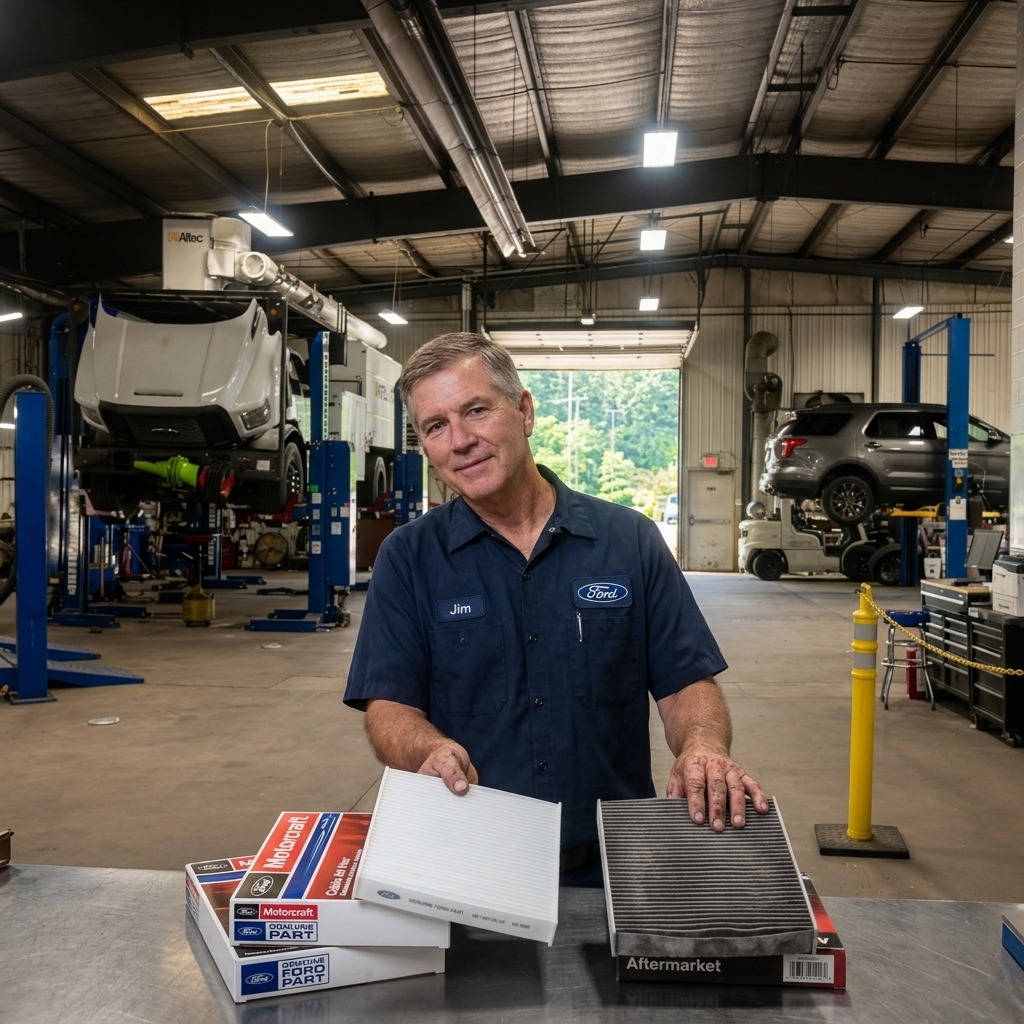
Q: What are the physical signs drivers might notice when their filter is starting to fail, and how does that impact the rest of the HVAC system?
A: One of the first things people notice is a persistent, musty odor that smells a bit like a damp basement every time the air kicks on. This happens because the organic material trapped in the filter, like leaves or insects, begins to rot over time. In suburban areas like Calcutta, where we have a lot of wooded neighborhoods and rolling hills, filters tend to collect more organic debris and mold spores than in strictly urban environments. Beyond the smell, you might notice your windows are taking much longer to defrost or that the airflow feels weak even on the highest setting. When a filter is clogged, the blower motor has to work significantly harder to push air through the restriction, which generates excess heat and can lead to a premature motor failure. To avoid these expensive repairs, you can order the correct parts through our website or book a service visit to have one of our technicians inspect the entire system. We even see this with our new commercial truck inventory, where heavy use in dusty environments can clog a filter in half the usual time, making regular inspections a necessity for business owners.
Q: Is there a specific time of year that is best for this maintenance, or a mileage milestone we should be watching?
A: Most Ford manuals will suggest a replacement every 15,000 miles to 20,000 miles, but for those of us living in the high-pollen regions of the tri-state area, I recommend a Spring Refresh every single year. Ideally, you want to change the filter in March or April before the heavy pollen season really kicks into gear. This ensures you start the warmest months with maximum airflow and a clean slate for your air conditioning. We often bundle these inspections with other seasonal needs, such as our comprehensive battery testing, since the winter cold can be just as hard on your electrical system as the spring allergens are on your HVAC. You can find these combined savings in our monthly service specials which we update regularly to reflect the needs of the season. For those who are planning ahead and looking at a new vehicle custom order, I always remind them that starting a maintenance log from day one is the best way to preserve the vehicle’s long-term value and cabin comfort.
Q: For the DIY-minded folks, what are the basic steps for a typical replacement, and when should they call in the pros?
A: For many modern Ford vehicles, the cabin air filter is located right behind the glove box. You usually have to lower the glove box by releasing a few retaining tabs, which then exposes a plastic cover. The most critical part of the job is ensuring the airflow arrow on the new filter is pointing in the correct direction, which is typically downward, though you should always check the housing markings. If you find that the cover is stuck or if you see signs of rodent activity, like chewed wiring or nests, that is the moment to stop and bring it to us. Proper maintenance history is actually a big factor in vehicle value, and you can even see how your well-maintained car stacks up by using our online valuation tool. If the process seems a bit daunting, our service center on Pennsylvania Ave is ready to handle it for you in about fifteen minutes. Feel free to reach out at (330) 462-7578 if you want to confirm we have your specific filter in stock before you head over.
Jim Dinsmore’s decades of experience highlight a clear truth: the air you breathe while driving is just as important as the oil in your engine. By choosing genuine Motorcraft parts and timing your maintenance with the local allergy cycles, you protect both your family’s health and your vehicle’s complex HVAC system. Whether you are tackling a DIY replacement or taking advantage of our mobile service, the team at Tri State Ford is here to ensure your spring drives are clear and comfortable. Contact our service department today to schedule your spring refresh and breathe easier all season long.

