Blog / Maintenance & Service, Vehicle Inspection & Diagnostics, Parts & Repairs, Warranty & Resale Value,

Expert Q&A: Maximizing Performance with The Works Maintenance Package at Tri State Ford

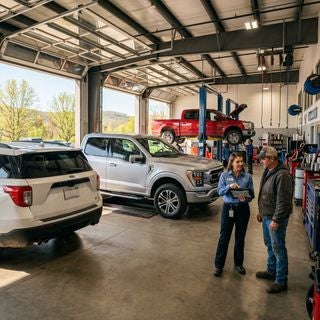
Cinematic wide-angle shot, interior of a bright and busy service bay at a Ford dealership in Calcutta, Ohio, a modern silver Ford F-150 and a white Ford Explorer parked over clean concrete floors, a professional service manager in a blue Ford uniform pointing to a digital diagnostic tablet while speaking with a customer, the customer is a middle-aged man in work clothes and a baseball cap, warm morning sunlight streaming through large garage windows, May spring weather showing budding green maple trees and a clear blue sky outside, a backdrop of neat tool chests and organized fluid canisters, realistic industrial lighting with soft lens flares, no logos or text, high-detail automotive textures, calm and reassuring atmosphere, vibrant natural colors, Appalachian plateau landscape visible through the open bay door.

Expert Q&A: Maximizing Performance with The Works Maintenance Package at Tri State Ford

In this exclusive interview, we sit down with Matt Shaw, the Service Manager at Tri State Ford, to discuss the critical role of preventative maintenance in vehicle longevity. With over a decade of experience overseeing specialized automotive care, Matt provides an inside look at why comprehensive service bundles are the backbone of a reliable commute. Readers will gain a deep understanding of how specific maintenance tasks prevent mechanical failure and ensure that every Ford, from a family SUV to a heavy-duty work truck, remains in peak operating condition.

Q: Matt, we often hear that Tri State Ford wants every vehicle to work perfectly, but how does a bundle like The Works actually achieve that?

A: Proactive care prevents the need for reactive repair. For drivers completing a 20-mile commute across the tri-state area, The Works functions as a total health check for the vehicle. It isn't just about swapping out fluids; it’s about a systematic review of the components that keep you safe on the road. For our local families and those driving our F-Series work inventory, reliability is non-negotiable. By bundling these services, we ensure that nothing is overlooked, which ultimately extends the lifespan of the engine and chassis significantly. A: Beyond the mechanical benefits, we want to make the process as seamless as possible for our community in Calcutta. Whether you are looking at new vehicle specials to maintain a recent purchase or keeping an older model running, scheduling is the first step toward peace of mind. You can easily book your appointment online to find a time that fits your busy schedule. We also see many professionals who utilize our Transit work vans for their businesses; for them, a breakdown isn't just an inconvenience, it's lost revenue. That’s why we offer specialized support for our new work truck inventory to keep those wheels turning. A: We also recognize that every driver has different needs, which is why we stay flexible. If you’ve decided to custom order a new Ford, starting a maintenance habit from day one is the best way to protect that investment. We often have manufacturer vehicle specials that make it even easier to prioritize this care. If you have questions about what your specific model needs, you can always give our team (330) 462-7578 a quick call. For those ready to visit us, finding our dealership in East Liverpool is straightforward, and we also keep a close eye on used vehicle specials for those maintaining a pre-owned Ford.

Q: Walk us through the specific technical components that a technician actually touches during The Works service.

A: When a vehicle enters our bay, the process begins with a Synthetic Blend Oil Change and a premium Oil Filter replacement. This is the baseline for engine health, but the "bundle" aspect is where the real value lies. We perform a comprehensive tire rotation and a precise pressure check, which is vital for maintaining even tread wear. Our technicians then move into a detailed multi-point inspection. This includes checking all fluid levels—such as coolant, brake, and power steering fluids—and topping them off as needed. We also conduct a brake inspection and a battery test to ensure your starting system is robust, especially before our cold Ohio winters hit. A: The battery test is one of the most vital parts of the package because a battery might start a car fine in the driveway but fail during short trips. By utilizing our specialized battery service, we can catch a failing cell before it leaves you stranded. If we do find that a component like a belt or a hose is reaching its limit, we use only genuine Ford parts. You can even order specific parts directly through us if you're looking for something particular. We want to ensure that every part we install matches the exact specifications of your F-150 or Explorer. A: Efficiency is another priority for us. For those with packed schedules, we’ve introduced Ford Mobile Service, which allows us to bring certain maintenance tasks directly to your home or workplace. It’s the same expert care, just more convenient. We also encourage drivers to check our monthly service specials from the manufacturer to see if there are current offers that apply to their upcoming visit. This transparency in pricing and service scope is how we build long-term trust with our customers.

Q: Why should a driver choose a dealership service over a DIY approach or a local quick-lube shop?

A: Ford factory training requires technicians to master specific diagnostic tools calibrated for your vehicle’s onboard computers—technology that a DIYer or a general shop often lacks. At Tri State Ford, our team works exclusively with Ford engineering. This allows us to see "hidden" codes or pending issues that don't always trigger a check engine light immediately. When you bring your vehicle to a Ford dealership near you, you're getting expertise that is backed by the factory.
"A comprehensive inspection identifies wear patterns that a standard oil change might miss, protecting the vehicle's mechanical integrity over time."
A: There is also the matter of convenience and comprehensive care. Many people think DIY saves money, but when you factor in the cost of high-quality Synthetic Blend Oil, a Motorcraft filter, and the time spent disposing of old fluids, the gap closes quickly. Plus, a DIYer often skips the tire rotation or the brake lining inspection because they lack a lift. To make it even easier for our customers, we offer Ford Pick Up and Delivery. We can come to your house, take the car for service, and bring it back, so you never have to interrupt your day. It’s about providing a professional level of care that fits into a modern lifestyle. A: Finally, there is the documentation aspect. Every time you service with us, that data is recorded in the Ford network. This is incredibly helpful if you ever need to visit our finance department to discuss a new vehicle down the road, as a well-documented service history is a major asset. It proves you’ve cared for the vehicle according to the manufacturer’s standards, which is something a stack of handwritten notes from a home garage just can't replicate.

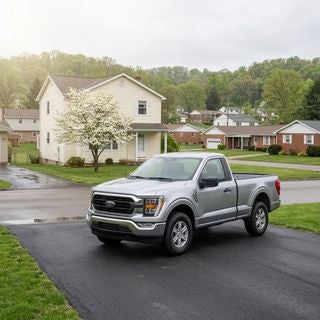
A 2026 Ford F-150 parked on a clean, paved driveway of a modest, well-maintained two-story frame house in a quiet Calcutta, Ohio suburban neighborhood, eye-level wide angle shot, soft May afternoon sunlight filtering through a light spring haze, the truck is the clear focal point with a polished finish reflecting the overcast sky, gently rolling hills and patches of fresh green woodland in the background, a small flowering dogwood tree in the front yard with white blossoms, a damp asphalt street and a neighborhood of mid-century suburban homes, cool spring air, naturalistic and crisp photography style, realistic and practical working-class setting, no text.

Q: How does staying consistent with this specific maintenance package impact a vehicle's warranty and its eventual resale value?

A: Regular maintenance is often a requirement to keep your New Vehicle Limited Warranty in good standing. If a major engine component fails and there is no record of oil changes or cooling system checks, it can complicate the warranty claim process. By getting The Works, you are creating a digital "paper trail" of professional care. This is especially important for the rolling hills around Chester, where the terrain can put extra stress on the transmission and brakes. Documented inspections prove that you’ve been proactive about that wear and tear. A: When it eventually comes time to move on to your next vehicle, that service history translates directly into dollars. A buyer—or a dealership—will always pay more for a car that has a clean bill of health from a certified technician. If you're curious about your current vehicle's worth, you can use our online valuation tool to see how that consistent care has paid off. We often find that vehicles maintained with us have fewer "surprises" during the appraisal process because we've been catching and fixing small issues for years. A: Part of that value also comes from the tires and suspension components. During The Works, we check your tread depth and wear patterns. If we notice uneven wear, we can recommend an alignment before it ruins a set of tires. When you eventually do need new rubber, our tire finding tool helps you select the exact match for your model’s load rating and performance needs. To get started on this path of value protection, you can check our current hours and directions to plan your visit. We’re here to make sure your Ford stays as valuable as the day you drove it off the lot.

Q: If a technician finds something during the multi-point inspection, how do you handle those recommendations with the customer?

A: Transparency is our core trait here at our dealership. If a technician identifies an issue—say, a thinning brake pad or a leaking strut—we don't just tell you; we show you. We provide a Vehicle Report Card that uses a simple red/yellow/green coding system. Green means you're good to go, yellow means it’s something to keep an eye on for the next visit, and red means it’s a safety or reliability concern that needs immediate attention. We never pressure our customers; our job is to provide the information you need to make an informed decision for your family’s safety. A: For our customers who use their vehicles for heavy-duty tasks, such as those browsing our new truck inventory, these findings are critical. A small leak in a differential seal might not seem like much during a trip to the grocery store, but it can lead to a catastrophic failure when you’re towing a trailer. Catching that during a routine Works package visit can save you thousands of dollars in major repairs later. We want to be your partner in ownership, not just a place you go when something breaks. A: If the inspection findings lead you to realize it might be time for a different vehicle altogether, we can help with that transition too. You can schedule a test drive to see how a newer model with updated safety features like Blind Spot Information System compares to your current ride. But our primary goal is always to keep your current vehicle running as long as possible. We take pride in seeing Fords with 200,000 miles on the odometer that are still running strong because they never missed an appointment with us.

Q: For someone coming in for the first time, what should they bring with them to ensure the appointment goes smoothly?

A: Most appointments take between 60 to 90 minutes to complete. If it's your first time visiting us from East Liverpool, bringing your vehicle’s owner’s manual can be helpful so we can verify any specific maintenance intervals unique to your trim level. If you have any previous service records from other shops, those are great to have so we can integrate them into your vehicle's permanent Ford history. We want to have the most complete picture of your car’s health possible. A: It’s also a good idea to have your insurance card and registration handy, just in case we need to verify any vehicle identification details for warranty or recall checks. While your vehicle is in the bay, you’re welcome to relax in our lounge or take a look at our latest inventory of Ford trucks. We try to make the environment as comfortable as possible because we know your time is valuable. If you're running tight on time, just give us a quick call and we can let you know the current bay volume. A: Our technicians ensure you return to the road with fresh oil, rotated tires, and vetted safety systems. Whether you’re heading across the Chester bridge or just down the street, you’ll have the assurance of a professional inspection. If you're ready to get started, you can get directions to our service center and come see us. We’re looking forward to helping you keep your Ford in the best shape possible for years to come.
Maintaining your vehicle doesn't have to be a complicated or stressful process. As Matt Shaw has highlighted, The Works package at Tri State Ford offers a comprehensive, professional, and transparent way to ensure your vehicle’s safety and longevity. By combining essential services like oil changes and tire rotations with expert multi-point inspections, we provide the peace of mind that every driver deserves. We invite you to experience our commitment to quality firsthand. Visit us at 1503 Pennsylvania Ave, East Liverpool, OH 43920 or contact our service team today to schedule your next appointment and keep your Ford running like new.

© 2026 Tri State Ford. All rights reserved.
Posted in:

Related Posts

k

What Fall Maintenance Does Your Ford Need Before Winter?

.hrizn-rte-content .e-rte-image{border:0;max-width:100%;height:auto} .hrizn-rte-content .e-rte-image.e-imginline{display:inline-block;float:none;margin-left:5px;margin-right:5px;max-width:calc(100% - 10px);vertical-align:bottom} .hrizn-rte-content .e-rte-image.e-imgbreak,.hrizn-rte-content .e-rte-image.e-imgcenter{display:block;float:none;margin:5px auto;max-width:100%} .hrizn-rte-content .e-rte-image.e-imgleft{float:left;margin:0 12px 8px 0;max-width:100%} .hrizn-rte-content .e-rte-image.e-imgright{float:right;margin:0 0 8px 12px;max-width:100%} .hrizn-rte-content figure.e-rte-image{margin:8px auto;max-width:100%} .hrizn-rte-content figure.e-imgleft{float:left;margin:0 12px 8px 0} .hrizn-rte-content figure.e-imgright{float:right;margin:0 0 8px 12px} .hrizn-rte-content figure.e-imgcenter{display:block;margin:8px auto;text-align:center} Before winter arrives, your Ford requires a fall maintenance routine focused on six core areas: testing battery cold-cranking capacity, inspecting tire tread depth and setting inflation pressure, verifying brake pad thickness, replacing worn wiper blades with freeze-resistant washer fluid, testing engine coolant, and changing engine oil. Addressing these wear items before ambient temperatures drop below 50 degrees Fahrenheit preserves winter traction, cold-start reliability, and passenger safety across unpredictable autumn roads. Following Ford’s factory-recommended service schedule provides a structured framework for autumn vehicle care. For most 2025–2026 models, including the Ford Escape, Ford Explorer, and Ford F-150, standard maintenance guidelines call for an engine oil and filter change approximately every 10,000 miles or 12 months, or whenever prompted by the instrument cluster's oil-life monitor. Combining this oil change with a pre-winter multi-point inspection ensures that every vital system is evaluated before sub-freezing weather places extra mechanical strain on your vehicle. Autumn serves as a critical maintenance window because summer heat breaks down motor oil, degrades battery chemistry, and bakes rubber wiper blades. When cool autumn rain and early morning frosts arrive, compromised components reveal their weaknesses quickly. Inspecting these systems early helps you avoid peak service rushes at the dealership while preventing minor component wear from turning into an unexpected roadside delay. For drivers negotiating the steep riverfront bluffs around East Liverpool, morning frost and damp river valley fog make responsive brakes, healthy tires, and clear windshields essential priorities every day. Staying proactive with routine care protects your vehicle’s longevity and ensures consistent performance throughout the changing seasons. When you are ready to prepare your truck or SUV for colder weather, our team at our East Liverpool facility is here to assist, or you can give us a quick call to speak directly with our service advisors. Table of Contents What Items Belong on Your Essential Ford Fall Maintenance Checklist? Why Are Fall Battery Testing and Cooling System Flushes Critical for Ford Vehicles? What Is the Minimum Safe Tire Tread Depth and Pressure for Autumn Driving? How Often Should Ford Wiper Blades and Cabin Air Filters Be Replaced? How Much Does a Complete Ford Fall Inspection Cost at a Dealership? Common Questions About Ford Fall Maintenance Keep Your Ford Safe and Reliable All Season Long What Items Belong on Your Essential Ford Fall Maintenance Checklist? An essential Ford fall maintenance checklist includes evaluating battery state-of-charge, checking tire tread depth above 4/32 inch, testing brake pad friction material, verifying exterior bulb operation, replacing cabin and engine air filters, and inspecting rubber serpentine belts for cracking. Systematically checking these components eliminates unexpected breakdown risks during wet and cold autumn commutes. A complete seasonal inspection focuses on key operational systems: Battery and Charging System: Conduct a digital load test to measure cold-cranking amps and clean surface corrosion from battery terminals. Tire Condition and Alignment: Measure tread depth across all four tires, adjust cold inflation pressures, and check for uneven wear patterns. Brake System Hydraulics and Hardware: Inspect brake pad thickness, check rotor surfaces for scoring, and verify brake fluid clarity. V isibility and HVAC Components: Replace worn wiper blades, fill washer fluid with a non-freezing formula, and check heater and defroster operation. Engine Fluids and Filters: Change engine oil and filter, inspect engine air filter cleanliness, and test antifreeze freeze protection. Belts and Hoses: Check serpentine belts and cooling system hoses for cracking, softening, or fraying. Vehicles subjected to severe operating conditions require shorter service intervals. According to Ford special operating maintenance charts, vehicles frequently used for heavy trailering, extensive idling, short-trip driving, or operating in dusty environments should undergo engine oil changes and tire rotations as often as every 5,000 miles or 6 months. High-stress usage accelerates fluid breakdown and component wear, making autumn inspection even more vital for work trucks and family hauling vehicles. Families bringing in an Explorer or F-150 for autumn prep often ask whether a standard multi-point inspection covers the heating and defroster systems before cold weather arrives. During a professional multi-point check, technicians evaluate cabin air filter condition, heater core output, and air-blend door operation to guarantee clear windshield defogging. You can easily manage your seasonal upkeep by scheduling a service appointment online or ordering genuine Motorcraft replacement parts directly through our department. Why Are Fall Battery Testing and Cooling System Flushes Critical for Ford Vehicles? Fall battery load testing and cooling system inspections are critical because freezing temperatures reduce battery chemical output while demanding maximum cranking power and proper engine freeze protection down to sub-zero levels. Catching a declining battery or weak antifreeze mixture in autumn prevents sudden non-start emergencies and internal engine corrosion during hard winter freezes. Chemical reactions inside a vehicle battery slow down dramatically as temperatures drop. At 32 degrees Fahrenheit, a battery loses roughly 20 percent of its electrical strength, and that loss increases to nearly 50 percent at zero degrees. Simultaneously, cold engine oil creates greater mechanical resistance during engine startup, requiring higher amperage from the battery to turn the crankshaft. A digital conductance test measures actual cold-cranking capacity against factory specifications, revealing internal cell degradation that standard static voltage testing might miss. Cooling system care is equally vital for engine longevity. Engine coolant, or antifreeze, contains chemical rust inhibitors and pH buffers that break down over time. As these additives deplete, coolant becomes acidic and loses its ability to protect internal engine components from corrosion and cavitation. Furthermore, if the water-to-antifreeze ratio becomes diluted, the coolant can freeze inside the engine block or radiator, leading to cracked castings and severe mechanical failure. Ford maintenance guidelines recommend testing engine coolant concentration during routine service intervals and flushing the system according to factory mileage schedules, typically every 50,000 miles to 100,000 miles depending on model year and engine design. Ensuring proper fluid strength guarantees freeze protection down to minus 20 degrees Fahrenheit or lower while supporting efficient heater core operation to warm the cabin. Drivers interested in learning more about charging system health can review our battery service guide for expert insight. What Is the Minimum Safe Tire Tread Depth and Pressure for Autumn Driving? The minimum safe tire tread depth for autumn and winter driving in a Ford is 4/32 inch, which provides sufficient groove depth to channel standing water, mud, and slush away from the tire footprint. Tire pressure must also be monitored closely, as ambient temperatures drop tire inflation by approximately 1 PSI to 2 PSI for every 10-degree Fahrenheit drop in outside temperature. While 2/32 inch represents the legal minimum tread depth in most jurisdictions, tires worn down to that limit lose their ability to evacuate water efficiently on wet roads. Driving on shallow tread increases stopping distances and heightens the risk of hydroplaning during heavy autumn rainstorms. Measuring tread depth with a dedicated gauge across the inner, center, and outer tread grooves ensures that your tires maintain proper traction before snow and ice arrive. Maintaining correct tire pressure is essential for vehicle handling, fuel economy, and tire longevity. Thermal contraction causes air inside the tire to condense as ambient temperatures fall. A tire inflated to 35 PSI on a warm 80-degree summer day can drop to 30 PSI when autumn mornings settle in the 40s. Operating a vehicle with soft tires creates excessive sidewall flex, increases rolling resistance, and causes uneven tread wear along the outer shoulders. Proper tire maintenance is particularly important for models equipped with intelligent All-wheel-drive, such as the Ford Escape with a 1.5L EcoBoost engine or the Ford Explorer featuring a 2.3L EcoBoost engine. Differing tire pressures or uneven tread wear across axles alter the effective rolling circumference of individual wheels, placing unintended stress on AWD transfer cases and center differentials. Rotating tires every 7,500 miles to 10,000 miles ensures even wear across all four wheel positions and maintains smooth driveline operation. Drivers making daily trips along State Route 170 in Calcutta encounter rolling elevation changes where wet fallen leaves require maximum rubber contact and accurate tire inflation to maintain traction every morning. Checking tire pressures monthly with an accurate digital gauge helps keep your vehicle performing safely through seasonal weather shifts. How Often Should Ford Wiper Blades and Cabin Air Filters Be Replaced? Ford windshield wiper blades should be replaced every 6 months to 12 months, or immediately upon noticing streaking, chattering, or rubber split lines. Cabin air filters should be replaced approximately every 20,000 miles, or sooner if operating in dusty environments or if heater airflow feels weak during windshield defogging. Summer sun and intense heat bake the rubber squeegee edge of wiper blades, causing the material to harden, crack, or lose its flexibility. When autumn rain and road spray arrive, compromised wiper blades leave wide streaks across the windshield, severely impairing night vision and driver safety. Installing fresh beam-style wiper blades before winter ensures full contact across contoured glass and prevents blade chatter during frosty morning starts. Top off the windshield washer fluid reservoir with a winter-blend washer fluid formulated to prevent freezing on cold glass. The cabin air filter cleans incoming outside air before it enters the HVAC system, trapping dust, pollen, mold spores, and road debris. Over time, accumulated debris restricts airflow through the heating and air conditioning vents. In autumn, a clogged cabin air filter prevents the defroster from blowing sufficient warm, dry air across the interior windshield, leading to persistent glass fogging and reduced cabin heating performance. Replacing the cabin air filter restores proper HVAC blower volume, improves interior air quality, and reduces load on the blower motor. Inspecting both the cabin air filter and engine air filter during fall maintenance ensures that your passenger cabin stays comfortable while your engine receives clean, unrestricted airflow. How Much Does a Complete Ford Fall Inspection Cost at a Dealership? A complete Ford fall maintenance inspection package at a dealership is available at current service pricing, often structured as a comprehensive multi-point service that combines a synthetic blend oil change, tire rotation, battery test, brake measurement, and fluid check. This structured service offers a convenient way to verify vehicle readiness before severe winter weather arrives. Professional dealership maintenance offers significant value by bundling essential preventive tasks into a single visit. A standard multi-point fall service package generally includes: Motorcraft® Oil and Filter Change: Replacing worn engine oil with factory-recommended synthetic blend or full synthetic oil and an OEM filter. Tire Rotation and Inspection: Rotating all four tires, measuring tread depth, and adjusting inflation pressure to door-jamb specs. Comprehensive Brake Inspection: Measuring front and rear brake pad friction material in millimeters and inspecting rotor surfaces. Digital Battery Load Test: Testing battery cold-cranking capacity and charging system voltage output. Fluid Level and Condition Check: Inspecting coolant freeze protection, brake fluid clarity, power steering fluid, and windshield washer fluid. Visual Safety Inspection: Checking steering linkage, suspension bushings, exhaust hangers, drive belts, and exterior lighting. Performing basic visual checks at home—such as inspecting wiper blades and checking tire pressure—is a great way to stay connected with your vehicle. However, complex safety diagnostics require specialized equipment. Measuring brake fluid moisture content, checking battery reserve capacity under load, and evaluating computer-controlled HVAC blend doors require calibrated tools and factory training to execute accurately. Completing scheduled maintenance at an authorized service facility also preserves your original factory warranty and Ford Protect extended service coverage. Utilizing genuine Motorcraft parts installed by factory-trained technicians ensures that every component meets precise engineering standards. To get your vehicle ready for the upcoming season, stop by our service center location, call (330) 462-7578, or connect with our authorized Ford service team online to confirm current maintenance packages. Common Questions About Ford Fall Maintenance Q: Can I perform basic autumn vehicle checks at home before booking professional service? Yes, checking tire pressure, measuring tread depth with a tread gauge, inspecting wiper blades, and topping off washer fluid are simple tasks to handle in your driveway. However, critical safety evaluations like battery conductance load testing, brake pad thickness measurements in millimeters, and cooling system hydrometer tests require specialized diagnostic tools best handled by trained technicians. Q: How does the Ford Oil-Life Monitor help determine fall maintenance timing? The Intelligent Oil-Life Monitor calculates oil degradation by analyzing engine operating temperatures, towing frequency, idle duration, and driving habits. When dashboard prompts appear, such as "Change Engine Oil Soon," it indicates that your engine oil has reached the end of its protective lifespan and signals an ideal opportunity to complete a full fall maintenance inspection. Q: Is an engine coolant flush necessary every single fall? An engine coolant flush is not required every year unless the fluid fails a hydrometer strength test, shows acidity contamination, or reaches Ford's recommended mileage interval. Ford factory schedules typically recommend coolant replacement every 50,000 miles to 100,000 miles depending on the specific model year and powertrain, though annual autumn checks verify freeze protection levels. Q: What happens if I keep summer washer fluid in my Ford through late autumn? Summer washer fluid contains a higher concentration of water and lacks anti-freezing additives. When ambient temperatures drop below freezing, summer fluid freezes inside the washer fluid reservoir, supply lines, and spray nozzles. Freezing can crack the plastic reservoir, rupture fluid hoses, or damage the washer pump, leaving you without windshield cleaning capability during icy conditions. Q: What emergency supplies belong inside a Ford vehicle during autumn? An autumn emergency kit should contain warm fleece blankets, waterproof gloves, an LED flashlight with extra batteries, reflective hazard triangles, heavy-duty jumper cables, a compact shovel, non-clumping clay litter for traction, a USB phone charger, bottled water, and non-perishable protein snacks. Store these items inside the passenger cabin rather than the trunk for easy access during unexpected roadside delays. Keep Your Ford Safe and Reliable All Season Long Taking time to complete a fall maintenance checklist is the single best way to ensure your Ford remains safe, efficient, and dependable through the colder months ahead. From verifying battery cold-cranking capacity to inspecting tire tread depth and updating windshield wipers, proactive autumn care prevents minor component wear from escalating into severe winter repairs. Our factory-trained technicians at Tri State Ford are committed to helping you maintain your vehicle’s performance and reliability. Using genuine Motorcraft parts and advanced diagnostic tools, our team delivers thorough, transparent maintenance tailored to your vehicle's exact mileage and usage needs. Beat the late-season service rush and enter the colder weather with total peace of mind. Schedule your fall service appointment online today or contact our service desk to discuss your maintenance options with our dedicated staff. © 2026 Tri State Ford. All rights reserved. Title Tags Ford Fall Maintenance in East Liverpool OH | Tri State Ford Meta Description Keywords Open Graph Twitter Card Canonical Article Metadata Geographic Targeting { "@context": "https://schema.org", "@graph": [ { "@type": "NewsArticle", "@id": "#article", "headline": "What Fall Maintenance Does Your Ford Need Before Winter?", "datePublished": "2026-09-08T20:17:45.340Z", "dateModified": "2026-09-08T20:20:12.738Z", "author": { "@id": "#author" }, "publisher": { "@id": "#dealer" }, "wordCount": 2449, "description": "Prepare your Ford for winter with essential fall maintenance, including battery, tire, brake, and oil checks to preserve cold-weather performance and safety." }, { "@type": "AutoDealer", "@id": "#dealer", "name": "Tri State Ford", "url": "https://www.tristateford.net", "telephone": "+13304627578", "sameAs": [ "https://maps.google.com/?cid=1136336406351438323" ], "address": { "@type": "PostalAddress", "streetAddress": "1503 Pennsylvania Ave", "addressLocality": "East Liverpool", "addressRegion": "OH", "postalCode": "43920", "addressCountry": "US" }, "areaServed": { "@type": "GeoCircle", "geoMidpoint": { "@type": "GeoCoordinates", "latitude": "40.6367833", "longitude": "-80.5443033" }, "geoRadius": "48280" }, "geo": { "@type": "GeoCoordinates", "latitude": "40.6367833", "longitude": "-80.5443033" }, "openingHours": [ "Mo 09:00-20:00", "Tu 09:00-18:00", "We 09:00-18:00", "Th 09:00-20:00", "Fr 09:00-18:00", "Sa 09:00-15:00" ] }, { "@type": "FAQPage", "@id": "#faq", "mainEntity": [ { "@type": "Question", "name": "Can I perform basic autumn vehicle checks at home before booking professional service?", "acceptedAnswer": { "@type": "Answer", "text": "Yes, checking tire pressure, measuring tread depth with a tread gauge, inspecting wiper blades, and topping off washer fluid are simple tasks to handle in your driveway. However, critical safety evaluations like battery conductance load testing, brake pad thickness measurements in millimeters, and cooling system hydrometer tests require specialized diagnostic tools best handled by trained technicians." } }, { "@type": "Question", "name": "How does the Ford Oil-Life Monitor help determine fall maintenance timing?", "acceptedAnswer": { "@type": "Answer", "text": "The Intelligent Oil-Life Monitor calculates oil degradation by analyzing engine operating temperatures, towing frequency, idle duration, and driving habits. When dashboard prompts appear, such as \"Change Engine Oil Soon,\" it indicates that your engine oil has reached the end of its protective lifespan and signals an ideal opportunity to complete a full fall maintenance inspection." } }, { "@type": "Question", "name": "Is an engine coolant flush necessary every single fall?", "acceptedAnswer": { "@type": "Answer", "text": "An engine coolant flush is not required every year unless the fluid fails a hydrometer strength test, shows acidity contamination, or reaches Ford's recommended mileage interval. Ford factory schedules typically recommend coolant replacement every 50,000 miles to 100,000 miles depending on the specific model year and powertrain, though annual autumn checks verify freeze protection levels." } }, { "@type": "Question", "name": "What happens if I keep summer washer fluid in my Ford through late autumn?", "acceptedAnswer": { "@type": "Answer", "text": "Summer washer fluid contains a higher concentration of water and lacks anti-freezing additives. When ambient temperatures drop below freezing, summer fluid freezes inside the washer fluid reservoir, supply lines, and spray nozzles. Freezing can crack the plastic reservoir, rupture fluid hoses, or damage the washer pump, leaving you without windshield cleaning capability during icy conditions." } }, { "@type": "Question", "name": "What emergency supplies belong inside a Ford vehicle during autumn?", "acceptedAnswer": { "@type": "Answer", "text": "An autumn emergency kit should contain warm fleece blankets, waterproof gloves, an LED flashlight with extra batteries, reflective hazard triangles, heavy-duty jumper cables, a compact shovel, non-clumping clay litter for traction, a USB phone charger, bottled water, and non-perishable protein snacks. Store these items inside the passenger cabin rather than the trunk for easy access during unexpected roadside delays." } } ] } ] }