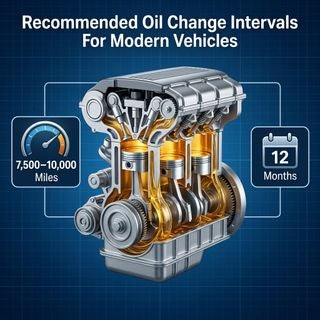
Most modern vehicles using full synthetic or synthetic-blend motor oil require an oil change every 7,500 to 10,000 miles or once every 12 months, whichever arrives first. Advances in engine manufacturing, precise internal tolerances, and modern lubricant chemistry have safely extended service intervals far beyond older maintenance habits for standard daily driving. Automotive engine technology has evolved significantly over the past two decades. Modern powertrains, such as the 2.3L EcoBoost engine in the Ford Explorer or the 1.5L engine in the Ford Escape Hybrid, operate with exceptional thermal efficiency and tight mechanical clearances. These engineering improvements reduce the rate at which combustion byproducts pollute the crankcase, allowing clean motor oil to protect moving parts over longer distances. Distance is only half of the maintenance equation. Engine oil breaks down over time due to exposure to oxygen, ambient moisture, and fuel vapors. A vehicle driven for only 3,000 miles in a calendar year still requires an annual oil and filter refresh. Low-mileage driving along suburban routes around Calcutta often involves short trips that prevent the engine from reaching full operating temperature. When an engine remains cool, condensed water vapor accumulates inside the oil pan rather than evaporating off, creating acidic compounds that harm internal seals over time. Following the exact maintenance schedule outlined by the vehicle manufacturer preserves long-term dependability and maintains factory warranty coverage. To review your specific maintenance schedule or speak with certified technicians, visit our service center on Pennsylvania Avenue or give our team a quick call to discuss your driving routine. Table of Contents Is the 3,000-Mile Oil Change Rule Still Valid for Modern Engines? Normal vs. Severe Service Schedules: What Driving Habits Shorten Oil Life? Conventional vs. Synthetic Oil: What Are Typical Service Intervals? How to Check Motor Oil Correctly and Spot Overdue Symptoms Common Questions About Engine Oil Care and Maintenance Intervals Schedule Reliable Engine Care and Routine Service Is the 3,000-Mile Oil Change Rule Still Valid for Modern Engines? The traditional 3,000-mile oil change rule is no longer necessary for modern vehicles operating under normal driving conditions. Contemporary engines feature advanced metallurgy and precise fuel injection systems that, when paired with high-quality synthetic lubricants, maintain protective viscosity well past 7,500 miles. The 3,000-mile guideline originated decades ago when carbureted engines and basic mineral oils were the industry standard. Older engine designs permitted higher rates of unburnt fuel to wash down cylinder walls into the oil pan. Older mineral oils also suffered from rapid thermal breakdown, losing their ability to lubricate critical components under sustained high heat. Modern synthetic lubricants contain advanced detergent packages, anti-wear additives, and shear-stable base stocks designed to withstand extreme pressure without thinning out prematurely. Changing your motor oil every 3,000 miles on a modern engine running under standard conditions results in unnecessary service expenses and wasted fluid. Automakers engineer modern maintenance schedules around real-world oil degradation rates. Adhering to a 7,500-mile to 10,000-mile service window provides complete engine protection while optimizing your maintenance schedule. Selecting the proper filter is just as critical as choosing the right oil viscosity. A high-efficiency oil filter removes microscopic metal particles and carbon deposits down to tiny micron levels. When performing routine maintenance at home, ordering genuine Ford oil filters and OEM fluids ensures proper bypass valve calibration and continuous oil flow to upper valvetrain components. Normal vs. Severe Service Schedules: What Driving Habits Shorten Oil Life? Severe service maintenance schedules require changing motor oil every 3,000 to 5,000 miles due to operational demands that accelerate fluid contamination and thermal breakdown. Driving patterns that involve frequent short trips, heavy payload hauling, extended idling, or extreme local weather classify a vehicle for severe-duty service intervals. Understanding what constitutes severe service helps protect your engine against premature wear. Automakers define severe driving conditions through several specific operational scenarios: Frequent short trips: Drives under 5 miles in ambient weather, or under 10 miles in freezing temperatures, prevent the engine from reaching steady-state heat, trapping moisture inside the crankcase. Heavy stop-and-go driving: Navigating urban traffic or idling for extended periods increases engine operating hours without accumulating odometer miles. Towing and heavy loads: Hauling trailers or maximum cargo with a truck like the Ford F-150 equipped with the 3.5L EcoBoost engine subjects the motor oil to elevated thermal loads and shearing forces. Harsh terrain and dust: Driving on unpaved gravel roads or navigating steep inclines, such as the riverfront bluffs in East Liverpool, forces the engine to work harder while exposing intake systems to elevated dust levels. During routine service check-ins, drivers frequently ask whether short winter commuting requires earlier oil changes than highway driving. Operating a vehicle during freezing weather without reaching full operating heat creates sludge buildup faster than high-speed turnpike cruising. Reviewing your daily drive pattern with a technician clarifies whether your vehicle benefits from a severe-service maintenance window. Maintaining proper underlying systems also prevents oil degradation; monitoring routine vehicle maintenance and battery health guidelines ensures strong starter engagement during cold-weather startups. Conventional vs. Synthetic Oil: What Are Typical Service Intervals? Full synthetic motor oil typically delivers 7,500 to 10,000 miles of engine protection between changes, whereas conventional mineral oil requires replacement every 3,000 to 5,000 miles. Synthetic blend formulations offer a middle ground, providing reliable wear protection for 5,000 to 7,500 miles under normal driving conditions. Full synthetic oil undergoes a comprehensive chemical refining process that uniformizes molecular structures. This uniformity allows synthetic fluid to flow instantly during freezing cold startups while resisting high-temperature oxidation during summer operation. Conventional oil consists of refined crude mineral fluid with irregular molecular sizes, making it more vulnerable to thermal breakdown, evaporation, and sludge accumulation under heavy engine strain. Modern Ford vehicles utilize an onboard Intelligent Oil-Life Monitor system that removes guesswork from scheduling fluid changes. Rather than relying solely on static mileage tracking, the system continuously analyzes sensor inputs including: Engine operating temperatures and cold-start frequency Total engine revolutions and load factors Extended idling duration and towing hours When the system calculates that fluid life has reached approximately 5%, it displays a "Change Engine Oil Soon" message on the instrument cluster, followed by an "Oil Change Required" alert at 0%. Following these digital prompts guarantees that you replace fluid precisely when required. For drivers managing busy weekly routines, taking advantage of Ford mobile service options allows certified technicians to complete routine oil and filter maintenance directly in your driveway or workplace parking lot. How to Check Motor Oil Correctly and Spot Overdue Symptoms To obtain an accurate motor oil reading, check the dipstick roughly 5 to 10 minutes after turning off a fully warmed-up engine while parked on a level surface. Waiting several minutes allows fluid circulating through the upper cylinder heads to drain back completely into the oil pan. Checking your oil level involves a straightforward step-by-step process: Park the vehicle on flat, level ground and turn off the ignition after the engine reaches normal operating temperature. Allow the engine to rest for 5 to 10 minutes so internal fluid settles into the sump. Open the hood, locate the dipstick handle, pull the dipstick out completely, and wipe it clean with a lint-free rag. Reinsert the dipstick fully into its tube, then pull it back out to inspect the oil level relative to the crosshatched indicators. Verify that the fluid line sits comfortably between the minimum and maximum fill marks. Recognizing early indicators of degraded motor oil prevents expensive internal mechanical damage. Postponing oil changes past recommended limits produces distinct warning signs: Dark, gritty fluid: Fresh oil displays a clear amber color; thick, black, or abrasive fluid indicates heavy carbon accumulation. Valvetrain ticking noises: Depleted oil loses hydraulic film strength, causing metallic tapping or ticking sounds from hydraulic lifters upon startup. Strong fuel odor: An oil level reading above the maximum mark accompanied by a sharp smell of gasoline points to fuel dilution inside the crankcase. Dashboard illuminated alerts: Low oil pressure light warnings or persistent oil maintenance messages signal immediate service requirements. Common Questions About Engine Oil Care and Maintenance Intervals Q: Should motor oil be changed by calendar time even if the vehicle is barely driven? Yes, motor oil must be replaced at least once every 12 months regardless of how few miles appear on the odometer. Over time, stationary oil inside the crankcase absorbs ambient moisture and unburnt fuel byproducts. This chemical reaction creates internal acids and harmful sludge that can corrode engine bearings and degrade internal seals even while the vehicle remains parked inside a garage. Q: Can synthetic motor oil be used in older engines or vehicles previously using conventional oil? Switching to full synthetic motor oil in older vehicles or engines that previously used conventional oil is completely safe and beneficial. Modern synthetic formulations meet rigorous API SP and ILSAC GF-6A performance standards, offering immediate oil pressure during cold engine starts and superior resistance against thermal breakdown without causing seal leaks or internal damage. Q: What does it mean if the oil level is overfull and smells strongly of gasoline? An oil level reading above the full mark paired with a strong gasoline odor indicates fuel dilution inside the crankcase. This condition commonly occurs when vehicles are driven exclusively on short, cold trips or when a fuel injector leaks. Unburnt fuel thins the motor oil, destroying its lubricating properties, and requires immediate fluid replacement to avoid bearing damage. Q: Is it necessary to replace the oil filter during every oil change? Replacing the engine oil filter during every service appointment is essential for long-term engine durability. The oil filter traps microscopic metal particles, dirt, and carbon debris generated during combustion. Leaving a saturated, dirty filter in place forces fresh motor oil through the filter's internal bypass valve, recirculating trapped contaminants directly back into critical engine components. Q: How does Ford’s Intelligent Oil-Life Monitor know when service is due? The Intelligent Oil-Life Monitor calculates fluid degradation by continuously analyzing operational data from the powertrain control module. It evaluates total engine revolutions, ambient operating temperatures, idling time, and towing duration. By calculating real-world engine stress rather than using simple mileage counting, it accurately alerts the driver when oil life reaches 5% remaining capacity. To keep your vehicle running smoothly, you can easily schedule a service appointment online with our certified maintenance team. Schedule Reliable Engine Care and Routine Service Adhering to correct oil change intervals is the single most effective action you can take to preserve engine performance, maximize fuel economy, and ensure long-term vehicle reliability. Whether your daily commute calls for standard 7,500-mile synthetic service or your towing habits require a 5,000-mile severe-duty schedule, maintaining fresh lubricants protects your investment mile after mile. Our factory-trained technicians at Tri State Ford utilize genuine OEM filters and manufacturer-recommended oil viscosities tailored specifically to your engine. Located at 1503 Pennsylvania Ave, East Liverpool, OH 43920, our service center provides complete vehicle maintenance, routine multi-point safety inspections, and transparent care for every driver. Take the next step in protecting your powertrain by exploring our available service slots today. You can get directions to Tri State Ford to plan your visit or give our service department a quick call to speak directly with an advisor about your vehicle's maintenance needs. © 2026 Tri State Ford. All rights reserved. Vehicle specification data © JATO Dynamics Limited. Modern Vehicle Oil Change Intervals in East Liverpool OH | Tri State Ford