

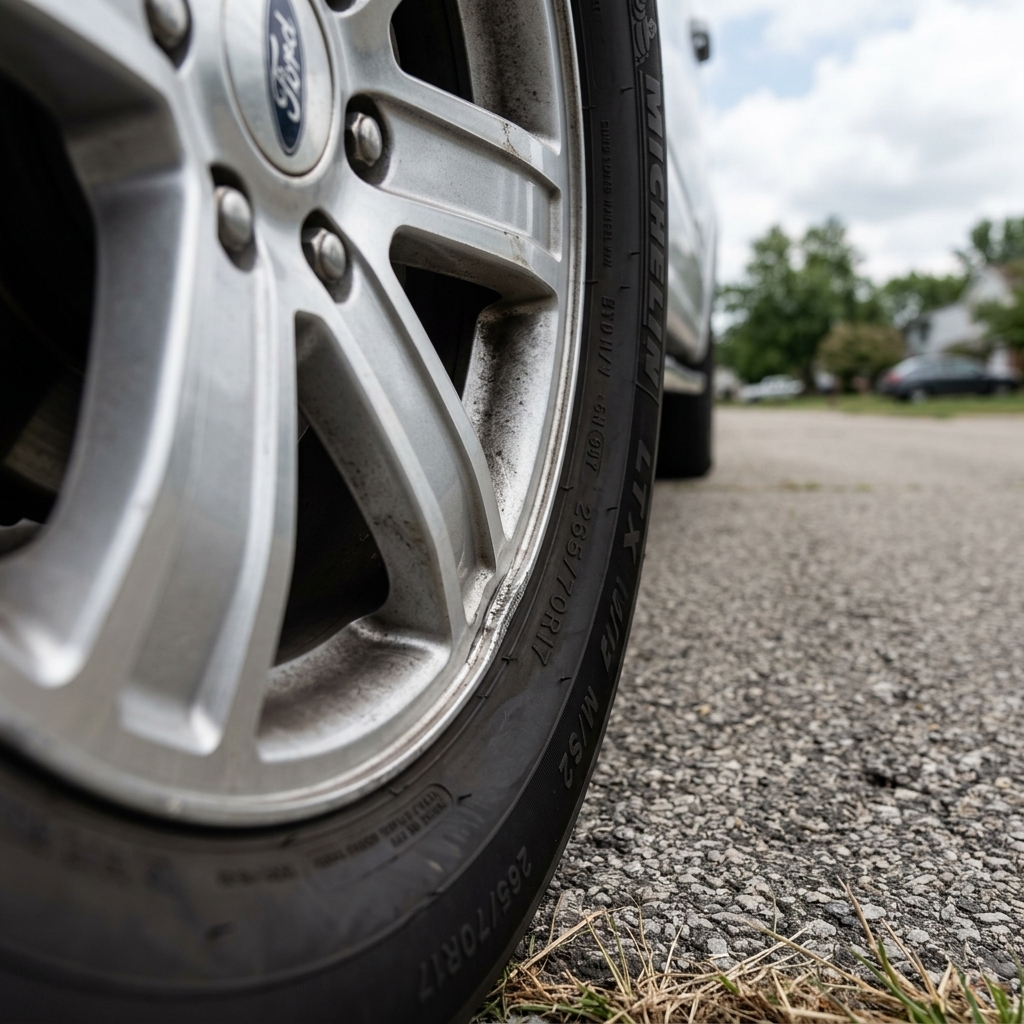
You know a tire rim is bent if your vehicle develops a persistent steering wheel or seat vibration between 40 and 70 mph, continuously loses tire air pressure without a tread puncture, or displays visible flat spots and scuffs along the metal edge. A bent wheel disrupts the smooth rotation of the assembly and prevents the rubber tire bead from sealing tightly against the wheel flange, leading to handling pull, rhythmic thumping noises, and uneven tread wear.
When driving across the Ohio River bluffs in East Liverpool, unexpected pothole impacts and sharp curb strikes frequently push alloy and steel wheels past their structural tolerance. While severe impacts cause immediate flat tires, minor rim damage often reveals itself gradually through physical symptoms that get worse at higher speeds.
To determine whether your wheel is bent, start with a thorough visual and physical inspection:
- Check the outer and inner rim lips for flattened edges, visible gaps, or metal cracks. The inboard lip receives the hardest force during a pothole strike and suffers damage more often than the visible front face.
- Inspect the tire sidewall adjacent to the wheel lip for bulges, cuts, or pinched rubber, which indicate that the tire compressed completely against the metal.
- Monitor your tire pressure monitoring system. Repeated pressure drops in a single tire with no nails or glass in the tread usually point to a distorted bead seat.
- Observe your vehicle while driving on smooth, flat pavement. A rhythmic hopping motion or a steering wheel shimmy that persists regardless of road quality indicates an out-of-round wheel assembly.
Ignoring a bent rim puts unnecessary stress on your vehicle’s wheel bearings, tie rods, and shock absorbers. If you suspect your vehicle has a compromised wheel, you can visit our service center on Pennsylvania Avenue for a professional inspection or give our team a quick call to discuss your symptoms.
Table of Contents
- What Are the Primary Signs and Symptoms of Rim Damage While Driving?
- How Can You Tell a Bent Rim From an Unbalanced Tire?
- What If a Tire Will Not Seal on the Rim Bead?
- How Long Can You Safely Drive on a Bent Rim in an Emergency?
- What Will A Mechanic Check and How Much Does Wheel Straightening Cost?
- Frequently Asked Questions About Damaged Rims
What Are the Primary Signs and Symptoms of Rim Damage While Driving?
The primary signs of rim damage while driving include speed-dependent steering wheel shake, seat or floorboard vibrations, rhythmic thumping sounds, reduced steering responsiveness, and unpredictable air pressure loss. These symptoms occur because a deformed rim creates abnormal radial or lateral runout, forcing the tire to hop and wobble rather than roll smoothly against the asphalt.
The specific location where you feel the vibration offers an immediate clue regarding which wheel is affected. Damage to a front wheel rim transmits oscillation directly through the steering linkages, causing noticeable steering wheel shimmy in your hands. Damage to a rear wheel rim transmits motion through the frame and subframe, creating a buzzy vibration felt primarily through the seat cushion and floorboard.
As wheel damage worsens, several distinct mechanical issues begin to surface:
- Rhythmic thumping or humming noises that rise and fall in pitch with vehicle speed, caused by the tire unevenly slapping the road surface.
- A subtle pull or drift toward one side of the road, resulting from altered rolling resistance and localized tire contact patch distortion.
- Accelerated, irregular tread wear such as diagonal wiping or cupping, where rubber is scrubbed off in localized patches across the tire circumference.
- Unsteady cornering feedback, particularly on heavier vehicles like a Ford Explorer XLT or Ford F-150 XLT, where wheel flex reduces high-speed stability.
Driving continuously on a compromised wheel subjects critical suspension components to non-stop mechanical hammering. Over time, this oscillation degrades ball joints, control arm bushings, and wheel hub bearings, converting a minor wheel issue into an expensive steering system repair. When replacing damaged factory wheels becomes necessary, sourcing components through our genuine Ford parts department ensures exact fitment, original load ratings, and factory structural integrity.
How Can You Tell a Bent Rim From an Unbalanced Tire?
You can tell a bent rim from an unbalanced tire because an unbalanced tire vibrates strictly within a narrow speed window, whereas a bent rim produces continuous vibration across all speeds and frequently causes slow tire air loss. A simple weight imbalance causes a hopping motion that peaks between 40 and 55 mph and calms down at higher speeds, while structural rim distortion remains present from low parking-lot speeds up to highway velocity.
Differentiating between mass distribution problems and physical metal distortion requires evaluating how the vehicle behaves under various conditions. When a clip-on or adhesive balance weight falls off, the tire and wheel remain perfectly round; the mass is simply uneven around the axis of rotation. When a wheel strikes a curb, the geometry of the metal changes, creating mechanical distortion that extra balance weights cannot correct.
| Diagnostic Factor | Unbalanced Tire | Bent Wheel Rim |
|---|---|---|
| Speed Range | Peaks between 40–55 mph; smooths out above/below | Present at all speeds; worsens as velocity increases |
| Air Pressure Integrity | Holds air pressure normally | Frequently experiences slow air loss at the bead seat |
| Visual Appearance | Wheel lip appears smooth and uniform | Flat spots, lip bends, or cracks present along flange |
| Low-Speed Feel | Rolls smoothly without hopping below 30 mph | Minor wobble or uneven rolling feel at low speeds |
| Solution | Standard spin balancing or match mounting | Precision hydraulic straightening or rim replacement |
Technicians pinpoint the exact cause of a vibration using a road force balancer. This advanced diagnostic machine applies a heavy roller to the spinning tire to simulate the real weight of the vehicle, measuring both mass imbalance and radial runout in thousandths of an inch. Manufacturer guidelines state that lateral and radial wheel runout on aluminum wheels should not exceed 0.030 inch. If runout exceeds this limit, weight balancing alone will not resolve the shake.
If you are experiencing persistent wheel oscillation, you can schedule a wheel inspection online to have our factory-trained technicians measure runout. If the wheel is beyond repair, our team can assist with finding the right tires and factory wheels built specifically for your vehicle model.
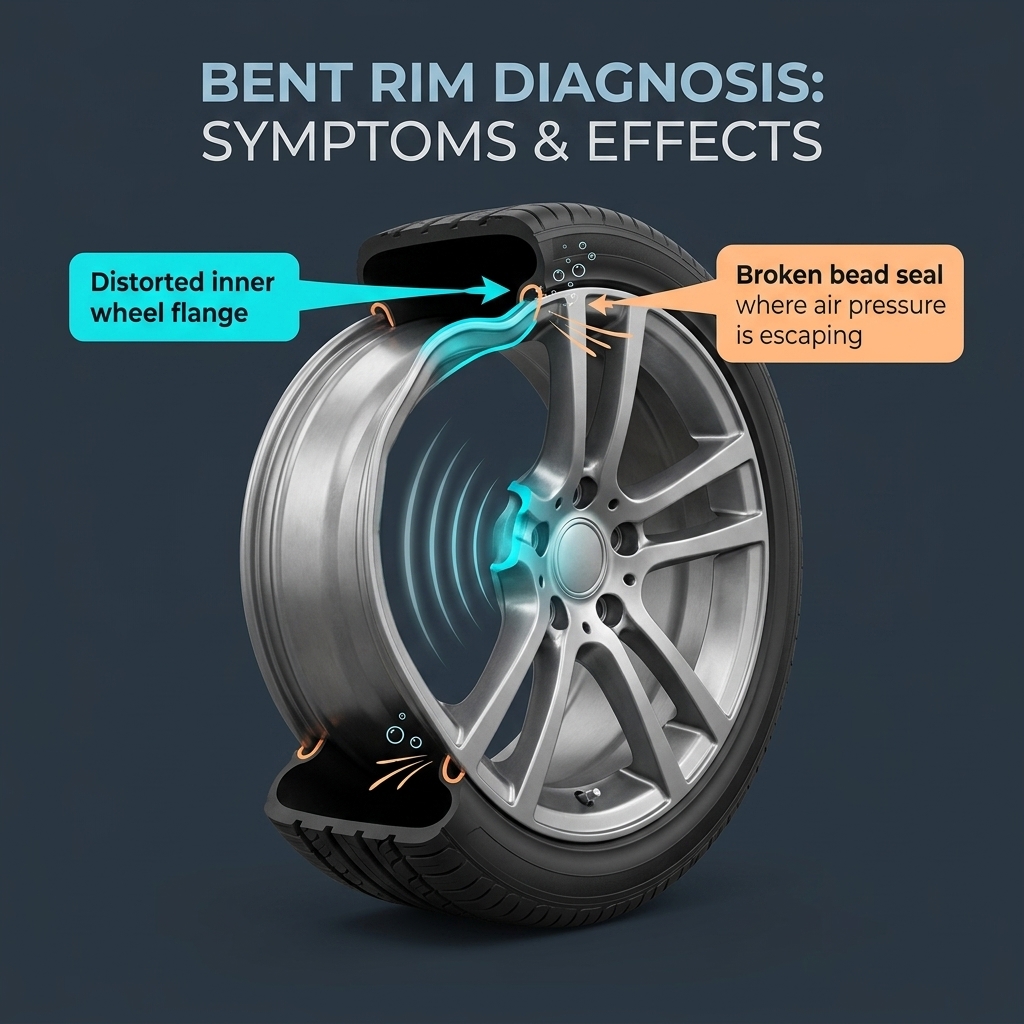
What If a Tire Will Not Seal on the Rim Bead?
If a tire will not seal on the rim bead, the wheel flange has likely suffered structural bending, severe metal corrosion, or cracking along the bead seat area where rubber meets metal. The bead seat forms an airtight mechanical junction held together by internal inflation pressure; any bend or surface oxidation creates microscopic pathways through which pressurized air constantly escapes.
Attempting to fix a bead sealing issue by dumping temporary aerosol tire sealant into the valve stem is ineffective and unsafe for long-term driving. Chemical sealants are designed for minor tread punctures from nails, not for structural gaps along a distorted metal rim lip. In fact, liquid sealants can coat tire pressure monitoring sensors and ruin the internal balance of the assembly.
When a tire repeatedly loses air around the rim flange, service technicians perform a systematic bead inspection:
- Dismount the tire from the wheel to expose the inner barrel and mounting flanges.
- Inspect the metal bead seat for deep rust, flaking paint, or pitted aluminum corrosion that prevents flat rubber contact.
- Check the inboard and outboard rim lips for subtle flat spots or outward flaring caused by impact stress.
- Perform a leak-bubble test using a soapy water solution around the entire circumference to reveal exact air exit points.
On older alloy wheels, light surface corrosion along the bead seat can sometimes be cleaned using a wire wheel and treated with a specialized bead sealing compound. However, if the metal flange is visibly deformed or cracked, the tire will continue to burp air during cornering and weight transfer. Continuing to operate a vehicle with a compromised bead seal risks sudden tire unseating, which can instantly deflate the tire while turning or stopping.
How Long Can You Safely Drive on a Bent Rim in an Emergency?
You can safely drive on a slightly bent rim only for a short distance at speeds under 35 mph to reach a nearby service facility, provided the tire holds full air pressure and shows no sidewall bulging. Driving extended distances on a bent wheel creates a severe risk of sudden air loss, complete tire bead separation, and structural fatigue failure of the wheel metal.
In an emergency situation, your primary goal is minimizing dynamic stress on the damaged wheel. Higher driving speeds quadruple the kinetic force exerted by an out-of-round wheel, drastically accelerating tire wear and suspension damage. If you must drive a short distance on a damaged wheel, observe these safety precautions:
- Keep vehicle speed low, avoiding highway travel completely.
- Avoid sudden braking, hard acceleration, and aggressive cornering maneuvers that place heavy lateral load on the compromised wheel lip.
- Check tire air pressure immediately and stop driving if pressure drops rapidly.
- Replace the damaged road wheel with your vehicle’s full-size spare tire whenever possible before traveling.
Owners of Ford vehicles benefit from included emergency support during unexpected road hazard events. You can contact Ford Roadside Assistance at 1-800-241-3673 for flat tire changing support, towing service to an authorized service center, or emergency roadside coordination.
When managing vehicle care between service visits, taking time for direct evaluation is invaluable. For example, local commuters taking daily drives along State Route 170 near Calcutta frequently compare ride smoothness on different wheel sizes when scheduling a test drive in a new Ford Escape Active, illustrating how wheel diameter and sidewall height directly impact impact absorption over rough pavement.
What Will A Mechanic Check and How Much Does Wheel Straightening Cost?
A mechanic will check a damaged rim for radial runout, lateral wobble, bead seat integrity, structural metal cracks, and hub mounting surface flat spots. Pricing varies by wheel condition and repair requirements; please contact us for a current estimate.
During a professional wheel evaluation, certified technicians follow a precise diagnostic sequence to determine whether a wheel can be safely repaired or must be replaced entirely:
- Mounting the bare wheel on a precision balancing spindle and placing a dial indicator against the inner and outer barrel lips to measure runout.
- Inspecting high-stress areas—such as spoke intersections and lug nut holes—under high-intensity light for micro-cracks or metal fatigue.
- Testing aluminum alloy composition, as cast aluminum wheels react differently to repair stress than forged or steel wheels.
- Evaluating whether heat application is necessary to restore the wheel’s original shape.
Aluminum alloy wheels undergo a factory T6 heat treatment process during manufacturing to establish their structural strength. When a repair shop uses uncalibrated torches to bend cast aluminum back into shape, excessive heat over-ages the metal, permanently weakening its internal crystalline structure. A properly equipped shop uses controlled, localized heating and specialized hydraulic rams to gently cold-form or low-heat restore the flange without destroying its structural temper.
If a wheel shows cracks across a spoke or hub mounting face, professional guidelines strictly prohibit welding or straightening. In those situations, replacing the wheel with a factory-certified component is the only safe resolution for long-term driving safety.
Frequently Asked Questions About Damaged Rims
Q: Can a bent aluminum alloy wheel be safely straightened?
A bent aluminum alloy wheel can be safely straightened if the bend is confined to the outer or inner lip, measures under 0.060 inch of runout, and exhibits no metal cracks or spoke deformation. Professional wheel repair facilities use specialized hydraulic machinery and controlled temperature monitors to restore true roundness without compromising structural integrity. If the wheel has cracks in high-stress load paths like the spokes or hub center, it cannot be safely repaired and must be replaced.
Q: What causes a tire to lose air pressure when the rim is bent?
A tire loses air pressure on a bent rim because the distortion breaks the continuous rubber-to-metal seal at the bead seat flange. Tires rely on a smooth, perfectly round metal lip to hold pressurized air inside the casing. When an impact flattens or flares the rim lip, tiny gaps open between the tire bead and the wheel metal, allowing air to escape slowly during straight-line driving or rapidly during hard cornering maneuvers.
Q: Will driving on a bent rim ruin a new tire?
Yes, driving on a bent rim will rapidly destroy a new tire by causing irregular tread cupping, diagonal wiping, and sidewall stress. Because an out-of-round wheel hops and wobbles as it rotates, the tire tread scrub against the road surface unevenly, grinding down localized sections of rubber within a few hundred miles. Additionally, impact flex along a damaged wheel lip can pinch internal tire cords, creating dangerous sidewall bulges.
Q: Is a bent inner rim lip more dangerous than a bent outer lip?
A bent inner rim lip is typically easier to repair than outer face damage, but it is harder to detect because it stays hidden behind the vehicle body. Because the inner barrel lacks the structural support of wheel spokes, it absorbs the primary force of pothole strikes and bends more frequently. While an inner lip bend rarely causes immediate wheel shattering, it regularly creates hidden bead leaks and severe high-speed chassis vibration.
Q: How do technicians measure if a rim is out of round?
Technicians measure wheel deformation by mounting the wheel on a spin balancer or truing stand and placing a mechanical dial indicator against the inner and outer rim flanges. As the wheel rotates, the indicator measures radial runout (up-and-down hop) and lateral runout (side-to-side wobble) in thousandths of an inch. If runout measurements exceed factory specifications—typically around 0.030 inch—the wheel requires mechanical truing or replacement.
If you suspect your vehicle has a bent wheel or compromised tire seal, visit our service location on Pennsylvania Avenue for a comprehensive wheel runout inspection, or give our service advisors a quick call to discuss expert repair options today.
© 2026 Tri State Ford. All rights reserved.
Connect with us


- Automotive News, New Vehicle Reviews, Buying Guides, Financing & Insurance, Seasonal Driving Tips
- Buying Guides, Financing & Insurance, New Vehicle Reviews, Model Comparisons, Sales & Promotions
- Buying Guides, Financing & Insurance, New Vehicle Reviews, Model Comparisons, Technology & Innovation
- Buying Guides, Financing & Insurance, Used Vehicle Guides, New Vehicle Reviews, Cross-Border Purchasing
- Buying Guides, Financing & Insurance, Vehicle Inventory & Offers, Dealership Visit Preparation, Trade-In & Valuation
- Buying Guides, New Vehicle Reviews, Financing & Insurance, Commercial Vehicle Sales, Model Comparisons
- Commercial Leasing Options, Business Fleet Solutions, Financing & Leasing Programs, Commercial Vehicle Inventory, Business Vehicle Acquisition
- Commercial Truck Sales, Fleet Purchasing Guides, Financing & Lease Options, Work Truck Customization, New Vehicle Inventory
- Commercial Truck Sales, Fleet Vehicle Financing, Custom Work Truck Upfits, Commercial Vehicle Buying Guides, Used Commercial Truck Inventory
- Commercial Vehicle Sales, Financing & Leasing, Small Business Vehicle Incentives, Fleet Purchasing Guides, Tax Benefits for Vehicle Buyers
- Commercial Vehicle Sales, Fleet Leasing & Management, Commercial Financing & Tax Incentives, Upfitting & Customization Solutions, Trade & Lease Programs
- Commercial Vehicle Sales, Fleet Purchasing & Management, Financing & Leasing for Businesses, New & Used Work Truck Inventory, Commercial Truck Ordering Process
- Community Engagement & Events, New Vehicle Promotions, Financing & Trade-In Options, Maintenance & Service, Used Vehicle Offers
- Community Events & Customer Appreciation, New Vehicle Reviews, Financing & Trade-In Guides, Maintenance & Service Specials, Commercial & Work Truck Solutions
- Community Events & Dealership News, New Vehicle Promotions & Incentives, Maintenance & Service Specials, Financing & Trade-In Guidance, Family-Friendly Dealership Experiences
- Community Events & Dealership News, New Vehicle Reviews, Financing & Insurance, Maintenance & Service, Work Trucks & Commercial Vehicles
- Community Events, New Vehicle Buying Guides, Financing & Insurance, Maintenance & Service, Local Dealership News
- Compare Cars
- Custom Ordering & Build Process, New Vehicle Inventory & Offers, Financing & Trade-In Guidance, Manufacturer Incentives & Rebates, Vehicle Purchase & Order Tracking
- Dealership Events & Promotions, Financing & Trade-In Options, Maintenance & Service Specials, Community Involvement & Charity, New & Used Vehicle Buying Guides
- East Liverpool, OH Ford Dealer
- East Liverpool, OH Used Cars
- Financing & Insurance, Buying Guides, Commercial Vehicle Solutions, Fleet Management, Inventory and Availability
- Financing & Insurance, Buying Guides, New Vehicle Reviews, Used Vehicle Guides, Automotive Sales & Inventory
- Financing & Insurance, Buying Guides, New Vehicle Reviews, Used Vehicle Guides, Automotive Sales Strategies
- Financing & Insurance, Buying Guides, New Vehicle Reviews, Used Vehicle Guides, Model Comparisons
- Financing & Insurance, Buying Guides, Used Vehicle Guides, Trade-In Tips, New Vehicle Sales
- Financing & Insurance, Buying Guides, Vehicle Inventory & Offers, Trade-In & Appraisal, Dealership Services
- Financing & Insurance, Buying Guides, Vehicle Trade-In Tips, Dealership Sales Process, New Vehicle Promotions
- Financing & Insurance, Leasing Benefits, Model Comparisons, Technology & Innovation, Buying Guides
- Leasing & Financing Options, Buying Guides, Model Comparisons, Negotiation Tips, Inventory & Specials
- Leasing & Financing Options, Buying Guides, New Vehicle Reviews, Model Comparisons, Technology & Innovation
- Leasing & Financing Options, New Vehicle Leasing Guides, Buying Guides, Inventory Spotlight, Trade
- Leasing & Lease Deals, Financing & Insurance, New Vehicle Sales, Commercial Vehicle Leasing, Vehicle Trade-In & Purchase Options
- Leasing Options, Financing & Insurance, New Vehicle Reviews, Buying Guides, Technology & Innovation
- Leasing Options, Financing & Insurance, New Vehicle Sales, Buying Guides, Vehicle Inventory
- Maintenance & Service, Air Conditioning Repair, Genuine Parts & Accessories, Dealer-Authorized Service, Vehicle Ownership Care
- Maintenance & Service, Automotive Air Conditioning Repair, Vehicle Cooling System Care, Diagnostic & Leak Detection, Seasonal Vehicle Maintenance
- Maintenance & Service, Automotive Detailing & Cleaning, Seasonal Vehicle Care, Vehicle Protection & Preservation, Service Center Expertise
- Maintenance & Service, Automotive Detailing & Paint Care, Vehicle Exterior Protection, Paint Repair & Restoration, Parts & Accessories Installation
- Maintenance & Service, Automotive Detailing & Protection, Corrosion & Rust Prevention, Paint & Exterior Care, Professional Vehicle Care
- Maintenance & Service, Automotive Detailing, Paint Protection & Care, Seasonal Vehicle Care, Professional Vehicle Servicing
- Maintenance & Service, Automotive Detailing, Vehicle Care & Protection, Off-Road Vehicle Maintenance, Parts & Repairs
- Maintenance & Service, Automotive Electrical Systems, Battery Care & Replacement, Diagnostics & Repairs, Electric Vehicle Maintenance
- Maintenance & Service, Automotive Electrical Systems, Battery Care & Replacement, Vehicle Lighting & Electrical Issues, Roadside Assistance & Emergency Services
- Maintenance & Service, Automotive Fluids & Lubricants, Vehicle Care & Ownership, Dealership Service & Repairs, Preventive Maintenance
- Maintenance & Service, Automotive Glass Repair, Safety Features, Technology & Innovation, Mobile & Convenient Service
- Maintenance & Service, Automotive Lighting & Electrical, Vehicle Safety & Visibility, DIY Vehicle Care, Parts & Accessories
- Maintenance & Service, Automotive Parts & Accessories, Seasonal Vehicle Care, Vehicle Safety & Visibility, Professional Auto Service
- Maintenance & Service, Automotive Parts & Accessories, Vehicle Air Quality & HVAC Care, Preventive Vehicle Maintenance, Service Tips & FAQs
- Maintenance & Service, Automotive Parts & Accessories, Vehicle Ownership Care, Engine Care & Protection, Warranty & Service Contracts
- Maintenance & Service, Automotive Parts & Accessories, Vehicle Safety & Repair, Warranty & Coverage, Service Specials & Offers
- Maintenance & Service, Automotive Parts & Components, Vehicle Safety & Repair, Warranty & Service Coverage, Preventative Vehicle Care
- Maintenance & Service, Automotive Parts & Repairs, Vehicle Warranty & Protection, Service Center Tips, Cost-Effective Vehicle Care
- Maintenance & Service, Automotive Repair Tips, Service Team Selection, Warranty & Service Policies, Vehicle Ownership Care
- Maintenance & Service, Automotive Repair, Mobile & Remote Vehicle Service, Warranty & Roadside Assistance, OEM Parts & Service Specials
- Maintenance & Service, Automotive Repair, Parts & Accessories, Vehicle Ownership Care, Technology & Innovation in Service
- Maintenance & Service, Automotive Technology & Diagnostics, Vehicle Electronics & Sensors, Seasonal Vehicle Care, Parts & Repairs
- Maintenance & Service, Automotive Technology & Software Updates, Warranty & Recall Service, Mobile Vehicle Repair & Convenience, Customer Service & Transparency
- Maintenance & Service, Battery Care & Diagnostics, Electric Vehicle (EV) Maintenance, Seasonal Vehicle Care, Automotive Electrical Systems
- Maintenance & Service, Battery Care & Replacement, Vehicle Electrical Systems, Seasonal Vehicle Maintenance, Professional Automotive Repairs
- Maintenance & Service, Brake System Care, OEM Parts & Replacement, Vehicle Safety & Inspections, Expert Technician Services
- Maintenance & Service, Brake System Care, Vehicle Safety & Inspection, Automotive Repair Tips, Service Financing & Convenience
- Maintenance & Service, Brake System Care, Vehicle Safety & Inspection, Parts Quality & Replacement, Heavy Duty Vehicle Maintenance
- Maintenance & Service, Brake System Care, Vehicle Safety & Inspections, Parts & Components, Professional Automotive Services
- Maintenance & Service, Brake System Care, Vehicle Safety & Inspections, Parts & Repairs, Expert Tips & Advice
- Maintenance & Service, Brake Systems & Repair, Vehicle Parts & Accessories, Towing & Load Management, Seasonal Driving Tips
- Maintenance & Service, Certified Technician Insights, Warranty & Service Coverage, Genuine OEM Parts, Service Center Selection Guidance
- Maintenance & Service, Cooling System Repairs, Vehicle Ownership Care, Diagnostic & Troubleshooting, Automotive Parts & Components
- Maintenance & Service, Diagnostic Services, Vehicle Health & Diagnostics, Service Tips & Advice, Check Engine Light Solutions
- Maintenance & Service, Engine Care & Performance, Parts & Accessories, Genuine vs. After
- Maintenance & Service, Essential Vehicle Care, Preventive Maintenance Tips, Vehicle Longevity Strategies, Truck Maintenance Essentials
- Maintenance & Service, Expert Repairs & Diagnostics, Genuine Parts & Accessories, Engine Care & Performance, Vehicle Ownership & Care
- Maintenance & Service, Mobile Vehicle Services, Vehicle Care & Ownership, Genuine Parts & Repairs, Seasonal Maintenance Tips
- Maintenance & Service, Paint Protection & Detailing, Vehicle Exterior Care, Seasonal Vehicle Maintenance, Professional Auto Detailing
- Maintenance & Service, Parts & Accessories, Engine Care & Repair, Vehicle Longevity Tips, OEM Parts Benefits
- Maintenance & Service, Parts & Accessories, Vehicle HVAC Care, Seasonal Vehicle Maintenance, DIY Vehicle Maintenance
- Maintenance & Service, Parts & Replacements, Vehicle Care Tips, Seasonal Maintenance, DIY Vehicle Maintenance
- Maintenance & Service, Recall Information, Safety & Reliability, Vehicle Ownership Care, Parts & Repairs
- Maintenance & Service, Recall Updates & Safety Notices, Genuine Parts & Accessories, Truck Care & Maintenance Tips
- Maintenance & Service, Repair & Diagnostics, OEM Parts & Accessories, Warranty & Recall Information, Vehicle Care & Ownership Tips
- Maintenance & Service, Repair & Diagnostics, Parts & Accessories, Vehicle Ownership Care, Service Plans & Extended Warranty
- Maintenance & Service, Repair & Diagnostics, Parts & Components, Preventive Care & Tips, Warranty & Recalls
- Maintenance & Service, Repair & Diagnostics, Tire & Wheel Care, Vehicle Safety & Inspection, Parts & Replacement Services
- Maintenance & Service, Repair & Parts, Vehicle Ownership Care, Safety Features, Technology & Innovation
- Maintenance & Service, Repair & Parts, Vehicle Ownership Care, Transmission
- Maintenance & Service, Repair Solutions, Vehicle Ownership Care, Parts & Accessories, Diagnostic Tips
- Maintenance & Service, Repair Tips & Techniques, Vehicle Care & Ownership
- Maintenance & Service, Safety Features, Automotive Recalls & Repairs, Parts & Warranty Services, Vehicle Ownership Care
- Maintenance & Service, Safety Features, Automotive Recalls & Repairs, Technology & Innovation, Seasonal Driving Tips
- Maintenance & Service, Safety Features, Automotive Recalls, Vehicle Ownership Care, Parts & Repairs
- Maintenance & Service, Safety Features, Parts & Repairs, Vehicle Ownership Care, Automotive Service Tips
- Maintenance & Service, Safety Features, Recall & Repair Updates, Parts & Repairs, Vehicle Ownership Care
- Maintenance & Service, Safety Features, Recall & Safety Campaigns, Vehicle Inspection & Repairs, Vehicle Ownership Care
- Maintenance & Service, Safety Features, Recall & Warranty Information, Vehicle Diagnostics & Repair, Certified Service & Genuine Parts
- Maintenance & Service, Safety Features, Recall Repairs & Safety Campaigns, Parts & Genuine Components, Vehicle Ownership Care
- Maintenance & Service, Safety Features, Recalls & Repairs, Parts & Accessories, Vehicle Ownership Care
- Maintenance & Service, Safety Features, Repair & Recall Updates, Parts & Components, Vehicle Ownership Care
- Maintenance & Service, Safety Features, Repair & Replacement, Vehicle Care & Inspection, Parts & Accessories
- Maintenance & Service, Safety Features, Seasonal Driving Tips, Technology & Innovation, Parts & Repairs
- Maintenance & Service, Safety Features, Technology & Innovation, Automotive Electrical Systems, Parts & Repairs
- Maintenance & Service, Safety Features, Technology & Innovation, Automotive Parts & Accessories, Seasonal Driving Tips
- Maintenance & Service, Safety Features, Technology & Innovation, Automotive Recalls, Parts & Repairs
- Maintenance & Service, Safety Features, Technology & Innovation, Automotive Recalls, Vehicle Ownership Care
- Maintenance & Service, Safety Features, Technology & Innovation, Automotive Service Tips, Recall & Repair Updates
- Maintenance & Service, Safety Features, Technology & Innovation, Parts & Repairs, Seasonal Driving Tips
- Maintenance & Service, Safety Features, Technology & Innovation, Parts & Repairs, Vehicle Ownership Care
- Maintenance & Service, Safety Features, Technology & Innovation, Recall & Warranty Information, Vehicle Care & Repairs
- Maintenance & Service, Safety Features, Technology & Innovation, Repair & Recall Information, Parts & Vehicle Care
- Maintenance & Service, Safety Features, Technology & Innovation, Seasonal Driving Tips, Parts & Repairs
- Maintenance & Service, Safety Features, Technology & Innovation, Tire Care & Replacement, Diagnostic & Repair Services
- Maintenance & Service, Safety Features, Vehicle Inspections, DIY Vehicle Care, Repair & Diagnostics
- Maintenance & Service, Safety Recalls & Repairs, Vehicle Safety & Compliance, Powertrain & Drivetrain Maintenance, Towing & Hauling Maintenance
- Maintenance & Service, Seasonal Driving Tips, Model Comparisons, Technology & Innovation, Safety Features
- Maintenance & Service, Seasonal Driving Tips, Safety Features, Technology & Innovation, Parts & Repairs
- Maintenance & Service, Seasonal Driving Tips, Vehicle Care & Ownership, Brake System Maintenance, Tire & Wheel Care
- Maintenance & Service, Seasonal Driving Tips, Vehicle Care & Ownership, Parts & Accessories, Safety Features
- Maintenance & Service, Seasonal Driving Tips, Vehicle Care & Ownership, Safety Features, Professional Repair & Service Techniques
- Maintenance & Service, Seasonal Driving Tips, Vehicle Care & Protection, Brake Maintenance, Tire Care & Safety
- Maintenance & Service, Seasonal Driving Tips, Vehicle Care & Warranty, Service Specials & Packages, Automotive Repair Insights
- Maintenance & Service, Seasonal Driving Tips, Vehicle Cooling Systems, Automotive Safety Features, Parts & Repairs
- Maintenance & Service, Service Scheduling & Convenience, Vehicle Repair & Diagnostics, Parts & Accessories, Fleet & Commercial Vehicle Service
- Maintenance & Service, Technology & Innovation, Automotive Service Transparency, Digital Vehicle Inspections, Vehicle Ownership Care
- Maintenance & Service, Technology & Innovation, Safety Features, Parts & Warranty, Vehicle Ownership Care
- Maintenance & Service, Technology & Innovation, Vehicle Diagnostics & Telematics, Fleet Management Solutions, Parts & Accessories
- Maintenance & Service, Tire Care & Repair, Roadside Assistance, Vehicle Safety & Inspections, Automotive Parts & Replacements
- Maintenance & Service, Tire Care & Repair, Wheel Alignment & Balancing, Suspension Maintenance, Vehicle Performance Optimization
- Maintenance & Service, Tire Care & Replacement, Seasonal Vehicle Care, Safety Features, Automotive Service Tips
- Maintenance & Service, Tire Care & Replacement, Vehicle Safety & Handling, Seasonal Vehicle Preparation, Drivetrain & Tire Maintenance
- Maintenance & Service, Tire Care & Replacement, Vehicle Safety & Inspection, Emergency Roadside Assistance, Automotive Parts & Accessories
- Maintenance & Service, Tire Care & Replacement, Vehicle Safety & Inspections, Seasonal Vehicle Maintenance, Automotive Parts & Accessories
- Maintenance & Service, Transmission Care & Repair, Vehicle Fluid Services, Automotive Diagnostics, Warranty & Resale Value Maintenance
- Maintenance & Service, Transmission Care, Repair & Parts, Vehicle Ownership Care, Common Vehicle Issues
- Maintenance & Service, Vehicle Care & Longevity, Scheduled Service Packages, Oil Changes & Fluid Top-offs, Tire & Brake Maintenance
- Maintenance & Service, Vehicle Care Tips, Parts & Accessories, Seasonal Vehicle Maintenance, Service Specials & Packages
- Maintenance & Service, Vehicle Detailing & Care, Parts & Accessories, Seasonal Vehicle Preparation, Service Scheduling & Convenience
- Maintenance & Service, Vehicle Detailing & Cosmetic Care, Automotive Cleaning & Protection, Service Scheduling & Preparation, Vehicle Ownership Care
- Maintenance & Service, Vehicle Detailing & Cosmetic Care, Service Scheduling & Convenience, Seasonal Vehicle Care, Vehicle Ownership Tips
- Maintenance & Service, Vehicle Detailing & Protection, Repair & Inspection, Parts & Accessories, Vehicle Care & Warranty
- Maintenance & Service, Vehicle Detailing & Protection, Vehicle Care Tips, Seasonal Vehicle Maintenance, Dealership Service Benefits
- Maintenance & Service, Vehicle Diagnostics & Repair, Engine Performance & Troubleshooting, Fuel System Care, Preventative Maintenance Strategies
- Maintenance & Service, Vehicle Fluids & Lubrication, Engine Care & Repair, Parts & Accessories, Professional Vehicle Care
- Maintenance & Service, Vehicle Inspection & Diagnostics, Parts & Repairs, Warranty & Resale Value, Service Specials & Convenience
- Maintenance & Service, Vehicle Interior Care, Technology & Innovation in Service, Professional Detailing, Seasonal Vehicle Care
- Maintenance & Service, Vehicle Ownership Care, Mobile Repair Services, Genuine Parts & Certified Technicians, Electric Vehicle Maintenance
- Maintenance & Service, Vehicle Ownership Care, Parts & Accessories, Repair & Diagnostics, Certified Technician Insights
- Maintenance & Service, Vehicle Pickup & Delivery, Mobile Service & On-Site Repairs, Oil Change & Fluid Care, Vehicle Care Technology & Apps
- Maintenance & Service, Vehicle Repair & Diagnostics, Parts & Accessories, DIY Vehicle Care, Safety & Reliability Tips
- Maintenance & Service, Vehicle Repair & Diagnostics, Parts & Accessories, Hybrid & Electric Vehicle Care, Seasonal Vehicle Care
- Maintenance & Service, Vehicle Repair & Diagnostics, Parts & Accessories, Seasonal Driving Tips, Battery Care & Replacement
- Maintenance & Service, Vehicle Repair & Diagnostics, Parts & Accessories, Service Lane Tips & Insights, Vehicle Ownership Care
- Maintenance & Service, Vehicle Repair & Diagnostics, Parts & Accessories, Towing & Performance Care, Mobile & Convenient Service Options
- Maintenance & Service, Vehicle Repair & Parts, Service Convenience & Customer Care, Roadside Assistance & Support, Vehicle Ownership Tips
- Maintenance & Service, Vehicle Repair Tips, Parts & Accessories, Safety Features, Technology & Innovation
- Maintenance & Service, Vehicle Service Warranties, Repair & Coverage Plans, Ownership & Vehicle Care, Automotive Service Tips
- Maintenance & Service, Vehicle Software Updates, Safety Features, Technology & Innovation, Recall & Warranty Information
- Maintenance & Service, Warranty & Recalls, Repair & Diagnostics, Parts & Accessories, Vehicle Ownership & Care
- Model Comparisons, Buying Guides, New Vehicle Reviews, Financing & Insurance, Inventory Updates
- Model Comparisons, Buying Guides, New Vehicle Reviews, Technology & Innovation, Safety Features
- Model Comparisons, Buying Guides, Technology & Innovation, Safety Features, Maintenance & Service
- Model Comparisons, New Vehicle Reviews, Buying Guides, Technology & Innovation, Safety Features
- Model Comparisons, New Vehicle Reviews, Safety Features, Technology & Innovation, Seasonal Driving Tips
- Model Comparisons, New Vehicle Reviews, Technology & Innovation, Buying Guides, Maintenance & Service
- Model Comparisons, New Vehicle Reviews, Technology & Innovation, Safety Features, Buying Guides
- Model Comparisons, Towing & Hauling Guides, Maintenance & Service, Technology & Innovation, New Vehicle Reviews
- New Vehicle Promotions, Buying Guides, Financing & Insurance, New Vehicle Reviews, Inventory Highlights
- New Vehicle Reviews, Buying Guides, Financing & Insurance, Model Comparisons, Automotive News
- New Vehicle Reviews, Buying Guides, Financing & Insurance, Model Comparisons, Automotive Sales Strategies
- New Vehicle Reviews, Buying Guides, Financing & Insurance, Model Comparisons, Automotive Technology & Innovation
- New Vehicle Reviews, Buying Guides, Financing & Insurance, Model Comparisons, Commercial & Work Truck Sales
- New Vehicle Reviews, Buying Guides, Financing & Insurance, Model Comparisons, Inventory Highlights
- New Vehicle Reviews, Buying Guides, Financing & Insurance, Model Comparisons, Inventory Updates
- New Vehicle Reviews, Buying Guides, Financing & Insurance, Model Comparisons, Used Vehicle Guides
- New Vehicle Reviews, Buying Guides, Financing & Insurance, Model Comparisons, Vehicle Inventory Updates
- New Vehicle Reviews, Buying Guides, Financing & Insurance, New Vehicle Specials, Trade-In & Value Estimation
- New Vehicle Reviews, Buying Guides, Financing & Insurance, Used Vehicle Guides, Inventory Updates
- New Vehicle Reviews, Buying Guides, Financing & Insurance, Used Vehicle Guides, Model Comparisons
- New Vehicle Reviews, Buying Guides, Financing & Insurance, Vehicle Inventory & Specials, Model Comparisons
- New Vehicle Reviews, Buying Guides, Financing & Insurance, Vehicle Inventory, Model Comparisons
- New Vehicle Reviews, Buying Guides, Model Comparisons, Financing &
- New Vehicle Reviews, Buying Guides, Model Comparisons, Financing & Insurance, Inventory & Sales
- New Vehicle Reviews, Buying Guides, Model Comparisons, Maintenance & Service, Technology & Innovation
- New Vehicle Reviews, Buying Guides, Safety Features, Technology & Innovation, Model Comparisons
- New Vehicle Reviews, Buying Guides, Technology & Innovation, Safety Features, Maintenance & Service
- New Vehicle Reviews, Buying Guides, Technology & Innovation, Safety Features, Seasonal Driving Tips
- New Vehicle Reviews, Financing & Insurance, Buying Guides, New Vehicle Specials, Model Comparisons
- New Vehicle Reviews, Financing & Insurance, Buying Guides, Technology & Innovation, Automotive Inventory Updates
- New Vehicle Reviews, Financing & Insurance, Buying Guides, Used Vehicle Guides, Model Comparisons
- New Vehicle Reviews, Model Comparisons, Buying Guides, Technology & Innovation, Safety Features
- New Vehicle Reviews, Model Comparisons, Commercial Truck Guides, Technology & Innovation, Maintenance & Service
- New Vehicle Reviews, Model Comparisons, Financing & Insurance, Technology & Innovation, Safety Features
- New Vehicle Reviews, Model Comparisons, Off-Road Adventures, Technology & Innovation, Maintenance & Service
- New Vehicle Reviews, Model Comparisons, Safety Features, Technology & Innovation, Buying Guides
- New Vehicle Reviews, Model Comparisons, Technology & Innovation, Financing & Insurance, Maintenance & Service
- New Vehicle Reviews, Model Comparisons, Technology & Innovation, Safety Features, Buying Guides
- New Vehicle Reviews, Model Comparisons, Technology & Innovation, Safety Features, Maintenance & Service
- New Vehicle Reviews, Off-Road Capabilities, Outdoor Adventure Vehicles, Technology & Innovation, Local Driving Destinations
- New Vehicle Reviews, Technology & Innovation, Buying Guides, Safety Features, Model Comparisons
- New Vehicle Reviews, Technology & Innovation, Safety Features, Maintenance & Service, Buying Guides
- New Vehicle Sales, Financing & Incentives, Trade-In & Appraisal, Special Sales Events, Electric Vehicle Purchasing
- New Vehicle Sales, Financing & Incentives, Trade-In & Value Guides, Manufacturer Promotions, Commercial Vehicle Sales
- New Vehicle Sales, Financing & Insurance, Buying Guides, Manufacturer Incentives & Discounts, Trade-In & Vehicle Valuation
- New Vehicle Sales, Vehicle Delivery & Logistics, Financing & Credit Applications, Trade-In & Vehicle Valuation, Commercial Vehicle Sales
- Tips
- Trucks
- Uncategorized
- Used Vehicle Guides, Buying Guides, Financing & Insurance, Model Comparisons, Selling Your Car
- Used Vehicle Guides, Financing & Insurance, Buying Guides, Model Comparisons, Local Dealership Highlights
- Used Vehicle Guides, Financing & Insurance, Buying Guides, New Vehicle Reviews, Commercial Vehicle Sales
- Used Vehicle Guides, Financing & Insurance, Buying Guides, Pre-Owned Vehicle Sales, Vehicle Trade-In & Appraisal
- Used Vehicle Guides, Financing & Insurance, Buying Guides, Trade-In Advice, Certified Pre-Owned Programs
- Used Vehicle Guides, Financing & Insurance, Buying Guides, Vehicle Warranty Information, Pre-Owned Vehicle Sales
- Vehicle Sales Events, Financing & Leasing, Trade-In & Trade-Up Guides, New Vehicle Inventory Highlights, Dealership Buying Experience
- Vehicle Sales Events, New Vehicle Buying Guides, Financing & Incentives, Dealership Inventory Highlights, Commercial Vehicle Sales
- Vehicle Sales Events, New Vehicle Pricing & Incentives, Financing & Lease Options, Trade-In & Appraisal Guides, Dealership Buying Experience
- Vehicle Sales Events, New Vehicle Pricing, Financing & Credit Applications, Trade-In & Loyalty Programs, Leasing vs Buying Guides
- Vehicle Sales Events, New Vehicle Purchasing, Incentives & Discounts, Financing & Pre-Approval, Trade-In & Appraisal Guidance
- Vehicle Sales Process, Financing & Credit Applications, New and Used Vehicle Inventory, Pickup and Delivery Services, Online Vehicle Purchasing
- Vehicle Sales Process, Online Vehicle Purchasing, Financing & Loan Approval, Trade-In & Vehicle Valuation, Vehicle Delivery Services
- Vehicle Sales Promotions, New Vehicle Buying Guides, Financing & Credit Applications, Dealership Inventory Highlights, Model Pricing Comparisons
- Vehicle Sales Promotions, New Vehicle Buying Guides, Financing & Incentives, Trade-In & Valuation, Dealership Sales Events
- Vehicle Sales, Online Car Buying, Financing & Incentives, Trade-In Guides, New Vehicle Delivery Services, Youngstown Dealership
- Vehicle Trade-In Advice, Financing & Insurance, Buying Guides, Used Vehicle Guides, New Vehicle Sales
- Vehicle Trade-In Tips, Financing & Insurance, Buying Guides, Dealership Sales Strategies, Inventory & Specials